Category Archives: middle grades

Sitti’s Key by Sahar Khader Ali illustrated by Noor Alshalabi

Standard
Sitti’s Key by Sahar Khader Ali illustrated by Noor Alshalabi

sitti key

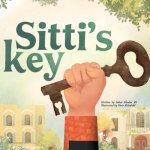
I try and buy, read, and review every children’s book about Palestine that is published, it is the least I can do.  I also try not to compare them to each other as they present different aspects of oppression, perspectives of strength, examples of joy, and messages of hope, even among many similar themes of food, keys, traditions, and culture.  I really appreciate that this book though is incredibly blunt.  It isn’t lyrical, it isn’t poetic, and as Israel is bombing Jenin as I write this I’m glad it doesn’t mince words about the Nakba. I do think caregivers though, should probably read it first as it might be a little triggering for sensitive children.  The story is OWN voice and probably best suited for middle elementary aged children.  It is perhaps also worth noting that the book could be seen as making Jews synonymous with Zionists.  The characters are Muslim, Islamic phrases and Arabic terms are sprinkled throughout, and even despite the pain the family has endured, the book stays hopeful and proud.

Sitti is coming and Amal is excited, it has been two years since she last saw her.  She loves how excited her mom and grandma are to unpack gifts of olive oil, dates, and zataar from friends.  Amal isn’t sure what to do with the “old lady thoub” she has been gifted, but she smiles in appreciation none-the-less.  When Sitti pulls out an old key, Amal starts to ask her about it, but her mother shuffles her off to bed.

The next day at school, Amal has to work on a presentation about “culture,” but there are no Palestinian books in her school library, so she just watches the other kids.  At home they eat and listen to Sitti’s stories of long ago in Haifa, and Amal asks her why she left Palestine.  Despite her mother trying to redirect, Sitti says it is time she knew about the Nakba.

Sitti tells about living on the land for generations and how the Jews believed the land belonged to them.  In 1948 the British decided Palestine would be the homeland for the Jews.  Armed men came and arrested anyone who tried to stay in their homes. Sitti’s brother was handcuffed and never seen again.  The family grabbed what they could including the key to their home as they made their way to a refugee camp in Lebanon.  They stayed for three years, before making their way to America.

When Sitti concludes her story she hands the key to Amal and her hope that she will return to their home inshaAllah.  Feeling the pride and warmth of home, Amal has a determination to reclaim her heritage and share her “culture” with her classmates.

The illustrations are sweet, the mom and Sitti wear hijab even in the home, and the inshaAllahs and salams come naturally. The book does not stop to define zataar or marimya, which helps the flow. I also like how it shows that there aren’t books about Palestine in the school library, it is strong and important detail.  I don’t understand where Sitti is coming from though, it would seem Palestine as she is bringing gifts from friends, but in the story it says after Lebanon they made their way to America, so I’m not sure where Sitti lives, and how the logistics of the family work to be honest.  I also kind of wish there was a  recipe for zataar in the book and lyrics with translation for the song the family sings.

Book is available on Kindle or can be ordered from www.littlehibba.com

The Unlovable Alina Butt by Ambreen Butt-Hussain

Standard
The Unlovable Alina Butt by Ambreen Butt-Hussain

img_9079

This middle grade book in many ways reads like a memoir, it isn’t, it is OWN voice fiction, but the chapters often come across like short stories with their own climax or punchline.  The lacking continuity of smaller threads being resolved means if you put the book down, you aren’t necessarily itching to pick it back up to see what happens next.  There isn’t a larger pressing conflict driving much of the book, yes the girl is bullied, but by one kid, and she has a great group of friends and a supportive family, so the intensity is just not present.  I do like the growth of the character toward self-acceptance, but I don’t know that the target audience will get the 90s references of Spice Girls,  CDs, lava lamps, and gel pens.  The book hits most of the stereotypical immigrant tropes of feeling othered by one’s name, clothes, food, and while she works through them to deal with the bully and find her own confidence, she unfortunately never deals with her internalized Islamophobia, which is disappointing.  She puts Islam on her parents as something they practice, and only begrudgingly seems to acknowledge she too is Muslim when she doesn’t eat pizza with non halal meat.  She is embarrassed when her friends see Islamic calligraphy at her house, hear the athan, she doesn’t reply to her parents salaams, she calls her mother “the most devout in our family” as the reason she has to wear tights under her skirt: she only seems to ok with being Muslim when outsiders give their approval.  The book for me is mediocre, nothing to rush out and buy, nor anything to pull from shelves.  I’ll send my copy to the Islamic school library shelves as the book is fairly clean: a few giggles about naked statues at the museum and very lightly hinted at boy/girl crushes. The older sister deals with a boy who wants to date her and harasses her to the point of affecting her personality, but I think if a 10 or 11 year old picked up the book and read it, they would be ok to see the characters finding their voice, good friends, and sibling support.

SYNOPSIS:

Eleven year old Alina Butt is in her fourth school in three years since arriving in England from Pakistan.  She never fits in, and never has friends, but she is determined that if she can keep her last name a secret, she might have a chance.  One the third day of 6th grade though, her last name becomes known and Adam Atkins has his eyes set on giving her a hard time.  With encouragement from her older sister and love from her baby brother, Alina puts herself out there to make friends and when the teacher assigns her a new group, she finds herself among three girls happy to welcome her in.  The new group also puts her sitting across from Adam, but at least now she doesn’t have to face him alone.

At home, she navigates life as an immigrant trying to blend her worlds.  Her loving family lives above the grocery store they own and face Islamophobia and settling in together as they each have to find their strength and voice and resilience to drive, stand up to harassment, and for Alina, to love herself.  Alina gets the courage to try out for the school play, but when she lands the part of Gus in Cinderella, she has to dig deep to be happy for her friend, forgive a bully, and step in to the spotlight.

WHY I LIKE IT:

Alina is likeable enough, and I love that she grows to love herself too, I’m not sure she was ever unlovable though as the title suggests.  I don’t like that potentially really big plot points are mentioned and then abandoned.  She cuts her bangs way too short, her mom says something and no one else ever mentions it, and she never brings it up again.  Her dad is so sick he leaves the truck on the side of the road and sleeps and the mom takes care of everything, and what was wrong with the dad is never revisited.  These are just two examples of rising action that present that they are going to be important that are seemingly undermined by the lack of follow through.

I love that she finds a way to stand up to the bully and she even helps her sister deal with the boy antagonizing her.  It is strong and resonates with the reader, but it should also be noted that as soon as she has friends, they are gossiping and being rude to Adam too.  I’m not saying it isn’t warranted, and he definitely is worse, but if she is modeling behavior she should perhaps at least feel bad teasing him even before she knows that he has a bit of a rocky home life.  Plus he is one kid with two stereotypical sidekicks, yeah he is annoying and mean, but she has friends and family and teachers that are completely on her side too.  And Adam bullies her about her name, but no one else even acknowledges it or asks her about it.

I didn’t quite get the schooling, but it is probably because I am American.  She is in middle school, but she has one teacher all day and they play on the soccer fields at break and her kg aged brother does field day with her?   The 90s references were fine for me, but I don’t know that the target audience will get some of them, and it might be a little annoying to get through for younger readers.

Ultimately, the way Islam was presented was really disappointing.  It feels like we should be past the internalized othering of our faith.  The culture was worked through and appreciated internally for Alina, but for some reason, religion was only ok when the outside influences deemed it acceptable, and I’m not sure that in 2023 this angle of narrative is doing anyone any favors.  She loves her mom, and part of the character arc is seeing and appreciating her mother’s strength, but very early on mom is labeled as “devout” even though they are all Muslim.  And this self othering to be the reason her mom is keeping her from dressing like everyone else left a bitter taste in my mouth.  Never once does it feel that Alina has a connection to Allah swt, no matter what she is going through there is no bismillah, or prayer, or dua to ask for help, and strength, or show appreciation.  I absolutely get that not every story will have that, but the way Islam is presented as something foreign and never circled back on or portrayed as something that she embodies, makes all the mentions of faith seem deliberately othering, and as a Muslim book reviewer, I feel it is an important point to mention about this book. I wonder if it was intentional or an oversight sensitivity reading would have helped resolve.

FLAGS:

Birthdays, music, bullying, harassment, teasing, othering, mention of naked statues, some sneaking and dishonesty.

TOOLS FOR LEADING THE DISCUSSION:

I wouldn’t use this as a book club selection, and as stated above I wouldn’t rush out to buy the book to shelve at home, in a class or school library, but if it found its way to the shelves I would not remove it.  The book has heart, I just feel like along the way the messaging of finding your voice and putting yourself out there to make friends, the book also hints that the Quran on your walls, modesty, the athaan, eating halal, are all things that are weird, unless your friends think it is cool, then it is ok- and that is not messaging I would really want to spread.
Stand Up and Speak Out Against Racism by Yassmin Abdel-Magied illustrated by Aleesha Nandhra 

Standard
Stand Up and Speak Out Against Racism by Yassmin Abdel-Magied illustrated by Aleesha Nandhra 

stand

The very first page of this practical Muslim authored, visible Muslim featured, how-to book draws you in with the author’s conversational tone and approach.  She presents life as being a mountain we all are born to climb and articulates that we are all given different tools to do so.  The book sets out to understand how race and racism affect the climb, how we can make it more fair, and uses questions from kids in the UK as the general organization of the 128 page book for middle grade readers and up.  As a Black Sudanese born, Australian raised, immigrant London woman who speaks Arabic, is Muslim, has authored five books, is an engineer and social justice advocate, she acknowledges privilege, and injects plenty of InshaAllahs, Alhumdulillahs, and global perspective to racism, its history, and what we can do to stand up and speak out about it.  I do wish the book was sourced, but the first person perspective, and her own intersectional identities, carry confidence and OWN voice power in making the world a better place for all.

SYNOPSIS:
The book starts with a section about how racism started, then moves into what racism looks like today and how it shows up and affects us all.  It then concludes with a focus on the action of standing up and speaking up.  The book spends time reassuring the reader that the contents might create strong emotions and to breathe acknowledge your feelings and find a safe way to express them. Chapter 6 discusses religions, even though the book is about race and says it does so because it is the same social construct of grouping a very diverse group together because of something “other” that they share.  It spends time on anti-Semitism, and Islamophobia.  The book doesn’t have to be read cover to cover, it can be read in sections, in any order, there is also a glossary and index at the back to find particular topics to look at.

WHY I LIKE IT:
As an American, I love that the book is global in focus and shows the effects of colonization and attitudes, and thus realities.  I also like that it takes time to discuss internalized racism, as well as interpersonal, institutionalized, and systemic.  Pointing out schools and how many of your teachers or principals look like you, really drives the points home.  I love that there is a whole page on hijab and truly that you see the author regularly bringing in Islam to the conversation which is great.  The action steps of what to do if you see racism, what to do if it is aimed at you, are well presented in metaphors that are easy for kids to see why the course of action suggested is doable, logical, and important.  It doesn’t shy away from acknowledging that pushing back on racism escalates the situation, and encourages individuals to be safe and do what they can. There are pull-out boxes, comic strip scenarios, bolded and bulleted text, and colorful engaging illustrations and infographics that connect with 9 year old and up readers independently or in small groups.

FLAGS:

The book discusses an emotional topic, but I don’t think there are any particular flags to be noted for 4th grade and up  There are important conversations to be had based on what is shared, but nothing is overly graphic or sensationalized.

TOOLS FOR LEADING THE DISCUSSION:

I think this book would be great to share with students regularly and often.  It should be on library and classroom shelves and should be used in small groups, large groups, and one-on-one.  The variety of methods that the information are conveyed make a useful tool when concerns arise, and a great reflective piece to encourage children to think deep, better themselves, and be aware at all times about the privilege and effects of their thoughts and actions.

Available for preorder on Kindle here https://amzn.to/3PH98u2

The Boy Who Saved a Bear by Nizrana Farook

Standard
The Boy Who Saved a Bear by Nizrana Farook

bear

There is nothing Islamic and there are no Muslim characters in this middle grade read, but this being the fourth and final standalone book on the island of Serendib, by a Muslim author, with a lot of heart, kid led adventure, and fun, made me want to share it here.  The beginning is a little bumpy, and sure you have to suspend reality a bit, but this story about a boy, expectation, friendship, perseverance and saving the day, had me invested and cheering for Nuwan to succeed.  The story is just under 200 pages, and I love the subtle references to the other three books with sight mentions of an elephant, a leopard, and a whale.  If your kids liked the other books, they will love this, and if you are in need of an easy, fast paced adventure, this book is great for readers 8-12 years old.  I felt slightly offended by *SPOILER* librarian villain, but it is a work of fiction, so I’m hoping one bad apple, doesn’t dim the light on a very honorable profession.

SYNOPSIS:

A key has been found that opens an old statue and secret treasure, Nuwan wants a closer look and combined with him wanting to prove himself to his family that he is as capable as his older brother Krish, he finds himself sneaking into the library and discovering something unsettling going on.  What starts out with him taking books from the North Library to the Kings City soon becomes him avoiding blame for stealing the key that is making its way to the queen, and saving a bear who wears the key around his neck from being captured by the wilderness authority for being dangerous.

WHY I LIKE IT:

I love that it is about a boy and a bear, but underneath the adventure it is about a boy accepting himself and finding his place in his family.  His friend Sani has to help him see his worth, but she’s a pretty fierce character and I like that they can have those kind of conversations.  Nuwan is a good kid and it is nice to see that even though he doesn’t see it, the reader sees how big his heart is, his strong his moral compass is, and how powerful his drive is.  I do wish it said what was in the statue, or what happened to the librarian and her husband, but the conclusion stayed on the kids, and it was heartwarming.

FLAGS:

Lying, sneaking, stealing.

TOOLS FOR LEADING THE DISCUSSION:

I doubt I’d do it as a book club, it is well below a middle grade reading level, but definitely is a must on school, classroom, and home book shelves.  The added beauty is how pretty the book’s cover is and how it is magnified when placed next to the “matching” books in the series.

The book is out in the UK, but not yet in the USA: you can preorder/order yours from Amazon here: https://amzn.to/42Nwilp

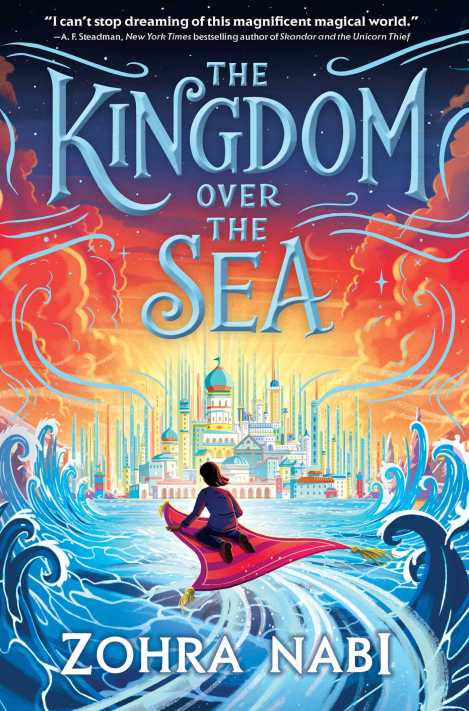
The Kingdom Over the Sea by Zohra Nabi

Standard
The Kingdom Over the Sea by Zohra Nabi

kigdom

This 336 page middle grade fantasy book had a lot of promise for me, but ultimately fell a little flat.  The protagonist was likeable, there was emotion, the story was compelling, and I know it is widely said that debut novels tend to be a little weak or be underdeveloped or having pacing problems, yet I hesitate these days to use this as an excuse.  I’ve been around the industry a few years and it seems many author’s debut novel, is not, in fact, the first book they’ve written or even the first book they’ve “sold.” Books are written and finalized years before they are released for some genres particularly of late, so I’m trying not to let myself get caught up in the author’s writing journey (I’m sure I’m all sorts of wrong about what I think it would be anyway), and just review the book in front of me. This book has no religion, and I don’t know if the author identifies as Muslim.  There are a hodgepodge of Arab and Desi cultural references in the characters’ names, and in the sprinkling in of salwar qamis, abaya, head scarf, sambusak, and there is a ma’a salama at one point along with the presence of jinn (not religiously referenced). There is also mention of medicinal wine, magic, a lady who has a crush on another lady in her youth, music, and dancing. The book held my interest as I wanted to see how it unraveled, and I recognize that there is a book two, so some of my thoughts might be premature, but I struggled with the premise of the protagonist trying to understand the journey her deceased mother has sent her on, and how the person she was supposed to find for the answers simply won’t talk, even though the two are living together.  It made the story really drag in places and seem underdeveloped.  The world building, the backstories, the adventure at hand, really is imaginative, but the development of the relationships in the story are absolutely non existent, and the book overall suffers because of it. Also the ease in which rising action is resolved is often the kids just throwing an idea out and it being right.  I read and review through a critical lens and many recent middle grade fantasy books have been absolutely incredible, perhaps it isn’t fair to compare, but this book just came up short for me in developing memorable characters and plot, even though all the elements were present, capitalizing on bringing it all together stayed just out of reach unfortunately.

SYNOPSIS:

Yara’s mother has died and when she finds a letter with instructions of what to do and where to go should this moment arrive, she decides to dodge her social worker and journey to a world of magic across the sea.  Unsure of her own background, she thinks she might be Iraqi, but doesn’t speak Arabic, she longs to find a place to belong, and when she arrives in Zehaira and hears the language of her mother, she is hopeful that this Leyla Khatoun, who lives in the third to last house on Istehar Way, will provide her with answers. But alas Leyla is not there, the Sultan’s alchemists are, and Yara is now on the run in a foreign land.  Help finds her and with a little magic she finds Leyla.  Leyla begrudgingly takes her in, but refuses her any insight into her past, her relationship with her mother, or why the letter directed Yara to her.  As the alchemists poison the sorcerers, Leyla and some other kids (friends?) have to find a way to save the settlement and magic in the land.

WHY I LIKE IT:

Yara as a character is likeable, she is plucky, resourceful, determined, and despite her circumstance does not want or need pity or handouts.  She advocates for animals, the poor, is a grassroots organizer, and unapologetic in how she carries herself.  I love that she isn’t whiney or helpless, and that she trusts herself to problem solve and isn’t afraid to think outside the box, while maintaining her kindness and appreciation for those around her.

As someone who doesn’t like Alice in Wonderland type stories, this book grounded the world building in an easily consumable way, so even though it is Yara leaving the UK and stepping into a new world, the functioning of the new world didn’t feel random or surprising.  While this was beneficial for someone like me, it made the focus of the story more on the characters’ relationships in enhancing the plot, and the book wasn’t strong in showing those connections.  Yara meets a map maker for a moment and a cat, and months later recalls the cat and the map maker by name and face.  A boy, Rafi, who is also studying magic and Yara don’t get along, yet are friends because it says so, the book doesn’t show us their bond.  Rafi meets some great uncle and the great uncle is painfully underdeveloped (along with his “friend”) and the tangent weak in reinforcing the major climax. The relationship between Yara and Leyla is the center of the story and so glossed over, there is no tangible connection, or cathartic release when details emerge, it was very disappointing to say the least. Yara and Ajal, the jinn, what is that relationship even, she frees him à la Aladdin freeing the Genie, but they are friends, not friends, he looks out for her, but doesn’t like her, the telling and the showing don’t align.  Even Yara’s relationship with the settlement and the inhabitants is disconnected from the plot of saving magic.  The climax is weak because we, the reader, don’t feel any connection to any magical folk.  The emotion of the mother dying at the beginning and the slight retrospection (I’m not going to spoil it) of the mother’s love at the end, was developed and made me invested in Yara, that same energy did not present itself, sadly, in any other relationships in the book.


FLAGS:

Death, loss, poison, imprisonment, magic, mention of medicinal wine, one line mention of a female character liking another female character as more than a friend, dancing, singing, jinn, torture, male and female friendships, destruction, lying, sneaking.

TOOLS FOR LEADING THE DISCUSSION:

I wouldn’t use this as a book club selection and wouldn’t go out of my way to shelve it in the school library or classroom library.  I will probably read the second book though and see where the series goes and reevaluate. I will also probably read future works from the author as the sparks of good story telling and writing definitely show promise for the author even though this particularly book wasn’t “magical” for me.


Grounded: A Novel by Aisha Saeed, Huda Al-Marashi, Jamilah Thompkins Bigelow and S.K. Ali

Standard
Grounded: A Novel by Aisha Saeed, Huda Al-Marashi, Jamilah Thompkins Bigelow and S.K. Ali

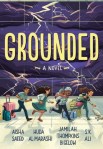
Over the years I’ve read to a lot of kids, with a lot of kids, discussed books in classrooms, and in book clubs, so when reviewing I often share what kids think or what I imagine kids will think, and I usually acknowledge when I’m being overly critical as a reviewer, but this book I will tell you, I did not read through the intended middle grade lens, I read it as a 42 year old seasoned reader.  I know this because I cried during the entire second half, and the book is not sad.  It is fast paced, joyful and adventure filled.  I cried at the ownership of identity, the pureness of friendship, the acceptance of the flaws and strengths of those closest to us, the love of family and that this book is written by four incredible Muslim women authors for Muslim kids to be seen and for non Muslims to see Muslim kids in action in a fantastic, non preachy, authentic, powerful engaging story.  In short I loved it.  I love that the voices are different, but polished and seamless in conveying a fictional story with universal themes through a variety of Muslim characters without talking down or over explaining anything. From the maps to the crossover character Hanna from S.K. Ali books, the poetry from they young lyricist to the representation and discussions of Muslims not being a monolith, and the sprinkling of a Hadith or Quranic ayat here and there (I wish there was more), the book tugged at my heart strings.  For kids third grade and up, some of those themes might resonate, or it might just be a book about a lost cat in an airport and a hodgepodge group of strangers, turning friends, stranded in an airport searching for her while dodging security and exasperated parents.

SYNOPSIS:

The end of the MONA  (Muslims of North America) Conference has lots of families at the fictional Zora Neale Hurston heading home.  Tired parents and restless kids lead Feek’s little sister Ruqi to go missing and Feek to blame.  As he searches for his little sister he meets Hanna, a girl looking for a lost cat, not her lost cat, just one she has heard about from her animal activist group that is missing at the airport.  As they search for Ruqi, Sami gets dragged along even though he’d rather be mentally keeping his anxiety in check as he prepares for the Karate competition he is heading to.  Luckily Nora, Congresswoman Najjar’s daughter, finds Ruqi and the five strangers are brought together.  When all flights are grounded because of weather, the group goes in search of the missing cat, Snickerdoodle, finding leads, security, secret corridors, self confidence, friendship, and skills along the way.

WHY I LIKE IT:

I knew the book would be good with the authors’ names on the cover and their ability to tell a good story, but I was still blown away by how real the characters were fleshed out and their “problems” articulated.  The emotional connection to each character facing their insecurities and supporting one another’s’ vulnerabilities was reflective and insightful. I love the diverse inclusion of showing Muslims that don’t speak Arabic or don’t know if they are Muslim enough, of Black Muslims and Black culture, of being an only children and struggling with siblings, understanding parental expectation and finding your voice to speak up to those you love.  The surface story is paced well and entertaining and sufficient, but the details and the story beneath the surface, really is powerful.

Again with the reviewer lens- I did wish in the middle there was a tiny bit more inclusion of a Bismillah when following a lead or an AstugfirAllah when breaking a rule or a quick prayer when running from authorities, the beginning and end was Islamically rooted, but as an Islamic School Librarian, I must admit I’d like a few more mentions during the “adventure” parts.

FLAGS:

The kids are dishonest, they break rules (possibly laws), they lie, and do some damage, they sneak and kind of talk back to their parents, nothing is normalized or accepted though and they are called to account.  There is a birthday that is celebrated with everyone singing, and possible triggers of talking about a deceased parent. The kids are 12/13 and younger, and brought together by circumstance, but by the end the girls and boys have developed close friendships.

TOOLS FOR LEADING THE DISCUSSION:

Even though the book is meant for middle grades, I think younger middle school readers would enjoy the book and find plenty to discuss as they see themselves and others in the characters, imagine what they would do in such a situation, and get swept up in the ride.

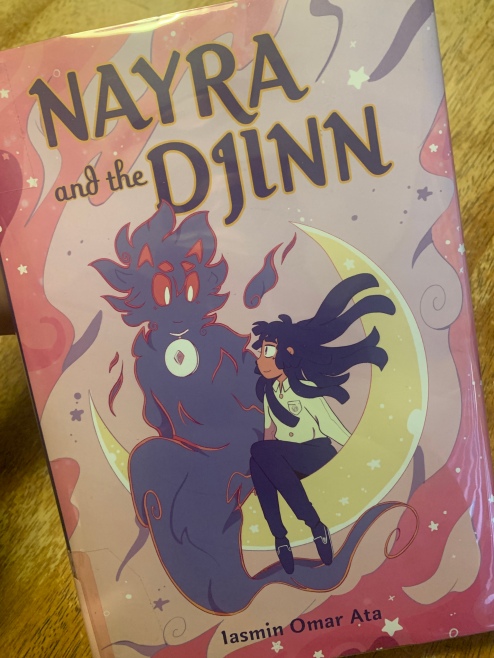
Nayra and the Djinn by Iasmin Omar Ata

Standard
Nayra and the Djinn by Iasmin Omar Ata

img_6973

Set in Ramadan this graphic novel for middle grades has a coming of age theme brought to life with fantasy, religious practices, and storylines of bullying, acceptance, and folklore.  Nayra is fasting, she prays, she says bismillah and Assalamualaikum, her  practice of her deen is never in question and by and large I don’t know that anything is “haram” in the Islamic representation.  Yes, she says bismillah in julus, the sitting position of salat, there is sihr, magic. done by the djinn, and a lot of liberties about the ghayb (you can’t really disprove them), but honestly my biggest problem with this book is that somehow even though it is a graphic novel, more visual than text, there is way too much telling and not enough showing.  The reader is told that there is bullying, but only shown that one girl calls her “baba ghanoush,” we are told over and over that she is friends with Rami and that she needs to fix the relationship, but we never see what the friendship was before, only the forced awkwardness that it is now. The inside flap of the book stereotypes the “strict family,” but we never really see them being overly demanding or difficult, and the conclusion is very naïve with both the two girls and the two djinn resolving everything on Eid. I wanted to care about the characters, but never felt a connection to their stresses, traumas, and relationships, and many mirror my own life.  In full transparency though, I must acknowledge to you all, that I do not read a lot of fantasy graphic novels or even comic books, if the choppiness, and lack of depth is what makes the genre work for others, then this book will be fun with its pink and purple pallet and tracking of the Ramadan moon.  I really might just be the wrong person to review this OWN voice djinn fantasy authored by a Palestinian Muslim who like her fictitious djinn goes by they/them pronouns.

SYNOPSIS:

Nayra is being picked on by Tanya for messing up in volleyball in PE, and gets to calling Nayra “baba ganoush.”  When the book opens Nayra fasting for Ramadan is what Tanya chooses to attribute Nayra’s lacking skill too, and Nayra is ready to find a new school.  Her family offers no support, her older siblings set the bar high and got through by ignoring the bullies, and expect her to do the same.  The one other Muslim at school is Rami, and Nayra needs a break from her, they meet to break fast every evening, but Rami is exhausting.  When an online forum somehow gets a visit from a djinn, Nayra offers to be the anchor that Marjan needs to escape the ghayb and exist in the human world.  Marjan’s past comes back to haunt them, and when Zirkouniya arrives, there is only so much protection the month of Ramadan can offer as Eid arrives and the djinn are returned to full strength.  Djinn and human alike will have to own up to their mistakes, forgive others, and rebuild the relationships that matter.

WHY I LIKE IT:

I like the Ramadan centering, and appreciate that the coming of age story line was not an identity crisis about Nayra’s faith.  I  finished the book feeling like I didn’t understand much.  There was a lot of build up for a strict family, and djinn wisdom, that just didn’t exist.  The conflict with the friends was superficial and the resolution the same.  Maybe I missed the visual resonance as I tend to enjoy lyrical writing and relatable text, but the story seemed really simplistic, and the characters flat.

I honestly don’t know if the liberties of the djinn world and djinn themselves goes too far or if folklore, mythology, and fantasy give it fictional protection.  There are details that perhaps come from culture, or are completely made up, I don’t know.  Djinn in Islam are real, they are made of smokeless fire, some are good, some are bad, they have genders, and families, and feelings, and communities.  Outside of that, I don’t know much, and do not presume to, when I sent @bintyounus some of the pictures from the book, she remarked, “Djinn are part of the Ghayb/unseen, So it’s not like we say oh none of it is true, but we also don’t take it as 100% true.”

The magic is minor just a fixing of a flower and flower pot, so in reality the only fantasy are the details about the djinn and the journey to the djinn world.

FLAGS:

Lying, bullying, magic, sneaking out.

TOOLS FOR LEADING THE DISCUSSION:

There is not enough in the book to discuss in a book club, and because of the lacking resonance, I don’t know that most kids would read the book or be interested in it. I can see it being thumbed through, but I don’t think it would be finished by Muslim kids at the Islamic school, or by my own children.  Those that know the Islamic view of djinns won’t find that enough of a hook when the story inside is about a friendship, and not a particularly deep or fleshed out one.  They might see the bullying as relatable, but being called baba ganoush doesn’t really seem that bad compared to what many endure and pining for friends, when you have a very loyal friend, also will probably be met with some confusion.

Hamra and the Jungle of Memories by Hanna Alkaf

Standard
Hamra and the Jungle of Memories by Hanna Alkaf

hamra1

This 400 page middle grade retelling of Little Red Riding Hood bursts with Malaysian culture, magic, action, and adventure.  The main character and her family are Muslim and hijab, duas, zikr, halal, Qur’an and salat are included throughout.  The mix of legends and characters from Malaysian culture in building the fae world is not contrasted with religious faith, but assumed to both coexist without issue.  The book is clean for ages nine and up and the only concepts worth noting are some intense life and death situations, close male and female friendships, dementia, and the element of fantasy.  The book is set during the Covid-19 pandemic which will ultimately date the book as it doesn’t convey the tone for readers unfamiliar with the curfews, social distancing, controversies, and masking.  Those who have just lived through it, will not need the framing, but in a few years I do fear that the book will be lacking in fully understanding why the tourists, parents, and markets are so absent.  As with all of the author’s books there are also dated pop culture references, that slow the narrative down for today’s readers.  The book grabs you from the start and the second half flies by smoothly, but the middle quarter is a bit slow as the world building is not robust, and the reader is thrust into a magical world that is just accepted without pause, and the reader is asked to accept it at face value as well.

SYNOPSIS:

It is Hamra’s birthday, but the independent 13 year old is not being celebrated- everyone has forgotten: her mother is a front line worker, her father helping those with limited resources, and her aging grandfather and her are left to care for her memory slipping grandmother.  When Hamra, Little Red, storms off to the jungle to collect some herbs, in an act of spite, she defies the rules drilled in to her 1- Always ask permission before you enter.  2- Don’t challenge what you can’t even see. 3- Never use your true name. 4-Never take what isn’t yours. 5-If you hear someone calling your name, never, ever look behind you. She also doesn’t listen to the regular reminders to tie her shoes.  Simple rules, that when broken set the story in to motion.  Along with her best friend Ilyas, the two will strike a deal with a weretiger for their transgressions that takes them on a journey to try and save Opah, themselves, and prove their quest a success.  The characters they meet, the clues they unravel, the legends they understand, and the scenic islands they explore are as lush as the love Hamra has for her family and the drive she has to return home safely.

WHY I LIKE IT:

I love the way Islam is truly part of the characters, and a natural extension of how they see the world and act within it.  I wish there was stronger world building blending the world of the known and the fantasy for the reader.  The writing of the Malaysian setting is beautifully unapologetic and I love that there is not a glossary or overly explained descriptions, it is immersive and I appreciate that, but the framing of the two worlds I felt was a bit disjointed and needed some fleshing out.  At times it feels more telling than showing in detailing the depths of the legends or the superstitions that are true for the story.  I did enjoy the characters’ quirks and stubbornness, there is not a lot of arc and growth, but with the intensity of the adventure and culture, I didn’t feel it lacking in development.  For much of the book I didn’t quite appreciate the Covid-19 framing, but by the end I understood that it was a way to have the tourist spots void of people, the parent’s out of the way; a little more development though would have had the uncertainty of so much more fully realized.

FLAGS:

Fear, trickery, danger, loss, death, music, musical references, dammit is said.  There is some violence, close male and female friendships, and a possible trigger of dementia in a loved one.  There is myth, legend, magic, fairies, fae, and fantasy, if you are ok with the concepts in general the presentation is clean even with mixing religion and these concepts.  If you are uncomfortable of fantasy and Islam coexisting, this book draws the two worlds very close.

TOOLS FOR LEADING THE DISCUSSION:

I have taught two of her books in middle school book club discussions, and I would teach this one as well.  It is enjoyable to see Malaysian Muslim characters so confident in their identity and having adventures that are enhanced by their faith and culture while focusing on larger themes of friendship, family, forgiveness, and adventure.

The book comes out in March of 2023, I’ve preorderd mine HERE and I hope you will as well.

A Bit of Earth by Karuna Riazi

Standard
A Bit of Earth by Karuna Riazi

earth

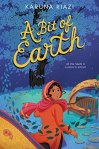
This Secret Garden retelling mixes the heart of the original with a dash of modernity, the flavor of desi culture, and the lyricism of a good writer.  Over 368 pages the slow plot but rich imagery will draw readers in, hold their attention, and leave them thinking about the characters they have been fortunate to spend time with on Long Island.  Islam is practiced and normalized and naturally woven into the Muslim characters’ daily lives without othering or over explaining.  I did struggle a bit trying to keep the relationships of who was supposed to be caring for the protagonist at various points since her parent’s died clear, but once I abandoned stressing about it I was able to be swept away.  I recently reread The Secret Garden with my own children and the original is not plot heavy, nor action packed, but I watched as my own children were drawn to the slower, more grounded (pun intended) nuanced tale, and I think this book, in the same vein, will find its way in to the hearts of middle grade readers.  The book is clean, there is a possible crush hinted very slightly at the end, periods are also endured, and I do have reservations of the terrible marital relationship between Mr. and Mrs. Clayborne, but it establishes that change will occur, so at least it isn’t normalized.  There are sprinkles of magic implied regarding the house, but it is always framed without clarity and in a subtle way to set the tone and the emotions the characters are feeling more than centralizing something rooted (see I did it again) in fantasy.

SYNOPSIS:

The book updates and mirrors the original fairly well with an obstinate orphan arriving at a sprawling house, finding a prickly boy, and setting off to form a tentative toleration of one another with friendly neighbor kids in a garden that is unquestionably off limits.

Maria Latif arrives from Pakistan against her will to be taken in by a distant relative (I’m not sure how she is related), but Asra has been called away and she is forced to stay with Lyndsay, the new wife of Mr. Clayborne.  The first wife was a friend of Maria’s family, but Lyndsay is just as emotionally overwhelmed and lost as the child in her charge.  With Mr. Clayborne away on businesses, his mother Charlotte keeps them all on edge.  When Colin Clayborne is expelled and returns home, more tension erupts and the two children find themselves in an off limits garden trying to make the most of a difficult situation.

WHY I LIKE IT:

I love the mix of poetry and standard novel format.  It is beautifully written and clearly the author does a remarkable job of making her very unlikeable characters worm their way in to the reader’s heart.  Both Maria and Colin are thorny and difficult, stubborn and rude, but you seriously cheer for them, and I did shed a few tears at the end.  With the author’s writing ability apparent, I’m still not sure why the foundation of the relationships and getting Maria to the Clayborne home is so cumbersome.  It is too muddled and it drags the book down every time it is revisited.  The Dadi having the aunt’s phone number was too easy, the inconsistency of the neighbors having no relationship to the Clayborne’s for so long and Lyndsay not even pausing to think another Bangladeshi family living a few houses down might be my husband’s first wife’s friends, seems inconsistent.  Honestly Lyndsey in general needed to read like a competent woman struggling, not a teenager in over her head. I disliked her and Mr. Clayborne’s relationship and I would hate to think any reader would find it ok or normal.

I love the Islam and how it presents when the character has to pray, she goes and prays, it is part of the story and it is seamless.  I don’t think the culture is handled quite as well.  Lyndsay is a foot writer who is always cooking, yet knows nothing of desi foods? If Colin’s mom is desi, wouldn’t she at some point tried to cook familiar foods for him.  Half the neighborhood is Bangledeshi, so it seems everyone has a parent or step parent or distant relative that is desi and I loved the normalizing, but it seemed a bit assuming.  I don’t think kids will wish it was more clear, but as an adult reading it, I felt like it needed to be interjected more without explanation, or if left as is, adding some context. I also wanted to know what Maria’s parents did and a little introspection from Maria.  Again as an adult I see how her anger and grief changes how she remembers them, but from them always being away, to such soft poignant memories at the end, I think kids will need a little hand holding to understand the grief process and her understanding of them.  As it is, they just seem terrible and then all of the sudden great, and the pacing gets thrown off in the process.

FLAGS:

It seems to hint at the end that Maria might have a bit of a crush on Colin, I honestly thought up until a single line that they were making a chosen family with the people who cared for them, but that line seemed to suggest it might be more of a romantic feeling than friend or brotherly.  I read an early copy, so this is subject to change.

Maria gets her period and it is detailed what she is feeling.  I think boys and girls can and should read it.  It is presented on age and appropriately: cramps, achy, dry about blood leakage, having it start young like her mother, etc..

Implied magic (possibly), music and musical instruments being played, milaad, lying, sneaking, being kicked out of school for physical assault, close male and female friendships, ADHD stigma.

TOOLS FOR LEADING THE DISCUSSION

I think this book would work in a classroom and would appeal to readers in an Islamic or public library.  I would consider it for a middle school book club, I think readers will connect and feel empathy for Maria, Colin, and Lyndsay and be better for it.

I preordered my copy HERE and I hope you will do the same

My Garden Over Gaza by Sarah Musa illustrated by Saffia Bazlamit

Standard
My Garden Over Gaza by Sarah Musa illustrated by Saffia Bazlamit

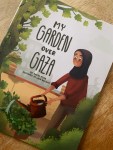
This book is hard to read, it hurts the heart, it doesn’t let you claim ignorance regarding the plight of Palestinians, and it shows cruelty,  a specific inexcusable cruelty, in a children’s book that will haunt you and infuriate you for weeks and months, if not indefinitely.  I’ve read a number of Palestine set books, but this one, in its simplicity, leaves me raw.  A child with a rooftop garden that helps feed her family is deliberately targeted by Israeli drones and destroyed.  This isn’t science fiction or dystopian, this is based on real acts.  The book itself threads in themes of hope, of not giving up, of remembering strength of a lost parent, of vowing to move forwards, but the catalyst for it all is not happenstance, and while the details of the occupation and oppression are not stressed and articulated, they are referenced and skillfully present to be discussed with children on their level with the included backmatter at the end.  This book is powerful and should be required reading. It is a difficult read and it has flags, but it is also a glimpse of the reality of our world, and the manner in which this book is told allows for the discussion to taken place with middle grade readers and up. The book is not text heavy, but the nature of the content makes me suggest it for mature children.
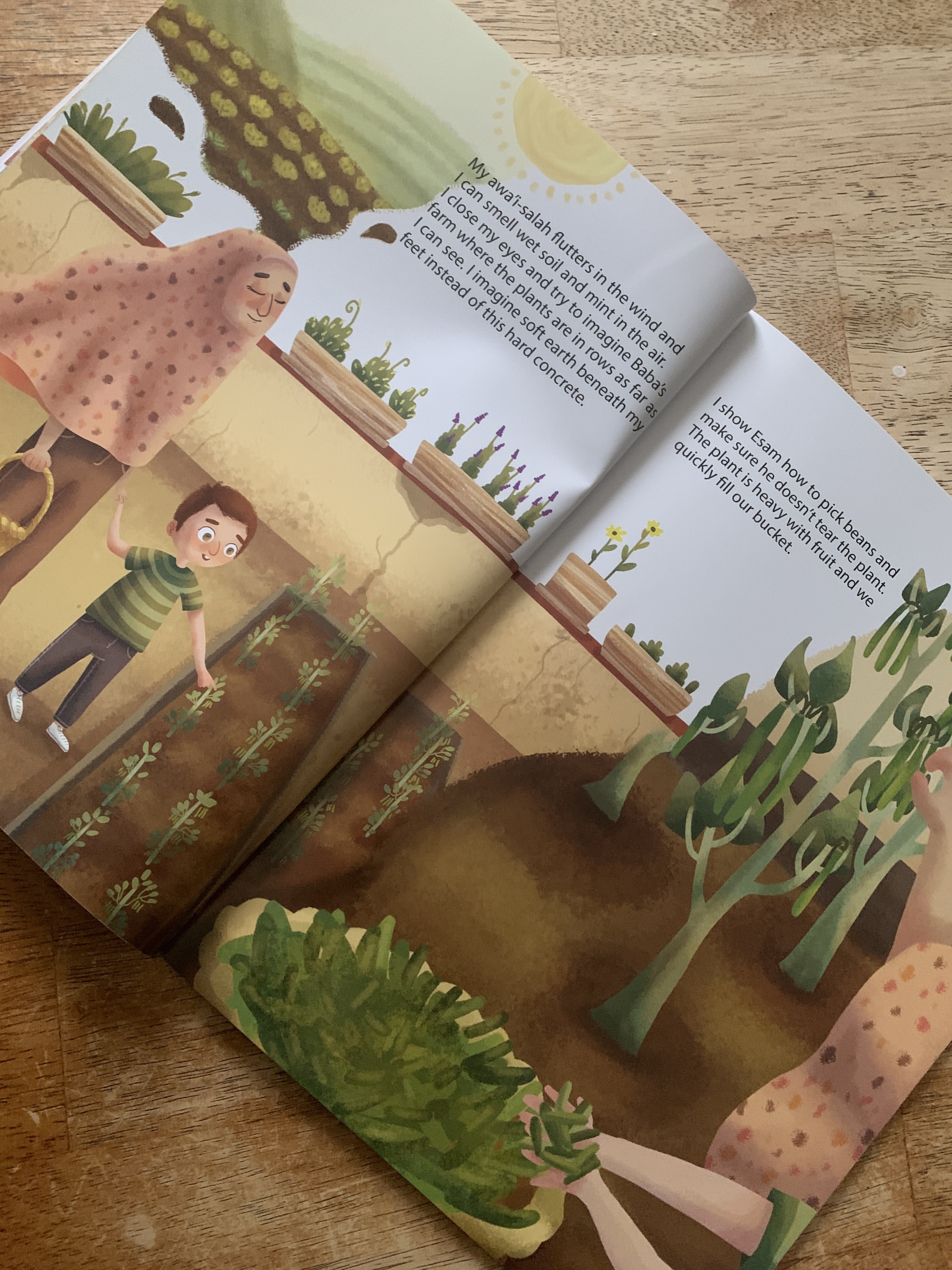
Noura, a young girl, is in her home in Gaza when drones are seen just out the window and she quickly pulls her little brother Esam away to safety.  To distract him she tells him about their father and his farm that he used to have in Umm An-Naser.  She explains how the wall cut them off from their land and when the drone noises fade, she takes him up to her rooftop garden to pick green beans.  Their mama works downstairs as a seamstress, and while they wish they had meat, the garden helps them have fresh vegetables.

The next day after Noura gets her little brother ready for the day they head to the roof, but drones arrive and start spraying chemicals on the growing plants, killing them, and sending Noura gasping to breathe.  She tries to cover the plants and swing a shovel at the drone, but it does little to save any of the food and Noura is devastated.

Noura’s mama reassures her daughter that the food can be regrown, but she is irreplaceable, as Noura goes to scrub the chemicals from her skin.  The frustration is real, but determination prevails as the family cleans the garden and begins again, just as their father did.

The last two page spread of the book is a basic map, general touchstones of the situation in Palestine, and the very real drones that fly in to Gaza to surveil, attack, and spray herbicides on crops. You can purchase a copy on the publisher’s website or HERE at Crescent Moon Store.