Category Archives: How-To

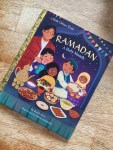
A Little Golden Book: Ramadan: A Holy Month by Malik Amin illustrated by Debby Rahmalia

Standard
A Little Golden Book: Ramadan: A Holy Month by Malik Amin illustrated by Debby Rahmalia

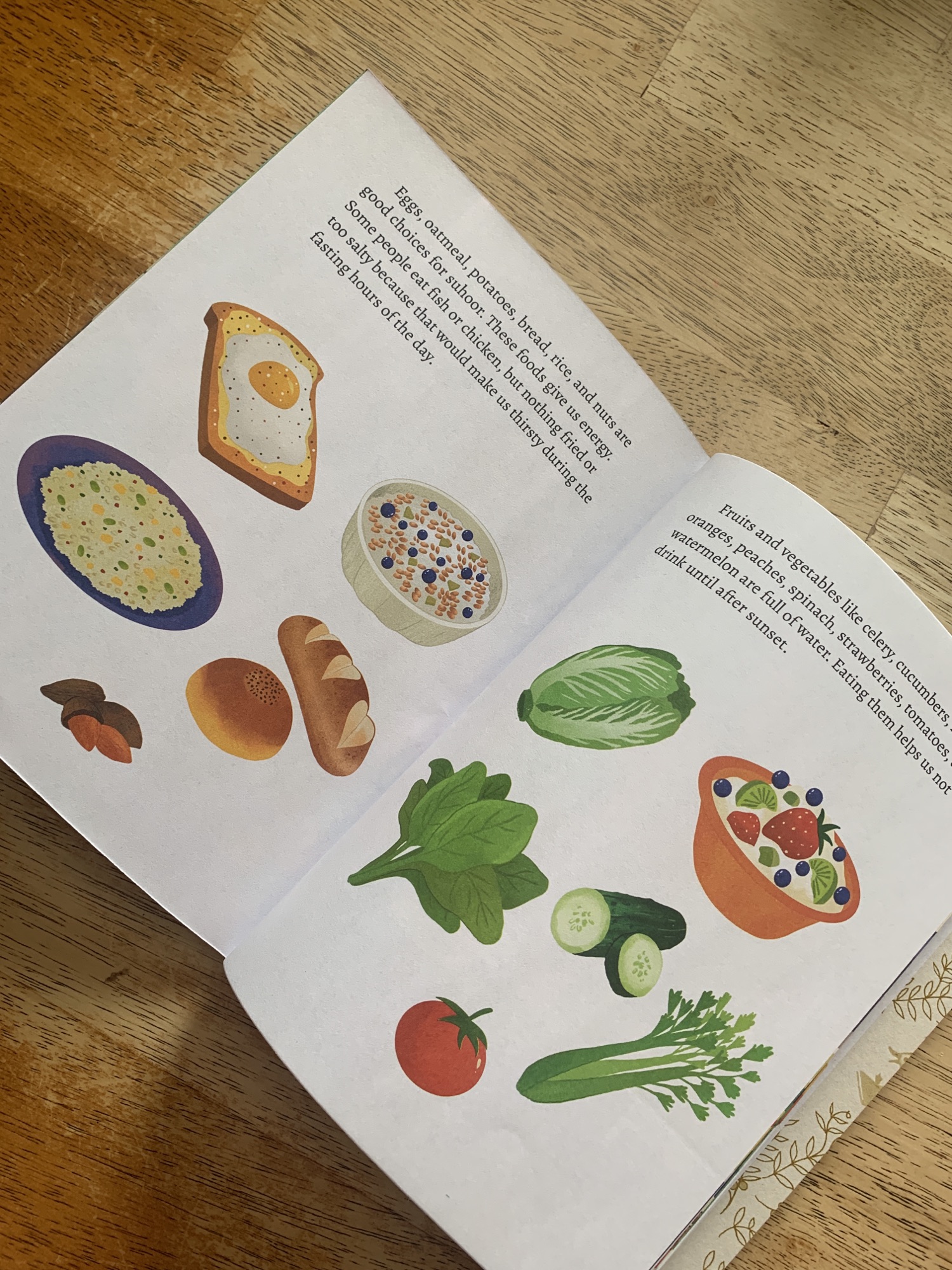
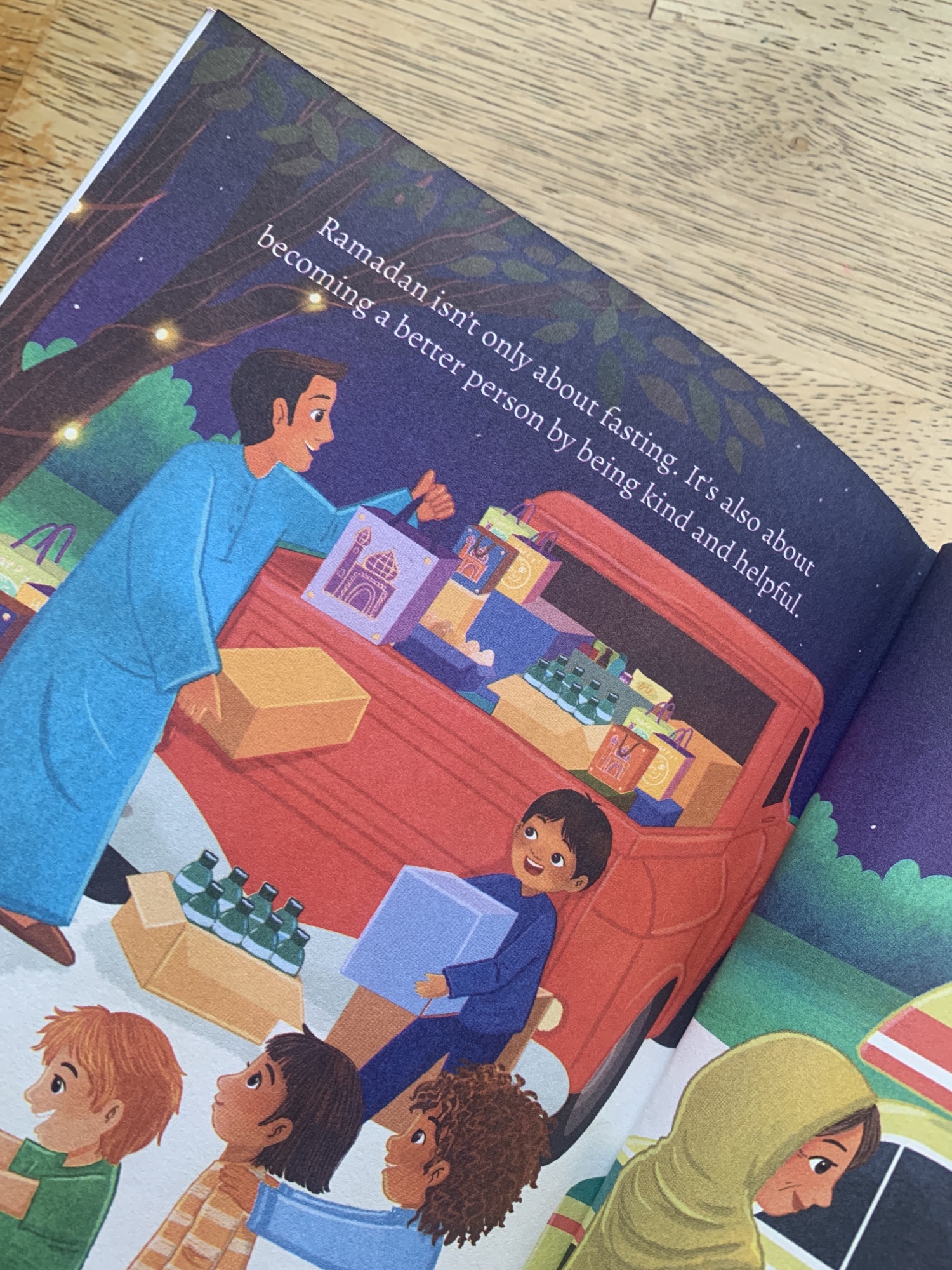
As a child I had a stack of Little Golden Books, my libraries always have a good part of a shelf with Little Golden Books, my own kids have a few dozen of them, but honestly I don’t know that I love any of them, aside from the Monster at the End of the Book.  They are a staple, they have spanned generations, but I always find them a bit abrupt, the text to small and dense, and the vocabulary a little too advanced. So, on the one hand I am thrilled that this timeless brand has a Ramadan title, but on the other hand, some of the food descriptions contain vocabulary a bit advanced for the recommended 2-5 year olds.  If you have been reading my 2024 Ramadan and Eid reviews, you will however be glad to know that this Ramadan book, does pack a lot of information into the pages, and when it asks why do Muslims fast? It says unequivocally “because it is written in the holy book called the Qur’an.” Suhoor is said to be before the sun even rises at one point, and then dawn at another, but then, however, it kind of equates dawn and sunrise, I’ll let it pass, cause it is a little vague with the equating, after saying when we eat clearly. My only real gripe are the food tangents, detailing not to eat fried and salty foods at suhoor, to they hyper specific “creamy curries, fresh soups, and rich stews. Fragrant rice dishes paired with grilled meat or kofta” at iftar.  Yeah it almost seems like the author wrote the book while fasting, with food heavily on his mind.   It does mention doing extra good deeds, more prayers, and it reads as an easy non fiction book.  It doesn’t try and interject the information into a fictionalized framing, it just tells about Ramadan.  It would be nice though, if it was sourced, but with the reasonable price point and accurate information, makes it a solid book to add to gifts and to share.

The story is told in the first person and opens with a family searching the sky for the moon. It then says in a single paragraph on a two page spread that “during Ramadan, Muslims eat and drink only when it is dark.”  It then asks why? Answering on the next spread with, “the Qur’an.”  It says that it is read in many different languages, which technically isn’t wrong, but I wish it would have said that it is written in Arabic. It continues to say that “the Qur’an tells us how to be Muslim.” To care for people, to pray. to fast, but that children and those that are sick aren’t required.

It then details foods to eat and foods to avoid for suhoor before returning to the more spiritual aspects and traditions of being kind and giving charity.  It explains Ramadan Mubarak and then finds its way back to foods, highlighting iftar drinks and foods.

Ramadan is a month, followed by Shawwal and then the celebration of Eid, making sure to note that on Eid we cook our favorite foods.

Overall, a lot of information clearly conveyed, with bright, fun, joyful illustrations.  The final page is a gloassary of words and phrases.  I purchased my copy here on Amazon.

Craft it Up This Ramadan and Eid by Zayneb Abdullatif photography by Sidoie Djunaedi

Standard
Craft it Up This Ramadan and Eid by Zayneb Abdullatif photography by Sidoie Djunaedi

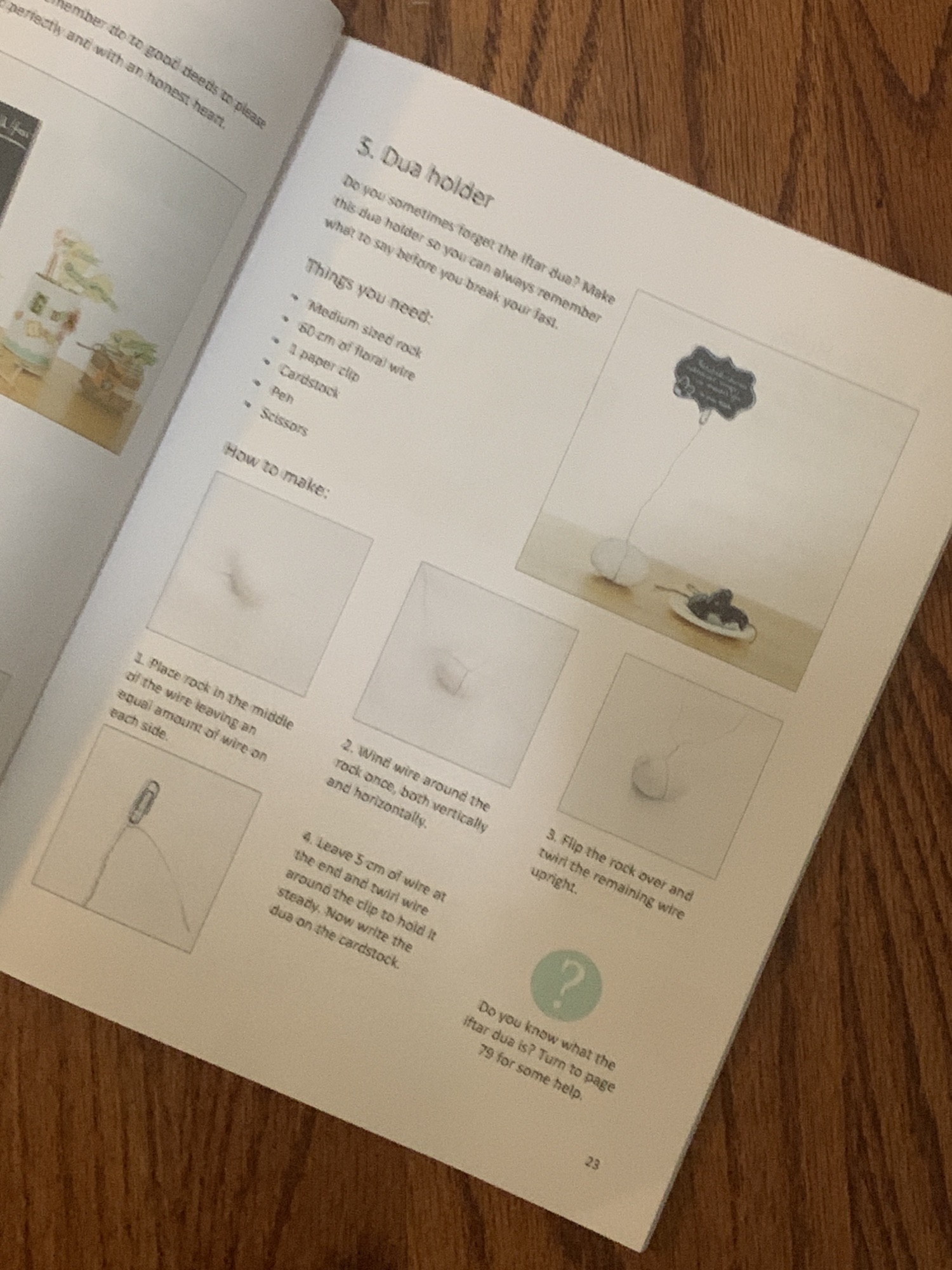
This book is not new, but I saw it at my library and thoroughly enjoyed looking through it.  I’ve hosted, helped, and attended numerous Ramadan craft fairs and story and craft times over the years, and I know everything can be found online.  Yet somehow this 79 page, 2015 published book was kind of fun to look at with my toddler.  It wasn’t overwhelming or super complicated, it was just a nice roundup of simple crafts that you could easily do with items around your home, while dropping little informative bits about Islam, Muslims, Ramadan, and Eid.  I doubt young parents today would even think to look in a library book for Ramadan craft ideas, it is a bit of an antiquated concept in todays day and age.  I highlight it today to remind us that so many have worked very hard to advance Muslim representation in books in all its forms, alhumdulillah, so that we can continue to see ourselves, make strides, and raise the bar.

The book starts with tips for parents and guardians, followed by the basics, crafts for the joyous month, crafts for Eid, a special festival, and concludes with templates, good deeds activity list, and a glossary.

It erroneously says we fast from sunrise to sunset, but does get right that we increase our worship and that fasting was ordered for us by Allah swt.  On the Eid section it discusses the takbirat and gives Eid al Adha a paragraph explanation as well.

A fun library find, that kept us off a screen and able to plan some little activities to do this Ramadan.

We Know What to Say: Phrases Commonly Used by Muslims by Sabria Chao

Standard
We Know What to Say: Phrases Commonly Used by Muslims by Sabria Chao

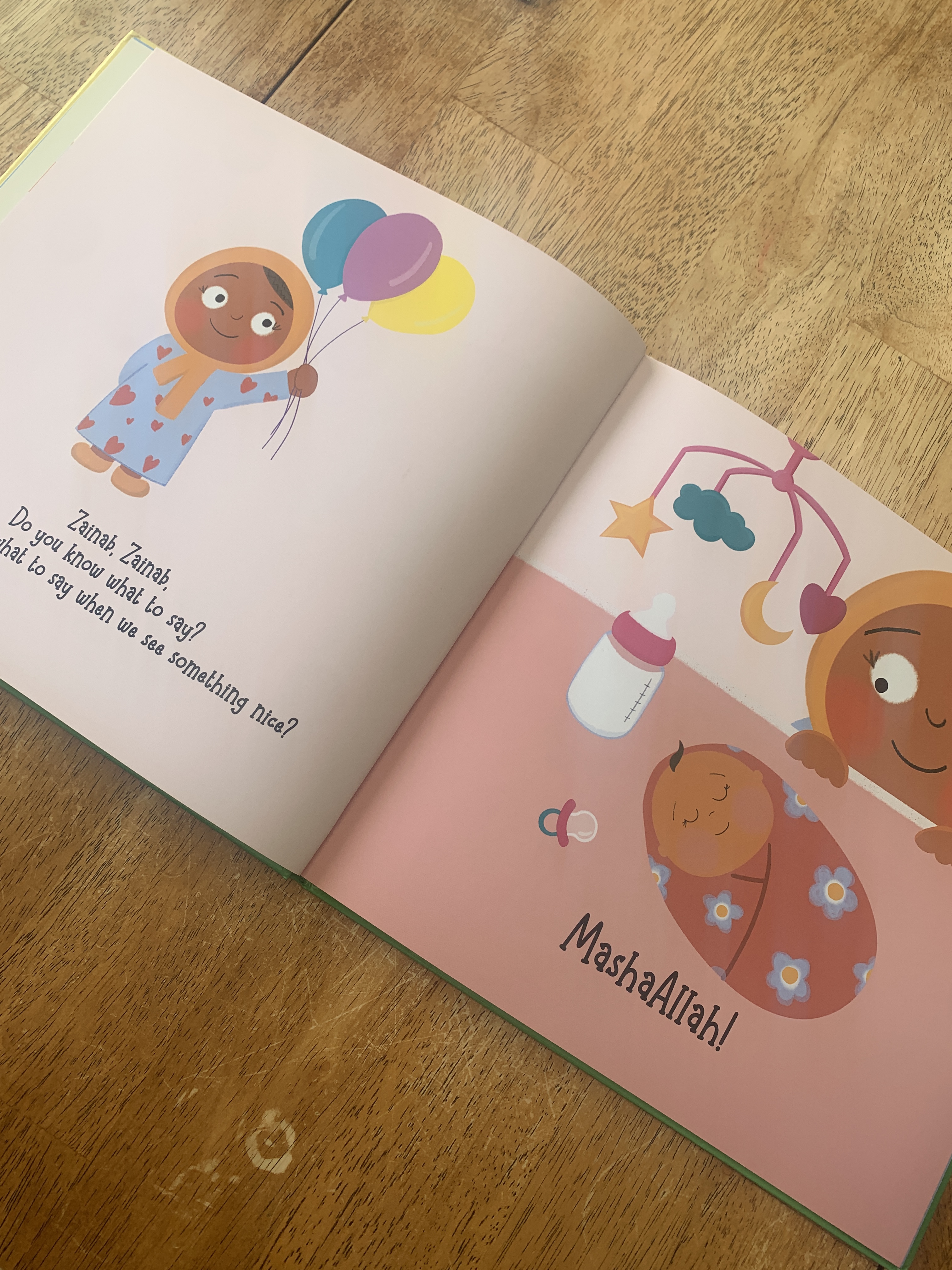
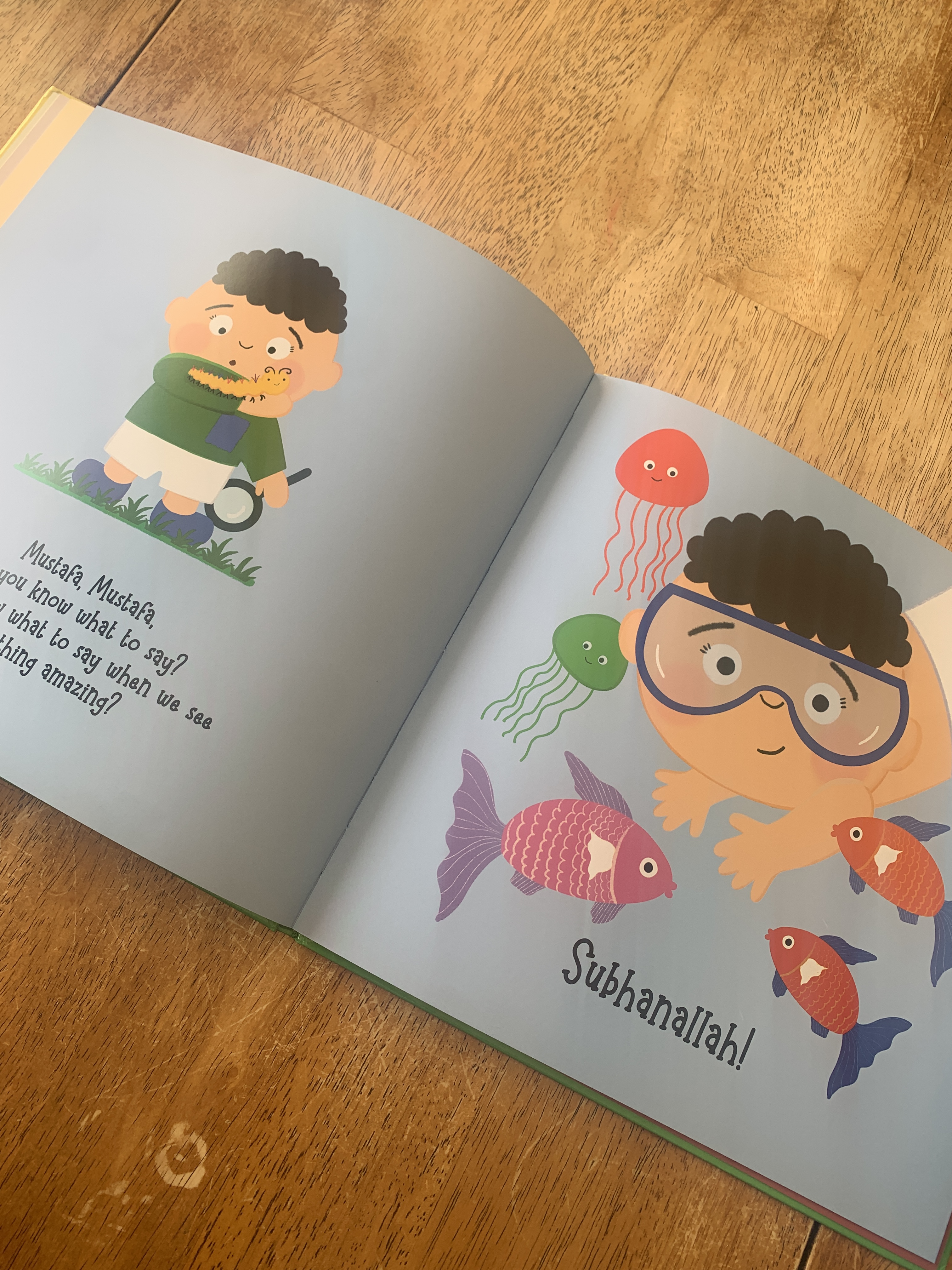
The concept behind this 42 book is really nothing new, but the presentation is wonderful.  The large hardback size, the clear inviting illustrations, and the repetition allow the book to be a delight at story time and bedtime alike.  Each Islamic term is introduced by a diverse character with a common Muslim name being asked if they know what to say in a situation.  The child gives the word, the following two-page spread restates the term and when to use it. All the terms are shown at the end in a two page spread along with a glossary and a Note to Parents.

I love the relatable scenarios: zoom calls, rain, getting sick, etc..  I also like the rhythm of the book, it reminds me a little bit of Brown Bear, Brown Bear.  The bright colors, the simple engaging illustrations and the big size make me ecstatic to share this at story time.  So many of the books that focus on Islamic terms for toddler to preschool level are small board books.  They serve a purpose, but we have long needed a large clear book for groups of children to learn, practice, and review together.

This book was nominated for the 2023 Muslim Bookstagram Awards, but you can purchase a copy here

The Big Yard Sale: David Learns How to Treat Customers by Tariq Touré illustrated by Anika Sabree

Standard
The Big Yard Sale: David Learns How to Treat Customers by Tariq Touré illustrated by Anika Sabree

img_9753

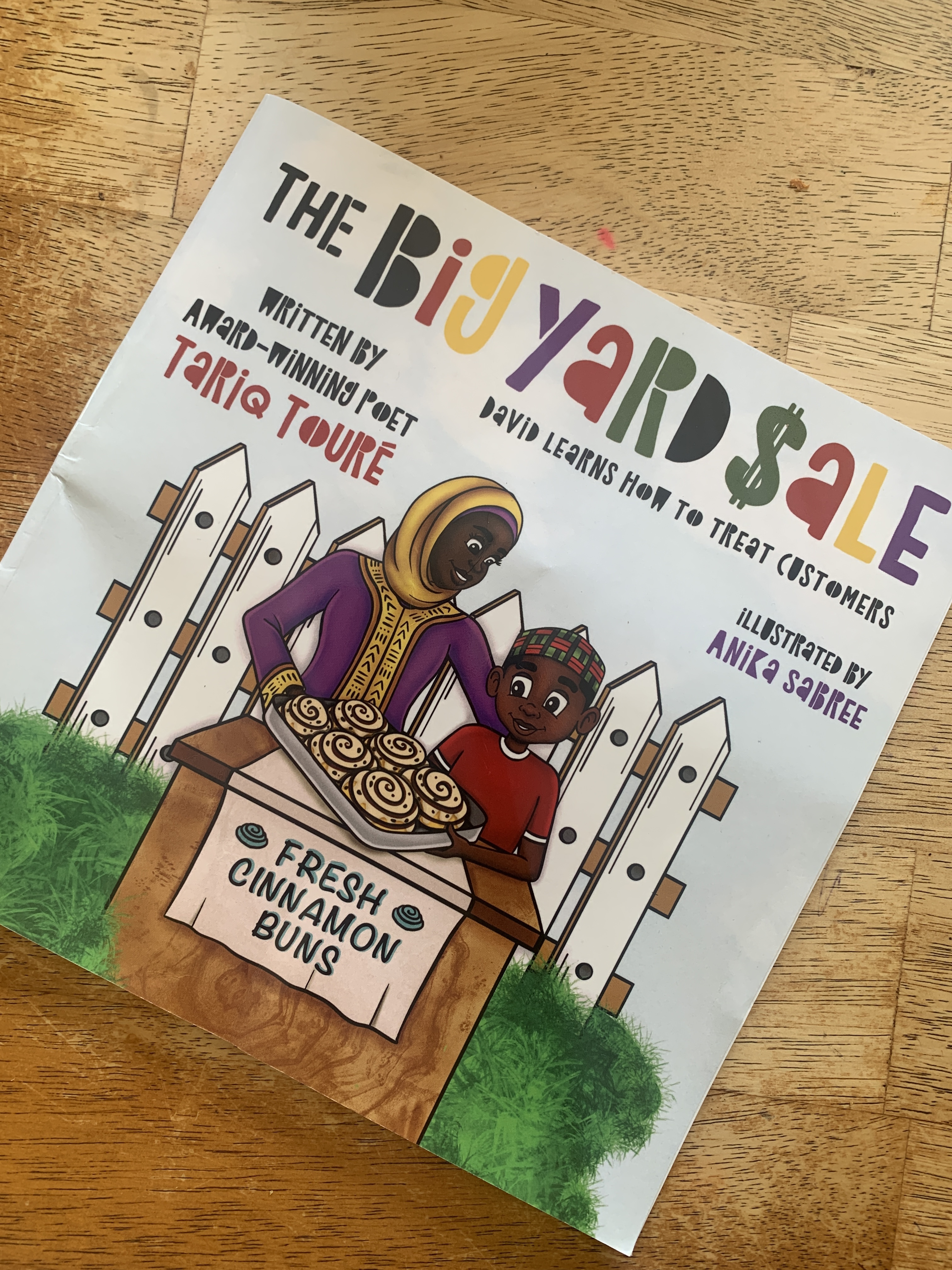
David Kareem is back and learning how to treat customers at his neighborhood yard sale.  The 26 page rhyming poem, turned children’s book (note there is little punctuation) is brightly illustrated as it follows David on his selling journey.   With Mommy’s baking and guidance on how to treat customers, his Saturday morning offers lots of lessons, mistakes, learning, and entrepreneurship for David and the reader alike.  There is a hint about a smile being charity, an Imam stops by, and David puts on a kufi.  It has good lessons and the same community vibe as the first book David’s Dollar, with visible Muslims in the illustrations and with Muslim names in the text throughout. But there was a page with two typos which disappointed me, a changing number of cinnamon rolls, and when the copy arrived it was pretty damaged and bent (probably/possibly not the fault of the author, but it cost $25 through the preorder Launchgood, so disappointing none-the-less, alhumdulillah you can now purchase it here from Amazon for $12).

David wakes up and hears commotion outside, he thinks he left a toy on, but soon realizes the neighbors have their stuff on tables and are selling things.  David wants in on the action, but can’t figure out what to sell.  He seems to gather up some toys and household items in the early illustrations, but ultimately it is about him selling his mother’s cinnamon rolls.  She is a baker, and is testing them out, but he says he only needs five and is off to peddle his wares.

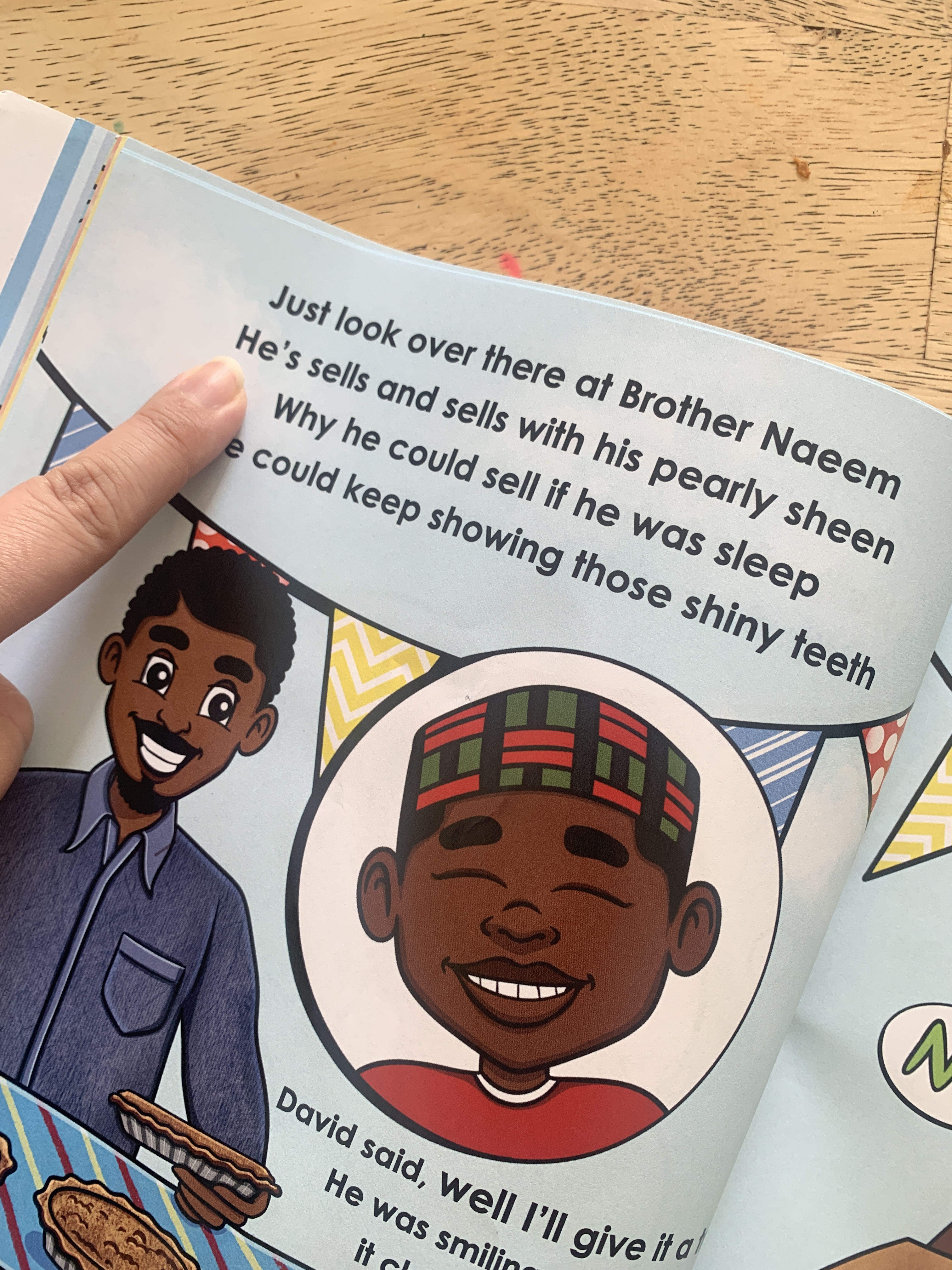
The first costumer comes, and leaves, he asks his mom what he did wrong, and she advises him to adjust his attitude by smiling.  They look at Brother Naeem as an example. The next costumer comes, but asks if he can warm up the now six cinnamon rolls in the illustrations.  David says no, and once again he turns to his mom to find out why.  She tells him that “the customer is always right” heads off to get a heat lamp, and uses Sister Khadijah selling beads for reference.  When Imam Musa comes, David completes the sale, but Mommy says he needs to learn gratitude.

img_9757

One page has “He’s” when it should be “He,” and “sleep” when it should be “asleep.”  I get the lack of punctuation is stylistic, but I don’t feel like these two on the same page are intentional, they just seem erroneous, and being that they are on the same page, makes it seem like the page was just missed perhaps in editing.

Overall I enjoyed the presentation, representation and content of this book and am glad I preordered it months ago. I wish it had a smidgen more Islam in it, but I think this book would be great in an early elementary story time with recently traditionally published books about business for a similar demographic, including the author’s earlier book, David’s Dollar. Teaching kids about entrepreneurship, ethics, gratitude and doing it with Muslim characters is incredible to see and important to share.

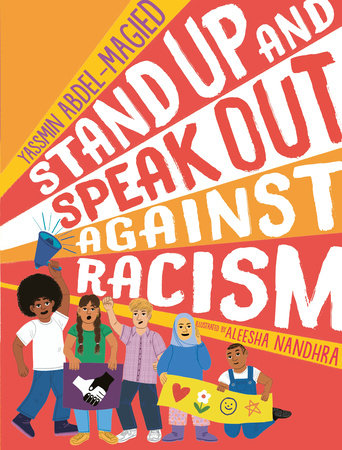
Stand Up and Speak Out Against Racism by Yassmin Abdel-Magied illustrated by Aleesha Nandhra 

Standard
Stand Up and Speak Out Against Racism by Yassmin Abdel-Magied illustrated by Aleesha Nandhra 

stand

The very first page of this practical Muslim authored, visible Muslim featured, how-to book draws you in with the author’s conversational tone and approach.  She presents life as being a mountain we all are born to climb and articulates that we are all given different tools to do so.  The book sets out to understand how race and racism affect the climb, how we can make it more fair, and uses questions from kids in the UK as the general organization of the 128 page book for middle grade readers and up.  As a Black Sudanese born, Australian raised, immigrant London woman who speaks Arabic, is Muslim, has authored five books, is an engineer and social justice advocate, she acknowledges privilege, and injects plenty of InshaAllahs, Alhumdulillahs, and global perspective to racism, its history, and what we can do to stand up and speak out about it.  I do wish the book was sourced, but the first person perspective, and her own intersectional identities, carry confidence and OWN voice power in making the world a better place for all.

SYNOPSIS:
The book starts with a section about how racism started, then moves into what racism looks like today and how it shows up and affects us all.  It then concludes with a focus on the action of standing up and speaking up.  The book spends time reassuring the reader that the contents might create strong emotions and to breathe acknowledge your feelings and find a safe way to express them. Chapter 6 discusses religions, even though the book is about race and says it does so because it is the same social construct of grouping a very diverse group together because of something “other” that they share.  It spends time on anti-Semitism, and Islamophobia.  The book doesn’t have to be read cover to cover, it can be read in sections, in any order, there is also a glossary and index at the back to find particular topics to look at.

WHY I LIKE IT:
As an American, I love that the book is global in focus and shows the effects of colonization and attitudes, and thus realities.  I also like that it takes time to discuss internalized racism, as well as interpersonal, institutionalized, and systemic.  Pointing out schools and how many of your teachers or principals look like you, really drives the points home.  I love that there is a whole page on hijab and truly that you see the author regularly bringing in Islam to the conversation which is great.  The action steps of what to do if you see racism, what to do if it is aimed at you, are well presented in metaphors that are easy for kids to see why the course of action suggested is doable, logical, and important.  It doesn’t shy away from acknowledging that pushing back on racism escalates the situation, and encourages individuals to be safe and do what they can. There are pull-out boxes, comic strip scenarios, bolded and bulleted text, and colorful engaging illustrations and infographics that connect with 9 year old and up readers independently or in small groups.

FLAGS:

The book discusses an emotional topic, but I don’t think there are any particular flags to be noted for 4th grade and up  There are important conversations to be had based on what is shared, but nothing is overly graphic or sensationalized.

TOOLS FOR LEADING THE DISCUSSION:

I think this book would be great to share with students regularly and often.  It should be on library and classroom shelves and should be used in small groups, large groups, and one-on-one.  The variety of methods that the information are conveyed make a useful tool when concerns arise, and a great reflective piece to encourage children to think deep, better themselves, and be aware at all times about the privilege and effects of their thoughts and actions.

Available for preorder on Kindle here https://amzn.to/3PH98u2

A Cat Like Me! A Fun Hajj Tale by Emma Halim illustrated by Aissa Mutiara

Standard
A Cat Like Me! A Fun Hajj Tale by Emma Halim illustrated by Aissa Mutiara

img_8799

A rhyming cat centered book about hajj that has been checked by a Shaykh!  Over 46 pages, preschool aged children and up will be able to see the steps of hajj in a fun, engaging and accurate way.  This book is great for bedtime and small group story time and the reasonable price makes it perfect for sharing too.  The illustrations do not have faces with eyes, but the joy comes through and Bissa the cat makes sure you know how special hajj is.

img_8800

I love that the book identifies what type of hajj is going to be shown and thus signals that there are different ways.  I also love that the book is sourced and the Shaykh is named and qualifications listed.  For so long erroneous information in children’s books has gone unchecked and it really is such an important   verification for something critical in our faith to be sourced and checked. Plus it is reassuring for the reader to feel confident in sharing the information with others.

img_8802

The book radiates with excitement and information and the rhymes and illustrations keep kids engaged.  The book is 8.5 x 8.5 so it might not work in big groups.  I purchased mine from if you use code https://crescentmoonstore.com if you use my initials ISL (Islamic School Librarian) at checkout you will save 10% it is also available here on Amazon.

img_8803

Eliyas Explains Why Should I Pray My Salah? Bite Size Journal by Zanib Mian illustrated by Daniel Hills

Standard
Eliyas Explains Why Should I Pray My Salah? Bite Size Journal by Zanib Mian illustrated by Daniel Hills

img_7821

I love the Eliyas Explains books, but was a little curious what a “Bite-Size Journal” version would be, and Alhumdulillah, the silly relatable voice is the same, there just isn’t as much fictional story weaving together as the Angels and Miracles books had.  Instead it has activities and guided prompts for the reader to engage with and space for them to write.  The first 15 pages or so are Eliyas explaining about salah and what he has learned and how he has improved, and some parables through his point of view.  Then the journal pages begin, and while the first few are truly “journalistic” as it progresses to the last of the 60 pages you realize along the way there was a lot of “story” included on the activity pages as well.  The book isn’t blank pages and bound together as a book, it has text, it has hadith, it has games, it has questions, and trackers, and a lot of information.  I love that it states that it has been checked and the Shaykh’s name is included, the positive child framing, and the reasonable price point.  For first through third graders learning about salah, wudu, athan, and inshaAllah becoming more mindful of their actions and behavior, this book will be relatable, funny, and informative.

img_7823

SYNOPSIS:

The book starts with Eliyas remembering when he was too lazy to make wudu and pray his salah, he then offers a story of an orphan and a muffin and a lady who makes the muffin to try and show readers that salah benefits and nourishes us and the maker of the muffin truly loves us.  It is a little random, but it somehow all works and kids will go along with the allegory, it isn’t drawn out.  He then moves to talking about how Allah swt loves him and what his parents told him that helped him to love praying.  There are hadith and Eliyas’s explanation attempts, drawings, and some really powerful points about angels and being accountable on the day of judgement to Allah swt.  The journal pages involve decoding, timing your prayers, writing down all the places you’ve prayed, latitude and longitude decoding and a lot more.  The book also discusses the athan and Surah Fatiha.

img_7824

WHY I LIKE IT:

I love the voice of Eliyas.  It isn’t fear driven, or punishment framed, it stays positive and motivates from a place of love, but the conscience and priorities are highlighted too.  It is such a crucial part of raising young Muslims, to lead with Allah’s love, but as kids get older you want to introduce consequences, and choices, and being accountable, and this book does it seamlessly with out it being overwhelming.

I honestly don’t know if I like the journal format or the other Eliya’s Explains books more, I do like the storytelling of Miracles and Angels and the way the facts are woven in, but I think for the topic of Salah this format works.  I am happy with mine, and you can purchase yours here from Crescent Moon Store.

img_7825

FLAGS:
None

TOOLS FOR LEADING THE DISCUSSION:

I don’t think the book would work for a book club, but in small groups at an Islamic School or Weekend School the teacher could very easily and affordably have a book for each student, or read aloud the story parts and engage the students in the activities without any difficulty at all.

Allah and My Heart by Humera Malik illustrated by Basmah Syadza

Standard
Allah and My Heart by Humera Malik illustrated by Basmah Syadza

img_7583

This 47 page book of feelings and reassurances shows Muslim kids that they are not alone and that Allah swt is always there for them providing love.  The book is not a story, and at times it might sit unopened on a shelf, but when it comes out as a needed tool, I think the resource it provides will be much appreciated, powerful, and useful.  The book offers scenarios with emotions: fear, excitement, anger, sadness, and then reassures the reader with Allah’s promises, and then with what we can do or say.  There are only a few words on each page, with a simple illustration that changes with each scenario and is reflective and inclusive to skin colors and abilities.  The book if rushed, will just seem like a list, it really needs to be discussed and shared with children in a way that leads to internalization, application to their own life, and appreciation that Allah swt is aware of everything.  The book is not sourced, but the sentiments are familiar.

img_7584

Here are a few samples of how the book is tied together: “When it is dark outside, I feel scared, Allah says don’t be scared I am with you.  I can say ‘Allah is my protector,’ and read the last three surahs of the Quran.” This plays out over four pages. “When I have too much to do, I feel overwhelmed.  Allah says He does not give me more than I can handle.  I can say ‘Allah I am overcome, help me’ and I can do dhikr to calm my body.

img_7586

I like that the book is well done for what it is.  The repetitive format and Islamic centering make it is a useful tool and the guidance gentle on a child’s level.  If nothing else knowing that what you are feeling is normal and common and accounted for in our deen is a tremendous reassurance in feeling big emotions.  The reasonable price and the Islamic centering makes me hope this book is shared and shelved in places that little Muslims will have access to with adults to help facilitate the messaging.

img_7588

The book can be purchased here from Amazon or from Crescent Moon Store here if you use my initial ISL (Islamic School Librarian) at checkout you will save 10%.

img_7587

Ahmed Goes to Friday Prayer: Ahmed se va a la oración del viernes by Wendy Díaz illustrated by Muhammad & Mariam Suhaila Guadalupe

Standard
Ahmed Goes to Friday Prayer: Ahmed se va a la oración del viernes by Wendy Díaz illustrated by Muhammad & Mariam Suhaila Guadalupe


ahmed


This dual lingo: English and Spanish is a linear story of Ahmed going for Jummah prayers.  The rhyming text in both languages is fairly consistent and the information framed in an upbeat, fun, positive way.  From waking up early and taking ghusl to reading Surah al-Kahf, the book shows some spiritual aspects, some sunnah reminders, and social Jummah interactions with friends as well.  The 48 pages are good for preschool to early elementary aged readers and with the minimal text on the pages, even younger listeners will enjoy the book.  I wish the religious statements were sourced, and while I didn’t initially love the aesthetics of the puppets when I first saw the cover, I definitely warmed up to Ahmed and absolutely cooed at the adorable (puppet) Imam.  The book starts with a sourced hadith and ayat from the Quran and ends with questions to test your knowledge.
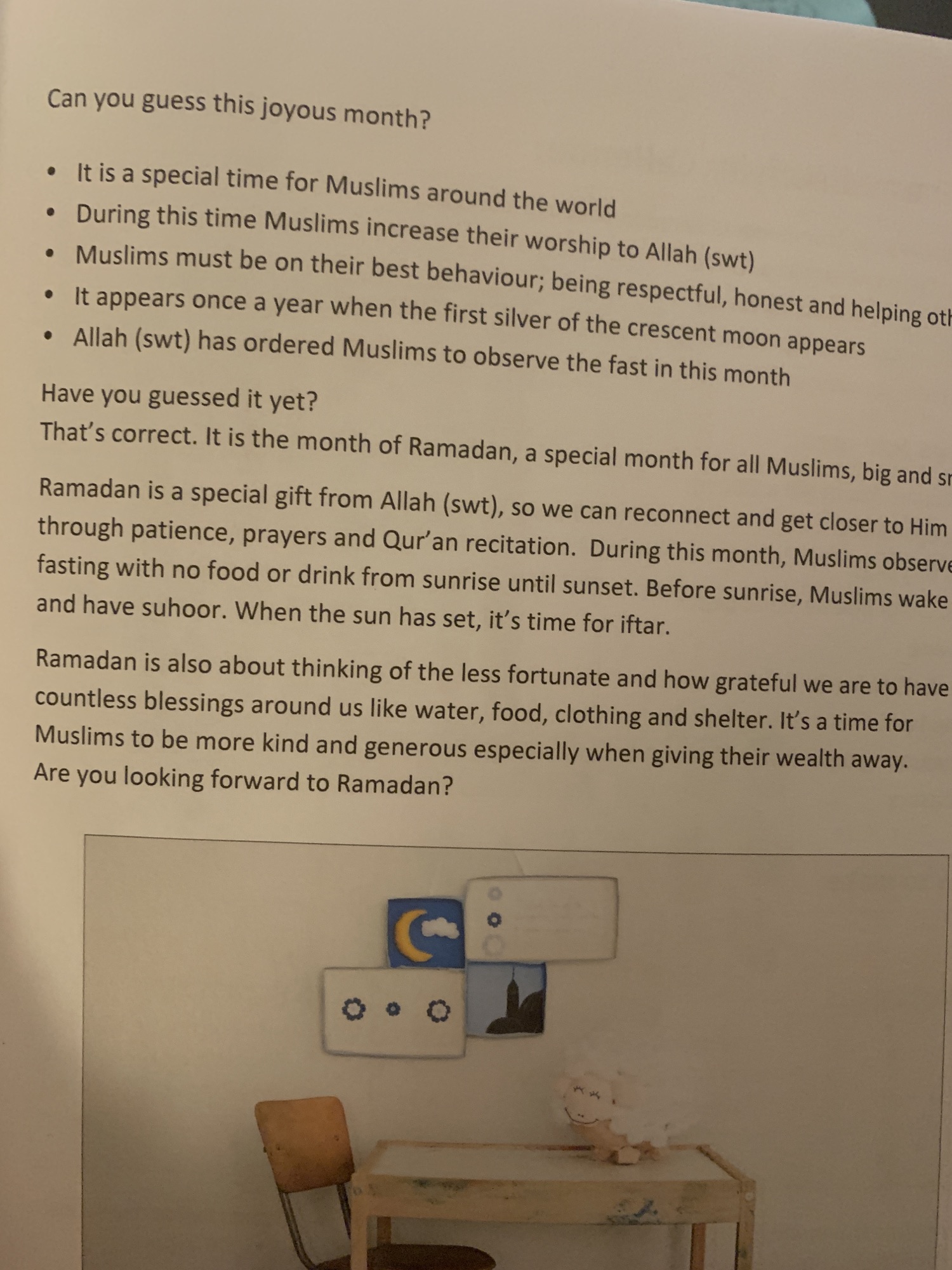
The story begins in a bit of an awkward fashion with Ahmed breaking down the fourth wall, and addressing the reader, and then on the next page, the “narrator” reaching out to the readers to have them pay attention to Ahmed.  Then the story starts with asking if the reader knows what the special day of the week is called.  It then tells us that it is called Friday in English, Jummah in Arabic and that I, Ahmed, is going to tell us about it.  With all the introductions and signposting it makes the book actually start 11 pages in.  I read the first few spreads numerous times trying to see what was going on, and finally just realized it has a lot of framing and set up before diving in.  Alhumdulillah, after the repetitive first few pages, the book reads smooth and clearly.  

Ahmed wakes up, does ghusl, puts on nice clothes, and then waits until midday to go to salatul Jummah.  Muslims read Surah al-Kahf, and then get to the mosque early.  It is noted that we get rewards for every step we take, we are encouraged to praise our Lord, we greet friends with Salam, and after athan we sit calmly and quietly listening to the Imam.  The khutbah talks about our faith and then we pray foot to foot closing the gaps. The last few spreads are about the importance of Jummah.

The illustrations show Ahmed the puppet in different places with other Wendy Diaz books displayed in poster form, books on side tables, and graffitied on a wall. The only other character beside Ahmed and the Imam is Ahmed’s un named friend.  The simple illustrated backgrounds with puppets in the foreground, the minimal rhyming text and the content presentation make this book a great addition to home and school libraries as well as ideal at story time or bedtime where early elementary aged children are able to understand both the excitement and protocols of the blessed day.

img_5601

Over the years I’ve done a few Jummah themed readings and this book would be a great addition at story time.  You can purchase the book here.
My First Book About Salah: Teachings for Toddlers and Young Children by Sara Khan illustrated by Ali Lodge

Standard
My First Book About Salah: Teachings for Toddlers and Young Children by Sara Khan illustrated by Ali Lodge

img_3719

Looking at the books in the series, reading them to my children, getting the latest one delivered to my doorstep: every step along the way makes me smile, alhumdulillah.  The soft warm illustrations and impressive amount of information lovingly conveyed in board book form really makes the series a staple for young children.  The newest addition to the series is about Salah, and I love that the framing is that prayer is a blessing, it doesn’t open with listing the five daily prayers, it begins with Isra wal Miraj.  It sets the tone that prayer is special and beautiful and a gift.  It does eventually list the five required prayers, the words of the athan, Fatiha in English and Arabic, steps of wudu, and parts of salah, but the way it is woven together is seamless and so much more than just lists of information.  With ayats from the Quran sprinkled in, the book flows from one focus to the next, leaving the end as always, for facts and questions.  Appropriate for ages two and up, this 26 page board book can and will still inspire and teach older kids.

The only pause this book gave me were the illustrations.  There is not a single page where the people praying are standing shoulder to shoulder, foot to foot.  I could see if in a few pictures the creative liberty, or Covid reality manifest itself in the pictures, but whether it is a family praying, or people in a masjid, there is a gap between the individuals, and that seemed off to me.  Additionally because of the spacing in all the pictures, the pictures where perhaps the people are not praying together, but are just shown to be making tasleem or the illustration that all Muslims of all colors and all professions and all abilities pray, it almost seems to show men and women praying together.  I don’t know that the toddlers in the audience will notice, but perhaps be aware of it if when reading it to your children.  Aside from that the illustrations show the global faith of Islam and the beauty that we all worship together.

Available to purchase here and I’m sure it will be stocked by Crescent Moon as well.  Oh PS it also comes with a sheet of stickers.