Category Archives: Historical Fiction

The Slightest Green by Sahar Mustafah

Standard
The Slightest Green by Sahar Mustafah

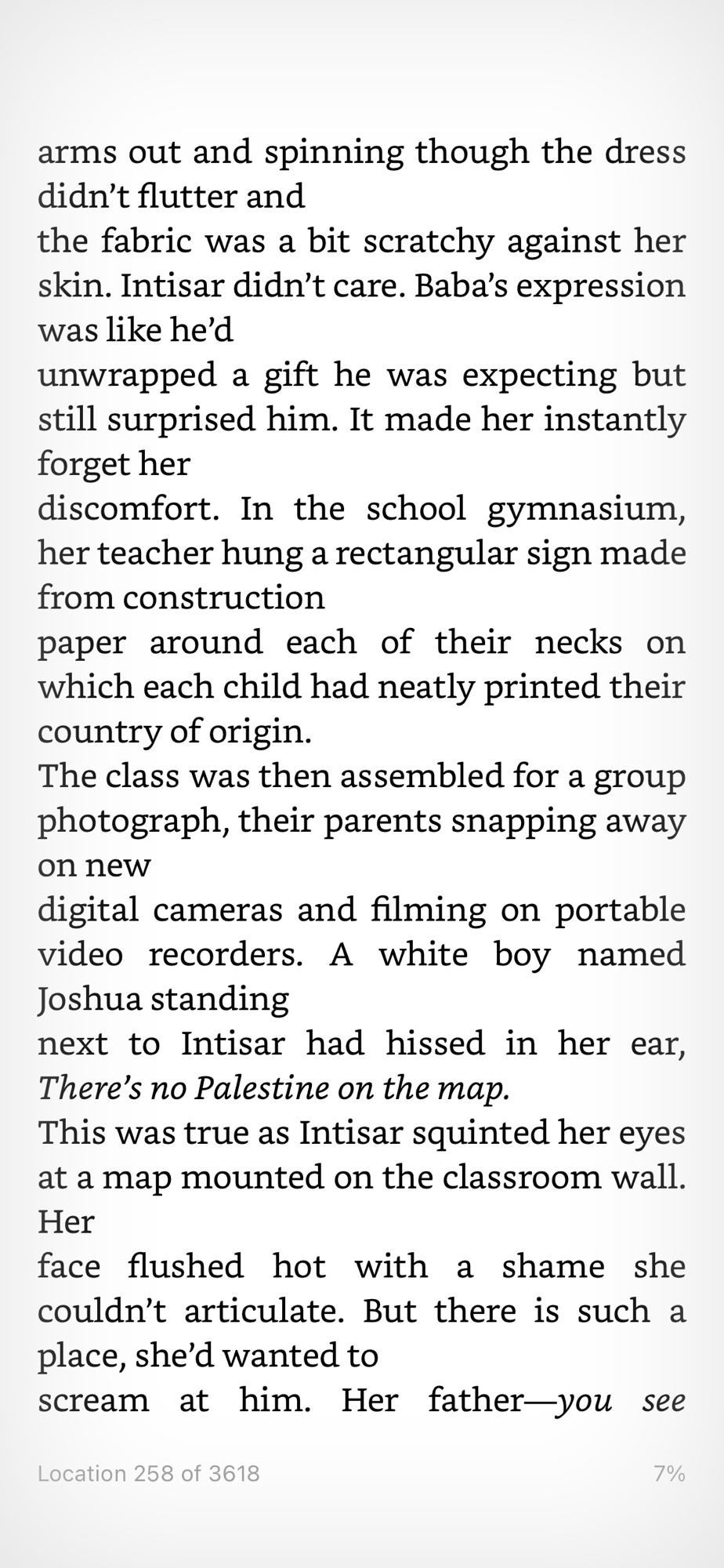
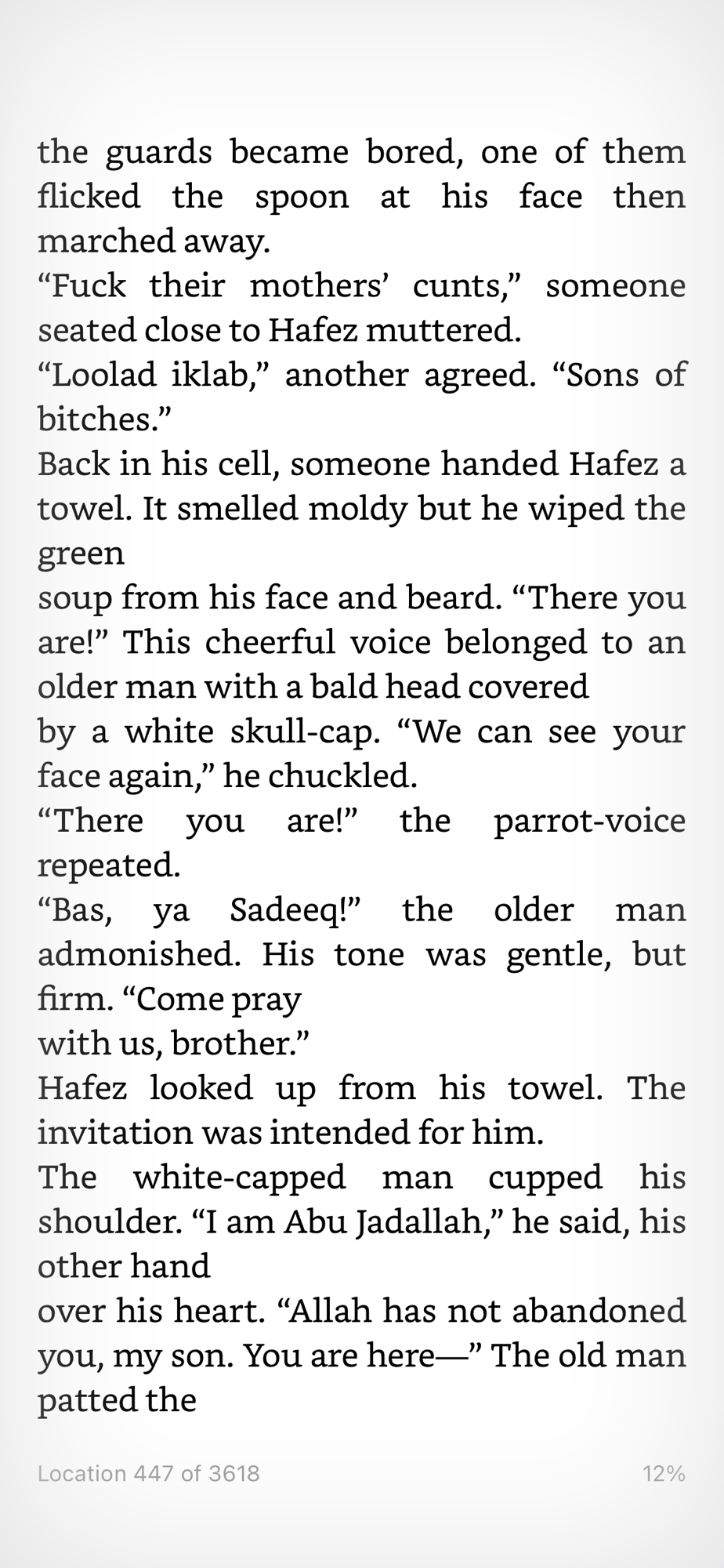
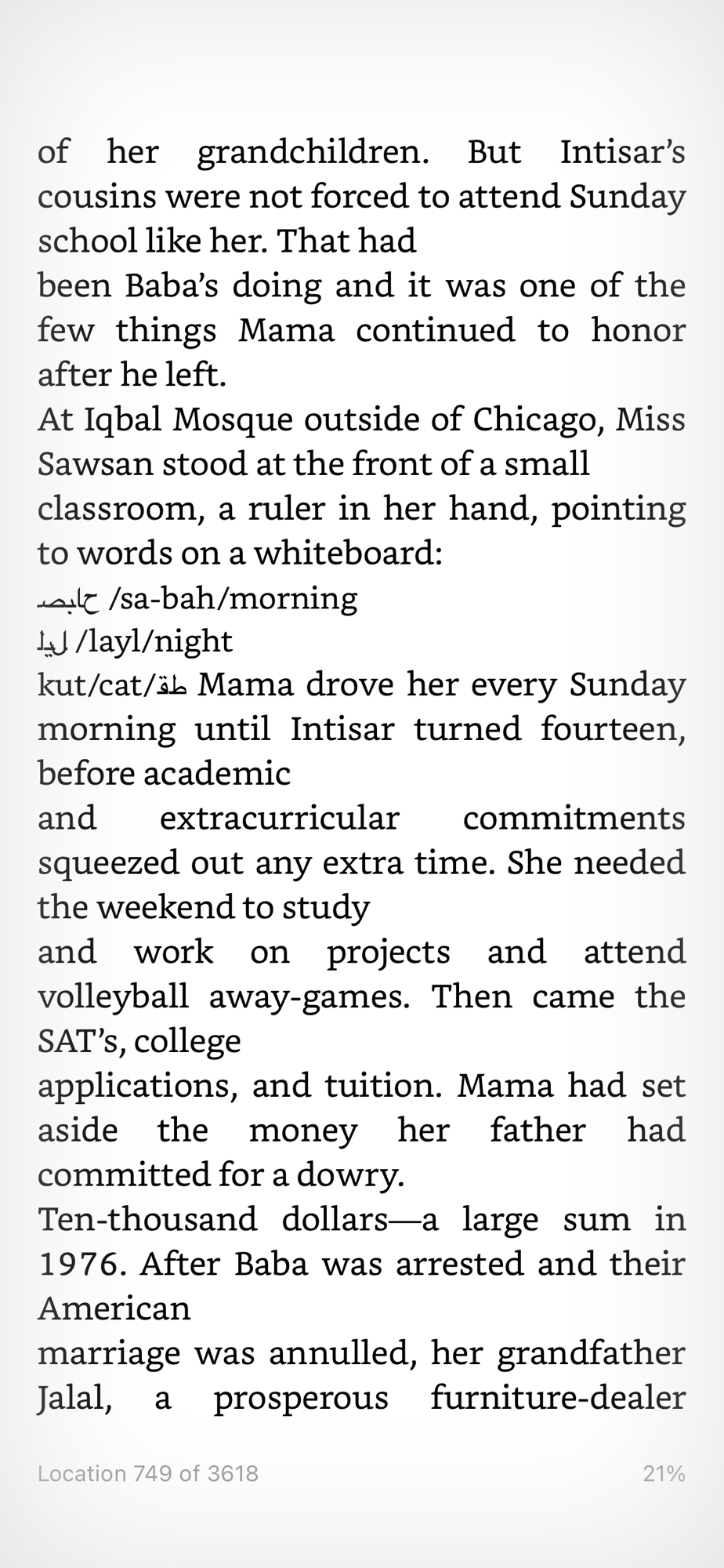
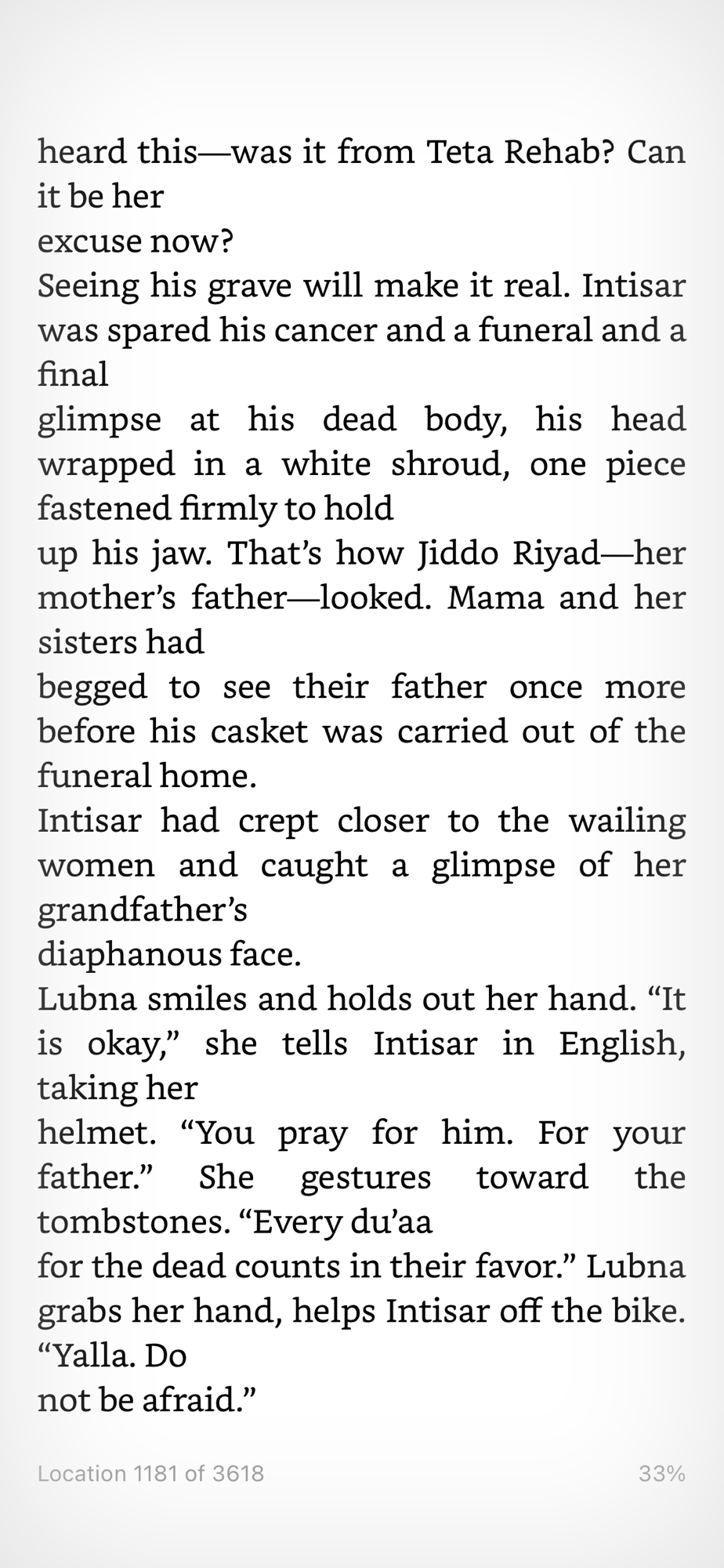
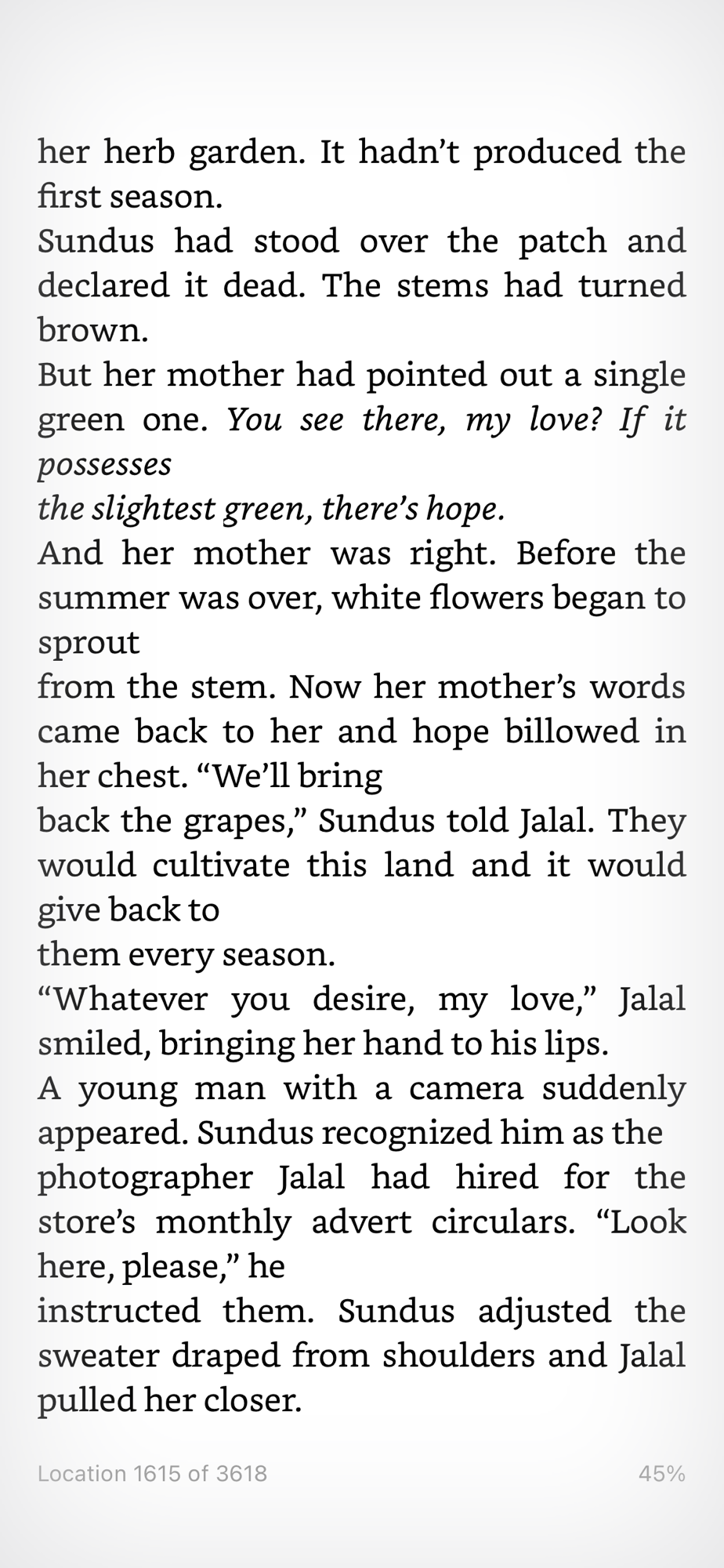
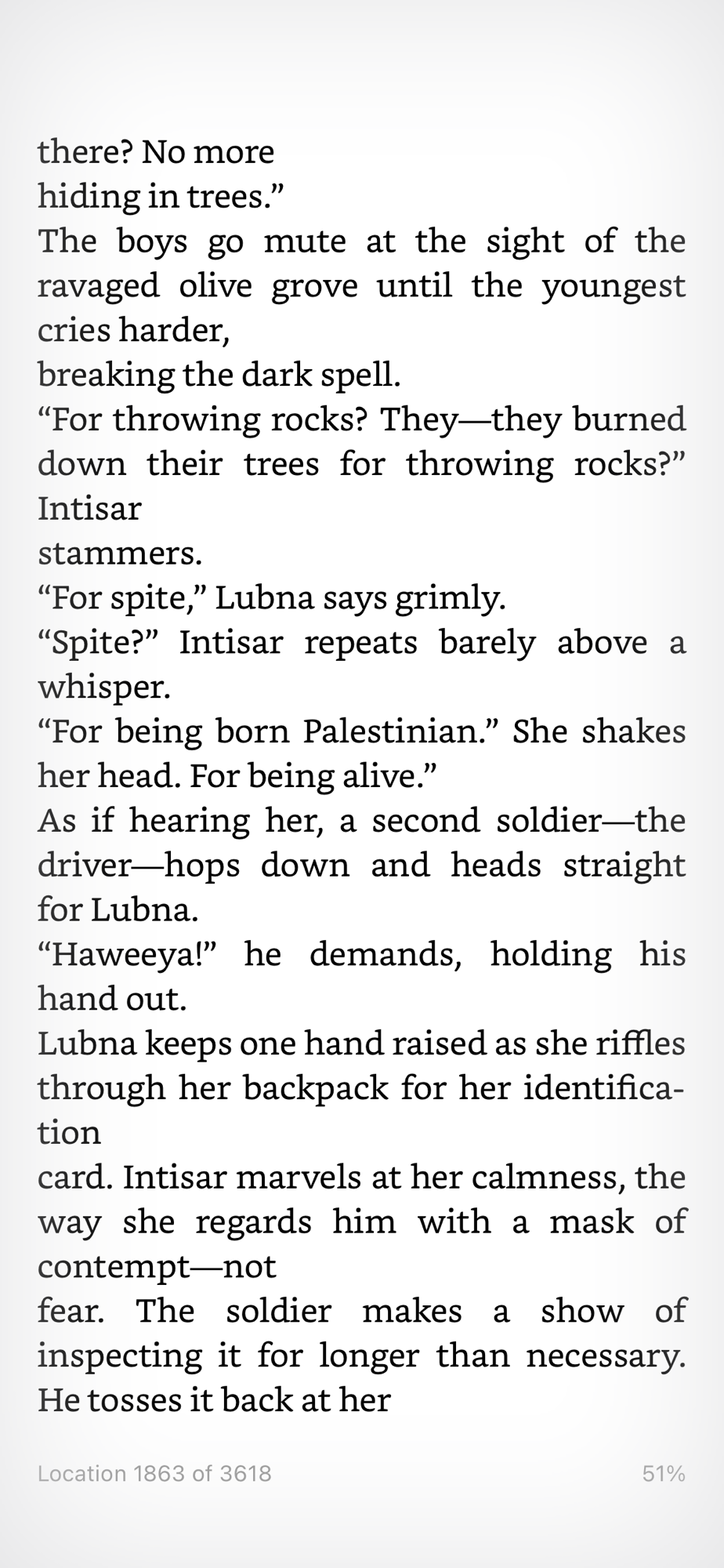
This adult multi generational novel weaves a narrative that will stay with the readers for the warmth and depth it explores of a fictional family that over the course of 248 pages becomes very real, and in many ways familiar through its personal focus. The book is deliberately slow as it glides through different members of the family, their backstories and different points in time. The prose highlights the plight of Palestinians but not in a didactic or call to action sort of way. The characters and their stories, and their trauma and dreams are very tied to Palestine and the occupation, but the focus on the individual and the ripple effects is what will linger. I do not know when the book was written, (it is published in November 2025) as I read a digital arc which had very minimal backmatter, but this book is set before the recent genocide and is all the more important for today’s readers in pushing back against attempted erasure of Palestinian voice, culture, and history.

Intisar is a nurse in Chicago, the only daughter of divorced parents. She lives with her mother and has not seen her father in over 20 years. Not since he left the family to return to his home in Palestine, join the resistance and after a fateful mission is forced to serve a life sentence in Gahana Prison. When he is released to live his final days before he succumbs to cancer, Intisar heads overseas to see him one last time. Her grandmother Sundus additionally needs Intisar, the only heir, to fight for her to keep her land and home, a task that Intisar is not willing to pursue. As family history is shared, daily atrocities witnessed, Intisar starts to see herself differently, and considers if she could feel at home in her father’s homeland.

Again I read an arc, but there are a few sentences that really have me hoping line edits will still occur before the final version. The book is adult, it has a Muslim drinking and serving alcohol, there is assault, sexual and physical mentioned, and yet I didn’t feel like it was sensationalized, actually felt that the author was deliberately holding back to keep the story about the family and not the larger issues. Their is quite a bit of Islam, not from every character, but it is woven in and not an identity issue. Actually one line used frequently is my only real gripe with the book. “Pray to the Prophet,” is regularly said by a few characters, so I though perhaps it is something unique to them, up until about the midpoint, where many characters start to say it and I don’t like it. It makes it clear other places that Allah swt is One and who we pray to, it has the shahada in English and verses from the Quran, so I’m guessing it is a colloquialism perhaps, or maybe a poor translation, I honestly don’t know, but it bothered me, so I am sharing.
The Land of La La La by Sana Saghafi illustrated by Azam Vazehimogadam

Standard
The Land of La La La by Sana Saghafi illustrated by Azam Vazehimogadam

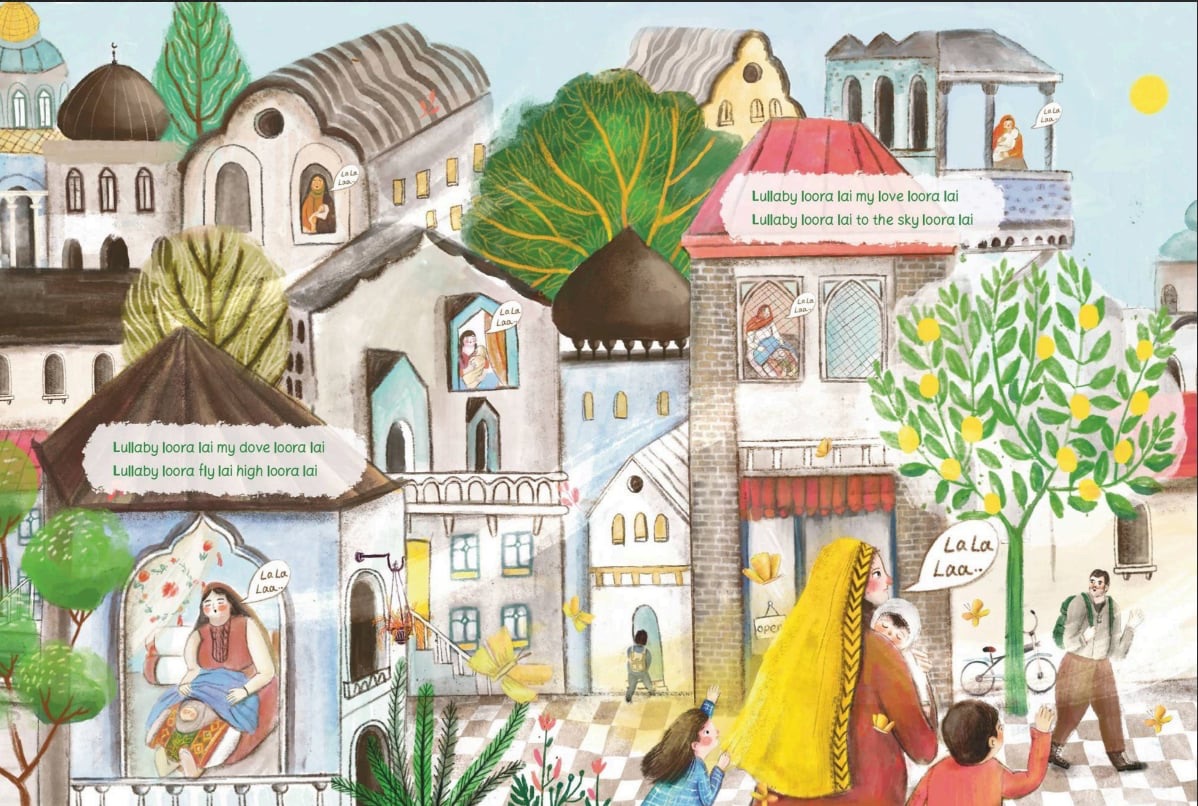
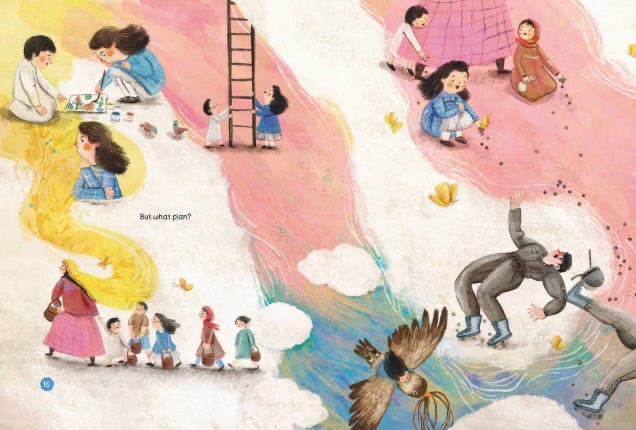
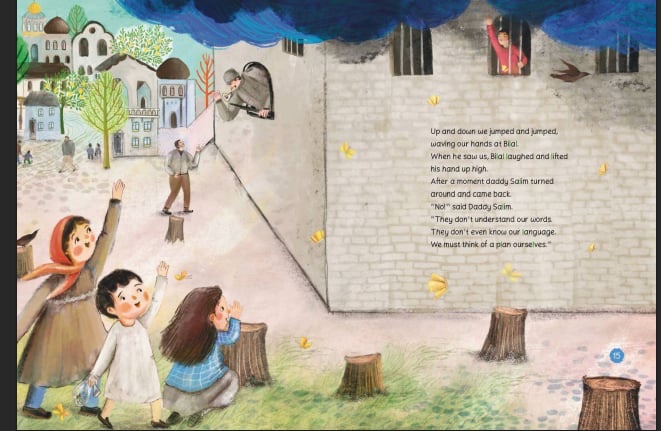
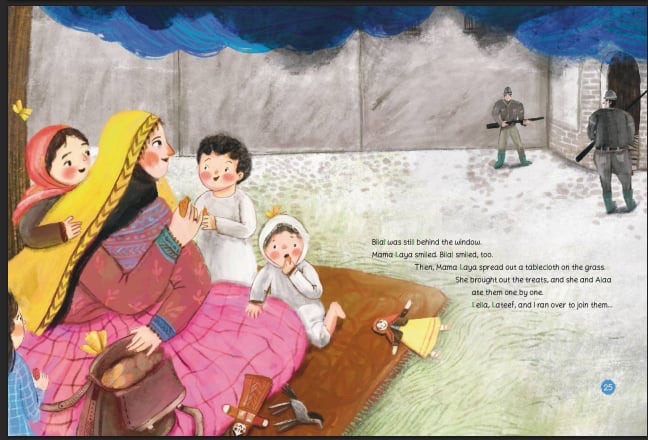
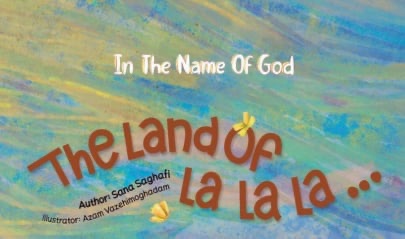
This gorgeous and powerful 36 page picture book goes back in time to a Palestine where the struggles of today are still found, along with the resilience of the people, determination of the women, ingenuity of the children, love and hope.  The book is so strongly unapologetic in its portrayal of marbles representing strategy of kids to battle the giants aka soldiers, of children being imprisoned, of the occupiers being outsmarted by the people, and the joy that persists despite the attempts of erasure. The story within a story…within a story(?), doesn’t name Palestine until the very end, after the stories at hand have wrapped up, and doesn’t disclose that it is based on a true story, except for in the blurb.  It is also worth highlighting that the book is not OWN voice or sourced.  I still am sharing though because it is positioned as happening long ago, and thus hopefully not further erasing a Palestinian voice, but rather sharing a story to prevent it from being lost.  I do not know the author, illustrator, or publishers’ intent, this is simply my view and I am happy to be corrected if I have arrogantly overstepped.  


The book starts with a lullaby lilting through the air, the la la las, connecting the women caring for their children. Mama Laya is busy so Big Brother Bilal is playing with the children, marking which soldiers have been defeated on the paper that matches the marble game in the lane. When the giants take him away the children run to find Daddy Salim.

The searching children and family find Bilal in prison, and the giants don’t speak the language of the people to be reasoned with, so they must figure out a way to free him on their own.  Mama and the children have a picnic outside the prison and secret filled lullaby conveys the plan right under the giants’ noses. With Bilal free, the women gather to teach each other a secret way to communicate, to resist, to hope, in the lullabies that they sing.

There is no religion mentioned, but the title page begins, “In the Name of God,” and numerous characters are depicted wearing hijab.  I read a digital arc and I hope the printed version has backmatter to highlight that the author is not Palestinian, when this would have taken place, and if it is accurate.  Authenticity and accuracy are important, and I hope the book clarifies what is real, what is imagined, an where the information came from.


Zeyna Lost and Found by Shafaq Khan

Standard
Zeyna Lost and Found by Shafaq Khan

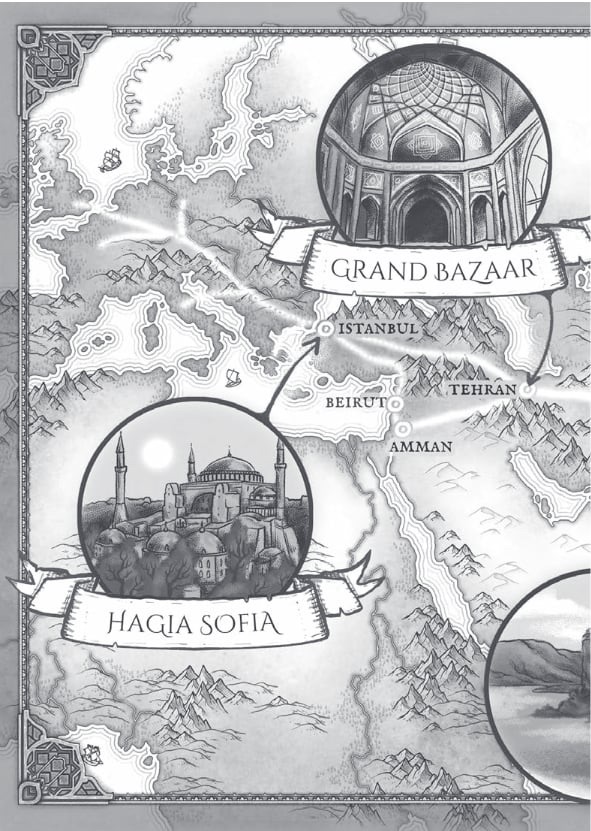
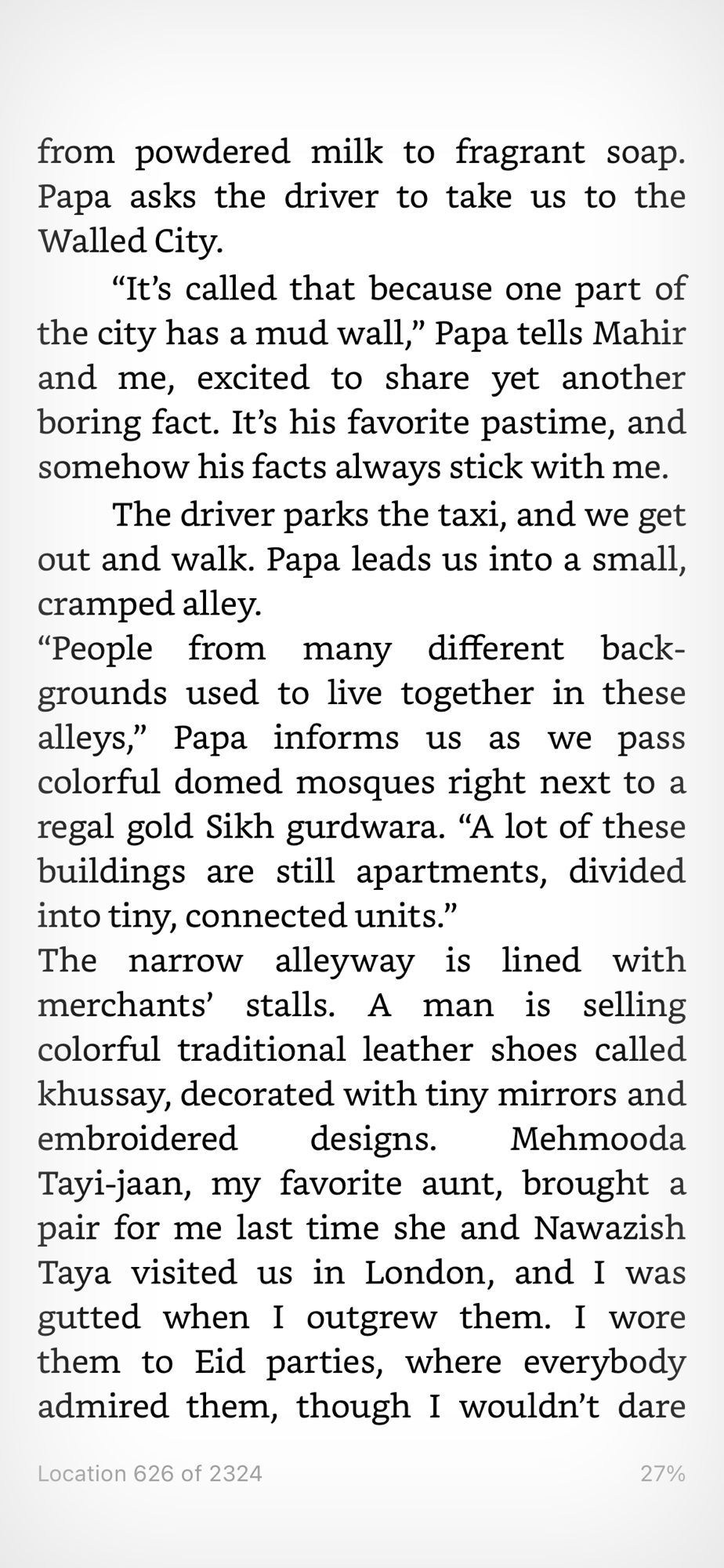
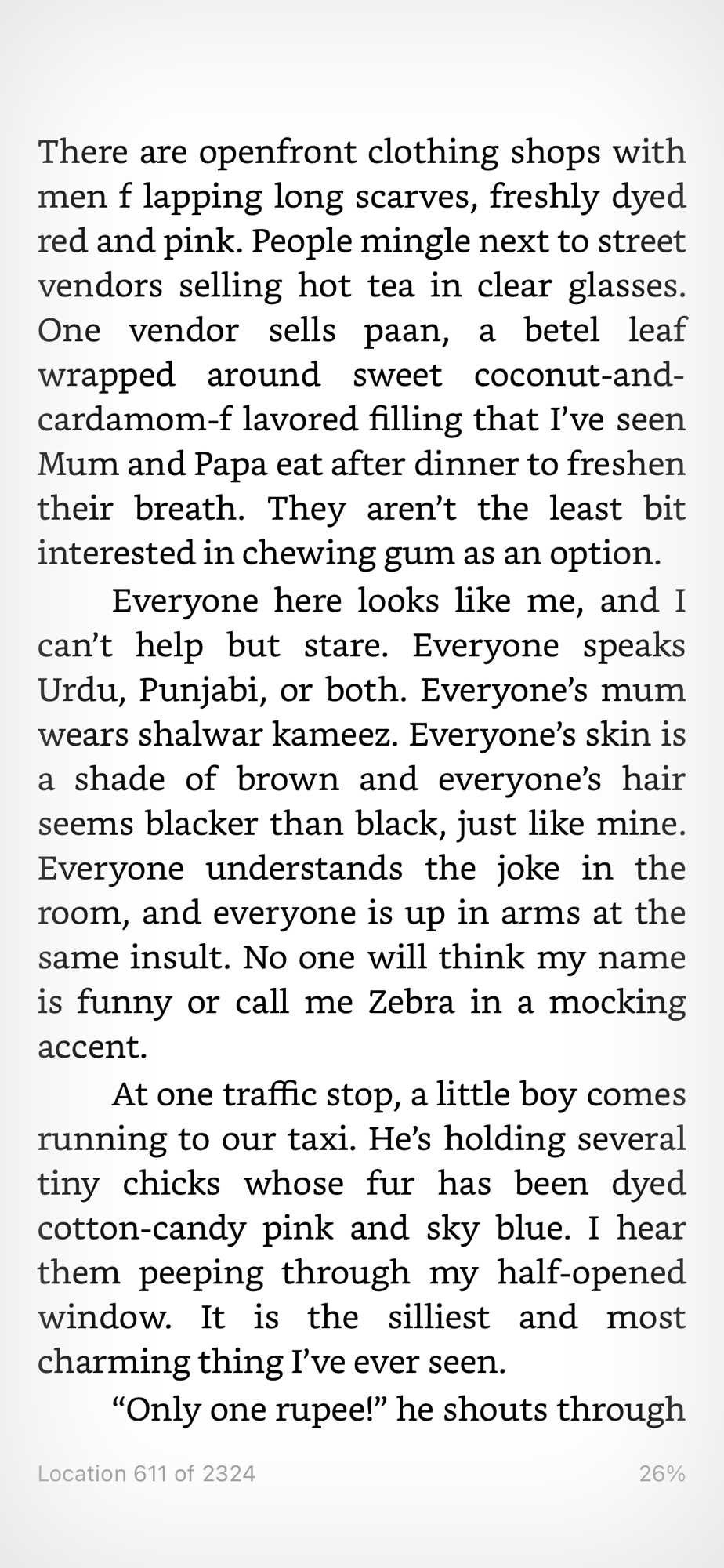
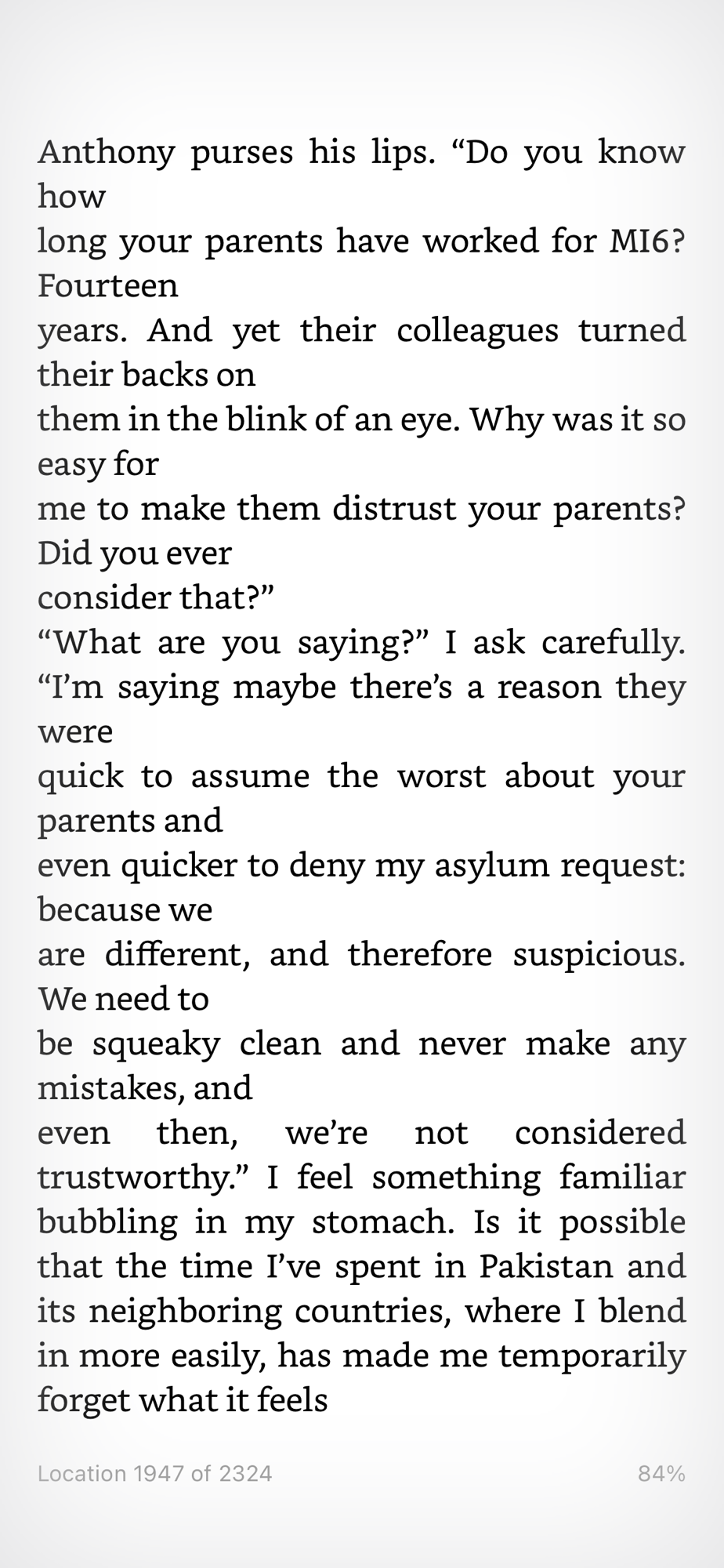
I think I needed this 336 page middle grade book that gets parents out of the way and lets a trio of kids  hop from country to country to solve a mystery, track down the bad guys and save the day. Set in the 1970s in the UK and on the Hippie Trail between Lahore, Pakistan and Istanbul, Turkey, the book is a fast paced read with humor, heart, and adventure.  I absolutely love Zeyna’s snark and voice, and her relationship with her brother and cousin, ground the story and make you cheer for them even when their antics are incredibly dangerous and improbable.  As an Islamic school librarian, my one critique with the book is that I wish there was more/any Islam. I, at one point considered that they are not Muslim, and I’m not sure what the author identifies as, but she does thank “Al-Barr, for all that is good” in the acknowledgements, and Zeyna does mention an Eid party in passing, so while I’m still on the fence, I’m going to assume they are all Muslim.  Major beats in the plot are meeting at both the Badshahi and Blue Mosque, but none of the characters ever pray, or mention the names of prayers when the athan is heard.  When they see women in burkas and chadors, Zeyna stares, not connecting the clothing to hijab, that one would hope she would know. There is only one salaam in the whole book, and the story is predominately set in Pakistan, Afghanistan, Iran, and Turkey. Granted I am sensitive, but it almost feels like a deliberate exclusion to the point of going out of the way to not let those details be present.  There are plenty of Urdu and Punjabi words and titles and cultural commentary, so it doesn’t seem that the author was concerned about watering down authenticity, a theme of the book infact is finding your place and accepting yourself.  All that aside I really enjoyed pickpocketing, imaginative, determined, sarcastic, loyal detective Zeyna, and I think kids will join me in hoping this is the first in a series.

SYNOPSIS:
Zeyna is 12, and likes to imagine she is a detective on a case, sneaking and snooping, and roping her inventing younger brother Mahir to be her Watson. The city is on edge with the theft of the Shirin Jewel, a large Persian ruby, a case involving the 15, that Zeyna would love to solve.  When she sees a man with knife in London, who later seems to be following her and her mum, and then drops a paper with their street name on it, Zeyna is convinced this her chance to prove her self. A sudden trip to Pakistan though dampens her mood as the clues to the case will be left in the UK. She doesn’t stay down long though, as her parents start acting peculiar in Lahore, meeting with strange people, lying about why they suddenly made the trip at all, and when the police show up at the familial home to arrest her parents, they all discover that her parents have vanished.  Zeyna realizes her parents and the events in London are tied to the missing ruby, and with the help of Mahir and their cousin Amina they set off to solve the case and find her parents.

WHY I LIKE IT:
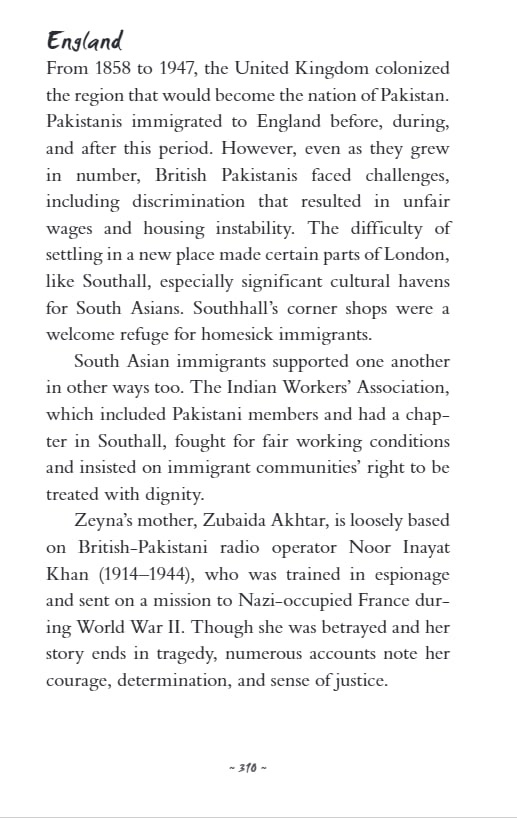
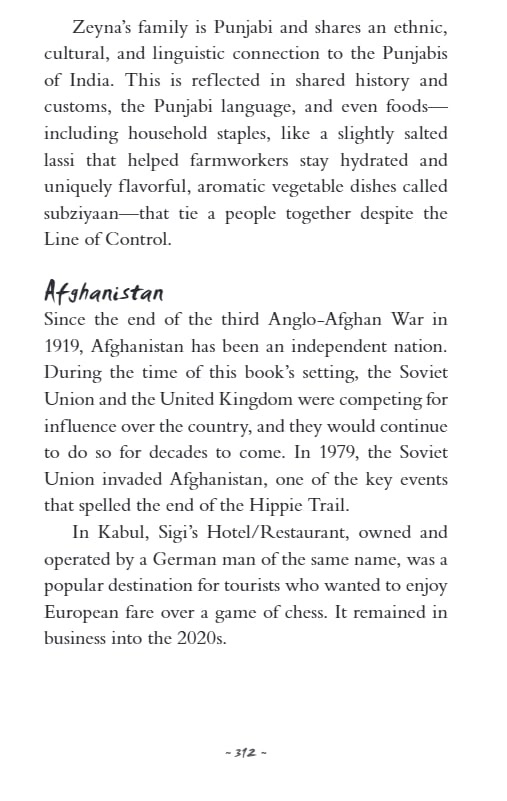
It’s hard to review a book like this without giving the twists and climax and resolution away, but more than once I gasped in delight when something happened on the page, and it crystalized where the book was going in my head.  Sure there were some particularly outlandish connections and a few plot holes, I even Googled when fax machines were invented, but I had a blast reading the book.  I loved the historical backmatter discussing the events in post partition Pakistan, a year before Bangladesh was independent, Soviet Union and UK competing over influence in Afghanistan, the discontent voices in Iran toward the shah, and the role of the Pudding House for messages in Turkey.  There are also discussion questions, a glossary, acknowledgements, and about the author at the end.

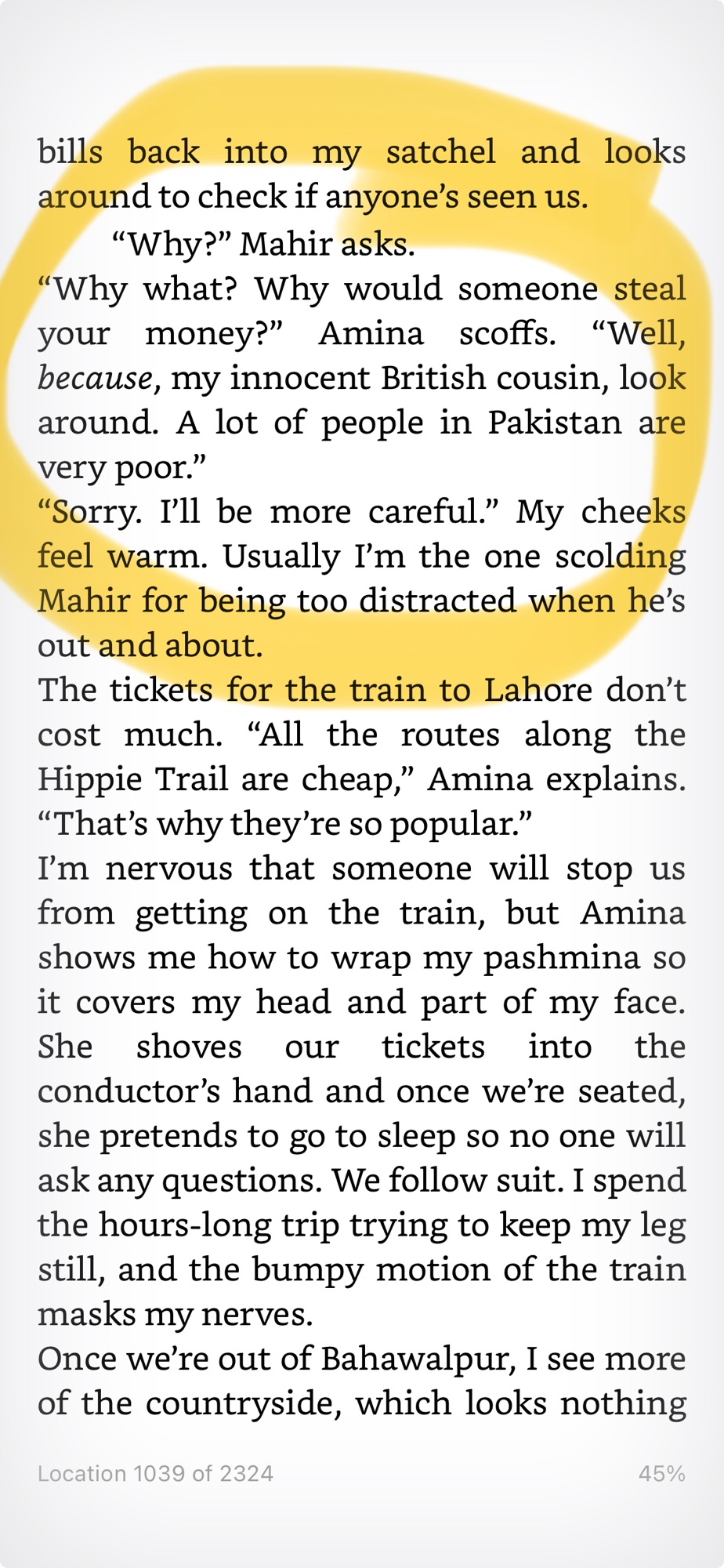
One tiny concern was the assumption that money could be stolen because the people around them are poor, it is just one paragraph, it isn’t a constant in the book, but it struck me as odd and stereotypical, and really not needed.

FLAGS:

Lying, stealing,  deception, pretending to be someone you are not, breaking and entering, eavesdropping, snooping, its a heist book!

TOOLS FOR LEADING THE DISCUSSION:
This would be an awesome book club book or novel study read, I can’t wait for it to be released in a few weeks so that I can have my kids read it.

Kamal’s Key by Rifk Ebeid illustrated by Sophia Soliman

Standard
Kamal’s Key by Rifk Ebeid illustrated by Sophia Soliman

This 44 page hardback book gently, yet powerfully, focuses on the Palestinian resistance symbol of the key, by sharing a multi generational tale of new beginnings, heartache, hope, and resilience. The writing is moving, and flows with simple lines, beautiful illustrations, and maintaining a focus on a singular theme. So often well meaning books about oppression, war, politics, try and include numerous details that the picture book suffers in its appeal to younger audiences, the opposite is often true with books being so generalized that it isn’t clear exactly where refugees are from or what turmoil is being discussed. This book strikes a beautiful balance of calling the incoming occupiers a dark cloud and not giving them space or attention, while focusing on Palestinian experiences through a lens of hope, joy, and love.

The book starts with the key. It is a beginning to Kamal’s home. It is on his belt at his wedding, it is the beginning of his and Huda’s new life starting together, a symbol of their home when their son is born. It is the beginning of Jalal’s imaginative play of using it as a dhulfiqar. It is secured around Huda’s neck when they are forced to leave their home, and find refuge in tents. It is hung when the tents become walls.

One day Jalal takes it down, when the hurt in his father’s eyes is too much for him to witness. When Jalal becomes a father though to Salma, the key becomes her toy, her microphone, her connection. When Kamal gifts the key to his granddaughter it becomes her art, her poetry, her necklace, a symbol of her hope and a people’s right to return.

I’ve read this story a few times to myself, as well as with my children, and I only wish it was a little larger in size. It works well one-on-one or with a few, but it is a story that needs to be shared in large story time groups, and the 9 x 9 inch size makes it a bit difficult.

img_8454-1

The book concludes with an author’s note, an illustrator’s note and a glossary, not just of terms, but traditions, concepts, and information about the song. I purchased my copy from Crescent Moon Store.

Vultures in the House of Silence by A.R. Latif

Standard
Vultures in the House of Silence by A.R. Latif

img_7966-1

This 312 page richly imagined Islamic fantasy is both engaging and compelling.  It is too advanced for me to review as it weaves a complex tale based on history, religion, fantasy, and imagination.  I do know that it was for the most part well written, I have some issue when the character’s diction would include words that felt too contemporary slang, but it didn’t happen too often.  The pacing though, unfortunately for me, was definitely off.  Undoubtedly the author has tremendous skill.  The emotional pulls, the world building, the consistent cliffhangers at the end of each chapter, kept me curious to see what would unfold.  The story beats just dragged more often than they should have for no clear reason in developing the plot, defining character arcs, or adding to the rising action.  I don’t think I ever stopped reading at the end of a chapter, those hooks were well placed, but when I stopped in the middle of the chapter, it often took four or five days for me to be motivated enough to open the book back up.  I truly think it just needs a good editor to help cut certain scenes, and smooth out the tempo.  The idea and layers are great, and if I, as someone who struggles with middle grade fantasy, couldn’t walk away from this YA/Adultish read, I’m sure lovers of fantasy, jinn, monsters, Islamic history, found family, gray characters and action, will find this book an enjoyable read, even the slow parts, that  I struggled with.  So no this is not a negative review,  I am hopeful my teenagers will read it and enjoy it, I just really hope the author will consider working with an editor to elevate the text as it truly has potential.

SYNOPSIS:

I don’t know that I can retell the story, it has a lot going on and I’ll probably inadvertently spoil something, so here is the summary from the back of the book:

“A boy wakes up surrounded by corpses. Unable to move, he is assaulted by vultures who stop pecking at him only when he speaks. To survive this nightmarish ordeal, he tells them the story of how he ended up on their menu…

What follows is the wild tale of the young gardener Khurafa, coping with the aftermath of the Mongol invasion of Baghdad and the death of his parents amidst the bloodshed. After a vivid dream and several supernatural encounters, he becomes convinced that an ancient group of nine sorcerers called the Servants are bent on world domination. Accompanied by his scholarly mentor Shaykh Nariman, and the sly, uncannily perceptive Zakiyya, he seeks saintly help against the Servants, but finds mostly monsters instead.”

WHY I LIKE IT:

I love the opening, it really grabs you, the emotion of Khurafa and the loss of his parents and his predicament with the vultures connects you to him and his vulnerabilities.  The twists are also well developed and keep the book interesting.  I feel like the end needed more, and the middle needed less.  SPOILERS: I didn’t get the cat, or the going from village to village.  All the names, and all the drama at each village, dragged for me.

It appears the book is meant to be a series, so I wonder if many of the characters that died will return, but I feel like the final battle was a little disappointing, and anti-climatic.  All the build up and then it went so quick.  I appreciated the full circle on the House of Silence, and the answering of some of the questions, but for all the emotion  at the start, the end didn’t mirror that in the cathartic way I hoped it would.

I say all this with full acknowledgement that I am not drawn to fantasy, I am not well versed in Islamic history, and it is absolutely possible, that I just don’t get it. In brief, I am not the target audience.

TOOLS FOR LEADING THE DISCUSSION:

I think this book could be a good book club selection, with some motivation to get to the end, I think readers will be happy that they did, and I would imagine they would be willing to read the next book in the series. For many I would imagine it would be the first Islamic fantasy they will have read that has the layers, richness, and intrigue that this book does, and inspire them.

Prince Among Slaves by N.H. Senzai illustrated by Anna Rich

Standard
Prince Among Slaves by N.H. Senzai illustrated by Anna Rich


462575630_1072301494218509_2457799047040333197_n

This 48 page biography tells a story that we all should know, yet are probably hearing for the first time.  The story of how West African Prince, Abdulrahman Ibrahim Ibn Sori, was forcefully taken and sent to America to be a slave on a plantation, what he endured for decades, and how he made his way back to the African continent.  The large emotional illustrations and poignant text tell of his his life in Fouta Djallon, the painful journey to Mississippi, the trials as a slave, the joy of being a husband and father, and his attempts to return home a free man.  With each challenge and at each stage, him additionally showing amazing strength and trust in Allah swt.  The heartbreaking tale unearths so much evil, ignorance, and faith, that the story is not meant to be read once, it begs to be reflected on, pondered over, and shared far and wide. The treatment of Prince Abdulrahman shown in some of the illustrations are difficult to look at, as they should be, there is also a very passionate kiss shown up close between him and his wife.  I think the story’s words and illustrations emphasize the anguish, the strength and the humanity, but I mention the illustrations for each to decide on their own.  There is not a biography or sources in the book, but rather mentions in the Author’s Note the source matter being a film by Unity Production Foundation.  It is not unusual to adapt a biography from a film, and I read an ARC, but I do hope the final copy will be sourced.  The book is for middle grade readers, and I cannot wait to add a physical copy on my own bookshelves, and gift numerous ones to teachers to share in their classrooms.

WARNING: SPOILERS: THE SYNOPSIS CONTAINS A FULL RETELLING, as it is historical, I hope that is ok, but in no way shape or form is my summary taking away from the details, emotion, and writing the actual book contains. 


In 1762, the Fulbe enjoyed prosperity and peace under the king, and when Abdulrahman was seven he started school in Timbo. He loved learning about the Prophets in the Qur’an, and excelled at his studies.  So much so that his father sent him to Timbuktu to continue his studies at age 12. Five years later he returned to train as a warrior, when the first white man, a surgeon, Dr. John Cox appeared injured and lost, they helped heal him and sent him back home to Ireland.

By age 26, Prince Abdurrahman was a warrior, a scholar, soon to be king, a husband and a father of a son.  One day while on patrol, he was captured. He and 170 others were loaded on a ship, for eight months, and sent over 3,000 miles across the Atlantic Ocean.

On August 16, 1788 he arrived starved in Natchez, Mississippi, for $930 he and another man became the property of Colonel Foster.  Resigned that this was his fate, he helped share his knowledge of cotton, and the plantation prospered. In 1975 he married, Isabella.  They had nine children and eight grandchildren.  

In 1807 while selling goods in the market, Abdurrahman sees Dr Cox (subhanAllah), and the doctor pleads with Colonel Foster to free the Prince.  Foster could not be moved and when the doctor died, Abdurrahman once again accepted his fate. 

His story though had started to spread, and a printer, felt a softness to the Prince turned slave and printed often embellished stories trying to help his cause.  He asked the Prince to write a letter, the Prince wrote an ayah from the Quran and the printer passed it to Mississippi senator Thomas Reed explaining the Prince’s desire to return to Africa.  Senator Reed got the letter to Henry Clay, the Secretary of State under John Quincy Adams, who then got the message to the President of the United States.

The letter was written in Arabic, and they assumed Prince Abdurrahman was thus from Morocco.  The Sultan of Morocco was touched by his plight and petitioned for his release, and the Prince kept quiet not wanting the truth of where he was from to remove the help he was receiving.

He was finally freed and able to purchase the freedom of his wife Isabella with the help of those who had heard his story, but the efforts to free his children were not as successful.  The truth about him not being Moroccan became known, and despite extensive travels and pleas, his declining health forced him to leave America with out his children.  He arrived in Monrovia, Liberia, but would die before he could reach his home of Fouta Djallon.

462563778_440473032154161_1815006209353878188_n


A Map for Falasteen by Maysa Odeh illustrated by Aliaa Betawi

Standard
A Map for Falasteen by Maysa Odeh illustrated by Aliaa Betawi

img_5521-1

This 40 page OWN voice written and illustrated picture book for kindergarten to elementary, addresses the question and provides some answers that Palestinian diaspora children have faced for years, about the attempted erasure of Palestine by way of not labeling the country on maps.  The book does not name the occupiers, so hopefully it will avoid bans and censorship, as it does not shy away from articulating the taking of land, theft of homes, and renaming of villages.  The refrain is that “Palestine lives in you and me,” and that can never be taken away.  That the book stays on level and is traditional published is quite impressive for the contents contained. I love that their are resources as the beginning for adults to learn more, that Isha prayer is mentioned, The Proudest Blue is in an illustration, that rohi, omri and habibti are woven in, and the Author’s Note is detailed. 

img_5522-1

The book starts with little Falasteen at school, the class has a new map of the world and everyone is taking turns telling about where their families are from.  Let me pause here and say, this was my biggest, only real problem with the book, the illustration hints that the map is the rug, and the rug is just shapes of the continents, it is not a political maps that shows country boundaries, but I also read an e-arc so maybe something will change in the illustrations, but none-the-less, I note it here because it is the first page.  Moving on, when it is Falasteen’s turn she doesn’t see Palestine and when she asks her teacher, her teacher tells her, “I think there is no such place.” I wish I could say this is extreme, but I’ve been hearing similar conversations from friends for over 30 years, at least in the book the teacher isn’t mean about it, just ignorant, real life sadly, is often much more aggressive.  This is the catalyst though that prompts Falasteen to start asking her question.

When she gets home, she asks her Jido, who is tending the grape vines, why Palestine is not on the map, and he draws her a map to take to school the next day to share with her friends and teacher.  He tells her, her “teacher needs teaching.” Let me pause again her, I was initially a little surprised at this tone, and SPOILER that at the end it doesn’t circle back to her teaching her teacher and class, but on the second reading, I was glad for it.  No one should have to prove their existence, that is my bias of wanting to be accepted or palatable to an outside gaze.  Teachers all the time get asked something they don’t know and if it on topic will go and find an answer, to dismiss little Falasteen intentionally or out of ignorance regarding her home country, is not something that needs outside approval, or that needs to be proven.  Outside acceptance is not required in this example of reality. 

She then asks her Teta who is cooking in the kitchen, why Palestine is not on the map.  Teta tells her about when soldiers came with their tanks and guns, and burned their fields, and she had to leave with Falasteen’s mom in her arms to keep her safe.  She shows her the key that she keeps from her home that was taken, and how she longs to return.

img_5524-1

After Isha prayer, Falasteen asks her mother the same question.  Her Mama tells her that some places don’t need a map to be found, and that “Palestine lives in you and me.”  That even though Falasteen has never seen Palestine it is within her.  When she tells her mother that her teacher told her it doesn’t exist, her mom explains that those that say it doesn’t exist, that make the maps, cannot erase them, their memories, their culture. 

The remainder of the book is more hopeful and prideful of the places where Palestine is found and the hope that someday they can visit. I enjoyed the read, it is important, it is needed, and I hope you will preorder/order it to show your support.

The Story of Hajj and Eid Al-Adha by Humera Malik illstrated by Basmah Syadza

Standard
The Story of Hajj and Eid Al-Adha by Humera Malik illstrated by Basmah Syadza

img_5367-1

This early chapter book discusses some of the key parts of Hajj and Eid al-Adha in a fictionalized manner.  A young girl, Sumayyah, spending the weekend with her grandparents finds an old photo album of their trip to Hajj, and bed time, walks to the park, and baking muffins, all provide great opportunities for grandma and grandpa to share their experience, the Islamic concepts, and the historical roots of this pillar of Islam.  The book is presented in a gentle way with concepts explained in broad terms, some related to experiences Sumayyah can relate to, and kept light and age appropriate.  The book is not particularly detailed, or even as informative as many picture books, but allows early independent readers to emerge themselves in the story, pick up on familiar and new facts, and hopefully gain a bit of an overview about Hajj and Eid al Adha.  Their isn’t a plot, it is characters and their dialogue providing a framing for the concepts to be shared.  The illustrations are sweet and make it accessible to the target audience, and while the author’s note acknowledges that further information can and should be sought from people of knowledge.  I really wish this book would have sources or a scholars approval, or where to go for more information.  Overall, a good book for our kids, and an easy read that they will benefit from, alhumdulillah.

The book starts with establishing the characters, the photo album, and the curiosity surrounding it all.  There are nine chapters in the book: The Photo Album, Prophet Ibrahim, Ihram, Tawaf, Sayy, Mina, Arafah, Muzdalifah, and The Ka’bah.  The titles really outline the book and what it covers.  The rituals are explained and the historical concept given and often linked to something Sumayyah and her grandparents are doing.  For example, Sumayyah is inspired by Hajarah’s bravery running between As-Safah and Al-Marwah and uses that to fuel her determination to tackle the zip line at the park.

I enjoyed the approach to the content, it doesn’t just list everything as steps or facts.  The history, the acts of hajj, blend together to make it read like a story, even with the predictable framing of teaching the character to teach the reader.  My 8 year old knows a lot of the facts and details, but could chat about them a bit more after reading this book, alhumdulillah.

The Djinn’s Apple by Djamila Morani translated by Sawad Hussain

Standard
The Djinn’s Apple by Djamila Morani translated by Sawad Hussain

img_4352-1

This short, 160 page YA book is really quite gripping. Admittedly, during the first third of the book, which is primarily world building, I had no idea what was really going on, but I was intrigued and by the half way mark, I was so invested, I truly could not put the book down. I received an early digital copy so I am not sure if the grammar errors, typos, and lacking punctuation is because it had not been through line edits yet, or a result of translation oversights, none-the-less I thoroughly enjoyed this book and read it in a single sitting. I wish this book was 500 pages long, with details about the time and environment, and build up to the conclusion, and angst to the romance, but it is not there, it is short, and rushed, and I don’t really know how to review it, because to point out all that is wrong, doesn’t convey all that was right. I am a self appointed reviewer, so I’m going to break my own standards and just copy and paste the teasing blurb, I can’t say it better, you are welcome: “Historical fiction meets crime fiction in The Djinn’s Apple , an award-winning YA murder mystery set in the Abbasid period—the golden age of Baghdad. A ruthless murder. A magical herb. A mysterious manuscript. When Nardeen’s home is stormed by angry men frantically in search of something—or someone—she is the only one who manages to escape. And after the rest of her family is left behind and murdered, Nardeen sets out on an unyielding mission to bring her family’s killers to justice, regardless of the cost…”

SYNOPSIS:

See above, I know my standards are slacking, but that blurb is what helped guide me when I got lost a little lost with the words on the pages.

WHY I LIKE IT:

I love the map and in this case the glossary and backmatter really helped me to understand the setting because the text assumes the reader knows about Harun Al-Rashid, the Golden Age of Baghdad, and the Abassids. I appreciated the Reader’s Guide and further information about the Bimaristan, as well.

I like that it showed the family as being practicing Muslims, them being accused of being infidel Zoroastrian, and the adopted father and teacher being Jewish, it added a layer that entices the reader to reconsider stereotypes and look further into the society. The book doesn’t offer much commentary about it, but does highlight the different religious groups and show them interacting.

The book really pulls you in and considering that I was lost and there were grammar errors and typos, really speaks to the story and heart of the writing. I am glad I read it, it will stay with me, and I may not be able to pass an AR test on it, but I do plan to get a physical copy for the library and for myself, so that I can read it again.

FLAGS:

Murder, plotting, revenge, poison, romantic feelings.

TOOLS FOR LEADING THE DISCUSSION:
I need to read the book again, but yes, it would be awesome as a book club selection for Middle School or even High School to discuss, pick apart, analyze, research, and enjoy.

Muhammad’s Recipe for Remembering By Maidah Ahmad illustrated by Shruti Prabhu

Standard
Muhammad’s Recipe for Remembering By Maidah Ahmad illustrated by Shruti Prabhu

img_4274-1

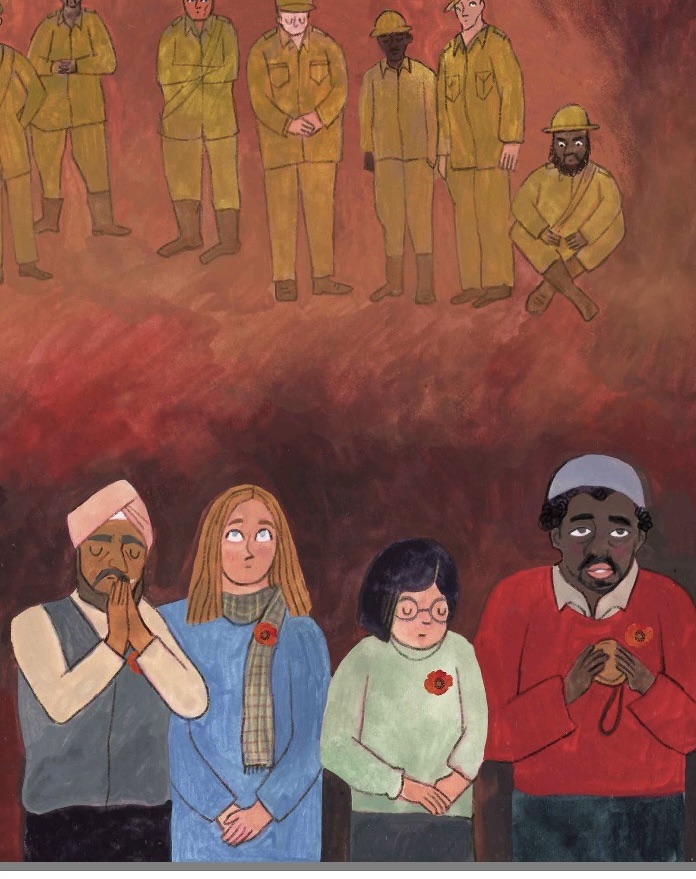
I feel like the idea and heart of this 40 page picture book is decent, but the story, presentation and takeaway are just really poorly executed.  The pitch is a Muslim Desi kid feeling left out when all his friends are rehearsing for the upcoming veterans assembly because he doesn’t have anything to share.  He then starts asking his family, and the Muslims and non Muslims hanging out at the mosque to find out about Muslim and Indian involvement in the World Wars.  A rarely explored topic, considering in the West WWI and WWII are taught from a Western centric perspective, no doubt.  Unfortunately, most early elementary readers, the book’s target audience is 4-7, have limited knowledge of the World Wars, let alone about the subcontinents own politics and that they were occupied themselves under colonial rule at the time, and this book does nothing to explain any of it.  The inconsistencies, plot holes, vocabulary and ultimate lack of sharing a single story from a descendant of someone who fought, make the book rather pointless and forgettable.  Truly the take away is that there were Muslims among the Indian army, they made roti and prayed.  No real idea what they experienced, saw, endured, or gained in return for being forced to fight for Britain on the global stage.

img_4275-2-1

The book starts with Muhammad listening in to his classmates talk about their family members that are veterans and him feeling left out.  At recess they don’t let him battle in the reenactments and instead make him be the cook. When he gets home his dad is making rotis and Muhammad asks his dad if they have veterans in their family, they then go ask his grandfather if his great great grandfather fought in either World Wars.  Dada jaan recalls that “they sent my grandfather to France in World War One.”  But he never spoke about it except to mention that they shared rotis.  He suggests they go to the mosque the next night as that is where, “a kaleidoscope of people gather.” He learns from a Sikh uncle in a turban that whole villages went to fight and from Imam Rafiq that the soldiers fasted in Ramadan, prayed, and celebrated Eid.  No one has any visible tokens of their family’s service as they were lost over time.  Determined not to let the stories be lost, Muhammad shares roti at the assembly.

img_4277-1

Ok, buckle up, I have a lot to point out, but first the positive.  I like that the dad makes rotis.  Mom isn’t in the book, but there are a lot of pictures of a lady hanging on the walls of the house, so possibly she has passed and dad has to cook, no matter, it is nice seeing a Desi dad in the kitchen.  I also like that the mosque is central to the story, I wish it was called a masjid, and that it was explained why people that are not Muslim are hanging out there.  Brown people are generally lumped together and this seems to reinforce that stereotype, which makes me less than thrilled.  It seems like a social environment with ping pong tables and snacks happening, so why not say it is a social hall at the masjid where people of all faiths often gather.  A “kaleidoscope of people” does not explain people of different religions at a mosque to most four year olds.  The book claims the assembly is honoring veterans, so why is Muhammad only curious about WWI and WWII is never explained.  He is teased and forced to be the cook by his friends, with a very negative connotations and depiction in the illustration, but that notion is never pushed back upon, and is actually heightened with rotis being the thread that ties the entire book together.  A missed opportunity to be sure.

img_4279-1

I really struggle with the reality that the majority of Indians were forced to fight, and the book keeps it vague in the text with lines such as “joined the war effort,” and “they sent..” who is they? It sounds nice that Muhammad doesn’t want the stories, like the artifacts to be lost, but WHAT STORIES? If the book is about remembering, and stories are to be shared at the assembly, I feel short changed that the reader doesn’t get a single story about a Muslim or Indian that fought in one of the World Wars.  Isn’t that the point of the book? Yes the book has sources at the end, but it is fictionalized, make up a story, give the reader and Muhammad something to take pride in, to understand through, to imagine, what it was like for his great great grandfather.

img_4280-1

I struggled with the illustrations as well, Imam Rafiq looks off in the final image, I don’t get why Dada jaans memories seem to be on the TV either.  I also didn’t understand why rotis were the thread, but then it is paratha at breakfast that gives the idea, and who really is constantly spreading ghee on paratha or roti let alone at war, or at recess.

img_4278-1

War is not a trivial matter, and I kind of feel like this book reduced it to food, and allowed some racism, classism, and  Islamophobia, to go unchecked along the way.  I like that the backmatter has a recipe and an author’s note, but colonialism, service, war, are all heavy topics that are hard to bring down to an early elementary level picture book, and sadly this book is unable to connect and inform readers about this time in history.