Category Archives: Elementary Fiction

Stuck in the Middle by Sumayyah Hussein illustrated by Diana Silkina

Standard
Stuck in the Middle by Sumayyah Hussein illustrated by Diana Silkina

middle

At 122 pages this early chapter book with frequent illustrations is a great book to share with 2nd-5th graders.  It is has a great message and lesson with lots for children to relate to with regards to life with siblings, getting frustrated, making mistakes and recovering.  The lesson is strong, but doesn’t become preachy as the protagonists voice rings true to her age.  Mistakes are made by many characters and situations are fleshed out so the reader can understand why things are done.   By showing that there isn’t one side to a story, and that knee jerk reactions are common, readers will get that ultimately we are still responsible for how we act, and learning from our transgressions is part of growing up.

5343F790-E06E-47DB-96D9-A85A7EAEFA9E

SYNOPSIS:

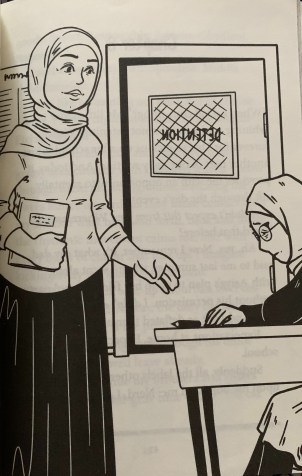
Salma is the middle child in a busy family, and very little is in her control.  When her frustration over her brother stealing a chocolate bar, causes her to lose her cool, and then she is forced to run errands with her family, homework doesn’t get done in time and she finds her self in detention.  Normally a very good student, teachers and other students are shocked that Salma is in trouble.  Things don’t improve when her brother steals her carrot cake the next day, and in a plot to get even, Salma ruins her brothers brand new PS4 controller.  She also turns a blind eye at school when she sees someone picking on him.

Doing her best to avoid being discovered as the culprit, or being in a position to see her brother being bullied, her guilt starts to get to her.  When an ambulance has to come to the school for a kid that got pushed and needs stitches, she realizes she has to make things right, even if that means getting in trouble.

7E60CD43-7DCB-41AE-BFF8-6CA415A5BDA2

WHY I LIKE IT:

I love that it is so relatable, honestly switch Salma with my middle son Haroon, and the 13 year old boy that doesn’t want to go out with the family, with my 13 year old daughter that doesn’t want to go out and we are looking in a mirror, haha.  The family is Muslim and they practice and let the religion shape their view of the world and how to function within it.  The girls wear hijab and use the hadith premise that they have to fix a bad deed with a good deed to provide the solution to the mistakes made earlier in the story.

AE60B7D6-48FA-4A46-A4E7-4F0BB40351AD

FLAGS:

None

46612FC3-B196-4A59-9BB8-AA54F7ADBD3F

TOOLS FOR LEADING THE DISCUSSION:

I already made my middle child read the book, and because of the length it wouldn’t lend itself to a book club, but I can see teachers having kids read it and then discussing, just like I am doing in my family.  It is sweet and well done and a great addition to your bookshelf.


Not Quite Snow White by Ashley Franklin illustrated by Ebony Glenn

Standard
Not Quite Snow White by Ashley Franklin illustrated by Ebony Glenn


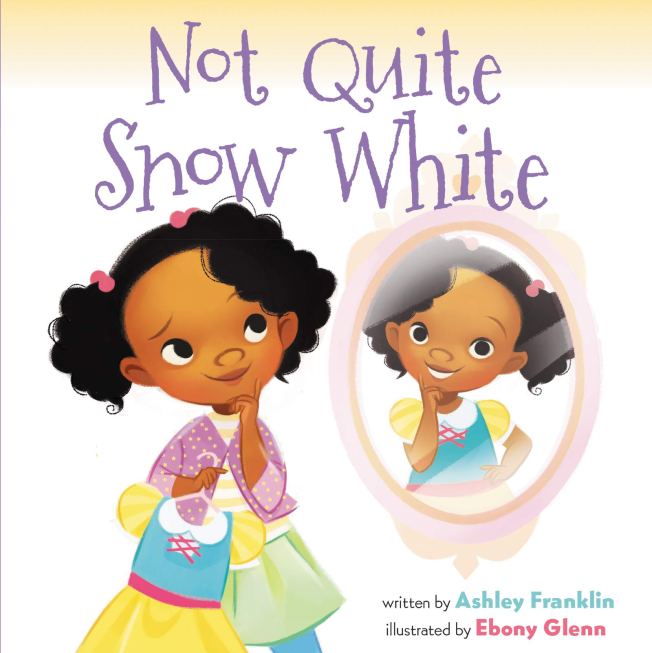
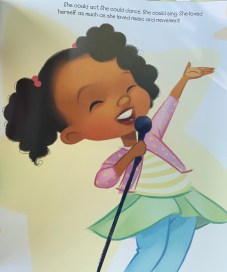
not quite snow whiteThis 32 page picture book meant for preschool to 3rd grade really should be required reading for EVERYONE.  So many lessons, so beautifully conveyed in the simple text and beautiful illustrations that I made each of my kids read or listen to it and then discuss: self confidence, nay sayers, self esteem, race, passion, body image, kindness, and perseverance to name a few. Accelerated Reader Level is 3.2 as older kids will understand a bit more than the younger ones, but I truly believe all will benefit.  Written by a Muslim woman of color, featuring a girl of color and illustrated by a woman of color, this OWN voice book has it all for girls and boys alike.

67C6C849-8C74-438C-B57D-15648F8E6136

Tameika loves to sing and dance and be on stage in front of an audience (stuffed and unstuffed).  She feels like she can be anything she wants and when her school puts on a production of Snow White she can’t wait to audition to be a princess.

3A1948AB-AD83-42E1-8133-AB27C3708705

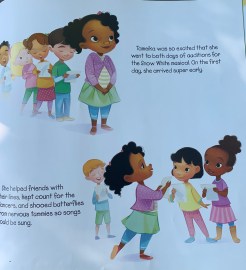
She arrives early the first day of auditions and helps her friends with their lines and nerves.  But then she hears them whispering that she can’t be Snow White.  “She’s too tall, too chubby, too brown.”

6639ED62-4406-41EB-8957-69B6268E8C75

Their words deflate her as she internalizes their thoughts about her.  She doesn’t feel like singing or dancing and she questions her appearance.  Her mom tries to build her back up.  Her father reinforces her qualities, and slowly she starts to think maybe her parents are on to something.

A06D6FE9-87FC-4A83-8F09-14D627BE9902

The next day she has to face her fears and when she steps out on to the audition stage.  She knows what she loves, she knows the joy it brings her and she has to dig deep to push the negative away and shine.

E0144101-5394-4BDC-B0AE-0441ED085ACB

Yes, I’m going to spoil the ending, she gets the part and she rocks it, ok I’m projecting based on her smile.  But it truly isn’t about getting the part and excelling at it, it is trusting that you are perfect as you are and confidently owning it.

The book is available everywhere, even the library, so please go get it, read it with your kids and get discussing! Fiction is a great start to talk about racism and fat shaming and all the other things that you think are hard, but kids need to hear and see and talk about from a very early age.


Our Superhero Edhi Baba written and illustrated by Maria Riaz

Standard
Our Superhero Edhi Baba written and illustrated by Maria Riaz

edhi

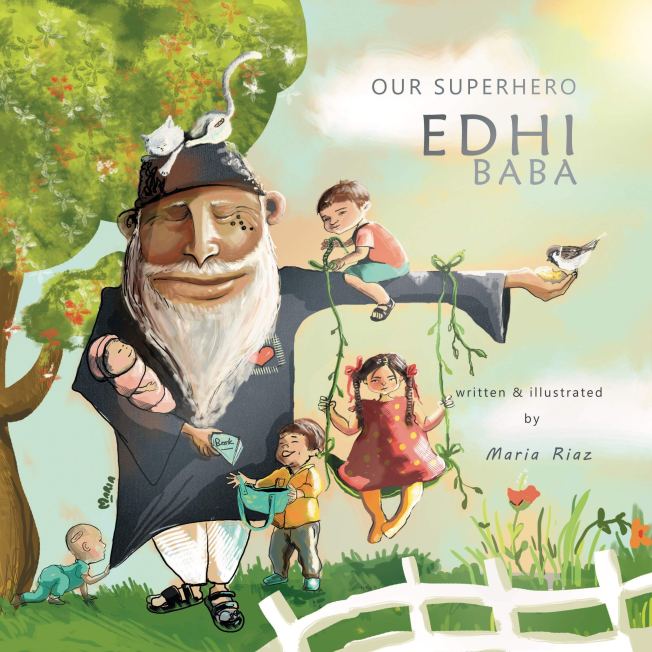
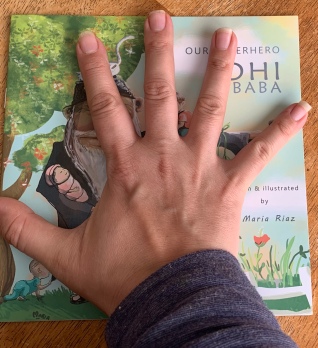
This is a hard review to write.  I have been trying to get this book in my hands since it was published and just could not.  I’d ask people to bring it from Pakistan, or try and order it on Amazon to find it out of stock.  And then finally I was fortunate that my cousin was able to purchase it for me, get it to my dad who was visiting Karachi, my dad then mailed it to me within the U.S. and voila a book that sells online for $15 (and is currently in stock) in my hand for RS 475 (less than $3), I mention this because if I had paid $15 for a 7×7 inch book that has only 16 pages, I’d be grumpy.  Having paid less than $3 (plus shipping) and involved multiple family members in the process, if I’m honest, I’m still a little disappointed with.

6A2DB5A1-8FE8-4608-8C3A-E81A352477EA

The book is beautifully illustrated, the author is the illustrator so why not make the book larger, so the illustrations could be appreciated?  The book is really short and very vague, even the note at the end could provide so much more about this national hero, his accomplishments, his struggles, his goals, his legacy.  And I’m not sure why it doesn’t.

7B314A2E-9BFA-4D25-A810-339E20A460AD

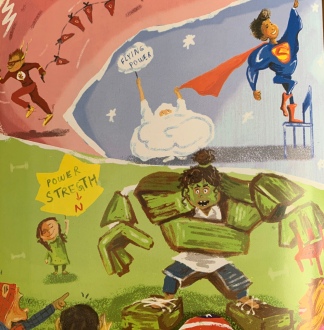
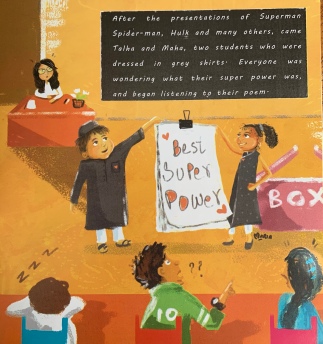
The book is framed with kids presenting superheroes in class: Superman, Hulk, Spiderman, etc., two kids wearing grey shirts and white pants start their presentation about Edhi.

B695DEF7-CC65-4623-817F-DCD780CA508B

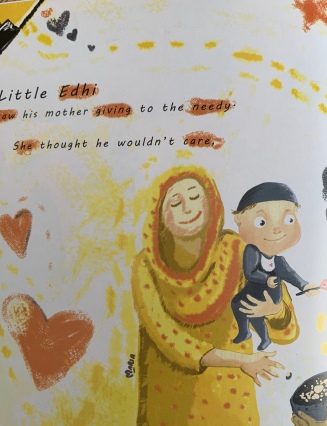
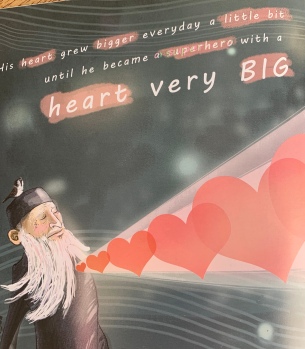
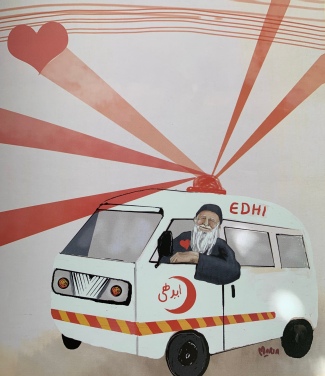
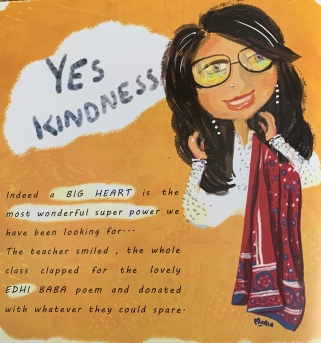
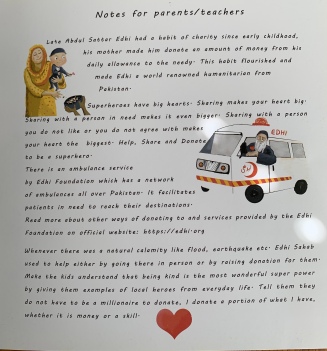
In rhyming lines the kids talk about how Edhi’s mother would give to the needy and how he continued this giving whatever he could spare from a young age.  How giving everyday made his heart grow big.  He gave to everyone and didn’t discriminate based on skin.  It mentions that he started an ambulance service and we should follow his plan of helping and donating.

A2DF1235-63EA-4FEF-8495-66B63AEFA578

The note at the end talks about how to donate and how superheroes have big hearts and share not just with people they like, but even people they don’t like.  The author then says that she donates money and skill.

7E6B0C80-7C8B-44C5-846F-C0781DBC84DA

The writing is clear enough for the sparse words on the page.  I don’t want to critique a Pakistani writing rhymes in British English, because I speak one language, and clearly realize the beauty in being able to speak and write and convey in more than one language, but it is a bit awkward in parts.

F0FC330D-C20E-4957-9917-7C0551D0ED91

The idea of the book is beautiful.  Edhi was a humanitarian that needs recognition both within Pakistan and abroad.  But, I really wish this book had a bit more substance to it.  I think it can get a conversation going with little kids, but older kids will find it very generic, and unless a nearby adult can add to the story, it sadly won’t be remembered.

B33B93B2-BA26-4194-B1EF-F864E9B3112D

A portion of the book goes to support edhi.org, but it doesn’t specify how much.

(size reference):

97973BFE-6B49-478F-A110-B1C122ECAD9E

The Vine Basket by Josanne La Valley

Standard
The Vine Basket by Josanne La Valley

vine basket

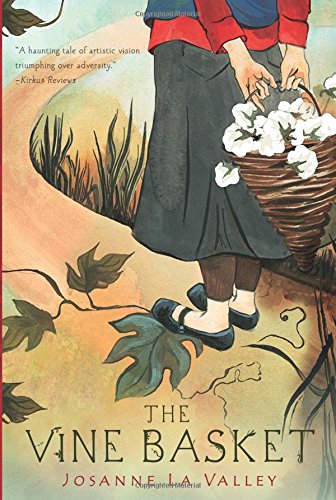
While in the midst of moving from Knoxville to Birmingham nearly 4 years ago, a lady reached out to me telling me that a colleague of hers, also an author, was a follower and fan of my blog and had recently passed away, she asked if she could send me a copy of her friend’s books.  I agreed, not knowing what type of books the lady had written and didn’t think much of it.  In the chaos that is moving, I received the books and boxed them up and then unboxed them and vaguely remembered that they were about Muslims in China.  I put them in the to be read pile and just never got to them.  Then as the plight of the Uyghurs started to be known here in the US, something tickled my brain, but nothing came of it, until recently when I realized, a lady, a non Muslim years ago was trying to tell the Uyghur’s story, and had reached out to me, and I didn’t get it, and still wasn’t getting it.  So alas, I have now read the Vine Basket, and while it might not present Islam the way we are used to seeing it in life and in print, the characters do identify as Muslim and this middle grade book is a simply woven, beautiful story that gives voice to a population that is horrifically being silenced.  The AR 5.0, 252 page book is a quiet book that will stay with me: the drunken father, the threat of being sent to a factory, the loss of tradition;  I am so glad I read the book, and only wish I could reach out to the author to hear more about her knowledge of the region, of the people, of the culture that is being erased.

SYNOPSIS:

Mehrigul is 14, and since her older brother left, she has been forced to leave school to help her father sell goods in the marketplace.  More often than not though, it is solely Mehrigul’s responsibility as her father drinks and gambles away the meager earnings the family makes. Her mother, ashamed of the poverty the family endures along with some presumed mental illness and headaches, seeps further and further away from the reality of life and the chores that need to be done to ensure food and survival of the family.  Her younger sister is the only spark in a dreary and difficult life, and Mehrigul is determined that she should stay in school and be shielded from the darkness hanging over the family.

One day while in the market, an American woman approaches Mehrigul and asks to purchase a frivolous grape vine basket Mehrigul had made and hung to decorate the cart.  She offers her 100 yuan, more money than Mehrigul has ever seen, and asks her to make more baskets, and that she will be back in a month to purchase them. The basket serves no purpose like the willow baskets her grandfather weaves and despite the money, Mehrigul’s father is not happy.

Mehrigul is forbidden from making the baskets for the American, and the fact that she will even return is dismissed.  Her father grows increasingly cruel toward Mehrigul and keeps her busy to prevent her from making more.  Mehrigul seeks solace in her elderly infirm grandfather who tries to help her find inspiration and time to make her baskets as he sees in her a gift that has value in their old culture.  At one point as her father steals her baskets to take on a “religious” pilgrimage to the mountains.  And her planting crops in the fields leaves her hands cut and swollen, unable to make more with just days left before the American lady is due to return.

WHY I LIKE IT:

At first I was really uncomfortable with the idea of a white American savior coming to a dying oppressed culture to offer hope, until I read the afterwards and understood that much of the story was inspired by the author’s own experience and that she worked with Uyghur’s to get the story right.  The book reads like historical fiction which makes the day to day life of this modern book all the more heart breaking, it isn’t about the past it is the present, and life in East Turkestan is bleak.  I like the character of the father, he is an abusive mess, yet somehow it isn’t that easy to write him off, he has his own struggles and the depth of character I found in him, in a middle grades book, is haunting.  I also really like how Mehrigul’s story is so foreign to us here in America, yet her emotions and insights are universal and thus relatable.  She wants to find her place, and excel, and help her family, and she is scared, doesn’t know who to trust, and takes on more than most children any where should, but often are forced to do.

The characters identify as Muslim and as a people the Uyghurs are Muslim.  They say salam in the story, but only to the grandfather, and the girls all cover their hair with scarves.  The father obviously drinks and gambles, two practices, not permitted in Islam.  Mehrigul fastens a talisman and connects her prayers to it as a form of worship which I would imagine is cultural perhaps, and when things go awry she remarks she should have prayed to Allah swt.  The father goes on a pilgrimage to a mountain shrine, which again seems off from traditional Islam, but is presented in the book instead as odd because the father is not normally religious.  Islam is not a big part of the book, so it is hard to know if the representation of it are isolated to who the author met, or a larger norm of the community.  Considering how isolated and oppressed the Uyghurs are, I tried really hard to suspend judgement, or offer my privileged limited critique of the people.

FLAGS:

Drinking, gambling, abusive father, anger, lying, deception.

TOOLS FOR LEADING THE DISCUSSION:

I would consider this for a middle grades or even middle school book club, there is so much going on in China and in the erasing of Islam there that this book would supplement the news and few stories we are hearing.  It opens up the culture and gives it a face that is not political, but personal.  The faults of the father are not glorified at all, and the discussion about his desire to hold on to culture and fear about his daughter surpassing him would be fascinating to hear from people the protagonists age.

Mikaeel and Malaika: The Power of Dua by Kazima Wajahat illustrated by Gustavo Gutierrez

Standard
Mikaeel and Malaika: The Power of Dua by Kazima Wajahat illustrated by Gustavo Gutierrez

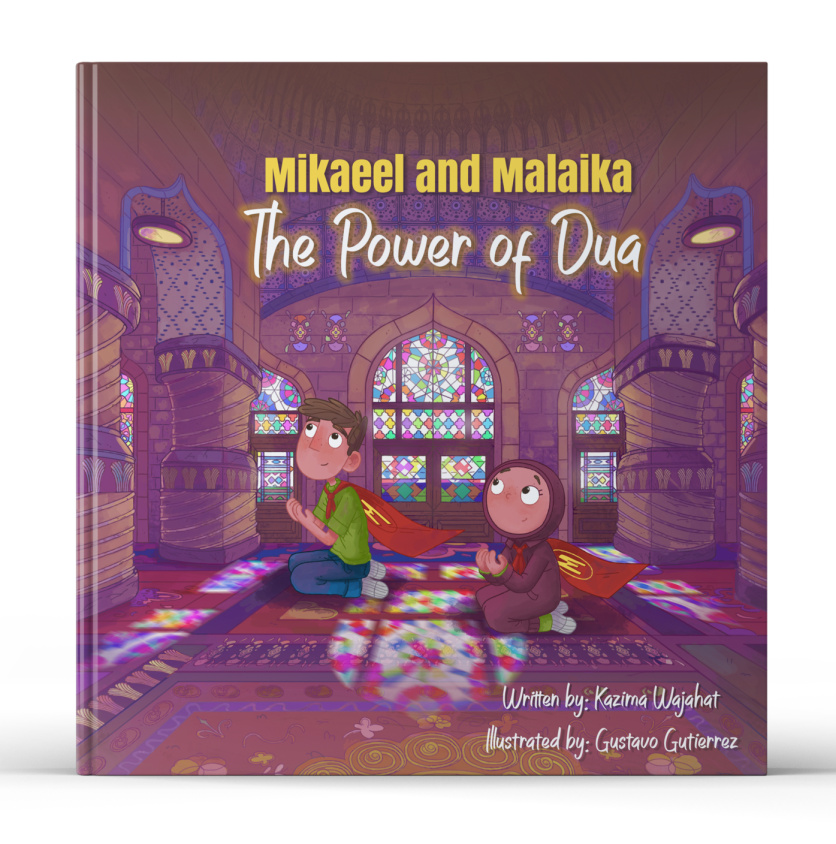
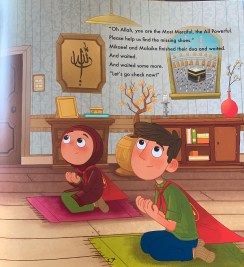
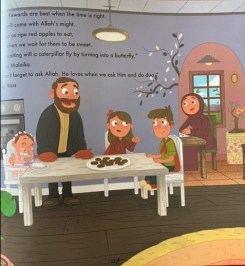
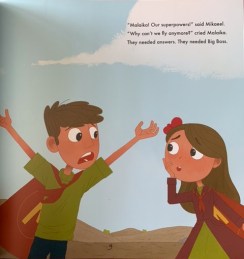
power of duaMikaeel and Malaika are back in this 32 page hardback book that explores why duas sometime seem not to come true.  Done in a hilarious manner that brings in riddles and problem solving elements, it is perfect for 6-8 year olds.  Younger children will enjoy the beautiful illustrations and silliness, and older children (and parents) will thoroughly enjoy Big Boss’s play on words and the illustrations showing his parenting style.  I’ve read the book multiple times to myself, my toddler, and even my older kids; each time surpressing a smile and enjoying the message lovingly and entertainingly conveyed: “rewards are best when the time is right.”
A8CB8717-C5BF-43A7-9A6D-AF90A8915A89

The book starts out with a problem to be solved, a mystery: who took the shoes from the masjid.  I know such a real world problem in a picture book, but fear not, super hero siblings Mikaeel and Malaika are on it.  There is just one problem, their super powers are gone.

04419E7B-4F57-4ACB-91CE-06F246F1C205

They head to Big Boss, aka their father, to find out what happened to their powers, only to learn they were part of a “14 day free trial” and their superjet? It was sold on Spamazon. At a loss of what to do, Big Boss reminds them that they have one super power left, the power of dua.

EA088D63-50D9-400D-A80D-A0C70FF1BF6A

The kids run to pray and then they wait.  When they can wait no longer, they go to see if the shoes have been returned, but…they haven’t. Big Boss gives them some sage rhyming explanaition that they don’t understand, but try to unravel in an apple orchard.  When that doesn’t work, he gives them more advice and they follow it up in a butterfly garden. With no answer insight, Mikaeel gets frusterated and wants to know why his dua won’t come true.

FE59775D-8071-4E5E-87FD-16CE71F341D5

Finally understanding that Allah (swt) does things at the perfect time and only at the perfect time, the children change their dua and the shoes are found, and the lesson learned and shared.

E5E3FE5E-EAA4-4B55-B192-BF82D8C69BA6

I love Big Boss, and this book makes it much more clear than in Mikaeel and Malaika: The Quest for Love, that his advice and riddles are in rhyme, but that the rest of the text is not.  I love that he is a hands on parent changing diapers, cooking, and guiding his kids. His steralizing of an infintile waste unit, and skimming a superhero manual are awesome and silly.

The book is about Muslim children, for Muslim children, but I think any child would enjoy the story to learn what Muslims believe, and any religious child who believes that there is one creator would be able to relate to the story as well.

671A295E-6B03-40AC-9172-C3F8085E7A73

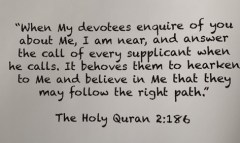
The book ends with an ayat from the Qur’an in English promising that Allah swt answers the prayers of the supplicants.  InshaAllah there will be more Mikaeel and Malaika adventures, and more of Big Boss and Super Agent M.O.M., too.


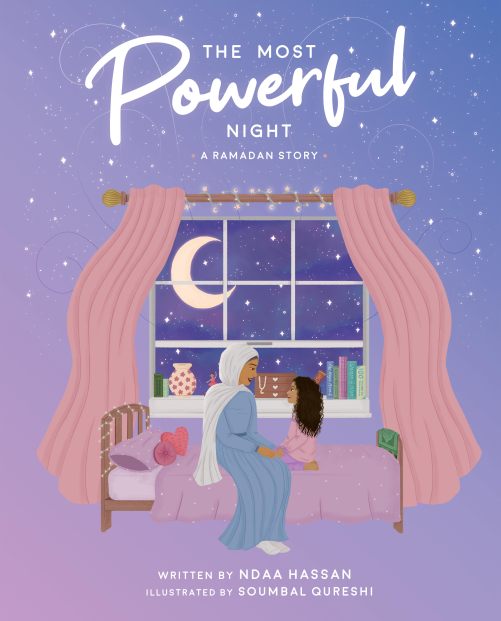
The Most Powerful Night: A Ramadan Story by Nada Hassan illustrated by Soumbal Qureshi

Standard
The Most Powerful Night: A Ramadan Story by Nada Hassan illustrated by Soumbal Qureshi

the most powerful night

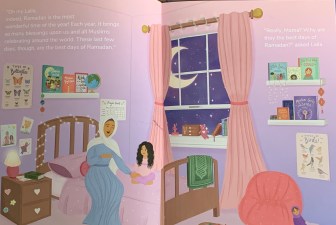
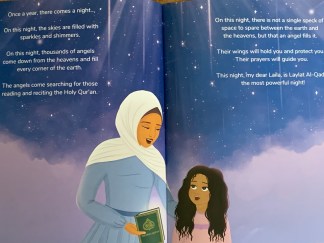
This beautiful poetic book about Laylat Al-Qadr explains in detail and wonder the importance of the most blessed night in the blessed month of Ramadan.  The soft purples and pinks of Laila’s room, and the repetitive refrains set the mood and tone of an informative bedtime story that will convey the awe and mercy of the night to seven and eight year olds.

C2080E23-FF92-40D7-A40A-49F53DD85406

The book is 40 pages, and pretty text heavy, but it flows smooth enough, and the details in the pictures are enough to keep little ones engaged. Younger and older children will also enjoy the story as both an introduction to the night the Quran first came down, and as a reminder of the gifts to be had.

816801CB-54C8-4FDE-836D-C9038DB1B538

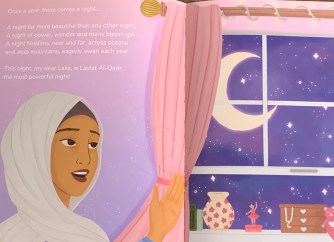
Laila is sad that Ramadan is leaving as she peers out the window and sees the moon resmembling a crescent again.  Her mother takes the opportunity to tell her about the blessings of the last ten nights, and Laylat Al-Qadr specifically.

DD841DEB-9591-4305-80E6-CC328CAB45E6

“The Night of Power and Miracles,” Laila’s mother explains is a night like no other, that comes only once a year.  Thousands of angels come down until there isn’t a speck of space that they do not fill.

13B3DC09-7A02-4921-BD9A-9DCBAAAE77D5

The night that is better than a thousand months and all our deeds are multiplied 70 times, the night the Holy Quran was first revealed to Prophet Muhammad (saw).

2F0180A5-B187-4511-A3B8-9DC0F37A55E8

Laila wants to make sure she pronounces it correctly and practices saying Laylat Al-Qadr.  Excited to make sure she is praying and reading Quran that night, she is desperate to know what day it is.  Her mother explains to her that we do not know.  Laila uses this to her advantage to get to stay up past bedtime for each of the last 10 days.

46D932B3-0A00-44AB-B44D-6A9CE84ECD65

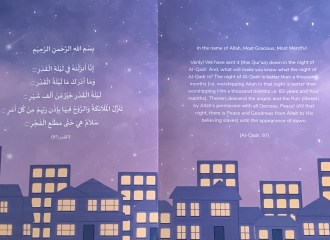
The book begins with Surah Al Qadr in Arabic and with the meaning of the translation in English.  It ends with a glossary, more information about Ramadan, and a glimpse of the author’s first book: Ramadan Around the World.

C84423A6-DCE5-4185-ABD7-3F0FF86ED59E

The 9 x 11 hardback binding and font are beautifully done and with there no other books for children that I can think of that discuss Laylat Al-Qadr, I foresee this one being read at least once a year, if not more, for many years to come, alhumduillah.


Khadijah and Cat: Ramadan is Here by Shamsa Ahmed illustrated by Afsaneh Bagherloo

Standard
Khadijah and Cat: Ramadan is Here by Shamsa Ahmed illustrated by Afsaneh Bagherloo

khad and cat

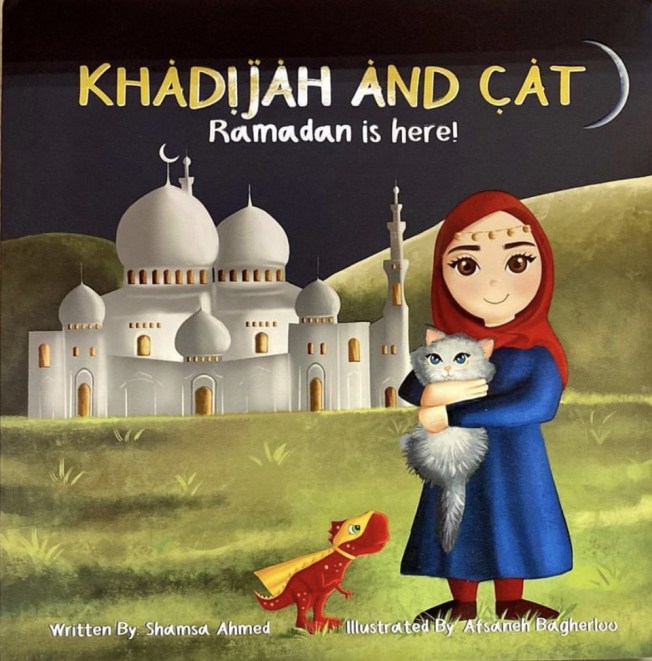
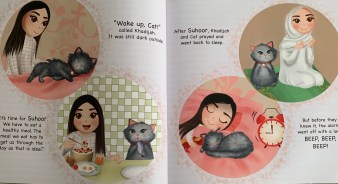
New this year in the Ramadan category is this gorgeous 40 page hardback book that mixes information about the blessed month with personable characters very well.  It stays on track without getting silly, even with a talking cat and a reoccurring super hero dinosaur, but I don’t understand the attempted rhyme scheme.  I’ve read the book over a dozen times trying to map it, and sometimes it is so natural that it makes reading it aloud smooth and lyrical, and sadly a few times it seems so forced that it makes the sentence nonsensical or awkward.  There is so much information, so beautifully paced and illustrated for children 4 and up, that I’m willing to overlook the few sentences that irked me to recommend this book for you and your children to enjoy this Ramadan.  Without a glossary though, it is probably best for Muslim children, or those with someone who can explain words such as: suhoor, iftar, adhan, SubhanAllah, dua, Allah, etc..

47EC69E5-532D-49CE-BA55-31787B8FF517

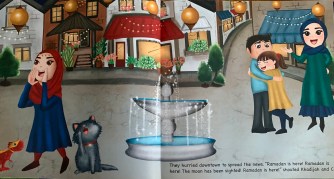
Khadijah and Cat are looking for the moon to know if it is the start of Ramadan, and once they find it, they rush to spread the news.  Immediately everyone starts decorating and celebrating and sharing delicious food.

663D21CA-B838-4CE3-8205-7CF1561B267E

They then head home to sleep so they can wake up early for suhoor.  They make a point to eat something healthy to sustain them for the whole day, then they pray and go back to sleep.

87F8555A-229B-40B8-8FC3-EAC757057BFE

Cat wakes up ready to eat and is surprised that they have to wait until sunset before they can eat or drink anything.  Khadijah explains that Ramadan is a holy month and one of the five pillars of Islam.  The illustrations show the other pillars, but the explanation of Ramadan is a bit advanced with words such as regression, unpriviledged, compassion, and purifying.

CA7C44AE-AD4B-41EF-BBBF-0B802A42CCC9

The next page continues listing off what Khadijah and Cat are learning about Ramadan, as they spend time praying and reading the Holy Quran.  At the sound of the fourth Adhan they break their fast.  The names of the salat or that they pray five times a day is not mentioned, but lends itself to a great teaching point.

789953D0-E39D-4847-A274-F72BA6BC941A

They then pray and eat and take the neighbors some gifts.  Cat is convinced that the day was good and is ready for the next 30.  The last ten nights are identified as important and Laylat al Qadr is mentioned as being special, but it does not tell why they are unique.

1684103F-25CF-4E67-A13C-50A8D50FAF0D

Khadijah and Cat then invite you to fast and see why Ramadan is so special.  The end of the book has some questions, a Ramadan count down and a coloring page.  I was surprised that there was not a glossary as the Arabic words in the text are enlarged, and often not defined.

C1681A56-BE04-4CE0-917C-7A5F3DFA3F9C

I love the font and binding and horizontal 10 x 11.5 layout.  The illustrations are gorgeous and the details in the decor and Khadijah wearing hijab while out, but not at home are very well executed.  I’m not sure why the Meer-Rex is in the book, he is never identified or given attention, maybe in future books he will have more of a role, inshaAllah.

I ordered mine from Crescent Moon Store and received it within days of placing the order, thank you!

Once Upon an Eid: Stories of Hope and Joy by 15 Muslim Voices edited by S.K. Ali and Aisha Saeed

Standard
Once Upon an Eid: Stories of Hope and Joy by 15 Muslim Voices edited by S.K. Ali and Aisha Saeed

once upon an eid

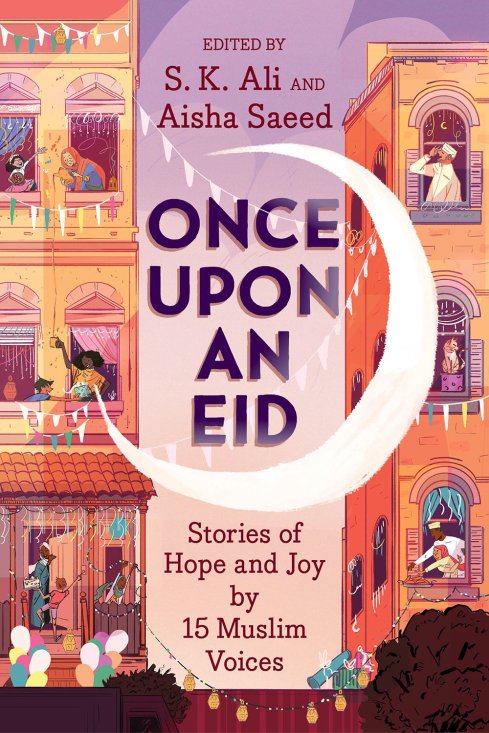
I’ve never been a huge fan of short stories, but this book has me reconsidering such an arrogant approach, as every single story in this collection has me feeling the warmth of Eid, the joy of authenticity, and the beauty of being a part of a faith with such strong female writers.  Fifteen entries for middle graders in mind: short stories, poetry, and even a graphic novel, spread over 304 pages that shine light on Eid in today’s world,  Eid al Fitr and Ramadan make up the bulk of the focus, but Eid al Adha and Hajj are in there too.  And the best part of the book is that you will see yourself in it, possibly all through out it, but reading such diverse OWN Voice stories are sure to make a Muslim reader feel represented and right at home, and give non Muslim’s a peek at us from the inside, inshaAllah.

SYNOPSIS:

I don’t know how to review the book as a whole since there really are 15 different stories, that are each heartfelt and strong in their own right and yet somehow made better by the company around them.  There were no weak links.  There are stories with bickering siblings, annoying cousins, different cultures, mixed background familes, divorced families, converts’ stories, stories of families where money is tight, stories with illness, stories of loss, a story from the perspective of a refugee, and stories of reaching out of your comfort zone.  There is one story about Eid al Adha and a story starring a Shi’a muslimah feeling different within Islam.  There are stories told from boys voices and girls voices and every single story has a take home message, some more subtle than others, but all there and all real.  I feel like even a summary of a story would prove a spoiler and take away from one just falling in to the collection and receiving the warm hug that awaits.   I’ll leave the summaries to their titles and well known authors to spark your curiousity.

Perfect: Jamilah Thompkins-Bigelow

Yusuf and the Great Big Brownie Mistake:  Aisha Saeed

Kareem Means Generous: Asmaa Hussein

Don’ut Break Tradition: S.K. Ali

Just Like Chest Armor: Candice Montgomery

Gifts: Rukhsana Khan

The Feast of Sacrifice: Hena Khan

Seraj Captures the Moon: G. Willow Wilson and Sara Alfageeh

Searching for Blue: N.H. Senzai

Creative Fixes: Ashley Franklin

Taste: Hanna Alkaf

Eid Pictures: Jamilah Thompkins-Bigelow

Not Only an Only: Huda Al-Marashi

Maya Madinah Chooses Joy: Ayesha Mattu

Eid and Pink Bubble Gum, Insha’Allah: Randa Abdel-Fattah

WHY I LIKE IT:

I recieved this book as an Advanced Reader (digital) copy and I am thinking I want a hard copy too, (I wasn’t able to view the artwork).  A lot of people ask me and I see postings in various social media groups asking for suggestions of books to read each night as a family in Ramadan, and I think this one would work for grades 3 and up.  Have each kid read the story throughout the day and then discuss in the evening.  Every story will have something that is familiar, probably something new, and each has a teachable moment.  I think different kids will identify with different aspects of the story and to articulate them in Ramadan will really bring the already memorable characters to life.

The book is very well done, and reads very smooth and cohesive, it really has a unified tempo and mood which is remarkable because so many different author’s and voices are included.  The book stays focused on the feeling rather than getting too weighted down by doctrine.  There are stories that feature hijab prominantly, and a bit of Prophet Muhammad (SAW), and some slight mention of islamaphobia, but it focuses on the friends and the love that support us, both Muslim and non, that make Eid and life hopeful.

FLAGS:

Clean

TOOLS FOR LEADING THE DISCUSSION:

I would consider this as a book club book to be hosted just as I hope to do this Ramadan with my own children in my home (see above).  I think really I just want to buy a bunch of copies to give as gifts to the fabulous elementary aged children I know, alhumdulillah.

Eid Breakfast at Abuela’s by Mariam Saad illustrated by Chaymaa Sobhy

Standard
Eid Breakfast at Abuela’s by Mariam Saad illustrated by Chaymaa Sobhy

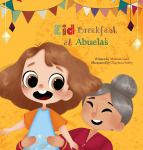
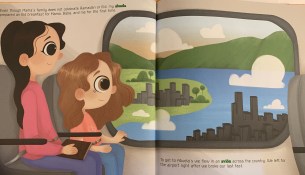
breakfastThis book is the first in a series (hopefully) called Trilingual Sofia, where English is the predominant language, and Spanish and Arabic are interwoven to tell the story.  Focusing on Eid and spending the holiday in Mexico with her non Muslim grandmother, the story with bright illustrations is a celebration of diversity, acceptance, family, and Eid.
DBFF1967-9421-47C8-B88C-4AAF8703E31F

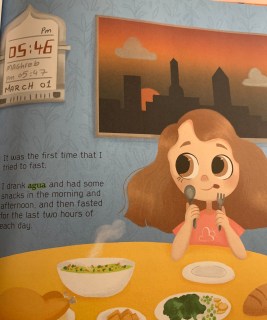
Sofia has had a special Ramadan.  She tried fasting for the first time and now that the month is over, they are breaking their fast and then getting on a plane to Mexico to have Eid breakfast with her Abuela.

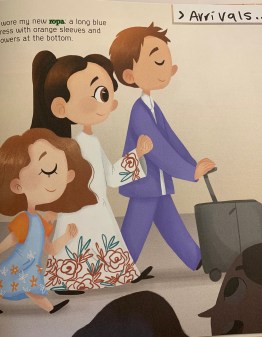
On the plane she keeps her pretzel bag to add to her scrapbook and then they get changed into their Eid clothes before they land.  Once in Mexico they go straight to the mosque to meet their friends and then to Abuela’s house.

2CA2CEE1-B699-4E8E-A829-C25E3E313FBC

Abuela’s house is decorated for Eid and all the family is there.  They eat breakfast together and the kids play games and sing songs and take pictures.

084D716E-6D5D-448E-A580-95E48C73FDD0

The 32 page 8.5 by 8.5 inch hardback book claims to be for toddles and preschoolers, but I think it is more for kids in early elementary with the small and ample text.  The Spanish words are highlighted in green and Sofia teaches some Arabic to her Mexican cousins.  There is a glossary of all three languages at the end.  

0DA1427C-192E-4E78-B3DE-A564B98A4327

The book is not meant only for Muslim children, but it doesn’t explain Ramadan or Eid, so while Muslim’s might be able to connect the dots of why she only fasted the last two hours of a day or why they went to the mosque before they went to Abuela’s, I wish the book explained it.

00BE02BE-79D1-4753-BA92-A48C7311B4C3

I love that their are subtle connections between the three languages, like Angel Gabriel/Jibreel and the name Yusuf/Joseph.  The book is a great example of Islam outside of the Middle East and the Asian subcontinent and I truly hope there are more books in this series and more books like it to show the diversity of Islam and the commonalities we all share.

Yusuf’s Ramadan Lantern by Jasmin Zine illustrated by Brad Cornelius

Standard
Yusuf’s Ramadan Lantern by Jasmin Zine illustrated by Brad Cornelius

yusuf ramadan lantern

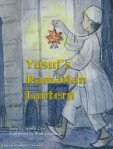
The soft illustrations on 32 pages, surrounded by ample, large, well -paced text for second graders and up give life to a sweet story about a young boy, his grandfather, and the passing on of a Ramadan heirloom.  While not a chapter book, and a little too long for little ones to enjoy as a simple picture book, the book may not beg children to pick it up and read it, but if they do, they will enjoy a sweet story that parents won’t mind reading more than once.

10B43E53-3B8F-46E3-AE57-F9B372D1D282

Synopsis:

Yusuf’s grandparents have just returned from their trip to Egypt and Yusuf is excited to see them, and receive the electronic fanooz he asked them to bring back. But when Grandpa takes Yusuf outside to give him the gift, it isn’t the modern light up lantern he asked for, it is an old rusty, cracked metal fanooz.  Grandpa explains that the old fanooz used to be his when he was a young boy and begins his story of himself going out with his father to wake their neighbors for suhoor in Ramadan.  The subtle details of how he would be woken up, how his dad would beat the drum and the song they would sing as they would walk around, keeps the story slow and engulfing.  He then tells about returning and eating dates soaked in milk, and bread and fava beans before the white thread of light appeared.

Slowly the little boy, seeing how happy his grandfather is in his reminiscing, realizes that the fanooz he has been entrusted with is far better than the electronic one he asked for.  As he walks his grandfather out the door, he is surprised with the gift he originally wanted, the fancy new fanooz.  Not excited, his grandfather asks Yusuf what is wrong, and Yusuf, realizes that he likes the history filled one better.

The old fanooz finds a permanent place in Yusuf’s room, and he and his father fix the broken glass and polish up the metal to be regularly lit on Ramadan mornings and remind them all of grandfather as a little boy walking and waking people up before dawn.

26BA9466-BC9A-4153-AF82-313D43366B21

WHY I LIKE IT:

I love the subtlety and detail.  There are now so many books about the tradition of waking the neighbors up for suhoor, but this one focuses on the bonding of the grandfather and his father as well as the bond between the grandfather and Yusuf.  The story speaks of the tradition with the drum, yet somehow it is the lantern that ties it all together.

There is sufficient referencing about Ramadan and fasting to appeal to Muslim kids and inform non Muslims a bit.  The book is not preachy, it is cultural and religious in a narrative story sort of way.

My only main complaint is that I don’t know who the target audience is with the long pages of text, and full page pictures.  It is a hard book to place.  The illustrations are sweet and compliment the story, but in the pictures, Yusuf just seems too young.  His ability to appreciate his grandfather’s old lantern verses the electronic fanooz he asked for implies a bit older child.  In the pictures he looks like he is three or four years old, a disconnect that often distracted me from the story.  I also wish they would have used an Arabic word or title for the grandfather.

CE5EAF67-D73D-43EF-88CA-47DA31F098CC

FLAGS:

clean

60BAECF4-FF3A-4713-89DD-E22072503E47

TOOLS FOR LEADING THE DISCUSSION:

It is obviously too short and not the correct format for a book club, but I am hoping to share it at story time.  It will be a bit of a challenge for little children to sit through, but I’m thinking it is worth the effort, inshaAllah, bismillah…

DA2E16E8-7AD1-458F-BDD5-C6373BB5D04A