Category Archives: 2nd through 4th grade

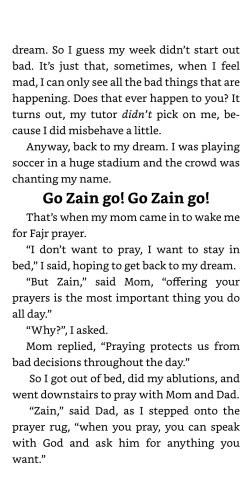
Be Sure to Pray, Zain! By Humera Malik illustrated by Gonmuki

Standard
Be Sure to Pray, Zain! By Humera Malik illustrated by Gonmuki

1636FC1C-82AA-48FD-9904-10616FD9CB55

A very relatable 31 page early elementary chapter book about not only establishing salat, but doing it for the right reasons.  The book is not preachy or reprimanding, and even with a moral purpose, Zain manages to connect with readers and be funny and likable along the way.  Told from the view of the young narrator, realization is achieved, confessions made, understanding gained, and inshaAllah regular prayer established.  A great book to share with your own children when salat integrity is in question, and a great reminder of the power of salat that kids will enjoy reading even when it is not, alhumdulillah.
3FE2BB19-9372-4292-A0AE-B091D66B8F1D

SYNOPSIS:

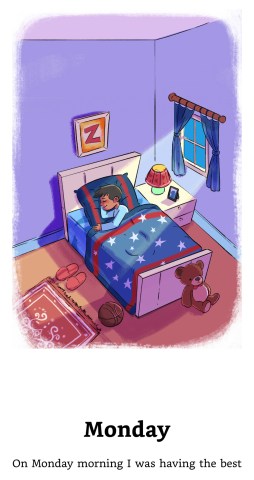
Zain starts off by introducing himself as a kid who lives with his parents and is having an  awful week.  He rewinds and begins with recapping Monday.  Right away he acknowledges that Monday actually started out ok as he was having an awesome dream, but that sometimes when he is mad he only sees and remembers the bad things.  Because of his awesome dream he didn’t want wake up and pray Fajr, but his parents reminded him that when you pray you can ask anything you want from God and that praying protects us from bad decisions.  He drags himself up to pray and asks God to help him on his spelling test.  Later that day he took his test, said Bismillah, and aced it.  So he concludes that maybe Monday wasn’t so bad, and Tuesday wasn’t either.

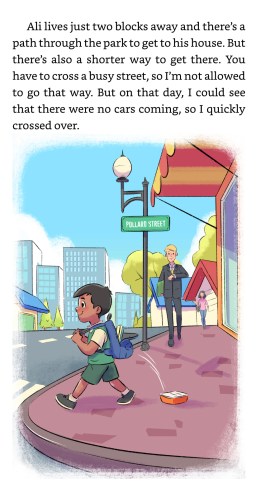
On Tuesday, Zain sticks up for his neighbor Joey who is being picked on by some older bullies.  Later that night Joey’s parents come over to thank him and take him out for ice cream in appreciation.  Wednesday, starts out great at school, and after school he gets to bake blueberry muffins with his mom.  When the muffins are done he was suppose to pray Asr and then take the muffins to his friend Ali’s house.  His mom reminds him to take the safe way and not cross the busy street.  But, Zain forgot to pray Asr and sees no cars coming and chooses to take the short cut across the road.  When he gets to Ali’s house his backpack is open and the muffins are missing.

The rest of the week continues with highs and lows.  Many of the lows coming when he doesn’t pray.  At one point a friend comes to tell him to come to the park to play soccer, and he knows his mom is going to ask him to wait a so they can pray together, so he pretends not to hear and rushes out the door.  Another day he chooses to not miss the end of a show he is watching to pray and heads off to tutoring without praying at all.

When the book rejoins Zain in the present he is feeling bad about kicking a friend playing soccer, cheating on a math test, and not getting to taste his muffins.  He unloads everything that has happened over the week, and his parents calmly and patiently ask him if he has been praying.  When Zain realizes he has been neglectful his mom likens prayer to bricks in a wall that help keep bad things out.  His parents tell him that when we miss our prayers, we end up with holes in our wall and bad ideas can sneak in.  Resolved to stay strong, Zain wakes up the next morning to pray Fajr and have a good day, inshaAllah.
31F4B3A3-12AE-493B-80DA-E93FC0F75AEB

WHY I LIKE IT:

I love that it stays with a young kids perspective and doesn’t get weighed down with hadith and ayats and lectures.  The parents let him learn from his mistakes and he comes to his own realization, not through their reprimanding or catching him in his deceitfulness.  The book is a great way to remind kids that it is their responsibility to pray and that Allah swt knows everything, so that connection has to be made between the person and their creator, it isn’t something you do only when someone is watching or telling you to do it.  I do wish that when he did resolve to pray that there would have been a bit of an outpouring to Allah.  I love that he had tears in his eyes when he told his parents everything, but I think it would have been really powerful to see Zain ask Allah to forgive him and to help him keep his wall strong.

The book reads smoothly, and the illustrations are well done and inviting.  Early chapter book readers will enjoy the font and format and knowing where the story is going with the days of the week chapters.  On one occasion I wish the word “wudu” would have been used instead of ablution, and I’m not sure what Zain has against carrots, but nothing too major will keep kids from enjoying the story and understanding it.
4AE0291F-2915-4F34-BA1C-D625DC0B97D6

FLAGS:

none.

EA28C866-45A0-47D6-B446-AF196504321E

TOOLS FOR LEADING THE DISCUSSION:

This book is for children learning to pray and realizing how important salat is.  So while it won’t work for a book club, I really hope teachers in Islamic Schools and Sunday Schools will read the book aloud or assign it to their students.  It is a great teaching tool, a great reminder, and a fun story too.
 

The Day Saida Arrived by Susana Gómez Redondo illustrated by Sonja Wimmer translated by Lawrence Schimel

Standard
The Day Saida Arrived by Susana Gómez Redondo illustrated by Sonja Wimmer translated by Lawrence Schimel

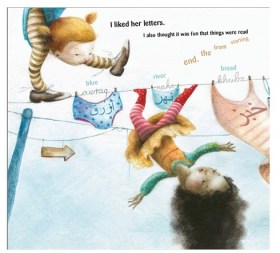
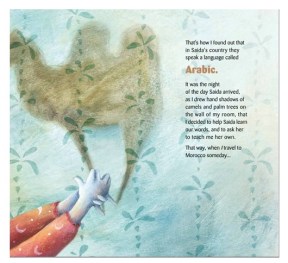
saidaThis absolutely gorgeous lyrical book will sweep you up and hold you tight as you imagine a world where more people take the time to get to know one another through the power and beauty of language.  Over 32 pages that are exquisitely and whimsically illustrated the words dance and come to life in English and Arabic as a friendship is formed.  Perfect for preschool through 3rd graders, older children and adults alike will be softened by the kindness and example shown between two little girls.
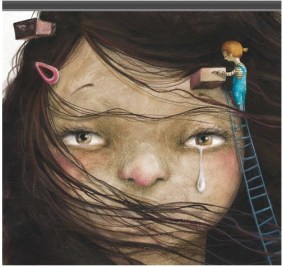
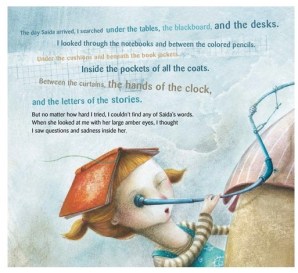
saida1

Told from the perspective of a little girl that meets a new girl in school named Saida and decides right away that they are going to be friends.  Unfortunately Saida speaks only Arabic, and the little girl only English.

saida2

But it is no problem, because the little girl is going to help Saida find her words.  She is going to look everywhere to let her get rid of her tears and throw away her silence.  So that she doesn’t see questions and sadness locked up in her.

saida4

That night at home, the little girl’s parents tell her about Morocco and find it on the globe.  They explain that Saida’s words don’t work here and that her words wouldn’t work in Morocco.

saida5

Undeterred the two girls start teaching each other words in their languages.  Some stick, some float away, but the two learn and communicate and connect. They find friendship in learning each other’s words.

They recite a poem by Jacqueline Woodson and tells stories about Marrakesh. The two girls plan to travel the world together. The book concludes with both alphabets shared and the reader wishing to join the little girls on their adventures.

saida 3

I was blown away by the presentation of the book and the feeling of compassion and cultural appreciation depicted.  Such a beautiful approach to welcoming someone different in to your life.

There is nothing Islamic or religious in the book, or really even cultural, aside from language.

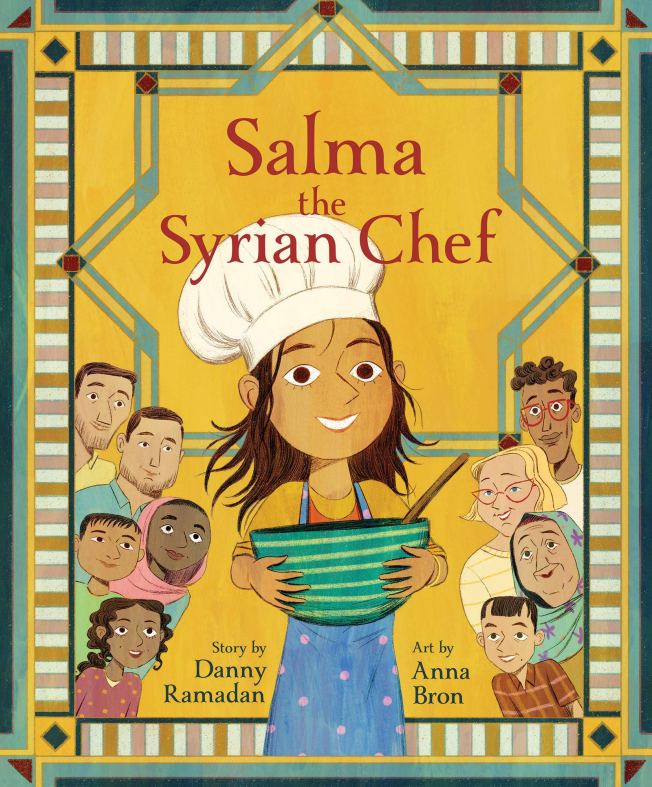
Salma the Syrian Chef by Danny Ramadan illustrated by Anna Bron

Standard
Salma the Syrian Chef by Danny Ramadan illustrated by Anna Bron

salma

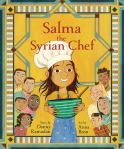
This 40 page picture book meant for 4-7 year old children is full of diversity, community and love.  The only thing missing, is a recipe for the dish, foul shami, that Salma recruits everyone at the refugee Welcome Center to help her make to cheer up her mom. Possible flag is there is a gay couple featured in the text and illustrations.

syrian1

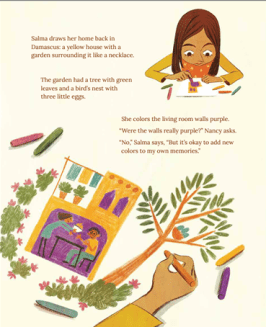
Salma and her mom are refugees from Syria living in Vancouver, and desperately missing Salma’s dad who still has not been able to join them.  When Salma shares her sadness with Nancy at the Welcome Center, she is encouraged to draw her good memories.  And then Salma has the idea to cook a dish from home for her mom. The other kids at the center mention foods they miss, Ayman from Egypt, Riya from India, Evan from Venezuela.   Then the translator, Jad, from Jordan helps her find a recipe online.

syria

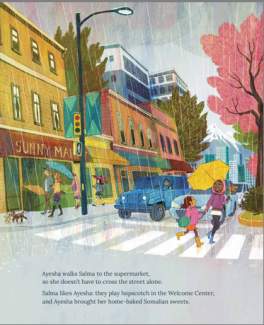
Convincing herself that she can do this, Salma  draws a picture for each of the ingredients since she doesn’t know the names in English.  She then heads to the market with Ayesha from Somalia, an older girl that helps her cross the street, and get the needed groceries.

syria2

Back at the Welcome Center to cook. Malek and Amir, a gay couple from Lebanon help her chop the vegetables and kiss away each others onion tears.  The spices make Salma sneeze, but she can’t find the sumac.

syria 5

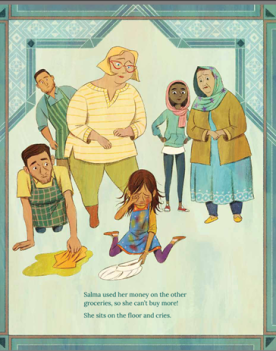
Granny Donya from Iran has the missing spice and reassures Salma that she can do this.  That is until the olive oil bottle slips and falls and shatters.  With no more money and feeling discouraged, it takes Nancy and everyone else to convince Salma not to give up as the dish is made with love and Mama will love it.

syriasad

Everything is set up to surprise Mama with the dish, but once mama comes home and the door bell rings, it is Salma who is surprised with all her friends coming over to bring her olive oil.

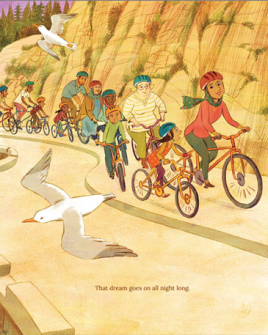
Mama laughs and tells Salma her smile is home, and Salma dreams of riding her bike around the Vancouver seawall laughing with her friends and Mama.

syriabike

I love the sense of community that it takes to make the dish and that she finds love and support from so many.  I also like her determination to make her mother smile along with her willingness to accept help when she needs it.

I’m assuming the family is Muslim, the mom appears to remove a scarf when she returns home, Ayesha and Granny Donya also wear hijab.


Stuck in the Middle by Sumayyah Hussein illustrated by Diana Silkina

Standard
Stuck in the Middle by Sumayyah Hussein illustrated by Diana Silkina

middle

At 122 pages this early chapter book with frequent illustrations is a great book to share with 2nd-5th graders.  It is has a great message and lesson with lots for children to relate to with regards to life with siblings, getting frustrated, making mistakes and recovering.  The lesson is strong, but doesn’t become preachy as the protagonists voice rings true to her age.  Mistakes are made by many characters and situations are fleshed out so the reader can understand why things are done.   By showing that there isn’t one side to a story, and that knee jerk reactions are common, readers will get that ultimately we are still responsible for how we act, and learning from our transgressions is part of growing up.

5343F790-E06E-47DB-96D9-A85A7EAEFA9E

SYNOPSIS:

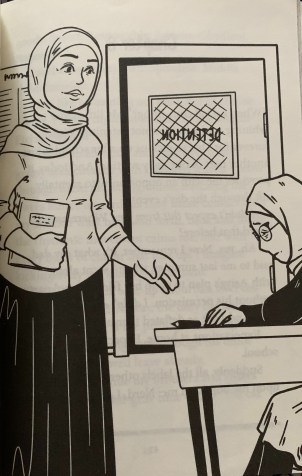
Salma is the middle child in a busy family, and very little is in her control.  When her frustration over her brother stealing a chocolate bar, causes her to lose her cool, and then she is forced to run errands with her family, homework doesn’t get done in time and she finds her self in detention.  Normally a very good student, teachers and other students are shocked that Salma is in trouble.  Things don’t improve when her brother steals her carrot cake the next day, and in a plot to get even, Salma ruins her brothers brand new PS4 controller.  She also turns a blind eye at school when she sees someone picking on him.

Doing her best to avoid being discovered as the culprit, or being in a position to see her brother being bullied, her guilt starts to get to her.  When an ambulance has to come to the school for a kid that got pushed and needs stitches, she realizes she has to make things right, even if that means getting in trouble.

7E60CD43-7DCB-41AE-BFF8-6CA415A5BDA2

WHY I LIKE IT:

I love that it is so relatable, honestly switch Salma with my middle son Haroon, and the 13 year old boy that doesn’t want to go out with the family, with my 13 year old daughter that doesn’t want to go out and we are looking in a mirror, haha.  The family is Muslim and they practice and let the religion shape their view of the world and how to function within it.  The girls wear hijab and use the hadith premise that they have to fix a bad deed with a good deed to provide the solution to the mistakes made earlier in the story.

AE60B7D6-48FA-4A46-A4E7-4F0BB40351AD

FLAGS:

None

46612FC3-B196-4A59-9BB8-AA54F7ADBD3F

TOOLS FOR LEADING THE DISCUSSION:

I already made my middle child read the book, and because of the length it wouldn’t lend itself to a book club, but I can see teachers having kids read it and then discussing, just like I am doing in my family.  It is sweet and well done and a great addition to your bookshelf.


The Most Powerful Night: A Ramadan Story by Nada Hassan illustrated by Soumbal Qureshi

Standard
The Most Powerful Night: A Ramadan Story by Nada Hassan illustrated by Soumbal Qureshi

the most powerful night

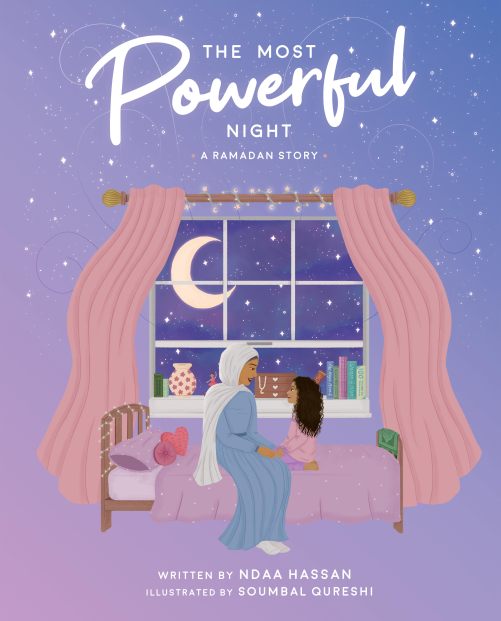
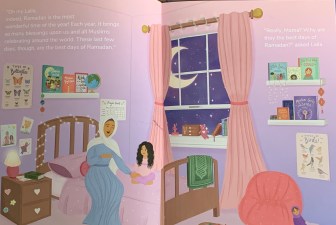
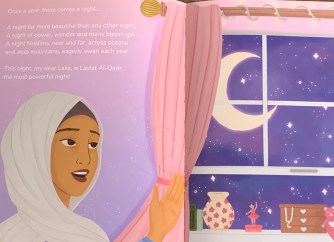
This beautiful poetic book about Laylat Al-Qadr explains in detail and wonder the importance of the most blessed night in the blessed month of Ramadan.  The soft purples and pinks of Laila’s room, and the repetitive refrains set the mood and tone of an informative bedtime story that will convey the awe and mercy of the night to seven and eight year olds.

C2080E23-FF92-40D7-A40A-49F53DD85406

The book is 40 pages, and pretty text heavy, but it flows smooth enough, and the details in the pictures are enough to keep little ones engaged. Younger and older children will also enjoy the story as both an introduction to the night the Quran first came down, and as a reminder of the gifts to be had.

816801CB-54C8-4FDE-836D-C9038DB1B538

Laila is sad that Ramadan is leaving as she peers out the window and sees the moon resmembling a crescent again.  Her mother takes the opportunity to tell her about the blessings of the last ten nights, and Laylat Al-Qadr specifically.

DD841DEB-9591-4305-80E6-CC328CAB45E6

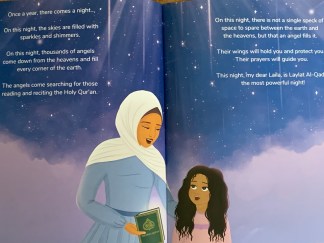
“The Night of Power and Miracles,” Laila’s mother explains is a night like no other, that comes only once a year.  Thousands of angels come down until there isn’t a speck of space that they do not fill.

13B3DC09-7A02-4921-BD9A-9DCBAAAE77D5

The night that is better than a thousand months and all our deeds are multiplied 70 times, the night the Holy Quran was first revealed to Prophet Muhammad (saw).

2F0180A5-B187-4511-A3B8-9DC0F37A55E8

Laila wants to make sure she pronounces it correctly and practices saying Laylat Al-Qadr.  Excited to make sure she is praying and reading Quran that night, she is desperate to know what day it is.  Her mother explains to her that we do not know.  Laila uses this to her advantage to get to stay up past bedtime for each of the last 10 days.

46D932B3-0A00-44AB-B44D-6A9CE84ECD65

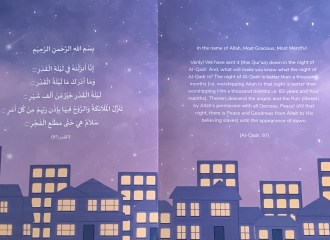
The book begins with Surah Al Qadr in Arabic and with the meaning of the translation in English.  It ends with a glossary, more information about Ramadan, and a glimpse of the author’s first book: Ramadan Around the World.

C84423A6-DCE5-4185-ABD7-3F0FF86ED59E

The 9 x 11 hardback binding and font are beautifully done and with there no other books for children that I can think of that discuss Laylat Al-Qadr, I foresee this one being read at least once a year, if not more, for many years to come, alhumduillah.


Yusuf’s Ramadan Lantern by Jasmin Zine illustrated by Brad Cornelius

Standard
Yusuf’s Ramadan Lantern by Jasmin Zine illustrated by Brad Cornelius

yusuf ramadan lantern

The soft illustrations on 32 pages, surrounded by ample, large, well -paced text for second graders and up give life to a sweet story about a young boy, his grandfather, and the passing on of a Ramadan heirloom.  While not a chapter book, and a little too long for little ones to enjoy as a simple picture book, the book may not beg children to pick it up and read it, but if they do, they will enjoy a sweet story that parents won’t mind reading more than once.

10B43E53-3B8F-46E3-AE57-F9B372D1D282

Synopsis:

Yusuf’s grandparents have just returned from their trip to Egypt and Yusuf is excited to see them, and receive the electronic fanooz he asked them to bring back. But when Grandpa takes Yusuf outside to give him the gift, it isn’t the modern light up lantern he asked for, it is an old rusty, cracked metal fanooz.  Grandpa explains that the old fanooz used to be his when he was a young boy and begins his story of himself going out with his father to wake their neighbors for suhoor in Ramadan.  The subtle details of how he would be woken up, how his dad would beat the drum and the song they would sing as they would walk around, keeps the story slow and engulfing.  He then tells about returning and eating dates soaked in milk, and bread and fava beans before the white thread of light appeared.

Slowly the little boy, seeing how happy his grandfather is in his reminiscing, realizes that the fanooz he has been entrusted with is far better than the electronic one he asked for.  As he walks his grandfather out the door, he is surprised with the gift he originally wanted, the fancy new fanooz.  Not excited, his grandfather asks Yusuf what is wrong, and Yusuf, realizes that he likes the history filled one better.

The old fanooz finds a permanent place in Yusuf’s room, and he and his father fix the broken glass and polish up the metal to be regularly lit on Ramadan mornings and remind them all of grandfather as a little boy walking and waking people up before dawn.

26BA9466-BC9A-4153-AF82-313D43366B21

WHY I LIKE IT:

I love the subtlety and detail.  There are now so many books about the tradition of waking the neighbors up for suhoor, but this one focuses on the bonding of the grandfather and his father as well as the bond between the grandfather and Yusuf.  The story speaks of the tradition with the drum, yet somehow it is the lantern that ties it all together.

There is sufficient referencing about Ramadan and fasting to appeal to Muslim kids and inform non Muslims a bit.  The book is not preachy, it is cultural and religious in a narrative story sort of way.

My only main complaint is that I don’t know who the target audience is with the long pages of text, and full page pictures.  It is a hard book to place.  The illustrations are sweet and compliment the story, but in the pictures, Yusuf just seems too young.  His ability to appreciate his grandfather’s old lantern verses the electronic fanooz he asked for implies a bit older child.  In the pictures he looks like he is three or four years old, a disconnect that often distracted me from the story.  I also wish they would have used an Arabic word or title for the grandfather.

CE5EAF67-D73D-43EF-88CA-47DA31F098CC

FLAGS:

clean

60BAECF4-FF3A-4713-89DD-E22072503E47

TOOLS FOR LEADING THE DISCUSSION:

It is obviously too short and not the correct format for a book club, but I am hoping to share it at story time.  It will be a bit of a challenge for little children to sit through, but I’m thinking it is worth the effort, inshaAllah, bismillah…

DA2E16E8-7AD1-458F-BDD5-C6373BB5D04A

Rami the Ramadan Cat by Robyn Thomas illustrated by Abira Das

Standard
Rami the Ramadan Cat by Robyn Thomas illustrated by Abira Das

rami

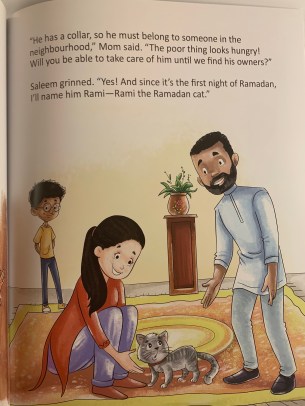
This delightful little story about a boy, a lost cat, Ramadan and making friends, has a great lesson in empathy and understanding even when things are hard.  The 28 page beautifully illustrated glossy book (8.5 x 11)  is set in Ramadan, but is enjoyable for children 5 to 9 all year long.

Saleem has just moved to a new city with his parents and doesn’t know anyone.  Feeling lonely on the first day of Ramadan he is outside sulking when he sees a lost little cat.  He brings it in and his parents help him take care of him until they can find the cat’s owners.

B342E851-726B-4B8A-9B63-F381F5C1009D

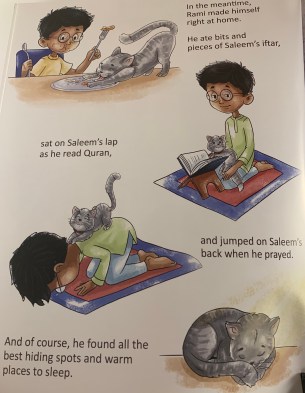
Saleem decides to call the cat, Rami the Ramadan cat for his timely appearance.  The next day the family makes flyers to post around to try and find Rami’s owner.  But no luck even after a few weeks, and secretly Saleem starts hoping they never find the owners.  Rami is his best friend, he jumps on Saleem when he is praying, keeps him company when he reads Quran, even shares his iftar with him.

22F7C85A-8891-4121-A608-421511688C49

One night at the mosque, Saleem makes Dua that Rami will stay with him forever.  After Taraweeh, Saleem can’t find his father, he waits by the door as everyone leaves, but can’t see him, he checks the shoe rack and his shoes are gone.  Feeling scared and alone he wonders if his father left him.  When his father returns from the washroom, Saleem is relieved, but wonders if that is how Rami felt that first day of Ramadan.

6E10660E-7FE3-4341-AF7E-B75EDF45DC8E

The next morning Saleem and his mom knock on every door in the neighboorhood until they find Rami’s owner.  When they find her, she is a nice lady, and tell Saleem, the cat’s name is Sammy.  Rami gives her his address and asks her to contact him if she ever needs someone to cat-sit Rami.

3634A3A5-B74D-4505-8C44-AED216D38872

Saleem’s Eid isn’t very fun without his only friend.  After prayers, there is a knock at the door, Sammy’s owner has come to offer to let Saleem keep Rami if he promises to bring him around to visit with her and her grandkids sometime.  She has other cats and sensed that he was missing Saleem.

16157CCA-24F9-4BDD-A661-B3353B6775C4

Saleem’s parents invite the lady, Mrs. Tompkins and her grand kids in to celebrate eid with them and Saleem and the children play with Rami, the best eid present ever.

The book shows Saleem praying and reading Quran and going to the masjid, but it isn’t preachy.  I think even non Muslims would enjoy the book and not be confused by anything Saleem and his family are doing.

I love that the mom so clearly wears hijab out of the house, but not in the house.  That there is some skin color diversity in the book, that Mrs. Tompkins is in a wheel chair.  I also love that the new friends, and only friends are presumably non Muslim, and that a little gray cat brought them all together, Alhumdulillah.

My Great-Grandmother’s Gourd by Cristina Kessler illustrated by Walter Lyon Krudop

Standard
My Great-Grandmother’s Gourd by Cristina Kessler illustrated by Walter Lyon Krudop

gourd
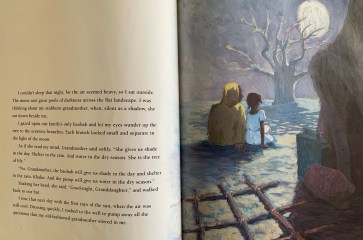
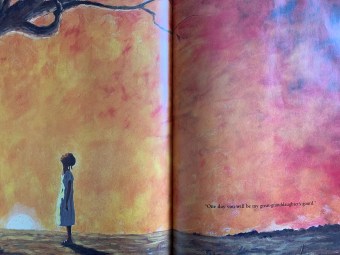
A beautiful story based on a true event in Sudan, this 32 page AR 4.2 book contains lessons about tradition, new technology, village life, culture, family, love, and community.  Unfortunately it is one of those books that I doubt any child would pick up and want to read.  Meant for fourth graders, there is a lot of text on each page, and the story is not quick and light, it is thoughtful and memorable. The book is a powerful one in opening one’s eyes to a different culture, environmental challenges, and innovations making it an important one for parents and teachers to share with younger children and encourage older ones to spend some time with.

8A5303D5-525F-4D37-A886-F22F18D0FE0B

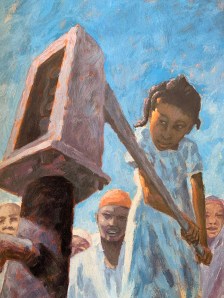
Fatima’s Sudanese village has just installed a new pump, and to show how easy it is to use, Fatima is chosen to try it out first.  With all the excitement over new technology, life for the village is about to get easier.  No more hauling the water with camels and filling the baobab trees to store the water in for the dry season.

104E36DC-E27A-47BB-8C4C-A510198CE604

Easier for everyone except Fatima’s grandmother.  She refuses to abandon the methods of the past so easily, and independently begins to prepare her tree, her great-grandmother’s gourd.  Fatima tries to talk her out of it, and the other villagers mock her refusal to accept technology.

DCB3DBD3-7EC3-4631-9A9D-EC34DE46055F

When Fatima hears the neighbor louder than the call to prayer calling her grandmother a fool and laughing at her, Fatima boldly and defiantly joins her grandmother in preparing the tree for when the rains come.

84F665EB-EFD6-49A6-BFDA-FF348CD80D00

The two dig a circle, a necklace, around the old tree to catch the water in the hard red clay, when the rains come, it catches the water, and when it stops, the two move the water to the inside of the tree with buckets. All the while, the villagers shake their heads at the two hard at work.

56BA11B5-7314-4D88-BDAA-50FE61765467

When, in the middle of the dry season, the pump breaks and it will be days before it can be repaired, the chief, Ibrahim, declares they must resort back to the old ways and Fatima and her grandma offer to share their water to hold everyone over.  “Maybe it’s wise to mix old with the new,” Grandma poignantly notes.  The following year the village works together to prepare the trees, just in case the pump breaks.

E4443445-EDEA-4C9C-99E4-4BE6AFB96C1A

There is a glossary of Arabic Words at the beginning of the book and an Author’s note about the “Thirst Triangle” and the use of the baobabs or tabaldi trees used to store water.

F429299A-BFD4-4BCC-9DA4-134FEAF09E4F

There is nothing overtly religious in this culturally rich story.  The women cover their head, they say “inshaAllah,” the call to prayer is mentioned and they have Islamic names: Fatima, Ibrahim, Musa, Ahmed, Ali, Osman etc..

The Arabic Quilt: An Immigrant Story by Aya Khalil illustrated by Anait Semirdzhyan

Standard
The Arabic Quilt: An Immigrant Story by Aya Khalil illustrated by Anait Semirdzhyan


arabic quilt

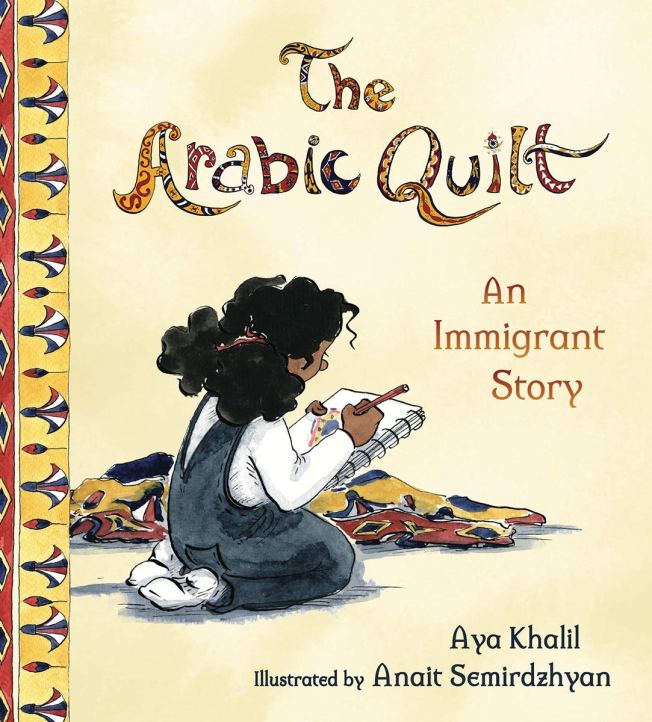
This 36 page picture book tells a beautifully presented story that incorporates events from the author’s real life that convey a story of loving your culture, finding similarities and giving people a second chance.  Ideal for students between 2nd and 4th grade, younger children will enjoy having the story read to them, and older kids will benefit from the message as well.

7C03525B-A26D-427F-A7EA-591BB3095F10

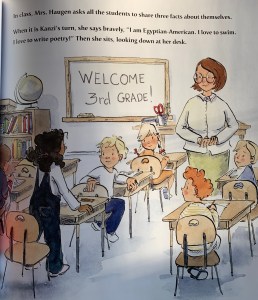
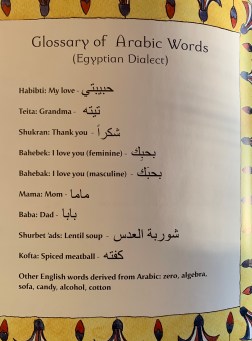
Kanzi is about to start her first day of 3rd grade in a new school.  It doesn’t specify if she has just come from Egypt, but being she seems to speak English well, knows that she’d rather have peanut butter and jelly instead of a kofta sandwich and mentions that she got a quilt when she visited her grandmother, in Egypt, she possibly is just starting a new school, not her first in America, but it is considered an immigrant story, so I’m not certain. E403D261-438B-4263-A2FB-C3F8693C9D3E

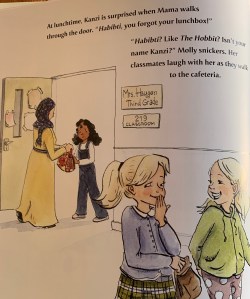
When she arrives in class and introduces herself she bravely says that she is Egyptian-American, but on the way to school she turns down the Arabic music in the car, so the reader sees that she is a little nervous about being seen as “different.”  When her hijab wearing mom brings her forgotten kofta sandwich and calls Kanzi ‘Habibti,’ classmate Molly teases her that she is being called a hobbit.

A crying Kanzi tells her teacher and Mrs. Haugen reassures her that “being bilingual is beautiful.”  That night Kanzi asks her mom to send her a turkey sandwich for lunch the next day, and before beds she writes a poem as she snuggles in her beloved quilt.

76FCD440-0D81-4893-80F3-1CC6033E8461

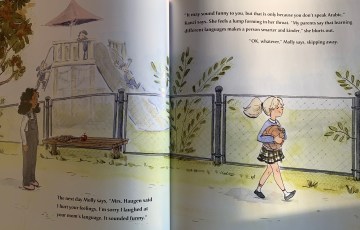
At school Molly apologizes to her and says that it just sounded funny.  Kanzi tells Molly it is because she doesn’t speak Arabic and that her mom says that “learning different languages makes a person smarter and kinder.”  Molly dismisses the comment and smugly walks off.

Mrs. Haugen sees Kanzi’s poem about her quilt from her grandma in Egypt and asks her to bring her quilt to school. The kids love it, and Friday Kanzi’s mom shows up to help with a special project: an Arabic quilt with the kids names.

98E875AE-0FD1-4827-BF39-1CA7B1172843

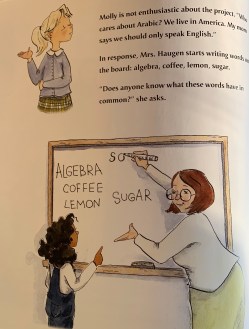
Molly is not enthusiastic and Mrs. Haugen writes English words that come from Arabic on the board: coffee, lemon, sugar, algebra.  Telling the kids that “we can speak non-English languages and still be American.”

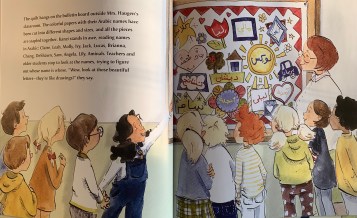
Kanzi and her mom write the kids names down and the children copy them.  The teacher cuts them out and makes a quilt to hang in the hall.  On Monday when everyone sees the quilt, they love the beautiful letters and colors.  Even Molly sincerely apologizes and asks Kanzi to write her mom’s name in Arabic as a gift.  The two hug and seemingly will become friends.

832244F2-1F7E-4C4A-9778-40E0EEC6BE82

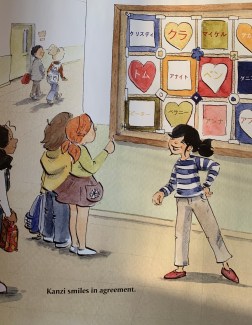
Across the hall another quilt is hung with names in Japanese, as another student and teacher were inspired by Kanzi and her quilt.  The last page of the story is a letter Kanzi has written to her parents telling them how grateful she is that she has two languages and that she will speak them without guilt.

BB6797A4-05C9-4CDC-AC70-88273ED3997B

The story is beautifully told and exquisitely illustrated on well-sized 9.5 x 10.5 pages in a hardback binding.  The mom wears hijab and it mentions it, but there is nothing religious about the text.  It is a universal story of coming to be proud of your roots and inviting those around you to learn and grow.  There is a Glossary of Arabic Words at the end and a bit about the author and illustrator.

9AF3D465-F5DA-4F25-8FC1-5BEE16FD9B21

My kids favorite page by far was reading the names written in Arabic and they all enjoyed the story (ages 13, 10, 9, 4).  I actually had an issue when Molly apologized the first time, feeling that Kanzi’s response was a bit pretentious to what seemed like an 8 year old being told to go say she was sorry, but my older three unanimously and fervently disagreed with me, saying that she was obviously insincere and Kanzi knew it.  I’d love to hear from other readers if they felt like Molly was sufficient in saying sorry and admitting that it sounded funny and that Kanzi was arrogant in saying that people that know two languages are smarter and kinder, or if Molly was being rude and racist and Kanzi was sticking up for herself.

CF16ACA2-8EC4-443B-AA8B-2B9EA3D05D6D

Irregardless, the book is well done, enjoyable, and will get repeated reads by a large range of readers.  My children keep pulling it off the book shelf, and for that I need to thank Gayatri Sethi (@desibookaunty) who generously sent me the book the same day I checked it out from the public library.  Her generosity once again is a gift that I hope to pay forward in the future.  This book also highlights how amazing teachers can be and often are in facilitating inclusion, understanding, and respect.

ED8D19BC-96FE-4B8F-8B35-87A1AA885B7F


Planet Omar: Unexpected Super Spy by Zanib Mian illustrated by Nasaya Mafaridik

Standard
Planet Omar: Unexpected Super Spy by Zanib Mian illustrated by Nasaya Mafaridik

planet omar

Omar is back, and the nine year old kid with a huge imagination, proves that his heart is even bigger.  Middle graders that loved the first version, The Muslims, and the reboot, Planet Omar: Accidental Trouble Magnet, will undoubtedly love this book’s adventures and the real, relate-abl, presentation of Islam in a Muslim family.  While it references the first book, it can work as a stand alone book too, and can and will be enjoyed by kids and adults, girls and boys, Muslims and non Muslims.  At 217 pages, the large spaces, doodles, playful fonts, and illustrations, make the book fly by and beg to be read again and again.

C95DB8C6-9652-4EB8-8008-112361FAE8DF

SYNOPSIS:

Omar’s family still has their Science Sundays, but they don’t visit a new mosque every Saturday, as they have found a mosque near their home that gives his parents, “secret smiles” and them all a sense of community.  Omar and his sister still bicker, and his little brother Esa is still lovable, and the former bully, Daniel, is now a great friend to Omar and Charlie.  Life is good, Alhumdulillah, but in the midst of the boys planning how to get laser guided Nerf guns and have an all out battle, Omar learns the mosque’s roof is in need of repair and that the congregation will need to come up with 30,000 pounds to cover the costs, and fast.  In an act of selflessness, Omar abandons his dream of a foam gun and donates to the masjid.  Seeing that is not going to be anywhere close to enough he plots and schemes with his friends, his non Muslim friends, on how to raise the funds.  They bake cookies, make origami birds, and get their school to host a talent show to raise the money.  Their teacher and the head teacher coordinate the hall and judges and winning prizes all to help out Omar and the mosque, in the end though, they raise just under 1,500 pounds.  Not enough by themselves, but a great contribution to what other people hopefully are scrounging up.  The worst part however isn’t that they didn’t make enough, but that what they did make, goes missing.  Omar, Charlie, and Daniel, along with the parents and police and school personnel, try and find the money and who might have taken it before time runs out.

0030B40D-17F8-415C-A54A-7874768A5B5D

WHY I LIKE IT:

I love how effortlessly the author adopts a nine-year-old’s voice and persona.  So many of the details, for example, about how the school administration signed off on a fundraiser for a religious building, and how tickets were sold, and the planning took place are left out, as a nine year old, probably wouldn’t know, or be concerned with the logistics of such endeavors.  It seemed like some details should be given, but I doubt readers would feel that way, so I pushed it aside and went along for the ride.

Omar has amazing friends, from the unpredictable old neighbor lady, to his non Muslim friends being so enthusiastic and supportive of saving a mosque.  I love it, and that they are that way because Omar is so unapologetically Muslim first.  They even discuss a hadith about how building a mosque, builds you a house in Jannah, and a mainstream book published this, and it is AMAZING! It isn’t just a kid and his family, who happen to be Muslim, the whole plot of the book is to save a mosque, and the fact that this book exists, seriously is so beautiful, and powerful, and hopeful, Alhumdulillah.

This book has a lot of layers, most kids won’t pick up on the interfaith aspects being so ground breaking, or the beauty of teachers and parents believing and supporting young kids, but will just read it as a funny story with anecdotes and inside jokes that they get as kids, as Muslims, and maybe even as Desis.  It truly is the culmination of an author who can write well, characters that our kids can see themselves in, and an opportunity to tell our OWN stories that make this book work for kids, adults and everyone in between.

3C3DA84E-29F6-4A6D-90FE-0BC134E7E615

FLAGS:

Omar and his sister are mean at times, but alas love each other and look out for each other too.

TOOLS FOR LEADING THE DISCUSSION:

I don’t do an elementary book club, but if I did, I would do this book in a heartbeat.  For middle school it would be too quick of a read, but I think all classrooms and all libraries should have the book, up through middle school.

https://www.alaraby.co.uk/english/society/2020/2/7/planet-omar-pushing-for-muslim-characters-in-childrens-literature

I got my copy here in the US at www.crescentmoonstore.com and as always you cannot beat their customer service and prices.  If you don’t have the first book, you can get it there, too.  Thank you Noura and Crescent Moon Store.