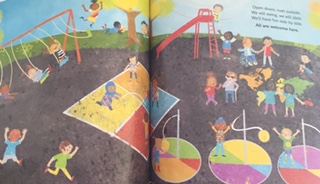
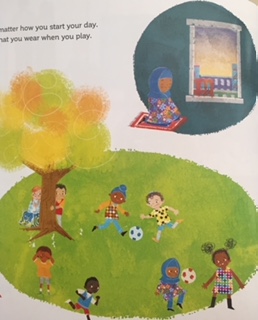
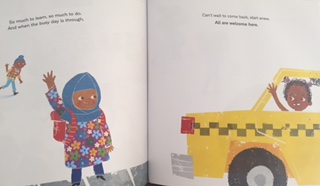
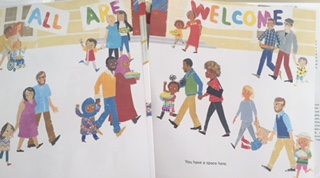
Ali and the Moon by M.I. Kafray illustrated by Aaliya Jaleel

Standard
Ali and the Moon by M.I. Kafray illustrated by Aaliya Jaleel

IMG_1421

I originally bought this book in Ramadan and had hoped to review it so that those looking for Ramadan books could benefit. But it isn’t Ramadan specific, just moon themed, and I really was so disappointed with the binding quality for the amount I paid for it, I didn’t think it was fair to review the story until I could get over the number of blank white pages in the book, and the overall copy-shop self-printed and bound vibe that the book emits as soon as you hold it.

The premise of the book is the hadith that if you see something bad you should change it with our hands, and if you can’t, then change it with your tongue, and if you can’t do that, then pray for them in your heart. 

The 16 page book starts off a bit awkward, with the boy just staring at the moon, but by page five, the story hits its stride and is sweet.  The moon dims and is sad about the state of the world.  Ali starts talking to the moon in rhyming lines, and convinces him that there is still good in the world.  The moon and Ali decide that at night they will pray for the world and the people in it.

ali inside2

The end of the book has the hadith and the surahs one should say before going to sleep: Surah al-Ikhlaas, Surah al-Falaq, then Surah an-Nas and lastly, Ayatul Kursi.

The illustrations are cute, they are expressive and the moon and boy sweet.  I just wish the paper had more weight and that the story a bit longer.  A lot could be discussed with the premise of the Muslim boy talking to the moon with a great vantage point.  More specifics and more inspiration would have made this mediocre, albeit expensive book, great.

ali inside


The Most Pleasant Festival of Sacrifice: Little Barul’s Eid Celebration by Munise Ulker Illustrated by Beyza Soylu

Standard
The Most Pleasant Festival of Sacrifice: Little Barul’s Eid Celebration by Munise Ulker Illustrated by Beyza Soylu

batul.jpg

This book is beautiful, it feels great in your hands, the raised glitter embellishments in the illustrations, the price point, everything except the text.  The gist of the story is even fine, the execution is just off.  It reads very much like it has been translated from another language in to English, and yes my privilege might be showing, but the phrasing, the passive voice, the orphanage, all make the book with its massive text passages hard to convince kids younger than 7 to sit through.

batul9

The story starts off with parents and two kids , Murad and Batul, driving to a friend’s house for dinner, commenting on the Christmas decorations that they see.  The parents ask what the kids know about Eid al-Adha that is coming up and the kids remember how much fun they had in Turkey.  Except it is really awkward to get this bit of information out.  They discuss Eid last year, and then remind each other that they were in Turkey, and how it was much more fun.  Noting that international travel is expensive and they won’t be able to go again, the Mom over dinner discusses how they can make Eid fun for the kids with her friend.

batul2

It is decided that the Muslim and non Muslims will celebrate together and include a local orphanage.  “Each Muslim family would be responsible for buying new clothes for two children from the orphanage, and they would take their own children along to do the shopping.” This would teach the kids to thank Allah and learn about community and sharing.  A great lesson overall, again just a concept presented in a really wordy, round about, awkwardly forced manner.

The Mom contacts the library and gets permission to decorate an information table, the kids make Eid cards for their grandfather in Turkey, at Sunday school they make gifts for friends.  They learn about Zakat and sacrificing an animal like Allah commanded Abraham to do, they even send cards to their neighbors.  Oddly though remarking how fun it is to get candy outside of Halloween.  After the first two pages explaining Christmas and telling that Muslims don’t celebrate it, I found it odd that they would, 15 pages later, be referencing Halloween. 

bat

Some of the sentences also don’t made sense.  About half way through I didn’t understand what the author meant by the boys “celebrating each other’s Eid” after they put their new clothes on and went to Eid prayer.

Once at the party, they give specific details of how much they charged everyone, yet no details about the food they all brought.  The kids enjoy a pinata and everyone including the orphans get Eid gifts.  Despite everyone’s fun the party has to end, and the orphans return to the orphanage and Murad and Batul declare they “will always remember this Eid.”

batul3

The illustrations are great, it is really yet another example of a book just needing a good editor.  From the very beginning, even the title isn’t really right, the book isn’t even mainly about Batul, to the random details shared, the book is just too long and too unpolished.  It is really unfortunate, because it has so much going for it on its 32 pages.  The main points however, I feel are lost about Eid and the reason it is so dear to Muslims everywhere.

Peg + Cat: The Eid al-Adha Adventure by Jennifer Oxley and Billy Aronson

Standard
Peg + Cat: The Eid al-Adha Adventure by Jennifer Oxley and Billy Aronson

peg.jpg

Easily the most anticipated Eid al-Adha book to come out this year, the book does not disappoint.  Following the episode, the book, is 32 pages and while ok for ages 3 and up, like the show, it really is geared to children able to grasp the math concepts presented.

The book’s story is that it is Eid al-Adha, and Peg and Cat are learning about it with their friends Yasmina and Amir. The holiday facts don’t seem forced and words like hijab. oud, and Eid Mubarak, are integrated naturally.  The concept of giving charity, giving to those with LESS, becomes the set-up for learning about more than, and less than. 

peg4

A few pages later the tradition of dividing meat into three parts: one to keep, one for friends, and one for the poor, sets up a lesson on fractions and using a pan balance.  The really big problem, involves moving crates.  They count down from seven to calm down, and then use all their lessons learned to solve the problem and help a neighbor.

peg5.jpg

The illustrations are straight from the show in all their adorable glory, I’m not sure why Yasmina has some strange tree branch looking loose hairs poking out of the top of her scarf.  I love that the page numbers are math problems (2 +1=3 for the 3rd page).  And the hardback with slip cover workpages on the underneath side, are a nice treat.  I was especially greatful the picture on the slip cover is the same as on the book, so the cover can be discarded, as will ultimately occur with multiple readings.

peg2

Books like this are great ways to introduce an Islamic tradition to non Muslims in a non preachy, non threatening way.  By seeing beloved characters with Muslim friends helps shape perceptions and increase understanding, inshaAllah everyone wins, alhumdulillah.

Skunk Girl by Sheba Karim

Standard

skunk girl

Having been pleasantly surprised with a few recent reads in the romance/islamic fiction genre I thought to give this slightly more cultural take a try.  Unfortunately, this book didn’t surprise me pleasantly, but rather left me disappointed and slightly annoyed.  At 231 pages and an AR 5.2, the book would have worked much better framed as a memoir or semi autobiographical dairy, as it stands as a novel there is no point to the story, no real character connection, no real lasting impression.  There are a few comical concepts, but only because I am Pakistani-Muslim and female did I get them, and sadly those few instances, aren’t enough to carry the book and make it worth recommending.

SYNOPSIS:

Nina Khan is in high school in a small New York town and her strict parents don’t let her do the typical high school stuff like date or talk to boys.  Her parents are not religious, unless her mom’s family is visiting and they put on an act.  Her parents aren’t awful, however, they are educated, kind, and quirky, but culturally strict none-the-less.  Nina has two amazing school friends, that she has grown up with that accept her and her social limitations for the most part.  When Nina falls for the new boy in school, Asher, though, they work overtime to figure out how to get them together.  In addition to the boy dilemma the other stress is Nina feeling like she is in her older sister’s shadow.  An older sister who is a genius and is away at Harvard. There’s a girl at school that annoys Nina, but really their interactions are petty and annoy the reader more than anyone else.

As Nina’s friends hook up with boys and Nina has various interactions with Asher, one involving him seeing down the back of her sweater and thus her stripe of back hair, we are also introduced to some of her Desi friends.  In my opinion the passages about her conversations with the ethnic kids trying to find their way in life and in love and still maintain their culture and religious values, is way more entertaining than the bantering back and forth with Helena and Bridget.  If the author were to rewrite the book as a diary or biography, and focus more on the Desi friends, the book would probably be more interesting, compelling, and relevant.

The climax, if there is one, is when Nina’s parents go out of town and she is able to sneak off to a party and try alcohol, getting blackout drunk, and then going on a ski weekend with Asher, making-out with him and then deciding that that’s not for her.  At least I think that is what she decided.  She decided she can’t be with him, and she heads off to Pakistan with her sister to meet her parents, but thats it.  There isn’t really a climax, there isn’t an ending. Literary structure might allow you to do one, but not having either a point or a conclusion, makes the book fall flat.

WHY I LIKE IT:

I read the whole book, so it wasn’t so atrocious that I couldn’t get through it, it just seemed to focus on the wrong things in the narrative and not make the main character relatable.  I wanted to grow with her, but her reflection at the end didn’t really make a strong point for her, so it didn’t make one for the reader either.  I think part of this is that the author, frustratingly to me, interchanges religion and culture a lot.  And while she might get them kind of right, I think non Muslims and non Pakistanis might find the two muddled.  She asks Allah to help her make a good impression with and Asher, yet constantly uses the Pakistani culture as the reason why she can’t date and drink in the first place.  My thinking is that the religion should trump the culture, but because being brown and Paki and Muslim are all viewed as being the same, the logic is kind of lost.  And granted in some households it really is that way with religion and culture, but the nuances aren’t explored, explained, or even acknowledged, unfortunately.

It is clear that the author knows Islam and Pakistan, her love of them (assumption) just doesn’t come through.  Her off hand remarks about a lota, and ayatul kursi, and her Pakistani ranking system are funny, and momentarily relatable.  Unfortunately, so often it seems the story is positioned so that the religion and culture are stifling and the western world is being denied to her.  Honestly after reading the book, I’m not really sure why she doesn’t rebel and do what she wants, the story doesn’t really show what she gets out of doing what her parents want her to do, and why it would matter to her in the long run to do what she wants as a “rebellious” teen.  

FLAGS:

There is alcohol mentioned and consumed.  There are a lot of relationship topics  explored throughout the book including the minor characters deciding to have sex and the  main character kissing.  For mature readers, high school and up.

TOOLS FOR LEADING THE DISCUSSION:

I wouldn’t present this book to a book club, nor can I see myself suggesting anyone to read it.


How to Scare a Monster by Zanib Mian

Standard
How to Scare a Monster by Zanib Mian

scare a monster

I like a lot of books, but this one, well it might be my favorite.  The size, the length, the colors, the fonts, the illustrations, the message, truly it is fabulous for 3-5 year olds.

ScareMonster-003

The premise is simple and straightforward.  The book doesn’t try and do too much or put too much on its 32 pages.  It identifies ways to deal with monsters, and then offers what some people try and do to scare them away, concluding the best and only solution, is to ask Allah for help by saying, Audhoobillah.  

Kids will laugh at the silly illustrations and attempts to be monster free, and remember the clear strong message of calling on Allah swt when afraid.  

ScareMonster-002

The only critique for me is the page about the kid with a stink-bomb in their nappy. While funny, the sentence structure doesn’t flow, the narrator’s voice seems abrupt and off to me.  Possibly that it goes from active voice to passive for that line only (its been a while since I’ve articulated grammar structure, so maybe not :)).

Most people try to rrooaaarr!

or hide under the bed.

Sometimes they call their mum, mmummm!

or even better.  A kid with a stink-bomb in their nappy.

Some turn the lights on,

or hold on to their favourite teddy.

Other than that, the book is fun and works well for muslim kids at story time or bedtime alike, alhumdulillah.


No Ordinary Day by George Green

Standard
No Ordinary Day by George Green

no ordinary day.jpg

I was really, really excited to get this book in my hands.  An early chapter book, about Islam and sports, with diverse characters, that seemed to be the start of a series featuring the “Childhood Champions,” seemed to have the potential to fill a gaping void in Islamic fiction.  And while the book shows promise and has a lot going for it, it falls short of what it could be, and perhaps with the ever growing book options, what it should be. 

To be clear the Islamic lessons and values are on point as are the pictures, it is the holes in the story, the random text layout inside and the lack of depth that keep this book from reaching its full potential.

SYNOPSIS:

Ibrahim normally needs help to get up for school on Mondays, but not on this day. On this day they were promised a surprise at school and Ibrahim can’t wait to see what it is.  When the 8-year-old gets to school he and his friends are delighted to meet Hakeem Muhammad a soccer star on the California Spartan’s Team in town to play against the local Harlem Knights.  To win one of the five tickets that he is giving away the students have to recite some ayats from Juz Amma and tell why it is important that they study the Quran.  Ibrahim goes first, and we don’t know what he recites, but he says that studying Quran makes him feel happy and inspired.  Which to me didn’t really meet the criteria of the competition.  The next student is also a member of the “Childhood Champions,” but we know nothing about Jannah, other than the one page bio at the beginning of the book.  Jannah recites some mystery ayats and says that knowing the meaning helps her with reciting, a bit more of an appropriate answer, but still kind of not fulfilling the question in my opinion.

ordinary1

All five kids in the crew win tickets for them and their families for the game that night.  A limo picks them up and they get to meet Hakeem in the locker room.  When they arrive  he is praying, so they wait, say salam, chat, and then are shown to the VIP box.  The game is close, Hakeem scores the winning goal for the Spartans and the kids go home happy. No real problem or solution, the climax is just the game.

WHY I LIKE IT:

I love that the font was chosen to help kids with dyslexia and the full color internal pictures are a nice plus.  I don’t understand how it was determined how much text is on a page, as it is so varied and inconsistent, that it seems like a draft rather than a final copy.

I love that this book is about Muslims and for Muslims, the star athlete prays, and connects with Allah swt, and is proud of it.  His praying before the game is not weird to his teammates, which is awesome for kids to see.  The conversation after his salat with the kids is also pretty powerful, but the setup is incredibly awkward. Yasin won a ticket for reciting Quran, so why the answer about why he is praying before the game started with explaining that he prays five times a day, seems jarring to the flow of the book and story.  I liked the insight about praying and being grateful whether they win or lose, but the catalyst for the exchange was really forced.   Loved that Hakeem made sajood when he scored and that Ibrahim was asking Allah for help.

I wish the ayats the kids recited would have been shared.  I think the book is for muslim kids, so it would have helped if they really inspired something tangible that the readers could relate to.  The book is very bland and it could be much more memorable.  I’ve read the book three times, and couldn’t tell you any of the students names.  I had to look back to write this review.


I’m not a soccer expert, but I think the winning goal would have been called back for offsides, I’m hoping I’m mistaken.  The breaking a world record for loudest fans seemed a stretch, but kids 6-8 probably would be bothered by it or find it out of place.  The book says it is for ages 6-12, but I can’t see kids 12 years old getting much out of this 40 page book.  

FLAGS:

None the book is completely clean.

TOOLS FOR LEADING THE DISCUSSION:

The book wouldn’t work for a book club selection, but I would probably have it in a school library for kids transitioning to chapter books, and in a classroom for excitement and novelty.  There isn’t anything “wrong” with the book, it just needs a good editor and a little more.  It really is almost there.

https://www.launchgood.com/project/childhood_champions__no_ordinary_day_a_book_for_muslim_children#!/


Muhiima’s Quest by Rahma Rodaah illustrated by Daria Horb

Standard
Muhiima’s Quest by Rahma Rodaah illustrated by Daria Horb

IMG_0976

This picture book for ages 7 and up, reads incredibly smooth for the amount of text on each page, and the pictures are warm and expressive in this large (8.5 x 11) 32 page book.  Clearly the author is talented in writing and passionate about empowering her character to hold on to her culture and faith, however it seems overly forced at times.  

muhima

The premise is that it is Muhiima’s birthday, but that she doesn’t celebrate birthdays, her family only celebrates both Eids.  So when her mom hands her a surprise on the morning of her birthday and Muhiima asks if it is a birthday gift and her mom says, “kinda” it seems a bit like she is walking back from the premise. The tie-ins throughout the book as she journeys from location to location on her quest as a result seem forced.

muhima1

The map first leads her to her father’s book store to get wisdom and love and a gift that she can’t open until the end.  She also journeys to her Grandparent’s house, her Uncle’s basketball game, her Aunt’s beauty salon, and oddly her Masjid Quran Class, which apparently she is skipping, but stops to get the wisdom and gift from her teacher at, none-the-less.  Oddly enough, but at least noted, she reaches home to find everyone on her quest already there.

muhima3

On her way home, she sees her non-muslim friend Rosie celebrating her birthday and wishes she could have a birthday gathering with gifts and family too.  When she opens the door to her own home, she gets just that.  The passages detailing why it is hard to be different are incredibly relatable and poignant, but to then have Muhiima get the same thing with a different name, again seems like the author is walking back on her premise.

muhima2

The wisdom and advice the family gives to Muhiima is wonderful and powerful. I love that the character is a strong girl of color, and that her family is supportive and consistent.  They say Salaam, they pray, they go to the mosque.  Some of the little details were jarring, like why it didn’t specify what prayer, why it was her class that she visited at the mosque, how all the people got to her house before her, etc.  This minor glitches with the forced premise of relating the quest to her birthday, make the book overall a bit awkward.  This is so unfortunate because the advice and the quest are so endearing, while not being judgementat or preachy.  I don’t know how to fix it, I just hope, like really really really hope, that the author keeps writing and that her next book is a little more revised and editted.


It Ain’t So Awful, Falafel by Firoozeh Dumas

Standard
It Ain’t So Awful, Falafel by Firoozeh Dumas

it aint so awful

Islamaphobia is rampant in today’s America, but it isn’t the first time that a minority group has had to face extreme persecution.  Often us Muslims need to look around and be reminded: Blacks are still targeted, Japanese once were interned, Italians, Irish, Hispanics, really every minority group has, and continues to struggle to be accepted as part of American culture, unfortunately.  Today’s middle school students didn’t live through 9//11 and often they think they are the first to be ostracized for their faith or their parent’s countries of origin.  So I picked up this book to see how well the book would serve as a way to discuss prejudice and persecution with Muslim kids, in a way that they could relate to, but be removed enough from that hopefully they could offer their own insights and experiences.   This book takes place in the 1970s and the climax is the Iran hostage situation as the book is told from an 11-year-old Iranian girl’s perspective. 

Similarly, most Persian penned books that I’ve read fight against Islam and the way it was forced upon them by their government, so I also wanted to see how the author would paint the faith in her semi auto-biographical-middle-school tale.  Alhumdulillah, I was happily surprised how Islam was handled in this 378 page, AR 4.7, book, and I think, like the inscription reads, “To all the kids who don’t belong, for whatever reason.  This one’s for you.”

SYNOPSIS:

Zomorod has lived in America before.  She was born in Iran, moved to California, moved back to Iran, back to California, and now from Compton, California she is moving to the much wealthier Newport Beach and hoping to start middle school fitting in more with her new Brady Bunch inspired name, Cindy.  Establishing early that she is the translator for her mother, who doesn’t speak English and doesn’t want to learn, and that she is somewhat embarrassed by her parent’s thick accents, lack of American snacks, Iranian food, and conversation topics, the book will appeal to most middle schooler’s who can relate.  Her parents, however, are pretty chill about letting her go out with friends, and doing whatever she wants, so really its more about the age and being angsty and awkward, then it is about her parents and their lifestyle and culture.  The basic point of the book is a growing-up tale of making friends, finding real ones that care about you, finding the balance between family and the outside world, cultures that conflict, the past and the future, and ultimately finding acceptance and pride in who, and what you are.

The political climate in Iran and in America amplify what it is like when people hate your country, but can’t find it on the map, and manifest in the story with bullying at school, Zomorod’s father losing his job and not finding a new one, and some hateful acts occurring at the Yousefzadeh’s home. 

WHY I LIKE IT:

The book could be heavy and dark, but it’s not.  The voice of Zomorod really stays in the persona of an 11-year-old girl and is poignant, clever and light-hearted, I even laughed out loud a few times.   The 1970’s backdrop isn’t too alienating for today’s readers, as there aren’t a lot of cultural references that would turn them off.  The historical significance, is very likely one they will not have heard of before and the book, through Zomorod’s eyes, will shed light on Iran in the late 70s and early 80s without boring the target audience.  They might even learn something and remember it.  

The stereotypes about Iran are addressed, the concept of a single person having to represent every one of that minority group is felt first had through the main character, and many misconceptions about Iran are clarified.  Yet, the book doesn’t get preachy, it maintains its lightness, and while I read it in a few days, it was just as easy to put down as it was to pick up.  The characters felt real and developed for the most part, so even though it was a tale about life, it was compelling enough to stick around, and you are invested enough to care how the characters are doing. There are a lot of really great supporting characters in the book as well: neighbors, friends, teachers, friend’s families, and a few not so nice characters that surprisingly aren’t painted with a singular condemning evil stroke.  The author is very careful to reserve judgement of all her characters and the sub groups they represent.

Which brings me to how Islam is handled in this book.  Her family doesn’t practice, but her reference for Islam is shia, as evident by her mentioning 12 imams.  I took pictures of most of the pages where Islam is mentioned, less than 10 in all, but where it is mentioned it is handled very politically correct and powerfully.   She talks about how they don’t celebrate Christmas or most holidays as they aren’t Christian or really American, but when the pool key is lost she does pray to a Christian Saint after a suggestion that such an act will help it be found.  It isn’t really presented as a religious act, more of one done in desperation. Here are the most applicable and relevant passages regarding Islam.

  • Dr. Klein shakes his head in sympathy.  “Do your wife and Cindy have to wear those cover-ups if you go back?”  “Yes, and I cannot believe this.  When we lived in Iran, my wife, my sisters, all the women I knew wore western clothes.  No tennis clothes like you see here, but regular clothes.  Only religious women chose to wear hijab, it meant something.  Imagine if everybody in America had to wear a cross around their neck or a Star of David-what would those symbols mean? Nothing. If you have to wear it, it means nothing.  If you choose to wear it, it means something” (168).
  • “The Ayatollah is Muslim, right? So is, like Allah, his God?”  “Allah is the Arabic word for God,” I say.  “It’s the same God. (154).”
  • We don’t have Saints in Islam, just a Prophet with twelve imams, and they don’t preach to animals or help find lost items,  My family, like most Iranians, is Muslim, but we never do anything religious.  I’ve never even been in a mosque, which is like a church (40).
  • “Being Muslim means different things to different people,” I say.  “My family doesn’t do anything officially religious.  My dad says religion is kindness and that’s what everyone should practice” ((184-5).
  • “…even though we belong to three different religions. We are alike in so many more ways than we are different.” 

FLAGS:

The book is fine for middle school readers, there is mention of Cindy’s dad trying alcohol at one point in the past and not liking it.  Cindy’s friends tease her once or maybe twice about liking a boy and Halloween is celebrated.  There is a lot of lying in the book, but it is made clear why, even if she doesn’t always feel bad about it: she is embarrassed by her mom’s food and lies that she shared it, she withholds information a lot, she pranks the neighbor lady who left a dead rodent on their porch, etc.  Hopefully the demographic won’t be inspired by Zomorod’s antics and just find them as her way of dealing with life.

TOOLS FOR LEADING THE DISCUSSION:

This would be a fun book club book to discuss being new to a country, minorities, how to handle conflicting cultures, and how to be and have good friends.

Educators guide: http://firoozehdumas.com/wp-content/uploads/2016/03/ItAintSoAwfulFalafelguide.pdf

https://www.floridamediaed.org/uploads/6/1/4/2/61420659/ms_-_it_ain%E2%80%99t_so_awful_falafel.pdf

https://www.bookmovement.com/bookDetailView/49051/It-Ain’t-So-Awful,-Falafel-By-Firoozeh-Dumas

Author’s page: http://firoozehdumas.com/books/it-aint-so-awful-falafel/

Controlling Your Anger by Saaliha & Ali

Standard
Controlling Your Anger by Saaliha & Ali

anger cover

I love little picture books for toddlers and early elementary kids that introduce children to Akhlaaq, good manners and characters.  The book’s tone, however, seemed a bit off to me, so I put it away a month ago and pulled it out again today to read it, knowing I would have forgotten most of my initial thoughts, but somehow, they resurfaced with a vengeance, unfortunately.  And while the pictures and binding and theme are all absolutely wonderful in this 23 page book, I didn’t like the main character at all, and being it is based on a real person, a child, I feel awful saying that.

anger

Saaliha starts the book keeping her anger just under the surface as her friend Hannah has borrowed and lost her pencil.  Hannah says she’ll look for it after lunch, and Saaliha controls her anger and basically says that it needs to be found now because it is the right thing to do.  All of that is fine, but for some reason she seems bossy and controlling and I really don’t know why.  Maybe because once they look for the pencil and then find it, Saaliha gives her peer (and thus the reader) a teaching moment by saying that she knew she didn’t lose it on purpose.  Hannah’s response is more believable when she feels embarrassed and admits she should be more careful, but I found Saaliha’s reaction smug because she was so close to getting mad, and then to be self-righteous about it, seemed a little passive aggressive to me.  

anger3

As the book continues, Saaliha recounts that accidents can happen at any time and to not get mad, which is great, it gives the example of when her younger brother Ali, accidentally knocked her ice cream out of her hand with his basketball or when he broke her pencil.   She seems to have a thing with pencils, there should have been a different example.

anger2

It then moves on to an incident with a friend, Jalal, who took a donut without asking, but it was an accident for not asking as he normally asks.  The repetition of the word accident here, I get is to carry the concept, but that doesn’t seem like an accident, it seems like he forgot, and an apology should have been in order, not Saaliha having to justify it solely.  Being it is a book about Akhlaaq I feel like the illustration of Jalal winking and eating the donut, seemed off.  

anger1

I like that Saaliha reminds her friends not to get angry as anger comes from Shaitan, but then when the book says she always says A’uthu Billahi Mina Shaitan Nir Rajeem to keep her anger in check, one wonders why in the opening scenario she didn’t say it.

I can’t pinpoint why I didn’t love this book, or maybe I just didn’t like the main character and I would probably give the series another try, but I’d like to hear your thoughts if you have read the book, and more importantly what your children thought of it.


Magnus Chase and the Gods of Asgard: The Sword of Summer by Rick Riordan

Standard
Magnus Chase and the Gods of Asgard: The Sword of Summer by Rick Riordan

The_Sword_of_Summer.jpg

Yes, that is a Rick Riordan book cover you see.  Yes, it is about Norse mythology.  Yes, the whole book is about fake gods and fictional demigods.  Yes, you are on the correct blog. 

Brace yourself, if you haven’t heard about Magnus Chase, son of the god Frey, whose series is now on book three, it is ok, Rick Riordan has brought a lot of mythology back to pop culture in a fairly short amount of time.  But this series stands out because get this, the Norse god Loki, (yeah the one featured in popular Marvel Avengers movies), in this series, has a daughter…named Samirah Al-Abbas…who wears hijab…and is a valkyrie…and is an Iraqi immigrant, and is a main character, and is really awesome.

The book is 497 pages and is also a pretty fun audio book.  It is an AR 4.8.

SYNOPSIS:

So, the basic plot is much like Percy Jackson, in that a young boy, in this case a homeless orphan, Magnus Chase, finds out that he is demigod and has to basically find some friends and save the world while learning about the given mythology that they belong to.  For Magnus, he learns about his father, Frey, the god of spring and summer, when he dies and is taken to Valhalla, a paradise for warriors in the service to Odin.  The whole book is about Magnus, who is now an einherjar, a member of Odin’s eternal army , trying to prevent ragnarok from happening.  Among his group of friends are Jack, the sword, Blitzen, a dwarf, Hearthstone, an alf, and Samirah (Sam).

WHY I LIKE IT:

By and large, Sam is pretty well developed as a practicing Muslima.  She is being raised by her grandparents and feels bad sneaking out to perform her valkyrie duties.  She is not at all comfortable being alone with males one-on-one, nor being seen with males as she has an arranged marriage to Amir Fadlan, her second cousin, when she gets older.  She wears a green hijab that doubles as a camouflage cloak, and she mentions going to the mosque with her grandma.  (In later books, according to my daughter, she also talks about fasting, how she is a practicing Muslimah and the daughter of Loki who handles all that Norse mythology throws at her.)  She is proud and strong, and really the only thing that makes no sense to me is why she takes off her hijab so freely when not in life threatening scenarios, I get when she uses the camouflage to hide in emergencies.  She apparently explains later that she considers the einherjar her extended family, but that wouldn’t make them her mehram, so it is still a bit sketchy.

Here is an interview question from Entertainment Weekly to Author Rick Riordan about Sam, and his answer: (http://ew.com/article/2015/10/14/rick-riordan-magnus-chase-interview/)

Speaking of Loki, one of my favorite characters in the book is Sam, or Samirah Al-Abbas. I think she’s a great example of a diverse character — not a white man, not a woman who’s there to be a love interest. She’s also seamlessly woven into the history of this myth. Can you talk about the conception of her character?

The idea for her started with the primary sources. The story that Sam tells in The Sword of Summer about an ambassador from the Caliph of Baghdad visiting the Vikings in Russia – that’s true. It really is one of our best sources because the Arabs of the time were reading and writing when nobody else was. That connection back then – that the world was a whole lot more connected even back then than we think of, that these cultures did not exist in these hermetically-sealed little bags, they were blending together all the time – that fascinated me. I thought, what would it be like to have a modern Muslim-American character who still had that connection to the Viking world like the Caliph of Baghdad did all those years ago?

And then again I started pulling on stories from students I’ve had in the past. One very powerful memory I have was being in my American history classroom on 9/11 and one of my students was a Muslim-American girl. She burst into tears when she heard the news, because she knew that her world, her life, had just changed, and had been defined for her in a way that she did not want and could only do so much to control. That really was powerful for me, and it inspired me to learn a lot about Islam and what the tradition actually was, as compared to what we hear about in the media and how it’s often distorted, and to honor her experience. Samirah kind of came out of that confluence of things.

FLAGS:

Obviously the whole story features multiple fake gods.  I don’t think it is celebrated though, they are beyond ridiculous, but if your kids can’t understand the idea of mythology or you think it is beyond the scope of fiction, that is your call. 

There is a ton of violence, as they prepare for ragnarok and just killing in general, some is gruesome. The book is not dark at all, however, it is in fact laugh out loud funny.  

There are some giants that get drunk, mention of mead, some jokes about Hel in reference to Helheim and the goddess of Helheim, Hel.  There are some “damns” scattered in as well. 

The stories of some of the gods is a bit scandalous, but for the most part the book doesn’t give much detail.  It does discuss Freya marrying dwarves for a day for their jewels and having kids with them.  There is flirting and mention of kissing.  There is also some mention of males being moms and animals and monsters being born of human parents, it is all very confusing.  But it is there. Also, my source, my 11 year old daughter, mentions that the rest of the series does have a gender fluid character named Alex.

TOOLS FOR LEADING THE DISCUSSION:

I doubt I’d do this as a book club book, but as any teacher or librarian knows, Rick Riordan fans are committed and enthusiastic.  I still keep in touch with many kids that weren’t big readers until the read Percy Jackson, and once they read the series multiple times, they then jumped to his other series.  So, while I wouldn’t use this as a book club book, there is a ton of kids that would love to discuss it with you, so read it, the bonding as a result will be well worth it.