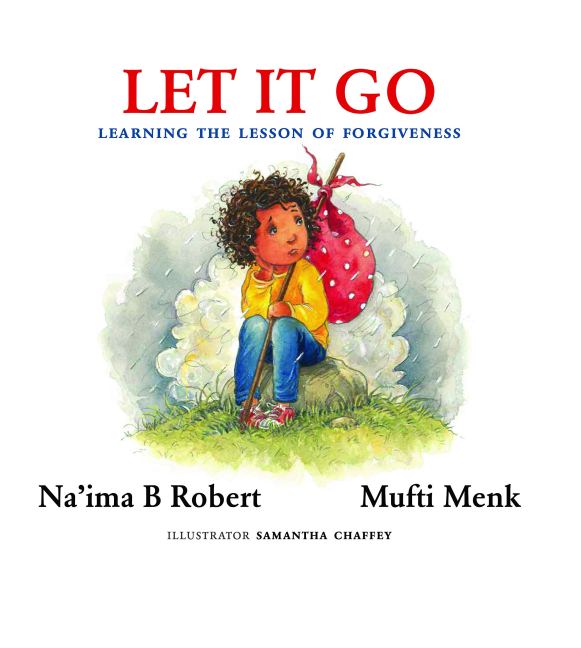
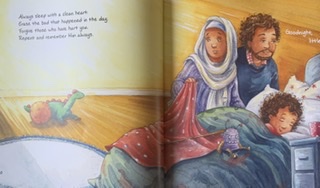
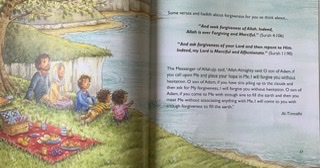
This 32 page rhyming book follows a little boy around as he is weighed down by a lot of things not going his way. He doesn’t want to forgive until he is the one that hurts someone else and realizes we all make mistakes, forgiveness is not a weakness, and we all feel angry at times. The book breaks from the story to ask the reader to think about their emotions in various situations, and encourages the reader to talk about their feelings. The framework is Islamic and the repenting to Allah swt is part of the message. I found it awkward to read independently, but I read it to a small group of my own kids and their cousins, seven in all, ages four to thirteen, and it worked very well to discuss what the boy was feeling and how they would react. I think this book would be great in a classroom or as a book an adult reads to a child at bedtime to encourage conversation. I had to point out to the little ones, that the knapsack was getting bigger with the little boys anger, and explain what it was, but as a tool to foster dialogue it was incredibly powerful.
The book starts out with a poem/du’a by Mufti Menk that sets the tone for the book. It makes clear that we are all human and feel things and that this book is a tool to understand and emotionally grow from. No one is going to get in trouble or be reprimanded.
The story stats with the little boy waking up happy and ready to have a wonderful day. But then when he comes down for breakfast, his sister has eaten the last piece of toast. The book asks the reader, “how do you feel when things don’t go your way?” and asks the little boy to let sorry make it better so that he can let it go. But the little boy doesn’t want to let it go, he wants to hold on, and as a result it makes his heart feel heavy.
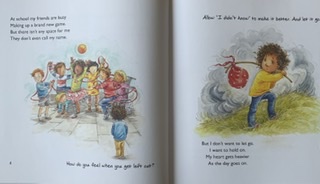
This pattern is followed throughout the book giving examples when the boy doesn’t get included in a game at school with his friends, when his friend kicks his football (soccer ball) in to the road and it gets popped by a passing car, and at dinner when his older brother laughs at him.
He then picks on his sister at bedtime, and doesn’t even know why he is doing it, and realizes that he too has made a mistake. He learns that “it takes a strong person to let it go,” and that “forgiving is like taking off a heavy bag that I’ve been carrying all day long.”
The book ends with some verses and hadith about forgiveness. Has some facial expressions with emotions to discuss, and space to write down things that make you feel angry, hurt, or sad as well as a place to share what makes you happy, grateful, and safe. There is also a glossary of Islamic Arabic terms on the inside back cover.
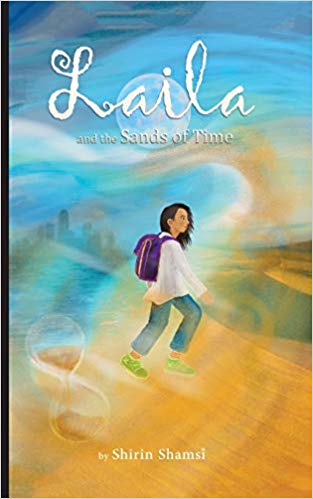
This 127 page book has a lot of potential, but ultimately didn’t win me over. It is one of those that needs a good editor to encourage the author to flesh out the characters, take advantage of a potentially cathartic resolution, and fill the gaping holes in the story. Meant for ages 8-12 the tiny font, and tight spacing, make the book really dense and intimidating to look at and read. The book, as written, should be well over 200 pages, if spaced appropriately for the target audience. Once you accept the presentation and get in to the story, it isn’t an awful read, it just could have and should have been so much more. I hope the author revisits it and polishes it up- the time travel, the science DNA component, and the death of the protagonist’s parents, offer a lot for Muslim and non Muslim readers to sink their teeth in and be swept away by, but ultimately, I don’t know that most readers will be motivated to finish the book, and those that do, won’t remember anything about it.
SYNOPSIS:
Laila’s dad has recently died, and with her mother having died years earlier, Laila is now 13 and an orphan living with her stepmom and baby sister. Feeling resentful that her dad remarried and had a child that took time away from her in his final span of life, doesn’t make Laila a very kind person at home. Her best friend Beth, even points out how cold she is to her family. With school vacations approaching, Laila is headed for Umrah with her dad’s brother, her uncle, and his wife. While making tawaf, Laila loses her aunt and uncle in the crowd and finds herself transported to 7th century Arabia. She hears a baby crying and learns that the baby’s life is in danger. To save her, she must get the baby, the baby’s mom and baby’s sister from Makkah to Yathrib. The only way to do that is to join a caravan, and they can only join a caravan if they have a male escort. So Laila chops off her hair, acts like a boy, and gets them in the caravan. They meet bandits along the way, but nothing too scary, they arrive in Medina and right before they meet RasulAllah, Laila finds herself back in the present. She is in a hospital, but the doctors do not know what is wrong with her so they release her. She returns to the US, relays the story to Beth, and decides that at an upcoming field trip to study DNA, she is going to submit the baby’s hair that she still has for dating. The results show it is from 1400 years ago and a family heirloom of her step moms reveals that the baby is a great great great great… grandmother of her’s. Resolved to open her heart to her family, Laila is a changed person, alhumdulillah.
WHY I LIKE IT:
I love the premise, it is like Sophia’s Journal and When Wings Expand thrown together and scrambled. Laila is struggling with her faith and is trying to find it, while also finding a way to move forward after losing her father. There are just a lot of things that aren’t answered, are contradictory, or don’t make sense. It says she learned Arabic because her mother spoke it, her dad is desi, but really no hiccups speaking in 7th century Arabia other than forgetting the word for scissors? She at one point said she was a cousin from the north, but while on the caravan mentioned that she had never travelled through the desert. There really should have been more action with the thieves and the regrouping when the men came back. Similarly, her gender reveal should have been a bigger deal than it was. I was hoping there would be a mention of if her hair was long or short when she awoke in the hospital, I don’t think I missed it, but maybe, or maybe it wasn’t there. Once back home, there really needed to be a reunion scene with Laila and her stepmom and half sister, I mean the whole point of the time travel was to save a baby. Really? Nothing? I was disappointed that it was glossed over and mentioned as a retelling to Beth and pushed aside. The second climax is when the DNA testing is being questioned, but I didn’t get the need for the babysitter and everything to be rearranged for a two second conversation with the principal accusing Laila of theft, a phone call should have sufficed, plus when Laila and Beth mention it to the scientist, it seems everyone was questioned, but Beth wasn’t, something wasn’t consistent there either. Overall, the book needed more action for a book that involves time travel and more emotional attachment and character connection for a book that involves a newly orphaned young teen girl.
I like the conveying of Islamic facts and information and history in a fairly smooth way. At the beginning, Umrah being explained was a little text bookish, but it smoothed out as the book progressed. I love the little flashbacks at the beginning of each chapter, I wish there would have been some information about the remarriage of her father and her emotions on the matter at that time. It is one thing to be grieving, but really she is a brat to her step mom, and if the uncle and aunt live right there, not sure where they live, someone should really be working on getting them all some family therapy, not a quality situation for anyone.
FLAGS:
none
TOOLS FOR LEADING THE DISCUSSION:
I wouldn’t use the book as a book club selection, nor would I think it would get read if on a classroom shelf. I might use the premise of going back in time to meet Prophet Muhammad, as a writing prompt though. Would be a good assignment with factual and Islamic references to get kids stretching their imagination to make it all come together and work.
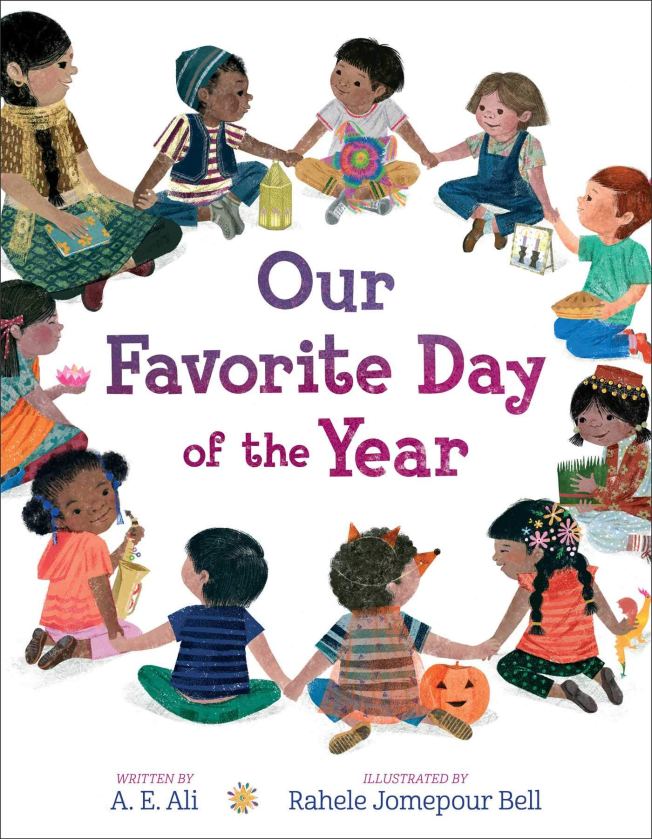
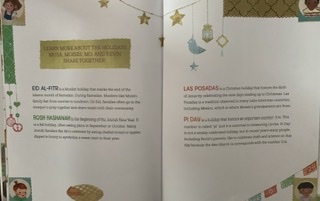
A great book about inclusion for back to school, except well with Corona, we aren’t doing things how we always have. None-the-less this book about the first day of kindergarten for Musa and the friendships and celebrations of diversity (Eid al-Fitr, Rosh Hashanah, Las Posadas, Pi Day) that will take place over the school year, connect the kids and their cultures in a beautiful and heartwarming way. The book is 40 pages with engaging illustrations and text perfect for 5-7 year olds.
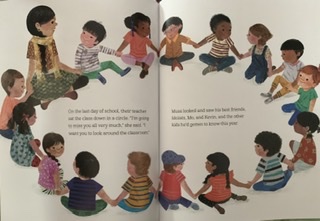
It is the first day of school and Ms. Gupta tells the class it is her favorite day of the year. She also tells the children that the people around them will become their best friends. Musa doubts this as he looks around at the strangers at his table.
He also wonders how the first day of school can be any ones favorite day, clearly Eid al-Fitr is the best holiday. Luckily, every show-and-tell will be about someone’s favorite day, so that the class can join together in celebrating it. Moises can’t believe that Christmas isn’t the most fun until he learns that not everyone celebrates it.
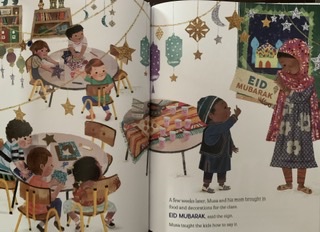
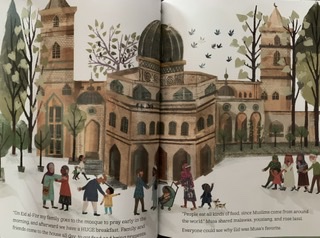
When it is Musa’s turn to teach about Eid, his mom and he bring in food and decorations and teach the kids to say Eid Mubarak. They learn what Eid is like and can see why it is his favorite.
Up next is Mo’s turn. He tells everyone about Jewish New Year and how to say Shanah Tovah. On Rosh Hashanah they light candles and share food with friends and family.
Moises explains how Las Posadas is how his family celebrates Christmas. It lasts nine days and there are songs and pinatas and presents.
In the spring it was Kevin’s turn and he shared his love of Pi Day as his family celebrates science. On March 14 (3.14) they make different pies and learn about scientists and their discoveries.
On the last day of school, the children are sad, but their teacher hopes they will remember each other always throughout the year as she hands out calendars for them to keep.
The book concludes with information about each of the four holidays mentioned. It is possible that on the Rosh Hashanah page the family is two gay men with two children, but it could be just two men as well, and doesn’t say anything in the text that suggests who and how the family is comprised.
No matter where you are in your school journey, there is a good chance that this year is not going to look like anything you have ever known or experienced before. This is true for children, teachers, administrators, and parents. There is a lot of discussion about educational standards, some discussion about mental health, and in my opinion not nearly enough discussion about the lacking socialization and community building that occurs when diverse people interact.
Now, more than ever perhaps, books have an incredible role in showing children different cultures, religions, viewpoints and ultimately the unifying humanity that binds us all.
With children stuck inside for months now, and only seeing the same people day-after-day, chances are children aren’t learning about the diversity around them that comes from just seeing people at the library or grocery store or on their soccer teams. Someone isn’t eating a samosa for the first time when they go over to work on a school project at Fatima’s house or learning about the sport of cricket when they see Harry and his dad playing in the yard, they aren’t seeing Mustafa’s mom in hijab at the park, celebrating Chinese New Year with their neighbors or helping a friend plan her sister’s quinceanera. So many stereotypes can be broken down when we get to know people different than ourselves. So what happens when we are holed up in our homes and not challenging ourselves, not showing our children other people’s experiences?
Teachers and parents are adapting and coping with a lot of educational and routine changes, but the power of literature has not changed, it has just been amplified during this pandemic. As a critical tool to growing and learning, fictious friends can open windows into diversity that a Zoom window may have slightly closed.
If you are trying to find diverse books for your children and feel overwhelmed, Bates College has a wonderful easy to use resource that can help you identify and explore multicultural picture books. This free resource has a searchable database that anyone can use to locate and explore children’s books featuring Black and Indigenous People of Color (BIPOC) characters and see what roles and messages are depicted in the story. https://diversebookfinder.org
Public and School Librarians, particularly those who might have a lighter load with fewer kids coming in person, can further take advantage of the Collection Analysis Tool (CAT). An online tool that allows you to upload your picture book database and receive a report detailing your collection’s racial and cultural strengths and weaknesses. https://cat.diversebookfinder.org
Back to school is not the same as it has always been, but the literary resources available today are better and more diverse, so please take advantage. Representation matters, but only if we are interacting with the representation. Teachers, parents, librarians, you got this, Happy 2020-2021 school year!
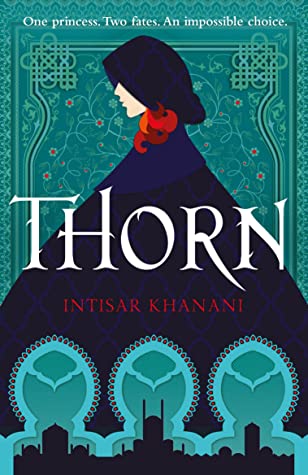
I finished this book, all 512 pages, and before closing it at 12:44 am, I picked up my phone and sent the author a thank you message on instagram. Yes, it was that good and that fun, and so well written and so encompassing that I don’t feel like I read a book, I feel like I got to know a friend. There is abuse, and death and sexual assault, but I think thirteen and up can handle and appreciate the crimes and the severity of them, as they are not taken lightly. The book has magic and royalty, but is so much more about choice and justice and making life meaningful, that Thorn will stay with you as you imagine her life, long after you turn the last page. ***I did not know it was a retelling of Goose Girl by the Brothers Grimm prior to reading the book, and only read it after writing this review, so forgive me for being so swept away by Falada and Kestrin and loathsome to Corbe’ and Valka, if it so irks you that I am.***
SYNOPSIS:
Princess Alyrra is set to marry Prince Kestrin in a neighboring country. Unloved and unwanted by her own mother and abused by her brother, none of the royal family can figure out why the King of Menaiya would be coming to see her and appraise the match. One possibility is because the royal Menaiyan family tends to disappear at alarming rates, and Alyrra might just be a princess that no one will miss. When a Menaiyan mage comes to warn her and is pushed aside by a magic Lady, Alyrra may be leaving an abusive brother, but getting herself a much bigger nightmare to manage.
Alyrra is known for her honesty. She stood up for a servant against a Lord’s daughter and prospective wife for her brother, and since then, the royals despise her and the servants adore her. She spends her time with the holsters and cooks and they keep her aware of her cruel brother’s locations. When the visiting entourage comes, they see her tormentor and give her a security detail, as well as see how she is beloved by the staff.
Once the match is arranged she is off to Menaiya with Valka, the girl she revealed to be a thief. Along the way, the Lady presents herself again and switches Valka and Alyrra’s bodies, to give Valka another chance to be queen and to use the real Valka as a tool to destroy the royal family. The only person in the traveling group aware of the switch, and that can see through it, is Falada a white talking horse, that only speaks to the real Alyrra and refuses to be ridden.
When the girls arrive at the palace, the pretend princess dismisses Alyrra, who has decided to rename herself Thoreena, Thorn. She asks the king if there are any available positions and thus becomes the Goose Girl.
Thorn is still summoned to the castle to write letters home for the imposter and the prince and former security quad find something off with a former lady of the court finding such contentment in manual labor. As she settles in to life with the other employees she finds laughter and companionship and only Falada prods her to reclaim her position as princess and save Prince Kestrin from the Lady.
When Falada is killed, and street justice is called on to avenge the brutal rape and killing of a friend, Thorn must decide to enjoy her quiet life or step up and be the change the people and royals of Menaiya need.
WHY I LIKE IT:
I love that it isn’t a sappy love story, it really could have been, but Thorn is calling the shots and she is enough without anyone or with everyone. I love that she is secure in any role and that her sense of loyalty and obligation comes from within. The writing is seamless, so often things are repeated and forced upon in a first person present tense story, but this read easily and held my interest. I love the titles and some of the sprinkling of made up words, it gave depth and richness, as well as the struggle that Thorn had to go through to speak the language. I loved that she had to work to acquire the skills to communicate and that it was a part of the story, it didn’t just happen, nor did it get swept aside.
Thorn is religious, but no idea what religion or what it means, she seeks going to the temple for peace and clarity, and we know she takes off her shoes, but that is about it. The author is Muslim and the book is superb. I had my daughter read it before I read it, and she in turn made me read it, even watching her younger siblings so I could sneak away.
FLAGS:
Death, murder, public execution, hanging, sexual assault, rape, abuse, violence.
TOOLS FOR LEADING THE DISCUSSION:
I am thinking to do it as a book club book if and when we return to school. It would depend a bit on the group, but I think older middle school could handle it toward the end of the year. There is a lot to discuss, a lot that readers could understand differently regarding the Lady, when her secret identity was blown, the value of love and choice, that I am confident that the conversation would be rich and enlightening.
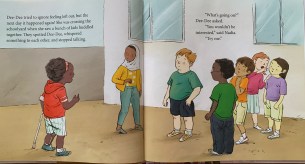
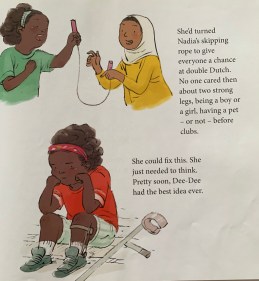
I debated reviewing this book, but seeing as it is one in a series of four, and Nadia a hijab wearing girl of color, is included in them, I thought I should draw attention to these diverse books that teach moral lessons. Over 24 pages this book for preschool to second graders focuses on inclusion and friendship.
The diverse group of classroom kids (skin color, hair color, body shapes, mobility) have different likes, and exclude Dee-Dee from joining in any of their clubs. One group after another tell her no, even though she knows she is a good friend to all of them.
Dee-Dee decides she has to do something to change this and asks her teacher Ms. Crosby for some art supplies. Curious as to what she needs them for, Dee-Dee lays out her plan and how her friends’ exclusion is making her feel.
Dee-Dee starts the Friendship club where all you have to do is sign up and treat others the way you would like to be treated. You then pick a sign that has an attribute of being a good friend as a reminder or something to work on: be kind, show respect, care, etc.
Everyone realizes they were mean to Dee-Dee, apologizes and phew, the friends are all back together without anyone getting mad, or in trouble, but rather realizing their mistake fixing it and resolving to do better. Great problem solving Dee-Dee!
I love that the group is so diverse. Nadia, the Muslim girl excludes Dee-Dee too, and has to learn to include others. I’m sure everyone will relate to feeling left out, or being the perpetrator of exclusion in the book and learn how to voice how it makes you feel, and how to not do it to others.
And yes Nadia probably doesn’t have to wear hijab, but alas, for reasons unknown to the reader she is wearing it, and is visibly showing her faith at a young age.
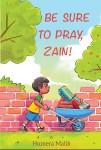
A very relatable 31 page early elementary chapter book about not only establishing salat, but doing it for the right reasons. The book is not preachy or reprimanding, and even with a moral purpose, Zain manages to connect with readers and be funny and likable along the way. Told from the view of the young narrator, realization is achieved, confessions made, understanding gained, and inshaAllah regular prayer established. A great book to share with your own children when salat integrity is in question, and a great reminder of the power of salat that kids will enjoy reading even when it is not, alhumdulillah.
SYNOPSIS:
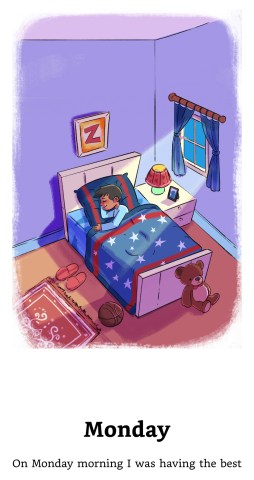
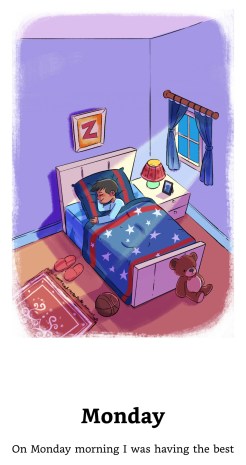
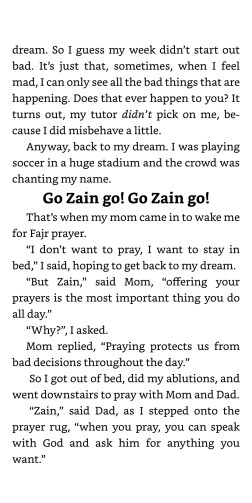
Zain starts off by introducing himself as a kid who lives with his parents and is having an awful week. He rewinds and begins with recapping Monday. Right away he acknowledges that Monday actually started out ok as he was having an awesome dream, but that sometimes when he is mad he only sees and remembers the bad things. Because of his awesome dream he didn’t want wake up and pray Fajr, but his parents reminded him that when you pray you can ask anything you want from God and that praying protects us from bad decisions. He drags himself up to pray and asks God to help him on his spelling test. Later that day he took his test, said Bismillah, and aced it. So he concludes that maybe Monday wasn’t so bad, and Tuesday wasn’t either.
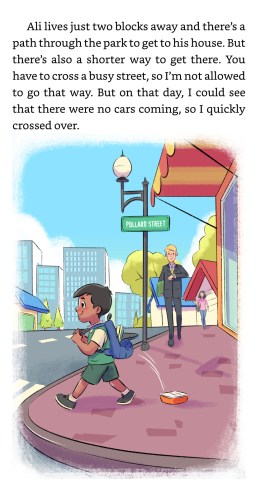
On Tuesday, Zain sticks up for his neighbor Joey who is being picked on by some older bullies. Later that night Joey’s parents come over to thank him and take him out for ice cream in appreciation. Wednesday, starts out great at school, and after school he gets to bake blueberry muffins with his mom. When the muffins are done he was suppose to pray Asr and then take the muffins to his friend Ali’s house. His mom reminds him to take the safe way and not cross the busy street. But, Zain forgot to pray Asr and sees no cars coming and chooses to take the short cut across the road. When he gets to Ali’s house his backpack is open and the muffins are missing.
The rest of the week continues with highs and lows. Many of the lows coming when he doesn’t pray. At one point a friend comes to tell him to come to the park to play soccer, and he knows his mom is going to ask him to wait a so they can pray together, so he pretends not to hear and rushes out the door. Another day he chooses to not miss the end of a show he is watching to pray and heads off to tutoring without praying at all.
When the book rejoins Zain in the present he is feeling bad about kicking a friend playing soccer, cheating on a math test, and not getting to taste his muffins. He unloads everything that has happened over the week, and his parents calmly and patiently ask him if he has been praying. When Zain realizes he has been neglectful his mom likens prayer to bricks in a wall that help keep bad things out. His parents tell him that when we miss our prayers, we end up with holes in our wall and bad ideas can sneak in. Resolved to stay strong, Zain wakes up the next morning to pray Fajr and have a good day, inshaAllah.
WHY I LIKE IT:
I love that it stays with a young kids perspective and doesn’t get weighed down with hadith and ayats and lectures. The parents let him learn from his mistakes and he comes to his own realization, not through their reprimanding or catching him in his deceitfulness. The book is a great way to remind kids that it is their responsibility to pray and that Allah swt knows everything, so that connection has to be made between the person and their creator, it isn’t something you do only when someone is watching or telling you to do it. I do wish that when he did resolve to pray that there would have been a bit of an outpouring to Allah. I love that he had tears in his eyes when he told his parents everything, but I think it would have been really powerful to see Zain ask Allah to forgive him and to help him keep his wall strong.
The book reads smoothly, and the illustrations are well done and inviting. Early chapter book readers will enjoy the font and format and knowing where the story is going with the days of the week chapters. On one occasion I wish the word “wudu” would have been used instead of ablution, and I’m not sure what Zain has against carrots, but nothing too major will keep kids from enjoying the story and understanding it.
FLAGS:
none.
TOOLS FOR LEADING THE DISCUSSION:
This book is for children learning to pray and realizing how important salat is. So while it won’t work for a book club, I really hope teachers in Islamic Schools and Sunday Schools will read the book aloud or assign it to their students. It is a great teaching tool, a great reminder, and a fun story too.
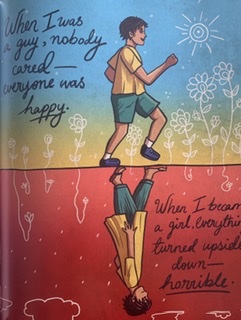
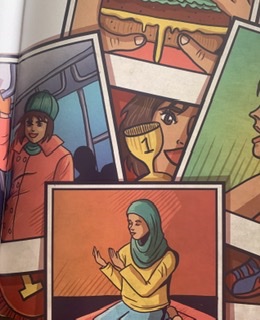
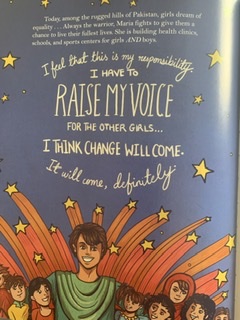
This children’s biography of Maria Toorpakai Wazir, Pakistan’s world famous squash player, is simplified and suitable for children 2nd grade and up. At 42 pages with bright illustrations older kids will understand a little bit more about the cultural norms that were being oppressive and the strength and risks Maria took to play a sport she loved and defy the Taliban while disguising herself as a boy. Younger children will probably only get her determination and perseverance, which is impressive in its own right.
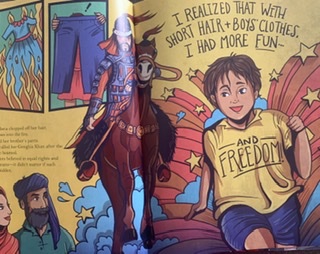
In 1990, Maria was born in the mountains of the Tribal Areas in Pakistan. Conservative society and strict gender roles amplified by the control of the Taliban in 2001. Maria’s parents supported rights for their sons and daughters, and allowed Maria to cut her hair, dress like a boy, and play sports.
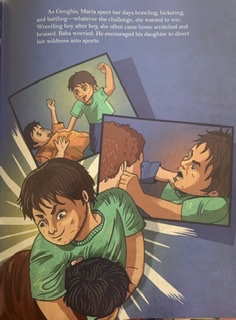
Her father called her Ghenghis Khan after the great warrior and when the family moved to the city of Peshawar he even introduced her as his son to people. As Ghenghis, Maria was always picking fights and encouraged instead to play sports to channel her wildness.
She fell in love with the game of squash, and when she went to join the Squash Club she had to submit her birth certificate which revealed that she was a girl. The director let her join the club, as the only girl among 400 boys. But now her secret was out.
She was bullied and her family ridiculed, but she kept playing and kept winning. The President of Pakistan awarded her honors for her outstanding achievements, but that infuriated the Taliban and they threatened her family.
As a result Maria had to hide, and would practice at night, in secret, and for 3 years she played against the wall in her bedroom. Appealing to squash clubs around the world for help, she finally heard from Jonathon Power in Canada, willing to help her get away from the Taliban and be able to play.
She left behind everything she knew at 20 years old to train in Toronto. She still represented Pakistan in tournaments. She studied, she prayed, she succeeded. She now is back in Pakistan establishing health clinics, sports clubs, and schools for girls and boys.
The story is inspirational, and well told, it shows how culture limited her, not religion, and that in a larger city, culture was a little less conservative. Muslim and non Muslim children will be inspired by her efforts, her willingness to look like a boy and her determination to excel. Muslim kids will enjoy that it shows her praying, but might be surprised to see her in shorts and tank tops. The book would be a great conversation starter about women’s rights and how it isn’t just in Pakistan that women struggle to have equal opportunity and respect. It also might many children’s first exposure to the sport of squash.
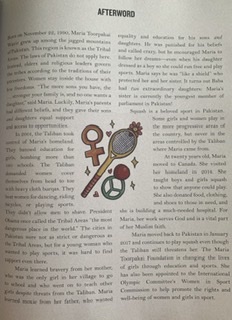
There is an afterward at the end with more information. A list of additional reading about other inspirational women, a selected bibliography and a highlight timeline of female firsts in sports.
I was not expecting to be so absorbed by this 362 page AR 5.4 book. I knew it was about a Syrian refugee in Brussels and his friendship with an American kid living in Europe for a year, so I knew that Islamaphobia and immigration would all be factors. I also knew that as a middle grade book it would be optimistic, and a bit of a stretch at times, but when I had to pause in the first chapter to wipe the tears off my cheek, I knew that while it could be billed as, another refugee story, it really was going to be a poignant story about humanity and friendship and family and making a difference, so I settled in and was swept off to Belgium and the adventure of two determined kids.
SYNOPSIS:
The book opens with 14-year-old Ahmed on a boat with his father hoping to reach Greece from Turkey, when the boat stalls, his father and two other men, the only other people on the dinghy that know how to swim, jump into the sea to drag the boat. When a storm swell hits them, his father is lost and Ahmed, who left Syria when an explosion killed his mom and sisters, is all alone.
Max is 13 and his parents and sister have just arrived in Belgium for a year. Not a great student, Max learns that he will be going to a local school where French is spoken, and will be repeating 6th grade. Less than thrilled with the news, he is additionally hurt that his parents didn’t tell him first.
The two stories start off separate with Max trying to find his footing in school and scouts where he understands very little, and has no desire to learn, and is also getting picked on by a kid named Oscar. He learns about the history of his street and house during World War II from his after school tutor and a police officer that used to live in the house they are renting and makes regular checks on how it is being maintained.
Ahmed has been staying with Ibrahim and his family, another man that tried to drag the boat in the sea, but with news that they are probably going to be forced to return to Iraq, suggests that Ahmed register in as an unaccompanied minor so that he could find a place to stay. Ahmed knows that if he registers in Beligium he will never make it to England, he hires a smuggler for 300 Euros to get him there. When the smuggler steals his money and his phone, Ahmed worries his organs could be next, and jumps out of the moving car,
Ahmed runs through a neighborhood looking for shelter and safety and some warmth from the frigid air. Ahmed finds the basement of a house unlocked, he then finds a wine cellar room that is empty and decides to stay for the night as he figures out his next step. One day turns in to two and before he knows it, he has a routine of finding food upstairs during the night, which he records so that he can repay the family one day, caring for the family’s discarded orchids, and working on his English. Then one day Max goes downstairs and discovers Ahmed living there.
Deciding he isn’t a terrorist, Max decides not to turn Ahmed in nor tell his parents, and the two become friends. The two enlist Farah, a nice Muslim girl at school to help, and they get Oscar too, to forge papers to get Ahmed in to school. While the biggest problem should be keeping a kid hidden in the basement, and keeping him fed and entertained, the situation is compounded as terrorist attacks by Muslim extremist plague the city and Europe, making everyone on high alert. The police keep checking in and anti immigrant sentiment rises. When Ahmed gets accused of being a bomb maker his secret is out, but can his knowledge of how a jewish boy was hidden in the neighborhood during the war keep him free? Nope, I’m not going to spoil it, you have to read it, trust me, you’ll thank me for it!
WHY I LIKE IT:
I love, love, love, the history parallel, and the truth in the story of Albert Jonnart and Ralph Mayer that is woven into this modern fictional story. I love that Max so plainly says that the stories are the same and that laws that aren’t right shouldn’t be followed, yes! The book reads a lot like Refugee by Alan Gratz crossed with The Boy at the Back of the Class by Onjali Q. Rauf with the kids being so heroic and determined and awesome, throw in a dash of The Diary of Anne Frank, switching out a boy for a girl, a Muslim for a Jew, the basement for the attic, and a diary for a fictional story, and you have this book.
I love that the adventure and excitement shows how resourceful kids can be even when they don’t share common language. Max speaks English and is learning French, he is helping Ahmed learn better English and some French, when they talk to Farah who speaks Moroccan Arabic /Berber, they often have to go through Oscar who speaks French and English. Yay, for American television and kids who’s hearts are bigger than the obstacles they are taking on. Additionally, when the kids hit a dead end, they reach out to Jews in America for help, knowing that the two religions have more in common than politicians and the media would like to think. Seriously, kids should rule the world.
Ahmed is a religious boy that prays, refuses meat even when hungry to ensure it is halal, and makes sure that Max knows in Islam kindness and charity are the norm and commands, not the violence that people are doing in the name of his religion. A lot of the moms of the kids at school where hijab, and the author gets the Islam right and believable. It doesn’t get preachy, but a fair amount of information about Islam is shared.
FLAGS:
A lot of lying. Some violence, death, hate speech. There is mention of smoking and the adults I think drink wine at one point.
TOOLS FOR LEADING THE DISCUSSION:
I’m hoping to do this as a middle school book club selection, because it really is so good.
This silly book has an abrupt ending, but plenty of giggles along the way that make you forgive the sudden conclusion. Additionally there is a lot of diversity in the illustrations, a little hijabi girl of color that steals the show, and a lesson about asking and listening that children 4-7 will find sweet and enjoyable. It is an AR 2.5 and has 36 pages. Some are text heavy, but my 4 year old had no problem sitting through it with the silly pictures and large 9 x 11.5 size.
Poe is an elephant that has planted himself in the middle of the only road in Prickly Valley. The citizens do everything they can think of to get him to move. They honk, write him a ticket, bang pots and pans, play trombones, blast megaphones, tickle, beg, and bribe. They even bring in mice, and magnets, and motivational speakers. Clowns and copters, cranes and pastors, magicians and the mayor, no one can get him to move.
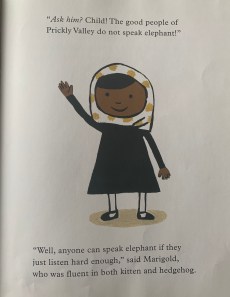
After lots of discussions involving coffee in stryrofoam cups, a little girl named Marigold, asks the mayor if anyone has asked Poe. Such an obvious suggestion, the Mayor laughs and says she doesn’t speak elephant. Little hijabi Marigold says, “anyone can speak elephant if they just listen hard enough.” She is also fluent in kitten and hedgehog.
Marigold discovers that Poe is waiting for a friend that is very late. A reporter asks if the friend could be wearing a polka-dot-tie, it is determined that it is possible and that also perhaps he is sitting on his friend. At that Poe stands up, finds his friend Mo and the two walk off.
The randomness of Poe sitting on his friend made me have to read the story a few times checking to see if a page was missing or stuck together, but alas no, it just suddenly is resolved and ends with no clues indicating that the elephant is sitting on a monkey.
I love that the name in the text for the little girl is Marigold, and that the illustrator chose to depict her as a little Muslim girl of color. On many of the other pages with the town folk trying to move the elephant, there are people of all colors, body shapes, hairstyles, head gear, eye wear, facial hair, body art, etc shown. Marigold seems to be at work with her father at their flower shop, and the mayor is a female.
There is nothing religious in the book, save a pastor trying to persuade the elephant to get behind him, and it doesn’t appear that the author or illustrator are Muslim (it is published by Disney Hyperion) which in someways makes the normalizing of a girl in hijab all the more sweeter. Sure, someone her age wouldn’t be required to cover, but the message and representation is deliberate and appreciated.