Tag Archives: Palestine

The Little Green Drummer by Taghreed Najjar retuld by Lucy Coats illustrated by Hassan Manasrah

Standard


A485FA5B-6839-4720-9E5B-BA2D9AB71901

This book is perfect for early readers that are more fluent than picture books, but not quite ready for a full on chapter book.  With five chapters, pictures on every one of its 73 pages, this book is a joy to read both on your own or out loud to a group.  It is fun for Muslim children and non Muslim kids, and a great addition to bedtime or story time at Ramadan, or any other time of the year for that matter.

3BC30F96-8F88-48D3-8963-99E9EFA5BE44

SYNOPSIS:

Samia and her Yaba live in Lifta, Palestine and her dad’s job in the month of Ramadan is is to wake the whole village up as the dawn waker-upper.  Samia loves his important job, and hopes one day to do it too, but her dad says a girl has never done it before.  Samia doesn’t understand why, girls can shout and bang drums as well as anyone else.

The day before the start of Ramadan, Yaba is not feeling well and doesn’t know what he will do.  Samia sees her chance and says she can do it.  Her drum is loud, her lantern is bright, and her dog, Barkie, will keep the wild wolves away.

As she sets out in the dark, she sees orange scary eyes in the woods and sings a song to herself to keep her brave as Barkie defends her.  When she gets to the first house, they are surprised to see her, but the children of the home rush out to join her with their own drums.  When the three children and Barkie get to the next house, their friend Omar wants to join in with his tambourine.  This continues as the village children join together with whatever instruments, even pots and pans, they have to make sure everyone gets up in time for suhoor.  For five is louder than four, all the way up to nine being the loudest of all.

The children all sing and the villagers reward them with candy and treats.  On the way back home the wolves stay away and when they reach home Samia’s dad is feeling better and can’t wait to hear of her adventure.

44520351-F7CC-4FAA-A643-936E6858FD73

WHY I LIKE IT:

The book is based in truth which is detailed at the end of the story on three pages that tell about Lifta, and how after a war the people were not able to return.  It also tells about Ramadan as the story text itselft mentions it very little.  Yes, it takes place in Ramadan, and the people need to be woken up to eat before the day starts to fast, but the afterword gives a bit more about the holiday and Eid that follows.

I love that the book is about a girl doing something because she can, I was afraid it was going to be like Hiba Masood’s Drummer Girl, but it takes a different turn in showing Samia having to be brave, showing team work and cooperation in getting the job done, and the village not even really caring who wakes them up, her being a girl doing a “man’s job” is never even mentioned again.

The book is fun with the sound effects and inclusion of everyone and the illustrations are incredibly well done.

8A2F6DC8-8573-46E1-8CD0-364E46DDB1AC

FLAGS:

The book is clean, the “scary part” is quick and while it adds a little tension, not enough to scare even sensitive little ones.  The dog stands his ground and becomes the Dog King of the Village.

A658F1B7-5975-42C1-822A-90F652CA668D

TOOLS FOR LEADING THE DISCUSSION:

I’m trying to see if I can do this as an online story time during Ramadan amid Covid 19.  It is a super quick read, and is a lot of fun, but the small (8×5) size might make the pictures hard to see.  I think all kg through 2nd grade classes should have this story.  It explains a cultural celebration of Ramadan in a universal way that will make Muslims feel proud and non Muslims excited to learn about something new.

5871BBBF-1802-4A33-A387-A9B3C91020F6


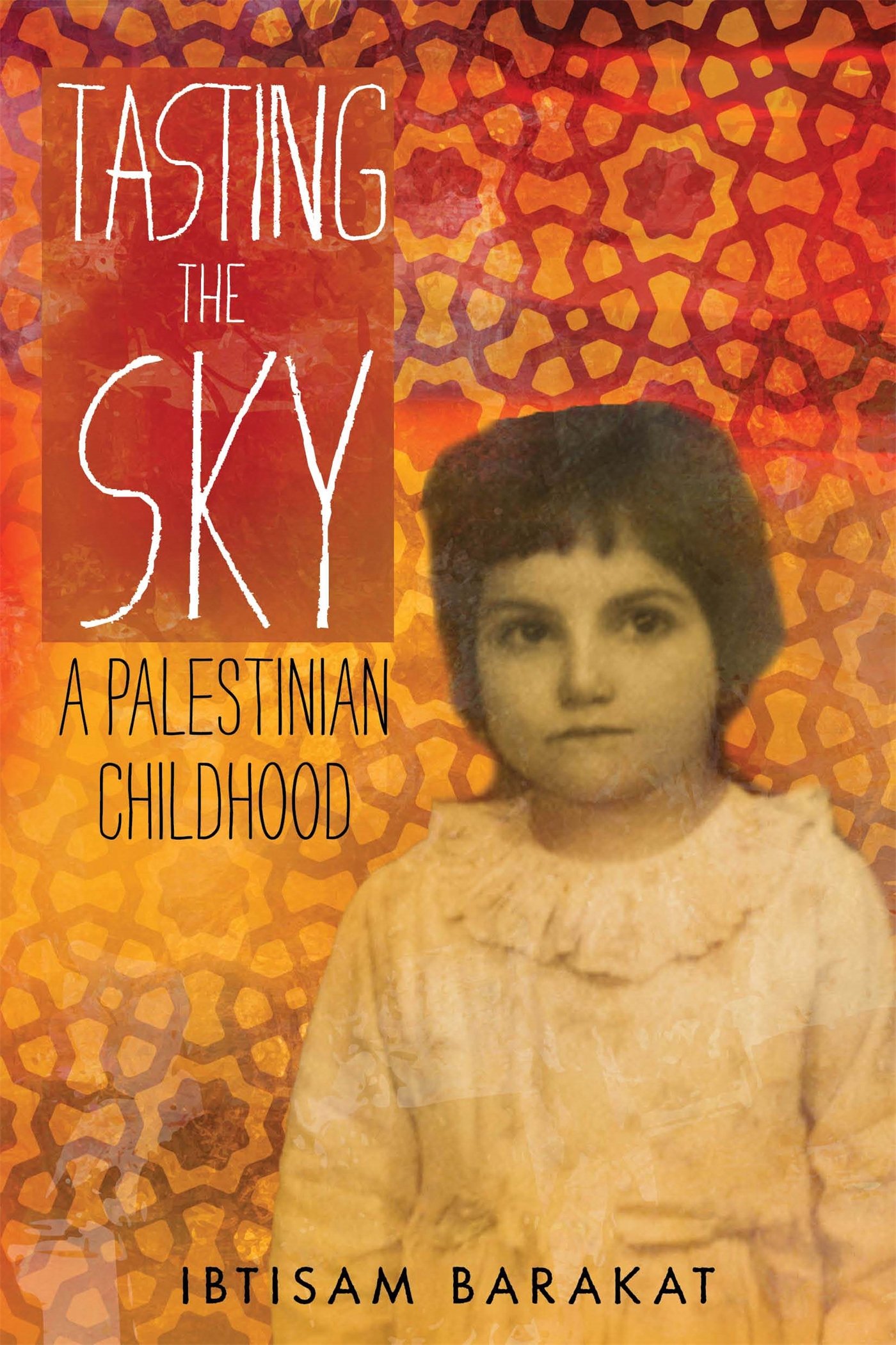
Tasting the Sky: A Palestinian Childhood by Ibtisam Barakat

Standard
Tasting the Sky: A Palestinian Childhood by Ibtisam Barakat

tasting the sky

This memoir may qualify as non fiction, but the majority of this 176 page book is told from the perspective of the author when she was three years old, so much of it reads to me as somewhere between historical fiction and autobiography.  No matter how you categorize it though, this AR 5.8 book is better suited for middle school and up. I love that this is is a Palestinian perspective of the Six-Day War and the immediate aftermath, but after reading it, I’m not haunted by the atrocities of the Israeli occupation so much as, some of the choices her family made.  I got my copy through Scholastic and in excitement, purchased multiple copies that I sadly think will sit in a box as I doubt I’ll find many students that will enjoy this book.

SYNOPSIS:

The book is divided into three parts with the first and third being short letters written in 1981, and the second part being the majority of the story taking place between 1967-1971.

The first part is a high school Ibtisam getting detained at a checkpoint after heading out to check a PO Box that she uses to keep in touch with her pen pals from around the world.  She reveals what life is like and shares the joy of learning about the outside world from her correspondence, but that she rarely talks about her childhood and her life during the war.  Part two is her sharing that.

The Barakat family lives removed from neighbors and a city, but Ibtisam loves her two older brothers and younger sister and at three years old is happy.  When war comes, the family decides to run, in the process Ibtisam doesn’t have time to find a shoe, and then she gets separated from her family and swept up with the people running for the caves to escape the bombings.  Once reunited with her family, they along with numerous other Palestinians make their way to Jordan and some safety.  Safety comes at a cost though and the family is separated as her father leaves to find work.  When the war ends, the family moves from the shelter and finds a small room to rent until they can return home.

Once the family returns home, things do not return to normal as the Israeli army begins training near their house causing Ibtisam’s mom to worry constantly in her attempts to keep the children inside and away from the windows.  Eventually, the mom takes the children and herself to an orphanage in Jerusalem saying that their father cannot keep them safe.  Ibtisam is close to her father and this dramatic change does not sit well with her.

In the orphanage, the boys get separated from the girls and eventually their father promises the mother to build a wall and make repairs to the home and purchase a goat if they come home.  They do, and the kids are grateful to be together again.  The boys then start school and the goat has a baby and life carries on.   Ibtisam grows close to the baby goat and their father promises that he will remain the children’s pet and will not be slaughtered.  But, when the boys are 8 and 9 they get circumcised and the feast involves the goat.

The next major event in young Ibtisam’s life is when she finally gets to go to school.  Incredibly smart, her mother essentially equates her love for her daughter with her success in school and with that motivation and predisposition to learn and excel, she does very well.  One day on the way home, she is sexually assaulted by an older boy, and makes arrangements to always have her brothers with her when walking.  Her parents are not made aware of the offense, and don’t seem to investigate Ibtisam’s change in attitude toward school.  When an Israeli soldier attempts to assault her mother, the family moves once again and part three is a teenage Ibtisam quarreling with her parents and once again excelling at school.

WHY I LIKE IT:

I like that tidbits of memories are woven together to give an overall impression of the author’s childhood.  The book is a quick read and is compelling enough to hold one’s attention.  The family is culturally religious, but the book makes a point that the father prays, not indicating that the rest of them do or even know how.  I love how the freedom and hope that Ibtisam has comes from learning the first letter of the Arabic alphabet, alef.  The love of language and the power found in reading and writing, is celebrated in its reverence to the learning of the letters.

I don’t get the mother, and while I get that war is a horrific time, and she is 24 when Ibtisam is 3 and has like four kids, so her life is definitely not easy, I still find it disturbing to me that she would lose a one shoe-ed daughter, take her kids to an orphanage to live while both parents are alive and well, and be so cold to her daughter.  The father seems to be loving to the kids, but he still slaughtered their pet, and I’m guessing culturally circumcisions are done at that age, because that seems incredibly cruel.

FLAGS:

War, loss, sexual assault, details about the circumcisions.

TOOLS FOR LEADING THE DISCUSSION:

I won’t do the book as a book club selection and while I know the book is in many libraries and classrooms I doubt many kids would be compelled to pick it up and read it based on the cover and synopsis on the back.  I have a few Palestinian friends that I will ask to read the book to see if they find it an accurate representative of life during the six-day war and even today as it could definitely be used to teach about the region, the conflict, and writing a biography about life for others to learn from.


The Chronicles of Bani Israil: The King, Queen, and the Hoopoe Bird by Dr. Osman Umarji illustrated by Sama Wareh

Standard
The Chronicles of Bani Israil: The King, Queen, and the Hoopoe Bird by Dr. Osman Umarji illustrated by Sama Wareh

the king

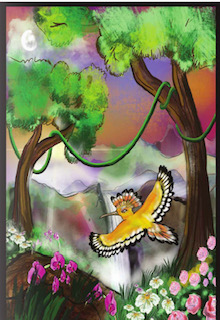
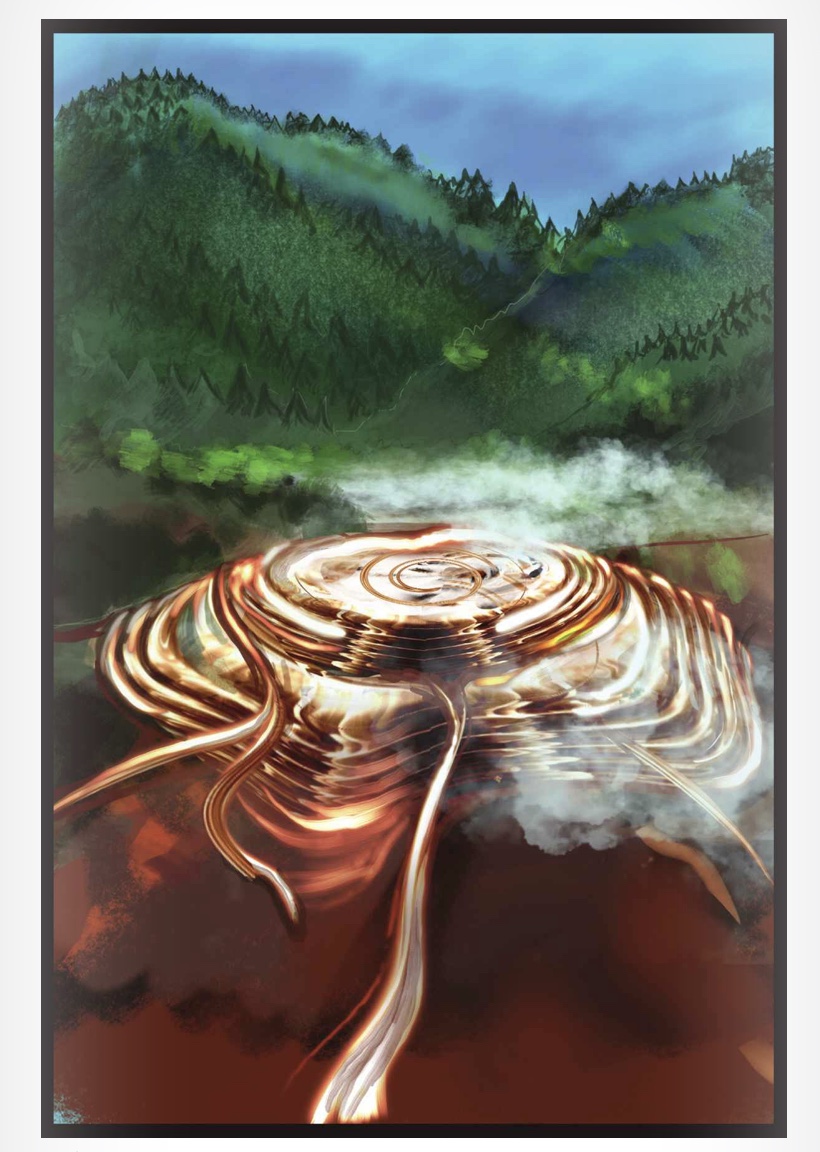
At 134 pages the fictionalized retelling of Prophet Sulaiman’s (AS) kingdom and interaction with Queen Bilqis comes to life from the point of view of a Hoopoe bird.  The book is marketed as a “Quranic fantasy adventure,” which I found a bit misleading.  The book is rooted in Quran and Hadith facts according to the author, and colored in to try and tie a story together, but even for 3rd and 4th graders I don’t know that there is much adventure or suspense.  As a prophet story it is pretty solid, but as an adventure book it seemed a bit scattered in its attempts to give history, draw in unrelated anecdotes and make it seem intense, when the dialogue suggested otherwise.

IMG_9137

SYNOPSIS:

The book starts with the narrator setting the stage to tell his story of being in Prophet Sulaiman’s army nearly 3,000 years ago in the land of Sham.  Told in first person and  limited to what he saw, the Hoopoe bird (Hud-hud) addresses the reader and begins his tale.  He first gives some information about Hoopoe birds and Prophet Dawud (Prophet Sulaiman’s father), before lovingly describing Jerusalem and how the Bani Israil came to the land of Sham.

The first real glimpse of what kind of ruler Prophet Sulaiman is, is given with the detail allotted to how he repaired Masjid Al-Aqsa.  The bird then tells of Prophet Sulaiman’s many powers and gifts from Allah (swt), the ability to control the wind, control liquid metal, speak with animals, and of course the Jinn.  Slowly, the reader begins to understand how impressive Prophet Sulaiman’s kingdom is, not just by being told, but being shown, so to speak, and reminded pointedly by the Hoopoe that despite so much power how humble towards Allah swt, Prophet Sulaiman remained.

There is a tangent about his love of horses, before the Hud-hud takes center stage again as a spy in the powerful army of men, jinn, and animals. The story of the ants is shared and about half way through the book it is on one of the bird’s scouting missions that he sees a Queen and her people worshipping the sun.

The back and forth between Prophet Sulaiman and Queen Bilqis as Prophet Sulaiman urges the Queen to allow her people to worship Allah or risk invasion is a familiar tale and one the author asserts he tried to use only Islamic sources to include.

The book ends after the Queen has visited, embraced Islam, more anecdotes about Prophet Sulaiman’s wisdom are shared and how even in his death he attempted to show the doubting people the power and oneness of Allah swt.  The revelation of the termite breaking his walking stick and the retirement of the bird who had lived a most wondrous life, conclude the story before an Author’s Note at the end of the book.

IMG_9117

WHY I LIKE IT:

I love Prophet stories and especially ones that are easy to read, memorable, and factual.  I think the book does a decent job in a fictionalized retelling of getting a lot of the important information in, albeit sometimes a bit forced, but keeping it on level for upper elementary and being clear and concise.  I didn’t stumble on grammatical mistakes or find parts confusing, it was well told and presented.  More than once in the book, I felt like it would have made a better oral story than written one.  The bird had to articulate how he knew stuff if he wasn’t there, and he kept asking the reader questions or telling them to pay attention.

The book is meant for Muslim kids and I wish there would have been footnotes or sources.

The illustrations were nice, they are full color but I am admittedly bias as I grew up writing letters to the illustrator who was my penpal for a few years.

IMG_9043

FLAGS:

None

IMG_9092

TOOLS FOR LEADING THE DISCUSSION:

Doesn’t fit my book club criteria, but definitely think kids would benefit from reading the story and discussing how the author shared the information, what they think the Hud-hud’s life was like and then maybe trying to retell a story of their own from a different perspective.


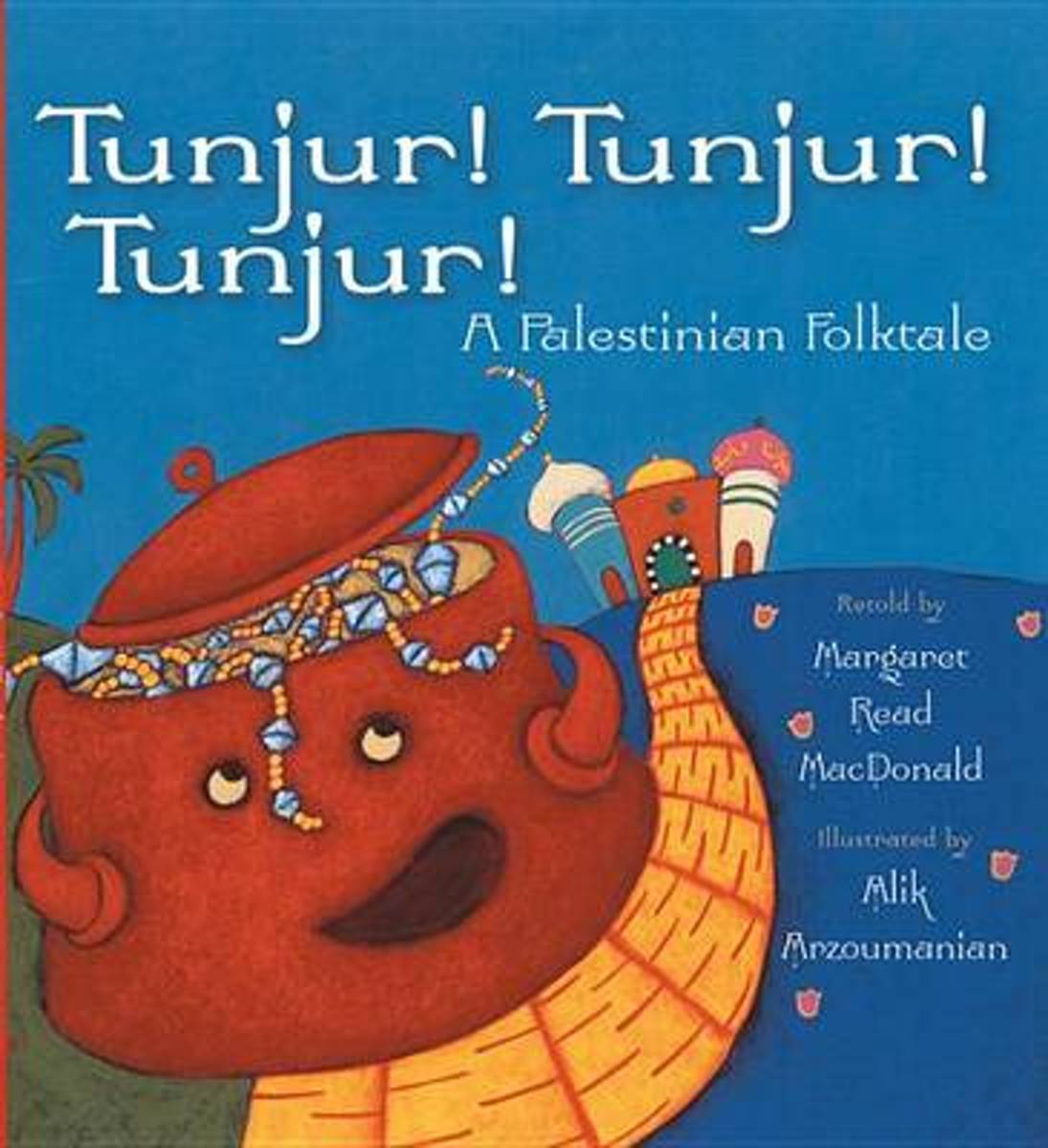
Tunjur! Tunjur! Tunjur! A Palestinian Folktale retold by Margaret Read MacDonald illustrated by Alik Arzoumanian

Standard
Tunjur! Tunjur! Tunjur! A Palestinian Folktale retold by Margaret Read MacDonald illustrated by Alik Arzoumanian

tunjur.jpg

This delightful little folktale is beautifully presented in 32 pages on an AR 1.7 level.  Perfect for little ones to listen to and early readers to tackle on their own.  The pictures are fun and engaging and the story teaches a great lesson of right and wrong in a silly memorable fashion.

IMG_8036

A childless woman asks Allah to bless her with a child, even if it is just a cooking pot, and “Willa! She had a child! And it was a little pot!”

At first taken aback, the little pot professes her love for mama and thus the woman decides to take care of the little pot.  Every day the little pot bumps against the walls as she rolls and jumps around making the sound, Tunjur.

IMG_8037

One day the pot wants to go to the market by herself.  Mama refuses as she is too young and doesn’t know right from wrong, but alas she talks her mom in to it, and off she goes.

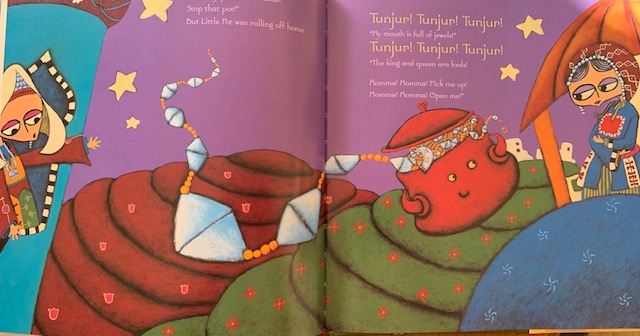
She meets a rich man who wants to fill her with honey for his wife.  The pot loves honey so she doesn’t protest, but she refuses to release her lid when the man gifts the pot to his wife.  Angrily he throws the pot out the window and the little pot finds her way home. Mama assumes the honey seller sent it as a gift and little pot says nothing at all.

IMG_8039

The next time little pot heads out she finds herself filled with the queen’s jewels and when she returns Mama is not happy that her little pot has taken things that do not belong to her.

IMG_8038

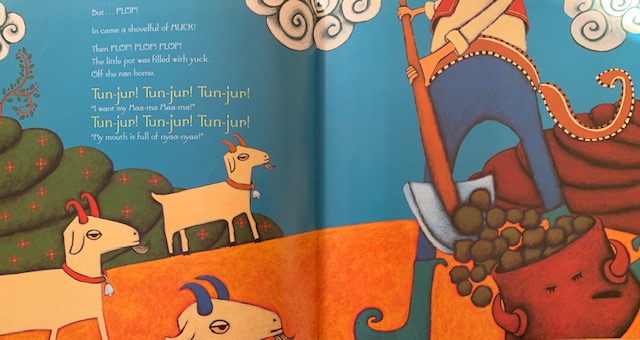
When little pot heads out again to apologize, the rich man takes her to the king and queen for a reward,  and they fill her with something to teach her a lesson.  When she comes home to Mama, she has definitely learned her lesson.

IMG_8040

The women in the story seem to wear hijab, most notably the wealthy man’s wife.   The Mama asks Allah swt for a child, but other than that there is nothing religious in nature in the book and seeing as I checked it out from the public library, I think it appeals to all kids.


Jasmine Falling by Shereen Malherbe

Standard
Jasmine Falling by Shereen Malherbe

jasmine

This 184 page book about a girl figuring out her past, to accept her present, and plot her future. is not marketed, or perhaps even written as a YA novel, but I’m reviewing it because while the protagonist is in her 20s the book could be enjoyable to ages 15 or so and up, if they are willing to stop trying to understand a lot about the book and are content to just go along for the heartfelt ride.

SYNOPSIS:

Jasmine is half Palestinian and half British and when her wealthy mother passes but stipulates to claim her inheritance Jasmine must find her father, the book leaves England and heads to Palestine.  To further complicate things she has only 10 days to find a father who has been missing for years, in a land she has only visited once before many years ago.

Once in Palestine, the story takes her from one city to the next and one village to another with pit stops at various historical sites along the way.   With lots of fragmented memories, the shadow world of Jinns, and a race against time and around the obstacles of the occupation, Jasmine rediscovers Islam, her family history, and the fears that haunt her.  She also meets Josh, a character of questionable allegiances, motives, and background himself, that constantly finds himself able to help Jasmine and possibly himself.

From Jericho and Jerusalem and Batien, Jasmine hears stories about her father from people that know her family,  as she pieces it all together and reunites with her family members, she understands her past and works to determine what path her future should take.

WHY I LIKE IT:

I love the backdrop of Palestine and the history and the richness of culture that is brought to light in a surprisingly non political way.  The interaction of the different faiths among the villagers and the love of the land is truly palpable.

The part I struggled with was the holes in the story telling, for each page that brought Jasmine closer to answering her one question of where her father is, the reader was given 27 new ones that would never be answered.  Where did the wealth come from, how did Jasmine’s parents meet, what were the circumstances that made Jasmine’s dad leave, who is Richard, who was Ali, how old is Jasmine, why are there so many Jinns every where, why is there secret passages in the mountain, how come she trusted Josh, how could Josh get from one city to another in record time, why did the soldiers at the check points know of her family and specifically her father, and most importantly why every time she meets someone that knows her family, why does she run away.   It is incredibly frustrating that every time the story hints at what makes her father so famous, or sought after or memorable, or hint at why he disappeared, something interrupts them and the reader is left in the dark, only to have the book end and no really understanding conveyed.

I get why the story is told in pieces, but really the story is confusing in how it is told, and it doesn’t need to be.  The author can write and the last 50 pages are really great.  For as confused as I was so often, I kept reading because the story is good.  There is just a tad too much with diving in to the past to understand the present, the supernatural of the jinn, the reemergence of faded memories and dreams, the political climate, the letters from World War II, that the character dynamics are lost until the end.  I care about Jasmine and am curious about Josh, but a little more detail to the relationships the two main characters have with all the other minor characters that they encounter would really make the story soar, and clarify so much.

One thing I didn’t love was the presentation of Jinns, I know it is to add cultural richness and a bit of muddled confusion, but really the story I think is strong enough without the supernatural and character building could have benefited in its place. I also really, really, really wished there was a map and an afterward telling what parts about Palestine and history and the Holy Cities is fact, for those of us that have never been.

FLAGS:

Jasmine attempts suicide, jumping out a window.  Jasmine also gets drunk a few times in the book before deciding to stop drinking as she doesn’t like who she is when she does.  There is some violence and killing talked about but not overtly detailed.

TOOLS FOR LEADING THE DISCUSSION:

I don’t think I would do this as a book club book, but I definitely would encourage those with connections to Palestine to read the book.  And I am really hoping that someone, anyone, that has read the book will chat about it with me.  For all the questions I have, I’m optimistic that I just missed the answers and that they were in fact there.


Secret Recipe Box by Helal Musleh illustrated by Nalan Alaca

Standard
Secret Recipe Box by Helal Musleh illustrated by Nalan Alaca

recipe-box.jpg

The publisher suggests this book for ages 4 and up, but I think it’s a bit long (30 pages) and detailed for that age group, and first grade and up will benefit more from this heartfelt story.

IMG_5872.jpg

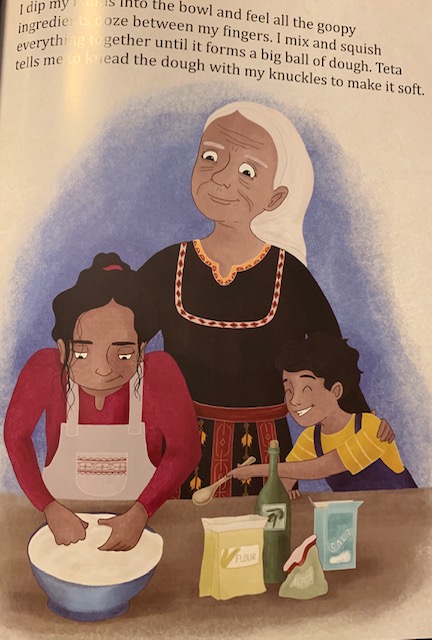
Maha is excited her Teta is moving from Palestine to live with her, her brother Sami, and parents in Canada.  Maha dreams of being a chef on a famous cooking show, and her Tata and her secret recipes will be a great way to practice.

IMG_5873.jpg

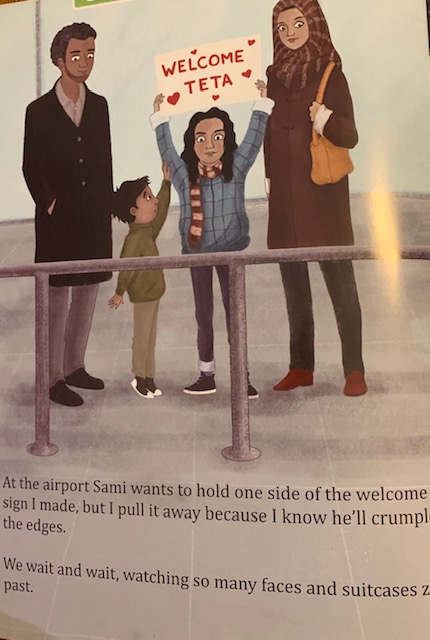
Her little brother Sami is always in the way though.  Whether it is wanting to hold a sign Maha has made, or is wanting to cook with her, she is annoyed by him at every turn.

IMG_5764.jpg

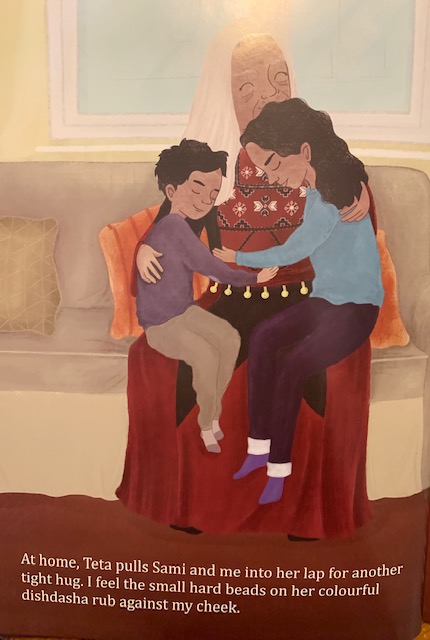
As Maha listens to Teta’s stories and learns about her life in Palestine, she starts to change in her approach to Sami and realizes that family has to take care of each other.

IMG_5874.jpg

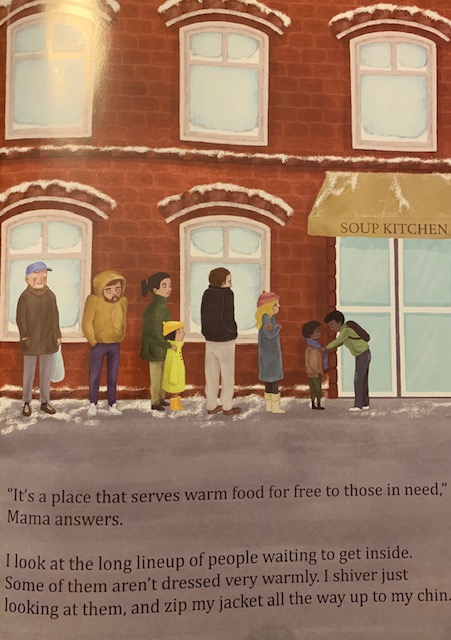
After a day of cooking together, Maha, Sami, and Teta have made too much food and decide to go and share it with those in need at the soup kitchen.

IMG_5763

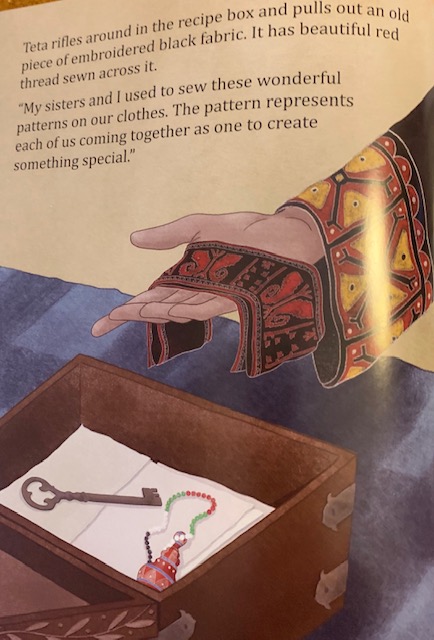
The book addresses kindness, changing, compassion, immigration, taking care of one another, multi generational lessons and love, stories, life lessons, and some highlights of Palestinian culture, food, clothing, and tradition.

IMG_5761

The book is warm and well done, with the exception of a few of the pictures which seem a bit off to me.  Overall, it is a sweet story that presents with a lot of lessons, but doesn’t force them upon the reader.  The character growth is gentle and subtle and will resonate with readers.

IMG_5762

The characters mention Halal food, and the grandma wears hijab even in the house, where the mother is shown wearing it at the airport, but not in the home.  The book would work for Muslim and non Muslim readers.

The Tower by Shereen Malherbe

Standard
The Tower by Shereen Malherbe

the tower

At 246 pages I’m not sure if this book would be classified as Young Adult, but I think it could be, as its message, focus and presentation makes it a valuable thought provoking read.  And the cleanliness of everything being resolved so neatly might almost be too coincidental for older, more jaded readers, where I personally wasn’t too bothered by how much emotional action was packed in to the book and how quickly it was resolved as the characters were compelling and the pacing made it an enjoyable quick read.

SYNOPSIS:

The story follows two women, Reem and Leah as their very different worlds and circumstances come together when they move in to the same apartment building.

Reem is a Syrian refugee whose past is presented in bits and pieces as her fragmented memories surface in the story.  She is searching for her 10 year old brother Adar, as well as trying to create a future for her self in London.

Leah has recently lost her husband, left her training as a doctor, and is trying to make a life for her and her son, Elijah, away from her parents’ shadow of expectation and demands.

When the two ladies meet, neither is completely settled or functioning, yet the desperation each is feeling causes Reem to ask for Leah’s help, and Leah agreeing.  The two become friends as they share parts of their world with one another and slowly start to heal.

Then Reem’s secret pregnancy comes to light, her abusive husband finds her, Leah’s posh friends abandon her, and their apartment building, the tower, catches fire.  Granted it doesn’t all happen that quick and there are lots of details that make their pasts, their friendship, and their goals for the future believable and inspiring, as well as making the pain for those lost in the fire emotionally wrenching.

As the two women once again try and survive hardship, this time together, they make progress before a terrorist attack on the mosque again sets them back.  Through all these major plot points details about how Reem got to England, and the atrocities she suffered that her mind blocked out are made clear.  Additionally, more about Leah and her families involvement in the tower fire and their friends’ involvement in human trafficking all tie the lose ends up. In the final pages there is hope and resilience and respect from the reader for the brave characters brought to life and their determination to persevere.

WHY I LIKE IT:

I love that it is a very personal, character driven story about a horrific fire, reminiscent of the Grenfell fire which claimed the lives of over 70 people.  I also absolutely love how Islam is presented.  The Muslim characters are tangibly real.  Reem wants to fast because it is Ramadan, but has the excuse that she is pregnant, but tries anyway.  She prays, she covers, she meets a Muslim that doesn’t cover, but they pray together at the mosque later and become great friends.  Leah is interested in Islam and asks questions and when she cooks for her Muslim friends she gets halal meat.  There is an amazingly helpful character Mo in the story who Leah is crushing on, but he refuses to be alone with her, or touch her, and when she tells him of her feelings, he says that everything she likes isn’t him it is his religion.  Leah and Reem discuss how the sunnah’s of the Prophet influence Mo and his brother and it is quite detailed.  Quranic ayats are quoted in character’s dialogues in natural presentations, not preachy or misplaced.  It hints at the end, when Leah has joined Doctors Without Borders and is in the Middle East that perhaps she has taken shahada, but it isn’t a plot point and isn’t mentioned explicitly.

My biggest complaint about the book is the random foreshadowing that pulls out from the story to hint that something more is going to happen between certain characters or be of more importance later.  I think it happened three times, and each time completely unnecessary. The story and characters and writing are clear and done well enough that needing the hint sells it all short and it wasn’t just annoying and irritating, it really kind of made me mad.  Here I was feeling an attachment for a character or what they were experiencing only to be reminded that there will be more, rather than letting me go along for the ride with the character.

I also was bothered by the font and spacing.  It is really tight on the pages, but with big margins, that a little breathing room would have been nice.  So, much happens in the book, that I wanted to be able to relish in each event and often I felt the presentation made it rushed and I found myself skimming, more than I would have liked.  I would have also liked to know what parts, if any, were based on or inspired by real events: the tower fire, human trafficking, stealing organs, artifacts coming out of Syria, refugee treatment in London, etc.

FLAGS:

There are memories of war and dead bodies.  The stealing of organs and dumping of bodies into the ocean.  There is a lot of death after the fire and after the shooting at the mosque.  There is a lot of blood, a terrorist act, a baby being delivered, a drunk man at a party.  Nothing is overly sensationalized, but it is a gripping book with some intense moments.

TOOLS FOR LEADING THE DISCUSSION:

I don’t know if middle school can handle the book, the characters are older, so it won’t resonate with them like a traditional YA book would, but I’m tempted to have my almost 13 year old read it so we can discuss.  I will most definitely suggest it to the high school book club adviser as there is a ton to discuss and relate to in this action packed book.

Author’s website and Q and A: https://shereenmalherbe.com/


P is for Palestine: A Palestine Alphabet Book by Golbarg Bashi illustrated by Golrokh Nafisi

Standard
P is for Palestine: A Palestine Alphabet Book by Golbarg Bashi illustrated by Golrokh Nafisi

p for pale

I first heard about this book maybe a year ago when it was making waves for including such passages as “I is for Intifada, Intifada is Arabic for rising up for what is right, if you are a kid or a grownup!” The book was in limited supply however and hard to find.  Recently a 2nd edition came out and is widely available in major outlets. 

IMG_2401

The book follows the well established genre of giving each letter in the alphabet a page to depict in picture and words details about a given subject.  The form usually rhymes and appeals to little kids learning about something specific, and adults, who enjoy the topic at hand.  

IMG_2399

While this book is fabulous because it exists, and praiseworthy because it celebrates Palestine, Christmas and Eid and the birthplace of Jesus and Lebneh and Quds and olives and grape leaves and everything else that makes Palestine so close to one’s heart, the stanzas themselves are really forced and inconsistent in rhyme and meter.

IMG_2400

Granted, one doesn’t buy or even pick up a book like this for its literary merits, but the text is really a bit all over the place.  “Can we sing the ABC anywhere? With a woolly bear or in thin air? L is for Labneh is like yogurt.  I eat it for lunch, wearing my loafer! B is for Bethlehem, my birthplace with the best Baklawas, put it on a plate not in a vase! K is for Kuffiya, the best kind you can hang on a hook in Hebron souk! E is for Eid, it means Festival, like the Muslim Eid al-Fitr when we eat enticing eats, get excited over gifts, and enjoy seeing out extended families. J is for jesus, Jesus was born in my hometown (Bethlehem), not Jamestown!”

IMG_2403

I of course overlooked some of the awkwardness because the illustrations are lively and beautiful and the parts I thought needed explaining, I chalked up to me not being Palestine, nor having visited there.  

Many of the passages are touching and memorable and make the book so important.  M is for Miftah, Key of Return…Mama’s Mama, and my Jiddah’s Mama’s, for which I yearn! T is for Thob, a traditional dress wtih tatreez (embroidered pieces).  Takes time to make, with thousands of tiny threads, if you please!

IMG_2405

There is an Appendix in the back, giving a tad more information on the main idea mentioned for each letter.  There is also a Publisher’s note.  While there was some controversy that the book is anti Semitic or spreading propaganda, I think the book comes from a place of love and culture.  There is Christian and Muslim concepts and a character named David making grape leaves.  It does not mention Israel or Zionism blatantly, which I think shows that Palestine has its own culture and isn’t solely defined  by the crimes committed against them.  Interestingly, the author is from Iran.


Sitti’s Secrets by Naomi Shihab Nye illustrated by Nancy Carpenter

Standard
Sitti’s Secrets by Naomi Shihab Nye illustrated by Nancy Carpenter

sitti

Sitti’s Secret was published in 1994 and given the events of the week, I’d say it is more relevant today than it was when written.  And if by some chance the events of the week haven’t affected your children, then the poetry and soul of the book still makes it an amazingly powerful story.

Mona travels from America to Palestine to visit her grandma, her Sitti.  Without the ease of speaking the same language, Sitti and Mona learn to communicate and build a tight bond cut too short by a vacation coming to an end.  When Mona returns she sees the news and writes a letter to the President, telling her Sitti’s secrets, telling him they would be great friends, and telling him they only want peace.

Truly Nye is a poet, even in Turtle of Oman her words transport you to a place where time slows down and the connection between a child and a grandparent make you nostalgically yearn for a simpler time.  Having spent my summer’s abroad visiting my grandma I could relate to so much of this book and truly had to still my heart.  The little things, like examining your grandma’s hand, or hanging out laundry, or brushing her hair. Even that dreaded final hug as you prepare to leave,  I could relate and it was enchanting.

No where in the book does it mention the Middle East or Islam, only at the beginning does she hint at it by dedicating the book to her 105 -year-old Sitti in Palestine, it mentions that she speaks Arabic and a few words are sprinkled in. And the Grandma does wear a scarf.  Other than that the book is by and large not political.  If you know that Nye has a Palestinian father and American mother and often writes semi auto biographical pieces, the book can take a bit of a different role to the reader.  Many reviews criticize the activism upon her return (the letter to the President), and found it disjointed to the rest of the story.  But in today’s climate I found it empowering and hopeful.  The world will only find peace when we put a face to those that are different to us, and even children can change our stereotypes.  I love that my children are seeing that they can make a change in the world today, and to see it reinforced in literature was gratifying.

The book is 32 pages and written on an AR 3.9 level.  The illustrations are beautiful.  They bring the words to life in a tender and heartfelt way.  The detail is subtle but deep and i have found myself thumbing back through the pages to get lost in the illustrations multiple times.  I think the book works on different levels for different age groups.  If you have a family that has to overcome great distances to be together, even younger readers will be able to identify with the story’s tenderness.  If you are in 3rd-6th grade and are aware of what is happening in the world you will be inspired.  If you just are looking for a sweet book, subhanAllah it manages to fulfill that category too.

Snow in Jerusalem by Deborah da Costa illustrated by Cornelius Van Wright & Ying-Hwa Hu

Standard

Snow in Jerusalem

The world is always in need of kindness for animals and for one another, so when I saw this book written in 2001 about two boys who live in different quarters of Jerusalem coming together when they learn they are caring for the same stray cat, I was definitely excited to dive in.

The book starts with a Jewish boy, Avi, caring for a fluffy white stray cat and his mom teasing him for caring for him.  He begins to wonder where the cat goes and resolves next time he comes around to follow him.  The reader then sees the cat journey through a market place and have the exact same interaction with Hamudi, a Muslim boy.  Both boys go days without seeing their beloved cat and when they begin to look for her, they find each other.  The boys fight over her as it begins to snow and the cat takes them to see where she has been, with her new kittens.

Again the boys fight and ultimately resolve to divide up the kittens to care for them and let the mama cat go back and forth to feed them.  Needless to say, I was a little let down by the book, I had hoped the boys would bond or see how similar they are. Instead they simply work out a solution for this one situation.  I can’t help but thinking the kitty family getting broken up and the poor mom having to go back in forth is rather selfish on the boys behalf.

IMG_0326

The book is 32 pages and written on an AR level 3.1.  Third grade and up can probably understand the similarities of the boys and how they come together to care for the cat and appreciate it with a simplistic understanding of Jerusalem’s complexities. Kindergarten and 1st graders could probably handle it as a story time selection, and understand working together to help a cat.  I’m sure fifth graders and up however, will be a little concerned for the mama cat and disappointed in the boys at a lost opportunity to provide hope in a troubled region.

There is an Author’s note and Glossary of Arabic and Hebrew words at the end, and a simple, yet valuable map of the Old City at the beginning.