Tag Archives: Palestine

Sitti’s Secrets by Naomi Shihab Nye illustrated by Nancy Carpenter

Standard
Sitti’s Secrets by Naomi Shihab Nye illustrated by Nancy Carpenter

sitti

Sitti’s Secret was published in 1994 and given the events of the week, I’d say it is more relevant today than it was when written.  And if by some chance the events of the week haven’t affected your children, then the poetry and soul of the book still makes it an amazingly powerful story.

Mona travels from America to Palestine to visit her grandma, her Sitti.  Without the ease of speaking the same language, Sitti and Mona learn to communicate and build a tight bond cut too short by a vacation coming to an end.  When Mona returns she sees the news and writes a letter to the President, telling her Sitti’s secrets, telling him they would be great friends, and telling him they only want peace.

Truly Nye is a poet, even in Turtle of Oman her words transport you to a place where time slows down and the connection between a child and a grandparent make you nostalgically yearn for a simpler time.  Having spent my summer’s abroad visiting my grandma I could relate to so much of this book and truly had to still my heart.  The little things, like examining your grandma’s hand, or hanging out laundry, or brushing her hair. Even that dreaded final hug as you prepare to leave,  I could relate and it was enchanting.

No where in the book does it mention the Middle East or Islam, only at the beginning does she hint at it by dedicating the book to her 105 -year-old Sitti in Palestine, it mentions that she speaks Arabic and a few words are sprinkled in. And the Grandma does wear a scarf.  Other than that the book is by and large not political.  If you know that Nye has a Palestinian father and American mother and often writes semi auto biographical pieces, the book can take a bit of a different role to the reader.  Many reviews criticize the activism upon her return (the letter to the President), and found it disjointed to the rest of the story.  But in today’s climate I found it empowering and hopeful.  The world will only find peace when we put a face to those that are different to us, and even children can change our stereotypes.  I love that my children are seeing that they can make a change in the world today, and to see it reinforced in literature was gratifying.

The book is 32 pages and written on an AR 3.9 level.  The illustrations are beautiful.  They bring the words to life in a tender and heartfelt way.  The detail is subtle but deep and i have found myself thumbing back through the pages to get lost in the illustrations multiple times.  I think the book works on different levels for different age groups.  If you have a family that has to overcome great distances to be together, even younger readers will be able to identify with the story’s tenderness.  If you are in 3rd-6th grade and are aware of what is happening in the world you will be inspired.  If you just are looking for a sweet book, subhanAllah it manages to fulfill that category too.

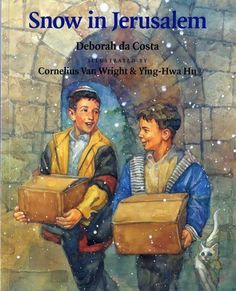
Snow in Jerusalem by Deborah da Costa illustrated by Cornelius Van Wright & Ying-Hwa Hu

Standard

Snow in Jerusalem

The world is always in need of kindness for animals and for one another, so when I saw this book written in 2001 about two boys who live in different quarters of Jerusalem coming together when they learn they are caring for the same stray cat, I was definitely excited to dive in.

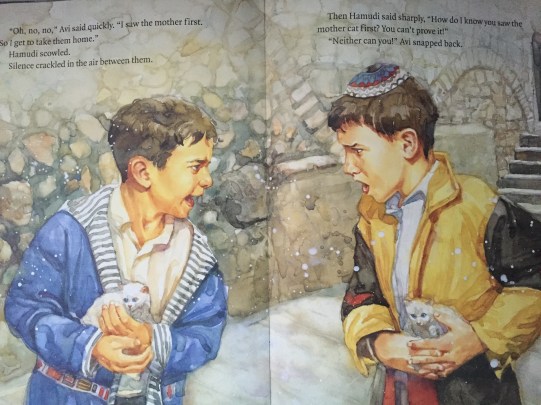
The book starts with a Jewish boy, Avi, caring for a fluffy white stray cat and his mom teasing him for caring for him.  He begins to wonder where the cat goes and resolves next time he comes around to follow him.  The reader then sees the cat journey through a market place and have the exact same interaction with Hamudi, a Muslim boy.  Both boys go days without seeing their beloved cat and when they begin to look for her, they find each other.  The boys fight over her as it begins to snow and the cat takes them to see where she has been, with her new kittens.

Again the boys fight and ultimately resolve to divide up the kittens to care for them and let the mama cat go back and forth to feed them.  Needless to say, I was a little let down by the book, I had hoped the boys would bond or see how similar they are. Instead they simply work out a solution for this one situation.  I can’t help but thinking the kitty family getting broken up and the poor mom having to go back in forth is rather selfish on the boys behalf.

IMG_0326

The book is 32 pages and written on an AR level 3.1.  Third grade and up can probably understand the similarities of the boys and how they come together to care for the cat and appreciate it with a simplistic understanding of Jerusalem’s complexities. Kindergarten and 1st graders could probably handle it as a story time selection, and understand working together to help a cat.  I’m sure fifth graders and up however, will be a little concerned for the mama cat and disappointed in the boys at a lost opportunity to provide hope in a troubled region.

There is an Author’s note and Glossary of Arabic and Hebrew words at the end, and a simple, yet valuable map of the Old City at the beginning.


Where the Streets had a Name By Randa Abdel-Fattah

Standard

streets

This is the second book I have read by Randa Abdel-Fattah, and I still don’t know if I love her as an author, but I did enjoy the content of Where the Streets had a Name, much more so than I did with Does My Head Look Big in This?  The timeliness of this book is also as apparent as ever with the genocide and occupation occurring in Palestine, had I read it years ago I don’t know if it would have had the pull that it had on me, reading in now.  With all the images on social media and the news, this book really does a remarkable job of showing the daily struggles for Palestinians in terms of settlements and check points and just basic day-to-day living that is hard to imagine from anywhere outside of Palestine.  While some may find it slow moving I enjoyed the detail and childlike perspective of the world as seen through the 13 year-old characters in the book.  Despite all the material for it to be a preachy, political, and gruesome, it is not, it is undoubtedly told from a Palestinian Muslim perspective, but the supporting characters come from all backgrounds and focus on the humanity contained with in us all: Muslim, Christian, Jew, and even Israeli.

SYNOPSIS:

Hayaat’s family has been kicked out of their home by Israeli soldiers and are living cramped up in Bethlehem, struggling with no jobs, curfews, and the impending wedding of Hayaat’s sister to a boy on the other side of the checkpoint.  When Hayaat’s beloved, albeit farting, grandama, Sitti Zeynab, falls ill Hayaat believes that she needs to touch her ancestral land to recover.  With a curfew free day, her best friend Samy at her side, and an empty hummus jar, the kids sneak out from school to try and bring back a handful of dirt.  The journey is only a few miles, but with checkpoints, a protest, soldiers and documents, the chances that Hayaat and Samy will retrieve the dirt is minimal, as their priority becomes to make it out safe.  The book is fiction, but from all reviews that I’ve read, it very well could be real, it’s accuracy of the struggles endured and the hope that still remains are not completely fabricated.

WHY I LIKE IT:

I like that Hayaat is a Muslim Palestinian, Samy is a Christian Palestinian, along their journey they meet kind Israeli’s fighting for Palestine, they meet horrible people and soldier’s too, but it is never a black and white issue.  Zionism is what makes life so painstakingly difficult for Samy and Hayaat and all those around them, all the while tourists are flocking around as if walls and checkpoints are the norm.  The first 50 pages of the book are a mess, I don’t know if it is because it is translated from Arabic or if it is just the author’s style to overload and stuff everything in at the beginning that might possibly be interesting or funny to hook the reader. Either way, it doesn’t work and once you get through those 50 pages and the adventure with Samy and Haayat begins and Sitti Zeynab’s story starts to be woven through and we learn more about how Hayaat’s face was scarred, the story starts getting good.  Similarly the book is about 50 pages too long, after the adventure I was ready for the story to end, but I suppose the wedding of Hayaat’s sister, Jihan, has to take place.  Even though it is critical to see the logistical nightmare of having a West Bank girl marrying an Israeli Arab from Lod, the story gets muddled and loses its flow both at the beginning and end with the details of living in Ramallah and figuring out what roads to take to have the ceremony.  Adults may appreciate it, but with an AR reading level of 4.8, the target audience gains a better appreciation for the struggles of the Palestinians through the main story.  In total with the glossary and acknowledgement the book is 313 pages.

FLAGS:

The book is remarkably clean, there is a slight joke about birth control pills, but Hayaat doesn’t understand it, and her companions on the service (bus) don’t explain it to her, so I doubt the young readers will get it either.  (Hayaat thinks her sister shouldn’t get married if it is making her sick and she can’t understand why every day at the same time her mother makes her take a tiny pill.)

There is some violence, but it is not explicit, it is more emotional when Hayaat’s friend is killed and Hayaat’s face marred.  Similarly she blacks out during the protest, so there isn’t much description

TOOLS FOR LEADING THE DISCUSSION:

I do plan to do this as a book club book, I think the students are well aware of the situation and it might be a good place to let them voice their thoughts and emotions.  I may also have a Palestinian sit in on the discussion, to help keep it accurate.

Discussion questions:  www.panmacmillan.com.au/resources/RA-WhereTheStreetsHadAName.pdf

Author’s website: http://www.randaabdelfattah.com/