Tag Archives: OWN Voice

Three Summers: A Memoir of Sisterhood, Summer Crushes, and Growing Up on the Eve of the Bosnian Genocide by Amra Sabic-El-Reyess with Laura L. Sullivan

Standard
Three Summers: A Memoir of Sisterhood, Summer Crushes, and Growing Up on the Eve of the Bosnian Genocide by Amra Sabic-El-Reyess with Laura L. Sullivan

three summers

It is difficult and probably rather inappropriate for me to offer a “review” of a memoir, after all who am I to have opinions on someone’s lived experience.  And this non fiction book in particular is so desperately needed and important, as OWN voice middle grade literature about Bosnia is fairly non existent. So continue reading my thoughts with a grain of salt, suffice it to say, that I enjoyed the book, and loved the author’s YA book The Cat I Never Named, but ultimately I struggle to suggest this for the intended audience of 8-12 year olds.  As a child my family was involved with Bosnian refugees in the 90s, as an adult I understand that Islam, and being Muslim, is not a monolith, as someone who can empathize with loss and heartache, I couldn’t put the book down.  Yet, I truly doubt that many fourth graders will feel the emotional climaxes that are not shown, but told.  That they will understand the timeline and what is about to happen if the book were to continue.  That they will feel a connection to the characters who read so much older than them.  If the book was fiction, I would say the characters read YA, with the bikinis and details of body growth, kissing, making out, having boyfriends, and dancing at the discotheque, cigarette smoking, backless dresses, noting which neighbors are having affairs, and trying to become their “truest self,” but the book is a memoir, this is the author’s life when she was 11, 12, and 13.  In an environment where her maturity is noted as being heightened because of the loss of her brother and her personality, the book shows cultural norms, that will still strike contemporary reader as being much more adult in nature. Islamically, the label of Muslim and Bosniaks, is ever present.  Bosniaks were massacred for being Muslim, period.  The book never shows them praying, or mentions Allah swt or the Quran, covering is something only the older generations did, they do drink alcohol on occasion, but they have a cow slaughtered Islamically and burials are done in accordance with Islamic principles.  There is kissing, having boyfriends is not problematic unless they are Serb, the only imam mentioned does weird black magic type things.  So while the label of “Muslim” may feel to Muslims readers more like a cultural marker at times, it is none-the-less incredibly empowering to see that Amra takes pride in her Bosniak identity and doesn’t shy away from it. Other flags/triggers are domestic abuse, bullying, physical violence, attempted drowning, accidental drowning, death of a sibling, kidnapping, imprisonment, threat of war, racism, Islamophobia, music, fortune tellers, lying, threatening.  The backmatter offers a timeline and thus gives some information about the rape, torture, genocide, abuse, and destruction.

SYNOPSIS:

The book starts with a visiting fortune teller giving Amra and her family hope that her older brother Amar will be pain free soon. Amar suffers from Marfan syndrome, and is frequently weak, teased, and in pain.  But he is also wise and patient, brilliant and gentle, and beloved by so many, and Amra is broken when he passes away.  To help break her from her debilitating grief, her parents reach out to a cousin in Belgrade, who has long been estranged for marrying a Serb, to come visit for the summer.  Zana and her younger sister Vedrana, engulf Amra in warmth and adventure and the summer on the River Una is just what Amra needs.  The next summer Zana and Amra resume their idyllic adventures of swimming, make-up, crushes, and coming of age, with only a hint of fracture based on religious lines creeping in the final days.  The following summer Amra is starting to mature on her own and understand the world around her.  Her father has lost his job, been kidnapped essentially and tortured, and while nights dancing at the discotheque give laughter and light, the girls final summer, is the end of peace, and innocence for all Bosniaks.

WHY I LIKE IT:

I love the end, that there are real life updates of the people in the book.  It made me cry.  It is also so timely to what is occurring in Gaza and how no matter how clear it is that it is genocide, and it is oppression, and it is racism, some just cannot see it.  The book is joyful, but the reality of the backmatter is heavy, and real, and important.

I like that the book shows Bosnia and the culture and the traditions, the few books I’ve read focus on the war, and the rich culture and deep history doesn’t get to shine like it does here.

I do wish the book was more showing than telling.  I know it is a memoir, but at times it was just too advanced commentary and insight.  I fully believe the author is brilliant, and at 11 years old was pondering her life, but most readers just aren’t at that age, and the tangents keep the readers at arms length.  The book says it is about crushes, so I don’t want to keep harping on it, but it really is Amra and Zana and a gaggle of other female cousins quite often worrying about boys, and crushes, and kissing.  It doesn’t get obnoxious, but it isn’t a line here or there, it is the bulk of the book.

FLAGS:

Domestic abuse, bullying, physical violence, attempted drowning, accidental drowning, death of a sibling, kidnapping, imprisonment, threat of war, racism, Islamophobia, music, fortune tellers, lying, threatening, death, loss, grief, affairs, cheating, racism, bare bodies, crude jokes, crushes, kissing, making out, sneaking out, smoking, drinking, developing bodies, bullying, internalized Islamophobia, kidnapping, imprisonment, dancing, black magic imams.  The backmatter offers a timeline and thus gives some information about the rape, torture, genocide, abuse, starvation, and destruction during the Bosnian genocide.

img_4254-1

TOOLS FOR LEADING THE DISCUSSION:

I think with some context about war, about communism, the Ottoman empire even, this book could be used in a teaching setting to allow the time frame to be seen from those living it, but, for more mature middle school to early high school readers.  It is a lot for MG and that it is non fiction makes me want it to be understood and appreciated and I don’t know that for the intended demographic, even with context and guidance it would be achieved. There really isn’t a plot, it is a memoir, and the pacing and assumed context knowledge I feel like, just wouldn’t be there for the typical western middle grade reader.

Sister Friend by Jamilah Thompkins-Bigelow illustrated by Shahrzad Maydani

Standard
Sister Friend by Jamilah Thompkins-Bigelow illustrated by Shahrzad Maydani

img_3521-1

After years of teaching, librarian-ing, and mothering, my reviewers are for adults, but with kids in mind. I read in different environments and try and balance what children will think with my more critical literary impressions. But honestly, my first reaction when I see Jamilah Thompkins-Bigelow has a new book out, is not about the children, or their parents, it is incredibly selfish, and I want to read the picture book for me.  It has been about a year since I first read my all time favorite, Salat in Secret, and I still feel all the feels, every time I read the book. I even enjoy handing the book to people and watching them read it for the first time.  So, I was both excited, and nervous to read this new book, not knowing if it would measure up to my expectations or rather hopes, so to speak.  I needn’t have worried, subhanAllah, this book in it’s own right is moving, heartfelt, layered, powerful, hopeful, relatable, tender, and while staying on a kindergarten to second grade level is also unapologetic with its centering of Islam, race, and feeling invisible, being new, and making a friend.  The illustrations and words blend beautifully, and by the second page of the 40 page book, I was already emotionally attached to the little protagonist Ameena.  Good writing is good writing, and as a result this beautiful book works for all ages and will be appreciated on multiple layers even after dozens of readings, alhumdulillah.

img_3522-1

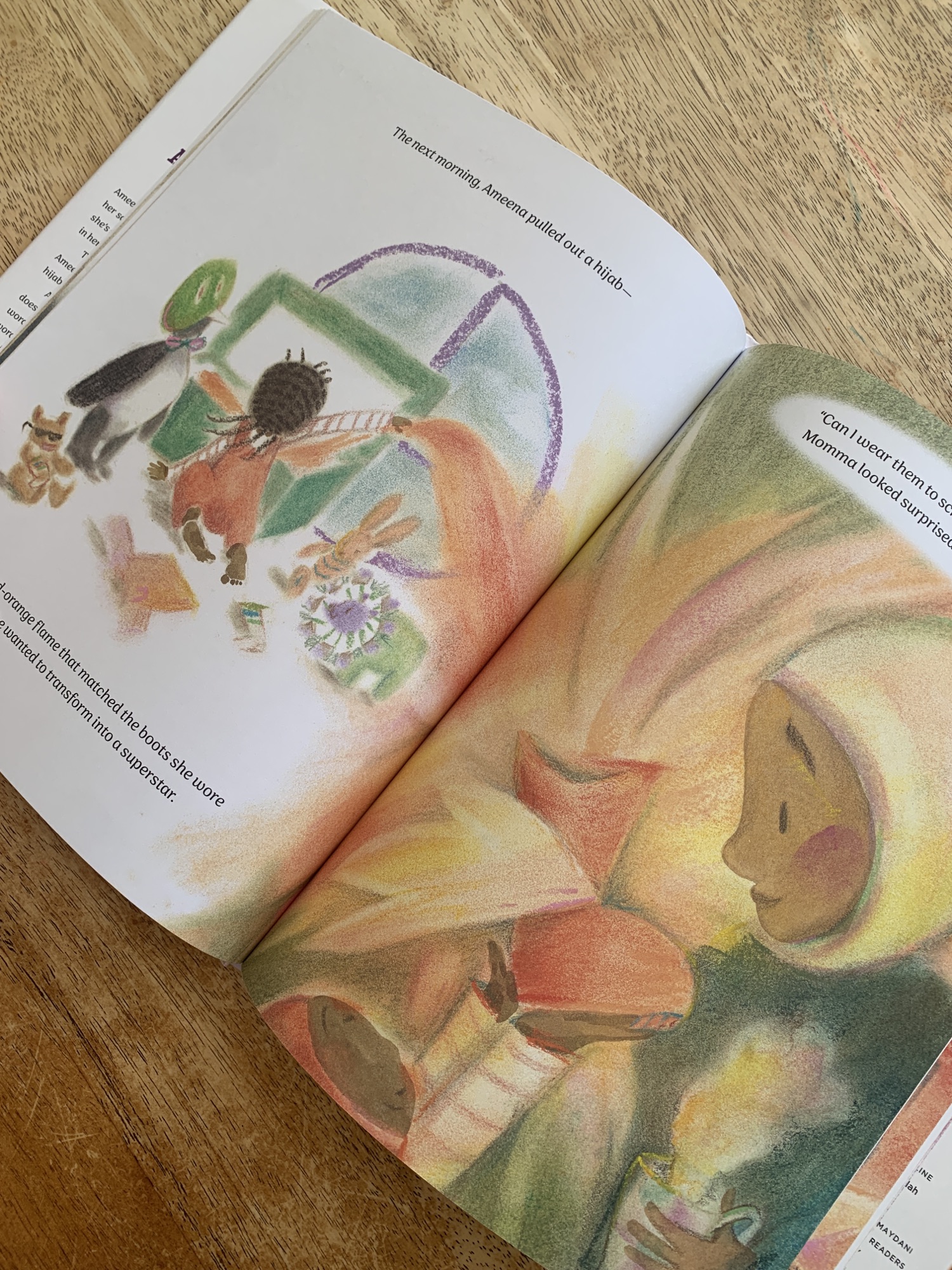
The book begins with Ameena playing a game by herself.  She always plays by herself at school, where she tends to be invisible.  Maybe it is her hair in twists or her brownness, she doesn’t know.  One day a new girl comes, her name is Sundus, she wears hijab like Ameena wears to the masjid.

All day Ameena tries to talk to Sundus, but something always seems to keep them apart.  When they finally meet,  Ameena’s excited words get all tangled, and a misunderstanding occurs.  Ameena decides the next day to transform into a rockstar: red-orange hijab and matching boots. The other kids say she is copying the new girl.  Sundus doesn’t say anything.

img_3523-1

Ameena disappears again at school, but family night at the masjid is her happy place.  Where she doesn’t play alone, and there are lots of browns, and she is seen.  When Mama meets a new sister, and greets her with Assalamu Alaikum, Ameena sees how a greeting and a hug can be the start of sisterhood and friendship. And the next time Sundus and Ameena meet, they know just what to say.

img_3525-1

The joy at the end forces you to smile, just as Ameena playing alone at the beginning tugs at your heart.  It is a great book to see yourself and see others in a beautiful, authentic way.  The universal themes of not being seen, making a friend, and being the new kid, are woven in just as hijab, masjid and Assalamu Alaikum are, making the book powerful for Muslim and non Muslims alike.

img_3524-1

I particularly love that their is no glossary, and that the text uses the word masjid not mosque, hijab not scarf and Assalamu Alaikum not salam.  That the masjid is her safe place to laugh and play, and that this book is mainstream published and will find its way to public spaces and be widely accessible.

You can preorder your copy here on Amazon.

Kareem Between By Shifa Saltagi Safadi

Standard
Kareem Between By Shifa Saltagi Safadi

img_3395-1

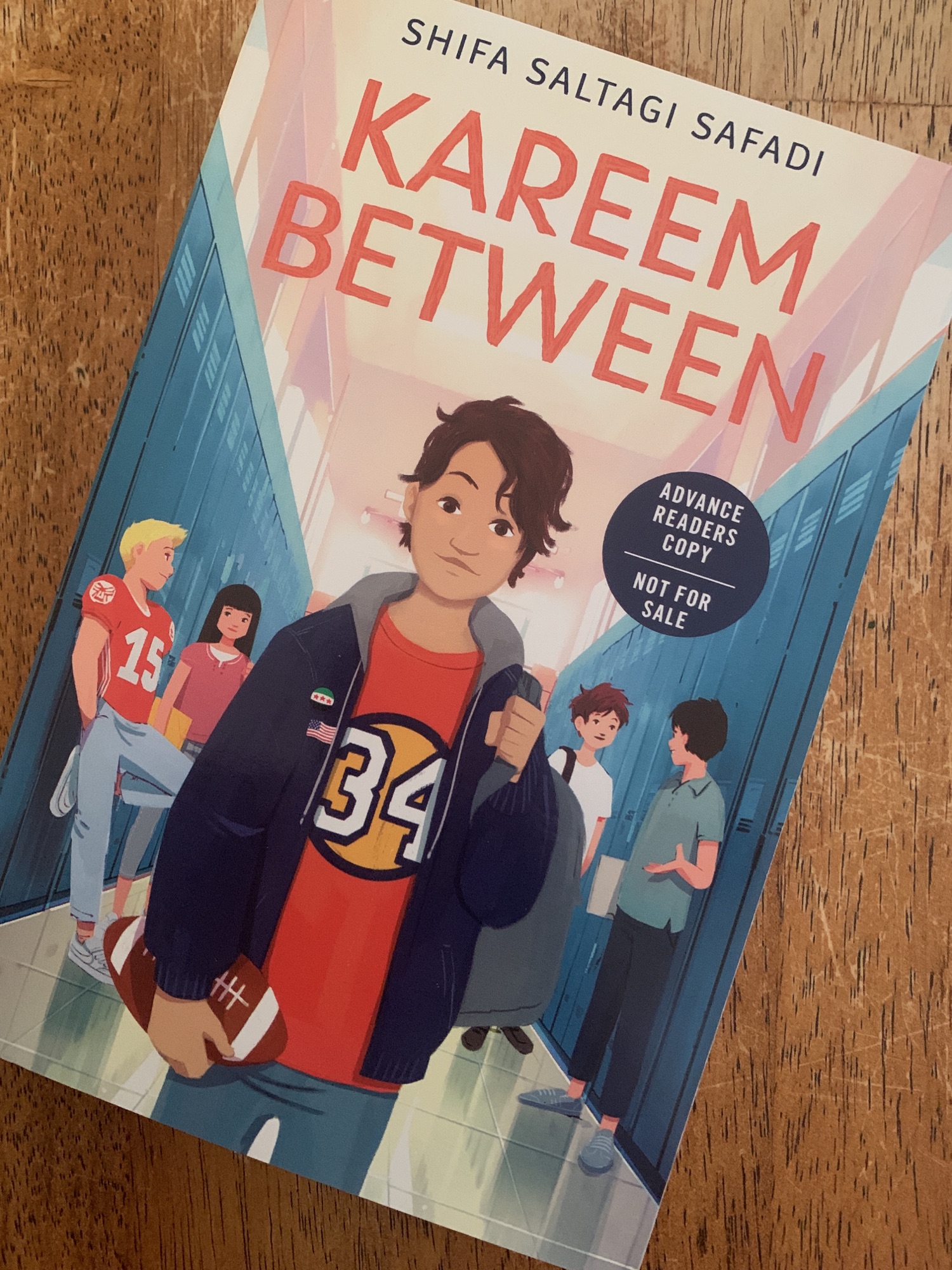
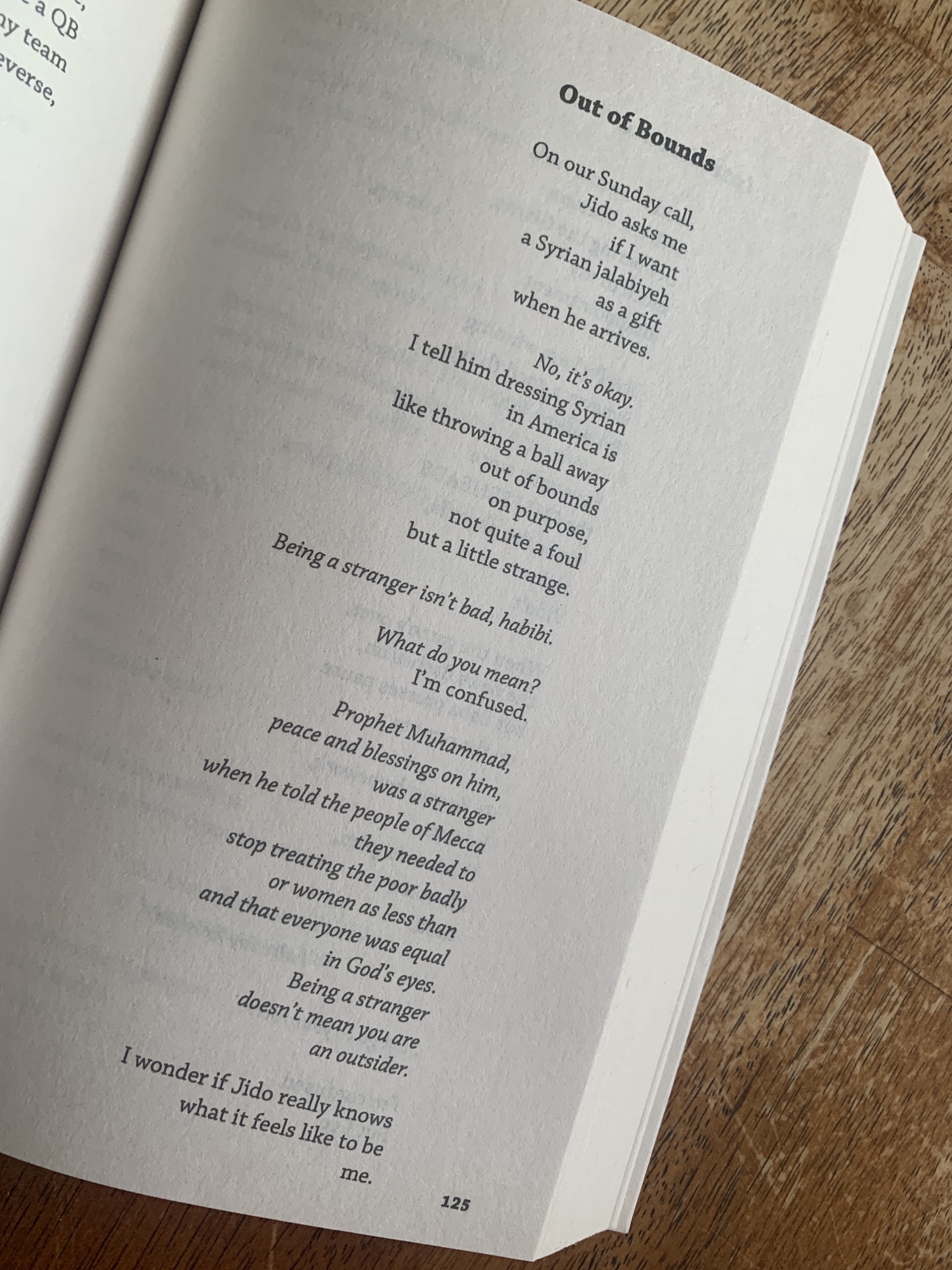
It doesn’t matter how many Word documents you read, Goggle docs you add comments to, and screen shots you revise; to hold a physical book in your hands that you have been blessed to observe from the sidelines through numerous revisions, is mind blowing.  Reading the final version from page 1 to page 324, plus the backmatter, has left me at a loss for words with tears streaming down my cheeks. I truly cannot imagine the book any other way. All past drafts and storylines, were just stepping stones to get the book to this version, and as a fan of literature my whole life, to see this metamorphosis in real time has added to my respect and admiration of authors.  Enough about me though, this review is of the middle grade novel in verse that tells the story of Syrian American Kareem, a loveable boy caught in between choices, siblings, friends, labels, and global acts beyond his control.  He makes mistakes, he tries to make things right, and at the center of it all is his Islamic identity, love of football, and genuinely good heart.  I am biased in that I have self appointed Kareem as my nephew, but even after dozens of readings, I was moved to tears three times during the course of this reading.  I made my teens read the book and they loved it, and like them, we hope we get more Kareem in the future.

img_3541-1

SYNOPSIS:

Kareem loves football, particularly the Bears, and dreams of seeing his Arabic name on an American jersey one day in the NFL.  Unfortunately, he hasn’t made the school team, his best and only friend Adam has moved away, and the coach’s son is offering to talk to his dad for Kareem in exchange for some school help.  Add in a new Syrian kid at school, his mom going to Syria to take care of his grandfather, and the fruition of Executive Order 13769 aka the Muslim Ban, and seventh grade has Kareem scrambling on every down to say the least.

img_3543-1

WHY I LOVE IT:

The football framing, the literary inclusions, the Arabic, the Islam, all combine with such tangible heart to create a seamless read both as a compelling story and as an example of literary craft.  The language is on point and intentional, that even if you don’t know the character or novel referenced, the Arabic words included, or football terminology used, you will be invested in the characters and plot, and find yourself cheering for Kareem.  Often debut authors show promise, but their stories have plot holes, or pacing issues, or inconsistencies, that is not the case with this book.  The crumbs are there that tie everything together, the depth of the characters’ personalities reveal how developed they are, and the timeline keeps the book moving forward.  There are no dry or slow spots in the entire novel, it is easily read in one sitting as you find yourself nervous for Kareem, and curious how it will resolve.

Boys and girls, Muslims and non Muslims, Arabs and non Arabs, all will find themselves drawn to this book, and thinking about the characters, particularly Kareem, long after the final page is read.

img_3544-1

FLAGS:

Some stress and anxiety with missing parents.  Death, bullying, cheating, fighting, lying, racism.

img_3540-1

TOOLS FOR LEADING THE DISCUSSION:

The book is a solid middle grade, but the quality of writing and engaging plot makes it work for a middle school book club read as well.  I cannot wait to share this book widely.

Preorders speak volumes and I truly hope if you are able that you will preorder a copy, you can do so here.  Requesting your local public library to shelve the book is also a tremendous help to signal to publishers what type of stories and OWN voice authentic representation consumers will support.

Any Way You Look by Maleeha Siddiqui

Standard
Any Way You Look by Maleeha Siddiqui

img_3416-1

If you feel that hijab is like salat and that it should be done no matter what, even if you are being forced, your heart is not in it, or you are doing it to appease someone other than Allah swt, than this book might not be for you.  I am not a scholar, I should not be giving anyone Islamic advice or suggestions, but after sitting with this book, having read all 250 pages in one go, this is the crux that I have come up with regarding who will be the target Muslim audience for the book.  The Islam flows and the central Islamic message is the importance of one’s relationship with Allah swt.  So whether the fictional characters are wearing hijab, considering hijab, removing hijab, I was not overly bothered, they were still praying, going to the masjid, attending halaqas, and spending time thinking about their relationship with Allah swt at present, and what they hope it will be in the future.  The niqabi mother never forces her view on her daughters, the book does not get preachy, nor does it only show one perspective, as a result the reader is allowed to appreciate the other themes of the book and the impeccable writing.  That being said, did I wish there was more sitting on the prayer rug conversing with Allah swt about what to do? Yes.  Do I wish that everyone’s hijab journey, both real and fictitious, was easy? Yes. Do I wish we lived in a world that women were respected no matter how they dressed? Absolutely.  This book is middle grade and it takes on numerous sensitive topics, and in my very biased opinion does an incredible job.  The book contains sexual harassment, judgement, peer pressure, stereotypes, gender roles, bullying and so much more.  I truly couldn’t put the book down, the tears of being seen kicked off the book, and then tears of strength concluded the book.  Muslim and non Muslim readers alike, will be better for reading this unapologetic, OWN voice book.

SYNOPSIS:

Ainy’s life is busy: school is wrapping up, summer plans with her best friend Safiya are being made, the family has moved into the basement of her crush Izyaan’s house, her father is in Pakistan caring for an ill grandma, and Amma’s clothing store, Naseerah’s Almari, is getting busy.  Ainy begs to work at the shop as Bajjo takes on a second job to help the family make ends meet, and when her Amma finally agrees, Quratulain’s best laid plans to learn how to be a designer, and have the best summer ever, are about to be challenged.

Before she can design, she has to learn how the shop works, the frustration and time involved make her unable to fulfill her plans with Safiya causing a widening rift with the life long friends.  Bajjo who has always been Ainy’s role model starts shutting her out, and Izyaan’s cousin Yasir seems to be everywhere Ainy is. She is not comfortable with him showing up at her work, bumping in to her all over town, messaging her at night, and while she knows he is in the wrong, she starts to wonder if it is a result of something she has done.  With no one to talk to, Ainy is left to handle the Yasir problem on her own, and the relentless anxiety, isolation, and fear begin to change Ainy and everyone is too busy to notice until all the threads combine: a big wedding order from Yassir’s mom, hijabs being taken off and put on, and Ainy taking a stand.

WHY I LIKE IT:

The book hits close to some events I have experienced in my life, to the point that I had to check if the book had the typical disclaimer that the characters are a work of fiction and any resemblance is coincidental.  The characters feel that real, and their emotions that relatable, that even at my old age, I was moved, invested, and unable to look away.

I love that the author provides a lot of perspectives about hijab, but does not make a heavy handed judgement, the title of the book hints that women should be respected, and valued, no matter how they dress, and the mom in the book does a great job of setting that tone as she asks her clients how they feel in different clothes, as she models how her daughter’s choice to wear or not wear hijab is a reflection of their relationship with Allah swt, as her decision to wear niqab is hers.

There is no internalized Islamophobia, no othering, no watering down.  The book is solid and I think even if you don’t agree with the choices the characters make, the writing is strong enough that you can see why the characters do what they do for them.

My only real critique is the cover.  I don’t know why, but I don’t love it.  It doesn’t scream fashion and Islam, and the strength of the writing, the characters, and their summer together deserve a better visual representation, sorry.

FLAGS:

Triggers for those who’ve experienced unwanted attention and sexual harassment. Does have boys and girls being friends, crushes mentioned, hijab, backbiting, bullying, stereotypes, peer pressure.

TOOLS FOR LEADING THE DISCUSSION:

While I can see why some people would not “approve” of the book, and some will love the book, I think in an environment of discussion and someone qualified (not me) to guide young readers, this book would be an incredibly empowering, book to think about, enjoy, and relate to in an Islamic school book club setting.

Please consider preordering/ordering this book.  It is available here on Amazon.

Until You Find the Sun by Maryam Hassan illustrated by Anna Wilson

Standard
Until You Find the Sun by Maryam Hassan illustrated by Anna Wilson

I don’t know that this book is particularly unique or mind blowing, but I read a digital copy a few weeks ago and was surprised when some tears fell, I read it when I got the physical copy to my kids and my throat caught again, and here I am writing this review and feeling all vulnerable.  It is as if I too am a little girl in a new place missing her grandfather on the other side of the world, which clearly I’m not.  The book is sweet, and moving, and I find myself emotionally invested every time I read through the 32 pages and get lost in the large sweeping illustrations.  The book is not Islamic, there are a few hijabis in the background and text that articulates friends saying salaam before the girl moves.  Additionally, the main character’s name is Aminah, and the author is of Pakistani decent, and has a Muslim sounding name.  The story though, at its core is universal, heartfelt, reassuring, hopeful, and lovely to share in all spaces. It begs to be read aloud and holds the attention of toddlers to early elementary aged children.

The book starts with a happy little Aminah in a bright sparkly environment of sunshine, mangoes, and salaams.  Every night she listens to Da’s stories of adventure as she snuggles next to her grandfather.  One day she finds out they are moving, going on an adventure.  Only Da won’t be joining them and Aminah is devastated.

The new home is gray, and cold, and no adventure at all.  She wants to go back, but Da reassures her during their nightly conversations that things will get better.  And sure enough, with a bit of bright yellow inspiration, she starts to discover the adventures awaiting in her new home.

Kids will find the end hopeful and resolved, but I somehow found it a little bittersweet.  Da loves his grand daughter and wants her happy, but the adult me, realizes their relationship will never be the same, and Da will miss her in many ways, alone, as she embarks on her own life.  I know I’m projecting, but the ability to see both perspectives adds a nice layer to the book.

The book is available here from Amazon and will be in local libraries in June 2024.

An Eid Story: Husna and the Eid Party by Fawzia Gilani-Williams illustrated by Kulthum Burgess

Standard
An Eid Story: Husna and the Eid Party by Fawzia Gilani-Williams illustrated by Kulthum Burgess

img_3309-1

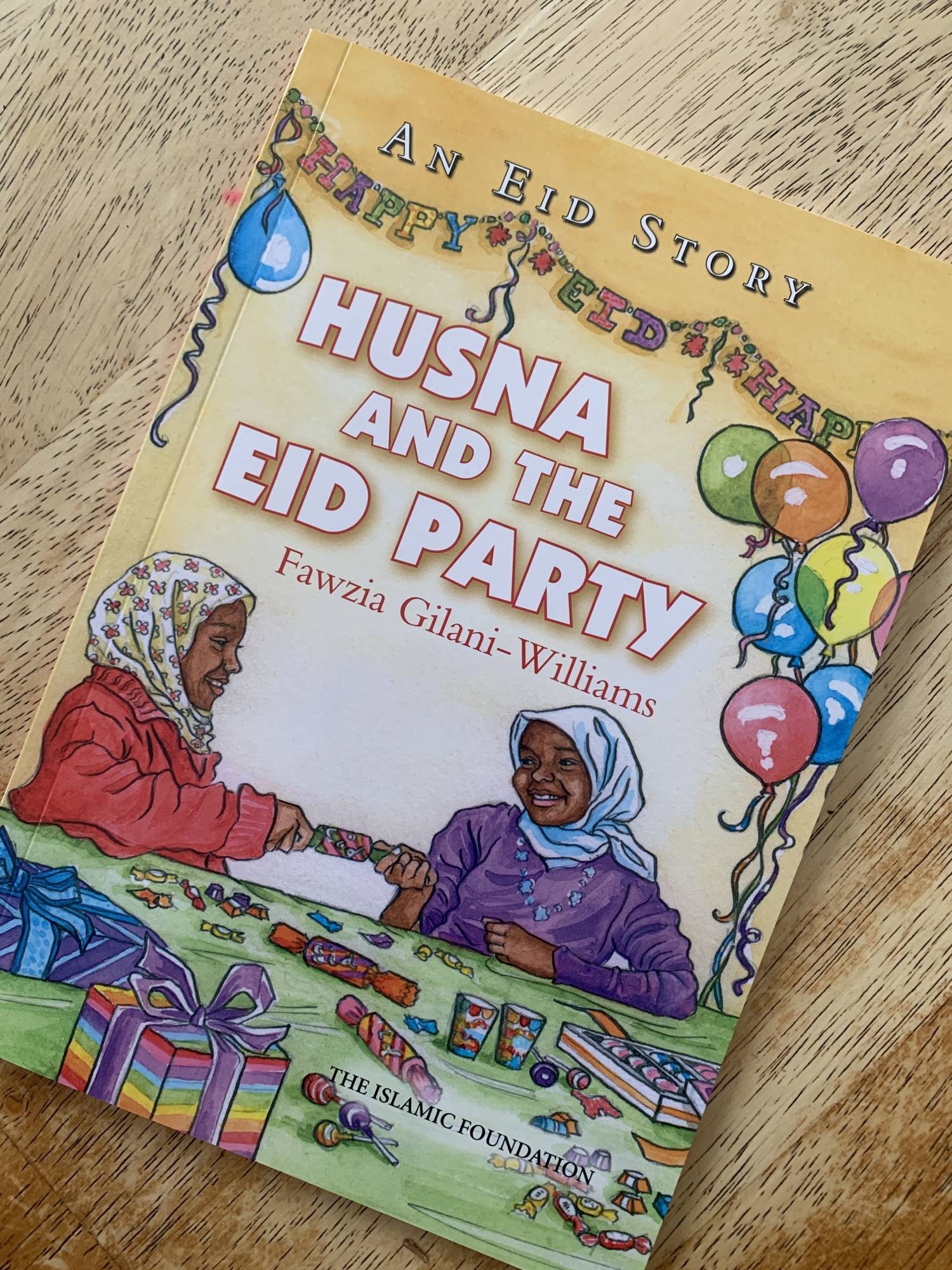
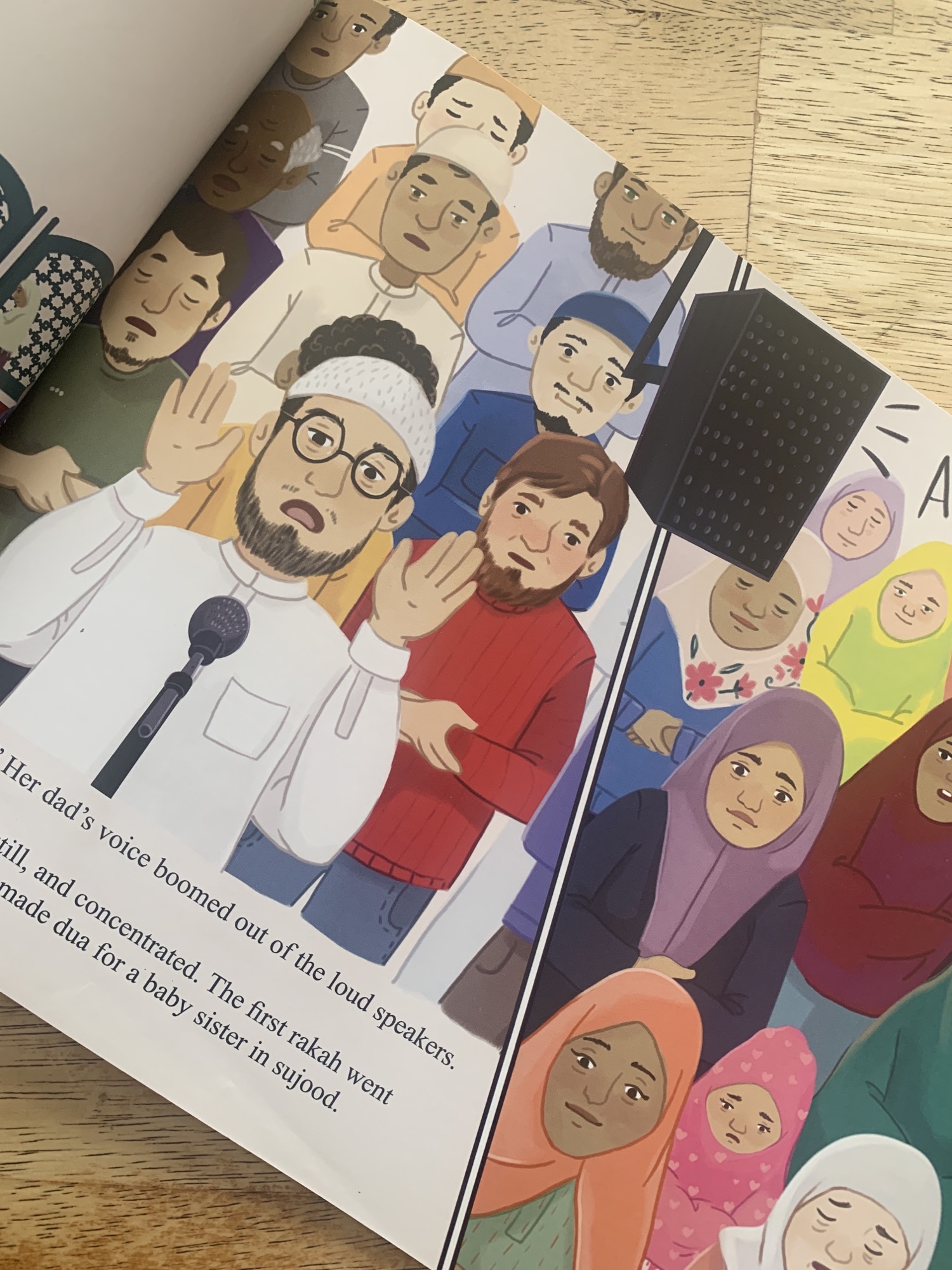
This 27 page book is old, published in 2007, and one that I kept an eye out for on occasion since reviewing a similar early chapter book by the same author, The Lost Ring, that I found in a public library in 2016.  Somehow it found its way to me in 2024, and I’m reviewing it because it has been a while since I’ve indulged in older books that shaped the foundation of Muslim literary representation so many years ago.  It is the epitome of Islamic fiction and what Islamic fiction looked like when I started teaching.  It has a Muslim protagonist, with a universal stress, framed in Islamic acts, perspectives, information, and morals.  It is unapologetic, it is at time preachy, and while the writing isn’t remarkable, an engaging story is laid out with numerous lessons along the way.  You may not want to rush out and purchase this book, but if you have it on your shelf, it would be worth pulling out, dusting off, and sharing with a child. At times the details feel a little dated, but there is a timelessness to stresses with friends, being left out, assuming the worst, and wanting to be included.  This book will offer a chance to be seen in the text and illustrations as Husna waits to be invited to her friend’s Eid party.  The book does not specify if it is Eid al-Fitr of Eid al-Adha, but it really isn’t impactful on the story, as it simply sets the time, mood, and draws all the threads together.

SYNOPSIS:
It is the week after Eid and students are back at their Islamic school, Husna has lots of friends, but Maryam is her favorite.  While on the playground, someone asks Maryam where the party is going to be, and she responds, “probably at the house.”  Excited Husna waits for her invitation, that unfortunately never comes.

WHY I LIKE IT:
Even though the book has a happy ending and is based on a misunderstanding, the feelings are very real.  I remember feeling left out, I’ve seen my own kids and students feel it, and that the book is a snapshot of that feeling from a Muslim perspective, really makes it hit home.  Husna makes dua in sujud at Maghrib and Fajr that she will be invited, conversations begin with As-Salamu ‘Alaikum and end with Barak Allahfi-ki, homework is learning Hadith and memorizing ayats, jumah is prayed, and every page is filled with Islam.

FLAGS:

None

TOOLS FOR LEADING THE DISCUSSION:
The book is an early reader, a text heavy one at that, but none-the-less meant for ages seven and up. I can see it being read today in small groups in an Islamic school or if you have a young one who is perhaps feeling something similar.  You might have to explain invitations in the mail, or calling on a house phone, but it still has relevance.

Trouble at Taraweeh by Rosalind Noor illustrated by Rania Hasan

Standard
Trouble at Taraweeh by Rosalind Noor illustrated by Rania Hasan

img_3132-1

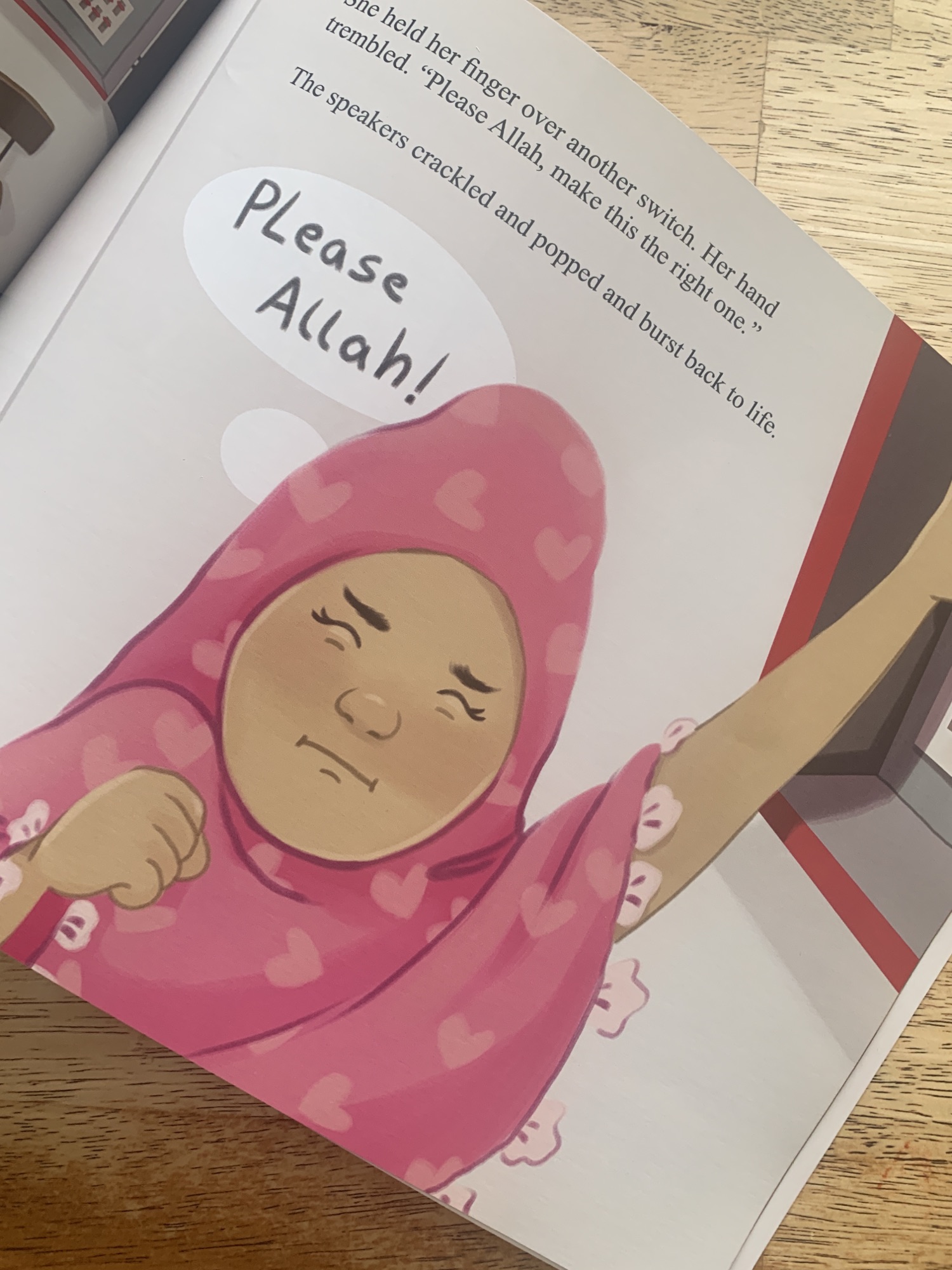
I love funny books that are Islamically accurate, Muslim filled, and informative as well.  Alhumdulliah for this outrageous Ramadan tale, that gets kids laughing and parents horrified.  A frog on the loose at Taraweeh on the 21st night, and a little girl who is a self proclaimed “trouble magnet,” focuses on Laylatul Qadr, good intentions, and Allah swt hearing our prayers.  It is text heavy, so for a read aloud, think slightly older children, seven or up, would be the ideal audience, but in a bedtime story setting the illustrations will keep younger ones engaged.

img_3133-1

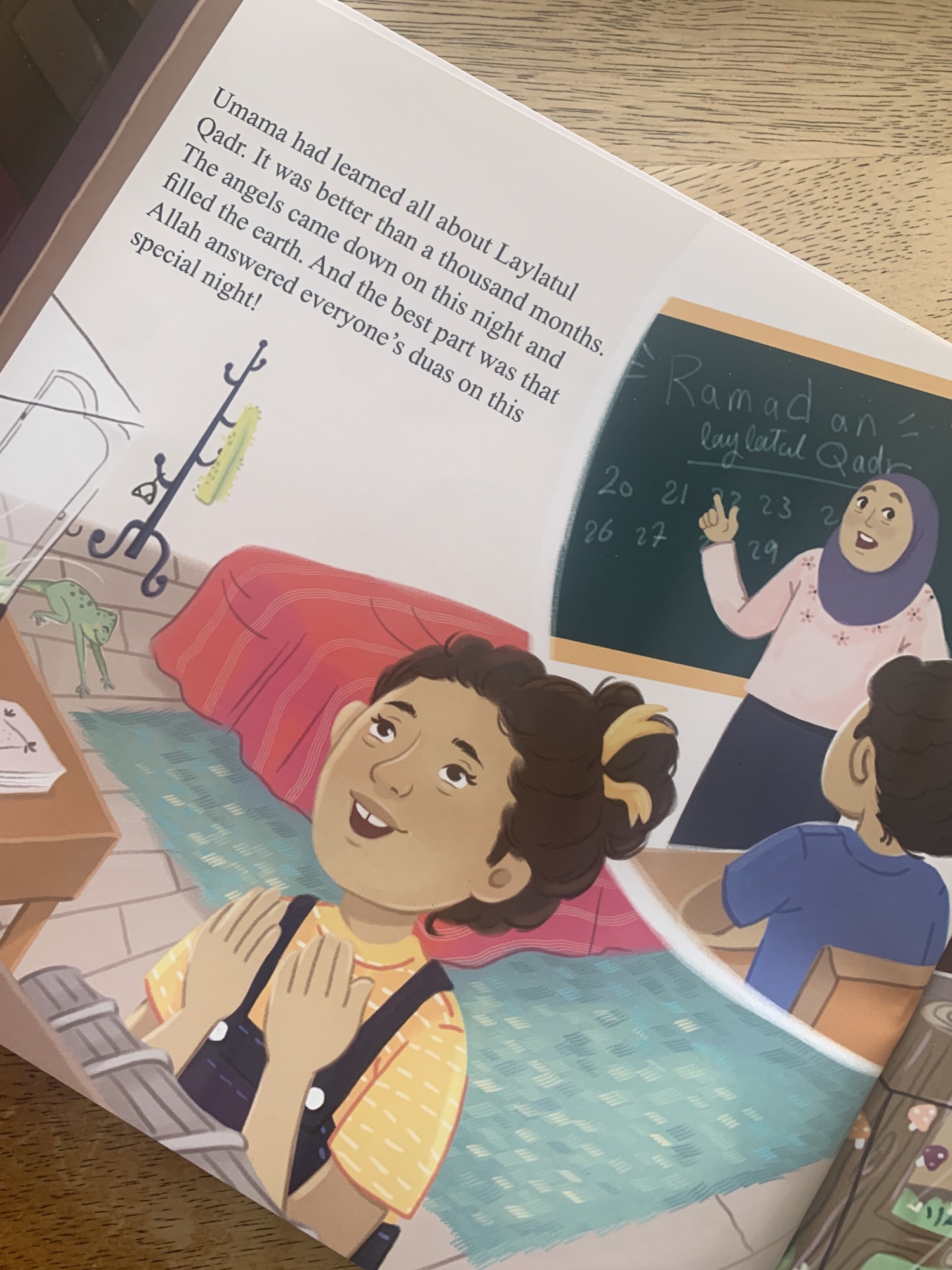
The book starts with Umama looking forward to Laylatul Qadr.  She knows duas are answered that night when the angels come down and fill the earth, and she has a special dua to make, she really wants a little sister.  It is the first odd night of the last ten days and she has had an eventful Ramdan so far.  She accidently flooded the wudu area, she tripped on her prayer skirt and knocked people over, she even tried to organize the shoes, but then no one could find their shoes.

img_3134-1

Tonight she is determined will be trouble free, which naturally means, it won’t be.  Fluffy, her frog, gets loose.  She apologizes to the woman as she scoops him off her head, but then…he gets away from Umama, and the chase is on.

img_3135-1

With plugs getting yanked, breakers being flipped, and little Umama asking Allah swt to help her make it right. The imam, her dad, keeps his cool and somehow you find yourself, parents included, feeling bad for Umama and hoping she has a smooth remaining Ramadan.

img_3136-1

The expressive illustrations are  bright and complementary to the story.  Kids enjoy looking at them and they really do help hold the kid’s attention as the story unfolds.  So many of my Ramadan staples come from Ruqaya’s bookshelf, and this is a great addition to the shelf.

The book is available here at Crescent Moon Store

img_3137-1

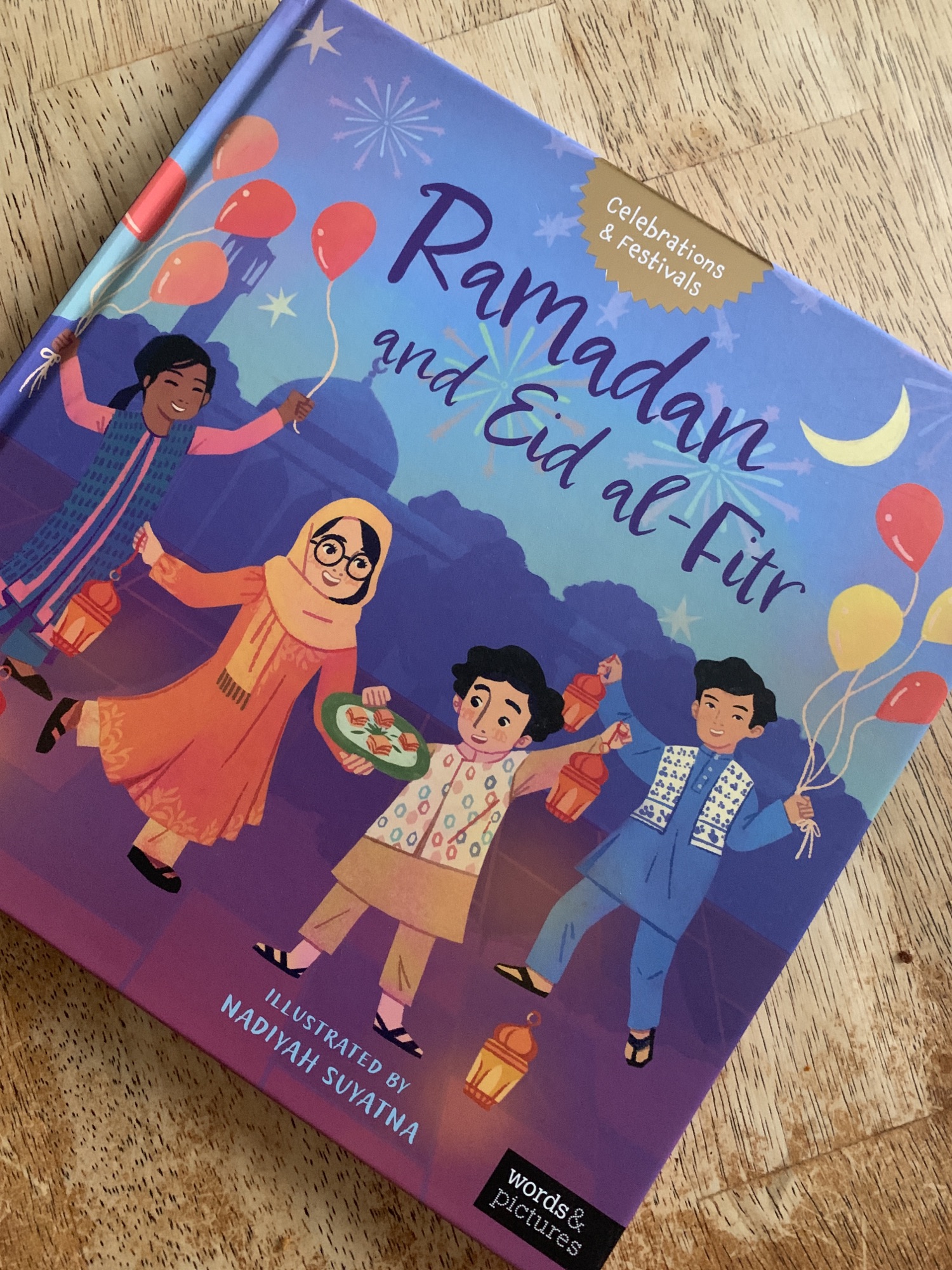
Celebrations and Festivals: Ramadan and Eid al-Fitr by Sara Khan illustrated by Nadiyah Suyatna

Standard
Celebrations and Festivals: Ramadan and Eid al-Fitr by Sara Khan illustrated by Nadiyah Suyatna

img_3101-1

This 48 page, informational based book is told through a little girl explaining her Ramadan and Eid days in a fictionalized story format. The information is not new, nor is the framing, and it has my pet peeve  line of “Ramadan is the ninth month in the lunar calendar,” but aside from that, the book does a good job of showing the joy, the activities, the faith, and the importance without self-othering, unrealistic cluelessness, or watering down. For whatever predictability the story has, the back matter is excellent. The additional information about Islam, the crafts, and even the quiz, make this book a standout in a crowded category. The book does not talk down to readers and thus works for Muslim and non Muslims alike. It also is unapologetic and informative making it a good book to share with non Muslim classrooms wanting to learn about Ramadan without crossing into “preaching.” The illustrations are warm and joyful bringing the lengthy book to life.

The story starts with Raya introducing Ramadan and then herself to the reader. She then details her Ramadan day. From sighting the moon to doing the good deed suggestions on the countdown calendar. It explains Allah swt and that adults are required to fast but kids are not. Raya spends time exploring how hard it is to skip snacks, but remains hopeful that when she is ready to fast she will be able. Her father also reminds her about other aspects of Ramadan and being on your best behavior as Raya helps set the table, donates to charity, and reads Quran. Throughout it all, informative details about Muslims are threaded through. Focusing on Raya herself also breaks some stereotypes as she discusses the joy found in a wide variety of foods from many cultures, Eid prep, looking for the moon, having henna put on, and heading out for Eid prayers and festivities. There are numerous details universal to all Muslims presented, as well as unique highlights specifics to Raya’s family such as showing the family bowling and reflecting on mini golf last year, activities that even her grandparents can participate in.
img_3104-1

The robust back matter starts with Fun Facts about Islam, stats about Muslims, details about the five pillars, etc.. The next two page spread is about the lunar calendar and has a pullout bubble explaining the use of the phrase “peace be upon him.” Then there are directions for a pop-up Ramadan card, Then information about the month of Mercy, Laylat al-Qadr, paradise, a recipe for Ramadan Cookies, info about Masjids, and finally a quiz, with answers.

img_3105-1

I like that the book balances showing joy through Raya’s personal experience, with facts about Ramadan, Eid, and Islam. I also like that Raya knows all this, my hatred of the formulaic child waking up and wondering why her family is up so early eating breakfast or a child wanting to fast and the family not supporting them is not widely realistic, and I appreciate that this book feels very reflective of what our kids feel, experience, and know about the blessed month. I also like that it features food, but does not dwell on it, and yes there are presents for Eid, but again it doesn’t make it the central factor in the joy she is feeling of being with her family.

Noura’s Crescent Moon by Zainab Khan illustrated by Nabila Adani

Standard
Noura’s Crescent Moon by Zainab Khan illustrated by Nabila Adani

img_3075-1

I know, I know, another Ramadan book about the moon and a little girl’s first fast, but this one is slightly different.  The moon they are searching for is the Eid moon and the focus is on whether they will see it and Eid will begin, or if there is one more day of fasting.  The story itself would not make sense if it wasn’t Ramadan and the characters Muslim, but the story only subtly sprinkles in bits of Islam, the backmatter though, is where the Islam really shines.  The tone of the book with the lyrical text and full color illustrations is very relatable to Muslims that both want to see the moon and celebrate, while at the same time being sad the the blessed month of Ramadan is over.  It comes from a Desi centric approach to the foods, and traditions, but their aren’t a lot of Urdu words used either, and those that are, are defined at the end.  The book works for Muslims and non Muslims, and would benefit both groups with a bit of discussion. Overall, not a particularly memorable book, but one that stands out for focusing on the tradition of looking for the moon and being together as a family.

I love that the notes at the end do mention that Muslims fast to “show love and obedience for the Creator,” under the Ramadan header.  The other backmatter headings are Eid ul-Fitr, Suhoor, Iftar, Chaand Raath, Pakora, Gulab Jamun, Sheer Khurma, and The Islamic Calendar and the New Moon.  A lot of space is dedicated to food, explaining those mentioned in the story.  It gets it right that Muslims begin fasting at dawn, it shows mom not wearing hijab at home, but wearing it when they go out, yet, it doesn’t just say the maghrib athan it refers to it as the “call for the twilight prayer.”  And it doesn’t mention or show them praying, which would have been a nice inclusion.
img_3080-1

The book starts with Noura playing outside and her tummy rumbling on this 29th day of Ramadan, and her first fast.  Mama, Papa and Noura all help make and pack up iftar, as they get ready to go look for the Eid moon.

img_3079-1

Before they go, Mama shows Noura her new dress, and they add some henna cones to the items they are taking, they then set out to the countryside.  All along, Noura is hoping to see the moon and her parents are reminding her how rare it is to see it.

When they get to the hill there are other families already there, and Noura has done it, completed her first fast.  Unfortunately the moon is not there as hoped, or is it?

img_3078-1

I wish some duaas or Islamic expressions, and salat would have made it into the book, but the large hardback size makes this a good book to read at story times, and a nice way to explain why we don’t know when we will miss school to celebrate Eid, or how many days we will fast.

A Little Golden Book: Ramadan: A Holy Month by Malik Amin illustrated by Debby Rahmalia

Standard
A Little Golden Book: Ramadan: A Holy Month by Malik Amin illustrated by Debby Rahmalia

As a child I had a stack of Little Golden Books, my libraries always have a good part of a shelf with Little Golden Books, my own kids have a few dozen of them, but honestly I don’t know that I love any of them, aside from the Monster at the End of the Book.  They are a staple, they have spanned generations, but I always find them a bit abrupt, the text to small and dense, and the vocabulary a little too advanced. So, on the one hand I am thrilled that this timeless brand has a Ramadan title, but on the other hand, some of the food descriptions contain vocabulary a bit advanced for the recommended 2-5 year olds.  If you have been reading my 2024 Ramadan and Eid reviews, you will however be glad to know that this Ramadan book, does pack a lot of information into the pages, and when it asks why do Muslims fast? It says unequivocally “because it is written in the holy book called the Qur’an.” Suhoor is said to be before the sun even rises at one point, and then dawn at another, but then, however, it kind of equates dawn and sunrise, I’ll let it pass, cause it is a little vague with the equating, after saying when we eat clearly. My only real gripe are the food tangents, detailing not to eat fried and salty foods at suhoor, to they hyper specific “creamy curries, fresh soups, and rich stews. Fragrant rice dishes paired with grilled meat or kofta” at iftar.  Yeah it almost seems like the author wrote the book while fasting, with food heavily on his mind.   It does mention doing extra good deeds, more prayers, and it reads as an easy non fiction book.  It doesn’t try and interject the information into a fictionalized framing, it just tells about Ramadan.  It would be nice though, if it was sourced, but with the reasonable price point and accurate information, makes it a solid book to add to gifts and to share.

The story is told in the first person and opens with a family searching the sky for the moon. It then says in a single paragraph on a two page spread that “during Ramadan, Muslims eat and drink only when it is dark.”  It then asks why? Answering on the next spread with, “the Qur’an.”  It says that it is read in many different languages, which technically isn’t wrong, but I wish it would have said that it is written in Arabic. It continues to say that “the Qur’an tells us how to be Muslim.” To care for people, to pray. to fast, but that children and those that are sick aren’t required.

It then details foods to eat and foods to avoid for suhoor before returning to the more spiritual aspects and traditions of being kind and giving charity.  It explains Ramadan Mubarak and then finds its way back to foods, highlighting iftar drinks and foods.

Ramadan is a month, followed by Shawwal and then the celebration of Eid, making sure to note that on Eid we cook our favorite foods.

Overall, a lot of information clearly conveyed, with bright, fun, joyful illustrations.  The final page is a gloassary of words and phrases.  I purchased my copy here on Amazon.