Tag Archives: Muslim

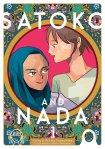
Satoko and Nada 1 by Yupechika

Standard
Satoko and Nada 1 by Yupechika

satoko.jpg

A manga series about two college roommates who have come to America to study, Nada from Saudi Arabia and Satoko from Japan.  Written by a Japanese author and translated into English, there is a lot about Muslims, particularly Muslims from Saudi, as the two characters get to know each other and become friends.  Their interactions work to dispel a lot of stereotypes and promote how rewarding getting to know people different from your self can be.  Volume one (there are three) is 127 pages, read right to left in four panel pages, and is fairly clean for all ages (they do buy underwear and bras at one point), but would most likely appeal to female readers in 4th or 5th grade and up.
8CE09DE5-2BEB-48C0-9157-96B13CC78CD9

SYNOPSIS:

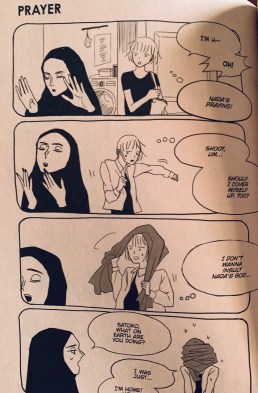
The book is about two girls getting to know each other, learning about each other’s culture, and navigating life in America.  There isn’t really a plot or a story line outside of this basic framework, and with a heading every page or two it reads like a quick scene about the topic expressed in the heading.  So, for example there are headings of Veils, Ramadan, Birthday, MashAllah Choice, etc, and then a few panels showing the girls having an interaction about it, resulting in understanding, humor, or a lesson.

In a bit of a stereotype twist, Nada is more street savvy then Satoko when approached by a stranger for a ride, and thus Nada hasto educate her a bit.  The book brings in a Christian American character and a third generation Japanese character learning Japanese, to further show how assumptions plague as all and how simple conversation and an open mind, can lead to some amazing friendships.

WHY I LIKE IT:

The book is really choppy, but you get used to it and soon you forget that it isn’t a typical story.  I admittedly haven’t read a lot of manga so, I have no idea if this is the norm, or something unique.  I love that its upfront about stereotypes, if it was an American writing it, or a even a Muslim it would probably come across as preachy or arrogant, but somehow it doesn’t seem like the two characters have much baggage, nor feel a need to defend their culture by putting another’s down.  They deal with issues such as women driving in Saudi, differences between hijab, burka, abaya, niqab, being around alcohol,  the joy of a fatwa allowing soy sauce and its alcohol content to be permissible, etc.  Some things are cited for clarity and something are very Saudi, but it really contains a lot of information, about Islam that I am pretty impressed by.  There isn’t a ton about Japanese culture since I would assume it was written for Japanese readers, so it would be redundant, but I did learn, according to Satoko, how religion is viewed by Japanese, how putting age and gender and race on forms seems incredibly personal, and some information about food.

FLAGS:

There is a possible failed abduction, not sure what the guys intention was, but the girls treated it as such.  The girls do go buy undergarments, so they are visually depicted.  There is mention of alcohol.

2DF66805-A246-4150-89BA-E7E1EAF90E90
TOOLS FOR LEADING THE DISCUSSION:

I wouldn’t do this as a traditional book club, but I think I am going to get a copy of the series to pass around my daughters middle school group of friends, to

one- give them a taste of manga

two- see what they think of the Islamic rep from a Japanese paradigm and

three- give us all something to chat about

The book is fun, I got it at the public library and think it might open up a new book type for kids to try and a new point of view for many of us to consider.
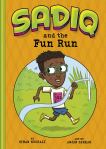
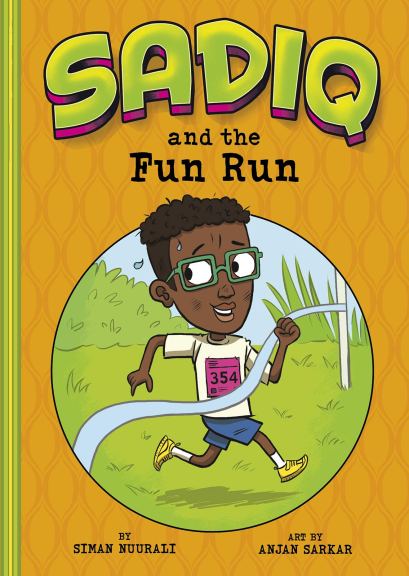
Sadiq and the Fun Run by Siman Nuurali illustrated by Anjan Sarkar

Standard
Sadiq and the Fun Run by Siman Nuurali illustrated by Anjan Sarkar

sadiq

This new series featuring Sadiq, a Somali American living in Minnesota, is great for early chapter book readers looking for representation and diversity.  There are four books about Sadiq, his family, and his friends and classmates in third grade, and all are either an AR 3.6 or AR 3.5.  At 57 pages long, divided into five chapters and filled with bright and colorful illustrations students in grades 1st through fourth, depending on reading level and interest, will enjoy these simple plotted, yet relatable stories.

F905B46F-CCAE-4094-A2C1-C7A66CD4B66F

SYNOPSIS:

Sadiq’s friends are all getting ready to try out for football, but his parent’s say that he is too young for such a rough sport and has to wait until he is 12 like his older brother, Nuurali, did.  Sadiq’s parents and family encourage him to try another sport, and with a new running club starting in a few days coached by a member of the national team, that’s what he opts to do.  Begrudgingly he joins the team, but is hurt when his friends talk about how much fun football is and how much more tough and difficult it is compared to running.  While this is going on, he is getting support from his brother to keep running, and from his teammates, but it is hard and he doesn’t enjoy it.  Slowly, he starts to improve, however, and with the Fun Run the climax of the book he sails across the finish line in first place when he sees his friends have come to cheer him on!

307C04CE-AE9B-4121-9DA0-04BE7302D795

WHY I LIKE IT:

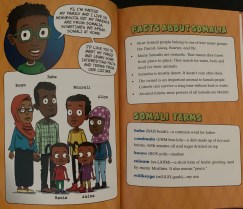
I love that the book/series proudly features a Somali-American-Muslim family.  There is information about Somali at the beginning as well as some Somali terms and a portrait with names for the members of Sadiq’s family.  The mom and older sister wear hijab, “Salaam” is one of the defined words and the characters use it when they meet.  I also love the diversity of skin tones in the illustrations and one of the girls on the track team wears a scarf as well.  There are Muslim named kids and non Muslim named kids in the story, and while Islam isn’t mentioned outright, it is definitely represented through the characters words, names, and appearances.

4F1421B3-B166-4B44-BB86-0DA161F5939F

The story is straightforward and perfect for the age group, the books in the series do not need to be read in any order, and you will get to see the different supporting casts featured more prominently in different books, thus getting to know Sadiq and his world.  I like that he doesn’t get his way, and doesn’t get to do what all his friends are doing, but he makes it work.  He is grumpy and upset, but he doesn’t get obnoxious or overly whiney.  I think this subtly gives readers some tools and insights to model in their own disappointments.  I also like that while he has to put in the work and fix his attitude, he doesn’t have to do it all alone.  His family and coach are supportive, and eventually his friends apologize and support him too.  For the simplicity of the book, you actually do get invested in his little trial and want to see the outcome.

3AC10F17-7A77-40AD-BC46-A57D4359D94F

FLAGS:

None, it is clean.

TOOLS FOR LEADING THE DISCUSSION:

This book is like a boy protagonist version of the Meet Yasmin books, they show a kid of culture in everyday experiences.  The target audience wouldn’t make it work for a school wide book club, but I think early elementary teachers would benefit from having the series in their classrooms and letting kids in small groups discuss if they want. These books would be great for first graders that are way above reading level and parents are struggling to find appropriate books.

The end of the book has some resources as well: a glossary, discussion questions to talk about and some to write down, as well as a home workout guide and information about the author and illustrator.

Little People, Big Dreams: Muhammad Ali by Isabel Sanchez Vegara illustrated by Brosmind

Standard
Little People, Big Dreams: Muhammad Ali by Isabel Sanchez Vegara illustrated by Brosmind

muhammad ali

A few things surprised me in this latest addition to the non fiction biography series Little People, Big Dreams. First that a police officer told him to learn how to fight if he wanted to face the thief that stole his bike.  Second, that the 32 page book targeting 5 to 8 year old children has an AR level of 4.8 and finally that it does mention his conversion to Islam and shows him praying.

IMG_7247

The biography hits a lot of major milestones in the boxer’s life after showing he once was a little kid too.  He was born in Kentucky, had a younger brother and after his bicycle was stolen he started learning how to box.  He wasn’t the strongest fighter, but he was fast.

IMG_7243

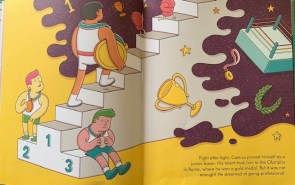
He won a gold medal at the Olympics in Rome, and then set his sights on being a professional boxer and becoming the world heavyweight champion.  Its nice that on this page the illustrations show that part of that pursuit involved physical training but the books and meditation show internal growth was valued and pursued as well.

IMG_7244

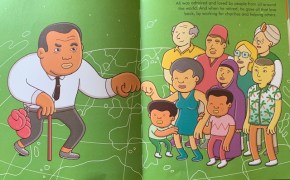
It shows how he used to taunt his opponents and that some thought it poetry, while other’s thrash talk. It also makes it clear that he used his voice to speak out for things important to him at a time when it was dangerous and accepted the consequences, whether it was African American rights or the war.

IMG_7246

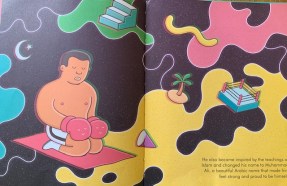
The page about him becoming Muslim explains that he was inspired by Islam, changed his name and “felt strong and proud to be himself.”  After his ban from boxing, he won the heavyweight belt three times before retiring and dedicating his life to community and giving back.

IMG_7248

The book ends with a timeline and some real pictures of Muhammad Ali, along with some other books you can turn to for more information.  The illustrations are comical yet detailed in their emotion and the information that is conveyed.  Kids will enjoy them and find they give life to the simple text on the pages.

IMG_7245

I got my copy from the library and my children aged 4-12 enjoyed the book as they have the other books in the series.

IMG_7249


Two Pigeons on a Pilgrimage: A Hajj Story by Rabia Bashir illustrated by Aisha Dean

Standard
Two Pigeons on a Pilgrimage: A Hajj Story by Rabia Bashir illustrated by Aisha Dean

pigeons

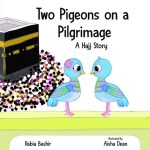
An adorable 40 page paper back book about Hajj aimed at ages 3 and up and told from the perspective of two Pigeons performing Hajj with humans.

IMG_5976

A boy and girl pigeon say Bismillah and spread their wings as they head off to Hajj.  They see pilgrims at the airport wearing ihram before they start circling the Ka’ba like the humans below.  After seven rounds they go to Ibrahim’s Station before they are off to Safa and Marwa while pausing to sip on Zamzam.

IMG_5977

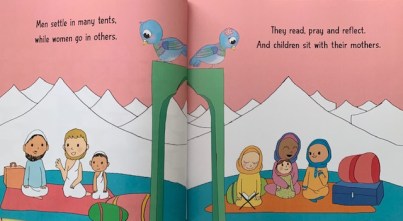
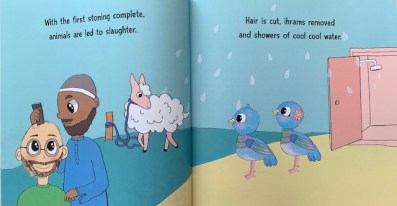
With Umrah complete they are off to Mina, then Arafat where duas are made.  They then go to sleep under the stars in Muzdalifah, before they slaughter an animal, cut their hair, shower, and throw stones at Shaitan.

IMG_5978

The concepts are simplified, but told in sequential order of how hajj is performed with very little commentary or embellishment.  The lines rhyme, so there is some creativity thrown in to keep the pattern and facts in line.  The font size, spacing and overall presentation of the book is good for reading at bed time or in small groups.

IMG_5979

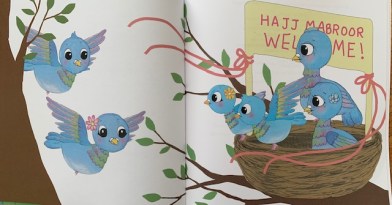
The best part of the book, are the pictures.  They are sweet, colorful, and engaging and to find out at the end that they are done by a 12 year old girl is an extra added bonus.

IMG_5980

The book is factual in the steps for hajj, but because it doesn’t have a glossary, or give much information about why Muslim’s perform Hajj or details about the different acts of worship, it probably is better suited for Muslim kids that will hopefully know some of the answers, or have access to an adult who can answer and fill in the blanks.

IMG_5981

Overall, a good addition to books about Hajj to share with your little ones.  I just wish it would have come out a little bit earlier, as the Hajj starts in a few days and the book just came out.  If you can’t find it this year, inshaAllah get a head start for next year as I think the book has staying power and will be read more than once as both a learning tool, and fun book requested by kids.

IMG_5982


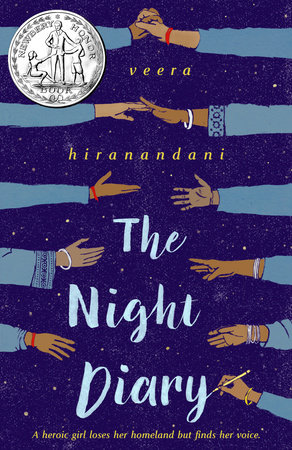
The Night Diary by Veera Hiranandani

Standard
The Night Diary by Veera Hiranandani

night diary

I was curious to see how partition would be presented in this book by an Indian Hindu author featuring characters who are half Hindu and half Muslim relocating to Hindu India.  Told in journal entries written by 12 year old Nisha to her deceased Muslim mother, the 264 page AR 4.5 book is wonderfully done, extremely compelling, and about so much more than the politics that birthed India and Pakistan.

SYNOPSIS:

Nisha and her twin brother Amil are opposites, yet they complete each other and care for each other in such a tangible and heart swelling way, that you can’t cheer for one while not rooting for the other one to find success and their place in the world as well.  As the twins turn 12 and Nisha is gifted with a journal from the families beloved cook Kazi, India and Pakistan too are about to come to fruition and Nisha’s journal entries detail her understanding of the larger events around her as well as her own struggles to come in to her own.

For Nisha words do not come easily.  She excels at school and loves to cook, but talking to people, or making friends eludes her and her longing for her deceased mother, make her a quiet reflective child.   She observes and  takes in so much around her, internalizes it, ruminates on it, and pieces it back together in a gifted way when she writes, that reading her entries, and the voice the author creates for her, is really amazing and fluid.  You feel like you really know Nisha and what makes her tick, what she fears, and how she thinks, you also get emotional attached to her and her world and find yourself surprised at how invested you are in not only her family’s successful migration across the new border, but also in her finding her voice and the confidence to use it.

Amil’s voice comes through Nisha, but her love for him and the way his strengths are her weaknesses and vice versa allows insight into the other family dynamics and attitudes to the two children.  Amil is an amazing artist, that suffers from dyslexia and does poorly in school.  He is weak and wiry, but fast, and he can talk and charm and ask all the questions that Nisha wants asked but can’t find the words for.  He and their physician father are rarely on good terms, as he isn’t the ideal strong boy with a medical degree in his future.

When it is decided that the family must leave their city where Muslims and Hindus and Sikhs live together and journey into Hindu India, the twins, their father, and their father’s mother, Dadi, must rely on each other to survive the riots and violence of the mass migration.  Nisha must also survive the understanding that with a Hindu father and Muslim mother there is so much about her own place in the world she doesn’t understand, and thus the journey is both an internal and external one, that will change Nisha forever.

WHY I LIKE IT:

I love that the protagonists voice is so steady and believable.  I truly fell in love with Nisha and felt her pain, happiness, anguish and overall got emotional for her, it was a rollercoaster.  The author does an amazing job of painting the politics of Jinnah, Nehru, Gandhi and Mountbatten in broad strokes, but believable ones to the understanding of a 12 year old.  She sees that one India held people of all faiths and that this breaking up of everything is leading to violence, upheaval, and horrors previously unimaginable.  She doesn’t understand why people had issues with her mother being of one faith and her father another, she loves her Muslim cook and loves listening to him pray five times a day as her paternal grandmother sings Hindu prayers in the other room.  She is both Hindu and Muslim and doesn’t see the contradiction within herself, suspending the reader’s own opinions on partition (if they have them), because how she sees it, does make sense for the story’s narrative.  The author takes Gandhi’s side of non violence and staying together, but balances very well and very intentionally that atrocities and humanity was seen from people of various faiths and political persuasions.  The role of British colonization and freedom from it, is slightly glossed over to the point of disservice, but again, being the target age of the reader and the age of the characters, I’m willing to over look it.  Families with Indian and Pakistani heritage will want to take the lacking information and help their children to fill in the blanks.

I love that the backdrop is the action of the story, but the relationship between the characters is truly the heart.  A lot of growth and compassion is conveyed very succinctly and powerfully.  Nisha wants so desperately to speak, but can’t, and her internal struggle and the pain she feels when she can’t speak up to help and participate in the world around her is gut wrenching.  As she confides in her diary, you realize that kids understand so much more than we adults often give them credit for.  The lesson is not lost on me.  I initially thought a book steeped in subcontinent history, with religious conflict and foreign words, wouldn’t appeal to a western elementary aged readers, after reading it, however, I now think this heartwarming story should be thrust upon them all.

FLAGS:

There is violence and death.  Not sensationalized, but detailed enough to set the tone of how serious the journeys were between the two countries when British rule stopped  There is some bullying and mention of the father smoking socially with friends.

TOOLS FOR LEADING THE DISCUSSION:

There is an Author’s Note, and a glossary at the back, and the inside covers have maps showing the journey the characters take.  I would absolutely do this as a Book Club selection for upper elementary, and will consider it even for middle school.  A lot of tools for teaching the book are available online, here are just a few:

Educator’s Guide: https://www.penguin.com/wp-content/uploads/2018/02/The-Night-Diary_Educator-GuideWEB.pdf

Children’s Discussion Questions: https://www.readbrightly.com/brightlys-book-club-for-kids-the-night-diary/

Classroom Bookshelf: http://www.theclassroombookshelf.com/2018/06/the-night-diary/


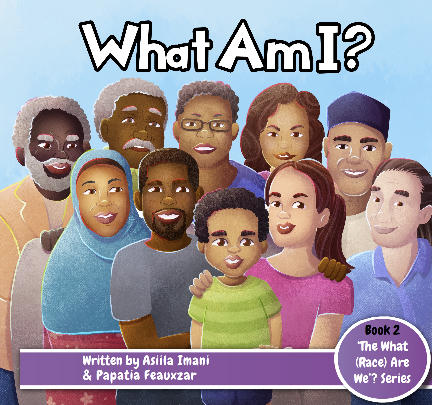
What Am I? Book 2 ‘The What Race are we Series’ by Asiila Imani and Papatia Feauxzar illustrated by Juliana Paz

Standard
What Am I? Book 2 ‘The What Race are we Series’ by Asiila Imani and Papatia Feauxzar illustrated by Juliana Paz

IMG_4825.jpg

This incredibly important 37 page picture book highlighting a little boys heritage will speak to children who see themselves in his quest to answer what he is, as well as (hopefully) inspire them to search out their own family ancestry and unique make up.

IMG_4828

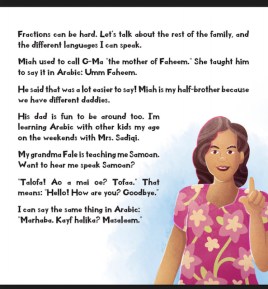
The book is not a traditional story book, in fact there isn’t much of a storyline, but the concepts presented show how beautiful and amazing multi-cultural and multi-ethnic families can be.  A lot of cultural information is conveyed and celebrated about Samoan and Pacific Island traditions as well as Islamic ones.

IMG_4831IMG_4832

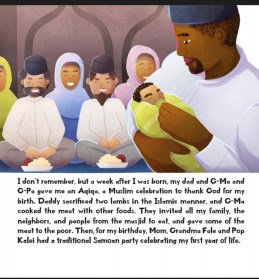
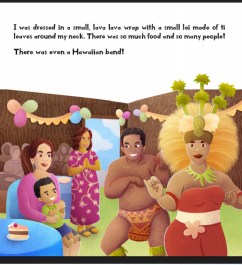
There is an aqiqa at the time of his birth as well as a Samoan party with a Hawaiian band.  Some members of his family cover, while other’s don’t.  He remarks how he has extra grandparents which equal extra blessings, and how he has a half brother because they have different dads.

IMG_4830

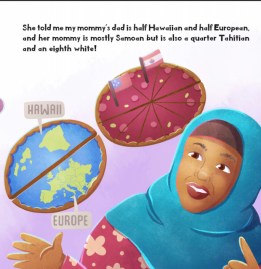
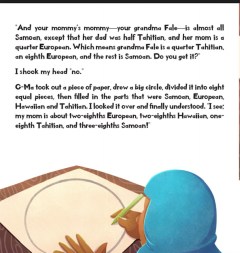
In addition to geography, there is also a STEM component as six-year-old Toa Idris learns he is a quarter this and half that through understanding fractions as visualized by slices of a pizza.  At one point Idris remarks that, “I can’t keep all those people and places straight,” and after reading the book half a dozen times, I honestly couldn’t either.  But, I think that is ok.  The point of the book is that being diverse is amazing, and having people love you is important, and culture and tradition and faith all make you richer.

IMG_4829 The text on each page is presented in a fun font, as are the pictures.  Really there is just one picture that makes Idris look angry and it is used in the story and the title page, which is unfortunate, I think it is supposed to have him look pensive, but it seems a bit off to me, where all the other pictures ooze with warmth and richness.

IMG_4826

I honestly don’t know what age group would benefit the most from the book.  Younger kids that may have been asked what their culture is will be empowered by having it reinforced that they are made just how Allah swt planned them to be, older readers will be able to create their own pizza slices, so to speak, and understand their own pieces, but I feel like both groups might need some coaching from an adult.  There are family trees at the beginning that almost become reference pages while reading the story and trying to keep everyone straight, that make the book almost interactive.  Muslim and non Muslim reader alike would learn about new cultures, and benefit from the “Extras” at the end.  Honestly, overall there is just a lot of information tossed around in the book, which isn’t a bad thing, it just might make it a bit more hit or miss if it will work for your child.

Mustafa and Arwa go on a Ramadan Adventure by Mekram Mohammad

Standard
Mustafa and Arwa go on a Ramadan Adventure by Mekram Mohammad

IMG_3184

Ramadan is two months away and this little book is a great way to introduce and stir up excitement for little Muslim toddlers and preschoolers. It could work for non Muslims, but the general overview given would need some details and explanations, and this book seems more geared to introduce excitement and a few key concepts for the blessed month.

IMG_3190

In 27 rhyming pages the brother sister duo explore some of the feelings of the month, activities that make the month special and what to expect at suhur, iftar, and taraweeh at night.  

IMG_3185

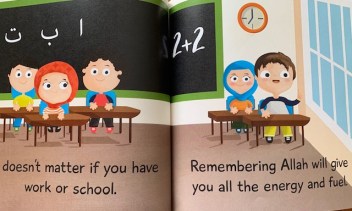
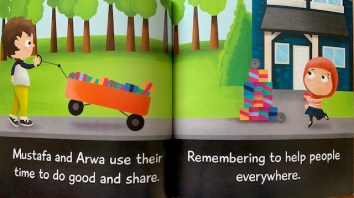
I like that it makes it clear that you don’t eat one bite, that you fast even if you are at work or school, that you use your time to do good and help people, and that you ask Allah for paradise.  

IMG_3188

The end is Eid and while the text presents some great general info, the illustrations are what really give the minimal clear text life.  Seeing the kids giving presents to people and looking for the moon and enjoying iftar together with smiling faces, show kids the warmth of Ramadan.  

IMG_3186

The book doesn’t have a story, it just talks about Ramadan, but the tone in this book and in Mustafa and Arwa go on a Prayer Adventure is very fun and light.  It doesn’t get into rules or articulate what little kids are expected or required to do, or even why Muslims do it, it just gives them some knowledge and some emotion to create the feeling of it being a grand adventure.

IMG_3189

The book is paperback 8.5 x 8.5 and the thickness, sheen and quality of the pages makes it durable and enjoyable to read at story time (in small groups) and bedtime alike.  This book most likely will be on repeat in the weeks leading up to Ramadan and then referenced throughout the month to remind children about what they are seeing and experiencing.  

Purity & Prayer: A Rhyming Picture Book of Sacred Rulings by Ameena Bint Abdir Rahman illustrated by Reyhana Ismail

Standard

IMG_2921

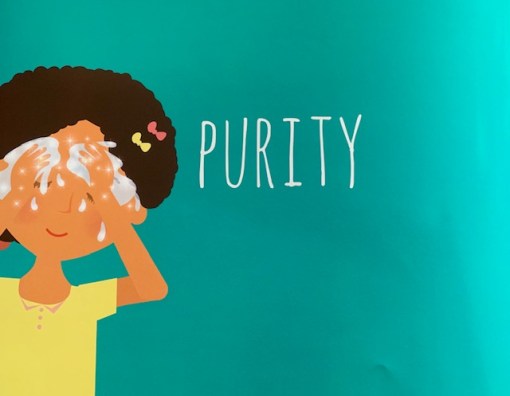
This book is definitely non fiction, and I’m reviewing it because I figure some of you like me, have looked at it online and wondered how it can do everything it claims.  The book is 50 pages, fully illustrated (with faces), meant for children before the age of accountability, written in rhyme about fiqh (wudu and salah) according to the Hanafi madhab, and everything is scholar supervised and checked.  I’ve read it a few times now, and yeah, it does all it claims to, and is a great tool and resource, and book to have around for kids of all ages, plus I think they’ll really enjoy it.

IMG_2922

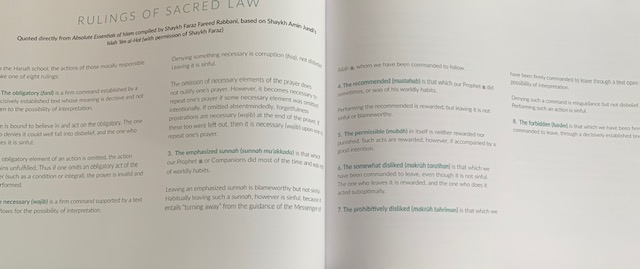
The book has a lot of information and disclaimers about how the author wrote the book and verified the information, there is a dua, preface, and Author’s Note at the beginning, and Rulings of Sacred Law by Shaykh Faraz Fareed Rabbani, an Appendix, References, Glossary of Arabic Terms, messages from the Fiqh Teachers, Author, and Illustrator at the end.

IMG_2925

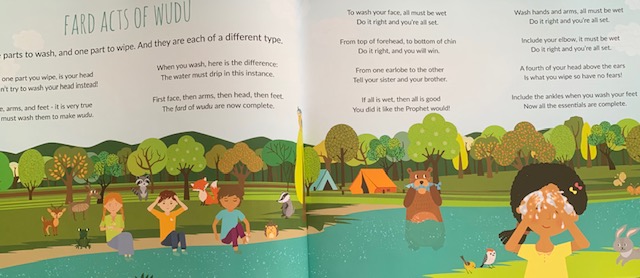
The 8.5 x 11 hard bound horizontal glossy book is divided into sections.  The first section is Du’a and Salah, followed by Purity which covers things like fard parts of wudu, what breaks wudu, etc..  The next section is Prayer and covers the fard conditions and integrals within prayer, wajib things you say, how you recite, postures, what breaks your salah, and incorporated in to the sections are what would need to be redone to make your salah valid.

IMG_2923

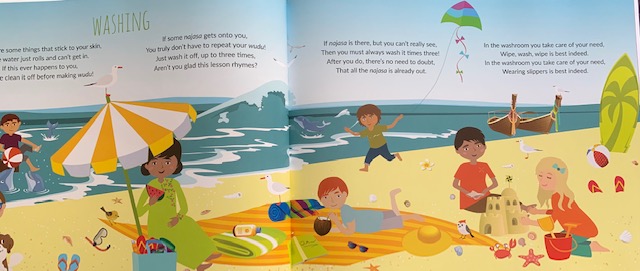
Each subheading is a two page spread with a title and either rhyming couplets or quatrains to convey the information.  While naturally at some parts the rhyme is incredibly forced, but because I found myself learning things, I wasn’t as bothered by it as I thought I would.  The repetition sometimes got jarring, but again, because the complex facts are being brought down to a child’s level ,and yet isn’t belittling, I’m willing to overlook a lot. 

I like that it isn’t just facts, the Appendix is there for that, but also similes and metaphors that will help put the concept in perspective.  Du’as can be made at any time like making a call to Allah.  Prayer is like visiting a friend, you have to go at the time you were invited, dressed nicely, wear appropriate clothing.  

IMG_2924

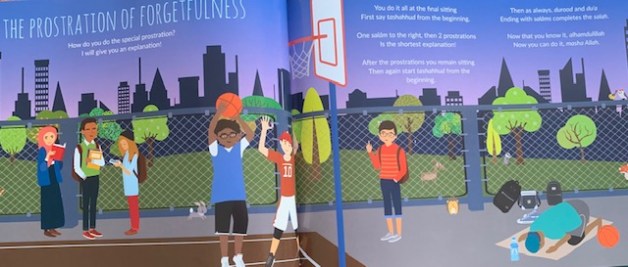
The breakdown of when you have to repeat the whole salah, or do a special prostration is incredibly helpful.  As is knowing what laughter breaks wudu and what breaks wudu and salah.  It is so great that children will see how detailed our religion is, and how everything has an explanation.  Yes, you shouldn’t laugh while praying, but clearly it happens, so when it does this is what you do.  The approach makes the book grow with children as their knowledge and awareness increases.

IMG_2926

I hope to read a two page spread each night with my kids, and have them discuss.  My kids range in age from 3-12 and while my 3 year old won’t add a lot, he will be entertained by the rhyme, fascinated by the pictures, and be included in the early introduction to fiqh.  InshaAllah the older kids will learn or review something and know how to find such knowledge if they have questions in the future.

IMG_2927

Undoubtedly, such a book, was a huge undertaking, may Allah swt reward all those involved, I was pleasantly surprised and greatly impressed at how the book reads, presents the information, and still connects to younger children, mashaAllah.


My Name is Fatima. Mine Too! by Fatima D. ElMekki illustrated by George Franco

Standard
My Name is Fatima. Mine Too! by Fatima D. ElMekki illustrated by George Franco

IMG_1926

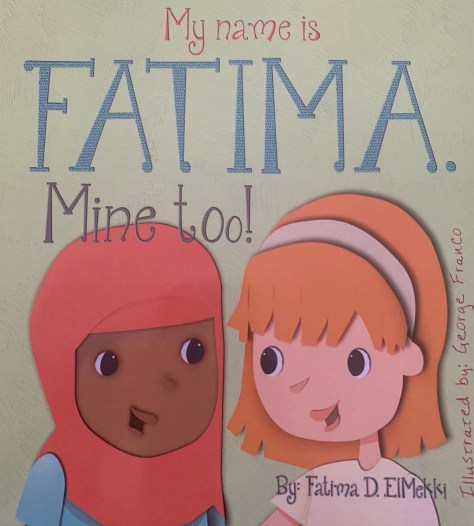
This book is interfaith, and learning your own roots, and asking questions about your heritage and faith all rolled in to a cute little package for children.  But despite it’s length, 28 pages, and cute little girls on the cover, the book is for more first grade/second grade and older children, rather than toddlers. 

IMG_1927

The message that we are more alike than different is a great message, even for the littlest of readers, but this book goes a little deeper, and the didactic approach will bore them a bit.  Older kids for sure 2nd and up will benefit from the exchanges between Fatima and Fatima and learning both valuable religious lessons about their namesakes as well as respect and friendship for those with different beliefs.

IMG_1928

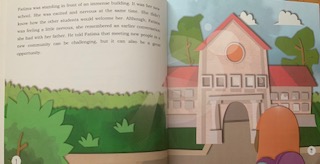
Fatima is from the Democratic Republic of Congo and on her first day of school in a America she tries to remember her father’s advice, that meeting new people can be a challenge, but also an opportunity.  

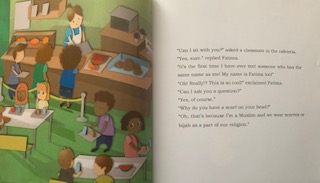
At lunch a little girl asks to sit with her, excited to meet someone with her same name.  Fatima asks her why she wears a scarf, and listens to her explain it is because she is Muslim and the hijab is part of her religion.  

IMG_1929

At recess, Muslim Fatima tells non Muslim Fatima that she is named after Prophet Muhammad (saw)’s daughter and asks her who she is named after and if asks she is Muslim, too.  The other Fatima says that she is Catholic and that she doesn’t know why her parents named her Fatima, but that she will find out and let her know.

IMG_1930

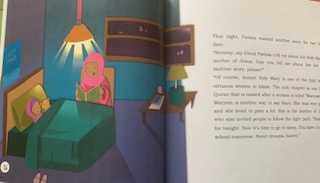
That night Catholic Fatima learns that her mom had gone to Fatima, a city in Portugal, a famous city for all the miracles that have happened there and the apparition of Mary, the Mother of Jesus.  Fatima’s mom had gone there to pray for a baby and promised if she got pregnant that she would name the baby Fatima.

IMG_1931

The next day Catholic Fatima tells Muslim Fatima and also asks her if she has heard of Mary, the mother of Jesus.  Muslim Fatima says she has heard of her, but doesn’t know much and that she will ask her parents and let her know.

Muslim Fatima learns that Mary is one of the four virtuous women in Islam and that there is a chapter in the Quran named after her.  When she tells Catholic Fatima the next day at school, the girls marvel at how much they have in common.  They are BFFs despite their differences and beautiful ones at that.

IMG_1932

I love that the book is framed in opposites to show similarities.  I also love that it shows women in our respective faiths with similar values, similar names, and Mary’s role in both our traditions.  So often, when we are building bridges we discuss how Yusuf is Joseph and Musa is Moses, Yahya is John and we go through the old Prophets, this was a nice change in perspective.

IMG_1935

The illustrations are nothing to get excited by, but they do show smiling warm characters and family members.  They serve as a distraction from the text heavy pages that do nothing to grasp the reader with their plan font and majority white backgrounds.

IMG_1933

This book would work for Muslim children, Catholic children, really all children.  It talks about faith, but as the characters view it, not in a one is better or more right than another.  There is a second book in the series about Fatima inviting Fatima to an Iftar party  that I look forward to checking out soon.  I hope it is a little more rich in dialogue and character building instead of just a foil to disseminate the information between the two faiths, but even if it isn’t I still think the book has value and you should check it out.

IMG_1934


A Race to Prayer: Sulaiman’s Rewarding Day by Aliya Vaughan

Standard
A Race to Prayer: Sulaiman’s Rewarding Day by Aliya Vaughan

a race to prayer

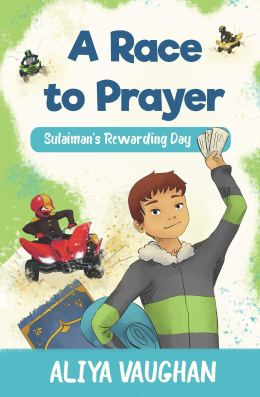
This 56 page (only 38 pages of story) early chapter book is a simple book with a lesson.  For kindergarten to 2nd grade readers the book could be a short story, but the added minuscule details (how he got in the car, slid over, and buckled up) and the illustrations, flesh the book out in to seven chapters with a note for parents/educators at the beginning, and sections of: evidence from the Quran and Sunnah, comprehension questions, inspiration behind the story, glossary and information on the author at the end.  The book isn’t bad, just kind of dry and bare bones.  Satisfactory for young readers that enjoy quad races, and ideal for those that whine whenever it is salat time.

SYNOPSIS:

Sulaiman loves watching quad races and playing football (soccer, the book is British), but feels like, “Every time I want to do something exciting, it either rains or it is time to pray.” one afternoon when he is feeling particularly grumpy, his dad offers to take him to watch the quad races at a nearby stadium.  Grandpa joins them and grandma sends them off with lunches and duas.  First the car won’t start, then they take a bus and wait in line.  Once they are inside the day looks up, the races are fun and then it is Thuhr time.  Sulaiman wants to wait until a break, but it is winter and the days are short meaning Asr will be approaching fast.  They go find a place to pray and when they return their seating section is closed.  Part of the roof fell in due to the rain.  Feeling fortunate that they had left to pray, Sulaiman sees the value of praying on time in this duniya.  They later are given better seats and Sulaiman feels blessed that they had gone to pray.

The story was inspired by a real event, according to the “Inspiration Behind the Story” at the end, where the author says that her husband was at a football match in Algeria when an earthquake struck.

IMG_0029

WHY I LIKE IT:

I love that the character is relate-able to most of our young Muslim children.  He is a good kid, but has a hard time stopping what he is doing to pray.  He has to be reminded to make wudu and brush his teeth.  I like that grandpa gets to come along, but I wish he would get to tell some of his stories, rather than just have Sulaiman shush him and be annoyed.  Similarly, I like that the dad is a “fixer” but some character development would have been really great.  I understand the reading age isn’t tempted by back story, but a little investment in the characters would make the climax that much more intense.  I was surprised by the roof falling in, but it snuck up so quick and was resolved equally fast, that I didn’t really feel it.

Also, I am not entirely sure what quad racing is. I mean I get that they are 4 wheelers racing on a stadium track.  But, I didn’t realize it was such a thing to be watching it on tv and then heading to watch it live nearby.  I’m glad I learned that kids dig it in Britain, but I’m thinking that it might be a little foreign .  A soccer match or another race, might have made the story a bit more appealing.

The book is for Muslims by a Muslim despite the glossary at the back. The pictures aren’t great, but they make the page breaks appeal to the younger kids.  The font, binding, and presentation makes for a nice looking and feeling book.

IMG_0030

FLAGS:

None, alhumdulillah.

TOOLS FOR LEADING THE DISCUSSION:

This book would be really great in small groups.  I can see it being used in Sunday schools or in Islamic schools, where Language Arts teachers and Islamic Studies teachers crossover to drive the importance of salat home.  I think this would easily inspire this age group to then write their own copy-cat stories of why salat is important.  The questions at the end could even make it like an extra credit novel study or a read aloud story with the questions used to verify comprehension.