Tag Archives: Muslim Characters

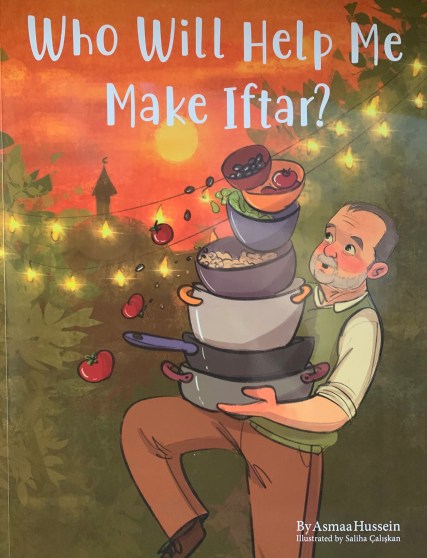
Who Will Help Me Make Iftar by Asmaa Hussein illustrated by Saliha Caliskan

Standard
Who Will Help Me Make Iftar by Asmaa Hussein illustrated by Saliha Caliskan

IMG_3796

This sweet story shows how even when people refuse to help, we should treat them with kindness, as our actions should be to please Allah alone, and inshaAllah in real life, much like in the story, people will fix their ways and offer their help in return.  This new story reads very much like the old(er) favorite Nabeel’s New Pants, where everyone is too busy to help, but then come around to realizing that helping one another is a way to show people we care.  This 32 page 8.5 x 11 soft back story is well bound with large glossy pages and clear text.  The story works well for ages 4 and up, as they will understand the moral message and inshaAllah feel inspired to find ways to help as well.  

IMG_3797

It is a 40 year tradition that Mustafa Amce and his wife Ayse Teyze feed iftar to their friends and families on the first day of Ramadan.  This year, however, Ayse is not well and Mustafa is confident he can enlist the help of neighbors and family to help him keep the tradition alive. 

IMG_3798

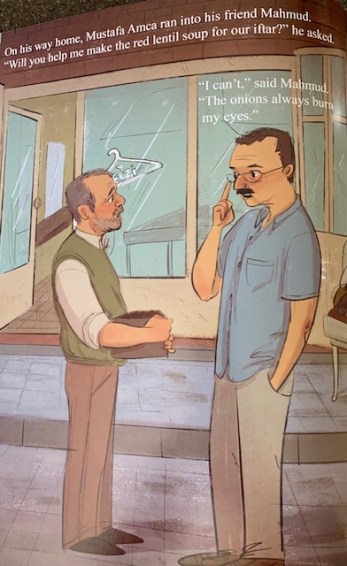
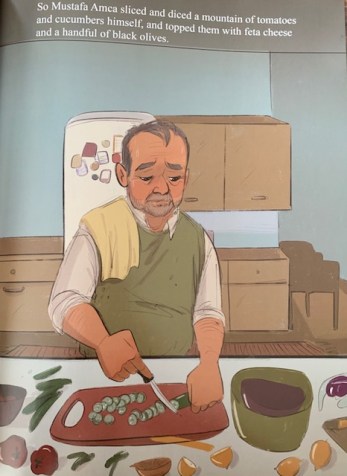
Unfortunately, everyone has an excuse.  His daughter is tired, his grand daughter is too busy with her video games and his neighbor doesn’t want to get his new shirt dirty.  Their sad reasons don’t stop old Mustafa Amce, and he makes the salad, and cooks the rice and beef by himself.

IMG_3799

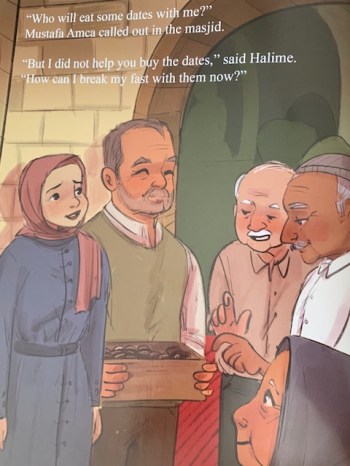
When iftar time arrives, he offers sweet dates to those at the masjid and invites everyone to come to his courtyard to break their fasts together.  All those that had early refused to assist him feel incredibly guilty and don’t want to take advantage of a lovely meal. Mustafa reminds them that, “God loves those who are generous especially to their families, neighbors, and guests.  and I always want Got to love me.” So they join in the delicious meal.

IMG_3800

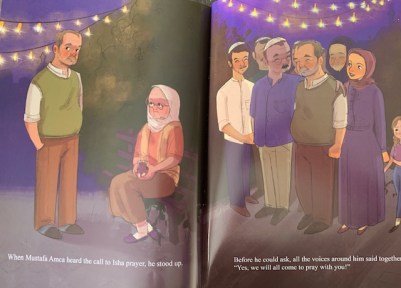
After food Ayse Teyze shows that while she might be ill, she can still save the day when her husband realizes he has forgotten to prepare dessert.  The guests then offer to wash the dishes and sweep the floor and take the leftovers to the poor.  And best of all when the athan for isha prayer calls out they all without prompting stand to join Mustafa Amce in praying salat together.

IMG_3801

The names are Turkish with a pronunciation guide at the end, as well as a paragraph about Ramadan.  The book would work for non Muslims and Muslims alike as the story is set in Ramadan, but more about coming together to help out.  The illustrations are large and detailed and descriptive.  You see the warmth between Mustafa and his wife as well as the apologetic feelings from those that were unwilling to help. 

IMG_3803

Forgiveness by Isa Beaumont

Standard
Forgiveness by Isa Beaumont

IMG_3669

This dual language book, is structured and feels like a leveled reader, but is more geared for fluent reading five to seven year olds.  It definitely has more complex diction and vocabulary than an emerging reader would be able to handle in English, I have no idea about the Arabic.  

SYNOPSIS:

The concept in 26 pages is how to forgive others and react calmly when we are upset.  The book is brightly illustrated on glossy sturdy softbound pages, and the characters are found in all of the company’s stories and plush figures at https://www.littlemaysoor.com/

IMG_3670

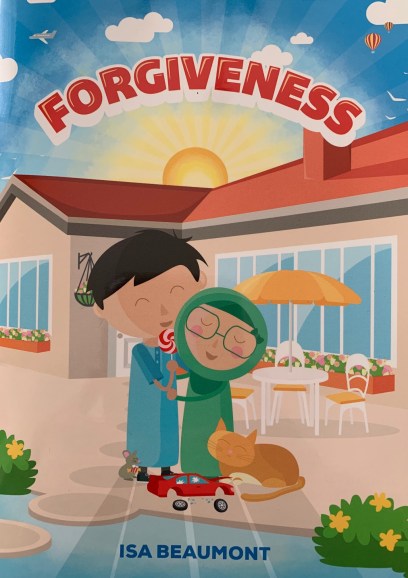
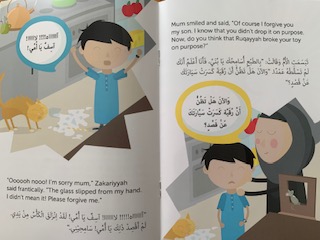
Little Zakariyyah has been behaving well, and as a result his mom gets him a new red toy car, he loves it and plays with it in the garden everyday. His sister Ruqayyah wants to play with it, he agrees and when he hands it to her, she accidentally drops it and it breaks.  In anger Zakariyyah begins screaming for her to “Go away from me!” Mom comes out to see what is going on and calm everyone down, she takes Zakariyyah inside and pours him some milk.  When she hands it to him, his hand slips and he drops the glass breaking it and making a mess. Mom forgives him and obviously highlights the similarities to what just happened with his sister and the toy car.  Mom then gently guides him to acknowledge his poor behavior and asks him what he things he should do.  Zakaraiyyah knows he needs to ask Allah swt for forgiveness and then apologize (apologise) to Ruqayyah.  Once he does this, his sister shares some sweets with him and reminds him of a hadith, “The strong one isn’t he who can overpower others.  Instead, the strong one is he who can control himself when he becomes angry.”

IMG_3671

WHY I LIKE IT:

Before the story begins there are six points you can implement before reading the story, and after the story, there are beginner and advanced concept questions and a place to write the answers provided.  The book has an agenda and it achieves its mark in showing a moral concept in an Islamic framework.

The book is written in British English which could make the spelling a bit confusing for new American readers, but manageable.  I honestly don’t know if the book was written in English then translated to Arabic or the other way around.  Some of the wording seems awkward so it could be attributed to it being translated from Arabic or it might just be the American/British difference.  For example Zakariyyah loves playing in “a small sand pit for children,” why not just say, sandbox? Again not terrible, but rationale for why I think children sounding out words might be a bit young for the target audience.  

I liked the story and how it lets the reader see the similarities to the events that unfold, just like I loved that the mom asked Zakariyyah what he should do, rather than dictate or scold him.  I was surprised when I read it, how smooth the ending was, because it really could have had Ruqayyah come across as a know-it-all and it didn’t.

The beginning of the book stumbled a bit with the set up trying to tell about Zakariyyah, why he got the toy and then staging the plot of the book.  If he had been playing with the car everyday, is it still a new car? Also the illustration before he drops the milk has him sitting at the table with a glass a milk in front of him.  Sure, maybe it was the second glass that he dropped, but it’s noticeable.

IMG_3672

FLAGS:

Clean

IMG_3673

TOOLS FOR LEADING THE DISCUSSION:

The book is obviously too short for a book club per se, but I think if you had a small group of readers, or are home schooling, you really could ask a child to read the book and then reflect back what they understood and what they learned and how they hope to put it in to practice.

Even with not reading the Arabic, the book is pretty solid in its approach and I plan to check out the other books in the series as I do a lot of story times with basic morals as themes.


The Jinni on the Roof: A Ramadan Story by Natasha Rafi illustrated by Abdul Malik Channa

Standard
The Jinni on the Roof: A Ramadan Story by Natasha Rafi illustrated by Abdul Malik Channa

IMG_3592

This 37 page culturally Pakistani Ramadan story is super sweet and fun.  There is so much I feel like my critical self should not like about the story, but by about page 15 each time I read it, I find my self full on smiling and thoroughly enjoying little Raza’s antics and his endearing grandma’s method for dealing with him.

IMG_3594

Raza is too young to fast, but with a house full of relatives gathered for Ramadan, Raza awakens to the sound of his uncle snoring before the siren to signal the start of fasting and the azan calling the worshippers to pray echo through Lahore.  Before he can go back to sleep, however, he hears the cook heading up the stairs to wake up grandma and then the smell of the food hits him and he wants a paratha more than anything.

IMG_3595

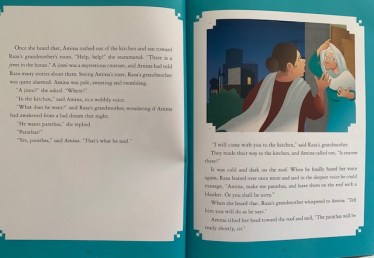
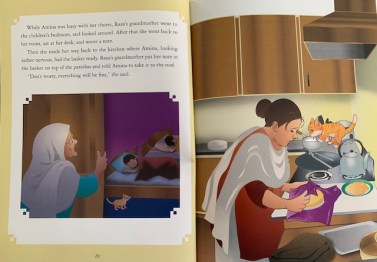
Raza embarks on a mission that involves him sneaking up to the roof, pretending to be a jinni and scaring Amina the cook through the chimney to convince her to send up food and a blanket.  

Scared out of her wits, Amina gets the grandma, culturally wards off evil, and delivers the goods to the jinni on the roof.  But the joke is on Raza who is out-witted by his grandma and gets the punishment of washing dishes for the rest of Ramadan, and learning that fasting a whole day will take a lot of will power, if he couldn’t even wait a few hours to get his beloved parathas.

IMG_3596

The book informs the reader that the following year Raza is able to successfully fast, that he is rewarded with gifts and that all is well and forgiven.  There is a glossary, information about Ramadan and a recipe at the end of the story as well.

I love that the plan just happens, it isn’t premeditated or considered, so it takes the reader along for the ride as it is unfolding.  It isn’t a deep story, but there is room for discussion as to whether Raza was naughty, or just caught up in the moment.

IMG_3597

The book is illustrated well and with big 8.5 x 11 pages, the book is engaging for first and second grade readers and listeners, as there is a lot of text on the pages.  The book takes a bit to find its stride as the author tries to use Urdu words, show their Arabic counterparts and then describe them in English. 

IMG_3598

There is a lot of cultural stage setting with everyone in grandmas house, the traditions of the family, of Ramadan, etc.  I think Desi familiar kids will get the most out of the book, but theoretically Muslim kids and non Muslims too could learn and enjoy it too.  I wish jinn and jinni were explained just a bit in the text, not just in the glossary, along with why an 8 year old wouldn’t be fasting or be required to do so. 

IMG_3599

My own kids, aged 8, 9, and 12, struggled on the first two pages, but when I told them to keep reading they zoomed through the rest smiling and ended saying it was good while giggling and shaking their heads.  We are Pakistani American and I think they enjoyed seeing familiar words and phrases in the book and sympathizing with Raza as well, and his sneaky plan that almost nearly worked.


Under the Ramadan Moon by Sylvia Whitman illustrated by Sue Williams

Standard
Under the Ramadan Moon by Sylvia Whitman illustrated by Sue Williams

under-the-ramadan-moon.jpg

I’ve been reading this book to groups of children for years, and how I’ve managed to not post a review is beyond me, but alas, this sweet book is perfect for preschool to kindergartners and works great at story time or bedtime with its sparse words, comforting illustrations, and predictable refrain that makes the book read like a lullaby.

IMG_3406 

The book gives glimpses of emotions felt during Ramadan and activities participated in, but in very toddler friendly way.  With between 10-15 words on each two page spread, the lyrical words paint pictures of families worshipping together, laughing together, eating together, helping the needy and working on being kind.  

IMG_3407

It mentions Quran, but no other Arabic specific words are mentioned, and it is through the pictures that it shows how Muslims pray.  Some of the women are in hijab, some are not.  At the end of the book is a full page with information about the blessed month of Ramadan, but the vagueness of Ramadan and Islamic requirements keeps the book open to both Muslim and non Muslim readers, and allows the feeling of Ramadan to permeate the few details given in a rich and soothing manner.

IMG_3408

The 8 x 10 size and 24 full color glossy pages make this book a regular during the month and a great choice to repeatedly curl up with your little ones and enjoy, alhumdulillah.

IMG_3409

Mustafa and Arwa go on a Ramadan Adventure by Mekram Mohammad

Standard
Mustafa and Arwa go on a Ramadan Adventure by Mekram Mohammad

IMG_3184

Ramadan is two months away and this little book is a great way to introduce and stir up excitement for little Muslim toddlers and preschoolers. It could work for non Muslims, but the general overview given would need some details and explanations, and this book seems more geared to introduce excitement and a few key concepts for the blessed month.

IMG_3190

In 27 rhyming pages the brother sister duo explore some of the feelings of the month, activities that make the month special and what to expect at suhur, iftar, and taraweeh at night.  

IMG_3185

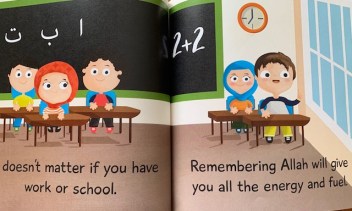
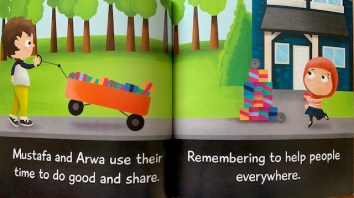
I like that it makes it clear that you don’t eat one bite, that you fast even if you are at work or school, that you use your time to do good and help people, and that you ask Allah for paradise.  

IMG_3188

The end is Eid and while the text presents some great general info, the illustrations are what really give the minimal clear text life.  Seeing the kids giving presents to people and looking for the moon and enjoying iftar together with smiling faces, show kids the warmth of Ramadan.  

IMG_3186

The book doesn’t have a story, it just talks about Ramadan, but the tone in this book and in Mustafa and Arwa go on a Prayer Adventure is very fun and light.  It doesn’t get into rules or articulate what little kids are expected or required to do, or even why Muslims do it, it just gives them some knowledge and some emotion to create the feeling of it being a grand adventure.

IMG_3189

The book is paperback 8.5 x 8.5 and the thickness, sheen and quality of the pages makes it durable and enjoyable to read at story time (in small groups) and bedtime alike.  This book most likely will be on repeat in the weeks leading up to Ramadan and then referenced throughout the month to remind children about what they are seeing and experiencing.  

Zara and Hakeem Learn ‘Alhumdulillah’ by Shabeena Rehman illustrated by Kevin Payne

Standard
Zara and Hakeem Learn ‘Alhumdulillah’ by Shabeena Rehman illustrated by Kevin Payne

IMG_2686.jpg

Board books from the UK! The glory of a well bound chunky book for toddlers to tote around, chew on and hopefully learn something from, with all the joy of international shipping.  I delayed buying these books for so long, because of it, and finally I gave in and just in the nick of time as I have started a weekly preschool story time, and this series is perfect for three and four year olds with limited attention spans and in need of repetition.

Zara and Hakeem, a brother and sister duo wake up to find their mother not feeling well, and instructions that they will have to help Daddy, Grandad and Grandma with the daily chores.  Then Mummy sneezes and says, Alhumdulillah.

img_2687

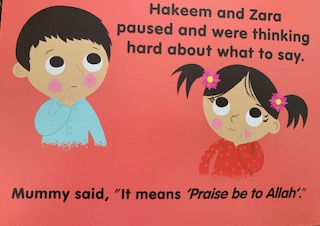
It seems the books  all have a pattern, something happens that sets the stage, then Hakeem and Zara pause and think hard about what to say, there is then an English translation/explanation about the meaning and then a universal, Muslims from all around the world say or do this, before the story resumes.

I don’t mind the break in the story, but the phrasing is a bit cumbersome and slightly off in this book.  Why are the kids thinking hard about what to say, when Mummy had just said it? If they were thinking hard about what she had said or where confused why she said it, I feel like it would make more sense. 

img_2688

I really like that the book shows that all Muslims say something the same, it is a good time to start to show this age bracket that they are connected to something bigger, without overwhelming them.  

The story continues with Hakeem helping daddy vacuum and Hakeem sneezing when some dust flies up.  Then Daddy and Zara mow the lawn when the grass makes Zara sneeze, everyone, Grandad, Grandma, all take a turn sneezing in different scenarios and everyone practicing to say Alhumdulillah.  

img_2690

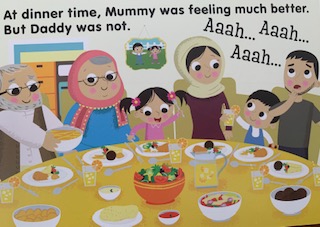
By dinner, Mummy is feeling better, but Daddy has a sneeze attack and takes to laying down as he is not feeling well, and tomorrow the kids will have to help Mummy with the chores.  A humorous full circle, that even toddlers will laugh at.

The kids I read the book to, loved the loud Atchoos and the cute illustrations, a few of the older four year olds, wanted to know why Yar Hamukumallah was not also said.  They also wanted to know why when the dad sneezed four times they only said Alhumdulillah three times.  I read a variety of books about being sick and we talked about using tissues and sneezing into our elbows, washing our hands, and not coming to school when we are sick.  The book was great to explore how mom was sick and dad must have caught her cold.  But that sneezing from pepper and cat hair, didn’t mean you were sick.  The kids also saw that everyone in the house has to help out, sick or not, old or young, male or female, which is always a great lesson to reinforce, Alhumdulillah.

img_2691

The book is 18 pages of text.  The illustrations show the mom and grandma in hijab, they are bright and colorful and engaging.  Children will enjoy getting carried away with the sneezes and the Alhumdulillahs when read aloud and will enjoy looking back at the pictures and details independently afterward.  This is a great story to put on repeat and then watch your own toddler retell the story on their own.

Overall, well worth the shipping! I hope US bookstores will stock the series as our little ones need books that are funny, clever, and well done.

img_2689

The Victory Boys by Jamal Orme illustrated by Eman Salem

Standard
The Victory Boys by Jamal Orme illustrated by Eman Salem

victory boys.jpg

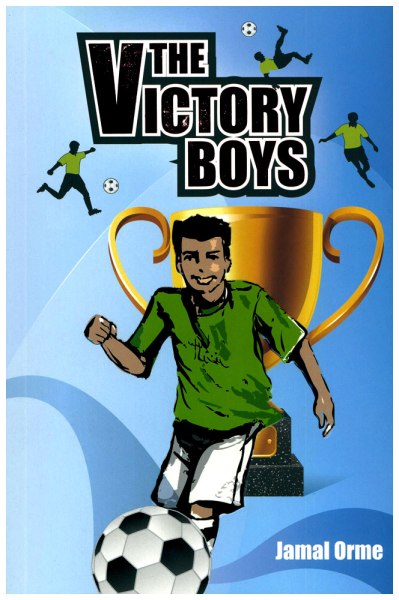
I’m not sure why Amazon states the book is for pre-school and up, when the publisher, Kube, posts this book for ages 7 and up.  I think 3rd or 4th grade soccer/football fans will enjoy the book.  There are some slightly mature ideas presented and worked through, and the soccer lingo assumes the reader knows the sport.  Plus the quality of the illustrations and the small font isn’t going to entice someone not already excited to read the book based on the content within.  My boys, ages 8 and 9, enjoyed the book, as did I, once the story got going.  It doesn’t really grip you from the first sentence, but as the story progresses and the way Islam is woven in makes for some learning experiences in the midst of a few intense football matches.

SYNOPSIS:

The boys at the Sunday Madrasa do not enjoy their time there.  They find the Imam boring and thus are not inspired to learn. When they sneak a football into break time however, they suddenly feel more engaged and present in their lessons.  A change the Imam notices and appreciates, but doesn’t know the reasoning for as he strictly forbids football and finds it a waste of time.  Outside of Madrasa, Junayd is having a hard time at home.  He has to help out a lot at his father’s restaurant and his older brother Saleem has gotten in trouble with the police.  His mom prays for the kids, but is also at a loss as to how to help with the stresses at home.

During a secret game of football in the masjid courtyard, an arrant ball breaks the neighbor’s greenhouse window, and the boys are forced to come clean about their covert game.  The Imam demands the kids stop playing and that they tell their parents what they have done, so that they may earn some money to replace the window.  As the kids come through with the money and the Imam sees the kids resort back to their lackluster attitudes to learning.  He gets an idea to start a football club after madrasa classes.  The only problem is that he knows nothing about the sport and no parents are willing to help.

Saleem by chance comes to collect his brother one day, and as he hollers advice from the sidelines, the Imam recruits him to coach the team.  In response the Imam ever so gently uses football to teach not only the madrasa kids, but Saleem as well.  When the boys learn of an upcoming tournament, the Madrasa enters an A and B squad and the Shabab Al-Nasr, Victory Boys, will be tested not only in their play, but also in their manners, and understanding of what it means to be a team and Muslim.

WHY I LIKE IT:

I love that the Imam grows and changes.  I mean it is a kids book about soccer, but really it is the adult in the story that shows the most heart.  He goes out of his comfort zone, reevaluates his opinions, and admits when he is wrong.  High five Imam!  I also like that he didn’t give up on Saleem, and the way he leads him is with such kindness and compassion, that even youngsters, will be impressed.  

The book does not talk down to the reader, which is nice, but at the same time I think it pushes the age appropriateness a bit with the detail devoted to alcohol being sold at the restaurant, Junayd’s father’s flaws, and even Adam’s dad’s tantrum of sorts.  There really aren’t any nice parents in the book.  We don’t learn much about the moms, but none of the dads seem too supportive.  Really the only nice adults are the Imam and the neighbor who’s window they broke.

The timeline isn’t entirely smooth, the kids come together and play well as a team remarkably fast for how intense the tournament is, and how well they perform. And some of the characters could have used some fleshing out, I couldn’t really tell you much about them.  The font is really small and the spacing often forgotten.  The book is about 95 pages with a glossary and an acknowledgement at the end, fortunately the 2nd book in the series seems to space the words and lines out more and is 155 pages.

The story is solid and for the most part well written.  I read it in one sitting and thoroughly enjoyed the lessons learned and then put into practice.  The book isn’t preachy, but you are glad to see the Imams words given life in the other characters’ actions.  Saleem changes quickly, but the author and story account for it in a way that is believable for the audience and the message of not giving up on one another comes through loud and clear.  There is a lot of technical detail about the sport, but it doesn’t drag on, it adds to the excitement even if you just know the basics.

FLAGS:

The talk of alcohol, of Saleem being with a group of kids and a stolen car, there is some yelling and aggressiveness from the adults.

TOOLS FOR LEADING THE DISCUSSION:

The story is a bit short for a book club selection, but I would definitely consider it for Lunch Bunch (where I read to 4th and 5th graders while they eat lunch).  And I think most Islamic School libraries and classrooms should stock the series.  

https://thevictoryboys.com/

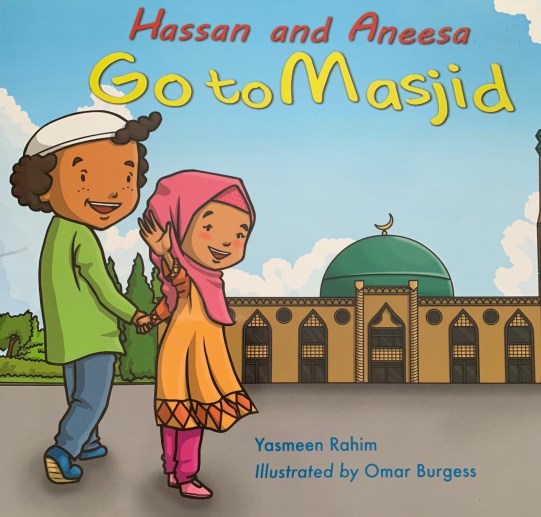
Hassan and Aneesa Go to Masjid by Yasmeen Rahim illustrated by Omar Burgess

Standard
Hassan and Aneesa Go to Masjid by Yasmeen Rahim illustrated by Omar Burgess

IMG_1911

I don’t often do two books in the same series, let alone three, but for as much as I enjoyed Hassan and Aneesa Love Ramadan and Hassan and Aneesa Celebrate Eid, I was a little disappointed in this story.  For starters, the title seems like it should read, Go to “the” Masjid, no? 

IMG_1912

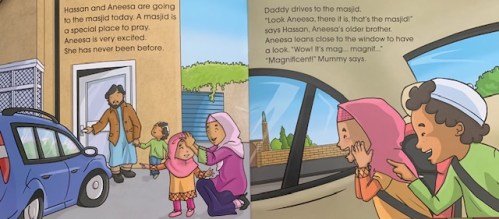
The story starts off with the notion that this is Aneesa’a first time to the masjid, which seems bit off.  Presumably mom and Hassan have been before, but mom’s excitement, and Hassan’s questions through the book, and knowledge about masjid etiquette make you wonder if it is their first time too.  A little odd, if you’ve read their other books, but ok, I’ll accept it and move on.

The family starts by marveling at the exterior architecture.  They enter and separate, Hassan going with his dad and Aneesa going with her mom, as it points out that men and women pray in separate areas.  It is a good tidbit of information, but again, it just seems a bit off in the way it is phrased that Aneesa wouldn’t know this.  

IMG_1913

The tone of the book is almost negative, again, a striking contrast to the other stories.  Aneesa splashes and wastes water when making wudu, doesn’t she make wudu at home? And the mom gets her clothes ruined in the process making her upset.  The illustration shows her to look really mad!

I would think a little context about not wasting water or even sharing the hadith about not wasting even if making wudu in a river, would have been a great lesson to convey, but instead the pictures show a lot of water by others also being wasted, and only mom looking really frustrated.

IMG_1914

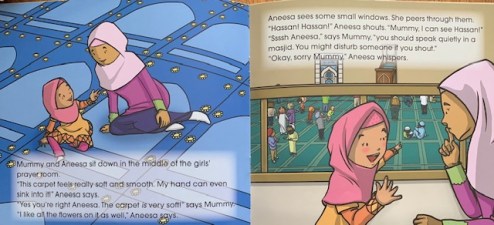
The two of them, put their shoes up and marvel at the dome and the soft carpet.  Aneesa then sees that the ladies prayer area over looks the mens and she begins screaming for Hassan.  Her mom corrects her and points out that “you should speak quietly in a masjid.  You might disturb someone if you shout.”

IMG_1915

Hassan turns and waves, and then rushes off to see a school friend.  But, first he is reproached for nearly walking in front of someone praying.  Again a good tidbit, but the phrasing of how the information is shared is rather negative, and these repetitive reprimands don’t make the book joyful.

IMG_1916

Hassan then learns about he mihrab and the mimbar before the athan is called and they all pray.  After salat they put some sadaqa in a box and the family heads home.

The illustrations are as sweet as ever, and the price very reasonable, but this book, compared to others in the series, is really wordy and there is a lot of text on EVERY one of the 20 pages.

IMG_1917

The framing of the book is awkward, thus making some of the behavior issues come off as negative, it is a minor thing that keeps the book from being great.  If the premise would have been maybe the kids talking about their favorite things about the masjid and reminding themselves to talk quiet and not waste water, the tone overall would have been lighter while still being really informative.

IMG_1918

If this is your first Hassan and Aneesa book, you might not be bothered, but if you find it a little off putting, try the other two.  The books says for ages 2 and up, but I think it would be better for 4 and up.  The younger kids you could tell them the story while showing them the pictures: what to expect at the mosque and how to behave, but there are too many words, and they will probably have a hard time staying focused.  Older four and five year olds, will enjoy seeing things they recognize and maybe learning some of the vocabulary for the architecture and being reminded on proper behavior at the masjid.


Sadia by Colleen Nelson

Standard
Sadia by Colleen Nelson

sadia.jpg

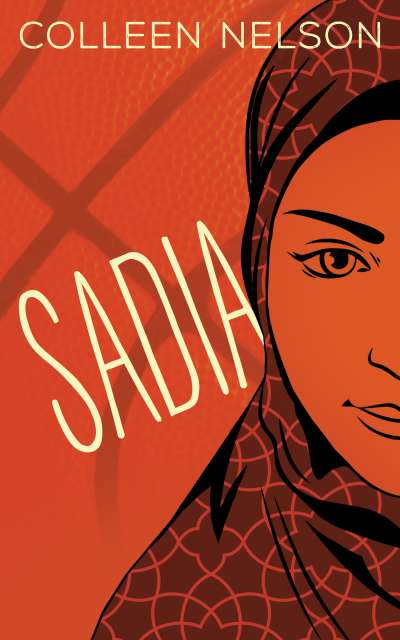
A middle school sports book with a female lead who wears hijab written by a non muslim.  The book could really go a lot of ways, I held my breath for all 239 pages waiting for something to go totally awry, and thankfully it never did.  In fact I read the book nearly straight through and while meant for ages 12 to 15, I quite enjoyed it.

SYNOPSIS:

Ninth Grader Sadia Ahmadi is an immigrant from Syria, her family left before things got “bad,” and while she has adjusted to life in Canada, High School is testing her in other ways.  Her best friend Mariam, an immigrant from Egypt, has started dejabbing, taking off her hijab to fit in it seems any chance she gets.  This is taken as a betrayal by Sadia and their friendship waxes and wanes throughout the book as each girl has to figure out who she is in relationship to hijab, and how to judge and/or accept each other and their choices.  Throw in a new refugee girl Amira from Syria who doesn’t speak English, a co-ed basketball tournament that doesn’t allow any headgear to be worn during games, a cute boy on the team and an awesome teacher with interesting assignments and you have the book in a nutshell.

WHY I LIKE IT:

I like Sadia, she is believable and strong.  She is well liked, athletic, she has a good relationship with her parents, brother and teachers, she prays and fasts and owns who she is, but she isn’t perfect.  She is hypocritical at times, and acknowledges it, she is tempted by parties, and boys and taking off her own hijab to play ball, and has to confront it about herself.  She doesn’t do things like pray on time, like she knows she should, but there she is and I am so impressed that the author picked up on so many nuances of Muslim life in her research or in her own observations as a teacher.  Yes, Amira has an awkward observation about Miriam being Muslim and not wearing hijab that seems really one dimensional considering large numbers of Muslims in Egypt and Syria don’t cover, but I don’t know if that was the author’s attempt to draw the issue to the light or if it was just a misstep.  

I like that there is a cute boy that accepts Sadia and who she likes as well, but they don’t do anything.  So often, these books become overrun by the romance story line and this one doesn’t, thankfully.  It seems to find a realistic balance, that she has feelings, but isn’t going to act on them, and based on her mom figuring out when she is lying that she won’t try and sneak behind her mom’s back.

Issues of halal food are mentioned in passing and it fleshes out that the girl is Muslim, not just going through the motions.  At times it is hard to know if her choices are based on belief and faith or expectation, but for an early YA/Middle School book, I think it suffices.  She mentions modesty as a reason for hijab, but also a lot of parental and cultural expectation.  One central theme the reader just has to go with, is that Sadia and the rest of the characters in the book, and there are a fair amount of Muslims, don’t know about any other ways to wear hijab for sports.  I get that Mariam and her sewing ability is a huge arc in the story, but they have smart phones, and its a contemporary piece, they have to know about Ibtihaj Muhammad in the Olympics, Bilqis Abdul-Qaadir, and Nike making athletic hijabs.  So, to make the story work you do have to turn a blind eye to the fact Muslima’s have taken to sports in the mainstream and that there is no way they can all be that clueless about her fabric, style, and covering options.

I love that the issue of refugees is addressed in the periphery, and the issues are given a human face.   I love that Sadia’s parents are religious, but not left as simple stereotypes, they deal with Islamaphobia, but aren’t looking for sympathy.

There is always the case, that the hijab becomes a stereotyped item as the story involves characters torn to wear it or not, but I loved how judgements were called in to questions and there wasn’t an easy answer.  The side friends in the story are all way too good to be true, but I think the whole book has a bit of a pollyanna feel to it, and in this case it was ok to error on the side of kindness than become overtly sensationalized and whiney.

The biggest hurdle this book faces is, is it the author’s story to tell. And I don’t know, I review a lot of books, and many are by Muslims and they get stuff wrong in my opinion, or they go so extreme to be accepted.  So, I don’t know, I think the book had heart, I didn’t know if the tournament would let Sadia play, I didn’t know if she would sneak off to the party, I didn’t know if she would cross the line with Josh, and I was curious, and invested and sucked in to it all.  Is it a book to teach others about Muslims or a book for Muslims to see themselves? I think all of the above.  Muslim’s should control their own narrative, but I think when author’s get so much right, we have to take some reassurance in the idea that we are being accepted by the larger society, and our stories are being told with love by other’s too.

FLAGS:

There is romance and lying, but no kissing, just hints at emotions or an errant arm flung over a shoulder during a huddle or photo.  There is mention of drinking at the parties, but Sadia doesn’t end up attending.

TOOLS FOR LEADING THE DISCUSSION:

I don’t know that I would do this as a book club selection, but if I met the right group of kids, I would definitely reconsider.  There is a lot of basketball, which I quite enjoyed, but I could see other’s maybe getting bored by the play-by-play.  I’ll make my daughter read it in a few years, and I look forward to discussing hijab and how she feels about it after.  It does raise the subject, and ask you to check your judgements on yourself and on others.

Author’s Website: http://www.colleennelsonauthor.com/


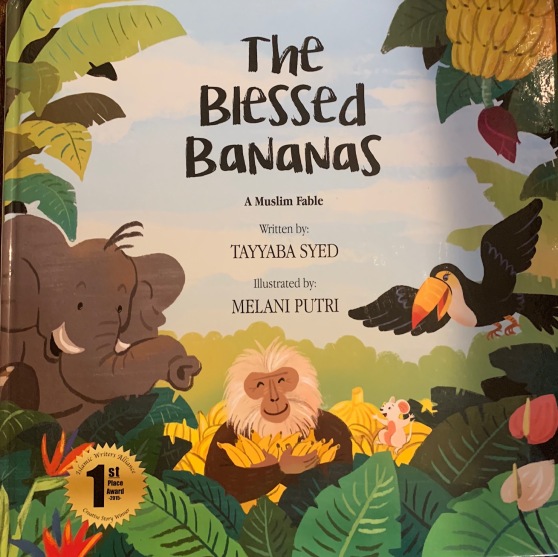
The Blessed Bananas: A Muslim Fable by Tayyaba Syed illustrated by Melani Putri

Standard
The Blessed Bananas: A Muslim Fable by Tayyaba Syed illustrated by Melani Putri

IMG_1798.jpg

 A fable with lessons of kindness centered around the Salawat, definitely is a great premise and for the most part I really enjoyed the book. 

IMG_1799

The 8.5 by 8.5 hardcover, 50 page book feels great in your hands and the illustrations are sweet and expressive.  The book is long, and is text heavy so I’d say the target audience is maybe 6 to 10 years old.   The font is incredibly small and irritating.   It should have been larger and more inviting to children in my opinion.  It doesn’t match the size, binding, and illustrations, and actually becomes a distraction if trying to read it in a group setting.  

IMG_1801

The story itself is smooth and intentional.  Rico, a blessed, yet ungrateful monkey, lives atop an ever abundant banana tree.  However, he attributes his blessings to his own hands and does not thank Allah swt.  He is mean and greedy toward people and animals alike.  Yet, something is missing in his life and he doesn’t know what. 

IMG_1800

When a little mouse, Chico, comes to him to ask for a banana and gets scolded at instead.  Chico makes dua for Rico asking Allah to guide the monkey to goodness.

IMG_1802

Tucana, a toucan, then stops in Rico’s banana tree after a long flight to be rebuffed by a foul tempered monkey who wants to be left alone.  When Tucana  leaves she forgives Rico for his rudeness and asks Allah to be merciful to him as well.

IMG_1803

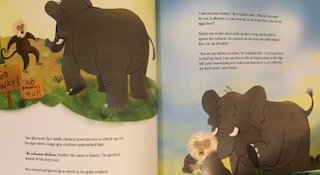
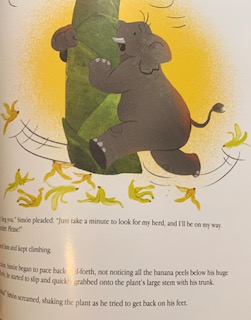
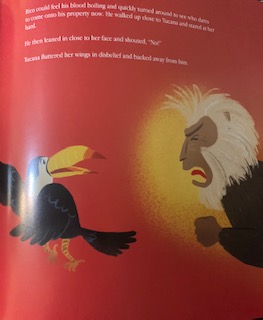
Rico then makes signs to keep people and animals away.  Which works for a while, but along comes Simon, an elephant, one afternoon to ask the monkey to climb his tree and help direct him back to his herd.  Rico of course refuses, and Simon reminds him that they are brothers in Islam and to please help. He begins shouting at the elephant to leave, and as Simon is pacing back and forth, he slips on the banana peels, grabs the tree to support himself and shakes the tree back and forth in the process.

IMG_1806

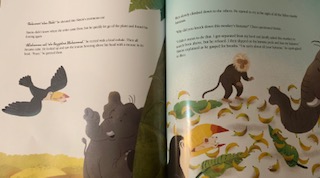
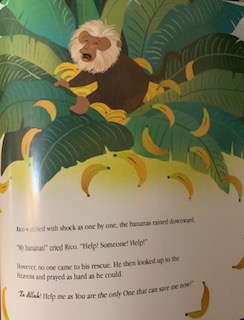
Rico begins hollering for help and sure enough the animals he had turned away previously, return to help him.  They had forgiven him as they hope Allah will forgive us all.  To calm the monkey, chico shouts, “Salawaat’alan Nabi!” in Simon’s ear and when he recites “Allahuma sali’ala Sayyidina Muhammad,” peace and calmness is restored.

IMG_1811 (1)

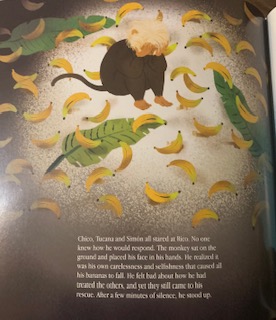
With all the bananas on the floor, many mushy and trampled, Rico has to decide if he learned a lesson, and how he will put his new knowledge into action, or if he will resume his life of ungratefulness.

IMG_1807

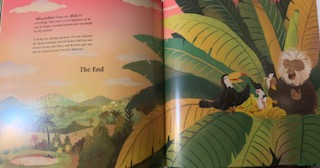
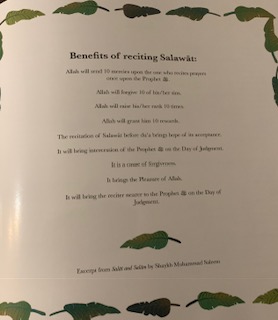
The book ends with each animals favorite banana recipe, information about the author and illustrator and benefits of reciting Salawat and an ayat from the Quran.

IMG_1810

The story and how it weaves Islam into the lessons is beautifully done, my only hiccup is the constant refrain of Rico counting his bananas.  I realize it is a fable, and maybe with talking animals interacting with humans, reality is notably suspended.  But, it seems misplaced to me.  How do you constantly count a perishable item? Does Rico only eat a certain amount a day? How many new ones grow a day? What is the number that he is adamant to have at all times? So, many questions, that I didn’t get why he was counting them, why he was irritated when he lost count, and why this detail was in the story and a big part of the story none-the-less.  Like the font, its a minor detail, but a distracting one for me unfortunately.  Clearly, however, I’m in the minority as the book has won the Moonbeam Children’s Book Award and the Islamic Writer’s Alliance Creative Story, so give it a read, and let me know your thoughts, jazakhAllah kher.

IMG_1809