Tag Archives: Muslim Characters

Zara and Hakeem Learn ‘Alhumdulillah’ by Shabeena Rehman illustrated by Kevin Payne

Standard
Zara and Hakeem Learn ‘Alhumdulillah’ by Shabeena Rehman illustrated by Kevin Payne

IMG_2686.jpg

Board books from the UK! The glory of a well bound chunky book for toddlers to tote around, chew on and hopefully learn something from, with all the joy of international shipping.  I delayed buying these books for so long, because of it, and finally I gave in and just in the nick of time as I have started a weekly preschool story time, and this series is perfect for three and four year olds with limited attention spans and in need of repetition.

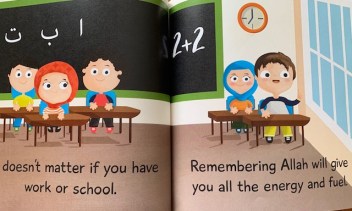
Zara and Hakeem, a brother and sister duo wake up to find their mother not feeling well, and instructions that they will have to help Daddy, Grandad and Grandma with the daily chores.  Then Mummy sneezes and says, Alhumdulillah.

img_2687

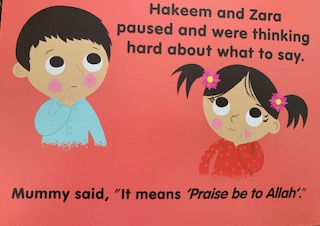
It seems the books  all have a pattern, something happens that sets the stage, then Hakeem and Zara pause and think hard about what to say, there is then an English translation/explanation about the meaning and then a universal, Muslims from all around the world say or do this, before the story resumes.

I don’t mind the break in the story, but the phrasing is a bit cumbersome and slightly off in this book.  Why are the kids thinking hard about what to say, when Mummy had just said it? If they were thinking hard about what she had said or where confused why she said it, I feel like it would make more sense. 

img_2688

I really like that the book shows that all Muslims say something the same, it is a good time to start to show this age bracket that they are connected to something bigger, without overwhelming them.  

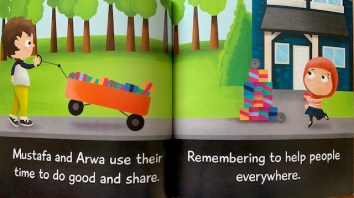
The story continues with Hakeem helping daddy vacuum and Hakeem sneezing when some dust flies up.  Then Daddy and Zara mow the lawn when the grass makes Zara sneeze, everyone, Grandad, Grandma, all take a turn sneezing in different scenarios and everyone practicing to say Alhumdulillah.  

img_2690

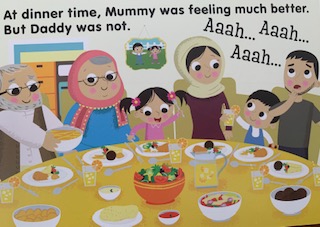
By dinner, Mummy is feeling better, but Daddy has a sneeze attack and takes to laying down as he is not feeling well, and tomorrow the kids will have to help Mummy with the chores.  A humorous full circle, that even toddlers will laugh at.

The kids I read the book to, loved the loud Atchoos and the cute illustrations, a few of the older four year olds, wanted to know why Yar Hamukumallah was not also said.  They also wanted to know why when the dad sneezed four times they only said Alhumdulillah three times.  I read a variety of books about being sick and we talked about using tissues and sneezing into our elbows, washing our hands, and not coming to school when we are sick.  The book was great to explore how mom was sick and dad must have caught her cold.  But that sneezing from pepper and cat hair, didn’t mean you were sick.  The kids also saw that everyone in the house has to help out, sick or not, old or young, male or female, which is always a great lesson to reinforce, Alhumdulillah.

img_2691

The book is 18 pages of text.  The illustrations show the mom and grandma in hijab, they are bright and colorful and engaging.  Children will enjoy getting carried away with the sneezes and the Alhumdulillahs when read aloud and will enjoy looking back at the pictures and details independently afterward.  This is a great story to put on repeat and then watch your own toddler retell the story on their own.

Overall, well worth the shipping! I hope US bookstores will stock the series as our little ones need books that are funny, clever, and well done.

img_2689

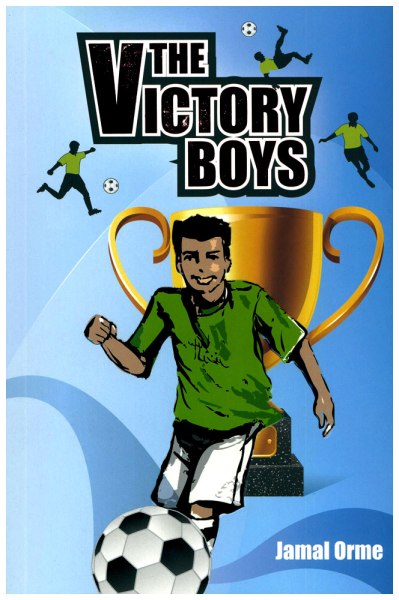
The Victory Boys by Jamal Orme illustrated by Eman Salem

Standard
The Victory Boys by Jamal Orme illustrated by Eman Salem

victory boys.jpg

I’m not sure why Amazon states the book is for pre-school and up, when the publisher, Kube, posts this book for ages 7 and up.  I think 3rd or 4th grade soccer/football fans will enjoy the book.  There are some slightly mature ideas presented and worked through, and the soccer lingo assumes the reader knows the sport.  Plus the quality of the illustrations and the small font isn’t going to entice someone not already excited to read the book based on the content within.  My boys, ages 8 and 9, enjoyed the book, as did I, once the story got going.  It doesn’t really grip you from the first sentence, but as the story progresses and the way Islam is woven in makes for some learning experiences in the midst of a few intense football matches.

SYNOPSIS:

The boys at the Sunday Madrasa do not enjoy their time there.  They find the Imam boring and thus are not inspired to learn. When they sneak a football into break time however, they suddenly feel more engaged and present in their lessons.  A change the Imam notices and appreciates, but doesn’t know the reasoning for as he strictly forbids football and finds it a waste of time.  Outside of Madrasa, Junayd is having a hard time at home.  He has to help out a lot at his father’s restaurant and his older brother Saleem has gotten in trouble with the police.  His mom prays for the kids, but is also at a loss as to how to help with the stresses at home.

During a secret game of football in the masjid courtyard, an arrant ball breaks the neighbor’s greenhouse window, and the boys are forced to come clean about their covert game.  The Imam demands the kids stop playing and that they tell their parents what they have done, so that they may earn some money to replace the window.  As the kids come through with the money and the Imam sees the kids resort back to their lackluster attitudes to learning.  He gets an idea to start a football club after madrasa classes.  The only problem is that he knows nothing about the sport and no parents are willing to help.

Saleem by chance comes to collect his brother one day, and as he hollers advice from the sidelines, the Imam recruits him to coach the team.  In response the Imam ever so gently uses football to teach not only the madrasa kids, but Saleem as well.  When the boys learn of an upcoming tournament, the Madrasa enters an A and B squad and the Shabab Al-Nasr, Victory Boys, will be tested not only in their play, but also in their manners, and understanding of what it means to be a team and Muslim.

WHY I LIKE IT:

I love that the Imam grows and changes.  I mean it is a kids book about soccer, but really it is the adult in the story that shows the most heart.  He goes out of his comfort zone, reevaluates his opinions, and admits when he is wrong.  High five Imam!  I also like that he didn’t give up on Saleem, and the way he leads him is with such kindness and compassion, that even youngsters, will be impressed.  

The book does not talk down to the reader, which is nice, but at the same time I think it pushes the age appropriateness a bit with the detail devoted to alcohol being sold at the restaurant, Junayd’s father’s flaws, and even Adam’s dad’s tantrum of sorts.  There really aren’t any nice parents in the book.  We don’t learn much about the moms, but none of the dads seem too supportive.  Really the only nice adults are the Imam and the neighbor who’s window they broke.

The timeline isn’t entirely smooth, the kids come together and play well as a team remarkably fast for how intense the tournament is, and how well they perform. And some of the characters could have used some fleshing out, I couldn’t really tell you much about them.  The font is really small and the spacing often forgotten.  The book is about 95 pages with a glossary and an acknowledgement at the end, fortunately the 2nd book in the series seems to space the words and lines out more and is 155 pages.

The story is solid and for the most part well written.  I read it in one sitting and thoroughly enjoyed the lessons learned and then put into practice.  The book isn’t preachy, but you are glad to see the Imams words given life in the other characters’ actions.  Saleem changes quickly, but the author and story account for it in a way that is believable for the audience and the message of not giving up on one another comes through loud and clear.  There is a lot of technical detail about the sport, but it doesn’t drag on, it adds to the excitement even if you just know the basics.

FLAGS:

The talk of alcohol, of Saleem being with a group of kids and a stolen car, there is some yelling and aggressiveness from the adults.

TOOLS FOR LEADING THE DISCUSSION:

The story is a bit short for a book club selection, but I would definitely consider it for Lunch Bunch (where I read to 4th and 5th graders while they eat lunch).  And I think most Islamic School libraries and classrooms should stock the series.  

https://thevictoryboys.com/

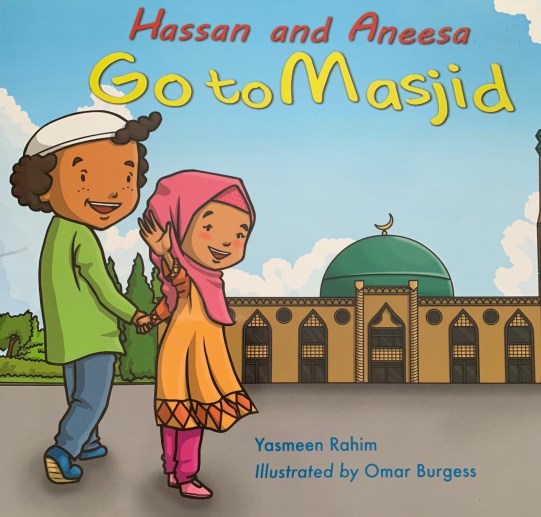
Hassan and Aneesa Go to Masjid by Yasmeen Rahim illustrated by Omar Burgess

Standard
Hassan and Aneesa Go to Masjid by Yasmeen Rahim illustrated by Omar Burgess

IMG_1911

I don’t often do two books in the same series, let alone three, but for as much as I enjoyed Hassan and Aneesa Love Ramadan and Hassan and Aneesa Celebrate Eid, I was a little disappointed in this story.  For starters, the title seems like it should read, Go to “the” Masjid, no? 

IMG_1912

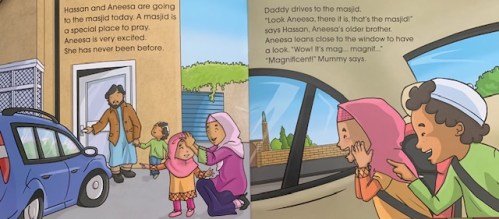
The story starts off with the notion that this is Aneesa’a first time to the masjid, which seems bit off.  Presumably mom and Hassan have been before, but mom’s excitement, and Hassan’s questions through the book, and knowledge about masjid etiquette make you wonder if it is their first time too.  A little odd, if you’ve read their other books, but ok, I’ll accept it and move on.

The family starts by marveling at the exterior architecture.  They enter and separate, Hassan going with his dad and Aneesa going with her mom, as it points out that men and women pray in separate areas.  It is a good tidbit of information, but again, it just seems a bit off in the way it is phrased that Aneesa wouldn’t know this.  

IMG_1913

The tone of the book is almost negative, again, a striking contrast to the other stories.  Aneesa splashes and wastes water when making wudu, doesn’t she make wudu at home? And the mom gets her clothes ruined in the process making her upset.  The illustration shows her to look really mad!

I would think a little context about not wasting water or even sharing the hadith about not wasting even if making wudu in a river, would have been a great lesson to convey, but instead the pictures show a lot of water by others also being wasted, and only mom looking really frustrated.

IMG_1914

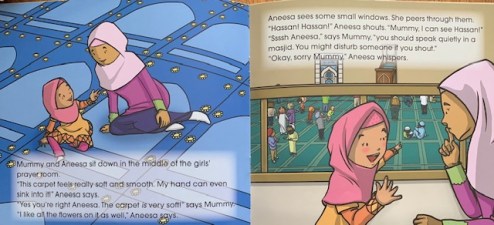
The two of them, put their shoes up and marvel at the dome and the soft carpet.  Aneesa then sees that the ladies prayer area over looks the mens and she begins screaming for Hassan.  Her mom corrects her and points out that “you should speak quietly in a masjid.  You might disturb someone if you shout.”

IMG_1915

Hassan turns and waves, and then rushes off to see a school friend.  But, first he is reproached for nearly walking in front of someone praying.  Again a good tidbit, but the phrasing of how the information is shared is rather negative, and these repetitive reprimands don’t make the book joyful.

IMG_1916

Hassan then learns about he mihrab and the mimbar before the athan is called and they all pray.  After salat they put some sadaqa in a box and the family heads home.

The illustrations are as sweet as ever, and the price very reasonable, but this book, compared to others in the series, is really wordy and there is a lot of text on EVERY one of the 20 pages.

IMG_1917

The framing of the book is awkward, thus making some of the behavior issues come off as negative, it is a minor thing that keeps the book from being great.  If the premise would have been maybe the kids talking about their favorite things about the masjid and reminding themselves to talk quiet and not waste water, the tone overall would have been lighter while still being really informative.

IMG_1918

If this is your first Hassan and Aneesa book, you might not be bothered, but if you find it a little off putting, try the other two.  The books says for ages 2 and up, but I think it would be better for 4 and up.  The younger kids you could tell them the story while showing them the pictures: what to expect at the mosque and how to behave, but there are too many words, and they will probably have a hard time staying focused.  Older four and five year olds, will enjoy seeing things they recognize and maybe learning some of the vocabulary for the architecture and being reminded on proper behavior at the masjid.


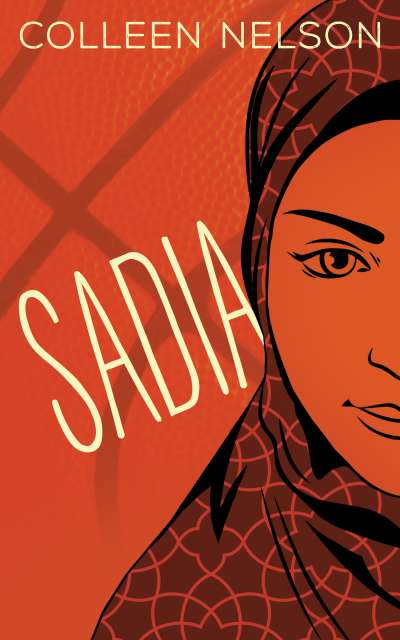
Sadia by Colleen Nelson

Standard
Sadia by Colleen Nelson

sadia.jpg

A middle school sports book with a female lead who wears hijab written by a non muslim.  The book could really go a lot of ways, I held my breath for all 239 pages waiting for something to go totally awry, and thankfully it never did.  In fact I read the book nearly straight through and while meant for ages 12 to 15, I quite enjoyed it.

SYNOPSIS:

Ninth Grader Sadia Ahmadi is an immigrant from Syria, her family left before things got “bad,” and while she has adjusted to life in Canada, High School is testing her in other ways.  Her best friend Mariam, an immigrant from Egypt, has started dejabbing, taking off her hijab to fit in it seems any chance she gets.  This is taken as a betrayal by Sadia and their friendship waxes and wanes throughout the book as each girl has to figure out who she is in relationship to hijab, and how to judge and/or accept each other and their choices.  Throw in a new refugee girl Amira from Syria who doesn’t speak English, a co-ed basketball tournament that doesn’t allow any headgear to be worn during games, a cute boy on the team and an awesome teacher with interesting assignments and you have the book in a nutshell.

WHY I LIKE IT:

I like Sadia, she is believable and strong.  She is well liked, athletic, she has a good relationship with her parents, brother and teachers, she prays and fasts and owns who she is, but she isn’t perfect.  She is hypocritical at times, and acknowledges it, she is tempted by parties, and boys and taking off her own hijab to play ball, and has to confront it about herself.  She doesn’t do things like pray on time, like she knows she should, but there she is and I am so impressed that the author picked up on so many nuances of Muslim life in her research or in her own observations as a teacher.  Yes, Amira has an awkward observation about Miriam being Muslim and not wearing hijab that seems really one dimensional considering large numbers of Muslims in Egypt and Syria don’t cover, but I don’t know if that was the author’s attempt to draw the issue to the light or if it was just a misstep.  

I like that there is a cute boy that accepts Sadia and who she likes as well, but they don’t do anything.  So often, these books become overrun by the romance story line and this one doesn’t, thankfully.  It seems to find a realistic balance, that she has feelings, but isn’t going to act on them, and based on her mom figuring out when she is lying that she won’t try and sneak behind her mom’s back.

Issues of halal food are mentioned in passing and it fleshes out that the girl is Muslim, not just going through the motions.  At times it is hard to know if her choices are based on belief and faith or expectation, but for an early YA/Middle School book, I think it suffices.  She mentions modesty as a reason for hijab, but also a lot of parental and cultural expectation.  One central theme the reader just has to go with, is that Sadia and the rest of the characters in the book, and there are a fair amount of Muslims, don’t know about any other ways to wear hijab for sports.  I get that Mariam and her sewing ability is a huge arc in the story, but they have smart phones, and its a contemporary piece, they have to know about Ibtihaj Muhammad in the Olympics, Bilqis Abdul-Qaadir, and Nike making athletic hijabs.  So, to make the story work you do have to turn a blind eye to the fact Muslima’s have taken to sports in the mainstream and that there is no way they can all be that clueless about her fabric, style, and covering options.

I love that the issue of refugees is addressed in the periphery, and the issues are given a human face.   I love that Sadia’s parents are religious, but not left as simple stereotypes, they deal with Islamaphobia, but aren’t looking for sympathy.

There is always the case, that the hijab becomes a stereotyped item as the story involves characters torn to wear it or not, but I loved how judgements were called in to questions and there wasn’t an easy answer.  The side friends in the story are all way too good to be true, but I think the whole book has a bit of a pollyanna feel to it, and in this case it was ok to error on the side of kindness than become overtly sensationalized and whiney.

The biggest hurdle this book faces is, is it the author’s story to tell. And I don’t know, I review a lot of books, and many are by Muslims and they get stuff wrong in my opinion, or they go so extreme to be accepted.  So, I don’t know, I think the book had heart, I didn’t know if the tournament would let Sadia play, I didn’t know if she would sneak off to the party, I didn’t know if she would cross the line with Josh, and I was curious, and invested and sucked in to it all.  Is it a book to teach others about Muslims or a book for Muslims to see themselves? I think all of the above.  Muslim’s should control their own narrative, but I think when author’s get so much right, we have to take some reassurance in the idea that we are being accepted by the larger society, and our stories are being told with love by other’s too.

FLAGS:

There is romance and lying, but no kissing, just hints at emotions or an errant arm flung over a shoulder during a huddle or photo.  There is mention of drinking at the parties, but Sadia doesn’t end up attending.

TOOLS FOR LEADING THE DISCUSSION:

I don’t know that I would do this as a book club selection, but if I met the right group of kids, I would definitely reconsider.  There is a lot of basketball, which I quite enjoyed, but I could see other’s maybe getting bored by the play-by-play.  I’ll make my daughter read it in a few years, and I look forward to discussing hijab and how she feels about it after.  It does raise the subject, and ask you to check your judgements on yourself and on others.

Author’s Website: http://www.colleennelsonauthor.com/


The Blessed Bananas: A Muslim Fable by Tayyaba Syed illustrated by Melani Putri

Standard
The Blessed Bananas: A Muslim Fable by Tayyaba Syed illustrated by Melani Putri

IMG_1798.jpg

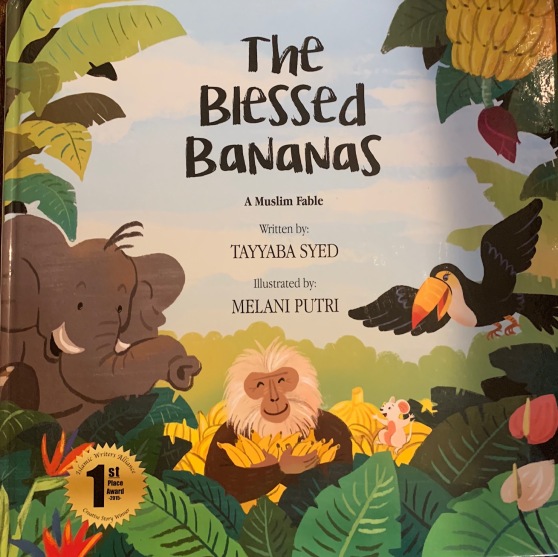
 A fable with lessons of kindness centered around the Salawat, definitely is a great premise and for the most part I really enjoyed the book. 

IMG_1799

The 8.5 by 8.5 hardcover, 50 page book feels great in your hands and the illustrations are sweet and expressive.  The book is long, and is text heavy so I’d say the target audience is maybe 6 to 10 years old.   The font is incredibly small and irritating.   It should have been larger and more inviting to children in my opinion.  It doesn’t match the size, binding, and illustrations, and actually becomes a distraction if trying to read it in a group setting.  

IMG_1801

The story itself is smooth and intentional.  Rico, a blessed, yet ungrateful monkey, lives atop an ever abundant banana tree.  However, he attributes his blessings to his own hands and does not thank Allah swt.  He is mean and greedy toward people and animals alike.  Yet, something is missing in his life and he doesn’t know what. 

IMG_1800

When a little mouse, Chico, comes to him to ask for a banana and gets scolded at instead.  Chico makes dua for Rico asking Allah to guide the monkey to goodness.

IMG_1802

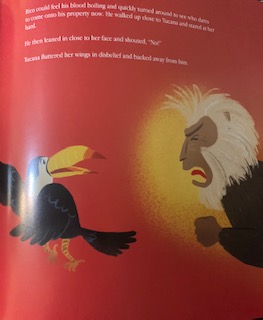
Tucana, a toucan, then stops in Rico’s banana tree after a long flight to be rebuffed by a foul tempered monkey who wants to be left alone.  When Tucana  leaves she forgives Rico for his rudeness and asks Allah to be merciful to him as well.

IMG_1803

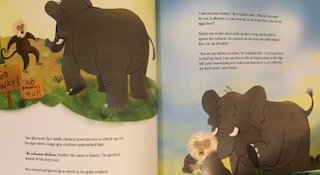
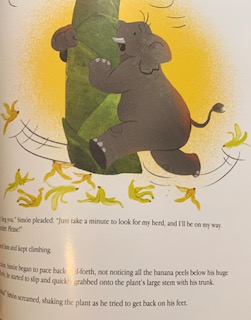
Rico then makes signs to keep people and animals away.  Which works for a while, but along comes Simon, an elephant, one afternoon to ask the monkey to climb his tree and help direct him back to his herd.  Rico of course refuses, and Simon reminds him that they are brothers in Islam and to please help. He begins shouting at the elephant to leave, and as Simon is pacing back and forth, he slips on the banana peels, grabs the tree to support himself and shakes the tree back and forth in the process.

IMG_1806

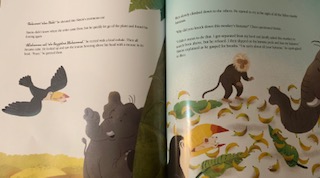
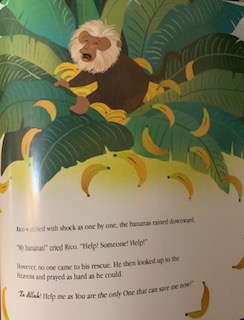
Rico begins hollering for help and sure enough the animals he had turned away previously, return to help him.  They had forgiven him as they hope Allah will forgive us all.  To calm the monkey, chico shouts, “Salawaat’alan Nabi!” in Simon’s ear and when he recites “Allahuma sali’ala Sayyidina Muhammad,” peace and calmness is restored.

IMG_1811 (1)

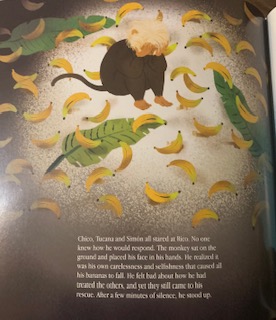
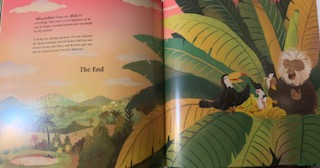
With all the bananas on the floor, many mushy and trampled, Rico has to decide if he learned a lesson, and how he will put his new knowledge into action, or if he will resume his life of ungratefulness.

IMG_1807

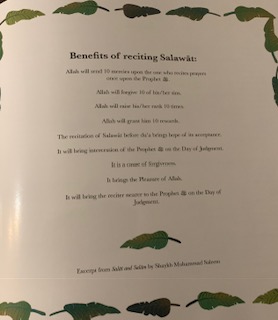
The book ends with each animals favorite banana recipe, information about the author and illustrator and benefits of reciting Salawat and an ayat from the Quran.

IMG_1810

The story and how it weaves Islam into the lessons is beautifully done, my only hiccup is the constant refrain of Rico counting his bananas.  I realize it is a fable, and maybe with talking animals interacting with humans, reality is notably suspended.  But, it seems misplaced to me.  How do you constantly count a perishable item? Does Rico only eat a certain amount a day? How many new ones grow a day? What is the number that he is adamant to have at all times? So, many questions, that I didn’t get why he was counting them, why he was irritated when he lost count, and why this detail was in the story and a big part of the story none-the-less.  Like the font, its a minor detail, but a distracting one for me unfortunately.  Clearly, however, I’m in the minority as the book has won the Moonbeam Children’s Book Award and the Islamic Writer’s Alliance Creative Story, so give it a read, and let me know your thoughts, jazakhAllah kher.

IMG_1809


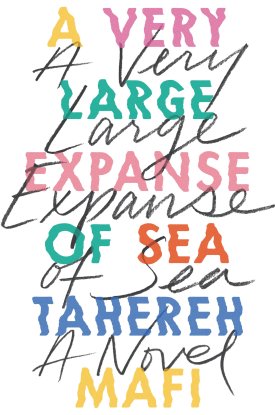
A Very Large Expanse of Sea by Tahereh Mafi

Standard
A Very Large Expanse of Sea by Tahereh Mafi

avleos

The book is often marketed as a Muslim coming of age story in a post 9/11 world.  The contemporary work is semi-autobiographical, but really I think the positioning is a bit misleading.  It’s a love story, and the main character is Muslim, and her environment is awful and she is angry. Its an engaging read, I read all 310 pages in one sitting, but I don’t know that the take-away will enlighten anyone about Islam, or really what it was like to be Muslim in the years after 9/11, I think people will remember how sweet the couple is and wonder how much of it mirrors the author and her husband, author Ransom Riggs (Miss Peregrine’s Peculiar Children), but not suddenly become knowledgable about more than what the main character experiences and endures.   I appreciate that the book challenges the stereotypes of Muslim women, there is authenticity as it comes from a writer who lives it, and I do think it shows evolution of attitudes that teens can benefit from.  The book is not yet in the AR database as it just came out, but I would imagine high school and up.  

SYNOPSIS:

Shirin’s Persian-American family moves a lot.  Her and her older brother are incredibly close as their parents are rather aloof to the day-to-day experiences the kids endure.  That isn’t too say her parents aren’t around, they eat two meals a day together and the parent’s are warm, but Shirin’s brother Navid is a much more present.  The story starts with 16-year-old Shirin starting her 12th new school.  Conditioned to not make eye contact, remember faces, or get affected by the trivialities around her, the reader sees how angry she is as she curses at a teacher that assumes she needs ESL not Honors.  Knowing how fleeting her time in any location can be, as her parents are constantly trying to find better jobs, Shirin doesn’t feel compelled to make friends or get attached to anyone or anything.  This intimidating vibe similarly keeps offers at bay, for the most part.  When she gets paired up with Ocean to dissect a cat, he tries to talk to her, and this throws her off her game.  Most every interaction she experiences at school are people making racist comments and being very one dimensional and bigoted.  Ocean tries to be nice, an attitude so foreign to Shirin that it begins to force her to change.  Simultaneously, Navid, who is charismatic and has no problem finding friends wherever they go, decides to put his and his sister’s dream into action and they start a break dancing club at school.  Three other kids join, and start becoming, not just Navid’s friends, but Shirin’s as well.  

Shirin and Ocean fall in love, despite Shirin fearing what the backlash will be for ocean.  She doesn’t really know anything about him, but feels strongly that all the racial slurs thrown at her on a daily bases will effect him and ultimately make them wish they didn’t pursue a relationship. She draws line after line in the sand, and crosses them all.  Only then does she learn how blind she has been, he is in two of her classes, not just one, he is a year older than her, and he is the golden star of the high school basketball team.  Being that the story is told from Shirin’s perspective, this is surprising to the reader as well.  The town turns on the pair and things get really ugly for Ocean who is willing to risk it all for Shirin.  Threats by the basketball coach, pictures of Shirin without her hijab being taken, accusations of terrorist ties and sympathies all challenge the couple and shape Shirin.

WHY I LIKE IT:

I really like the twist of having the relationship be difficult for the non Muslim, rather than going with the assumed Muslim girl having to sneak around.  Not saying that I support it, but interestingly she never mentions that what she is doing is going against anything religious.  She mentions twice that her parents wouldn’t like her with any guy, and that they view her as a child still, but she doesn’t explore Islamically any boundaries regarding their relationship.  She hides talking on the phone to Ocean, because her parents are adamant she gets enough sleep at night.  That is about it.  Shirin discusses that she wears hijab like an armor that she gets to pick who she shows her hair too.  I love the strength in that, but wish there was a bit of doctrine to back it up too.  At one point a Muslim, non hijabi, at school calls her out for wearing hijab and having a boyfriend, but she essential tells her it is none of her business, which it isn’t and who is to say that one sin is worse than another, but still it befuddles what exactly Shirin believes and why.  The book just paints her as a Persian Muslim, but never explores what that means other than the superficial outward appearance.  They do fast in Ramadan, no explanation about why is given, just that they not eat or drink during daylight hours, and right near the end, Shirin remarks how her mom asks her and her brother every morning if they have prayed and they lie and say yes, their mother sighs and tells them to make sure they pray the afternoon one, to which they lie and agree, only to have their mother sigh again.  AstagfirAllah, that is awful lying, and lying about Salat, but it is so real, I audibly chuckled.  

I like that the parents aren’t harsh, they just seem disinterested.  I didn’t want to read another book about the parent’s being the gatekeepers and bad guys, so that was really refreshing.  They mention they don’t celebrate Christmas, but they have an open door policy on Thanksgiving for any friends wanting to come.  I did hope for a bit more about them, why they don’t talk to the kids about moving, what makes them tick, because really they seem to have a solid relationship with the kids, they are just clueless to their social experiences and school environment stresses.

I love the growth and self reflection of Shirin, she holds a mirror to herself and she and readers are better for it.  She has to realize that she is doing so much of what she is accusing others of doing.  I love the support and genuine concern of the breakdancers and her brother.  It resonated to me as a girl with an older brother and the relationship feels very genuine. I just wanted to know more about Navid. 

FLAGS:

There is a lot of cursing. kissing, hand holding, romance, lying, and ditching school.  There is a brief mention of graffiti being sprayed.  There is racial slurs, threats of violence, violent physical outbursts by people of authority.  When a student throws a cinnamon roll at Shirin, Navid and his friends beat the kid up severely, it isn’t detailed, but it is mentioned.  Ocean  also gets suspended for a few games for a fight he engages in, and there is some detail of Shirin getting jumped in a previous city for wearing hijab.

TOOLS FOR LEADING THE DISCUSSION:

I don’t think I could in good conscience present this to a group of Muslim students.  I wouldn’t want them to think I was endorsing the violence and language and romance.  Like so many books of the genre though, if someone found it and read it on their own, I’d love to chat with them about it, as it is well written.

Youtube video about the book by the author: https://www.hypable.com/tahereh-mafi-a-very-large-expanse-of-sea-tour/

Iqbal and His Ingenious Idea: How a Science Project Helps One Family and the Planet by Elizabeth Suneby and Rebecca Green

Standard
Iqbal and His Ingenious Idea: How a Science Project Helps One Family and the Planet by Elizabeth Suneby and Rebecca Green

iqbal

It is a bit odd that this story is fiction, when it reads so much like a piece of nonfiction.  It is a picture book, but has an AR level of 4th grade 4th month.  So, while the story is great and highlights a country and culture, Bangladesh, not often seen, I don’t know that this book would appeal to many kids.  The kids that it does appeal to though and that can find it in a library or bookstore (not sure where it would be shelved), I think will not just like it, but possibly find it both inspiring and worth reading again and again.

IMG_2086

It is monsoon season in Bangladesh and the rains make Iqbal’s mom have to cook indoors.  As a result, she and the baby, Rupa are constantly coughing from breathing all the smoke from the woodburning stove.  Iqbal’s father mentions a propane stove he saw in the market, but the family cannot afford it, despite wishing that they could. 

Iqbal’s school has just announced the School Science Fair and the winners get cash prizes, if Iqbal can win, maybe he can buy his family the new stove.  His little sister Sadia offers her services to help him win and be his assistant.

IMG_2087

After a lot of thinking, pondering, and dreaming, Iqbal decides on the perfect project: a stove that didn’t produce smoke.

With the help of his teacher at school to find ideas and articles and plans on the internet, Iqbal and his sister build a solar cooker with foil and an old umbrella. 

IMG_2088

The science fair is a success, Iqbal wins, the family buys the stove and propane with the winnings, and when it isn’t raining, the family is able to use the solar stove Iqbal and Sadia built.

The book draws on ideas of sustainability, pollution, economic viability, problem solving, and education.  The culture provides the backdrop making all of these issues relevant and real, and mentioning Ramadan, Eid, and prayer provides some depth to the characters and adds to their culture.

IMG_2089

A lot of reviews online criticize that the mom is cooking and that the kids test an egg on the solar cooker and call her to eat it if it is supposed to be Ramadan, but I personally promise you, during Ramadan, we are always cooking.  And if she is nursing the baby, the mom wouldn’t be required to fast, there’s a lot of other reason she couldn’t/wouldn’t be fasting, but really, it is such a small portion mentioned in passing, no detail needs to be given, and it didn’t bother me at all.

Another complaint about the book is that if money is so tight the kids wouldn’t be at a school where they can just make copies, and buy eggs on their own.  I think there is some truth to this, but maybe a wealthy doner funds the school.  I think you could argue it either way.  I don’t know that the family is poor, it is the overall society, so kids could have pocket money, a propane stove is probably imported at least from a larger city so the expense would be more, similarily the infustruction of electricity and gas lines could hint more at why they cook the way they do.  Needless to say the family is smiling in the pictures, they have food, and they seem to be doing ok.  So the fact that the school printed a few articles and the kids bought some eggs without asking permission, didn’t bother me greatly.

IMG_2090

The illustrations are expressive and show the family connections and emotions.  I like that they bring to life a country many wouldn’t know, even if I wish it weren’t a work of fiction, but based on some child actually there.  

The end of the book has information about clean cookstoves, how to build one yourself, and a glossary.  The large 9×12 hardbound book would hold up well to multiple readings, and the amount of text on the pages would work well as a read-a-loud to younger kids who would find the subject matter interesting.  

IMG_2091


She Wore Red Trainers by Nai’ma B. Robert

Standard
She Wore Red Trainers by Nai’ma B. Robert

red.gif

After having fairly good luck with the Muslim YA Romance Novel Genre in An Acquaintance and Saints and Misfits, I was willing to give She Wore Red Trainers a try.  Na’ima B. Robert has written a lot of books and this 261 page book was an easy and entertaining read.  There are no plot twists, deep thoughts, or intense drama, its a light read that infuses religion and environment into a story that will be great for 14-16 year olds that have slim pickings of relevant, Islamic, “halal” fiction options.

SYNOPSIS:

The story is told from two 18-year-olds’ perspectives, Ali and Amirah. It goes back and forth and while the perspective is obvious, the bottom of the page identifies the character so there is no chance for confusion.

Ali has begrudgingly moved to London with his brothers and father.  Not very religious before his mother’s death, he and his father and younger brother have made a new start and commitment to Islam since losing her to cancer.  The middle brother, resists this, but isn’t too critical in the story, other than to add a voice to the concept that people have to come to Islam on their own, that the relationship between a person and Allah is not cookie cutter or often simple. 

Amira too has a past and a lot on her plate as she strives to balance her chaotic family life and moving past decisions of her rebellious self.  The two meet and in the brief second before gazes are lowered, they fall in love.  Ok, so it isn’t that cliche’ but it is close.

The two, as the dedication of the book states, “are striving to keep it halal.”  They have a few encounters and the sparks are there, but they both have their own stories and supporting cast of friends as well. It isn’t until the very end, SPOILER, they get married.

Yup. impromptu wedding of 18 year olds.  It isn’t out of left field though, there are passages that contemplate the Islamic merits of a young marriage, and perhaps that is the depth of the book, as far as giving the reader something to think about. That and choosing Islam and actively living it.

WHY I LIKE IT:

The stuff that makes the book interesting, isn’t really even the two love birds, it is the context.  The struggle of Amirah’s complex family situation with a mom that has had multiple husbands, and is suffering from depression.  Amirah also has a creepy stepdad (makes her uncomfortable and seems to make sexual advances toward her) and a sketchy past that isn’t really articulated but is hinted at enough to know that she did rebel briefly by running away and experimented with drugs and alcohol before realizing it wasn’t the life she wanted.  She takes tremendous care of her younger siblings, one who is deaf, and respects her older brother tremendously.  Her friends are not overly developed but provide enough diversity that the reader will see themselves in someone even if just fleetingly.

Similarly Ali is fleshed out by the company he keeps.  He has very religiously devout friends, a few rebellious ones and countless opportunities to define who he is.  His home life is a little chaotic, but they’ve gone through the destruction and are in the rebuilding phase. 

I like that the characters are fallible and represent a wide spectrum of religiosity.  The book isn’t political, nor does it discuss culture really, but it is meant for Muslim readers.  The characters throw in Arabic terms and while there is a glossary at the back, the religious rules, the contemplation of hadith and ayats, understanding Islamic divorce and the stress to be well established before marriage make it a book for those that can relate.  I love that part of keeping it halal is that they don’t talk and text.  I know that makes it a bit unbelievable, but I like that the line is drawn and established.

I wish that the past of many of the characters was clearer.  Not overly sensationalized, but a tiny bit more.  I wanted more information on what Ali’s dad’s new job was, and how far away they would be moving.  I wanted to know how Amira’s family would manage without her and the creepy stepdad, would the mom be able to step up and care for her kids.  I wanted more details about Amira’s family in general and why her older brother had to leave his studies permanently in Saudi Arabia, and wasn’t able to just delay graduation.  

I can’t criticize the writing too much because I did read the book in one sitting and it kept my interest.  I didn’t expect it to be deep or thought provoking, so for a light summer read, it was good enough.  I felt like the ending was a bit rushed, and yes there are some far fetched ideas, but I think it’s a romance novel, halal or not, so yeah, there are going to be some places that forgiveness is needed.

FLAGS:

There is mention of hooking up, drug and alcohol use, virginity, and a creepy sexual predator in the stepdad. It isn’t appropriate for middle school, but not so vulgar that one would need to be 18 to read.  I think high schoolers won’t find it too cheesy, and not be shocked by the content either.  Granted it depends on the reader. but I think it is better to be safe than sorry.

TOOLS FOR LEADING THE DISCUSSION:

I would consider the book for a high school book club. Might have to get parental permission, but I think it works well to consider how to have it all so to speak.  How to live within Islam and be smart about your choices.  The book doesn’t offer a lot to think about and mull over, but if you were a teenager, I would imagine that the book presents a lot of what you are feeling.  There is a lot to relate to in the friends, the deen, the emotions, and the temptations.  It also shows that just because families are Muslim, doesn’t mean that they are not complicated and troubled, a scenario that many would find reassuring at least superficially in the book.

Interview with the Author: http://www.kubepublishing.com/an-interview-with-naima-b-robert-about-her-forthcoming-book-she-wore-red-trainers/

Peg + Cat: The Eid al-Adha Adventure by Jennifer Oxley and Billy Aronson

Standard
Peg + Cat: The Eid al-Adha Adventure by Jennifer Oxley and Billy Aronson

peg.jpg

Easily the most anticipated Eid al-Adha book to come out this year, the book does not disappoint.  Following the episode, the book, is 32 pages and while ok for ages 3 and up, like the show, it really is geared to children able to grasp the math concepts presented.

The book’s story is that it is Eid al-Adha, and Peg and Cat are learning about it with their friends Yasmina and Amir. The holiday facts don’t seem forced and words like hijab. oud, and Eid Mubarak, are integrated naturally.  The concept of giving charity, giving to those with LESS, becomes the set-up for learning about more than, and less than. 

peg4

A few pages later the tradition of dividing meat into three parts: one to keep, one for friends, and one for the poor, sets up a lesson on fractions and using a pan balance.  The really big problem, involves moving crates.  They count down from seven to calm down, and then use all their lessons learned to solve the problem and help a neighbor.

peg5.jpg

The illustrations are straight from the show in all their adorable glory, I’m not sure why Yasmina has some strange tree branch looking loose hairs poking out of the top of her scarf.  I love that the page numbers are math problems (2 +1=3 for the 3rd page).  And the hardback with slip cover workpages on the underneath side, are a nice treat.  I was especially greatful the picture on the slip cover is the same as on the book, so the cover can be discarded, as will ultimately occur with multiple readings.

peg2

Books like this are great ways to introduce an Islamic tradition to non Muslims in a non preachy, non threatening way.  By seeing beloved characters with Muslim friends helps shape perceptions and increase understanding, inshaAllah everyone wins, alhumdulillah.

No Ordinary Day by George Green

Standard
No Ordinary Day by George Green

no ordinary day.jpg

I was really, really excited to get this book in my hands.  An early chapter book, about Islam and sports, with diverse characters, that seemed to be the start of a series featuring the “Childhood Champions,” seemed to have the potential to fill a gaping void in Islamic fiction.  And while the book shows promise and has a lot going for it, it falls short of what it could be, and perhaps with the ever growing book options, what it should be. 

To be clear the Islamic lessons and values are on point as are the pictures, it is the holes in the story, the random text layout inside and the lack of depth that keep this book from reaching its full potential.

SYNOPSIS:

Ibrahim normally needs help to get up for school on Mondays, but not on this day. On this day they were promised a surprise at school and Ibrahim can’t wait to see what it is.  When the 8-year-old gets to school he and his friends are delighted to meet Hakeem Muhammad a soccer star on the California Spartan’s Team in town to play against the local Harlem Knights.  To win one of the five tickets that he is giving away the students have to recite some ayats from Juz Amma and tell why it is important that they study the Quran.  Ibrahim goes first, and we don’t know what he recites, but he says that studying Quran makes him feel happy and inspired.  Which to me didn’t really meet the criteria of the competition.  The next student is also a member of the “Childhood Champions,” but we know nothing about Jannah, other than the one page bio at the beginning of the book.  Jannah recites some mystery ayats and says that knowing the meaning helps her with reciting, a bit more of an appropriate answer, but still kind of not fulfilling the question in my opinion.

ordinary1

All five kids in the crew win tickets for them and their families for the game that night.  A limo picks them up and they get to meet Hakeem in the locker room.  When they arrive  he is praying, so they wait, say salam, chat, and then are shown to the VIP box.  The game is close, Hakeem scores the winning goal for the Spartans and the kids go home happy. No real problem or solution, the climax is just the game.

WHY I LIKE IT:

I love that the font was chosen to help kids with dyslexia and the full color internal pictures are a nice plus.  I don’t understand how it was determined how much text is on a page, as it is so varied and inconsistent, that it seems like a draft rather than a final copy.

I love that this book is about Muslims and for Muslims, the star athlete prays, and connects with Allah swt, and is proud of it.  His praying before the game is not weird to his teammates, which is awesome for kids to see.  The conversation after his salat with the kids is also pretty powerful, but the setup is incredibly awkward. Yasin won a ticket for reciting Quran, so why the answer about why he is praying before the game started with explaining that he prays five times a day, seems jarring to the flow of the book and story.  I liked the insight about praying and being grateful whether they win or lose, but the catalyst for the exchange was really forced.   Loved that Hakeem made sajood when he scored and that Ibrahim was asking Allah for help.

I wish the ayats the kids recited would have been shared.  I think the book is for muslim kids, so it would have helped if they really inspired something tangible that the readers could relate to.  The book is very bland and it could be much more memorable.  I’ve read the book three times, and couldn’t tell you any of the students names.  I had to look back to write this review.


I’m not a soccer expert, but I think the winning goal would have been called back for offsides, I’m hoping I’m mistaken.  The breaking a world record for loudest fans seemed a stretch, but kids 6-8 probably would be bothered by it or find it out of place.  The book says it is for ages 6-12, but I can’t see kids 12 years old getting much out of this 40 page book.  

FLAGS:

None the book is completely clean.

TOOLS FOR LEADING THE DISCUSSION:

The book wouldn’t work for a book club selection, but I would probably have it in a school library for kids transitioning to chapter books, and in a classroom for excitement and novelty.  There isn’t anything “wrong” with the book, it just needs a good editor and a little more.  It really is almost there.

https://www.launchgood.com/project/childhood_champions__no_ordinary_day_a_book_for_muslim_children#!/