Tag Archives: Muslim Characters

Peg + Cat: The Eid al-Adha Adventure by Jennifer Oxley and Billy Aronson

Standard
Peg + Cat: The Eid al-Adha Adventure by Jennifer Oxley and Billy Aronson

peg.jpg

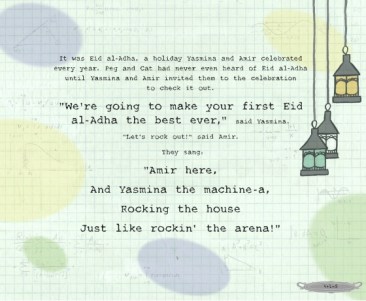
Easily the most anticipated Eid al-Adha book to come out this year, the book does not disappoint.  Following the episode, the book, is 32 pages and while ok for ages 3 and up, like the show, it really is geared to children able to grasp the math concepts presented.

The book’s story is that it is Eid al-Adha, and Peg and Cat are learning about it with their friends Yasmina and Amir. The holiday facts don’t seem forced and words like hijab. oud, and Eid Mubarak, are integrated naturally.  The concept of giving charity, giving to those with LESS, becomes the set-up for learning about more than, and less than. 

peg4

A few pages later the tradition of dividing meat into three parts: one to keep, one for friends, and one for the poor, sets up a lesson on fractions and using a pan balance.  The really big problem, involves moving crates.  They count down from seven to calm down, and then use all their lessons learned to solve the problem and help a neighbor.

peg5.jpg

The illustrations are straight from the show in all their adorable glory, I’m not sure why Yasmina has some strange tree branch looking loose hairs poking out of the top of her scarf.  I love that the page numbers are math problems (2 +1=3 for the 3rd page).  And the hardback with slip cover workpages on the underneath side, are a nice treat.  I was especially greatful the picture on the slip cover is the same as on the book, so the cover can be discarded, as will ultimately occur with multiple readings.

peg2

Books like this are great ways to introduce an Islamic tradition to non Muslims in a non preachy, non threatening way.  By seeing beloved characters with Muslim friends helps shape perceptions and increase understanding, inshaAllah everyone wins, alhumdulillah.

No Ordinary Day by George Green

Standard
No Ordinary Day by George Green

no ordinary day.jpg

I was really, really excited to get this book in my hands.  An early chapter book, about Islam and sports, with diverse characters, that seemed to be the start of a series featuring the “Childhood Champions,” seemed to have the potential to fill a gaping void in Islamic fiction.  And while the book shows promise and has a lot going for it, it falls short of what it could be, and perhaps with the ever growing book options, what it should be. 

To be clear the Islamic lessons and values are on point as are the pictures, it is the holes in the story, the random text layout inside and the lack of depth that keep this book from reaching its full potential.

SYNOPSIS:

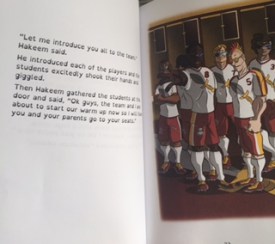
Ibrahim normally needs help to get up for school on Mondays, but not on this day. On this day they were promised a surprise at school and Ibrahim can’t wait to see what it is.  When the 8-year-old gets to school he and his friends are delighted to meet Hakeem Muhammad a soccer star on the California Spartan’s Team in town to play against the local Harlem Knights.  To win one of the five tickets that he is giving away the students have to recite some ayats from Juz Amma and tell why it is important that they study the Quran.  Ibrahim goes first, and we don’t know what he recites, but he says that studying Quran makes him feel happy and inspired.  Which to me didn’t really meet the criteria of the competition.  The next student is also a member of the “Childhood Champions,” but we know nothing about Jannah, other than the one page bio at the beginning of the book.  Jannah recites some mystery ayats and says that knowing the meaning helps her with reciting, a bit more of an appropriate answer, but still kind of not fulfilling the question in my opinion.

ordinary1

All five kids in the crew win tickets for them and their families for the game that night.  A limo picks them up and they get to meet Hakeem in the locker room.  When they arrive  he is praying, so they wait, say salam, chat, and then are shown to the VIP box.  The game is close, Hakeem scores the winning goal for the Spartans and the kids go home happy. No real problem or solution, the climax is just the game.

WHY I LIKE IT:

I love that the font was chosen to help kids with dyslexia and the full color internal pictures are a nice plus.  I don’t understand how it was determined how much text is on a page, as it is so varied and inconsistent, that it seems like a draft rather than a final copy.

I love that this book is about Muslims and for Muslims, the star athlete prays, and connects with Allah swt, and is proud of it.  His praying before the game is not weird to his teammates, which is awesome for kids to see.  The conversation after his salat with the kids is also pretty powerful, but the setup is incredibly awkward. Yasin won a ticket for reciting Quran, so why the answer about why he is praying before the game started with explaining that he prays five times a day, seems jarring to the flow of the book and story.  I liked the insight about praying and being grateful whether they win or lose, but the catalyst for the exchange was really forced.   Loved that Hakeem made sajood when he scored and that Ibrahim was asking Allah for help.

I wish the ayats the kids recited would have been shared.  I think the book is for muslim kids, so it would have helped if they really inspired something tangible that the readers could relate to.  The book is very bland and it could be much more memorable.  I’ve read the book three times, and couldn’t tell you any of the students names.  I had to look back to write this review.


I’m not a soccer expert, but I think the winning goal would have been called back for offsides, I’m hoping I’m mistaken.  The breaking a world record for loudest fans seemed a stretch, but kids 6-8 probably would be bothered by it or find it out of place.  The book says it is for ages 6-12, but I can’t see kids 12 years old getting much out of this 40 page book.  

FLAGS:

None the book is completely clean.

TOOLS FOR LEADING THE DISCUSSION:

The book wouldn’t work for a book club selection, but I would probably have it in a school library for kids transitioning to chapter books, and in a classroom for excitement and novelty.  There isn’t anything “wrong” with the book, it just needs a good editor and a little more.  It really is almost there.

https://www.launchgood.com/project/childhood_champions__no_ordinary_day_a_book_for_muslim_children#!/


Controlling Your Anger by Saaliha & Ali

Standard
Controlling Your Anger by Saaliha & Ali

anger cover

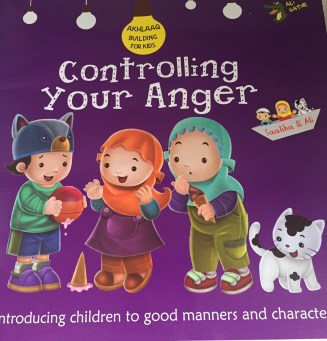
I love little picture books for toddlers and early elementary kids that introduce children to Akhlaaq, good manners and characters.  The book’s tone, however, seemed a bit off to me, so I put it away a month ago and pulled it out again today to read it, knowing I would have forgotten most of my initial thoughts, but somehow, they resurfaced with a vengeance, unfortunately.  And while the pictures and binding and theme are all absolutely wonderful in this 23 page book, I didn’t like the main character at all, and being it is based on a real person, a child, I feel awful saying that.

anger

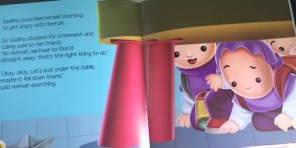
Saaliha starts the book keeping her anger just under the surface as her friend Hannah has borrowed and lost her pencil.  Hannah says she’ll look for it after lunch, and Saaliha controls her anger and basically says that it needs to be found now because it is the right thing to do.  All of that is fine, but for some reason she seems bossy and controlling and I really don’t know why.  Maybe because once they look for the pencil and then find it, Saaliha gives her peer (and thus the reader) a teaching moment by saying that she knew she didn’t lose it on purpose.  Hannah’s response is more believable when she feels embarrassed and admits she should be more careful, but I found Saaliha’s reaction smug because she was so close to getting mad, and then to be self-righteous about it, seemed a little passive aggressive to me.  

anger3

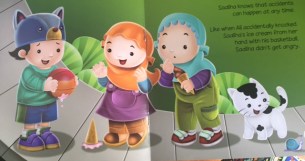
As the book continues, Saaliha recounts that accidents can happen at any time and to not get mad, which is great, it gives the example of when her younger brother Ali, accidentally knocked her ice cream out of her hand with his basketball or when he broke her pencil.   She seems to have a thing with pencils, there should have been a different example.

anger2

It then moves on to an incident with a friend, Jalal, who took a donut without asking, but it was an accident for not asking as he normally asks.  The repetition of the word accident here, I get is to carry the concept, but that doesn’t seem like an accident, it seems like he forgot, and an apology should have been in order, not Saaliha having to justify it solely.  Being it is a book about Akhlaaq I feel like the illustration of Jalal winking and eating the donut, seemed off.  

anger1

I like that Saaliha reminds her friends not to get angry as anger comes from Shaitan, but then when the book says she always says A’uthu Billahi Mina Shaitan Nir Rajeem to keep her anger in check, one wonders why in the opening scenario she didn’t say it.

I can’t pinpoint why I didn’t love this book, or maybe I just didn’t like the main character and I would probably give the series another try, but I’d like to hear your thoughts if you have read the book, and more importantly what your children thought of it.


Mikaeel and Malaika: The Quest for Love

Standard
Mikaeel and Malaika: The Quest for Love

mikaeel.jpg

The beautiful hardback book is pricey, but fun.  I didn’t have any expectations when I read it, but now that I’ve read it three times and had my children read it, and my mom a reading specialist/teacher of 45 years read it, I feel pretty confident in saying, its a well-done book.  I think it can get a bit cumbersome when reading aloud, because some lines rhyme and some don’t, but on the third read through I read it to six kids ages two to nine and all throughly enjoyed it.

maandm

The sibling superhero duo are on a quest to find out how to have a pure heart.  They try praying aloud, praying quietly, then they go and talk to the Big Boss, their dad, who speaks in rhyming clues.  The play on words might make the book utterly confusing to children younger than five, or kids of all ages if full attention isn’t being given when read aloud.  For independent readers, they will delight in the words that sound the same yet have completely independent meanings.

mandm2

Eventually their quest also takes them to Agent M.O.M who loves them more than anyone else they can imagine, but the big reveal is that Allah (swt) loves us even more.  I don’t know that it is crystal clear that getting a pure heart involves loving the one who loves us most. But, I think by the end, the readers are just entertained that they figured out Allah loves them more than anyone else in the world and is the creator of us all.  The last page has an ayat from Surah Rehman, ” So which of the favors of your Lord would you deny?” Which again adds one more thing to the story about being grateful for all that Allah has given us, keeping it from being a completely streamlined story, but adding to the overall love and appreciation for Allah.

mandm1

The illustrations are absolutely beautiful and engaging, the amount of text and the font is perfect for ages 6-8 and the messages is fun and educational.  I hope that there are more in the series, alhumdulillah.


Eid by Maria Migo

Standard
Eid by Maria Migo

eid cover

This linear story works great for toddlers that might not remember what a typical eid day is like, or those that do well to know what to expect.  There isn’t a ton of detail, but each page has a sentence or two that move the story from spotting the moon, to putting on new clothes, going for prayers, opening presents, and falling asleep at the end of the day dreaming of next year.

eid4

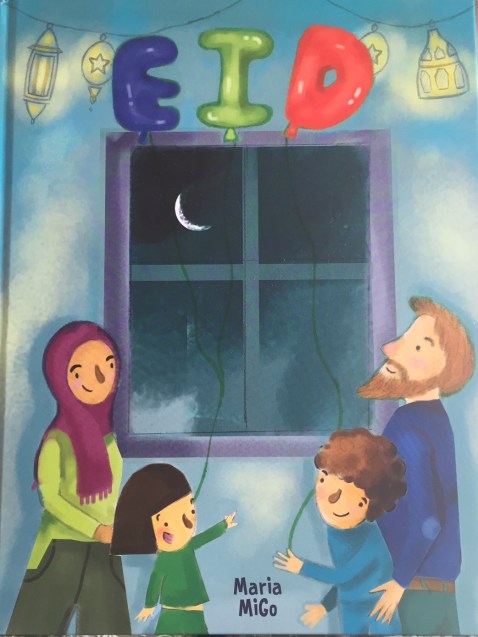
The gentle pictures convey that Eid is a time of family and love, but don’t necessarily convey that chaos and excitement of the day.  The kids are smiling, as are their parents, and the interaction is playful and safe.  I feel like this book is really ideal for kids with anxiety or that need some reassurance when their daily schedule is altered.  For kindergarten kids and older for the most part, I think they might find the book a glorified timeline list.  After one reading, I’m sure they will not ask for another nor remember much from the 32 page book.

IMG_0478

As seems to be the unwritten rule for books like this, the story is framed through a brother sister duo, however the simplicity of the text doesn’t name them, nor give them any role other then to show what an Eid day is like.  

FullSizeRender (100)

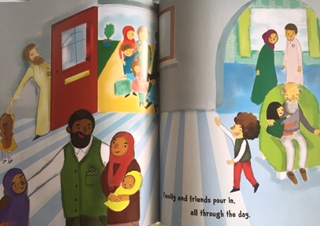
I like that they do go to the mosque and that it remarks that it is a little squished.  I also like that it mentions Eid is in summer, and implies that it isn’t always, something that could be discussed with older readers.  It doesn’t clarify if it is Eid al Fitr or Eid al Adha, so it would work for both.  The hard back binding and size are beautiful and ideal for story time and bedtime.  

FullSizeRender (99)

It isn’t my favorite book, but there is nothing wrong with it.  The Muslim Children’s Books publisher seems to have changed the cover, I’m not sure if anything else has changed.  The book would be a great addition to a book shelf, or in an Eid basket, but I don’t know that it has the wow-power to be a great stand alone gift or book to generate excitement for the blessed holiday.  


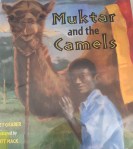
Muktar and the Camels by Janet Graber illustrated by Scott Mack

Standard
Muktar and the Camels by Janet Graber illustrated by Scott Mack

FullSizeRender (39)

On the border of Somalia and Kenya, there isn’t a library, or a book mobile, there is a traveling camel library! While the main character is more excited about the camels, at least his friend is excited about the books in this AR 3.2 story.

Muktar is an orphan who dreams of his life before his parents were killed as a nomad tending to their camels.  Their teacher, Mr. Hassan calls him lazy as he dreams of the camels he misses, but one day, a librarian from Garissa comes on camel to bring books to the orphanage, and while Ismail and the other kids are excited for the books, Muktar is drawn to the desert beasts.  Muktar notices that one of the three camels is injured and recalling the root to help sooth the ailment, he tears his shirt, treats the wound, and covers it.  When seeing his abilities, the librarian, Mr. Mohamed asks him to come with him to tend the camels as they travel with books through the desert.

muktar insideThe story definitely makes readers appreciate the life they have, and realize how simple and harsh others’ lives can be.  I like the mention of the foods, giving insight into the culture, but I didn’t like the harshness of the adults.  The calling the boys lazy, not taking Muktar food as he tends the camels, not being concerned about the injured camel until Muktar insists he notices, all made me a bit sad.  Yes I was glad that Muktar was able to resume a nomadic life with camels, but he wasn’t given a say in it.  And sure I’m glad that his friend Ismail will get books and be able to work toward being a teacher, but somehow it wasn’t a warm book, and I can’t quite identify why.

The pictures, however, are warm and detailed in the present, with Muktar’s memories being more hazy and muted.  There isn’t any mention of religion, but being the characters are Somali and their names being what they are you can assume they are Muslim. There is a short author’s note at the end that tells about the war causing the nomads to become orphans and the library service that works to share books.

FullSizeRender (38)

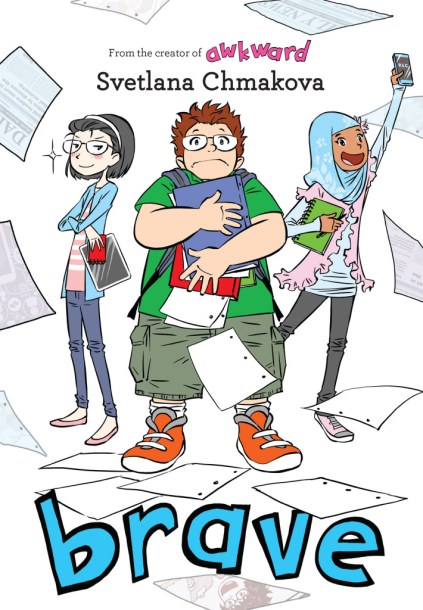
Brave by Svetlana Chmakova

Standard
Brave by Svetlana Chmakova

bravecover.jpg

Often these days, minority groups are feeling more and more marginalized in a blaring world that is increasingly divisive and polarized.  So to see a book in my child’s Scholastic Magazine with a muhajaba on the cover, and not a main character, in a book about bullying, where she isn’t the instigator or recipient, made my minority heart swell with hope.  This 238 page graphic novel (AR 2.8) is a quick, quick read for middle schoolers, and one with a good message, that is more self empowering than preachy.  A companion book to Awkward (which I haven’t read, but hope to soon), the author takes us into Middle School through the eyes of Jensen, a kid who is struggling to find his place and escapes into his daydreams to conquer every day stresses.


SYNOPSIS:

Jensen wants to be a NASA scientist, but he isn’t good at math.  He loves to draw, but the Art Club is consumed with an upcoming event he knows nothing about, he is harassed by two bullies every chance they get, and occasionally he is asked by the newspaper staff to do menial work.  Yet, somehow despite having no friends, and a constant barrage of things going against him, he doesn’t see himself as a victim or as the recipient of bullying.  Rather, he falls into regular day dreams where he is the main character in a video game and all these battles have to be overcome to reach the end.  The surrounding characters have their own little stories, and you get to know a bit about them through Jensen, but the author doesn’t let any of them be painted with a singular stroke.  You see the athletes, being kind and sticking up for kids getting picked on, one being a math wiz.  The journalism staff of Jenny, Akila, and Felipe, run the school, but have their own stresses and internal struggles.  The circle of activity comes to a head when a student is expelled over the dress code, and all the various groups in Jensen’s world have to come together to make change.  In the process he realizes that he is being bullied, and that something needs to be done.  He also realizes nobody has it all together and he has a part to do to help others as well.

WHY I LIKE IT:

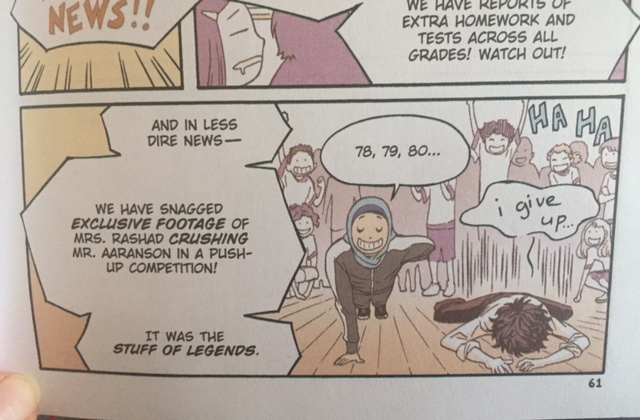
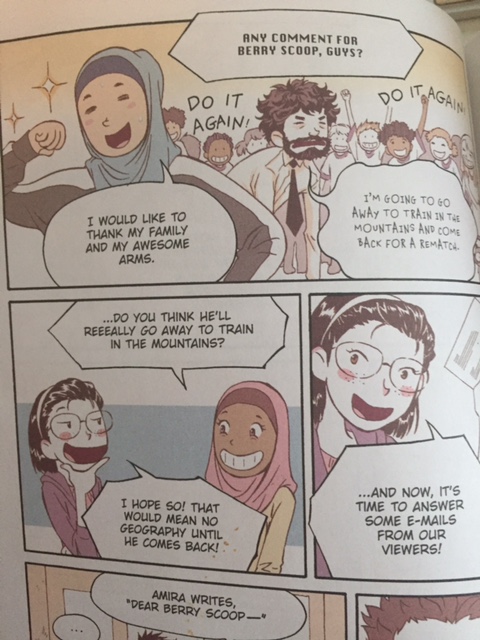
First I like it because there are Muslims in the book, that are just characters in the book.  They don’t represent all Muslims, they aren’t “different” or “other.”  Akila wants to be a journalist and she is smart, and she is kind, but she fights with her best friend, the bossy Jenny, and it is Jensen that has to help them see their errors.  I also like that the P.E. teacher, Mrs. Rashad, is a hijab wearing Muslim, that beats the social studies teacher in push-ups. I mean what an amazing way to break a hundred stereotypes, by not mentioning them, and just showing them as normal. A muslim woman, working, being physical fabulous, and being modest, ya we need more of this. There is no mention of their religion, their clothing, their hijabs, nothing.

FullSizeRender (27)FullSizeRender (28)

I also like that the students in some cases didn’t realize that they were bullying.  I think this happens a lot, where maybe someone won’t let you sit by them because they are saving a seat for someone else, but the second or third time it happens, the recipient feels alienated, where the aggressor may not even be aware.  The book explores lots of ways of bullying, but because it is filtered through the character, it leaves a lot of room for discussion about how people treat us, and how we treat others, and where a lot of pain can come from the misinterpretation on both ends.

There is a lot of diversity in the book, boys, girls, skin tones, body sizes, physical abilities, handicaps, intelligence, etc. that come up to varying degrees, but do at least offer the readers real ways to see themselves in the pages.  The book has a very tidy, happily ever after feel, which is ok I think for middle school. The book has a specific audience. Elementary will just find everyone mean, high schoolers will find it childish, but as social relationships get more challenging in middle school, I think this demographic will often have to find the courage to be brave to get through unscathed.

FLAGS:

None. One character has a boyfriend, maybe. But it is clean with pretty much everything, it even says for All Ages ont he back.

TOOLS FOR LEADING THE DISCUSSION:

I would love to do this as a book club book.  I don’t think it would need any prompting or guides. My 6th grade daughter said it was “ok” yet has brought it up at least ten times since she read it, and has come and sat by me to watch me read it.  I think, she has had some similar issues and to be able to talk about them through the characters, has been liberating for her, and furthered my conviction that fiction has power.

The Author’s website: https://svetlania.com/


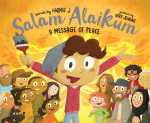
Salam Alaikum: A Message of Peace by Harris J illustrated by Ward Jenkins

Standard
Salam Alaikum: A Message of Peace by Harris J illustrated by Ward Jenkins

salam alaikum.jpg

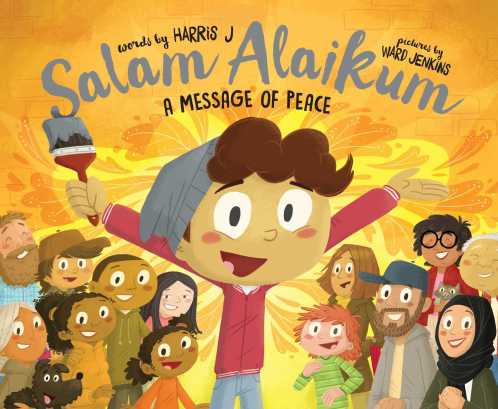
Harris J’s song by the same name gets stuck in my head because it seems like “Salam Alaikum,” is the only words in the song, so when I heard that he had written a book based on the lyrics, I was a little skeptical. But, total credit to the illustrator, the book is adorable, and the lyrics aren’t too bad either.

salam1

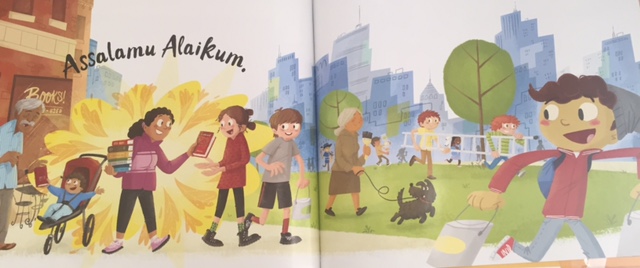
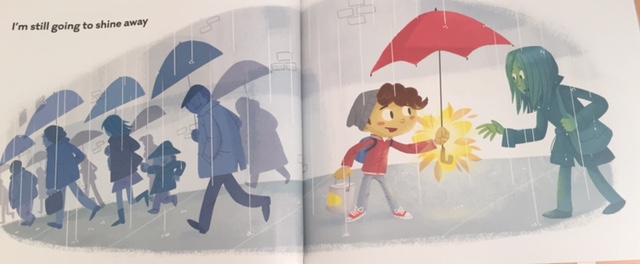
Thirty big pages, that radiate with light and happy faces and a big clear font that celebrates peace, love, and coming together.  The words “Salam Alaikum”  is a Muslim greeting, but there is nothing overtly religious. There is one muhajaba that appears on a few pages, but with the content matter, there is a lot of diversity in the book.  A variety of skin tones, ages, clothing, genders, sizes, all come together to hold hands and work for peace.

salam2

The content isn’t ground breaking, but the number of words on the page are good for 3-6 year olds.  And it does introduce that the world is more fun when we all work together and are kind.  Kids will like the illustrations and return for them undoubtedly.  It is hard to know if the books these days are truly better, or are just done better.  But, while I checked this one out from the library, I think I just might want a copy of my own.

salam3


I Will Not Clean My Room by Saharish Arshad illustrated by Elsa Estrada

Standard
I Will Not Clean My Room by Saharish Arshad illustrated by Elsa Estrada

FullSizeRender (22)

What a great premise for a children’s book, a little boy, Musa,  does not want to clean his room, and imagines all the better things he will get to do in Jannah (heaven) instead. Luckily for his room, his sister comes to help him tidy it up, as well as his mom and dad.  FullSizeRender (25)

The rhyme scheme and the kids’ imaginations at how wonderful Jannah will be, go hand in hand and make the book silly and fun.  The cartoonish illustrations also help sneak in messages of listening to your parents, cleaning your room, being kind to your siblings, helping each other, and ultimately doing things even if they are hard or boring to please Allah swt.  

FullSizeRender (24)

The book is a 28 page, 8×8, paperback.  The price is a little steep, $12, for its structure, in my opinion and is meant for Muslim readers.  The only real issue I had is when the mom threatens to flounce Musa. “Stop jumping and bouncing, or you’ll get a flouncing,”  seems excessive to me, and not consistent with how loving the family is throughout the rest of the book. It was probably included to maintain the rhyme scheme, but I took it to be a threat of violence, which I’m not ok with.

FullSizeRender (26)

The pictures show the mom in hijab, the word Jannah instead of heaven is used, the characters’ names are Islamic and Allah is mentioned throughout.  Musa’s thoughts on the last page are particularly sweet (see picture below).  I plan to read this to a group of kids at story time and will just omit the flouncing line, as it does well in appealing to ages 4 and up.  Three year olds may not understand it, but because of the rhyming, I think they will be equally entertained.

FullSizeRender (23)

A Little Tree Goes for Hajj by Eman Salem

Standard
A Little Tree Goes for Hajj by Eman Salem

little tree

A friend loaned me this book with a bit of hesitation as to its quality, and although I needed one more Hajj book for an upcoming story time, it seemed that it was yet another book about the steps for Hajj, so I wasn’t stressing about acquiring it. Luckily we were both wrong, at least from my perspective.  The book is so sweet, and not so much about the steps and details of Hajj, but more about the longing to go.  To seal the sweetness deal, it is about the friendship between a man, and a tree, and perfect for 3 year olds and up.

tree1`

The little tree dreams of traveling, but more than anything he dreams of going to see the Ka’aba.  Noting the logistical struggles of travel with roots, his mother encourages him to make duaa for his heart’s desires.  After a lot of patience and a lot of duaas, (alhumdulillah, it shows duaas take time and are not a magical instant granting of a wish) a young man walks by on his way to the coast to catch a boat for Mecca.  Startled by a talking tree, the clever boy just happens to have a basket and he uproots the tree and they head out together.

tree2

The book shows the two doing all the steps in a large two page illustration, keeping the text to a minimum.   On the next page though, it highlight the two praying and trimming their hair and leaves. When the tree is returned to his mother, she is watered with Zam Zam water and “they agree it is the sweetest water ever tasted.”

The friendship continues, as they journey on countless adventures, and in the end, when the man is old and the tree is too big, the old man returns to rest on the tree’s roots and tell stories to the nearby saplings.

a-little-tree-goes-for-hajj-islamic-story-book-for-muslim-children-in-arb-eng-8252bfb5e194e76cc8e2190c5c691211

Written in both English and Arabic, the story is a fast read that holds even the little one’s attention as they look at the expressive illustrations.  There is additional information on the Hajj rituals page, but it can be used according to need, like the glossary in the back.  The story is for Muslim children and families as it does not explain the requirements of Hajj, importance of the Ka’aba, or history of the rituals.