Tag Archives: Muslim Characters

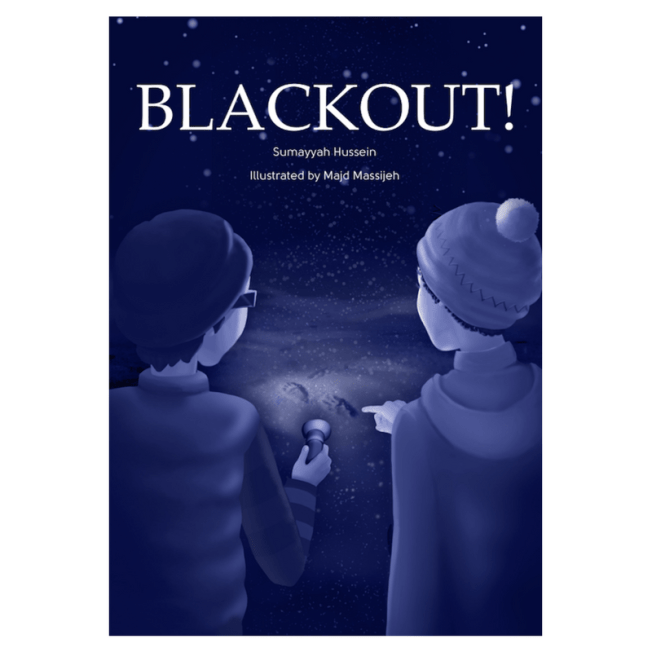
Blackout! by Sumayyah Hussein illustrated by Majd Massijeh

Standard
Blackout! by Sumayyah Hussein illustrated by Majd Massijeh

blackout.png

Presenting the stories of refugees to young children often involves a balancing act of fact, emotion, and restraint, all while finding the common ground to create empathy in the reader.  Increasingly on bookshelves are successful picture books that use illustrations to build bridges of understanding and bright colors to convey hope.  For older children there are books that can devote time to explain issues or offer first hand accounts along with political back stories and historical events.  For elementary age children 2nd and 3rd grade particularly, chapter books on refugees are not very common.  Children this age seem to relish in silly outlandish characters with a few font happy sentence and pictures on each page or stick to series that are easily predictable as they present tidbits of history or simple mysteries.  All reasons to encourage your child to read Blackout! and break the monotony and gain some empathy.  As delicate as the subject matter is, the book manages to resonate with most children how good they have it and how fortunate they are, without getting preachy or pretentious.

SYNOPSIS:

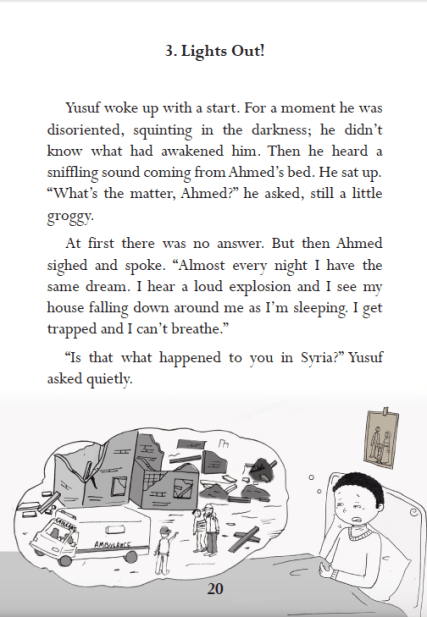
Yusuf, a 12-year-old Canadian boy is anxiously waiting the arrival of his cousin Ahmed from Syria.  Ahmed recently lost his father when their makeshift boat capsized, and while coming to Canada is a blessing, he is still haunted in his dreams and memories by all that he has seen and endured.  This idea that being safe now, doesn’t erase all the pain and fears experienced, is a concept most adults understand, but I was surprised that my children had to talk it out a bit.  They understood that he would be sad, but hadn’t really thought how hearing loud noises would immediately remind him of the explosions he heard in Syria and of his home and buildings crumbling down.
blackout inside

The story’s focus is the present however, and follows Yusuf.   The backstory of Syria and Ahmed’s escape is juxtaposed with an ice storm turning Toronto powerless and cold.  As Yusuf deals with the annoyance of a few days without electricity he learns a bit of compassion for others in the world, who endure a similar situation indefinitely.  In a beautiful way, Ahmed’s enduring optimism changes Yusuf as they find reasons to smile at the raccoon rummaging through their food put outside to stay cold, or playing in the snow to pass the time.  The characters have a lot of heart, for a short book, and you really feel like you get to know them and feel for them.  Yes, Yusuf whines, but he is a kid who’s winter vacation plans have gone awry and is frustrated and bored.  Ahmed, while a survivor, still struggles, but maintains a personality much more than just victim.  The other family members are background, but they aren’t flat, they have warmth and humor and pain in equal parts, implying if the book was longer, we’d get to know more about them too, and probably like them as well.

Despite the refugee story line, and the blackout, the crux of the story is actually helping one another and being neighborly.  Ahmed at one point is telling a story of how he began helping someone in a refugee camp and that it gave him purpose.  This reminds Yusuf that they have an elderly neighbor and the radio alerts had encouraged people to check on one another.  The boys rush over to find Mr. Caldwell, suffering from carbon monoxide poisoning brought on by his kerosene heater. Luckily an ambulance is able to get there just in the nick or time. On the third day of the blackout, the Imam speaks about helping one another and making this obstacle into something positive.   Ahmed tells Yusuf how the neighbors in Syria would gather in the winter to share what food they had.  This brilliant idea gets the support of Yusuf’s dad, the Imam and the whole congregation as they rush home to invite the neighbors to a neighborhood BBQ.  The perishable food needs to be consumed, so what better way to enjoy it, than to share it.

When the power comes back on, Yusuf is not the same kid, he has grown in compassion, and patience, and inshaAllah the reader will be similarly affected for the better.

WHY I LIKE IT:

I love that the book addresses a hard topic on a kid level.  It does not overwhelm the reader or frighten them.  MashaAllah, it balances what they can understand, with something bigger.  The illustrations keep it light in their doodle like appearance and the font, spacing, chapter length and presentation are perfect for the target audience.

blacout2

The women wear hijab, they pray, they go to the mosque, yet they don’t quote hadith or Quran or say a lot of mashaAllah and Alhumdulillah, making the book work easier for non Muslims.  The coming together of community is nice.  No one asks or worries what religion, race, or ethnicity anyone in the neighborhood is, they just come together to share a meal and welcome Ahmed and his mom to Canada.  The Imam is relatable and the dad is involved and generous, the mom is competent and respected, all normal behaviors that reinforce community and normalize diversity and acceptance.

FLAGS:

The violence of war may affect young children differently.  Nothing is sensationalized or graphic, but Ahmed does get stuck in the rubble when his house is destroyed, and his father’s drowning is discussed.  Nothing is talked about in depth, but the ideas are presented.

TOOLS FOR LEADING THE DISCUSSION:

This book would be perfect for a young book club.  I’m looking forward to reading it with my six-year-old son and my eight-year-old niece so that I can see how what they get from the book.  There is a brief explanation on refugees at the back of the book, and I think current events would naturally make a book club discussion easy to facilitate.  I think gathering items and meeting refugees after, would also be a wonderful way to turn the fictional story into real action.  It is also worth noting 100% of profits from this book will be going to the Syrian Canadian Foundation‘s mental health and wellness initiative for Syrian newcomers.

blackout1

Yippee! Ramadan is over, It’s Eid by Farjana Khan

Standard
Yippee! Ramadan is over, It’s Eid by Farjana Khan

yipee

A friend loaned me this book from the local public library, so I was not only excited that a book about Eid was readily available, but also hopeful that it was good quality.  Then I saw the title.  I mean I get that the “Yippee!” is a title part of a series of books on the different holidays Muslim’s celebrate, but for as excited as Muslims are for Eid, they are usually very sad that Ramadan is over.

Nevertheless, I opened it up and hoped to be swept away.  The list of Eid activities and rituals however, were very dry and anticlimactic.  The characters are not named, the pages are meant for pre-schoolers I would imagine, but the lack of excitement in the language is disappointing.

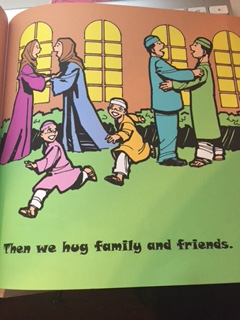
yippi hugThere are 19 pages of text, and the first few pages start off pretty well with a little boy seeing the Eid moon.  Then the family goes to the mosque and learn that Eid marks the end of fasting and the month of the Quran.  The boys father then gives money to the mosque, it doesn’t say that it is charity, but if one is familiar with Eid, one could assume. However, the book seems to be for those unfamiliar with Eid, so for me, this is where the book started to be lacking.  The next page also is where the list seems to start, and some of the items on the list are a bit of a stretch.  “We hug family and friends,”  followed a few pages later by a whole page dedicated to “My mother sets the table.”

yippi table

The book is also obviously desi as they eat parathas and firni.  At one point the kids play a game, not sure what game, it only says what sister’s favorite game is, and then a page is dedicated to the fact that “sister’s team wins.”

yippi fries

Perhaps I am too harsh, as the book is colorful and shows family and friends happily interacting.  There are women covered, not covered and with niqab, and there isn’t anything erroneous in what is written.  I just would hope for more.  The book is small in size, 8.5 x 8.5, and could have been fleshed out a lot more.  It reads like a child’s rough draft, each page or so, being a topic sentence, without the details.

I really don’t know what one would learn or get out of this book, that they wouldn’t get out of a fictionalized account or even a character driven story at Eid time.  Online prices don’t convince me the book is a stand out either.  There are much more fun, engaging, and memorable Eid books out there, not sure why the library chose to invest in this one, but alhumdulillah, I suppose it is better than nothing.

Zachariah’s Perfect Day by Farrah Qazi illustrated by Durre Waseem

Standard
Zachariah’s Perfect Day by Farrah Qazi illustrated by Durre Waseem

IMG_4757I was really excited to learn about this book from the author, as it seemed to be a book that would stand out in a very crowded genre and work for both Muslim and non Muslim kids.  When I tore off the package however, the face on the cover seemed a bit off for my taste, the glossary is on the back cover and while the pages are full size and full color, the book starts on the first page and somehow seemed more “home done” than “professional.”  Which isn’t a bad thing, and I’m happy to support local writers, but alas I do often judge books by their covers and format, and my first impression had to be stuffed away so I could give the book a fair chance.
The book is 20 pages with the 20th page being recipes.   I would guess children 5 and up would be considered the target audience.  It basically is a book telling about Ramadan with the author trying to blend in a story, that for me, sometimes worked and sometimes really didn’t.

FullSizeRender (3)

It starts with Zachariah, a 12 year-old-boy waiting for his mom to wake him up to fast, a day he has been waiting his whole life for.  Why he had to wait to fast at age 12 is not clear to me or made clear in the story.  His 10 year-old-sister only does half days, but in the illustrations she seems to only look about 3 years old, so I’m not sure where the arbitrary age requirements for fasting come from.  There is also a third sibling in the pictures that is never mentioned, not sure why, my kids and I speculated a lot more on that than we probably should have.  It isn’t told from Zachariah’s point of view but he is the focus as his day gets started.

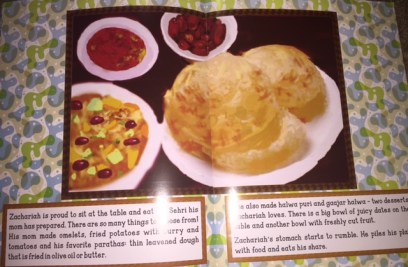
The characters are undoubtedly desi as the book is very steeped in subcontinent cultural over tones.  Sehri, the pre dawn meal, is described in abundance of detail, “His mom made omelets, fried potatoes, with curry and tomatoes and his favorite parathas: thin leavened dough that is friend in olive oil or butter”  It’s a bit detailed of how the items are prepared for a kid’s book, and that is just page one of two pages dedicated to detailing the food on the table for breakfast.  Iftar the meal to break the fast is also two pages of description and cooking methods, but about double the amount of text.

FullSizeRender

Culture is often food, and Ramadan has its own food traditions, but there is a lot of space dedicated to food in this book,  and it kind of takes away from the message of fasting, and moderation, and not going in excess.  Later in the book the mom does pack up some of the food to take to the less fortunate which is great, but she does it while the rest of the family is breaking their fast.  Not sure why she couldn’t have done it before or after and joined them.

After sehri is presented the family talks about Ramadan and what it means and what they like best about it.  There is a bit of dialogue that is actually sweet and funny, and gives some warmth to the story.  It is clear the author is just trying to flesh out the facts about Ramadan, but for a kid’s book, I think getting the facts in and presenting them in a fictionalized setting is a useful tool.

FullSizeRender (2)

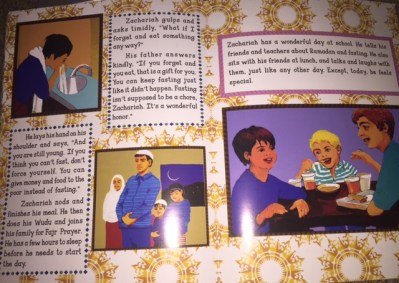
The story seems a bit lopsided when it shrinks Zachariah’s day at school to one five line paragraph saying it was wonderful and then moves on saying “Later, he helps his mom.”  After spending 10 pages on the predawn meal, I would have liked to know a bit more how school went for him, it is his perfect day after all.  Also, the lapse in time by the narrator seemed a bit off to me in the sequential flow of the story, as it was following him in real time so to speak, and then fast forwards the bulk of the day only touching on lunch time, and

FullSizeRender (1)

Alhumdulillah, the family is sweet and excited for Ramadan. They pray together and are seen with smiling faces.  There isn’t much diversity in the pictures, the family has darker skin, the friends at lunch are more fair.  The mom wears hijab and is in the kitchen, dad doesn’t seem to be, but Zachariah helps his mom.

The book is colorful, and busy.  I’m not sure if the pictures are meant to be a stylized reality or look computer generated, but they seem a little blurry in places.  The font and backgrounds are nice.  There is a verse from the Quran in English and Arabic, as well as the athan and some Islamic calligraphy.

Overall, there is nothing “wrong” with the book, it just isn’t memorable.  There are some really good Ramadan books out there, and this one does it’s job of explaining Ramadan, but lacks the characters to leave an impression.  I definitely don’t regret buying it, but I don’t know that my kids or I will read it again this Ramadan, it doesn’t create that reaction.  It will probably stay on the shelf until next year, when we can’t recall many of the details and give it another go.

IMG_4748 (1)


Zaid and the Gigantic Cloud by Helal Musleh illustrated by Sabrina Pichardo

Standard
Zaid and the Gigantic Cloud by Helal Musleh illustrated by Sabrina Pichardo

zaid

We all experience disappointment and frustration and feeling like a gray cloud is weighing us down, and for Zaid, it really is!  In 36 bright colorful pages, children ages 5 and up can see that bad days happen to everyone, and that sometimes it seems like nothing is going right.

Zaid has been waiting for months for a weekend camping trip with his uncle and cousin, but when Ahmed comes down with the chicken pox, the trip is cancelled.  That night Zaid barely sleeps he is so upset, and in the morning notices a small grey cloud hovering above him.  As he waits for the bus, the autumn leaves remind him that it will soon be too cold to play soccer outside, then he has to sit at the back of the bus, and needless to say its just the beginning of many disappointments in his day, that make the cloud above him grow.  But then, a little something out of the ordinary, in the form of a small bird needing help, presents Zaid with a change of pace and a chance to turn his day around.  Slowly but surely the cloud starts to shrink and Zaid copes with the rest of the day with a bit of perspective and a growing smile.

zaid2

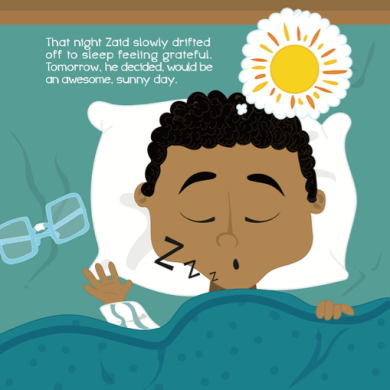
The book is a much needed one in showing children coping with emotions in a somewhat autonomous manner.  The book doesn’t judge his feelings, but shows how he finds a way to see the silver lining and make do with a string of frustrations.  The adults don’t lecture him or solve his problems for him, but are definitely supportive and caring should he need them.  The story does a good job of flowing and not getting preachy.  I can’t wait to read it to my 6-year-old who has a gray cloud pop up at the slightest disappointment, but currently my 10-year-old has been sent to her room with the book to see if she can relate Zaid’s predicament with her own.  The handy discussion questions at the end also can help talk about feelings through Zaid, and hopefully making the child’s connection from a fictional character to their own experiences more poignant.

This book really cemented in my head the growing subcategories of Islamic fiction picture books.  Naturally there are books that are geared for Muslim kids only and ones that work for Muslim and non Muslim kids alike.  But this book, along with a few of the new releases like it, cover universal themes with Muslim characters (at least by name) and have diversity in their pictures.  They show a few characters in hijab but do not mention or explain it, in this book the marshmallow package says halal, again with no explanation.  However, there is no specific ayat or hadith that the book stems from or an Islamic pearl that is meant to get through.  The characters do not greet each other with salam, or say alhumdulillah and mashaAllah, making it more appealing to a wider audience, but words I hope when the story is being read aloud to Muslim kids, can be sprinkled in.  I think it is a great addition to the literary world when Muslims are seen in a larger community and is not jarring.  I hope parents of non Muslim children also appreciate this diversity in literature and I pray that it leads to more acceptance in the “real” world, ameen.

zaid3

Welcome Ramadan by Lila Assiff-Tarabain illustrated by Gurmeet

Standard

welcome ramadan.jpg

As many of us are setting out our Ramadan decorations and pulling our Ramadan books from the shelves, or realistically browsing Amazon, the quality and presentation of Islamic picture books is impressive.  And with this new expectation, there is also an increase in price, this book however, is the opposite.  Ranging from .97 cents to $3 online this little 6.5 inch by 9.5 inch 24 page book is a lot of bang for your buck.welcome ramadan1

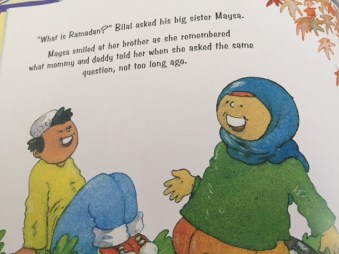
Starting with finding the moon, big sister Maysa tells her younger brother Bilal all about Ramadan, in (mostly) rhyming couplets none the less.  She tells him about walking up before dawn and explains that yes that means no lunch.  She also explains that because they are little they aren’t required to fast. They then explore breaking the fast, going to the mosque to pray, having good manners, and learning that a full moon means that Ramadan is half way over.  Reading the Quran is discussed as well as how we have to be generous with what Allah swt has given us. It concludes with Eid and a Parent/Teacher guide at the end to help Muslim and non Muslims alike learn about Ramadan.

welcome ramadan3

The pictures are cute and comical, albeit small given the overall size of the book.  It covers Ramadan on a level kids of all ages can understand, and because of its easy reading style even older kids can skim through it and find it enjoyable.  There isn’t really a story, it is just a fun way to share the “facts” but a welcome addition to any book shelf both at home and in a classroom setting.

Watched by Marina Budhos

Standard
Watched by Marina Budhos

Watched-

This book is so incredibly timely that it feels like it could be real, granted its been timely since 911 and homeland security took to watching people more aggressively and openly.  But, New York police have been in the news about their methods regarding watching muslims and mosques, and this fiction book does a great job of getting inside a boy’s mind as he explores both being watched and being the watcher.  The book is 265 pages and is written on an AR level of fourth grade, but content wise I would not recommend it for anyone younger than high school.  The concepts and themes need to be put in perspective to appreciate the book.  And at the same time, being able to understand how terrorist recruit and how police aren’t always ethical, creates some gray area that require a certain level of maturity to make it resonate.  It isn’t a black and white story with good pitted against bad or legal verse illegal, the nuances in between are where the action takes place.

SYNOPSIS:

Immigrant. Muslim. Teenager. Screw-up. Lots of labels for high school senior Naeem Rahman.  Born in Bangladesh, he moves to Queens in New York, after his mother dies and his father has remarried in America and sends for him.  While there is a gap in his relationship with his father, the story doesn’t focus on issues at home.  He has a very strong relationship with his step mom, and his younger brother, making him very likable and endearing.  He has problems elsewhere, however, that stress his family and get him in to trouble.  His grades are poor and he learns he will not be able to graduate, which further distances Naeem from his small shop owning father.  And his friends have dwindled to a single friend, Ibrahim,  that enjoys weaving tales mixed with truth and fantasy and dreams, that gives Naeem a taste for living on the edge and running fluidly around the city.  When an adventure with Ibrahim goes bad, and Naeem gets stuck holding stolen goods, it is a deal with some cops that comprises the bulk of the story, and forces Naeem to decide if he can go from being watched, to being a watcher, an informant for the police.

With a prior run in with the law, some marijuana in his backpack, a working class family, and not wanting jail time, the police officers know that they can pretty much ask anything from Naeem and he will comply.  Naeem starts spying on his community online and by going to the masjid for prayers, volunteering with MSA’s, helping out with summer schools for Muslim kids, all things he and his family had stopped doing after 9/11 when cameras started going up on poles outside of mosques, and fellow worshippers started eavesdropping on each other to report back to the police.  But, now that Naeem is on the inside, he finds power and strength in what he is doing, a confidence he has never had before.  He starts helping neighbors, helping the family income, fasting in Ramadan, but all with a guilty conscience.  His foundation is deceptive.  When the story comes full circle and Naeem realizes the path he is on, he has to find a way to get out and own up to the choices he has made both to his community and to the police.

WHY I LIKE IT:

The story has moments of action and intensity, but it is also poetic and introspective.  Budhos really gets inside Naeem’s head and shares that with the readers.  Obviously, the book is for Muslims and non Muslims, it is a companion story to her book Ask Me No Questions, but I think the reason it resonated so much with me is because it is something I am familiar with.  So the poetic musings made Naeem more likeable to me, I didn’t see them as speed bumps in a book billed as a thriller.  I was glad that Naeem was charming and fleshed out.  His relationship with his little brother and with his step mom, really show that he has layers and isn’t just one label or another.  There is a lot of diversity in the Muslims presented and their backgrounds that make them who they are.  There are also a lot of cultures presented in this immigrant neighborhood that make the details solid.  There is no doubt that the author knows what she is talking about, that she is perhaps lived it in some capacity, the authenticity is definitely present.

FLAGS:

Aside from the arcing themes that raise flags for the younger, more sheltered readers. There are a lot of things mentioned, although not explicit or celebrated, they are presented in passing to create understanding of an environment.  There is drug use, kissing, violence and some profanity.  In a story like this there is obviously a lot of lying, stealing, talk of homegrown terrorism.

TOOLS FOR LEADING THE DISCUSSION:

The author’s website: http://www.marinabudhos.com/books/watched

Author interview with NBC news: http://www.nbcnews.com/news/asian-america/immigrant-teen-gets-swept-nypd-surveillance-marina-budhos-watched-n661171

The Treasure at Bayan Bluffs by Farah Zaman illustrated by Kim Zaman

Standard
The Treasure at Bayan Bluffs by Farah Zaman illustrated by Kim Zaman

img_2961

At 231 pages this book claims to be for ages 9 to 18 and that’s a pretty large spread for a mystery, yet alone an Islamic fiction one by a first time author.   In a tone reminiscent of Nancy Drew and the Hardy Boys,  it should really should just say 9 and up, I was hooked!

SYNOPSIS:

Adam and Layla along with their younger twin brothers Hassan and Hakeem from America are visiting their family home of Bayan Bluffs in Midan for the summer.  Their grandfather and great aunt and a few long time servants aren’t much entertainment for the children, so their parents arrange for their college friends kids’ Zaid and Zahra from Crescent City, a few hours away, on the other side of Midan to join them.  The children get along right away and decide to try and solve a mystery of a hidden treasure that they have heard bits and pieces of over the years.  Their search for the Moon of Masarrah starts innocently enough, but quickly escalates as they learn they aren’t the only ones searching for the missing gem.  As they learn more about the jewel and the circumstances of its disappearance the gem and the murder of Adam and Layla’s great grandfather get further entwined.  With a few of the suspects still alive and many of their family members still in the city, the children soon find they themselves in danger as well.

WHY I LIKE IT:

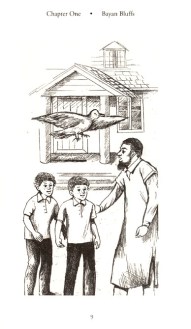
The biggest reason I like it, is it is well written.  There aren’t confusing passages, or too many characters or boring preachy paragraphs.  The plot is good, the dialogue believable and the fact that they are Muslim children, just depth to the story.  They plan to meet after asr or before Jummah, and they say inshaAllah and mashaAllah, and its just a really good balance of who they are, but not all they are.  In retrospect, maybe they all get a long a little too well, but it isn’t syrupy and they have some minor annoyances, so it doesn’t hinder the story.  The only thing I caught myself looking back on was the age of the twins.  At times they seem like toddlers and at other times much, much older.  Even the author says they are “about six years old,” and having a six year old myself, I do believed that they can vacillate to both extremes in any given moment and thus I accepted their antics and let it go.  Additionally I wish she included a map.  It isn’t confusing, but it would have been great to look back upon as the action speeds up, and would definitely help younger readers visualize the details.  The terrain vocabulary for anyone younger than nine might need some explanation.  There is a glossary at the end for some of the Arabic words, and for some of the specific ships and weapons mentioned.  Their are a few illustrations that I think help the younger readers, they aren’t needed for the story, but they don’t impede it either.  I wasn’t crazy about them within the story, but I did appreciate that they show the girls in hijab and the illustrator clearly put a lot of work in to them.

bayan.jpeg

I wish that the cover was more appealing, for a story that was so good, I wish it begged to be picked up.  InshaAllah word of mouth will carry the book, so that more like it are written and published.

FLAGS:

None, mashaAllah it is clean and wholesome.  There are good and bad Muslims and no judgement is put in a religious context.  There is some violence, but it is nothing even a seven year old would find offensive.  Alhumdulillah.

TOOLS FOR LEADING THE DISCUSSION:

I would love to do this as a Book Club book for 5th through 8th grade.  The writing quality and the different characters the students would be able to identify with, would make it a lot of fun.  There isn’t any deep or though provoking discussion points to accompany the book, but I think the genre is hard to come by and Muslim kids seeing Muslim kids solving a crime and going on a treasure hunt, is just exciting.  I couldn’t find any study guides or even much information on the book or author, but none is needed to enjoy the story.  Farah Zaman if somehow you see this review, know that I hope you keep writing, and I thoroughly enjoyed your book!  Happy Reading Everyone!


The Roses in My Carpet by Rukhsana Khan illustrated by Ronald Himler

Standard

roses-cover

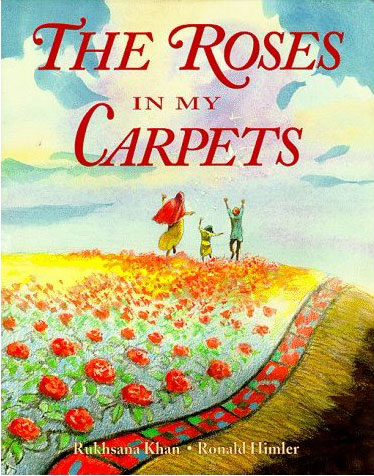
The concept of “refugees” is not a new one, but with the pervasiveness of the term in the news right now, children are starting to need some understanding of what it means to be a refugee, and how to empathize with what their classmates and friends may have endured.  Books like One Green Apple, The Red Pencil, and Four Feet Two Sandals are great, and I excitedly hoped this one would be a great addition to the theme.

roses-2

The book is leveled as an AR 3.2, but I don’t know that many eight and nine year olds would be able to grasp some of the content unassisted.  This is a good example of the limitations of Accelerated Reader.  Yes, diction and sentence length are third grade level, but content is a bit heavy in this 32 page water-color illustrated book.

roses-1

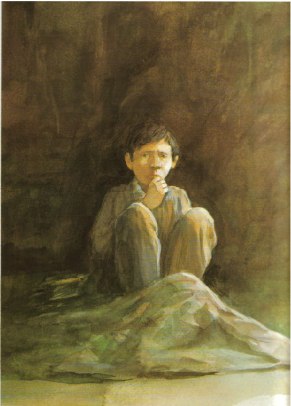
A young boy is telling the story of his life in a refugee camp in Pakistan.  The nightmares of jets dropping bombs opens the story and sets the tone of a very frightening reality that this boy, his mom, and his sister Maha face.  His father, a farmer, had been killed, and I think the author does a good job of showing readers that although the characters are now in a refugee camp, food and safety are still not a given.  I think we as westerners tend to think, ok they had to leave their home, and that is sad, but now they are taken care of, and this book clearly shows that, that is not the case. The boy mentions that someone has sponsored him and helps them with money, something his father wouldn’t have accepted, and I’m not sure why this is included.  Perhaps to show that people still can help and need to, or to show that affluent people donate as a way to ease their conscious without working to fix what caused the problem in the first place? I don’t know. It would lead to some good discussions with older children, perhaps fifth grade and up, as the author doesn’t make it a good or a bad thing, but does introduce it none the less.

The environment is drab, “Here, the walls are mud, the floor is mud, the courtyard is mud, too” and the day-to-day chores monotonous, lining up for water, for food, going to the mosque to pray, and going to school.  For some reason, not sufficiently explained in my mind, the little boy hates school.  A sharp contrast to stories that show how appreciative many children in other parts of the world are at the opportunity to study and learn. The boy rather, loves weaving.  He looks forward to escaping his reality and getting lost daydreaming in the weaving of beautiful colorful images where the bombs can not get him.

The characters are clearly Muslim, as they pray and wear hijab and go to the mosque.  They trust Allah when they are faced with challenges, but no details of belief are conveyed and it simply describes the characters. The book does not come across as whiney to me, and while there is some hope that radiates through when the boy is weaving, it really is a sad book.  It is made more depressing when Maha is hit by a truck, she thankfully survives with broken legs, and by the thought that although the boy wants to use his weaving to provide for his family, the future doesn’t seem bright.  In the end perhaps running free on a rose filled carpet where the bombs cannot get them only exists in his dreams, a sobbering thought for the characters and readers alike.

roses_in_my_carpet_p30-31

Laila and Pesto the Fly by Rania Marwan illustrated by Fatima Asheala Moore Jewel Series Story #1 Cheating

Standard

laila-and-pesto-the-fly

I ordered this book with the hopes that it would be the first book of a wonderful series teaching values in an Islamic context.   It says that it is book #1 in the Jewels Series and it focuses on cheating.  However, the book was published in 2009 and I can’t find any other books in the series.  Sadly, I can possibly see why.  The book is not great.  The illustrations make it so tempting even if all the girls are gorgeous and the illustrations simple, they would seemingly work well with a book aimed at 4 to 8 year olds, and just 24 pages long.

laila1

Unfortunately the text is lacking and doesn’t create a story worth reading more than once. The sentences are repetitive. And the same words are used over and over.  The first page alone says the word “play” four times in three sentences.  It is about 4th grade girls that play, watch cartoons and essentially hold lessons/ book clubs for each other once a week.  A lot going on for a book that on the second page says the word “flies” three times in three sentences.  Needless to say the repetition makes it hard for a story time selection, and the run on sentences hard for young readers.  The first page features a font that is probably about a size 20 and the next page it drops down to one that is about 11, the third page is about a 14 and the trend of the ever-changing font size continues throughout the book.

laila-text

Example of repetitiveness from Laila and Pesto the Fly

The story idea is a good one at its core.  A girl teaches her friends about flies.  Then the fly talks about Laila and how she is kind and honest. Then the next sections returns to Laila not being ready for a math test and she is tempted to cheat when Pesto, the fly, distracts her and writes a message for her in glitter.  I’m not sure how the glitter stays on the page, but, the message is received by Laila and emphasized by the author sharing a hadith, “He that deceives us is not one of us.” The last page of the book is a bulleted list emphasizing the harms of cheating, and how to overcome the temptation as the girls urge you to join their Cheat Deceit Foundation.

Overall, the book is awkward and doesn’t work for me.  There are a lot of better books out there.  That being said, if the author wrote another book, I may give her another chance, it isn’t hopeless. It just needs some tweaks. The fly is a silly likeable character, but the group of friends are a monolith and have no individual roles.  The message is clear and important, and we need books like this, but alhumdulillah the standards have gone up, way up, and the writing quality isn’t where it needs to be to attract Muslim children or their parents.


Nusaiba and the 5th Grade Bullies by Asmaa Hussein illustrated by Zul Lee

Standard

Nusaiba.png

As someone who deals a lot with reading and comprehension, I really misread the description of this book and assumed erroneously that it was a chapter book targeting 5th graders.  Oops, alhumdulillah, my confusion and slight disappointment didn’t last long as I got swept up in Nusaiba’s spunky imagination and endearing personality.  The message of the book is powerful.  Not only does Nusaiba have to deal with bullies, but she has to wrangle with accepting herself, even if that means being different.

nuaiba2

Nusaiba is almost to school when she overhears some 5th grade boys making fun of her mom and what she is wearing.  Nusaiba’s mom is wearing a hijab, and the story is set up to imply that that is what they find “weird.”  This morning encounter bothers Nusaiba all day, and while she doesn’t talk to her teacher about it when asked, she does spill the beans to her best friend Emily.  The next day Nusaiba distances herself from her mom and asks to walk to the school gate alone.  The bullies don’t say anything, but Nusaiba feels guilty about leaving her mom like that. Later that day when Mom picks Nusaiba and Emily up from soccer they swing by a local hijab shop for some clothes shopping.  I don’t know why, but I found the premise for taking the girls clothes shopping a little forced.  It seemed too words of a setup, and I couldn’t help but wonder why Emily would be dragged along.  As mom tries on skirts for work, the girls in their boredom get swept up in using the scarves as costumes and transforming themselves from queens, to underwater divers, to fisherwomen, to mountain climbers, to fantastic cleaners ready to clean up all the scarves on the display.  Her mom lets her pick one to buy, and she decides to wear it to school the next day.  It is noteworthy that Emily doesn’t try on any of the scarves.  She is an amazingly supportive friend, and even in make-believe is right there with Nusaiba, but she doesn’t put one on, and I kind of want to know the author’s reasoning or purpose as to why.  So the next day at school, Nusaiba asks her mom to again walk with her, and when the 5th grade boys call her mom an “odd-ball.” Nusaiba finds her courage to confront them.  Nusaiba and the reader discover the boys are making fun of Nusaiba’s mom, but it isn’t for her hijab.  Nusaiba and her mom set the boys straight and giggle in the process, as Nusaiba realizes she can be anything she dreams.

nusaiba1

The book is 44 pages and probably about a second grade mid year reading level.  The pictures are big and bold and beautiful making it a great option for story time to ages 4 and up.  The pictures do an amazing job complementing the story and going back through to look at them after the “twist” at the end was even more delightful.  The illustrator draws you into Nusaiba’s world and you really do cheer her on when she stands up for herself. The book easily lends itself to discussion, and there is also a question guide at the end, incase you get stumped. It reads more like a school assignment, but it could obviously be re-worded to engage a child at bedtime or in a read-a-loud environment.  The font is a nice size, however, I found it distracting. On some pages it is white on others black, on some it has a shadow and on others it does not.  I’m certain most people would not notice, but for some reason it was jarring to me.  Alhumdulillah, alhumdulillah, if that is the only negative in a book, I think everyone who reads it will be glad to have a copy of their own to read again and again and again and again and….