Tag Archives: Muslim Characters

Just a Drop of Water by Kerry O’Malley Cerra

Standard
Just a Drop of Water by Kerry O’Malley Cerra

just-a-drop-of-water-cover

Thankfully the adult in me won out as I resolved to read a book whose cover and title did nothing to tempt me.  I know, I know, never judge a book by its cover, but seriously a kid running on the American flag with major Muslim characters, written by a non-Muslim about September 11th? I was hesitant and nervous to know what messages would be spread in the 304 pages to children on an AR 4.0 grade level.  But alas, I was  nervous for nothing.  The book is wonderful, and I want to read it again with my 5th grade daughter so we can discuss it.  It is hard to believe 9/11 is now taught as history, but as someone who lived through the tragedy as a college student, this book hit on so many of the defining moments of that horrific morning and the days that followed.  The book isn’t overly political, or judgemental, or preachy, and in retrospect, most people on September 11th and the days immediately following, weren’t either.  We were confused, scared, and unsure, a tone the book reflects and magically presents on an elementary level without getting  overwhelming with the enormity of it all .   The book was published two years ago, and I’m very tempted to contact the author or editor and urge them to reconsider a cover and title change because truly the story deserves it.

SYNOPSIS:

Jake and Sam have been friends their whole lives.  They bonded in the sandbox with their little green army men and have been planning battles and missions together ever since.  Told from Jake’s perspective the reader sees what life is like for these two 8th grade boys.  They push each other in cross-country, their parent’s come together for Jake’s 13th birthday, neighborhood boys swing by for pizza and front yard football games.  But there are stresses too: siblings, busy parents, not getting named captain of the team, friends that play dirty.  Then September 11th happens and worlds are shattered.  The boys learn that one of the hijackers, Mohammed Atta, was from their town, and although Sam has only been to the Mosque a few times with his grandparents, and his parents are culturally American not Saudi, the school bully Bobby is determined to get rid of Sam.  Jake makes it his mission to defend his friend with his fists and his words, but when his parents urge him to stay away from Sam, the stakes are raised.  President Bush says, you are either with us or against us.  But what is Jake to do?  Secrets about Sam’s dad come out and the FBI takes him away for questioning.  The town is gripped in fear and 8th grade boys on both side are determined to change the world, to be the drop of water creating ripples of change.  As Sam and Jake pull away from each other, Sam starts going to the mosque to learn about what he is being accused of being and begins to identify as Muslim.  Jake’s frustration with his parents continues to grow as does his impatience with Sam, but when Jake overhears Bobby plotting something serious, Jake will have to decide where he stands and how strong he is.

WHY I LIKE IT:

I like that the author crafts a story that is complex, but not overwhelming.  She sticks to focusing on getting inside Jake’s head and succeeds.  He is frustrated and confused and determined, but alas he is only a kid and can’t foresee his actions or articulate them the way an adult can.  He is likeable and fallible and she doesn’t belittle him, thus making his plight tangible and relatable.  I was a little disheartened when about a quarter of the way in it was made clear that Sam knows nothing of Islam or his culture, but it works so well in the story to show that he was pushed to go learn about his roots, since others were treating him as if he represented Arabs and Muslims.  This is so real, I knew so many non practicing Muslims that suddenly started coming to the mosque or reading books on Islam because they realized they should know where they come from.  Many resumed a secular life over time, but many also became more practicing, a phenomenon, the US media and politicians have seemingly failed to acknowledge as Islamaphobia is rampant and so many people pick up a Quran to see how a religion painted so negatively, can simultaneously be one of the fastest growing religions in the world.  The author doesn’t even touch on what Muslim’s believe, but she does include that they abhor violence and disavow the attacks.  The Sheikh is presented as nice enough and there is no negative judgement or tone from the author, aside from the xenophobic characters.

The title of the book comes from a song that Jake’s grandma likes and she often tells Jake, “just a drop of water.” Jake takes it to mean that something is insignificant, but she has him listen to the song and explains that it makes ripples that grow.  The imagery is great, and the line becomes powerful, I guess I just felt it wasn’t devolved or woven in enough to make a strong, clear statement to be the title of the book.  I’m sure many would disagree with me, but as I stated earlier the title along with the cover photo didn’t pull me in.  The book appeals to both girls and boys as both are presented very positively.  There are a handful of side stories that add depth to the characters and narrative that I haven’t touched on, but they are all charming in their own way.  There is a Boo Radley type character, there is a whole tangent about Jake’s grandfather and the details surrounding his grandfather’s death, and the overall messages about friendship, and doing what’s right that make the book relevant to a wide spectrum of readers of all ages.

FLAGS:

The book is remarkably clean considering it is about an act of terror followed by bigotry.  There is some hate speech and violence, and some lying and cheating, and mention of getting pantsed.  But, overall clean and no concerns for 4th grade and up.

TOOLS FOR LEADING THE DISCUSSION:

There are a lot of resources online and it doesn’t surprise me.  This book would do great as a novel study, as it is historical fiction.  It would also work well as a book club selection for any elementary or middle schoolers, not just those in an Islamic school.

Core Connections: achievethecore.org/file/1602


Broken Moon by Kim Antieau

Standard
Broken Moon by Kim Antieau

Broken Moon.jpg

I didn’t initially think the premise of the book was terribly original: a poor scarred girl in Pakistan working as a servant, cuts her hair to look like a boy and be free to move about and rescue her brother.  But the weaving in of the One Thousand and One Arabian Nights stories into the larger story, and the plot of kidnapping children to be camel jockeys in the Middle East, made the story good.  Really good, but not the book.  I really struggled with the format of the book.  It is written as letters by the main character Nadira to her young brother Umar.  The information seems too forced in this style, she is telling him how old he is, or retelling him things he said a few days ago.  Once they are together she has to clarify that now she is writing it to their mother, and then again alter it to be writing to those following her story.  It presents too many characters, that are awkwardly introduced because presumably he knows who they are, the reader does not, and bridging that gap makes the book halt the reader from diving head first into a really compelling story.  I feel like the book’s editors let the characters down, it would have been an easy fix to tell the story as Nadira told it to the Sheikha, and then when the story caught up with the present to continue it from there as written, without the guise of it being shared in letters or a diary format.  But, alas no one asked me.  Luckily the book is only 183 pages and written on a AR 4.2 level so it is a speedy read.  Do not let the fourth grade level, however, trick you into thinking it is content appropriate for a 10 year old. There is a lot of abuse, in every sub category of the word.

SYNOPSIS:

When Nadira was 12 years old she was attacked by a group of men seeking to avenge an alleged crime Nadira’s older brother committed against their daughter.  By this girl’s reputation allegedly being ruined by Nadira’s brother, the village decides that a female in his family should in exchange be ruined.  Nadira manages to fight and ends up with some external scarring, including a moon shaped scar on her face, a lot of internal scarring, but the book points out quite often that she got away from being sexually abused.  In her culture she is assumed to be ruined, and will never be married.  She begins to work as a servant to help the family financially as her older brothers have more or less disappeared and no longer are of any help to her family.  When her father dies, her mother and younger brother, Umar, rely on Uncle Rubel who is a horrible man who covertly sells Umar to the smugglers to become a camel jockey.  The family that Nadira works for seem kind, they stick to the norms and don’t include her in their fun and frivolity, but they don’t abuse or belittle her either.  They offer her, her mother, and Umar a place to live on the property, and assist her in finding someone to locate her brother.  Nadira, however, is strong and determined and takes matters into her own hands by cutting her hair to look like a boy, finding the smugglers, and convincing them to take her.  Once in the camp she wins over all the boys, by becoming Sherazad and telling a story to delay her being beat.  Her wit, tenacity, and perseverance is infectious and you find yourself cheering her on.  As she prepares for the races and to broaden her access to camps to find her brother at, she meets a western vet, a Sheikha who essentially owns her, and discovers that all the boys she lives with know she is a girl and love and respect her.  The climax involves her racing in the Sheikha’s Race where the winner is granted a wish by the Sheikha.  Can Nadira win? Can she find her brother? Can she save all the boys at the camp that she has taken in as her brothers? I won’t spoil it this time.  You’ll have to read it.

WHY I LIKE IT:

I like that the author did not cast judgement on a group of people.  Not all Pakistanis are bad, not all women are helpless, not all men are oppressive, not all employers are abusive, etc..  similarly, there is a western character, but she doesn’t swoop in and save the day, in fact I read her to be complacent in what she knew were obvious human rights violations.  I loved the relationship that Nadira had with her father.  The love of learning and love of his daughter is so sincere and beautiful that I think readers can see that the stereotype of daughters not being prized jewels in a family as being false.  I wish the mother would have been further developed.  She seems defiant, but not fleshed out, which is unfortunate. I also like the subplot of the gardener boy, Saliq.  A boy who completed some of his education in England, only to be made crippled by a horse, and sent back to be a servant.  He’s role and respect of Nadira furthers the notion that her scar does not define her, as he proposes marriage and pledges to support her in her efforts to continue rehabilitating kidnapped children and stopping the cycle.  I also like that the author doesn’t share her response, as if to emphasize that she is liberated and with or without a husband she is a complete person.

The characters are Muslim by culture, but there is no real mention of Islam or Islamic practices.  Before Nadira cuts her hair she wears a scarf, but that is neither her nor there.

FLAGS:

The premise of the book is an accusation of a sexual crime.  One of the stories she tells at the  camel camp to delay the beatings,  is the story of the lady who traps a merchant, a king, a carpenter, and a Kazi to free her lover.  She offers her body to the men and traps them in a cabinet naked after obtaining their signatures.  There is some kissing and some innuendos and references to sexual acts.  There are also references to the sexual abuse at the camps as well as descriptions of the physical ones that take place.  Not for the faint of heart or young and innocent. The boys at camp also discover that Nadira bleeds like their sisters, as a clue to them figuring out she is a girl, but compared to the sexual crimes, menstruation seems hardly like a flag, and I only mention it because the AR level is so low, not because there is any reason for shame or shyness in discussing an act all women endure.

TOOLS FOR LEADING THE DISCUSSION:

I think high school students could handle the book, and would allow a plethora of discussion options from child labor, civic responsibility, abuse, justice and the power of literature as a coping mechanism.  I wish the author would have included some information on camel racing and how they are regulated and jockeys are obtained, and maybe thrown in a recipe for masala chai as well.

There are no online websites or guides that I could find to accompany the book.

King For A Day by Rukhsana Khan illustrated by Christiane Krome

Standard

King-for-a-Day1.jpg

Its time for Basant, the Lahore, Pakistan kite flying festival, and Malik and his siblings are ready.  Ready to launch Falcon into the sky, ready to set other kites free, and ready to put the bully next door in his place.  While some kids have huge kites, and some have many, Malik has just Falcon, a speedy little kite that Malik prays can get the job done.

King for a day inside

Once again Rukhsana Khan does a remarkable job of taking a universal theme, adding some culture, and finding artists to empower minorities without making it an issue, all in a 32 page children’s book.  Written on an AR level of third grade ninth month, readers see characters handling a bully by beating him “on the court” so to speak, a character having confidence in his abilities, yet still asking Allah swt for help, and a boy in a wheel chair celebrating a fun spring time festival with his family.

king 1

The illustrations are rich with texture and angles, which contrasts the font and text presentation.  Little kids probably won’t be tempted to pick this book up, but as a read-a-loud first and second graders will enjoy the story and the kite flying action.  Third and fourth graders will enjoy reading the book independently, and find themselves cheering for Malik, appreciating his kindness, and wanting to pick up a kite and head out themselves.  The author includes a note at the back which provides more information about Basant and how it is celebrated.  Although it takes place in Pakistan and is a festival not celebrated in America, there isn’t a “foreign” feeling to the book, as kids can relate to bullies, wanting to be the best and the satisfaction of succeeding and feeling like a “king for a day.”

king2

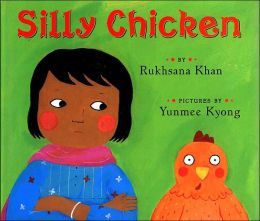
Silly Chicken by Rukhsana Khan illustrated by Yunmee Kyong

Standard

silly chicken

Silly Chicken is a story about sibling rivalry, except there isn’t a sibling, there is a chicken.  Rani feels that her mom, Ami, loves a chicken, Bibi, more than she loves her.  Rani is jealous of the attention Bibi receives and finds the chicken in general, silly.  One day when Rani and Ami leave their home by tonga to visit her father’s grave, a dog gets in and when they return, Bibi is no more.  Ami is devastated and Rani is sure she closed the gate.  It isn’t until Bibi’s egg hatches by surprise, that the story comes full circle and Rani responds to Ami’s chiding that she loves the baby chick more than her mother, that the reader and Rani realize how silly that would be.

I really liked this 32-page, brightly and playfully illustrated book.  It is written on a AR 2.3 level and is fun out loud or at bed time.  The story takes place in Pakistan and a lot of reviews online remark that it is a good book about Pakistan or for showing Pakistani culture, critiques that I both agree and disagree with.  Every kid, everywhere, through out time, can probably relate to being jealous of something or someone occupying their mother’s attention.  The concept of a pet and loving it and being sad and feeling guilty, are all universal themes.  That being said, both the author and illustrator do a remarkable job of breaking stereotypes without drawing attention to them.  Ami and Rani are relatable and are clearly Pakistani, subtly removing an us and them stance.   Rani’s dad has passed away, but Ami and Rani seem to be doing well.  Ami seems very self-sufficient in daily activities and brave when they think a burglar may be present.  The two chat with neighbors and travel independently breaking down the erroneous stereotype that women cannot go out or be recognized without a male.  The mother wears hijab and traditional Pakistani clothes while Rani being young obviously does not cover.  Their clothes are bright and colorful and their expressions relatable and inviting.  The way that Bibi’s death is handled is age appropriate and a child could possibly think she simply was run off rather than killed, either interpretation would allow the reader empathy for Ami and be a great topic to explore with a child.  Enjoy!


Malala: A Brave Girl from Pakistan/Iqbal: A Brave Boy from Pakistan by Jeanette Winters

Standard

Malala Iqbal

Again I break from my fiction preference to review another book about these two remarkable individuals: Malala and Iqbal.  In this beautiful book linking two brave children from Pakistan, Jeanette Winter’s brings their stories to a young audience in a powerfully simplistic way.  Written on an AR 3.6 level, each story is 20 pages and presented in a flip book format.  Before each story there is a brief Author’s Note about each character in a broader view, for context to be given as needed to the adults to share with the children listening to the book, or for older children to read and deepen their understanding and appreciation.  The sentences are short and the font and presentation is inviting to even early readers.  The pictures are wonderful and do a tremendous job showing the intensity of the environment Malala and Iqbal face, while not frightening the reader.

The Malala portion of the book starts with the Taliban asking for her on the bus and like her biography, then takes the reader to the threats and deterrents they made to girls in school, but on an audience appropriate level.  It tells how they stopped wearing uniforms so that they could be harder to identify and how even burning the girls school didn’t stop them. It then returns to her being shot and going from the hospital in Swat to one in England.  It concludes with her speaking to the U.N. on her 16th birthday.

Malala

The story of Iqbal is a bit harder I think for children to understand as they may not know what a loom is or have ever thought about who makes carpets.  Also the words bondage, Peshgi, outlawed, and mourners are not in their vocabulary .  They should understand that he is sold for an unpaid $12 debt, but that too may need to be stressed and explained. If the kids can grasp this, I really think children as young as kindergarten can appreciate his story.  I love that the author didn’t shy away from the fact that he was shot and killed.   Even if they do not understand all the facets that make Iqbal’s work so incredible.  They will feel inspired that someone so young was so brave.  Iqbal


Ten Things I hate About Me by Randa Abdel-Fattah

Standard

Ten Things I Hate About Me

I’ve read and reviewed a few Randa Abdel-Fattah books and read and reviewed even more cheesy West-meets-East-and-my-parents-are-so-strict-so-I-will-rebel books, that with such a flimsy title referencing a movie which references Shakespeare, I didn’t expect much.  With such minimal standards, the book didn’t disappoint and the surprising warmth of many of the characters actually left a pleasant smile on my face.  I’ve had this book on my to-read list since it came out in 2006, and for some reason it is a bit hard to find now a days.  There seems to be a few covers out there, and I don’t know if they differ, but the one pictured above is the one I read, and it is 297 pages and written on an AR 4.8 level, but probably would appeal and be more content appropriate as a light read to 9th through 12 graders.

SYNOPSIS:

Jamilah Towfeek leads a double life.  At home she is a proud Lebanese Australian that goes to Madrassa, plays the darbuka drums in an Arab band, and identifies as Muslim.  She has recently dyed her hair blond and wears contacts to hide her Arab heritage and doesn’t allow her sister who wears hijab to pick her up from school where she is known as an all Australian girl, Jamie.  Her mother has passed away and her father is pretty strict about who she goes out with and her curfew.  They even have a contract posted on the fridge. Despite this, Jamilah and her dad seem to have an ok relationship and it is definitely something they both are fighting to improve.  Jamilah’s older brother is a bit of a rebel and goes out with girls to bars and the book definitely discusses the double standard.  He however, isn’t painted as “bad” or as presented as an outcast, he just does things differently, and must wage his own path to build a relationship with their father.  At school Jamilah has acquaintances more than friends, as she is constantly pushing people away.  The stage is set that she has to keep lying to her friends, but it is more in her head than in reality.  She doesn’t open up to her friends, nor they to her.  As a result the Jamie at school amongst her peers are presented as incredibly shallow, which is partially intentional I think, and partially, under developed.  She makes up excuses to not attend parties and it isn’t a big deal until the most popular guy at school starts to take an interest in her.  In frustration she starts opening up to someone who has started e-mailing her.  Her user name is Ten_Things_I_Hate_About_Me and the dialogues between her and Rage_Against_The_Machine reveal a lot about how she sees the world.  There is some tension with immigrants in Australian and Jamilah starts to realize that her silence is consent to the bigotry and bullying around her, and that there is no way to stay neutral.  There really aren’t any major plot twists, you can see a mile away who the mystery email boy is, and that he likes her, you can see that her friend Amy will come through, and that she will have to reconcile her two identities.  There are a few minor ones with her dad getting remarried and thankfully with her opting to not “hookup” with anyone in the end despite a climatic kiss in order to stay honest with her father.

WHY I LIKE IT:

I’m obviously older than the target audience and the characters, as is the author, but compared to a lot of the other books of similar content, I feel like this book stays the most grounded.  There are some pop cultural references, and obviously the kids are naive, but there are some universal truths and experiences brushed upon that I think a lot of high schoolers can relate to, not just immigrant Muslim ones.  The idea of having to be two different people at home and at school, family relationships, cultural identity, being true to yourself, dealing with the loss of a parent, taking a stand when you see something wrong, etc.. All that being said there is a huge gaping plot hole.  How her friends that have known her from elementary school when her mom brought Arab food suddenly don’t know she is Arab, or don’t pick up on her ethnic last name is beyond even a 5th grader to over look.  If you can tune out your internal sense of logic for the premise, the book is much more enjoyable, but it really is a stumbling point.

I wish that Jamilah was a bit religious.  She identifies as Muslim and clearly her sister is, but pretty much all of her actions and gripes come more from her culture than from her faith.  Many of her father’s friends drink, as they are either not religious, or Christian, which is fine, but part of me really wanted her to live up to the picture on the cover of the book and discover her religious stance alongside her owning up to her cultural one.  I love that at it’s core it is a book about a girl’s relationship with her dad and being true to her self, but somewhere her religion fizzled out of the narrative and I wish it hadn’t.  I Would have loved that she turned down the prospect of a boyfriend because it wasn’t Islamically permissible, in addition to her wanting to be honest with her father.  But, alas the author didn’t pursue that.  She did however, do a good job of not making it a judgement of culture or faith, just as attributes of her characters.

FLAGS:

There are racial slurs, drinking, dating, and kissing.

TOOLS FOR LEADING THE DISCUSSION:

Surprisingly I wouldn’t completely disregard this book for a Book Club selection.  It would be for older kids, ideally upper High School.  But I think especially in an Islamic School setting the discussion would be so much better than the book.  Many send their children to Islamic Schools to reduce the need for dual identities and I would love to see how the kids view the effectiveness of it.  I would also enjoy hearing students’ perspectives on going to formal dances with siblings or a group of girls, the double standards of boys in girls, and dealing with Uncle’s and Aunty’s constant opinions.

Author’s Website 


Elephant in the Dark: Based on a poem by Rumi retold by Mina Javaherbin illustrated by Eugene Yelchin

Standard

Elephant in the Dark

Rumi’s poem The Blind Men and the Elephant has been retold and transformed over time to emphasize many lessons: getting the whole story, defining truth, not being nosey, understanding points of view amongst others.  The basic story is that each person touches a part of the elephant in the dark and cannot fathom each other’s perspectives or what an elephant is, thus they take to bickering and proving that they and they alone are right.Elephant in the Dark inside

A big fan of the Karen Beckstein early reader version, that involves 6 blind men and is presented on a 2.6 level I was skeptical of this 32 page AR level 3.0 version.  The bright pictures and large picture format quickly won me over.  This book works so well for story time as the kids all know what an elephant looks like, they can all understand how the people are getting confused and all can see how their arguing isn’t helping.  All without much adult prompting.  The kids get so annoyed by the villagers not respecting Ahmad’s personal property and not listening to one another that when the illustrator has the children being the smart ones and enjoying the elephant at the end, the reader/listeners are giggling and feel like they are “in” on the truth.

elephant in the dark end

one translated version:

Some Hindus have an elephant to show.
No one here has ever seen an elephant.
They bring it at night to a dark room.
One by one, we go in the dark and come out
saying how we experience the animal.
One of us happens to touch the trunk.
A water-pipe kind of creature.
Another, the ear. A very strong, always moving
back and forth, fan-animal. Another, the leg.
I find it still, like a column on a temple.
Another touches the curved back.
A leathery throne. Another the cleverest,
feels the tusk. A rounded sword made of porcelain.
He is proud of his description.
Each of us touches one place
and understands the whole that way.
The palm and the fingers feeling in the dark
are how the senses explore the reality of the elephant.
If each of us held a candle there,
and if we went in together, we could see it.

Ruler of the Courtyard by Rukhsana Khan illustrated by R. Gregory Christie

Standard

RulerOfTheCourtyard

Set in Pakistan, Saba has to cross the courtyard to get to the bathhouse.  Fearful of the chickens that seem to have it in for her, she braves the distance in a dashing sprint and slams the door to relish in the safety of a chicken free patch of space.  However, today as she searches for courage to face the chickens after her shower she spots a snake near the door.  She is afraid, and wants to scream for her grandma, her Nani, but worries that the snake will bite anyone that comes through the door.  Realizing she must face this fear and solve the problem on her own, not only empowers her, but puts the chickens in to perspective.

This 32 page picture book written on an AR 2.6 level is a good book when discussing overcoming fear.  It reads aloud well, as the short sentences from Saba’s perspective convey her trembling fear, her determined resolve, and her elation and freedom after she faces the snake.  The illustrations on first glance, and even after the first reading seemed off.  They didn’t seem to compliment the story smoothly, however, after revisiting this book, I think I have grown to appreciate the exaggerated features of the girls face, and the simplistic blurred images of her surroundings.  I think it shows her focus and skewed view when faced with such a fear.

The Author’s website & teaching guide

Snow in Jerusalem by Deborah da Costa illustrated by Cornelius Van Wright & Ying-Hwa Hu

Standard

Snow in Jerusalem

The world is always in need of kindness for animals and for one another, so when I saw this book written in 2001 about two boys who live in different quarters of Jerusalem coming together when they learn they are caring for the same stray cat, I was definitely excited to dive in.

The book starts with a Jewish boy, Avi, caring for a fluffy white stray cat and his mom teasing him for caring for him.  He begins to wonder where the cat goes and resolves next time he comes around to follow him.  The reader then sees the cat journey through a market place and have the exact same interaction with Hamudi, a Muslim boy.  Both boys go days without seeing their beloved cat and when they begin to look for her, they find each other.  The boys fight over her as it begins to snow and the cat takes them to see where she has been, with her new kittens.

Again the boys fight and ultimately resolve to divide up the kittens to care for them and let the mama cat go back and forth to feed them.  Needless to say, I was a little let down by the book, I had hoped the boys would bond or see how similar they are. Instead they simply work out a solution for this one situation.  I can’t help but thinking the kitty family getting broken up and the poor mom having to go back in forth is rather selfish on the boys behalf.

IMG_0326

The book is 32 pages and written on an AR level 3.1.  Third grade and up can probably understand the similarities of the boys and how they come together to care for the cat and appreciate it with a simplistic understanding of Jerusalem’s complexities. Kindergarten and 1st graders could probably handle it as a story time selection, and understand working together to help a cat.  I’m sure fifth graders and up however, will be a little concerned for the mama cat and disappointed in the boys at a lost opportunity to provide hope in a troubled region.

There is an Author’s note and Glossary of Arabic and Hebrew words at the end, and a simple, yet valuable map of the Old City at the beginning.


The Lost Ring: An Eid Story by Fawzia Gilani-Williams illustrated by Kulthum Burgess

Standard

The Lost Ring.jpg

This is a good little story about Eid ul-Adha for 2nd through 4th graders.  It is not AR and at 29 pages it balances information about Islam and Eid with a simple little story that keeps the target demographic interested.  It isn’t great, but for a book that would probably be a level reader equivalent of a three, it suffices in being a bit of a mystery, a bit of a comedy, and bit of a lesson on why and how we celebrate Eid.

Rahma’s Grandma and cousin, Muslimah, are visiting for Eid. The girls start off the story trying on their beautiful dresses and feeling like princesses.  The girls and Grandma then get to work on making samosas for Eid.  Rahma sees her grandmother’s ring next to the bowl of dough and tries it on. The story moves fluidly and the girls take turns helping  with the folding of the samosas.  Some more adults come in and add tidbits to the story about giving gifts on Eid and getting ready for Salat and depicting a typical practicing family.

The story shifts to dad asking the kids what they remember about Eid-ul-Adha and what they know about Eid-ul-Fitr, the Festival of Sacrifice. On the day of Arafat the children fast, visit the hospital and take gifts to people in the community and the neighbors.  After Salat-ul-Maghrib dad reviews some of the sunnah acts for Eid as well.  It doesn’t get too preachy, or overly detailed, it is more highlights and brief summary revisions.

Eid day is fun and exciting, but when night falls and the family prepares for people to come over, Grandma can’t find her ring.  The kids want to be detectives, but Rahma suddenly realizes that the ring must be IN one of the samosas. So the children decide to eat them all to check. When the ring doesn’t turn up, Rahma and her cousins recite Ayat-ul Kursi, ask Allah for help and decide to tell Grandma the truth.  Just then Mum yells and the ring is found in her samosa, the truth is revealed and they all enjoy a good laugh and resolve to “always remember this as the Samosa Eid.”

The Lost Ring inside

There is a lot of text on the page, and a fair amount of “foreign” words that I think the book is probably meant for Muslim children, or those familiar with the basics of Eid.  There is a Glossary in the back, but it still might be a bit too much for non Muslim children to grasp without someone to answer their questions. The illustrations have the elder females with hijab and the girls uncovered when not praying.  The small pictures are detailed and complimentary, but the younger readers will wish they were a bit more engaging.  Overall, a good book to have in a classroom, and a great one to check out from the library to encourage young readers, or just to enjoy before Eid-ul-Adha.