Tag Archives: Muslim Author

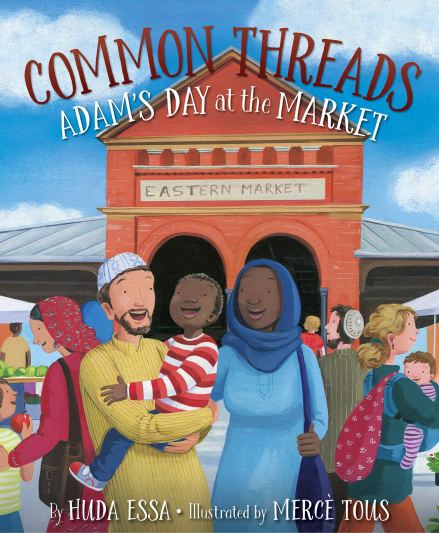
Common Threads: Adam’s Day at the Market by Huda Essa illustrated by Merce’ Tous

Standard
Common Threads: Adam’s Day at the Market by Huda Essa illustrated by Merce’ Tous

Common-Threads-Book-Cover.jpg

A lot of story is conveyed in this 13 word book for preschoolers about diversity, similarities, and love.  In 32 picture rich pages you meet a little family at an outdoor market, see Adam lose track of his parents as he follows a bird, and meet a lot of kind people as he mistakes them for his parents based on the clothing they are wearing.

A7AC0F6A-D891-4F4F-A537-0A10BA8F19A4

Naturally it has a happy ending, and it appears all the characters come together to get to know one another.  The pictures are beautiful and radiate with light and colors.

The market in general is diverse and the characters Adam meets show clothing similarities.  His mother wears hijab and he mistakes a nun in a habit for her, and then a lady in a kanga.  He thinks he sees his father, but it is a man with a yarmulke and a gentleman in a similar color shalwar kameez looks a lot like his dad’s kurta, but isn’t him either.

This is truly a picture book with sparse words of “Mama?” and “Baba?” being the bulk of the text.  It is visual and conversation sparking in its minimal and simplistic text.  By not having the author fill in the conversation, a preschooler gets to do it themselves, and hopefully broaden their mind in the process.

The beginning of the book has a beautiful Note to Readers urging children and adults to engage in diverse collaborations to increase empathy, innovation, social justice, and understanding to the benefit of us all.

6304D0EE-6710-44B9-9CF1-F6E5AD9359DC

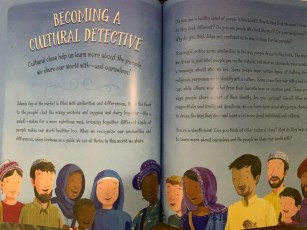
The book concludes with a challenge to children to become cultural detectives.  It notes that what we wear sends a message about who we are, but it is just what you see on the outside.  It encourages us to ask questions respectfully and kindly to learn about one another.

E48812D3-A399-40B9-B903-3D366414827A

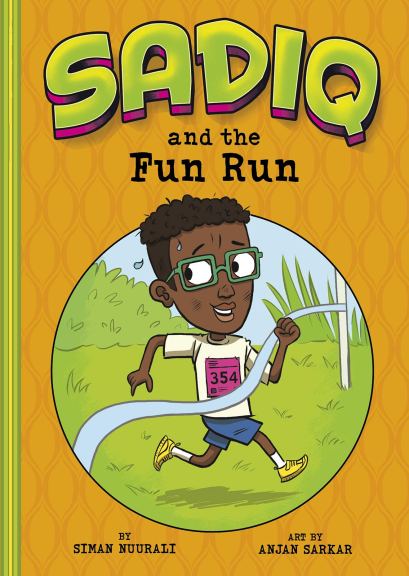
Sadiq and the Fun Run by Siman Nuurali illustrated by Anjan Sarkar

Standard
Sadiq and the Fun Run by Siman Nuurali illustrated by Anjan Sarkar

sadiq

This new series featuring Sadiq, a Somali American living in Minnesota, is great for early chapter book readers looking for representation and diversity.  There are four books about Sadiq, his family, and his friends and classmates in third grade, and all are either an AR 3.6 or AR 3.5.  At 57 pages long, divided into five chapters and filled with bright and colorful illustrations students in grades 1st through fourth, depending on reading level and interest, will enjoy these simple plotted, yet relatable stories.

F905B46F-CCAE-4094-A2C1-C7A66CD4B66F

SYNOPSIS:

Sadiq’s friends are all getting ready to try out for football, but his parent’s say that he is too young for such a rough sport and has to wait until he is 12 like his older brother, Nuurali, did.  Sadiq’s parents and family encourage him to try another sport, and with a new running club starting in a few days coached by a member of the national team, that’s what he opts to do.  Begrudgingly he joins the team, but is hurt when his friends talk about how much fun football is and how much more tough and difficult it is compared to running.  While this is going on, he is getting support from his brother to keep running, and from his teammates, but it is hard and he doesn’t enjoy it.  Slowly, he starts to improve, however, and with the Fun Run the climax of the book he sails across the finish line in first place when he sees his friends have come to cheer him on!

307C04CE-AE9B-4121-9DA0-04BE7302D795

WHY I LIKE IT:

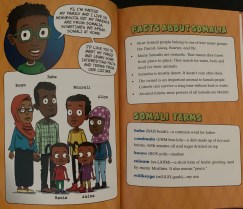
I love that the book/series proudly features a Somali-American-Muslim family.  There is information about Somali at the beginning as well as some Somali terms and a portrait with names for the members of Sadiq’s family.  The mom and older sister wear hijab, “Salaam” is one of the defined words and the characters use it when they meet.  I also love the diversity of skin tones in the illustrations and one of the girls on the track team wears a scarf as well.  There are Muslim named kids and non Muslim named kids in the story, and while Islam isn’t mentioned outright, it is definitely represented through the characters words, names, and appearances.

4F1421B3-B166-4B44-BB86-0DA161F5939F

The story is straightforward and perfect for the age group, the books in the series do not need to be read in any order, and you will get to see the different supporting casts featured more prominently in different books, thus getting to know Sadiq and his world.  I like that he doesn’t get his way, and doesn’t get to do what all his friends are doing, but he makes it work.  He is grumpy and upset, but he doesn’t get obnoxious or overly whiney.  I think this subtly gives readers some tools and insights to model in their own disappointments.  I also like that while he has to put in the work and fix his attitude, he doesn’t have to do it all alone.  His family and coach are supportive, and eventually his friends apologize and support him too.  For the simplicity of the book, you actually do get invested in his little trial and want to see the outcome.

3AC10F17-7A77-40AD-BC46-A57D4359D94F

FLAGS:

None, it is clean.

TOOLS FOR LEADING THE DISCUSSION:

This book is like a boy protagonist version of the Meet Yasmin books, they show a kid of culture in everyday experiences.  The target audience wouldn’t make it work for a school wide book club, but I think early elementary teachers would benefit from having the series in their classrooms and letting kids in small groups discuss if they want. These books would be great for first graders that are way above reading level and parents are struggling to find appropriate books.

The end of the book has some resources as well: a glossary, discussion questions to talk about and some to write down, as well as a home workout guide and information about the author and illustrator.

Bismillah Little Leyla by Qura Abid illustrated by Mona Ismail

Standard
Bismillah Little Leyla by Qura Abid illustrated by Mona Ismail

leyla

I thought this book might be leveled- reader type based on the binding and page numbers (26), but it reads more like a picture book with its repetitive refrain, and honestly the awkward small size (5×8) makes it feel like a pamphlet.  So, I’m not sure who it is trying to appeal to, and unfortunately is a great example of how the outward presentation killed an otherwise decent book.  I also don’t know who is to blame for the final physical product, the author, the publisher, the printer? But at a $10 price point, I’m not sure anyone who purchases this book is going to be happy with the size and binding, and the book will simply get lost on a book shelf, and be forgotten.

D2F8834B-35BD-4EDA-AD61-7DBBE81379C0

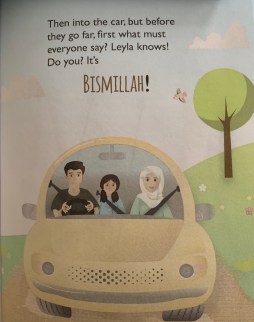
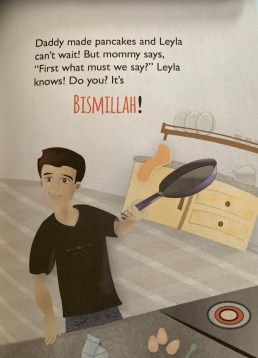
The premise of the book is good.  Rather than just tell kids to say Bismillah before they do anything, Little Leyla actually does it in the course of a morning.  I like that it shows that we say Bismillah before we do all types of things, not just before we eat or get in a car, but even when we swing and play a game or put on a jacket.

66AC3E97-BC82-4A6E-8E25-8E22F728E46E

The climax of the book is Leyla saying bismillah, shooting a goal and scoring against her dad.  The lesson being that Allah is always there to help us.

017585B3-7AD4-4769-AD6A-C218ECAE4A33

I’ve read the book a dozen times, to myself and aloud, and I think the book has a natural cadence based on the diction and sentence length, and I think it wants to rhyme.  Additionally, after each example and on nearly every page, the refrain at the end of the paragraph is (nearly) the same:  “What must she say? Leyla knows! Do you? It’s Bismillah!”  The repetition makes it memorable, but with the sing song beat and on and off, often forced, rhyme, I find myself tripping over the words a lot, and I cant quite put my finger on why.  If the book were larger, and I were using it for a preschool story time, I would just have to practice it a few times, but there is no way, sadly,  you could read this book to a group if you want them to see the pictures.

857FA476-B9FF-46D0-BBBA-035CBFADD7B1

The illustrations might be ok, it might also be a presentation thing that makes them look washed out OR maybe that is how they are, I’m not sure. The detail and expressions are there, they just kinda seem faded.   Concept wise I like that they show the dad cooking and Mom playing soccer. The mom wears hijab she the family seems warm and happy.

DD72FDED-2FB4-4E08-8275-22E7E7202728

Thanks again to crescentmoonbooks.com for the excellent customer service and selection.


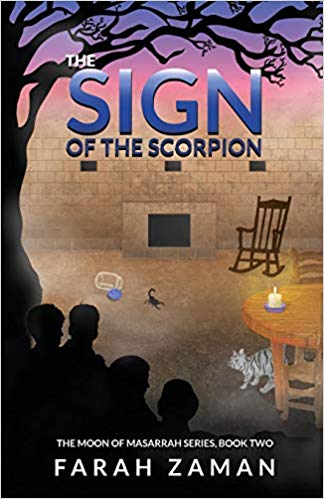
The Sign of the Scorpion by Farah Zaman

Standard
The Sign of the Scorpion by Farah Zaman

scorpion

This is the second book in the Moon of Masarrah series, but can be read as a stand alone book if you are looking for a linear story with fast paced action, intense twists, decently developed characters and quality writing that brings the sleuthing of Muslim characters to life.  At 229 pages including the glossary, the book reads to me as a middle grades book, but the last 50 pages place a lot of emphasis on accusations of a character molesting servants in the castle and another character having an affair, which might be more appropriate for older readers.  Perhaps middle school readers would be a better target audience, but I’m waiting to hear back from the author regarding who she had in mind when she wrote it.  The author said she wrote it for Young Adult, ages 12 and up in mind.

SYNOPSIS:

Brother and sister, Adam and Layla are reunited with their friends, siblings, Zaid and Zahra after last summers intense adventure involving a diamond.  This summer as a result, they are the honored guests of Shaykh Sulaiman at his dessert home, Dukhan Castle. They arrive to find out that the Shaykh is bedridden from a stroke after learning his son has died.  With a house full of relatives with reasons to want their claim to the Shaykh’s fortune, the four teenagers start putting odd occurrences of a ghoul in white, a hooded horseman, a gypsy woman’s tale, and the idea that there has been foul play, together to try and arrive at the truth of what is going on.  As they piece more and more together about the tutor, the cousin, the fiance, the grandson, and a mysterious mole-man following them, they themselves get tangled in the sinister plot of revenge and must keep an eye out to figure out who the scorpion, Al-Aqrab, is before one of them ends up dead.

WHY I LIKE IT:

Set in a fictious land, the detail is the perfect balance between setting a stage and over describing it.  The book did not drag for me at any place, nor did I find myself confused about what was going on and why.  Granted I probably could not tell Adam apart from Zaid and Layla from Zahra, but the book is about their adventure and figuring out whats going on, not about their relationships or back story.  And with the focus on all the possible perpetrators and their motives taking center stage, having four people gathering clues makes the information come easier and smoother.

All the characters are Muslim.  Some of the women cover and some do not, some stop to pray and make regular references to Islamic hadith or Quranic Ayats, and some are suspects.  For example when they are exploring the dungeons beneath the castle, they liken the caves to the Sleepers in the Cave mentioned in Surah Kahf.  The book never gets anywhere near preachy, nor do the few references ever get annoying, they just flesh out that the characters are Muslim, and thus they see the world through that lens.

FLAGS:

The book has murder, lying, deception, all the ingredients for a good who done it.  And while the details are all clean regarding how the four teens interact with the opposite genders, the climax of the book is the coming to light of allegations of molestation and a failed marriage is attributed to a presumed affair.  No definition of the words is given, and I reread many of the passages and I don’t know that there is even enough context clues to decipher what the word molest means in the text.  Most kids however, could easily ask Siri or Hey Google or whatnot and may have more questions about what it means to sexually assault a person, specifically a woman or child, and why someone would do it.  I leave that for parents to decide at what age those in their charge can grasp such a word and concept.

TOOLS FOR LEADING THE DISCUSSION:

I’m torn on teaching the book as the linear telling might not appeal to older kids, but the motive and revenge isn’t appropriate for younger kids.  I think if used to discuss broader issues the book could be really powerful, and not just a fun read.  I could see discussing with 9th graders or so the seriousness of false accusations, drawing on the Me Too movement and how sexual crimes and transgressions should be handled and treated.  I think the book could be a springboard for those discussions and seeing the effects of believing or not believing, and perhaps suspending judgement until research can be done.  In the case of the book, it would not have been difficult to pursue the allegations, while protecting any potential victims.


NOTE:

The first book in the series, The Moon of Masarrah, was originally published under the title, The Treasure at Bayan Bluffs, some changes have been made in the new printing, so while I don’t normally review second books in a series, I felt this book might bring attention to the new title of the first book and drum up interest for the upcoming third book in the series.  No, I don’t benefit in any way and I purchase my copies just like you, the stories are just really well done and I want readers to give them a try.  Happy Reading!

If Allah Allah Wills by Dr. Oz illustrated by Mariya Khan

Standard
If Allah Allah Wills by Dr. Oz illustrated by Mariya Khan

if allah wills

Not all books need to teach something, but when the book would lend it self so easily to dropping a fact or two, it seems like it would take it.  In 40 pages, preschoolers are taken on a highly imaginative journey to the Ka’ba, yet no information about the history of the Ka’ba, or any mention of Umrah or Hajj is shared, not even in passing.

IMG_6336

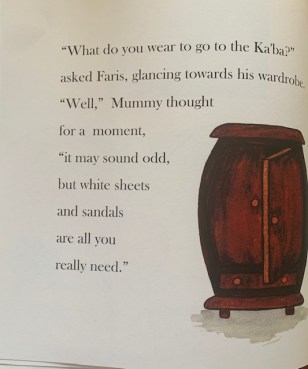
Faris wants to go to the Ka’ba but it is nearly his bedtime, so he has to act fast.  He asks his mom what he needs to wear, obviously knowing special clothes are required, but his mom prefaces the answer of white sheets as being “odd” and then adds that you need sandals.  For a book that wants to normalize Islam for children, I don’t understand why the mom would say that ihram is odd, why the word ihram isn’t used, why it doesn’t even specify the number of white pieces of unstitched cloths and why sandals would be included.

IMG_6337

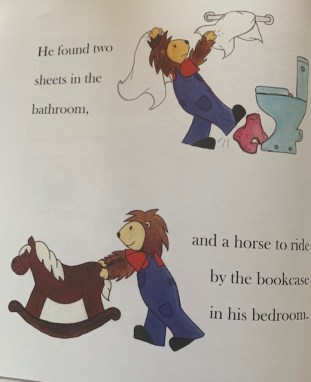
Faris then finds two white sheets, but the illustration shows him getting towels out of the bathroom (possibly showing his imagination, but kids will just think it is an error, mine did), packing some food and jumping on his rocking horse to head off for the Ka’ba.

Faris finds himself among the stars without a map and starts to worry that he won’t find his way.  He then sees a flock of birds and wonders how they know where to go.  The book however, doesn’t answer how birds know, and just has him land and find someone to ask.

IMG_6338

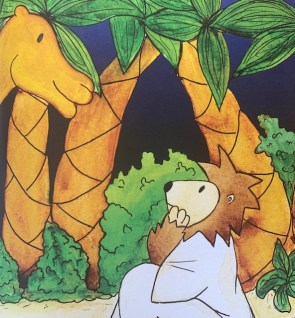
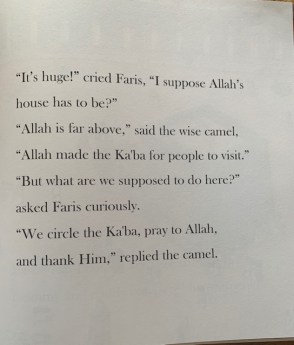
Luckily Faris finds a camel to ask, and luckily he is a nice camel and he shows Faris to the Ka’ba.  Faris is surprised at how big it is and then supposes that Allah’s house has to be.  But he asks it as a question, which makes it a little off grammatically.  The camel points out that Allah swt is above and that the Ka’ba is for people to visit.  Faris asks what is supposed to be done at the Ka’ba and the camel answers, “We circle the Ka’ba, pray to Allah, and thank Him.”  This seems like a great place to sneak in some facts about who built the Ka’ba and why or mention Hajj or Umrah, it seems so misguided to just say we circle it.

IMG_6339

Faris makes some prayers that he can return for real one day with his parents before he finds a place to eat his snack and share his food with his camel.  It is nice that he shares with his new friend, but odd that when they part Faris asks him his name and he says he doesn’t have one.  Maybe give him a name, and detail its meaning or don’t include the exchange at all.  I seriously don’t understand the purpose of the exchange.

IMG_6340

Faris makes is home with a crash and his mom tidies him up and they say InshaAllah that Faris’ prayer inshaAllah will come to fruition.

The book has a great premise of imagination and tying in the Ka’ba, but truly there is no information about Islam or the Ka’ba or even Allah swt, it gives a mood of worship, but that is about it.  I get that it is for little kids and the book is supposed to be whimsical and light, but sneak in some facts, kids can handle it.

As for the illustrations, they are just ok.  They would have benefitted from being a little smoother and not looking home-done, but there is nothing terribly wrong with them aside from the towel and sheet imagery.    The glossary cover and large font inside is age appropriate, some pages are a bit text heavy, but overall sufficient.

IMG_6341

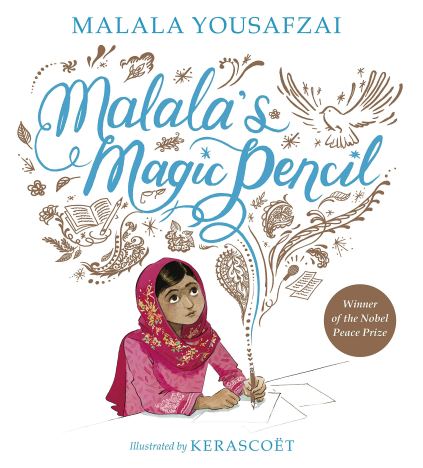
Malala’s Magic Pencil by Malala Yousafzai illustrated by Kerascoet

Standard
Malala’s Magic Pencil by Malala Yousafzai illustrated by Kerascoet

malala

I’m going to try my best to review a nonfiction autobiographical book and focus on the story, not on the author because yikes, Pakistanis have strong opinions about Malala, and I have no desire to get pulled in to an argument.  I’m half Pakistani, I know the position of both sides.

IMG_6245

I have read both the Young Readers Edition and original I Am Malala books, so I didn’t jump to review this book in 2017 when this AR 3.6 40 page re-re-telling of her story came out.  After reading numerous other children’s books about girls in the subcontinent striving to go to school and be educated, I thought maybe the controversy had calmed down and I could read this large hardbound book a bit more objectively, and thus focus on the story a bit more.

IMG_6246

The book is listed as a biography, not an autobiography, so I’m not sure Malala even wrote the book, but none the less it is a synopsis of her story for younger elementary children.

IMG_6247

Starting off a bit like Harold and the Purple Crayon, Malala asks if the reader believes in magic, and then tells what she would do if she had a magic pencil to draw things that would make other’s happy like a proper soccer ball for her brothers and a way to stop time so she could sleep in a little longer in the morning.

IMG_6249

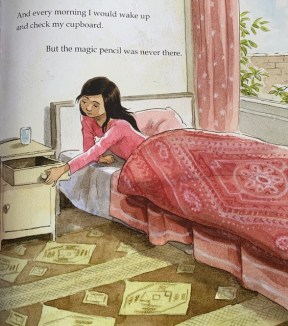
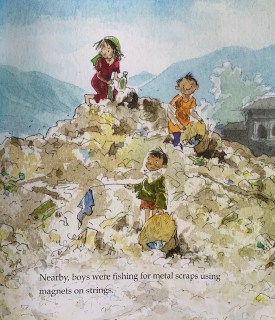
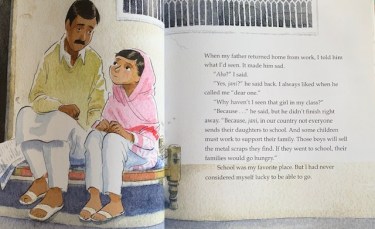
Every night she hopes for a magic pencil, and every morning she is sad one hasn’t appeared.  As she starts to notice the world around her she realizes that the kids looking for food and metal scraps in the junk yard, have it much much worse.  She asks her father about it and learns that if the children were in school their family’s might go hungry.

IMG_6250

As she notices “real” problems around her, her ideas for what her magic pencil could fix, evolves and develops into a burgeoning social conscience.  But quickly her naive outlook is changed when dangerous men start to appear on the streets and girls in her class stop coming to school.
IMG_6251

Her magic pencil finds real world power when she uses her words and her voice to make a stand and people start to pay attention.  The rest of the book highlights how she made progress despite the attempt to stop her and how she now uses her “magic pencil” to work to make a more peaceful world.

IMG_6252

The surface story is incredibly hopeful and would motivate young children to notice the world around them and do what they can to improve it. Inquiring children might be alarmed at children going through trash, or want a lot more information about who the scary men are and why they don’t want girls going to school and why she gets to travel around and tell her story. Information that is given at the end of the book in an afterwards of sorts.

IMG_6253

Most pages have sparse text and the ones that have a lot are kept on level and avoid being preachy.  Even the attempt on her life is present, but not detailed, sufficing to say that they tried to silence her, but failed.

The illustrations are beautiful and tell the story as much as the words do.  The book does not mention religion, but in the pictures where she is out of the house her hair is covered, but not when she is at home in bed and whatnot.  Obviously it is how she carries her self in real life.

Overall, I think the book is incredibly well done and inspiring to young readers.  Anytime a modern day figure can show children that they too have a voice and can use it, I think it is a good thing.  The fact that the voice comes from a minority, a female, a person with a name and culture different than the ones in most western children’s text books is also a plus.  I hope if nothing else it opens a window to children that there are a lot of amazingly strong and courageous people in all cultures and to seek out their stories.

IMG_6254

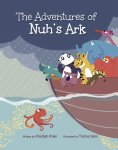
The Adventures of Nuh’s Ark by Khadijah Khaki illustrated by Tashna Salim

Standard
The Adventures of Nuh’s Ark by Khadijah Khaki illustrated by Tashna Salim

nuh

If you are looking for a comprehensive or somewhat detailed story about Prophet Nuh (AS), this book isn’t for you or your child.  If you want a silly story with hilarious animals to introduce your little one’s to the concept of the animals boarding Nuh’s Ark as a commandment from God, then order this book already!

IMG_6160.jpg

This 24 page rhyming hardback 8×10 book written for preschoolers through early readers takes the idea of animals boarding Nuh’s ark and tells what it is like in a fictional account narrated by the animals themselves.  And focuses on a pair of confused koalas as to what is going on.

IMG_6161.jpg

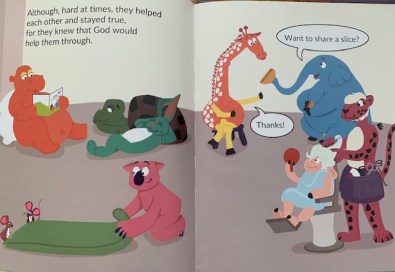
The poor koalas, are not prepared for rain and don’t do well in small spaces.  They pack too much and can’t keep up, but luckily the other animals are nice and they all work together until it stops raining and they can disembark on to land.

IMG_6162.jpg

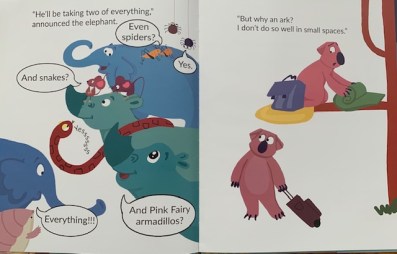
The pictures are cute and comical and bring the text to life.  With the conversation bubbles adding to the story, even the pages that are a bit text heavy keep the younger listeners engaged, as they know something funny is about to be said.

IMG_6164.jpg

Also, the book is one in a series or three, so far, and the characters are the same ones found in the Adam and God’s Creation book as well (might be in the Ibrahim one too, but I haven’t read that one), making the nameless animal characters actually memorable as they say silly things, and are pictured being rather unique too.

IMG_6163.jpg

The books do not use the word Allah, but do mention God, and the Arabic of Nuh, rather than Noah, and there is mention of why there is a flood and how long it will last, but nothing quoted directly from the Quran.

My older elementary and middle school kids found the books silly as well, and giggled their way through.  It is a a fun read that even adults won’t mind repeating.  If you want a more Prophet story retelling, Migo and Ali Love for the Prophets is a good non fiction book, and it, along with the three book Lunar Learners serious can all be found at my favorite supplier Crescent Moon Store.


Secret Recipe Box by Helal Musleh illustrated by Nalan Alaca

Standard
Secret Recipe Box by Helal Musleh illustrated by Nalan Alaca

recipe-box.jpg

The publisher suggests this book for ages 4 and up, but I think it’s a bit long (30 pages) and detailed for that age group, and first grade and up will benefit more from this heartfelt story.

IMG_5872.jpg

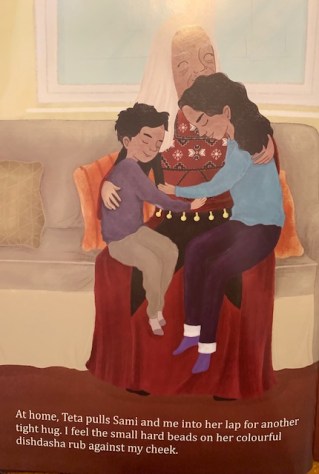
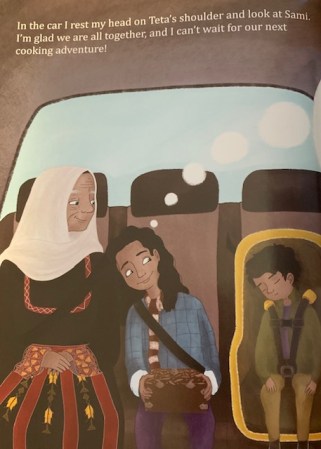
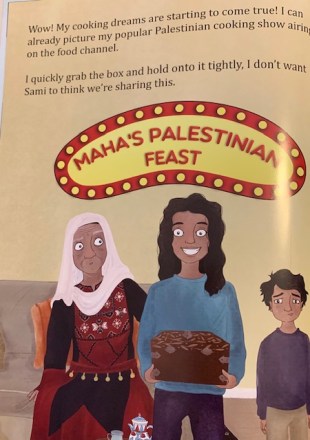
Maha is excited her Teta is moving from Palestine to live with her, her brother Sami, and parents in Canada.  Maha dreams of being a chef on a famous cooking show, and her Tata and her secret recipes will be a great way to practice.

IMG_5873.jpg

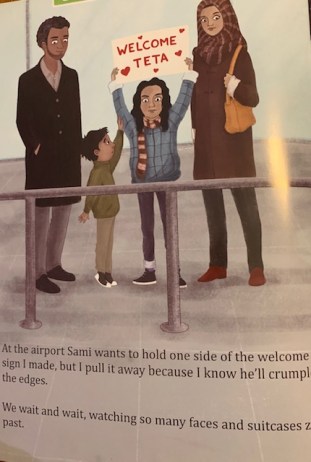
Her little brother Sami is always in the way though.  Whether it is wanting to hold a sign Maha has made, or is wanting to cook with her, she is annoyed by him at every turn.

IMG_5764.jpg

As Maha listens to Teta’s stories and learns about her life in Palestine, she starts to change in her approach to Sami and realizes that family has to take care of each other.

IMG_5874.jpg

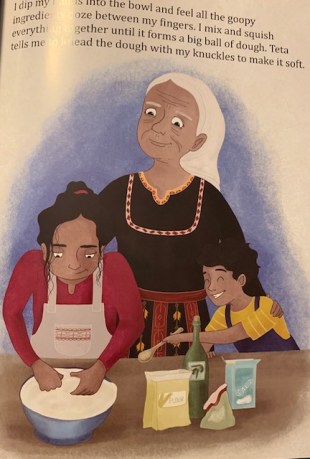
After a day of cooking together, Maha, Sami, and Teta have made too much food and decide to go and share it with those in need at the soup kitchen.

IMG_5763

The book addresses kindness, changing, compassion, immigration, taking care of one another, multi generational lessons and love, stories, life lessons, and some highlights of Palestinian culture, food, clothing, and tradition.

IMG_5761

The book is warm and well done, with the exception of a few of the pictures which seem a bit off to me.  Overall, it is a sweet story that presents with a lot of lessons, but doesn’t force them upon the reader.  The character growth is gentle and subtle and will resonate with readers.

IMG_5762

The characters mention Halal food, and the grandma wears hijab even in the house, where the mother is shown wearing it at the airport, but not in the home.  The book would work for Muslim and non Muslim readers.

Our Granddad by Maryam Ahmed illustrated by Kulthum Burgess

Standard
Our Granddad by Maryam Ahmed illustrated by Kulthum Burgess

grandad.gif

This 29 page (four chapter) middle elementary book about understanding sickness, old age, and a bit of death, makes some good points about sabr and dua and Allah testing us with illness.  The story, however, is really dry and never becomes more than just a vehicle for conveying the author’s message of how Islam views elders and the challenges often brought upon as they age.

SYNOPSIS:

Hafsah, age 8, and her 11 year old brother Hasan are meeting after school so that they can join their parent’s in the long drive to Devon to check on their sick grandfather.  The drive is apparently really long, but being that we don’t know where the kids live or how long the drive is, we just know it is a long, painful, miserable drive.  The family is silent with worry about the grandfather on the trip, but no indicators as to what his diagnosis or symptoms are is given, just that he is ill and as the night and drive progress, the children worry he is dying.  Hasan, in the darkness of the car, sheds some tears about losing his fun granddad, but no details about the adventures they go on, or why he is fun are shared.  Their mom encourages them to continue to make dua and tells them that maybe the illness is a blessing, but the children don’t understand what she means by that.

When they arrive, the children are told it is too late bother their granddad and to wait til morning to see him.  The next day the doctor tells them he had an asthma attack and is on new medicines that are helping.  Seems like there should be more to the illness, as asthma once the attack is over can be controlled, and no other mention of heart problems or pneumonia or other diseases are indicated.  Hafsah and Hasan finally get to see him and are surprised he is awake and talking and they learn that sometimes Allah tests us by giving us hardships and that their duas and prayers were helping.  He shares the hadith, “No Muslim is afflicted with an ordeal, be it an illness or something else, without Allah thereby causing his sins to drop away just as a tree sheds its leaves.” Unfortunately, the hadith is not footnoted or attributed, but the characters and readers understand the lesson and find peace in knowing that every hardship is an opportunity not a punishment.

WHY I LIKE IT:

I love the concept of the book, just not the execution of the principles it instructionally conveys.  Kids need books that explain some of the big concepts that they can’t necessarily understand or even ask about, such is why do we get sick, what is going to happen to our grandparents etc.  The book really just needed more showing and less telling.  It details how the kids chase each other home from school, but doesn’t tell of the adventures that granddad and Hasan go on, it just tells us that they miss having these adventures.  There is no character development, and there is definitely space for the reader to feel for the grandpa and the concern of the kids, but it is glossed over in words not in anecdotal sharing.

The book is British, and some of the words and phrases might be confusing to American kids, such as the description of the grandfather being poorly used repetitively.

The book is presented well with clear font and spacing on glossy pages bound in a hard illustrated cover.  There are small detailed life-like pictures throughout the story that show the kids and family.  The females are in hijab and the family is clearly Muslim.


FLAGS:

None

TOOLS FOR LEADING THE DISCUSSION:

This is probably a decent book to have in an Islamic School library, it would function as a reference book more than a novel or book kids would naturally pick up.  If doing a theme on aging or sickness, or tests from Allah, this book would fit in nicely in adding to a discussion, but outside of that, I can’t see that kids will even remember the book or what it is about.


Bilal Cooks Daal by Aisha Saeed illustrated Anoosha Syed

Standard
Bilal Cooks Daal by Aisha Saeed illustrated Anoosha Syed

bilal cooks daal

Aside from me desperately wanting to get Bilal’s family a pressure cooker this 40 page book does a good job, and follows a reliable tradition of using food to introduce a “foreign” culture while simultaneously showing universal themes that show how similar we all are when it comes to family, meals, friends and feeling loved.  

Bilal’s favorite food is daal, lentils, and when he is out riding his bike with his friends, his father calls him in to help him make it.  Confused as to why Bilal’s dad would need to start dinner so early in the day, Bilal’s friends join in, in helping make the slow cooking traditional asian subcontinent dish.

IMG_5306

They line up the spices, they put it in the pot, and then they wait.  They put their shoes back on and play hopscotch, they go swimming, they go for a hike and it still isn’t done. 

IMG_5308

At one point Bilal is worried his friends won’t like it, but after waiting all day and gathering more friends at each activity, when the time finally comes they all dive in and love it.

IMG_5309

I love the diversity of the friends and that the dad is cooking and involving his son.  I also like that everyone is willing to try something new and give it a chance.

IMG_5307

The book would work for all kids ages 4 and up with the expressive colorful illustrations, diction, and amount of text on the page.  The book is 9×8 so it works well in small groups and at bedtime.  
IMG_5310

If you eat daal your kids will love seeing themselves in the pages, if you have never had daal there is a recipe at the end following an Author’s Note. 

IMG_5311

There is nothing religious in the book, and anyone from India, Pakistan, and Bangladesh could easily take ownership of the dish and story.  The Author’s note mentions that Bilal’s grandparents are from Pakistan and with a name of Bilal chances are he is a Muslim character.