Tag Archives: magic

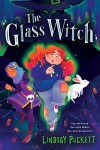
The Glass Witch by Lindsay Puckett

Standard
The Glass Witch by Lindsay Puckett

glass witch

Another Scholastic published book that I genuinely cannot understand why the author forced a Muslim character to be a part of, and no it isn’t just a token hijab on a character named Fatima.  It mentions she goes to the mosque, there is a Quran on the book shelf, her parents don’t understand her obsession with monsters, she is desi, and there is Urdu in the text as well.  This isn’t me just doubling down on Halloween being a pagan holiday that I’m against, this book is about witches and magic and while it does take place on Halloween, and the witches are Good(e), it is their last name, it is a weird inclusion flex for me.  The book also has the Muslim grandpa crushing on the grandma witch, he even kisses her hand and they are revealed to be soul mates.  There is evil possession, different men that could be the protagonists father, killing, and a pageant.  The book has good qualities- positive body size messaging, focus on family love, self acceptance, and is fast paced and entertaining, but even as a parent that lets my kids read fantasy books, and books that mention Halloween, this book went too far for me.  It normalizes Muslims being ok with magic, it isn’t world building and fantasy, it is very much the real world with sihr characters and practices. It positions the parents as being loving when they come around to accept their daughter’s love of monsters, it also seems to normalize men and women relationships, and for a middle grade 224 page book I just can’t support a Muslim character’s role in such a story. 

I know sometimes I’m ok with magic in books, this one just seems a bit intense, we might just have to agree to disagree if you feel differently, and I’ll own my possible inconsistency in the matter as well.

SYNOPSIS:

Adelaide is heading to her grandma’s house with her mom, and being dropped off for three months- abandoned is more like it. The family dynamic is stressed even on a good day, and today is not a normal day.  The Goode family of witches are all that remain of the witches in the town and more than three can not exist within town lines.  Additionally, if at least one witch is not always in Cranberry Hollow, all the magic will be lost.  Adelaide, doesn’t have magic though, toss in that she is a bigger girl than most other twelve year olds, and that she never feels like she is enough, and the bees within her are buzzing. 

The plan was to drop off Addie and head out of town.  The neighbors, Hakeem and his granddaughter Fatima show up though, and before Candice can sneak out, she finds herself heading to the Cranberry Hollow Halloween Festival with Fatima, Addie, and her mom.  The town loves the Goodes, they help crops grow better, cancer to be cured, and so much more.  Of course they don’t know that they are witches, but they know that they are helpful.  When the time to leave arrives, Aunt Jodie stays on the other side of the town line and they prepare to say their goodbyes and keep the fourth Goode outside the imaginary line, but Addie in a last ditch attempt to make her mother notice her, pulls her mother back across and thus sets off the curse of having too many witches in the town.  The hated Hern family is going to be possessed, and Addie will be hunted come midnight on Halloween.

WHY I LIKE IT:

The book is intense and scary at times, just toeing the line of what a MG reader can handle, I just don’t get the Muslim character.  It really seems intentional and thought out, and I would love to find out why it was a conscious choice.  There is a small passage equating Addie standing out because of her size with Fatima and her hijab, but I can’t imagine that is enough of a reason to have a practicing Muslim loving Monster hunter in the book.  I know we want representation, but this didn’t work for me, and while I know others are ok with Halloween and some with sihr in a fictional sense, having a Quran on a shelf above the book of monsters and jinn that the Nana has collected, just rubs me the wrong way.  The book is published by Scholastic and will undoubtedly be in book order offerings and in book fairs, and if you are ok with it for your children, that is your choice, I just feel obligated to share my concerns so that you can decide what is best for your family.

FLAGS:

Magic, witches, curses, killing, death, Halloween, crushes, romance, kiss on the hand, premarital sex not detailed (two options at least for who Addie’s father is), cigarette smoking, bullying, mention of a kid at the festival with two dads.

TOOLS FOR LEADING THE DISCUSSION:

I wouldn’t shelve the book in an Islamic school library or classroom.  I would also pull it from a Scholastic Book Fair display at our Islamic school.
A Darkness at the Door by Intisar Khanani

Standard
A Darkness at the Door by Intisar Khanani

darkness

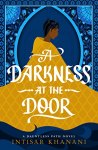
Y’all I was devastated when Theft of Sunlight ended on a cliffhanger, but Alhumdulillah, this conclusion was well worth the wait.  My heart is at ease, even if I am trying to figure out how to get the “Blessing” so that I can forget I read the book, and enjoy it all over again for the “first” time.  I don’t normally review second books in the series, and this won’t be a typical review, but truly if you have not read Thorn or Theft, what are you waiting for, go get those books and start reading.  I don’t know a lot about the publication drama of this fantastic book, but I do know that it was not published in the USA by the same publisher as the first book in the duology, and the thought that we, the readers, could have stepped up the pre-sales and shown our love for the series, the author, and the characters weighs heavy on me.  Thankfully, the UK publisher kept the book and the author found a way to get Darkness to us in the US (it publishes later this summer), but truly we have the power to support good, quality stories, and we must actively show it so that they get published, rather than simply complain about what options are made available to us. This is the author’s website: http://booksbyintisar.com/ if you sign up for her newsletters you can get all the bookishly delicious info.  She is not asking me to promote her or her books, but I happily share and direct support to her, because her stories really are great, and from what I can fangirl find out about the author, so is she.

The book picks up where Theft leaves off, and manages to remind readers what might have been forgotten in the interim.  It had been over a year since I read book one and while I fumbled a little at the beginning, the author caught me up to speed and didn’t let me lose a beat in Rae’s latest and ongoing adventures.  It starts with Rae aboard a slavers ship with children bound for a horrible fate.  More than just her life is at stake, as the information she has recently discovered implicates palace officials, the Circle of Mages, an heir to the throne and so much corruption.  With the help of street thief Bren, Rae gets herself in and out of trouble quicker than most expect.  Her clubfoot, sharp brain, and genuine values, force anyone who underestimates Rae to find themselves scrambling to keep up.  She has grown to love her body and the strengths that it affords her, and in her actions and dedication to changing the world she becomes a formidable river Pirate Queen that you genuinely care for, cheer on, and hope gets a happy ending.

Yes, if you have read Theft and are wondering why I didn’t mention Princess Alyrra, Red Hawk, the Cormorant, Niya, Stonemare, Artemian, and everyone else, fear not, they are all present, and get their story arcs, I just don’t want to risk a single spoiler.  If you’ve waited for this conclusion, you will find yourself desperately dreading the final pages, and wishing the story would never end.  The fantasy, action, characters, world building is all incredible and so hard to put down.  The author is Muslim, but there is no Islam present in the stories, although hints of desi culture do seem to present in the Sweetening atleast. 

The book is YA, but I think 15 and up or so would be a good fit. Like the others in the series, it has magic, murder, killing, lying, thieving, alcohol, corruption, implications of sexual abuse, assault and threat of rape, but this book also has some language, talk of infertility, and some implied banter about marital relations. The romance is very halal and clean, but the violence is graphic as dealing with the implications of murder and slavery are grappled with and thus a thematic element of the story.

Thank you Netgalley UK for the arc, if the book looks interesting and fun for you, please preorder the book wherever you are.

Hungry Hearts: 13 Tales of Food and Love edited by Elsie Chapman and Caroline Tung Richmond

Standard
Hungry Hearts: 13 Tales of Food and Love edited by Elsie Chapman and Caroline Tung Richmond

hungry hearts

Occasionally I get asked about short story and/or essay from a collection that a college or high school student is hoping to share with a class that doesn’t take long to read, but shows Islamic representation.  And I never have a suggestion.  The middle grade collection Once Upon an Eid is amazing, but for younger readers.  When I learned about this collection that features two known Muslim authors, Karuna Riazi (The Gauntlet series) and S.K. Ali (Saints and Misfits, Love from A to Z), and involves food, I thought to take a look and see if I might finally have a suggestion.  Sadly, no.  None of the 13 stories wowed me, or really impressed.  A few I started then skipped, and none were really memorable.  The premise is unique: all the stories take place in the same neighborhood, feature food, and crossover characters, but some are love stories, others redemption, some have super heroes, others murder and gang violence, some really keep the food central, and others just mention it as being present.  There is familial love, romantic straight, lesbian, and trans love, there is friendship and food from many cultures served up to varying effects.  I admittedly read few short story collections, but even with that taken in to consideration, I think skipping this 353 page YA/Teen book is probably the best option.

SYNOPSIS:

I’ll only summarize the two Muslim authored stories.  A few of the others are culturally Indian, but they eat pork, so I’m assuming they are not Muslim, and the Persian one by Sara Farizan features alcohol and a lesbian romance, so since in a past book of hers I noted that I didn’t know if she or her characters identify as Muslim, I will skip reviewing hers as well.

Hearts a’ la Carte by Karuna Riazi:   Munira works at her families food cart, King of Kuisine and serves up Egyptian food to the people on Hungry Heart Row.  When a guy falls from the sky, she finds her self also falling hard for Hasan, as he regularly starts coming to eat and visit, but when it is revealed that he is a super hero (the Comet) and the reason her families cart is destroyed, Munira is not willing to pursue things further.

A Bountiful Film by S.K. Ali: Hania and her family have recently moved to Hungry Heart Row, where her father grew up and grandma Valimma lives.  Irritated that she had to leave her school, her job at Daily Harvest and friends behind, Hania is hoping to lose herself in putting together her film for the upcoming competition and beating her long time rival Gabrielle Rose.  With no clear idea of what her film should be about she starts with interviewing Valimma and her friends, which turns up a bit of an unsolved mystery involving a missing boy that keeps showing up on the security footage from local businesses.  Hania decides to pursue it, but finds herself being watched, and filmed in the process.

WHY I LIKE IT:

I like that the stories are interconnected, I don’t know that it works, but I like the idea of it.  As for the two Muslim authored stories, I like that Islam and culture are included slightly, but that the story is much more than that, and the characters have more pressing issues to figure out.  I wish in both of these two stories, food was more fleshed out.  They seemed to be lacking the magical food premise that many other stories in the collection had.

img_7244

FLAGS:

See above paragraph for some collection flags.  Riazi’s story has crushes and a budding romance, but nothing overtly “haram.” Ali’s story is clean.

TOOLS FOR LEADING THE DISCUSSION:
I wouldn’t probably even shelve the book in our Islamic school library, it doesn’t offer much in my opinion.

The Tale of Princess Fatima, Warrior Woman: The Arabic Epic of Dhat al-Himma translated and edited by Melanie Magidow

Standard
The Tale of Princess Fatima, Warrior Woman: The Arabic Epic of Dhat al-Himma translated and edited by Melanie Magidow

princess fatima

I’m not sure how to really review this 167 page book.  It is the translated YA work of an Arabic Epic that took place somewhere between the seventh and 10th centuries and began possibly being compiled in the 1100s.  It was told orally, but when written, comprised some 6000 pages.  The translator notes that the choices of what to include and how to translate, all potentially alter and reshape the narrative, so as a reviewer I’m simply going to review the text in my hands.  I have no outside knowledge of this epic woman, and approached the book as I would have in high school when reading The Odyssey or Beowulf: some of the history is accurate, the characters fictitious, the culture possibly representative.  As a result, I find the comparisons to Wonder Woman and Katniss Everdeen on the back cover, very odd choices.  At times the contemporary diction, in my opinion cheapens the narrative.  Sure I appreciate the modernization of the text to make it an easy read, but throwing in modern slang seems too much.  I found the book’s framing unfortunately counterproductive of what it hoped to achieve.  I have no idea what the other 5,900 pages include and what the translator had to choose from, but the majority of the book focuses on marriage, being raped by her husband, and working to prove who the father of her Black son is when her and her rapist husband are white.  I was prepared for battles, and conquering, and fighting misogyny, and saving the down trodden, not every one just wanting to marry her.  Many of the characters are Muslim, some convert to Christianity to escape Dhat al-Himma, the Quran is quoted, prayers are made, the Kaaba visited.  I do however, take issue with the explanation of the child’s skin coloring being attributed to intercourse (rape) occurring while Fatima is menstruating and a case of Prophet Muhammad (saw) being used as proof of this occurring.  So much of the text is footnoted, this instance is not, and I find it disturbing.  The book also contains a lesbian character who ends up marrying a man, violence, death, and many other potential flags (see below) that might make it better suited for older college age readers.

SYNOPSIS:

The story doesn’t begin with the birth of Fatima, but rather with her great great grandfather.  It sets the stage a bit to show culture, how women and honor are treated, and the line of her ancestry.  When we get to know Fatima a few chapters later she is being born and her gender is a disappointment, so she is hidden away.  As she grows away from her tribe she becomes an accomplished warrior and captures her father in a raid.  When she returns to her people, her cousin, Walid, born the same time as her, is struck by her beauty and wants to marry her.  She refuses.  Repeatedly.  Finally she agrees to battle him and if he wins, she will marry him.  She wins, and he still doesn’t back down, finally she is forced/tricked in to marrying him by the Caliph’s agent.  The two are pronounced wed, but little changes for Fatima, she is a warrior and does not seek intimacy or companionship.  Eventually, her husband Walid enlists the help of Fatima’s milk brother and friend, Marzuq, to have him drug Fatima, so that he can rape her.  He acknowledges the rape, the whole community does, but allows it, because he is her husband.  When the child is born he is Black and Walid and his family refuse to accept that the child is his.  Amira Fatima is socially put on trial for being a whore and that the child is illegitimate.  As Walid works to have them killed, Fatima works to prove her innocence and carry on with her life trusting in Allah swt completely, all while the Arab-Byzantine battles are raging in the borderlands.  As Abdelwahhab, Fatima’s son, grows he too becomes a formidable warrior and the two have continued adventures.

WHY I LIKE IT:

I love the richness of the culture coming through a compelling story. Fatima is incredibly devout in her worship of Allah, swt.  She does not falter, ever.  When she is being tested she needs only her faith, at one point a man converts to Islam upon having a dream as a result of her conviction in praying.  That being said, I genuinely don’t understand a few critical points.  How can a woman who single handedly destroys tribes not be listened to, to make her own decisions to lead her own life.  I get that that is perhaps the poignant point of the story in today’s context, but there are a lot of strong women in this book, so why does her marriage and being defined by her not wanting to marry get so much of the spotlight? Her father didn’t want her, but they don’t resolve anything, they just reunite and all is well.  I need more.  I want to know what happened to Walid once he became Christian, was it a permanent thing, a temporary fix? What ended up happening between her and Marzuq? He was her trusted advisor and immediately regretted drugging her, what happened to him.  I want more about her mother, maybe even her Aunt or other women to see how their lives compared and contrasted to the powerful women highlighted.  How did they view her, was she inspiration, an anomaly, beloved, loathed?

I appreciate the footnotes, the introduction, the Note on the Translation, the further reading list, help with pronunciation and the character list.  A map would have been nice.

FLAGS:

There is violence, killing, rape, talk of sexual intercourse and menstruation.  There is misogyny, racism, flirting, sexual temptation, a lesbian character, magic, jinn.

TOOLS FOR LEADING THE DISCUSSION:
I would not be able to lead a proper discussion on this book, I am just not knowledgeable enough on the larger story.  I think I would like to be a student or be able to join a discussion led by someone well versed in The Tale of Princess Fatima and all the subtext that brought her story to life and maintained it over time.  It would be fascinating.

Amira & Hamza: The War to Save the Worlds by Samira Ahmed

Standard
Amira & Hamza: The War to Save the Worlds by Samira Ahmed

amira and hamza

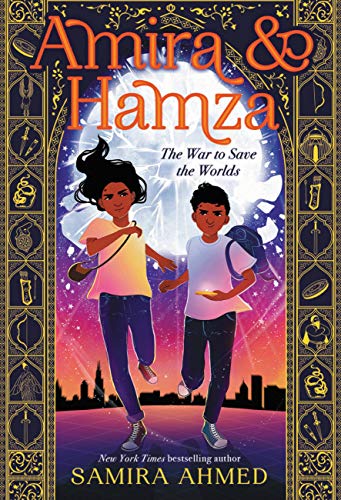
Make sure you are sitting in a comfy spot when you crack open this middle grades fantasy adventure, because it hits the ground running from the very beginning and doesn’t let up over 368 pages.  The like-able and relatable brother sister duo snarkily banter and bicker about everything from cultural Indian (Desi) folklore, religious stories, Marvel, Lord of the Rings, He-Man, Arabic Sesame Street, Star Wars, hygiene, fears, potential science fair projects, and food, all while battling jinn, devs, peris, and reality as they work to save the worlds.  The book is chalked full of STEM concepts, cultural touchstone, Islamic footholds, pop culture, and fun, as one character remarks, it is the ultimate fan fiction. I regularly Googled people, references, and concepts, and ended up learning quite a bit.  And don’t fret if you ever get lost or confused, or something doesn’t make sense, you don’t have to worry that you missed something or that the author left a gap in the narrative, the book moves quick and Amira’s constant dialogue and commentary points out all the ridiculousness of what they are experiencing and the questions that she wishes she had time to ask, explore, and discover.  The author never loses control of the narrative, and keeps the world building on level without skimping on details and understanding.  I have not loved any of the author’s previous books in their entirety, I think this one, however, is her best one yet, and the switch to middle grades is a good fit.  

SYNOPSIS:

Twelve-year-old Amira and her 10-year-old brother Hamza are heading to the Shriner’s Madinah Temple in their hometown of Chicago to explore the exhibit of Ancient Astronomy artifacts, or as Hamza calls it “tools that belonged to dead Muslim Astrologers.”  Hosted by the Islamic Society of Ancient Astronomy corresponds with the eclipse viewing party of the incredibly rare super blood blue moon.  In typical Hamza fashion however, a Nerf gun is brought and things are touched.  When Amira is tasked with bringing her brother up to the roof to learn how to use the telescopes, the two scuffle over a small box with a tiny moon inside, a series of snatching and tussling between the siblings cause the Box of the Moon to break, or rather start working.  As day turns to night, the moon seems to be breaking a part, and everyone in the world is suspended in sleep except for Amira and Hamza, and an entire jinn army is heading their way.

When jinn leaders Abdul Rahman and Maqbool reach the children they must convince them that they are not there to harm them, but rather to recruit them as the chosen ones to save the worlds: Qaf and Earth and the barrier, the moon, that keeps the realms separate from destruction at the hands of Ifrit.  The confusion over there being two of them creeps up, but is squashed as Suleiman the Wise left tests to prove that the chosen one is properly equipped to battle Iftrit as it has been prophesized.  The children must work together to prove themselves they must then actually seek out and defeat Ifrit.  As tests and challenges arise, it becomes clear (pun intended) that the two are not the chosen ones, but with no option of turning back they must forge ahead none-the-less.

“What? We’re Indian, dude, we were basically born half doctor.”

WHY I LIKE IT:

I love Amira and Hamza’s banter.  The references are at times laugh out loud funny.  Similarly, I was impressed by all the historical and STEM concepts intertwined in the story, there is even a tiny bit about mental health.  I learned about parts of the moon, historical figures, folklore, and more.  The characters are Muslim, Amira wears Ayatul Kursi around her neck and they talk of Sunday school.  The book isn’t religious though, in they aren’t saying Bismillah before they embark on things, or supplicating when in danger, but they greet different beings with peace, and the framing is clearly from an Islamic paradigm.  I think the high speed pacing works for most of the book, and somehow you still get to know and connect with the characters, but at times a slight pause to clarify a point would have been nice.  I would have liked to have the kids proving they were the chosen ones a bit more articulate and dramatic before hand rather than in retrospect.  I feel like the jinn transportation of cauldrons could have used a bit of backstory as well.  And a little fleshing out of the scroll, the government structure and communication methods of Qaf, would have helped some of the transitions between the action.  I read a digital ARC and it had a page reserved for a map, and I think when the physical book comes out that will be really helpful, as I didn’t quite fully understand the 18 realms and their locations  in comparison to the locations the children encounter.  

FLAGS:

UPDATE:  I TOOK THIS BOOK AS COMPLETE FICTION. THAT THE ISLAMIC PREMISE WAS A STARTING OFF POINT, AND DIDN’T DWELL TOO MUCH ON THE ACCURACY.  I READ AN ADVANCED READER COPY OF THE BOOK THAT DID NOT HAVE ALL THE SUPPLEMENTAL AUTHOR’S NOTES AND RESOURCES AT THE END.  I WAS UNAWARE THAT THE AUTHOR FELT SHE WAS INCOPERATING FACT AND ACCURACY IN THIS INCREDIBLY FICTIONALIZED BOOK. AND AS A RESULT I AM NERVOUS TO SUGGEST THIS BOOK TO THE MIDDLE GRADE INTENDED AUDIENCE.  IF YOU HAVE A MUSLIM CHILD THAT IS WELL VERSED ON PROPHET SULAIMAN, THE CONCEPT OF FICTION, AND IS OLDER THAN THE IMPRESSIONABLE EIGHT OR NINE YEAR OLD INTENDED AUDIENCE, ONLY THEN PERHAPS WOULD THIS BOOK WORK FOR YOU.  IT WOULD BE VERY MISLEADING IF YOUR CHILD TAKES THE TWISTED STORY AS FACTUAL AND BASED ON THE NOTES AND RESOURCES AT THE END, THIS VERY WELL COULD HAPPEN. To read more about the concerns you can click here and head over to Muslim Mommy Blogs take on the book.

There is magic and magical beings. A transgendered jinn.  It mentions Amira and Hamza celebrating Halloween. Death and fighting.

TOOLS FOR LEADING THE DISCUSSION:

I think this would be a great audio book to listen to with the family or a read aloud in a middle grades classroom.  It is too young for middle school readers to not find it slightly predictable, but if you had it on a classroom or home shelf I am sure it would be picked up, read, enjoyed by middle grades and middle schoolers alike.  It reads much like the Rick Riordan Presents series and I hope that there are more books featuring Amira and Hamza in the future.


A Pocketful of Stars by Aisha Bushby

Standard
A Pocketful of Stars by Aisha Bushby

This middle grades magic realism novel draws you in and pulls on your heartstrings pausing only to offer pointed commentary on friendship, self-awareness, and self acceptance.  Oh sure there were parts that seemed a bit repetitive and parts I had to read again because the continuity was just off enough to have me confused, but the book has power, and especially for a debut novel I was blown away.  Well, actually I was in tears, and thats a pretty strong emotion to be felt in 246 pages, so be impressed.  I don’t know if the author identifies as Muslim, she was born in Bahrain and has lived in Kuwait amongst other places.  The main character, Safiya,  experiences her mother’s memories in Kuwait where Eid and the Athan are briefly mentioned and a few characters wear scarves.  There are culture rich Arabic names, but no religion is mentioned outright.  Saff has Christmas money, eats pepperoni, a side character has a boyfriend and they kiss, and there is just a touch of magic to tie it all together.

SYNOPSIS:
Safiya’s parents have been divorced for a few years, and when she chose to live with her dad, her Saturdays became one-on-one time with her mom.  Her mom, Aminah, is a lawyer from Kuwait who can chat with anyone and everyone about anything and everything.  The complete opposite of video game loving Saff who struggles to find her voice, and has nothing in common with her articulate, headstrong, independent, theater loving mother.  The two rarely get along and after a particularly intense fight, Safiya decides to not spend Saturday with her mom, but rather head out with her best friend Elle and new year eight friends at the mall.  When her dad tells her to come home asap, she knows something is up, but could never have imagined how life altering the days events are about to become.

Aminah is in a coma, and Safiya is full of regret and fear.  As she sits next to her mother’s hospital bed and drinks in her perfume, she is drifted to a far away land filled with a crumbling house and a magic like quality.  Approaching this oddity like her favorite video game, she explores her mother’s memories, and finds a girl not so different from herself.  As reality and magic merge in young Saff, she begins to sort through her feelings toward her mother and come to peace with what she has to do and endure and overcome.

In the process of handling her life-changing home situation, Saff, also finds the strength to call out cruel acts from classmates, find her voice, and cut out toxic friendships while cultivating supportive ones.  The journey on both fronts will have readers cheering for Saff while wiping away tears.

WHY I LIKE IT:

I love the quick pace and rawness of the characters.  Grandma, mom, and Safiya all say and do things they regret while hot and angry and have to learn the consequences and humbling that needs to occur to fix what their words have broken.  No character is completely good, nor completely bad, and in a middle grade book that is powerful. Each one has relatable qualities that really make the book memorable.  

Safiya has to really work out what is going on with her best friend, Elle, and what she is willing to accept and what lines she is not willing to cross.  The character’s maturity is inspiring, and I love it.  She doesn’t fancy boys (yet), and doesn’t see liking boys a sign of maturity.  She doesn’t want it forced on her, and she doesn’t want to give up things that she enjoys just to “fit in.” The fact that she can articulate how Elle is a chameleon blending in to her surroundings where she is just a plain old lizard is wonderful.

I enjoy the magical trips to Kuwait.  They don’t show much of the culture, but what is revealed is lovingly conveyed.  I like that it did acknowledge that Aisha knows Arabic, but struggles a bit to read it.  I would have loved more Arabic words sprinkled in, but at least it accounted for the linguistic abilities as it jumped between countries.  The book is set in England, so some of the concepts or phrases might need a bit of explanation for younger American readers.

I wanted more information about the backstories just beneath the main story line.  How did Safiya’s parents meet? Was the divorce amicable? Did her dad have any family around? How did Aminah leave for England at such a young age alone? How come Saff never visited Kuwait? How come Saff didn’t know about Aminah’s friends? How did the friends take Aminah leaving? Why didn’t they just email her the invitation? Why did they still have it? How did the girls meet in the middle of the night? I know that the book is middle grades, but just a bit more would have helped some of the holes feel shallower, and the overall story details more polished.

FLAGS:

Teasing, death, boyfriend, kissing, illness, verbal fighting. Nothing middle graders can’t handle, although the mom is kind of terrible to Aminah at the beginning.

TOOLS FOR LEADING THE DISCUSSION:

I think this would be an awesome fourth or fifth grade book to read and discuss. I don’t do a book club for that age, nor do I have children in that age group at the moment, but I am planning to suggest it to teacher friends I know.  The book would appeal to boys and girls, but I think girls especially those going through friend dramas and girls butting heads with their moms will really benefit from this quick memorable read.

Gokul Village and the Magic Fountain by Jeni Chapman and Bal Das illustrated by Charlene Chua

Standard
Gokul Village and the Magic Fountain by Jeni Chapman and Bal Das illustrated by Charlene Chua

gokul

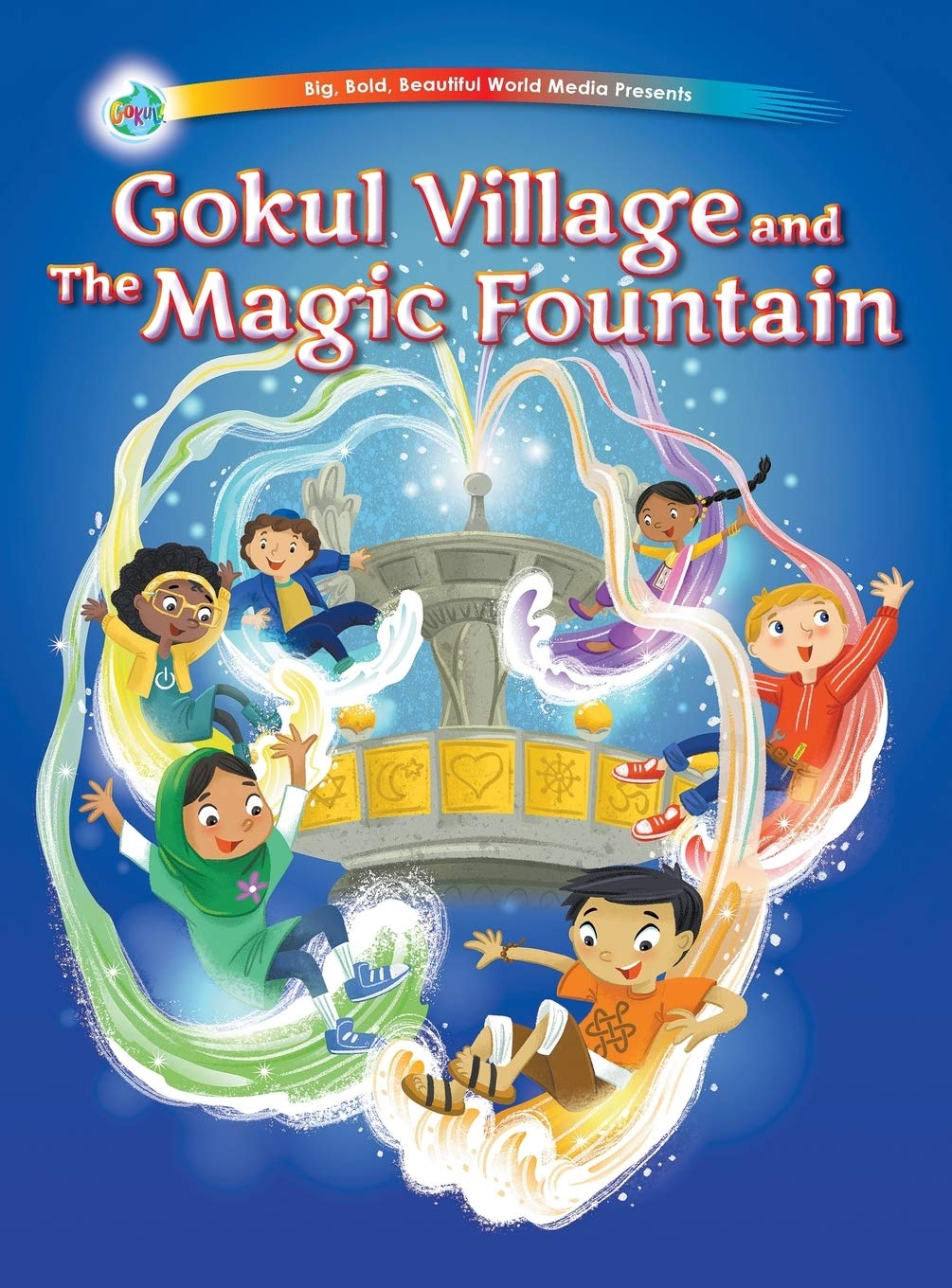
This 32 page book for preschool to second graders, 3-7, is very formulaic and reads like an episode of Handy Manny, or Dora the Explorer, or Paw Patrol.  Each of the six characters has a skill and represents a different culture, when they work together magic happens and they learn something in the process.  There is a girl with hijab and even a mayor that has to be convinced and the kids are successful and save the day.  Sure there is nothing wrong with it, but it is a bit cheesy, on the nose, and largely forgettable.  The book claims that the six kids are going to learn and celebrate other New Years festivals, as they travel to New York, China, and India for Diwali, except, nothing is really learned or even experienced at any of the festivals or the one that they are hosting in their own village.  The book is the first in a series, and I don’t plan to purchase the next one to see if it improves on showing, rather than telling, but if I could find it in a library, I would definitely read it and enjoy the bright illustrations of diverse kids.

img_2714

The book starts off showing a sad broken fountain that isn’t loved or used except by six kids every day who gather there to play.  Zoya to paint, Christopher to build, Riya to play her flute, Dalai to ride his bicycle, Noelle to fly her drone, and Jacob to share the treats he baked.  They like to pretend that the waters of the fountain are connected to all the water around the world and that they can go on adventures.

img_2715

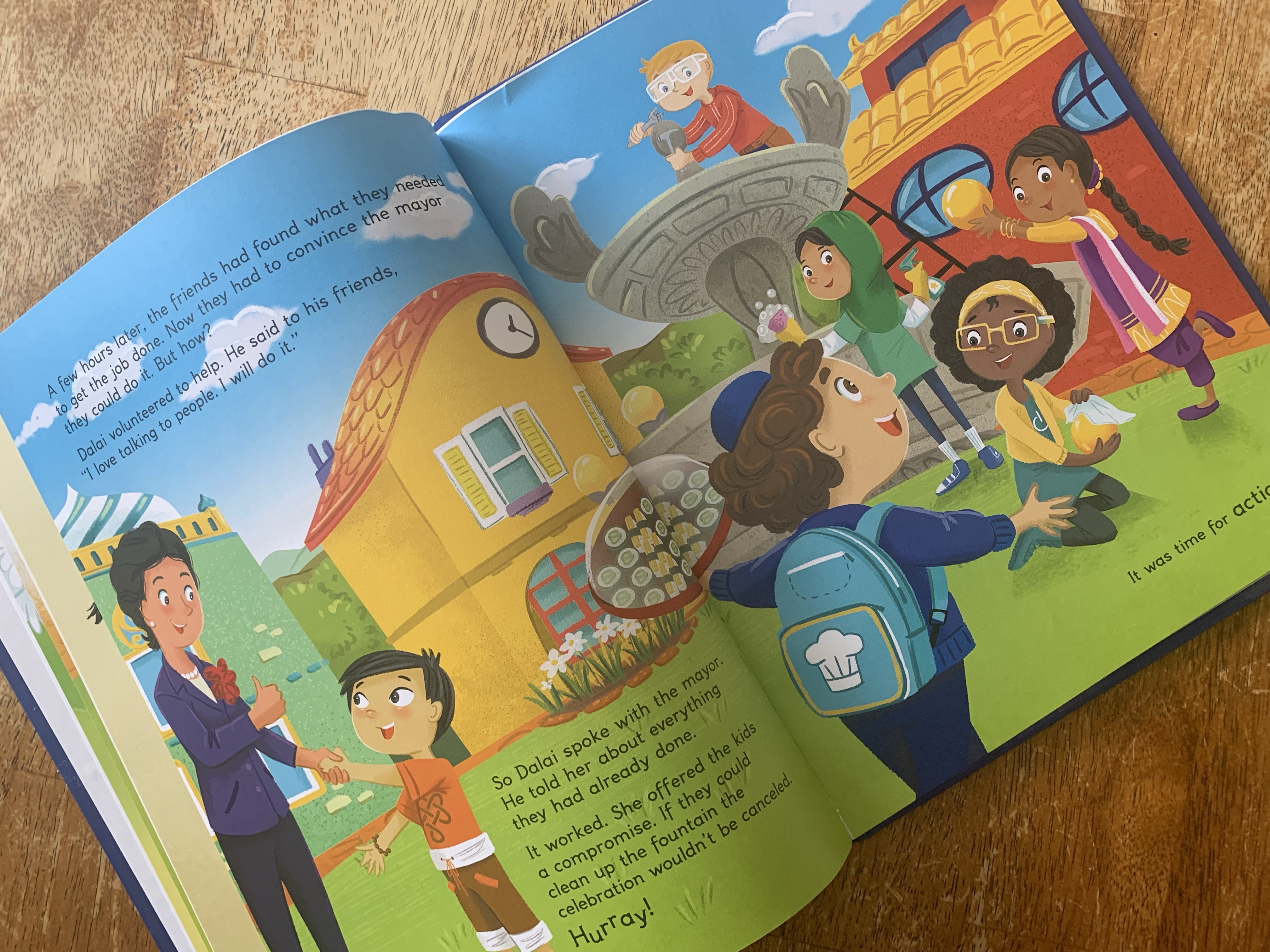
When the kids learn that the New Year’s party is canceled because the fountain can’t be repaired in time the kids decide to take action.  Time-out, I know, I usually give the entire summary then highlight the holes, but the book claims no one uses the fountain, now it is in the city center and needs repairs for a party, it seemed that it was old and crumbling, but last year it was fine? And if the kids could have always fixed it, why didn’t they? Any way Riya assigns everyone jobs to fix the fountain, AND THEN they go get the mayor and let her know they are going to fix it and she agrees saying if they can get it done in time the New Year’s Celebration wouldn’t be canceled.  The order seems off to me, they start fixing it, then work it out with the mayor and then have it all fixed in two days and the mayor clears it.  The illustrations show it pretty much fixed when the mayor arrives the first time, not sure what took two more days, and how it was ok for kids to fix a fountain prior to getting permission.

img_2717

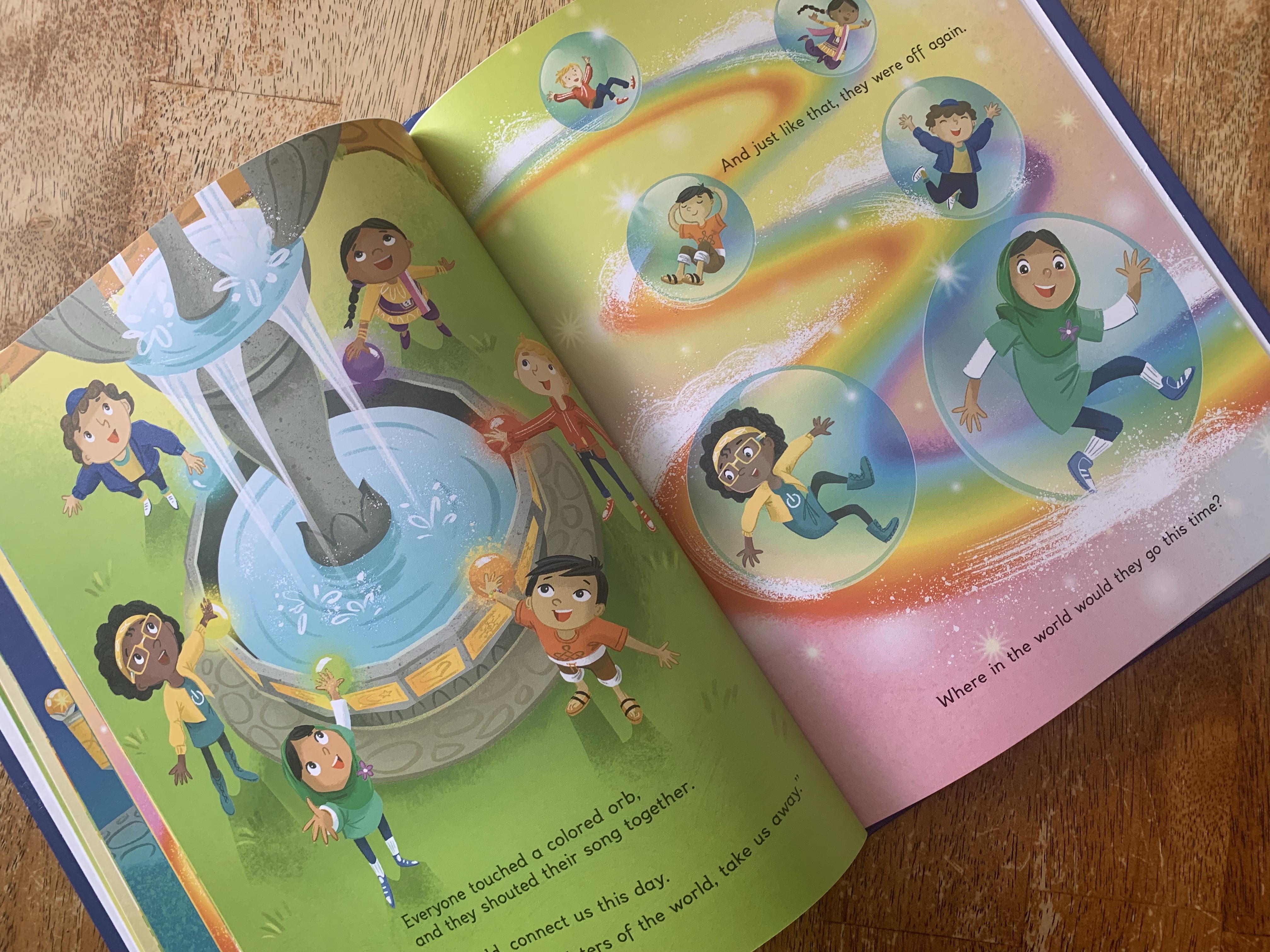
With the festival back on, the fountain looks happy and the kids suddenly have enhanced skills: notes from the flute turn in to birds, Zoya can paint in the air, Dailai’s bracelet is glowing, tools are growing and multiplying, and the drone, iDea, speaks.  She tells the children to read the inscription on the heart of the fountain.  Somehow the kids know to each touch a glowing orb and sing a song verse together.  It reminded me of Dragon Tales.

The fountain whisks the kids to New York where they see a “jostling, jolly,” crowd celebrating.  Then they are off to watch “millions of people clap and sway together, hoping for happiness and good fortune for all,” at a Chinese celebration.  That is literally all it says, it doesn’t say that Chinese New Year would be at a different time because of the lunar calendar or anything, and then they are off to celebrate Diwali, in India, which also wouldn’t be at the same time as western New Years, and all they learn about it is that it is a celebration of light over darkness.  I’d guess readers wouldn’t even realize that it often coincides with the Hindu lunar calendar’s new year celebrations.

img_2716

The kids come back, name the fountain the Friendship Fountain, use some of the decorations they saw to decorate for their own new year’s party, and then they clean up after the party.  There is no showing how their village celebrated, there are no other villagers attending or helping or participating, it just says they agreed it was “the best party ever.”

img_2718

Perhaps  I am cynical because the book is $17, but even if the book was free, it really is lacking some depth.  If you are going to highlight some cultures, then highlight some cultures, don’t just name drop and move on. I love that the characters are diverse, but I hope in future book, their own cultures and beliefs are shared not just visually represented.  The formula works for little readers, but if even a talking hammer and screw driver in Handy Manny can have their own personalities, sadly these six kids missed a chance to show themselves and foster inclusive representation and teamwork in a celebratory manner.

https://www.gokulworld.com

The Wild Ones by Nafiza Azad

Standard
The Wild Ones by Nafiza Azad

wild ones

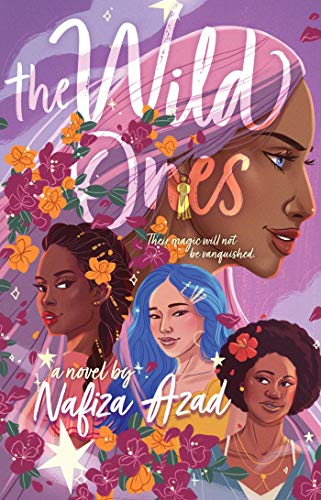
At times this 352 mature YA book was really hard to read for a variety of reasons: the subject matter, the writing style, the pacing of the story, and the numerous characters and inconsistencies.  At other times, the book was descriptive, and ethereal and hard to put down.  It took me over a month to finish the book because it really is all over the place and a lot of internal force and motivation was required to get through it, yet for all its flaws, I find my thoughts drifting back to it often.  The book contains a lot of violence against women, as that is the thread that brings this feminist group together.  There are hetero, lgbtq+, trans, and nonbinary individuals and relationships in the book, but they are not explicit, the rape, assault, suicide, prostitution, child trafficking and murder are more detailed.  The book takes place all over the world, and often mentions the athan being called or a mosque being passed.  Many characters have “Islamic” names, but there is no religion specifically practiced in this hijabi authored women powered tale.

SYNOPSIS:

The premise of the book is simple and straightforward.  A girl, the daughter of a prostitute, is betrayed by her mother when she is sent to a man.  As she runs through the city to escape, she crosses paths with a young boy who tosses her a box that contains stars.  A star embeds itself in her palm and allows her to enter a place called the “Between.”  The Between is a magical corridor made of magic that contains doors that lead to locations all over the world.  Once she enters she stops aging and is now made of magic.  She has the power to scream which can destroy other middle worlders and she can go invisible when around normal humans.  She travels the world finding other girls betrayed by those who had been entrusted to protect them, and offers them a star and a place in the Wild Ones.  This has been going on for centuries.  When the boy with the star eyes is in danger, he is reunited with the girl and her gang, and they pledge to protect him.

WHY I LIKE IT:

The concept of the book is pretty good, but the plot for more than half of the book it seems focuses on the girls constantly arriving in a new location, exchanging diamonds for local currency, finding food, and getting settled in, before doing it all over again.  It is repetitive and pointless.  Sure it is nice to read about exotic locations and savor local foods, but these girls live forever essentially and we learn so little about them or what it is they do.  Toward the middle of the book you start to see them helping other girls, but this should have been made clear much earlier on, I’m sure many people stopped reading before they saw how part of each girls’ healing involved helping others.  It is not developed or shown, which I think other than the two encounters detailed would have created some connection between the characters and the reader.

The cause of most of the confusion is that there are 11 Wild Ones, and you never really get to know any of them, the point of view switches between Paheli, and unknown speaker, and it has pages of prose from other Wild Ones that are neither explanatory of their life before or in relation to what they are currently experiencing. The fourth wall is broken periodically, but inconsistently.  So often, I just had no idea what was going on.

At times the characters speak like they are the teens that they are when they entered the Between, really noticeably and painfully, but they are decades old at the youngest, and centuries old for some of them.  Also, Taraana is presented as a young small boy that needs coddling a lot, although he too is centuries old, but then as the girls start protecting him, he suddenly is this incredibly handsome man in love with Paheli.  I get that their physical ages are suspended, so a relationship really might be possible and not creepy, but Taraana seemed to change, and it wasn’t explained.

The world building overall is weak, which is a shame, because it isn’t disjointed from the real world, it is just a slight addition to what the reader already knows.  If the Between is just hallways how is there a library? Can you live in the Between? Can all middle worlders access it? If so why aren’t the corridors crowded?

The pain of the girls, their rage, their ability to deal with their traumas in their own way and time, is very empowering.  I wish the sisterhood was more mutual than blindly following Paheli, like lost little children.  These girls/women can decide what to partake it, and leave the group if they want, so they are strong and capable, they just don’t seem to get to show it as they bounce around from place to place to place eating and doing what they are told.

The book almost seems to have been written in sections and then dropped in to place.  Much of the character information comes too late to make the story resonate.  Sure part of it is intentional to clarify and create “aha” moments, but it creates really boring stagnant chapters, when these girls should be fierce and powerful, not lounging and mundane.

There were a few spelling errors and grammar gaps, but I read an advanced readers copy, so I’m hopeful they will be resolved.

FLAGS:

Prostitution, rape, assault, suicide, death, murder, child trafficking, torture, drowning, infanticide, girl/boy kissing, girl/boy and girl/girl flirting. Many of the online reviews make it seem more lgbtq+ than I felt it was.  There are two lesbian characters that flirt and imply that their relationship will move forward, but within the Wild Ones they aren’t all hooking up.  Paheli and Taraana kiss, but nothing more graphic.

TOOLS FOR LEADING THE DISCUSSION:

I don’t think there is any way I could do this as a book club selection at an Islamic school, nor would I want to. The book has powerful commentary on the status and crimes against women the world over, and possibly older, say early 20 year olds, would benefit from reading and adding their voices to a dialogue regarding life experiences. But, the story line might be too simplistic for older readers to bond with, and the confusion and inconsistencies may not be worth the time needed to finish the book.

Silverworld by Diana Abu-Jaber

Standard
Silverworld by Diana Abu-Jaber

silverworld

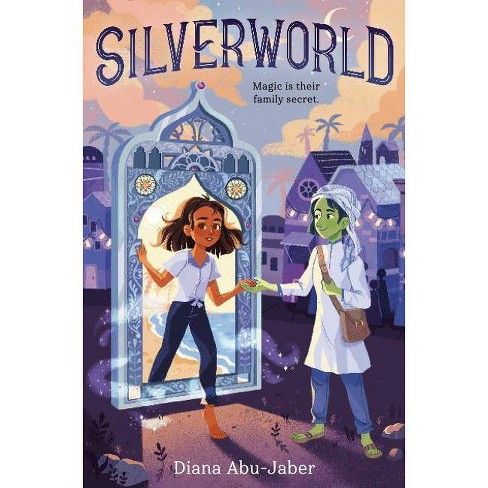
At 304 pages this middle grades fantasy OWN voice book attempts to weave together a granddaughters love for her Teta, with her adventures in a mythical world that only she can save.  In much the same way of Narnia, or Gregor the Overlander, or even Alice in Wonderland, the book takes a realistic character and pushes them, in this case Samara aka Sami, just beyond, into a world filled with mystery, adventure, and lessons.  The Lebanese flavor sprinkled in adds a little depth and uniqueness to the story, and aids a bit in the world building, but it isn’t a strong presence outside of ifrits and character’s names.  Teta is a Beduin that has a prayer rug and tarot cards and a painting of the Virgin Mary that she calls Fatima, and Sami’s deceased dad was American and the house has Christmas lights.  At one point the book remarks that Teta “likes to pick and choose her beliefs.”  The premise starts with Teta showing signs of dementia: speaking in a language no one but Sami can understand, and not eating and seeming present, the resolution as a result could give children the wrong idea about treatments for such real conditions, and adults might want to make sure their middle graders wont be triggered by the decline of a loved one.  The book is written well and holds reader’s interest, the world building is decent and the character’s relatable, I don’t know that it is overly memorable, but it is a fun light magical read with culture and family and friendship at its core that readers will enjoy.

SYNOPSIS:

Sami and her brother Tony, along with their attorney mom Alia and maternal grandmother, Serafina, have just moved to Florida from Ithaca, New York.  The children’s father was killed and the family has moved a few blocks away from his sister to start anew.  Sami is not settling in, and to make matters worse, Teta has stopped talking coherently, and Aunt Ivory and Alia are looking for a nursing home to place her in.  For some reason though, when it is just Sami and her grandma, she can communicate just fine, and Teta tells stories of her adventures with her flicker Ashrafieh in Silverworld.  Sami doesn’t necessarily believe the stories are true, but she gets the idea to use her Teta’s fairy stories to try and save her grandma, but when she finds her Teta’s spell book and peers into an old beloved mirror, Sami is taken to Silverworld and realizes that it is not just her grandmother’s future at risk.

In a world of flickers and shadows, Sami finds two balancers that taker her in and guide her: Dorsom and Natala.  The world is a reflection of the Actual world, but the Shadow Nixie is consuming the land and taking prisoners.  The balance is off, and Sami is convinced that this darkness is what is also harming Teta.  Between shadow spies and giant rotifers, magic and prophesied destinies, Sami must push her fear away and accept that she can be the one to set things right.

WHY I LIKE IT:

I like that Sami has to step in to her own and fight for what she wants, even when she is afraid.  I love the relationship she has with her Teta it is very warm and palpable.  I feel like the “saving Silverworld will save her Teta thread,” however, is lost in the middle of the book, it might be the catalyst and might have worked out that way in the end, but I don’t know that the middle makes the case that the two efforts are one and the same.  I appreciate that there are glimpses of Lebanon in the story with the athan in the background and spinning dervishes, but outside of Teta and a bit of the food, the cultural elements seemed a bit forced and deliberate instead of stemming from a natural flowing place.  A bit odd since it is an OWN voice novel, but maybe I was just wanting more. I would have liked more information about how Teta settled in America, learned English etc., or about her tattoos and Beduin upbringing. Another thing that seemed off to me was the close relationship of Dorsom and Sami at the end.  I hadn’t over nearly 300 pages realized that they were that much closer than Sami and Natala.  I even went back to see if I had missed something, but I couldn’t find that I had.  I wasn’t entirely sure why they were going to see Nixie either, I mean yes it was logical for they type of book it is, but I don’t know that Sami really had a plan for Silverworld or her Teta, she was just going to Nixie’s castle to get there.  There were also a few inconsistencies such as Sami wishing her and Tony could go fishing or surfing, when the book has made it clear that Sami is afraid of the water, particularly the ocean.

FLAGS:

There is magic, killing, death. There is talk of goddesses, there is a female character, a shadow, that has two flicker husbands and children with them both.

TOOLS FOR LEADING THE DISCUSSION:

I don’t think this would appeal to middle school readers, it is a solid middle grade book.  I do think fourth and fifth grade shelves would benefit from having this book available to be picked up and enjoyed.

The Magical Reality of Nadia by Bassem Youssef and Catherine R. Daly illustrated by Douglas Holgate

Standard
The Magical Reality of Nadia by Bassem Youssef and Catherine R. Daly illustrated by Douglas Holgate

nadia

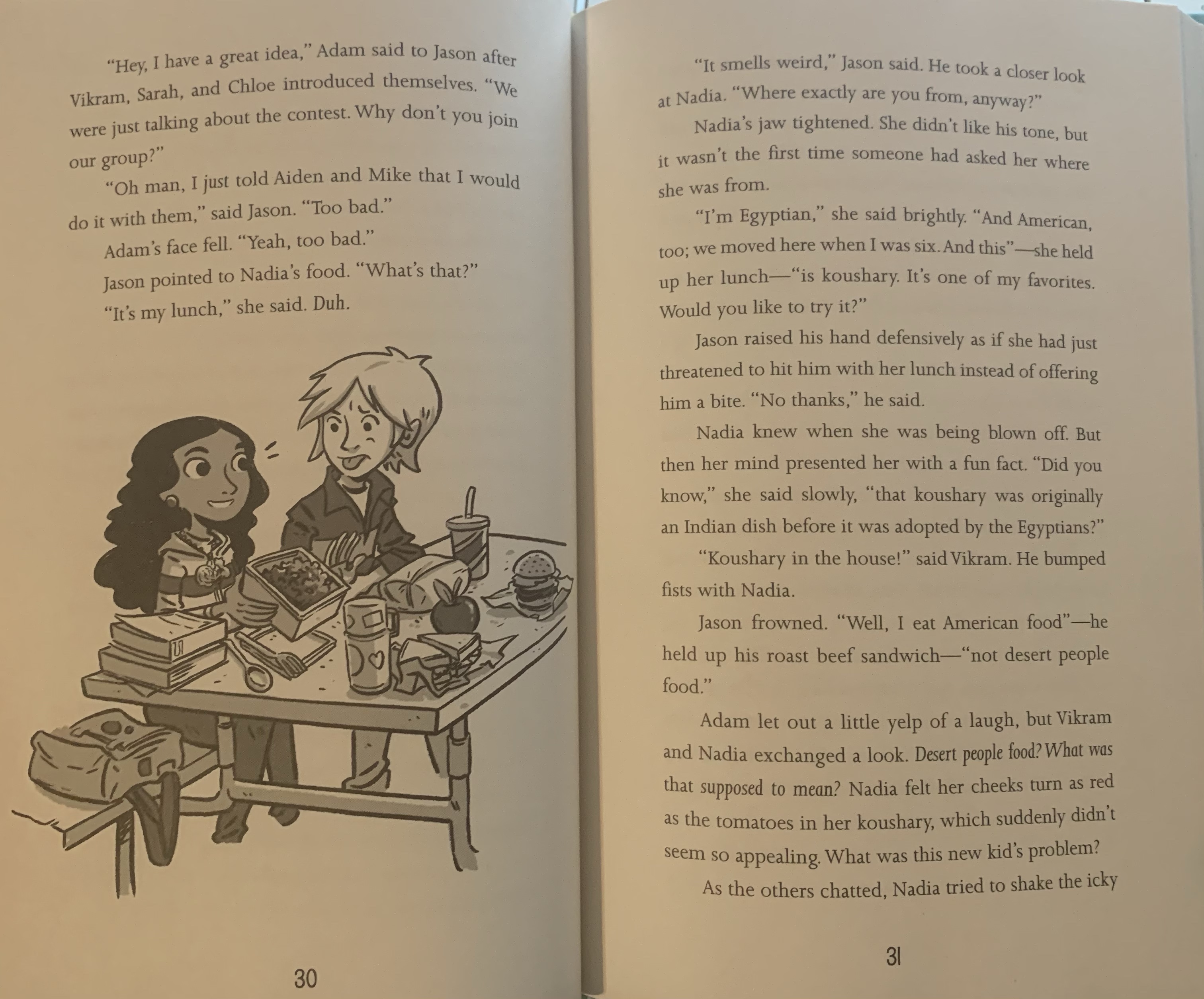
This middle grades AR 4.5 OWN voice book by Muslim author/comedian/surgeon/activists Bassem Youssef mixes text, comic strips, and illustrations over 166 pages to tell a story about ancient Egypt, friendship, leadership, xenophobia, and life sprinkled with magic.  It has a lot of potential, and I liked the lessons that Egyptian-American Nadia learns, but it just seemed lacking to me.  It seems to be book one in a series, and in many ways it reads like an introduction.  The magical element is underdeveloped to me and often just annoying.  The micro aggressions,  racism, and character’s ages would suggest upper middle grader readers would gravitate toward the book, but the overall writing style and length would more appeal to younger readers.  This disconnect makes the book hard to pin down and hard to connect with.  I’ll definitely check out future books in the series even though no religion is mentioned, because this brown girl has a lot of potential to break down Arab-American stereotypes and empower readers to be proud of where they and their families are from as universal obstacles are worked through.

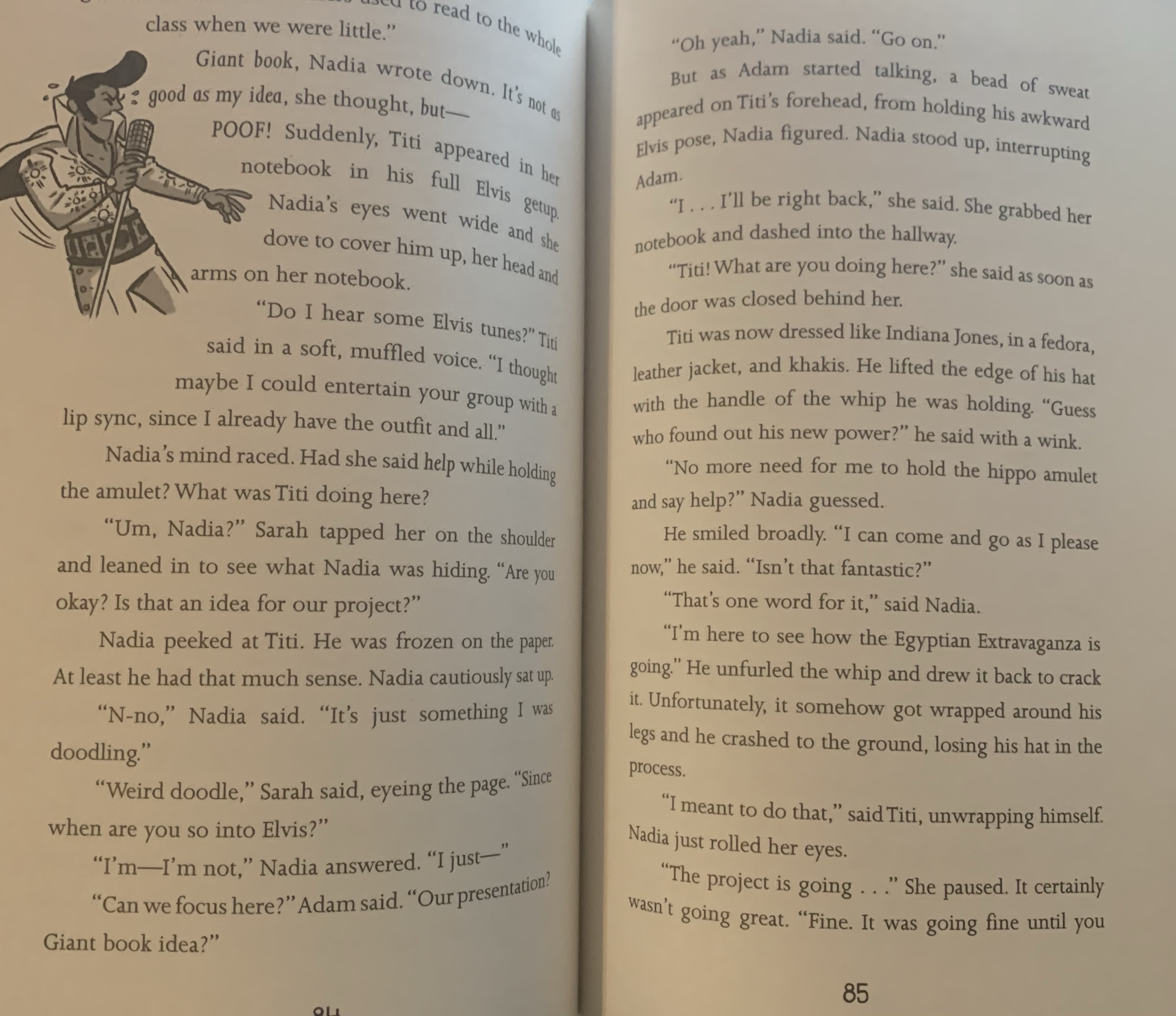
img_1640

SYNOPSIS:

Nadia has just come back from a summer vacation visiting family and friends in Egypt and can’t wait to get ice cream with her best friend Adam.  She picked up an Egyptian comic book for him and is anxious to see if he likes it.  Except the comic book seems to have disappeared and when she asks her many bobble heads to help her find it, her necklace with a hippo amulet starts to glow and an ancient Egyptian teacher, Titi, starts talking to her from the now found comic book pages.  As Nadia figures out how to control this ancient man who lives around her neck and in papers around her, she also has to deal with a new kid that acts like a bully and has the admiration of her best friend Adam.  Nadia loves facts and her and her friends call themselves the Nerd Patrol.  Nadia can be a bit bossy though, and while usually her friends let it go, she seems to be stepping on toes lately, especially with Adam.  When a competition at school is announced that will result in an exhibit at the Museum of American History, Nadia will have to use her “genie” to get help coming up with ideas for her display, coping with a bully, restoring friendships, and learning how to be a leader before her friendships fall apart.

img_1641

WHY I LIKE IT:

I love that Nadia is so proud of her culture and doesn’t feel like she has to pick one of her hyphens over another.  She brings Egyptian food for lunch, wears Egyptian inspired clothing, and is still very “American” as well.  Ancient Egyptian tidbits as well as modern day Egyptian information seeps through and weaves into the story smoothly.  The  diverse side characters are also a plus.  I think her trying to handle the bully in multiple ways makes the story resonate with other kids and gives readers something to ponder over.  I worry that most readers, however, won’t know who Elvis Presley is, or get if Titi is really helping or not and how it all comes together for him.  I am curious to see if he is a major character in future books, because I still have a lot of questions about his knowledge and understanding of the world after being trapped in an amulet for so long. Really, she could have learned so much from him, she just scratched the surface.

img_1642

FLAGS:

There is teasing and bullying and racism, subtle and overt.

TOOLS FOR LEADING THE DISCUSSION:

This book is too short and superficial for a middle school book club selection, but it could be a fun read aloud in a 3rd or 4th grade class.