Tag Archives: Iftar

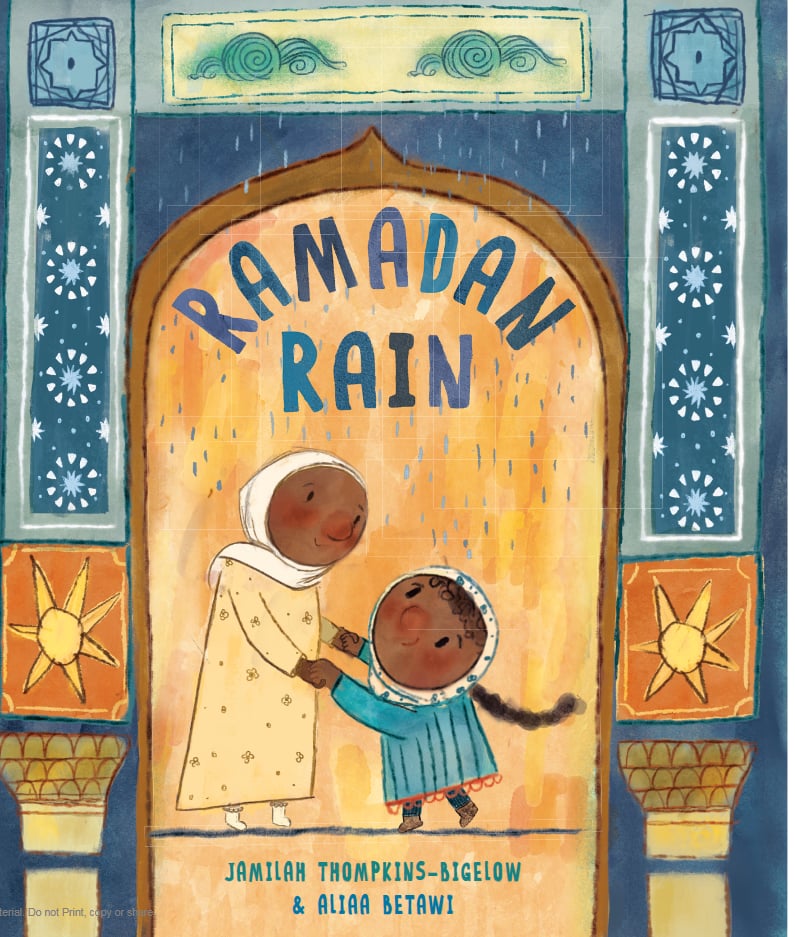
Ramadan Rain by Jamilah Thompkins-Bigelow illustrated by Aliaa Betawi

Standard
Ramadan Rain by Jamilah Thompkins-Bigelow illustrated by Aliaa Betawi

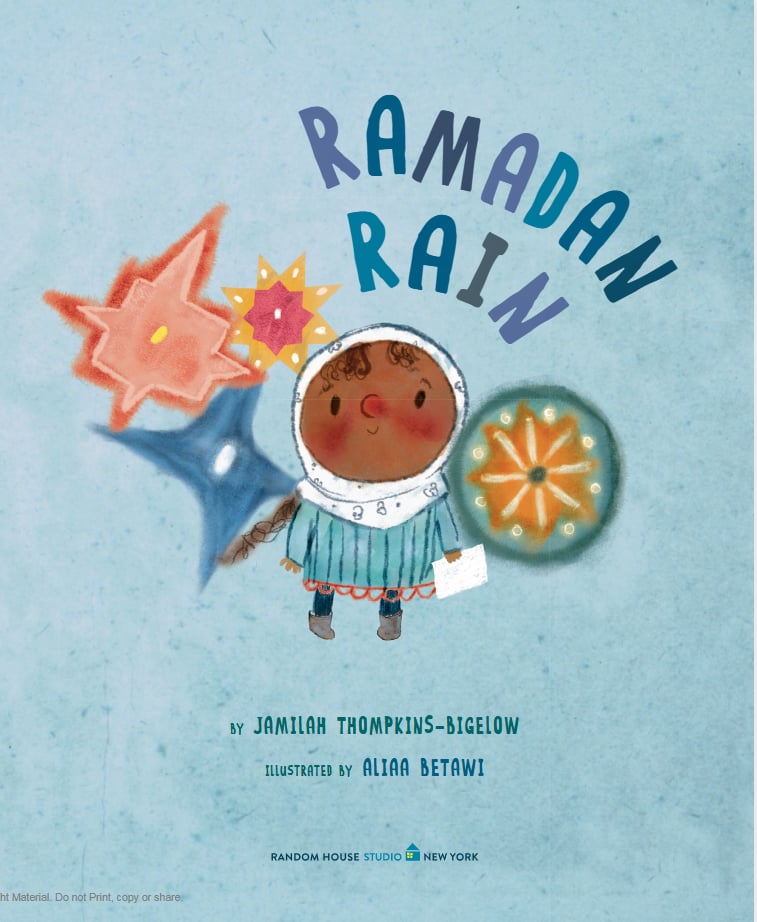
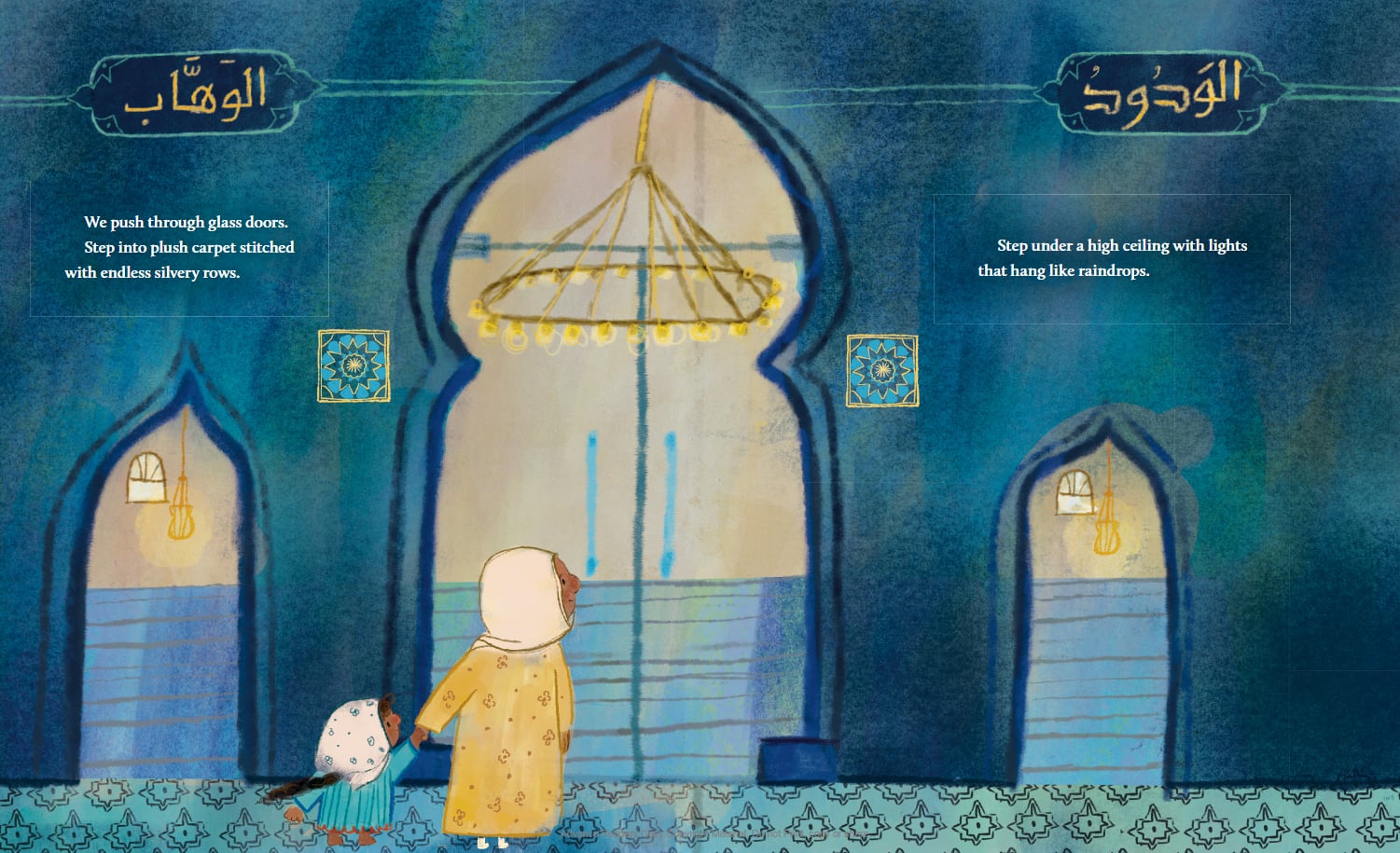
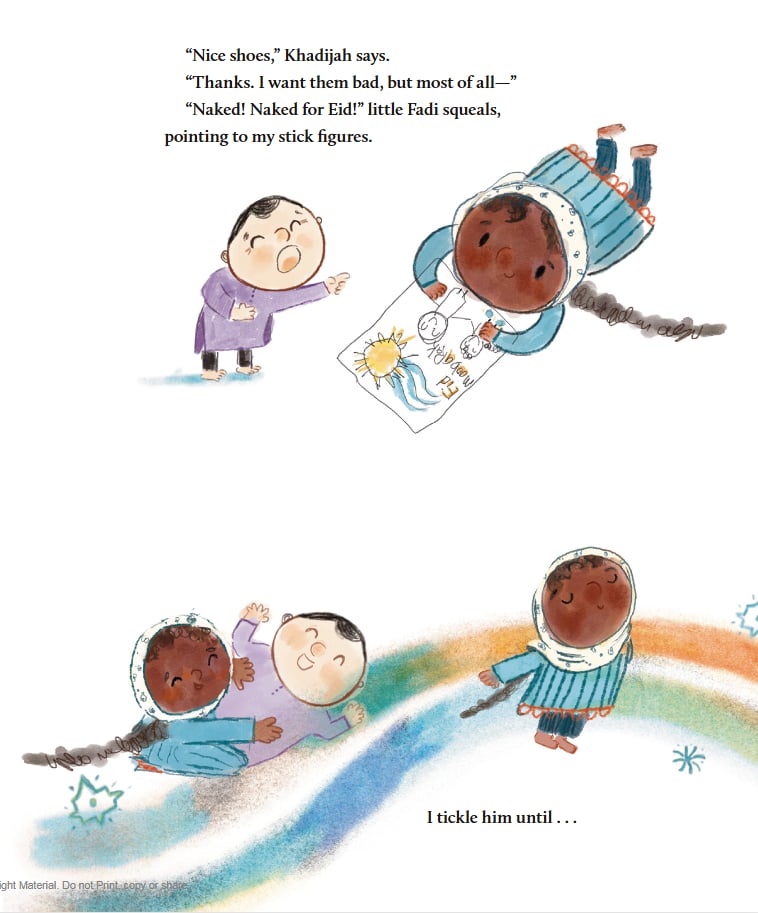
This 40 page book is all the feels as little Haneen’s Ramadan duas change from the material to the heartfelt while the rain pours down, taraweeh prayers are made, fun is had, and hearts are touched.  In true Thompkins-Bigelow fashion the book presents in layers that pull the emotional threads without turning didactic and preachy. The adorable illustrations complement the text and by the page when the characters are crying, I too, found tears in my eyes. I love that praying, duas, and practicing Islam is not sidelined, as current Ramadan and Eid books seem to do, but rather centered and celebrated as a source of comfort and joy. For the most part the external catalyst moving Haneen’s internal change were seamless, but the page with the little boy pointing and calling the drawings on her card naked, seemed a little jarring to the tone, even though I can see the function it served. I also acknowledge that a physical version might not make it as abrupt. Additionally it is worth noting the very nature of reviewing is to over think, so to be completely honest, by about the fifth reading I began to wonder, did her perspective change? There was no pivotal moment that set it in motion, it seemed she just got carried away in making the Eid card and never got to articulate what she really wanted to her mom. The initial dua is for the shoes that the family can’t afford, which I already felt was inconsistent because when asking Allah swt nothing is impossible, and the whole premise is that it is Ramadan and on top of that raining, but that aside, even when she first draws them, she states that it isn’t what “she really wants.”  So now, I’m wondering if anything really changed at all, or she just never clarified and thus the reader as well  her mom are taken along from Ramadan night to Eid day.  Also in the arc I read, it seemed a word was missing on page three that will hopefully be fixed in the final version. I love the tone and the warmth, and I know most won’t read it as deep as me, but the publication is not until March and I wonder, and hope, a few tweaks might still take place.  When my pre order arrives, I will revisit the review if need be, and yes, even with my critiques, I think this is a book that will delight all ages this Ramadan and give plenty to reflect on throughout the year.

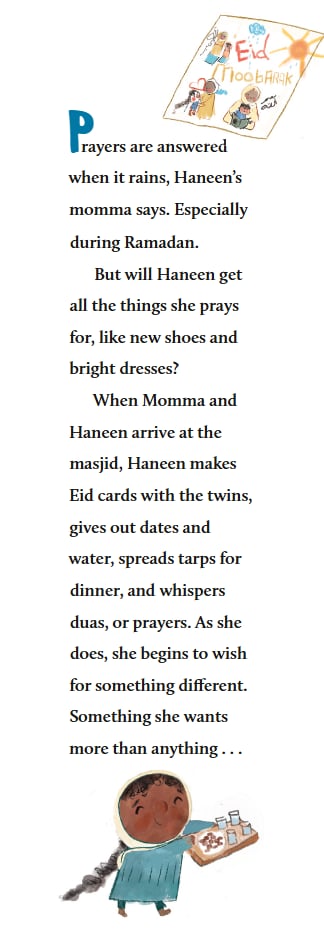
The book starts with a grumpy Haneen sitting on a bus, walking in the rain, and arriving at the masjid a little wet and muddy recalling when they had a car and things were easier.  She starts to complain but catches herself knowing that they can’t afford things, and Momma tells her that, “rain brings blessings.”  She also reminds Haneen that duas said on a rainy day get answered, especially during Ramadan.

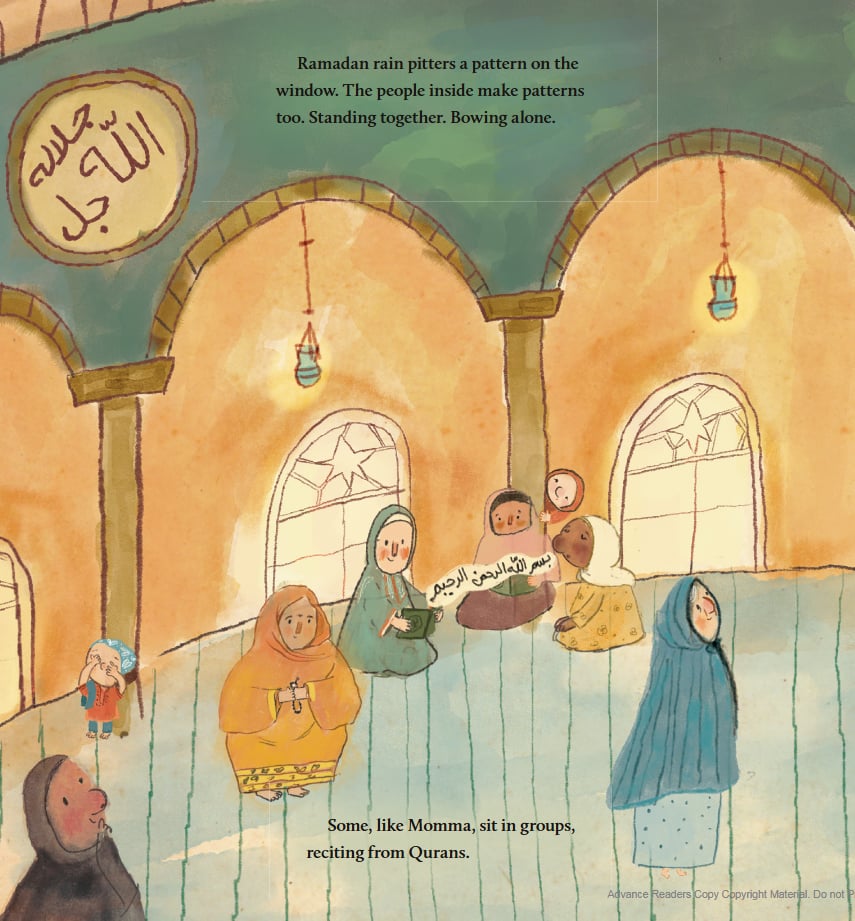
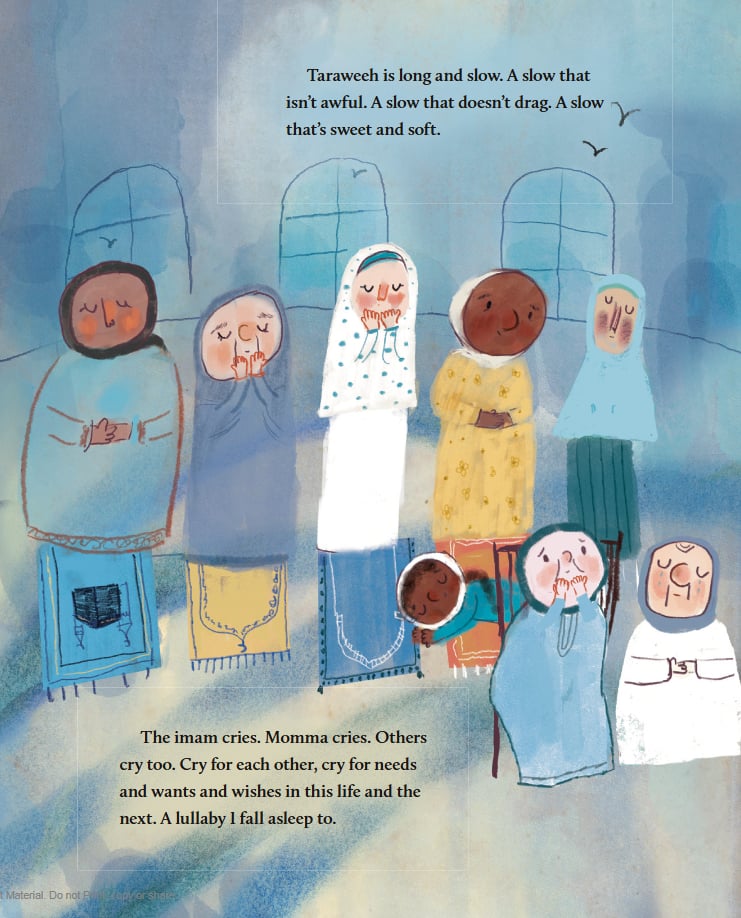
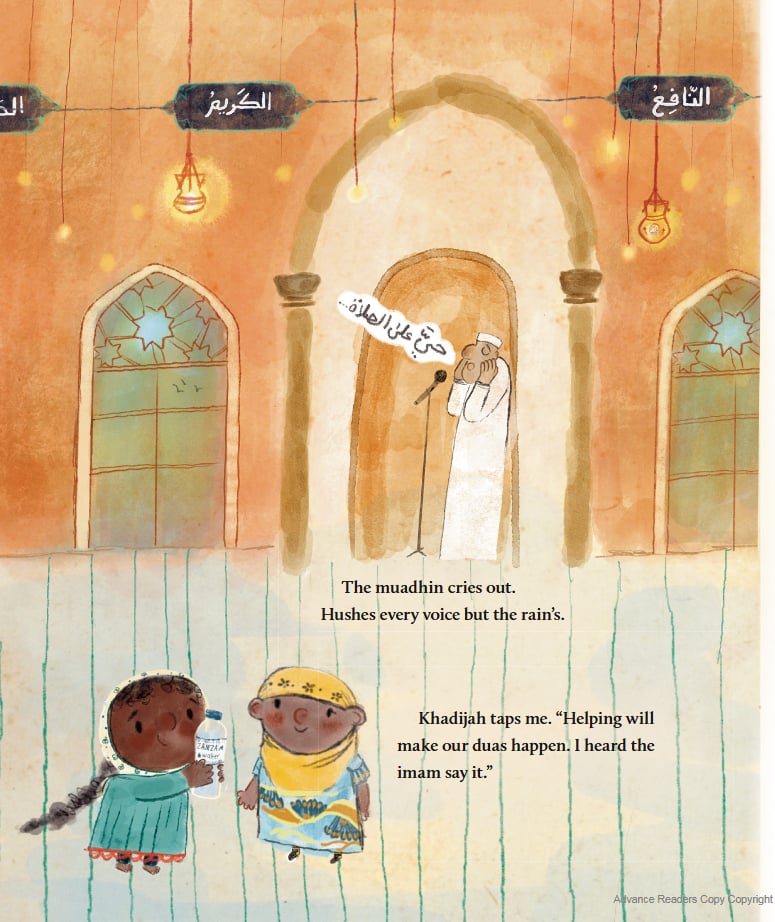
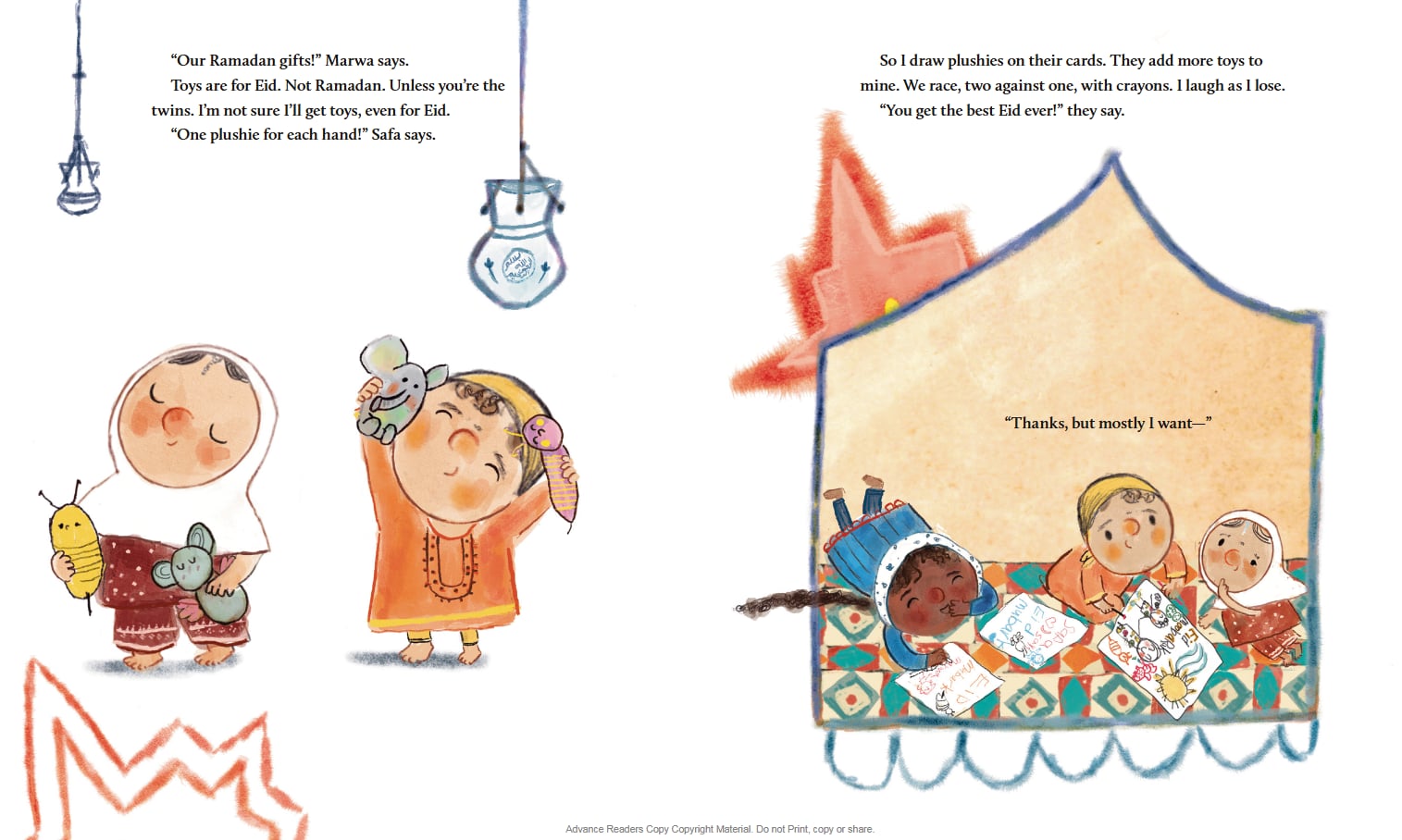
Once in the masjid, Momma reads Quran and Haneen starts to make duas for the shoes she wants but knows they can’t afford when she is distracted by friends, and they start making Eid cards. They children work together, and when it is pointed out that Haneen’s stick figure has shoes, but no cloths, she marvels at the different dressed women around her, before adding her favorite to the picture, wondering if she can get new clothes for Eid.  The pattern continues, she sees the twins with plush toys, and thus plushies are added to her wants, and filled in on her Eid card, as the congregation moves from athan, to iftar, to salat, to taraweeh.

When Eid comes, SPOILER gifts come from unexpected places, and a new card, showing what Haneen really wanted and prayed for that rainy Ramadan night are revealed, alhumdulillah.

Cookies and Crescents: An Eid Story by Nada Shawish Dutka illustrated by Zelma Firdauzia

Standard
Cookies and Crescents: An Eid Story by Nada Shawish Dutka illustrated by Zelma Firdauzia


We can always use more Eid al Fitr stories, but to stand out in an increasingly crowded field, really requires something special, impeccable story telling, and repeatability.  Unfortunately for me, this book just comes up short.  Food centered books are already so over done, toss in small font that nearly bleeds into the binding where you would hold the book for story times, top it off with a vague story lacking the OWN voice charm that a religious holiday centered book, by a Muslim, that is noted to be slightly autobiographical should have, and the recipe is just going to feel lacking.  There isn’t anything “wrong” with the book, it just doesn’t really seem like it will be memorable or asked for again. Focusing on a mom and daughter moving the night before Eid, the book has elements of adjustment, new traditions, change, nerves, salat, iftaar, looking for the moon and making a new friend- layers that should resonate with readers, but somehow for me, stayed on the surface of this 32 page book for preschool to early elementary aged children.

The book starts with the protagonist talking about the city where she was born, the community, the family atmosphere, and her mama’s famous Eid cookies.  But this year will be different, it is almost Eid and Reem and her mama are moving away from the city to a house with a yard. Reem is not excited, in fact, she spends much of the drive feeling carsick.  Once they arrive it is time to unpack, break their fast, pray and look for the moon.  The excitement of making making cookies with her Mama sustains her, until she notices the walnuts are missing. Change is inevitable, and Mama is determined to show Reem that they can make do with what they have.  When neighbors come over to welcome them to the neighborhood, a new friend might be just what Reem needs to settle in.

The book seems to be deliberately vague, and I don’t know that it will bother children, but it bothered the journalist in me.  Why are they moving, what city are they leaving, is Sarah Muslim or just knows to say Eid Mubarak, but doesn’t say walaikumasalam.  I also feel like the publisher didn’t properly invest in the book.  The text is tiny, when ample space is available on nearly every spread.  Blocks of text on the lower inner binding make one’s hand cover the words when reading to a group, and certain paragraphs seem to be erroneous or at the very least awkward.  Take for example this paragraph when they are unpacking, that I stumbled over every time I read it. “Tonight, it’ll be just me and Mama who look from between tall boxes.” Maybe it is in reference to looking for the moon, but the next page does have her and Mama planning to look for the moon.  Similarly, when the walnuts can’t be found, Reem wants to go back, but Mama says the store is too far. The mother in me was fuming that she didn’t see it was more than about the nuts, go give the girl a hug. Earlier Reem remarks that “Finally, Mama kept her promise,” in regards to the cookies, but is it finally they are making cookies or does Mama not normally keep her promises. I know I’m being picky, but it starts to add up, the reader doesn’t feel that Mama and Reem are in this together. That they listen to each other. So it is hard to get emotionally invested. And when I review I try and unearth why a book doesn’t work for me, and all these little hiccups for me, become obstacles that keep the book from being great.  Sadly all it needs is some good editing and my critiques really could have been resolved, sigh.

Even though the book is set at Eid, and shows the mom and daughter praying, they say salaam, they look for the moon, there is no real Eid as a religious holiday stressed, the focus is the cookies and the new friend.  Culture also seems to be noticeably absent, the cookies are Arab, the phrase “Al Harakah Barakah” is Arabic, but it isn’t sourced, the reader is never told where that sentiment comes from and it isn’t explored as much as the inner flap would suggest. The book concludes with an author’s note and a recipe for ma’amoul.


Ramadan on Rahma Road: A Recipe Storybook by Razeena Omar Gutta recipes by Faaiza Osman illustrated by Atieh Sohrabi

Standard
Ramadan on Rahma Road: A Recipe Storybook by Razeena Omar Gutta recipes by Faaiza Osman illustrated by Atieh Sohrabi


I would not know where to shelve this 40 page in a library, it has beautiful pictures, it is informative, resourceful, useful, and interesting- I’ve only delayed sharing it because I really have had to think, how best to use this book to its maximum potential, to make it truly effective. It is formatted externally as a picture book, but it reads much like an chapter book anthology with the stories connected by the road the diverse folks live on, Rahma Road, all coming together for a communal iftar, with some fasting and some not.  The spreads feature vignettes on the left of what each house is making, including tidbits of culture, facts about Ramadan, insights about method or ingredients, with the facing page being the recipe.  The book is incredibly meticulous and intentional in appealing to Muslims and non Muslims alike, as well as a variety of ages.  It works as a book for Muslims to see themselves in, non Muslims to get a peek at iftaar excitement through, messages about community and diversity celebrated, foodies to see new recipes that they can try, cultures to explore through food and native words, a story framing to feel connection, I really could go on and on with the layers and inclusions this book provides, alhumdulillah.  I think the best way to use and share the book is going to be for me to read it with my 5 and 9 year old children a week or so before Ramadan.  Where I can read the story portion, getting us excited for Ramadan, slipping in some reminders, appreciating Islam’s global presence, and then talking about the recipes so that they can pick dishes to try in Ramadan and add needed ingredients to the shopping list (I wish I made the effort to be this organized all year long).  I then will plan to leave the book out and have my teens flip through to find any recipes that they think sound good and will commit to making.  The book would work all year long, but as a new release, I’m sharing my plan with hopes that it can help your family as well. 

The book contains 25 globally inspired recipes, featuring 11 with accompanying stories.  I absolutely love that at the bottom of the recipes are page numbers for additional items that would pair nicely, or be condiments or beverages or desserts for the dish.  This allows easy personalization, fusion meals, and more importantly a way for different age groups to be able to help each other in the preparation.  Maybe koshari is a bit advanced for your kid, but the mint lemonade paired with it might be something they can tackle a bit more independently. 

The framing of everyone on the road coming together book ends with the neighbors sharing a meal at the end,  I love the backmatter explaining Ramdan, about the recipes, even about Rahma Road.  The message to the reader and the naming of consultants really is a credit to the time and effort put into this book.

A few of the dishes and countries featured are: Atayef from Palestine, African American Sweet Potato Pie, Nigerian Puff Puff, Japanese Temaki Sushi, Morrocan Harira, Uyghur Lamp Stir-Fry, Guatemalan Dobiadas, Turkish Chicken Gozleme, Malaysian Teh Tarik, Australian Mini Strawberry Pavlovas, South African Bunny Chow, Mexican Elotes  .I can’t wait to report back if my plan was successful, if the dishes prepared were a hit, and ideas for further maximizing the use of the contents it contains.

Noura’s Crescent Moon by Zainab Khan illustrated by Nabila Adani

Standard
Noura’s Crescent Moon by Zainab Khan illustrated by Nabila Adani

img_3075-1

I know, I know, another Ramadan book about the moon and a little girl’s first fast, but this one is slightly different.  The moon they are searching for is the Eid moon and the focus is on whether they will see it and Eid will begin, or if there is one more day of fasting.  The story itself would not make sense if it wasn’t Ramadan and the characters Muslim, but the story only subtly sprinkles in bits of Islam, the backmatter though, is where the Islam really shines.  The tone of the book with the lyrical text and full color illustrations is very relatable to Muslims that both want to see the moon and celebrate, while at the same time being sad the the blessed month of Ramadan is over.  It comes from a Desi centric approach to the foods, and traditions, but their aren’t a lot of Urdu words used either, and those that are, are defined at the end.  The book works for Muslims and non Muslims, and would benefit both groups with a bit of discussion. Overall, not a particularly memorable book, but one that stands out for focusing on the tradition of looking for the moon and being together as a family.

I love that the notes at the end do mention that Muslims fast to “show love and obedience for the Creator,” under the Ramadan header.  The other backmatter headings are Eid ul-Fitr, Suhoor, Iftar, Chaand Raath, Pakora, Gulab Jamun, Sheer Khurma, and The Islamic Calendar and the New Moon.  A lot of space is dedicated to food, explaining those mentioned in the story.  It gets it right that Muslims begin fasting at dawn, it shows mom not wearing hijab at home, but wearing it when they go out, yet, it doesn’t just say the maghrib athan it refers to it as the “call for the twilight prayer.”  And it doesn’t mention or show them praying, which would have been a nice inclusion.

img_3080-1

The book starts with Noura playing outside and her tummy rumbling on this 29th day of Ramadan, and her first fast.  Mama, Papa and Noura all help make and pack up iftar, as they get ready to go look for the Eid moon.

img_3079-1

Before they go, Mama shows Noura her new dress, and they add some henna cones to the items they are taking, they then set out to the countryside.  All along, Noura is hoping to see the moon and her parents are reminding her how rare it is to see it.

When they get to the hill there are other families already there, and Noura has done it, completed her first fast.  Unfortunately the moon is not there as hoped, or is it?

img_3078-1

I wish some duaas or Islamic expressions, and salat would have made it into the book, but the large hardback size makes this a good book to read at story times, and a nice way to explain why we don’t know when we will miss school to celebrate Eid, or how many days we will fast.

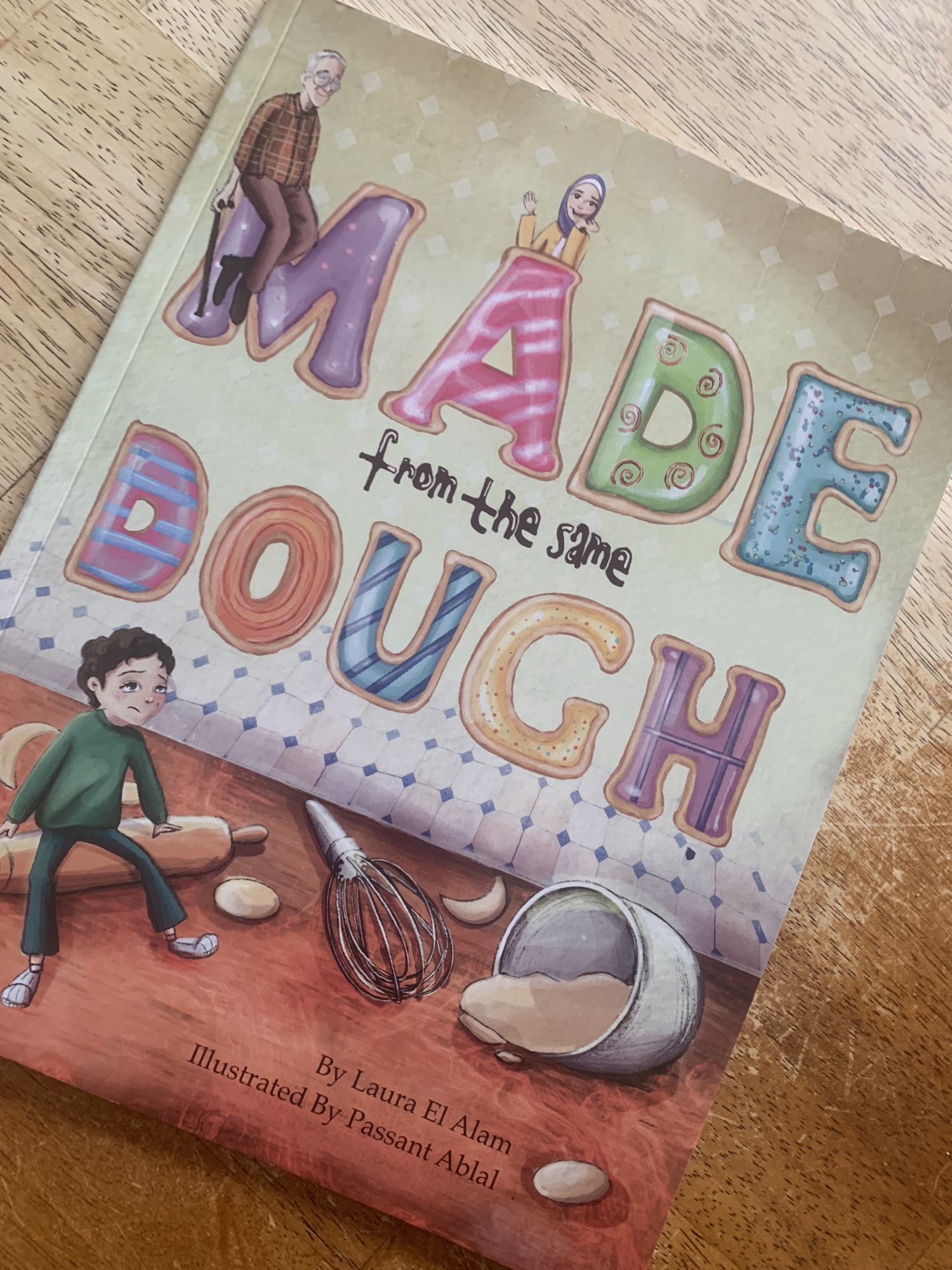
Made from the Same Dough by Laura El Alam illustrated by Passant Ablal

Standard
Made from the Same Dough by Laura El Alam illustrated by Passant Ablal

img_3052-1

Not all books about Ramadan have to be lists of facts. It is ok to show Ramadan and Islamic elements in stories that have their own plots, character arcs, conflicts and resolutions that are not just about abstaining from food and water, or losing your temper.  This book set in Ramadan is a story about a  Muslim boy and his Christian grandfather, and a whole lot of heart.  As a child of a convert, this book spoke to me, and I saw myself in that relationship, not only as a child, but even as an adult bringing my grandparents to my kids Islamic schools, friends’ lunches, and asking them to wait on the side while we pray.  I absolutely love the perspective of the protagonist, that he is worried about what Muslims will think of his grandfather not fasting or praying, as opposed to the often shown character worrying about what non Muslims think about us. The paradigm shift is subtle, but empowering to Muslim readers to see that they are not “other” in any environment.  The authenticity and how it all comes together in the clear text of the book is beautiful, but I must say, I really struggle with the illustrations.  I know art is subjective, and I am no artist, but yikes, I feel like the pictures actually distract from the story unfortunately.

The book starts with Papa coming over to his daughter’s family home and smelling something cinnamon-y delicious.  He dives in to the harira soup and recalls the cinnamon Christmas cookies they used to make.  Rayan wonders if Papa even remembers that the rest of them are all fasting.

Mama invites him to join the family at Auntie Hana’s for iftar the next night, and Rayan worries what Papa will do when they all pray, or if his friends will wonder why he came to iftaar if he is not fasting.

img_3054-1

Papa agrees and offers to make cinnamon cookies to share.  Rayan doesn’t like the idea of Christmas cookies at iftar and tells grandpa that Santa won’t be there.  The next day when Grandpa comes over to bake, Rayan refuses to help. Part scared, part frustrated, part anxious, Rayan hears everyone having fun, but stays in his room.

When they arrive at the iftaar potluck, Rayan reminds Papa to take of his shoes and then devises a plan to keep the Christmas cookies from causing any embarrassment. Only his sister Aliya foils his plan and Rayan will have to face his own feelings and make things right.

I’ve read this book easily close to twenty times, since ordering it, evaluating it for the Muslim Book Awards 2023, (it won the Holiday category), writing this review, and reading it to my littles at bed time, and it still hits close to the heart every time.  It reminds me of my own grandpa, who has been gone almost exactly a year, who may not have always understood our actions as Muslims no matter how often we tried to explain them to him, but never loved us any less.

img_3056-1

You can purchase your copy here at Crescent Moon

The Adventures of Adam and Anisah: The Golden Trail by Zahra Patel illustrated by Reyhana Ismail

Standard
The Adventures of Adam and Anisah: The Golden Trail by Zahra Patel illustrated by Reyhana Ismail

img_6818

This third book in the Adam and Zahra series, also available with a workbook, focuses on zakat and can be read alone.  Aimed at toddlers to early preschoolers, this rhyming story can also work at story time with slightly older kids as a reminder of zakat and giving to those in needs.  The book has very minimal text and as a result if you overthink it, it could be slightly problematic: there is magic, they are taking and giving something that doesn’t belong to them, Zakat is a portion of your wealth not sharing something you found-even if a note says otherwise.  I think the book is sweet though, and the discussions to have with little ones outweigh the adult concerns I’ve mentioned. It touches on giving to others, on people in need, of people in need living very close to you, that everything being a gift from Allah (swt), it shows siblings working together, sharing, generosity, a lemonade stand for Yemen, giving of food and money, and befriending others.  I think if you liked the other books in the series regarding a “magic” pray rug and a fasting shield, both mentioned in this, you will like the presentation of sharing and the term zakat presented in a similar fantasy laced manner; if those books felt uncomfortable for you and your family, this one probably will as well.

Adam and Anisa start the story in Ramadan, a week before Eid, digging in the sand at the beach.  Adam finds a treasure box and a message in a bottle.  The treasure box is locked and the message says that “My name is Zakat and I’m for someone in need…”  Once the kids get the box home and the lock off, a beam of light shines a path for them to follow.

img_6821

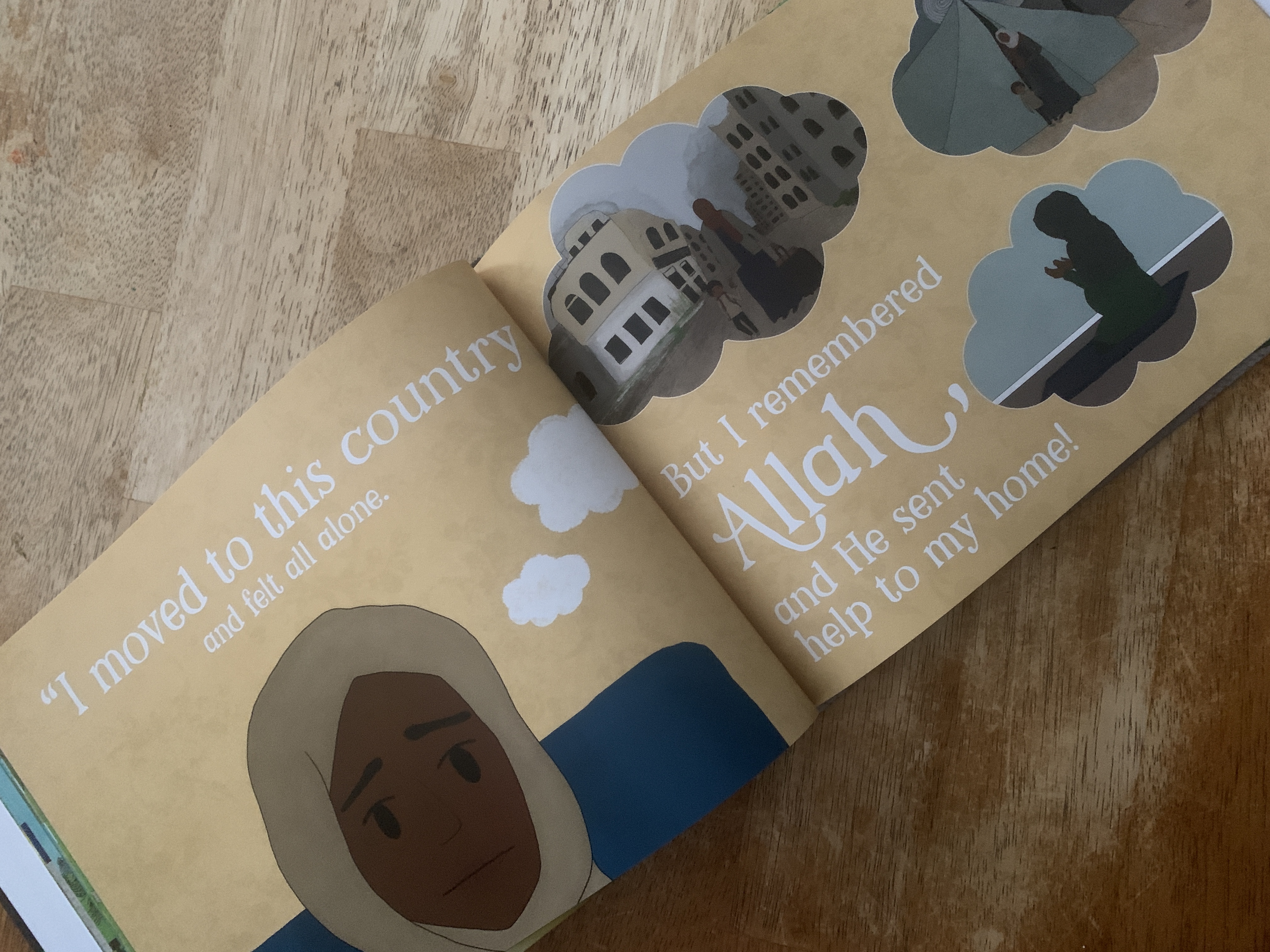
They follow the light out the door and through the field, and past the mosque and their friends, along the way they purchase a pie from the bakery for when they break their fast and keep following the light to the field as the sun starts to set.  They find a house in the forest with a mom, a baby, and a little boy, to whom they give the money and the pie. They learn that they had moved to this country and were all alone, but Allah swt provided for them, and He is never far. They all break their fast together and learn that “Whenever you give, Allah will give you more.”
img_6822

The backmatter of the book contains Context to the Story, Developing Character Strengths, Learning through Practice and a map of their adventure.  I purchased my copy from Crescent Moon Store here and if you use my initials (Islamic School Librarian) ISL at checkout you will save 10%.

img_6823

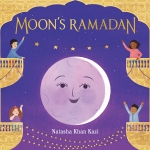
Moon’s Ramadan by Natasha Khan Kazi

Standard
Moon’s Ramadan by Natasha Khan Kazi

moon

This beautiful lyrical book has a simple premise of the moon looking down on people celebrating Ramadan as it circles the Earth, but stands out as being unique thanks to the poetic language and engaging illustrations.  Each spread shows moon in a different phase over a different country, and the joy, activities and worship that Muslims are partaking in during the blessed month.  I’m embarrassed to say, I didn’t realize that the author is also the illustrator until I sat down to write this review, and honestly it makes sense, as the story text and illustrations work seamlessly together.  The tone of the book, the details in the pictures, and the rich language make this a good read for a large audience.  Little ones probably won’t fully understand the poetry, but they will be mesmerized none-the-less and feel the excitement.  My three year old calls the moon all year round, the “Ramadan Moon” and he understood that the Moon in the story is excited seeing us celebrate and worship.  He consistently would still be peeking in windows or searching the scenes, not quite ready for me to turn the page long after the text was done being read.  Older kids will appreciate the shared global bonds of Muslims and the cultural specifics too.  They will grasp the information shared and beliefs touched upon in the flowing words that do not preach.  My only criticism is that the book starts with Moon saying, “Hello.”  In an Islamic centered book I would have expected to see Assalamualaikum, especially since it appears on the page where moon is above Egypt, so I’m not sure why the English greetings is used.  The book has a glossary and notes at the end making it a great addition to Muslim and non Muslim spaces alike.  I plan to read the book for a Masjid story time as the large hardback book will work just as well for a group of kids as it does at bed time.

Told from a personified Moon’s perspective, the book begins with Moon smiling at Earth as people all over the world excitedly point and look up at her, but once they see her, they rush off to prepare for the month. Over Turkey, the Ramadan Drummer awakens sleepy people for suhoor and over Indonesia he sees families gathering for iftar. As each day passes Moon grows fuller watching the children do good deeds and people sharing their wealth.

Nights of Taraweeh and listening to the Quran over Somalia, sharing treats in the United Kingdom, and  interfaith among neighbors in the United States bring joy to Moon.  And as the waning crescent sees henna being put on hands in Dubai the month is coming to an end.  People once again look to the sky, but they cannot see Moon in Argentina, Moon is new.  It is Chaand Raat and then it is Eid.  Moon is back in Egypt watching people celebrate and then the world returns to looking up at Moon and she beams with love and gratitude.

There are diverse characters of a variety of skin tones, mobilities, ages, body size and abilities featured all throughout the book in a positive and inclusive normalizing manner.  The backmatter makes the concepts more accessible and the book work on different layers.  I really enjoyed the book and am excited to share it.  I purchased mine at Crescent Moon Store where using my initials ISL (Islamic School Librarian)  will save you 10% it is also available here at Amazon Even my local public library has it on the shelves already! Happy Ramadan!

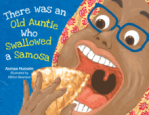
There was an Old Auntie who Swallowed a Samosa by Asmaa Hussein illustrated by Milton Bazerque

Standard
There was an Old Auntie who Swallowed a Samosa by Asmaa Hussein illustrated by Milton Bazerque

samosa

I feel like such a broken record of late (and in the future), of my reviews of books published by Ruqaya’s Bookshelf; the stories are WONDERFUL, but I really struggle with the titles.  I truly thought this was a cultural/religious version of the classic, I Know an Old Lady who Swallowed a Fly.  But it isn’t.  It is an original clever, laugh-out-loud hysterical story for preschool to early elementary.  And one that parents and caregivers will not dread reading over and over again with the well done rhyme, expressive illustrations, a silly conclusion, religious framework, and universal appeal.  The book is on point, the title and cover illustration, sadly for me are not, and don’t, in my opinion, do the story justice.

img_4190

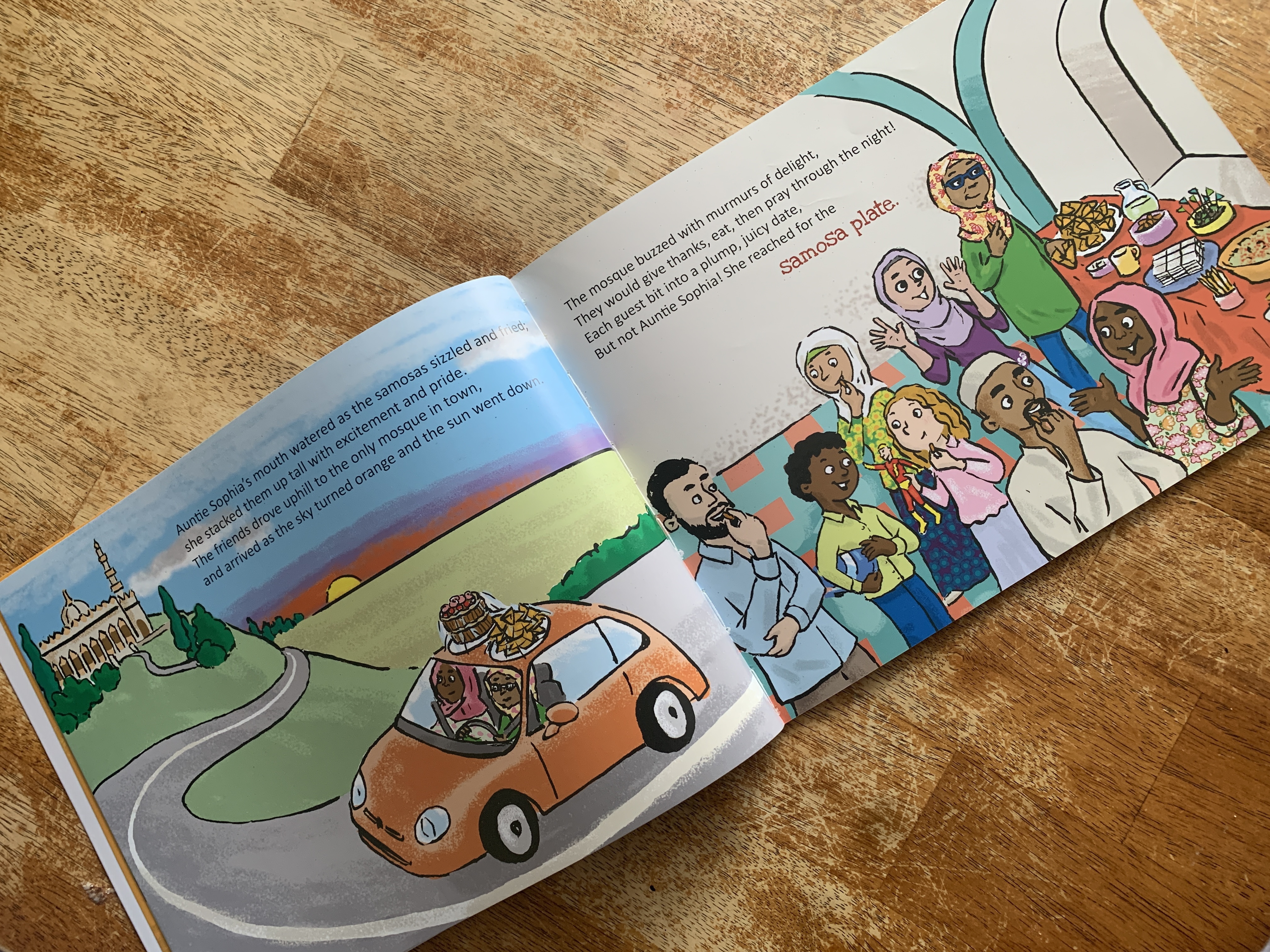
Auntie Sophie is making samosas with some peppers she grew herself.  Under the close company of her kitty, we learn how the Scotch bonnets were grown and cared for.  The doorbell rings and Auntie Eynara has arrived with her beautiful cake to take to the masjid for iftaar.  

img_4191

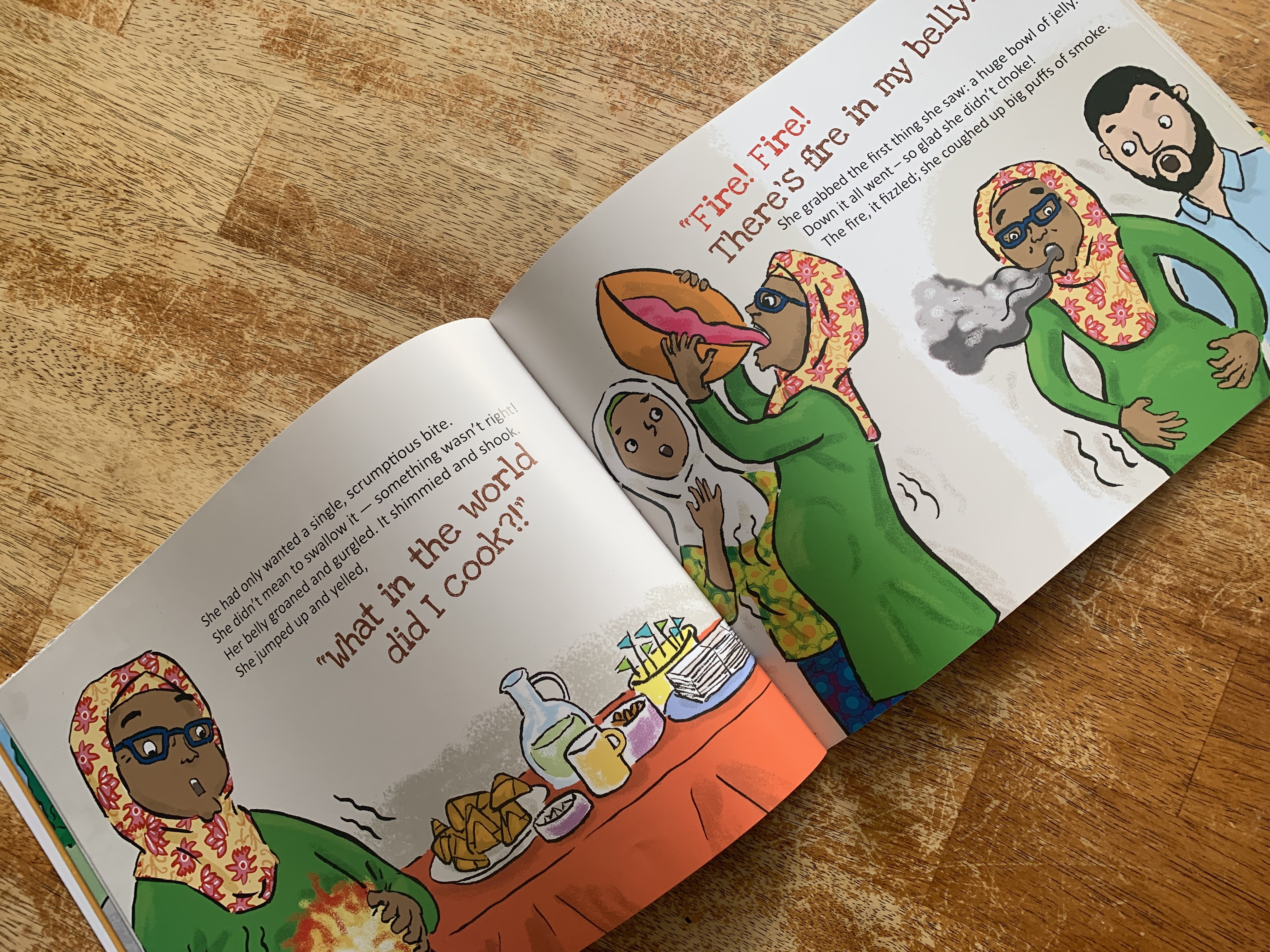
Auntie Sophie  hurries and fries her samosas and the ladies head up the hill to the only mosque in town.  Everyone breaks their fasts with a date, but Auntie Sophia dives in to her samosas.  When the imam’s mic crackles, she swallows the samosa whole and something is terribly wrong.  Her belly is on fire and jelly nor garlic knots nor mint lemonade not rice can cool it down.

img_4193

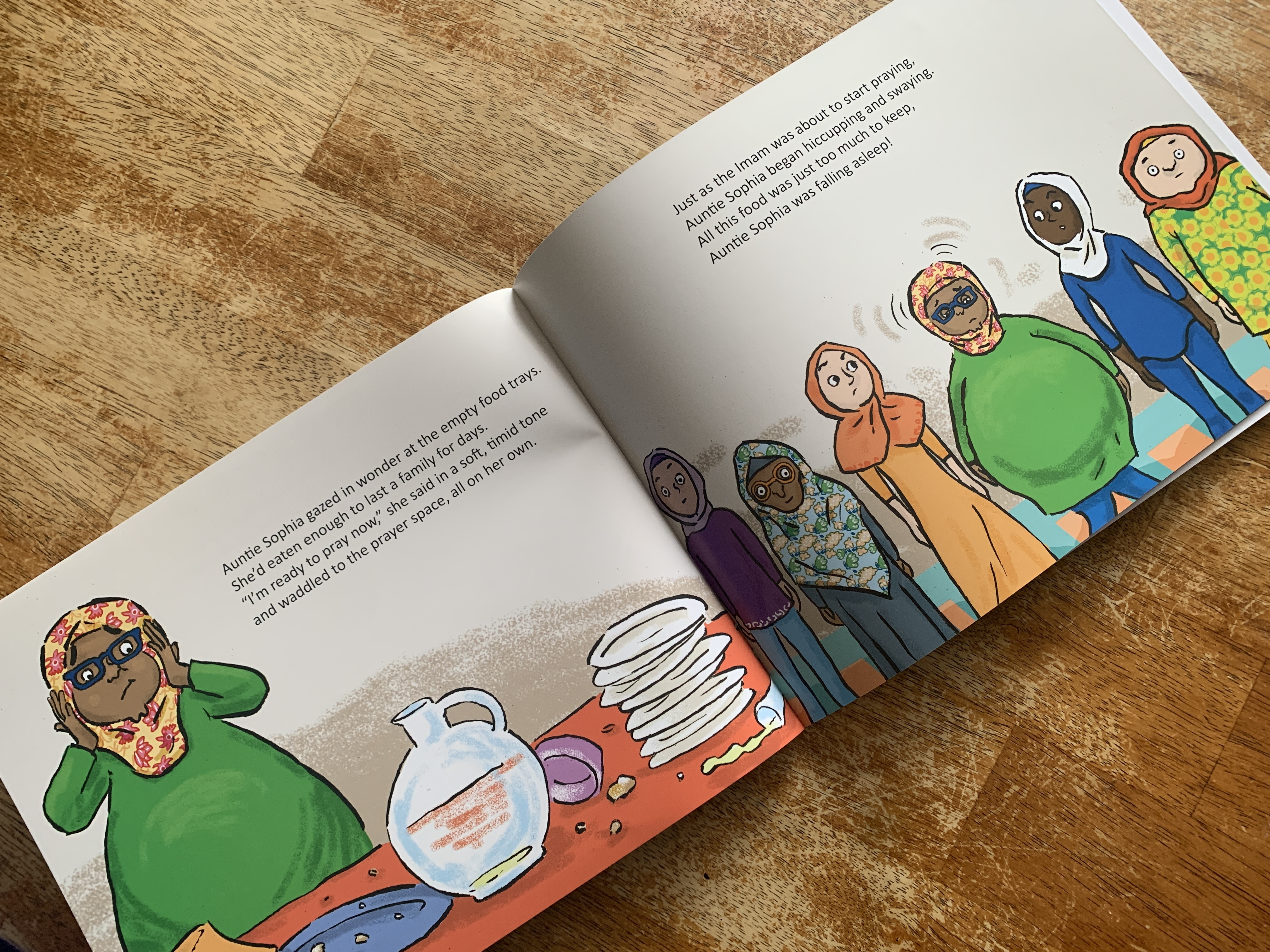
Just when she thinks she is ready to pray, it starts up again, and having eaten everyone’s dinner, Auntie Sophia is getting very tired. As she rolls out the door and down the hill to her house, she figures out what happened to her delicious samosa filling, and calls to have pizza and halal hot wings delivered to the mosque.  She also pledges to grow flowers next year instead!

img_4192

Kids will love the book as it is outrageous, while at the same time being so relatable.  The mosque, iftar, eating something spicy, the book is a favorite at our house for both the two and six year old and the horizontal 8.5 x11 orientation, keep eyes glued to the pages, while the rhyming lines move the story along.  I enjoy being able to talk about the peppers and different foods and smell of garlic with my kids after the 17th reading or so, and I love the diversity of the characters at the mosque. 

Ramadan’s Coming by Rabia Bashir illustrated by Laila Ramadhani

Standard
Ramadan’s Coming by Rabia Bashir illustrated by Laila Ramadhani

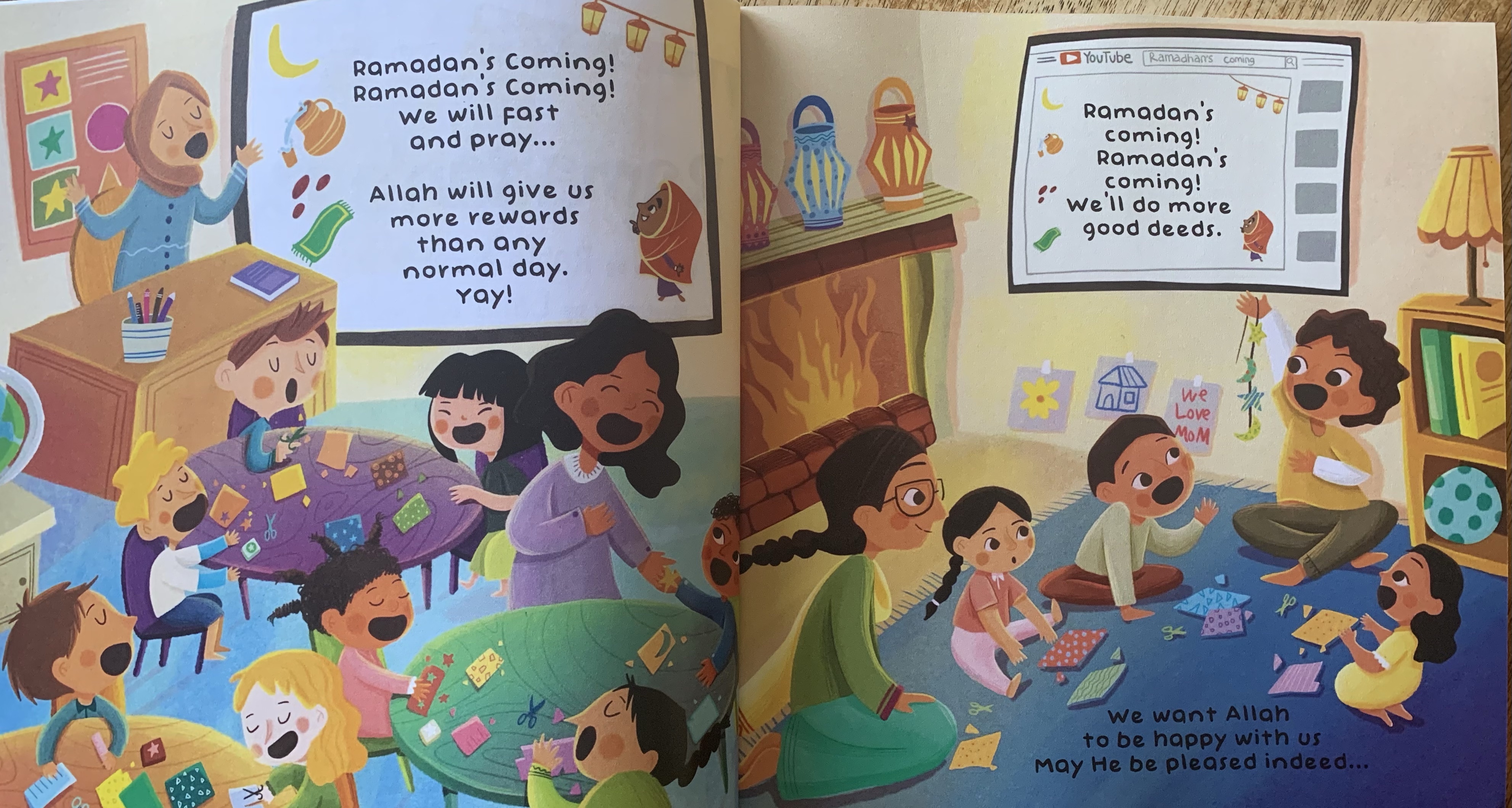
img_8785I think the illustrations in this 40 page picture song book are my favorite of the new 2021 books.  They are adorable and expressive and a big part of the story that the text alludes to, but doesn’t detail.  They also are a big part of the activities at the end of the book that encourage children to go back and find different Ramadan and Eid concepts to discuss and further understand.  I absolutely love that there is a glossary and a reference page that details and attributes the hadith implied in the simple sing song-y words.  The chorus is to the tune of jingle bells, and while I struggled to maintain the rhythm, the chorus reappears and if you are able to sing the book, your children will love it even more, haha, my voice and lack of rhythm forced me to read it, but either way it is absolutely delightful and informative for toddlers and up.
img_8787

It starts out with the refrain that Ramadan is here and we will fast and pray and that Allah (swt) will give us more rewards and we will do more good deeds, than on normal days.  It then shares that Ramadan is the month after Shaban when the Qur’an first came down and that we look for the crescent moon to know when Ramadan is here.  It is important to note that the words flow and are so concise you don’t even realize that much information has been conveyed.

img_8788

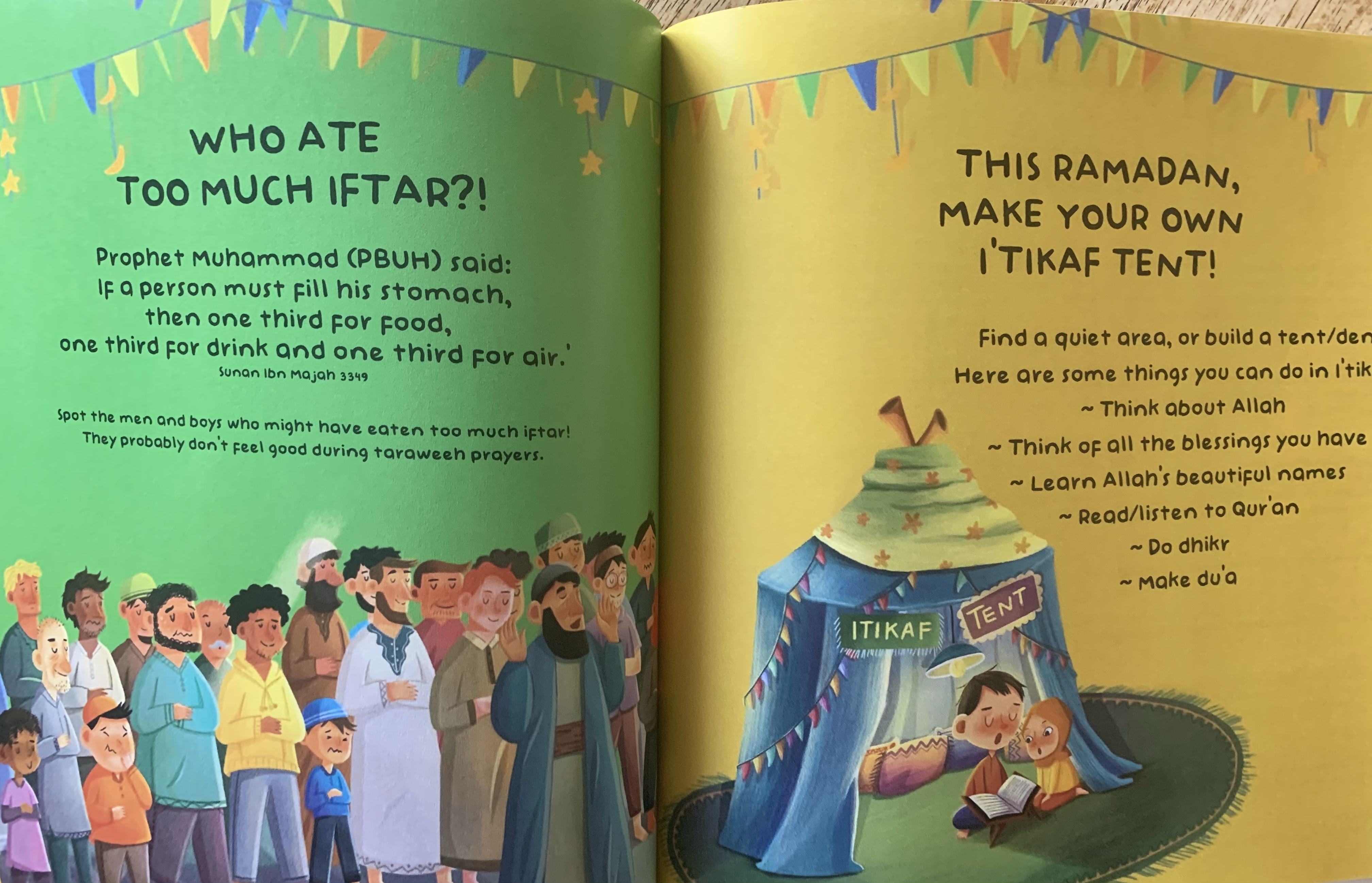
The chorus repeats and shows a family praying, kids helping vacuum, and giving socks to homeless.  The family then wakes up early for a healthy suhoor, no food or drink, thinking about how the poor must feel and then having iftar with a sticky sweet date and water.  Sometimes you eat so much your belly protrudes (a great vocabulary word for little ones). The next page has salat starting and those that ate too much wishing they would have left space for air and water.

img_8792

The chorus repeats again showing zakat being given, iftars being eaten in segregated large groups, before looking for Laylat ul Qadr takes place and some children read Qur’an in an itikaf tent. Then it is time for Eid hugs, salams, prayer, food and fun.

img_8791

On one page, the grammar of one line seems off, perhaps an extra word was added.  I contacted the author to see if it is an error as it is part of the chorus, but only appears wrong in one place and one time.  Even with the error, I would happily encourage this book for families with toddlers, preschoolers, and kindergarteners.  It will be read multiple times, and the pictures will hopefully offer something new with each reading as understanding increases.

img_8793

The copy I purchased from Amazon is 8.5 by 8.5 paperback, I’m not sure if they will be available from the publisher as a board book or without faces like so many of their books are.

10 Things I Love about Ramadan by Firhana Imam illustrated by Ali Gator

Standard
10 Things I Love about Ramadan by Firhana Imam illustrated by Ali Gator

img_8692

After a while a lot of Ramadan books seem repetitive with the information being more or less the same, this 24 page kindergarten and up book however, manages to present the information in a numbered format that allows for the information to flow without being constrained by an overly forced story.  The result is a fun little read that children will enjoy as they master some of the key concepts of Ramadan.  This book doesn’t have activities at the end, but would lend itself very easily to games, memorization challenges and discussion topics if read frequently for even the littlest Muslims. It would also work as an introduction to the month for non Muslims.  I know I get asked a lot for suggestions of books to be read to children’s classes in public schools, and this would definitely work for that too.

img_8694

The book starts out with an introduction to Nabeela as this is her list of 10 things that she loves about Ramadan.  She starts with Assalamu Alaikum before diving in with some facts and getting started with number one.  Each number is a two page illustrated spread, there are footnotes for any Arabic or religious terms used, and the bright colors and large fonts make the book easy for early readers to follow along with and attempt on their own.

img_8695

She starts by loving the new moon that her family looks for before the start of Ramadan. She loves Suhur: helping prepare for it the night before and eating her favorite pancakes early in the morning.

img_8696

Number 3 is iftar.  She loves pies and samosas and explains to us that she always has dates and water because that is the Sunnah.  Along the way she shares her love of family, making du’a because a fasting person’s du’as are always accepted, and reading Qur’an even though it is difficult because she knows she will get more rewards for trying so hard.

img_8699

She also loves Tarawih prayer whether at the mosque or at home, and the peacefulness of Lailatul Qadr.  She loves that her father and brother stay at the mosque the last ten nights of Ramadan in Itikaf and finally at number 10 is Eid!

img_8700

The book concludes with some verses from the Qur’an about Ramadan in English.  I thoroughly am impressed at how succinctly so much is conveyed and the adorable manner in which it is done, Alhumdulillah!