Tag Archives: gaza

Your Friend From Palestine by Nabila Adani

Standard
Your Friend From Palestine by Nabila Adani

This book is absolutely gorgeous, from the raised text on the cover, the sweeping illustrations with tangible details, the Islamic threads, and the heart, but…yeah you knew something critical was coming, the rhyme is not consistent, and the biggest hurdle for me, is that there is no backmatter.  I can’t say that I’m “bringing this up again,” because I don’t know that the debate ever dies down: can you write a book about something personal that you have not lived through? In this case can a non Palestinian write a book from a Palestinian perspective? As a former journalist and long time reader, I still maintain that you can, but backmatter detailing your own limitations, what efforts were made to have the book verified by those with OWN voice experience, and background information on why this is pertinent and relevant are mandatory. And this book does not offer them.  Nothing feels off about the contents, and anyone with a heart, has seen and felt everything on the pages about our brothers and sisters living under occupation and through genocide. So is it a good book, yes. Do I think it has value, yes. But, is it authentic? Is it accurate? Is it enough? Does the focus on hardship and destruction open eyes or diminish Palestinian joy? Why wasn’t a Palestinian brought in to cowrite the book with the author illustrator? Was it sensitivity read? I am not able to answer these questions, I simply bring up my concerns for you to decide for you and your children. While the book ends on hope for a free Palestine, and a safe Gaza, the oppressor is unnamed.

The book starts with children on a beach playing when they find a message in a bottle.  The message is from Khalid, a child in Gaza telling the finder about his life and asking about theirs. He likes to play football, but sometimes it isn’t safe, he likes to read stories but often can’t because there are no lights, and he dreams of swimming in a swimming pool, because they often don’t even have water to drink.

Khalid then tells the finders of the bottle, and thus the readers, to not lose hope, “to hold on to your imaan.” And it highlights what we can all do to help.  “You can pray for us! Send charity! Spread the news!” and tell people about Palestine. So that one day we can meet at the Dome of the Rock, pray at Masjid Al-Aqsa, and be together in a free Palestine, inshaAllah.

The illustrations are beautiful and the framing effective in connecting with readers, and highlighting the similarities before revealing the obstacles. Again why I wish there was backmatter, so that it didn’t feel simplistic, but rather bringing it down to a younger audience level.  With dialogue, explanation, and context, the book can be powerful, but on its own, I feel the lacking authenticity, transparency, and details about Palestine, make the book in need of an update before future reprintings.

The Donkey who Carried the War on her Back by Hooda Al Shawa illustrated by Sienny Septibella

Standard
The Donkey who Carried the War on her Back by Hooda Al Shawa illustrated by Sienny Septibella

This 44 page story told from Zahra’s perspective, a donkey in Gaza, juxtaposes her life and what she sees before the bombardment of Gaza with after, and the determination and hope that drives her and her owner Sami to help. I love that it shows the daily joy, beauty and the resilience in the face of attempted erasure. By using the donkey as the protagonist, the book is able to explain and show realities in a manner that remains simplified, removed, apolitical, but informative none-the-less, for young children. The book was created with the collaboration of the Tamer Institute for Community Education who’s vision is, “Towards a Free and Safe Palestinian Learning Society,” so, I’m not sure that my opinion counts for anything, but I do worry that the “telling” comes with the words the donkey hears of “sanctions, closures, embargoes, blockade,” but the “showing” comes when “one day, a war came to my city.” It feels like it could be interpreted that life was fine and then one day it wasn’t, and yes, the backmatter defines the words, but it doesn’t “show” the donkey at checkpoints, or show any previous destruction, or struggles.  Presumably the book wants to show the joy and beauty of Gaza to humanize a population that the global media is endlessly working to dehumanize, but the framing and the memorability paints a picture that to my acknowledged outsider, non Palestinian heart, feels dismissive of years of oppression, and aligns with the erroneous narrative that it started in October 2023. That isn’t to say the story is not important,  I think that with guided conversation and contemplation, the book will show children what Gaza looked like before the attacks by the occupation, the importance of pack animals such as donkeys, and why the people of Gaza dream of freedom.

The book starts with Zahra the donkey standing on green grass with buildings and the ocean in the background, acknowledging that Gaza is not an “ordinary city.”  She hears words in the market place that the greengrocers call out “sanctions,” “closures” “embargoes, “blockade,” and hears that the people cannot travel or leave, “that life is difficult and RESTRICTED!” But despite that, she enjoys carrying things in her wooden cart as she makes deliveries, food, solar panels, strawberries, stopping with Sami to get ice cream.

Then when the war hits, the city is turned to rubble, and people must live in tents. Zahra and Sami’s daily routine changes, they transport ration supplies, serve as an ambulance, transporting families to refugee camps, and the border with Egypt to try and leave. The sounds of crying are devastating, but she also hears laughter, and music, and stories from the hakawati.

I like that what they deliver is defined to explain what she is carrying “mahshi kousa,” although it seems like a translation error perhaps and should be “kousa mahshi” with the noun coming first, but again, what do I know. It appears the author is Palestinian Kuwaiti, but there is no mention in the text of the book about any religion, or indication online of the author or illustrator’s faith identity,  I share this not for its Islamic rep, but for solidarity and awareness.  There are visible Muslims in the illustrations.

Eliyas Explains + Bite-Size Journal: Why Does Allah Let Bad Things Happen? by Zanib Mian illustrated by Daniel Hills

Standard
Eliyas Explains + Bite-Size Journal: Why Does Allah Let Bad Things Happen? by Zanib Mian illustrated by Daniel Hills

img_3601-1

The book stems from the genocide occurring in Gaza, but expands to cover the more general concepts of qadr (destiny), tests, and sabr.  The book assumes that what is happening in Palestine is known and does not discuss specific details, allowing the book to be both timely, yet universal.  As with all the books in the series, the conversational humorous approach appeals to children as foundational Islamic concepts are broken down and explained.  The book is 73 pages with the journal portion starting on page 33. In some of the other books, the journal feels more of a hands on to already shared information, or an accompanying workbook of sorts.  In this book however, I feel like the second half continues to explain the topic at hand, and convey key components in understanding why Allah swt, lets “hard” things happen, how we should view the tests, approach difficulties, and inshaAllah triumph. The book has been checked by a Shaykh, and I highly recommend this important book for elementary, middle grade, and even middle school children. The concept of qadr is difficult, I struggle to truly grasp what we can and cannot change, but this book helps readers focus on what we can change and how to view terrible things that happen to us and to others.

The book starts with Eliyas introducing himself and his family, and then wondering why “Israel is being able to do what they’re doing in Gaza.  Why isn’t Allah stopping it?” As with all Eliyas books, mom and dad are sought out, food is somehow worked in, and time and space are given to Eliyas and his siblings to be given an answer. His parents start by being glad that Eliyas’s heart is soft for the Palestinians and that he is bothered by what is happening to them, before explaining that a lot of understanding is trusting and truly believing that Allah swt knows best.

img_3625-1

The book uses hadith, ayats from the Quran, it even shouts out other Zanib Mian books, The Mindful Book of Wellbeing, for seeing the bigger picture and Eliyas Explains Why Should I Pray my Salat on how to make yourself strong to get through the struggles of this duniya.

The book talks about why Allah swt didn’t make everyone good, and it is clear in saying that being mad and sad are ok too, as long as we are not questioning Allah swt. There are prompts and questions (with answers) and the book is not heavy, despite the subject matter, the tone and approach stay on level and allow readers to connect, alhumdulillah.

You can get your copy here at Crescent Moon Store.

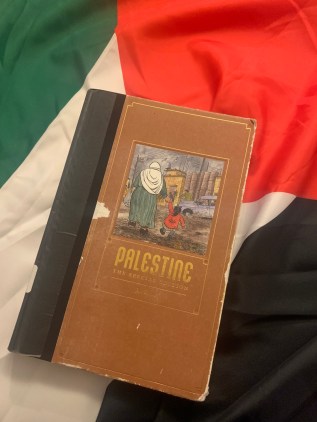
Palestine: The Special Edition by Joe Sacco

Standard

img_2164-1

Written between 1993 and 1995, and compiled as a complete set in 2001, this 285 page adult non-fiction graphic novel is not really something I can review, even if I knew how.  As we have passed 100 days of the escalation in Gaza, on top of the ongoing horrors of Israeli occupation, I am hoping to broaden my literary awareness to include not just children’s fiction and non-fiction about Palestine, but also adult works by those living it, those moved by it, and those reporting on it.

This particular “special edition” has a forward by Edward Said, and an introduction by the author and illustrator.  Once I started the actual story, I’ll be honest it took a few attempts to hook me, with the starting being in Cairo and being a little aggressive with alcohol and talk of women, but once I decided to just keep going, the book finds a bit of a rhythm.  It shows the author himself shaping his own opinion as he interviews, and sees, and reports on the events around him.  It is non-fiction, it is written by a journalist, at some points he acknowledges his bias, but the overall picture presented, is heart wrenching.  That the humiliation and torment and occupation of a people has been so well known and documented and ignored, in light of current events, and even in isolation, is devastating.  The exhaustion the writer feels just witnessing it, is palpable, and the complete ignorance of Israeli, former IDF soldiers none-the-less is stark.

The book is both a reflection of the time with internal political factions playing roles differently than they do in todays conflict.  There are also views about Iraq and Saddam Hussein, which might surprise readers today.  But the power of this book is what hasn’t changed, the torture, the imprisonment of children, checkpoints, illegal settlements, humiliation, restrictions from working, from moving, from being treated as equal.

I’m glad I read it, and spent time among the the ink filled pages. I am certain that many of the stories, particularly the ones from inside the prisons will stay with me and haunt me as I read headlines and scroll endlessly through the statistics occurring in real time.  How can we be so blind, for so long, how can a people endure so much and keep fighting, how does any of this make sense?

We are Palestinian: A Celebration of Culture and Tradition by Reem Kassis illustrated by Noha Eilouti

Standard

img_1887-1

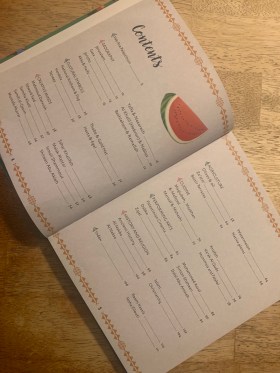
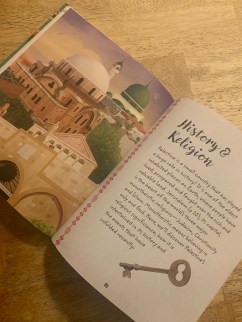
The book is non fiction, the author not Muslim, but here I am reviewing this book because, we are all Palestinian and my heart enjoyed reading this 112 page book that covers Geography, Cultural Symbols, Creative Minds, Agriculture, Cuisine, Performing Arts, and History and Religion for middle graders and up.  The book is a celebration rooted in information and expressed with beautiful illustrations, fun facts and text blurbs to break up the text.  I do wish it was sourced, and I desperately wanted a map, particularly in the section on geography- it seems odd in fact that it doesn’t have one.  The book contains information about the nakba, but doesn’t let it control the narrative or overshadow the culture that thrives in Palestine and in all Palestinians. Undoubtedly, this is an important book to spend time with and share, especially as the global media is currently working overtime in attempts to erase the richness, joy, and even basic humanity of an entire population.

img_1888-1

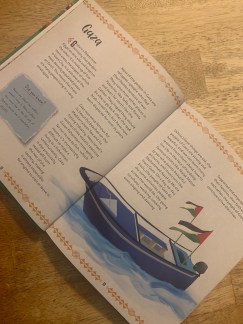
The section on Geography covers Jerusalem, Gaza, Jericho, Akka, Haifa, Yaffa, Nazareth, Hebron, Nablus, Bethlehem, and Ramallah.  Some cities are combined and are featured on a full two-page spread after an introductory page for the section.

img_1889-1

Cultural Symbols covers the national anthem and flag, Handala, tatreez, thobes and gold hat, hatta and egal.  I enjoyed learning more about cultural items that have become increasingly familiar, but whose origins, importance, and displays were new.

img_1891-1

The Creative Minds section focuses on people both currently still living and deceased.  I always struggle with books that highlight important people because how they are chosen is always such a mystery, and this book at least acknowledges that this is just a tip of the iceberg cross-section of people influential, talented, and noteworthy.

The Agriculture and Cuisine sections are a celebration of food and resources that most of us who have been privileged to have Palestinian friends sharing their lunch and dinner with will find particularly enjoyable.

img_1892-1

Performing Arts was informative and new to me, and I think further shows the depth and richness of the culture.  It highlights specific people, dances, cinema, and instruments in this section.

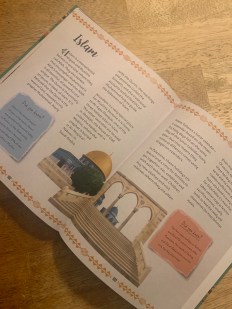
The final section of History and Religion starts with ancient history, followed by the Nakba, al Naksa, and then a two page spread on Islam and a two page spread on Christianity.

img_1893-1

Notably not mentioned in the entire book is Israel, and in the religion section there are no other faiths shared except Christianity and Islam.  The author seems to be making a point, by what is included, and what is focused on, and keeping the light shined on Palestine. There is an index, but no sources.

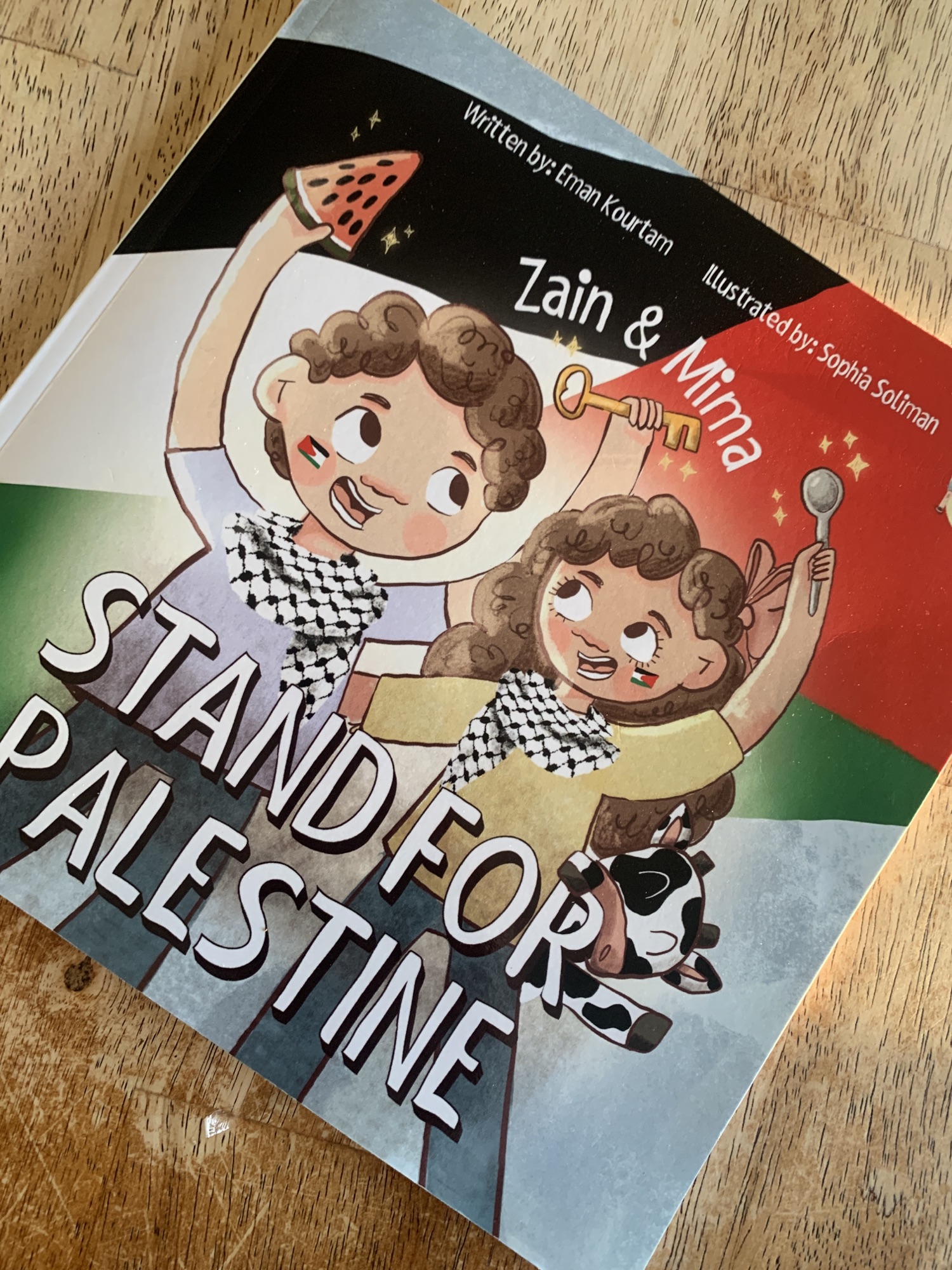
Zain and Mima Stand for Palestine by Eman Kourtam illustrated by Sophia Soliman

Standard

img_1853-1

I love this 57 page rhyming book from the perspective of a non Palestinian family pulling out their Palestine gear and taking to the streets to protest the occupation of Palestine.  Along the way the sibling duo, and thus the reader, learns about the history of Zionism, birth righters kicking people out of their homes, allyship with those on the side of Palestine, the crimes of Hitler, it shows maps of the occupation, details how movement is restricted, and even how to use BDS as a form of resistance from afar. All on an early elementary level.  There is a game at the end with an activity about resistance symbols, as well.

The book starts with Zain and Mima coming home from school tired and hungry.  They notice Mama is upset and glued to her phone, they then here noise outside and are encouraged by their mother to join the march as she hands them keffiyehs and explains that people are losing their homes in Palestine.

img_1855-1

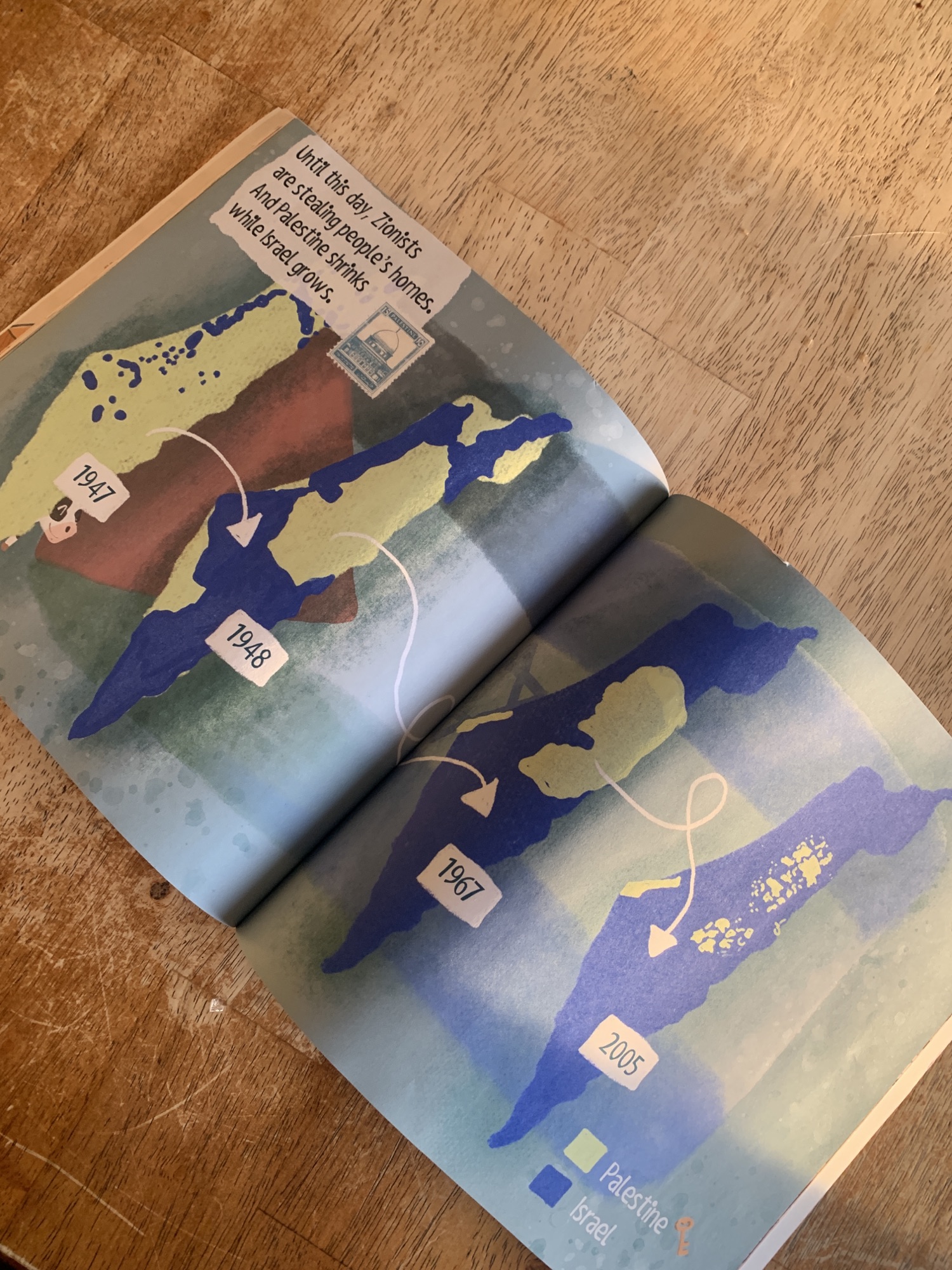
The kids are not sure of what is going on, but notice the chanting and signs and diversity of people coming together to demand freedom for Palestine.  After the protest they head home and Mama explains the history of Palestine and answers their questions.  She explains who Theodore Herzl was and his idea of Zionism.  Why it is dangerous and evil.  She then explains how Hitler’s actions in WWII gave rise to Zionism in the aftermath. A two page spread of maps show 1947 Palestine/Israel, 1948, 1967 and 2005 in easy to understand visuals. Mama then explains, without identifying any specific country, that Israel has the best weapons and Palestinians use rocks and slingshots to defend their homes and families.  It shows walls and checkpoints controlling people’s movements, and the oppression that has resulted.  When Mima asks what we can do in addition to marching and chanting, Mama explains using our money wisely with the BDS movement.  The next day, the children empowered by knowledge, make signs and are ready to stand bravely for Palestine.

img_1858-1

This book was originally written in 2022, and sadly is still so on-point.  It is available again on Amazon after being temporarily blocked, but I hope you will purchase it from a small business such as Crescent Moon Store where my initials ISL will save you 10%.

img_1857-1

My Garden Over Gaza by Sarah Musa illustrated by Saffia Bazlamit

Standard
My Garden Over Gaza by Sarah Musa illustrated by Saffia Bazlamit

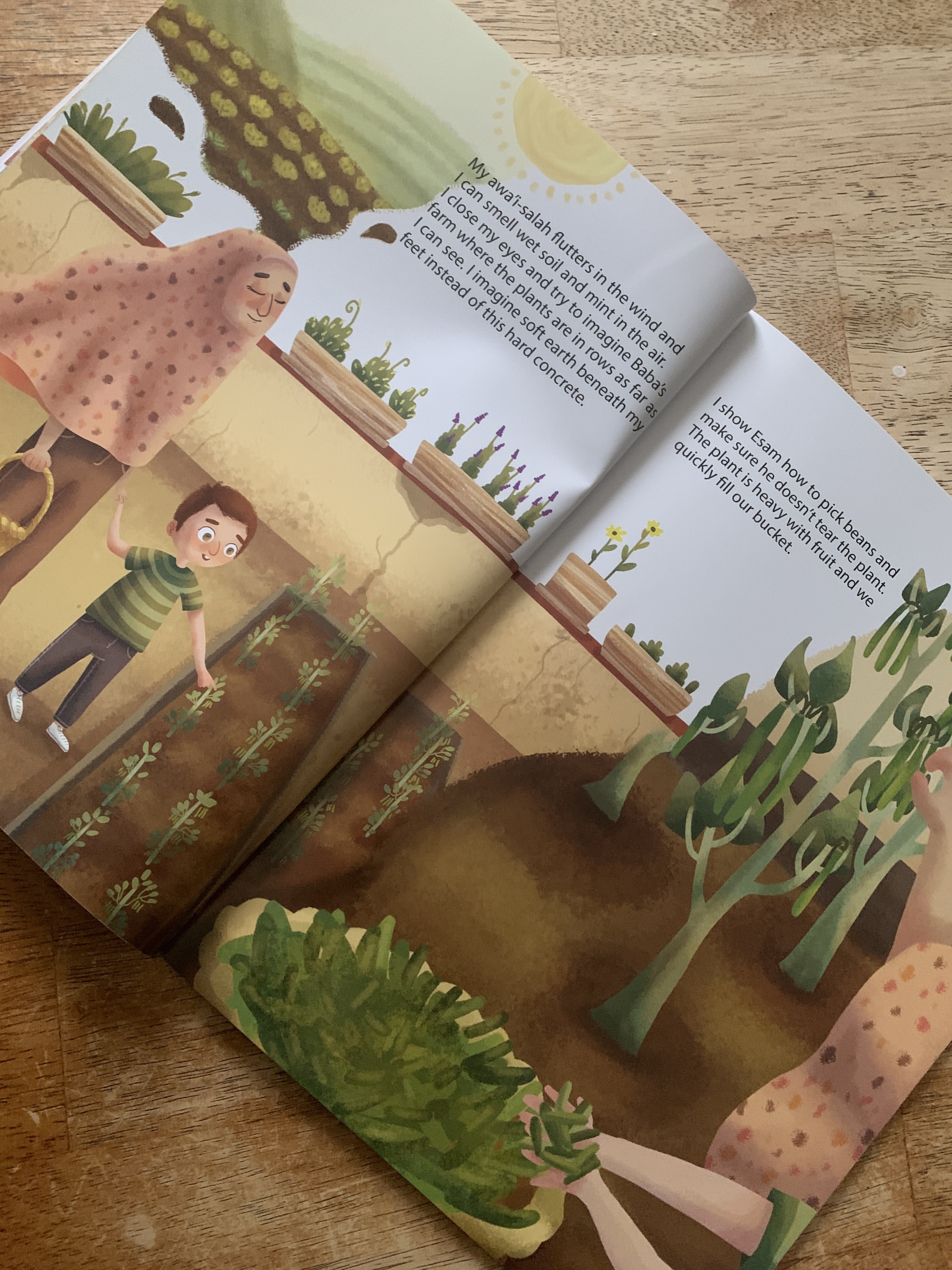
This book is hard to read, it hurts the heart, it doesn’t let you claim ignorance regarding the plight of Palestinians, and it shows cruelty,  a specific inexcusable cruelty, in a children’s book that will haunt you and infuriate you for weeks and months, if not indefinitely.  I’ve read a number of Palestine set books, but this one, in its simplicity, leaves me raw.  A child with a rooftop garden that helps feed her family is deliberately targeted by Israeli drones and destroyed.  This isn’t science fiction or dystopian, this is based on real acts.  The book itself threads in themes of hope, of not giving up, of remembering strength of a lost parent, of vowing to move forwards, but the catalyst for it all is not happenstance, and while the details of the occupation and oppression are not stressed and articulated, they are referenced and skillfully present to be discussed with children on their level with the included backmatter at the end.  This book is powerful and should be required reading. It is a difficult read and it has flags, but it is also a glimpse of the reality of our world, and the manner in which this book is told allows for the discussion to taken place with middle grade readers and up. The book is not text heavy, but the nature of the content makes me suggest it for mature children.

Noura, a young girl, is in her home in Gaza when drones are seen just out the window and she quickly pulls her little brother Esam away to safety.  To distract him she tells him about their father and his farm that he used to have in Umm An-Naser.  She explains how the wall cut them off from their land and when the drone noises fade, she takes him up to her rooftop garden to pick green beans.  Their mama works downstairs as a seamstress, and while they wish they had meat, the garden helps them have fresh vegetables.

The next day after Noura gets her little brother ready for the day they head to the roof, but drones arrive and start spraying chemicals on the growing plants, killing them, and sending Noura gasping to breathe.  She tries to cover the plants and swing a shovel at the drone, but it does little to save any of the food and Noura is devastated.

Noura’s mama reassures her daughter that the food can be regrown, but she is irreplaceable, as Noura goes to scrub the chemicals from her skin.  The frustration is real, but determination prevails as the family cleans the garden and begins again, just as their father did.

The last two page spread of the book is a basic map, general touchstones of the situation in Palestine, and the very real drones that fly in to Gaza to surveil, attack, and spray herbicides on crops. You can purchase a copy on the publisher’s website or HERE at Crescent Moon Store.

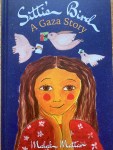
Sitti’s Bird: A Gaza Story by Malak Mattar

Standard
Sitti’s Bird: A Gaza Story by Malak Mattar

img_2562

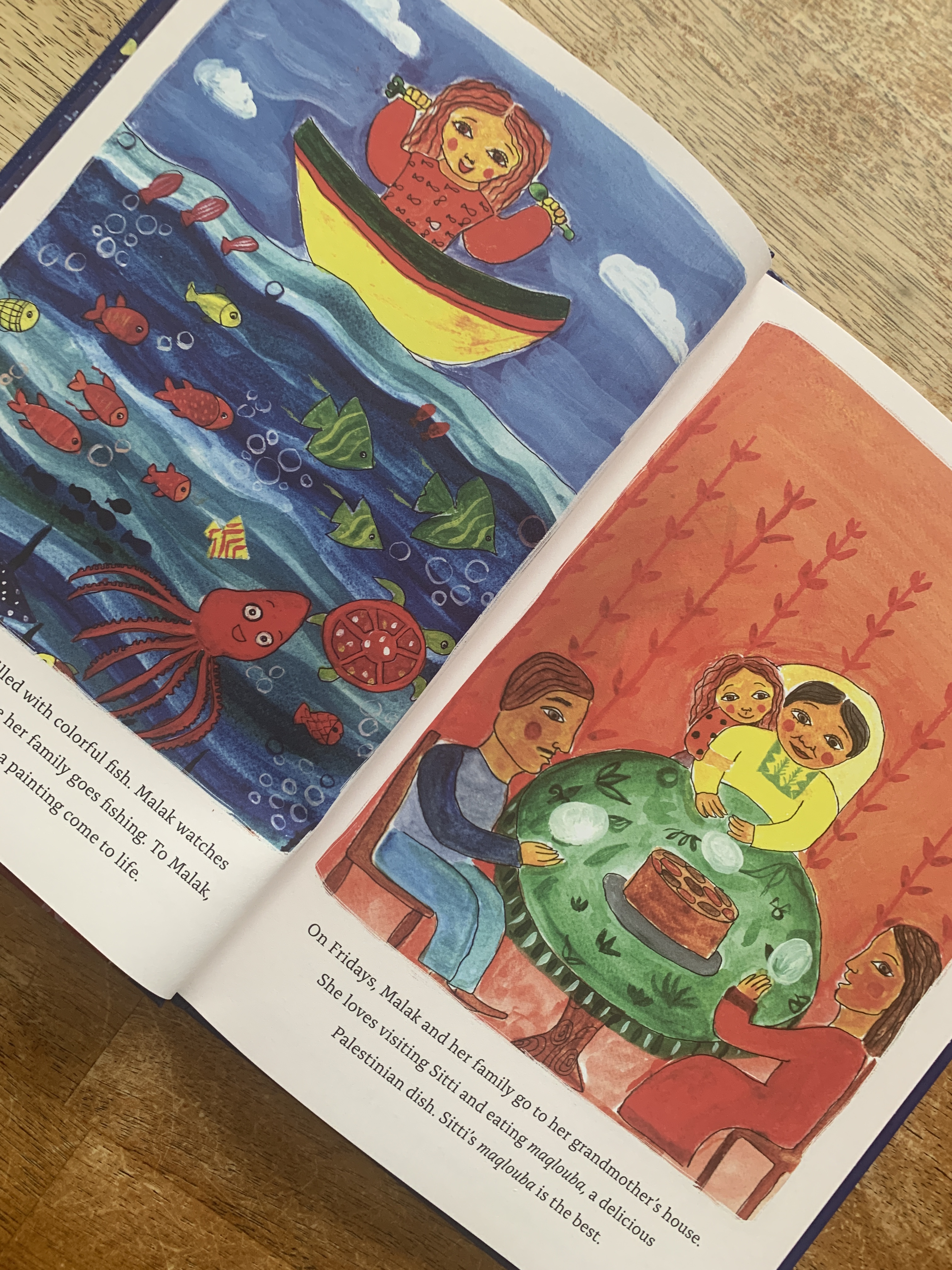
I hate that this book is so timely.  It was written by the author/illustrator recalling the 2014 airstrikes, but alas, has anything changed for the Palestinians’ suffering at the hands of the Israeli occupiers amid the  apathetic silence of the world?  This 32 page picture book shows family love and daily life while Gaza is under siege.  The heartbreak of a young girl’s reality and perception shows the reader, in a simple empathetic, heart-wrenching, real-life example how her dream was limited and caged because she is not free.  The book is not sensationalized, nor graphic, it is written by someone who endured this as a child, and has written the book for children. The theme is not even political, but more hopeful as art is found as a respite and way to keep dreams from completely dying.  May Allah swt ease the suffering of those under occupation and free Palestine, ameen.  

img_2557

The book starts with a little girl and her parents going to Sitti’s house for the best maqlouba.  Sitti has a beloved bird, Malak wonders if she too is in a cage.  Her grandmother encourages her to fly in her dreams.  At school she is happy with her friends, playing games, listening to stories, but when an explosion sends them all home, she won’t get to return for 51 days.

img_2559

Constant airstrikes keep the family home and in fear.  Malak finds some paints and starts to create.  Sitti’s bird is lost when Sitti’s home is destroyed, but somehow shows up at Malak’s home.  Eventually Malak returns to school and she shows her teacher all her paintings. Her teacher decides to host an exhibit. 

img_2560 

People show up and marvel at her art work.  Months later an international exhibit invites her to attend with her parents, but sadly she must decline.  Gaza is closed.  She cannot leave.  

The book is hopeful, but does not have a happy ending, and I think the weight of that makes this book all the more powerful: because it is timely, because occupation persists, because dreams cannot be made into reality, generation after generation, this story inshaAllah will inspire some change and lots of compassion.

img_2558

There is nothing Islamic in the book, save some #muslimsintheillustrations, the author is Muslim.

Available here at Crescent Moon Book Store https://crescentmoonstore.com/products/sittis-bird?sca_ref=1601585.fIPhoqtScY  

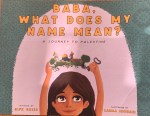
Baba, What Does My Name Mean? A Journey to Palestine by Rifk Ebeid illustrated by Lamaa Jawhari

Standard
Baba, What Does My Name Mean? A Journey to Palestine by Rifk Ebeid illustrated by Lamaa Jawhari

img_7233

This lyrical journey through Palestine’s major cities, shares historical facts, geographical information, cultural richness, and love for a homeland that will inspire and educate all readers. There is a lot of information pressed in to 32 pages and at times the rhyming text, illustrations, and maps are powerful, and at other times overwhelming. The 8.5 x 11 horizontal paperback bound book needs to be bigger to hold all that the pages contain, and hard back to hold up to the details that need to be poured over to be appreciated. The content about the names and places in Palestine is priceless and well done, but I really wanted to love the book a bit more than I ended up feeling for it. I think trying to make it all rhyme was just a bit too much for my liking, but I would buy this book again in a heartbeat to share with my children. Even though we are not Palestinian, I think all Muslims have a piece of Palestine in our hearts and feel a deep need to celebrate the culture, fight for their freedom, and demand a quality of life that they are brutally being denied by their oppressors.
img_7234

The book starts out at bedtime with a little girl, Saamideh asking her baba what her name means. He explains to her that it means “one who is patient, persistent and one who perseveres.” She is named this because she is Palestinian, he explains and then he shows her the key to their ancestral home in Palestine. He asks her to close her eyes and imagine a white dove, named Salam, taking her on tonight’s journey.

img_7235

Salam and Samamidah prepare to journey across Palestine’s mountains, hills, deserts, and plains. They start in Areeha, one of the oldest cities in the world, and one one of the lowest points on Earth.

img_7236

They journey next to Al-Quds, the capital. They see the old city, Al-Aqsa, and more, before heading off to Nablus, Yafa, Haifa and the Akka. Learning about the cities, the food, and the history of each.

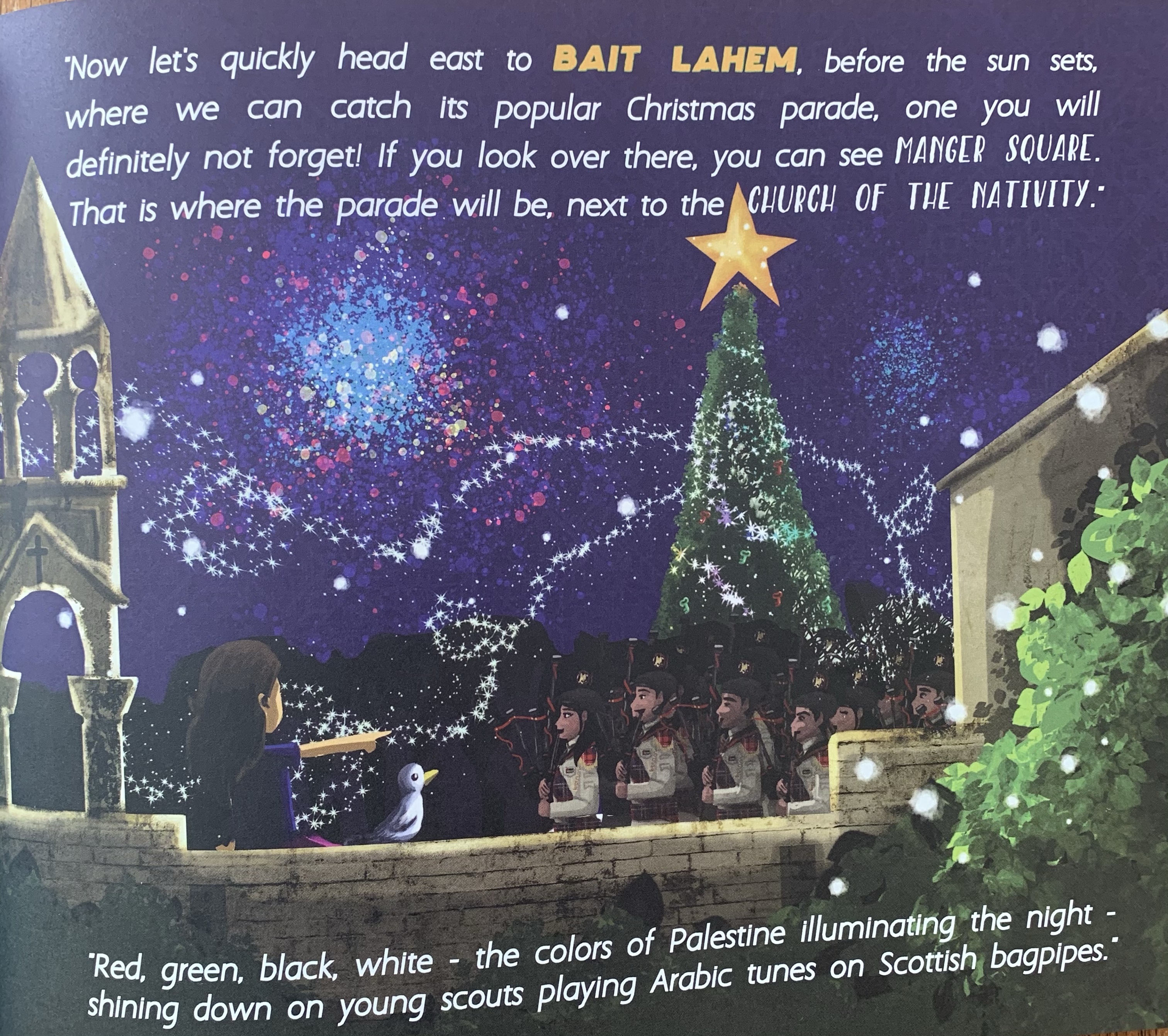
They learn about the dabkah, and the weaving in Gaza and head to Bait Lahem too. They learn about glass blowing in Al-Khalil at the Ibrabhimi Mosque, and finally they conclude their journey with the little girl dreaming of flying around the world to use her key and open people’s hearts and minds.

img_7239

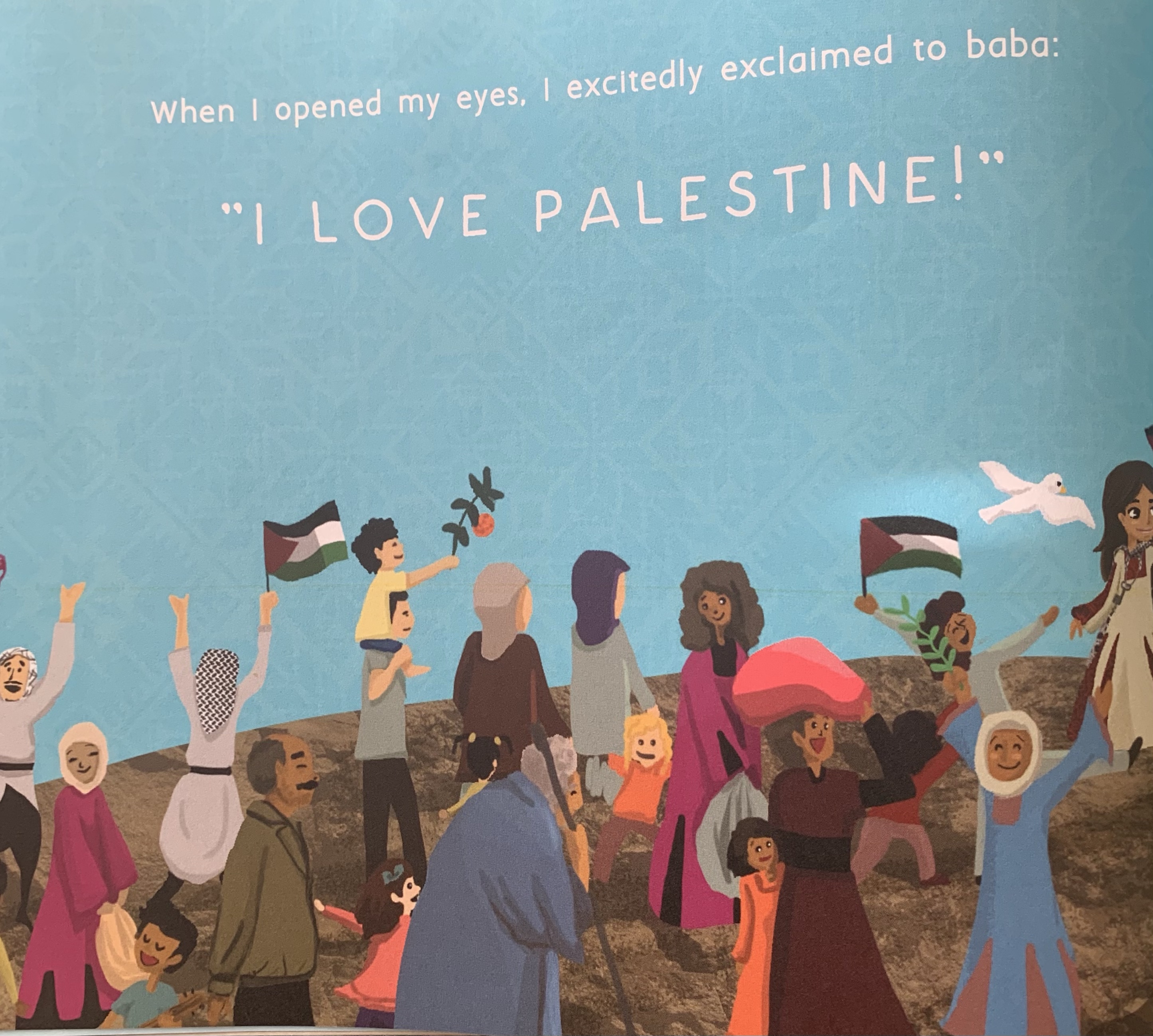
She proudly exclaims her love of Palestine and her and her baba pray that one day they will be able to return. Saamidah then asks her baba why they are refugees, and he promises to save that conversation for tomorrow’s beditme story.

img_7240

The book concludes with a list of the city names in Arabic, trasliterated in English, and then the English names. It then has discussion questions at the end.

The book is not outwardly political, nor critical. It is a celebration of a people, a culture, and land. Happy Reading!