Tag Archives: friends

Rami the Ramadan Cat by Robyn Thomas illustrated by Abira Das

Standard
Rami the Ramadan Cat by Robyn Thomas illustrated by Abira Das

rami

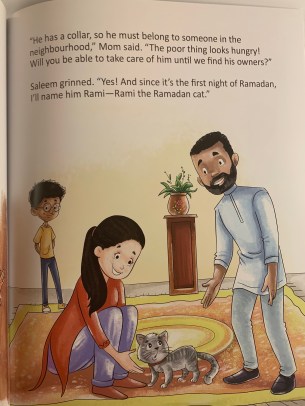
This delightful little story about a boy, a lost cat, Ramadan and making friends, has a great lesson in empathy and understanding even when things are hard.  The 28 page beautifully illustrated glossy book (8.5 x 11)  is set in Ramadan, but is enjoyable for children 5 to 9 all year long.

Saleem has just moved to a new city with his parents and doesn’t know anyone.  Feeling lonely on the first day of Ramadan he is outside sulking when he sees a lost little cat.  He brings it in and his parents help him take care of him until they can find the cat’s owners.

B342E851-726B-4B8A-9B63-F381F5C1009D

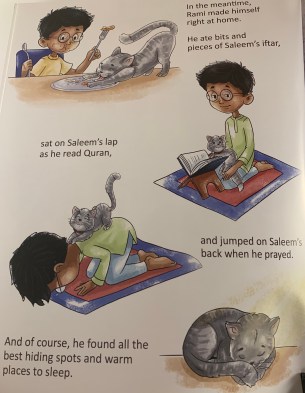
Saleem decides to call the cat, Rami the Ramadan cat for his timely appearance.  The next day the family makes flyers to post around to try and find Rami’s owner.  But no luck even after a few weeks, and secretly Saleem starts hoping they never find the owners.  Rami is his best friend, he jumps on Saleem when he is praying, keeps him company when he reads Quran, even shares his iftar with him.

22F7C85A-8891-4121-A608-421511688C49

One night at the mosque, Saleem makes Dua that Rami will stay with him forever.  After Taraweeh, Saleem can’t find his father, he waits by the door as everyone leaves, but can’t see him, he checks the shoe rack and his shoes are gone.  Feeling scared and alone he wonders if his father left him.  When his father returns from the washroom, Saleem is relieved, but wonders if that is how Rami felt that first day of Ramadan.

6E10660E-7FE3-4341-AF7E-B75EDF45DC8E

The next morning Saleem and his mom knock on every door in the neighboorhood until they find Rami’s owner.  When they find her, she is a nice lady, and tell Saleem, the cat’s name is Sammy.  Rami gives her his address and asks her to contact him if she ever needs someone to cat-sit Rami.

3634A3A5-B74D-4505-8C44-AED216D38872

Saleem’s Eid isn’t very fun without his only friend.  After prayers, there is a knock at the door, Sammy’s owner has come to offer to let Saleem keep Rami if he promises to bring him around to visit with her and her grandkids sometime.  She has other cats and sensed that he was missing Saleem.

16157CCA-24F9-4BDD-A661-B3353B6775C4

Saleem’s parents invite the lady, Mrs. Tompkins and her grand kids in to celebrate eid with them and Saleem and the children play with Rami, the best eid present ever.

The book shows Saleem praying and reading Quran and going to the masjid, but it isn’t preachy.  I think even non Muslims would enjoy the book and not be confused by anything Saleem and his family are doing.

I love that the mom so clearly wears hijab out of the house, but not in the house.  That there is some skin color diversity in the book, that Mrs. Tompkins is in a wheel chair.  I also love that the new friends, and only friends are presumably non Muslim, and that a little gray cat brought them all together, Alhumdulillah.

Yes No Maybe So by Becky Ablertalli and Aisha Saeed

Standard
Yes No Maybe So by Becky Ablertalli and Aisha Saeed

yes no

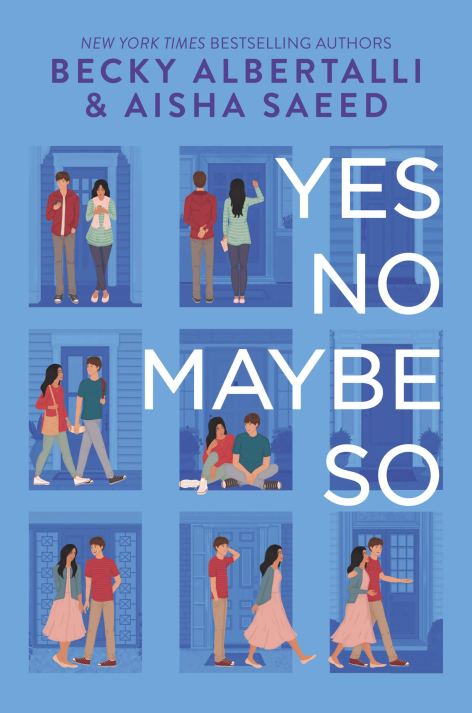
This new rom com in book form with a Muslim female character written by a Muslim author, sets itself apart by being co-written by a Jewish author and the other half of the love story being told by a Jewish boy’s point of view.  This YA book is very relevant as a special election in Georgia served as the catalyst of the two authors coming together and fictionalizing the effects of white supremacy, Islamaphobia, and antisemitism for the book, while real headlines were urging the two to canvas, get involved, and make a change against the increased showing of hate with the election of Trump.  The presentation of Islam is probably realistic, but definitely not ideal, and with the kissing, multiple LGBTQ+ supporting characters, the profanities, and 436 page length, the book is probably best for 15 year old readers and up.

SYNOPSIS:

Jamie Goldberg is 17 and is spending his summer helping his cousin work on a special election campaign for a Democratic candidate in an incredibly red district in Georgia.  A very nervous kid, who hates public speaking and talking to girls in general, he would rather be behind the scenes or hanging out at Target.  His little sister, Sophie’s bat mitzvah is coming and things at home are crazy with pre party planning.  His grandma, an Instagram sensation uses him for tech support and video filming, and his easy going demeanor means he spends a lot of time, being bossed around.

Maya is the 17 year old only child of a lawyer mom and physician dad and has just found out that they are separating.  With her one friend too busy with work and starting at the University of Georgia, US born, Pakistani-American Muslim Maya, is not having a very good Ramadan.  When an interfaith event reunites her with a childhood play-date friend, Jamie, her mom convinces her to help him canvas to keep busy and sweetens the deal by bribing her with a car.

Naturally the two spend a lot of time together vounteering for Jordan Rossum, stuffing envelopes, canvassing, and putting up signs.  Along their way they become good friends, and invested in the election as a House Bill banning head coverings, and antisemitic bumper stickers start getting plastered around town.  The end of Ramadan, the election, the hate the two encounter, and families changing, bring Jamie and Maya together.

Maya’s parents are pretty chill about boys, and only caution her about unnecessary complications by dating in high school, when Maya throws it back on them, that their relationship is pretty complicated, she seems to not find an Islamic reason not to make-out with Jamie.  The whole book is angsty and the two feign cluelessness, but based on the cover of the book alone you know where it is going.  The true climax is how much the relationship can be used for political gain, and if they can get their candidate elected.

WHY I LIKE IT:

I like the political setting, it is a different and very relevant slant.  It might be a little alienating to readers outside the United States, because the political process isn’t really detailed, but the characters involvement in their small slice is a major aspect of the book.  The book is definitely pro Democrat, but addresses the gas lighting, hate speech, and views of those on both sides.

I also like that two minority authors came together to share an OWN voice perspective of life today.  For the most part the story telling is smooth with the two characters getting alternating chapters to tell their story from their point of view.  A few times, I felt details were missing, for example what Maya wore for Eid, when space was given to detail that she didn’t wear ethnic clothes to an iftar, and her picking a dress for Sophie’s bat mitzvah.  Similarly, Maya’s parents seemed flat for their trial separation being a major part of Maya’s stress.  Jamie’s grandma was probably my favorite side character, and one of the most fleshed out.

I am fully aware that some Muslims pick and chose what to follow and that not everyone is strict about boy/girl relations, but I felt like for a book that is set in Ramadan, uses religion as a catalyst for civic action, Maya’s mom wearing hijab, and an opening scene being set at the masjid, there is really nothing Islam in the defining aspects of the characters or story.  It is so watered down and almost catering to non Muslims to feel comfortable, that it left me annoyed.  And I think non Muslims too will wonder why Maya’s mom covers and Maya doesn’t and how that works, or why Maya switches to having one reason for not dating and then a religious one.

The book sets out to do a lot in terms of humanizing the effects of laws and policy on average people, but I don’t know that most Muslims hoping to see a mirror to their experience will find that in Maya.  I can’t speak about Jamie, and the Jewish experience, but Maya is rather forgettable in my opinion.

FLAGS:

There is a lot of cursing, and the F word at that.  In the dialogue set in Ramadan, it becomes a joke to substitute it for something else, but once the month is over, the language resumes.  There is kissing, and making-out with the main characters.  There is talk of hooking up, but nothing explicit.  There are is a side character friend that is gay and he and his boyfriend are affectionate.  After the bat mitzvah Sophie comes out to Jamie.

TOOLS FOR LEADING THE DISCUSSION:

I don’t think that I could do this as a middle school selection, the rationale for Jamie and Maya dating, isn’t ok for an Islamic School message.  I really wish just once, a book like this would have the main character, being like, “nope, sorry.”  It is getting predictable and while I know it is countering the oppressed woman view, it is becoming equally one dimensional in its presentation of Muslim women.


Planet Omar: Unexpected Super Spy by Zanib Mian illustrated by Nasaya Mafaridik

Standard
Planet Omar: Unexpected Super Spy by Zanib Mian illustrated by Nasaya Mafaridik

planet omar

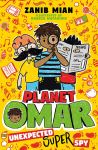
Omar is back, and the nine year old kid with a huge imagination, proves that his heart is even bigger.  Middle graders that loved the first version, The Muslims, and the reboot, Planet Omar: Accidental Trouble Magnet, will undoubtedly love this book’s adventures and the real, relate-abl, presentation of Islam in a Muslim family.  While it references the first book, it can work as a stand alone book too, and can and will be enjoyed by kids and adults, girls and boys, Muslims and non Muslims.  At 217 pages, the large spaces, doodles, playful fonts, and illustrations, make the book fly by and beg to be read again and again.

C95DB8C6-9652-4EB8-8008-112361FAE8DF

SYNOPSIS:

Omar’s family still has their Science Sundays, but they don’t visit a new mosque every Saturday, as they have found a mosque near their home that gives his parents, “secret smiles” and them all a sense of community.  Omar and his sister still bicker, and his little brother Esa is still lovable, and the former bully, Daniel, is now a great friend to Omar and Charlie.  Life is good, Alhumdulillah, but in the midst of the boys planning how to get laser guided Nerf guns and have an all out battle, Omar learns the mosque’s roof is in need of repair and that the congregation will need to come up with 30,000 pounds to cover the costs, and fast.  In an act of selflessness, Omar abandons his dream of a foam gun and donates to the masjid.  Seeing that is not going to be anywhere close to enough he plots and schemes with his friends, his non Muslim friends, on how to raise the funds.  They bake cookies, make origami birds, and get their school to host a talent show to raise the money.  Their teacher and the head teacher coordinate the hall and judges and winning prizes all to help out Omar and the mosque, in the end though, they raise just under 1,500 pounds.  Not enough by themselves, but a great contribution to what other people hopefully are scrounging up.  The worst part however isn’t that they didn’t make enough, but that what they did make, goes missing.  Omar, Charlie, and Daniel, along with the parents and police and school personnel, try and find the money and who might have taken it before time runs out.

0030B40D-17F8-415C-A54A-7874768A5B5D

WHY I LIKE IT:

I love how effortlessly the author adopts a nine-year-old’s voice and persona.  So many of the details, for example, about how the school administration signed off on a fundraiser for a religious building, and how tickets were sold, and the planning took place are left out, as a nine year old, probably wouldn’t know, or be concerned with the logistics of such endeavors.  It seemed like some details should be given, but I doubt readers would feel that way, so I pushed it aside and went along for the ride.

Omar has amazing friends, from the unpredictable old neighbor lady, to his non Muslim friends being so enthusiastic and supportive of saving a mosque.  I love it, and that they are that way because Omar is so unapologetically Muslim first.  They even discuss a hadith about how building a mosque, builds you a house in Jannah, and a mainstream book published this, and it is AMAZING! It isn’t just a kid and his family, who happen to be Muslim, the whole plot of the book is to save a mosque, and the fact that this book exists, seriously is so beautiful, and powerful, and hopeful, Alhumdulillah.

This book has a lot of layers, most kids won’t pick up on the interfaith aspects being so ground breaking, or the beauty of teachers and parents believing and supporting young kids, but will just read it as a funny story with anecdotes and inside jokes that they get as kids, as Muslims, and maybe even as Desis.  It truly is the culmination of an author who can write well, characters that our kids can see themselves in, and an opportunity to tell our OWN stories that make this book work for kids, adults and everyone in between.

3C3DA84E-29F6-4A6D-90FE-0BC134E7E615

FLAGS:

Omar and his sister are mean at times, but alas love each other and look out for each other too.

TOOLS FOR LEADING THE DISCUSSION:

I don’t do an elementary book club, but if I did, I would do this book in a heartbeat.  For middle school it would be too quick of a read, but I think all classrooms and all libraries should have the book, up through middle school.

https://www.alaraby.co.uk/english/society/2020/2/7/planet-omar-pushing-for-muslim-characters-in-childrens-literature

I got my copy here in the US at www.crescentmoonstore.com and as always you cannot beat their customer service and prices.  If you don’t have the first book, you can get it there, too.  Thank you Noura and Crescent Moon Store.

Zainab is Different by Irfana Khan illustrated by Josh Wise

Standard

zainab is different book

This 24 page picture book for kindergarten children and up, is sweet in its handling of being labled “different,” without getting overly negative or caught up in the manifestation of discrimination.  Unfortunately, with so much emphasis on different religions: the places of worship, the holidays celebrated, the manner of dress, etc., faith becomes inadvertantly highlighted as the root cause for the division and discrimination.  Perhaps I am reading too much in to it, and the book just needs a few more examples to make the author’s point that we are all different and unique, but as it is, I didn’t love it, my kids all thought it was cute though, especially my daughter named Zainab.

IMG_0555

Zainab walks to school every morning with her mom.  She says hi to the neighbor and can’t wait to get to school to her best friend Melissa and her amazing teacher Mrs. Sperber.

IMG_0556

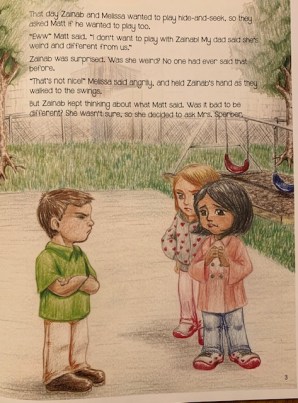
One day Melissa and Zainab want to play hide-and-seek and ask Matt if he wants to play too.  He responds, “Eww, I don’t want to play with Zainab! My dad said she’s weird and different from us.”

IMG_0557

Having never been called that, Zainab is bothered by the words and tells her teacher.  The teacher points out that they have different colored hair, but can see that Zainab is still hurt and tells her not to worry, she has an idea.

IMG_0558

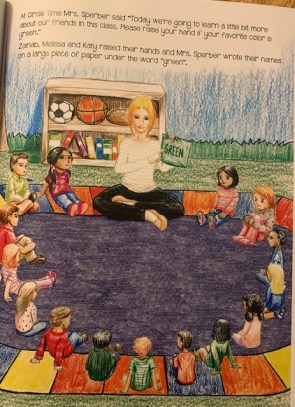
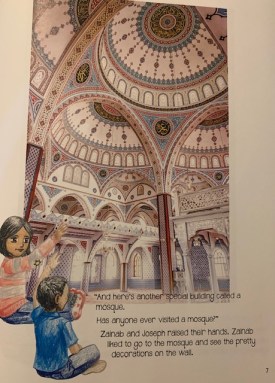
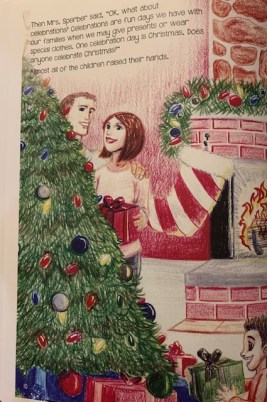
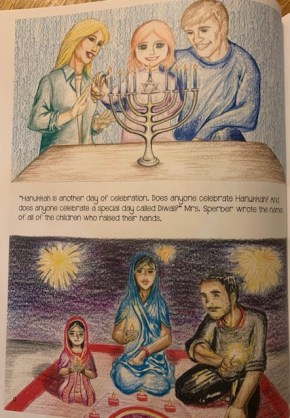
At circle time the teacher starts of by highlighting differences with the kids identifying their favorite color, and her writting their names on the ones they like best.  She then asks about places of worship they visit: churches, mosques, synagogues, temples, and again writes their names on the ones they have been to or frequent.

IMG_0559 Next she moves on to holidays celebrated, and then special clothing, only hijab is mentioned though.  The teacher then discusses feelings and how things about us might be different but our feelings are the same.  We like it when we are all nice to each other, and are sad when someone is mean.

IMG_0560

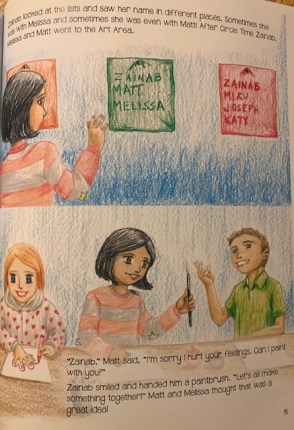
Zainab sees her name with different people’s names on the pictures now hanging up and Matt comes and apologizes for being mean earlier. The teacher also mentions that maybe some haven’t visited any of the buildings discussed.

IMG_0561

The pictures appear to be done in colored pencil and are colorful and detailed with the pictures of the places of worship bein actual images.  The 8.5 by 11 pages are large and would work well at story time or bedtime.

IMG_0562

The fact that Matt’s words are assumed to be about religion seems presumptious to me.  Maybe they are, maybe they aren’t, I feel like there needed to be more there.  A few pages about things other than faith, in my opinion, would make the message of us all being different in some things and the same in other things a bit more powerful.   The pacing too is a bit off. It is a big jump from what is your favorite color to do you go to a church?  The resolution is really quick too, as it is tied into feelings, a little bit more of showing the reader, rather than just telling them, would amplify the process and the message.


Mr. Wolf’s Class by Aron Nels Steinke

Standard
Mr. Wolf’s Class by Aron Nels Steinke

wolf

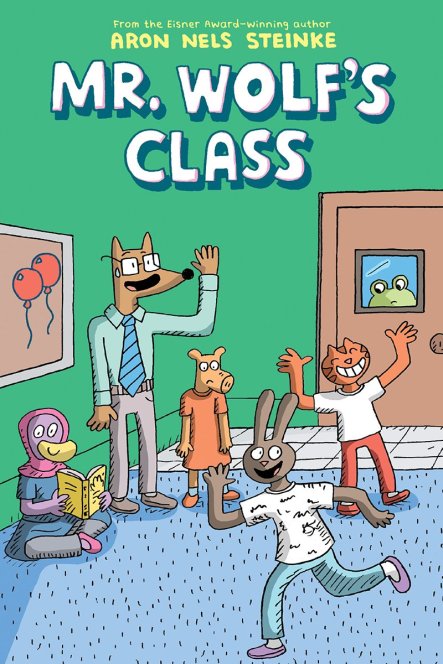
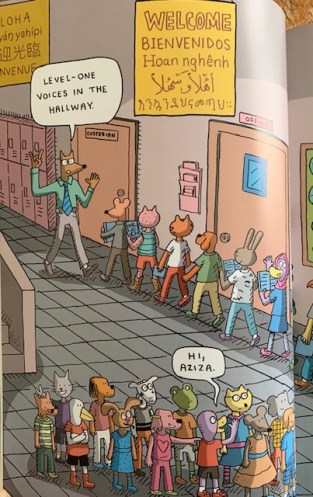
I know this AR 2.1, 156 page graphic novel probably doesn’t deserve a review, but for as important as OWN voice books are, books with Muslim characters thrown in the mix are important for representation too.  Yes sometimes we are the star and we definitely need to tell our own stories, but we are also friends, and side-kicks and supporters too.  In this case we are a purple duck with a headscarf named Aziza, that thinks she is smarter than the other 4th graders in Mr. Wolf’s class, but fits right in with the quirkiness of the anthrmorphized cast too.  There is nothing mentioned about the scarf or about Aziza’s faith, there is also a boy named Abdi in the class that is a cat and could also be Muslim, but really, in this silly book which is the start of a series, I was just so giddy to see a Muslim included and grateful for the representation.

IMG_0487

SYNOPSIS:

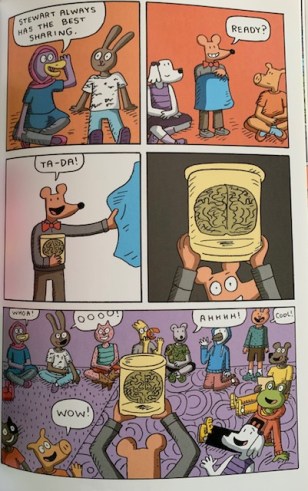
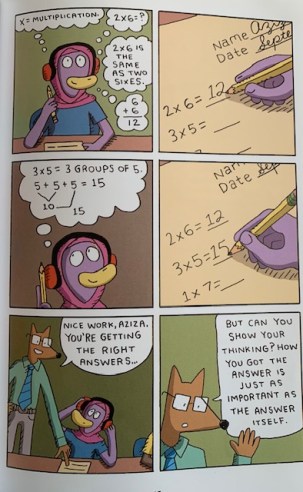
It is the first day of 4th grade and Mr. Wolf is nervous.  Margot is new too, but the other kids seem to know each other already.  Aziza, Abdi, Randy, Sampson, Henry, Penny, Bobby, Lola, Oliver, Stewart, Miguel, Noah, Molly, Lizzy, Oscar, and Johnny are all different animals and all unique.  The book is really just a handful of the characters trying to survive the first day of school.  Whether it be confronting another teacher about stealing your stapler, making a friend on the bus, having rats steal your lunch, falling asleep in a box because your new baby brother kept you up on all night, or trying to figure out why you have to show your work when on a math assessment.  The book will resonate with kids 2-4th grade and make them giggle at the silliness of it all.

IMG_0488

WHY I LIKE IT:

I love that the teacher is more nervous than the kids about the first day of school and that they all seem to be doing the best they can.  Aziza is earily irritated by her classmates who don’t seem to want to do their work, but she is no more annoying than the other students and all seem to have diverse backgrounds and issues at hand.  The author was an educator and the book reads true to any one who has littles or has been in a school environment, making it all the more charming.  There are four books thus far in the series and my kids say Aziza features prominantly in the second book too.  I have had this book in my house for a while now, and for some reason just now paid attention to the cover today when begrudgingly scolding my kids about leaving books out everywhere.  I asked if the duck had on a hijab and two of my boys without budging to put away said book, replied, “yeah it is Aziza.” As if seeing a muhajaba duck is the norm, who knows maybe it is.  So, I sat down to read the book with enthusiasm and 20 minutes later, thought how great it is to be included. Representation does shape perception, and non Muslim kids may not think anything of it, or my own kids who are flooded with Islamic fiction books, but I can only imagine how ecstatic I would have been as a kid to be included as the norm without fanfare or explanation given.

IMG_0489

FLAGS:

They talk about if farts are better or ice cream in the creation of a venn diagram.

IMG_0490

TOOLS FOR LEADING THE DISCUSSION:

Wouldn’t do it for a book club, but would definitely have it in a class library and school library.  Fun book, seemingly fun series, and easy reading for all levels.

https://www.mrwolfsclass.com/interviews-and-press

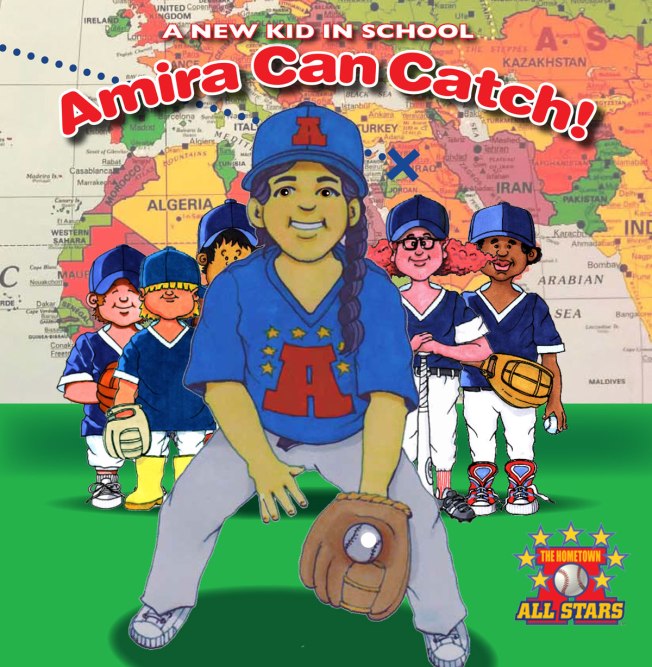
Amira Can Catch! by Kevin Christofora illustrated by Dale Tangerman

Standard
Amira Can Catch! by Kevin Christofora illustrated by Dale Tangerman

amira_can_catch

This is book four in the Hometown All Stars series aimed at 4-7 year olds.  The purpose of the series is to teach real coaching skills to help children learn about baseball, get out of the house to play, and have fun.  The 34 page book is baseball technique heavy with a fictional storyline to move it along.  Most sports books focus on team work and being a good sport, but this one takes it a step further by emphasizing the basic skills needed to play the game, as well as sneaking in lessons about inclusion and acceptance.  If your child is American and likes sports, the book will be a hit, pun intended, but there is a lot of text on each page and as America’s pastime, there is a lot of space dedicated to what it means to be American.

IMG_0410

A refugee Muslim girl from Syria, Amira, is invited to play on the after school baseball team, but first needs some help at school with spelling and adding.  Luckily the kids in class are super nice and accepting and help her learn about life in America, while similarly listening to her tell about life in Syria and at the refugee camp.  Not only do they all become friends, she also gets everyone to appreciate how much food they have, and the variety, as well as gets everyone to try pickles. Yum! They like them.

IMG_0411

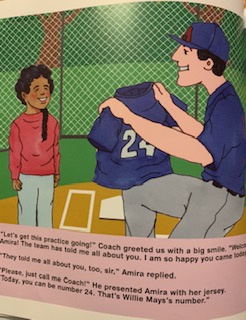
The kids at baseball practice are also incredibly welcoming as they get Amira a jersey, and teach her all about #24 Willie Mays.  From here, it is like a virtual baseball practice, the kids warm up with stretches, running the bases, and practicing their stances.  There are little info headers explaining things such as what hand to wear your mitt on and explaining how to squat, why the coach is using foam balls, and reminding the reader not to throw balls in the house.

IMG_0412

The kids learn three different types of catches.  How to stand, how to position their hands and how to be ready.  They run drills and practice, practice, practice. They find out Amira is really good, and she tells them that they had a lot of time to practice catching and throwing in the refugee camp.

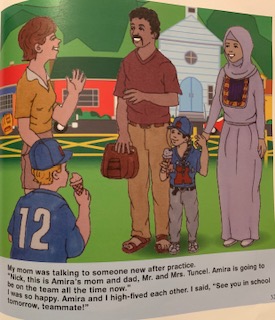
The coach then asks the kids and readers questions before Amira’s parents arrive to pick her up.  With big smiles on their faces, the mom is wearing a hijab and chatting with the narrators mom.

IMG_0415

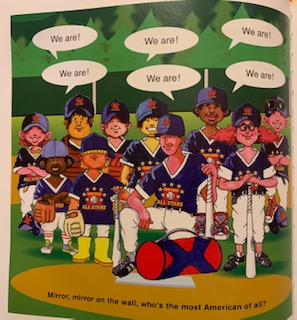
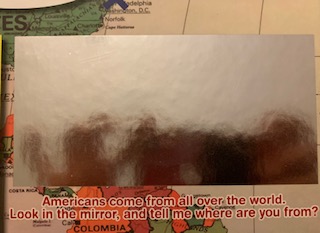
The book ends with a whole page on “What Does It Mean to be American,” a review of new words learned in the book, and all the kids answering who’s the most American of all, with “We are!”  The back cover has a reflective patch with the statement “Americans come from all over the world.  Look in the mirror, and tell me where are you from?”

IMG_0416

The book and series are a great way to learn about a game, that really a lot of kids today may not know much about.  Some of the terms, the skills, and just familiarity is clearly conveyed, with the illustrations providing the visuals and diagrams for what the coach is talking about in the text.  The fact that the author chose to add a refugee to such an “American” book and have the supporting  characters so welcoming, really does show the best of what Americans can be.

IMG_0417

Luv Ya Bunches by Lauren Miracle

Standard
Luv Ya Bunches by Lauren Miracle

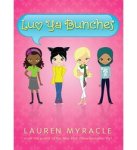
bunchesA book about 5th grade friendships told from the perspective of four different girls in a variety of styles: instant messages, chatroom conversations, video scripts, and traditional text.  The author seems to have a checklist of diverse characters and afflictions that all must make an appearance in the 335 page story.  It is written on an AR 4.4, but with one of the main characters having two moms, details of a suicide mentioned, talk of pole dancing, male anatomy joked about, thongs, crushes, and mental illness, four girls coming together to form friendships and take down a bully, might raise more questions for young readers than they are ready to handle.  Yasaman the Muslim girl in the group, also borders on perpetuating more stereotypes than she breaks, and while I definitely don’t think this book is a good fit for 4th and 5th graders, I don’t really recommend it for readers of any age, there are just better books out there.

SYNOPSIS:

Asian American Katie-Rose doesn’t have friends, unless you count her neighbor Max, but she doesn’t.  She dreams of having blond haired Camilla as a best friend, but the Camilla she went to Pioneer camp with is not the Milla at school who hangs out with Modessa (aka Medussa) and Quin, and is popular.  Katie-Rose also dreams about being a cinematographer or director, she isn’t sure yet, but she loves to imagine scenes and scripts and how things ideally should play out, even when in reality they never quite seem to do so.

Milla, isn’t sure if she wants to stay friends with Modessa and Quin, they aren’t nice and she has a lot more fun with Katie-Rose, but somehow she always ends up going back to the popular crowd.  She also has a lot of anxiety and needs various totems with her at all time to feel secure.  When her little plastic turtle goes missing, she struggles to stay composed, and her and her turtle will end up changing a lot at Rivendell Elementary.

Violet, is the new girl at school and she is not liking her life at home or at school.  Her mom is in a mental hospital and she misses her desperately, her dad brings home fast food every night for dinner and life just isn’t the same since she moved to California.  Immediately able to tell who the popular kids are at school, she hasn’t decided which group of friends is the best fit for her, but when she stumbles on Tally the turtle, and doesn’t immediately return it to Milla, she has to understand what that says about her, and figure out if she is strong enough to make things right.

Yasaman is the quiet computer wiz, she is also Turkish-American, Muslim, and a hijabi.  She designs a platform where kids who are too young to join Facebook can chat, stream videos and send cupcakes.  The only problem is, she has no friends to get to join.  When Katie-Rose and her strike up a friendship, the first seeds of the four flower named girls are planted, but it will take all four of them to put Modessa in her place, rescue Tally, and deal with stereotypes, emotions, and family along the way.

WHY I LIKE IT:

I love that a Muslim, muhajaba is included in the quartet, and that her religion, her scarf, her culture, and her belief in Allah, actually are sprinkled in.  I don’t love how in the book’s efforts to include such diversity, that it also seems to fall for a lot of the stereotypes that it on the surface seems to be dispelling.  Katie-Rose asks her if she even knows what YouTube is before being made aware of how computer savvy she is.  All this is to subtly show the assumption that Muslims are not aware of technology and whatnot, and set the record straight, but also regularly thrown in are side comments from Yasaman that her father would never let her wear something, or she wouldn’t be allowed to do that because of her dad, definitely reinforcing a male dominated, authoritarian, out-of-touch patriarchal view.  Even her mother, an artist, is shown to demand a lot of Yasaman and be incredibly strict.  A lot of things aren’t spelled out, they are just dropped in and assumed that the reader get’s it.  But only Yasaman’s parents are portrayed this way.  Milla’s two mom’s are caring, Violet and her dad seem close, and Katie-Rose’s parents are rarely highlighted.  So, I felt like it was noticeable, and not in a positive way.

I’m still completely confused as why pole dancing and male anatomy made appearances in the book.  And the pole dancing reference appeared not once, but twice when Yasaman is talking to an older cousin who is talking about a friend who’s aunt is a pole dancer, and then later when Katie-Rose’s babysitter also mentions the same friend.  They also discuss people as being slutty and boy crazy and skanky.  The male anatomy isn’t spelled out it is hidden with a girl with major orthodontia reading a Wikapedia page on the greek satyrs, discussing their physical pleasures and talents.

There is also a lot of mental health issues that I’m glad are present, but I’m not sure if they are handled seriously enough.  I’m glad they are addressed, because awareness is a good thing, but discussing how someone swallowed pills to commit suicide and even though she changed her mind still died, and not giving any context seems to make the concept come across as a bit trivial to me in its presentation.  Same goes for Camilla’s anxiety and Violet’s mom being in a mental hospital.  These girls have some major stuff going on that their preoccupation with a snotty group of girls, and the obsession of mud being consumed in an ice cream shake, seems a bit off.

Overall, the girls seem incredible perceptive and articulate in their self reflection and understanding of social personas, that I found their banter completely disjointed.  I don’t think the author’s voice is consistent, and the heavy stuff is too much coming from 5th graders in my opinion.

FLAGS:

Stereotypes, and discrimination against Yasaman and her younger sister Nigar.  Possible triggers with talk of suicide.  Milla has two moms, it is never labeled or made an issue, she just refers to them as Mom Abigail and Mom Joyce. Talk of boy private parts and erections, crushes, pole dancing, words such as skanky, and slutty and dingleberry (poop hanging on) used.  There is lying and bullying and retaliation and poetic justice.

TOOLS FOR LEADING THE DISCUSSION:

I wouldn’t use this book for a book club or even have it in the classroom.  I think it gets a bit crass unnecessarily and the cute flowery cover and inside flap, makes it all the more surprising.  You might expect some potty humor in other books, but knowing it is there allows the reader to make a decision to read it or not, I would imagine most Muslim parents would see four diverse girls on the cover, one wearing hijab, get excited and hand the book to their 3rd or 4th or 5th grade daughter and have no idea what the book also includes in passing, with no relevance to the story lines highlighted on the inside flaps and back of the book.

Allies by Alan Gratz

Standard
Allies by Alan Gratz
allies.jpg

This is the second Alan Gratz multi-perspective historical fiction novel I’m reviewing for its inclusion of a Muslim character.  While in Refugee it seemed a natural choice to include a Muslim family, I was completely shocked that he would feature one in a WWII D-Day novel.  With numerous storylines spread over 322 pages the book is quick, fast paced, intense and emotional.  An enjoyable read for history lovers and curious kids fifth grade and up, it is an AR 5.6 and older kids will benefit from it too.

SYNOPSIS:

The characters and timeline are fictionalized to all take place on D-Day, June 6, 1944, as the Allied forces and French resistance come together to storm German occupied France on the beaches of Normandy.  Many of the details do come from history though as detailed in the Author Notes at the end of the book.

The book starts out following Dee, a German national who left for America to escape the Nazi’s and is now returning in a Higgins boat to fight them. Knowing no one will understand, including his friend Sid, a Jew from New York, he keeps this knowledge to himself and focuses on the task ahead.

Samira and her mother are the focus of the next mission and highlight the role of the French Resistance, the Maquis.  What makes their story more meaningful is that they are spies with the French Resistance, but they are French Algerians, not really a part of France at all, and they are Muslim.  In Samira’s back story we learn how she must remove her hijab and how she is treated different at school because Algeria and France are at odds.  When her mother is taken by the Nazis before she can deliver the message to the Resistance, Samira vows to do it and get her mother back as well.

19-year-old James from Winnipeg Canada is a paratrooper who volunteered for combat to feel empowered after years of bullying. His buddy in the story Sam is a Cree Indian from Quebec, who has few rights at home, and hopes to have more success in the military.

Medic Henry is scrambling along on the beach helping anyone and everyone he can.  Having left behind a segregated US, even the military has reservations about African Americans saving and serving. As he performs one heroic act after another being questioned and doubted and insulted all along the way, readers see how ridiculous and infuriating racism is on every level.

We meet Private Bill Richards who drives a Sherman tank and is following in his fathers WWI footsteps.  But who is unfortunately killed before reaching Bayeux.   And finally we meet Monique Marchand, a French 13 year old girl, who gets caught up in the invasion because she left her swim suit in the beach hut the day before and has returned to retrieve it. Determined to do something other than cower in fear, she starts helping fallen soldiers and meets up with American journalist Dorothy, a strong woman determined to not be stopped on the basis of gender.

All the story lines criss and cross as the invasion is a chaotic mess and everyone is dropped, disembarked, or arriving in the wrong place at the wrong time.  Surviving the day is an immediate challenge and not one that everyone will succeed at.  The larger success of the mission will depend on some lucky breaks and a whole lot of teamwork.

WHY I LIKE IT:

I love that the story somehow isn’t political at all in the traditional war story, war strategy sense.  But the strength at least for me, wasn’t the horrific battle at hand, which is truly violent and abhorrent, but the relationships between the people.   The realizing what is driving them, what matters and more importantly how hard our prejudices are.  The larger story of the Allies shows British, Americans, and Canadians coming together to defeat he Nazis, but yet, a girl, an African American, and a Cree are treated as “other” irregardless of how beneficial they are even in matters of life and death.

As for the story of Samira, she is a tough girl, both clever and brave.  To have a Muslim in  an American/westerm story of D-Day and a young girl at that, to me was pretty remarkable.  There isn’t mention of faith or anything other than that she is told to take off her scarf and continues to wear a small kerchief on her head anyway, but for Muslim kids all over, this character and how she behaves will spark a sense of extra pride in the Allies success over Hitler, just as the other minority characters will for their representation in such a dramatic event.

FLAGS:

There is a bit of mild profanity.  There is violence and death, and blood, not too bad, but the point is clear, the beach isn’t pretty.

TOOLS FOR LEADING THE DISCUSSION:

I think this book would be a great supplement to any WWII history lesson.  There are great resources at the end, and maps at the beginning and a high energy, short chaptered book that doesn’t skimp on character building or war intensity.

Author’s website: http://www.alangratz.com


Bibi’s Blessing by Lela Usama Goldsmith illustrated by Samantha Morazzani

Standard
Bibi’s Blessing by Lela Usama Goldsmith illustrated by Samantha Morazzani


IMG_8209

A wonderful lesson packaged in a sweet story about a girl learning to thank God for blessings, especially ones that don’t seem like blessings at all.  The 36 page book is meant for children age 4 and up and with its large 8.5 x 11 glossy full color pages it works well at bedtime and in small groups at story time.

IMG_8211

On the island of Lamu, Mwana lives with Bibi, her grandma who’s livelihood depends on making Mofa bread every day.  It is Mwana’s job to sell the sorghum ground bread in the streets for people to enjoy at tea time.

IMG_8210

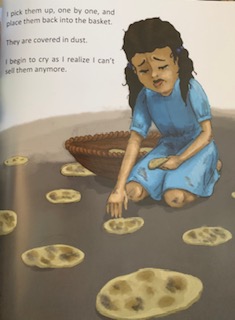
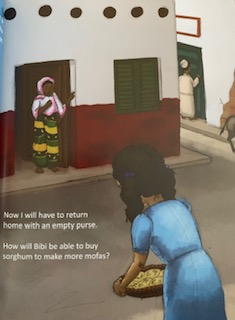
One morning a braying donkey frightens Mwana and she trips, spilling all the mofas on the ground.  When she tells her grandma what happened and how they have not made any money for the day, her grandma responds, “Thank God for this blessing.”

IMG_8212

Not believing Bibi, but being too excited to visit a friend, she doesn’t argue.  But then the power goes out and she can’t visit her friend and she gets grumpy. Grandma tells her to “Thank God for this blessing” and explains that sometimes not getting what you want is also a blessing.

IMG_8213

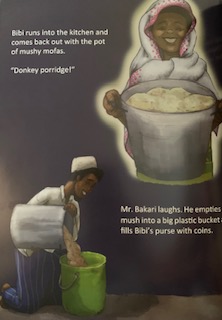
With nothing else to do, Mwana goes off to soak the rice pot, but instead accidently soaks the dusty mofas, to which her grandma again says it is a blessing.  She starts to feel she can do nothing right, and can’t believe there is any blessings in a pot of mushy mufas.

IMG_8217

But, with the power out many shops close and the owner of the donkeys has nothing to feed his animals.  He knocks on his neighbors door and Bibi and Mwana have just the thing.  He pays them for the food and alhumdulillah all is well, so many blessings from God.

IMG_8216

I love that the setting is a place many of us have never heard of and that there is information about Lamu at the end of the book along with a glossary.  The author is Muslim, the characters dress Islamically in the illustrations, and have Muslim names, but there is nothing Islamic specific in the text.

IMG_8214

Some of the sentences are worded awkwardly, for example, “We live in a small island by the Indian Ocean called Lamu.”  You typically say you live “on” an island not “in” it, and islands are in the ocean, not by them.  And some sentences read almost as run ons because of multiple conjunctions and their lack of punctuation.  I don’t love the illustrations.  The faces on many of the pages are really distracting and inconsistent, but the overall story is well done that I’m willing to over look my own critical opinions, and encourage y’all to give the book a try.


Satoko and Nada 1 by Yupechika

Standard
Satoko and Nada 1 by Yupechika

satoko.jpg

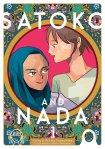
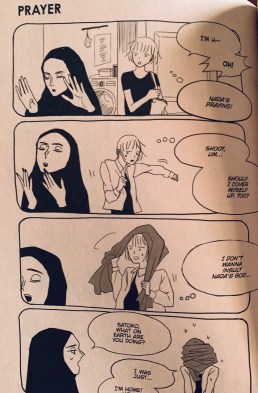
A manga series about two college roommates who have come to America to study, Nada from Saudi Arabia and Satoko from Japan.  Written by a Japanese author and translated into English, there is a lot about Muslims, particularly Muslims from Saudi, as the two characters get to know each other and become friends.  Their interactions work to dispel a lot of stereotypes and promote how rewarding getting to know people different from your self can be.  Volume one (there are three) is 127 pages, read right to left in four panel pages, and is fairly clean for all ages (they do buy underwear and bras at one point), but would most likely appeal to female readers in 4th or 5th grade and up.
8CE09DE5-2BEB-48C0-9157-96B13CC78CD9

SYNOPSIS:

The book is about two girls getting to know each other, learning about each other’s culture, and navigating life in America.  There isn’t really a plot or a story line outside of this basic framework, and with a heading every page or two it reads like a quick scene about the topic expressed in the heading.  So, for example there are headings of Veils, Ramadan, Birthday, MashAllah Choice, etc, and then a few panels showing the girls having an interaction about it, resulting in understanding, humor, or a lesson.

In a bit of a stereotype twist, Nada is more street savvy then Satoko when approached by a stranger for a ride, and thus Nada hasto educate her a bit.  The book brings in a Christian American character and a third generation Japanese character learning Japanese, to further show how assumptions plague as all and how simple conversation and an open mind, can lead to some amazing friendships.

WHY I LIKE IT:

The book is really choppy, but you get used to it and soon you forget that it isn’t a typical story.  I admittedly haven’t read a lot of manga so, I have no idea if this is the norm, or something unique.  I love that its upfront about stereotypes, if it was an American writing it, or a even a Muslim it would probably come across as preachy or arrogant, but somehow it doesn’t seem like the two characters have much baggage, nor feel a need to defend their culture by putting another’s down.  They deal with issues such as women driving in Saudi, differences between hijab, burka, abaya, niqab, being around alcohol,  the joy of a fatwa allowing soy sauce and its alcohol content to be permissible, etc.  Some things are cited for clarity and something are very Saudi, but it really contains a lot of information, about Islam that I am pretty impressed by.  There isn’t a ton about Japanese culture since I would assume it was written for Japanese readers, so it would be redundant, but I did learn, according to Satoko, how religion is viewed by Japanese, how putting age and gender and race on forms seems incredibly personal, and some information about food.

FLAGS:

There is a possible failed abduction, not sure what the guys intention was, but the girls treated it as such.  The girls do go buy undergarments, so they are visually depicted.  There is mention of alcohol.

2DF66805-A246-4150-89BA-E7E1EAF90E90
TOOLS FOR LEADING THE DISCUSSION:

I wouldn’t do this as a traditional book club, but I think I am going to get a copy of the series to pass around my daughters middle school group of friends, to

one- give them a taste of manga

two- see what they think of the Islamic rep from a Japanese paradigm and

three- give us all something to chat about

The book is fun, I got it at the public library and think it might open up a new book type for kids to try and a new point of view for many of us to consider.