Tag Archives: American

Rainbow Fair by Diana Ma

Standard
Rainbow Fair by Diana Ma


If you see this 224 page middle grade book, the title might hint that the content is LGBTQ+ as the rainbow often symbolizes such, but if you look closely at the cover you don’t see a rainbow flag, just a Chinese scene on one side and on the other you will see crescent moon lights being hung up above a masjid silhouette, merging together with a little girl holding a rehal, a book and some art supplies. If you then turn the book over, or search the internet, and read the blurb, you will learn that the book is about Sophie, a Chinese Muslim girl learning and sharing her heritage at the school’s Rainbow Fair. As a result, I requested an arc to read and review. No where does it reveal that the book centers queer characters, LGBTQ+ support and allyship, consistently parallels Islamic faith with sexual and gender identities, and prioritizes intersectional identities and agenda over plot and insight. Had I known this, I wouldn’t have read the book, I share this review simply as a heads up to its contents, so families can decide for themselves if it is for them. The book is MG and honestly, it feels misleading and intentional that it is not articulated in a book meant for nine to 12 year olds.  With identity exploration of being Chinese, a child of immigrants, a main character being bisexual, the protagonist repeatedly claims to want to learn about her Muslim identity, but very little information or interaction with the knowledge is sadly ever shown.  The plot seems to just become a forced juxtaposition of two marginalized communities: Muslim and LGBTQ+, to make the point that we are all more than one label. I understand that my view and practice of Islam, is not every Muslims, but trying to have a faith identity and sexual/gender identity parallel one another by having the protagonist “coming out as Muslim,” and being “outted” as Muslim by her bisexual friend before she is ready, is an awkward read. It continues in this approach comparing a trans character being misgendered in a locker room to a Muslim character not having a space to pray, and likens the diversity of a mosque BBQ to the pride parade. I support finding common ground, but when questions about Muslims stoning gays are left hanging, the reader never getting a convincing answer to why her parents hide their Islam, and there is no real rising action, climax, or character arcs- I feel like the labels and the author’s agenda, even if OWN voice, are the point of the book, and it doesn’t make for a compelling read.

SYNOPSIS:

Sophie and Katie did their school’s Chinese booth together last year at the Rainbow Fair, they are best friends and do everything together, but since Katie has come out as bi, she has new friends and is petitioning to add an LGBTQ+ booth, and the rules say she can only be at one booth.  When a sleep over breakfast calls attention to Sophie not eating bacon, it comes out that she is Muslim, not something she meant to keep secret all these years, but something not even Katie knew about.  When discussions about being Muslim spill over into class when booths are being assigned, Sophie decides to do the Muslim booth. She is afraid her parents will be disappointed, and even though she knows nothing about Islam, she is ready to learn.  A new kid at school, Anna, is Muslim and joins Sophie at the booth, and as the two become friends, Anna tells Sophie there “is more than one way to be Muslim” and of course she is a “real Muslim.”  Empowered by not having to pick one identity, Sophia and Katie and all the other kids change Rainbow Fair and show how everyone is more than just one label.

WHY I LIKE IT:

The premise on the back of the book is promising, I just feel like the book missed meeting its own stated intention. The characters are not developed, there are no moments of growth or self reflection, they have no arc or relatability outside of a label.  Sophie paints her parents to be strict, but the precious little that is shown, never backs that up. As a result the reader has no idea why Sophie doesn’t just tell her parents she is doing the Muslim booth and ask them about Islam. After they see the booth at the fair, they say they don’t talk about Islam because of Islamophobia in America and feeling othered in China, but that is it.  Exploration of that would be a far more interesting story: Why did they leave China for Taiwan? When did they migrate to America, was it recent, or did they slowly start to hide their Islam? Dad learned to read Arabic in Taiwan, what was the Chinese community like? Why don’t they celebrate Eid, but have a Christmas tree, did something happen? Why do they not eat pork but drink alcohol? Sadly the two dimensional parents are not fleshed out and Sophie faults them, while constantly trying not to let Chinese stereotypes define them, but the repetitive contradiction, just leans into the labels and fails to make them feel real and relatable.

The book is all talk and no show, and with no real plot, the talking gets repetitive. Breaking the fourth wall we are taken in circles of the same talking points that more than once had me checking if I had bumped the screen and gone back to pages already read. Threads are introduced and then abandoned: what is the point of the whole roller derby thread aside from showing Sophie makes powerpoints, and her parents give in? The girls never go roller skating, it is not something that bonds them. We only know they are close because we are told they are. The beginning and end show Sophie can smell food and decipher its contents, so why isn’t that part of the story as she is trying to figure out Eid foods, cooking, the lunch offerings at the mosque? It hints that the Black culture booth is being suppressed, but it never develops it, nor articulates any real push back, it just skirts the issue. Why the judge-y competitive aunt and uncle? Is their inclusion meant to make Sophie’s parents more or less likeable? Does it reinforce or dispel Asian stereotypes?

From the very start the book feels forced.  Sophie has never gone to a sleep over, her best friend plans a sleepover birthday, but is willing to change it if Sophie can’t come.  What kind of stilted set up is this, why wouldn’t these bffs plan the birthday together, and get Sophie’s parents on board first? It makes no sense that if she can’t come it will be changed and not be a problem because they are so close and she has to be there. It also immediately contradicts the looming conflict of the book, that the parents are strict.  They gave in to roller derby, they give in to this sleep over, and have no problem that two of the girls are dating that sleep over, and “Shane is non binary and doesn’t identify as a girl or a boy.” Clearly the parents are very supportive.

Consistently Sophie drops words, or cultural practices, but doesn’t explain them or engage with them, both the Chinese historical and cultural rep, and Islamic, quick example, she has a Quran but never reads it, we don’t learn about the immortals her dad wants her to feature at the Chinese booth.  It makes it seem superficial and further distances the reader from connecting with Sophie, with culture, with faith, with the book.  Speaking of books, it really bothered me that two books mentioned as being intersectional, Black Muslim Author, Autumn Allen’s All You Have to Do, and Queer Muslim Author Adiba Jaigirdar’s Hani and Ishu’s Guide to Fake Dating are YA books, isn’t that off to mention repeatedly books that your target audience won’t know, or be in the demographic yet to read?

I could go on and on, but I will stop, I think it is clear I didn’t enjoy the book. 

FLAGS:

Islamophobia, alcohol, LGBTQ+, microagressions, racism, labels, stereotypes

TOOLS FOR LEADING THE DISCUSSION:
There is no way I could shelve this in an Islamic School.

All Mixed Up by Raj Tawney

Standard
All Mixed Up by Raj Tawney

all mixed up

The premise of this slightly biographical middle grade book is that of a very multicultural boy, Kamal, finding his voice, with the help of a Pakistani Muslim friend, Jaz, a year after the 9/11 attacks.  It brings in themes of Islamophobia, terrorism, bullying, friendship, alcoholism, immigration, refugees, “legal” and “illegal” citizens, Pakistan and India’s partition, and growing up and feeling alone over 208 pages.  The writing style seems deliberately loose in touching on very complex themes, but not preaching on them, and instead letting the reader draw on their own thoughts and experiences to form their own opinions. It is debatable if enough information is even provider for the reader to ruminate on the themes, or care to, or feel enough of a connection to the characters to want to know how all the dots connect, but none-none-the less it seems to have been done with intent, and with the middle grade POV for some it might get away with key information and the resolution going unexplored.  For me though, honesty I just couldn’t get past one line, one line tossed out with no explanation, no arc, no real purpose, never revisited even, at 16% it says “Allah is stupid.”  Yes, I debated tying the phrase out.  I don’t know why it has this line, it has no real impact on the story and could have easily been replaced for another reason Jaz received a purple nurple from a bully in Pakistan.  Later in the book there is a scene where Jaz has brought a prayer rug to school, he states he doesn’t always pray, but clearly he does practice Islam, not just maintain the label in name only.  I am not saying that the scene is not based on the author’s real life, or that people don’t say stuff of this nature, but it is hard to read in black in white in a book with no discussion.  I don’t know what the author’s intent was in including it, but I think it is a disservice to so many of the themes in the book and does not serve the target audience as a mirror, or a respectable takeaway either. For this one line, I truly don’t feel like I could have this book on my shelf, which is unfortunate.

SYNOPSIS:

Kamal Rao is half Indian, a quarter Puerto Rican, and a quarter Italian living in New York, he is relentlessly bullied at school, has no friends anywhere, and is dealing with a father that drinks a little too much most nights since he lost his job.  When a new boy, Jaz shows up at school, that can pronounce his name, a friend just might be what Kamal needs to find his voice, confidence, and place in the world.  Except Jaz has his own issues, and remains pretty mysterious about his past, his home life, even his name.  When a Halloween terrorist attack occurs, Jaz makes a run for it and Kamal has to decide what his friendship means.

WHY I LIKE IT:

I really can’t decide if I like the writing style or not. I recognize that to stay on a middle grade point of view the banter between Kamala and Jaz is often done when it is just the two of them in a scene, making sense of a world they might not know much about. Unfortunately, that also means a lot of erroneous statements, perspectives, and facts get unchecked, and possibly perpetuated.  It also means that at times the boys seem really worldly and competent: riding across town on their bikes, living pretty independently, but also being really naive about being a brown Muslim kid waving around a gun in public, even if it is pretend.  The inconsistencies often are in relation to Islam, so they particularly stood out to me, for example Kamal knows what a hijab is, but not that Muslim’s pray five times a day.  I think when a book is OWN voice and based on lived experiences, but so much of the plot pivots around someone who is so different from you, some of the details just seem inauthentic.  Admittedly, I was turned off early by that one statement, and I am not the target audience, but it was hard to relate to Jaz because it seemed so forcefully trying to present him in an almost performative way. A place of love no doubt, but overly polished to make the reader accept him and feel a kinship to him as Kamal did.

FLAGS:

Halloween, lying, terrorism, bullying, abuse, alcohol, sneaking

TOOLS FOR LEADING THE DISCUSSION:

I cannot encourage this to be on an Islamic school library or classroom shelf. That line even with discussion can’t really be explained, there is no point to it.  I’d like to assume that as a child he was frustrated with life and was lashing out in fear or grief or desperation even, but there is nothing in the text that would support or suggest that, it is just there.  I read an electronic ARC, and I hope that the line has been removed in the final copy.


Kareem Between By Shifa Saltagi Safadi

Standard
Kareem Between By Shifa Saltagi Safadi

img_3395-1

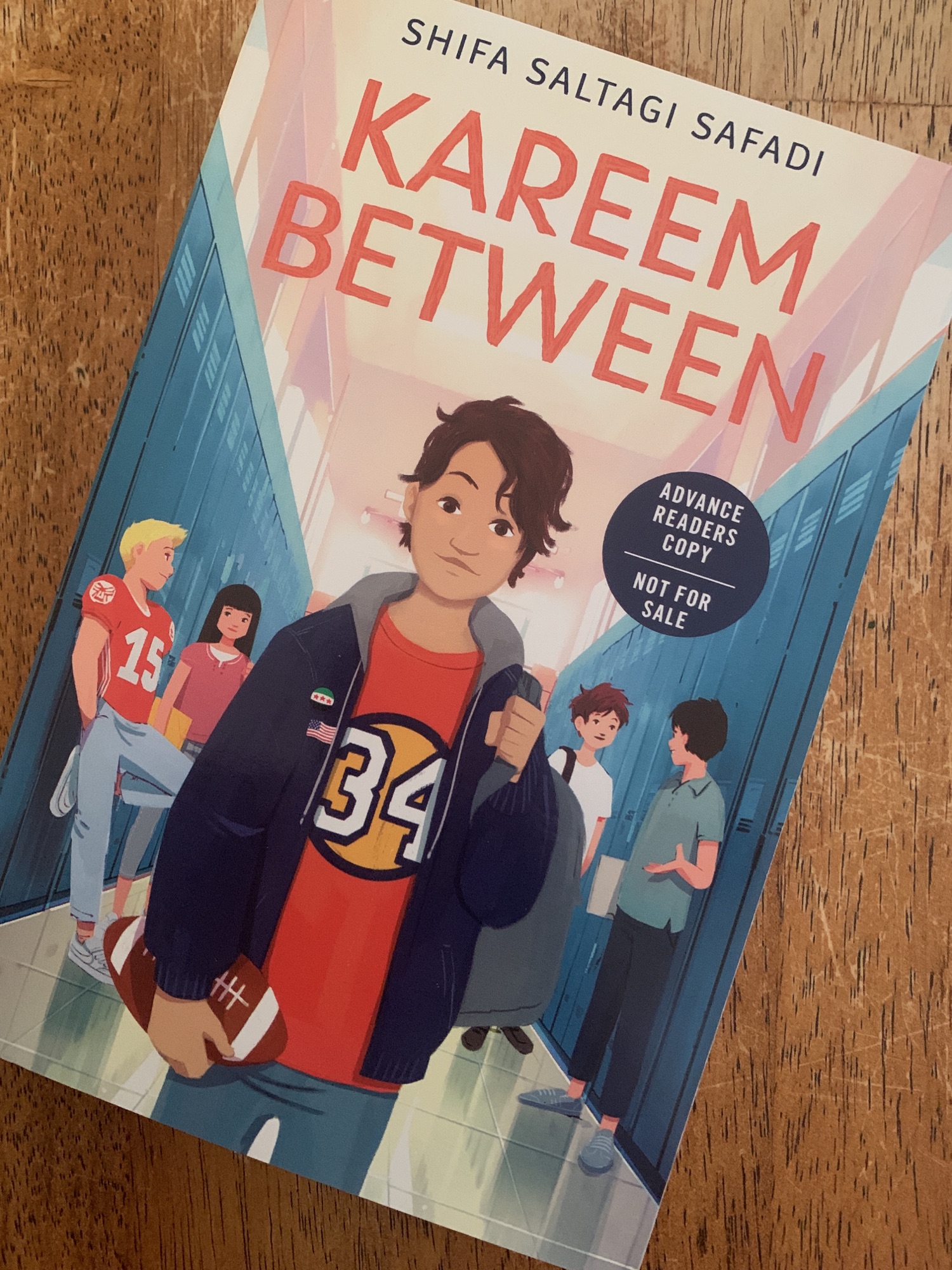
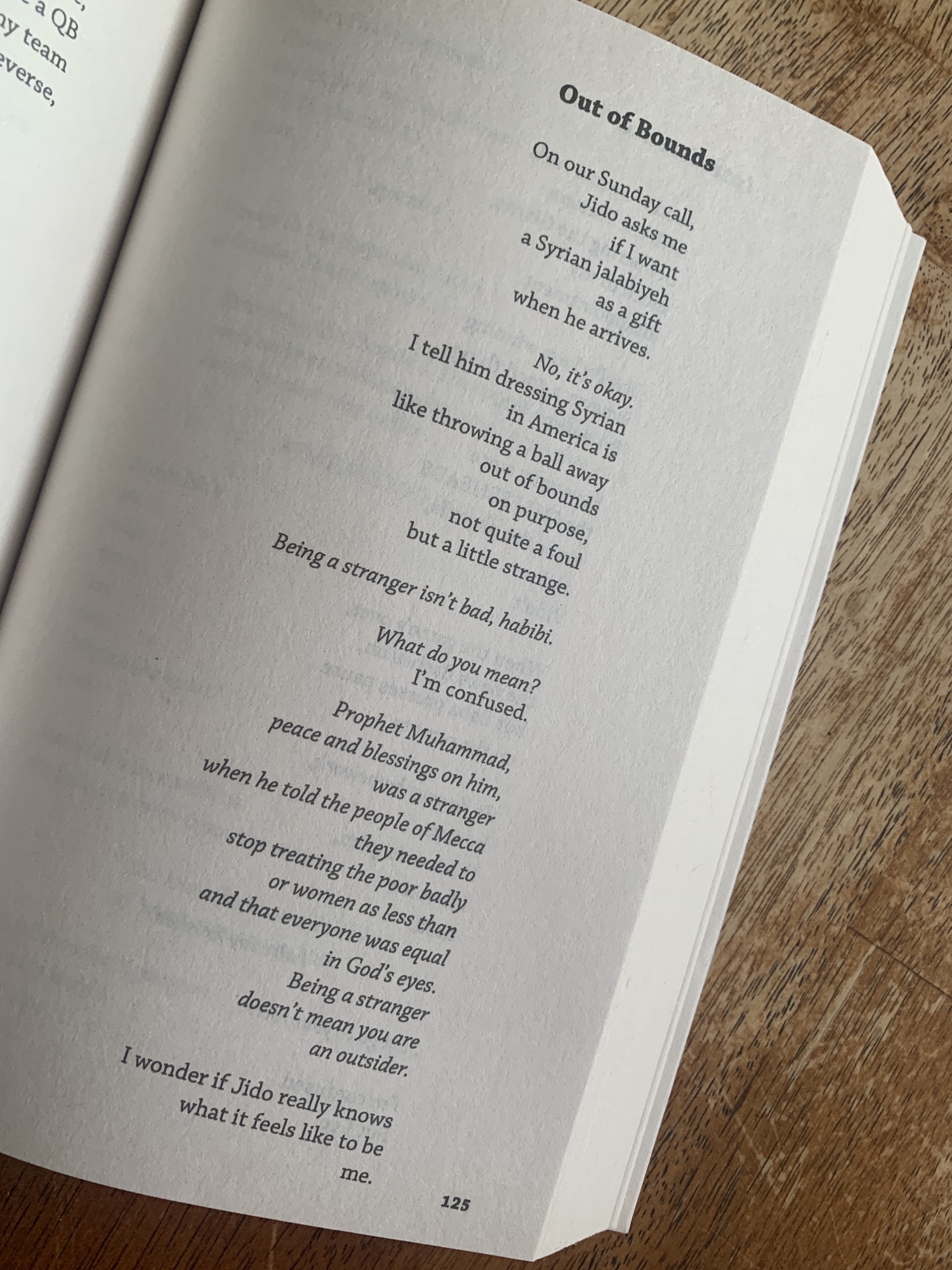
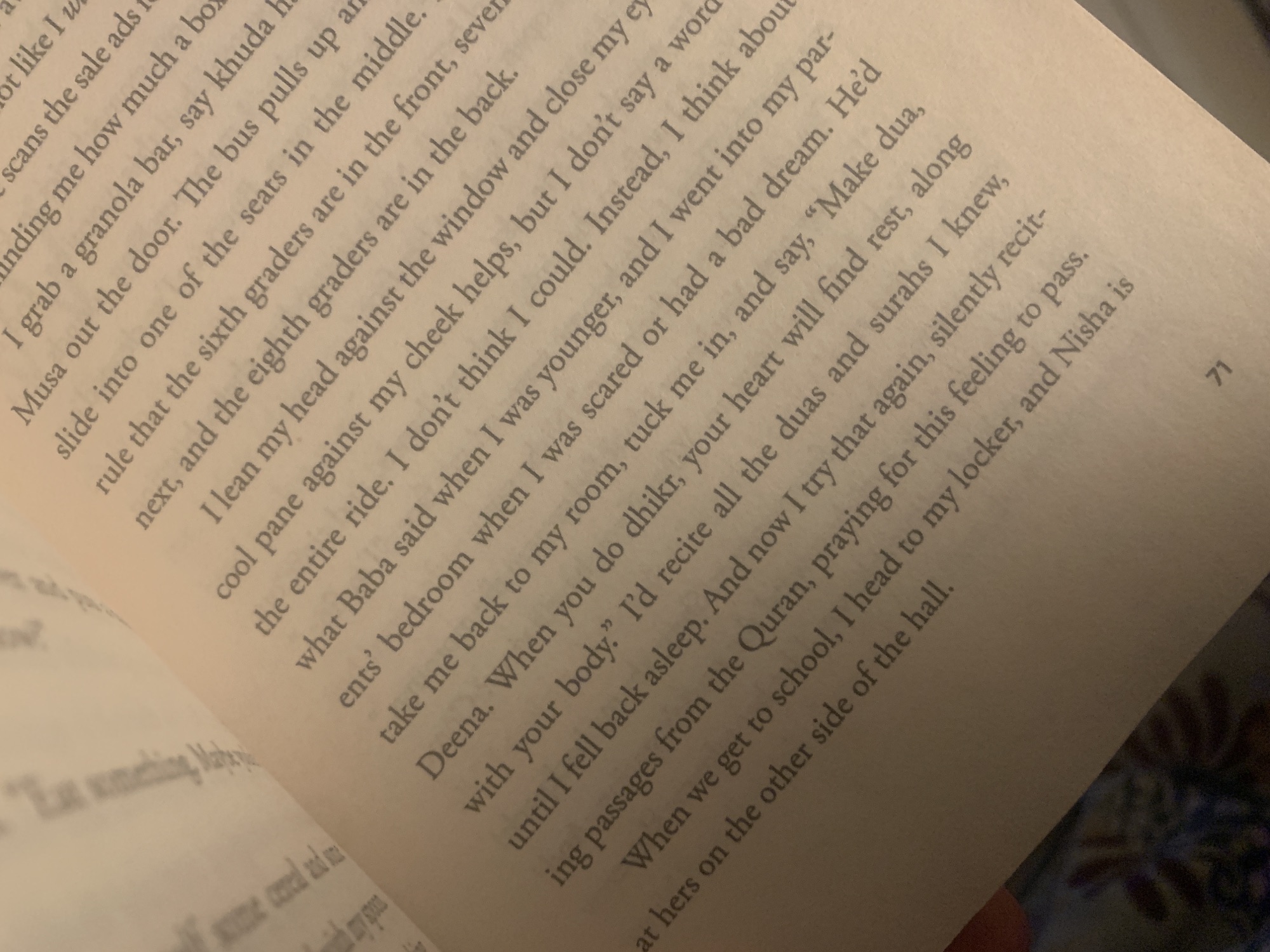
It doesn’t matter how many Word documents you read, Goggle docs you add comments to, and screen shots you revise; to hold a physical book in your hands that you have been blessed to observe from the sidelines through numerous revisions, is mind blowing.  Reading the final version from page 1 to page 324, plus the backmatter, has left me at a loss for words with tears streaming down my cheeks. I truly cannot imagine the book any other way. All past drafts and storylines, were just stepping stones to get the book to this version, and as a fan of literature my whole life, to see this metamorphosis in real time has added to my respect and admiration of authors.  Enough about me though, this review is of the middle grade novel in verse that tells the story of Syrian American Kareem, a loveable boy caught in between choices, siblings, friends, labels, and global acts beyond his control.  He makes mistakes, he tries to make things right, and at the center of it all is his Islamic identity, love of football, and genuinely good heart.  I am biased in that I have self appointed Kareem as my nephew, but even after dozens of readings, I was moved to tears three times during the course of this reading.  I made my teens read the book and they loved it, and like them, we hope we get more Kareem in the future.

img_3541-1

SYNOPSIS:

Kareem loves football, particularly the Bears, and dreams of seeing his Arabic name on an American jersey one day in the NFL.  Unfortunately, he hasn’t made the school team, his best and only friend Adam has moved away, and the coach’s son is offering to talk to his dad for Kareem in exchange for some school help.  Add in a new Syrian kid at school, his mom going to Syria to take care of his grandfather, and the fruition of Executive Order 13769 aka the Muslim Ban, and seventh grade has Kareem scrambling on every down to say the least.

img_3543-1

WHY I LOVE IT:

The football framing, the literary inclusions, the Arabic, the Islam, all combine with such tangible heart to create a seamless read both as a compelling story and as an example of literary craft.  The language is on point and intentional, that even if you don’t know the character or novel referenced, the Arabic words included, or football terminology used, you will be invested in the characters and plot, and find yourself cheering for Kareem.  Often debut authors show promise, but their stories have plot holes, or pacing issues, or inconsistencies, that is not the case with this book.  The crumbs are there that tie everything together, the depth of the characters’ personalities reveal how developed they are, and the timeline keeps the book moving forward.  There are no dry or slow spots in the entire novel, it is easily read in one sitting as you find yourself nervous for Kareem, and curious how it will resolve.

Boys and girls, Muslims and non Muslims, Arabs and non Arabs, all will find themselves drawn to this book, and thinking about the characters, particularly Kareem, long after the final page is read.

img_3544-1

FLAGS:

Some stress and anxiety with missing parents.  Death, bullying, cheating, fighting, lying, racism.

img_3540-1

TOOLS FOR LEADING THE DISCUSSION:

The book is a solid middle grade, but the quality of writing and engaging plot makes it work for a middle school book club read as well.  I cannot wait to share this book widely.

Preorders speak volumes and I truly hope if you are able that you will preorder a copy, you can do so here.  Requesting your local public library to shelve the book is also a tremendous help to signal to publishers what type of stories and OWN voice authentic representation consumers will support.

Tagging Freedom by Rhonda Roumani

Standard
Tagging Freedom by Rhonda Roumani

20801TaggingFreedom

This 282 page OWN voice middle grade book weaves together two points of view that shed light on the recent events in Syria and life as a Syrian American without self-othering or over-explaining.  The characters are Muslim and while yes, I wish there was more Islam woven in,  when it did present itself in more than just a passing “inshaAllah” or “ya rab” it was heartfelt and sincere.  The book has a few plot holes, a plethora of underdeveloped characters, and the religion and cultural components take a backseat to the tropey MG themes of finding your voice, friendships, crushes, fitting in, and having hope. Despite my critiques though, I still found the book focused around graffiti and spirit squad, engaging and hard to put down.  The pacing makes for an easy read, and while the adult reviewer in me wishes there was more depth, insight, consequences, and Islamic references, I definitely appreciated the emotion and framing of this story.  The book does contain a lot of lying, crushes, sneaking out, “vandalism,” breaking laws, and mentions bombings, disappearing, and fear.  The connection though of what has been left behind and experienced in Syria is moving, and I’m glad that a book so relatable to western kids is widely available to be shared with them.

SYNOPSIS:

The chapters alternate between Kareem and his cousin Samira, aka Sam. At the beginning of the book Kareem is in Syria, spending time with his friends graffitiing in protest of Bashar al-Assad and in support of the boys from Dara’a.  They are covering their tracks, sneaking out to join rallies and finding their strength in their art, common goals, and the change that is taking over the country.  Unfortunately, his parents don’t see it that way and decide he needs to be sent to live with his uncle’s family in Massachusetts for his own safety.

Sam is Kareem’s cousin, she is great at reciting Quran, she has a best friend Eleanor who lives across the street, and is an amazing artist.  She sees people as fonts, and dreams of being a part of the school spirit squad.  Her only real problem is Cat, a girl that has bullied her for years and spread rumors about her in the past.  It is never quite articulated what was done and how bad it was, but the fact that Cat is the head of spirit squad, the daughter of influential parents, and the twin sister of Sam’s crush Dylan, has Sam trying desperately to fit in.

When Kareem arrives, he is not happy to be in America.  He calls Sam out for her inability to speak up and with Sam and her bff Ellie on the outs, Sam heads off to her new friends that have allowed her into spirit squad, and Kareem and Ellie start sharing their art around town.

Kareem’s character arc is more subtle, but Sam/Samira, finds herself with the help of her cousin as she channels the yearning of Syrians to set her free in America.

WHY I LIKE IT:
I love that it is Syrian American OWN voice MG, the news cycle has moved on, but stories are so critical to reminding the privileged outsiders what has occurred and continues to endure, so just that this book exists, is a positive for me.  I like that the code switching of being Samira and speaking Arabic at home is so clearly contrasted with Sam at school.  I struggle with the idea of dating not being a religious, but rather a cultural no-no, and her being so obsessed in the beginning with Dylan and then Amari is a bit of flag. By the end they feel like friends, but it is definitely a big part of the first half of the book that could have used some context, same with when she goes out in a tank top.  I wish there was a Muslim conscience that enters the story, to see Sam grappling with who she is from a faith perspective would have been nice.

I love that Kareem comes to America and starts school, it doesn’t have him being meek, or struggling to transition, it really is empowering that he breaks that stereotype just by allowing him to be seen from the very first day as strong and fully fleshed out.  Yes, in real life and in some books the adjustment is a plot point, but in this book it is not, and the author seems to not indulge in it deliberately.

I struggled with a few plot holes. I get that Kareem was frustrated and wanted to educate and be heard, and when Sam can’t stick up for herself and he calls her out, they are both annoyed, but to go from that to graffitiing is a big step.  A few instances of maybe trying to talk about Syria being shut down by teachers, or friends, would have made it a more logical leap.  I worry a little that there wasn’t enough hand holding regarding graffiti as a whole seeing as it is an MG book.  I understand it is expression and art, but there is some element of vandalism to it as well, and because it didn’t connect the dots that street art was the only way to be heard, I bring it up for awareness.

I needed closure on Cat, I didn’t like that we didn’t know more specifics about her torment or her thoughts at the end.  I know the story is not about her, but she was important for much of the story and to have her fade seemed a little short sighted.  I liked Ellie, but her wanting to sticker everything seemed in contradiction to her environmental activism.  Sam’s parents are barely a blip on the radar, and even some details about the supporting cast, really would have made the story that much better.

FLAGS:

Crushes, immodest clothing, lying, sneaking out, boy/girl friendships, boy/girl hugging, vandalism, breaking the law. Hearing about bombings, being taken away by the police, death.

TOOLS FOR LEADING THE DISCUSSION:

I don’t think I would use this for book club, but I would have it on the library and classroom shelf.

Drawing Deena by Hena Khan

Standard
Drawing Deena by Hena Khan

This 232 page middle grade read with a beautiful cover, has a beautiful heart as well.  A Muslim girl in a Muslim family is struggling with anxiety and family financial stresses, remarkably the book avoids tropes of blaming immigrant parents, culture, or religion.  It also doesn’t have any relationship crushes, or catty friends, bullies, or annoying sibling squabbles.  It was refreshing to see a strong character that seemed to not lack a voice, really find her voice,  advocate for herself and those she loves, apologies when in the wrong, and be surrounded by friends and family members that truly love one another.  I also appreciate that a licensed school psychologist was consulted and named in the backmatter.  As with nearly all Hena Khan chapter books, there is Islam and culture, but as an Islamic school librarian, I long for more.  There are a few inshaAllahs, mashaAllahs, salams, and references to praying, there is one solid paragraph that mentions dua, dhikr, and the Quran, but that is about it in a book that focuses a lot on fashion, make-up, social media, drawing portraits and hanging them in the home.  The protagonist is in middle school, but this is a solid middle grade read that teachers and librarians can feel confident having on the shelves and sharing with students.

img_2301-1

SYNOPSIS:

Deena loves art and to draw, she’s also really good at it.  She longs to take extra classes outside of school, but she knows it isn’t a priority with her bite guard already causing a lot of stress on the already financially strapped family.  Overhearing her parents fights about money adds to her anxiety and makes her nauseous every morning before school.  Determined to help her mom grow her basement clothing boutique, and increase the family income, she dabbles in social media, designs a logo, and sets up a website.  One of the new customers is a real life artist, who encourages Deena to look at art differently, and offers to take her under her wing to teach her about the power of art and decolonizing her mind. Things are starting to look up for Deena, but a disagreements with her cousin Parisa, feeling like she let a close friend down, and being overwhelmed at an immersive Van Gogh exhibit culminate with her having a panic attack at school.  The school counselor wants her to attend some therapy sessions at the school, but first Deena will have to convince her parents that this is something she needs and wants.

WHY I LIKE IT:

I mentioned a lot of my likes and loves above, but really it is a solid middle grade read where the character just happens to be Pakistani American and Muslim.  I like that Deena is just a sweet girl.  I think a lot of kids that have the emotional intelligence to know how fortunate and privileged they are, often push down their emotions and troubles, because they know others have it worse, don’t want to worry their parents, and/or seem ungrateful, and that this book can normalize getting help, advocating for yourself, and communicating with your parents, is really quite impressive.  Deena has a diverse group of friends, religion doesn’t come up much or seem to shape her perspective which is unfortunate, but it doesn’t make things harder for her either.  She isn’t bullied, there is no Islamophobia, or self-othering or stereotypes.  Deena is who she is, with a good head on her shoulders, and throughout the book you find yourself cheering for her and her success.

FLAGS:

She does draw faces, and they talk of hanging up the images in the living room.  There isn’t lying, but it kind of skirts the line at times. Anxiety.

TOOLS FOR LEADING THE DISCUSSION:

For even a young middle school book club, I think this book would be a quick read, but open the door for some quality discussion about anxiety that would benefit middle graders and up.  The book on the shelf will tempt readers, and handing it to kids will yield results.

The book goes on sale February 6, 2024 and you can preorder/order it here.

Hope Ablaze by Sarah Mughal Rana

Standard
Hope Ablaze by Sarah Mughal Rana

This young adult book is an intense raw unflinching read, containing  incarceration, assault, politics, Islamophobia, immigrant pressure, and loss throughout the 384 pages that mix poetry and traditional writing.  At times the book is incredibly hard to put down as the commentary on two party politics and Muslims in America is articulated in a way that transcends the fictional constrains and affirms reality.  But unfortunately, it took me a long time to complete the book, because when I did put it down, I didn’t feel that relentless urge to pick it up and see what happens next.  I had been alerted to the fact that there were elements of magical realism, but even with that knowledge, I still felt it misplaced, and truthfully, unnecessary.  The pacing was inconsistent, and many points unnecessarily forced.  It often felt the author was simply trying too hard to tell the story and make sure the reader got all the messages intended.  As a result many characters are flat, many plot holes exist, and the reader is left wishing things were done just a little bit different to make the book what it could have been, not what it is.  I know it is a debut, so I’m not going to be overly detailed in my harshness, I am fairly positive I will read anything this author writes down the road, I took pictures and shared passages that I loved on my socials.  The book is good, it just really could have been great.

SYNOPSIS:

Nida is a poet, her uncle is a poet, and her uncle is in prison.  When Nida is frisked, her hijab removed by a political candidate’s team as she makes salat in a public park, Nida is forced to find her words, her voice, and her place in an unkind Islamophobic world.  High school friendships, immigrant Muslim community pressures and idiosyncrasies persist for Nida as she navigates media manipulation, injustice, slander, and political talking points.  Life was already complicated with her father’s departure, her maternal uncle’s wrongful incarceration, and the goats that her mother brings home to sacrifice, but with the support of the Poet’s Block, her Muslim community, family, and the thread tied to her family through generations, she will find she isn’t alone, and she has support, she just has to take a stand.

WHY I LIKE IT:

I love how much mirrors contemporary reality, the MIST competition, the politics, the media, the dirtiness of it all. I also like that it has a fair amount of humor, the Islamic accuracy, friends getting called out for boys and girls texting each other.  Overall though, it just felt so forced. I think some subtly and nuance and undercurrents would have given the reader the ability to connect the dots for themselves, so the book would have lingered and taken up space long after the last page was read.  It is hard to write a book about how great a writer is, how powerful poems are, so at times it really felt spoon fed that this is powerful, here read it, see it was powerful.  Additionally, I think when the author did try for subtlety, it just came across as lacking.  I still don’t fully understand any of the side characters, their relationships, or their purpose.  From the betrayal of a school friend, to the new friend from MIST, to the little brother, to the friend and his uncle who is imprisoned, there ultimately lacked a lot of emotional heart for minor characters, who remained stagnant, while passionately emphasizing issues at their expense.

The OWN voice Islamic rep is so spot on even if the evil eye passages seemed amplified and repetitive. Islam is centered, it is unapologetic, it is the characters identity, comfort, and soul.   Only one point really stood out as erroneous, but I read a digital ARC so it could have been fixed or it could have been a spacing issue since it was in a poem, but it has sajood in janazah, and I’m really hoping the final book will not have it wrong, as there is no sajood in janazah.

FLAGS:

Assault, frisking, incarceration, death, profanity (not a lot, damn, hell, shit), Islamophobia, racism, systemic abuse, lying, talk of terrorism, stereotypes, gaslighting.

TOOLS FOR LEADING THE DISCUSSION:
I’m on the fence about using this book for a book club read.  I love the Pakistani culture, the Islam, the contemporary relevance, and the political commentary.  I think it would have actually more success in a guided or required reading situation with teens than it would as a pleasure read.  Undoubtedly I will order a copy to put on my library shelf, but I might test it out a bit on a few readers to see how their thoughts before I present it as a book club selection or not.

Huda F Cares? by Huda Fahmy

Standard
Huda F Cares? by Huda Fahmy

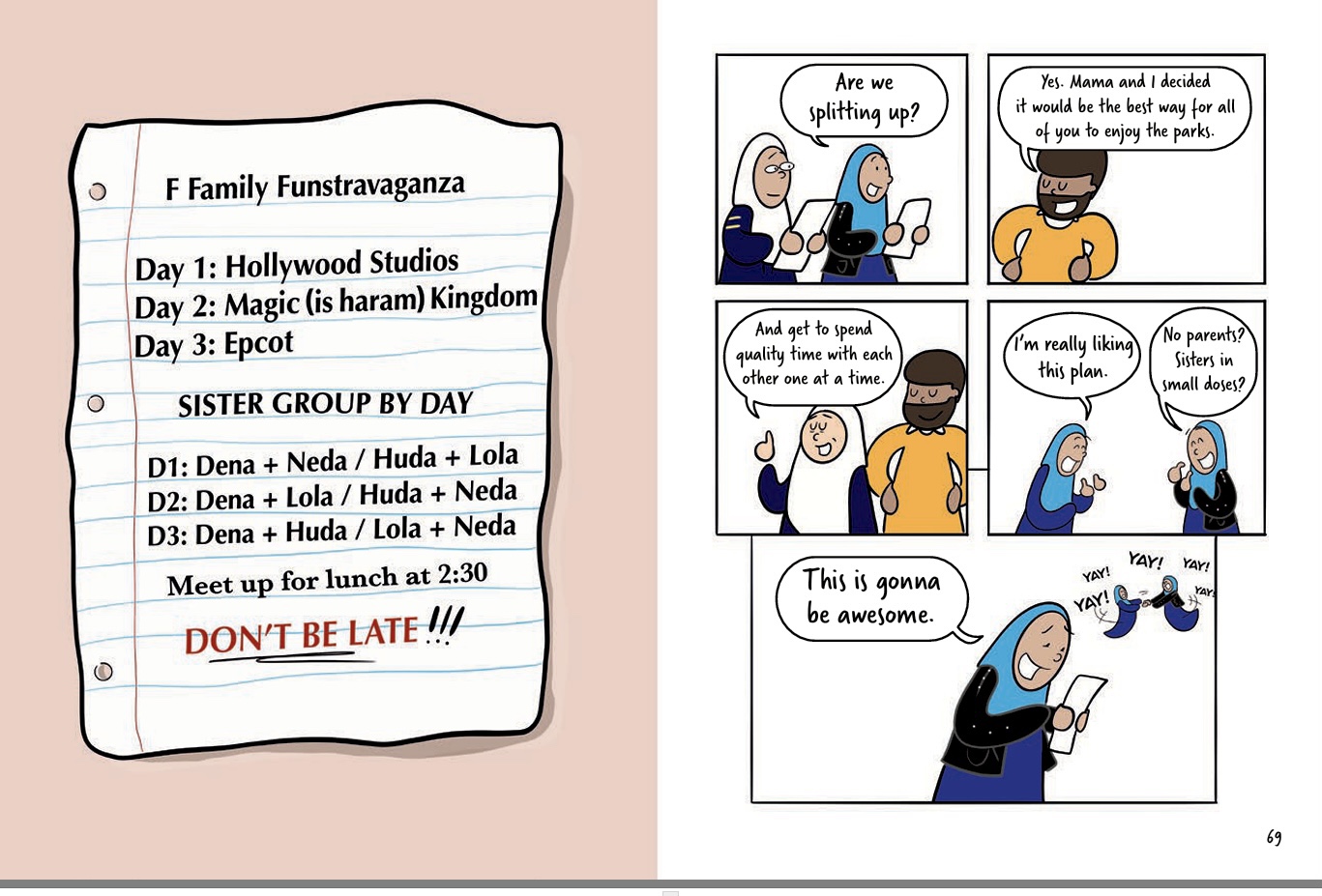
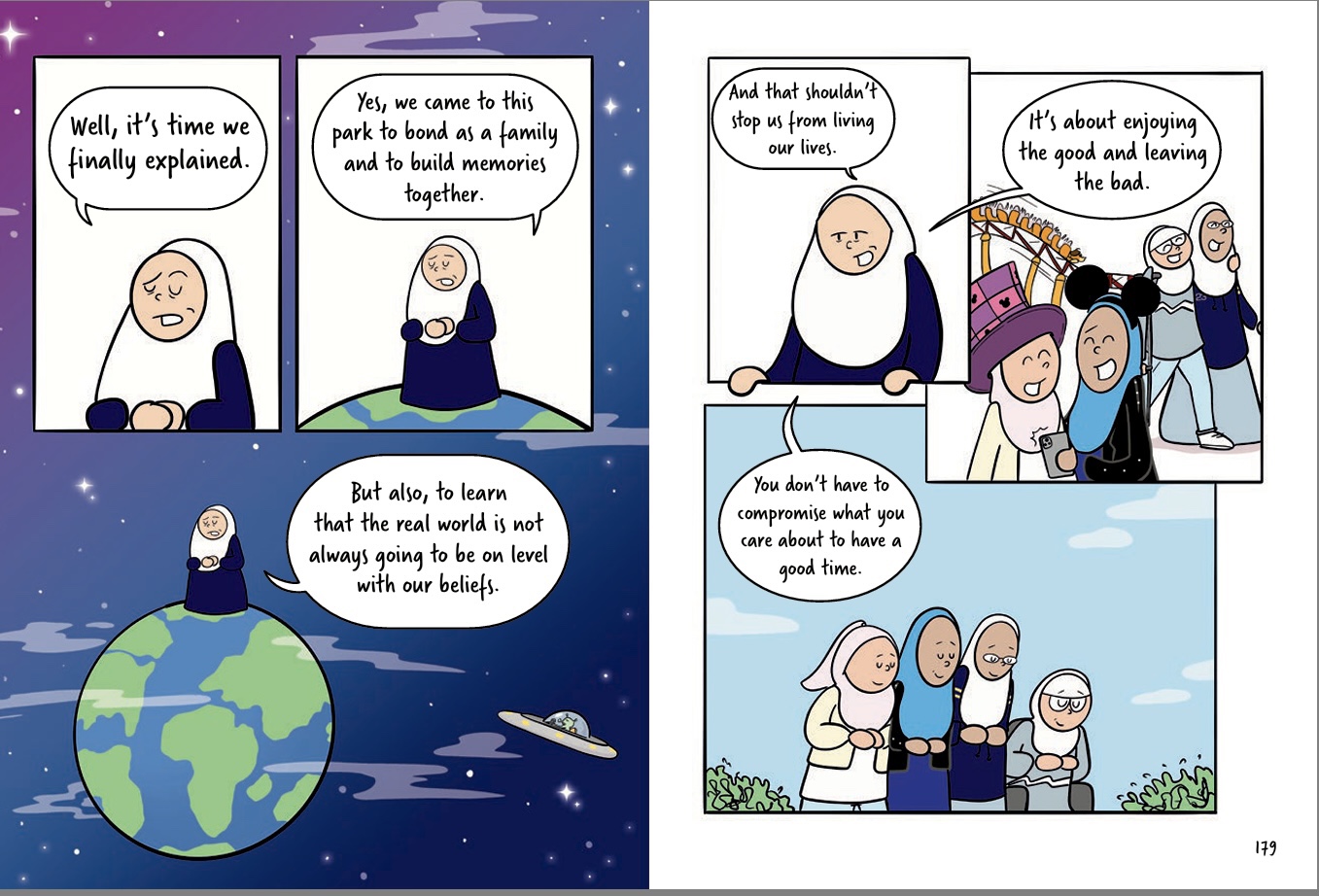
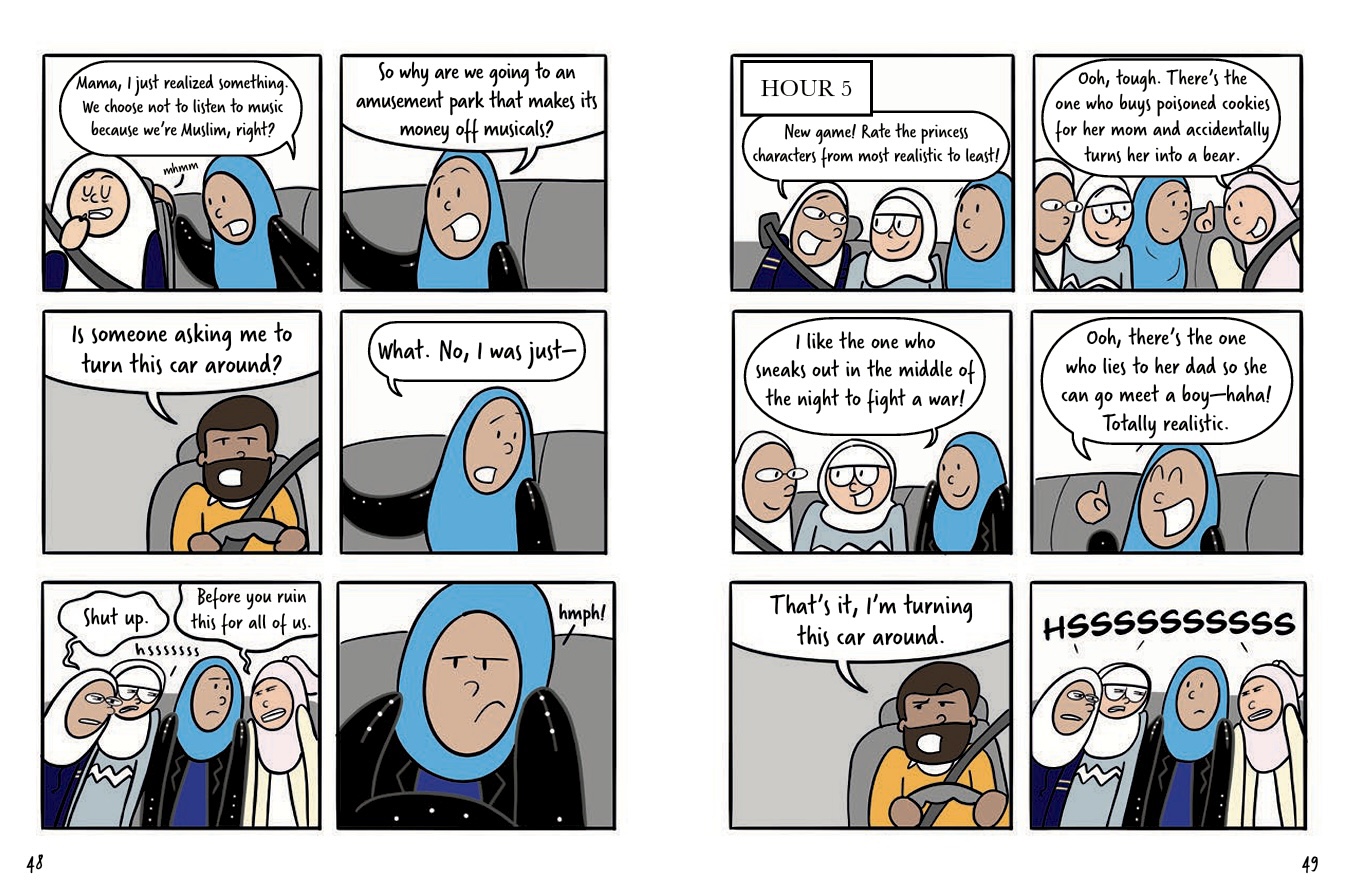
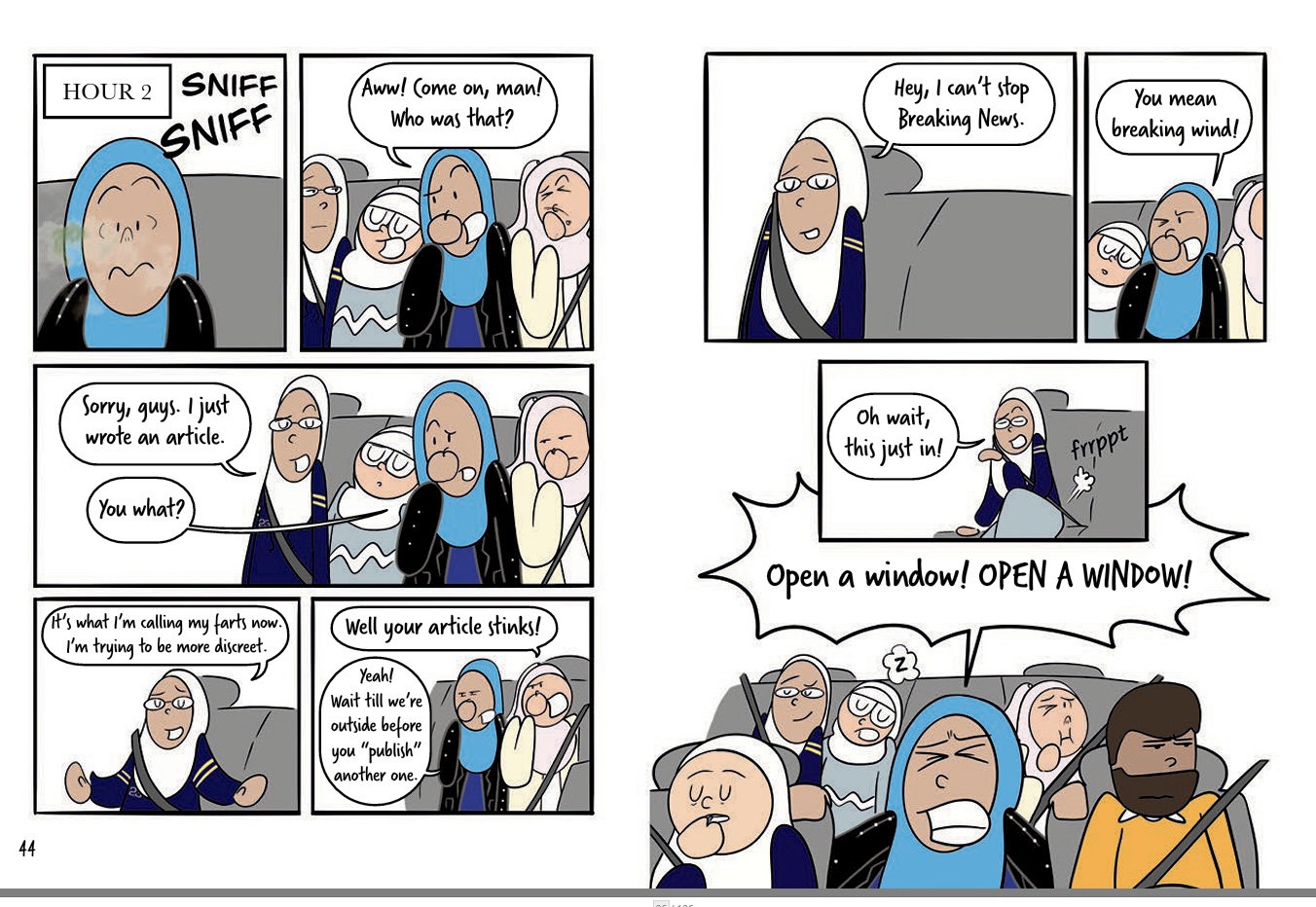
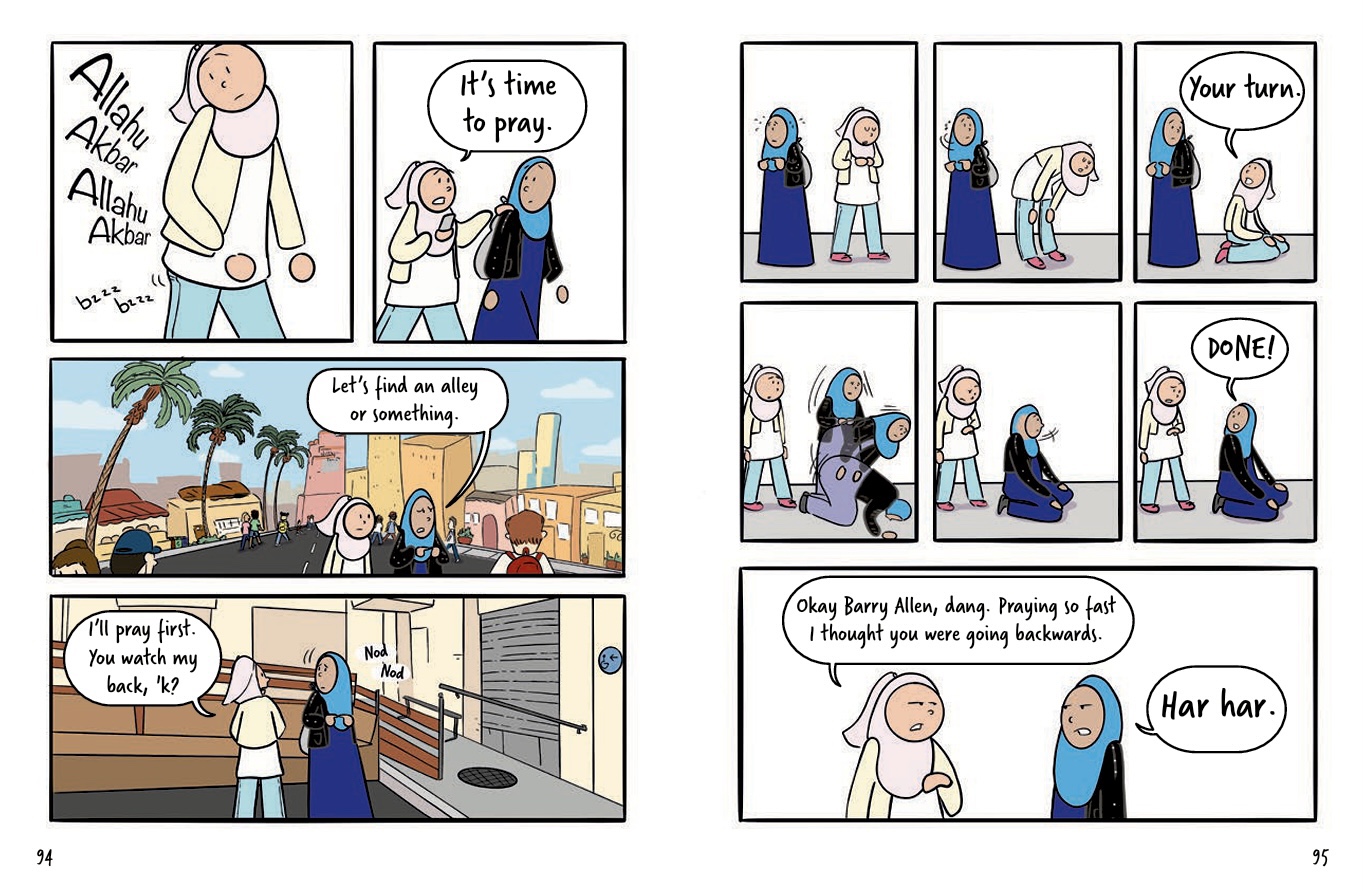
There is nothing quite like reading a YA graphic novel where you feel so completely seen, where you laugh out loud and snort at the shared idiosyncrasies, and where you don’t have to worry that the next page will normalize something haram.  This book, and the entire series, are such a gift to us all that I’m posting this review now, knowing full well that the book does not release until October, with the hopes that you will all preorder it.  This OWN voice authentic rep needs all the support we can offer it to signal to publishers that we want to see books like this published for our kids, ourselves, to share with our Muslim and non Muslim friends and that we want to see similar unapologetic voices in the future.  Huda loves Islam, she is Muslim, but that doesn’t mean she doesn’t feel uneasy at the idea of praying in public, or making wudu at a rest stop.  Her sisters sing Native Deen’s M-U-S-L-I-M to call her out, she fan girls about We Hunt the Flame, and the entire book reads like time spent with friends who can keep you laughing, comfort you when needed, and who are willing to share their very real relatable world with you as they take on Disney World.

SYNOPSIS:

It is summer and Huda and her family are heading on a road trip to Disney World. One sister hangs back for a Quran intensive, the one sister she likes.  Determined to make the best of it she piles in the back seat of the family car with her three other sisters and they hit the road.  The 24 hour one way trip is filled with sibling bickering, rest stop stresses, and parental gems.  Once they get to the park though, their parents have some surprises for them, and Huda finds herself bonding with her sisters despite herself.

FLAGS:

Fart jokes, bullying, punching, self defensive, hitting a boy in the privates for attempting to pull off a hijab, forced physical touch, lying, nothing YA can’t manage.  The title might seem crude to some, I, personally, love the ownership of one’s name, but the book is not offensive.

TOOLS FOR LEADING THE DISCUSSION:

This book won’t work as a book club selection, but I hope it finds its way to every home, middle school and up class and library.  Boys and girls will enjoy the content and I have no doubt, like the other books in the series preteens and teens will be regularly thumbing through the pages giggling and sharing their favorite parts.  You can preorder your copy here https://amzn.to/44Be87O

Please preorder if you can, and if you cannot please request your public library to shelve it, check it out, read, suggest, and enjoy!

Definitely one of my favorite books of the year, decade…..ever?

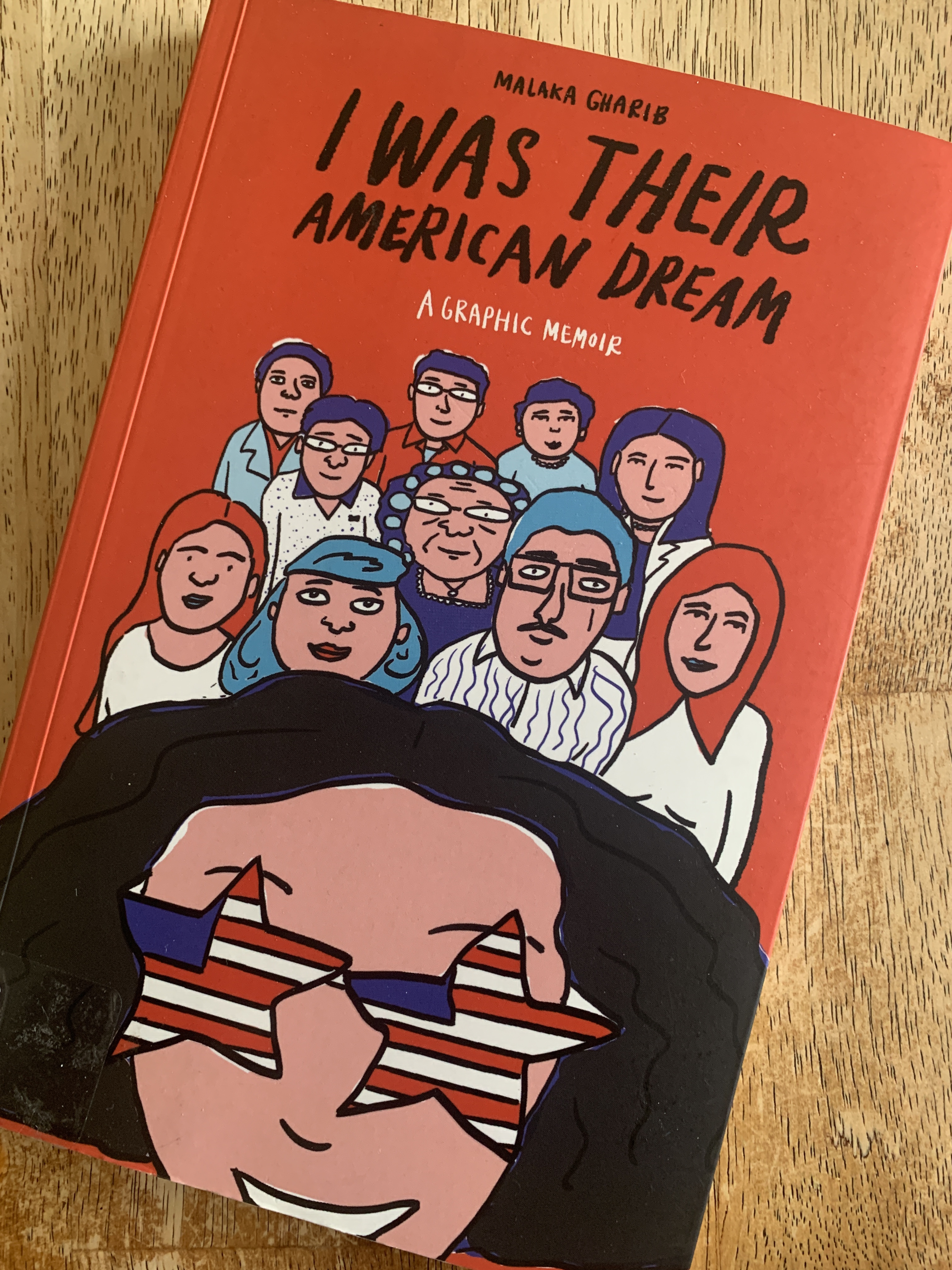
I Was Their American Dream: A Graphic Memoir by Malaka Gharib

Standard
I Was Their American Dream: A Graphic Memoir by Malaka Gharib

img_7800

I was hesitant to read the book, afraid it would pit the author’s two cultures (Egyptian and Filipino) and faiths (Catholic and Muslim) that her parents identified with against each other.  Raised as the daughter of immigrants from very different backgrounds in California I was very pleasantly surprised that the book leads with heart and positivity for the unique, yet universal feelings she experienced in her life.  The short 156 page red, white, and blue filled pages are funny, poignant, and reflective, that I think high school readers and up will enjoy spending time in Cerritos and Egypt through the eyes of Malaka.  It is easy to say that you can’t be Muslim and Catholic, but she doesn’t opine on the right or wrong of it in large terms, she discusses her life and her own situation.  As a teacher I would see students that would attend Islamic school five days a week and then go to church on Sundays, whether you agree with the choices this author/character makes is not what I intend to review, it is her life, but rather the manner in which it is shared.  There are many kids out there from “conflicting” backgrounds, and to see someone take the love and benefits offered to forge their own path in creating their own American dream, was a nice twist on the immigrant identity finding narrative.

SYNOPSIS:

The book starts with introductions to the characters, her family members that influence her, and then begins the tales of what brought her Filipino mother and Egyptian father to America, how they met, married, started a family, and divorced. Malaka exists outside her family in school, balancing her heritage and coming of age.  Raised during the school year by her mother and extended Filipino family, she spends summers in Egypt where her father resides with his new wife and children.  Coming of age as an immigrant, balancing cultures, religions, school, and dreams, the book concludes with her marrying a white Southerner and adding to the mix.

WHY I LIKE IT:

Even though she identifies more as Filipino American and goes to Catholic school, there is a fair amount of Islam and Egyptian culture included in the book.  I love that she loves her step mom and step siblings and finds beauty in Islam, learns to pray, read Quran, and mentions her love of Prophet Muhammad saw.  Sure as an Islamic school librarian, I wish she chose Islam, lived it and centered it in her life, but this is not a character, this is a real person, and to see her lovingly showing the goodness in Islam and how it has positively influenced her, is nice to see nonetheless.  There are a few storylines I didn’t quite understand, the skateboarding in Egypt a big one, but the quick pace of her narrative life-story flows well and is easily consumable.  Often stories like this are overly dragged down by dated pop cultural references and over criticizing “othering” paradigms, but this book contains enough to keep it grounded without it alienating contemporary readers.

FLAGS:

Stereotypes, lying, relationships, periods, music, dancing, nothing really stands out, there might have been some language, I read it a few days ago and honestly don’t recall anything overly problematic, but content wise it is a mature teenage read with retrospection and marriage being a part of the narrative.

TOOLS FOR LEADING THE DISCUSSION:
I don’t know that I would shelve or teach this book, but I think it is one to file away in my head for people I might encounter looking for a book about blended faiths and cultures benefitting from the many worlds they have one foot in and one foot out of, and those ultimately looking for a place to see their experiences mirrored.

I found my copy of this book at my local public library and it is also available here from Amazon.

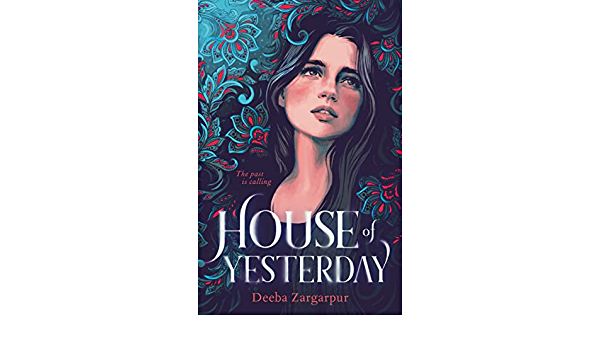
House of Yesterday by Deeba Zargarpur

Standard
House of Yesterday by Deeba Zargarpur

house of yesterday

While reading this 320 page YA supernatural/contemporary book-I couldn’t turn the pages fast enough.  When finished- I was bothered that certain threads weren’t resolved, now that I’ve ruminated a bit- I think the vagueness of the author’s prose in sharing her “fever dream” on paper has lingered and the gaps not as troublesome.  The author’s OWN voice Afghan-Uzbek Muslim identity adds layers to a story that is both haunting in the literal sense and familiar in the immigration inter-generational traumas and secrets shared.  Even deeper though, the book pokes at universal themes of regret, holding on to the past, family, friendships, and grief.   The book’s characters identify as Muslim, but the story is not Islamic, nor is there much religion save a few salams and mentions of Eid.  The supernatural elements in the book, whether you understand it to be ghosts, or personified memories, or jinn, are a large part of the book, but are not framed in a belief or spiritual manner, and while some may find it Islamically off-putting, I felt the book explored what the main character was enduring and what the weight of the past was doing to her, didn’t necessarily cross the haram line.  Her father has a girlfriend he is looking to marry, but it isn’t celebrated, and there are close male/female friendships, but the book is relatively clean for the genre and would be a good fit for high school readers and up.

SYNOPSIS:

Summer on Long Island has Sara retreating into herself.  Surrounded by nearly a dozen aunts and uncles and numerous cousins, it is the separation of her parents and trouble with her best friend that makes getting out of bed every morning a challenge.  As a result, her mother ropes her in to helping with her latest remodeling project.  When she enters an old crumbling house one morning to take “before” pictures, she starts seeing things, and feeling things.  Things about her past.  Things about her beloved grandma, Bibi Jan, who is alive and deteriorating from dementia.  What is the house trying to tell her? Why won’t anyone tell the truth?

WHY I LIKE IT:

I love the mystery and the chills of the story.  As the reader you aren’t entirely sure where the story is headed, what you are to do with the bits of the puzzle you are given, but the intrigue to find out pulls you forward.  That being said, the book does reads debut, a few of the side story lines are not fleshed out enough to feel important, satisfying, or resolved and they come across as being abandoned.  I would have liked to see more of Sara and her father’s relationship, the details don’t seem to fit, and the continuity seems halfhearted.  At times so does the “night” it all changed with Sam.  I like the interpretive vagueness of the supernatural threads and that they are up for interpretation amongst readers not just at the end, but throughout the book.  I also like the family’s closeness even when they are disagreeing. For most of the book Sara and her cousins aren’t portrayed as particularly close and I didn’t invest time to differentiate one from another, but by the end, I felt that they were grounded and different and relatable, and I am not sure when that change occurred.  At times the writing seemed a bit repetitive, but the lyrical style would then catapult the story ahead.  There was one place that the fourth wall was broken though, and I was bothered by that slip.

Overall I loved that the Uzben Afghan culture sprinkles showed immigrant nuances, and that the love between the generations countered the trauma being shared as well.  The messaging is subtle but powerful long after the last page has been read.

FLAGS:

For the most part the book stays clean, the father has moved on and has met someone he would like to marry, the mom and aunts briefly recall sneaking out to attend a prom decades earlier.  There is mention of a child bride, and swimsuits, tank tops, and cocktail dresses being worn with no second thought.  For a YA book, the flags are incredibly minimal, save the “ghosts”(?). There are flags of a death that is detailed, the book is “spooky” at times, there is mental health, divorce, pain, dementia, abandonment, theft, running away, and fear.

TOOLS FOR LEADING THE DISCUSSION:

I would love to read this book with some high schoolers.  It is a quick read that would allow for a lot of self reflection, arguments, and entertainment.  The book is available here and releases in a few days, so if planning to purchase, please consider preordering and showing your support.

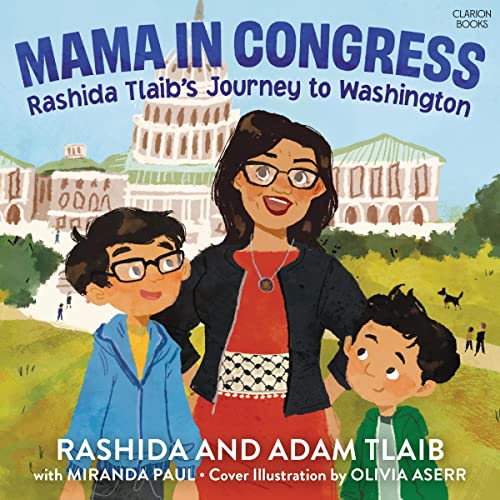
Mama in Congress: Rashida Tlaib’s Journey to Washington by Rashida and Adam Tlaib with Miranda Paul illustrated by Olivia Aserr

Standard
Mama in Congress: Rashida Tlaib’s Journey to Washington by Rashida and Adam Tlaib with Miranda Paul illustrated by Olivia Aserr

mama in congress

I wasn’t particularly looking forward to this book.  Books by politicians are always suspect, by a politician currently in office- more so, and a book written about one’s self can be a little self promoting to say the least, but when I saw my library had it, I put it on hold and thought to give it a shot.  Surprisingly, the book is really cute.  It is framed as her son (one of the contributors) telling his mom’s story, it owns that while yes she was one of the First Muslim Congresswomen, there were a lot of people before her that ran and paved the way.  What really shocked me was the amount of Islam in the book: Salat-al-Istikharha, actively learning about Islam not just as culture, there is an Ayat from the Quran, etc.. The book says for ages 4-8 and for the amount of text on the pages, there is no way a preschooler will sit through this. I can see this book, however, being used in an elementary classroom to teach about the American political system, and inspiring kids that they can make a difference, that they can rise to positions of leadership without compromising who they are, and that no matter their background, and that they can be successful in following their dreams.  I don’t think Congresswoman Tlaib should be put on a pedal stool for some of the policies she has supported or bills endorsed, but I think even if you don’t support her politically, her story and her accomplishments do show possibilities for minorities to reach the highest levels of government.  The fact that she is a Palestinian Muslim Women and has found success in the context of American government as told from a child’s perspective, really surprised and impressed me, and I can see it being a worthwhile story to share with young students.

The book starts with two boys on the steps of the capitol, Adam and Yousif wondering if the president is their mom’s boss, and mom, saying that no, the 700,000 people in the district she represents are.  The book then pulls back and Adam starts to tell the story of him and his brother going to work with their mom, Congresswomen Rashida Tlaib the representative from Michigan.

img_4036

Before she was elected their yama and yaba immigrated from the West Bank to America, where Rashida was born.  Eventually there would be 14 kids born and Rashida would choreograph dances, basketball games, and seek privacy to dance like a pop star, or chase after the bookmobile.

img_4037

Comments toward her well-spoken mother to learn English, embarrassment at the smell of the factory polluted environment, and an offer by a high school teacher to join the debate team, helped pave the way for Rashida to find her voice and make changes.

img_4038

Rashida was the first in her family to graduate high school and from there she went to college and then law school.  She also started to learn more about Islam and the reasons behind her family’s traditions.  Her favorite passage from the Quran became, “with hardship comes ease.”

img_4039

She started working with an elected official from the Michigan House of Representatives and started a family.  When a seat became vacant she was encouraged to run.  No Muslim had ever been elected to the Michigan House and even her own yaba didn’t think people would vote for an Arab, so she prayed Salat al-Istikhara and did a lot of thinking.

img_4040

The book shows what she wanted to accomplish and how she went door-to-door and found both success and hardship meeting with the people.  Ultimately though, she won the seat and held it for many years.  When Adam was 12 she decided to run for the U.S. House of Representatives, and he and his brother joined in to help knock on doors.

img_4041

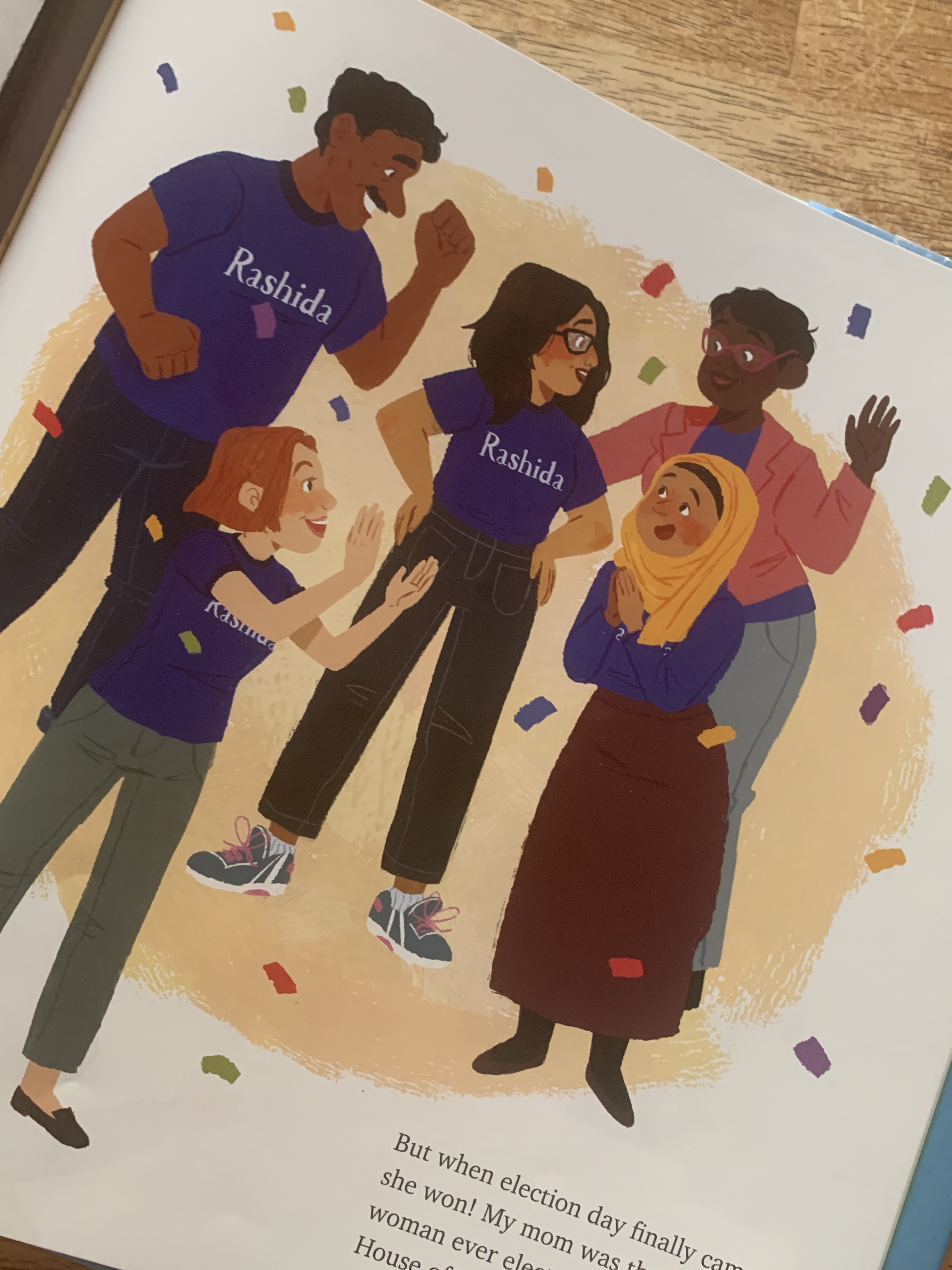
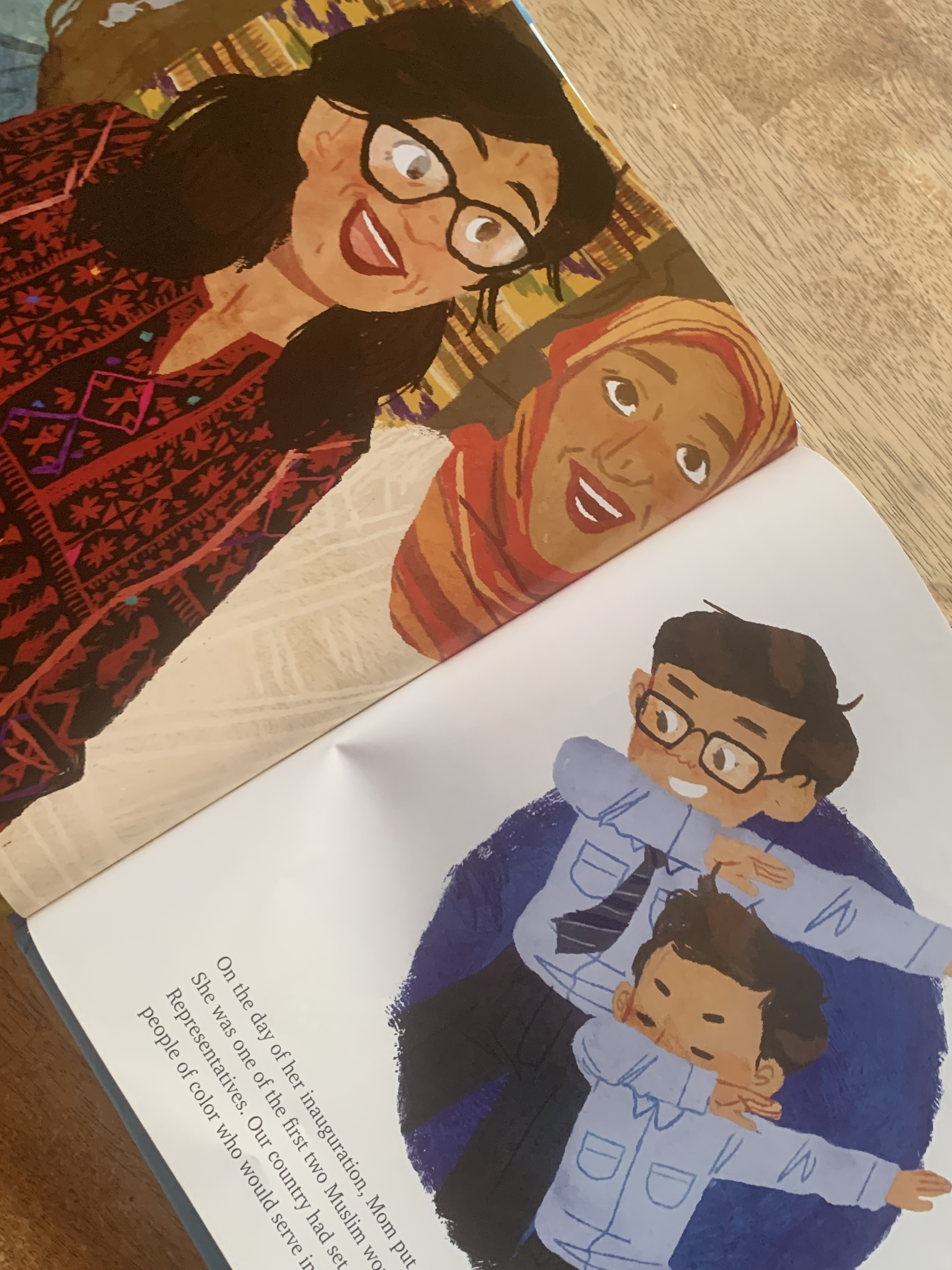
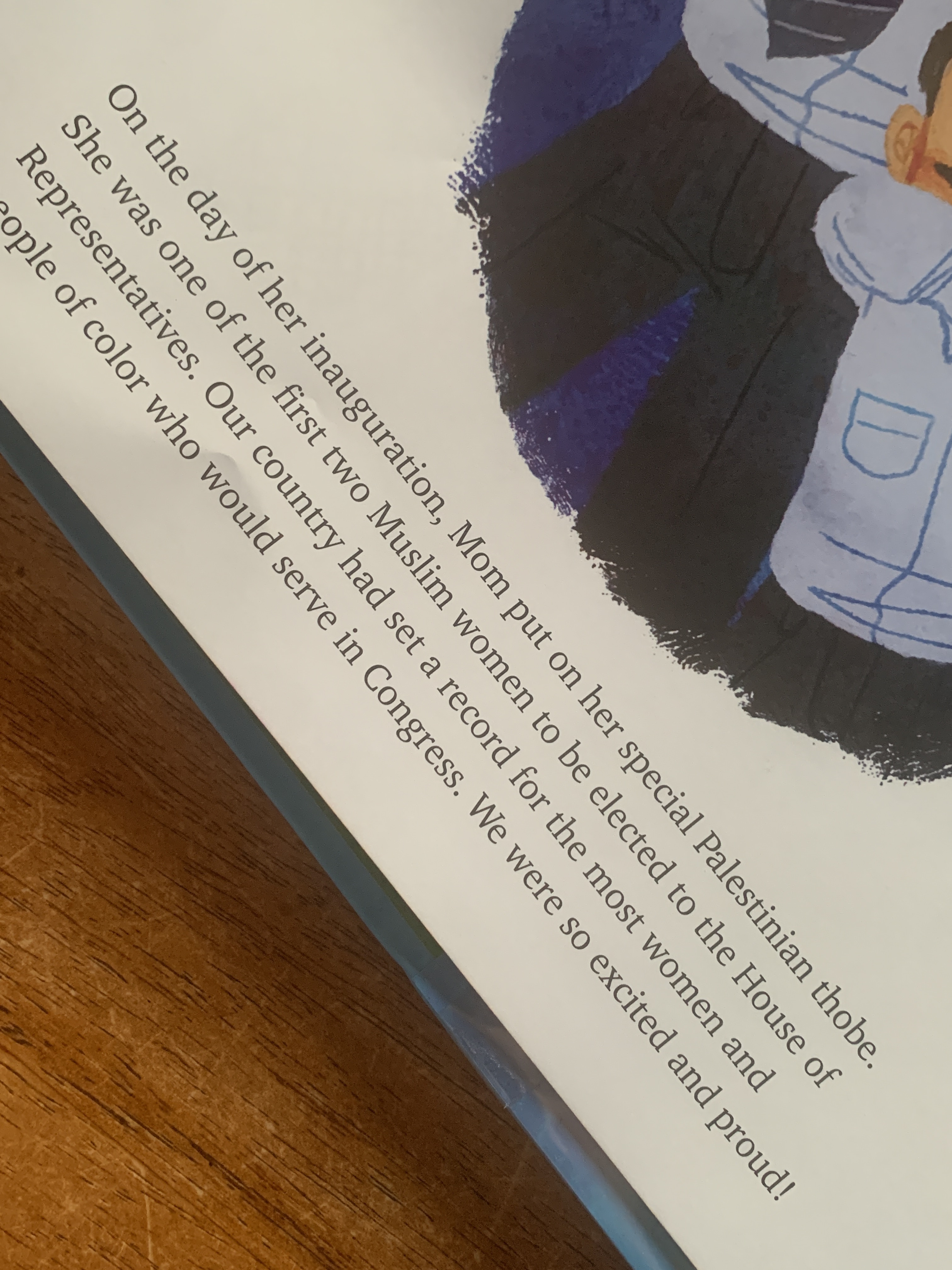
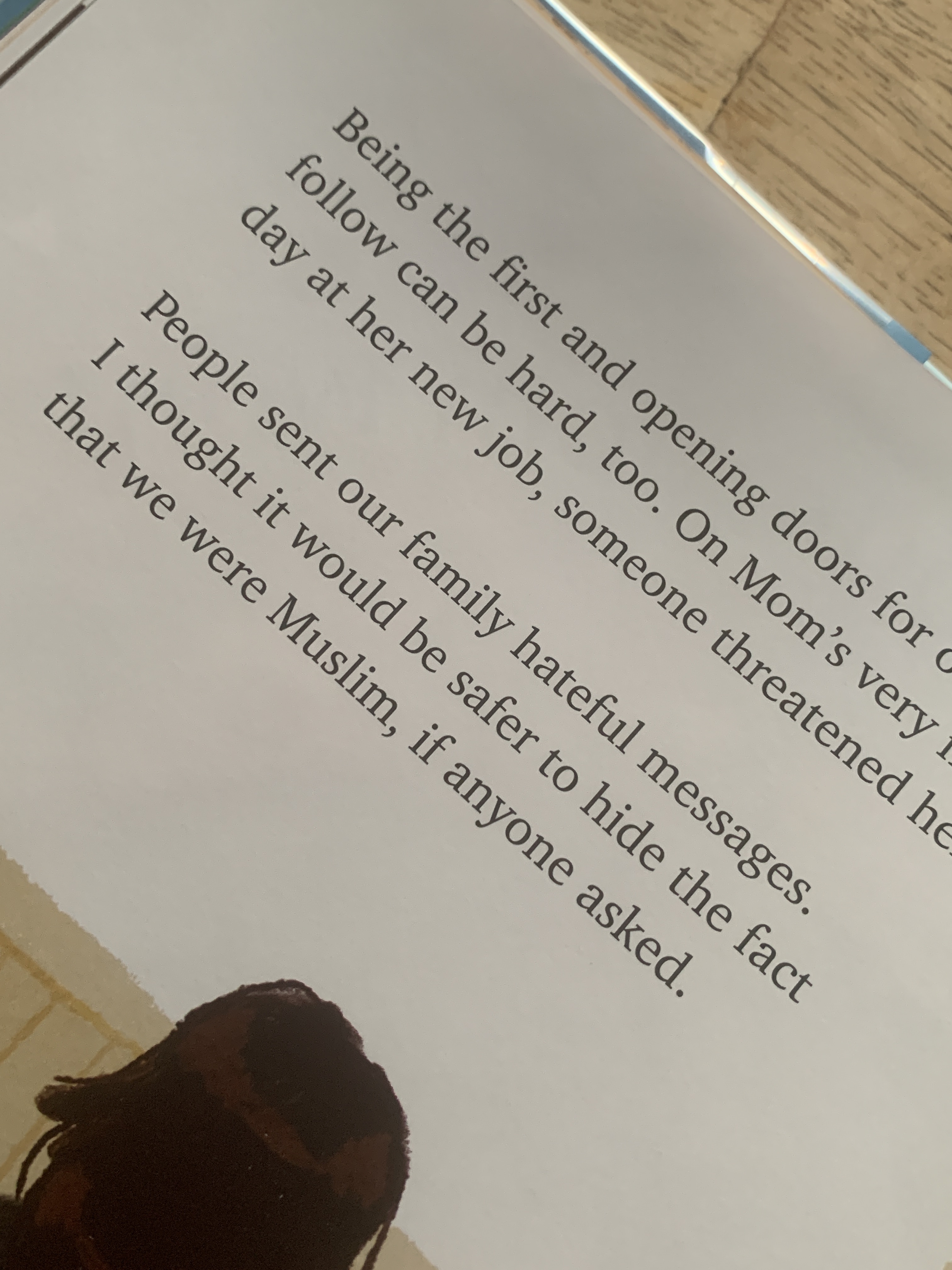
She won, and was one of two Muslim women to be elected that year.  Adam and Yousif dabbed in celebration at the inauguration as their mom was sworn in in her Palestinian thobe. On her first day, however, there were threats, and Adam though they should hide the fact that they were Muslims.  Their mom told them it is important to be their authentic selves, “that sometimes it takes many to run for there to be a first.”

img_4042

The book concludes with a glossary, an infographic of the branches of government. Can be purchased here.