Category Archives: Story Time

My Grandfather’s Masbaha by Susan Daniel Fayad illustrated by Avery Liell-Kok

Standard
My Grandfather’s Masbaha by Susan Daniel Fayad illustrated by Avery Liell-Kok

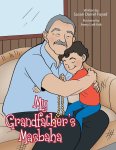
masbaha.jpgThis 20 page story is endearing and sweet for children aged 4 and up, with a great lesson.   At first I thought it was an Islamic fiction book, but after thinking about it, I’m not so sure.  Lots of faiths use prayer beads, although maybe only Muslims have 33, and the setting, Lebanon, is a pretty diverse place.  Regardless, the character’s names, and the lessons taught are universal and children will benefit from being reminded about how blessed they truly are, in a gentle loving way.
IMG_0113

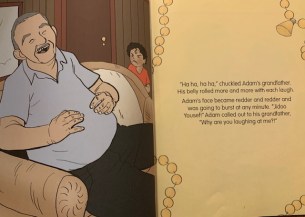
When little Adam’s friends go home and he has nothing to do, he enters his grandparents house stomping and complaining.  In response, Adam’s Jidoo, grandfather, starts to laugh.  This only makes Adam more angry.

IMG_0114

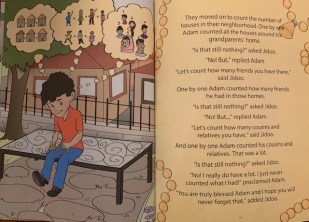
Jidoo Yousef then shows Adam his misbaha and explains that some people use it like an abacus to count, to mark prayers, some use it as decor, and that he uses it to remember God’s blessings.

IMG_0115

He and Adam, then go around and count all the blessings of toys, and people, and friends, and family, and food, and before Adam knows it, he is feeling blessed and thankful.

IMG_0116

The basic illustrations show the bond between Jidoo and Adam, but are nothing overly fabulous on the large 8.5 x 11 pages.  There is a lot of text on some of the pages, but it flows well and goes quickly.

IMG_0118

The book teaches a great lesson and if you get a chance to read it to your children, you definitely should.

Saffron Ice Cream by Rashin Kheiriyeh

Standard
Saffron Ice Cream by Rashin Kheiriyeh

saffron-ice-cream_1600_c.jpg

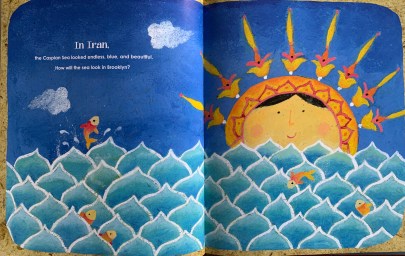
The book may seem to be a lighthearted diverse read about a little girl comparing a beach in America to those of Iran, BUT there is also some pretty charged portrayals about gender divided beaches, religious police, and hijab.  I’m not saying this own voice book is exaggerating or saying anything that isn’t true, but it is an oddly belittling perspective to slip into a brightly illustrated children’s book with the words “ice cream” in the title.  The 40 page book for ages 4-8 is not one I would recommend for its negative undertones and dismissal of understanding another culture.

6BC28B43-0CB0-468A-A866-35A02C7DE210

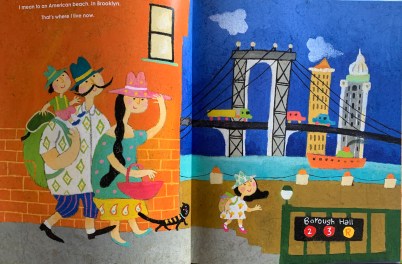
Rashin’s first trip to a beach in America has her and her family getting ready to go to Coney Island.   She remembers past trips to the Caspian Sea in Iran.  Trips where they would wake up early, her mom would prepare halim and they would drive through the countryside stopping for a picnic lunch.  Often her best friend Azadeh would come along and they would listen to Persian music and share kebabs.  On this trip they are going on the subway and there is diversity and music and excitement too.

6EC8AC6A-577A-4D94-B7EA-85AF22BDE8EC

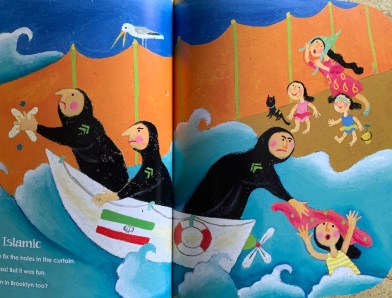
The next few pages detail and depict the curtain that would divide the women’s side of the beach from the men’s.  While the words say how fun the women’s side is and that even the ice cream vendor is a woman and the beach goers can remove their covers and get a tan, the inclusion of the Islamic guards with their aggressive faces and full black abayas and hijabs, is a stark contrast to the happy faces throughout the other pages.

4DA05BB7-D867-4E6C-BA2D-2D0C4BB10222

Rashin then recalls one trip where little boys poked holes on the men’s side to look at the female’s side. While it might be taken as silly to children, there is a lot to unpack with such “peeping,” the concept of respect and of covering.  It then seems to make the whole situation seem ridiculous by having the women covering themselves with umbrellas, newspapers and whatever they can find.

1B468F58-7A51-4523-9973-D1DA5F935B3B

When Rashin finally gets to Coney Island, the ice cream stall doesn’t have saffron ice cream and another little girl suggests she try chocolate crunch, she concedes and discovers it is pretty good, and the beginning of a new friendship is implied.  She then asks the girl about the rules of the beach and the accompanying illustration has the Islamic police seeming to try and stop the fun.

8C418BFD-96ED-4D1F-B065-C4EA97167CFF

It is natural to compare new things to those that we know, but this book has a very strong negative, judgmental tone to what could have simply been presented as different without the criticism.  The author is the illustrator as well, so there wasn’t a divide in continuity.  I appreciate that there is a visibly Muslim family at Coney Island, but it seems too little, in a book very aggressively passing opinion on a religion and how it is “enforced.”

3E7C76A7-22DE-4F8A-B87F-F3DC91982D33

I find it rather disappointing that Scholastic chose to publish such an angry book masked in smiling characters and a trip to the beach.  It may be how life is in Iran, but I don’t know that a children’s book is the platform to air grievances without explanation.  This book does nothing to open dialogue and acceptance, it definitely would cause more harm than good.

Cotton Candy Sky by Zain Bhikha illustrated by Amir Al-Zubi

Standard
Cotton Candy Sky by Zain Bhikha illustrated by Amir Al-Zubi

cotton candy sky.jpg

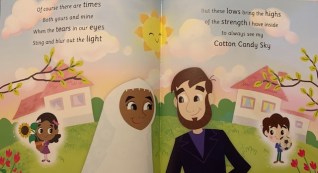
So glad to see another Zain Bhika song hit the mark and bring the beloved lyrics to life in book form. Ages 2 and up will enjoy the 28 page book even if they haven’t heard the song, and parents will enjoy watching the kids sing-read the pages independently if they have.

IMG_8895

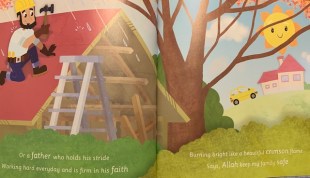
The illustrations are sweet and diverse with the characters and their families changing with each verse.  But all celebrating in their appreciation for the light of Allah’s blessings and the patience of waiting for the rain to pass.

IMG_8896

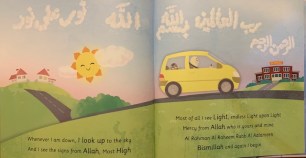
I particularly enjoy the Arabic in the clouds on the pages explaining what the character does whenever he/she feels down and looks up to the sky to see Allah’s signs.

IMG_8897

The hardback book is sturdy with a playful large font on the pages, and is meant for Muslim kids with the concept coming from Surah An-Noor (24:35).

IMG_8898

Once again, thank you Crescent Moon Store (https://crescentmoonstore.com/products/cotton-candy-sky?_pos=1&_sid=c94d58757&_ss=r) for fast friendly service and great prices!


Bibi’s Blessing by Lela Usama Goldsmith illustrated by Samantha Morazzani

Standard
Bibi’s Blessing by Lela Usama Goldsmith illustrated by Samantha Morazzani


IMG_8209

A wonderful lesson packaged in a sweet story about a girl learning to thank God for blessings, especially ones that don’t seem like blessings at all.  The 36 page book is meant for children age 4 and up and with its large 8.5 x 11 glossy full color pages it works well at bedtime and in small groups at story time.

IMG_8211

On the island of Lamu, Mwana lives with Bibi, her grandma who’s livelihood depends on making Mofa bread every day.  It is Mwana’s job to sell the sorghum ground bread in the streets for people to enjoy at tea time.

IMG_8210

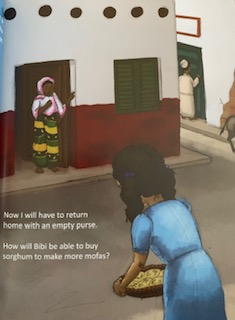
One morning a braying donkey frightens Mwana and she trips, spilling all the mofas on the ground.  When she tells her grandma what happened and how they have not made any money for the day, her grandma responds, “Thank God for this blessing.”

IMG_8212

Not believing Bibi, but being too excited to visit a friend, she doesn’t argue.  But then the power goes out and she can’t visit her friend and she gets grumpy. Grandma tells her to “Thank God for this blessing” and explains that sometimes not getting what you want is also a blessing.
IMG_8213

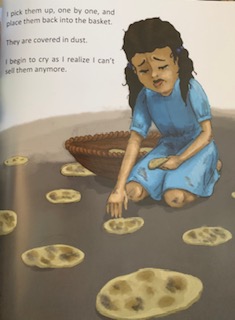
With nothing else to do, Mwana goes off to soak the rice pot, but instead accidently soaks the dusty mofas, to which her grandma again says it is a blessing.  She starts to feel she can do nothing right, and can’t believe there is any blessings in a pot of mushy mufas.

IMG_8217

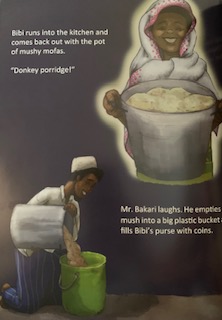
But, with the power out many shops close and the owner of the donkeys has nothing to feed his animals.  He knocks on his neighbors door and Bibi and Mwana have just the thing.  He pays them for the food and alhumdulillah all is well, so many blessings from God.

IMG_8216

I love that the setting is a place many of us have never heard of and that there is information about Lamu at the end of the book along with a glossary.  The author is Muslim, the characters dress Islamically in the illustrations, and have Muslim names, but there is nothing Islamic specific in the text.

IMG_8214

Some of the sentences are worded awkwardly, for example, “We live in a small island by the Indian Ocean called Lamu.”  You typically say you live “on” an island not “in” it, and islands are in the ocean, not by them.  And some sentences read almost as run ons because of multiple conjunctions and their lack of punctuation.  I don’t love the illustrations.  The faces on many of the pages are really distracting and inconsistent, but the overall story is well done that I’m willing to over look my own critical opinions, and encourage y’all to give the book a try.


My Grandma and Me by Mina Javaherbin illustrated by Lindsey Yankey

Standard
My Grandma and Me by Mina Javaherbin illustrated by Lindsey Yankey

grandma and me

I absolutely love that this 32 page picture book for children five and up breaks so many stereotypes and highlights so many commonalities between all people, everywhere.  I strongly believe that books like this, can change people’s perspective, and as a children’s books can prevent negative biases from forming in the first place.

IMG_8078

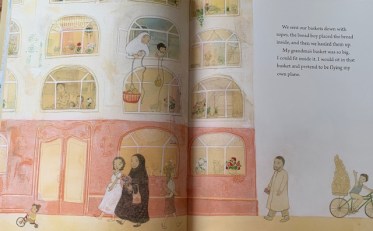
Set in Iran, a little girl absolutely loves and adores her grandma.  They pray together, they buy bread together and they share that bread with their best friends, their Christian neighbors next door.  While the little girl and her friend Annette play, the two grandmas chat, drink coffee and knit blankets to donate to the mosque and Annette’s Grandma’s church.

IMG_8079

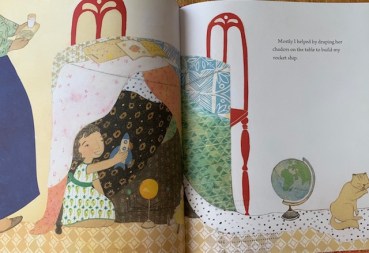
Grandma sews chadors to wear, and Mina helps.  But, mostly she uses the scarves to make rocket ship forts, and capes to fly to outer space in.  When she returns to base camp grandma has cookies for her and wants to hear about her adventures.

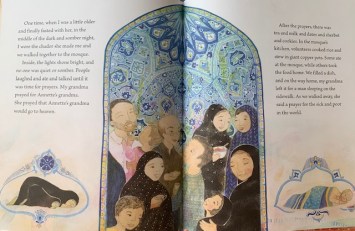
In Ramadan, the little girl wakes up early to eat with grandma even though she is too young too fast.  When she gets older, they go to the mosque together at night too, after they have broken their fast.

IMG_8082

One time she hears her grandma praying for Annette’s grandma to go to heaven.  The next day Annette tells Mina she heard her grandma praying at church for her grandma to go to heaven.  The little girl imagines the two grandmas knitting and laughing together in heaven, on Mars, on Earth, anywhere.

IMG_8081

The book ends with the little girl stating past tense how wonderful her grandma was and  that she still wants to be like her.

The book touches on family, interfaith, love, helping others, faith, religion, friendship, culture, and is just really really sweet.  I wish I loved the pictures, as much as I love the story, but I don’t.  I think I like most of them with their texture and details, unfortunately the faces in some just seem a little off to me.

I absolutely love that there is no over explaining, and no glossary, the author seamlessly brings words like namaz, and Ramadan and chador in to the story, normalizing them as the pretend play, and familial bonds are so universal.

IMG_8083


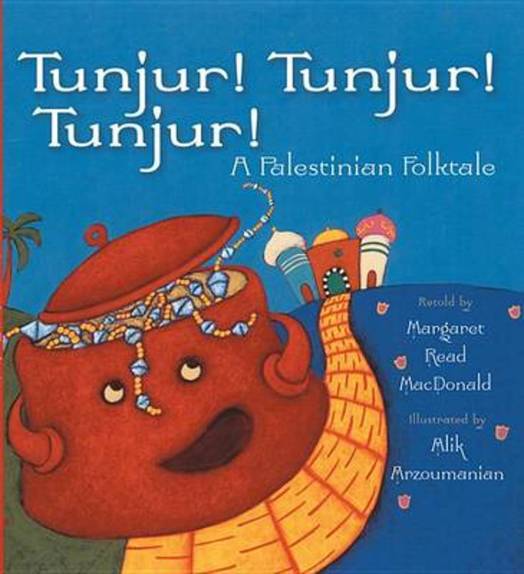
Tunjur! Tunjur! Tunjur! A Palestinian Folktale retold by Margaret Read MacDonald illustrated by Alik Arzoumanian

Standard
Tunjur! Tunjur! Tunjur! A Palestinian Folktale retold by Margaret Read MacDonald illustrated by Alik Arzoumanian

tunjur.jpg

This delightful little folktale is beautifully presented in 32 pages on an AR 1.7 level.  Perfect for little ones to listen to and early readers to tackle on their own.  The pictures are fun and engaging and the story teaches a great lesson of right and wrong in a silly memorable fashion.

IMG_8036

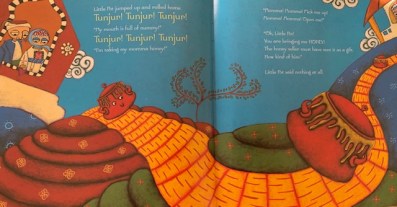
A childless woman asks Allah to bless her with a child, even if it is just a cooking pot, and “Willa! She had a child! And it was a little pot!”

At first taken aback, the little pot professes her love for mama and thus the woman decides to take care of the little pot.  Every day the little pot bumps against the walls as she rolls and jumps around making the sound, Tunjur.

IMG_8037

One day the pot wants to go to the market by herself.  Mama refuses as she is too young and doesn’t know right from wrong, but alas she talks her mom in to it, and off she goes.

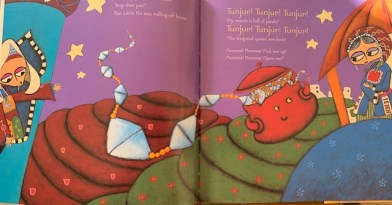
She meets a rich man who wants to fill her with honey for his wife.  The pot loves honey so she doesn’t protest, but she refuses to release her lid when the man gifts the pot to his wife.  Angrily he throws the pot out the window and the little pot finds her way home. Mama assumes the honey seller sent it as a gift and little pot says nothing at all.

IMG_8039

The next time little pot heads out she finds herself filled with the queen’s jewels and when she returns Mama is not happy that her little pot has taken things that do not belong to her.

IMG_8038

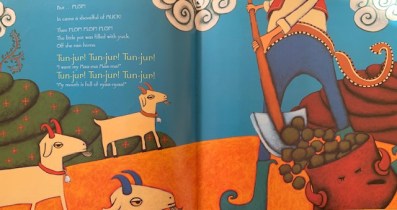
When little pot heads out again to apologize, the rich man takes her to the king and queen for a reward,  and they fill her with something to teach her a lesson.  When she comes home to Mama, she has definitely learned her lesson.

IMG_8040

The women in the story seem to wear hijab, most notably the wealthy man’s wife.   The Mama asks Allah swt for a child, but other than that there is nothing religious in nature in the book and seeing as I checked it out from the public library, I think it appeals to all kids.


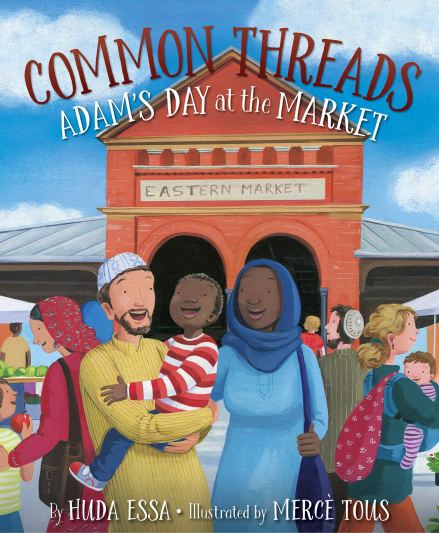
Common Threads: Adam’s Day at the Market by Huda Essa illustrated by Merce’ Tous

Standard
Common Threads: Adam’s Day at the Market by Huda Essa illustrated by Merce’ Tous

Common-Threads-Book-Cover.jpg

A lot of story is conveyed in this 13 word book for preschoolers about diversity, similarities, and love.  In 32 picture rich pages you meet a little family at an outdoor market, see Adam lose track of his parents as he follows a bird, and meet a lot of kind people as he mistakes them for his parents based on the clothing they are wearing.

A7AC0F6A-D891-4F4F-A537-0A10BA8F19A4

Naturally it has a happy ending, and it appears all the characters come together to get to know one another.  The pictures are beautiful and radiate with light and colors.

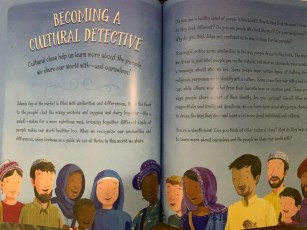
The market in general is diverse and the characters Adam meets show clothing similarities.  His mother wears hijab and he mistakes a nun in a habit for her, and then a lady in a kanga.  He thinks he sees his father, but it is a man with a yarmulke and a gentleman in a similar color shalwar kameez looks a lot like his dad’s kurta, but isn’t him either.

This is truly a picture book with sparse words of “Mama?” and “Baba?” being the bulk of the text.  It is visual and conversation sparking in its minimal and simplistic text.  By not having the author fill in the conversation, a preschooler gets to do it themselves, and hopefully broaden their mind in the process.

The beginning of the book has a beautiful Note to Readers urging children and adults to engage in diverse collaborations to increase empathy, innovation, social justice, and understanding to the benefit of us all.

6304D0EE-6710-44B9-9CF1-F6E5AD9359DC

The book concludes with a challenge to children to become cultural detectives.  It notes that what we wear sends a message about who we are, but it is just what you see on the outside.  It encourages us to ask questions respectfully and kindly to learn about one another.

E48812D3-A399-40B9-B903-3D366414827A

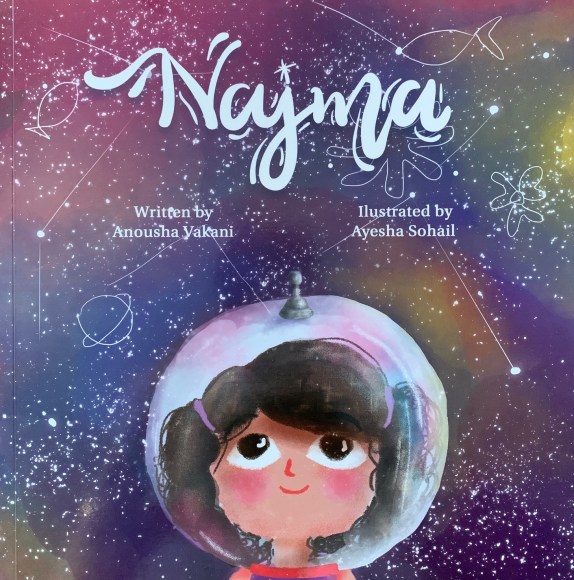
Najma by Anousha Vakani illustrated by Ayesha Sohail

Standard
Najma by Anousha Vakani illustrated by Ayesha Sohail


IMG_7194

In a world of new STEM books and female powered books, this 28 page fact driven story adds one more empowering element, Islam.  With beautiful pictures on thick glossy pages, the 10×10 book is both educational and endearing for boys and girls ages 6 and up.

IMG_7183

There isn’t a story with a climax or moral, but there are characters, Najma and her astronomer Mom, who move the book along, and keep it “grounded” so to speak.

IMG_7184

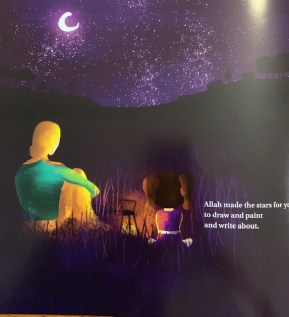
Little Najma loves the stars and space above her, she knows Allah created them, but she wants to know more about them, what they provide, and how Allah made them.

IMG_7185

Mama and Najma look through a telescope as Mama teaches the life cycle of a star in simple terms over 11 pages.


Najma then asks what stars are for, and Mama tells her the benefits of the sun that Allah swt made for us and the stars as well.  Mama explains Allah only has to say, Be and it is.

IMG_7188

Every scientific concept, and daily life example is tied back to Allah swt.  And with Najma’s adorable little face, and the beautiful complimentary illustrations, the book conveys facts about the universe, love between mother and child, and awe at Allah’s signs.IMG_7189

Thank you Crescent Moon Store for amazingly fast delivery of this brand new book.  InshaAllah there will be more books like this combining science, Allah, and strong females for us all to learn from and enjoy.


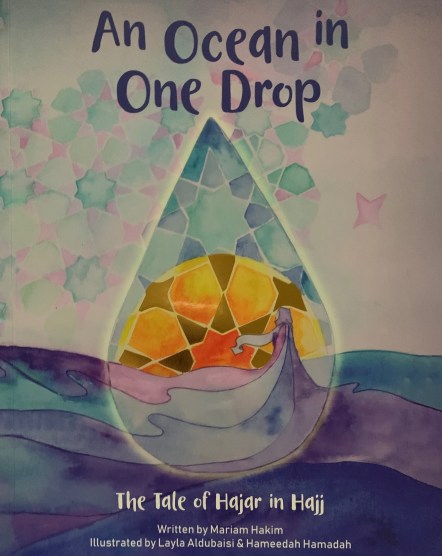
An Ocean in One Drop: The Tale of Hajar in Hajj by Mariam Hakim illustrated by Layla Abdubaisi & Hameedah Hamadah

Standard
An Ocean in One Drop: The Tale of Hajar in Hajj by Mariam Hakim illustrated by Layla Abdubaisi & Hameedah Hamadah

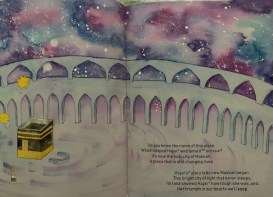
IMG_7027A story about Hajar (saa), about Zamzam, about Hajj, and how we are all connected through our faith in Allah.  In 32 water color adorned pages, the rhyming couplets tell a well-known historical story for children of all ages, with Hajar front and center.

IMG_7021

The book is framed with a young girl, Jamila sitting with her grandmother who has just returned from Hajj.  She is giving Jamila some Zamzam water as she tells her the story of Hajar, and how at the heart of our Hajj we honor and follow in Hajar’s footsteps.

IMG_7022

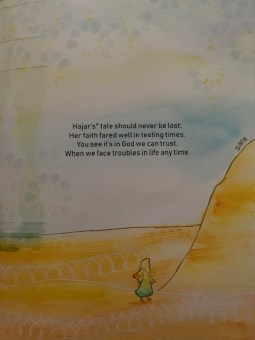
Left in the desert with her son Is’mail (as) she runs between two hills, Safa and Marwa looking for water and help. This step of Hajj, Sa’ee, is required by all pilgrims to perform as Hajar did. Grandma explains to Jamila, that after praying to Allah (swt) and after the seventh run, water appeared and still flows today, Zamzam.

IMG_7023

Jamila learns from her grandma the value of the water, and the power trusting Allah has in our lives.  She also learns how the well attracted people and is now the  city of Makkah.  “You see the sacred Sa’ee has many lessons within: Courage, patience, faith and love.” the grandmother tells Jamila before quoting Rumi and liking the desert water to an ocean of history.

IMG_7024

The book contains a two page Glossary of names and terms at the end as well as information about the author and illustrators.  As expected there is also an ayat regarding Prophet Ibrahim and his family from the Quran at the end, and somewhat surprisingly, Bible verses about Hagar.

IMG_7025

I’m not sure that the link to Rumi’s quote and hence the title of the book is smooth, it seems a bit forced.  Also, I’m not sure why the Bible verse and the Bible entry appearing in the Glossary is present.  It seems like an Islamic story for readers of all faiths to know what Muslim’s believe, so I’m confused why the interfaith angle at the end is there.  Perhaps, if there was an explanation or an Author’s Note or a tie-in to the story, but without any of that, it seems inconsistent and random.

IMG_7026

As far as the illustrations on the 8.5 x 11 thick soft bound pages are concerned, they are rather mediocre.  The anime’ style people, the texture, shimmery bits, and the flowing deserts, make me feel like I should love them, and there is truly nothing wrong with them,  I just wasn’t overly wowed by them.  I actually found the illustrations off for the story at hand.  I’m  certain everyone will disagree with me, and some really are gorgeous, but overall I found them collectively, to be just ok.


Bedtime Sunnahs Emaulating the Prophet one night at a time by Alia G. Dada illustrated by Robin Boyer

Standard
Bedtime Sunnahs Emaulating the Prophet one night at a time by Alia G. Dada illustrated by Robin Boyer

sunnah.jpg

A beautiful rhyming 11 page story for toddlers and up to learn parts of the Prophetic routine for bedtime.  Yes, 11 pages, the book in total is 28 pages, six are Appendixes, one is about the author, one is a dedication, and the rest are blank or title pages.  For a $15 book, I’m a little disappointed, which is unfortunate because the illustrations and information on those 11 pages is great.  The references are informative and important to see what Hadith the Sunnahs come from, but I think the story itself could have, and should have, been longer.

2D4EFF33-886B-46DB-92F6-74C7679D6F61

Each page has a different family getting ready for bed and doing various acts.  I love that moms and dads are involved in bedtime routines. The illustrations show diversity and the text is simple, flowing, rhyming and straight forward.

5EB6E7CC-3194-480E-9A58-EE259FAB9DB5

From brushing teeth to reciting Athkar, making duas to Allah and laying on our right side, each page has wonderful detail in the warm full color pages.  I love the decorations on the bedroom walls, signs with Allah’s name, statements saying “Strong like Zainab, Brave like Fatima, Smart like Khadija”, as well as “Smile! it’s Sunnah!”.

1DB8BDCD-6CEB-4104-B072-6A2D21951D71

The book is for Muslim children obviously, and makes getting ready for bed seem like a fun and bonding event.

The first Appendix is a Parents Notes on what the purpose of the book is and the second one is Islamic Terminology.  From the their Appendixes address the Ahadeeth about sleeping in a state of Wudu and on your right side, bedtime Atkhar, and reciting the three Quls,  I wish it would have including the Quls, seeming as the book is meant to provide information for caregivers to convey to a child, and many households may have non Muslims or new reverts in that role.

10500B30-4BF9-4473-94D5-F9D4EDFAEDD1

The remaining two reference pages are Additional Sunnahs for Advanced Children which include Reciting Ayah al Kursi, the last two verses of Surah al Baqarah, the dua before bed and when waking in the morning.  The dua texts are given, the Ayats are not. There is then a final page about the author.

F8DCC46D-0DFC-4A20-9E63-645B06FAE324

The hardbound glossy cover and thick inside pages are well done in this 8×8 perfect sized book for bedtime, I just wish there was more of it.