Category Archives: Non Fiction

Hawa Abdi by Emna Ennaifer illustrated by Anastasiia Bielik

Standard
Hawa Abdi by Emna Ennaifer illustrated by Anastasiia Bielik

This picture book biography starts with Dr. Hawa Abdi being born in Mogadishu, Somalia and shares with readers pivotal moments that helped define her academic and humanitarian journey as Somalia’s first female gynecologist and the founder of the Doctor Hawa Abdi Foundation.  The large horizontal pages with brightly colored illustrations help draw the readers in to the often advanced vocabulary filled text.  According to the publishers, the book is meant for ages 5-9, but I think seven and up, with some assistance, will better understand some of the diction, accomplishments, and what made her such a globally recognized figure.  I was surprised that Islam, and her being a Muslim is not mentioned at all in the book.  I actually doubted my knowledge of her and when I finished the book, I Googled to verify her religious association.  The book starts with a map and concludes with actual photographs that are referenced, but none of the facts about Hawa Abdi or where the information came from are sourced.  While I appreciate that her story is being brought to children through this book, I feel sourcing should have been included, and as a book that is part of a series meant to highlight “inspiring people from the Arab-Muslim world,” I was disappointed that there was no Islam whatsoever articulated in the text.

The story begins by showing little Hawa as an independent girl walking miles alone to get water from the river.  She loved school and often “stayed after school to look at the terrestrial and celestial globes.”  When her mother was in the hospital, Hawa spent months staying with her and observing the doctors.  When her mother passed away she decided she would become a doctor.  She took care of her four little sisters, and studies hard, eventually earning a scholarship to study medicine in Kiev. Her family supported her and she was off to study, promising to return.  When she returned she set up a clinic that soon become a large hospital.  When war broke out her hospital became a village of hope as she took people in, started schools, and kept the inhabitants safe from intruders.

The book really focuses on Hawa becoming a doctor and a humanitarian, thus making any personal remarks about her generalized and lacking.  For example the jump from taking care of her siblings to getting a scholarship is very abrupt, the book doesn’t mention marriage or having children, her daughters are just suddenly there helping run the hospital.  As a result the timeline is non existent and readers don’t know how old she was when her mom died, how old she was when she went to Kiev, when the war started, etc..  With any biography certain facts undoubtedly must be left out, but even a timeline in the backmatter would have been beneficial. 

Game Changers: Stories of Hijabi Athletes from around the World by Charlene Smith illustrated by Natalya Tariq

Standard
Game Changers: Stories of Hijabi Athletes from around the World by Charlene Smith illustrated by Natalya Tariq

This 80 page compilation of hijabi athletes from around the world focuses on 13 women that the author interviewed first hand.  Featuring athletes, sports and even countries that might be relatively unfamiliar to the targeted middle grade audience, the book will appeal to both boys and girls, Muslims and non Muslims.  Many included were the first to play with hijab, or the first female to play in their country, but each journey and experience is unique.  Each hijabi athelete and their sport is introduced to the reader over four pages with beautiful artwork, and pulled quotes.  A common issue I have with these types of books is wondering how those featured were chosen, and while this book doesn’t articulate it clearly, at least it sets some parameters in the forward and introduction, that for me at least, allowed me to appreciate the book that much more.  The book ends with four pages of “More Hijabi Athletes” that could have been included, as well as information on perseverance, hijab, modest sportswear, a glossary, resources, index, and acknowledgements.  There are real photographs included at he beginning and end of the book of various featured athlete in action. 


I can’t really review this non fiction book in my normal style, so I will simply say that the writing is clear and easy, at times details seemed overly vague, but to keep the continuity of the tone, and the reader engaged, I understand why specifics perhaps were not included.  In the first feature, I wish the infamous photograph would have been shared so the reader could see for themselves what the text was discussing.  Overall, this resource to inspire our Muslim girls is much needed and beautifully done.  I absolutely love the artwork. LOVE IT. The women are beautiful, strong, and the artwork conveys that for each of the 13 athletes.

The athletes featured:

Egyptian beach volleyball player Doaa Elghobashy
UAE hockey player Fatima Al Ali
Basketball player Fitriya Muhamed
Afghani soccer player Hajar Abulfazl
Syrian-American runner Rahaf Khatib
Basketball Player Kiandra Browne
Pakistani weightlifter Kulsoom Abdullah
Parkour Sara Mudallal
Downhill Mountain Bike Racer Sumayyah Green 
Iranian Triathlete Shirin Gerami
Kenyan Archer Shehzana Anwar
Wrestler Latifah McBryde
Skateboarder Nadeen Alhamad


Three Summers: A Memoir of Sisterhood, Summer Crushes, and Growing Up on the Eve of the Bosnian Genocide by Amra Sabic-El-Reyess with Laura L. Sullivan

Standard
Three Summers: A Memoir of Sisterhood, Summer Crushes, and Growing Up on the Eve of the Bosnian Genocide by Amra Sabic-El-Reyess with Laura L. Sullivan

three summers

It is difficult and probably rather inappropriate for me to offer a “review” of a memoir, after all who am I to have opinions on someone’s lived experience.  And this non fiction book in particular is so desperately needed and important, as OWN voice middle grade literature about Bosnia is fairly non existent. So continue reading my thoughts with a grain of salt, suffice it to say, that I enjoyed the book, and loved the author’s YA book The Cat I Never Named, but ultimately I struggle to suggest this for the intended audience of 8-12 year olds.  As a child my family was involved with Bosnian refugees in the 90s, as an adult I understand that Islam, and being Muslim, is not a monolith, as someone who can empathize with loss and heartache, I couldn’t put the book down.  Yet, I truly doubt that many fourth graders will feel the emotional climaxes that are not shown, but told.  That they will understand the timeline and what is about to happen if the book were to continue.  That they will feel a connection to the characters who read so much older than them.  If the book was fiction, I would say the characters read YA, with the bikinis and details of body growth, kissing, making out, having boyfriends, and dancing at the discotheque, cigarette smoking, backless dresses, noting which neighbors are having affairs, and trying to become their “truest self,” but the book is a memoir, this is the author’s life when she was 11, 12, and 13.  In an environment where her maturity is noted as being heightened because of the loss of her brother and her personality, the book shows cultural norms, that will still strike contemporary reader as being much more adult in nature. Islamically, the label of Muslim and Bosniaks, is ever present.  Bosniaks were massacred for being Muslim, period.  The book never shows them praying, or mentions Allah swt or the Quran, covering is something only the older generations did, they do drink alcohol on occasion, but they have a cow slaughtered Islamically and burials are done in accordance with Islamic principles.  There is kissing, having boyfriends is not problematic unless they are Serb, the only imam mentioned does weird black magic type things.  So while the label of “Muslim” may feel to Muslims readers more like a cultural marker at times, it is none-the-less incredibly empowering to see that Amra takes pride in her Bosniak identity and doesn’t shy away from it. Other flags/triggers are domestic abuse, bullying, physical violence, attempted drowning, accidental drowning, death of a sibling, kidnapping, imprisonment, threat of war, racism, Islamophobia, music, fortune tellers, lying, threatening.  The backmatter offers a timeline and thus gives some information about the rape, torture, genocide, abuse, and destruction.

SYNOPSIS:

The book starts with a visiting fortune teller giving Amra and her family hope that her older brother Amar will be pain free soon. Amar suffers from Marfan syndrome, and is frequently weak, teased, and in pain.  But he is also wise and patient, brilliant and gentle, and beloved by so many, and Amra is broken when he passes away.  To help break her from her debilitating grief, her parents reach out to a cousin in Belgrade, who has long been estranged for marrying a Serb, to come visit for the summer.  Zana and her younger sister Vedrana, engulf Amra in warmth and adventure and the summer on the River Una is just what Amra needs.  The next summer Zana and Amra resume their idyllic adventures of swimming, make-up, crushes, and coming of age, with only a hint of fracture based on religious lines creeping in the final days.  The following summer Amra is starting to mature on her own and understand the world around her.  Her father has lost his job, been kidnapped essentially and tortured, and while nights dancing at the discotheque give laughter and light, the girls final summer, is the end of peace, and innocence for all Bosniaks.

WHY I LIKE IT:

I love the end, that there are real life updates of the people in the book.  It made me cry.  It is also so timely to what is occurring in Gaza and how no matter how clear it is that it is genocide, and it is oppression, and it is racism, some just cannot see it.  The book is joyful, but the reality of the backmatter is heavy, and real, and important.

I like that the book shows Bosnia and the culture and the traditions, the few books I’ve read focus on the war, and the rich culture and deep history doesn’t get to shine like it does here.

I do wish the book was more showing than telling.  I know it is a memoir, but at times it was just too advanced commentary and insight.  I fully believe the author is brilliant, and at 11 years old was pondering her life, but most readers just aren’t at that age, and the tangents keep the readers at arms length.  The book says it is about crushes, so I don’t want to keep harping on it, but it really is Amra and Zana and a gaggle of other female cousins quite often worrying about boys, and crushes, and kissing.  It doesn’t get obnoxious, but it isn’t a line here or there, it is the bulk of the book.

FLAGS:

Domestic abuse, bullying, physical violence, attempted drowning, accidental drowning, death of a sibling, kidnapping, imprisonment, threat of war, racism, Islamophobia, music, fortune tellers, lying, threatening, death, loss, grief, affairs, cheating, racism, bare bodies, crude jokes, crushes, kissing, making out, sneaking out, smoking, drinking, developing bodies, bullying, internalized Islamophobia, kidnapping, imprisonment, dancing, black magic imams.  The backmatter offers a timeline and thus gives some information about the rape, torture, genocide, abuse, starvation, and destruction during the Bosnian genocide.

img_4254-1

TOOLS FOR LEADING THE DISCUSSION:

I think with some context about war, about communism, the Ottoman empire even, this book could be used in a teaching setting to allow the time frame to be seen from those living it, but, for more mature middle school to early high school readers.  It is a lot for MG and that it is non fiction makes me want it to be understood and appreciated and I don’t know that for the intended demographic, even with context and guidance it would be achieved. There really isn’t a plot, it is a memoir, and the pacing and assumed context knowledge I feel like, just wouldn’t be there for the typical western middle grade reader.

Lion on the Inside: How One Girl Changed Basketball by Bilqis Abdul-Qaadir with Judith Henderson illustrated by Katherine Ahmed

Standard
Lion on the Inside: How One Girl Changed Basketball by Bilqis Abdul-Qaadir with Judith Henderson illustrated by Katherine Ahmed

This nonfiction picture book memoir is about Bilqis Abdul-Qaadir’s love of basketball, accomplishments, and ultimate decision to choose her hijab over her career.  For elementary readers the 40 page book reads like a story, and shows what it means to work hard, be talented, stay true to yourself, and be willing to fight for what you believe in.  As the Massachusetts State high school basketball scoring record holder and the first NCAA hijab wearing Muslim basketball player, she was forced to leave the fight on the court and instead fight to change the rules regarding headgear for women playing international professional basketball.  She won the fight, but unfortunately it was too late for her, she now advocates for Muslim girls in sports to not have to choose to cover or play.

The book has a flow as it starts from her being born into a basketball family, and shooting hoops at three.  She plays with her brothers with her grandma, Mudgie, always cheering her on.  Her mother’s strength grounds her and at age 12 she puts on her mother’s hijab and heads out to play ball.

At 14 she is wearing her own hijab and playing on the high school team, her hijab is her super power, and reminder to be fierce, faithful, and kind. When the ref halts the game and says she can’t wear her hijab, her team stands with her, until the game resumes.

She gets a full scholarship to the University of Memphis and plays her final season at Indiana State.  She meets President Obama and beats him in a game.  When she decides to play international though, again she gets told she can’t unless she removes her hijab. She chooses her faith, and when she finally gets the ban overturned, it is too late for her, but not for other Muslim girls.

The book concludes with some photographs, additional information, discussion questions, and places to discover more.  I appreciate that it shows her praying, but I wish it gave just a little insight as to why Muslim women cover, why it is part of our faith.

I found my copy at the library, it is available to purchase here.

Eliyas Explains + Bite-Size Journal: Why Does Allah Let Bad Things Happen? by Zanib Mian illustrated by Daniel Hills

Standard
Eliyas Explains + Bite-Size Journal: Why Does Allah Let Bad Things Happen? by Zanib Mian illustrated by Daniel Hills

img_3601-1

The book stems from the genocide occurring in Gaza, but expands to cover the more general concepts of qadr (destiny), tests, and sabr.  The book assumes that what is happening in Palestine is known and does not discuss specific details, allowing the book to be both timely, yet universal.  As with all the books in the series, the conversational humorous approach appeals to children as foundational Islamic concepts are broken down and explained.  The book is 73 pages with the journal portion starting on page 33. In some of the other books, the journal feels more of a hands on to already shared information, or an accompanying workbook of sorts.  In this book however, I feel like the second half continues to explain the topic at hand, and convey key components in understanding why Allah swt, lets “hard” things happen, how we should view the tests, approach difficulties, and inshaAllah triumph. The book has been checked by a Shaykh, and I highly recommend this important book for elementary, middle grade, and even middle school children. The concept of qadr is difficult, I struggle to truly grasp what we can and cannot change, but this book helps readers focus on what we can change and how to view terrible things that happen to us and to others.

The book starts with Eliyas introducing himself and his family, and then wondering why “Israel is being able to do what they’re doing in Gaza.  Why isn’t Allah stopping it?” As with all Eliyas books, mom and dad are sought out, food is somehow worked in, and time and space are given to Eliyas and his siblings to be given an answer. His parents start by being glad that Eliyas’s heart is soft for the Palestinians and that he is bothered by what is happening to them, before explaining that a lot of understanding is trusting and truly believing that Allah swt knows best.

img_3625-1

The book uses hadith, ayats from the Quran, it even shouts out other Zanib Mian books, The Mindful Book of Wellbeing, for seeing the bigger picture and Eliyas Explains Why Should I Pray my Salat on how to make yourself strong to get through the struggles of this duniya.

The book talks about why Allah swt didn’t make everyone good, and it is clear in saying that being mad and sad are ok too, as long as we are not questioning Allah swt. There are prompts and questions (with answers) and the book is not heavy, despite the subject matter, the tone and approach stay on level and allow readers to connect, alhumdulillah.

You can get your copy here at Crescent Moon Store.

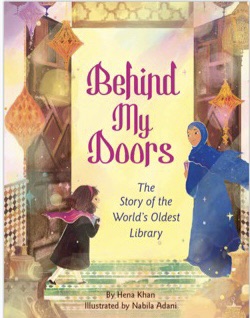
Behind My Doors: The Story of the World’s Oldest Library by Hena Khan illustrated by Nabila Adani

Standard
Behind My Doors: The Story of the World’s Oldest Library by Hena Khan illustrated by Nabila Adani

img_3557-1

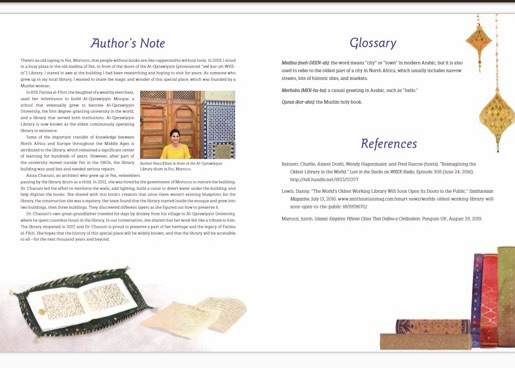
The world’s oldest library proudly stands in Fez, Morocco: started by a Muslim woman, restored by a Muslim woman, and in this 40 page book the library itself tells its own story in a book authored by a Muslim woman.  The personified library shares a few highlights from its early start as a corner in Fatima Al-Fihri’s masjid and university to collections spanning multiple buildings, from a bustling center of learning and knowledge to a place of disrepair and neglect.  Staying on an early elementary level, the informative author’s note and references make the book engaging for older readers as well, and an incredible addition to bookshelves everywhere.

img_3558-1

The book starts with the library introducing itself and welcoming the reader. “Merhaba! I am Al-Qarawiyyin Library–the oldest library in the world.” At over a thousand years old, the library begins at the hands of Fatima Al-Fihri in 859 who dared to dream big and created a space of learning and worship in Morocco.

img_3559-1

As the courtyards and collections grew, seekers of knowledge, from all backgrounds, gathered to discuss, debate, and learn.  Special rooms with special locks kept books safe: a Quran written on camel-leather, a philosophers drawings in gold ink.

img_3561-1

Nearly destroyed once by a fire, the library endured, but over time the rooms were no longer filled with the bustle of people.  One day a small girl, Aziza, paused at the door, but did not enter for many years.  When she did return, she came as an architect with a team to restore the library and invite people back in to read, learn, and dream.

img_3565-1

It delights me that such an important story is available to be widely learned from and appreciated.  You can preorder a copy here from Amazon.

img_3566-1

Baby Touch: Happy Eid! by Lemon Ribbon Studio

Standard
Baby Touch: Happy Eid! by Lemon Ribbon Studio

img_3516-1

This 12 word, 10 page, touch and feel board book is nothing special, yet for some reason it does make me smile.  It could be better, and absolutely, “star” has nothing to do with Eid, but that it is in our public library, that it is full of joy for our littlest humans, and that it has mosque and prayer rug, and charity, and community, and family, and feast, is really quite sweet. It would work for either Eid and the bright uniform pictures are clear and simple to engage babies and toddlers alike.

img_3517-1

Each page spread has a singular image and a word below it.  The pictures on the right have some sort of touch and feel element, from a bumpy minaret, to raised smooth coins in the charity jar.  I wish the rice on the feast plate would have been raised and that a plush prayer rug would have been offered, but until publishers seek out beta readers, this is probably as good as it is going to get.

img_3518-1

Some of the words might be too advanced, but I think the singularity allows for discussion if the child wants, if not, it is still nice to see elements of Eid illustrated for a baby to connect to in a joyous presentation.  The 7x 7 book is not overly padded, but the corners are rounded and easy for little hands to carry.

I found mine at my library, but it is also available here on Amazon.

Letters from a Prophet by Zimarina Sarwar illustrated by Giorgio Bacchin

Standard
Letters from a Prophet by Zimarina Sarwar illustrated by Giorgio Bacchin

I’m not a fan, as a general rule, of lift the flap books for toddlers (they just tear them), so imagine my delight when I was completely captivated with a lift the flap book for middle grade and up! And the flaps are not trivial, they reveal letters from Prophet Muhammad (saw), maps, interesting facts, and make an already impressive, beautiful non fiction picture book, feel interactive and somehow even more enticing.  The book gives context and information for four letters sent by RasulAllah to Emperor Heraclius, Al-Muqawqis, King Chosroes, and Al-Nijashi.  Each section has the story of the letter and then a two page spread that details lessons we can learn.  The book itself starts with an introduction, a section about the seal and where the ideas to send the letters came from.  It concludes with final thoughts and a bibliography.  I do wish the book was perhaps checked by a scholar, but at least it has sources at the end.  Truly, I learned so much from reading this book and discussing it with my kids, I’m even thinking I might need to gift my mom a copy for Eid. It works for adults and kids alike, a few pages at a time at bedtime, in a classroom setting, as a resource.  I hope books like this become the norm for teaching Islamic history to our children, it really has raised the bar, alhumdulillah.

The book starts with the cover, the large 55 page hardback book with raised images, really sets the tone that this is going to be an experience.  The introduction starts with the basics explaining the value of lettering writing in history, it then establishes where the idea came from to reach out to Byzantium, Egypt, Persia, and Abyssinia.

It gives a brief timeline of the life of Prophet Muhammad saw, tells about the value of seals and what the Prophet’s seal looked like before starting the letters.  Then the four sections begin, the first being to Heraclius the Emperor of Byzantium, then Al-Muqawaqis also known as the Ruler of Egypt: Jurayj ibn Mina-Kiolos, Leader of the Copts, then King Chrosroes also known as the Shah of Persia Khosrow al-Parvaiz II, and then finally Al-Najashi also known as King Negus of Abyssinia As’hama Ibn Abjar.

The Final Thoughts discuss the impact even though most did not convert and offer the reader different aspects to consider while looking at the bigger picture.

The book won the Muslim Book Awards 2023 Non Fiction category and is available for purchase here at Crescent Moon Store.

Not Yet: The Story of an Unstoppable Skater by Zahra Lari and Hadley Davis illustrated by Sara Alfageeh

Standard
Not Yet: The Story of an Unstoppable Skater by Zahra Lari and Hadley Davis illustrated by Sara Alfageeh

img_2890-1

Despite my initial hesitancy, the book really won me over.  The inspiration behind the story is impressive, but even if it was complete fiction, it would still be a cute book.  Over 40 pages, the illustrations and simple text introduce you to Zahra, a young girl in the UAE with big dreams and a lot of determination.  And that is before she even sets foot on the ice.  Four to eight year old kids will enjoy the humor, with the older readers appreciating what she was able to overcome and accomplish.  Adults will appreciate the authors’ and illustrator’s notes at the end and seeing their kids being inspired to pursue their dreams.

The book begins with Zahra watching a movie at a theater and being inspired by the skaters on the screen.  She slides across the floor in her socks that night when she gets home, and declares she is going to be a figure skater.  Her brother points out that she doesn’t know how to skate. When she asks her friend to make her a costume, it is revealed that she isn’t even taking lessons. It seems everyone wants to point out the flaws in Zahra’s plans.  To which she responds, “not yet.”

Luckily her dad supports her, and takes her to the only ice skating rink in the country, where she promptly falls over again and again.  But there is something to be said for not giving up, and the true story of Zahra Lari shows that sometimes you have to be the one to break the barriers and remove the “not yets” on the path to achieving your dreams.

I found this book at my public library, but it can also be purchased here.

The Muslim Girl’s Pocket Guide to Growing Up by Yasmin El-Husari illustrated by Noon Eltoum

Standard
The Muslim Girl’s Pocket Guide to Growing Up by Yasmin El-Husari illustrated by Noon Eltoum

I still get asked fairly frequently about maturation books for Muslim kids. Boys are another story, but for girls, I’ve always had to settle on a non Muslim book that gives an introduction and some conversation starters, bur rely on the adult to provide the Islamic perspective.  Alhumdulillah, those days are over, I can now recommend this 47 page book as a great resource to hand to a young Muslim girl to read independently and/or together with a trusted adult.  The conversational text, the Islamic centering, the complimentary subtle illustrations, allow the book to be informative, but not intimidating.  For girls on the cusp of puberty it shows them what to expect and it normalizes what they are going to experience in terms of body changes and hygiene, all within an Islamic framework.  I do wish that it noted if scholars approved the text.  The author is a teacher and the illustrator an MD, but a statement at the beginning asserting the accuracy would give additional credibility to the contents.  In full disclosure, the author was my daughter’s teacher, but none of my kids are currently in her class, and I purchased the book on my own.  Truly the book is so desperately needed, the fact that it is well done is something I am happy to share, and inshaAllah, inshaAllah a book for boys will be forthcoming.

The book starts with an introduction from the author and then a table of contents.  Growing Up, Seeing Spots, A Hairy Situation, Body Safety, A Sweaty Dilemma, Tahaarah!, Periods: The Big Change, Periods in Islam, Discharge, Feminine Protection, Bra Measuring Guide, and Glossary.  There is not a lot of talk about moods, emotions, friendships (relationships), it really is streamlined to cover the body’s changes and practical tips through an Islamic lens.

The tone is very reassuring that what a girl is experiencing or about to experience is normal, something all women go through, nothing to be embarrassed about, and nothing to feel isolated by.  Even the glossary reinforces this this tone by explaining the medical terms and Islamic terminology used.  If a girl reads it alone, she will get that messaging, and hopefully feel empowered to embrace her changes and reach out if needed.  If one is reading it with an adult, the book lends itself easily to discussions that can be more specifically tailored to the young girl, or even a group of girls.

It talks about hijab and provides a chart about who can see you with and without, I’m a bit confused by young children being in both categories, I’m not sure if I am missing something or if it is a mistake.** I also feel like the chapter headings and the section subheadings are not clear as the font, color, and text size are often the same.  The book is small and short, it can be read in one sitting or thumbed through, so the chapters are not particularly necessary, but if it has a table of contents and headings, I feel they should be different in appearance for consistency and ease.

The book is currently available here on Amazon.

**UPDATE FROM AUTHOR:

*Correction Post
Assalamu Alaikum readers both past and present. Jazakum Allahu Khairan for your support and engagement with The Muslim Girl’s Pocket Guide. We had a reader reach out to us pointing out a typo in the text last week. Alhamdulillah that mistake is now corrected. Any book ordered after March 14th should be the correct version of the text. If you bought a copy with the printed mistake it can be returned to Amazon and repurchased inshallah. Again, I appreciate all of your support and Jazakum Allahu Khair 🦋