Category Archives: Muslim Character

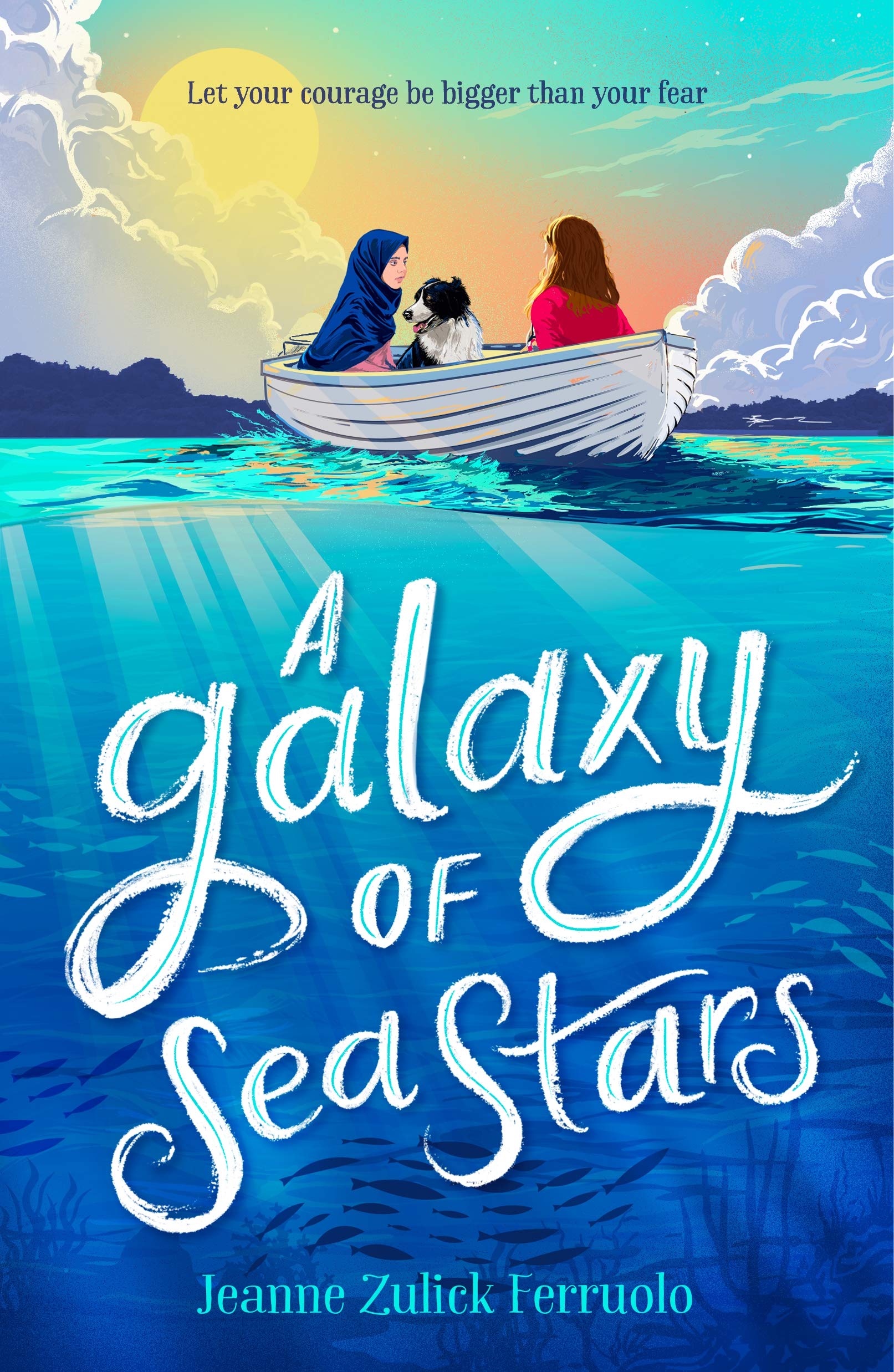
A Galaxy of Sea Stars by Jeanne Zulick Ferruolo

Standard
A Galaxy of Sea Stars by Jeanne Zulick Ferruolo

This middle grade, 330 page book is an easy read that touches on concepts of change within friendships and families with the back drop of life in a coastal town, finding courage, and Islamaphobia. While early middle school readers might find the book a bit predictable and cliche’, the characters, lessons, and fluid storytelling would still make the book worth their time.

SYNOPSIS:

Eleven year old Izzy spends her summer days in Rhode Island on her skiff mapping out the floor of the pond that runs next to the ocean. Fearful of the open ocean, she is, however, confident and independent in her abilities to navigate the calmer water and understand what is beneath the surface. Her father has recently returned from Afghanistan and with his post traumatic stress disorder making him angry and not the same as before. Izzy is further thrown into turmoil when the family moves out of their house and into the marina, her mother extends her already summer long absence to Block Island and middle school at a new regional school is about to start. As always she hopes to lean on her fellow sea stars, Zelda and Piper, best friends since kindergarten, however, things with them don’t quite seem the same either. Add in that her father’s translator from Afghanistan and his family have just moved in upstairs with their two young boys and 11 year old daughter Sitara, and Izzy has a lot to handle and navigate.

Piper and Zelda decide to take television production class first period to make sure they have at least one class together, Izzy is incredibly shy and while she appreciates that this has all been arranged she isn’t confident that it is a good fit for her. Dragged along, as it seems she often is by her much more confident friends, It is arranged that Sitara will also be in the class. Right away Piper and Zelda decide that they don’t like Sitara and her hijab and her “different-ness” and exclude her and by extension Izzy from their lives. As Sitara and Izzy get closer and start to learn from one another, Piper and Zelda lash out and go from ignoring to being mean to Izzy and Sitara. Sitara explains to people on the announcement show why she covers and helps Izzy to understand that her father was in danger after helping the Americans and that they had to leave Afghanistan. The anniversary of 9/11 however, turns many students into verbally berating Sitara and her having her hijab pulled off in the lunchroom. When Izzy figures out that her former sea stars were involved in the planning she is devastated and must take the lessons from Sitara and her Czech Grandma to have more courage than fear, find her voice, and do something to make things right.

WHY I LIKE IT:

I love that Izzy has a lot going on in her life and in many ways Sitara has been through a lot, allowing them to encourage each other to keep moving forward. There are some parallels in losing their homes and dealing with change that they comfort each other with, but the two characters combined show readers that strength and bravery occurs when you are afraid, and that most people aren’t truly fearless. I really feel for Izzy, her friends may have been there for her on occasion, but by and large they seem kind of dismissive of her and her fears. I think she sees them as equal, but I don’t get the feeling that they see her that way, they may be protective of her, but they kind of bully her in to doing what they want. Every few chapters is a flashback to a pivotal point in the sea stars friendship and even before Sitara enters the dynamic, I started to question Piper and Zeldas sincerity. Their best friend just moved, her dad came back from serving in Afghanistan, and her mom is not coming home, they should be concerned, not belittling her for liking art and wearing old clothes. The mom is another painful plot point, like lady I get that you have stuff going on in your life, but really you are just going to leave your child? Ya, I wasn’t a fan of hers.

I like that the story addresses Islam and Islamaphobia, and while it is very much in the story, it isn’t really about it. Izzy is front and center, and even she takes a while to warm up to Sitara. I love that it shows what Afghanis that helped fight against the Taliban went through and how painful it is for them to resume life after doing so. I think this point is so lost in mainstream understanding whenever there is a terrorist attack, that this is what the refugees are leaving, that people in Afghanistan and Iraq and Syria are running from, and when they get called terrorist it hurts that much more, because their whole lives and people they care for have suffered from the real terrorists.

I really wish there was a map, I wanted to visualize better the breachway and had I not lived in Rhode Island for a few years I probably wouldn’t have understood Block Island’s location to to the mainland. Like with so many middle grade novels I wish there was some more depth to the characters, but I truly appreciated that there wasn’t a completely happy ending, and that growth occurred in so many characters, but at different rates. It really made it clear that we all need to continuously work to get to know one another, find our voice, our courage, and be willing to change.

FLAGS:

Clean.

TOOLS FOR LEADING THE DISCUSSION:

I don’t do an elementary book club, but I think this would be a great recommendation for those that do. There is a lot to discuss and explore that kids can relate to. The majority of the characters are female, but I think the themes are universal enough that boys will enjoy the book as well. I’m confident all readers will learn something new about sea stars and possibly even television production in this sweet story.

The Cat Man of Aleppo by Irene Latham and Karim Shamsi-Basha illustrated by Yujo Shimzu

Standard
The Cat Man of Aleppo by Irene Latham and Karim Shamsi-Basha illustrated by Yujo Shimzu

cat man

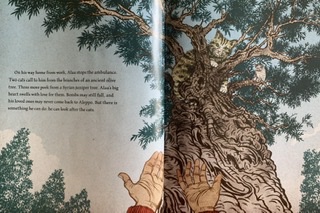
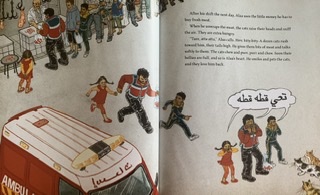
This 40 page true story about Mohammad Alaa Aljaleel of Aleppo aka the Cat Man shows how one person can make a difference even in the middle of a war.  The amount of text on the page, the topic covered, and the detailed illustrations will most appeal to second graders and up, but younger kids, particularly those that love animals, will enjoy the story as well.

D63A0C5F-727E-427A-AF82-31AAB49F8F51

Alaa loves his city: the markets, the foods, the people.  When war comes, he doesn’t flee, he keeps working as an ambulance driver.  He has a big heart.  His sees destroyed neighborhoods where everyone has left, except for the cats.  There is no one to feed them and give them water, and Alaa feels for them.

E286EEDD-0114-4A0C-A712-DC8F162F4AC6

After his shift he buys meat, and feeds over a dozen cats.  He does this everyday and soon a dozen turns in to fifty and he realizes that he can no longer care for the cats alone.  He needs a place for them.

43F2DBA2-9364-4107-93F2-983172AE9191

Word spreads and volunteers and donations start pouring in.  He purchases a building with a shaded courtyard and soon cats are everywhere.  When people leave Aleppo they bring their beloved cats to him, and even other animals start arriving.  Alaa even builds a playground for the children and digs a well so everyone can have fresh water.

ABA9B59B-43F3-4EEF-83AE-8CC8461D8CAA

The book is pretty straightforward and steady, it doesn’t have much emotion for such a powerful true story, but it will still hit the mark in inspiring children to show kindness and compassion for animals and others.

6B5F68B3-1DA4-4117-A66A-7210DACC468F

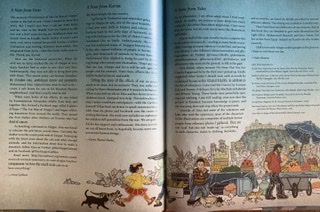
There are notes from each other and the illustrator at the end that share light on their connection to the story and the situation in Syria.  There is nothing religious in the book other than a few females in hijab.

Littering Stinks by Summayyah Hussein illustrated by Eman Salem

Standard
Littering Stinks by Summayyah Hussein illustrated by Eman Salem

img_6510

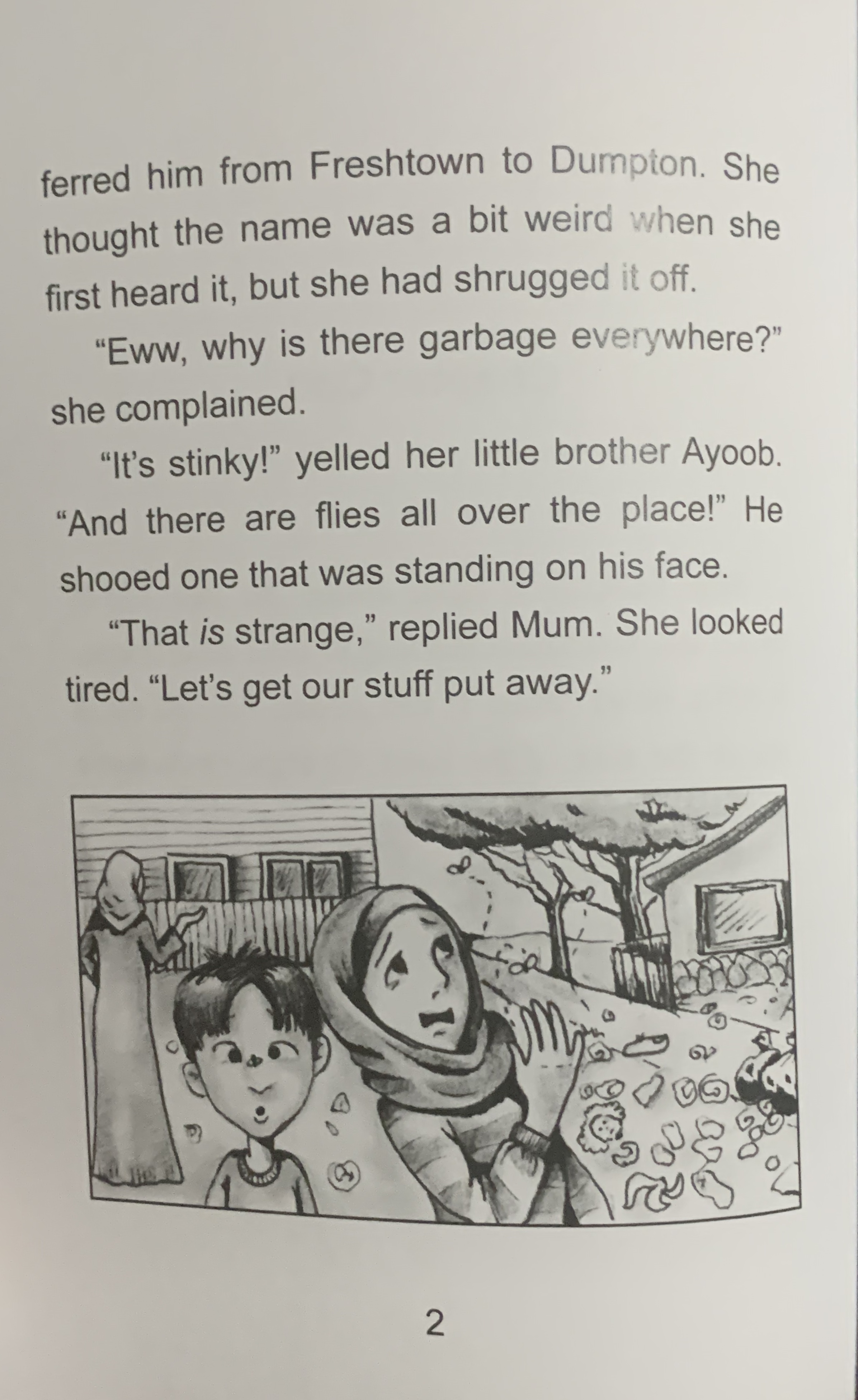
This 36 page early chapter book is a good introduction to the concept that one person can make a difference.  The seven chapters flow easily, and while the names of the cities, Freshtown and Dumpton are a little on the nose and the premise a bit of a stretch, fluent 1st and second grader readers will enjoy the story and delightful pencil illustrations of a kid changing things for the better and making a difference.  One blatant hole for me was the lack of outright Islamic preaching.  For a book that is not available in mainstream outlets here the US and only through Islamic book stores, I expected more than just a Muslim family with hijabi characters and Islamic names.  I wanted cleaning up the environment and doing good deeds to have hadith and ayats quoted and referenced throughout, but alas there are none.  So, I suppose the book isn’t “Islamic Fiction.” but, in my opinion it really could and should be.

img_6514

SYNOPSIS:

Aliyah and her family have just moved to a new city, Dumpton.  Transferred by her father’s work, the family is shocked by the trash, smell, garbage and flies everywhere.  The kind neighbor lady brings them a pie and welcomes them to the neighborhood, but is later seen throwing a candy wrapper out the window.  Aliyah is shocked that such a nice lady is also a litterbug.  Aliyah calls a family meeting to come up with a plan to clean up Dumpton.

Each day Aliyah tries something new: cleaning up the street she lives on by herself, letting people know about littering, putting up signs, and finally on day four forming a clean up crew.  But nothing works.  Aliyah gets discouraged, but her parents encourage her to do the right thing no matter what.

The night before the first day of school Aliyah has an idea, she grabs a bunch of solid color t-shirts and a permanent marker and makes herself some shirts to encourage people to take care of their trash.  Every day she wears a different one with a different saying and by the end of the week people are starting to ask her about them.

The following Monday, her brother joins her and wears a matching shirt to start the cycle again, but when she gets to school the two of them aren’t the only ones wearing yellow t-shirts that say “Littering Stinks.” Everyone is!

The principal calls her into the office to discuss the potential of children to change the pollution in their city and slowly but surely they get the city cleaned up.

img_6513

WHY I LIKE IT:

I love that it encourages everyone, no matter how small, to make a differences and do what they can to make things better.  I love that it doesn’t just happen and that she gets frustrated and has to power through and stay true to herself. The main character wears hijab, but there is no mention of religion or faith which would have added some depth to her as a character finding motivation from belief in a higher cause and a responsibility to the care of the Earth.  Even some concern with starting at a new school as a hijabi would have possibly added some relatable connection to her personal strength and why she is willing to trust herself with the littering task at hand.

The premise that no one born and raised in the town seems to have a problem with the littering and pollution or that people from the outside haven’t been completely disgusted by it, but rather joined in over time, is a bit far fetched.  Sure you could make the argument that in other countries this is how it is, but it seems like a bit of a leap given the setting of the book and the target audience.

img_6512

FLAGS:

Clean, haha pun intended?

img_6515

TOOLS FOR LEADING THE DISCUSSION:

This book is an early chapter book, not to be confused as being a book for early readers.  The sentences and diction and vocabulary are for fluid readers that are just moving into short chapters and need a few illustrations, spaced lines and a bit larger font.  There are questions at the end which would make the book a great small group reading to discuss, but definitely for early elementary.  Would be a great inclusion in a unit on leadership, project planning, or Earth Day.

A Thousand Questions by Saadia Faruqi

Standard
A Thousand Questions by Saadia Faruqi

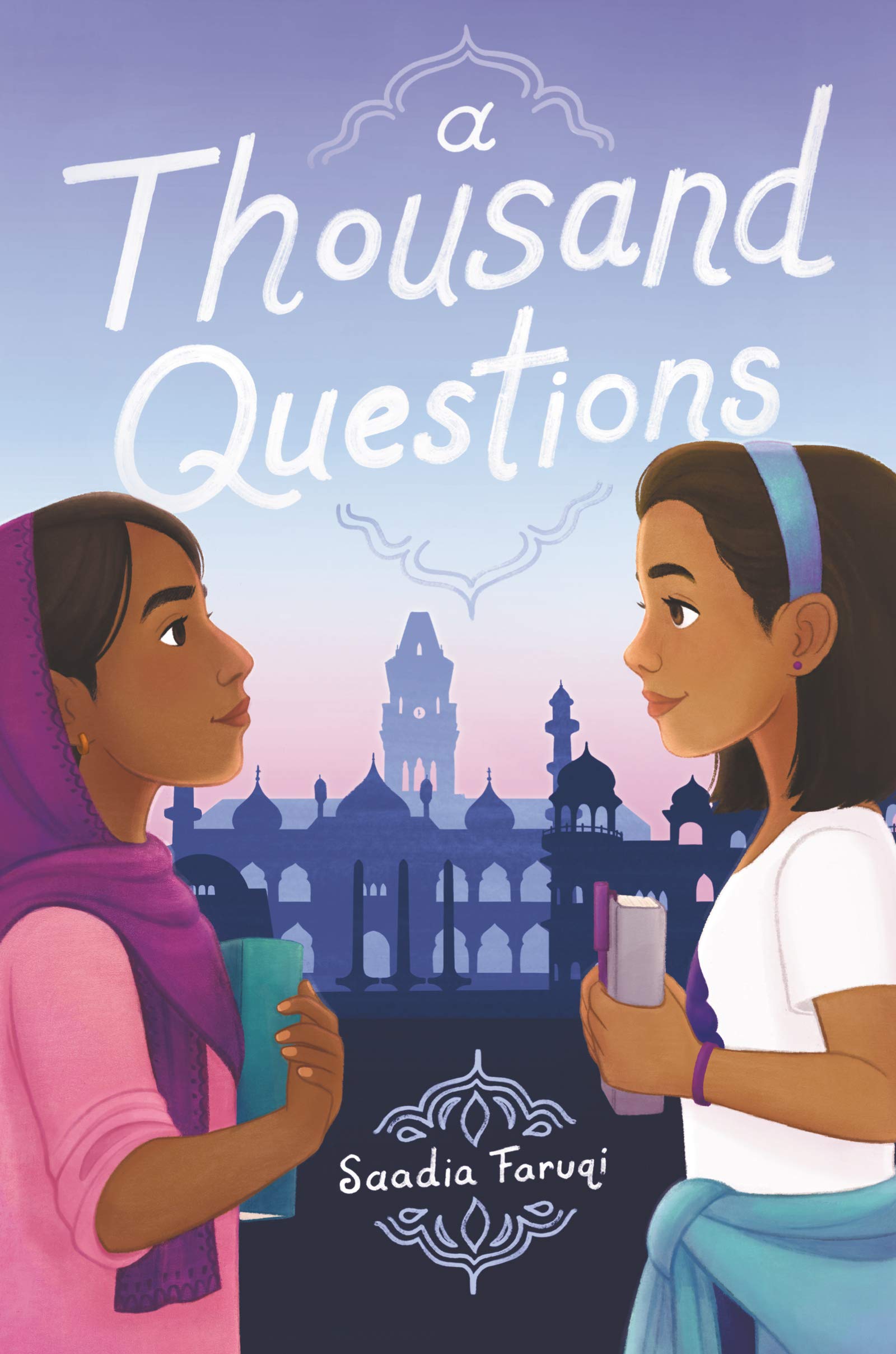
This 320 page middle grade novel with alternating point of view chapters engulfs you like a warm genuine hug. It does not have a clear climax, it is predictable, and some characters and cultural touch points could have used more detail, but honestly, I couldn’t put it down. As a half American kid who spent my summers in Karachi, so much of the author’s love of her homeland flows so effortlessly from the pages and took me back to my childhood and how the transformation of comparing the two countries moves to seeing the best in both causes growth within your heart and makes leaving so devastatingly hard. Readers of all backgrounds will seamlessly fall in to the story and enjoy the growth of the main characters, while learning a bit about a culture and the similarities of people.

SYNOPSIS:

The back drop is the sweltering heat of a Karachi summer in the middle of elections. Mimi, Maryam, is visiting Pakistan for the first time in her life. It is her mother’s home land, but her grandparents, and her mom aren’t close. They didn’t approve of Mimi’s dad and mom getting married, and even though they have been divorced for years and he has left, Mimi’s mom hasn’t been home in 12 years.

Sakina narrates the other chapters. She is the daughter of Mimi’s grandparent’s cook. She dreams of going to school, but needs help with her English to pass the admissions test. And even if she passes her family needs her income to survive, and her father’s failing health means that she has to take over his job too.

When Mimi arrives at her grandparents home, it is awkward at best. She doesn’t really know her grandparents, she has never had servants before, and her mother is rarely around. That leaves her to get to know Sakina. Sakina finds this odd as the owners of the home rarely “chat” with her and here this American girl wants to get to know her and is fine with helping in the kitchen. The two strike a tentative friendship as Mimi agrees to help Sakina with her english, and Sakina with the permission of Mimi’s grandmother and with the use of the driver, agrees to show her some of the city.

As Mimi takes in the traditional tourists sites she gives Sakina her first taste of ice cream and soda and other “luxuries” she has never experienced. Sakina introduces her to bun kabobs and other local foods. The budding friendship isn’t smooth, mostly because Mimi constantly compares Pakistan to America and Sakina doesn’t understand why Mimi doesn’t have a father. When the girls find out that Mimi’s dad, a journalist, is in Karachi covering the elections, the girls work together to try and find him.

Throughout all of this, Mimi keeps a journal and the entries are letters to her father.

WHY I LIKE IT:

I love that the girls have to navigate their friendship without and often despite interference from adults. I also like that while societal wise one girl is seen as economically privileged and one is not, the book gives enough for even elementary aged children to see that in America Mimi and her mom are financial struggling, but in Pakistan they are not and how that disparity is arbitrary. They also see that family and safety and security are also a part of life’s quality and not country specific. Things that one girl takes for granted are envied by the other, and it goes both ways.

Even for a middle grades book, there were some plot holes. If Mimi had been late night googling and plotting on a secret map all the places her dad had been writing articles from, she should have had a heads up about Pakistan. She knows so little about Islam and has like one shelwar kamees, so it seems a bit of a stretch that she speaks urdu pretty proficiently. I feel like some stumbling with the language or some back story on that would have been great.

Religion is handled as a cultural touch point, neither girl prays, but both find solace in visiting a masjid. Various characters are in sleeveless tops, the athan is heard in the back ground. I wish there would have been a bit more finding of Islam as Mimi found her culture too, but alas it isn’t there.

The majority of the book takes place within the grandparent’s home with the elections being a big part of why they can’t go out, yet the mom goes out a lot, which really rubbed me the wrong way. She took her daughter shopping once to meet an old friend and that is it. Who travels across the world to spend zero time with her kid. I didn’t like the mom at all, and wish there was some background or even some growth on her part. A lot of the minor characters seemed to fizzle as well in terms of having some depth.

There are some cultural and country facts at the end of the book, but within the text I was surprised that more wasn’t shared. I like that it mentioned Karachi was the original capital, but it should have also in the same sentence mentioned that Islamabad is the current, I think readers would assume that Karachi is still the capital of Pakistan.

The book is an OWN voice through and through and the value of that is felt in every sentence. It isn’t all positive and rosy, but it is genuine. The author loves what she is writing about and it shines through leaving the reader with a favorable sense of Pakistan: the country, the culture and the people.

FLAGS:

The book is clean, possibly some tense moments when Sakina’s family is robbed. There is also discussion of marrying someone your parents don’t approve of, divorce, and Mimi’s mom possibly having a boyfriend. Mimi’s mom is an artist and paints pictures of people. There is lying and scheming.

TOOLS FOR LEADING THE DISCUSSION:

I think the book would be a fine choice for an elementary book club, I think any one older will find the book a tad bit predictable. I plan to have my children read it so we can discuss points of view, experiences, universal traits and social economic classes. There are a lot of wonderful lessons wrapped up in a heartfelt story that I can see 4th and 5th grade children benefiting from over and over again.

Not the Girls You’re Looking For by Aminah Mae Safi

Standard
Not the Girls You’re Looking For by Aminah Mae Safi

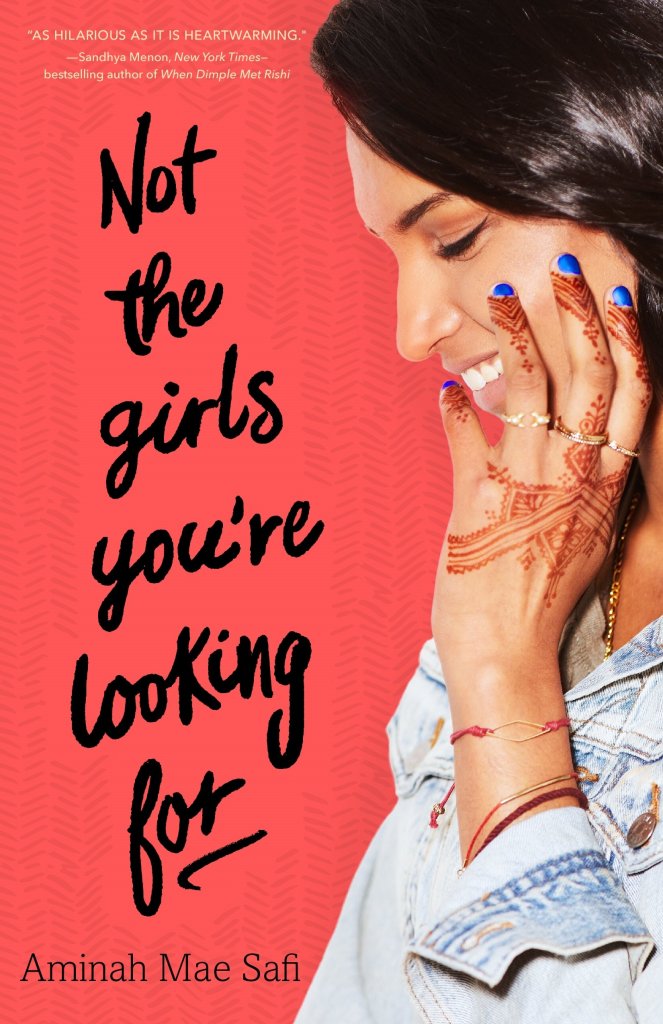
This book did not work for me. Despite the fact that the main character is Muslim and it is Ramadan, no matter how much I wanted to connect with this multicultural lead and her friends, and see myself in her as she navigates high school, I just could not. The writing was choppy 3rd person which distanced the main character for me, the crude language on every page, the drugs and alcohol in every scene, the detailed sexual encounters throughout, the lacking growth of the characters and the muddled point of the book in general made the book difficult to read. The book is an AR 4.9 but content wise is more suited for mature 18 year olds. Even this review might be a little too much, I’ll do my best to keep it clean. Ultimately this book missed the mark for me in showing females defining themselves, celebrating friendships and diversity, or even just creating characters to cheer for as they navigate life.

SYNOPSIS:

Leila is half Iraqi Muslim from her dad’s side and half American Catholic from her mother. She doesn’t know how to pray as her father isn’t religious, but celebrates Ramadan and Christmas and defines the world on her own terms. She is fearless and owns herself, hence she hates her name and goes by Lulu instead. The book opens with her making out with a boy in a closet which she kind of regrets and then goes to join up with her friends at the party to drink and get high and attack one another for their poor choices resulting in drama. In this instance Lulu’s anger pushes a boy in the pool, and then the four friends devise a way to get home and work out the lies they will need to tell to the parents involved. This scenario with only slight variations repeats five or six times in the book.

Lulu is the fearless one, Lo, short for Delores, is the leader, Audrey is an alcoholic math whiz and Emma, not to be underestimated and often is forgotten (literally) is coming out in her first lesbian relationship. Yes these labels are limiting and stereotypical, especially in a book calling for girl power or what not, but sadly that is really the only space they flesh out, not a whole lot more is known about them. The girls defend each other fiercely to outsiders, but are truly awful and angry to one another all the time. They break apart and Lulu doesn’t really know why, so the path back to one another isn’t really cathartic. They pull a prank to get back at a boy that crossed the line with Lulu, but it fizzles when the threat of what the prank could do is enough to keep him away and they don’t have to complete it completely.

Between the parties there are some sub plots that weave in and out. Lulu has to spend time with Iraqi family friends who don’t accept her and are critical, in Arabic, of her mother. This gives some cultural layer to the story, but the characters are pretty flat and petty and hypocritical. The bombings in Paris a few years earlier, and the resulting bullying by classmates hardened Lulu, but there isn’t much info on how awful they treated her or how it defined her, so not much sympathy is garnered by the event nor does it help the reader get inside Lulu’s head. There is also a sweeter love story brewing than the one night stands that define Lulu, but then she goes with her mother to get birth control so she can sleep with him all while making it clear that he isn’t her boyfriend, she just wants to have sex with him- which she does on her seventeenth birthday.

Eventually the girls are back together and gushing with tales of sorrow and personal growth and vows that they will always be like sisters.

WHY I LIKE IT:

I don’t mind the premise so much as the execution of it. I get that people practice Islam differently, but I really don’t get the need to even bring her religion in to such a story. Culture maybe, but even that is a stretch. I don’t know if the story would be better if it was first person, I would like to think so, as not connecting with the main character was such an obstacle for me. I wanted to see her grow and change or at least have clarity in her decisions even if I didn’t agree with them or couldn’t relate to them. I wanted to feel her remorse or the weight of her decisions, but was often just told in passing that something scared her or was hard for her, not shown it. The theme of not belonging anywhere is a legit one, but I don’t know that this book explored it, it just sort of brushed by it almost as a trial to see if the emotions would stick. Which for a character built up to be unapologetic and unafraid to suddenly want a victim label without any real emotional ties, didn’t work for me. There are such holes in the story, that at times things didn’t seem believable or details were so specific with no context that I didn’t get their purpose. I would have loved to know more about her brothers and the tests they went through, or why her family was so loyal to the Arabs around them. I desperately wanted something that showed a different side of Lulu not just the anger and “F everyone who wants to change me” mantra. People are scared of her and she enjoys that power, but I don’t get why they are scared and why she enjoys it. It seems like a big part of her story and of the book in general to miss. Yes she is independent, and I get that can be misread, but she almost seems one dimensional and flat which defies the concept of defining yourself on your own terms and carving out where you want to belong among groups that see you as other, right?
The character is pretty open that she knows little about Islam, she also claims she isn’t interested. She fasts not so much because it is a commandment but more to appreciate poor people. She says this, but actions don’t seem to back it up. She tries not to drink during Ramadan but she still smokes, gets high, makes out, and lies once the sun goes down. At one point she calls a bride and her mother whores, and refuses to apologize, so her dad gets a fatwa issued. Lulu’s mom mentions that something went all Shiite on the situation, so I’m not sure if the fatwa issuing for such a specific thing is a shiite thing or something I’m just not aware of or familiar with as a tool for handling family dramas.

FLAGS:

The whole book really. Sex, drugs, alcohol, sexual assault, lying, cheating, blackout drunk, vaping, talk of orgasms and going down, lesbian relationship, hetero relationships, sexual encounters, language etc etc etc.

TOOLS FOR LEADING THE DISCUSSION:

Would never cross my mind to share or suggest this book. Even religion representation issues aside, I don’t know that there is really a single “healthy” relationship highlighted among the main characters, some of the side characters maybe, but not enough information is given to really make that case. The characters just all seem so angry, not saying teenage years aren’t angry and messy, but this one doesn’t seem to add much perspective to that singular thought unfortunately.

Solar Story: How One Community Lives Alongside the World’s Biggest Solar Plant by Allan Drummond

Standard
Solar Story: How One Community Lives Alongside the World’s Biggest Solar Plant by Allan Drummond

Set in Morrocco, the fictionalized framing of a children’s story about solar energy and sustainability at the the world’s largest solar plant in Ghassate will appeal to curious children in kindergarten and up. Told through the every day life of Jasmine, a little girl living near the plant, the concepts are not technical, but give a broad overview allowing readers to understand how impressive solar energy is, as well as the disparity that exists in the world. Over 40 pages with factual sidebars and an author’s note at the end, children who enjoy the story and are curious about the reality of it all will find an easy opportunity to learn more.

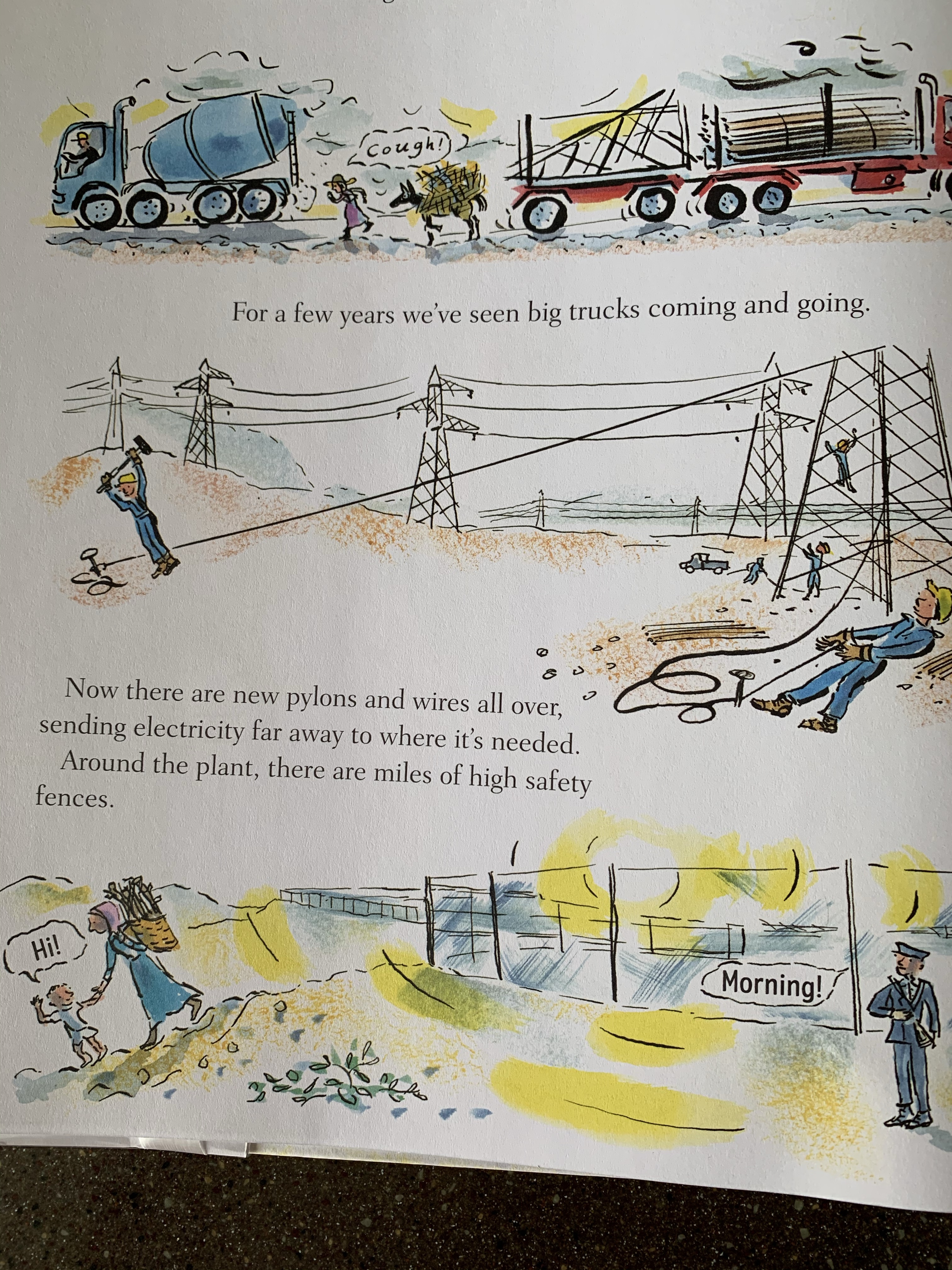
Jasmine and her friend Nadia live in Morocco between the High Atlas mountains and the huge Sahara desert. It is always sunny where they live.

They talk a lot about making energy from sunshine as they watch trucks going and coming from the world’s largest solar plant. Their teacher likes to ask them about the big changes happening in their world.

As the villagers tend to their sheep and cows, they cook on open fires and bake bread in clay ovens all while keeping an eye on the workers making the largest solar tower in the world. Jasmine’s dad rides a mule to work and many classmates parents work at the state of the art plant. The contrast is obvious.

The next day at school Miss Abdellam the teacher asks the students about sustainability. And the book doesn’t define the concept right away. First the class goes on a field trip to the solar plant.

At the plant the size of 3,500 soccer fields they see the 660,000 mirrors that follow the sun like sunflowers and bounce the rays to the 800 ft tower. The tower gets to a thousand degrees on top and heats water whose steam powers turbines and is turned into electricity.

The kids go home to work on their sustainability homework. With no internet or computers even, they have to think for themselves. The remaining pages define and provide examples of how solar power is changing life for the villagers and improving life for people not just in Morrocco or Northern Africa but potentially the entire world.

I love that the concept of sustainability isn’t just a definition it shows how it is in every day things, and those every day things lead to big things that are both tangible and ideological. The author/illustrator acknowledges his own surprise and bias when he learned that the largest solar power plant was in Nothern Africa. I love that some of the females wear hijab, and some do not, and that the teacher and some of the parents at the solar plant are female. There is nothing religious even mentioned in the book, but the visibly Muslim characters are empowering and honest for a story about science and Morocco.

My Friend the Alien by Zanib Mian illustrated by Sernur Isik

Standard
My Friend the Alien by Zanib Mian illustrated by Sernur Isik

This adorable 96 page book is a great early reader for second graders and up. The play on the concept of being an “alien” is filled with a lot of heart, humor, and thought provoking concepts on what it means to be human, have feelings, and be a good friend. There is nothing religious in this book by a Muslim author meant for all children, but with the name Jibreel and him being a refugee (“alien”) many Muslim children might assume and relate to his plight a little stronger.

SYNOPSIS:

Maxx the alien has come to Earth to understand human feelings. His trip was ok and landing successful, but he hasn’t heard from home and the Filandoo Sperk is broken. Told in diary form, the fart jokes start rights away as he lands in a cow pasture. He heads to a city disguised as a human and discovers chocolate. He also discovers Google and uses it to help him understand human emotions.

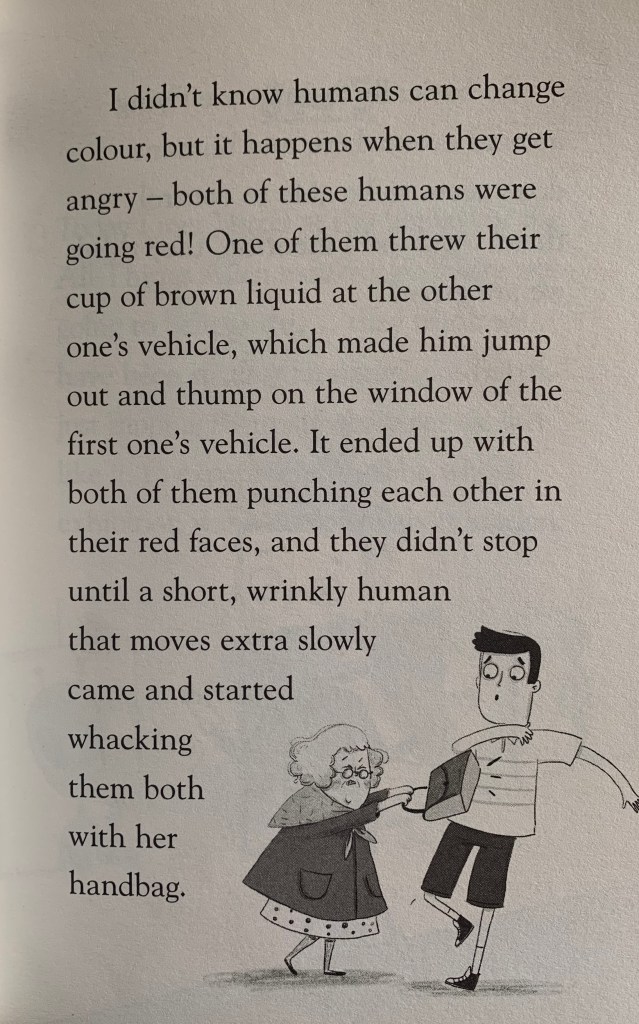
As he gets on public transportation he finds that humans smell different, and some are not so nice. At the park he finds how humans talk about baby dogs, he forgets the name for those, very odd, and love very gross. On Day 4 he makes a friend, Jibreel, who is looking at books and magazines about Aliens. He knows he isn’t supposed to talk to humans, but since no one from home is talking to him, he figures it might be ok. When the boys head outside they see two grown men fighting about a parking space and turning red, they punch each other and don’t stop until an old lady whacks them with her purse. Emotions are flying around everywhere and Maxx hopes Jibreel can help him understand it all.

Maxx and Jibreel head to the library the next day for the “All Things Alien Exhibit” and boy do we have it all wrong. As Maxx tries to correct the exhibit and explain the truth about aliens, Jibreel just finds him funnier and funnier, not believing that Maxx is from outer space.

The two boys become good friends and when bullies from Jibreel school start giving Jibreel a hard time, Maxx learns about hugs, and helping a friend out. Maxx starts having feelings. When the boys get called aliens and Maxx makes them both go invisible, Jibreel realizes Maxx is an alien from another planet and Maxx learns that Jibreel is a refugee. He also learns that Jibreel’s misses his mom who wasn’t able to escape with Jibreel and his brother, and is still back in their country.

Maxx makes the bullies look foolish to help Jibreel, but Jibreel is not happy and Maxx has to learn about being kind even when you really want to be mean. Now that Maxx is having all sorts of feelings, he too confides in Jibreel that he is worried about not hearing from home and Jibreel offers to help him fix the Filandoo Sperk.

The only problem is the spaceship after the initial tour, goes missing. And so are the bullies. I won’t completely spoil the ending, but there is a surprise and happy ending for everyone.

WHY I LIKE IT:

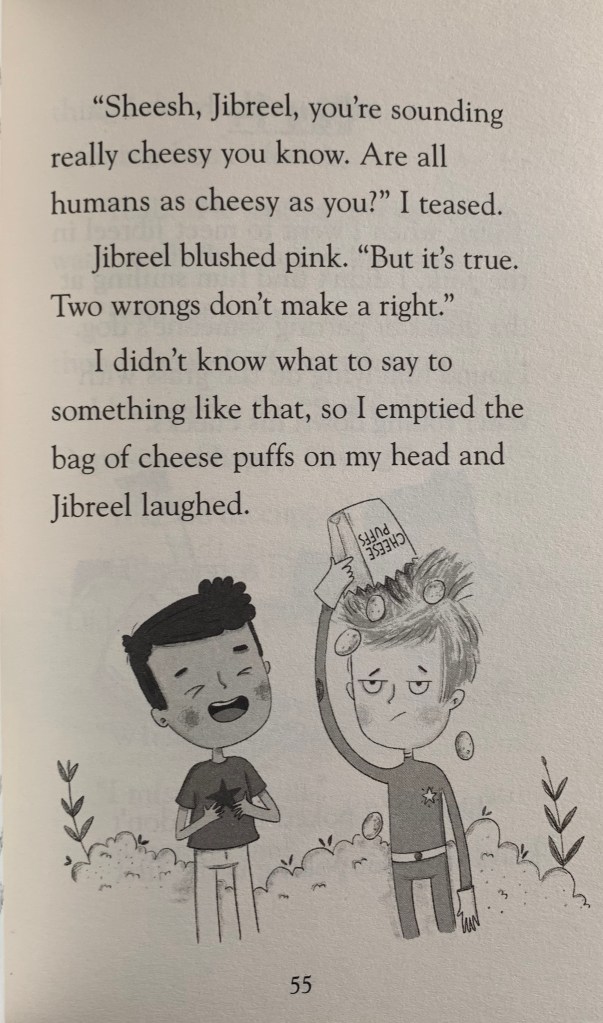
Oh I love how the story weaves feelings and emotions in with bullies and friendship in such a smart way. The book is silly with the fart humor and assumptions about aliens, but it really is clever. The vocabulary doesn’t talk down to the reader with words such as abomination and the observations of someone new to Earth offer the reader a chance to add their own silly persepective to the fictional set up. American children might need a bit of help with the British jokes, like the name of the chocolate bars, but it really is such a universal story that will stick with adults and kids alike.

The end has some questions and activities to do with the book, and with the exception of Jibreel’s name being spelled wrong on one these last pages, they do a good job of helping make sure kids grasp the story.
FLAGS:

There are fart jokes, and mention and illustrations of kissing on the cheek as being gross. Bullying, being mean, and two men fighting.

TOOLS FOR LEADING THE DISCUSSION:

The book is great for 2nd and third graders to read and discuss. I don’t do a book club for that age, but I did have my 2nd grade nephew read it to start a conversation about feelings and emotions with him and it worked great. We talked about how things make us feel, understanding when we see other people acting a certain way how they might be feeling. We discussed how even if we think someone deserves something, our own integrity needs to come first. We talked about being a good friend and how being away from our mom and family would make us feel. From top to bottom this little chapter book, packs a lot of discussion options under its silly superficial layer.

Playing Atari with Saddam Hussein: Based on a True Story by Jennifer Roy with Ali Fadhil

Standard
Playing Atari with Saddam Hussein: Based on a True Story by Jennifer Roy with Ali Fadhil

atari

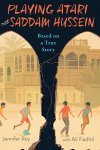
This 165 page AR 3.9 book about the 42 days in 1991 that Iraq was at war with the United States is told from an 11 year old half Kurdish Christian boy’s perspective, but he mentions that he has friends that are Muslim and culturally and historically the book is relevant, important, and engaging as well.  I had my 9, 11, and 13 year old read it to gain perspective of the Gulf War, the difference between politics and people, and to see diverse religions co-existing despite stereotypes, especially in the middle east.

SYNOPSIS:

Ali gets the highest score on his Atari console the day that the bombs start falling.  Ali and his brothers Shirzad and Ahmed, and sister Shireen along with their parents retreat to the safest room in the upper middle class home to hopefully stay safe.  With experience of surviving the Iran-Iraq war which ended just three years earlier, the kids camp out at night in the room farthest from the nearby school and spend their days playing soccer in the abandoned streets.  The safe room was determined by knowing that Saddam uses his own people as human shields and places military installments in public service locations so that he can use propaganda to try and convince people that the enemy is bombing schools and hospitals intentionally to harm the innocent.

When the electricity goes out and the water cuts off, the family is forced to accept government rations.  Their dad is a dentist, but as he is essentially property of the state, he is forced to work as a medic and is often absent from home.  The family lives in Basra, which is in southern Iraq and near to the invaded Kuwait, thus all the troops pass through the city and the children spend their days keeping up their house, playing soccer with their friend Mustafa and trying to avoid the bullies Omar and Umar who’s father is in Saddam’s Ba’ath Party.

Ali speaks English because of his love of American TV and feels that if he can meet some US soldiers he will convince them that he should be in America not in Saddam’s Iraq.  He loves Superman, video games, soccer, his family, and his country, but the people, not the leader, he loathes Saddam, even though he knows he can’t ever speak ill of him.

A trip to get rations results in Ali seeing public executions and a colleague of his math professor mother’s getting hauled away.  A visit from their cousin gives them news that their father is missing. Life is not easy for the family, and yet they know they have it better than a lot of other people.  After the war, once again the family will have to put back together their lives and carry on.

The book concludes with a 14 year jump and Ali translating at the trial of Saddam Hussein where the leader who has been hiding is found guilty and sentenced to be killed by hanging.

WHY I LIKE IT:

I love that Ali is so relatable, he could really be a kid anywhere which makes what he sees and hears and experiences all the more intense.  The way that the book shows how the soldiers are forced to be soldiers, the citizenry at the mercy of the government, and the inability to speak freely so very real and frightening, is strong, but not traumatizing to the reading audience.  Even Ali being forced to observe the killing of  people in the street is handled with the target audience in mind.  They are Kurdish and had to deal with that within Iraqi society, which is a nice added layer to understanding that Iraqis are not a single monolith.  I love how the family had to go to the governor’s house and how nice his son was, even though, they are all Ba’ath Party members and part of the larger oppressive system.  It shows that things aren’t always black and white, and to convey all this to eight and nine year olds so clearly is quite remarkable.

I also like that the book holds up over time.  My kids had no idea what Atari is or was, but they could understand that it is a video game, and that it was an escape during the night for Ali to imagine he was playing a game trying to catch the falling bombs as a way to be brave and endure.

FLAGS:

Execution, death.

TOOLS FOR LEADING THE DISCUSSION:

I would consider this for a middle school book club, it is a bit short and definitely more middle grades, but it would allow kids to identify and imagine and discuss war through the fictional characters and voice their understandings of an authoritarian government structure, which would be interesting.

Author’s Reading Guide: http://www.jenniferroy.com/wp-content/uploads/2017/05/Playing-Atari-Teacher-Guide.pdf


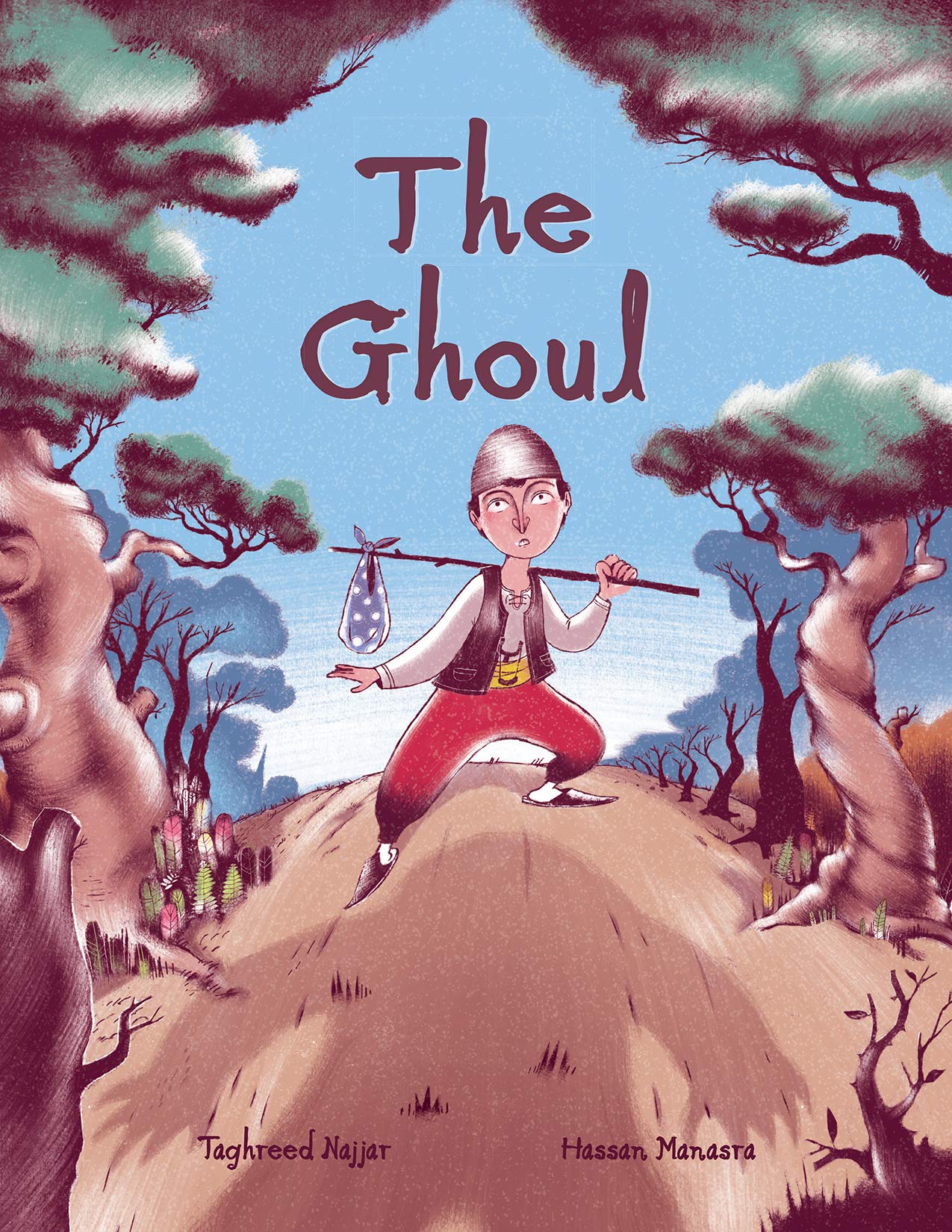
The Ghoul by Taghreed Najjar illustrated by Hassan Manasra

Standard
The Ghoul by Taghreed Najjar illustrated by Hassan Manasra

the ghoulThis 36 page book for ages five through eight is a cute story about being brave, facing your fears, challenging your perceptions, celebrating differences and giving friendship a chance.  Recently translated and published in English, this Arabic inspired folktale is timeless and important for readers of all ages to learn from.
8B5F2DF2-9E4D-41B0-B9CE-3220C01849D3

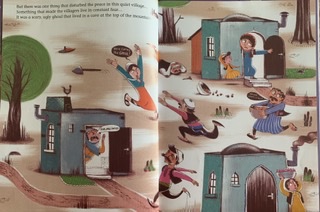
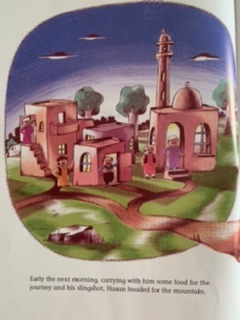
Hasan the Brave is a young boy that lives in a mountain village.  The children are told not to laugh out loud, the adults tiptoe to their fields, and the fear of being eaten by the ghoul that lives in a cave on top of the mountain consumes them all.

397BB0D0-FE53-491D-997C-F0A69FA851BE

But Hasan isn’t buying it and starts asking questions. Why is everyone afraid of the ghoul, he asks his aunt one day in the olive grove? She tells him because he is covered in hair, has one eye, long claws, sharp teeth and his favorite food is little boys and girls.  Unconvinced Hasan asks his dad if anyone in the village has been hurt by the ghoul.  His dad can’t think of anyone.  He asks his mom if the Ghoul ever ate anyone in the village? She can’t think of anyone, but has heard plenty of rumors and wants him to not disturb the ghoul none-the-less.

BA9EE74E-0AEA-4418-8265-146E1DFF7682

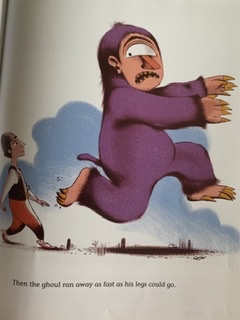
Hasan is tired of being scared and decides he will climb the mountain.  Everyone in the village tries to warn him against it, but he is Hasan the Brave after all and is determined to go.  When he gets to the top of the mountain and relishes at the beautiful view he proclaims that he is fearless and that he won’t be afraid of the ghoul.  Then he sees the ghoul, and after the ghoul sizes him up, the ghoul runs away.

76499216-F79A-45D1-8BD5-E7559269F315

Hasan goes to investigate why such a monster is scared of him and learns that the ghoul is scared of people because they have two eyes instead of one, they do not have thick hair like him, they have strange hair, small teeth, and they eat ghouls.  Ghouls, Hasan finds out are vegetarians.

A3D05D5F-10FB-42D3-866F-5863CEEDE484

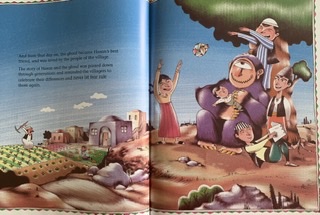
The two laugh at their assumptions, and run off to play together.  From that day on the two are best friends and the people in the village pass on stories to remind future generations to celebrate differences and not let fear rule them again.

There are a few women in hijab, the villagers say inshaAllah, but there is nothing religious in the book.  The illustrations are detailed and colorful in a muted manner.  Overall a fun book with a great lesson.


Alia’s Mission: Saving the Books of Iraq by Mark Alan Stamaty

Standard
Alia’s Mission: Saving the Books of Iraq by Mark Alan Stamaty

alia

Based on the true story of Alia Muhammed Baker, the Basra librarian who saved 30,000 books in 2003 from the destruction during the Iraq War, this 32 page graphic novel, is an AR 3.9 and while it isn’t a chapter book and isn’t just a picture book, it works well for 2nd through 4th grade readers that will enjoy a bit of history, a lot of excitement, and detailed panels that make the story come to life.  The story, as it is based on fact, is very similar to The Librarian of Basra, but with it’s different presentation style, might appeal to a larger audience to appreciate and celebrate what she did to save such precious books, naturally, I’m a huge fan!

5532A37C-C4DF-46FA-8334-5F4AA3A06AB5

SYNOPSIS:

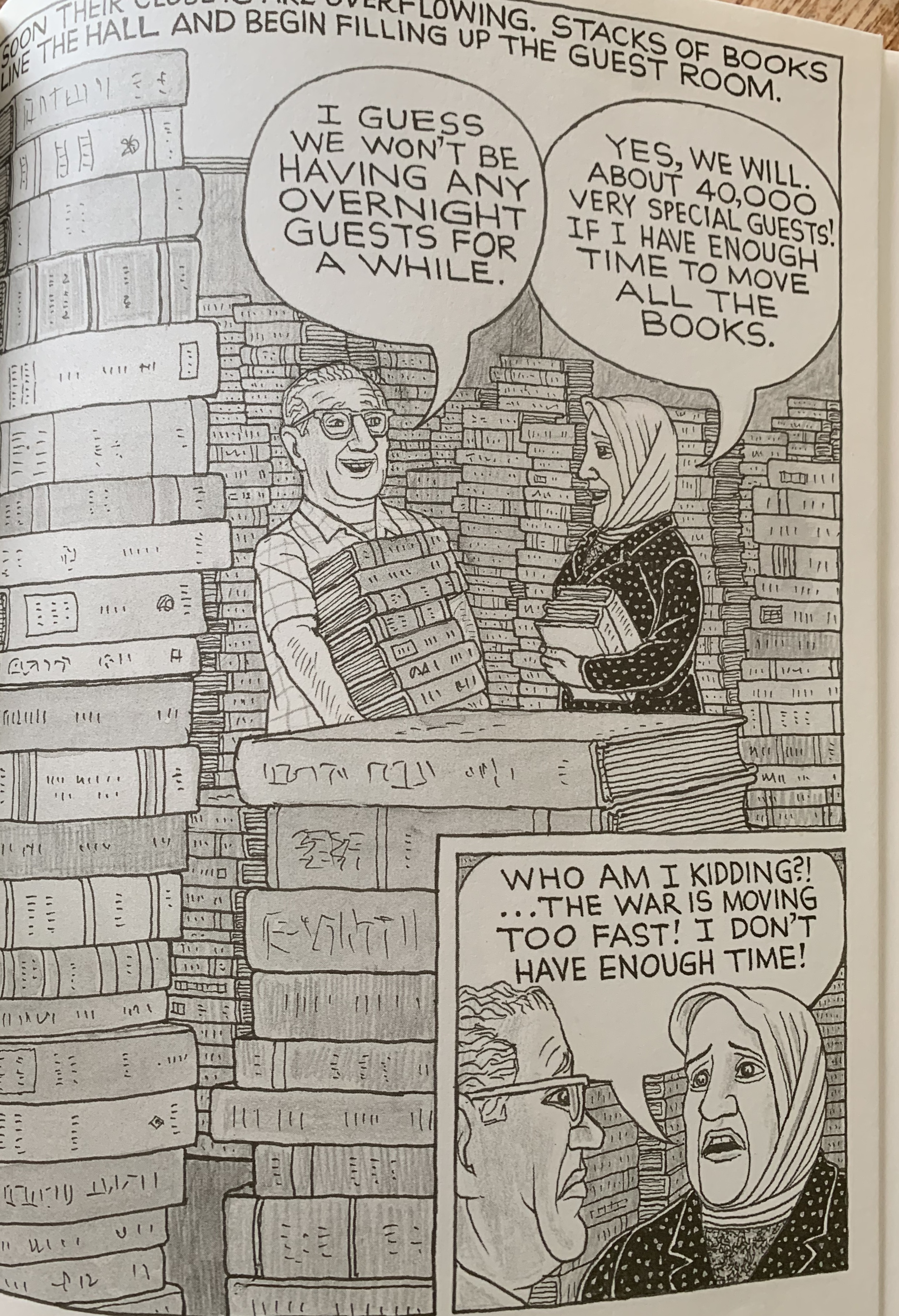
Alia is the Chief Librarian of Basra Central Library and has always loved books and learning.  As war draws closer, she tells her husband she is worried that the library could be bombed or set ablaze.  She goes to the government to voice her concerns and ask that the books are relocated, but her request is denied.  So she takes matters in to her own hands, and starts smuggling books under her shawl and in to her car, and stacks them in her home.  Every day she does this for a week, soon closets are over flowing and she starts stacking the books in her guest room.  Worried that she isn’t making fast enough progress, she gets the restaurant owner next door to help her when looters start taking the pencil sharpeners and furniture from the library.  She has a plan to have everyone possible come together to move the books, and many people come to help.

Eventually the library is set on fire, the news gives Alia a stroke.  When she recovers she learns she saved 30,000 books, and up next for this real life super hero? Building a new library, inshaAllah.

A3A17616-7940-4E80-8CA1-9798A8BA4FC8

WHY I LIKE IT:

I love that it shows the value of libraries and books, the determination of one person, and the support of a community.  People are awful during a war, yet, sometimes they are pretty amazing too.  The illustrations are detailed and varied, with inviting text and clear concise language.  It really is well done.

B0FB5A2A-7376-4F20-BCD1-6D64956B77C6

FLAGS:

Destruction of property, sneaking, looting.

TOOLS FOR LEADING THE DISCUSSION:

I think it would be great to have kids read this story and the librarian of Basra and discuss