Category Archives: middle grades

Hamra and the Jungle of Memories by Hanna Alkaf

Standard
Hamra and the Jungle of Memories by Hanna Alkaf

hamra1

This 400 page middle grade retelling of Little Red Riding Hood bursts with Malaysian culture, magic, action, and adventure.  The main character and her family are Muslim and hijab, duas, zikr, halal, Qur’an and salat are included throughout.  The mix of legends and characters from Malaysian culture in building the fae world is not contrasted with religious faith, but assumed to both coexist without issue.  The book is clean for ages nine and up and the only concepts worth noting are some intense life and death situations, close male and female friendships, dementia, and the element of fantasy.  The book is set during the Covid-19 pandemic which will ultimately date the book as it doesn’t convey the tone for readers unfamiliar with the curfews, social distancing, controversies, and masking.  Those who have just lived through it, will not need the framing, but in a few years I do fear that the book will be lacking in fully understanding why the tourists, parents, and markets are so absent.  As with all of the author’s books there are also dated pop culture references, that slow the narrative down for today’s readers.  The book grabs you from the start and the second half flies by smoothly, but the middle quarter is a bit slow as the world building is not robust, and the reader is thrust into a magical world that is just accepted without pause, and the reader is asked to accept it at face value as well.

SYNOPSIS:

It is Hamra’s birthday, but the independent 13 year old is not being celebrated- everyone has forgotten: her mother is a front line worker, her father helping those with limited resources, and her aging grandfather and her are left to care for her memory slipping grandmother.  When Hamra, Little Red, storms off to the jungle to collect some herbs, in an act of spite, she defies the rules drilled in to her 1- Always ask permission before you enter.  2- Don’t challenge what you can’t even see. 3- Never use your true name. 4-Never take what isn’t yours. 5-If you hear someone calling your name, never, ever look behind you. She also doesn’t listen to the regular reminders to tie her shoes.  Simple rules, that when broken set the story in to motion.  Along with her best friend Ilyas, the two will strike a deal with a weretiger for their transgressions that takes them on a journey to try and save Opah, themselves, and prove their quest a success.  The characters they meet, the clues they unravel, the legends they understand, and the scenic islands they explore are as lush as the love Hamra has for her family and the drive she has to return home safely.

WHY I LIKE IT:

I love the way Islam is truly part of the characters, and a natural extension of how they see the world and act within it.  I wish there was stronger world building blending the world of the known and the fantasy for the reader.  The writing of the Malaysian setting is beautifully unapologetic and I love that there is not a glossary or overly explained descriptions, it is immersive and I appreciate that, but the framing of the two worlds I felt was a bit disjointed and needed some fleshing out.  At times it feels more telling than showing in detailing the depths of the legends or the superstitions that are true for the story.  I did enjoy the characters’ quirks and stubbornness, there is not a lot of arc and growth, but with the intensity of the adventure and culture, I didn’t feel it lacking in development.  For much of the book I didn’t quite appreciate the Covid-19 framing, but by the end I understood that it was a way to have the tourist spots void of people, the parent’s out of the way; a little more development though would have had the uncertainty of so much more fully realized.

FLAGS:

Fear, trickery, danger, loss, death, music, musical references, dammit is said.  There is some violence, close male and female friendships, and a possible trigger of dementia in a loved one.  There is myth, legend, magic, fairies, fae, and fantasy, if you are ok with the concepts in general the presentation is clean even with mixing religion and these concepts.  If you are uncomfortable of fantasy and Islam coexisting, this book draws the two worlds very close.

TOOLS FOR LEADING THE DISCUSSION:

I have taught two of her books in middle school book club discussions, and I would teach this one as well.  It is enjoyable to see Malaysian Muslim characters so confident in their identity and having adventures that are enhanced by their faith and culture while focusing on larger themes of friendship, family, forgiveness, and adventure.

The book comes out in March of 2023, I’ve preorderd mine HERE and I hope you will as well.
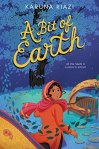
A Bit of Earth by Karuna Riazi

Standard
A Bit of Earth by Karuna Riazi

earth

This Secret Garden retelling mixes the heart of the original with a dash of modernity, the flavor of desi culture, and the lyricism of a good writer.  Over 368 pages the slow plot but rich imagery will draw readers in, hold their attention, and leave them thinking about the characters they have been fortunate to spend time with on Long Island.  Islam is practiced and normalized and naturally woven into the Muslim characters’ daily lives without othering or over explaining.  I did struggle a bit trying to keep the relationships of who was supposed to be caring for the protagonist at various points since her parent’s died clear, but once I abandoned stressing about it I was able to be swept away.  I recently reread The Secret Garden with my own children and the original is not plot heavy, nor action packed, but I watched as my own children were drawn to the slower, more grounded (pun intended) nuanced tale, and I think this book, in the same vein, will find its way in to the hearts of middle grade readers.  The book is clean, there is a possible crush hinted very slightly at the end, periods are also endured, and I do have reservations of the terrible marital relationship between Mr. and Mrs. Clayborne, but it establishes that change will occur, so at least it isn’t normalized.  There are sprinkles of magic implied regarding the house, but it is always framed without clarity and in a subtle way to set the tone and the emotions the characters are feeling more than centralizing something rooted (see I did it again) in fantasy.

SYNOPSIS:

The book updates and mirrors the original fairly well with an obstinate orphan arriving at a sprawling house, finding a prickly boy, and setting off to form a tentative toleration of one another with friendly neighbor kids in a garden that is unquestionably off limits.

Maria Latif arrives from Pakistan against her will to be taken in by a distant relative (I’m not sure how she is related), but Asra has been called away and she is forced to stay with Lyndsay, the new wife of Mr. Clayborne.  The first wife was a friend of Maria’s family, but Lyndsay is just as emotionally overwhelmed and lost as the child in her charge.  With Mr. Clayborne away on businesses, his mother Charlotte keeps them all on edge.  When Colin Clayborne is expelled and returns home, more tension erupts and the two children find themselves in an off limits garden trying to make the most of a difficult situation.

WHY I LIKE IT:

I love the mix of poetry and standard novel format.  It is beautifully written and clearly the author does a remarkable job of making her very unlikeable characters worm their way in to the reader’s heart.  Both Maria and Colin are thorny and difficult, stubborn and rude, but you seriously cheer for them, and I did shed a few tears at the end.  With the author’s writing ability apparent, I’m still not sure why the foundation of the relationships and getting Maria to the Clayborne home is so cumbersome.  It is too muddled and it drags the book down every time it is revisited.  The Dadi having the aunt’s phone number was too easy, the inconsistency of the neighbors having no relationship to the Clayborne’s for so long and Lyndsay not even pausing to think another Bangladeshi family living a few houses down might be my husband’s first wife’s friends, seems inconsistent.  Honestly Lyndsey in general needed to read like a competent woman struggling, not a teenager in over her head. I disliked her and Mr. Clayborne’s relationship and I would hate to think any reader would find it ok or normal.

I love the Islam and how it presents when the character has to pray, she goes and prays, it is part of the story and it is seamless.  I don’t think the culture is handled quite as well.  Lyndsay is a foot writer who is always cooking, yet knows nothing of desi foods? If Colin’s mom is desi, wouldn’t she at some point tried to cook familiar foods for him.  Half the neighborhood is Bangledeshi, so it seems everyone has a parent or step parent or distant relative that is desi and I loved the normalizing, but it seemed a bit assuming.  I don’t think kids will wish it was more clear, but as an adult reading it, I felt like it needed to be interjected more without explanation, or if left as is, adding some context. I also wanted to know what Maria’s parents did and a little introspection from Maria.  Again as an adult I see how her anger and grief changes how she remembers them, but from them always being away, to such soft poignant memories at the end, I think kids will need a little hand holding to understand the grief process and her understanding of them.  As it is, they just seem terrible and then all of the sudden great, and the pacing gets thrown off in the process.

FLAGS:

It seems to hint at the end that Maria might have a bit of a crush on Colin, I honestly thought up until a single line that they were making a chosen family with the people who cared for them, but that line seemed to suggest it might be more of a romantic feeling than friend or brotherly.  I read an early copy, so this is subject to change.

Maria gets her period and it is detailed what she is feeling.  I think boys and girls can and should read it.  It is presented on age and appropriately: cramps, achy, dry about blood leakage, having it start young like her mother, etc..

Implied magic (possibly), music and musical instruments being played, milaad, lying, sneaking, being kicked out of school for physical assault, close male and female friendships, ADHD stigma.

TOOLS FOR LEADING THE DISCUSSION

I think this book would work in a classroom and would appeal to readers in an Islamic or public library.  I would consider it for a middle school book club, I think readers will connect and feel empathy for Maria, Colin, and Lyndsay and be better for it.

I preordered my copy HERE and I hope you will do the same

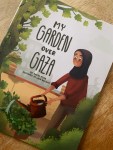
My Garden Over Gaza by Sarah Musa illustrated by Saffia Bazlamit

Standard
My Garden Over Gaza by Sarah Musa illustrated by Saffia Bazlamit

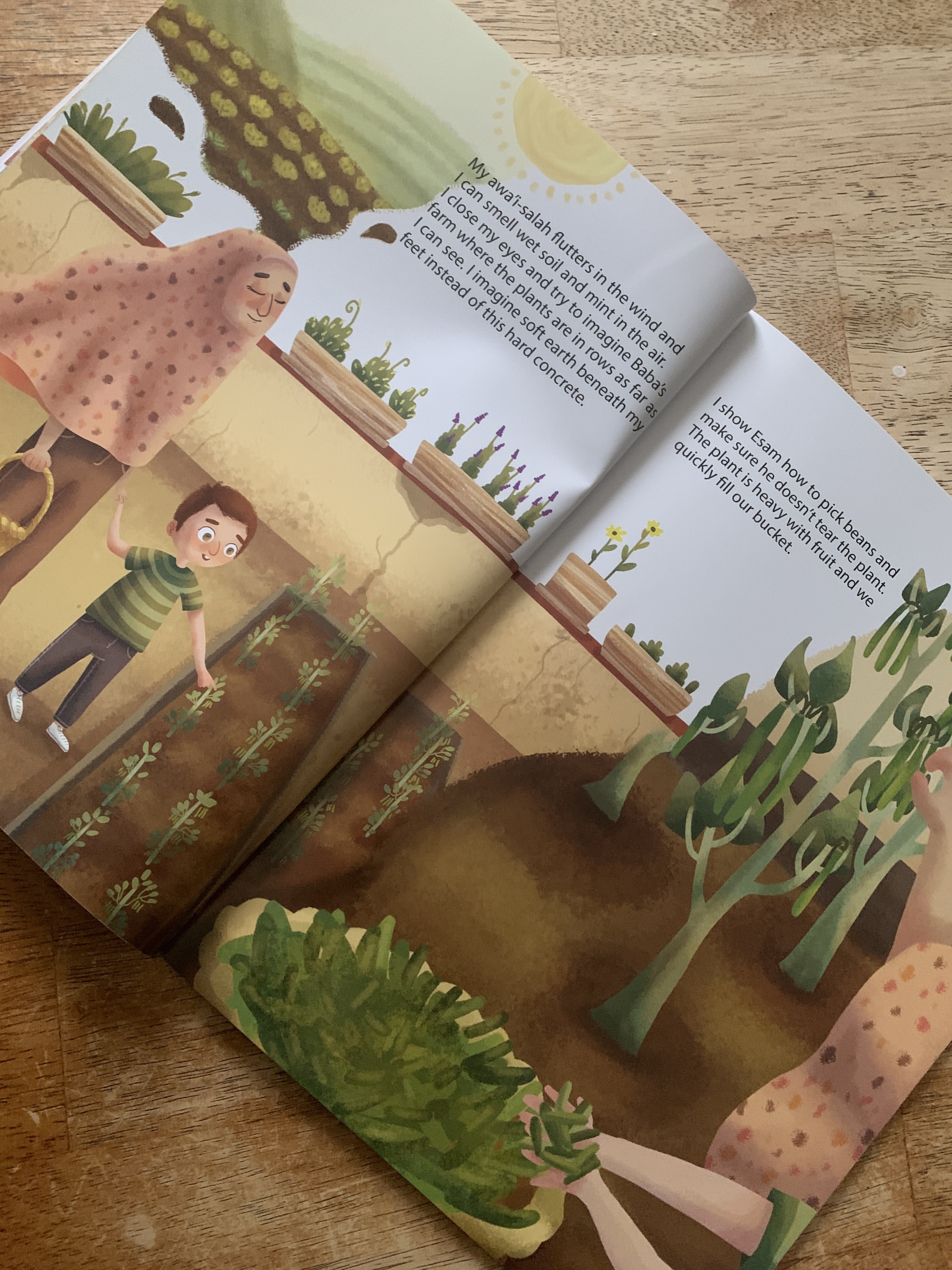
This book is hard to read, it hurts the heart, it doesn’t let you claim ignorance regarding the plight of Palestinians, and it shows cruelty,  a specific inexcusable cruelty, in a children’s book that will haunt you and infuriate you for weeks and months, if not indefinitely.  I’ve read a number of Palestine set books, but this one, in its simplicity, leaves me raw.  A child with a rooftop garden that helps feed her family is deliberately targeted by Israeli drones and destroyed.  This isn’t science fiction or dystopian, this is based on real acts.  The book itself threads in themes of hope, of not giving up, of remembering strength of a lost parent, of vowing to move forwards, but the catalyst for it all is not happenstance, and while the details of the occupation and oppression are not stressed and articulated, they are referenced and skillfully present to be discussed with children on their level with the included backmatter at the end.  This book is powerful and should be required reading. It is a difficult read and it has flags, but it is also a glimpse of the reality of our world, and the manner in which this book is told allows for the discussion to taken place with middle grade readers and up. The book is not text heavy, but the nature of the content makes me suggest it for mature children.

Noura, a young girl, is in her home in Gaza when drones are seen just out the window and she quickly pulls her little brother Esam away to safety.  To distract him she tells him about their father and his farm that he used to have in Umm An-Naser.  She explains how the wall cut them off from their land and when the drone noises fade, she takes him up to her rooftop garden to pick green beans.  Their mama works downstairs as a seamstress, and while they wish they had meat, the garden helps them have fresh vegetables.

The next day after Noura gets her little brother ready for the day they head to the roof, but drones arrive and start spraying chemicals on the growing plants, killing them, and sending Noura gasping to breathe.  She tries to cover the plants and swing a shovel at the drone, but it does little to save any of the food and Noura is devastated.

Noura’s mama reassures her daughter that the food can be regrown, but she is irreplaceable, as Noura goes to scrub the chemicals from her skin.  The frustration is real, but determination prevails as the family cleans the garden and begins again, just as their father did.

The last two page spread of the book is a basic map, general touchstones of the situation in Palestine, and the very real drones that fly in to Gaza to surveil, attack, and spray herbicides on crops. You can purchase a copy on the publisher’s website or HERE at Crescent Moon Store.

An Andalus Adventure by S.N. Jalali

Standard
An Andalus Adventure by S.N. Jalali

andalus

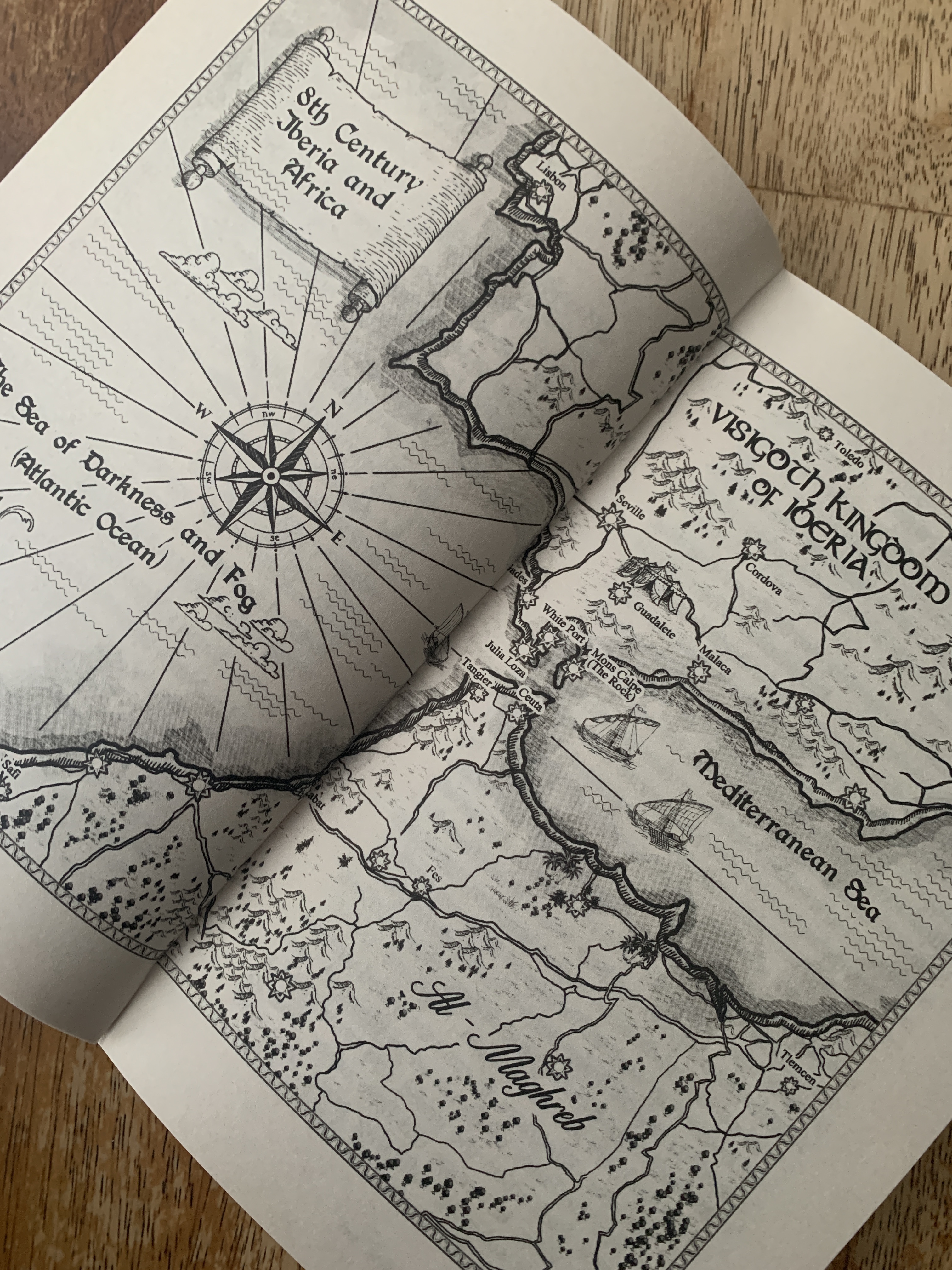
I truly am glad I read this book. I love historical fiction, visiting Spain is on my bucket list, this book has a map, details about what is historical what is fiction, has Islam woven in to the heart and soul of the story and characters, and yet it was a hard read.  The first few pages grip you, the last 50 bring it all together, but the middle 250 were hit and miss in this lower YA/upper MG book.  I honestly had to force myself to keep reading.  My teen and tween son couldn’t get past 38 pages or so, and I’ve asked around and no one I know that started the book, finished it.  I think ultimately there are just too many characters, too many points of view, that even though the history is rich, the literary points all in order, their isn’t enough character connection to hold the readers through the wandering details.  This author’s style is a bit more slow, but I think in the House of Ibn Kathir series, the setting of being in school and having friend problems is relatable to readers; boarding horses on to a boat, deciding to wage war, and going in to battle are not familiar concepts, and without the emotional connection it loses momentum.  The climax is nice but ultimately rather lackluster, and the beauty of characters taking shahada, Jews being freed, Solomon’s table, an old lady with a premonition, and a character dying are just not enough to keep the story in reader’s hands, unfortunately. 

img_4397

SYNOPSIS:

The summary might make the book seem fast paced, and while it does constantly move forward to a clear destination, it isn’t a “buckle your seatbelt and hang on” type of story.  The setting is Northern Africa and the Iberian Peninsula in 711 CE, 92 years after the Hijrah.  The book opens with two young siblings Ben and Bella, overlooking the coast, dreading their lives under Visigoth oppression, and hiding their Jewish culture and faith.  It then jumps to the Governor of Ceuta, Count Julian (Ilyan), awaiting to meet with Umayyad leader Tariq ibn-Ziyad.  He is hoping to rescue his daughter from the court of King Roderick and convince the Muslim General to enter Iberia, restore the rightful king, and free the people essentially.  Add in voices from Qasim, a young Berber, and Jacob a captured Iberian, and the stage is set to get everything in order to cross the straights, survey the enemy, take on the King, and introduce Islam to the new land.

WHY I LIKE IT:

I absolutely love the Islam and the history and the fictional liberties.  I love that the book is clean, although, I do wonder if more information about Lady Florinda would have helped the reader understand her father’s desperation, I do understand the vagueness, but it is a glaring omission that keeps the reader curious.  Ultimately I wanted more backstory.  The little given about the characters was engaging.  I loved the teasing about being a shepherd, Jacob coming to love Islam, Bella not wanting to marry, but it seemed to always stop short of sweeping me away.  I didn’t cry (SPOILER) when Hisham died, I barely knew him.  I didn’t feel the urgency to hide and escape from Leander’s proposal.  It set up to add depth regarding Old Mother Magda, the Cave of Secrets, and the unverified death of the king, but after being stated it was never mentioned again or resolved for any real purpose. 

All that aside, I think the book has value, it is just really dry in spots, a lot of spots, and given the vocabulary, the changing narrators, the choppiness between chapters, and the history, it is hard to keep reading or be anxious to pick up once you have put it down.  So with all that in mind, I think the book would be great to use in a classroom setting.  You could read a chapter Monday, and then pick it back up on Thursday and not worry that no one remembers anything because it is focusing on new characters anyway.  In a middle school, or upper elementary the book would be a great crossover between History, English, and Islam classes. The book would naturally lend itself to the students keeping character journals, the supplements and backmatter would allow for references and insight in to real history, and I think the book would do really well in this set up to connect with the audience. 

The Epilogue was nice, but a little disjointed.  I appreciated the updates on the characters and it showing Muslims and people of other faiths coexisting and being accepting even within families, but the connection to the story was a little lost.  Similarly, I love that it mentioned  Abbas Ibn Firnas, but I don’t know that most kids know enough about him to know what is being hinted at and what the outcome was of his flight at the end.

FLAGS:

Death, war, battles, killing, nothing graphic, very tame, not graphic or detailed gore.

TOOLS FOR LEADING THE DISCUSSION:

I don’t know that I could get middle school students to read the book for a book club, it would have to be motivated by a grade to get through it in a classroom setting I’m afraid.  See above to read my thoughts on how to present it.

I purchased my book on Amazon and will receive a few pennies if you decide to purchase a copy using this link.

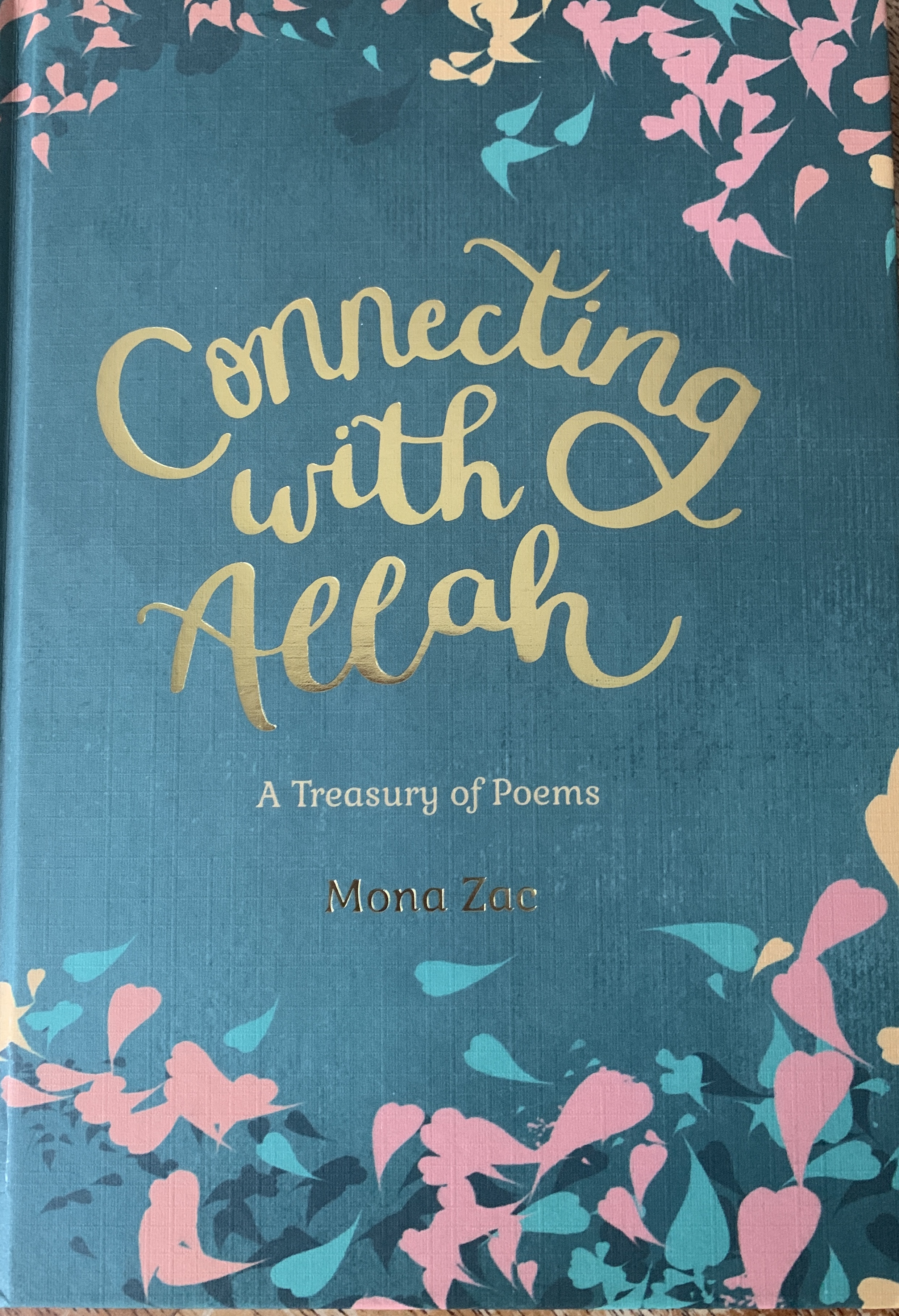
Connecting with Allah: A Treasury of Poems by Mona Zac illustrated by Neamah Aslam

Standard
Connecting with Allah: A Treasury of Poems by Mona Zac illustrated by Neamah Aslam

img_4279

Similar to Call Me By My Name, this book stands out in highlighting the Names of Allah swt.  In this collection it is the descriptive poetry, warm illustrations, urge to reflect and act, and space to think through and write up your own du’as that make this book so versatile.  I can see a middle grade to middle schooler using the book almost like a journal, just as easily as I can see an Islam teacher using the book to teach the names of Allah and have their students ponder and write their own verses.  I plan to use it with my own children when we gather up for salat-waiting for everyone to make wudu- to read a poem, discuss, and understand each name on whatever level the child is at thus bring the names of Allah swt, into our daily awareness, inshaAllah.

The book is divided into sections following a heading and seasonal imagery: Loving Allah, Asking Allah, Knowing Allah, and Blooming with Allah’s names.  The table of contents is out of order, but it isn’t an issue.  Poems are given a two page spread, some poems are one name, others are two.  At the end of each poem is a “Reflect and Act” section with bulleted items to help connect the name and the poem’s content with one’s own life and Islamic principles.

At the end of each section are two pages to write your own du’as using Allah’s names followed by Sources from the Qur’an and Hadith.  The illustrations are adorable to look at, and while on first glance the collection might seem more female appealing, I think boys and girls alike will benefit from time spent with the book and not find it targeting to only one gender.

The Asking Allah section features easy to read Arabic with harakat and even the English font is very appealing and easy to read.  Overall the hard bound book is beautiful and I hope to see it stocked in more places, hint hint Crescent Moon.  Currently in the US it is available here by the publisher.

img_4276

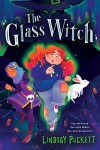
The Glass Witch by Lindsay Puckett

Standard
The Glass Witch by Lindsay Puckett

glass witch

Another Scholastic published book that I genuinely cannot understand why the author forced a Muslim character to be a part of, and no it isn’t just a token hijab on a character named Fatima.  It mentions she goes to the mosque, there is a Quran on the book shelf, her parents don’t understand her obsession with monsters, she is desi, and there is Urdu in the text as well.  This isn’t me just doubling down on Halloween being a pagan holiday that I’m against, this book is about witches and magic and while it does take place on Halloween, and the witches are Good(e), it is their last name, it is a weird inclusion flex for me.  The book also has the Muslim grandpa crushing on the grandma witch, he even kisses her hand and they are revealed to be soul mates.  There is evil possession, different men that could be the protagonists father, killing, and a pageant.  The book has good qualities- positive body size messaging, focus on family love, self acceptance, and is fast paced and entertaining, but even as a parent that lets my kids read fantasy books, and books that mention Halloween, this book went too far for me.  It normalizes Muslims being ok with magic, it isn’t world building and fantasy, it is very much the real world with sihr characters and practices. It positions the parents as being loving when they come around to accept their daughter’s love of monsters, it also seems to normalize men and women relationships, and for a middle grade 224 page book I just can’t support a Muslim character’s role in such a story. 

I know sometimes I’m ok with magic in books, this one just seems a bit intense, we might just have to agree to disagree if you feel differently, and I’ll own my possible inconsistency in the matter as well.

SYNOPSIS:

Adelaide is heading to her grandma’s house with her mom, and being dropped off for three months- abandoned is more like it. The family dynamic is stressed even on a good day, and today is not a normal day.  The Goode family of witches are all that remain of the witches in the town and more than three can not exist within town lines.  Additionally, if at least one witch is not always in Cranberry Hollow, all the magic will be lost.  Adelaide, doesn’t have magic though, toss in that she is a bigger girl than most other twelve year olds, and that she never feels like she is enough, and the bees within her are buzzing. 

The plan was to drop off Addie and head out of town.  The neighbors, Hakeem and his granddaughter Fatima show up though, and before Candice can sneak out, she finds herself heading to the Cranberry Hollow Halloween Festival with Fatima, Addie, and her mom.  The town loves the Goodes, they help crops grow better, cancer to be cured, and so much more.  Of course they don’t know that they are witches, but they know that they are helpful.  When the time to leave arrives, Aunt Jodie stays on the other side of the town line and they prepare to say their goodbyes and keep the fourth Goode outside the imaginary line, but Addie in a last ditch attempt to make her mother notice her, pulls her mother back across and thus sets off the curse of having too many witches in the town.  The hated Hern family is going to be possessed, and Addie will be hunted come midnight on Halloween.

WHY I LIKE IT:

The book is intense and scary at times, just toeing the line of what a MG reader can handle, I just don’t get the Muslim character.  It really seems intentional and thought out, and I would love to find out why it was a conscious choice.  There is a small passage equating Addie standing out because of her size with Fatima and her hijab, but I can’t imagine that is enough of a reason to have a practicing Muslim loving Monster hunter in the book.  I know we want representation, but this didn’t work for me, and while I know others are ok with Halloween and some with sihr in a fictional sense, having a Quran on a shelf above the book of monsters and jinn that the Nana has collected, just rubs me the wrong way.  The book is published by Scholastic and will undoubtedly be in book order offerings and in book fairs, and if you are ok with it for your children, that is your choice, I just feel obligated to share my concerns so that you can decide what is best for your family.

FLAGS:

Magic, witches, curses, killing, death, Halloween, crushes, romance, kiss on the hand, premarital sex not detailed (two options at least for who Addie’s father is), cigarette smoking, bullying, mention of a kid at the festival with two dads.

TOOLS FOR LEADING THE DISCUSSION:

I wouldn’t shelve the book in an Islamic school library or classroom.  I would also pull it from a Scholastic Book Fair display at our Islamic school.

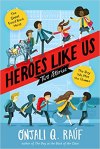
Heroes Like Us: Two Stories by Onjali Q. Raúf

Standard
Heroes Like Us: Two Stories by Onjali Q. Raúf

So this book is a little unique in that it is two stories, and The Great Food Bank Heist, one of the stories, has already been published, and the other story is a bit of an epilogue to The Boy at the Back of the Class.  So, I’m just going to review the first story in the book, The Day We Met the Queen, and while you probably can get away with not reading The Boy at the Back of the Class first, I wouldn’t want you to.  It is such a good book and you really should read it, everyone should. Yes, it is that good. So back to The Day We Met the Queen, the first story in the upcoming middle grade 176 page book, about refugees and kids making a difference.

SYNOPSIS:

This charming story shows what happens to Alexa and Ahmet and the whole crew as they prepare to met the Queen for tea.  The group of friends is about to show the entire school their invitations and share the two questions each that they plan to ask the monarch, the list was 52 questions, but because the Queen is nearly 100 years old, they have been advised to shorten the list.  On the day of the assembly news crews are present and Brenden-the-Bully is acting a little strange, as Ahmet starts talking the auditorium erupts with stink bombs and everyone leaves running.  The kids think it is just the bully striking again, but the gossip at the school and reports on the news imply it might be more than that, and the kids might not make it to the Queen’s tea after all.

WHY I LIKE IT:

I love getting some closure on the story, while simultaneously showing that refugee treatment and rights is not a thing yet resolved.  The idea of the Queen being at the center of the book definitely adds to the coincidental timeliness of it all, but that she is easy going and relatable to the children is still the takeaway whether you were a fan of the real Queen or not.  I love the voice of the protagonist and the relatability that her concerns are with the target audience. I particularly enjoy the critique about the media and the clarity in which the children understand the flaws and limitations of what they are told in the news both on the school level and on a global stage.  There isn’t anything Islamic in the text, Ahment is Muslim, as is the author.

FLAGS:

Hate speech, deception, bullying

TOOLS FOR LEADING THE DISCUSSION:

I don’t think there is an author that brings big real issues to children’s stories as well or as consistently as Onjali Rauf. Both stories in this book should be shared with middle grade readers and up to be discussed, reflected upon, and learned from as often as possible.  You can preorder your copy here: https://amzn.to/3Eq2G4M

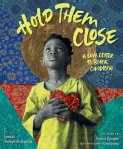
Hold Them Close: A Love Letter to Black Children by Jamilah Thompkins-Bigelow illustrated by Patrick Dougher with photography by Jamel Shabazz

Standard
Hold Them Close: A Love Letter to Black Children by Jamilah Thompkins-Bigelow illustrated by Patrick Dougher with photography by Jamel Shabazz

Hold+Them+Close

The power, the lyricism, the images, the layers- this book is not just for children, it is for everyone.  I have spent time with this book and it cannot be rushed, it needs to be felt and explored and reflected upon to feel the emotion that seeps from each and every page.  The book is remarkable in the amount of hope and warmth combined with history and social activism present.  It weaves together the personal with the community with the struggle past and present so flawlessly, but for me it is the pictures that complement the text so well that make this book spectacular on so many levels.  It is not a book for me to review, it is a book for me to support and elevate in any way I can.  The author is Muslim, there is nothing Islam specific in the text, aside from mentioning Malcolm X, and it should be required reading and sharing for everyone.  May Allah swt make us better to one another and actively work against oppression, ameen.

The book is framed as a letter, encouraging happy things to be held close.  For the young and old with stars in their eyes to be be held and elevated.  For stories of greatness to be passed down.  Stories of Kings, of Sojourners and Malcolms.  

The book encourages pushing away the disappointments, but to let the tears come. To not forget the lynchings, slavery, police brutality, oppression.  To stand and make it heard that you matter.

The illustrations are a mix of photographs and collage style layers.  The joy in a child that is very real, carrying those that came before.  Images of the past pulled to be seen in the present, very much a part of today.  The colors, the expressions, the hope, it radiates off the page with the coaxing of the text and becomes a feeling of both being held, and feeling support to take the next step.  Absolutely beautiful from beginning to end.

img_3903

The backmatter contains an Author’s Note, Illustrator’s Note, Background information, and Selected Sources.

img_3904

Available in libraries and book sellers, including here.

img_3905


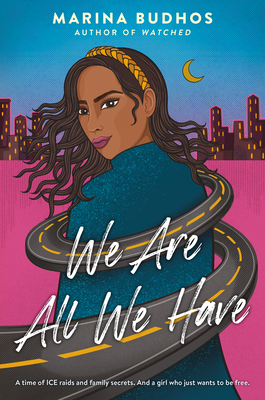
We are All We Have by Marina Budhos

Standard
We are All We Have by Marina Budhos

all we have

In many ways this book reads like a reboot of the author’s 2007 book Ask Me No Questions, there are sprinkled in references to Islamic culture, but nothing about the characters or the author truly show the book to be a Muslim story, or Islam centered.   Much like Ask Me No Questions, the book is told through a female protagonist who is forced to figure out why a parent is detained, what to do now that they are on their own with a sibling, and figuring out why they are being forced to leave America if they are not undocumented, but asylum seekers.  And much like that book, the protagonist is really whiney, entitled, and annoying, as is the mother.  This 256 page middle school/young YA read draws drama from the 2019 Muslim ban and ICE raids, but is more a character based plot than a political focused telling.  Because of the similarities to the earlier published book, and the lack of Islam in the text, and being unclear regarding the faith of the author, I’m just going to write a quick review and move on. The book is a quick read it has flashbacks to Pakistan and in those scenes mentions mosques, Eid, and Ramadan in passing. A few cultural side characters mutter an inshaAllah on occasion and there is a clear #muslimintheillustrations like side character that is remarked to wear a scarf on her head named Amirah, but is barely in the story.  Worth being aware of for younger readers is romance, kissing, making out, between Rania and Carlos, and *SPOILER* that the mother left her husband for another man years earlier.

SYNOPSIS:

Rania is weeks away from high school graduation when an ICE raid casts a wide net and picks up her mother as collateral.  Rania has always known they check in regularly to appeal their status, but with her journalist father killed years earlier in Pakistan, the family fled to America for safety, Kamal was even born in America, it has never been a concern.  As her mother gets taken away, Rania starts to wonder about the secrets her mother has always kept and the truth starts to unravel.  In the process though, protective services takes her and her brother to a shelter where they meet Carlos and escape.  Once on the run, they attend Rania’s graduation, spend months on Cape Cod, gain protection from a congregation at a synagogue all while trying to piece together Rania’s truth.

WHY I LIKE IT:

I like that it touches on the Muslim Ban and the fear that gripped the nation for anyone in the process of being a citizen or trying to travel to the flagged countries.  I wish it would have actually spent a bit more time on that.  The title of the book makes it sound like the family is completely alone and isolated, yet, they are constantly surrounded by people that are looking out for them and sympathetic in their choice not to ask too many questions.  I struggled with liking Rania, when you write a book about people that may or may not have broken a law, regardless of if you agree with the law or not, you really have to make it compelling. You have to get behind the character and their motives, and I never did.  I did not understand why she for example finally finds her uncle or an aunt and doesn’t demand answers, it is like, I’m tired, I’ll nap and we will talk later, no, not believable.  Additionally, I could not get a feel for the younger brother, I get that he is sheltered, but he reads like he is four years old, not that he is in second grade at best, I think he might be in fourth.  Really all over the place.  And the Rania and Carlos relationship, should have stayed awkward.  They at times are like siblings, and when the line is crossed, Carlos even remarks on it, and I think having it be weird, but clear that they have a bond, would have been a much stronger choice.  A lot of the plot holes make the story drag such as what was the problems at the bank for the uncle, but because it is short, I think older readers will get through it. I don’t think I’d suggest anyone read the book, but it isn’t so awful that I would warn too harshly against it.   The characters don’t identify or act Muslim, so when they kiss or lie, it isn’t a reflection on the religion.

FLAGS:

Kissing, lying, running away, making-out. Muslim friend sneaking out, drinking, partying, stereotypical oppressive Muslim dad and meek mom.

TOOLS FOR LEADING THE DISCUSSION:

I don’t know that I would throw the book out, but I wouldn’t actively seek to acquire it to shelve either.

Freestyle: A Graphic Novel by Gale Galligan

Standard
Freestyle: A Graphic Novel by Gale Galligan

img_3208

I one hundred percent understand that Muslims are not a monolith, but, I’m truly tempted to reach out to the author/illustrator of this upcoming 272 page middle grade graphic novel and ask her why she chose to have the female instigator in this coming of age story- that focuses on a dance crew, said girl tutoring a boy one-on-one in his bedroom, Halloween and a school dance, wear hijab? Yes there is also parental expectations, friend drama, leaving for high school stresses, and yo-yoing, but Sunna Ahmad being presented as a Muslim definitely gives me pause.  There is no romance in the book save a few background characters filling in frames holding hands, and it never articulates that Sunna or her older brother Imran are Muslim, but she doesn’t wear hijab when home with her family, does wear it when she goes out, so it definitely seems to imply it.  The cover and inside pages are bright and clear, and I think the book will be very tempting for young Muslim readers with the visible hijabi on the front.  Additionally the book is published by Scholastic, so if you are a parent whose kids get book order forms and attends a school where the Scholastic Book Fair is a big deal, you might want to read the entire review to see if it is Islamic representation that you are comfortable with supporting.

SYNOPSIS:

The Eight Bitz B Boy band is in their final year of middle school before they all go in separate directions for high school.  They want to win this year’s competition, or at least the leader of the crew, Tess, does.  Tess doesn’t want them freestyling and messing around, she wants the choreography and dancing in-synch and on-point.  Her military dictatorship is tearing the crew a part.  When Cory’s grades are not where his parents want them, he is grounded from dancing and forced to work with a tutor, Sunna Ahmad.  Sunna is weird, always writing intently in a secret notebook at school, and Cory wants nothing to do with her.  When he happens to see her throwing her yo-yo at school, though, he is impressed.  Reluctantly she trades teaching him yo-yo tricks if he agrees to do the work needed to get his grades up. Using yo-yo angles to teach geometry, it doesn’t take long before the two are friends.  It comes to a culmination when he invites her to the Halloween dance and his crew is both shocked and mad that he is hanging out with her, when he should be practicing with them.  As secrets and intentions come out, Cory has to make things right with his parents, his crew, Sunna, and himself.

WHY I LIKE IT:
I love graphic novels, they show context and setting and emotion, that often can’t be conveyed as well with words.  I absolutely love that Sunna wears different clothes on different days, from the hijab to the outfit, she has personality in her clothes as any middle schooler would, and nothing is mentioned about her hijab or her long sleeves, but the reader see’s it hopefully in a positive light. I do like the detail of her not covering at home when she is alone, or in the flashbacks when she is younger.

The story overall is decent and the added hip hop dancing and yo-yo infused details set the story apart, but some of the character building and plot points are a little rough.  When Sunna first starts tutoring Cory she feels like an adult disciplining, and reprimanding him.  She comes across as really arrogant and condescending, that he is somehow beneath her, yet they are the same age, in the same school, and are lab partners.  It reads off for no reason.

Similarly, I understand that the tension between middle schoolers and parents can be a source of contention, but the forced apology from Cory’s parents is incredible demeaning and cringe.  Sure flesh out that he shouldn’t yell at his parents, (Sunna shouldn’t either for that matter), but while the delivery was poor, the message was heartfelt and I think a book like this encouraging young kids to talk to their parents would be a great message, rather than have it almost glorified to not make the effort at all.  Not saying that the effort will always be received, but the forced apology would turn even kids with a good relationship with their parents questioning if it is worth talking to their mom and dad.

Poor communication and the stress it causes is a theme of the book, and I don’t understand why Tess keeps her choreography dreams a secret from the crew.  It seems underdeveloped, had she said that, that was the motivation, I think all the other seven members would have stepped up, not walked away.

FLAGS:

Music, dancing, girl and boys being alone with each other, girls and boys arms around each other, attending a school dance, girls and boys dancing together, Halloween being celebrated, birthday being celebrated, yelling back at parents, lying, secrets.

TOOLS FOR LEADING THE DISCUSSION:

In all honesty, I would probably not have this book on the library shelves, and would not display it during the book fair.  It normalizes a lot of gray if not haram actions for a very impressionable demographic because the character is visibly Muslim.  If the character was not visibly Muslim, I actually might be ok with shelving it and selling it.  The rep may be intended to show inclusion, but the character does not show actions that Islamically are appropriate.  If it were one or two actions, I might reconsider, but it is a lot very specific and varied activities.

freestyle3