Category Archives: middle grades

Drawing Deena by Hena Khan

Standard
Drawing Deena by Hena Khan

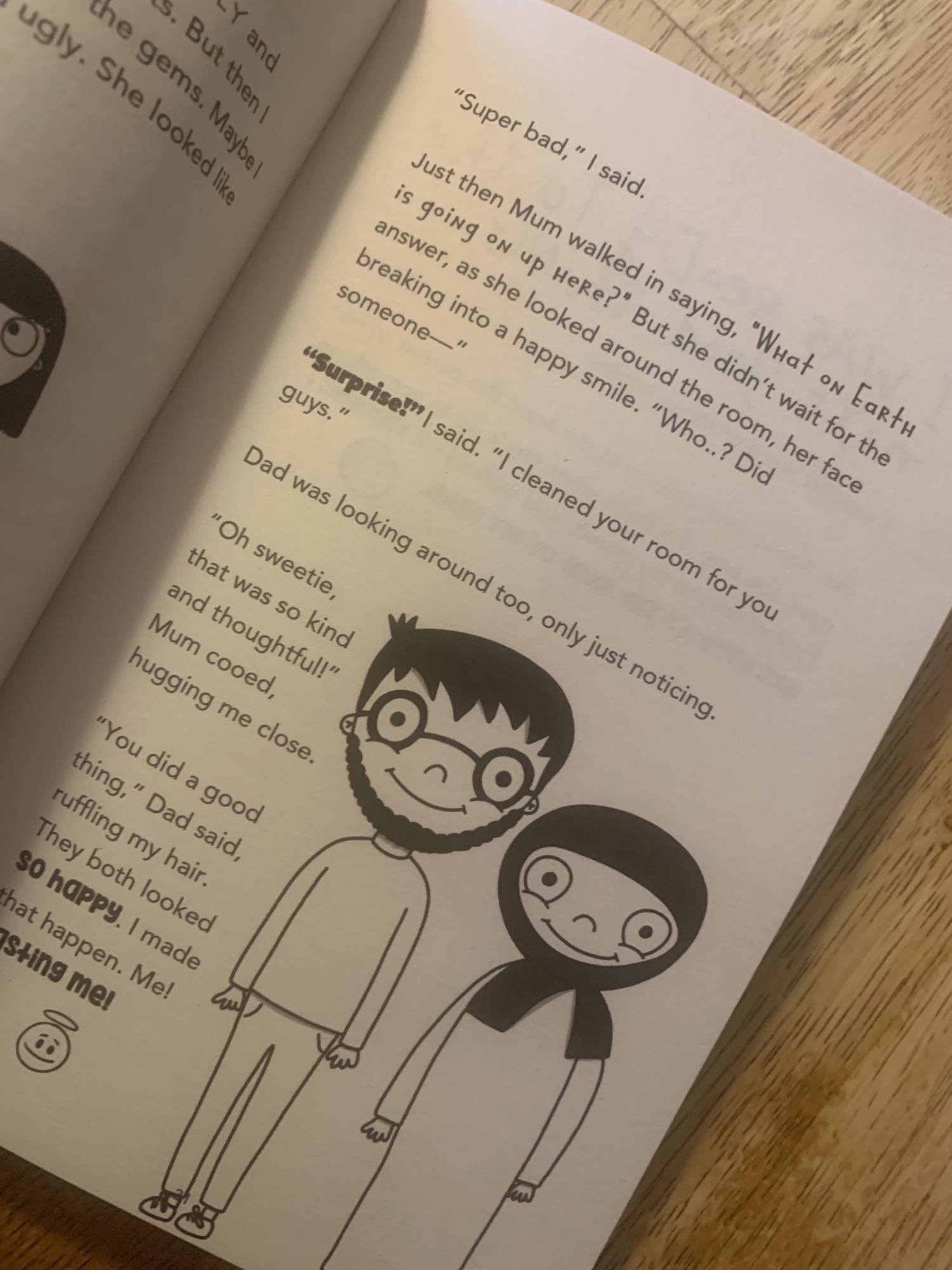
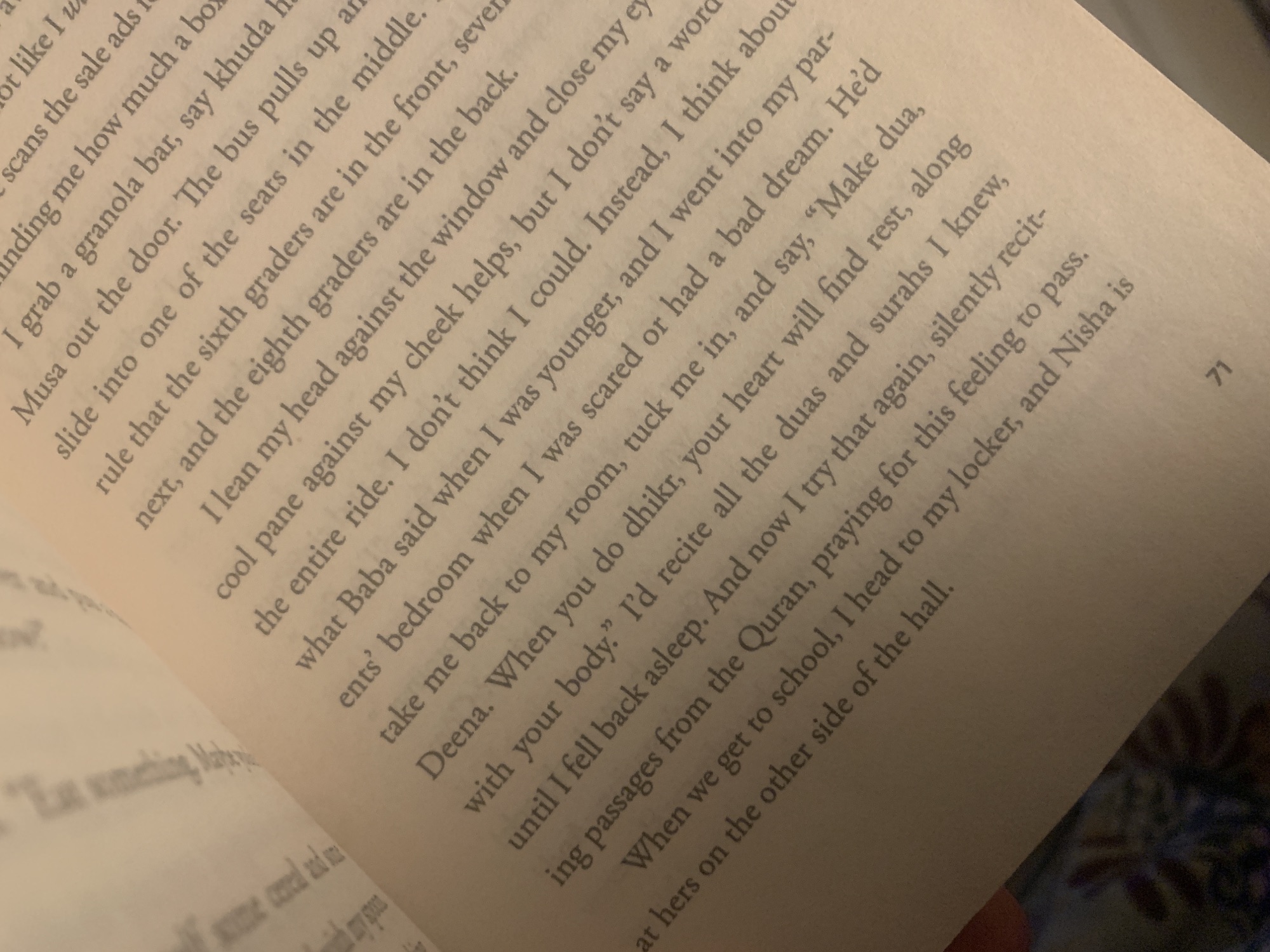
This 232 page middle grade read with a beautiful cover, has a beautiful heart as well.  A Muslim girl in a Muslim family is struggling with anxiety and family financial stresses, remarkably the book avoids tropes of blaming immigrant parents, culture, or religion.  It also doesn’t have any relationship crushes, or catty friends, bullies, or annoying sibling squabbles.  It was refreshing to see a strong character that seemed to not lack a voice, really find her voice,  advocate for herself and those she loves, apologies when in the wrong, and be surrounded by friends and family members that truly love one another.  I also appreciate that a licensed school psychologist was consulted and named in the backmatter.  As with nearly all Hena Khan chapter books, there is Islam and culture, but as an Islamic school librarian, I long for more.  There are a few inshaAllahs, mashaAllahs, salams, and references to praying, there is one solid paragraph that mentions dua, dhikr, and the Quran, but that is about it in a book that focuses a lot on fashion, make-up, social media, drawing portraits and hanging them in the home.  The protagonist is in middle school, but this is a solid middle grade read that teachers and librarians can feel confident having on the shelves and sharing with students.

img_2301-1

SYNOPSIS:

Deena loves art and to draw, she’s also really good at it.  She longs to take extra classes outside of school, but she knows it isn’t a priority with her bite guard already causing a lot of stress on the already financially strapped family.  Overhearing her parents fights about money adds to her anxiety and makes her nauseous every morning before school.  Determined to help her mom grow her basement clothing boutique, and increase the family income, she dabbles in social media, designs a logo, and sets up a website.  One of the new customers is a real life artist, who encourages Deena to look at art differently, and offers to take her under her wing to teach her about the power of art and decolonizing her mind. Things are starting to look up for Deena, but a disagreements with her cousin Parisa, feeling like she let a close friend down, and being overwhelmed at an immersive Van Gogh exhibit culminate with her having a panic attack at school.  The school counselor wants her to attend some therapy sessions at the school, but first Deena will have to convince her parents that this is something she needs and wants.

WHY I LIKE IT:

I mentioned a lot of my likes and loves above, but really it is a solid middle grade read where the character just happens to be Pakistani American and Muslim.  I like that Deena is just a sweet girl.  I think a lot of kids that have the emotional intelligence to know how fortunate and privileged they are, often push down their emotions and troubles, because they know others have it worse, don’t want to worry their parents, and/or seem ungrateful, and that this book can normalize getting help, advocating for yourself, and communicating with your parents, is really quite impressive.  Deena has a diverse group of friends, religion doesn’t come up much or seem to shape her perspective which is unfortunate, but it doesn’t make things harder for her either.  She isn’t bullied, there is no Islamophobia, or self-othering or stereotypes.  Deena is who she is, with a good head on her shoulders, and throughout the book you find yourself cheering for her and her success.

FLAGS:

She does draw faces, and they talk of hanging up the images in the living room.  There isn’t lying, but it kind of skirts the line at times. Anxiety.

TOOLS FOR LEADING THE DISCUSSION:

For even a young middle school book club, I think this book would be a quick read, but open the door for some quality discussion about anxiety that would benefit middle graders and up.  The book on the shelf will tempt readers, and handing it to kids will yield results.

The book goes on sale February 6, 2024 and you can preorder/order it here.

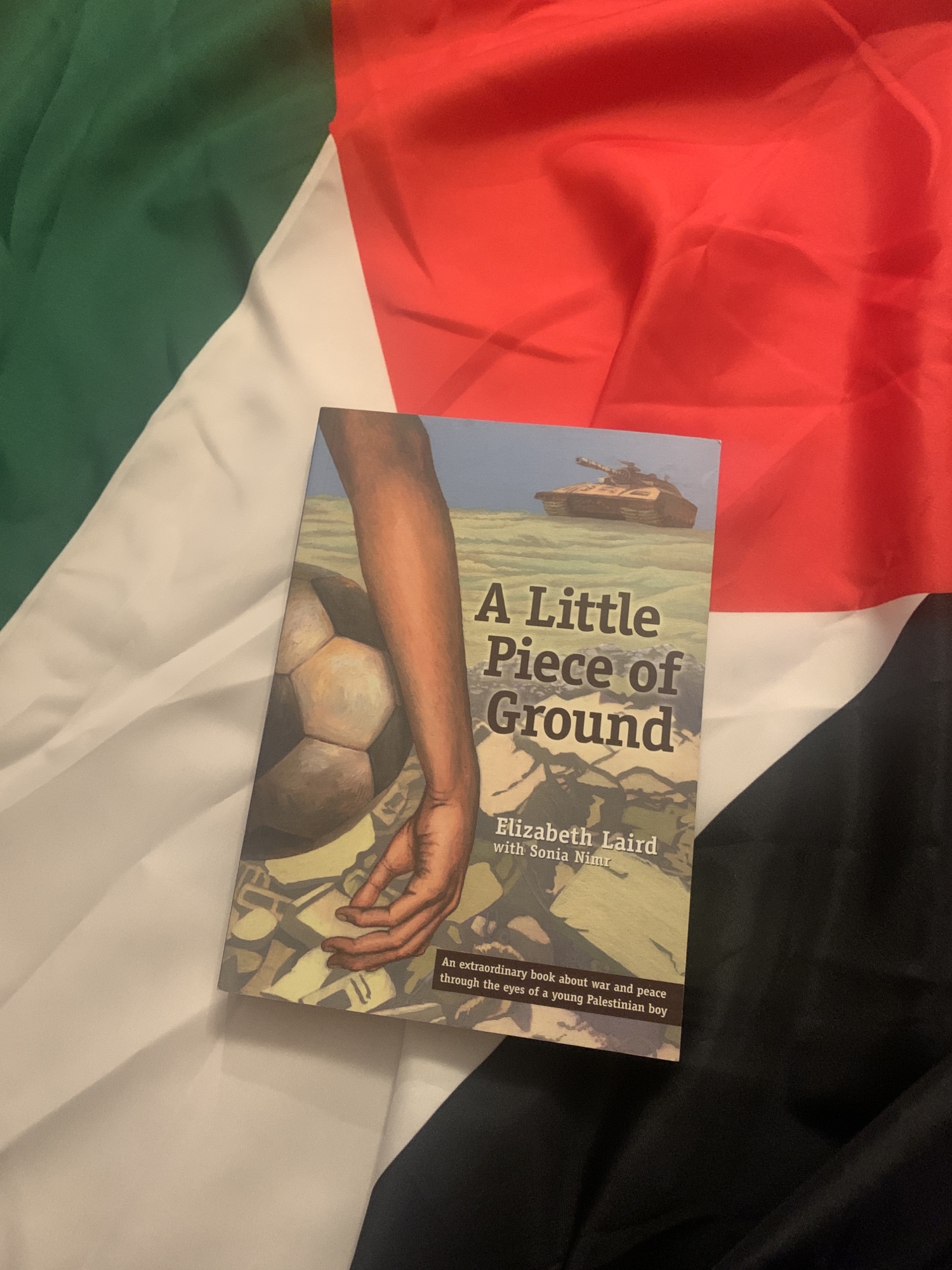
A Little Piece of Ground By Elizabeth Laird with Sonia Nimr

Standard
A Little Piece of Ground By Elizabeth Laird with Sonia Nimr

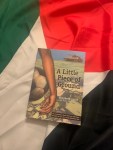
img_2165-1There are so few Palestinian middle grade books, so on that premise alone this 216 page book has a lot of value.  Because I am not Palestinian, I do not live, nor have I ever lived under occupation, I can argue some of the concerns from a point of privilege, and I acknowledge that is not my right.  I have been asked numerous times about this book and how it frames the suicide bombing mentioned in the text and blurbed about on the back of the book. It honestly is not a large part of the story, that being said, in my outside privileged view, I do not know that a 10 year old in the west will have context to understand the act of this level of desperation from the oppression and humiliation mentioned in the book. This is why I have held off my review.  The truth does not need to be defended or explained, and I fear my reservations will be taken as such, which is not my intention.  Would I let me 8 year old read this, yes, but we will read it together and discuss.  My children are aware of what is going on in Palestine, but Karim, the 12-year-old protagonist supports the bomber, and that notion is not clearly pushed back on. With discussion, absolutely, I think readers, will truly get Karim’s perspective that something has to be done to change the status quo.  The fear when Karim is alone and the target of soldiers, the settlers forcibly seizing the family land, the humiliation of strip searching men at checkpoints, the curfews, and constant fear of attack and imprisonment are all presented through the main character’s eyes, and would also do better with some discussion, so that empathy and duas and action can result.  But, the commentary as to the suicide bombing are minimal, there is even a prank package bombing that is presented as rebellion by a side character, and I would worry how a young child, without guidance, would internalize it.   Additionally, this is yet another difficult book for me to review, primarily because it was first published in 2003, and because I don’t know how much comes from a western gaze and how much the Palestinian voice played into it. Islam is clear on the prohibition of suicide.  In the early 2000 the news out of Israel was often about such attacks, but as an outsider, I honestly do not know if it was simply Israeli propaganda and stereotypes amplifying the idea as part of their public relations strategy or reality, seeing as now that Palestinians have direct outlets to share their daily life under an oppressive occupation, there is rarely talk of suicide bombing attacks. The author states on her website:

“I first visited Israel in 1968, and enjoyed a warm welcome from many Israeli friends. Later, I lived in Beirut with my husband and son during the civil war there, and became aware for the first time of the tragedy of the Palestinian refugees. I visited both Gaza and Ramallah, in the occupied territories, in 2002, while leading workshops for Palestinian writers. I was appalled by the circumstances in which people were living, and became aware that we in the West know very little of what life is like for Palestinians living under military occupation.

I have written A Little Piece of Ground in collaboration with Sonia Nimr, a Palestinian archaeologist, storyteller, writer and translator, who lives in Ramallah. We have tried to make our story as true to life as we can.”

The book is a hard read at times, but the joy is there.  Just as we as adults scroll through the devastation, the humanity persists.  The world may try and forget that they are attempting to erase a rich culture, but even in this book, their is laughter, and crushes, and sibling squabbles, and soccer games and friendship, and food, and joy.  There is a little Islam, not much, the main character is Muslim, a best friend is Christian.  It isn’t present in their everyday thoughts and actions, more just in identifying their faith.

SYNOPSIS:

Karim and his friends are not so much different than 12-year-olds everywhere, he loves video games, playing sports, isn’t so sure what he wants to be in the future, wonders what he will look like as he grows up, and is often annoyed with his family who he loves dearly.  Karim’s life in Ramallah is also unique, he lives under curfew, he doesn’t have freedom of movement, opportunity, or equal rights, and a simple family outing can be life altering.

The book follows Karim and his group of friend as they discover a patch of land they decide to turn into a soccer field, to claim as their own.  They work on it on days they can sneak away after school, in windows of time between curfews, and before long start to take pride in what the land can be. Adopting cats, learning about new friends from the refugee camp next store, teasing siblings about their crushes is all in contrast to Karim watching his father be stripped searched at a check point, being chased off their family land when they are harvesting olives by settlers shooting at them, and pranking soldiers in desperation of fighting back against oppression.

When soldiers roll in and occupy the land the boys have claimed, symbolic of their whole country, Karim gets stuck barricaded in an old abandoned car for days, with soldiers aiming their sights on him, and wondering if he will survive.

FLAGS:

Suicide, systemic abuse, oppression, humiliation, dehumanization, killing, beating, apartheid, genocide, violence, stripping, lying, crushes, occupation, shootings, injuries.

TOOLS FOR LEADING THE DISCUSSION:

This book does not need tools to be discussed.  It itself is a tool, to help middle grade kids be aware that this cruelty has been occurring for 75 years, this book took place 20 years ago, and today we just have social media sharing these stories more widely.  InshaAllah soon, Palestine will be free.

You can purchase this book here at Crescent Moon Store where code ISL at checkout saves you 10%

We are Palestinian: A Celebration of Culture and Tradition by Reem Kassis illustrated by Noha Eilouti

Standard

img_1887-1

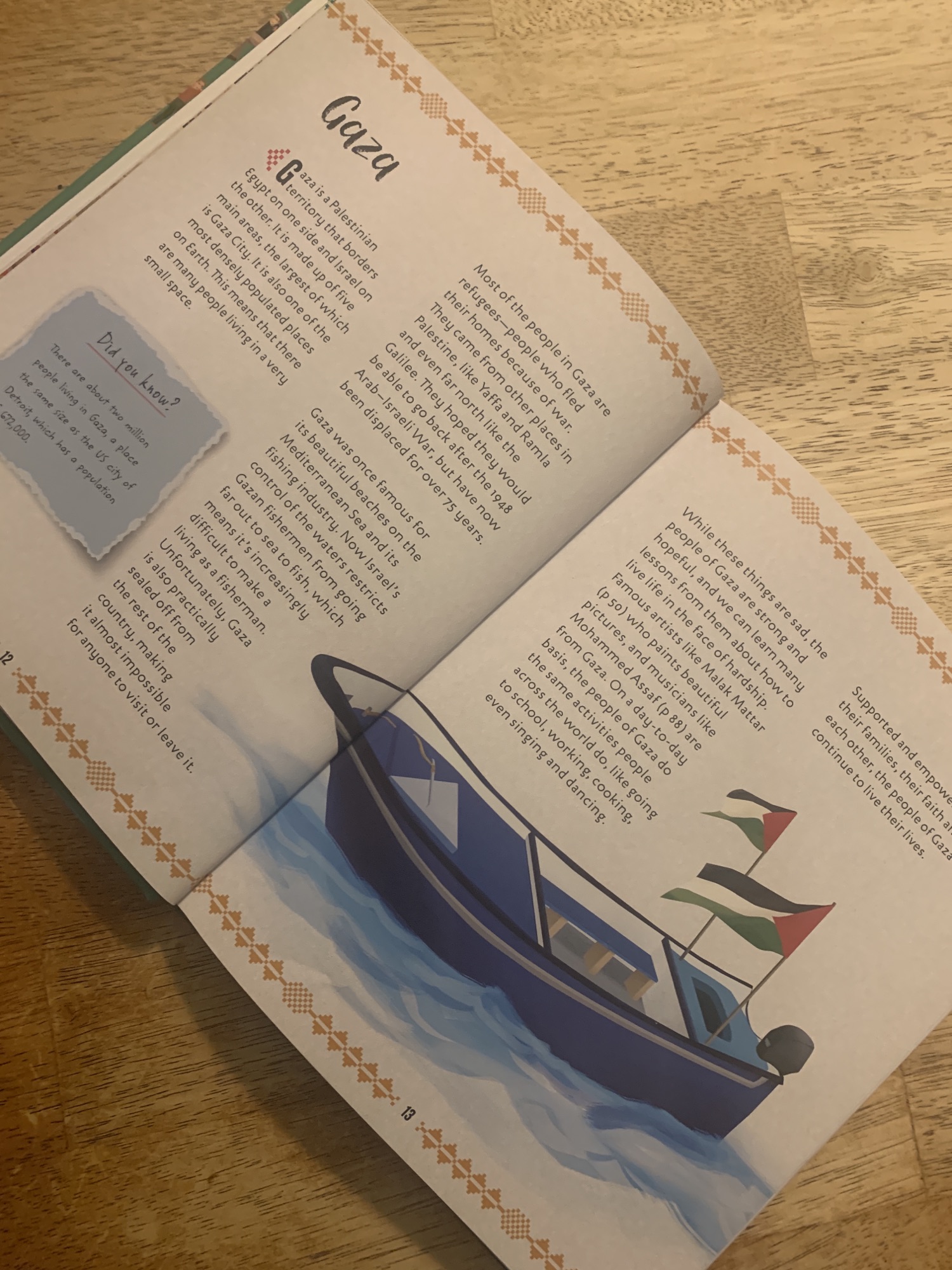
The book is non fiction, the author not Muslim, but here I am reviewing this book because, we are all Palestinian and my heart enjoyed reading this 112 page book that covers Geography, Cultural Symbols, Creative Minds, Agriculture, Cuisine, Performing Arts, and History and Religion for middle graders and up.  The book is a celebration rooted in information and expressed with beautiful illustrations, fun facts and text blurbs to break up the text.  I do wish it was sourced, and I desperately wanted a map, particularly in the section on geography- it seems odd in fact that it doesn’t have one.  The book contains information about the nakba, but doesn’t let it control the narrative or overshadow the culture that thrives in Palestine and in all Palestinians. Undoubtedly, this is an important book to spend time with and share, especially as the global media is currently working overtime in attempts to erase the richness, joy, and even basic humanity of an entire population.

img_1888-1

The section on Geography covers Jerusalem, Gaza, Jericho, Akka, Haifa, Yaffa, Nazareth, Hebron, Nablus, Bethlehem, and Ramallah.  Some cities are combined and are featured on a full two-page spread after an introductory page for the section.

img_1889-1

Cultural Symbols covers the national anthem and flag, Handala, tatreez, thobes and gold hat, hatta and egal.  I enjoyed learning more about cultural items that have become increasingly familiar, but whose origins, importance, and displays were new.

img_1891-1

The Creative Minds section focuses on people both currently still living and deceased.  I always struggle with books that highlight important people because how they are chosen is always such a mystery, and this book at least acknowledges that this is just a tip of the iceberg cross-section of people influential, talented, and noteworthy.

The Agriculture and Cuisine sections are a celebration of food and resources that most of us who have been privileged to have Palestinian friends sharing their lunch and dinner with will find particularly enjoyable.

img_1892-1

Performing Arts was informative and new to me, and I think further shows the depth and richness of the culture.  It highlights specific people, dances, cinema, and instruments in this section.

The final section of History and Religion starts with ancient history, followed by the Nakba, al Naksa, and then a two page spread on Islam and a two page spread on Christianity.

img_1893-1

Notably not mentioned in the entire book is Israel, and in the religion section there are no other faiths shared except Christianity and Islam.  The author seems to be making a point, by what is included, and what is focused on, and keeping the light shined on Palestine. There is an index, but no sources.

Safiyyah’s War by Hiba Noor Khan

Standard
Safiyyah’s War by Hiba Noor Khan

safiyyah

A.M.A.Z.I.N.G! SubhanAllah the subject matter is incredible, but the characters, writing, and Islamic inclusion really make this 327 page book a must read for all upper middle grade and lower middle school aged children everywhere. The book is historical fiction, set in Paris during WWII, the Nazis are invading and the Muslims at the Grand Mosque of Paris are covertly helping, hiding, and saving their Jewish neighbors.  Based on real facts, the book does not get lost in politics, or propaganda, or the enemy, the story stays on level for an MG reader with character arcs that are not confined to the atrocities at hand. The familial love, the friendships, the bravery of so many, really lingers long after the last page is read. Knowing that Muslims in France did this and that their stories have by-and-large been lost over time, makes this book all the more important to share with our own children.  This book fills such a void for children in Western countries wondering why WWII lessons in school never mention Muslims, and that this is traditionally published in the UK, soon to be in the USA, really is a benefit to us all.  I do wish the book was more strongly sourced, there are Historical Notes at the end, but I’d love to know where to go to get more facts about it all.  Little kid me would have been obsessed, adult me can’t wait to share this book with teachers and book clubs to discuss, teach, enjoy, and be inspired by, alhumdulillah.

SYNOPSIS:

Safiyyah lives in the apartments in the compound of the Grand Mosque and while Muslims are more-or-less safe from the imminent threat of the Nazi’s, because of their connections to North Africa, their world is still changing quickly. Safiyyah loves maps, helping run errands for her father, Ammo Kader, and Ammo Imam, and spending time with her Setti.  She also loves spending time with her best friend, Isabelle at school and on weekends.  When the Nazi presence is no longer avoidable, Isabelle and her family leave, errands are no longer safe and Setti’s beloved oranges are harder and harder to get. To top it all off, her father starts acting secretive and Safiyyah starts sneaking around to find out what is going on, unraveling a clandestine network helping those needing to get away.  Her family has no intention of involving her, but when soldiers start getting suspicious of the Muslims assisting the Jews, Safiyyah takes on dangerous roles that just maybe a young girl can accomplish without drawing too much attention to herself, the cause, and the Muslim community’s commitment to helping the innocent.

WHY I LIKE IT:

I love that the book is fast paced and the fear of being caught is always present, yet the book is able to flesh out relationships, character growth, and religious understanding.  Little details weave in and out, and the confidence that the writer is in control of all the threads allows the reader to be swept away, completely. The interfaith aspects are not just check marks, the story shows the ease in which the communities work together and their connections are tangible.  There is no internalized Islamophobia or othering, and the way that Islam emboldens the characters’ actions is so beautiful: from the larger commitment for justice, to the personal internal reflections of wearing of hijab, praying, listening to the athan, making duas for the deceased, etc..  Spending time to ruminate on the idea that breaking an unjust law to save lives through an Islamic lens is empowering, and knowing that this is the risk that real Muslims in Paris took is so very humbling. I love that the conflict of France and Algeria is not left out as the Kabyle protagonist and her grandmother note that they are now supporting those wearing French uniforms to fight the Germans.

FLAGS:

Wish making, lying, death, fear, occupation, war, destruction, oath taking on a Quran, tasbeehs, working with wine barrels and smugglers.  There is a strong familiarity with Christian and Jewish holidays, some crossover celebration.  Some Christian angel imagery being used by Safiyyah for Ammo. Sneaking, hiding, forgery, skipping school.

TOOLS FOR LEADING THE DISCUSSION:

Having only ever read one other book on this topic, The Grand Mosque of Paris, that would definitely be a reference I would present when introducing the book.  Whether in a classroom, a library, a home, a book club, I hope this book gets read, passed around, shared, and discussed.  Muslims and non Muslims alike will fall in love with persistent over-eager Safiyyah and hopefully remember the resistance the characters in the book and real life sought with courage and dedication for the good of humanity.

I own my UK copy and have preordered US copies for myself, my mom, my teacher friends and hope you will do the same (you can preorder here).  Please also request your local public libraries to shelve this important book.

Saving Sunshine by Saadia Faruqi illustrated by Shazleen Khan

Standard
Saving Sunshine by Saadia Faruqi illustrated by Shazleen Khan

img_9623

The themes, messaging and Islamic and cultural representation in this upper MG/lower middle school graphic novel are wonderfully unapologetically present.  Yet somehow, I never connected with the characters, and the plotting seemed stiff.  I don’t regret reading the book, and I’m sure most readers will be delighted with the main story of sibling annoyance, a sick turtle, and independent kids with reflective flashbacks and OWN voice threads of Islamophobia, immigration, starting to wear hijab, identity and othering.  I just felt the tropes were predictable, stereotypical even, and when the dad takes a stethoscope to a medical conference and the TSA agent doesn’t know what it is, I cringed.  Seriously, who takes a stethoscope on vacation? Who doesn’t know what one is? I normally love the author’s characters and wish for more Islam, this book gave me the Islam, but I really disliked the siblings, they were mean, angry, and annoying.  I own that reading a book about bickering kids a few days before my own five children returned to school may have jaded me, and I do think I found the religious touchstones predictable because I do read a lot of kid lit and I’m older, so while I’m not gushing in my praise for this book, I will be preordering a copy for myself and the school library. How is that for having an opinion and then completely walking it back? Yeah, it happens.

SYNOPSIS:

Twins Zara and Zeeshan bicker, a lot.  Zara loves animals and nature, Zeeshan space exploration, and both love their phones.  When the family heads to a medical conference in Key West where their mom is getting an award, the kids get their phones taken away by their parents when the two won’t stop fighting. The parents stick to their policy and the two are forced to stick together and entertain themselves while their parents attend lectures.  At one point they find a turtle and Zara takes the lead to try and help Sunshine, but will need her brother along the way.

WHY I LIKE IT:
I love that the characters identifying as Muslim was central and unapologetic.  I liked the flashbacks that provided a little bit of depth to the parents coming to America and their life in Pakistan, along with the personal reflections about starting to wearing hijab and when the kids started to go their own way.  But the airport scene, the identity issues, and the Islamophobia seemed a little superficial and over done.  The heart to hearts with the dad and his son and mom and Zara were sweet and insightful about belonging and where you come from, and not being so angry, but they also seemed very natural and in-character for the parents which is a disconnect from the anger the kids seem to carry.  If the parents are talking to them and modeling all this, it is a bit of a stretch that they are reacting as they are in the book.

I have a brother, it is just the two of us, we aren’t twins, but growing up in the 80s as the only Muslims in the area with a convert mom and immigrant dad, we came together a lot because only each other could understand the stresses we faced in and outside our home.  I thought this book would draw on that universal theme, and I was surprised that the point of the book felt a little underdeveloped.  I know MG can handle more than we give them credit for, but I felt like this book built up to have more of a warm hug, than I felt.  I wanted more of them plotting together, I didn’t feel like Zara really needed her brother to stick up for her, she wanted it sure, but that was a foot in the door that I think was missed.  She is strong, yet was being vulnerable with her brother, and he was able to step up for her, but it needed a few more beats to be appreciated.  I also wanted more connection to the turtle, his name is in the title, I thought he’d have a bigger role.

FLAGS:

Disrespect, lying, anger, yelling, bullying, teasing, Islamophobia, stereotypes, prejudice

TOOLS FOR LEADING THE DISCUSSION:

The book would allow for discussion for middle grade readers who might see themselves in the family dynamic or be able to relate to some of the Islamophobia.  It could also cause some worry for some children that being visibly Muslim or having cultural names, and wearing cultural clothes will bring negative differential treatment to them.

Available for order here

Sitti’s Key by Sahar Khader Ali illustrated by Noor Alshalabi

Standard
Sitti’s Key by Sahar Khader Ali illustrated by Noor Alshalabi

sitti key

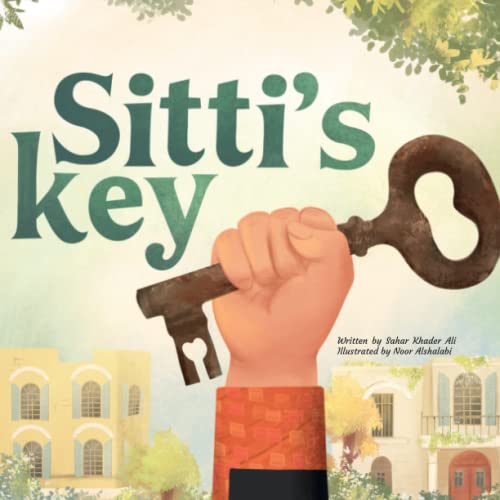
I try and buy, read, and review every children’s book about Palestine that is published, it is the least I can do.  I also try not to compare them to each other as they present different aspects of oppression, perspectives of strength, examples of joy, and messages of hope, even among many similar themes of food, keys, traditions, and culture.  I really appreciate that this book though is incredibly blunt.  It isn’t lyrical, it isn’t poetic, and as Israel is bombing Jenin as I write this I’m glad it doesn’t mince words about the Nakba. I do think caregivers though, should probably read it first as it might be a little triggering for sensitive children.  The story is OWN voice and probably best suited for middle elementary aged children.  It is perhaps also worth noting that the book could be seen as making Jews synonymous with Zionists.  The characters are Muslim, Islamic phrases and Arabic terms are sprinkled throughout, and even despite the pain the family has endured, the book stays hopeful and proud.

Sitti is coming and Amal is excited, it has been two years since she last saw her.  She loves how excited her mom and grandma are to unpack gifts of olive oil, dates, and zataar from friends.  Amal isn’t sure what to do with the “old lady thoub” she has been gifted, but she smiles in appreciation none-the-less.  When Sitti pulls out an old key, Amal starts to ask her about it, but her mother shuffles her off to bed.

The next day at school, Amal has to work on a presentation about “culture,” but there are no Palestinian books in her school library, so she just watches the other kids.  At home they eat and listen to Sitti’s stories of long ago in Haifa, and Amal asks her why she left Palestine.  Despite her mother trying to redirect, Sitti says it is time she knew about the Nakba.

Sitti tells about living on the land for generations and how the Jews believed the land belonged to them.  In 1948 the British decided Palestine would be the homeland for the Jews.  Armed men came and arrested anyone who tried to stay in their homes. Sitti’s brother was handcuffed and never seen again.  The family grabbed what they could including the key to their home as they made their way to a refugee camp in Lebanon.  They stayed for three years, before making their way to America.

When Sitti concludes her story she hands the key to Amal and her hope that she will return to their home inshaAllah.  Feeling the pride and warmth of home, Amal has a determination to reclaim her heritage and share her “culture” with her classmates.

The illustrations are sweet, the mom and Sitti wear hijab even in the home, and the inshaAllahs and salams come naturally. The book does not stop to define zataar or marimya, which helps the flow. I also like how it shows that there aren’t books about Palestine in the school library, it is strong and important detail.  I don’t understand where Sitti is coming from though, it would seem Palestine as she is bringing gifts from friends, but in the story it says after Lebanon they made their way to America, so I’m not sure where Sitti lives, and how the logistics of the family work to be honest.  I also kind of wish there was a  recipe for zataar in the book and lyrics with translation for the song the family sings.

Book is available on Kindle or can be ordered from www.littlehibba.com

The Unlovable Alina Butt by Ambreen Butt-Hussain

Standard
The Unlovable Alina Butt by Ambreen Butt-Hussain

img_9079

This middle grade book in many ways reads like a memoir, it isn’t, it is OWN voice fiction, but the chapters often come across like short stories with their own climax or punchline.  The lacking continuity of smaller threads being resolved means if you put the book down, you aren’t necessarily itching to pick it back up to see what happens next.  There isn’t a larger pressing conflict driving much of the book, yes the girl is bullied, but by one kid, and she has a great group of friends and a supportive family, so the intensity is just not present.  I do like the growth of the character toward self-acceptance, but I don’t know that the target audience will get the 90s references of Spice Girls,  CDs, lava lamps, and gel pens.  The book hits most of the stereotypical immigrant tropes of feeling othered by one’s name, clothes, food, and while she works through them to deal with the bully and find her own confidence, she unfortunately never deals with her internalized Islamophobia, which is disappointing.  She puts Islam on her parents as something they practice, and only begrudgingly seems to acknowledge she too is Muslim when she doesn’t eat pizza with non halal meat.  She is embarrassed when her friends see Islamic calligraphy at her house, hear the athan, she doesn’t reply to her parents salaams, she calls her mother “the most devout in our family” as the reason she has to wear tights under her skirt: she only seems to ok with being Muslim when outsiders give their approval.  The book for me is mediocre, nothing to rush out and buy, nor anything to pull from shelves.  I’ll send my copy to the Islamic school library shelves as the book is fairly clean: a few giggles about naked statues at the museum and very lightly hinted at boy/girl crushes. The older sister deals with a boy who wants to date her and harasses her to the point of affecting her personality, but I think if a 10 or 11 year old picked up the book and read it, they would be ok to see the characters finding their voice, good friends, and sibling support.

SYNOPSIS:

Eleven year old Alina Butt is in her fourth school in three years since arriving in England from Pakistan.  She never fits in, and never has friends, but she is determined that if she can keep her last name a secret, she might have a chance.  One the third day of 6th grade though, her last name becomes known and Adam Atkins has his eyes set on giving her a hard time.  With encouragement from her older sister and love from her baby brother, Alina puts herself out there to make friends and when the teacher assigns her a new group, she finds herself among three girls happy to welcome her in.  The new group also puts her sitting across from Adam, but at least now she doesn’t have to face him alone.

At home, she navigates life as an immigrant trying to blend her worlds.  Her loving family lives above the grocery store they own and face Islamophobia and settling in together as they each have to find their strength and voice and resilience to drive, stand up to harassment, and for Alina, to love herself.  Alina gets the courage to try out for the school play, but when she lands the part of Gus in Cinderella, she has to dig deep to be happy for her friend, forgive a bully, and step in to the spotlight.

WHY I LIKE IT:

Alina is likeable enough, and I love that she grows to love herself too, I’m not sure she was ever unlovable though as the title suggests.  I don’t like that potentially really big plot points are mentioned and then abandoned.  She cuts her bangs way too short, her mom says something and no one else ever mentions it, and she never brings it up again.  Her dad is so sick he leaves the truck on the side of the road and sleeps and the mom takes care of everything, and what was wrong with the dad is never revisited.  These are just two examples of rising action that present that they are going to be important that are seemingly undermined by the lack of follow through.

I love that she finds a way to stand up to the bully and she even helps her sister deal with the boy antagonizing her.  It is strong and resonates with the reader, but it should also be noted that as soon as she has friends, they are gossiping and being rude to Adam too.  I’m not saying it isn’t warranted, and he definitely is worse, but if she is modeling behavior she should perhaps at least feel bad teasing him even before she knows that he has a bit of a rocky home life.  Plus he is one kid with two stereotypical sidekicks, yeah he is annoying and mean, but she has friends and family and teachers that are completely on her side too.  And Adam bullies her about her name, but no one else even acknowledges it or asks her about it.

I didn’t quite get the schooling, but it is probably because I am American.  She is in middle school, but she has one teacher all day and they play on the soccer fields at break and her kg aged brother does field day with her?   The 90s references were fine for me, but I don’t know that the target audience will get some of them, and it might be a little annoying to get through for younger readers.

Ultimately, the way Islam was presented was really disappointing.  It feels like we should be past the internalized othering of our faith.  The culture was worked through and appreciated internally for Alina, but for some reason, religion was only ok when the outside influences deemed it acceptable, and I’m not sure that in 2023 this angle of narrative is doing anyone any favors.  She loves her mom, and part of the character arc is seeing and appreciating her mother’s strength, but very early on mom is labeled as “devout” even though they are all Muslim.  And this self othering to be the reason her mom is keeping her from dressing like everyone else left a bitter taste in my mouth.  Never once does it feel that Alina has a connection to Allah swt, no matter what she is going through there is no bismillah, or prayer, or dua to ask for help, and strength, or show appreciation.  I absolutely get that not every story will have that, but the way Islam is presented as something foreign and never circled back on or portrayed as something that she embodies, makes all the mentions of faith seem deliberately othering, and as a Muslim book reviewer, I feel it is an important point to mention about this book. I wonder if it was intentional or an oversight sensitivity reading would have helped resolve.

FLAGS:

Birthdays, music, bullying, harassment, teasing, othering, mention of naked statues, some sneaking and dishonesty.

TOOLS FOR LEADING THE DISCUSSION:

I wouldn’t use this as a book club selection, and as stated above I wouldn’t rush out to buy the book to shelve at home, in a class or school library, but if it found its way to the shelves I would not remove it.  The book has heart, I just feel like along the way the messaging of finding your voice and putting yourself out there to make friends, the book also hints that the Quran on your walls, modesty, the athaan, eating halal, are all things that are weird, unless your friends think it is cool, then it is ok- and that is not messaging I would really want to spread.

Stand Up and Speak Out Against Racism by Yassmin Abdel-Magied illustrated by Aleesha Nandhra 

Standard
Stand Up and Speak Out Against Racism by Yassmin Abdel-Magied illustrated by Aleesha Nandhra 

stand

The very first page of this practical Muslim authored, visible Muslim featured, how-to book draws you in with the author’s conversational tone and approach.  She presents life as being a mountain we all are born to climb and articulates that we are all given different tools to do so.  The book sets out to understand how race and racism affect the climb, how we can make it more fair, and uses questions from kids in the UK as the general organization of the 128 page book for middle grade readers and up.  As a Black Sudanese born, Australian raised, immigrant London woman who speaks Arabic, is Muslim, has authored five books, is an engineer and social justice advocate, she acknowledges privilege, and injects plenty of InshaAllahs, Alhumdulillahs, and global perspective to racism, its history, and what we can do to stand up and speak out about it.  I do wish the book was sourced, but the first person perspective, and her own intersectional identities, carry confidence and OWN voice power in making the world a better place for all.

SYNOPSIS:
The book starts with a section about how racism started, then moves into what racism looks like today and how it shows up and affects us all.  It then concludes with a focus on the action of standing up and speaking up.  The book spends time reassuring the reader that the contents might create strong emotions and to breathe acknowledge your feelings and find a safe way to express them. Chapter 6 discusses religions, even though the book is about race and says it does so because it is the same social construct of grouping a very diverse group together because of something “other” that they share.  It spends time on anti-Semitism, and Islamophobia.  The book doesn’t have to be read cover to cover, it can be read in sections, in any order, there is also a glossary and index at the back to find particular topics to look at.

WHY I LIKE IT:
As an American, I love that the book is global in focus and shows the effects of colonization and attitudes, and thus realities.  I also like that it takes time to discuss internalized racism, as well as interpersonal, institutionalized, and systemic.  Pointing out schools and how many of your teachers or principals look like you, really drives the points home.  I love that there is a whole page on hijab and truly that you see the author regularly bringing in Islam to the conversation which is great.  The action steps of what to do if you see racism, what to do if it is aimed at you, are well presented in metaphors that are easy for kids to see why the course of action suggested is doable, logical, and important.  It doesn’t shy away from acknowledging that pushing back on racism escalates the situation, and encourages individuals to be safe and do what they can. There are pull-out boxes, comic strip scenarios, bolded and bulleted text, and colorful engaging illustrations and infographics that connect with 9 year old and up readers independently or in small groups.

FLAGS:

The book discusses an emotional topic, but I don’t think there are any particular flags to be noted for 4th grade and up  There are important conversations to be had based on what is shared, but nothing is overly graphic or sensationalized.

TOOLS FOR LEADING THE DISCUSSION:

I think this book would be great to share with students regularly and often.  It should be on library and classroom shelves and should be used in small groups, large groups, and one-on-one.  The variety of methods that the information are conveyed make a useful tool when concerns arise, and a great reflective piece to encourage children to think deep, better themselves, and be aware at all times about the privilege and effects of their thoughts and actions.

Available for preorder on Kindle here https://amzn.to/3PH98u2

The Boy Who Saved a Bear by Nizrana Farook

Standard
The Boy Who Saved a Bear by Nizrana Farook

bear

There is nothing Islamic and there are no Muslim characters in this middle grade read, but this being the fourth and final standalone book on the island of Serendib, by a Muslim author, with a lot of heart, kid led adventure, and fun, made me want to share it here.  The beginning is a little bumpy, and sure you have to suspend reality a bit, but this story about a boy, expectation, friendship, perseverance and saving the day, had me invested and cheering for Nuwan to succeed.  The story is just under 200 pages, and I love the subtle references to the other three books with sight mentions of an elephant, a leopard, and a whale.  If your kids liked the other books, they will love this, and if you are in need of an easy, fast paced adventure, this book is great for readers 8-12 years old.  I felt slightly offended by *SPOILER* librarian villain, but it is a work of fiction, so I’m hoping one bad apple, doesn’t dim the light on a very honorable profession.

SYNOPSIS:

A key has been found that opens an old statue and secret treasure, Nuwan wants a closer look and combined with him wanting to prove himself to his family that he is as capable as his older brother Krish, he finds himself sneaking into the library and discovering something unsettling going on.  What starts out with him taking books from the North Library to the Kings City soon becomes him avoiding blame for stealing the key that is making its way to the queen, and saving a bear who wears the key around his neck from being captured by the wilderness authority for being dangerous.

WHY I LIKE IT:

I love that it is about a boy and a bear, but underneath the adventure it is about a boy accepting himself and finding his place in his family.  His friend Sani has to help him see his worth, but she’s a pretty fierce character and I like that they can have those kind of conversations.  Nuwan is a good kid and it is nice to see that even though he doesn’t see it, the reader sees how big his heart is, his strong his moral compass is, and how powerful his drive is.  I do wish it said what was in the statue, or what happened to the librarian and her husband, but the conclusion stayed on the kids, and it was heartwarming.

FLAGS:

Lying, sneaking, stealing.

TOOLS FOR LEADING THE DISCUSSION:

I doubt I’d do it as a book club, it is well below a middle grade reading level, but definitely is a must on school, classroom, and home book shelves.  The added beauty is how pretty the book’s cover is and how it is magnified when placed next to the “matching” books in the series.

The book is out in the UK, but not yet in the USA: you can preorder/order yours from Amazon here: https://amzn.to/42Nwilp

The Kingdom Over the Sea by Zohra Nabi

Standard
The Kingdom Over the Sea by Zohra Nabi

kigdom

This 336 page middle grade fantasy book had a lot of promise for me, but ultimately fell a little flat.  The protagonist was likeable, there was emotion, the story was compelling, and I know it is widely said that debut novels tend to be a little weak or be underdeveloped or having pacing problems, yet I hesitate these days to use this as an excuse.  I’ve been around the industry a few years and it seems many author’s debut novel, is not, in fact, the first book they’ve written or even the first book they’ve “sold.” Books are written and finalized years before they are released for some genres particularly of late, so I’m trying not to let myself get caught up in the author’s writing journey (I’m sure I’m all sorts of wrong about what I think it would be anyway), and just review the book in front of me. This book has no religion, and I don’t know if the author identifies as Muslim.  There are a hodgepodge of Arab and Desi cultural references in the characters’ names, and in the sprinkling in of salwar qamis, abaya, head scarf, sambusak, and there is a ma’a salama at one point along with the presence of jinn (not religiously referenced). There is also mention of medicinal wine, magic, a lady who has a crush on another lady in her youth, music, and dancing. The book held my interest as I wanted to see how it unraveled, and I recognize that there is a book two, so some of my thoughts might be premature, but I struggled with the premise of the protagonist trying to understand the journey her deceased mother has sent her on, and how the person she was supposed to find for the answers simply won’t talk, even though the two are living together.  It made the story really drag in places and seem underdeveloped.  The world building, the backstories, the adventure at hand, really is imaginative, but the development of the relationships in the story are absolutely non existent, and the book overall suffers because of it. Also the ease in which rising action is resolved is often the kids just throwing an idea out and it being right.  I read and review through a critical lens and many recent middle grade fantasy books have been absolutely incredible, perhaps it isn’t fair to compare, but this book just came up short for me in developing memorable characters and plot, even though all the elements were present, capitalizing on bringing it all together stayed just out of reach unfortunately.

SYNOPSIS:

Yara’s mother has died and when she finds a letter with instructions of what to do and where to go should this moment arrive, she decides to dodge her social worker and journey to a world of magic across the sea.  Unsure of her own background, she thinks she might be Iraqi, but doesn’t speak Arabic, she longs to find a place to belong, and when she arrives in Zehaira and hears the language of her mother, she is hopeful that this Leyla Khatoun, who lives in the third to last house on Istehar Way, will provide her with answers. But alas Leyla is not there, the Sultan’s alchemists are, and Yara is now on the run in a foreign land.  Help finds her and with a little magic she finds Leyla.  Leyla begrudgingly takes her in, but refuses her any insight into her past, her relationship with her mother, or why the letter directed Yara to her.  As the alchemists poison the sorcerers, Leyla and some other kids (friends?) have to find a way to save the settlement and magic in the land.

WHY I LIKE IT:

Yara as a character is likeable, she is plucky, resourceful, determined, and despite her circumstance does not want or need pity or handouts.  She advocates for animals, the poor, is a grassroots organizer, and unapologetic in how she carries herself.  I love that she isn’t whiney or helpless, and that she trusts herself to problem solve and isn’t afraid to think outside the box, while maintaining her kindness and appreciation for those around her.

As someone who doesn’t like Alice in Wonderland type stories, this book grounded the world building in an easily consumable way, so even though it is Yara leaving the UK and stepping into a new world, the functioning of the new world didn’t feel random or surprising.  While this was beneficial for someone like me, it made the focus of the story more on the characters’ relationships in enhancing the plot, and the book wasn’t strong in showing those connections.  Yara meets a map maker for a moment and a cat, and months later recalls the cat and the map maker by name and face.  A boy, Rafi, who is also studying magic and Yara don’t get along, yet are friends because it says so, the book doesn’t show us their bond.  Rafi meets some great uncle and the great uncle is painfully underdeveloped (along with his “friend”) and the tangent weak in reinforcing the major climax. The relationship between Yara and Leyla is the center of the story and so glossed over, there is no tangible connection, or cathartic release when details emerge, it was very disappointing to say the least. Yara and Ajal, the jinn, what is that relationship even, she frees him à la Aladdin freeing the Genie, but they are friends, not friends, he looks out for her, but doesn’t like her, the telling and the showing don’t align.  Even Yara’s relationship with the settlement and the inhabitants is disconnected from the plot of saving magic.  The climax is weak because we, the reader, don’t feel any connection to any magical folk.  The emotion of the mother dying at the beginning and the slight retrospection (I’m not going to spoil it) of the mother’s love at the end, was developed and made me invested in Yara, that same energy did not present itself, sadly, in any other relationships in the book.


FLAGS:

Death, loss, poison, imprisonment, magic, mention of medicinal wine, one line mention of a female character liking another female character as more than a friend, dancing, singing, jinn, torture, male and female friendships, destruction, lying, sneaking.

TOOLS FOR LEADING THE DISCUSSION:

I wouldn’t use this as a book club selection and wouldn’t go out of my way to shelve it in the school library or classroom library.  I will probably read the second book though and see where the series goes and reevaluate. I will also probably read future works from the author as the sparks of good story telling and writing definitely show promise for the author even though this particularly book wasn’t “magical” for me.