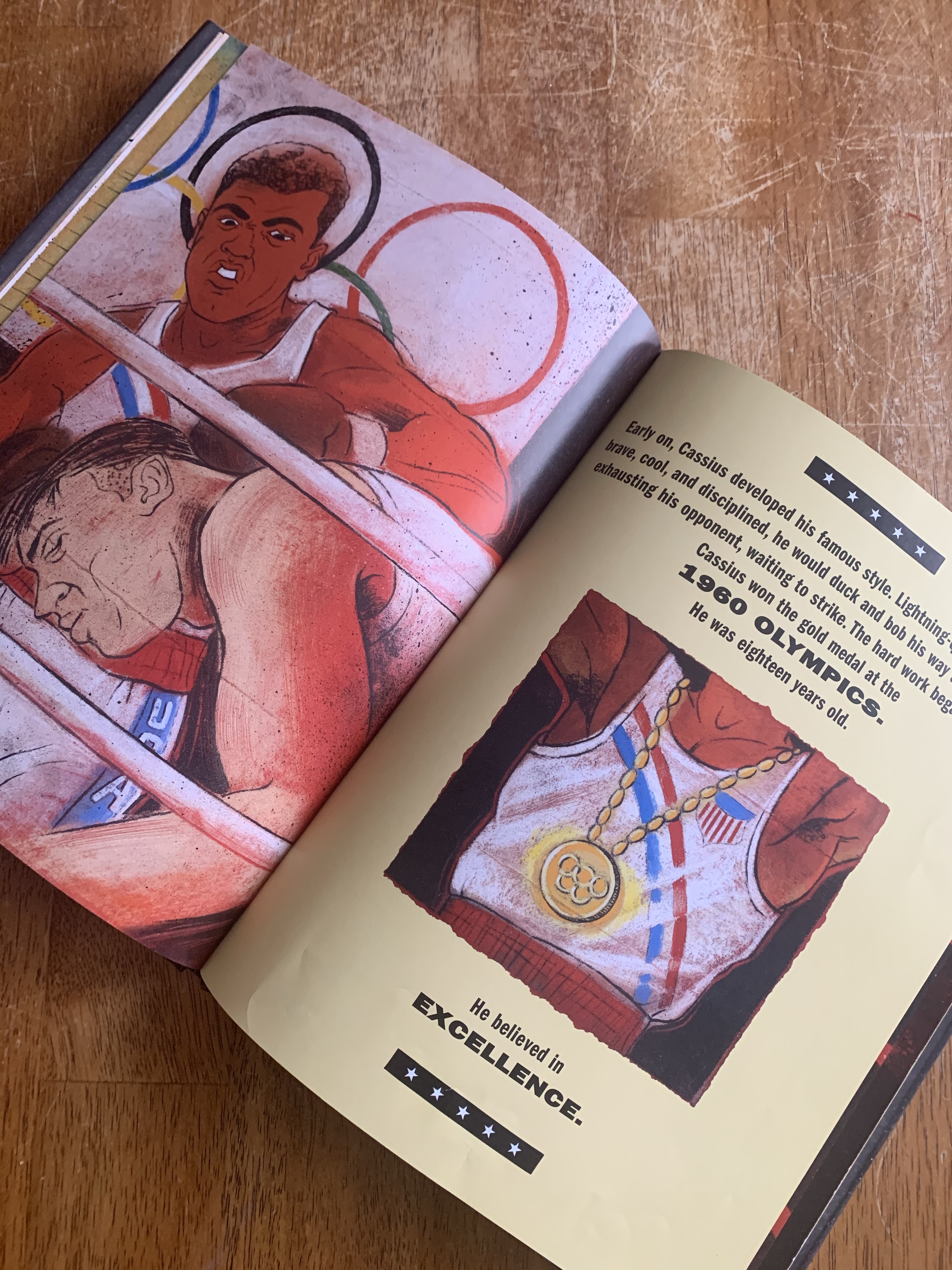
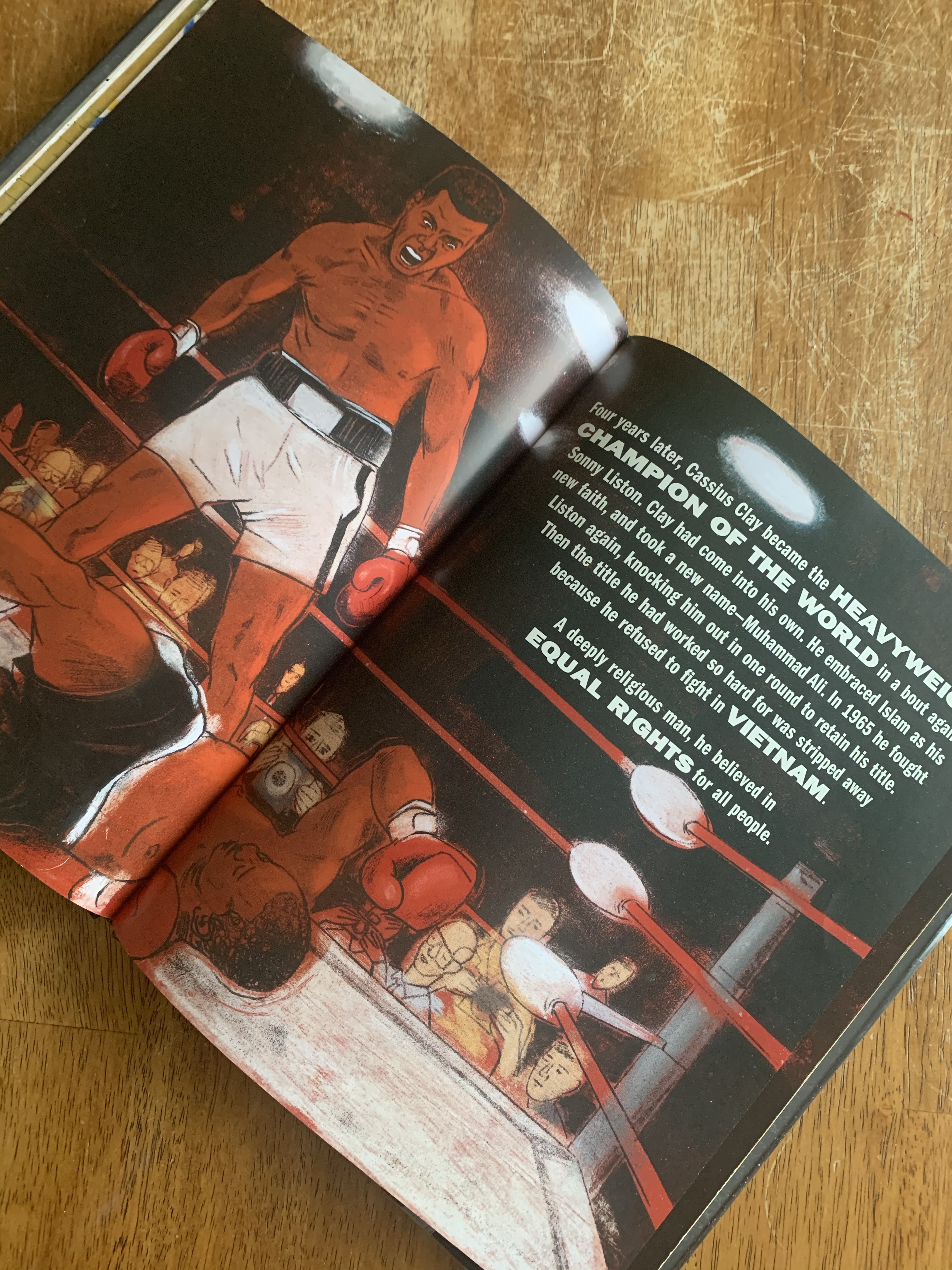
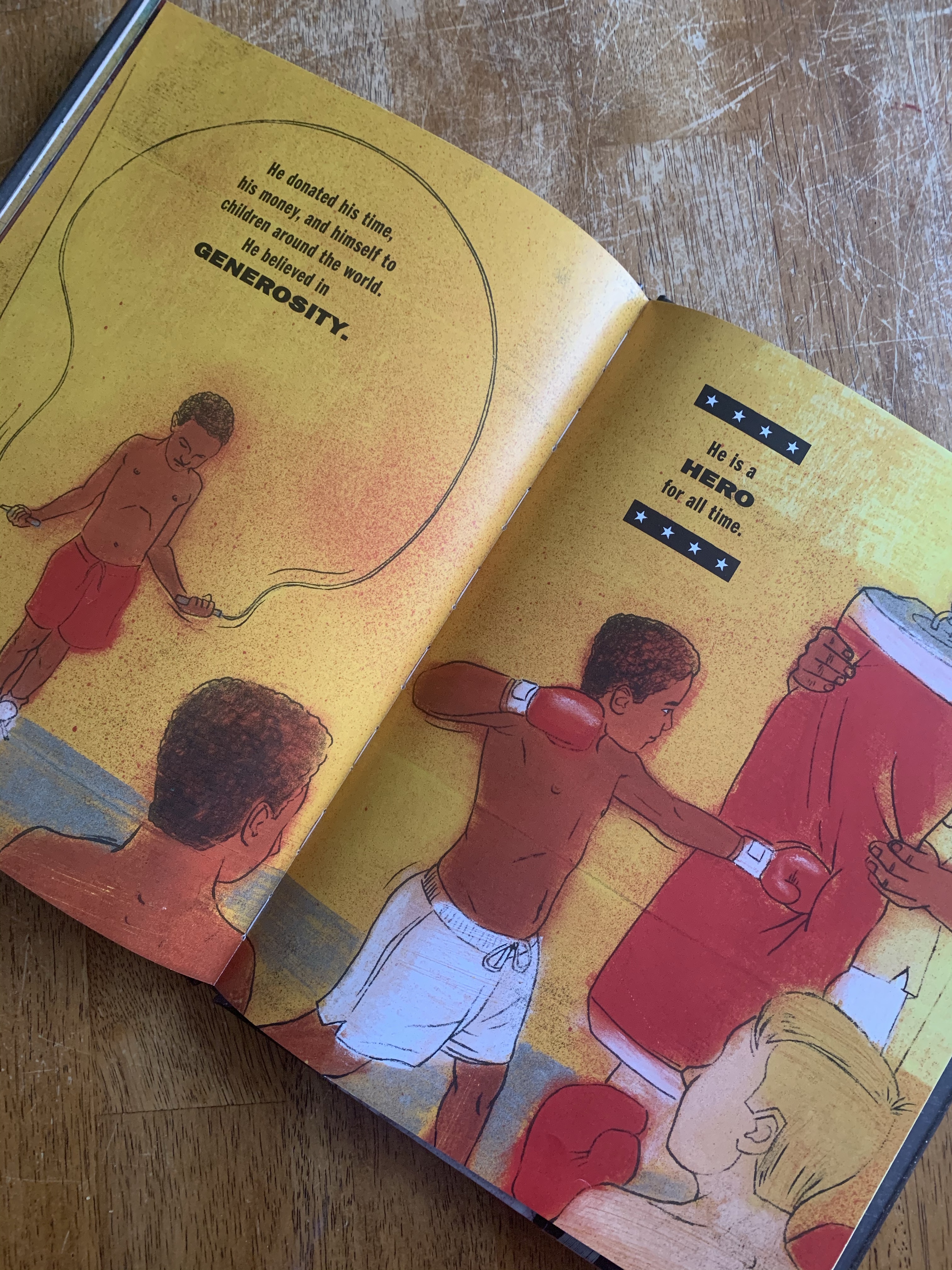
This 40 page biography beautifully presents major events of the famous boxer’s life without going in to much explanation. While it is an AR 4.7, it is still a picture book, and might work better for younger kids with some conversation and context, than for middle grade readers looking for anything in-depth about the beloved hero. While following his life, the reader sees him as a child growing up before he becomes famous, and sees that even after he retires, he is so much more than just a boxer, he is a compassionate leader, icon, and humanitarian.
Born in Louisville, Kentucky in the Pre-Civil Rights South as Cassius Clay, he struggled to understand why there was only a white superman, and questioned if heaven was divided up by color and income like Smoketown.
Cassius loved the power of words and would help his father make rhymes as a sign painter. When his bike gets stolen he is motivated to learn to fight so that nothing else is ever taken from him and his. He may not be the colored superman, but he is determined to be lightening fast and have fists that fly.
In 1960 at age 18 he won Olympic Gold. In 1964 he converted/reverted to Islam and changed his name to Muhammad Ali days after becoming the Heavyweight Champion of the World. His titles were stripped from him, however, when he refused to fight in Vietnam.
Years later in 1971, the Supreme Court reversed his convictions for not fighting and in 1974 he reclaimed his title by beating George Foreman in “The Rumble in the Jungle.” In 1981 after winning, keeping and losing the title, Muhammad Ali retired from boxing for good.
Muhammad Ali suffered from Parkinson’s disease but still donated his time, his money and himself. He believed in perseverance, and equality, and fought for what he believed in. He passed away in 2016 at the age of 74.
This is an updated edition from the 2002 originally published book, it now includes his death. I wish it was more than a fleshed out timeline and showed him as a person, or what it was like to lose everything when standing up for something you believe in, or explained what some of his catch phrases meant, or really just as a more high energy celebration of his life.
This middle grades companion book to Amina’s Voice, reads in much of the same way as a lot of Hena Khan books in that I feel she is presenting Pakistani Muslims in America to non Pakistani non Muslims in the west. In the first quarter or so of this 288 page book that takes place in Lahore, I felt a different tone than really spoke to me. Granted I am (half) Pakistani and Muslim, but when Amina says good-bye to her family, I was in tears. It was relatable and powerful and so real to me that I got emotional, the rest of the book, sadly, not so much. It’s not to say that it isn’t well written, I just feel like the majority of the book are borderline issues for many Muslims looking to see themselves in literature: music, school dances, boy/girl friendships, and when presented that a religious family is permitting and celebrating of these issues, it seems to be trying to make us fit in, rather than support us for holding to a different perspective. There is a lot of good in the book about finding your voice, sibling and family relationships, friends, and challenging stereotypes, that I think the book would be great for some 3rd graders and up. However, if your family is against the aforementioned potential flags you may find the book that talks about reading Quran and praying makes the characters harder to separate from your own kids, you may want to hold back in recommending it to them. Don’t get me wrong the book is clean and well done, I just know from personal experience that sometimes when characters do things that you family doesn’t agree with it is easier to say that those things are for them, not us, but when the family doing them looks a lot like your family, you have to be ready to explain the differences.
SYNOPSIS:
Amina is in Lahore exploring the city with her brother and cousins. She is visiting her uncle who had come to visit in Amina’s Voice and as the trip comes to an end, she doesn’t feel like she is the same person that came to Pakistan a month ago. She is closer to her older brother Mustafa, she feels connected to her extended family, and she is growing more comfortable with pieces of her self she didn’t know existed before. Excited to go back to America and tell her friends about her summer, she finds they really aren’t interested, and she is unsure how to keep her promise to her uncle to show the world the beauty of Pakistan.
Once school starts, Amina is assigned a wax museum project in Social Studies that requires her to research and present a person that has changed the world. She picks Malala, but when she explains to her class at a midway check how Malala was shot for going to school, rather than feel inspired, her classmates feel sorrow that Pakistan is so backward and oppressive, the complete opposite of what Amina felt surrounded by such vibrancy and strength while in Pakistan. Determined to set things right, she reaches out to her cousins and uncle in Pakistan, except her uncle is back in the hospital and worry consumes Amina and her family, who are torn with being so far away from their loved ones.
At the same time Amina is feeling like her best friends Emily and Soojin are drifting apart. Emily is in chess club, Soojin is running for class president, and Amina just wants to write music, produce songs and sing. There is a new kid Nico, who is half Egyptian, and has music computer software that when he offers to help Amina produce music she says yes, and he starts spending a lot of time at Amina’s house.
Friends new and old along with immediate and extended family, love and support Amina and cheer her on as she finds her voice to share the beauty of Pakistan, fight for her friendships, and be content with all her pieces that make her unique.
WHY I LIKE IT:
I love that Amina realizes her culture is more important than following rules and her grade. She breaks from the assignment to spread light on more strong, brave Pakistani women than just the one, and is ok with her grade suffering as a result. I love that she realizes the headlines don’t reveal reality and that you have to see more than one side to the story. I love that she is religious and that the imam is cool and that her whole family is service oriented and compassionate. I love that her friends are diverse and their families are close friends as well. The sense of community established is carried over from the first book, and I think it gives the book a level of comfort that is pure and honest.
I have issues with Amina’s family being ok with her going to the school dance. She goes with her female friends, but to me it seems like a conversation is missing or she shouldn’t be going. It is mentioned that Mustafa went alone to a high school dance, but never explains why. Similarly, Amina is nervous about having Nico over and her family at times is bothered by it, but again it never specifies why. I feel like if there was a conversation about why her family would be weird about it or why she is nervous to tell her mom that the friend coming over is a boy then when Amina reminds her mom that her best friend in kindergarten was a boy and everyone was fine with it, or that when her mom asks if there is anything more than friendship going on, the reader would know why it is such a big deal. It seems to skip the explanation part and jumps from the nervous to have a boy who is a friend, to defending the friend being a boy, and skip the why part.
I didn’t get why Nico identifies as Muslim and Christian but never says salam, and I especially didn’t get why Amina’s mom was more relaxed when she thought he might be Muslim.
I also wish that after the whole emphasis on music, that the lyrics would have at least been shared. I was looking forward to it and was let down by it not being shared.
FLAGS: Nothing blatant.
TOOLS FOR LEADING THE DISCUSSION:
I don’t think that this would work level wise or content wise for a middle school Islamic school book club.
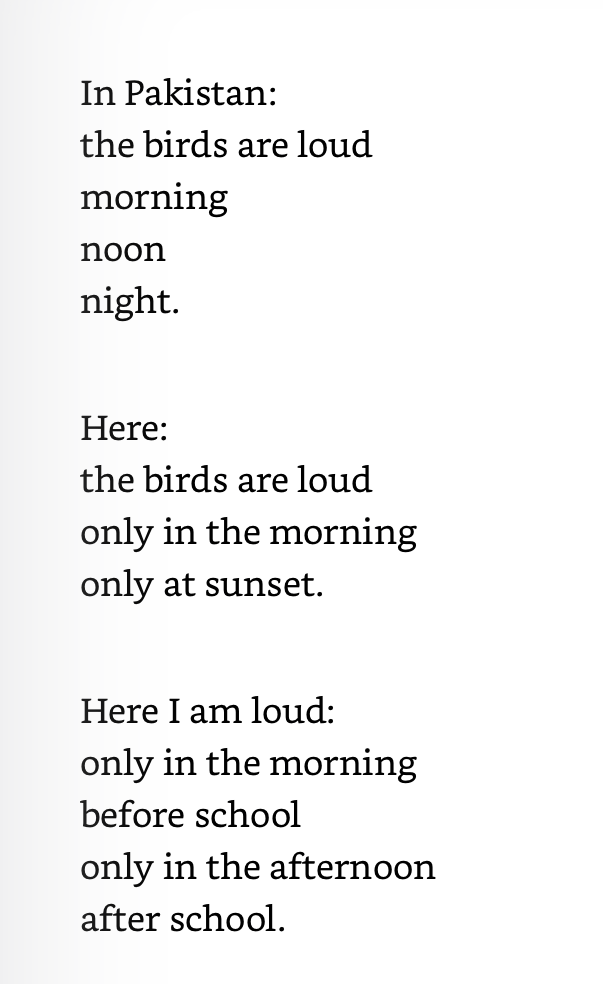
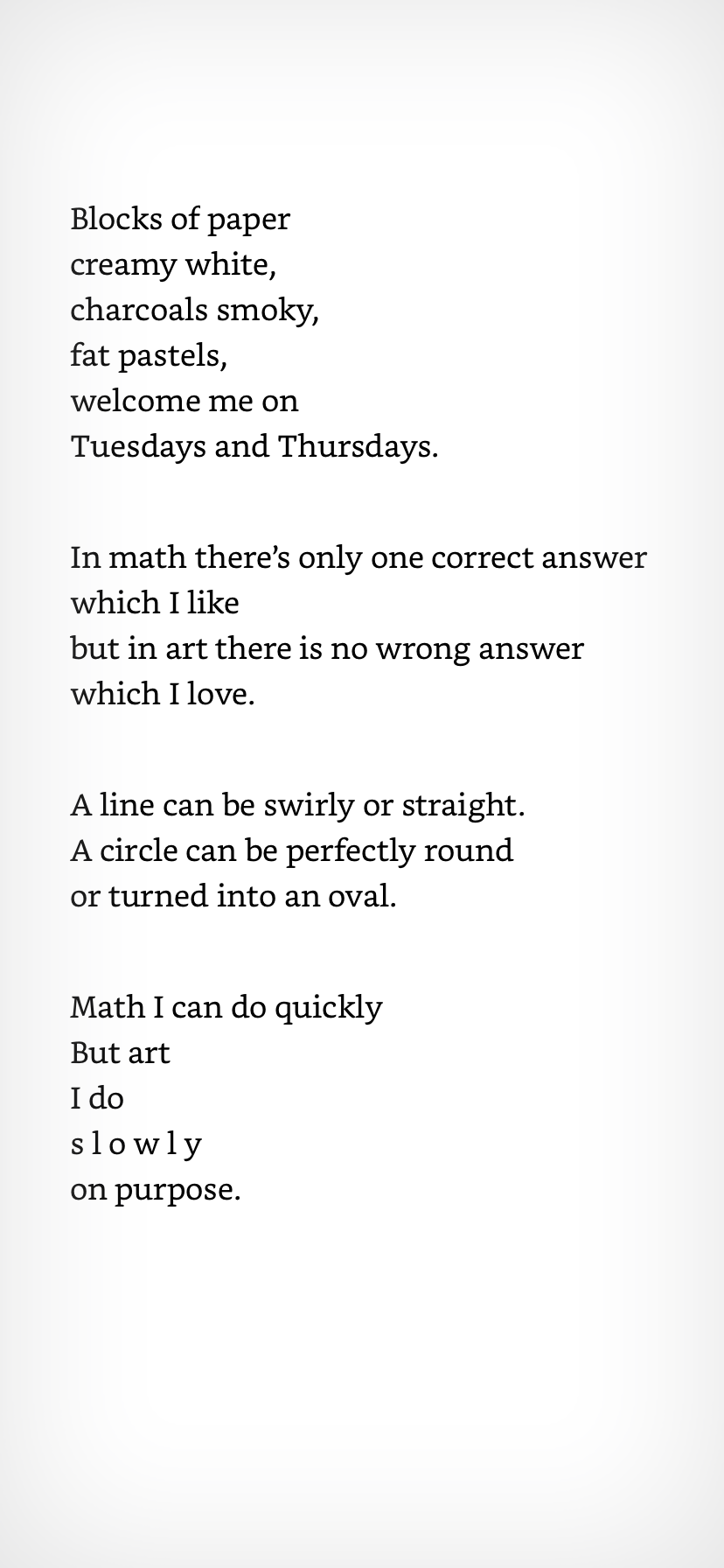
This book is a great OWN voice, middle grade coming of age book that rings with truth and hope in its poetic lines that sweep you up and keep you cheering. Over 352 pages the author’s semi-autobiographic story of coming to Peachtree City, Georgia from Karachi, Pakistan beautifully unfolds. I absolutely loved this book and the way it is told, in verse. The details, often small, ring with such sincerity that even those that have never moved to a new country, or been to a new school will feel for young Nurah Haqq and be inspired by her success, touched by her hardships, and disappointed in her mistakes.
SYNOPSIS:
Nurah’s best day is spent on the beach with her best friend Asna, playing in the warm waves and riding camels. However it ends up also being her worst day, when she returns home to her father’s news that they are moving to America. Strong, confident Nurah who spends time with her grandparents, swimming with her older brother Owais, and excelling at math in school is reluctantly leaving it all behind to start anew.
When they arrive in Georgia the family of four settles in a hotel until they find a house. Everything is different and new, and the transition with no friends and family difficult for the entire family. The way words are pronounced, the way the air feels and the birds chirp all make Nurah long for home. When they find a swimming pool at the rec center, things start to slowly change. Owais was a medal winner in Karachi, and will be one here too, people start admiring him, and Nurah tries to bask in his light.
School starts and math is a relief, but people are white, so white, and a boy reaches out to shake her hand. She feels betrayed that she has been told the schools in America are better, and lunchtime, with no one to sit by is a huge stress. She questions her clothing, her appearance, and the weather.
Her and Owais try out for the swim team and make it, and Nurah makes her first friend, Stahr. Stahr lives a few houses down from their new house and when Nurah’s mom has a miscarriage, it is Stahr’s mom who comes to show support and give comfort. The support is reciprocated when Stahr and her mom need help escaping from her abusive father.
As Nurah works to win swimming races and be more like her brother, she works to find her voice and use it to defend others and herself. A terrorist attack committed by someone claiming to be Muslim sets the family up to be targets. In a moment of jealousy, Nurah doesn’t intervene to help her brother and the consequences are huge.
WHY I LIKE IT:
I love the details and how they are articulated. I related to so much of Nurah’s feeling and impressions, that I reached out to the author and found her to be just as endearing as her character. The feeling of being different when swimming because of your decision to be modest, the role of food to comfort you and make you feel at home, the older brother that you so desperately want to resemble and be like: All of it hit close to home for me. I love how religion and culture are so much a part of the story and about the character’s identity, not to be made preachy, just to understand her and her experiences. She goes to the masjid, she prays, she starts to wear hijab. I love how she finds her voice and defends those that can’t, but that her path is not easy. She makes mistakes and she has to challenge herself to do what is right. The backdrop is always trying to “settle” in a new place, but the story has it’s own plot points that are interesting and simply made more impactful by Nurah’s unique perspective.
There are lots of little climaxes and victories for Nurah that show her to be well-rounded and relatable. You cheer for her early on and enjoy the journey. The only slight hiccup I felt was the name confusion of her Nana and Nani (Nana), it is explained, but it was a little rocky for me, it might be based on a real thing in her family, but once that is resolved, the book flows beautifully and smoothly.
FLAGS:
Nothing a 3rd/4th grader would find alarming, but none-the-less:
Crushes: Nurah has a crush on a boy at school when he shakes her hand and picks her for a lab partner, but she moves on from him while still maintaining a crush on her brother’s friend Junaid. Nothing happens, she just thinks they are cute.
Miscarriage: Her mother has a miscarriage and it details a blighted ovum and the mental strain on the mom and family in the aftermath.
Abuse: Stahr’s father is abusive
Hate: There are bullies, discrimination, physical violence.
TOOLS FOR LEADING THE DISCUSSION:
The book is a little below level for my middle school book club, but I think it it was on a bookshelf and a middle schooler picked it up, they wouldn’t set it down until they were done reading it.
Breathe, deep breaths, exhale, phew. This book is good, like really good, but it ends on a cliff hanger and I was not prepared for it because I read a digital copy and didn’t think 528 pages had gone by. Needless to say I was not emotionally prepared for there not to be a resolution. Then the afterward said it was a duology, and I may have freaked out and contacted the wonderfully patient author and had her talk me down, because such words could imply that Thorn was book one. Also, when I’m frantic I don’t read clearly, but now all is well, she assured me there will be a conclusion, inshaAllah, to Rae’s story. Picking up chronologically where Thorn left off, this book is a companion in the Dauntelss Path series, but follows a different protagonist and while I highly suggest reading Thorn first, it is not necessary to understand this original tale. So, phew, I am breathing again, and happy to venture back to Menaiya to share my review of a lovely story, written by an amazing Muslim who once again weaves such an engulfing tale that doesn’t drag or have holes in the narrative, is filled with strong female characters, and text that reads so effortlessly it just sweeps you away. Truly it is fun for middle school and up (13+), and clearly I’m not passionate about books and fictional characters and don’t need to get a reality check.
SYNOPSIS:
The book opens in a small village where Rae is in the market with her littlest sister Bean and their friends, Ani and Seri, when the unspeakable happens: Seri goes missing. This isn’t a tale of a child who has wandered off, it is about a child taken by the snatchers and the materialization that the rumors and horrors they have been hearing of children being taken, becoming very real. Niya, Rae’s middle sister is a secret mage who tries to track Seri, but can’t break through the mark that keeps her hidden. As the townsfolk exhaust all resources and resolve she is just another child lost, Rae gets an opportunity to find answers. Her pregnant cousin has invited her to spend the summer at the royal court and attend the wedding of Prince Kestrin and Princess Alyrra. Convinced that the palace must have more information about the snatchers, Rae reluctantly agrees to go and investigate what is being done to stop the country’s loss of children. Rae is nervous to leave her horse ranch, afraid of the teasing she will receive because of her twisted clubbed foot, but above all desperate to help her friend’s family.
Everything about Tarinon baffles Rae: the extreme poverty on the outer skirts of the palace, the vacant stares of the children, the ignorance of the courtiers, the politicking and secrets. She doesn’t get much time to ease into this new role though, because she is thrust head first in to it when asked to be one of Princess Alyrra’s attendants. She once again reluctantly agrees, with the hope of getting answers to help recover Seri and other lost children. After tests to gage if the princess can trust Rae, the two join together to secretly unravel what is going on. This work in and of itself is incredibly dangerous as those that ask questions often go missing. Her work is compounded when the princess sends her to get information from the head of a thief ring, Red Hawk, and his informants. The closer Rae gets to answers, the more perilous situations she gets in and out of, often having to count on her bravery, determination, and wit to stay alive. She finds an unlikely ally in Red Hawk’s right hand man Bren, help and friendship in an employee in the tax office, Kirrana, and the need for favors from a Fae mage and his Cormorant. As the investigation progresses, it leads to battles with neighboring thief rings, Rae held hostage at one point, getting her finger chopped off at another, the Circle of Mages seeming guilty, and royalty within the palace duplicitously involved. All this while a week long royal wedding is underway and the princess’s brother is attempting to kill the princess. No wonder 500 plus pages still ends with a cliffhanger, eh?
WHY I LIKE IT:
I love the world building and detail and speed of the story, but I’ve really delayed writing this review as I try and pinpoint and articulate what it is about the characters that I truly am invested in. And the answer is, I really don’t know, it probably it isn’t just one thing. They are believable, and flawed, yet so very strong. Rae in particular has her own self doubt and questioning, but she is a force and she makes mistakes, yet is still gracious and humble, she really is well rounded. There might be some romantic twinges between Rae and Bren, but she isn’t going to compromise one bit of who she is for him or anyone for that matter, which doesn’t mean though that she isn’t still growing and learning. The book absorbs you right away, there aren’t dull parts that you skim over, or character’s that you mess up and have to go back and clarify. Unequivocally, the writing is superb.
The snatchers are inspired by the slave trade and child trafficking that unfortunately is not fiction and is all too real. I think the edginess and intensity is heightened when that realization occurs for the reader to see that it isn’t just a fictitious conflict within a fantasy plot.
There is nothing Islamic in the book, the characters have their own religion that pops up as Speakers are involved in healing the recovered children and Alyrra goes to pray at one point, but it doesn’t detail what that looks like. The author is Muslim.
FLAGS:
The book is remarkably clean, especially for the genre. It does mention that some of the girls snatched end up in brothels, and the guards sent to investigate take advantage.
TOOLS FOR LEADING THE DISCUSSION:
I think I would absolutely do this for a middle school book club book. To open the students eyes to quality writing, taking a real problem and nesting it in fiction to be sorted out, and just to see their response to the journey that Rae under takes would make for a great lunchtime discussion. The book has not been released yet, so there aren’t a lot of reader’s guides or author interviews about it, but I suspect there will be soon.
This graphic novel jammed pack with sleuthing, friendship, and diversity is perfect for ages 8 and up. The inclusive cast shows motive and growth keeping anyone from being entirely good or completely villainous and strikes a wonderful balance of insight, community building, and relatable fun. From the main character’s mom wearing hijab, and random hijabis in the background panels, to characters of color, and characters with social obstacles, there are also bullies, cancer survivors, a character with two moms, working parents, and a missing gecko all coming together over 221 pages to leave the reader waiting for the next book in the series.
SYNOPSIS:
Jamila has just moved to the neighborhood and with older brothers as role models, she just wants to spend her summer shooting hoops and taking it easy. Her mom, on the other hand, wants to send her off to science camp. Shirley, is incredibly perceptive and wants to spend her summer solving neighborhood crimes, the ones adults won’t or can’t help with, but her mother has signed her up for dance camp. When the girls cross paths at a yard sale, Shirley uses her wits to convince her mom and Jamila’s mom to let them spend the summer together at the basketball courts, thus both girls get what they want. The two girls aren’t exactly friends, but the arrangement benefits them both, and the days go smoothly, until a gecko goes missing and Shirley and Jamila have to decide to break their parents’ rules to leave the courts and venture to the swimming pool to investigate. Jamila and Shirley hit a snag in their understanding of one another and realize they want to be friends, something neither of them currently have. As they work Oliver and Vee’s case to find Enoch the gecko, the reader meets lots of neighborhood characters, from life guards to daycare informants. And as the clues come together so do a group of kids, all needing friendship, kindness, and a little understanding.
WHY I LIKE IT:
I love the Nancy Drew, Great Brain, Encyclopedia Brown, vibe of the story. It is funny and plausible and about so much more than just the case. It is quick and well drawn, and really just a joy overall. I love the diversity and teamwork and innocence of a summer and some good old fashion kids using their brains to save the day.
Other than the mom wearing a scarf when out of the home and a few hijabis in the background there is no textual mention of religion. The mom at one point says something in Urdu and the family has Muslim names.
FLAGS:
One of the side characters mentions that she has two moms. It is mentioned once, it isn’t dwelled on, and in many ways I think a great way to explain to your kids, if they mention it, that they might have friends and classmates with different family structures. I love that fiction allows for this conversations to occur in the abstract so to speak, you can guide your children how to handle these differences while talking about fictional characters, and imparting your families view of such matters in an open and hopefully non judgmental or hateful way.
TOOLS FOR LEADING THE DISCUSSION:
As always with graphic novels, they just aren’t the best format for book clubs as they are usually quick reads. The target audience for this is middle grades as well and while middle schoolers might enjoy it, they would read it in less than a half an hour and there really wouldn’t be much to discuss once the case is solved. I would highly recommend checking your local public library for the book, that is where I found my copy, and happy reading!
This engaging and fun early middle grades detective story set in England, features a female protagonist of Pakistani origin who stumbles on a crime at her cousins mehndi party. Over 231 pages with illustrations and flourishes, Agent Zaiba along with her younger half brother Ali and best friend Poppy will have to solve a case, avoid a nosy cousin, try not to ruin their clothes and so much more while stuffing their pockets with samosas and pakoras, and making sure they make it back for all the traditional events as well. There is nothing Islamic in this culture rich book, but with names like Fouzia, Samirah, Tanvir, Mariam, Maysoon, and Hassan, Muslim children or readers with sub continent familiarity, will feel an immediate reflection of themselves in the story. I have no idea what religion the author identifies as either, but from what I can Google, it seems to be an OWN story book and the richness and integrity of the minor details would suggest first hand knowledge. Anyone looking to see a strong minority female lead with good friends, an open mind, and impressive sleuthing skills, should hold on tight as the agents assemble to get to the bottom of a theft and save the day for a beloved cousin.
SYNOPSIS:
Zaiba idolizes her Aunt Fouzia who is a real detective and owner of the Snow Leopard Detective Agency in Karachi, Pakistan. Aunt Fozia’s daughter Samirah is getting married and with the Eden Lockett mystery books Zaiba inherited from her mom when she passed away, this party at The Royal Star Hotel is the perfect venue to test out her observation skills and other lessons she has learned from devouring the famous books.
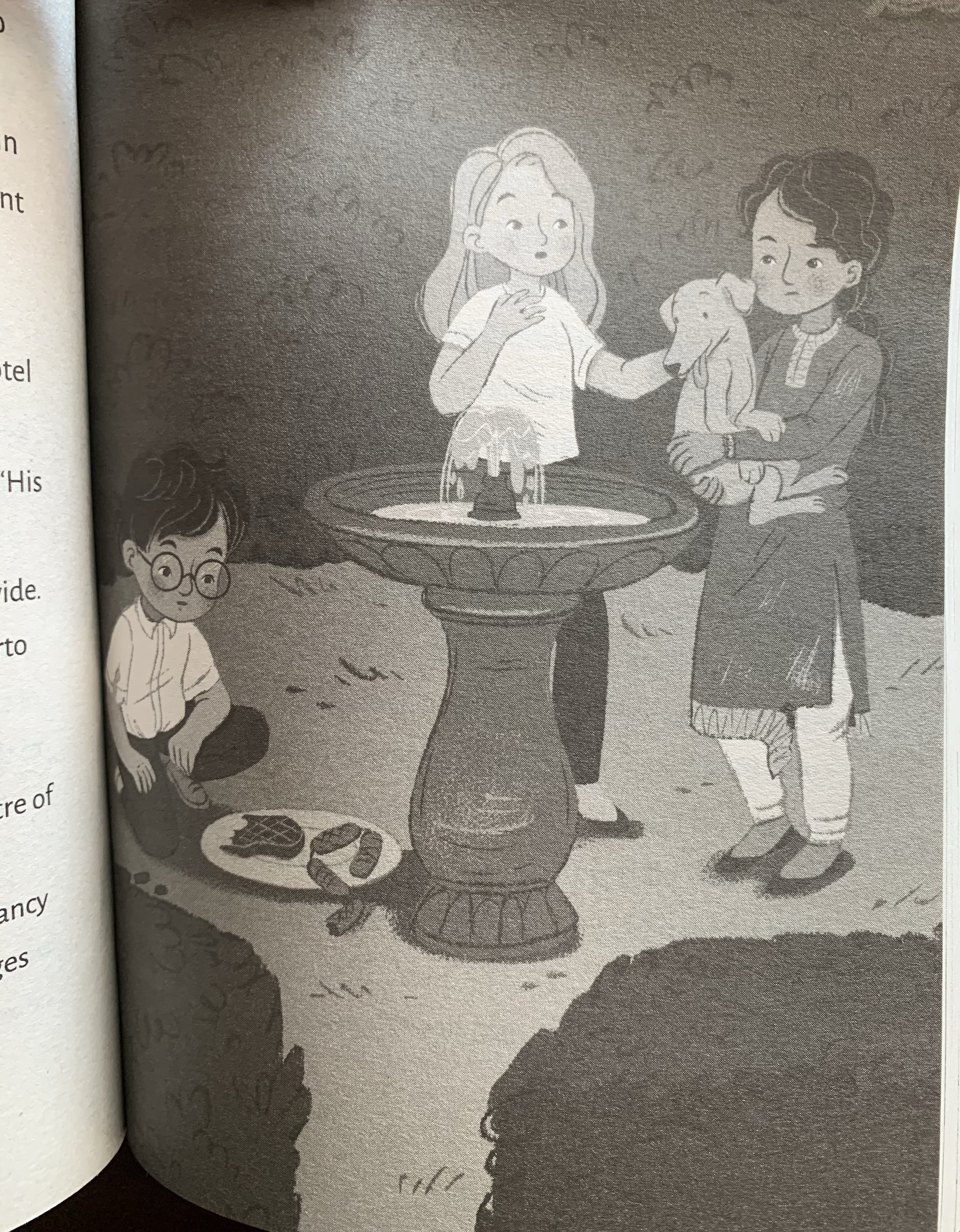
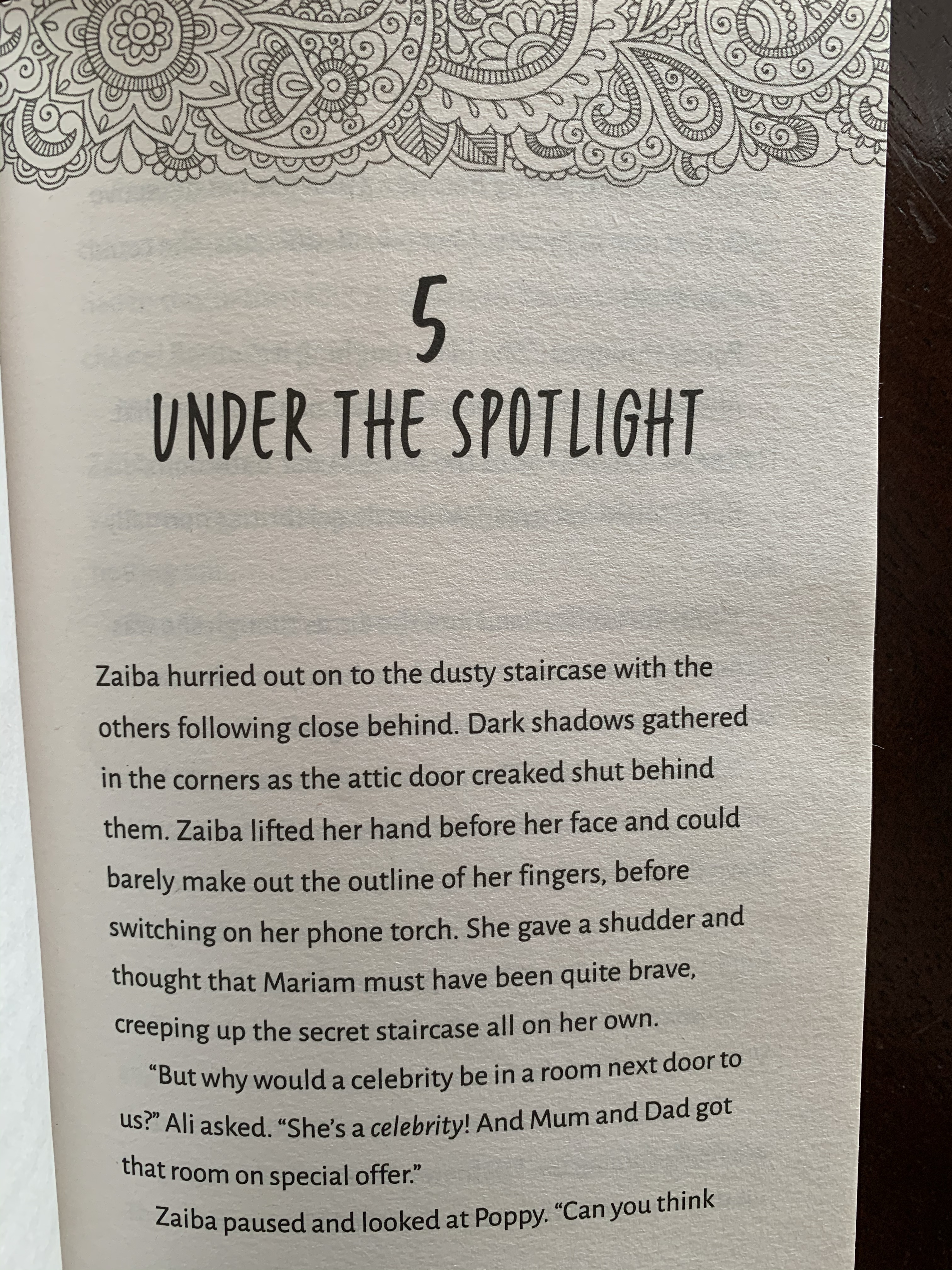
When Zaiba, Ali, and Poppy learn that there is a VIP guest staying in the same hotel, the team gets a chance to explore the hotel and find out who the guest is. What starts out innocently enough quickly elevates when a secret staircase is discovered, the VIP’s dog is set off his leash, and a jewel encrusted dog tag goes missing. The three kids work together and set off to find the dog that has terrified Sam and ruined her mehndi, once that is done, the stakes get higher as Maysoon explains that the good luck charm is not just expensive, but a lucky token she needs to move her career from singing and hosting, to acting. As the children work to find the diamonds and work their way through the list of suspects at the hotel, they have to make sure not get in too much trouble for missing key events of their cousins big day and getting in trouble with the tattling cousin Mariam.
WHY I LIKE IT:
I love that it is really for younger readers, second through early fourth grade, and shows the fun bits of a culture to a larger audience without being daunting. I love the idea of a mehndi as a back drop for a whodunit, seriously, it has the perfect energy and vibe. The family is amazingly supportive, Zaiba has a step mom, Jessica, that she adores, and a half brother that she loves. Aunt Fouzia and Sam encourage Zaiba to go solve the crime and give her respect when she does her big reveal to the police. It really is empowering to see the grown ups support. I love that Zaiba grows even in such a limited time as she learns about her mom and we even see Zaiba’s heart soften for Mariam.
Maysoon is a celebrity that is really flat and weak and whiney, at the end she shines a bit, but I really felt she was lame and under developed. I’m not sure what a champagne reception is, but the fact that Maysoon is having one would suggest she isn’t Muslim, not sure, I guess I’ll have to keep searching for clues.
The end of the book has a whole section to test the reader if they have what it takes to join the Snow Leopard Detective Agency: an excerpt from Eden Lockett’s book, her detective tips, things to practice, code writing, and info about the Agency, including Aunt Fozia’s record amounts of chai consumed.
FLAGS:
There is lying and stealing, it is a mystery after all, and the presence of champagne, both as part of the mystery solving and at the celebrity’s celebration.
TOOLS FOR LEADING THE DISCUSSION:
I don’t think I’d do it as a book club book, because there wouldn’t be a lot to discuss. I do, however, plan to suggest and gift the two book series to some young mixed ethnic Pakistani girls I know that would love to see a strong desi girl in the lead.
This middle grades, upper elementary book is a character driven contemporary story of two friends with their own fears coming together: one a native of Tampa, the other one a refugee from Syria arriving in the US on the day Trump’s ‘Muslim Ban’ goes in to effect. In 272 pages of alternating narratives, two 12 year old girls find strength and kindness in themselves, in each other, and in many around them. Islamaphobia is focused on in the story, but the inclusion of diversity, Black Lives Matter, anti semitism, mental health, social justice, and US immigration makes the book relatable to everyone and interesting to explore. The book is remarkably similar to another book published this year, A Galaxy of Sea Stars, and I wish I had not read them so close together. Both are well done, and I honestly don’t know if one is better than the other, but space them out so you don’t find yourself comparing them. I got my copy from Scholastic, and I’m always happy when the school market shows accurate strong Muslims, so if you see this in the book order forms that come home or book fairs and are wondering if you should get it, do it, it is worth your time and your child’s, inshaAllah.
SYNOPSIS:
Noura’s family has escaped Syria and had been living in Turkey when they learn they have been granted assylum in Tampa, Florida, USA. When the book opens Noura is practicing controlling her fear of water as the plane flies over the ocean. Her twin brother, Ammar, her parents and baby brother Ismail are greeted with protesters when they land. Whisked away by a church group and local Muslims, the family is given support and assistance in a new country.
One of the members in the church group that have volunteered to help the Alwan family, is Jordyn and her mother. Jordyn is going to be Noura and Ammar’s Student Ambassador at Bayshore Middle School and Jordyn’s mom has offered to help Noura’s mom learn English. Jordyn is the state title holder in swimming, but while she was swimming her fastest race, her mom was having a miscarriage, and both have a lot to work through to function as they once did.
The two girls immediately hit it off, and the families follow. Noura’s love of birds is mirrored in Jordyn’s love of water and fish, and both have their fears and mental health coping skills to bond and confide in with one another about. The girls and Ammar are assigned a Social Studies assignment and Jordyn getting close to the Alwans is not well received by Jordyn’s close friend Bailey who’s brother was killed while fighting in Afghanistan. Other classmates also show bigotry and with the real incidents of 2017 incorporated in to the story of a mosque being burned, Jewish cemeteries being ransacked, pedestrians being run-over in France, and more, the Alwans are questioning their new country, and their friends are wondering how America has gotten this way.
While praying at school Ammar and Noura are constantly harassed no matter where they relocate to, and finally ask the administration if there is a safe place they can worship. Florida law says a space can be set aside for all faiths to have the same access as clubs do (I’m overly simplifying), and many different and diverse students come together to turn an old closet into a place of peace, worship, freedom, reflection, and meditation. As expected, the space is destroyed, the culprits never caught and complaints to the school board mount. The ultimate climax involves the kids speaking up about what the space means to them, and waiting to see what the final school board vote is. Along the way there are smaller victories, such as Jordyn teaching Noura to swim, Ammar speaking about the white helmets saving him, and Jordyn and her mother working together to heal.
WHY I LIKE IT:
I love that the Muslim Ban is discussed in a way that it is personal, not political. By highlighting a fictional manifestation of refugees affected by such policy, even people that don’t know anyone affected, I’m certain would feel a connection to a concept and its affects in a very real way. I love that N.H. Senzai was brought on to make the story’s Islamic elements ring true and that the prayer room, a very American Muslim construct ends up being at the center of the story. Noura and her family eat halal, wear hijab, and pray. I enjoyed that other diversity and acceptance issues were carried in to the story by the supporting cast including a Jewish boy, a Cuban girl, a Hindu and more. Overall the book is well written and solid, the mental health and coping skills are so beautifully normalized. Both girls have sought help and found success with it, and both are brave in addressing their fears and opening up about them to those around them. It really is empowering.
The end of the book features more information about the real Syrian children heroes mentioned in the book: the ten year old model builder Muhammad Qutaish, the Olympic swimmer Yusra Mardini, and education activist Muzoon Almellehan. There is also information about the two authors and how their collaboration came to be.
I would love to not compare this book to A Galaxy of Sea Stars, but just to highlight a few of the near exact similarities would prove my point that had these two books not been published the same year, one would definitely be accused of copying the other. Both feature middle school girls, both have a refugee arriving to a coastal town with their families (one Afghan one Syrian), both have the American born protagonist loving water, being an only child, and have mothers going through their own life changing crisis. Both have two side kick friends, one that is very anti Muslim and one that is on the fence. Neither have a completely resolving happy ending with the three girls’ friendship and there is doubt in both books of friend’s possible involvement of hate motivated actions. Both feature a side character’s brother being killed in conflict in a Muslim majority country. Both feature an amazing teacher that is very involved in opening minds and facilitating growth regarding prejudice. Both feature PTSD issues, and fear of water issues as well as a major hobby being destroyed by an angry classmate character. The ‘ethnic mom’ in both stories is rather one dimensional but loves to cook and feed everyone. Sure they also have their differences, one alternates point of view and is tied closely to current real events, but both have remarkably similar themes of friendship, overcoming fear, and finding similarities over differences.
FLAGS:
Some mention of violence as the Alwans recall the destruction and fear of war in Syria. Mention of a cartoon drawn by a classmate mocking Jordyn getting her first bra, but it isn’t detailed. The swimming coach is a lesbian and she mentions her wife at one point.
TOOLS FOR LEADING THE DISCUSSION:
I would definitely encourage elementary teachers to have this book on their shelves and encourage students to read it and respond. I think it would be too predictable for middle schoolers to read in a critical manner, however, they would probably enjoy it as a light read. With Covid 19 still keeping me from starting up book clubs again, I have been asked to consider helping put together some side reading lists/suggestions, and this book would definitely find its way on that.
This middle grade, 330 page book is an easy read that touches on concepts of change within friendships and families with the back drop of life in a coastal town, finding courage, and Islamaphobia. While early middle school readers might find the book a bit predictable and cliche’, the characters, lessons, and fluid storytelling would still make the book worth their time.
SYNOPSIS:
Eleven year old Izzy spends her summer days in Rhode Island on her skiff mapping out the floor of the pond that runs next to the ocean. Fearful of the open ocean, she is, however, confident and independent in her abilities to navigate the calmer water and understand what is beneath the surface. Her father has recently returned from Afghanistan and with his post traumatic stress disorder making him angry and not the same as before. Izzy is further thrown into turmoil when the family moves out of their house and into the marina, her mother extends her already summer long absence to Block Island and middle school at a new regional school is about to start. As always she hopes to lean on her fellow sea stars, Zelda and Piper, best friends since kindergarten, however, things with them don’t quite seem the same either. Add in that her father’s translator from Afghanistan and his family have just moved in upstairs with their two young boys and 11 year old daughter Sitara, and Izzy has a lot to handle and navigate.
Piper and Zelda decide to take television production class first period to make sure they have at least one class together, Izzy is incredibly shy and while she appreciates that this has all been arranged she isn’t confident that it is a good fit for her. Dragged along, as it seems she often is by her much more confident friends, It is arranged that Sitara will also be in the class. Right away Piper and Zelda decide that they don’t like Sitara and her hijab and her “different-ness” and exclude her and by extension Izzy from their lives. As Sitara and Izzy get closer and start to learn from one another, Piper and Zelda lash out and go from ignoring to being mean to Izzy and Sitara. Sitara explains to people on the announcement show why she covers and helps Izzy to understand that her father was in danger after helping the Americans and that they had to leave Afghanistan. The anniversary of 9/11 however, turns many students into verbally berating Sitara and her having her hijab pulled off in the lunchroom. When Izzy figures out that her former sea stars were involved in the planning she is devastated and must take the lessons from Sitara and her Czech Grandma to have more courage than fear, find her voice, and do something to make things right.
WHY I LIKE IT:
I love that Izzy has a lot going on in her life and in many ways Sitara has been through a lot, allowing them to encourage each other to keep moving forward. There are some parallels in losing their homes and dealing with change that they comfort each other with, but the two characters combined show readers that strength and bravery occurs when you are afraid, and that most people aren’t truly fearless. I really feel for Izzy, her friends may have been there for her on occasion, but by and large they seem kind of dismissive of her and her fears. I think she sees them as equal, but I don’t get the feeling that they see her that way, they may be protective of her, but they kind of bully her in to doing what they want. Every few chapters is a flashback to a pivotal point in the sea stars friendship and even before Sitara enters the dynamic, I started to question Piper and Zeldas sincerity. Their best friend just moved, her dad came back from serving in Afghanistan, and her mom is not coming home, they should be concerned, not belittling her for liking art and wearing old clothes. The mom is another painful plot point, like lady I get that you have stuff going on in your life, but really you are just going to leave your child? Ya, I wasn’t a fan of hers.
I like that the story addresses Islam and Islamaphobia, and while it is very much in the story, it isn’t really about it. Izzy is front and center, and even she takes a while to warm up to Sitara. I love that it shows what Afghanis that helped fight against the Taliban went through and how painful it is for them to resume life after doing so. I think this point is so lost in mainstream understanding whenever there is a terrorist attack, that this is what the refugees are leaving, that people in Afghanistan and Iraq and Syria are running from, and when they get called terrorist it hurts that much more, because their whole lives and people they care for have suffered from the real terrorists.
I really wish there was a map, I wanted to visualize better the breachway and had I not lived in Rhode Island for a few years I probably wouldn’t have understood Block Island’s location to to the mainland. Like with so many middle grade novels I wish there was some more depth to the characters, but I truly appreciated that there wasn’t a completely happy ending, and that growth occurred in so many characters, but at different rates. It really made it clear that we all need to continuously work to get to know one another, find our voice, our courage, and be willing to change.
FLAGS:
Clean.
TOOLS FOR LEADING THE DISCUSSION:
I don’t do an elementary book club, but I think this would be a great recommendation for those that do. There is a lot to discuss and explore that kids can relate to. The majority of the characters are female, but I think the themes are universal enough that boys will enjoy the book as well. I’m confident all readers will learn something new about sea stars and possibly even television production in this sweet story.
This 320 page middle grade novel with alternating point of view chapters engulfs you like a warm genuine hug. It does not have a clear climax, it is predictable, and some characters and cultural touch points could have used more detail, but honestly, I couldn’t put it down. As a half American kid who spent my summers in Karachi, so much of the author’s love of her homeland flows so effortlessly from the pages and took me back to my childhood and how the transformation of comparing the two countries moves to seeing the best in both causes growth within your heart and makes leaving so devastatingly hard. Readers of all backgrounds will seamlessly fall in to the story and enjoy the growth of the main characters, while learning a bit about a culture and the similarities of people.
SYNOPSIS:
The back drop is the sweltering heat of a Karachi summer in the middle of elections. Mimi, Maryam, is visiting Pakistan for the first time in her life. It is her mother’s home land, but her grandparents, and her mom aren’t close. They didn’t approve of Mimi’s dad and mom getting married, and even though they have been divorced for years and he has left, Mimi’s mom hasn’t been home in 12 years.
Sakina narrates the other chapters. She is the daughter of Mimi’s grandparent’s cook. She dreams of going to school, but needs help with her English to pass the admissions test. And even if she passes her family needs her income to survive, and her father’s failing health means that she has to take over his job too.
When Mimi arrives at her grandparents home, it is awkward at best. She doesn’t really know her grandparents, she has never had servants before, and her mother is rarely around. That leaves her to get to know Sakina. Sakina finds this odd as the owners of the home rarely “chat” with her and here this American girl wants to get to know her and is fine with helping in the kitchen. The two strike a tentative friendship as Mimi agrees to help Sakina with her english, and Sakina with the permission of Mimi’s grandmother and with the use of the driver, agrees to show her some of the city.
As Mimi takes in the traditional tourists sites she gives Sakina her first taste of ice cream and soda and other “luxuries” she has never experienced. Sakina introduces her to bun kabobs and other local foods. The budding friendship isn’t smooth, mostly because Mimi constantly compares Pakistan to America and Sakina doesn’t understand why Mimi doesn’t have a father. When the girls find out that Mimi’s dad, a journalist, is in Karachi covering the elections, the girls work together to try and find him.
Throughout all of this, Mimi keeps a journal and the entries are letters to her father.
WHY I LIKE IT:
I love that the girls have to navigate their friendship without and often despite interference from adults. I also like that while societal wise one girl is seen as economically privileged and one is not, the book gives enough for even elementary aged children to see that in America Mimi and her mom are financial struggling, but in Pakistan they are not and how that disparity is arbitrary. They also see that family and safety and security are also a part of life’s quality and not country specific. Things that one girl takes for granted are envied by the other, and it goes both ways.
Even for a middle grades book, there were some plot holes. If Mimi had been late night googling and plotting on a secret map all the places her dad had been writing articles from, she should have had a heads up about Pakistan. She knows so little about Islam and has like one shelwar kamees, so it seems a bit of a stretch that she speaks urdu pretty proficiently. I feel like some stumbling with the language or some back story on that would have been great.
Religion is handled as a cultural touch point, neither girl prays, but both find solace in visiting a masjid. Various characters are in sleeveless tops, the athan is heard in the back ground. I wish there would have been a bit more finding of Islam as Mimi found her culture too, but alas it isn’t there.
The majority of the book takes place within the grandparent’s home with the elections being a big part of why they can’t go out, yet the mom goes out a lot, which really rubbed me the wrong way. She took her daughter shopping once to meet an old friend and that is it. Who travels across the world to spend zero time with her kid. I didn’t like the mom at all, and wish there was some background or even some growth on her part. A lot of the minor characters seemed to fizzle as well in terms of having some depth.
There are some cultural and country facts at the end of the book, but within the text I was surprised that more wasn’t shared. I like that it mentioned Karachi was the original capital, but it should have also in the same sentence mentioned that Islamabad is the current, I think readers would assume that Karachi is still the capital of Pakistan.
The book is an OWN voice through and through and the value of that is felt in every sentence. It isn’t all positive and rosy, but it is genuine. The author loves what she is writing about and it shines through leaving the reader with a favorable sense of Pakistan: the country, the culture and the people.
FLAGS:
The book is clean, possibly some tense moments when Sakina’s family is robbed. There is also discussion of marrying someone your parents don’t approve of, divorce, and Mimi’s mom possibly having a boyfriend. Mimi’s mom is an artist and paints pictures of people. There is lying and scheming.
TOOLS FOR LEADING THE DISCUSSION:
I think the book would be a fine choice for an elementary book club, I think any one older will find the book a tad bit predictable. I plan to have my children read it so we can discuss points of view, experiences, universal traits and social economic classes. There are a lot of wonderful lessons wrapped up in a heartfelt story that I can see 4th and 5th grade children benefiting from over and over again.
Based on the true story of Alia Muhammed Baker, the Basra librarian who saved 30,000 books in 2003 from the destruction during the Iraq War, this 32 page graphic novel, is an AR 3.9 and while it isn’t a chapter book and isn’t just a picture book, it works well for 2nd through 4th grade readers that will enjoy a bit of history, a lot of excitement, and detailed panels that make the story come to life. The story, as it is based on fact, is very similar to The Librarian of Basra, but with it’s different presentation style, might appeal to a larger audience to appreciate and celebrate what she did to save such precious books, naturally, I’m a huge fan!
SYNOPSIS:
Alia is the Chief Librarian of Basra Central Library and has always loved books and learning. As war draws closer, she tells her husband she is worried that the library could be bombed or set ablaze. She goes to the government to voice her concerns and ask that the books are relocated, but her request is denied. So she takes matters in to her own hands, and starts smuggling books under her shawl and in to her car, and stacks them in her home. Every day she does this for a week, soon closets are over flowing and she starts stacking the books in her guest room. Worried that she isn’t making fast enough progress, she gets the restaurant owner next door to help her when looters start taking the pencil sharpeners and furniture from the library. She has a plan to have everyone possible come together to move the books, and many people come to help.
Eventually the library is set on fire, the news gives Alia a stroke. When she recovers she learns she saved 30,000 books, and up next for this real life super hero? Building a new library, inshaAllah.
WHY I LIKE IT:
I love that it shows the value of libraries and books, the determination of one person, and the support of a community. People are awful during a war, yet, sometimes they are pretty amazing too. The illustrations are detailed and varied, with inviting text and clear concise language. It really is well done.
FLAGS:
Destruction of property, sneaking, looting.
TOOLS FOR LEADING THE DISCUSSION:
I think it would be great to have kids read this story and the librarian of Basra and discuss