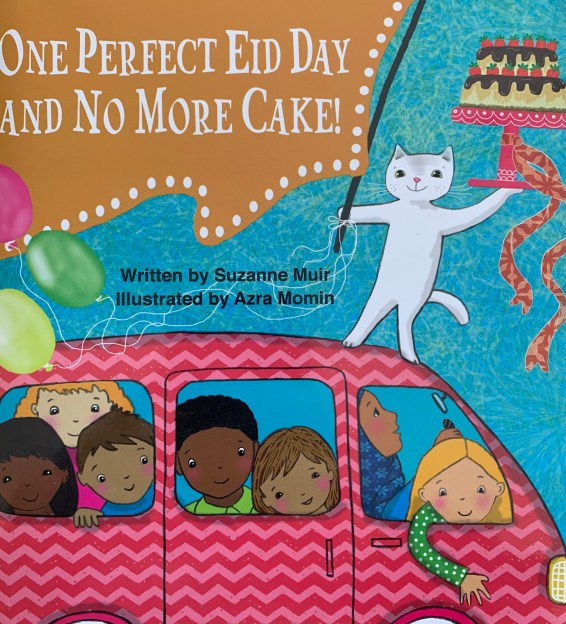
This lovely counting book celebrates the end of Ramadan and the festivities of Eid Al-Fitr by counting up to 10 and counting back down. Over 24 pages of rhyming lines, adorable illustrations will bring the holiday to life as a group of children and a little white cat celebrate. Aside from the title that for some reason I don’t love, the rest of the book is happy and festive and perfect for toddlers to preschoolers.
It starts with one month coming to an end, then henna cones and designs take over, before five pots and six trays of cake are prepared, decorations are hung, clothes are made ready and ten eager eyes watch the new moon rise.
Then ten sleepy cousins have to get up early for morning prayers with presents waiting, rotis are prepared before seven family members squeeze in the van. Friends are met at the masjid and coins are jingling as lunch parties are attended and fun-fair rides are riden. Two tired friends can’t stay away on this one perfect day, and no more cake.
I love the flow of the book, I’m not sure what the four henna designs are or what cousin doesn’t get a present and who doesn’t get to go for prayers, but little kids probably won’t over think it. The little cat is delightful on each page and the book sets a marvelous tone of what one can look forward to and enjoy on this splendid holiday with friends, family, festivities, and food.
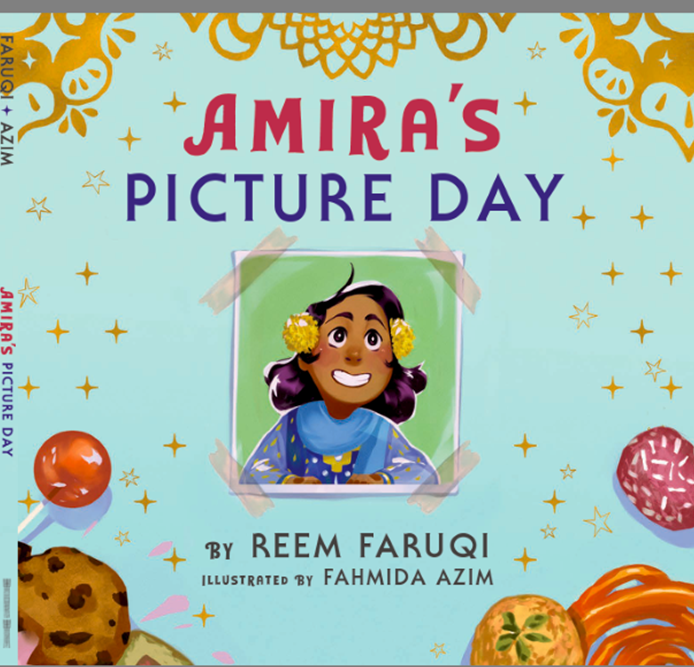
This book is the mirror so many kids are desperate to find in literature. A young Muslim girl is excited to celebrate Eid, while at the same time is sad knowing she is missing school picture day with her class. Not knowing what day Eid will be, not having it a scheduled day off in most school districts, and always feeling like you have your foot in two different doors starts early for children in non Muslim majority countries. This early picture book touches on those emotions, and even if you can’t always get a test rescheduled or a project due date moved, at least readers that face these dilemmas at any age and stage in life, will feel seen in this 32 page book perfect for ages 5 and up.
Amira and her brother Ziyad start the book looking out the window for the moon. They see it, which means Eid is tomorrow and Amira is going to have her mom put decorative Mehndi on her hands. She has her mom include a dolphin in the green swirls and hopes that by morning the color will be dark and beautiful. Ziyad is excited that they get to skip school.
Mom recruits the two kids to make goody bags and count out lollipops for the kids at the masjid, when the flyer for picture day catches Amira’s attention. Devastated that she will miss the class picture having already picked out a pink-striped dress for the occasion, mom reassures her that she will get to wear her new shalwar kameez, and they will take lots of pictures at the masjid.
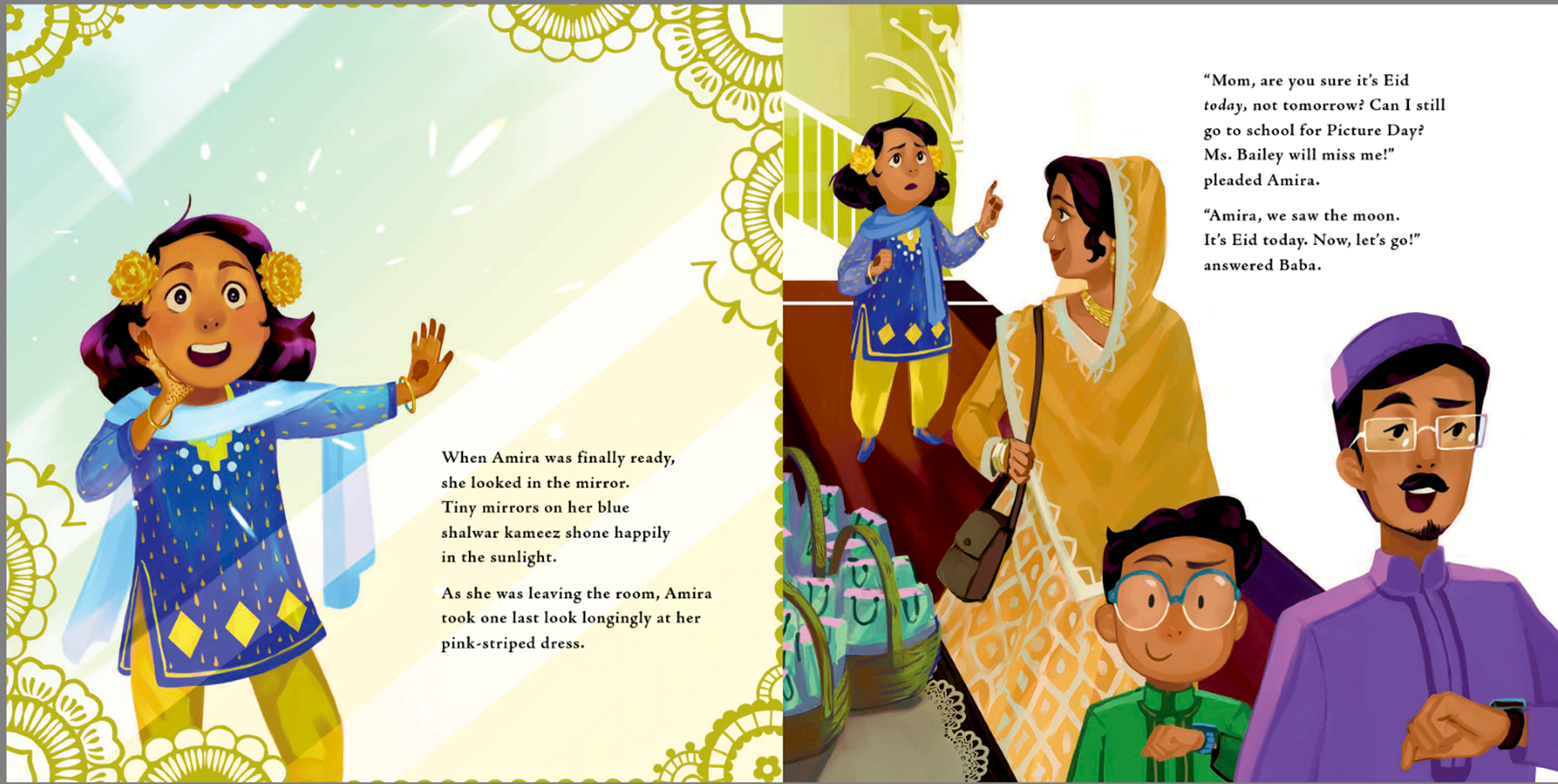
Amira loves going for prayers and the party after, but she is kept awake at night worrying how her classmates will remember her if she isn’t in the picture. The next morning she is excited, it is Eid, but seeing her pink dress hanging next to her blue Eid outfit makes getting dressed a heavy process.
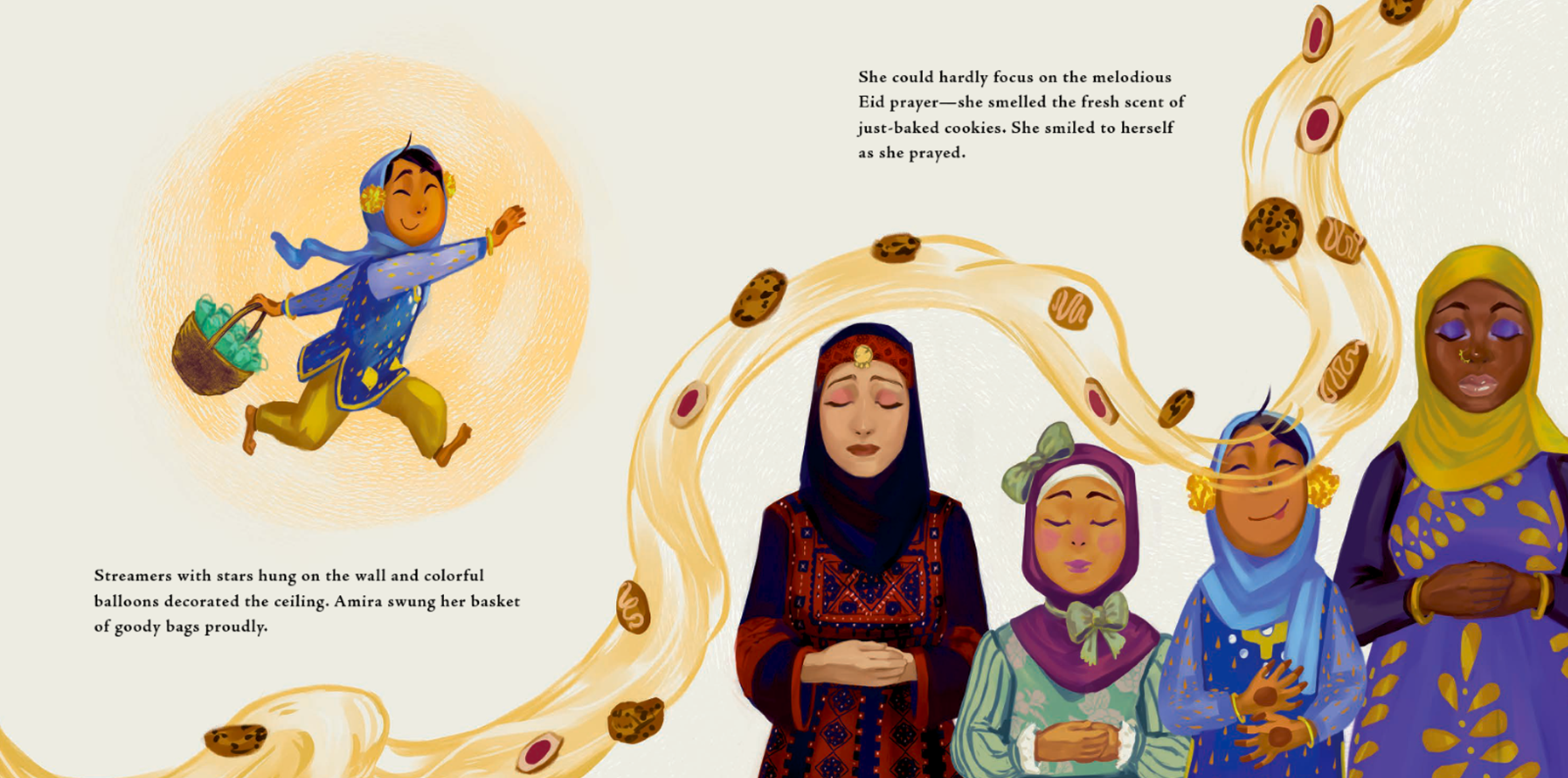
When they get to the masjid, Amira hardly recognizes it, it is all decorated and everyone looks beautiful. The smell of baked goods makes focusing on her prayers difficult, and after when everyone is taking pictures she remembers what she is missing and feels deflated.
On the way home Amira works to hold back the tears, when she suddenly has an idea to take the remaining goody bags to her classmates, and maybe catch her class pictures. Her parents agree and they stop at the school.
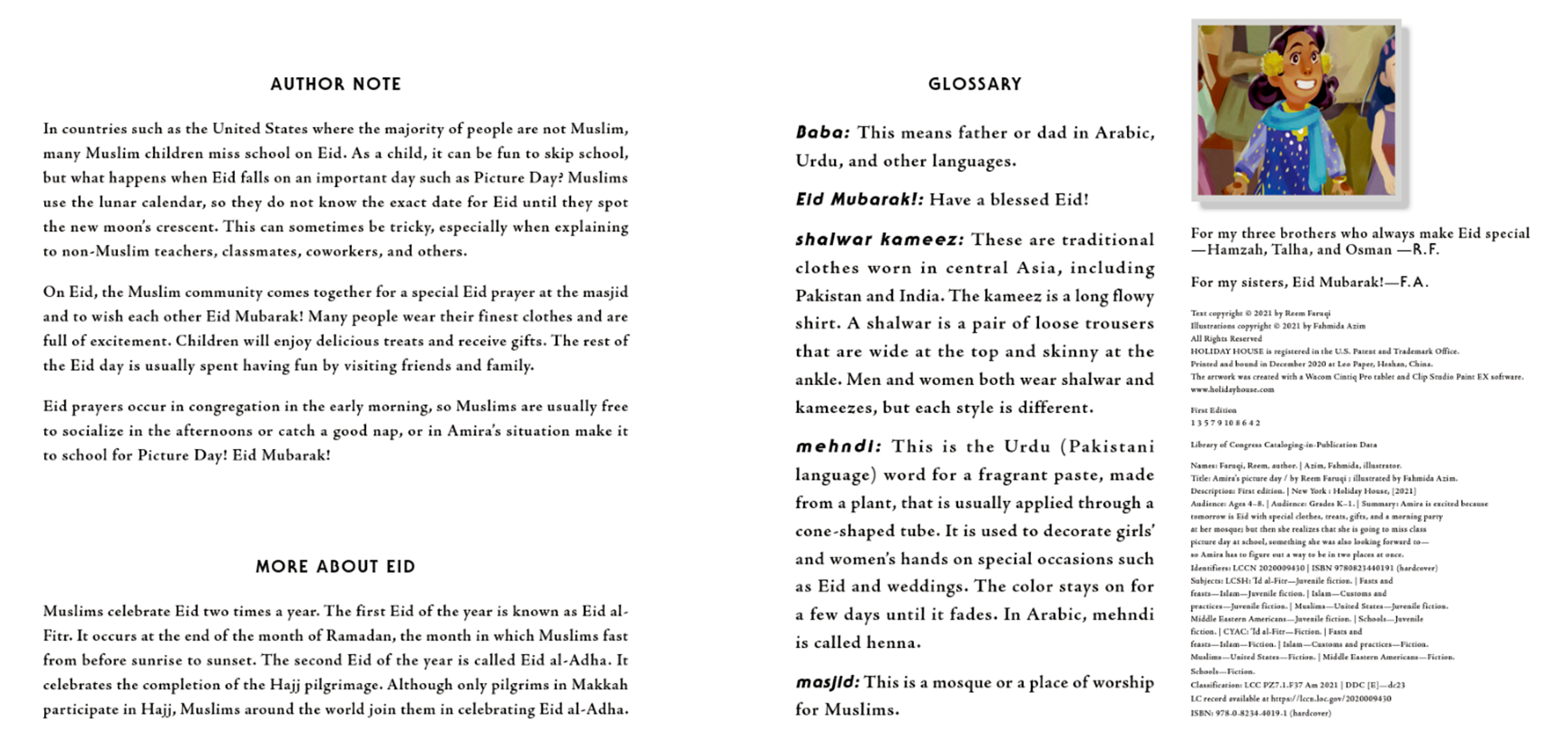
I won’t spoil if she made it in time, but the kids in her class love her clothes, and her mehndi designs. The book concludes with an Author’s Note, More about Eid and a Glossary.
I absolutely love the illustrations, little Amira is infectious and endearing. I wish the mom would have been a little more in tune with Amira’s feelings though, she definitely is upset and while I’m glad the family stopped after the Eid party, I feel like more could have been done beforehand to acknowledge Amira’s feelings, and see what could be done to accommodate both activities.
I love the diversity and brightness of the book to convey the absolute joy and happiness of Eid outside of presents. I think the book works for all children of all backgrounds and is a much needed addition to the repetitive Eid books available.
I was excited to see publishing company DK add this Ramadan book to their board book selection, but overall it didn’t wow me, or even really impress me. It has realistic pictures of diverse Muslims celebrating Ramadan, simple text, and bright images, but it read awkward as it switched between first and third person, realistic and stock looking images, and not terribly enticing with slightly faded mehndi and unexplained foods. There are better board books out there for babies and toddlers than this 12 page mainstream published one. If you can find it at the library, sure check it out, but I’d save my money on purchasing it.
The book starts out saying Muslims follow Islam and Ramadan is a special month in Islam. It features a a man holding a little girl and both are people of color. The opposite page is a cartoonish crescent moon saying it is the start of Ramadan.
The next page has a plate of realistic deviled eggs on a bright background stating that many Muslims fast, don’t eat from sunrise to sunset. It also states that the meal before dawn is called suhoor or sehri. I’m not sure why Urdu is included with the traditional Arabic and no other languages are mentioned.
The next page then shows a little girl praying and switches to present tense first person and says “Let’s pray…” followed by a little boy reading Quran and stating that reading Quran helps us learn about Islam. It then switches back to declarative 3rd person saying that people break their fasts before sunset prayers and shows a bowl of dates.
A family is then shown breaking their fast with a meal known as iftar and the reader is urged to pick their favorite sweet to eat from a plate of different shaped baklava. There is no description about the baklava and I don’t know how enticing they would be if you have never tasted it before.
The book concludes with the same cartoonish night sky and silhouetted masjids saying the crescent has been seen, Ramadan is over and tomorrow is Eid. The last page is a girls hand saying , “Let’s celebrate Eid by making henna patterns on our hands.”
I think the idea is good, but I feel like it doesn’t answer many questions about Ramadan and Muslims and probably makes the religion and celebrations seem foreign and odd, presumably the opposite effect. I admittedly haven’t read the other holiday books in the series and am not a baby expert, so perhaps I’m really critical and missing the developmental reasoning behind the presentation. But I don’t know that this book is fun or really informative for any age, it just seems random.
This book did not work for me. Despite the fact that the main character is Muslim and it is Ramadan, no matter how much I wanted to connect with this multicultural lead and her friends, and see myself in her as she navigates high school, I just could not. The writing was choppy 3rd person which distanced the main character for me, the crude language on every page, the drugs and alcohol in every scene, the detailed sexual encounters throughout, the lacking growth of the characters and the muddled point of the book in general made the book difficult to read. The book is an AR 4.9 but content wise is more suited for mature 18 year olds. Even this review might be a little too much, I’ll do my best to keep it clean. Ultimately this book missed the mark for me in showing females defining themselves, celebrating friendships and diversity, or even just creating characters to cheer for as they navigate life.
SYNOPSIS:
Leila is half Iraqi Muslim from her dad’s side and half American Catholic from her mother. She doesn’t know how to pray as her father isn’t religious, but celebrates Ramadan and Christmas and defines the world on her own terms. She is fearless and owns herself, hence she hates her name and goes by Lulu instead. The book opens with her making out with a boy in a closet which she kind of regrets and then goes to join up with her friends at the party to drink and get high and attack one another for their poor choices resulting in drama. In this instance Lulu’s anger pushes a boy in the pool, and then the four friends devise a way to get home and work out the lies they will need to tell to the parents involved. This scenario with only slight variations repeats five or six times in the book.
Lulu is the fearless one, Lo, short for Delores, is the leader, Audrey is an alcoholic math whiz and Emma, not to be underestimated and often is forgotten (literally) is coming out in her first lesbian relationship. Yes these labels are limiting and stereotypical, especially in a book calling for girl power or what not, but sadly that is really the only space they flesh out, not a whole lot more is known about them. The girls defend each other fiercely to outsiders, but are truly awful and angry to one another all the time. They break apart and Lulu doesn’t really know why, so the path back to one another isn’t really cathartic. They pull a prank to get back at a boy that crossed the line with Lulu, but it fizzles when the threat of what the prank could do is enough to keep him away and they don’t have to complete it completely.
Between the parties there are some sub plots that weave in and out. Lulu has to spend time with Iraqi family friends who don’t accept her and are critical, in Arabic, of her mother. This gives some cultural layer to the story, but the characters are pretty flat and petty and hypocritical. The bombings in Paris a few years earlier, and the resulting bullying by classmates hardened Lulu, but there isn’t much info on how awful they treated her or how it defined her, so not much sympathy is garnered by the event nor does it help the reader get inside Lulu’s head. There is also a sweeter love story brewing than the one night stands that define Lulu, but then she goes with her mother to get birth control so she can sleep with him all while making it clear that he isn’t her boyfriend, she just wants to have sex with him- which she does on her seventeenth birthday.
Eventually the girls are back together and gushing with tales of sorrow and personal growth and vows that they will always be like sisters.
WHY I LIKE IT:
I don’t mind the premise so much as the execution of it. I get that people practice Islam differently, but I really don’t get the need to even bring her religion in to such a story. Culture maybe, but even that is a stretch. I don’t know if the story would be better if it was first person, I would like to think so, as not connecting with the main character was such an obstacle for me. I wanted to see her grow and change or at least have clarity in her decisions even if I didn’t agree with them or couldn’t relate to them. I wanted to feel her remorse or the weight of her decisions, but was often just told in passing that something scared her or was hard for her, not shown it. The theme of not belonging anywhere is a legit one, but I don’t know that this book explored it, it just sort of brushed by it almost as a trial to see if the emotions would stick. Which for a character built up to be unapologetic and unafraid to suddenly want a victim label without any real emotional ties, didn’t work for me. There are such holes in the story, that at times things didn’t seem believable or details were so specific with no context that I didn’t get their purpose. I would have loved to know more about her brothers and the tests they went through, or why her family was so loyal to the Arabs around them. I desperately wanted something that showed a different side of Lulu not just the anger and “F everyone who wants to change me” mantra. People are scared of her and she enjoys that power, but I don’t get why they are scared and why she enjoys it. It seems like a big part of her story and of the book in general to miss. Yes she is independent, and I get that can be misread, but she almost seems one dimensional and flat which defies the concept of defining yourself on your own terms and carving out where you want to belong among groups that see you as other, right?
The character is pretty open that she knows little about Islam, she also claims she isn’t interested. She fasts not so much because it is a commandment but more to appreciate poor people. She says this, but actions don’t seem to back it up. She tries not to drink during Ramadan but she still smokes, gets high, makes out, and lies once the sun goes down. At one point she calls a bride and her mother whores, and refuses to apologize, so her dad gets a fatwa issued. Lulu’s mom mentions that something went all Shiite on the situation, so I’m not sure if the fatwa issuing for such a specific thing is a shiite thing or something I’m just not aware of or familiar with as a tool for handling family dramas.
FLAGS:
The whole book really. Sex, drugs, alcohol, sexual assault, lying, cheating, blackout drunk, vaping, talk of orgasms and going down, lesbian relationship, hetero relationships, sexual encounters, language etc etc etc.
TOOLS FOR LEADING THE DISCUSSION:
Would never cross my mind to share or suggest this book. Even religion representation issues aside, I don’t know that there is really a single “healthy” relationship highlighted among the main characters, some of the side characters maybe, but not enough information is given to really make that case. The characters just all seem so angry, not saying teenage years aren’t angry and messy, but this one doesn’t seem to add much perspective to that singular thought unfortunately.
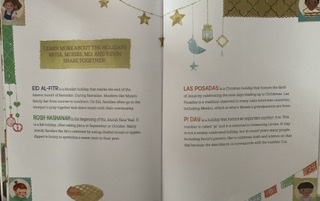
A great book about inclusion for back to school, except well with Corona, we aren’t doing things how we always have. None-the-less this book about the first day of kindergarten for Musa and the friendships and celebrations of diversity (Eid al-Fitr, Rosh Hashanah, Las Posadas, Pi Day) that will take place over the school year, connect the kids and their cultures in a beautiful and heartwarming way. The book is 40 pages with engaging illustrations and text perfect for 5-7 year olds.
It is the first day of school and Ms. Gupta tells the class it is her favorite day of the year. She also tells the children that the people around them will become their best friends. Musa doubts this as he looks around at the strangers at his table.
He also wonders how the first day of school can be any ones favorite day, clearly Eid al-Fitr is the best holiday. Luckily, every show-and-tell will be about someone’s favorite day, so that the class can join together in celebrating it. Moises can’t believe that Christmas isn’t the most fun until he learns that not everyone celebrates it.
When it is Musa’s turn to teach about Eid, his mom and he bring in food and decorations and teach the kids to say Eid Mubarak. They learn what Eid is like and can see why it is his favorite.
Up next is Mo’s turn. He tells everyone about Jewish New Year and how to say Shanah Tovah. On Rosh Hashanah they light candles and share food with friends and family.
Moises explains how Las Posadas is how his family celebrates Christmas. It lasts nine days and there are songs and pinatas and presents.
In the spring it was Kevin’s turn and he shared his love of Pi Day as his family celebrates science. On March 14 (3.14) they make different pies and learn about scientists and their discoveries.
On the last day of school, the children are sad, but their teacher hopes they will remember each other always throughout the year as she hands out calendars for them to keep.
The book concludes with information about each of the four holidays mentioned. It is possible that on the Rosh Hashanah page the family is two gay men with two children, but it could be just two men as well, and doesn’t say anything in the text that suggests who and how the family is comprised.
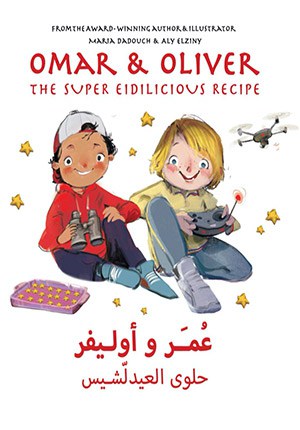
This super cute Eid book works great for ages 5 and up. Written in both Arabic and English, not just translated in to both languages, the book features a Muslim celebrating Eid and a Christian boy working together to try and get Omar’s sister’s cookie recipe so they can be the best cookie cooks ever! The book would work for either Eid and with the adorable illustrations, and included recipe, the book will get lots of requests all year round.
Omar is excited that his friend and neighbor, Oliver, is sleeping over the night before Eid. They boys are playing when Omar’s sister Judy brags that her friend has given her the best cookie recipe in the entire world.
Naturally, Omar and Oliver want to be the best too and offer to help Judy. She refuses, and the quest to get the recipe is on, so that Omar can make them for Eid and Oliver for Christmas.
The boys try to steal it through the kitchen window. But Judy catches them and slams the window shut. They then try binoculars from the stairs, but the boys can’t write fast enough and Judy grabs an umbrella to shield the recipe. Undeterred the boys pull out a drone, but the zoom on the camera isn’t quite good enough.
The boys then see Judy rushing out of the kitchen and run in to see if she left the recipe. They don’t find it, but they peek at the cookies and see that they are golden brown and if left in any longer might burn.
Tempted to let them burn, a sign on the fridge saying, “Eid: a time to share and show we care,” makes the boys realize saving them is the right thing to do. Judy says she too saw the sign and rushed out to copy the recipe for the boys. They then all work together to make lots of Eidilicious cookies and share them with everyone on Eid.
The book starts with some tips for parents on how to present the bilingual book and ends with a cookie recipe, as well as some information about what Muslims and Christians celebrate. I love the illustrations and that they are two page spreads, but the page with the note is the whole resolution and the note is split on the folded binding and honestly I missed it when I read the book myself and when I read it at bedtime to my kids. When I opened the book wide to take pictures it was crystal clear, and if you were reading it to a group you might not have an issue.
I also didn’t love the word, Mashallamazing, I obviously get what it is trying to do, and I feel like it works with Eidilicious, but that Mashallamazing is a stretch. Additionally, if it is claiming to be an interfaith book, a word like that might need some explaining. I got a bit hung up on it, so I had my 13, 11, and 9 year olds read it and they did as well. I also didn’t think the pulling out of the story to ask the reader if the boys were successful in getting the recipe was necessary after each attempt.
Disclaimer: I don’t speak Arabic and cannot comment on that, sorry!
I debated posting about this book for so long that Ramadan is more than half over. But as a reference for years to come, I thought I should go ahead and throw my late support toward this Ramadan tradition and a book deserving of space on your shelf for children 4th grade and up. I’ve seen people praising it for a few years, and finally I ordered it this year, however, I wanted to not only read it, but also test it out first: reading a story a day, discussing and asking the correlating questions with my own children, before reporting back. I cannot and thus won’t comment on the accuracy of authenticity of the book, nothing stood out as erroneous to me and there is a bibliography at the back, but there is a reason I try and steer clear of non fiction, I’m just not qualified to comment.
SYNOPSIS:
The book starts with the birth of Prophet Muhammad (saw) and ends with the selection of Abu Bakr (ra) as the first Khalifah. Each chapter is between one-and-a-half to two-and-a-half pages and the 30 chapters plus one Eid day chapter (so a total of 31), covers 103 pages in all. There are a few pictures of where the Battle of Badr took place, the Cave of Hira, not many. There are three questions at the back of the book for each of the chapters, but no answers. The book is pretty linear, just the second chapter bounces back to Prophet Abraham (as) and Hagar and the story of Zamzam and then the rebuilding of the Ka’bah. It is a glorified timeline, which in this case is a good thing. It doesn’t go off on tangents or provide a ton of outside references, it is concise and general, but hits the key parts: marriage to Khadijah, first revelation, migration to Abyssinia, Taif, Hijrah, treatment of slaves, year of sorrow, Battle of Badr, Battle of Uhud, Treaty of Hudaibiyah, it talks of tensions with various tribes, coming to an agreement about the Khalifah, and more.
I think younger children might possibly be able to have the short chapters read to them and then explained, but really, it would be a lot to process. The words are simplified and the gist of situations are conveyed, but topics aren’t necessarily shied away from. It discusses that Prophet Muhammad (saw) had more than one wife, and that there were slaves, and there were tensions with the Jews, and Bilal was tortured, all things that picture books might skip over.
WHY I LIKE IT:
I like that even my young teen could read and involve herself without feeling like the exercise was childish. Many of the answers are open ended in nature and require more than just a one word answer. It allows for children to add other facts that they know about RasulAllah to the dialogue and make connections to our history with our current life very easily. Even children that know the story of Prophet Muhammad (saw) will find the book engaging and smooth enough to read through again (and hopefully again each Ramadan) and learn new tidbits, understand concepts more clearly and be reminded about the beauty of our Prophet.
FLAGS:
Nothing
TOOLS FOR LEADING THE DISCUSSION:
If I was a teacher, I would definitely start each morning reading a chapter and doing the Q and A, whether it was Ramadan or not. I think we need to be more connected to our Prophet and grow our love and appreciation for him, so books like this are such a great tool in accomplishing that goal.
New this year in the Ramadan category is this gorgeous 40 page hardback book that mixes information about the blessed month with personable characters very well. It stays on track without getting silly, even with a talking cat and a reoccurring super hero dinosaur, but I don’t understand the attempted rhyme scheme. I’ve read the book over a dozen times trying to map it, and sometimes it is so natural that it makes reading it aloud smooth and lyrical, and sadly a few times it seems so forced that it makes the sentence nonsensical or awkward. There is so much information, so beautifully paced and illustrated for children 4 and up, that I’m willing to overlook the few sentences that irked me to recommend this book for you and your children to enjoy this Ramadan. Without a glossary though, it is probably best for Muslim children, or those with someone who can explain words such as: suhoor, iftar, adhan, SubhanAllah, dua, Allah, etc..
Khadijah and Cat are looking for the moon to know if it is the start of Ramadan, and once they find it, they rush to spread the news. Immediately everyone starts decorating and celebrating and sharing delicious food.
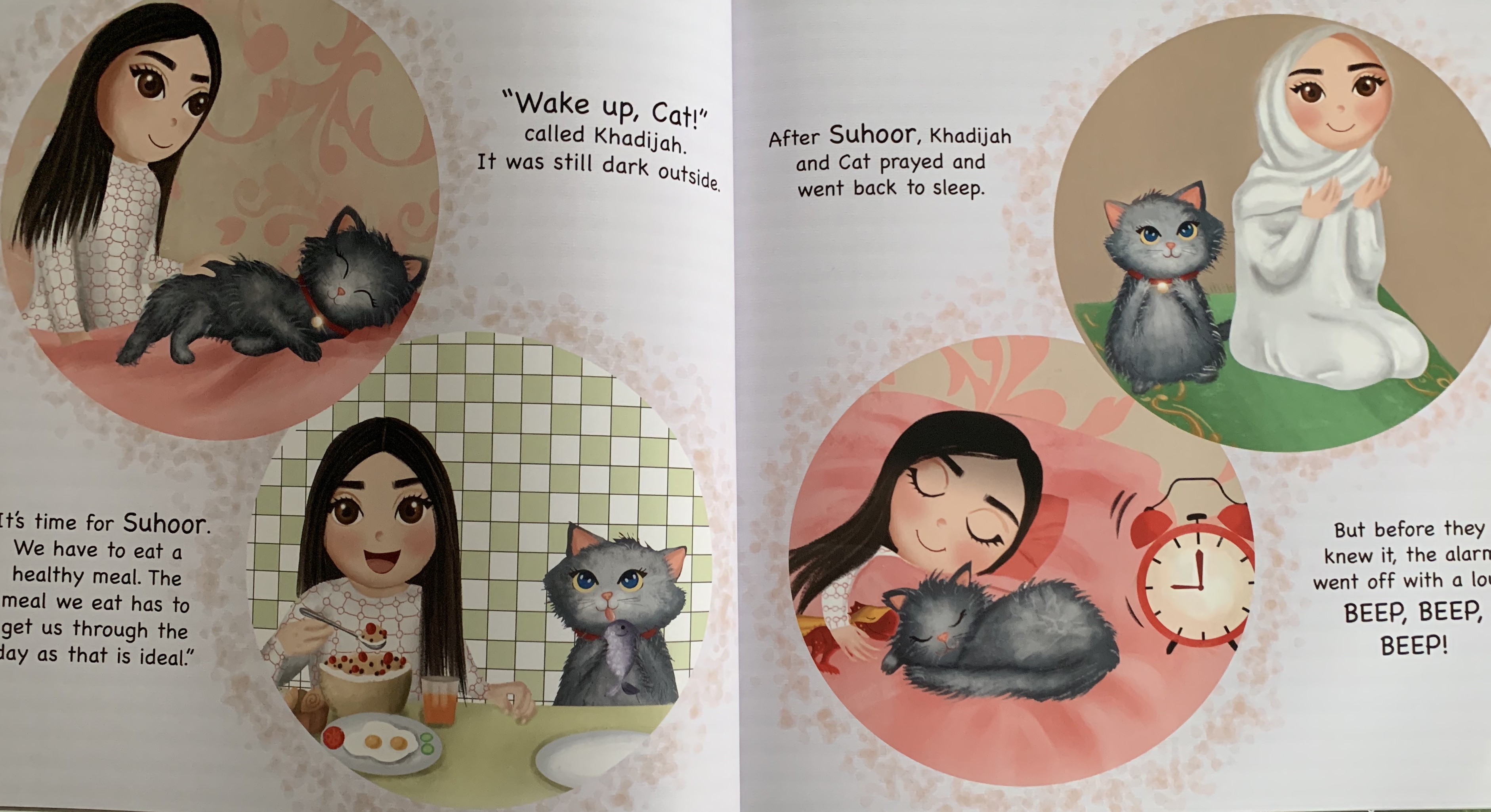
They then head home to sleep so they can wake up early for suhoor. They make a point to eat something healthy to sustain them for the whole day, then they pray and go back to sleep.
Cat wakes up ready to eat and is surprised that they have to wait until sunset before they can eat or drink anything. Khadijah explains that Ramadan is a holy month and one of the five pillars of Islam. The illustrations show the other pillars, but the explanation of Ramadan is a bit advanced with words such as regression, unpriviledged, compassion, and purifying.
The next page continues listing off what Khadijah and Cat are learning about Ramadan, as they spend time praying and reading the Holy Quran. At the sound of the fourth Adhan they break their fast. The names of the salat or that they pray five times a day is not mentioned, but lends itself to a great teaching point.
They then pray and eat and take the neighbors some gifts. Cat is convinced that the day was good and is ready for the next 30. The last ten nights are identified as important and Laylat al Qadr is mentioned as being special, but it does not tell why they are unique.
Khadijah and Cat then invite you to fast and see why Ramadan is so special. The end of the book has some questions, a Ramadan count down and a coloring page. I was surprised that there was not a glossary as the Arabic words in the text are enlarged, and often not defined.
I love the font and binding and horizontal 10 x 11.5 layout. The illustrations are gorgeous and the details in the decor and Khadijah wearing hijab while out, but not at home are very well executed. I’m not sure why the Meer-Rex is in the book, he is never identified or given attention, maybe in future books he will have more of a role, inshaAllah.
I ordered mine from Crescent Moon Store and received it within days of placing the order, thank you!
I’ve never been a huge fan of short stories, but this book has me reconsidering such an arrogant approach, as every single story in this collection has me feeling the warmth of Eid, the joy of authenticity, and the beauty of being a part of a faith with such strong female writers. Fifteen entries for middle graders in mind: short stories, poetry, and even a graphic novel, spread over 304 pages that shine light on Eid in today’s world, Eid al Fitr and Ramadan make up the bulk of the focus, but Eid al Adha and Hajj are in there too. And the best part of the book is that you will see yourself in it, possibly all through out it, but reading such diverse OWN Voice stories are sure to make a Muslim reader feel represented and right at home, and give non Muslim’s a peek at us from the inside, inshaAllah.
SYNOPSIS:
I don’t know how to review the book as a whole since there really are 15 different stories, that are each heartfelt and strong in their own right and yet somehow made better by the company around them. There were no weak links. There are stories with bickering siblings, annoying cousins, different cultures, mixed background familes, divorced families, converts’ stories, stories of families where money is tight, stories with illness, stories of loss, a story from the perspective of a refugee, and stories of reaching out of your comfort zone. There is one story about Eid al Adha and a story starring a Shi’a muslimah feeling different within Islam. There are stories told from boys voices and girls voices and every single story has a take home message, some more subtle than others, but all there and all real. I feel like even a summary of a story would prove a spoiler and take away from one just falling in to the collection and receiving the warm hug that awaits. I’ll leave the summaries to their titles and well known authors to spark your curiousity.
Perfect: Jamilah Thompkins-Bigelow
Yusuf and the Great Big Brownie Mistake: Aisha Saeed
Kareem Means Generous: Asmaa Hussein
Don’ut Break Tradition: S.K. Ali
Just Like Chest Armor: Candice Montgomery
Gifts: Rukhsana Khan
The Feast of Sacrifice: Hena Khan
Seraj Captures the Moon: G. Willow Wilson and Sara Alfageeh
Searching for Blue: N.H. Senzai
Creative Fixes: Ashley Franklin
Taste: Hanna Alkaf
Eid Pictures: Jamilah Thompkins-Bigelow
Not Only an Only: Huda Al-Marashi
Maya Madinah Chooses Joy: Ayesha Mattu
Eid and Pink Bubble Gum, Insha’Allah: Randa Abdel-Fattah
WHY I LIKE IT:
I recieved this book as an Advanced Reader (digital) copy and I am thinking I want a hard copy too, (I wasn’t able to view the artwork). A lot of people ask me and I see postings in various social media groups asking for suggestions of books to read each night as a family in Ramadan, and I think this one would work for grades 3 and up. Have each kid read the story throughout the day and then discuss in the evening. Every story will have something that is familiar, probably something new, and each has a teachable moment. I think different kids will identify with different aspects of the story and to articulate them in Ramadan will really bring the already memorable characters to life.
The book is very well done, and reads very smooth and cohesive, it really has a unified tempo and mood which is remarkable because so many different author’s and voices are included. The book stays focused on the feeling rather than getting too weighted down by doctrine. There are stories that feature hijab prominantly, and a bit of Prophet Muhammad (SAW), and some slight mention of islamaphobia, but it focuses on the friends and the love that support us, both Muslim and non, that make Eid and life hopeful.
FLAGS:
Clean
TOOLS FOR LEADING THE DISCUSSION:
I would consider this as a book club book to be hosted just as I hope to do this Ramadan with my own children in my home (see above). I think really I just want to buy a bunch of copies to give as gifts to the fabulous elementary aged children I know, alhumdulillah.
This book is the first in a series (hopefully) called Trilingual Sofia, where English is the predominant language, and Spanish and Arabic are interwoven to tell the story. Focusing on Eid and spending the holiday in Mexico with her non Muslim grandmother, the story with bright illustrations is a celebration of diversity, acceptance, family, and Eid.
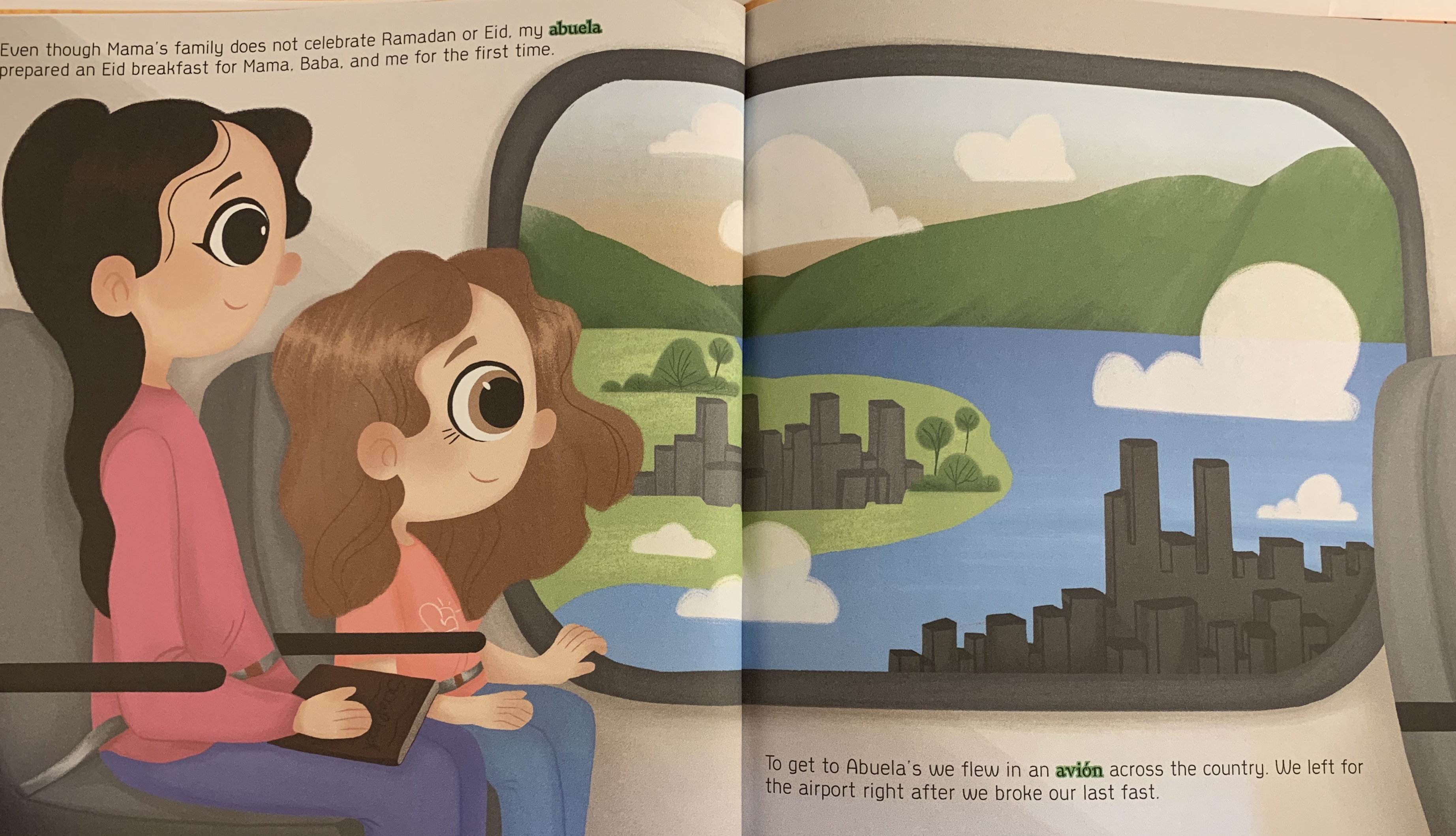
Sofia has had a special Ramadan. She tried fasting for the first time and now that the month is over, they are breaking their fast and then getting on a plane to Mexico to have Eid breakfast with her Abuela.
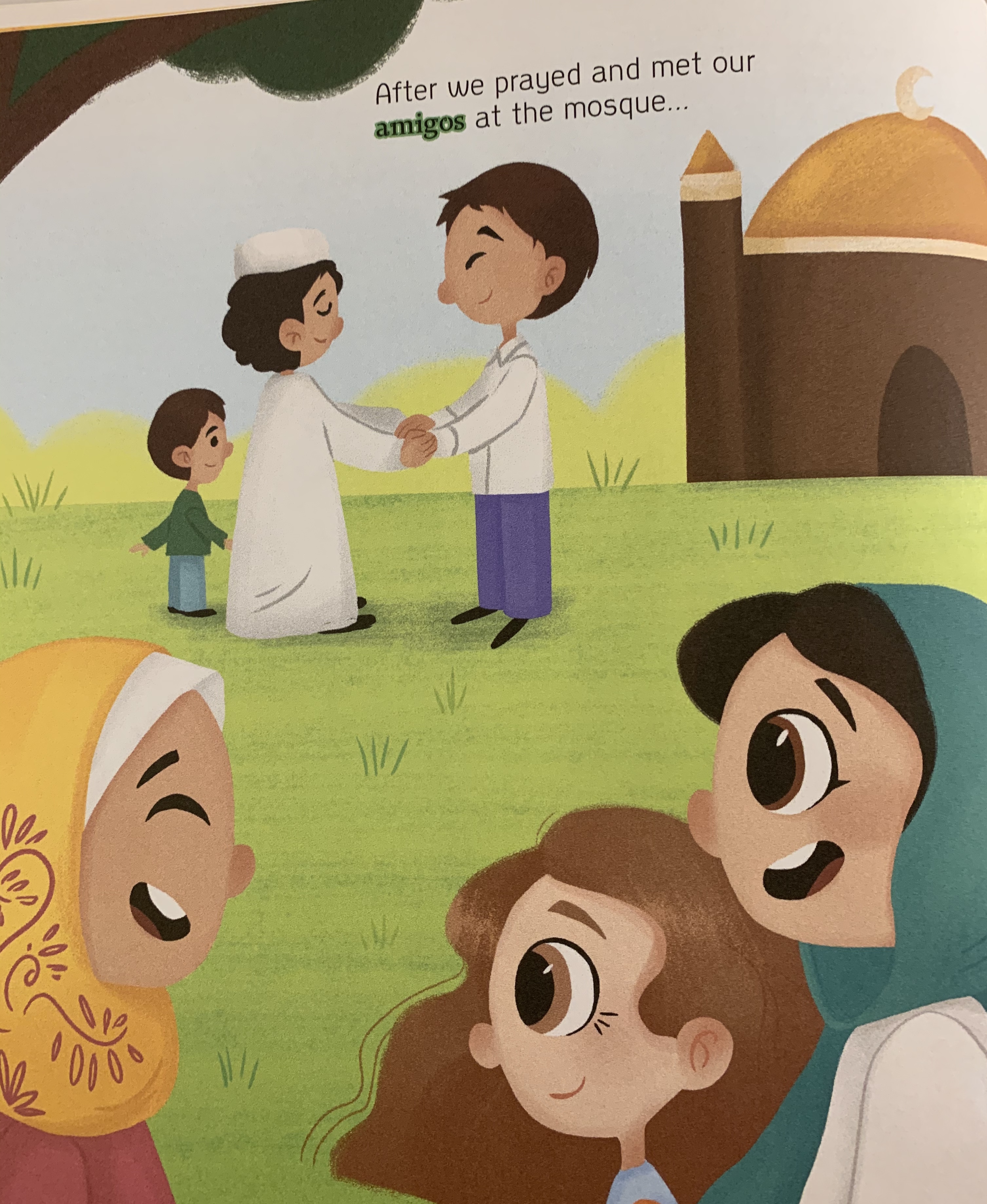
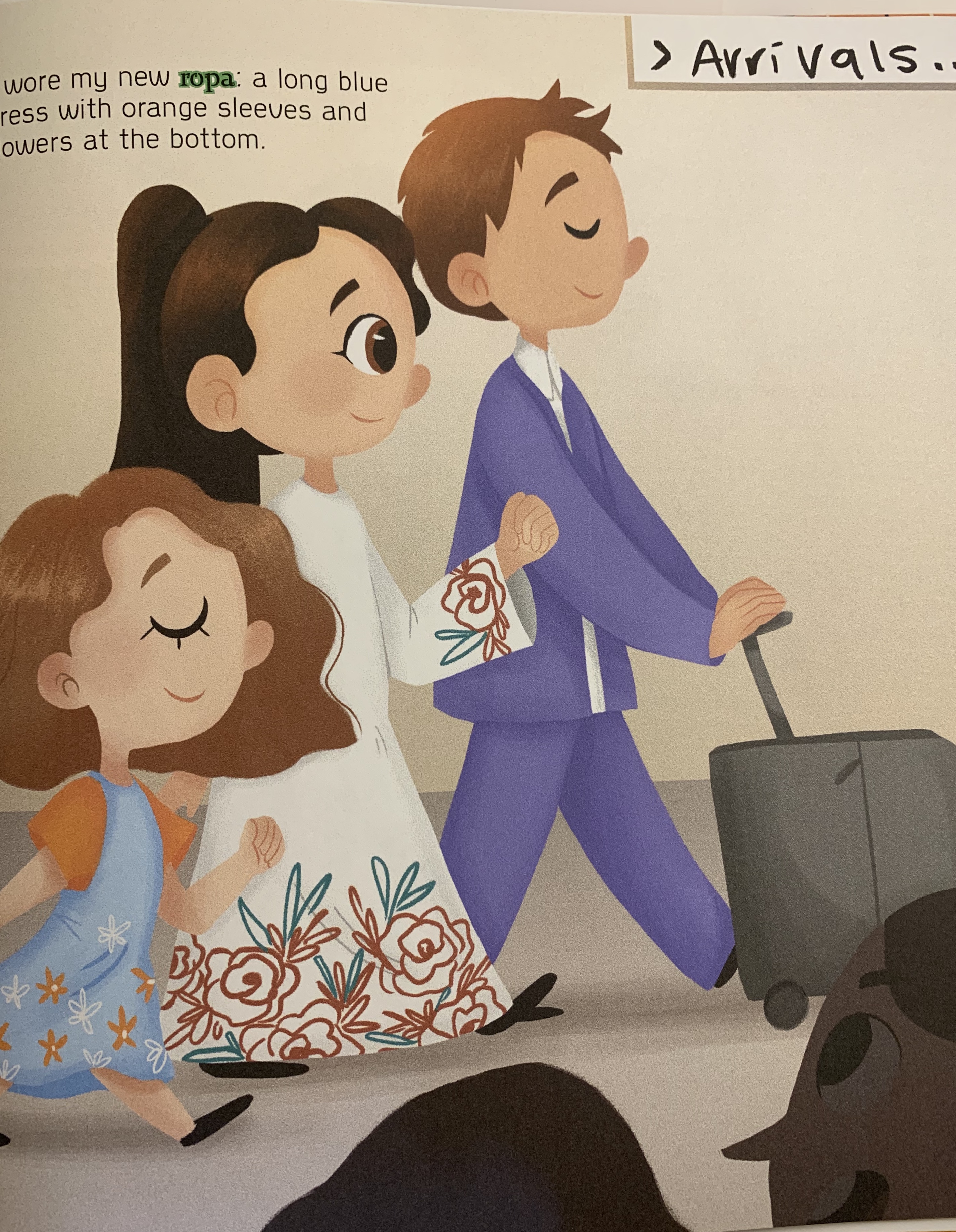
On the plane she keeps her pretzel bag to add to her scrapbook and then they get changed into their Eid clothes before they land. Once in Mexico they go straight to the mosque to meet their friends and then to Abuela’s house.
Abuela’s house is decorated for Eid and all the family is there. They eat breakfast together and the kids play games and sing songs and take pictures.
The 32 page 8.5 by 8.5 inch hardback book claims to be for toddles and preschoolers, but I think it is more for kids in early elementary with the small and ample text. The Spanish words are highlighted in green and Sofia teaches some Arabic to her Mexican cousins. There is a glossary of all three languages at the end.
The book is not meant only for Muslim children, but it doesn’t explain Ramadan or Eid, so while Muslim’s might be able to connect the dots of why she only fasted the last two hours of a day or why they went to the mosque before they went to Abuela’s, I wish the book explained it.
I love that their are subtle connections between the three languages, like Angel Gabriel/Jibreel and the name Yusuf/Joseph. The book is a great example of Islam outside of the Middle East and the Asian subcontinent and I truly hope there are more books in this series and more books like it to show the diversity of Islam and the commonalities we all share.





















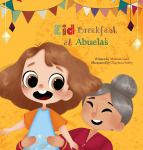
 This book is the first in a series (hopefully) called Trilingual Sofia, where English is the predominant language, and Spanish and Arabic are interwoven to tell the story. Focusing on Eid and spending the holiday in Mexico with her non Muslim grandmother, the story with bright illustrations is a celebration of diversity, acceptance, family, and Eid.

 Islamic School Librarian