Category Archives: 3rd grade and up

The Unicorn Rescue Society: The Secret of the Himalayas by Adam Gidwitz and Hena Khan illustrated by Hatem Aly

Standard
The Unicorn Rescue Society: The Secret of the Himalayas by Adam Gidwitz and Hena Khan illustrated by Hatem Aly

unicorn

This middle grades 208 page book is part of a series, but this particular installment is co-authored by Hena Khan, takes place in Pakistan, and features Muslim side characters in the quest to find and protect the mythical, magical, and illusive unicorns.  The adventure is quick, the cultural and religious references sincere and appreciated, the characters quirky and fun, and the writing smooth and enjoyable.  I can’t speak for the whole series, but I think second to fourth grade readers will enjoy the eccentric teacher, the clever kids, and the knowledge about animals, culture, and geography that is woven in to the story to keep it engaging.  I don’t think you need to read the books in order, but I would encourage it.

img_0785

SYNOPSIS:

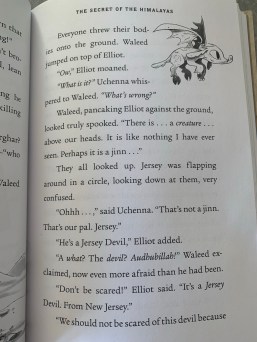
Elliot and Uchenna are elementary aged students and also members of the secret, Unicorn Rescue Society.  When a classmate starts a newspaper and interviews local businessman, the kids teacher, Professor Mito Fauna spots what he thinks is a unicorn horn in an accompanying picture and is determined to go and protect, once found, the imaginative creatures.  He enlists the kids and Jersey, a creature with a blue body, red wings, a goat face, clawed front legs and hooved hindlegs, to set off in his single propeller plane for the Himalaya mountains of Pakistan.

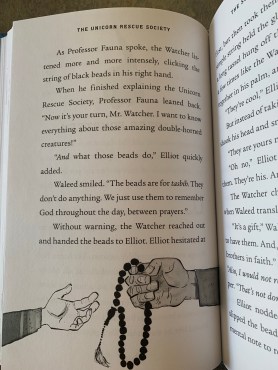
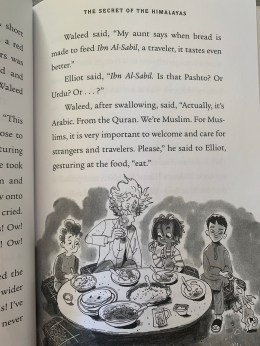
They arrive in Torghar, Pakistan and make a rough landing that nearly kills a local boy.  Alhumdulillah, Waleed is fine, and in true Pakistani and Islamic tradition the boy takes the visitors to his grandmothers home to be fed and welcomed.  Waleed agrees to help the Americans find a man known only as the “Watcher,” to see what he knows about unicorns and the hunters that come to poach for sport.

Hiking the mountains and getting short of breath makes each act that much more difficult, but alas the kids find the Watcher, aka Asim Sahib, but sadly *SPOILER* don’t find unicorns.  Rather a species of mountain goats, markhors, that have two long twisted magical looking horns. The wealthy businessman brothers also show up in their helicopter to capture, not kill the markhors.

The rescue society follows them and learn that the sinister brother are testing out the magical properties of a bezoar on pit viper bites.  Needless to say it doesn’t work and the rescue society must rescue the dying butler, and captured markhors.  All is not lost, even if they didn’t find any unicorns, at least they made new friends, and know that if they haven’t found the unicorns yet, hopefully no one else has either.

img_0778

WHY I LIKE IT:

I love that there is praying, and thikr, and ayats from the Quran quoted and explained in the book regarding saving animals, caring for each other and trusting Allah swt.  There is culture regarding taking gifts, welcoming guests, drinking tea and even breaking stereotypes of what a boy from Lahore visiting his family in the mountains knows and doesn’t know.  It isn’t preachy on any accounts, but the messages relayed in their silly way are very well woven in and leave a wonderfully represented impression of Islam, Muslims, and Pakistan.

The diversity featured in the book is nice, even within the main characters: one is an African American girl, one a Jewish boy, and the teacher is Hispanic.  The story at the end, A History of The Secret Order of the Unicorns, takes place during the reign of Charlemagne at a monastery, and features a boy named Khaled and his little sister Lubna. It is clearly intentional and a reflection of the author and illustrator.

img_0776

FLAGS:

There are some possibly gross moments featuring the goats licking urine, tea being made from the markhors’ saliva and the near death of a man requiring venom to be sucked from his leg.

img_0777

TOOLS FOR LEADING THE DISCUSSION:

The book is definitely below a middle school book club level, but I think younger elementary teachers and parents would see students get hooked on the series and would benefit from having the books around.

img_0780

Brave with Beauty: A Story of Afghanistan by Maxine Rose Schur illustrated by Patricia Grush, Robin Dewitt, and Golsa Yaghoobi

Standard
Brave with Beauty: A Story of Afghanistan by Maxine Rose Schur illustrated by Patricia Grush, Robin Dewitt, and Golsa Yaghoobi

brave

This 44 page fictionalized retelling of Queen Goharshad, a 15th century monarch of the Timurid dynasty in Afghanistan should really be a larger book than 8 x 8 to appreciate the artwork that is detailed and stunning.  The story of Goharshad, wife of Emperor Shah Rukh, and her influence on art, music, culture, higher education, and architecture, is one that we should be more familiar with, but the actual text and manner in which the story is conveyed isn’t consistent for me and I wanted more details about the society she stepped in to to rule,  I know it is fiction, and meant for 2nd to 4th graders, but I would like to think that readers will want to know what obstacles she had and what support she enjoyed and from where.  That they will question if it was a rich kingdom that she could pay musicians to play everywhere, and wonder if families sent their daughters to the University she built, ask why it wasn’t for women to design a  Masjid, and what was the name of the smaller mosque that bore an older woman’s name? The book at times overly summarizes and at other times is haltingly detailed.  It is a good read to reflect a strong woman and her influence on her land, but unless assigned, I don’t know that seven to ten year olds will pick up the book and be inspired by it enough to change their perception of the Afghanistan that they may see on the news.

img_0171

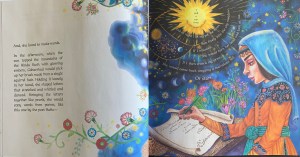
Seven centuries ago Goharshad loved beautiful things such as painting and the texts of Rumi.  Her brothers played at being like Genghis Khan and teased her for not being brave.  She vowed to be brave with beauty even though she didn’t know what that even meant.  At age 14 she was given in marriage to the king, Shah Rukh, in Herat.  She ruled with her husband and had resources and time to spread her beauty by speaking up and being brave.

img_0172

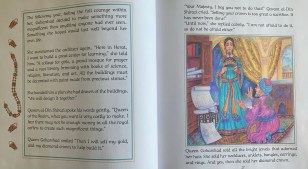
Her first act of beauty was by filling the kingdom with music.  She wanted music every day in the court and beyond. Music that was playful and pious, music that painted pictures in the listeners minds and brought joy like the laughter of God.  She next sketched and designed a beautiful and enchanting garden to be built.  It doesn’t say where it was, but that people came from all around to enjoy it.

img_0173

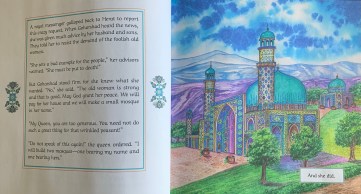
Feeling braver she turned her sights on building a mosque in the western city of Mashhad.  She designed it and called the court architect, Qavam al-Din Shirazi to discuss.  He doubted if it was right for a woman to design such spaces, but she assured him that she had the talent for it, so construction began.  An elderly woman refused to sell her cottage for the new project unless a mosque with her name was built.  The advisors wanted the old woman put to death or imprisoned, Goharshad disagreed appreciating the woman’s strength and instead agreed.  The big mosque was built with Goharshad’s name and a smaller one on the property with the old lady’s.

img_0175

With such an accomplishment complete, the Queen again summoned the architect and expressed her desire to build a great center for learning.  A college for girls, a grand mosque for prayer, and a vast library.  She wanted the structure decorated with paint from precious stones and sold her crown to finance the project.

img_0174

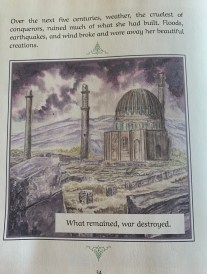
After her husband died Goharshad reigned, but sadly after she died, much of her accomplishments died as well.  Over time, harsh weather and war, nearly all her buildings disappeared and those that remain, do so in ruin.  The book ends with hope that memories of her will endure, A guide to some of the words in the story,  an Author’s note, and a Guide for Parents and Educators.

img_0176

There is not a lot of Islam in the story, just the building of masajid .  Some may take issue with her stress and celebration of music, and likening it to God laughing, but if you look at it as her story, it should be able to be appreciated even if you disagree.

img_0177

Rumaysa: A Fairytale by Radiya Hafiza illustrated by Rhaida El Touny

Standard
Rumaysa: A Fairytale by Radiya Hafiza illustrated by Rhaida El Touny

rumaysa

This middle grades retelling of the classic fairytales: Rapunzel, Cinderella, and Sleeping Beauty, replaces white characters with diverse Desi characters, reclaims female characters’ empowerment, and weaves the stories together with Rumaysa first freeing herself, and then using a magic necklace that takes her to those in need  (Cinderayla and Sleeping Sara) in her quest to find her long lost parents.  After a few chapters, I started writing a list of gaping-huge-ginormous plot holes, they are frequent and laughable, then I took a deep breath and recalled the similar eye-rolling inconsistencies that plague perhaps all fairy tales, but specifically Disney-esque ones. Once I let go of trying to understand why Rumaysa is wearing hijab while locked in an isolated tower, or how the witch can’t remember her name, but Rumaysa knows the name her parents gave her when she was kidnapped on the day of her birth, or that she knows she was kidnapped and her whole backstory, just to name a few, the book was much more enjoyable.  I still have major issues with some of the forced Islamization and cultural tweaks, but not because they existed, but rather because they weren’t strong enough.  Why have an Eid ball for all the fair maidens in the land.  It was awkward to read all the young people showing up to pair off, and then people asking the prince to dance, and him saying he didn’t know if he could.  Why not just make it an over the top Desi wedding with families, where dancing and moms working to pair their kids off is the norm. Having it be a ball for the maidens in the land, just seemed like it was afraid to commit to the premise of twisting the fairytales completely.  There are a few inconsistencies, however, that I cannot overlook.  This is a mainstream published books and there is at least one spelling error and grammar mistake.  I could be wrong, as it is British, and I am by no means competent in even American English, but I expect better.  Even content wise, Prince Harun for example, is wearing a mask, but the text comments on his blushing cheeks, eyes, eyelashes, and smile, not a typical mask perhaps? And don’t get me started on the  illustrations, the same awkward ball has Ayla leaving, and in the picture not wearing a mask concealing her face as the text states.  Overall, the inside illustrations are not well done.  The cover, by artist Areeba Siddique is beautiful with the shimmery leafing on the edges, that would have brought the inside pages a lot more depth and intrigue than the ones it contains.  Despite all the aforementioned glimpses of my critiques to follow, I didn’t hate the book and quite enjoyed the light handed morals and feminism that was interwoven with clever remarks and snark. The first story has Rumaysa wearing hijab, finding a book about salat and praying.  The second story takes place on Eid and Ayla eats samosas, discusses Layla and Majnun, and has a duputta. The third story I don’t recall any culture or religious tidbits other than keeping with the consistency of cultural names.  There is mention of romance between an owl who has a crush on a Raven, but the heroines themselves are learning to be self sufficient from errors of their parents/guardians and are not looking for any males to save them.  Other than that the book really needs an editor and new illustrations, I can see fairytale loving middle grade kids reading the book and finding it enjoyable, or even younger children having it read aloud to them a few chapters at a time, and being drawn in to the stories and eager to see what happens next. It would work for that demographic, but perhaps no one else.

img_0394

SYNOPSIS: (spoilers)

Rumaysa’s parents steal vegetables from a magical garden when there is no food or work to be found, as a result when Rumaysa is born, the owner of the garden, an evil witch, takes Rumaysa and places her in a tower protected by an enchanted forest and a poisonous river.  No one can get in, and Rumaysa cannot get out.  In the tower Rumaysa reads, no idea how she learned, and spins straw in to gold as she sings a song that channels the magic she consumed in utero from the stolen garden.  With only rations of oats to eat, a friendly owl named Zabina frequents Rumays daily and brings her berries and news .  When he brings her a new hijab, Rumaysa has the idea to lengthen the hijab with bits of gold over time, so that she might escape.  When she finally gets her chance, she is met by a boy on a magic carpet named Suleiman, and is both shocked and annoyed that someone got close to the tower, and only after she saved herself.  The two however, and Zabina, are caught by the witch and must escape her as well.  When that is all said and done, Suleiman gives Zabina a necklace that takes one to someone in need of help.  His parents want him to save a princess, he wants to study in his room, so he hands off the necklace hoping it will help Rumaysa find her parents, and he heads off on his flying carpet.

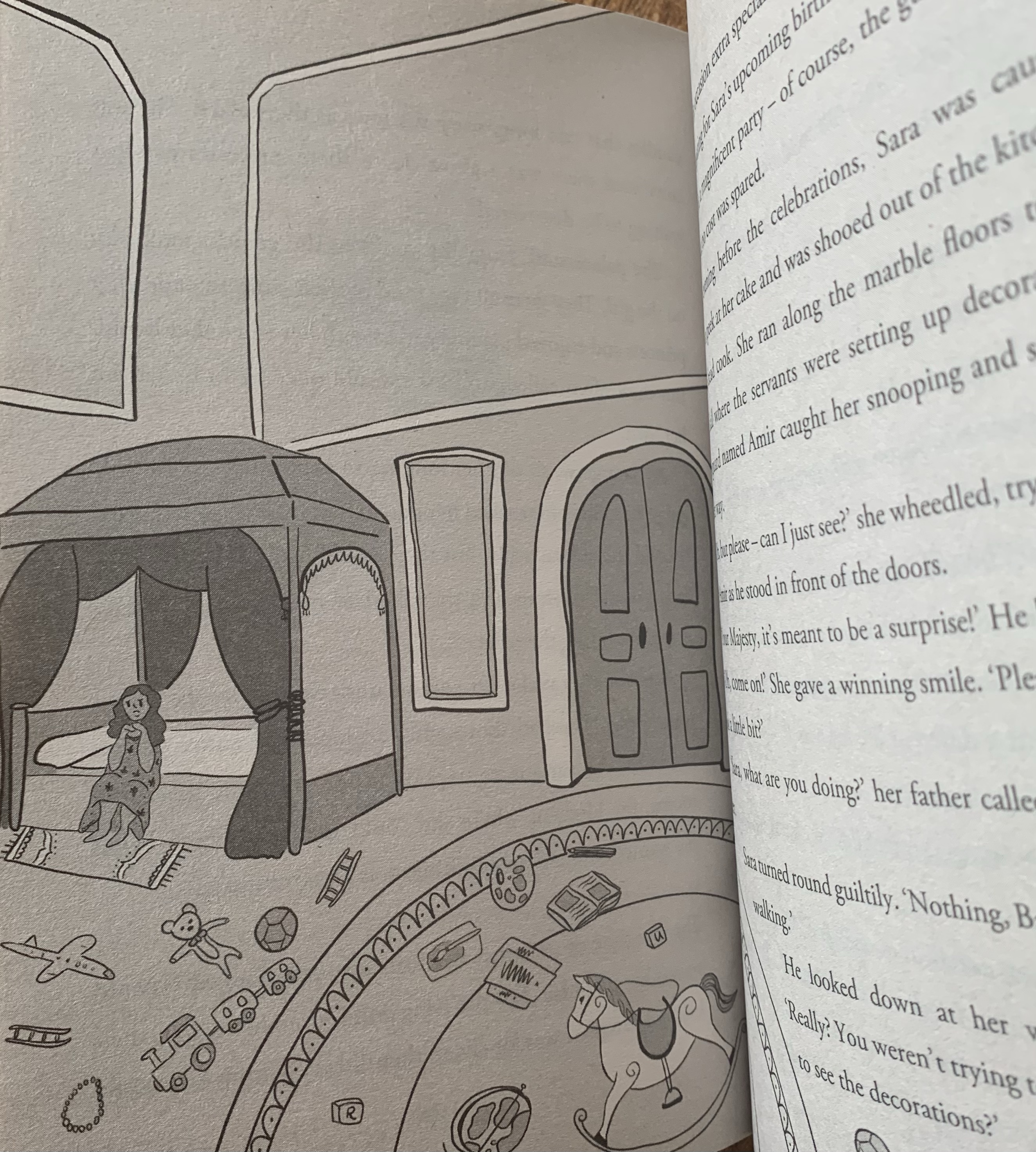
The necklace doesn’t transport Rumaysa to her parents, however, it takes her to a street where a girl is throwing rocks in desperation having been denied attending an Eid ball after her dress was torn to shreds.  The story starts with Ayla’s back story before Rumaysa arrives, but the two girls befriend each other, Rumaysa uses her magic gold weaving abilities to conjure up a new and beautiful dress and golden shoes and the girls head to the ball.  When Ayla heads off to get samosas she meets the prince, but doesn’t know he is the prince.  They argue about the play Layla and Majnun and when her stepmother asks about the dress, Rumaysa and Ayla make a run for it.  A shoe is lost, the stepmother comes to know, the guards search for the missing girl, and all is well.  Except Harun is incredibly shallow and superficial and only interested in Ayla’s clothes and status, so she rejects him and points out that she is much too young for marriage.  She instead reclaims her home, fixes her relationship with her stepsisters and begs Rumaysa to stay.  Rumaysa makes her excuses and is whisked away to a land that is being ruled by a man and his dragons.

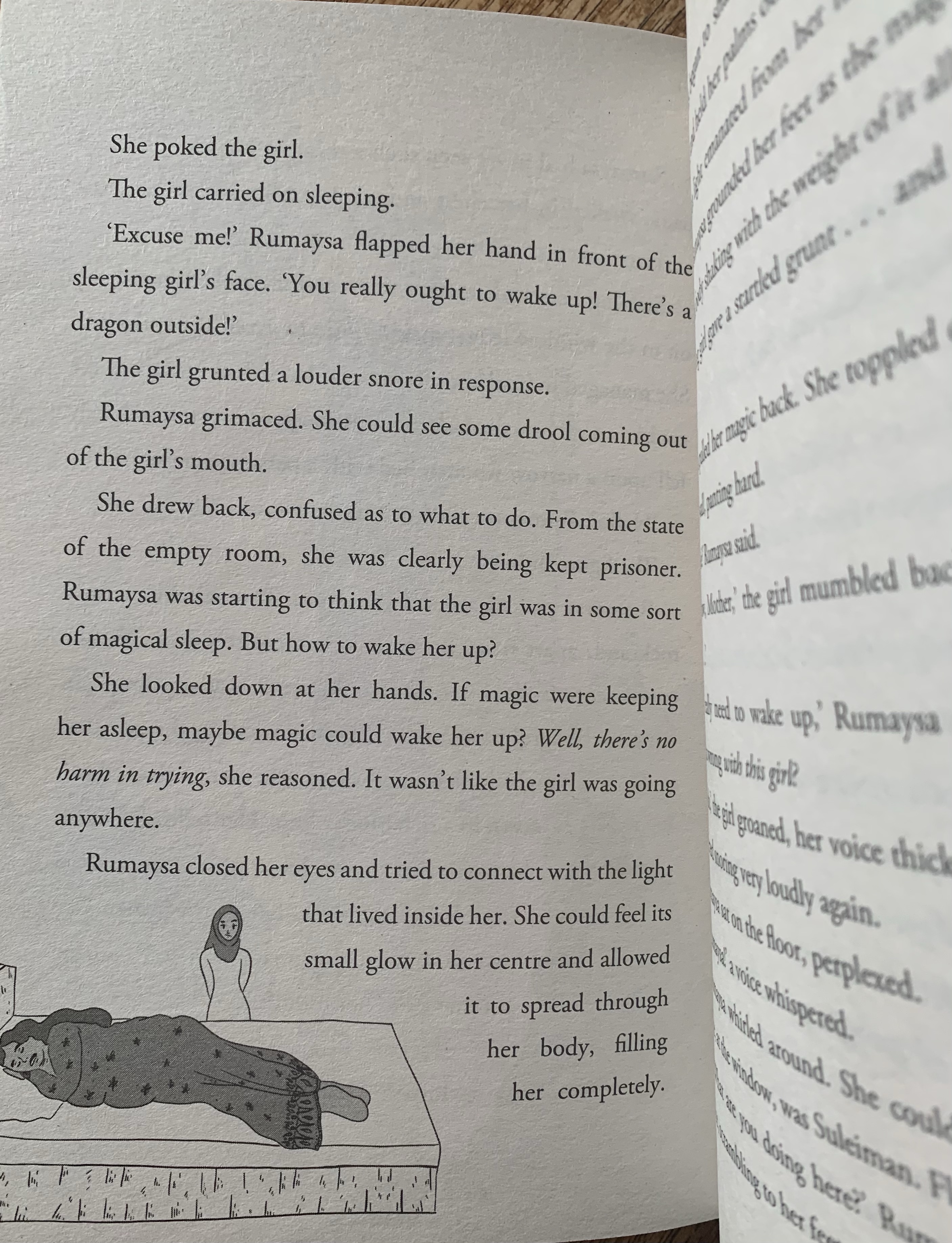
Originally the land of Farisia is ruled by King Emad and Queen Shiva, but they have become unjust and disconnected from their people.  When Azra gets a chance to steal Princess Sara and take the kingdom, he does.  Rumaysa arrives to free a sleeping Sara from the dragon and restore apologetic and reformed leaders to the thrown.
img_0397

WHY I LIKE IT:

I do like the spinning of familiar stories and either updating them, or twisting them, or fracturing them, so I am glad to see an Islamic cultural tinge available.  I feel like the first story was the strongest conceptually even if the details and morals weren’t well established.  The second story was strong in the messaging that Ayla, and any girl, is more than just a pretty dress, but the premise was a little shaky and not that different from the original.  The third story was a little lacking developmentally for me and all three I felt could have gone stronger in to the religion and culture without alienating readers or becoming heavy.  There are characters illustrated in hijab, some in saris, some in flowing robes. Princess Sara is noted to be a larger body type and I appreciated that in elevating the heroines, other’s weren’t put down.  Even within the book, there is diversity which is wonderful.  

img_0398

FLAGS:

There is lying and stealing with consequences.  “Shut up” is said.  There is magic, death, destruction, and a brief mention of an avian crush.
img_0395

TOOLS FOR LEADING THE DISCUSSION:

I could see this being used in a classroom for a writing assignment to urge students to write their own tales.  I think it is fourth or fifth grade that children read fairytales from different points of view: think the three little pigs from the wolf’s perspective or the Stinky Cheese Man and Other Fairly Stupid Tales, and this book would lend itself easily to that lesson as well.

Islamaphobia deal with it in the name of peace by Safia Saleh illustrated by Hana Shafi

Standard
Islamaphobia deal with it in the name of peace by Safia Saleh illustrated by Hana Shafi

img_9893

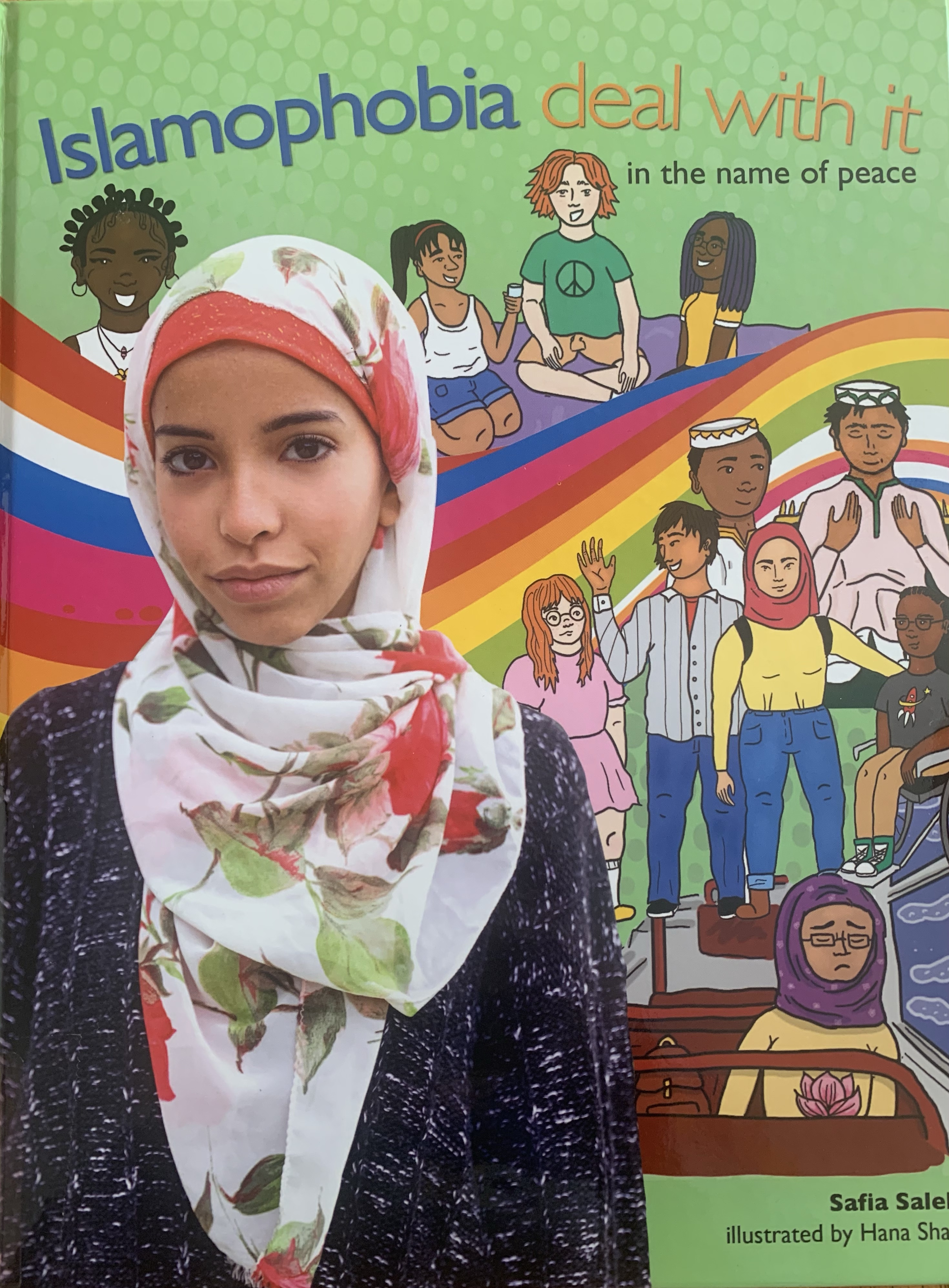
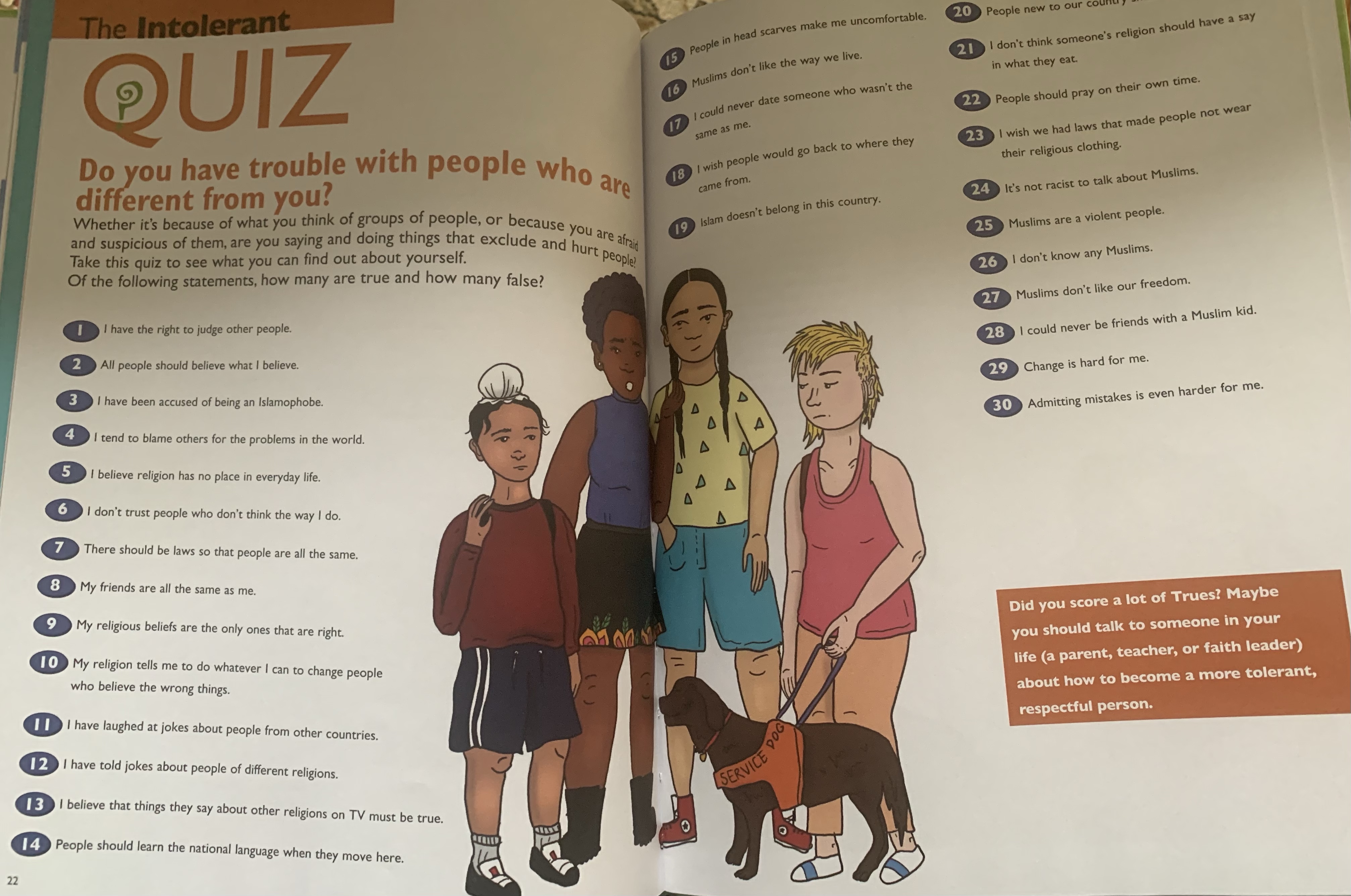
This nonfiction book has given me pause.  The information, the approach, the presentation, the importance, is all really well done, I just can’t really grasp how to use the book.  It is broken up in to four sections:  Islamophobia 101, The Believer, The Intolerant, and The Bystander. In each sections it has scenarios, comic strips, quizzes, infographics, advice columns and so much more spread out over 32 pages.  After it explains what Islamophobia is, it offers believers (Muslims) ways to see if what they are facing is classified as Islamophobia.  It has quizzes and questions and advice for people that are intolerant, and then if you are just around Muslims and intolerant folk what you can and should be aware of and do.  I think in a classroom all sections could be gone over, but I’m not sure in which grade and in what context.  In an Islamic youth group I think it could be really thought provoking to look at different sides and encourage the members to share their personal experiences, but I don’t know.  If you are a bully, would some quizzes and graphics be enough for you to recognize your own bias, could it make you change your attitude? I’d love to hear from others that have read this book, I checked mine out from the library.  It says it is for ages nine and up and other books in the series cover topics such as: consent, homophobia, transphobia, anxiey, racism, and freedom of expression.

img_9897

The first section: Islamophobia 101 starts off with a scenario of a girls first day of school after the summer and her first day wearing hijab.  No one really says anything, but there are whispers, her best friend asks if everything is ok at home.  It defines Islamophobia as “a kind of intolerance, or a refusal to accept and respect ideas and views that are different from your own.  It is the belief that Muslims, or people who follow the religion of Islam, are a group to be fearful of.”  It goes on to explain in examples what Islamophobia is while giving facts about Islam and things to think about. There are graphic comic type scenarios showing what Islamophobia can look like based on ignorance, stereotypes, then assumptions, and finally fear.  The section then offers a 10 question quiz, followed by questions and answers to a fictitious counselor in an advice column format. Finally there are myths and a Did You Know Section.

img_9899

The next section: The Believer, starts with a scenario of a Muslim holding their breath while watching the news.  Of being proud of your family and faith, but being tired of convincing people you are a Muslim and a good person.  An advice column about handling halal food, terrorism, hijab and sports is next followed by tips to not feel alone and an infographic on dos and don’ts to not be overwhelmed by your experiences.

img_9901

The third section is The Intolerant which asks if other people’s religions bother you, or if you question why religion has to be part of daily life and not kept personal.  There is a a 30 question true and false quiz, then a challenge to be part of the problem or part of the solution, with information on what you can do.  There is a sidebar about the role of social media as well as some highlights of current Muslim sports figures.

img_9900

The Bystander section asks if you’ve seen someone bullied or harassed for being Muslim, if it bothers you to hear people talk about immigrants and refugees as a threat, and what you can do to speak up. There are dos and don’ts a 10 question quiz, some more Islam facts and some direction to get more information.

img_9902

Overall the book is well done, and I had my kids look through it to see a way to facilitate anything they experience and how to articulate how they are treated and might treat others.  

img_9896

Ramadan and Eid Al-Fitr: Traditions and Celebrations by Melissa Ferguson

Standard
Ramadan and Eid Al-Fitr: Traditions and Celebrations by Melissa Ferguson

This 2021 nonfiction middle grade book about Ramadan and Eid al-Fitr breaks sections down by key concepts and the use of stock image photographs. The information is fairly accurate, no major flags, just a few awkward stresses: that kids look for the moon, that meat is so important at iftar, but most of the information is conveyed well. There is a glossary, more books to check out, internet sites to visit, an index, and pronunciation guide. The Capstone published, 32 page book, shows diversity in the pictures- some women with hijab and some without, different skin tones as well, and while it might not be the most tempting book to pick up, the text is inviting for non Muslims to understand Ramadan and Eid, how to join their Muslim friends in being kind and forgiving, and answers a lot of questions in a straightforward manner. Muslim children will also enjoy seeing their beliefs explained in a positive manner to readers in a book that stays religion focused and doesn’t get distracted by culture.
The book sections are: What is Ramadan?, When is Ramadan?, What does Fasting Mean?, Suhoor, Iftar, The Qur’an and Prayer, Acts of Kindness, Ramadan at School, and Eid Al-Fitr. It starts by introducing a fictional character named Ayesha reading the Quran with her family. It is the start of Ramadan, a month of praying, fasting, spending time with loved ones, and trying to be better people.

It then explains the lunar calendar before discussing that fasting is a choice to not eat or drink from dawn until sunset. It also notes that children and the sick and elderly are not required to fast.

It talks about eating healthy foods early in the morning before praying the first prayer of the day. It details iftar being dates and water, followed by the sunset prayer and then a large meal after that.

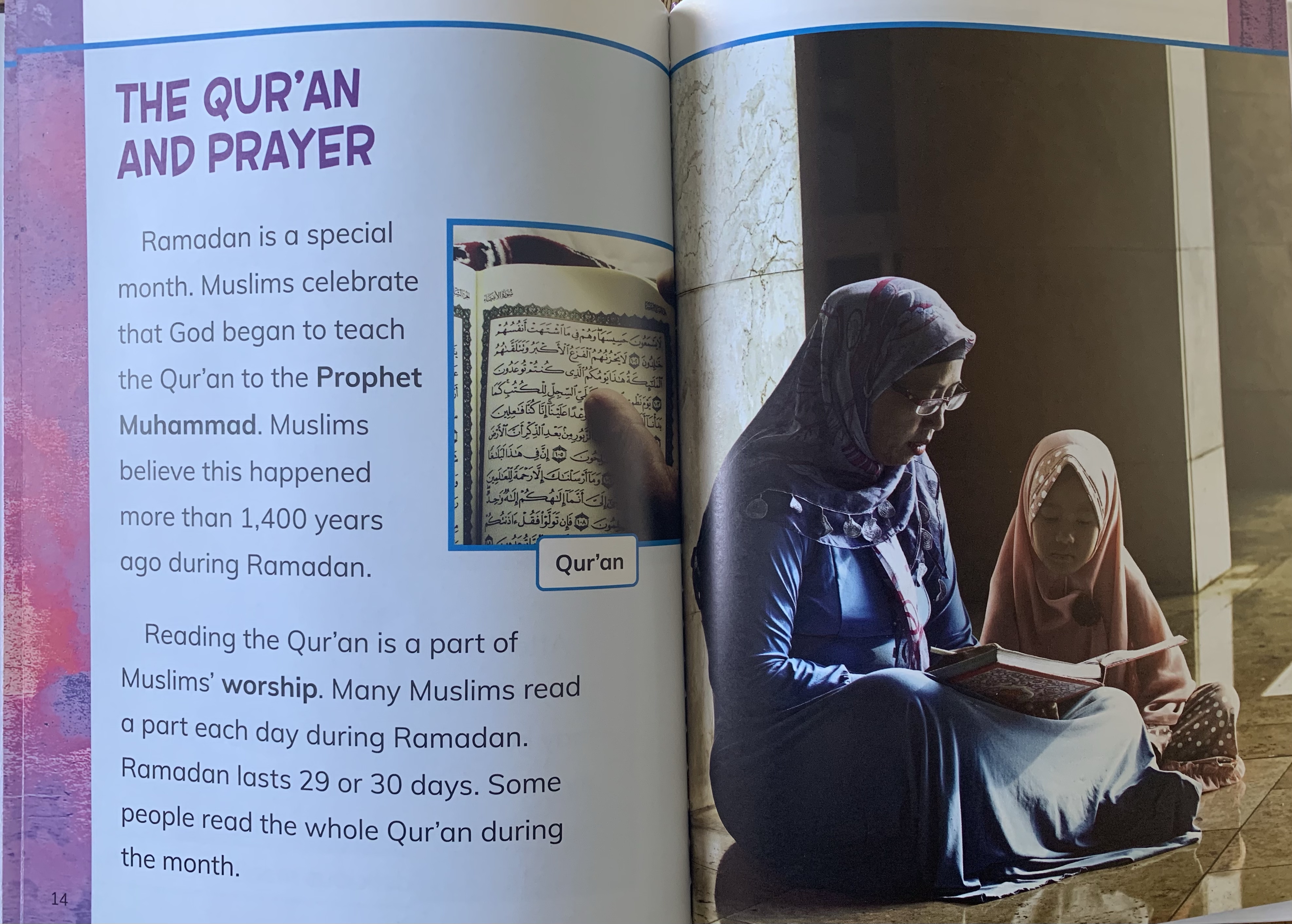
It is very clear in explaining that Muslims believe it was during Ramadan that God began to teach Prophet Muhammad the Quran more than 1,400 years ago. It identifies our five prayers and that people can pray at home or in mosques and that children learn to pray with their parents as they grow up.

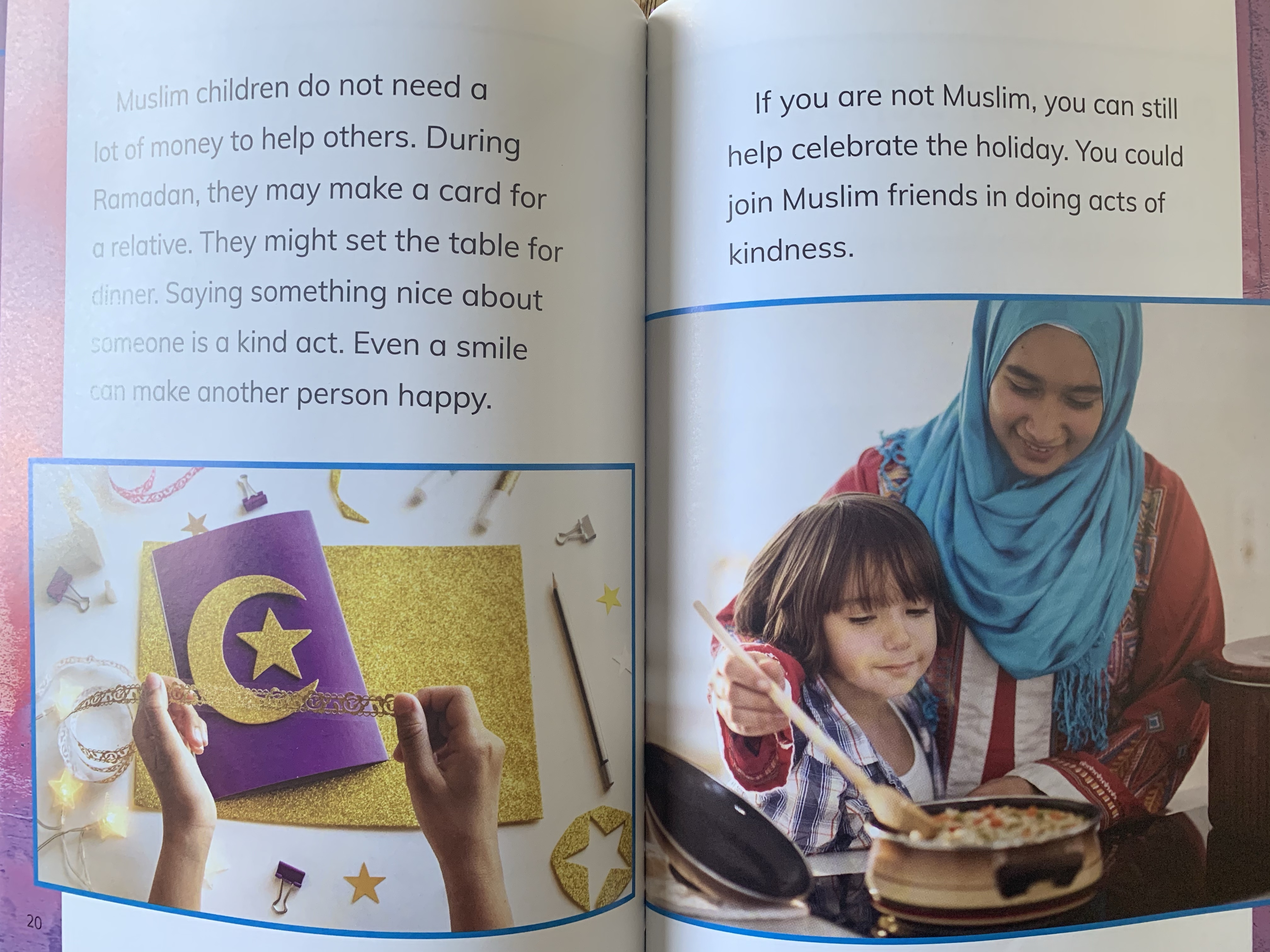
The book then becomes a little more unique as it gives time to the aspect of kindness in Ramadan. It gives examples of what Muslims do, from raising money and hosting large dinners, to buying and donating a toy. It even dedicates a whole page to children doing kind acts with little to no money: setting the table, making a card, smiling. It encourages non Muslims to join a Muslim friend in doing an act of kindness too.

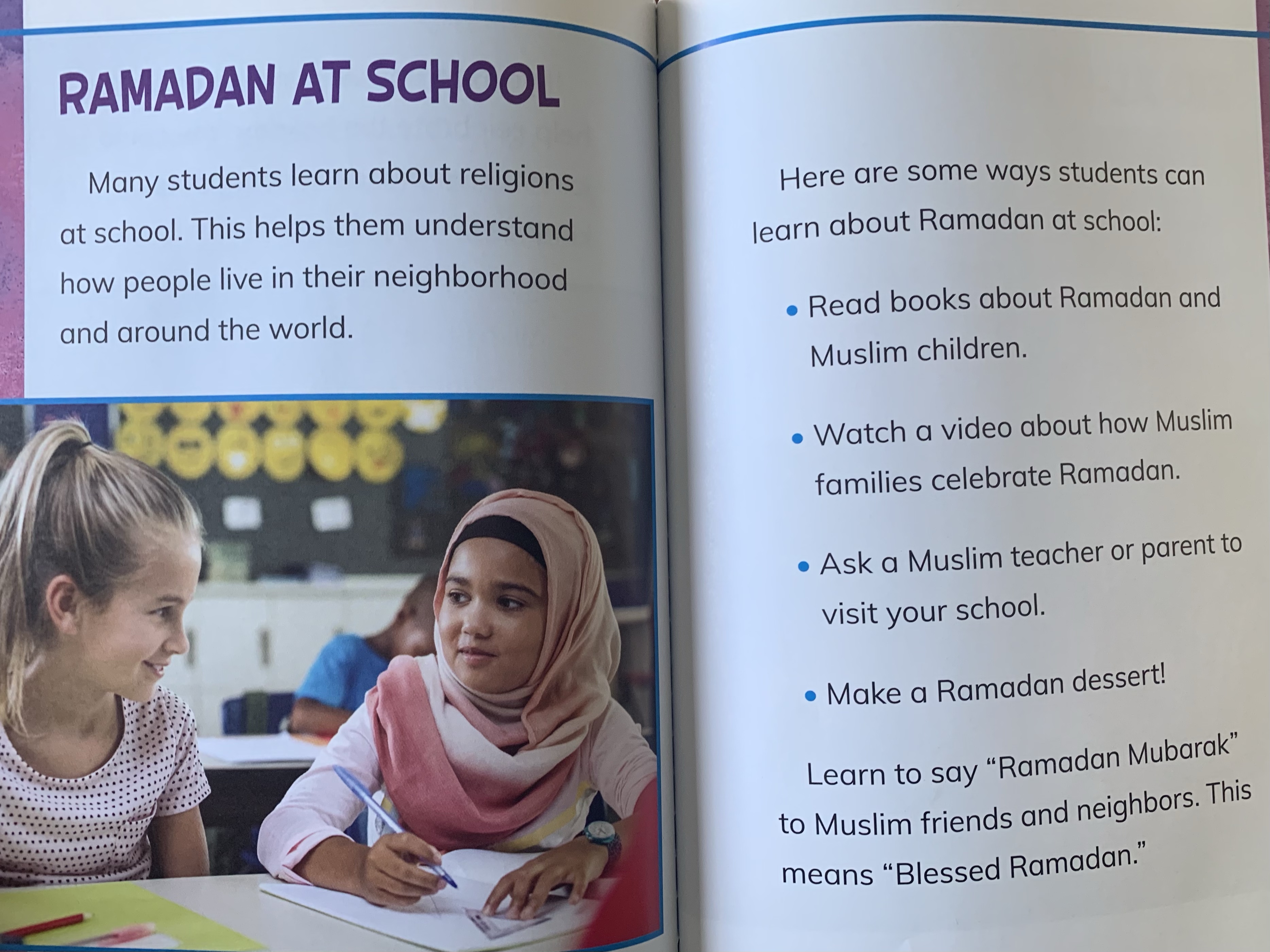
The next section, is similarly unique in talking about Ramadan at school and how often at school we learn about different religions in our neighborhood. It gives bulleted suggestions on how to learn about Ramadan in school and how to say Ramadan greetings. The book concludes with Eid Al-Fitr and coming back to Ayesha and her family celebrating.

Eid al-Fitr: Festivals Around the World by Grace Jones

Standard
Eid al-Fitr: Festivals Around the World by Grace Jones

img_8875-1

NO! NO! NO! NO! NO! Seriously, astagfiraAllah! This 24 page middle grades non fiction book about Islam and Eid published in 2018 with smart-board connections and QR scan media enhancements on its surface would seem to be a great classroom all-in-one to learn about the basics of celebrations, Islam, Ramadan, and Eid.  BUT, NO! The information is all sorts of off, and there is an illustration depicting Prophet Muhammad (saw).  How is this sort of ignorance even possible? This isn’t even a Karen Katz My First Ramadan depiction where you can possibly argue and stretch that it isn’t a depiction of the Prophet, but just of the people.  Every picture in the book is a photograph, except on the page talking about the first revelation, it is an illustration and there are no other people on the page, just a picture of the Quran.  I encourage you all to see if your public library shelves the book and ask them to pull it. ****UPDATE: My library pulled it, and the publisher has halted sales of it. Alhumdulillah! We must remember we can use our voices to make a differences, that people are receptive and willing, not always, but we won’t know unless we try.  ****

img_8873-1

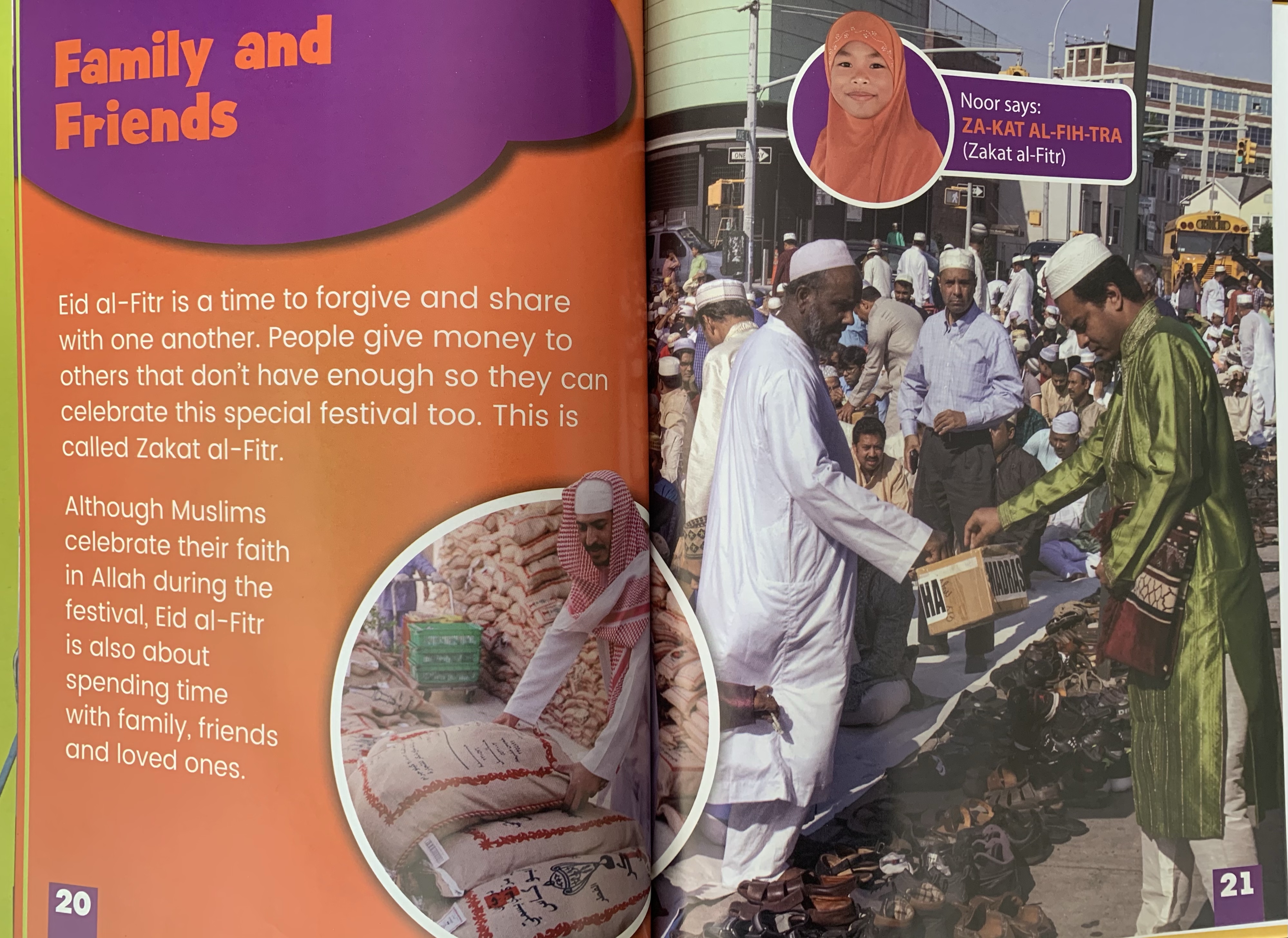
The book covers nine topics on two page spreads ranging from the generic what is a festival, to what is Islam to prayer and worship and festival food.  The book has a little girl Noor that pops up on pages to tell you how to say a word and has a glossary with her definitions at the end.  Even the definitions at the end about the foods are wrong, they seem to have switched ma’amoul and sheer khurma.  To it’s credit the book has a photographs of a lot of diverse Muslims celebrating Ramadan and Eid, unfortunately so much is wrong, from little things saying that “Sheer Khurma is traditionally eaten for breakfast during Eid,” to “Muhammad spread Allah’s words to other people by writing them down in a holy book…”.  

img_8869-1

It has in quotes that a voice from the sky called to Muahmmad, “You have been chosen to hear Allah’s words.”  This quote and its source are nor footnoted or referenced, clearly they are not from surah Al Alaq.  I’m not sure where they are getting this from.  There are no salutaions after Rasulallah’s name nor is Prophet before it.

img_8872-1

Other informative sentences are vague and suggest misinformation.  It says that we believe in Allah and pray to him in a mosque, which yes is fine, but we also pray to him in other places five times a day and the way it is worded, I don’t think that would be understood.  I feel like the role of the imam is also overly elevated in the book.  The takeaway I assume would be that only an Imam can lead a prayer and we must always pray in a mosque.  

img_8870-1

Ultimately the biggest problem I have in the book is the depiction of our beloved Prophet.  I can forgive that they assume eating a random dish for Eid is religious and not just cultural, but I can’t forgive such basic ignorance in a book that presumably is trying to teach about a faith to reduce ignorance and misunderstandings.


Samira’s Trip to the Masjid by Yara Kaleemah illustrated by Aveira Cartoon

Standard

img_8520

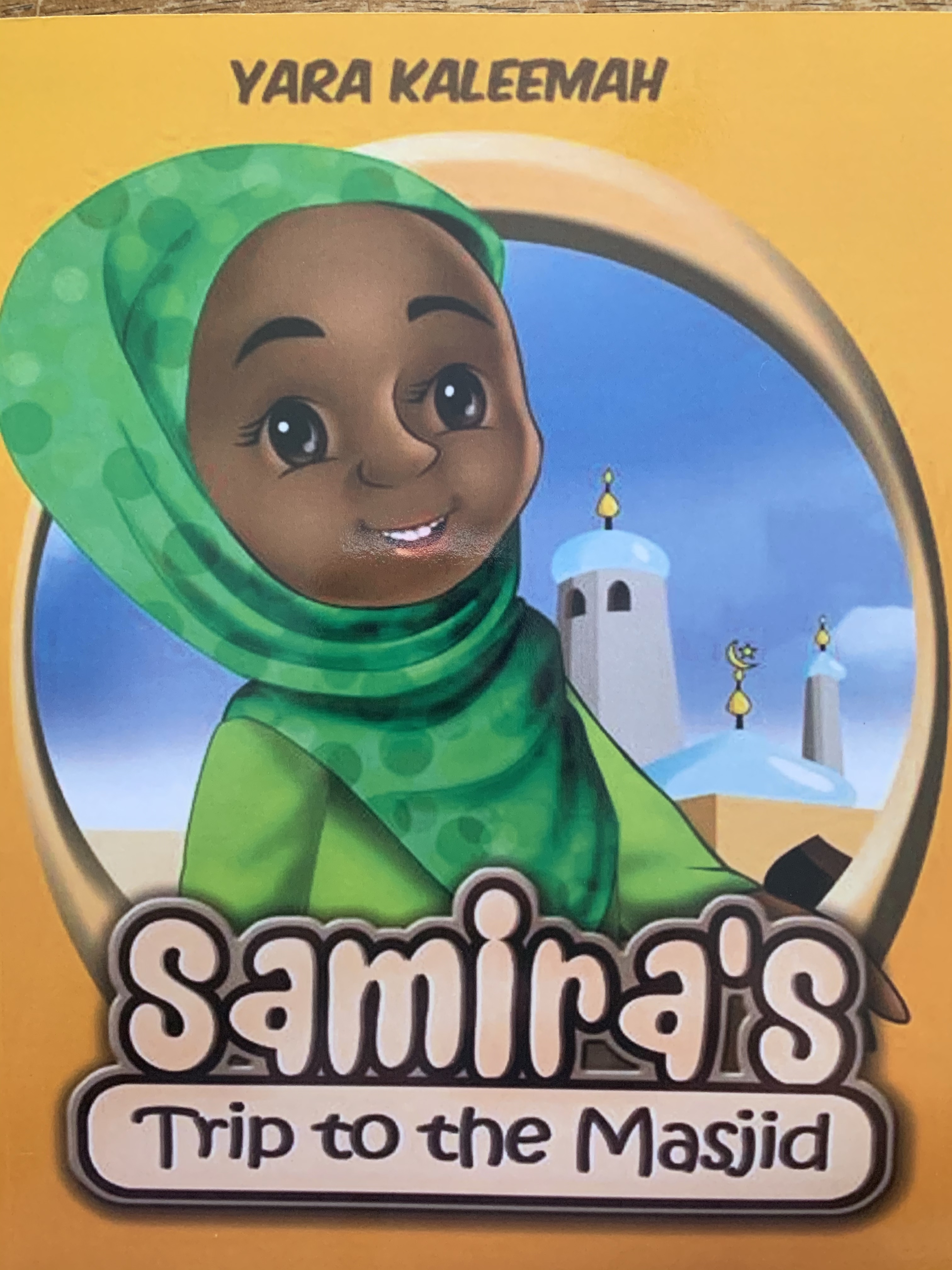
I’m a big fan of books featuring BIPOC leads in everyday situations, but when the quality of the product is subpar, I truly am conflicted if I should mention the book, or just tuck it away and pretend I never read it.  I’ve had this book tucked away for a while now, but I am pulling it out to bring attention to the importance of editors, proofers and revising.  The bar has been raised, Islamic fiction is becoming more and more mainstream.  The quality of many self published books rival and exceed traditionally published options, that to be putting out content that contains grammar errors (missing words, punctuation, random line breaks), spelling errors, voice and point of view inconsistencies, illustration errors, and content mishaps in a 26 page picture book, is not acceptable.  I feel like you are hurting the goal of representation and reflection, more than boosting it, when it is not well done.  I know that is harsh, but sadly minorities always have to do things better, it isn’t right, but it is the way it is.  You can argue my opinion that the story is too wordy or text heavy, but the technical components and final package in a $12 book, really need to be resolved.  The overall concept of the story is lovely: the Islamic details, the reminders about the sunnahs of Jummah, the little girl being excited to wear her favorite scarf and see a friend at the masjid, it really had a lot of potential.

img_8522

Samira greets the reader with As Salaamu Alaikum, as the fourth wall is breached and introduces herself as being a Muslim.  She then explains what being a Muslim is and tells the reader it is Jummah.  She asks her Ummi why we go to the masjid on Friday, before chiming in with all the information she in fact does know about Jummah.

img_8524

The next page details wudu as she prepares to go to the Masjid.  She then explains hijab as she tries to find her favorite green khimar with polka dots.  The words hijab, scarf and khimar are used interchangeable, causing a bit of confusion,  She explains that hijab is required by Allah swt to guard your chastity and that He also requires us to wear a khimar to the masjid.  I wish it would have clarified that we have to be covered when we pray, not necessarily just going to the masjid as she is a child, and many masjids are more than just places to pray, often having community halls and gyms.

img_8525

As the story continues she cannot find her favorite khimar no matter where she looks.  Ummi tries to give her some places to check, but in typical mom fashion, Samira can’t find it anywhere, and mom can find it immediately.  Samira shares some information about wearing your best clothes and they are off to the masjid not wanting to be late and hoping to get to the masjid first as the angels keep a record.  She finds her friend, and settles in to listen to the khutbah (misspelled as “Iman’s lecture” in the book).

img_8527

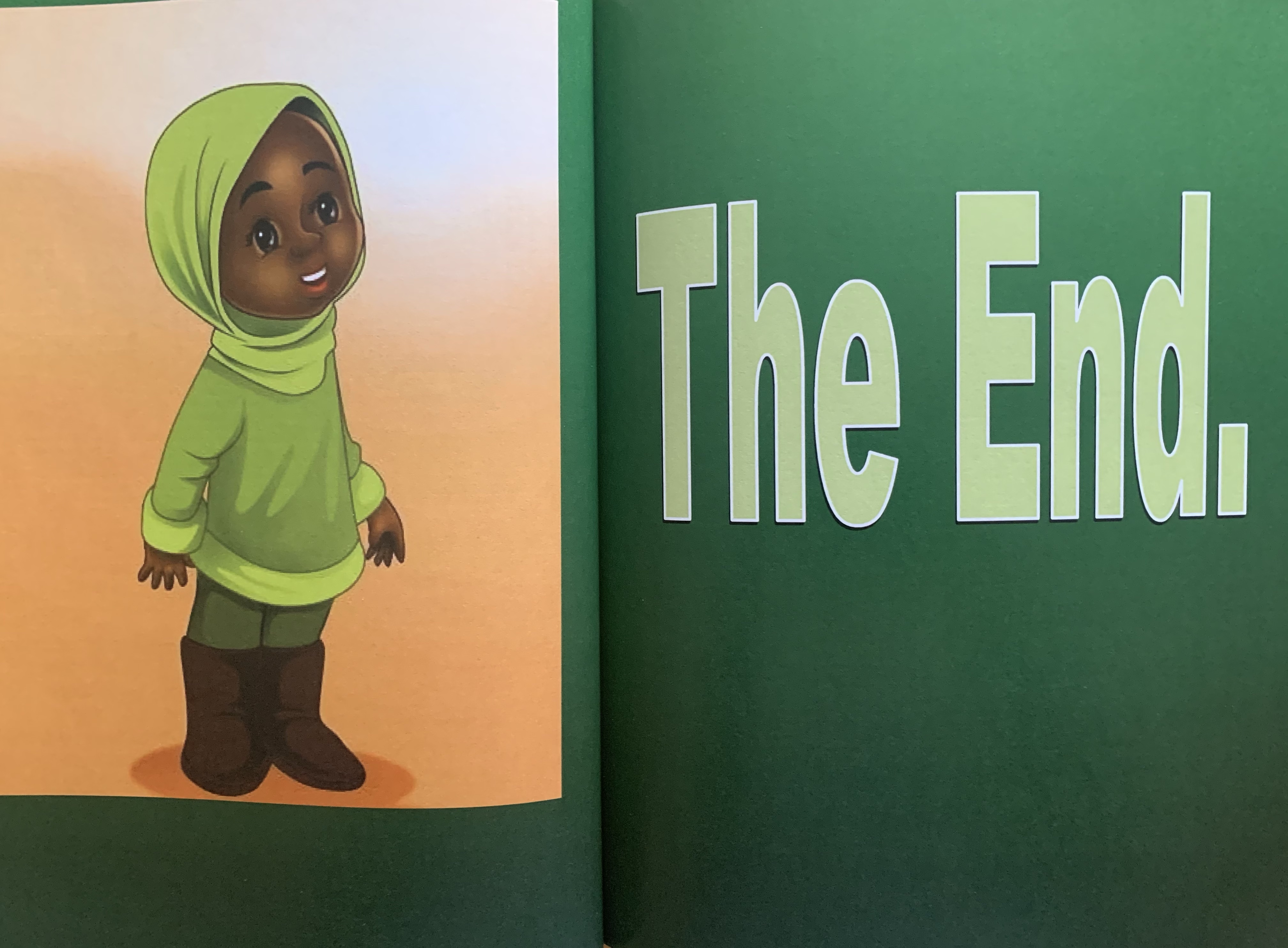
The conclusion of the book says “that even though Samira couldn’t find her favorite khimar, she was happy to take a trip to the masjid…”.  But she did find her favorite khimar? And on the very last page she is wearing the same shirts as she was at the masjid, but the polka dots have vanished from her green scarf?

img_8526

I’m hoping the author, illustrator, and publisher will clean up the book and someday republish it, we need these voices and images.

Amazing Muslims Who Changed the World: Extraordinary Stories of Incredible People by Burhana Islam illustrated by Reya Ahmed, Deema Alawa, Nabi H. Ali, Saffa Khan, Aaliya Jaleel and Aghnia Mardiyah

Standard
Amazing Muslims Who Changed the World: Extraordinary Stories of Incredible People by Burhana Islam illustrated by Reya Ahmed, Deema Alawa, Nabi H. Ali, Saffa Khan, Aaliya Jaleel and Aghnia Mardiyah

img_8359

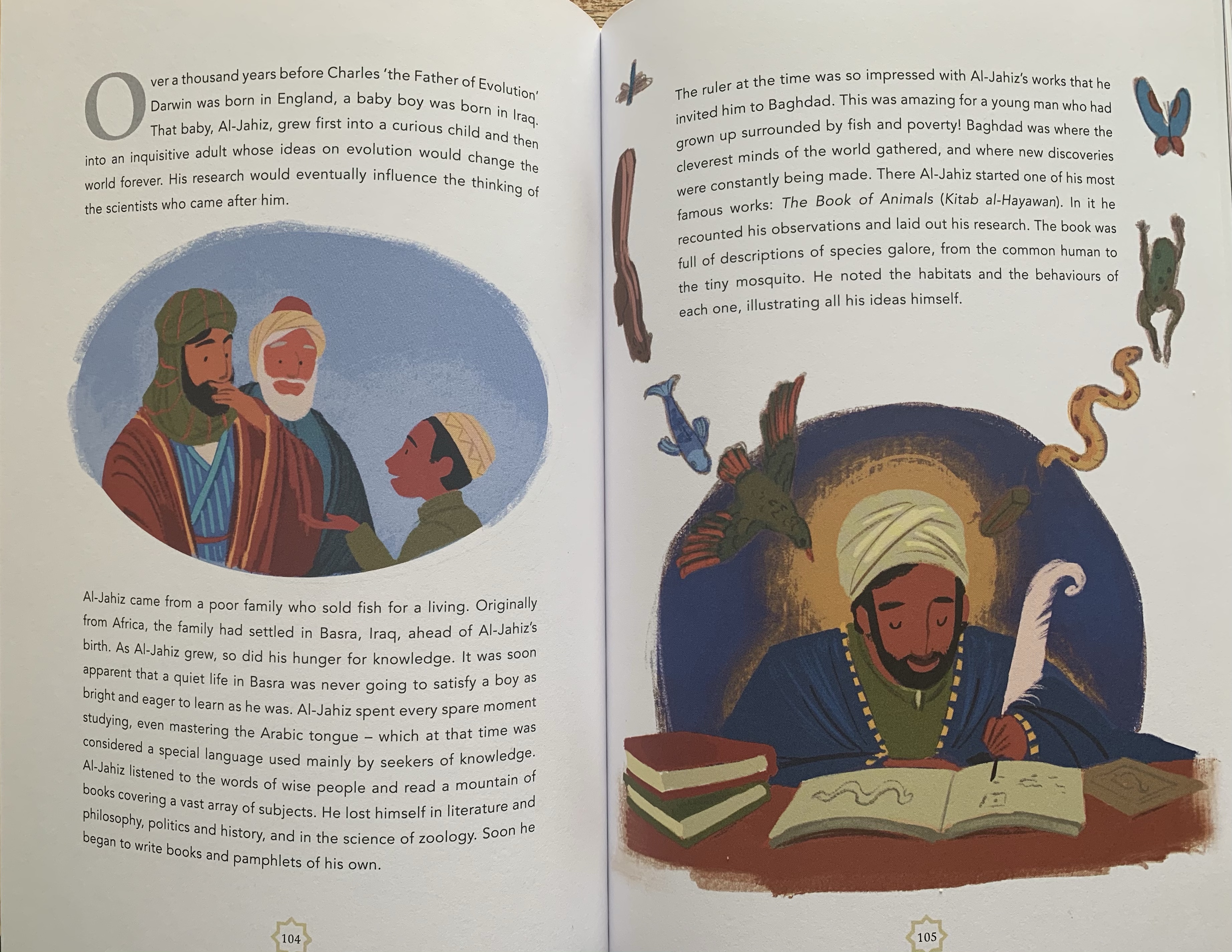
The 30 stories presented over 197 pages are inspiring, and this compilation so desperately overdue. The book is not chronological it is completely random, and at first I was confused, but as I made my way through the book, I actually grew to love not knowing who I would be reading about next.  Yes, there is a table of contents, but the point being that you don’t have to be born into royalty, or be a warrior, or have lived a long time ago to be amazing, you just have to follow your passion.  I learned so much about people I thought I knew about, and was tickled to learn about people I have never heard of: bakers, athletes, actors, educated slaves, architects, spies, singers, scientists and politicians.

img_8360

At the end of each six page illustrated blurb is an “Interesting Fact” and at the end of the entire book are some activities in the “Amazing Extras” section.  Readers can crack a code like Noor Inayat Khan who helped the Allies decode and send secret messages from France to Britain or write a poem like Rumi, a song like Yusuf Islam (Cat Stevens), draw a superhero like G. Willow Wilson, make a camera following the science of Hasan Ibn Al-Haytham, or color a picture of Muhammad Al-Idrisi.

img_8361

My favorite biographies were those that I knew little or nothing about before hand.  If I had to pick two favorite among all of those sections, I’d pick Khawlah bint Al-Azwar and Ayuba Suleiman Diallo.

img_8362

In 600 CE Arabia, Khawah, the masked knight, learned how to fight along side her brother and eventually served with Khalid ibn Waleed in battle.  It is said that she killed the Byzantine leader that captured her and then asked for her hand in marriage.

img_8365

Ayuba Suleiman Diallo in the 1700s in modern day Senegal was a highly educated man who was captured and forced in to slavery in Maryland, USA, interacted with James Oglethorpe, found himself being sent to England and with the help of a Thomas Bluett was able to be freed and eventually return home a free man. SubhanAllah!

img_8363

This book has it all: famous Muslim men, famous Muslim women, Black Muslims, Arab Muslims, European Muslims, American Muslims, Asian Muslims, African Muslims, Muslims who lived a long time ago, Muslims who are still alive all jumbled up and beautifully presented by a Muslim author and a handful of Muslim illustrators. This book is wonderful for 3rd graders to adults and would be a benefit on any book shelf.  It is worth noting there are no sources given, and doesn’t explain how the people were chosen to be included in the book.

Float Like A Butterfly by Ntozake Shange illustrated by Edel Rodriguez

Standard

img_8250

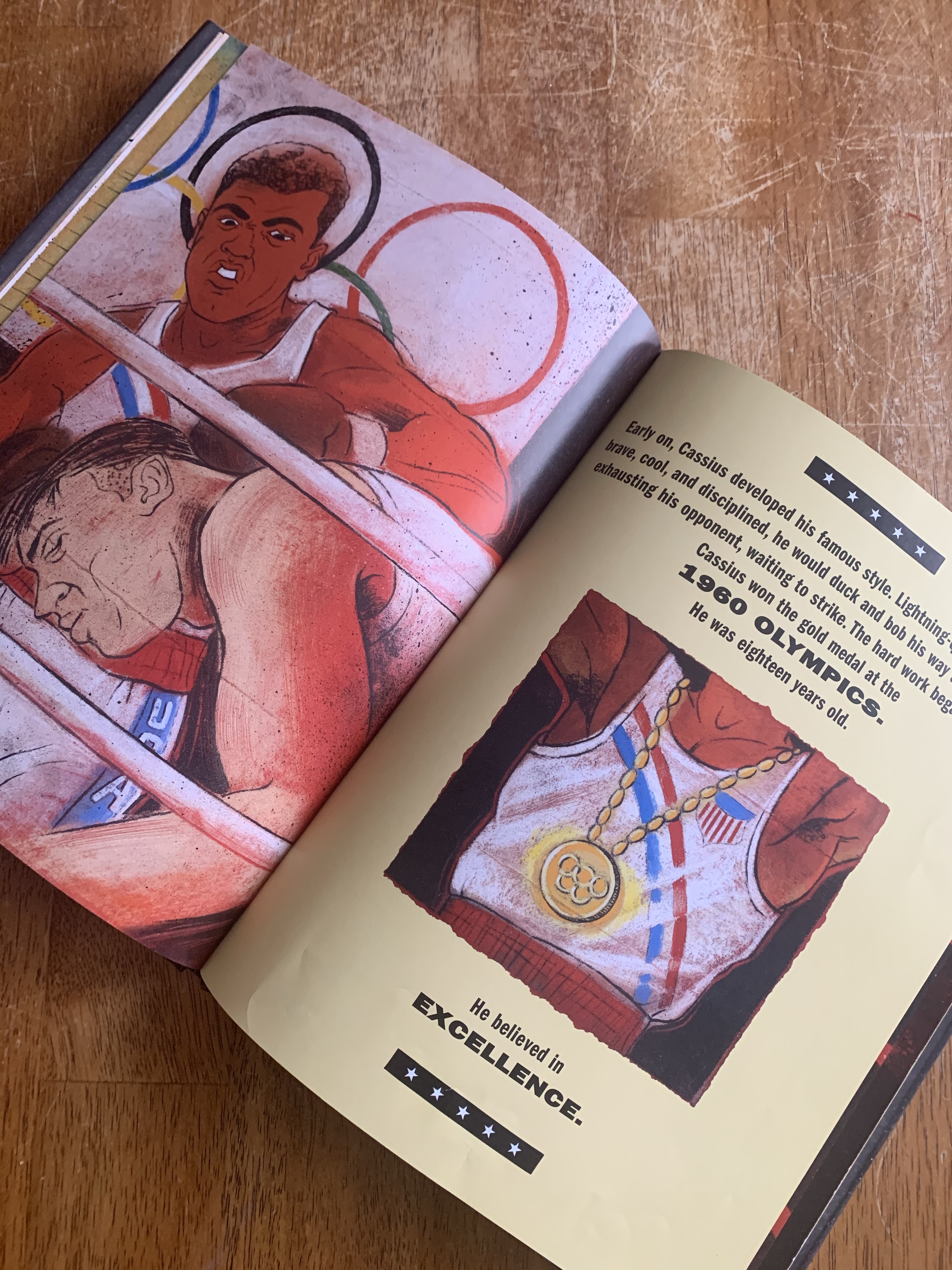
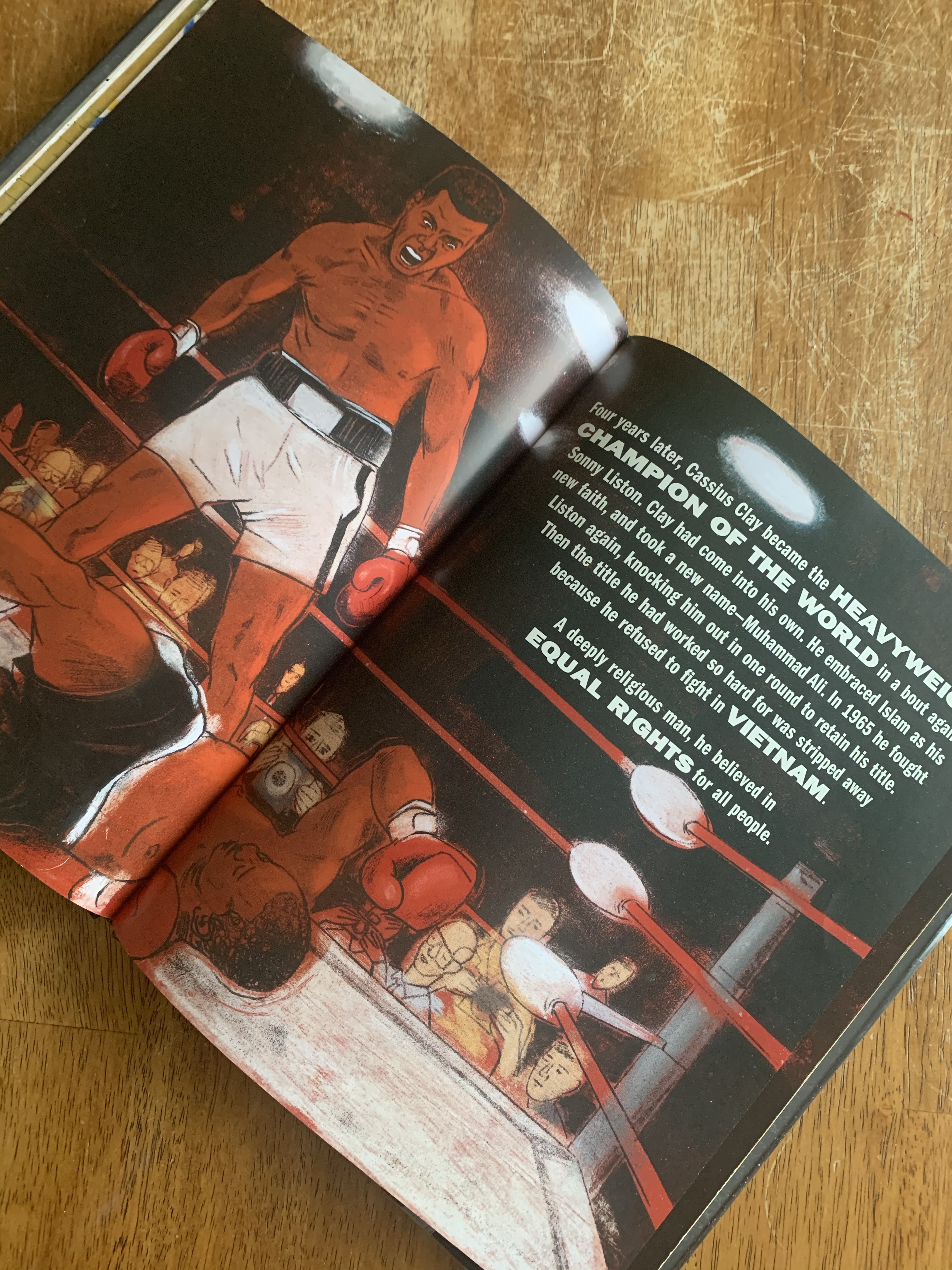
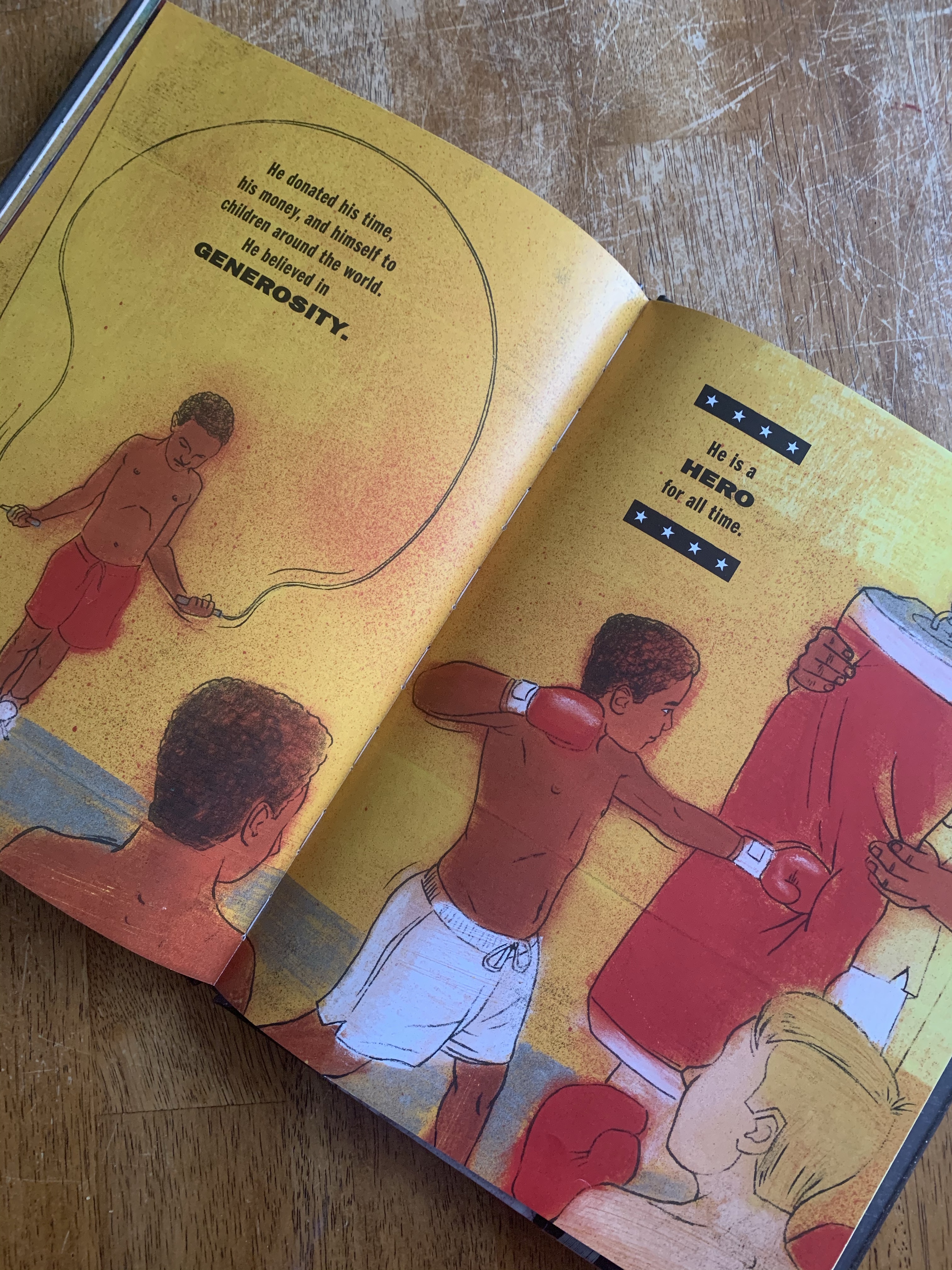
This 40 page biography beautifully presents major events of the famous boxer’s life without going in to much explanation. While it is an AR 4.7, it is still a picture book, and might work better for younger kids with some conversation and context, than for middle grade readers looking for anything in-depth about the beloved hero. While following his life, the reader sees him as a child growing up before he becomes famous, and sees that even after he retires, he is so much more than just a boxer, he is a compassionate leader, icon, and humanitarian.

img_8251

Born in Louisville, Kentucky in the Pre-Civil Rights South as Cassius Clay, he struggled to understand why there was only a white superman, and questioned if heaven was divided up by color and income like Smoketown.

img_8252

Cassius loved the power of words and would help his father make rhymes as a sign painter. When his bike gets stolen he is motivated to learn to fight so that nothing else is ever taken from him and his. He may not be the colored superman, but he is determined to be lightening fast and have fists that fly.

img_8253

In 1960 at age 18 he won Olympic Gold. In 1964 he converted/reverted to Islam and changed his name to Muhammad Ali days after becoming the Heavyweight Champion of the World. His titles were stripped from him, however, when he refused to fight in Vietnam.

img_8254

Years later in 1971, the Supreme Court reversed his convictions for not fighting and in 1974 he reclaimed his title by beating George Foreman in “The Rumble in the Jungle.” In 1981 after winning, keeping and losing the title, Muhammad Ali retired from boxing for good.

img_8255

Muhammad Ali suffered from Parkinson’s disease but still donated his time, his money and himself. He believed in perseverance, and equality, and fought for what he believed in. He passed away in 2016 at the age of 74.

img_8256

This is an updated edition from the 2002 originally published book, it now includes his death. I wish it was more than a fleshed out timeline and showed him as a person, or what it was like to lose everything when standing up for something you believe in, or explained what some of his catch phrases meant, or really just as a more high energy celebration of his life.

img_8257

The Girl Who Slept Under the Moon by Shereen Malherbe illustrated by Sarah Nesti Willard

Standard
The Girl Who Slept Under the Moon by Shereen Malherbe illustrated by Sarah Nesti Willard

img_8044

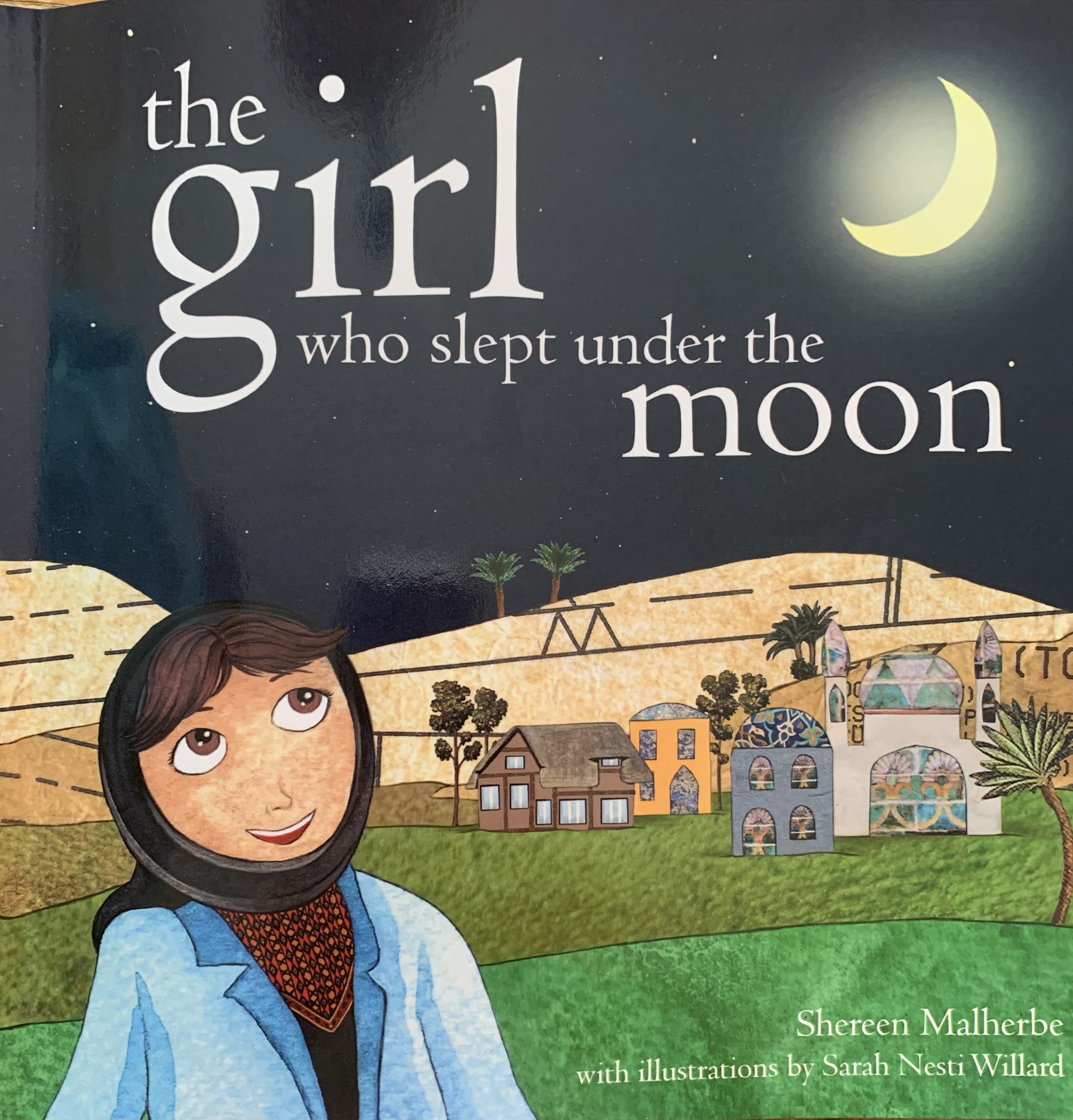
I was really surprised by the number of gaps in this 46 page story that is so adorably illustrated and seemingly planned out. I thought perhaps I was being overly critical, so as always I tested it on my kids, and they too were confused by the main character’s rational and choice of words, the holes in the narrative, and the inconsistency of the characters. The book is wordy, so conciseness cannot be the reason for the holes, and it is published by a publishing company, so I would assume it has been proofed. Really the point of stories connecting us and giving us comfort when we need it, is sadly lost. I had hoped to love this fictional story of a Palestinian girl using prayer to give her comfort in her new home, but alas it seemed to be trying to weave in too much, and as a result the story isn’t fabulous for me unfortunately.

img_8038

Noor is new at school and stands out. She finds comfort in remembering the things that are the same. 1-Allah could still see and hear her. 2- The Angels were still by her side, and 3-She still slept under the same moon. She also wears clothes that remind her of home and provide an unspoken clue as to where home is for her.

img_8039

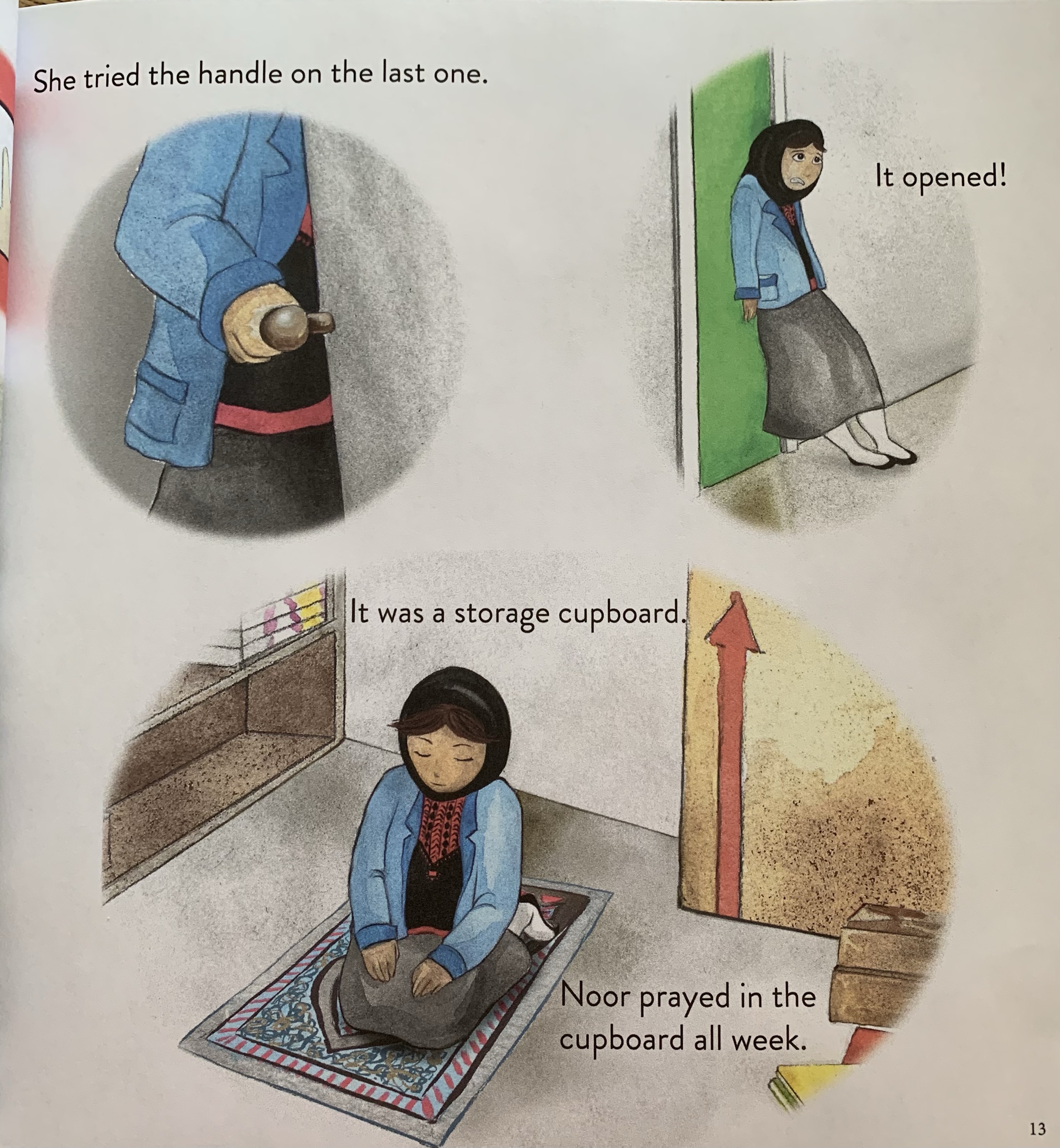
At school Noor has a problem, she needs a place to pray, but at lunch time the kids are not allowed to go inside and the dinner lady guards the door. Noor needs a distraction to sneak in the building and it isn’t clear if she provides the distractions, or just benefits from a baby bird falling out of a nest, a snake being in the grass, and a classmate getting hurt. Either way, when the teacher is occupied, Noor enters the building and finds a closet to pray in.

img_8040

On one such visit to the closet she finds someone already in there, Hannah. Hannah is there because she doesn’t like being on the playground because she is different. Noor never asks why Hannah feels different, so the reader isn’t made aware either. Hannah asks her why she is there and Noor says she comes “to pray because it reminds me of where I’m from.”

img_8041

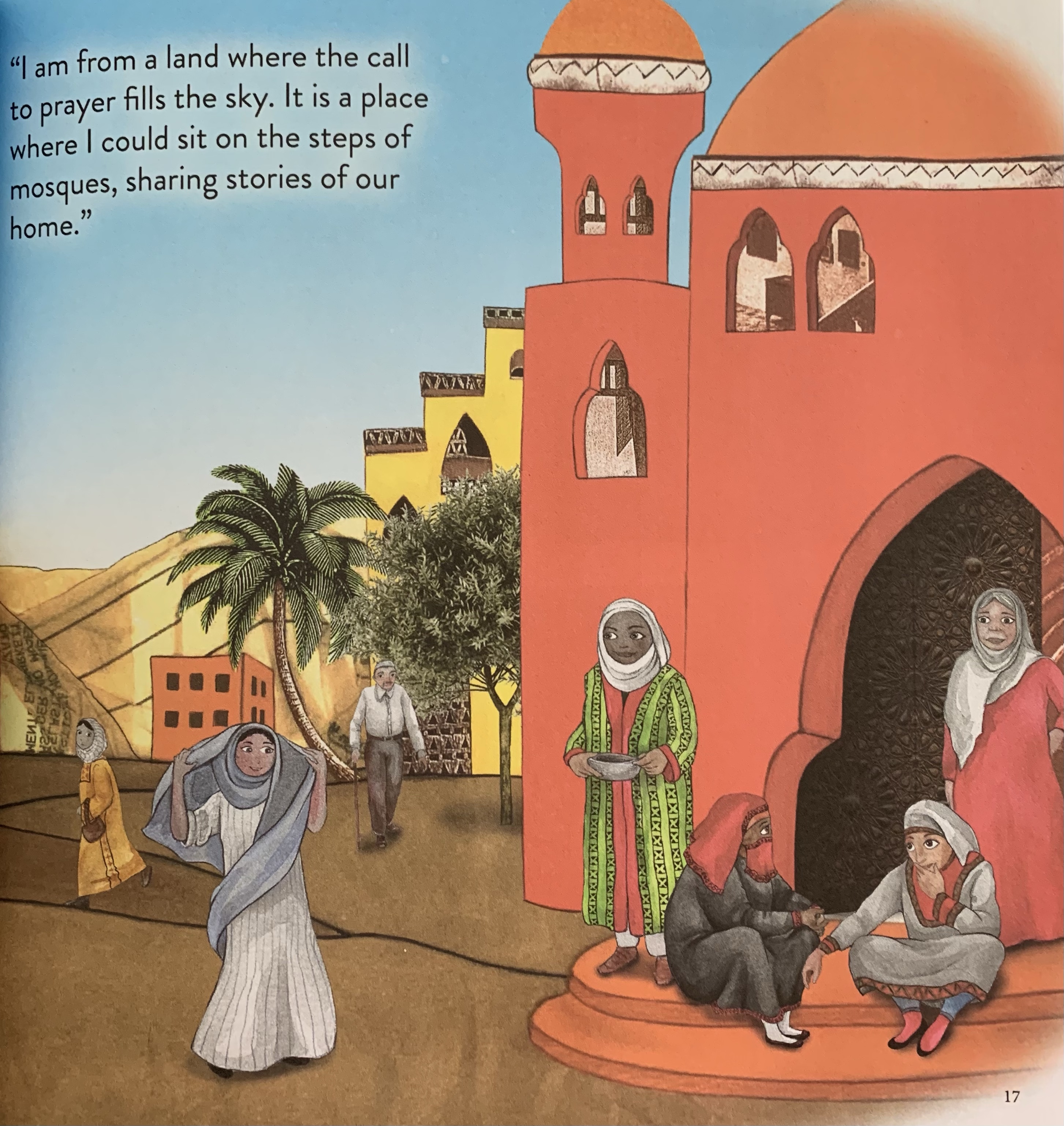
When Hannah asks where she is from, Noor doesn’t just simply answer, she tells her stories about her homeland, the mountains, olive trees, where the athan floats in the air and fisherman return to the shore with their catch. The next day Hannah is there again, and Noor tells her more stories and legends about her culture and lessons of the Prophets. Noor learns that through her stories she feels connected to her old home.

img_8042

Weeks pass, and one day when she sneaks in to the school, she finds the door locked. With no where to go she heads back to the playground and starts to cry that she won’t be able to pray. She then sees Hannah disappear and she follows her in to the drama studio. When she enters she sees sets built that look like the setting of her stories, of her home. Hannah knew she missed home and built her sets to look like Palestine.

img_8043

Other kids miraculously enter, and Noor begins telling them her stories, without praying first. The other kids seem to enjoy her stories and Noor learns that she can pray anywhere while holding on to her three reassuring thoughts.

The illustrations are engaging, although I’m not sure where the prayer rug seems to magically come from for Noor to pray on in the closet the first time. Had the book just been about prayer and finding a way to pray, or just about the stories connecting us to our past I think it would have been more powerful. I’m glad that Noor loves salat and that Hannah is a good friend, but I feel like by trying to do too much, the poignancy of the little things was lost.

And as for my questions: Can’t Noor ask for a place to pray? Can’t she pray outside? How is Hannah making the sets all by herself? Noor says she prays because it reminds her of home, she doesn’t pray for the sake of Allah or because it is required of her? Why did Hanna feel different, and why didn’t Noor bother to ask? It says that she needed to distract the dinner lady, isn’t that dishonest even for a good cause? Did she harm the baby bird so that it would need rescuing? Put the snake in the grass? Hurt the little girl so that she could get by the teacher? How was Hanna getting inside at lunch time? How is the school ok with a kid coming inside to build a whole set with school materials, but can’t let another child inside to pray for less than 5 minutes? And if Noor didn’t feel comfortable asking for a space to pray, clearly Hannah had connections to get permission to create a huge scene, couldn’t she have asked, or helped Noor ask?