Category Archives: 2nd through 4th grade

Amina Banana and the Formula for Friendship by Shifa Saltagi Safadi illustrated by Aaliya Jaleel

Standard
Amina Banana and the Formula for Friendship by Shifa Saltagi Safadi illustrated by Aaliya Jaleel

img_8365-1

I have five children, I have taught second grade, I have shelved, recommended, and read aloud a number of early chapter books for the better part of the last 20 years, so when I say that this book changes the standard of what a book (series) for this demographic can and should be, I do not say it lightly. Yes, I am bias, the author is a dear friend, but Amina has layers, growth, insight, struggles, warmth, heart, and all the other glowing adjectives normally associated with beloved books and characters for older readers. This book is the first in a series of four, and each book is somehow better than the previous. At 126 pages with a robust backmatter that includes scientific extensions, a recipe for ful mdamas, and a note from the author, I am confident that children of all ages, everywhere, caregivers, parents and educators alike will all fall in love with Amina, cheer for her, laugh with her, and be enamored with her attitude, perseverance, and joy.

SYNOPSIS:
Amina loves having a plan, a formula in fact, and when she arrives in Indiana as a refugee from Syria she is determined to make friends in 3rd grade.  Things don’t always go as expected, but alhumdulillah Amina doesn’t stay down: classmates, family, and determination combine to help the clever, yellow-loving protagonist find a way to rework her experiments, accept what she can and cannot control, and succeed in making this new country feel a little bit like home.

WHY I LOVE IT:
I adore the humor, unapologetic Islam, the rich Syrian culture woven in, and Amina’s approach to life.  So often early chapter book protagonists are obnoxious, annoying, crude almost, bratty, arrogant, and repetitive, Amina is none of those things.  She is vulnerable and strong, confident, yet nervous, hopeful, but worried, she is tangibly real in a way that readers will see themselves and relate.  I love the humor of idioms being confusing, and the heart of seeing what the parents have sacrificed and are willing to sacrifice by starting over in a new place.  The illustrations add to the experience of drawing reluctant readers in and will help those transitioning from picture books to chapter books be immersed by the story.  As always the author’s writing is impeccable and the story well-crafted.

FLAGS:

There is some teasing, reflections on why Syria was left, the journey to America, and hardship.

TOOLS FOR LEADING THE DISCUSSION:
This book is ideal for classroom, library, and home shelves.  It would be a wonderful classroom read aloud and works equally as well at bedtime.  My children college to elementary have all read and loved Amina, and I highly encourage preordering so that your children will get a chance to fall in love with her too.


Prince Among Slaves by N.H. Senzai illustrated by Anna Rich

Standard
Prince Among Slaves by N.H. Senzai illustrated by Anna Rich


462575630_1072301494218509_2457799047040333197_n

This 48 page biography tells a story that we all should know, yet are probably hearing for the first time.  The story of how West African Prince, Abdulrahman Ibrahim Ibn Sori, was forcefully taken and sent to America to be a slave on a plantation, what he endured for decades, and how he made his way back to the African continent.  The large emotional illustrations and poignant text tell of his his life in Fouta Djallon, the painful journey to Mississippi, the trials as a slave, the joy of being a husband and father, and his attempts to return home a free man.  With each challenge and at each stage, him additionally showing amazing strength and trust in Allah swt.  The heartbreaking tale unearths so much evil, ignorance, and faith, that the story is not meant to be read once, it begs to be reflected on, pondered over, and shared far and wide. The treatment of Prince Abdulrahman shown in some of the illustrations are difficult to look at, as they should be, there is also a very passionate kiss shown up close between him and his wife.  I think the story’s words and illustrations emphasize the anguish, the strength and the humanity, but I mention the illustrations for each to decide on their own.  There is not a biography or sources in the book, but rather mentions in the Author’s Note the source matter being a film by Unity Production Foundation.  It is not unusual to adapt a biography from a film, and I read an ARC, but I do hope the final copy will be sourced.  The book is for middle grade readers, and I cannot wait to add a physical copy on my own bookshelves, and gift numerous ones to teachers to share in their classrooms.

WARNING: SPOILERS: THE SYNOPSIS CONTAINS A FULL RETELLING, as it is historical, I hope that is ok, but in no way shape or form is my summary taking away from the details, emotion, and writing the actual book contains. 


In 1762, the Fulbe enjoyed prosperity and peace under the king, and when Abdulrahman was seven he started school in Timbo. He loved learning about the Prophets in the Qur’an, and excelled at his studies.  So much so that his father sent him to Timbuktu to continue his studies at age 12. Five years later he returned to train as a warrior, when the first white man, a surgeon, Dr. John Cox appeared injured and lost, they helped heal him and sent him back home to Ireland.

By age 26, Prince Abdurrahman was a warrior, a scholar, soon to be king, a husband and a father of a son.  One day while on patrol, he was captured. He and 170 others were loaded on a ship, for eight months, and sent over 3,000 miles across the Atlantic Ocean.

On August 16, 1788 he arrived starved in Natchez, Mississippi, for $930 he and another man became the property of Colonel Foster.  Resigned that this was his fate, he helped share his knowledge of cotton, and the plantation prospered. In 1975 he married, Isabella.  They had nine children and eight grandchildren.  

In 1807 while selling goods in the market, Abdurrahman sees Dr Cox (subhanAllah), and the doctor pleads with Colonel Foster to free the Prince.  Foster could not be moved and when the doctor died, Abdurrahman once again accepted his fate. 

His story though had started to spread, and a printer, felt a softness to the Prince turned slave and printed often embellished stories trying to help his cause.  He asked the Prince to write a letter, the Prince wrote an ayah from the Quran and the printer passed it to Mississippi senator Thomas Reed explaining the Prince’s desire to return to Africa.  Senator Reed got the letter to Henry Clay, the Secretary of State under John Quincy Adams, who then got the message to the President of the United States.

The letter was written in Arabic, and they assumed Prince Abdurrahman was thus from Morocco.  The Sultan of Morocco was touched by his plight and petitioned for his release, and the Prince kept quiet not wanting the truth of where he was from to remove the help he was receiving.

He was finally freed and able to purchase the freedom of his wife Isabella with the help of those who had heard his story, but the efforts to free his children were not as successful.  The truth about him not being Moroccan became known, and despite extensive travels and pleas, his declining health forced him to leave America with out his children.  He arrived in Monrovia, Liberia, but would die before he could reach his home of Fouta Djallon.

462563778_440473032154161_1815006209353878188_n


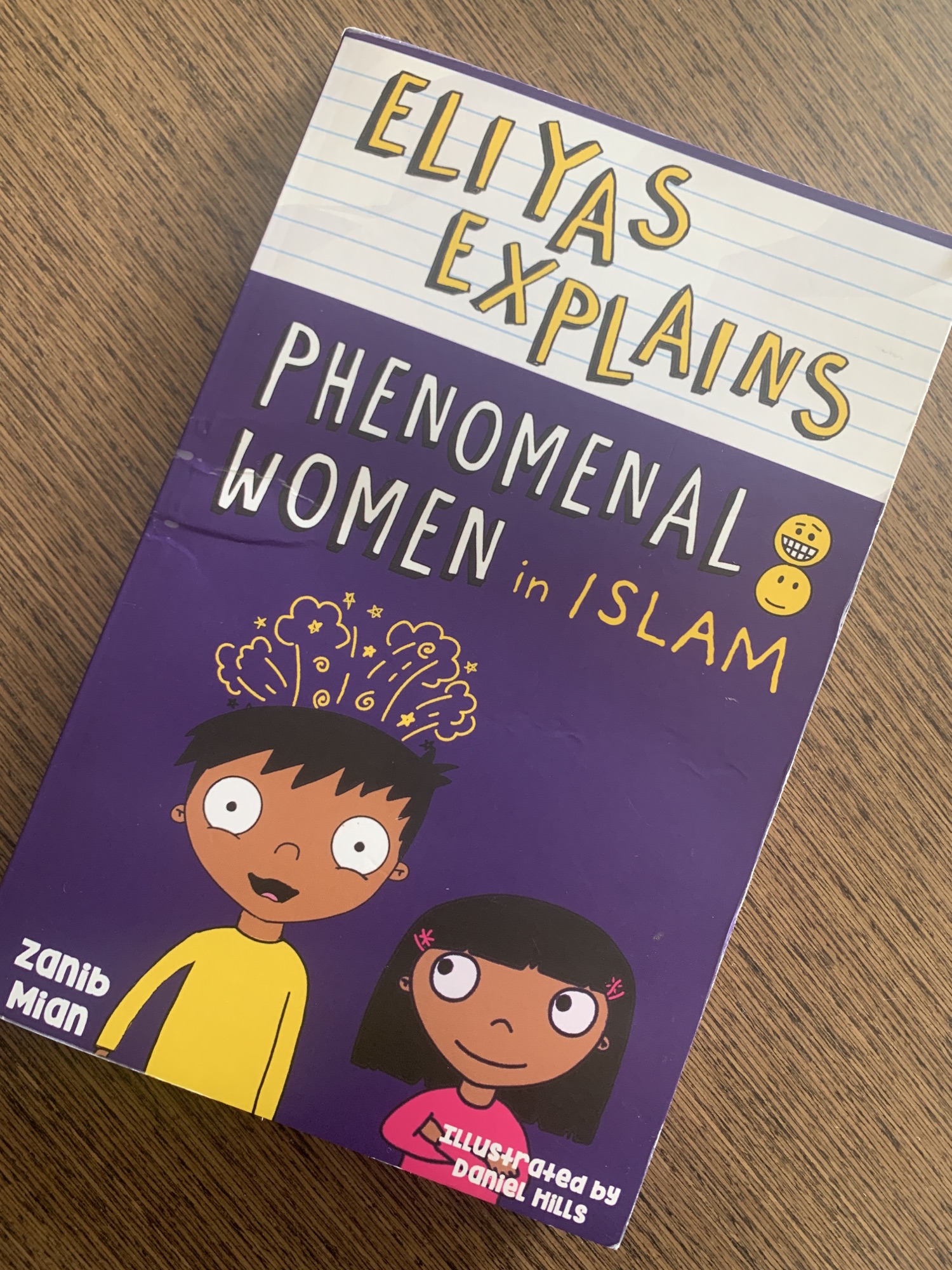
Eliyas Explains Phenomenal Women in Islam by Zanib Mian illustrated by Daniel Hills

Standard
Eliyas Explains Phenomenal Women in Islam by Zanib Mian illustrated by Daniel Hills

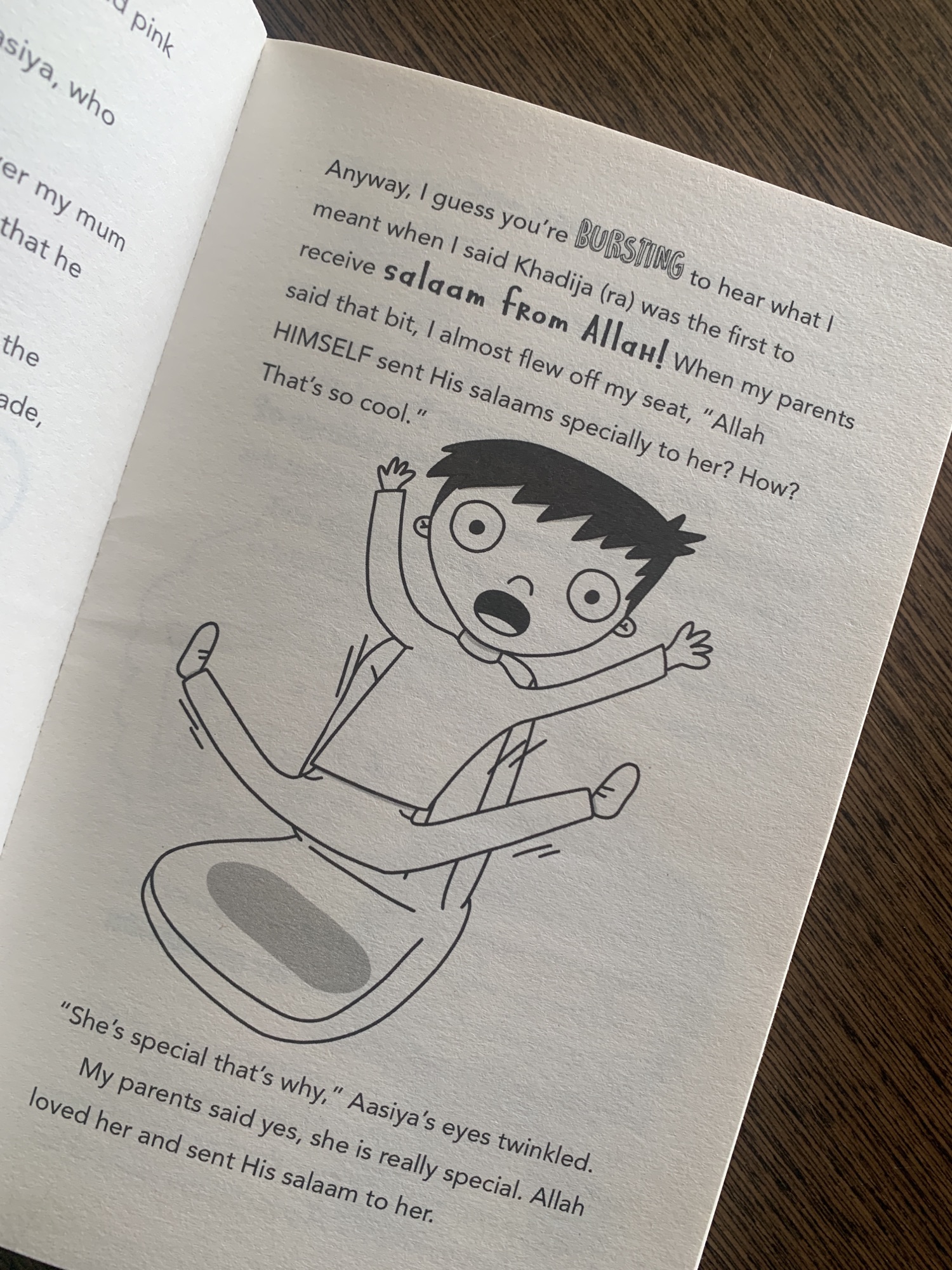
Another wonderful Eliyas Explains book that targets elementary readers with a relatable, funny, likeable voice that weaves in information, heart, faith, and humor in a way that makes them favorites at my house, even after my children have aged out of the target demographic. I particularly enjoyed this 106 page focus on women in Islam, because like the others in the series it is sourced, illustrated, and engaging, but I felt the cover story linking the facts was also compelling. I genuinely didn’t know what the family was going to do about the expo mix-up, and was invested in not just the Islamic role-modeling of how the family would handle the set back, and what historical woman it would be connected to, but also what they were going to do with all the Qur’an Match games, and I assure you, I didn’t see the resolution coming, or the twists that followed.  I always appreciate that the author’s books don’t talk down to the readers and with the information contained, I think both children hearing the stories for the first time or those that know them well, benefit.  The way they are presented serves as a reminder for some or a tease for others to go learn more.  Alhumdulillah for this series and this book that highlights Khadija (ra), Fatima (ra), Aisha (ra), Maryam (as), Hajar (as), and Aasiya. As prices for goods continue to soar, this reasonably priced book should be an auto buy for us all.

SYNOPSIS:

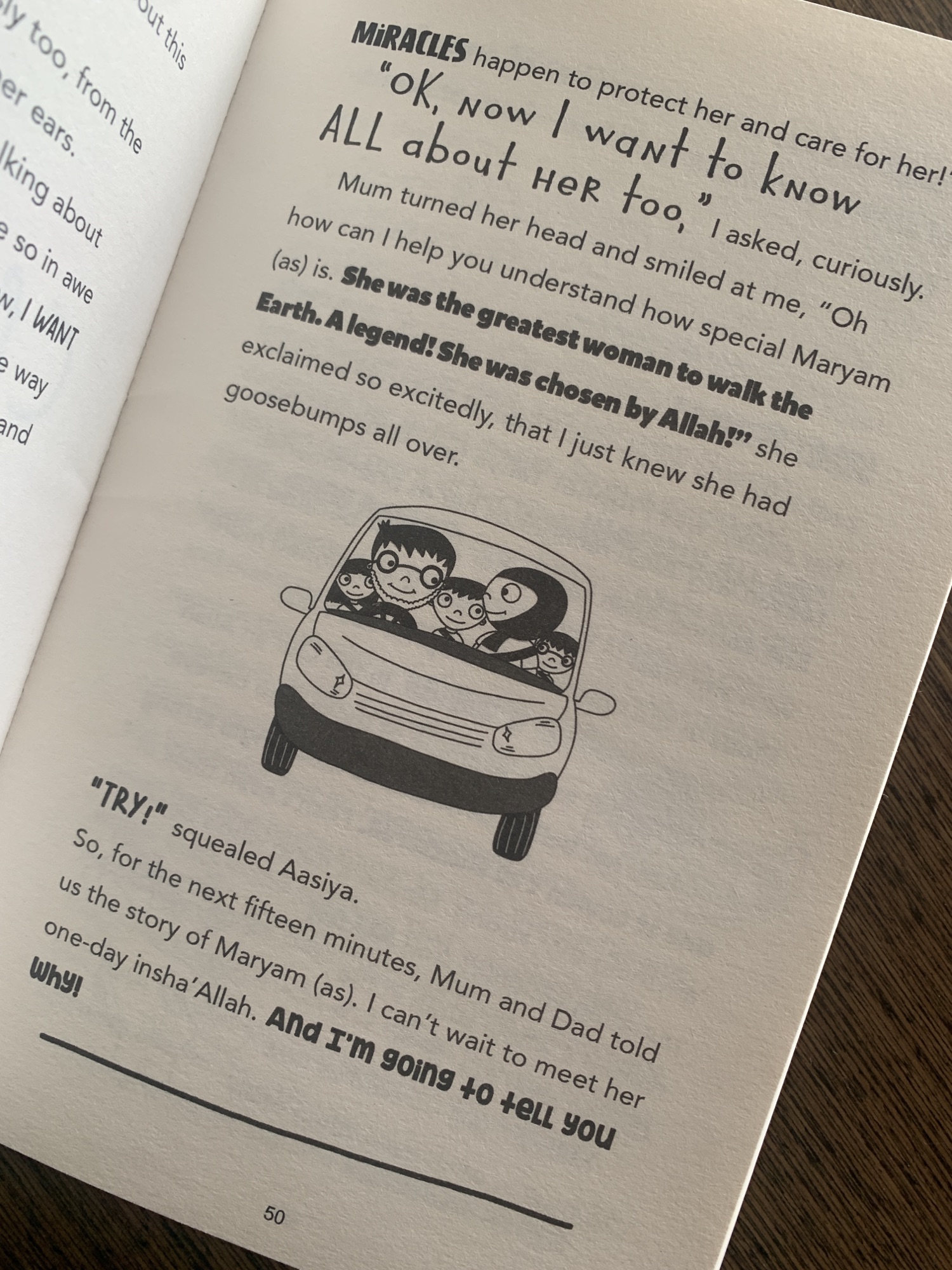
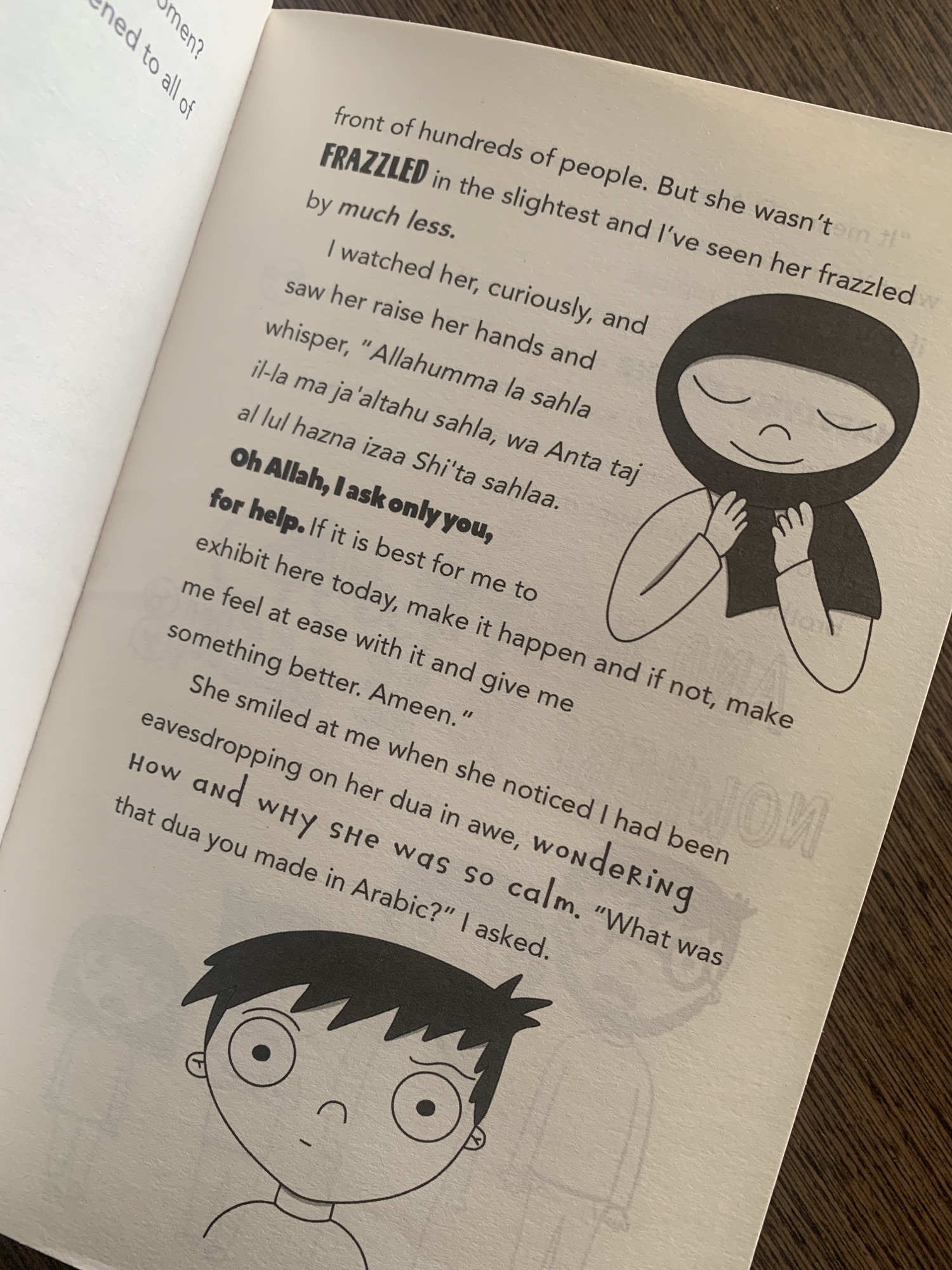
Eliyas and his family are heading to an expo to set up their booth and help their Mum sell her Qur’an Match game.  Mum is a little nervous and the road trip is the perfect setting to talk about phenomenal women in Islam to give her confidence and the kids some teachable moments.  The kids are wowed by the business savvy and status of Khadija bint Khuwaylid (ra), and they want to hear about the other  women promised jannah.  Little sister Aasiya is particularly interested in who she was named after.  Once they get to the expo though, things are not as expected.  The organizers have no record of the stall reservation, tickets are sold out, and Yusuf goes missing.  Alhumdulillah, Mum stays level headed and the family trusts Allah swt to provide them with something better.  The remainder of the book is the family taking what comes at them and making the best of each situation as they make their way home, share more stories, and enjoy each adventure as it comes.

WHY I LIKE IT:
I love the subject and how it is presented.  I always appreciate the sourcing given at the beginning so that the stress of accuracy is abated. The writing quality allows you to be sitting right there with Eliyas in the car taking it all in.  I know that many Eliyas books have workbook style prompts at the end, but I was glad this particular one is just a straight story read.  The illustrations as always are comical, and I can’t wait to see what is up next in the series.

FLAGS:

None

TOOLS FOR LEADING THE DISUSSION:

My kids read it and we talked and laughed, and I recommend it and the whole series for 2nd-4th grade classrooms to have for kids to read, enjoy and learn from, alhumdulillah.

My Olive Tree by Hazar Elbayya

Standard
My Olive Tree by Hazar Elbayya

img_7154-1

I love that this author illustrator traditionally published book shows the ways that olive trees and their fruit connect people.  The little girl, Salam, can’t wait to grow her very own tree, but it takes a while, and when it finally sprouts, it is trampled by soldiers.  Heartbroken to lose her plant, her community shows her how they are like their beloved olive trees: their roots are deep, and they are a part of the land.  The tender illustrations, the poignant symbolism, and the love and unity that radiates through, makes this book an important read for children and adults of all ages and backgrounds.  There are no countries mentioned in the text (Palestine appears only in the author’s note), nor any religion, there are visible Muslims in the illustrations, even the soldiers are unnamed, but the setting is clear.  Picture books take years to be published and that it released at this point in history, shows how long the struggle for freedom has been taking place, and how strong and resilient Palestinians are.  This book that will be read over and over, shows even in the sadness, the feeling of hope abounds.

The book starts with Salam noting how old her grandpa is, and that only the olive trees are older than Sido.  Sido then explains to his granddaughter how the olive trees connect them all: farmed, picked, pressed, oil used to cook, olives sold to eat, added to dishes, and made into soap.  Salam goes to plant her seed and be part of the connection. She waters it and waits, but it doesn’t seem to be growing.

Finally a spout, and then a little plant, and then the soldiers march into their lands and destroy everything in their path, even Salam’s olive tree.  Sido reassures her that she will plant more olive trees in her lifetime, but Sido also wants to show her that she is not alone.  Friends, family, and neighbors, come together to show her, “just like the olive trees, when they try to break us, we grow back stronger.”

A truly beautiful hopeful book, subhanAllah.

img_7144-1


Academy Story by Naim Hammami

Standard
Academy Story by Naim Hammami

I dnfed this elementary aged book a few months ago, and pulled it back out feeling obligated that the publisher sent it to me and, I ought to read it.  So, I did, and it is not well-written, but since I read it, I’m writing a review, and hopefully sparing y’all the same frustration.  The cover is pretty cool, so is the idea, and the Islam is centralized and prioritized, but the story reads like an introduction, yes a 152 page introduction.  It repeats itself so often, it contradicts itself within the repeated ideas, and then moves forward at a snails place before ending.  I think it wanted to end on a cliff hanger, but because so little is accomplished up until that point, it feels like it doesn’t end at a climax, but rather the start of the action, which is irritating.  It feels like the author started telling a story orally about a family in a kingdom that when they finish primary school either continue to secondary school or find themselves in a secret academy, and no one knows how they are chosen, or what the academy is like; someone heard that much and told the author to write a book, and they did.  There is no character development, drawing the reader in, suspense, imaginative language, or refinement, it reads rough and I don’t know if it is because it is translated, or because there was never much to work with, but if you have seen this book, and were excited to see an Islam centered adventure story, sadly I’d say pass, it misses the mark.

SYNOPSIS:

The book starts with centralizing three siblings, Fatima, Suhayl, and Harun.  Fatima is the oldest and is a second mother serving her family, cooking, and apparently enjoys reading, she was not chosen for the Academy and is still bothered by it.  Suhayl is the protagonist who hates school, and Harun is the little brother who is still in primary school.  The first few chapters are the repetitive circling of anticipation and excitement for finding out who gets in to the Academy at home and talking about what little is known about the Academy, and why it is important as today is the day Suhayl will find out.  Why they had no idea about the Academy before breakfast on the day he is going to find out, is beyond me, the world building was an info dump, repeated in the following chapter when Suhayl is now at school.  His friends all discuss that they are going to find out about the Academy, only then to contradict that whole build up and wonder IF they will find out about the Academy today.  We meet the friends, find out some of them have parents that went to the Academy, but do not talk about, as they are not allowed.  The reader is not told what the benefits of having gone to the academy are either, outside of knowing all educators have been trained there.  The book then says how Suhayl doesn’t have friends and proceeds to discuss how close he and his friends are.  When the assembly starts the class learns there is no Academy announcement and no end of the year field trip, instead they will have to come up with a challenge, that is optional, to do over the school holidays.  After rounds of voting and a weird power flex, a business challenge with rules is established and the winner gets to leave school if they want. Suhayl is determined to win, he and his buddy, Yusuf, decide to make fans using the Venturi Effect to sell at their stall and try and make the most profit and win.

WHY I LIKE IT:

I like the premise, the artwork, the Muslim characters, I even like the business, life-lessons and science explanation of the fan.  I don’t understand how it makes Suhayl’s fan more effective than a regular fan, but the book has bigger problems. I know for many author’s writing is figuring it out or making it up as you go, so I realize the ridiculousness of saying that this book feels like the book is being made up on the spot. It is writing quality that allows readers to get lost in a story, enjoy the words, and connect to the characters knowing that the author has control of a story and taken care of the required elements of a completed book.  The rules of the challenge and how they were to finalize the idea, seemed so scattered, that combined with the weak writing, and repetitive premise building, made the intrigue of a whispered about Academy seem like a completely separate story.

Additionally, I don’t understand the stressing of the three siblings, The book is only about one, Suhayl, and his friends, yet each have a “character profile sheet,” but they are not all together at the start, or even the end.  One profile sheet is at the end of chapter 2, one at the end of chapter 4, and then the third at the end of chapter 6.  If the point is that as the series progresses you will see the sibling more, and it is meant to garner interest, the choice assumed that readers will stick around for a series, and I don’t think the book at hand, will pull readers in to see how the series pans out.

FLAGS:
Secrets, business deception

TOOLS FOR LEADING THE DISCUSSION:

If the book were donated I would shelve it, but I would not seek it out to shelve.

Hawa Abdi by Emna Ennaifer illustrated by Anastasiia Bielik

Standard
Hawa Abdi by Emna Ennaifer illustrated by Anastasiia Bielik

This picture book biography starts with Dr. Hawa Abdi being born in Mogadishu, Somalia and shares with readers pivotal moments that helped define her academic and humanitarian journey as Somalia’s first female gynecologist and the founder of the Doctor Hawa Abdi Foundation.  The large horizontal pages with brightly colored illustrations help draw the readers in to the often advanced vocabulary filled text.  According to the publishers, the book is meant for ages 5-9, but I think seven and up, with some assistance, will better understand some of the diction, accomplishments, and what made her such a globally recognized figure.  I was surprised that Islam, and her being a Muslim is not mentioned at all in the book.  I actually doubted my knowledge of her and when I finished the book, I Googled to verify her religious association.  The book starts with a map and concludes with actual photographs that are referenced, but none of the facts about Hawa Abdi or where the information came from are sourced.  While I appreciate that her story is being brought to children through this book, I feel sourcing should have been included, and as a book that is part of a series meant to highlight “inspiring people from the Arab-Muslim world,” I was disappointed that there was no Islam whatsoever articulated in the text.

The story begins by showing little Hawa as an independent girl walking miles alone to get water from the river.  She loved school and often “stayed after school to look at the terrestrial and celestial globes.”  When her mother was in the hospital, Hawa spent months staying with her and observing the doctors.  When her mother passed away she decided she would become a doctor.  She took care of her four little sisters, and studies hard, eventually earning a scholarship to study medicine in Kiev. Her family supported her and she was off to study, promising to return.  When she returned she set up a clinic that soon become a large hospital.  When war broke out her hospital became a village of hope as she took people in, started schools, and kept the inhabitants safe from intruders.

The book really focuses on Hawa becoming a doctor and a humanitarian, thus making any personal remarks about her generalized and lacking.  For example the jump from taking care of her siblings to getting a scholarship is very abrupt, the book doesn’t mention marriage or having children, her daughters are just suddenly there helping run the hospital.  As a result the timeline is non existent and readers don’t know how old she was when her mom died, how old she was when she went to Kiev, when the war started, etc..  With any biography certain facts undoubtedly must be left out, but even a timeline in the backmatter would have been beneficial. 

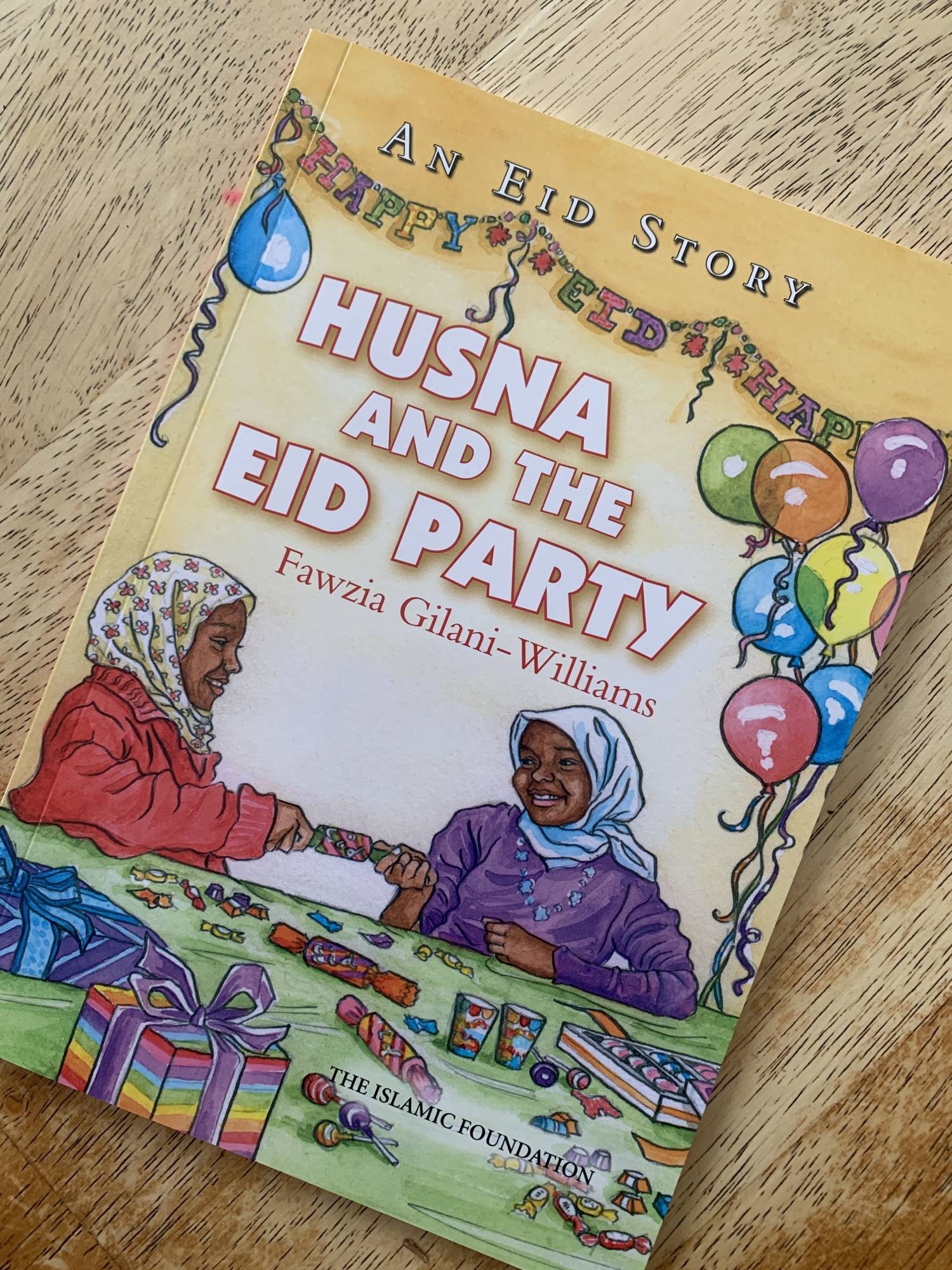
An Eid Story: Husna and the Eid Party by Fawzia Gilani-Williams illustrated by Kulthum Burgess

Standard
An Eid Story: Husna and the Eid Party by Fawzia Gilani-Williams illustrated by Kulthum Burgess

img_3309-1

This 27 page book is old, published in 2007, and one that I kept an eye out for on occasion since reviewing a similar early chapter book by the same author, The Lost Ring, that I found in a public library in 2016.  Somehow it found its way to me in 2024, and I’m reviewing it because it has been a while since I’ve indulged in older books that shaped the foundation of Muslim literary representation so many years ago.  It is the epitome of Islamic fiction and what Islamic fiction looked like when I started teaching.  It has a Muslim protagonist, with a universal stress, framed in Islamic acts, perspectives, information, and morals.  It is unapologetic, it is at time preachy, and while the writing isn’t remarkable, an engaging story is laid out with numerous lessons along the way.  You may not want to rush out and purchase this book, but if you have it on your shelf, it would be worth pulling out, dusting off, and sharing with a child. At times the details feel a little dated, but there is a timelessness to stresses with friends, being left out, assuming the worst, and wanting to be included.  This book will offer a chance to be seen in the text and illustrations as Husna waits to be invited to her friend’s Eid party.  The book does not specify if it is Eid al-Fitr of Eid al-Adha, but it really isn’t impactful on the story, as it simply sets the time, mood, and draws all the threads together.

SYNOPSIS:
It is the week after Eid and students are back at their Islamic school, Husna has lots of friends, but Maryam is her favorite.  While on the playground, someone asks Maryam where the party is going to be, and she responds, “probably at the house.”  Excited Husna waits for her invitation, that unfortunately never comes.

WHY I LIKE IT:
Even though the book has a happy ending and is based on a misunderstanding, the feelings are very real.  I remember feeling left out, I’ve seen my own kids and students feel it, and that the book is a snapshot of that feeling from a Muslim perspective, really makes it hit home.  Husna makes dua in sujud at Maghrib and Fajr that she will be invited, conversations begin with As-Salamu ‘Alaikum and end with Barak Allahfi-ki, homework is learning Hadith and memorizing ayats, jumah is prayed, and every page is filled with Islam.

FLAGS:

None

TOOLS FOR LEADING THE DISCUSSION:
The book is an early reader, a text heavy one at that, but none-the-less meant for ages seven and up. I can see it being read today in small groups in an Islamic school or if you have a young one who is perhaps feeling something similar.  You might have to explain invitations in the mail, or calling on a house phone, but it still has relevance.

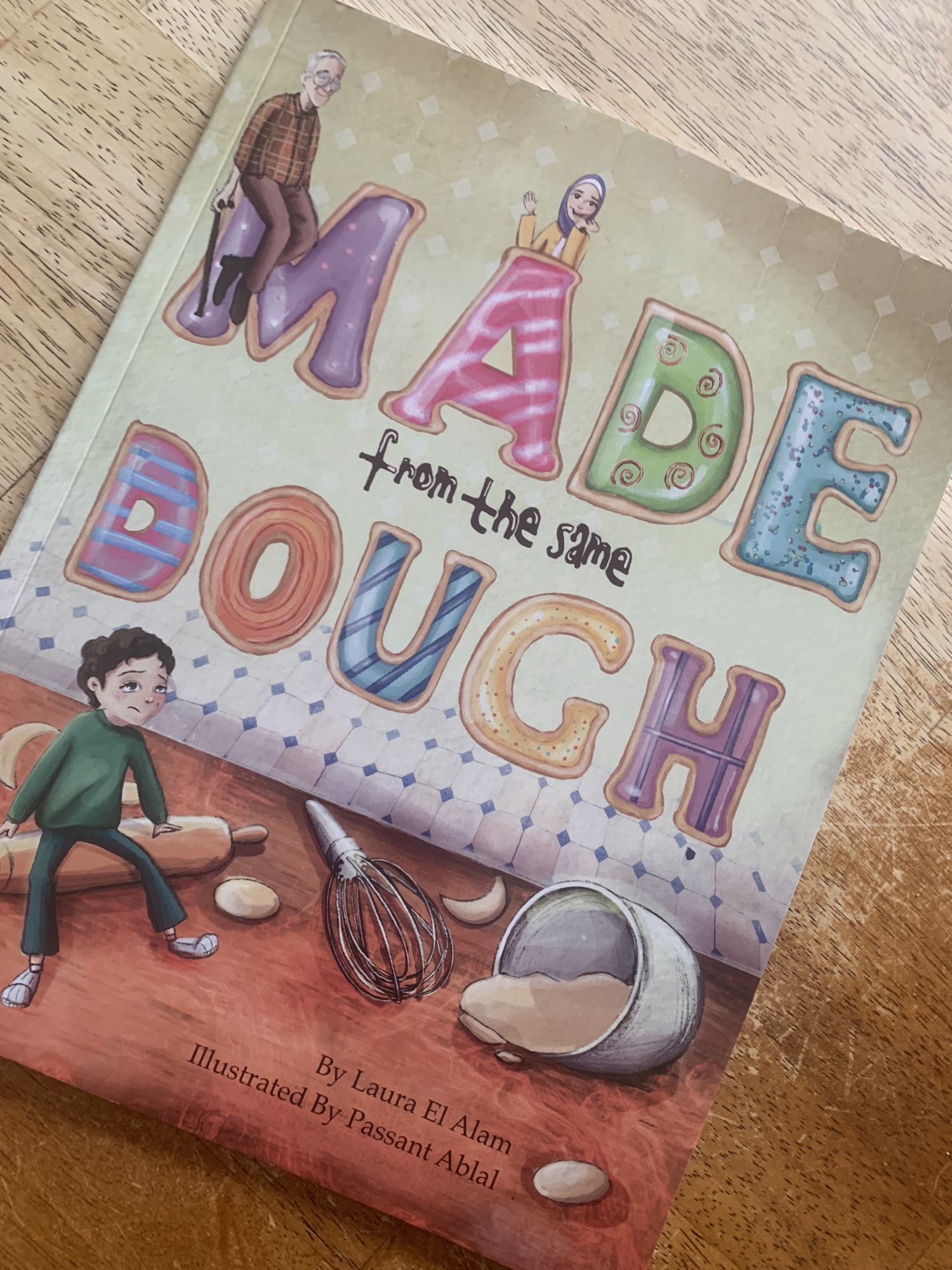
Made from the Same Dough by Laura El Alam illustrated by Passant Ablal

Standard
Made from the Same Dough by Laura El Alam illustrated by Passant Ablal

img_3052-1

Not all books about Ramadan have to be lists of facts. It is ok to show Ramadan and Islamic elements in stories that have their own plots, character arcs, conflicts and resolutions that are not just about abstaining from food and water, or losing your temper.  This book set in Ramadan is a story about a  Muslim boy and his Christian grandfather, and a whole lot of heart.  As a child of a convert, this book spoke to me, and I saw myself in that relationship, not only as a child, but even as an adult bringing my grandparents to my kids Islamic schools, friends’ lunches, and asking them to wait on the side while we pray.  I absolutely love the perspective of the protagonist, that he is worried about what Muslims will think of his grandfather not fasting or praying, as opposed to the often shown character worrying about what non Muslims think about us. The paradigm shift is subtle, but empowering to Muslim readers to see that they are not “other” in any environment.  The authenticity and how it all comes together in the clear text of the book is beautiful, but I must say, I really struggle with the illustrations.  I know art is subjective, and I am no artist, but yikes, I feel like the pictures actually distract from the story unfortunately.

The book starts with Papa coming over to his daughter’s family home and smelling something cinnamon-y delicious.  He dives in to the harira soup and recalls the cinnamon Christmas cookies they used to make.  Rayan wonders if Papa even remembers that the rest of them are all fasting.

Mama invites him to join the family at Auntie Hana’s for iftar the next night, and Rayan worries what Papa will do when they all pray, or if his friends will wonder why he came to iftaar if he is not fasting.

img_3054-1

Papa agrees and offers to make cinnamon cookies to share.  Rayan doesn’t like the idea of Christmas cookies at iftar and tells grandpa that Santa won’t be there.  The next day when Grandpa comes over to bake, Rayan refuses to help. Part scared, part frustrated, part anxious, Rayan hears everyone having fun, but stays in his room.

When they arrive at the iftaar potluck, Rayan reminds Papa to take of his shoes and then devises a plan to keep the Christmas cookies from causing any embarrassment. Only his sister Aliya foils his plan and Rayan will have to face his own feelings and make things right.

I’ve read this book easily close to twenty times, since ordering it, evaluating it for the Muslim Book Awards 2023, (it won the Holiday category), writing this review, and reading it to my littles at bed time, and it still hits close to the heart every time.  It reminds me of my own grandpa, who has been gone almost exactly a year, who may not have always understood our actions as Muslims no matter how often we tried to explain them to him, but never loved us any less.

img_3056-1

You can purchase your copy here at Crescent Moon

Holiday History Ramadan and Eid Al-Fitr by Marzieh A. Ali

Standard
Holiday History Ramadan and Eid Al-Fitr by Marzieh A. Ali

img_2952-1

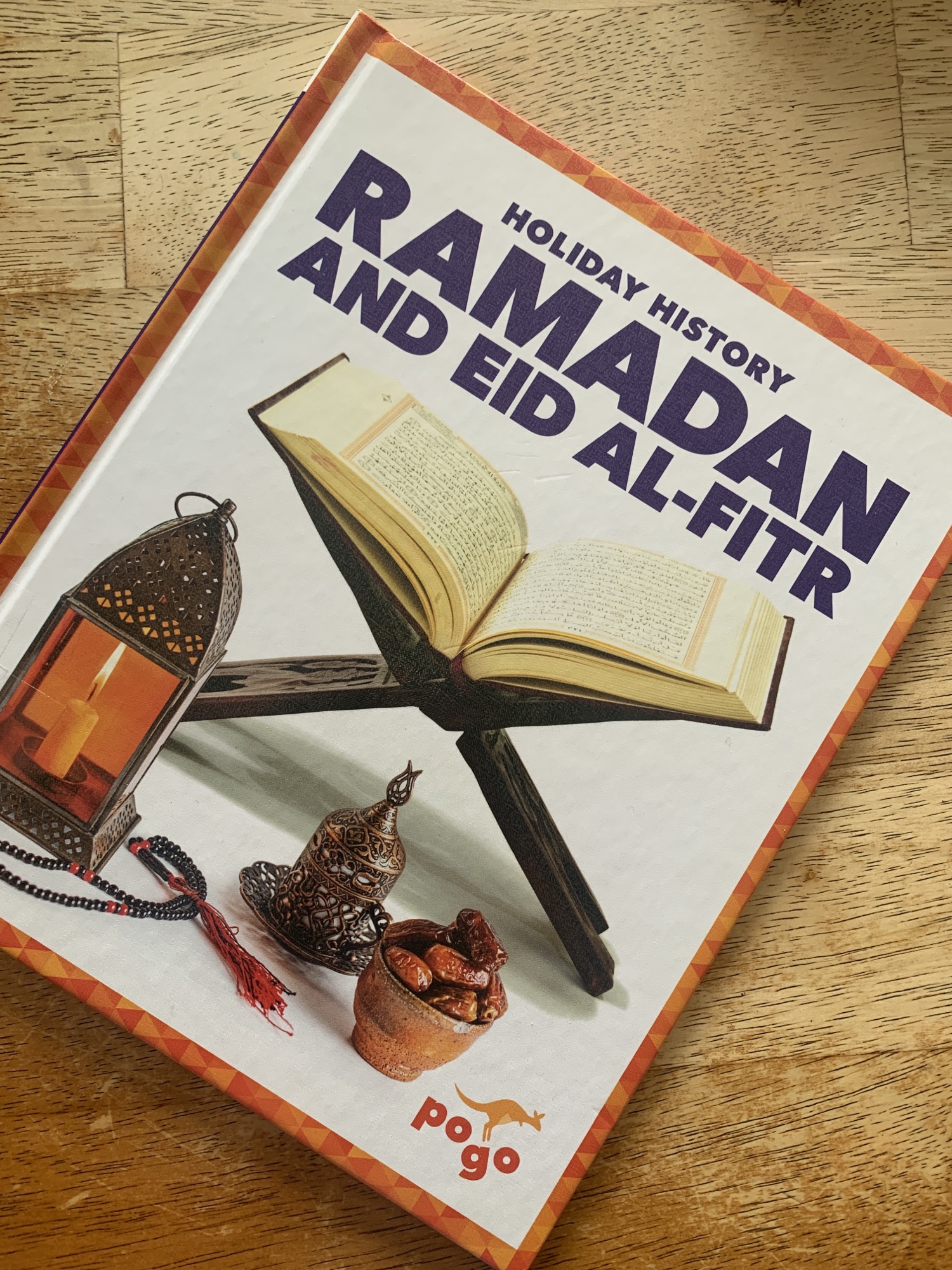
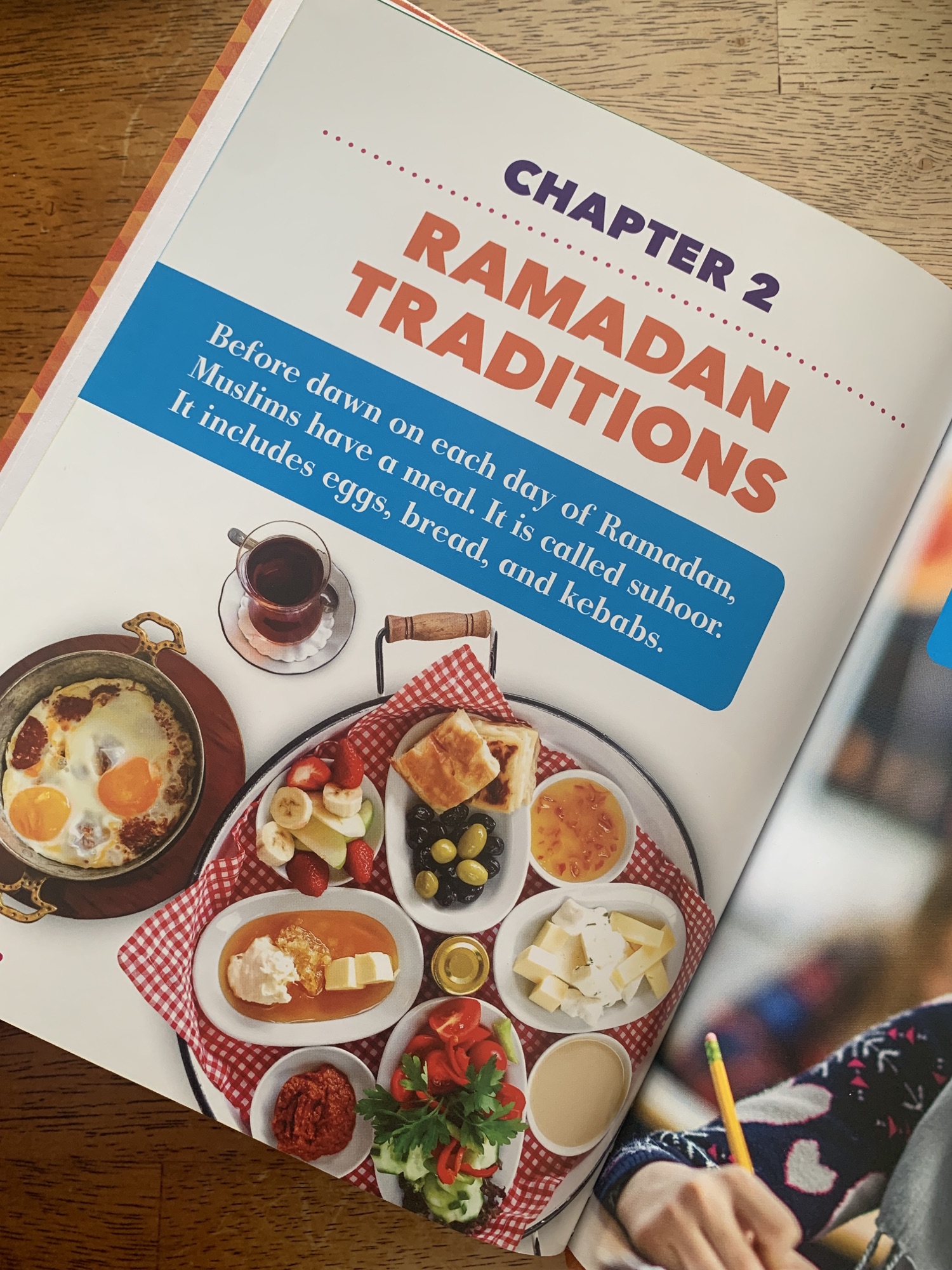
Traditionally published non fiction Ramadan and Eid books have more errors than they should.  I was hopeful with this one, the author is a Muslim and accomplished author, and it started out good, but then it hyper fixated on the foods eaten which can never be accurate.  Muslims are everywhere in the world, and no two people like the exact same foods anywhere, not even siblings  So why it would so clearly articulate, without qualifiers, what Muslims eat for suhoor or iftar is beyond me.  I do not eat eggs, bread, and kebabs for suhoor, we tend to enjoy brownie sundaes and pizza, and dates, broth, and fruit for iftar, sure makes me wonder if my nachos or pesto, rendered my fasts invalid?  Snark aside, it takes away from the quality information in the book that highlights that while fasting Muslim kids go to school and adults to work.  I also don’t like the suggestion that Ramadan is a time to reflect, pray, cook for others, and help those in need. It truly reads that this is when we do it, as if it is the only time we do it, and not that we do these acts all year, but do it MORE in Ramadan.  I know, I’m being picky, but these types of books are standards in public and school libraries, and in a world where Muslims are by-and-large having to prove their humanity, words have power, and need to be conveying that we pray five times a day, and more in Ramadan.  That we help those in need all year long, and more in Ramadan. The book is only 23 pages long, so when it spends so much space on these items worded in this way, it really becomes the takeaway message.

img_2953-1

The book starts pretty well, with clear precise sentences telling that “Islam is a religion practiced by Muslims” and that “they believe in one God” (note in the book God is not capitalized). It has that “Ramadan is the ninth month in the Islamic lunar calendar,” which I am ok with in non fiction books. And tells that “more that 1,400 years ago, the Prophet Muhammad received the first verses of the Quran” and that “they were sent by Allah through angel Gabriel.” 

img_2954-1

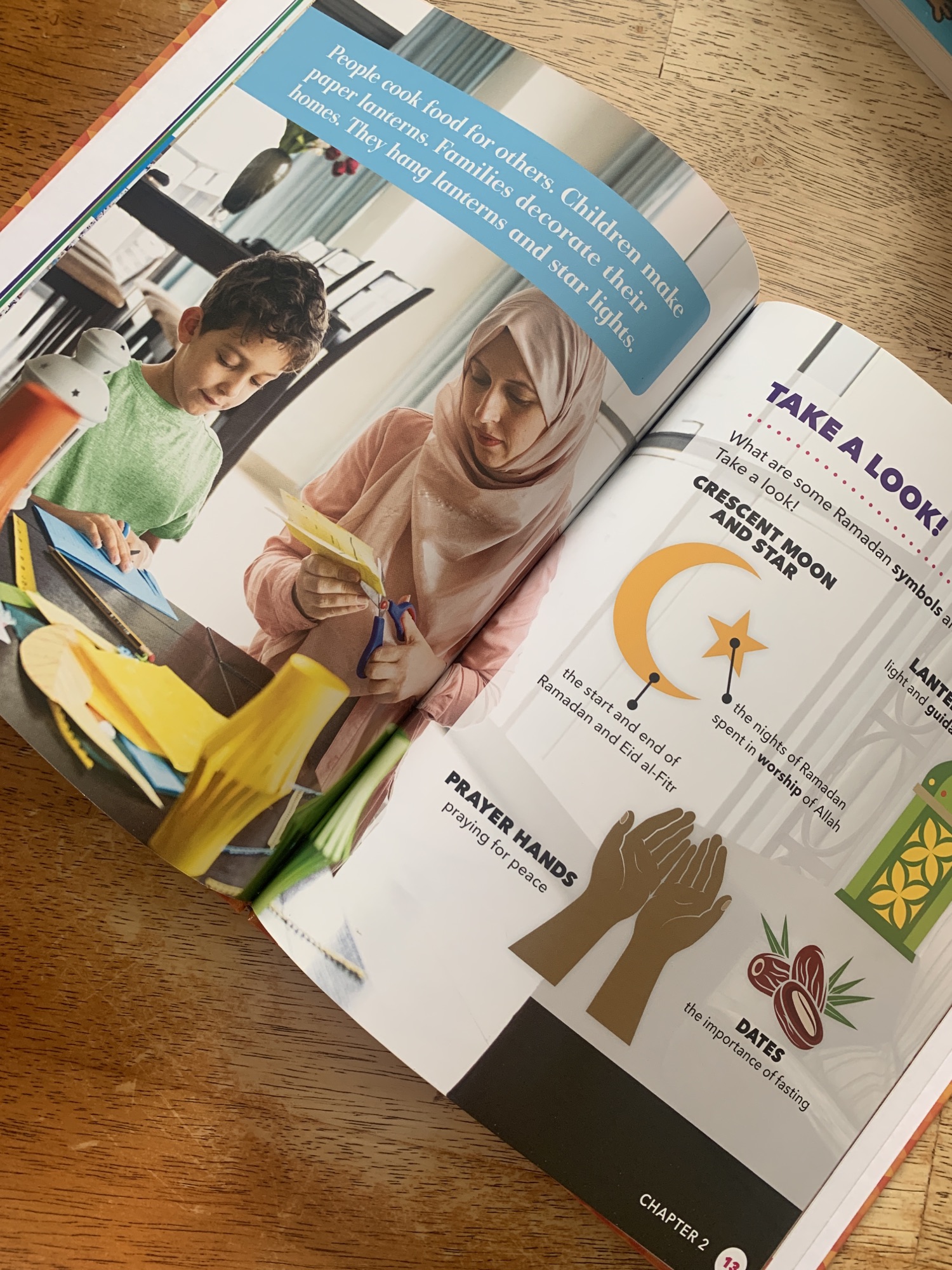
We then get two pages about specific foods, and told “Ramadan is a time to help.”  “It is also a time to pray and reflect.  People go to mosques.  They read the Quran.  They talk about Islam.” Stated just like that.  Making it seem that only in Ramadan are these things done. The unqualified statements make it seem that just as “They read the Quran” “Children make paper lanterns.” Apparently it isn’t optional, or a fun craft, it is just what is done.

I like that the five pillars are included, I wish it gave the terms of shahada, and sawm, and salat, and zakat and hajj, “journeying to Mecca” is a bit vague, and not at all sufficient.  I don’t know about they weight of the symbols either.  Dates show the “importance of fasting.” No they are the sunnah.  The star on the crescent symbolizes “the night of Ramadan spent in worship.” I think the symbols are a stretch to be honest.

img_2957-1

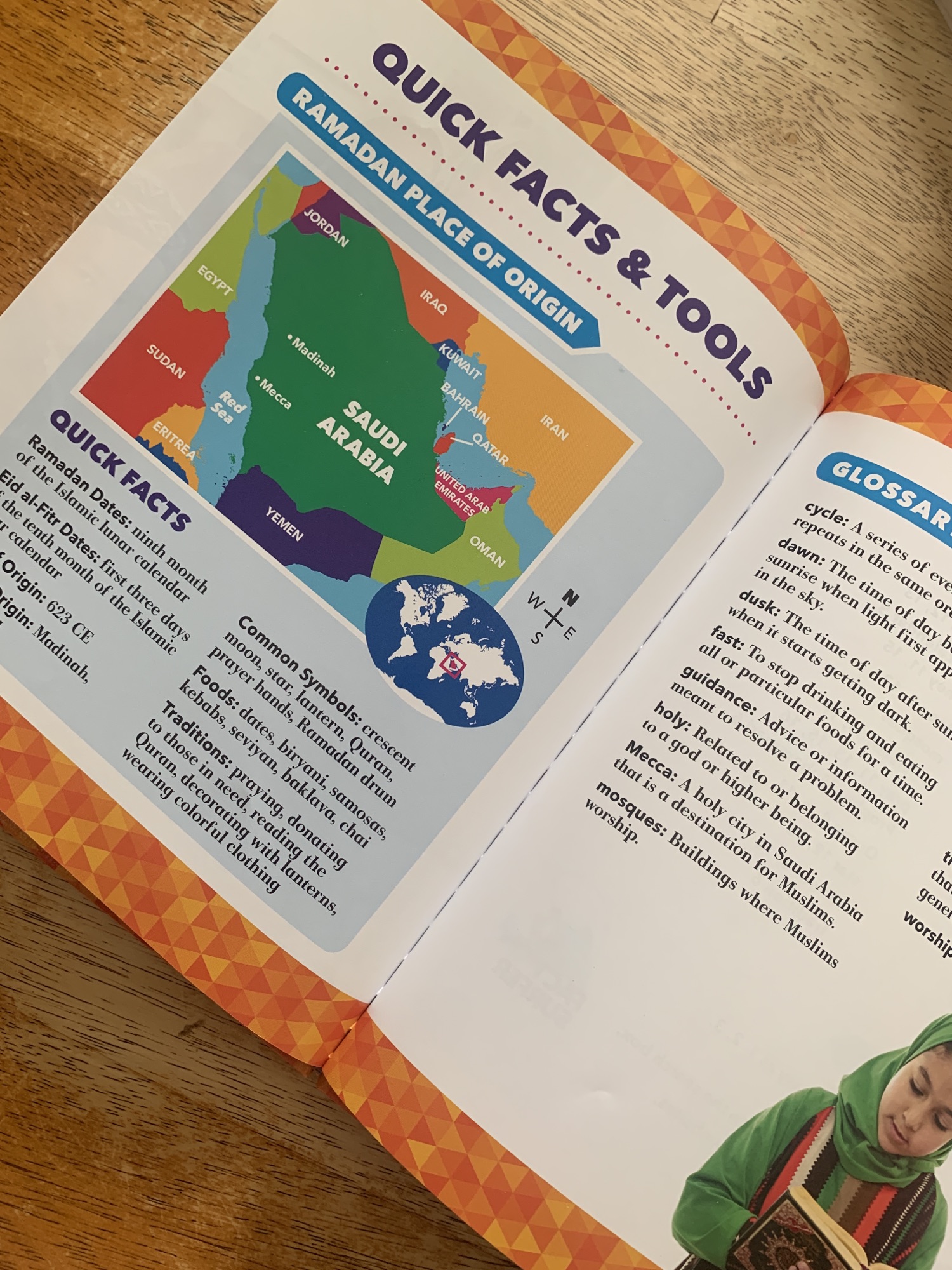
Eid al Fitr is one day not three as the book states.  The next spread then revisits the food, as if Biriyani is only eaten on Eid and all Egyptians make baklava.  The end is a one page Quick Facts and Tools and a glossary.  I have once again sent an email to the publisher asking them to edit future reprints of the book. 

img_2958-1


The Little War Cat by Hiba Noor Khan illustrated by Laura Chamberlain

Standard
The Little War Cat by Hiba Noor Khan illustrated by Laura Chamberlain

img_0521-1

Even though the book is told from the cat’s perspective, the book never overshadows the human cost of the Syrian war.  The beautiful illustrations and clear text do not shy away from the pain and destruction, but allows for young preschool children and up to see the affects of war through the cat’s eyes, as well as the kindness and hope that prevails. Over 32 pages readers are taken to the streets of Aleppo to see the marble mosques give way to boots and destruction.  The little cat observes the changes, notes the differences and when kindness is shown to her, she finds a way to pay it forward.  I had not intended to post another book by Hiba Noor Khan so close to another book of hers, but as atrocities in Idlib increase I felt it a good time to remind us all, that the war is not “over” in Syria and the destruction and loss of life still requires our awareness, help, prayers, and attention.

The book begins with a warm scene of a little grey cat playing and lounging under the sun in a masjid courtyard. When the boots come, though, it all disappears. The cat begins to notice the changes and the fear becomes real.  

But then one day the cat sees humans that are different than the ones with boots, and she follows one. He cares for her, and she starts to feel like herself again, when she sees someone that also is afraid, the cat is determined to help.

img_0527-1
The book concludes with a note from the author telling about the inspiration for the story, The Cat Man of Aleppo,” and challenging readers to find ways to share kindness.