Tag Archives: Pakistan

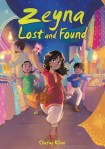
Zeyna Lost and Found by Shafaq Khan

Standard
Zeyna Lost and Found by Shafaq Khan

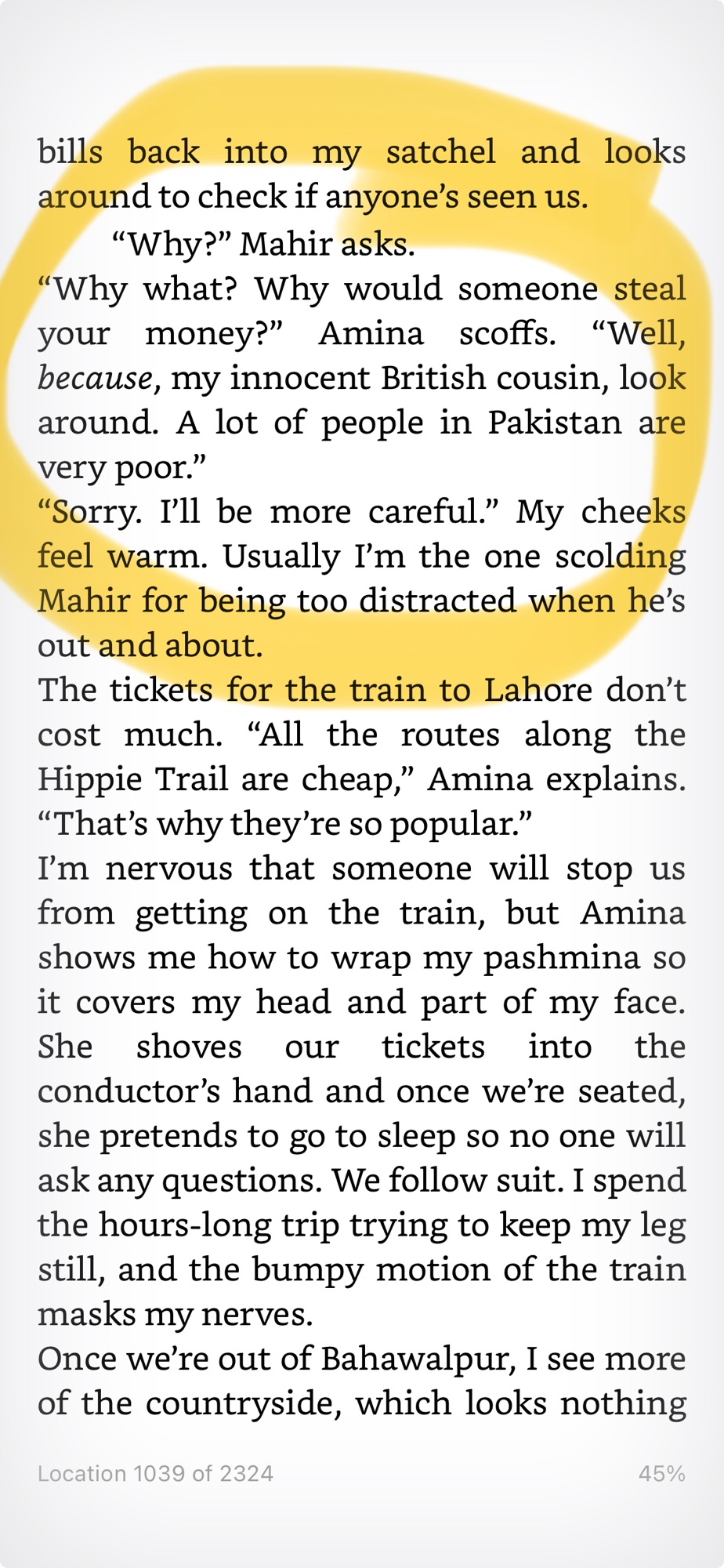
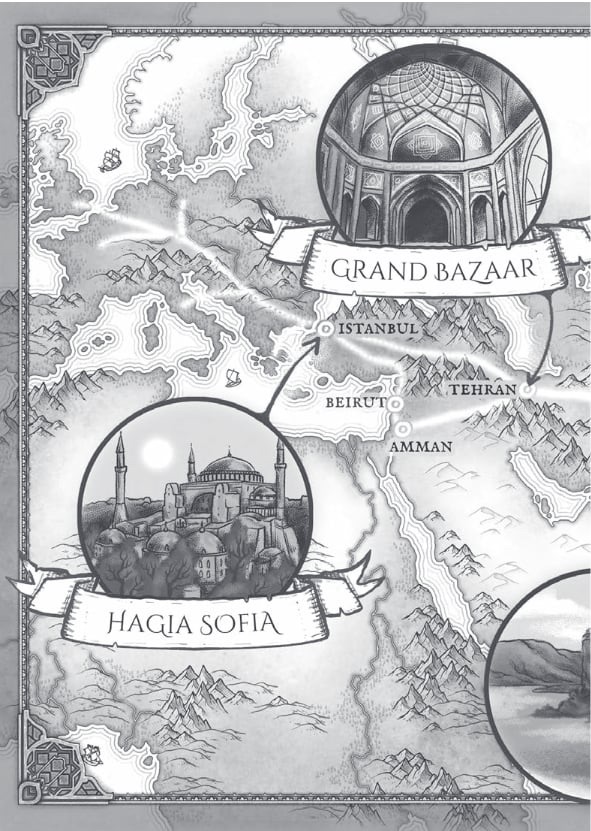
I think I needed this 336 page middle grade book that gets parents out of the way and lets a trio of kids  hop from country to country to solve a mystery, track down the bad guys and save the day. Set in the 1970s in the UK and on the Hippie Trail between Lahore, Pakistan and Istanbul, Turkey, the book is a fast paced read with humor, heart, and adventure.  I absolutely love Zeyna’s snark and voice, and her relationship with her brother and cousin, ground the story and make you cheer for them even when their antics are incredibly dangerous and improbable.  As an Islamic school librarian, my one critique with the book is that I wish there was more/any Islam. I, at one point considered that they are not Muslim, and I’m not sure what the author identifies as, but she does thank “Al-Barr, for all that is good” in the acknowledgements, and Zeyna does mention an Eid party in passing, so while I’m still on the fence, I’m going to assume they are all Muslim.  Major beats in the plot are meeting at both the Badshahi and Blue Mosque, but none of the characters ever pray, or mention the names of prayers when the athan is heard.  When they see women in burkas and chadors, Zeyna stares, not connecting the clothing to hijab, that one would hope she would know. There is only one salaam in the whole book, and the story is predominately set in Pakistan, Afghanistan, Iran, and Turkey. Granted I am sensitive, but it almost feels like a deliberate exclusion to the point of going out of the way to not let those details be present.  There are plenty of Urdu and Punjabi words and titles and cultural commentary, so it doesn’t seem that the author was concerned about watering down authenticity, a theme of the book infact is finding your place and accepting yourself.  All that aside I really enjoyed pickpocketing, imaginative, determined, sarcastic, loyal detective Zeyna, and I think kids will join me in hoping this is the first in a series.
SYNOPSIS:
Zeyna is 12, and likes to imagine she is a detective on a case, sneaking and snooping, and roping her inventing younger brother Mahir to be her Watson. The city is on edge with the theft of the Shirin Jewel, a large Persian ruby, a case involving the 15, that Zeyna would love to solve.  When she sees a man with knife in London, who later seems to be following her and her mum, and then drops a paper with their street name on it, Zeyna is convinced this her chance to prove her self. A sudden trip to Pakistan though dampens her mood as the clues to the case will be left in the UK. She doesn’t stay down long though, as her parents start acting peculiar in Lahore, meeting with strange people, lying about why they suddenly made the trip at all, and when the police show up at the familial home to arrest her parents, they all discover that her parents have vanished.  Zeyna realizes her parents and the events in London are tied to the missing ruby, and with the help of Mahir and their cousin Amina they set off to solve the case and find her parents.
WHY I LIKE IT:
It’s hard to review a book like this without giving the twists and climax and resolution away, but more than once I gasped in delight when something happened on the page, and it crystalized where the book was going in my head.  Sure there were some particularly outlandish connections and a few plot holes, I even Googled when fax machines were invented, but I had a blast reading the book.  I loved the historical backmatter discussing the events in post partition Pakistan, a year before Bangladesh was independent, Soviet Union and UK competing over influence in Afghanistan, the discontent voices in Iran toward the shah, and the role of the Pudding House for messages in Turkey.  There are also discussion questions, a glossary, acknowledgements, and about the author at the end.

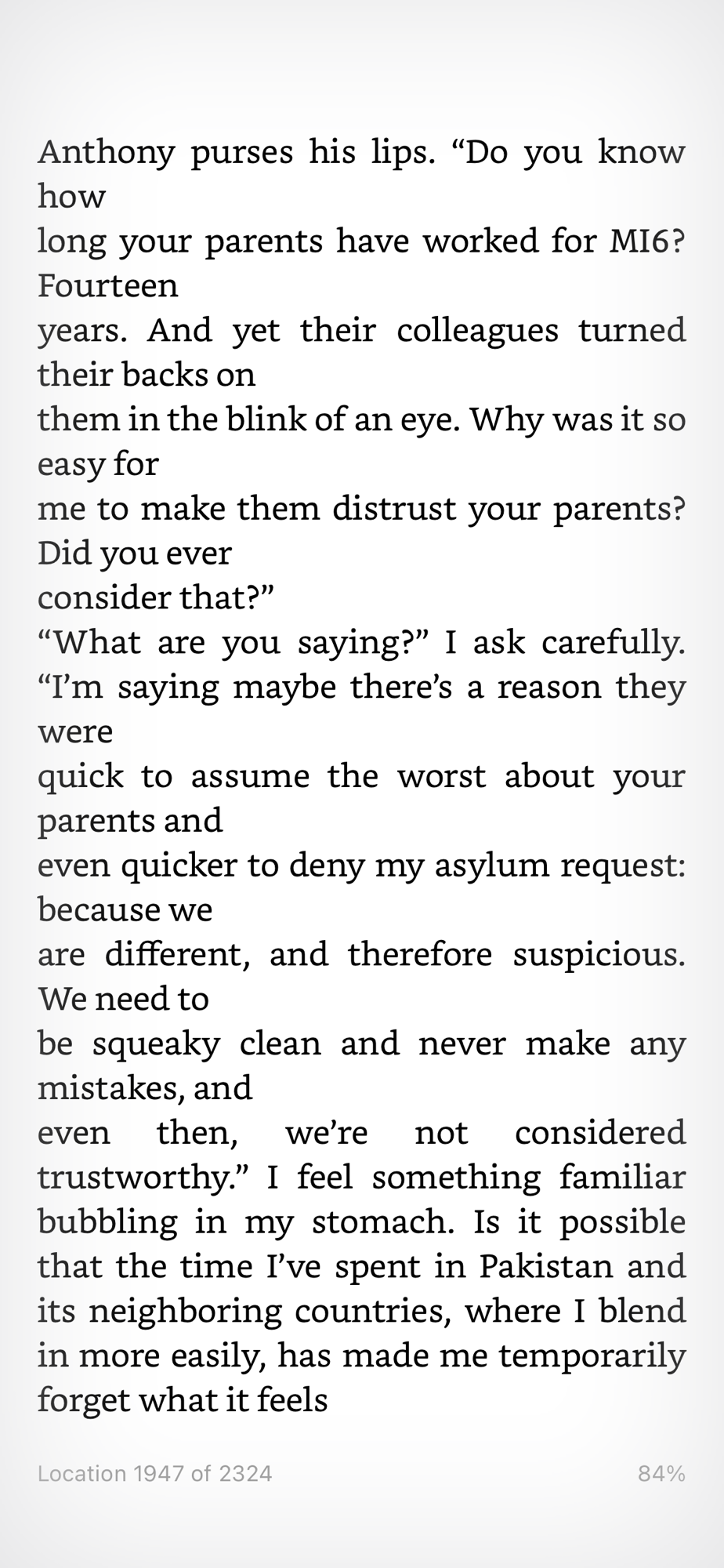
One tiny concern was the assumption that money could be stolen because the people around them are poor, it is just one paragraph, it isn’t a constant in the book, but it struck me as odd and stereotypical, and really not needed.

FLAGS:

Lying, stealing,  deception, pretending to be someone you are not, breaking and entering, eavesdropping, snooping, its a heist book!
TOOLS FOR LEADING THE DISCUSSION:
This would be an awesome book club book or novel study read, I can’t wait for it to be released in a few weeks so that I can have my kids read it.

Aarzu All Around by Marzieh Abbas

Standard
Aarzu All Around by Marzieh Abbas

I was hesitant starting this 384 page middle grade novel in verse, because the stereotype of having to disguise yourself as a boy to make things happen, seems like a western performative troupe that reinforces stereotypes, and has been done a fair amount in literature.  Pushing down my disdain, I opened the book to numerous pages of cricket terminology and rules, which further served as a barrier.  I do not understand the info dumping, literally, at the start of the book, and to top it all off it is not needed.  The book is blurbed as being a cricket loving, girl dressing as a boy in a patriarchal society, but really those are the most forced aspects of the all over the place narrative.  Cricket is underdeveloped and her actually playing is very minimal and lacking. Aarzu disguising herself as a boy is a blip that she admits to a few pages after she gets the job, and thus the story that remains is an orphaned girl with a mean uncle trying to find a way to help pay for her younger sister’s medical bills. Which isn’t a bad story it is all just so very disjointed.  And the verse is not written well, there are no beats or flow, it just seems to be a few decent poems in a sea of jumbled ones.  About 40% when the Islam starts to shine, I felt a brief connection to the book and the characters, but the loose threads and telling over showing, found skimming the pages to find out if the sister survived, if Aarzu got in trouble, and how cricket fit into it all.  The weak climax and sloppy resolution, combined with the premise, marketing, and info dumping, makes me recognize that I am not the target audience as a cynical Pakistani American reader, but truly makes me wonder who is.  I don’t know that the words on the page or the story at hand are going to resonate with middle graders.  I appreciate that Islam and culture are separated, that the mean uncle is confined to him and him alone, not a label on Pakistani men, but it feels like the editor took a day off or didn’t want to help the author make the story cohesive, which is unfortunate.

SYNOPSIS:

Aarzu and her younger sister have come to live with her poor maternal aunt’s family in Karachi after her parents are killed in an earthquake.  She is treated like a servant by the family, not allowed to watch cricket let alone play, and her government public school is hardly a challenge.  When Sukoon’s kidney failure worsens and dialysis is needed, as they wait for a kidney transplant match, Aarzu decides to find a way to make money.  She starts frying onions and selling them at the local market, the labor intensive and odorous job helps, but not enough.  When a nearby bungalow preparing for a wedding, needs laborers, her friend Nazia encourages her to cut her hair to look like a boy and apply.  Lying to her aunt about where she is, she spends her time after school getting to know the kids that live at the bungalow, confessing that she is a girl, and playing cricket.  The money helps her sister and things are starting to look up, until the truth comes out, Sakoons health worsens, finances at home hit rock bottom, and friendships frazzle.  Luckily though SPOILER the wealthy family likes her and solves all her problems and bribes the right people for her to make the cricket team.

WHY I LIKED IT:

Some parts, mostly the Islam, really spoke to me. I love that distinctions were made between religion and culture, that she taught the wealthy girl how to pray, that Aarzu is Muslim and loves her faith and relies on her relationship to Allah swt in handling every aspect of her life. The rep feels real and sincere and while it made me force a friend to read the book, it also highlighted how weak the other aspects were.  We, the reader, see so little of what Aarzu’s world is, we are just told. There are no flashbacks to her life with her parents juxtaposing her current situation that would have connected us to her.  The poverty, the mean uncle, the cricket, the sick sibling, they all just seem like plot points, not pieces to this girl. She compartmentalizes them in a way that make it hard for the reader to see the overlap, or that she is keeping all of these parts close to her heart at all times.

The resolution was disappointing, it felt half hearted. Why have wealthy saviorism? Dreams coming true from bribery? It took the grit out, and made the messaging fall less on hard work and perseverance, and more on, don’t be poor.

I did appreciate the kidney disease representation, having seen a loved one endure failure and daily dialysis, I appreciated the mention of dietary changes, and swelling, and lethargy, it was well done.  I wish the emotional impact, though not just the sibling love, but the fear of demise, could have come through stronger.

FLAGS:
Lying, physical abuse, theft, fear, illness

TOOLS FOR LEADING THE DISCUSSION:
I don’t know of a kid I would recommend the book to, but I would shelve it, let nine and up read it, and happily discuss with whoever wants to chat about it.

Mustafa’s Mithai by Sana Rafi illustrated by Nabi H. Ali

Standard
Mustafa’s Mithai by Sana Rafi illustrated by Nabi H. Ali

On the surface this 32 page OWN voice authored and illustrated book is absolutely adorable, a little boy who wants to share mithai’s with his friends and saves a gulab jamun for himself. As a mother of a child named Mustafa, who didn’t have a wedding cake a hundred years ago but flew in gulab jamuns from out of state, this book should be close to my heart, except the story makes no sense. The cultural rep is great, it isn’t religious, but mentions eid, shows Nani in a hijab, and the word Allah in Arabic appears in one of the illustrations on a wall decoration, but take that all away, and the story doesn’t add up.  The first few spreads establish how sad Mustafa is because he can’t eat his beloved mithai as all the holidays, birthdays, and Eid have passed, and mithai is only eaten in celebration.  This is particularly devastating since they have a huge box of leftover mithai. No idea why such a forced build up, but the take away would suggest that wasting leftovers is better, which makes no sense. No worries, Ammi says every day is a celebration, but Mustafa doesn’t acknowledge or build off of what his mother tells him, sticking with his original assessment he decides to have his non Desi friends over for a party to eat the leftovers. Ok, I’ll play along, maybe just the framing is awkward. Nope, after a pizza dinner he picks out a different mithai for each of his friends…and starts with Falooda, a jelly and ice cream drink! Mithai means sweets, so technically it could be a mithai, even if not commonly referred to as one, but surely not a left over one what would still be good, and definitely not one from the box. Another assigned sweet for a friend, is kulfi.  Kulfi is a frozen dessert akin to ice cream, and often served on a stick.  Again, no way it is from the leftover box and not really in the same classification of ladoo, chum-chum, jalebi, and rasmalai.  The illustration shows an apple in the leftover box, and the author’s note seems to suggest a more generalized use of the term, “mithai,” but craft wise, why have the boy build up the framing of when a cultural food genre is consumed, only to walk it back and have it contradict? Why have foods that wouldn’t be leftovers served? I know, I’ll be the minority and I’m over thinking it, but why go through all the effort of trying to be a window to a culture and its foods, having it beautifully bound and illustrated, only to skimp on the actual story part?

The book as stated above, starts with Mustafa wanting mithai, and being sad that nani and nana have left, eid and Baba’s birthday are over, and sweets are only eaten in celebration. Mustafa decides to have some friends over in celebration to eat the left overs and Ammi says “Mithai is always sweetest when shared.”

The kids all arrive and when they look in the big pink box they aren’t sure what they are looking at, Mustafa explains the variations and his friends are at a loss at what to pick.  To solve the dilemma Mustafa offers to match everyone up with a mithai after playing and dinner.

One by one he assigns a sweet to a friend, saving a gulab jamun for himself.  They all want more, and in round two the emboldened guest pick their own making sweet memories indeed. The backmatter is the author’s note explaining mithai, where they come from, the prevalence of dairy, and the role sweets have in Desi culture.

The Matchmaker by Aisha Saeed

Standard
The Matchmaker by Aisha Saeed

There is no Islam, save being told a wedding took place in a mosque, in this 320 page adult book by a Muslim author.  The thriller, mystery, romance, is fairly clean, save some drugs, killings, kissing, and normalized dating, yet I would probably be fine with mature teens reading it, if so inclined.  By the end, I enjoyed the book, but it took me three attempts to get past the 30% mark as the opening was painful with its numerous characters being name dropped, the setting being established, and getting the characters into position.  But then slowly the exposition gave way to story telling and intrigue, and the second half was a decent read.  Honestly, my biggest problem with the book is that I just didn’t like the main character, or any of the characters really, and I don’t know why.  They didn’t have some clear flaw or annoying habits, they just felt distant and bland, which resulted in the plot carrying the book, and me not really caring if the protagonist was killed or harmed, I know- harsh.  I cannot deny though, that what kept me reading was to see who was behind it all and I did figure it out, but continued on just the same to be sure, and that is a testament to the author’s writing skill, even if it took a minute for the pacing, plot, twists and climax to pull me in.

SYNOPSIS:
Nura Khan runs an elite matchmaking service in Atlanta, from hands on to a dating app, her and her team match people of all backgrounds and faiths.  She herself has a long time friend who acts as a fiancé for image purposes, and a recently retired aunt who’s bad days have meant family dynamics have changed.  As a third generation matchmaker, Nura is in charge and knows what she is doing, until suddenly her image, her reputation, and her matches start faltering.  Not confined to just heartbreak, there is also stalking, threatening notes, kidnappings, and attempted murder, which suddenly thrust Nura into a world she is ill prepared for, and one that seems to put her in the crosshairs of someone determined to see her demise.

WHY I LIKE IT:

It wasn’t a heavy thriller or heavy romance, it was an easy read that didn’t “other” desi culture and I found that refreshing. That being said, I always wish her books had Islam in them.  I also liked that the climax and second half honestly didn’t feel overly forced, I’m not a writer so take it with a grain of salt that I complain that the beginning was dry and too much telling, but then the second half flew by and loose ends were more or less tied up in a satisfactory way. I’m aware that the second half was a result of what was a established in the first part, but none-the-less I hope future books will make the two halves less cumbersome and inconsistent. I also really hope future books will have more character appeal.  There was a lot of potential to care deeply about the main characters, from the aunt, to the best friend, to Nura herself, but they lacked spark, and sadly just felt like vehicles for a plot that wasn’t dependent on them, their experiences, their flaws, and their personalities.

FLAGS:

Dating and relationships of all faiths, persuasions and labels, kissing, attempted murder, killing, plotting, lying, scheming, kidnapping, drugging, physical abuse, assault, deception.

TOOLS FOR LEADING THE DISCUSSION:

With no Islam I wouldn’t do this as a high school book club, but amongst friends it would be a fun group read.

What Shape is Your Mosque? By Jenny Molendyk Divleli illustrated by Zeynep Begüm Şen, Ayşenur Kazan, Hümeyra Yograncı, Hatice Leyla Arslanbenzer, Gökhan Özdemir, Özlem Güneş, Rumeysa T. Karaca, Şüheda Başer Yılgör, Aybüke B. Aslanoğlu, M. Ahmet Demir, Fatma Betul Akbal

Standard
What Shape is Your Mosque? By Jenny Molendyk Divleli illustrated by Zeynep Begüm Şen, Ayşenur Kazan, Hümeyra Yograncı, Hatice Leyla Arslanbenzer, Gökhan Özdemir, Özlem Güneş, Rumeysa T. Karaca, Şüheda Başer Yılgör, Aybüke B. Aslanoğlu, M. Ahmet Demir, Fatma Betul Akbal

Framed the same as the author’s book entitled What Color is Your Mosque? The readers are taken all over the world to see masjids in a variety of shapes: conical, spiral, oblong, flower, boat shaped and more.  Each two page spread has a child introducing themselves, where they are from, the name of the mosque and some bits of information to engage the reader.  It isn’t a literary masterpiece, but I don’t think it attempts to be.  It is a fun informative book to show children the diversity of architecture, the universal practice of Islam, and be motivated by the prompt at the end to ponder how they might design their own masjid. I particularly like that the author points out that the first mosque she ever prayed in was a converted house.  This book is great in small groups and story times, where the pictures can be looked at, and lends itself to further research of looking up pictures of the mosque’s included, building mosques with blocks or legos, or paired with a similarly inspired craft.

The book starts with a note to parents, some hadith, a dedication, and then the author, Jenny introducing herself to the reader, and starting the journey.  The book shares mosques in Kuwait, Qatar, Indonesia, Germany, Pakistan, Saudi Arabia, Croatia, Kazakhstan, China. Each spread is illustrated by a different artist, but all are beautifully done.

I found the pages smile inducing, as I Googled to see real photographs of the mosques mentioned.  One of my favorites was the Rijeka Mosque in Croatia that was designed by a sculpture and changes shapes depending on the vantage point.  And I was shocked I had never seen or heard, or somehow noticed, the Kashti Wali Masjid in Karachi, Pakistan.  I masjid that is boat shaped and very near to my familys’ homes.  

I purchased my copy from Crescent Moon and if you use code ISL (my initials) at checkout you can save 10% on your entire order.

The Eidi Bag by Shazia Afzal illustrated by Shiva Delsooz

Standard
The Eidi Bag by Shazia Afzal illustrated by Shiva Delsooz

This adorable 32 page picture book, is not just a story about celebrating Eid al fitr, it weaves in themes of culture, faith, anticipation, disappointment, change, and appreciation.  It is Sarah’s first Eid in a new country and she has made herself a new Eidi bag just for the occasion, to collect the money she will receive from friends and family to celebrate the holiday, and then use to buy treats to share.  Except other than her parents and grandfather, no one gives her Eidi.  She longs for Pakistan and the traditions that she is used to, when slowly she sees that new and different traditions can also be fun and filled with love and joy.  The slow realization and protagonist point of view are skillfully done in keeping the story engaging, the arc smooth, and the lessons nuanced.  The beautiful illustrations, tug at your heart and bring the story to life making me confident that it will be a highly sought after addition to any book shelf for story time, bedtime or independent readers, Muslim and non Muslim alike.

The book starts with Sarah running into the kitchen on Eid morning to show her Mama her Eidi bag and ask for her Eidi. Her Mama lovingly gives in and reminds her that it isn’t polite to ask for Eidi.  Sarah repeats the requests when Baba and Dada ji enter, and Mama rolls her eyes.  The family is then off to the masjid to pray, listen to the khutba and give donations.  At each turn of greeting friends, Sarah shows off her bag, and yet no one offers her Eidi, much to her confusion.  On the way home Sarah is missing Pakistan and recalling how full her bag would be if she were there.

Once home, Mama is busy in the kitchen getting ready for guests to come by. Sarah notices that they will be coming at a certain time, not in and out all day long like before.  When the guests, Muslim and non Muslim, start to arrive they each bring a gift, baklava, flowers, candies, a little plant, and even a set of 40 markers just for Sarah, that she can store in her Eidi bag.

I love that even though it could very easily come across as whiney, or with money being discussed, greedy, it doesn’t.  The book is very tender, and you feel the emotions of Sarah in a new place adjusting to what her expectations are to the reality, and adapting. Being kind of dismissed at Eid also was very reflective as children everywhere get a bit jostle with all the hugging and greetings flying around above their heads. I also love that the neighbors come, including a friend named Jessica, modeling for non Muslims what they too can expect if invited to an Eid party. Someone brings baklava, not a traditional Pakistani dish, also showing the diversity within Islam, subtly adding an additional beautiful layer to the story.

The book concludes with an Author’s note and a glossary.  A great book that will work for both Eid al Fitr and Eid al Adha.

Hidden Fires by Sairish Hussain

Standard
Hidden Fires by Sairish Hussain

I will not be getting over this book any time soon. It broke my heart, and all my other critical organs, in the most delightfully well-done way possible, and undoubtedly I am better for it. I don’t read a lot of adult fiction these days, and with some diabetic retinopathy concerns, I couldn’t read the 384 page adult book about generational trauma, partition, the Grenfell Tower fire, family dynamics, bullying, self-harm, and resilience, but was pulled in to the audio book version instead. The Desi-British voices of Yusuf, Rubi, and Hassan were refreshing to my American ears.  The multi-perspective book told in parts richly develops the characters, their relationships, and their current, past, and future struggles.  The author is Muslim, as are the characters, and while they all practice in their own way, it is undoubtedly who they are, and their Islamic identity is not questioned, feared, blamed, or apologized for.

SYNOPSIS:
The book weaves three distinct voices. Yusuf, is an 80 year old an immigrant who lived through partition, raised his family in the UK, has lost his wife a year prior, and is struggling with haunting memories of the past, failing health, regular loss of friends, and loneliness.  Hassan, Yusuf’s youngest son is a workaholic who is married to a non Muslim, non Desi who is suffering from fibromyalgia and who’s mother unexpectedly passes away in Spain.  Rubi, is Hassan’s 16 year old girl who is overweight, bullied, lonely and about to take her GCSE exams when she is dumped on her grandfather Yusuf’s door while her parents head to Spain.  The book opens in Ramadan the night of the Grenfell Tower fire and the horrific event affects them all, stirs memories, and shapes futures.  From there the layers of each character slowly unravel as they cope with the swiftly changing present as they desperately work to break free from the past.  As dementia plagues Yusuf, Rubi finds purpose in being needed, and Hassan is forced to re-prioritize his life before it is too late.

WHY I LIKE IT:
The book takes a slow approach to building up the characters and their back stories. It is almost feels like world building as a book would if it were a fantasy, it doesn’t info dump, but at some point the hooks are so deeply embedded that you really cannot leave the characters and their world and you have to finish the book, just to ensure they are ok.  Because I listened to the book, I feel like there might have been some Islamic content that was not completely ok, but again I was having vision issues and couldn’t note where to go back and check.  I think it is fine, and because it is an adult read, I think the audience can discern accuracy, but please know, I’m not 100% green lighting the Islamic rep.  It is undoubtedly well done and fasting and praying are a part of the characters, but their relationship to their faith and their understanding of it, is presented as theirs, it doesn’t get preachy or make broad statements about Muslims everywhere or Islamic doctrine.  

FLAGS:
There is body shaming, self-harm, trauma, death, torture, killing, lying, abuse, fear, guilt, dementia, bullying, assault, physical violence, drug use (mentioned), attempted suicide (mentioned), music, theft, make-up, close male and female relationships, Muslim marrying a non-Muslim, hallucinations.

TOOLS FOR LEADING THE DISCUSSION:
I think mature high school seniors or possibly even juniors could benefit from this book with discussions.  I think Rubi’s voice tied to her father and grandfather, will really open up youngsters perspectives, and provide a great vehicle to hear their thoughts, fears, worries, concerns about body image, self harm, aging grandparents, accessibility to parents, etc..

All Mixed Up by Raj Tawney

Standard
All Mixed Up by Raj Tawney

all mixed up

The premise of this slightly biographical middle grade book is that of a very multicultural boy, Kamal, finding his voice, with the help of a Pakistani Muslim friend, Jaz, a year after the 9/11 attacks.  It brings in themes of Islamophobia, terrorism, bullying, friendship, alcoholism, immigration, refugees, “legal” and “illegal” citizens, Pakistan and India’s partition, and growing up and feeling alone over 208 pages.  The writing style seems deliberately loose in touching on very complex themes, but not preaching on them, and instead letting the reader draw on their own thoughts and experiences to form their own opinions. It is debatable if enough information is even provider for the reader to ruminate on the themes, or care to, or feel enough of a connection to the characters to want to know how all the dots connect, but none-none-the less it seems to have been done with intent, and with the middle grade POV for some it might get away with key information and the resolution going unexplored.  For me though, honesty I just couldn’t get past one line, one line tossed out with no explanation, no arc, no real purpose, never revisited even, at 16% it says “Allah is stupid.”  Yes, I debated tying the phrase out.  I don’t know why it has this line, it has no real impact on the story and could have easily been replaced for another reason Jaz received a purple nurple from a bully in Pakistan.  Later in the book there is a scene where Jaz has brought a prayer rug to school, he states he doesn’t always pray, but clearly he does practice Islam, not just maintain the label in name only.  I am not saying that the scene is not based on the author’s real life, or that people don’t say stuff of this nature, but it is hard to read in black in white in a book with no discussion.  I don’t know what the author’s intent was in including it, but I think it is a disservice to so many of the themes in the book and does not serve the target audience as a mirror, or a respectable takeaway either. For this one line, I truly don’t feel like I could have this book on my shelf, which is unfortunate.

SYNOPSIS:

Kamal Rao is half Indian, a quarter Puerto Rican, and a quarter Italian living in New York, he is relentlessly bullied at school, has no friends anywhere, and is dealing with a father that drinks a little too much most nights since he lost his job.  When a new boy, Jaz shows up at school, that can pronounce his name, a friend just might be what Kamal needs to find his voice, confidence, and place in the world.  Except Jaz has his own issues, and remains pretty mysterious about his past, his home life, even his name.  When a Halloween terrorist attack occurs, Jaz makes a run for it and Kamal has to decide what his friendship means.

WHY I LIKE IT:

I really can’t decide if I like the writing style or not. I recognize that to stay on a middle grade point of view the banter between Kamala and Jaz is often done when it is just the two of them in a scene, making sense of a world they might not know much about. Unfortunately, that also means a lot of erroneous statements, perspectives, and facts get unchecked, and possibly perpetuated.  It also means that at times the boys seem really worldly and competent: riding across town on their bikes, living pretty independently, but also being really naive about being a brown Muslim kid waving around a gun in public, even if it is pretend.  The inconsistencies often are in relation to Islam, so they particularly stood out to me, for example Kamal knows what a hijab is, but not that Muslim’s pray five times a day.  I think when a book is OWN voice and based on lived experiences, but so much of the plot pivots around someone who is so different from you, some of the details just seem inauthentic.  Admittedly, I was turned off early by that one statement, and I am not the target audience, but it was hard to relate to Jaz because it seemed so forcefully trying to present him in an almost performative way. A place of love no doubt, but overly polished to make the reader accept him and feel a kinship to him as Kamal did.

FLAGS:

Halloween, lying, terrorism, bullying, abuse, alcohol, sneaking

TOOLS FOR LEADING THE DISCUSSION:

I cannot encourage this to be on an Islamic school library or classroom shelf. That line even with discussion can’t really be explained, there is no point to it.  I’d like to assume that as a child he was frustrated with life and was lashing out in fear or grief or desperation even, but there is nothing in the text that would support or suggest that, it is just there.  I read an electronic ARC, and I hope that the line has been removed in the final copy.


Game Changers: Stories of Hijabi Athletes from around the World by Charlene Smith illustrated by Natalya Tariq

Standard
Game Changers: Stories of Hijabi Athletes from around the World by Charlene Smith illustrated by Natalya Tariq

This 80 page compilation of hijabi athletes from around the world focuses on 13 women that the author interviewed first hand.  Featuring athletes, sports and even countries that might be relatively unfamiliar to the targeted middle grade audience, the book will appeal to both boys and girls, Muslims and non Muslims.  Many included were the first to play with hijab, or the first female to play in their country, but each journey and experience is unique.  Each hijabi athelete and their sport is introduced to the reader over four pages with beautiful artwork, and pulled quotes.  A common issue I have with these types of books is wondering how those featured were chosen, and while this book doesn’t articulate it clearly, at least it sets some parameters in the forward and introduction, that for me at least, allowed me to appreciate the book that much more.  The book ends with four pages of “More Hijabi Athletes” that could have been included, as well as information on perseverance, hijab, modest sportswear, a glossary, resources, index, and acknowledgements.  There are real photographs included at he beginning and end of the book of various featured athlete in action. 


I can’t really review this non fiction book in my normal style, so I will simply say that the writing is clear and easy, at times details seemed overly vague, but to keep the continuity of the tone, and the reader engaged, I understand why specifics perhaps were not included.  In the first feature, I wish the infamous photograph would have been shared so the reader could see for themselves what the text was discussing.  Overall, this resource to inspire our Muslim girls is much needed and beautifully done.  I absolutely love the artwork. LOVE IT. The women are beautiful, strong, and the artwork conveys that for each of the 13 athletes.

The athletes featured:

Egyptian beach volleyball player Doaa Elghobashy
UAE hockey player Fatima Al Ali
Basketball player Fitriya Muhamed
Afghani soccer player Hajar Abulfazl
Syrian-American runner Rahaf Khatib
Basketball Player Kiandra Browne
Pakistani weightlifter Kulsoom Abdullah
Parkour Sara Mudallal
Downhill Mountain Bike Racer Sumayyah Green 
Iranian Triathlete Shirin Gerami
Kenyan Archer Shehzana Anwar
Wrestler Latifah McBryde
Skateboarder Nadeen Alhamad


Honk Honk, Beep Beep, Putter Putt! by Rukhsana Khan illustrated by Chaaya Prabhat

Standard
Honk Honk, Beep Beep, Putter Putt! by Rukhsana Khan illustrated by Chaaya Prabhat

img_4493-1

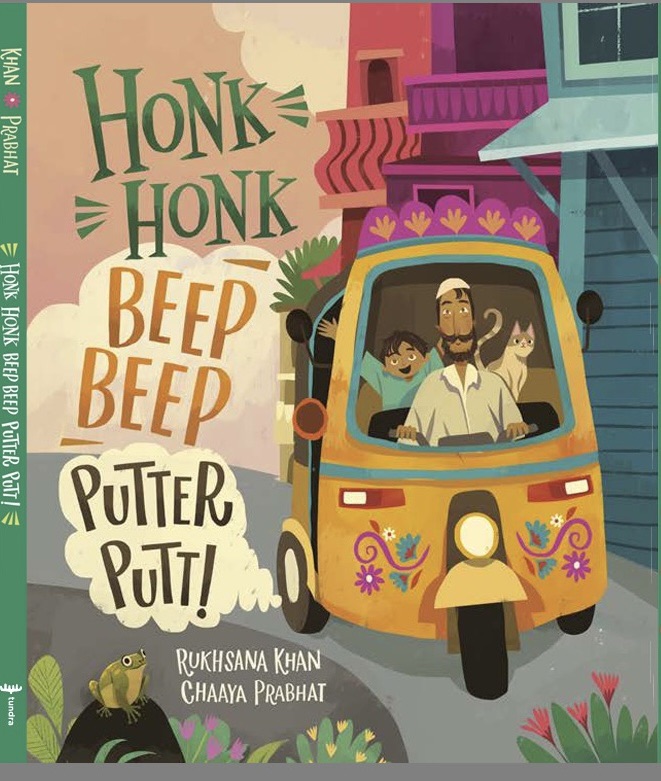
This adorable 32 page book is noisy and colorful and forces you to smile.  Granted I had dreams as a child of being a rickshaw driver, and even as a teen my father tried to arrange for me to take one for a spin early one hot Karachi morning, but alas, my dreams never came to fruition.  Cue the power of books, to take you right back to those busy streets, boisterous noises, colorful vehicles, and happy memories.  Even if you have never ridden in a rickshaw, or heard of one, this book is a fun adventure for toddlers and up as they catch a ride with Ibraheem, his Baba, his cat Mitu, and learn the language of the road and how to make room for everyone.  “Big and small, short and tall, everyone shares the road.” The book is by a Muslim author, and their are visible Muslim women with their heads covered in the illustrations.  There is nothing religion, country, or city specific in the text. 

img_4494-1

The book starts with Ibraheem and Mitu joining Baba on an important mission.  Baba is a rickshaw driver and he reminds Ibraheem that everyone has to share the road.  With his little rickshaw going “putter put,” the trio are off.  With a  “beep, beep” Baba tries to turn, but a little car responds, “honk, honk,” and in a hurry speeds ahead.  

img_4495-1

Up hills and down, a big colorful bus joins the road with a “toot, toot” as they go over the bridge, under the bridge, through a cricket game, all sharing the road.  A big truck joins the fun with a “rumble, rumble” and it isn’t long before they all come to a screeching halt.

img_4496-1

“Big and small, short and tall, everyone shares the road,” really means everyone as the mission is completed.

img_4497-1

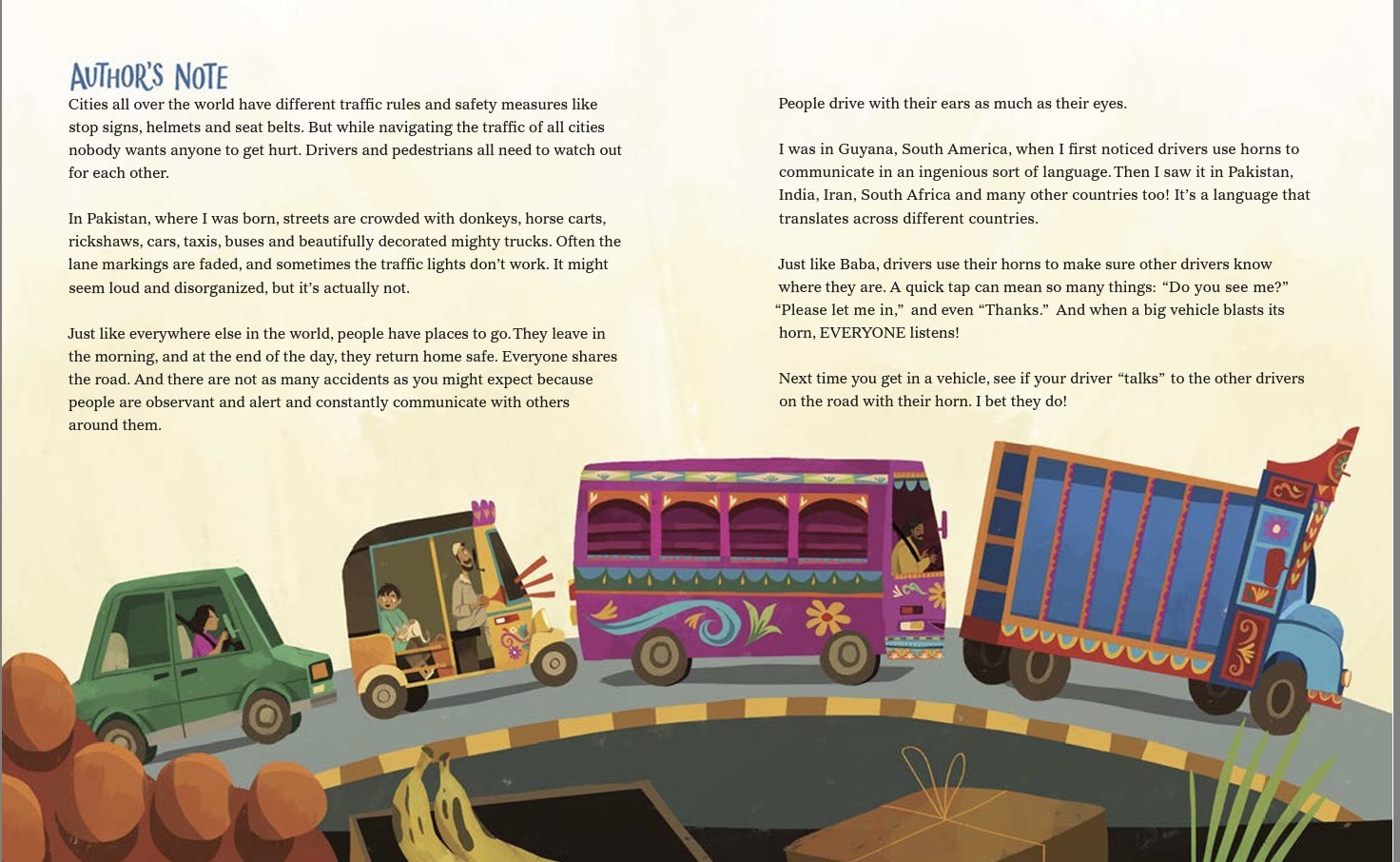
The backmatter is an author’s note about her experiences of vehicles “talking” to each other.  The book comes out in September and is available for preorder/order, here,