Tag Archives: Occupation

Tyger by SF Said illustrated by Dave McKean

Standard
Tyger by SF Said illustrated by Dave McKean

I don’t know that I’ve ever read a book like this 304 page middle grade fantasy, dystopian, highly illustrated adventure. It delves into philosophy, alternate universes, slavery, racism, politics, magic, identity, friendship, betrayal, human rights, education, following your dreams, saving the world, and a talking immortal tiger. It started a little stilted for me, but as the book progressed, I began to see that a lot of detail about all the above mentioned threads would make for a very adult, very lengthy read, and this is meant for 9-12 year olds, albeit they would need to be able to handle the darkness of the book at times, and caregivers, be aware there is a public hanging of a child. The author is Muslim, and the protagonist and a side character identify as Muslim.  There is not much about Islam, or shown in practice, but that they are afraid to learn and practice their faith is mentioned briefly. I think kids will enjoy the read, and not get hung up on threads unexplored as I did.  The illustrations really make it a book that feels exciting to spend time with, and one that will linger with the reader.  I look forward to sharing it when it releases soon in the US, as it was published in 2022 in the UK.

SYNOPSIS:

In short the book is about a boy, Adam, living “in an alternate London where the British Empire hasn’t ended and slavery was never abolished.” In a partitioned off Ghetto as a minority from the vague “Middle East,” who is unable to go to school, or even draw, he makes deliveries for his family to help keep them afloat. During one such delivery he encounters a tiger, an animal like so many others that is extinct, her name is Tyger, and she speaks.  She is an immortal searching for Guardians to help her heal and open a portal to the city.  When Adam, who is immediately connected to her, cannot find a Guardian, she begins to train him, time is short and when he discovers his friend Zadie, short for Scheherazade, has some training from her father, the two set out to open the doors of perception, imagination, creation, and  revelation, to save the day.

WHY I LIKE IT:

I really like that this book opens up larger discussions about society, self, literature, imagination etc, and can really be adapted to mean different things depending on what the reader brings to it. The book addresses these themes in a way that doesn’t talk down to the reader, and in many ways allows the simple bad guy of the story to not be the takeaway point, but rather the journey of understanding perspective, points of view, empathy, creating something, and hope to be far more important.

The identity of the characters being Muslim initially was just a label, one that just made Adam and Zadie more “other,” but a few cleverly crafted sentences about hiding their names, their skin color, and whether it worked or not, allow the reader to reflect on if denying yourself to appease others is effective or not, or rather more importantly knowing when and in which situations it could be a benefit or a selling out of who you are.  Zadie and her father seem to practice, and one point Solomon ( Suleiman), offers his prayers, he says Assalamualaikum and Bismilliah. Adam and his family on the other hand, have hidden their faith so as to fit in better, and thus it is simply an identity label.

I liked that the illustrations weren’t just stunning in their own right, but also highlighted the mood, and metaphysical elements of the story.  I feel like I could teach not just a few lessons on this book, but dozens, and who knows if they would be correct, but I think this book would be fantastic as a read aloud in a classroom for the story at hand and for the discussions.  The darkness, the excitement, the hope, really gripped me, and while I could opine on plot holes and lack of articulation, in some key scenes, I appreciate that over explanation would take away from all that the book gets right.

FLAGS:

Racism, oppression, colonialism, slavery, hanging, power imbalance, betrayal, lying, sneaking, fighting, killing, magic, fantasy elements.

TOOLS FOR LEADING THE DISCUSSION:

Where to even start, this book needs an educators guide, stat. I looked online and couldn’t find one and I hope that will be corrected soon because if you read my thought above, you know there is a lot to discuss.

Everything Grows in Jiddo’s Garden by Jenan A. Matari illustrated by Aya Ghanameh

Standard
Everything Grows in Jiddo’s Garden by Jenan A. Matari illustrated by Aya Ghanameh

This sweetly illustrated 32 page rhyming book starts off introducing a little girl living in one place, and having a home in Palestine that she has never been to, but loves.  The book then becomes pretty universal with her and her grandfather talking about what grows, his “green thumb superpowers,” and the magic of planting small trees that change and produce. The pages then add in more Arabic words of what is grown, and then when Jiddo is drying his eyes recounting why he had to flee his home and his roots, I too, found I was emotionally invested in light of everything current and past, and the simple words weaving a heartfelt story of family, connection, and home. I do wish that there was some Islam in the text or illustrations: a dua, a plea to Allah swt, a hijab on a main character not just on background memories, but there is not. There is also nothing overtly political or named in the text. The backmatter does discuss the Nakba without naming names and highlights the author’s inspiration, but inshaAllah nothing that will get the book banned or kept off shelves. The rhyme and cadence are pretty good, it doesn’t feel overly forced, but when reading aloud in a group, as always, I suggest practicing a few times to make the flow consistent.

The book starts with a beautiful spread of a mother and daughter looking through a photo album, and imaging going to Palestine one day, the subsequent pages show how Jiddo’s garden helps bring Palestine to them. The “sour green janarek plums,” “crunchy green khiyar,” and “plump red bandora.” Mama makes warak enab and Teta sings for more.

One day the little girl wonders how her Jiddo learned to grow everything and he shares that he learned from his father how to care for the land.  She then wants to know why they left Palestine, and he says, “our land was taken from us…and our family had to flee.” The hope is to return, the illustrations show the key to their occupied home being held on to, and reinforces the symbolism that Palestinians are like seeds that will flourish wherever they are, reaching toward the light.

The book contains a glossary with words written in English and in Arabic script, and an author’s note in the backmatter with presumably personal photographs of the author and her family.  I read a digital ARC and look forward to release day for my preorder to arrive.

Tipu’s Roar: A Freedom Fighter’s Tale by Subia J. Ali illustrated by Gabriel Sorondo

Standard
Tipu’s Roar: A Freedom Fighter’s Tale by Subia J. Ali illustrated by Gabriel Sorondo

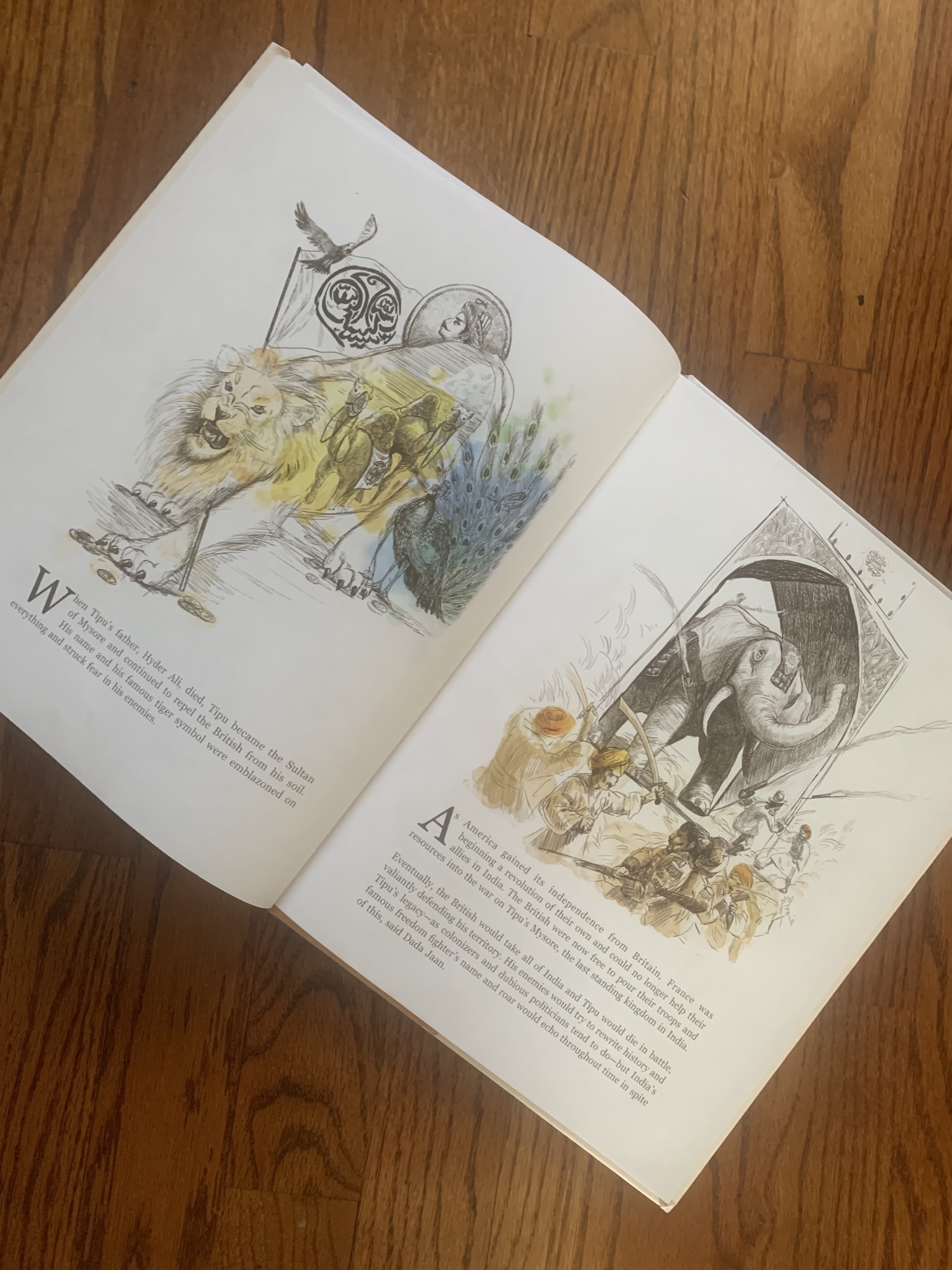
This large (9×11) hardback book is for the most part gorgeously illustrated in sepia tones, but the story is only 11 pages long; a pretty steep price point for 11 pages.  A story nestled with in a story, the premise of bringing to light a not well-known historical figure is admirable, but with no sourcing, it is hard to know what is real, and what is legend.  The concept and angle of being a freedom fighter and resisting colonization is timely, sadly it lacks the inspiration that I feel the author set out to convey.  I read the book a few times, and still had to Google a map of Mysore, Tipu Sultan and the role of the French in the subcontinent in the 1700s.  It would seem a book dedicated to the children of Palestine, defining words of freedom fighter, colonization, and imperialism before the book even begins, would answer the basic questions about the hero at hand.  

The book starts with an old man feeling gentlemanly wearing a bush shirt, chatting with his grand daughter who is being corrected to call him Dada Jaan instead of Grandpa. He then gets lost in thought and begins to tell his grand daughter the power of names to emphasize his point.  Tipu Sultan, known as the Tiger of Mysore, he tells her, “fought the British, who had come to colonize the Indian subcontinent.”

He doesn’t so much as convey the information in an entertaining way, as he lists off details and then pulls out to make sure she is still listening.  He tells her about the British East India Company draining the wealth of the subcontinent by taking tea, cotton, gems and spices.  He tells how Tipu “studied Islam, spoke many languages, and was a pioneer in rocket artillery.”  He credits Tipu’s rockets as revolutionizing warfare all around the world, and connects India, France and America as fighting off their Imperial colonizers, with the French being close allies in India’s struggle against the British.

Once her Dada Jaan’s retelling is through, and Tipu has lost, and Mysore falls, the little girls ponders over the story and years later appreciates her Dada Jaan in his traditional tunic rather than his bush shirt from before.

The book is in many ways needs to be fleshed out, sourced, and the messages articulated for today’s readers. 

A Little Piece of Ground By Elizabeth Laird with Sonia Nimr

Standard
A Little Piece of Ground By Elizabeth Laird with Sonia Nimr

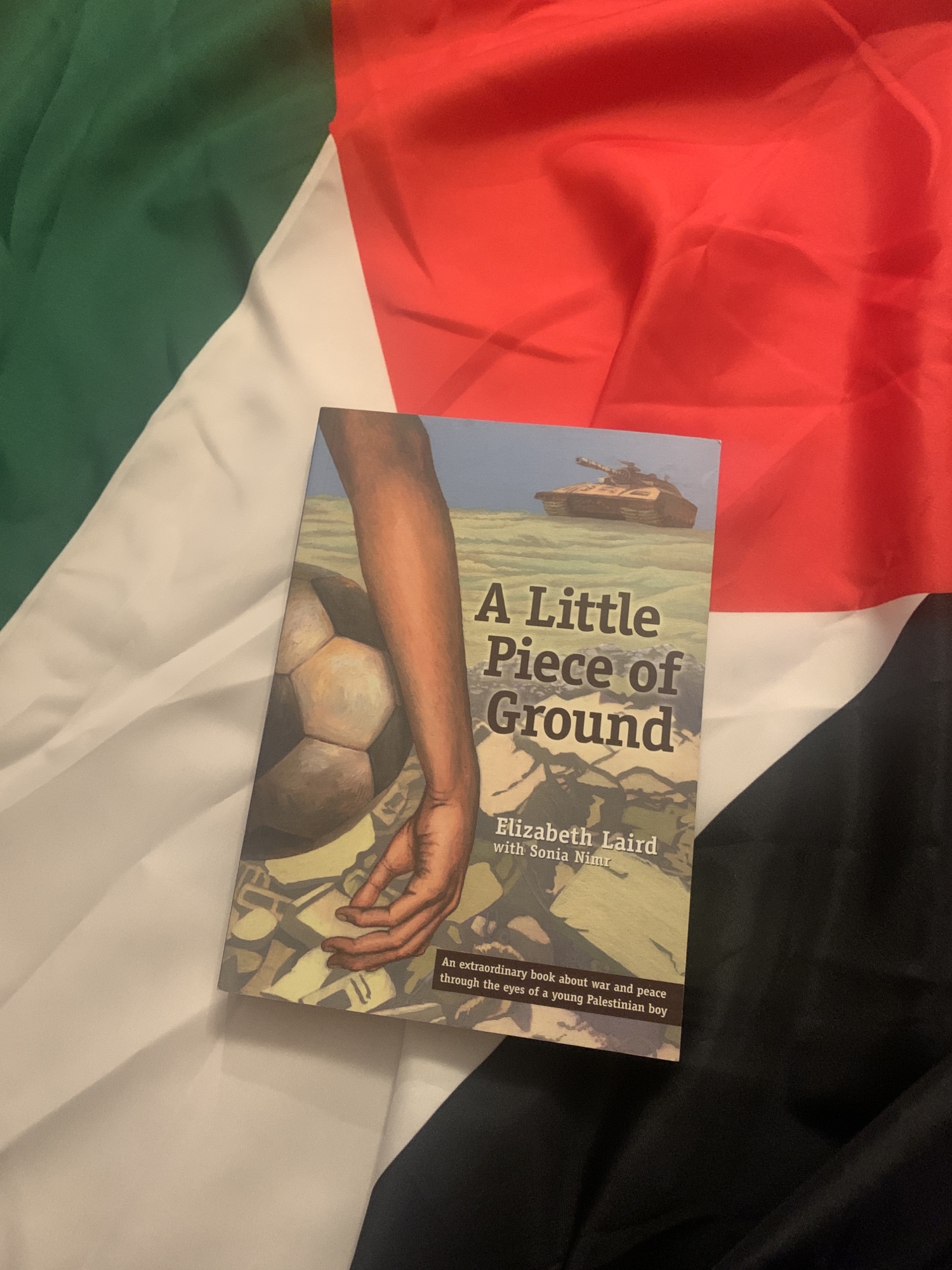
img_2165-1There are so few Palestinian middle grade books, so on that premise alone this 216 page book has a lot of value.  Because I am not Palestinian, I do not live, nor have I ever lived under occupation, I can argue some of the concerns from a point of privilege, and I acknowledge that is not my right.  I have been asked numerous times about this book and how it frames the suicide bombing mentioned in the text and blurbed about on the back of the book. It honestly is not a large part of the story, that being said, in my outside privileged view, I do not know that a 10 year old in the west will have context to understand the act of this level of desperation from the oppression and humiliation mentioned in the book. This is why I have held off my review.  The truth does not need to be defended or explained, and I fear my reservations will be taken as such, which is not my intention.  Would I let me 8 year old read this, yes, but we will read it together and discuss.  My children are aware of what is going on in Palestine, but Karim, the 12-year-old protagonist supports the bomber, and that notion is not clearly pushed back on. With discussion, absolutely, I think readers, will truly get Karim’s perspective that something has to be done to change the status quo.  The fear when Karim is alone and the target of soldiers, the settlers forcibly seizing the family land, the humiliation of strip searching men at checkpoints, the curfews, and constant fear of attack and imprisonment are all presented through the main character’s eyes, and would also do better with some discussion, so that empathy and duas and action can result.  But, the commentary as to the suicide bombing are minimal, there is even a prank package bombing that is presented as rebellion by a side character, and I would worry how a young child, without guidance, would internalize it.   Additionally, this is yet another difficult book for me to review, primarily because it was first published in 2003, and because I don’t know how much comes from a western gaze and how much the Palestinian voice played into it. Islam is clear on the prohibition of suicide.  In the early 2000 the news out of Israel was often about such attacks, but as an outsider, I honestly do not know if it was simply Israeli propaganda and stereotypes amplifying the idea as part of their public relations strategy or reality, seeing as now that Palestinians have direct outlets to share their daily life under an oppressive occupation, there is rarely talk of suicide bombing attacks. The author states on her website:

“I first visited Israel in 1968, and enjoyed a warm welcome from many Israeli friends. Later, I lived in Beirut with my husband and son during the civil war there, and became aware for the first time of the tragedy of the Palestinian refugees. I visited both Gaza and Ramallah, in the occupied territories, in 2002, while leading workshops for Palestinian writers. I was appalled by the circumstances in which people were living, and became aware that we in the West know very little of what life is like for Palestinians living under military occupation.

I have written A Little Piece of Ground in collaboration with Sonia Nimr, a Palestinian archaeologist, storyteller, writer and translator, who lives in Ramallah. We have tried to make our story as true to life as we can.”

The book is a hard read at times, but the joy is there.  Just as we as adults scroll through the devastation, the humanity persists.  The world may try and forget that they are attempting to erase a rich culture, but even in this book, their is laughter, and crushes, and sibling squabbles, and soccer games and friendship, and food, and joy.  There is a little Islam, not much, the main character is Muslim, a best friend is Christian.  It isn’t present in their everyday thoughts and actions, more just in identifying their faith.

SYNOPSIS:

Karim and his friends are not so much different than 12-year-olds everywhere, he loves video games, playing sports, isn’t so sure what he wants to be in the future, wonders what he will look like as he grows up, and is often annoyed with his family who he loves dearly.  Karim’s life in Ramallah is also unique, he lives under curfew, he doesn’t have freedom of movement, opportunity, or equal rights, and a simple family outing can be life altering.

The book follows Karim and his group of friend as they discover a patch of land they decide to turn into a soccer field, to claim as their own.  They work on it on days they can sneak away after school, in windows of time between curfews, and before long start to take pride in what the land can be. Adopting cats, learning about new friends from the refugee camp next store, teasing siblings about their crushes is all in contrast to Karim watching his father be stripped searched at a check point, being chased off their family land when they are harvesting olives by settlers shooting at them, and pranking soldiers in desperation of fighting back against oppression.

When soldiers roll in and occupy the land the boys have claimed, symbolic of their whole country, Karim gets stuck barricaded in an old abandoned car for days, with soldiers aiming their sights on him, and wondering if he will survive.

FLAGS:

Suicide, systemic abuse, oppression, humiliation, dehumanization, killing, beating, apartheid, genocide, violence, stripping, lying, crushes, occupation, shootings, injuries.

TOOLS FOR LEADING THE DISCUSSION:

This book does not need tools to be discussed.  It itself is a tool, to help middle grade kids be aware that this cruelty has been occurring for 75 years, this book took place 20 years ago, and today we just have social media sharing these stories more widely.  InshaAllah soon, Palestine will be free.

You can purchase this book here at Crescent Moon Store where code ISL at checkout saves you 10%

Palestine: The Special Edition by Joe Sacco

Standard

img_2164-1

Written between 1993 and 1995, and compiled as a complete set in 2001, this 285 page adult non-fiction graphic novel is not really something I can review, even if I knew how.  As we have passed 100 days of the escalation in Gaza, on top of the ongoing horrors of Israeli occupation, I am hoping to broaden my literary awareness to include not just children’s fiction and non-fiction about Palestine, but also adult works by those living it, those moved by it, and those reporting on it.

This particular “special edition” has a forward by Edward Said, and an introduction by the author and illustrator.  Once I started the actual story, I’ll be honest it took a few attempts to hook me, with the starting being in Cairo and being a little aggressive with alcohol and talk of women, but once I decided to just keep going, the book finds a bit of a rhythm.  It shows the author himself shaping his own opinion as he interviews, and sees, and reports on the events around him.  It is non-fiction, it is written by a journalist, at some points he acknowledges his bias, but the overall picture presented, is heart wrenching.  That the humiliation and torment and occupation of a people has been so well known and documented and ignored, in light of current events, and even in isolation, is devastating.  The exhaustion the writer feels just witnessing it, is palpable, and the complete ignorance of Israeli, former IDF soldiers none-the-less is stark.

The book is both a reflection of the time with internal political factions playing roles differently than they do in todays conflict.  There are also views about Iraq and Saddam Hussein, which might surprise readers today.  But the power of this book is what hasn’t changed, the torture, the imprisonment of children, checkpoints, illegal settlements, humiliation, restrictions from working, from moving, from being treated as equal.

I’m glad I read it, and spent time among the the ink filled pages. I am certain that many of the stories, particularly the ones from inside the prisons will stay with me and haunt me as I read headlines and scroll endlessly through the statistics occurring in real time.  How can we be so blind, for so long, how can a people endure so much and keep fighting, how does any of this make sense?

Sitti’s Key by Sahar Khader Ali illustrated by Noor Alshalabi

Standard
Sitti’s Key by Sahar Khader Ali illustrated by Noor Alshalabi

sitti key

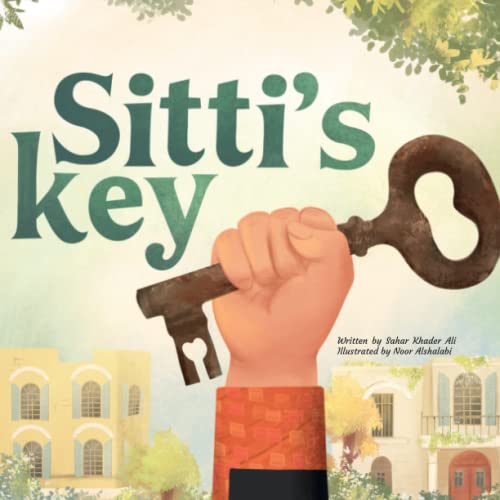
I try and buy, read, and review every children’s book about Palestine that is published, it is the least I can do.  I also try not to compare them to each other as they present different aspects of oppression, perspectives of strength, examples of joy, and messages of hope, even among many similar themes of food, keys, traditions, and culture.  I really appreciate that this book though is incredibly blunt.  It isn’t lyrical, it isn’t poetic, and as Israel is bombing Jenin as I write this I’m glad it doesn’t mince words about the Nakba. I do think caregivers though, should probably read it first as it might be a little triggering for sensitive children.  The story is OWN voice and probably best suited for middle elementary aged children.  It is perhaps also worth noting that the book could be seen as making Jews synonymous with Zionists.  The characters are Muslim, Islamic phrases and Arabic terms are sprinkled throughout, and even despite the pain the family has endured, the book stays hopeful and proud.

Sitti is coming and Amal is excited, it has been two years since she last saw her.  She loves how excited her mom and grandma are to unpack gifts of olive oil, dates, and zataar from friends.  Amal isn’t sure what to do with the “old lady thoub” she has been gifted, but she smiles in appreciation none-the-less.  When Sitti pulls out an old key, Amal starts to ask her about it, but her mother shuffles her off to bed.

The next day at school, Amal has to work on a presentation about “culture,” but there are no Palestinian books in her school library, so she just watches the other kids.  At home they eat and listen to Sitti’s stories of long ago in Haifa, and Amal asks her why she left Palestine.  Despite her mother trying to redirect, Sitti says it is time she knew about the Nakba.

Sitti tells about living on the land for generations and how the Jews believed the land belonged to them.  In 1948 the British decided Palestine would be the homeland for the Jews.  Armed men came and arrested anyone who tried to stay in their homes. Sitti’s brother was handcuffed and never seen again.  The family grabbed what they could including the key to their home as they made their way to a refugee camp in Lebanon.  They stayed for three years, before making their way to America.

When Sitti concludes her story she hands the key to Amal and her hope that she will return to their home inshaAllah.  Feeling the pride and warmth of home, Amal has a determination to reclaim her heritage and share her “culture” with her classmates.

The illustrations are sweet, the mom and Sitti wear hijab even in the home, and the inshaAllahs and salams come naturally. The book does not stop to define zataar or marimya, which helps the flow. I also like how it shows that there aren’t books about Palestine in the school library, it is strong and important detail.  I don’t understand where Sitti is coming from though, it would seem Palestine as she is bringing gifts from friends, but in the story it says after Lebanon they made their way to America, so I’m not sure where Sitti lives, and how the logistics of the family work to be honest.  I also kind of wish there was a  recipe for zataar in the book and lyrics with translation for the song the family sings.

Book is available on Kindle or can be ordered from www.littlehibba.com

What Color is My Hijab? by Hudda Ibrahim illustrated by Meenal Patel

Standard
What Color is My Hijab? by Hudda Ibrahim illustrated by Meenal Patel

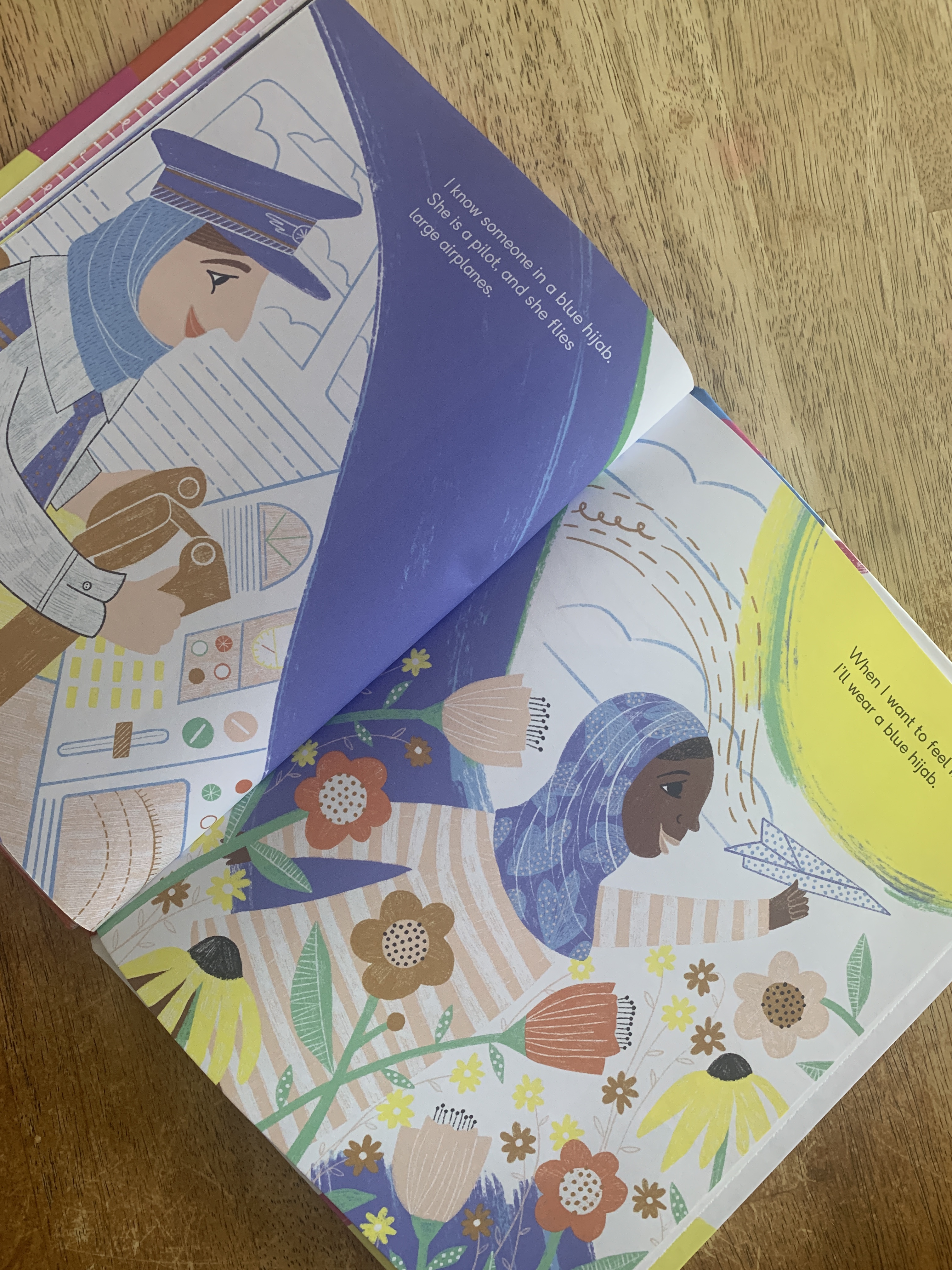
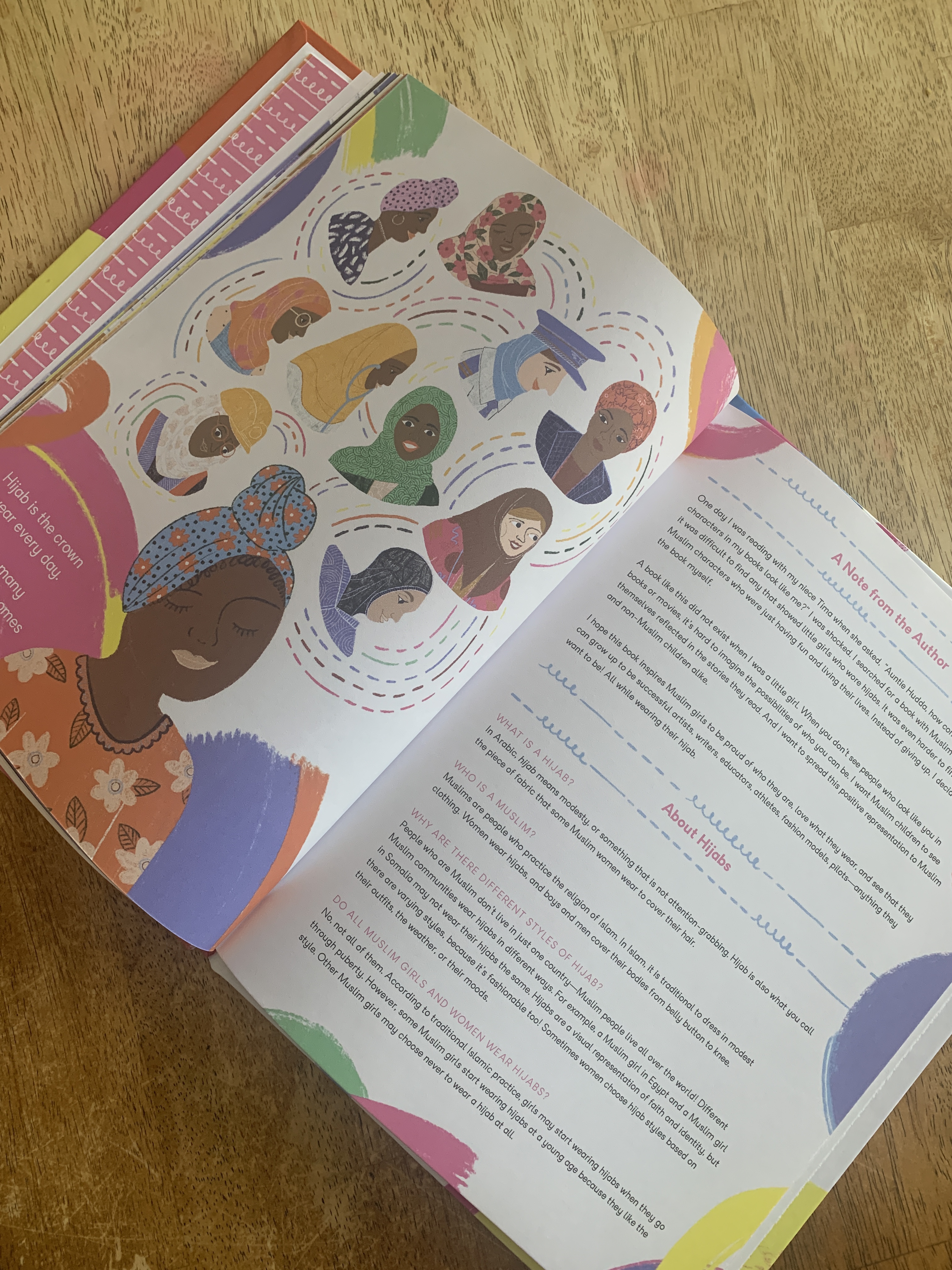
When this book arrived I flipped through it and loved that it tied hijab colors to careers, when I asked my seven your old to read it to my three year old and I overheard snippets, I was impressed that positive characteristics associated with the professions were articulated and embodied by the main character to inspire young girls everywhere.  When I finally sat down to read the book my self, I enjoyed the joy, diversity, and backmatter, but unfortunately felt like a page was missing at the end.  Over 32 pages the book introduces a color as seen on someone the narrator knows hijab, and identifies the woman’s job and a couple of characteristics.  The facing page highlights that when the girl wants to have strength or show kindness she too will wear that color hijab.  The text on the first page and the last page is the same, “Hijab is the crown/I wear every day./It is worn many ways, and it comes in every color.”  I absolutely love the premise of the book, but it seems that the conclusion should perhaps broaden that we can be anything and everything no matter the color we wear.  The blurb on the back of the book actually uses language of wearing “yellow, ‘like’ my doctor’s hijab, brown ‘like’ my teacher’s hijab,” etc.  that allows for a more interpretive and less literal view of I have to wear this color or that to be a leader or athlete or loving. I know I know, I’m probably overthinking it, but I’ve read the book so many times, and each time I just feel like the conclusion tying it together is missing and makes the book primarily a color book and thus preventing it from transcending into being more.

The book text is like a poem with the opening and conclusion reading the same.  The patterned body of the book works very well in establishing the links between hijab, color, occupation, empowerment, characteristics and implementation.  The pictures also allow the reader/listener to broaden their knowledge about various careers and see what they look like in action and what attributes they draw upon.

At times the wording gets a little loose with “give kindness” and “show wisdom” but the overall tone conveys the sentiment and allows for the stronger, “get results” and “be a leader” to balance out the flow of the book.  The illustrations amplify the color being presented, but it is worth pointing out that the hijab’s are all patterned and could be a little confusing to little readers.  Similarly, the yellow hijabs appear more orange and the purple more pink.

I love that the book is authored by a Somali woman and that the illustrations show diversity (skin color, mobility, body shape), but focus on strong black women inspiring the young protagonist.  The backmatter hints that it is the author’s niece and also explains hijab, and hijab styles.

I purchased mine from Book Depository, but they are going out of business, you can also purchase it on Amazon, here.

Book One: Thunderbird by Sonia Nimr translated by M. Lynx Qualey

Standard
Book One: Thunderbird by Sonia Nimr translated by M. Lynx Qualey

img_7178

My public library had this book and so I picked it up seeing that it was Palestinian authored fantasy, and I am always on the lookout to support OWN voice Palestinian stories.  The book cover is gorgeous, the inside text unfortunately is tiny making this middle school aged book only 110 pages.  It is translated from Arabic and published by a university, so my expectations were pretty meager which assisted in me being fully swept away by the story at hand.  Sure the book has a few glitches in point of view,  often it feels a bit abrupt and djinn stories are a dime a dozen, but what elevated this book and made it stand out was the Palestinian history interwoven into the plot: snippets about the Mamluk soldiers and Ottomans, the Ayyubid rulers and walls around Jerusalem.  There isn’t enough history touched upon in my opinion, but I look forward to see, now that the world building is established, if the rest of the series will highlight the historical thread.  I have no idea if the characters or author are Muslim, there are references to praying and hearing the athan, but they could just be cultural.  There is magic, fantasy, djinn, prophecies, and reading of tea leaves, as well as fighting, assault, and talk of oppression under Israeli rule.  I’d assume it is advanced Middle Grade or lower YA, but to me it seems 11 and up would enjoy the quick fast paced read.

img_7175

SYNOPSIS:

Noor’s parents are dead, and she lives with a grandmother who loves her, and an uncle and his family who don’t.  When her grandma dies, Noor is alone and with things combusting in to flames around her and no one left to defend her claims that it wasn’t her, Noor is trying to piece together a ring left to her, her mother’s research, and her flame creation abilities.  Her search leads her to a colleague of her mother’s and an old archaeological site.  While staying with an aunt in Jericho over the holidays, a mysterious cat guides her to the same archeological site where the cat reveals that she is really a djinn.  The barrier between the seen and unseen world is failing, and Noor is prophesized to be the only one that can ensure it doesn’t happen.  With a trait of the mythical phoenix Noor must find ways to travel in time and retrieve a feather before the bird is reborn.  Along the way she will have the help of the djinn and of her doppelgänger from that time period.

img_7176

WHY I LIKE IT:

The story is clever, fast paced, and the character endearing.  I wish the details were fleshed out and of course I wish there was more history when she travels back in time.  The climaxes are quick builds and even quicker resolutions, but despite all the flaws I really enjoyed the story and look forward to the rest of the series.  The book ends on a cliff hanger that feels rather abrupt, but being it is clearly established as book one in a trilogy, I don’t think readers will be too upset at the sudden end.

img_7177

FLAGS:

Magic, time travel, prophesies, fortune telling, assault, oppression, fighting, loss, arson, arguing, djinn, fighting

TOOLS FOR LEADING THE DISCUSSION:

The book probably is too short for a book club read, but I think a teacher could definitely use it as a reference in story writing, historical fiction fantasy, culture inclusion lessons.  If you wanted to use the book, you’d be able to find plenty to draw on for teachable moments in literature, history, and writing style.  There would also be a lot to discuss in terms of occupation, myth, legend, and culture.

If your library doesn’t have it you can find it on Amazon

Rebel of Fire and Flight by Aneesa Marufu

Standard
Rebel of Fire and Flight by Aneesa Marufu

rebel

I struggled with this 384 page young adult fantasy.  It skirts and plays with Islamic doctrine as the characters and plot points dance with fantasy and fiction; and because I never felt that the author was completely in control of the story and where it was going, I could never relax and be swept away.  The author identifies as Muslim and in the backmatter addresses how experiences with Islamophobia influenced her writing, yet I don’t know why jinn and hijab were in the book when fictionalized creatures and cultural dress would have sufficed.  Clearly the character on the cover is in hijab, the names of half the characters are Muslamic, the culture is very desi, the broad concepts of jinn, the ghaib, sihr, Prophet Sulaiman, call to prayer, are all Islamically rooted, but characters go to worship at temples, jinn and jinniya eat corpses and are described so often as looking like smoke.  There is no clear identifier that these characters are in fact Muslim, it is simply hinted at, which makes the fictional parts seem like extensions of religious doctrine and ultimately made me uncomfortable with much of the story.  It also makes me think readers will not know where the lines are, if my brain was muddled, I can’t imagine a  young teen reading it and keeping it clear.  There is a few rushed romantic scenes of kissing, there is a trans character who’s gender identity and born gender is a significant plot line in the story, and there is a lot of oppression, racism, death, abuse, misogyny and fear.  It is a dark read that metaphorically takes real societal concepts and sets them in shades of gray with the added use of fantasy. There are a lot of layers in the story, and while it wasn’t poorly written, there were definitely places it needed to be better.  I really didn’t like any of the characters, I didn’t understand their motives, their relationships, their drives, the commentary on occupiers and rebels was weak as was the push back on misogyny after the first few chapters.  I didn’t feel a love of hot air balloons or feel that the battle scenes accounted for many of the characters that would suddenly be missing from the scenes.  I think the dual perspectives kept the intensity of the climaxes at bay and halted the rising action.  Too many misses for me to recommend this standalone book, but if you’ve read it and can talk me through it, I’m willing to listen.

SYNOPSIS:

In a land where girls are running out of time to be arranged in marriage at 17 and transportation is done in hot air balloons, there are two groups of citizens: the darker Ghadaean’s are the rulers and the lighter skinned hāri are oppressed.  The book establishes this power dynamic early on in a quick synopsis: the hāri came from the Himala mountain range to trade to Ghadaea, but their greed and lust for power drove them to try and seize the land.  They failed, and now 90 years later the hāri are punished for the mistakes of their grandfathers (4%).  Both groups fear sihr and jinn.  Everyone is vegetarian because jinn are attracted to rotting corpses, animal and human, and thus anything dead is quickly burned.  When a radical hāri group, the Hāreef, is formed with a new leader, sihr and jinn are no longer enemies but tools to rebel against the racist oppression, and assist in the war to change the balance of power.  

Khadija is 16 and with her mother and younger brother deceased at the hands of some hāri, her older sister married and off in a balloon, her father is desperate to get her married.  Most females are not allowed to read, nor are they even allowed out of the house alone.  The fear of the jinn is weaponized to keep them in, and misogyny prevents from proving themselves.  While out meeting with a suitor, Khadija in a burst of desperation leaves her father and jumps in to an escaping balloon.  Khadija does not know how to fly a balloon, having never even ridden in one, but when it lands in different town she meets Jacob.

Jacob is hāri and the second of the dual perspectives telling the story, he is orphaned and is unique in that he is an apprentice of a glass blowing Ghadaean.  He meets Khadija and offers her food, and in the span of a few hours she saves him and he saves her and both seem to have a dead glass blower on their hands.  Add this to his growing rift with his best friend William, who has joined the Hāreef, and is now dead, and you have Khadija and Jacob escaping in a balloon, not trusting each other nor knowing who and what they support.

From here on the two’s friendship and motives wax and wane as they are drawn in to battle together, and against each other.  Neither are “good” or “bad” nor are their decisions always clear, but they will be forced none-the-less to figure out what they want and what they stand for as peri’s are tortured, nawab’s are killed, jinnya queens are called upon, wishes are granted and a group of hāri and Ghadeans known as the Wazeem offer a unified collective.  Unfortunately, change and power never come easy and when a dead son is brought back as an ifrit and an ancient princess in the jinn world is ready to battle, all the shades of gray that exist in politics, revolution, rebellions, families, hate, racism, gender identities, and control all come spilling out from balloon baskets and the ghaib. 

WHY I LIKE IT:

I honestly kept reading to see how the author was going to bring it to a conclusion and wrap up all the loose threads.  And while the book lagged at times, she definitely got it concluded.  Aside from the religious signaling, but never owning identity problems, I struggled with the writing too.  The hāri Jacob doesn’t read like a little brother, he and Khadija read the same age, and so his importance in the Hāreef seems an ill fit.  Plus he is very duplicitous and I get that that is part of the story, but I never liked him so it just got annoying how many second, third, fourth chances he got, and I mean, why would anyone care? 

Khadija seems like she is going to battle misogyny early on, I hate that marriage and arranged marriage is equated to oppression, but the not being allowed out and not being educated seems to fizzle in the middle and then come out a bit in the final scene.  I hoped it would have been commented on in every new city they arrived at.  The set up was there, but because it wasn’t, it made it seem more of a shortsightedness of her own father, and not a larger problem when strong women existed elsewhere.  This also reinforced a “brown Muslim” man stereotype that is never pushed back on.  

The racism, power struggle oppression is more consistent, but with the foundation that the hāri came and tried to take over nearly  90 years ago makes it hard to feel too bad for them.  They tried to occupy and now are enslaved.  Neither is ideal, but why didn’t they just go back? We aren’t talking more than one generation, it is the “crimes of their grandfathers,” they had a home, they were kicked out, they should leave.  Yes, I know they are human and racism is wrong, my point is a literary one, that the foundation should have been stronger, more detailed.

The love interest I also felt was lacking, Darian comes out of nowhere, they are in love, he gives her his heart so he is saved, I didn’t feel the tension, I didn’t get it, not at all.  It was forced and cheesy and I just know he kept getting hurt, they would kiss, and then he was back to getting hurt or possessed or something, had no personality what so ever.

The seal of Prophet Sulaiman and the hundreds of pieces of it didn’t sit right with me, nor the jinns being smoky and eating corpses.  I truly don’t understand why very real Islamic concepts were brought in and twisted.  Why not just create your own characters and say they were loosely inspired.  I felt like the religious rep and OWN voice kept one foot in the religious inspired world and one in the fantasy is fiction so I can do what I want, and it didn’t work for me.  I think it crossed in to being disrespectful, and had the author not identified herself as Muslim, I would have been furious as the book reads like an outsider who doesn’t get that jinn are real, Prophet Sulaiman was real, sihr is real, the ghaib is real.  It really needed some some clarification on where the story existed and where the religion or religious inspiration started and stopped.

The trans character is worth highlighting because it does touch into Islamic rulings regarding hijab, even though we don’t know if Anam or any of the characters are Muslim. Anam is born a male, but leaves her family of exorcists and is a leader of the Wazeem as a female. She presents as a female, but when she enters a room where numerous Wazeem women are changing many hide, draw their hijabs, make horrified gestures etc., it has to be explained to Khadija why this is.  It does not bother Khadija. Story wise it is a critical point because the Jinniya Queen Mardzma is the queen of female warriors and it is unknown if Anam would be seen as female or male. When Anam went from being an exorcist to the greatest human warrior present is beyond me, but there was a lot of assumptions you had to accept while reading.

FLAGS:

Death, erroneous religious rep, kissing, murder, killing, lying, torturing, threat of sexual assault, murder, coming back from the dead, oppression, racism, trans, misogyny, abuse, hetero relationships, stealing.

TOOLS FOR LEADING THE DISCUSSION:

I would not shelve this book in an Islamic school library or classroom, nor would I use it as a book club selection.  Although if my local public library or some adult Muslims read it and were planning to discuss, I would join to hear their thoughts about it.  I would not be able to lead, but I would enjoy picking it apart with others.

The book releases shortly, just because it didn’t work for me, if you think it sounds like something you would like, you can preorder and purchase it HERE.

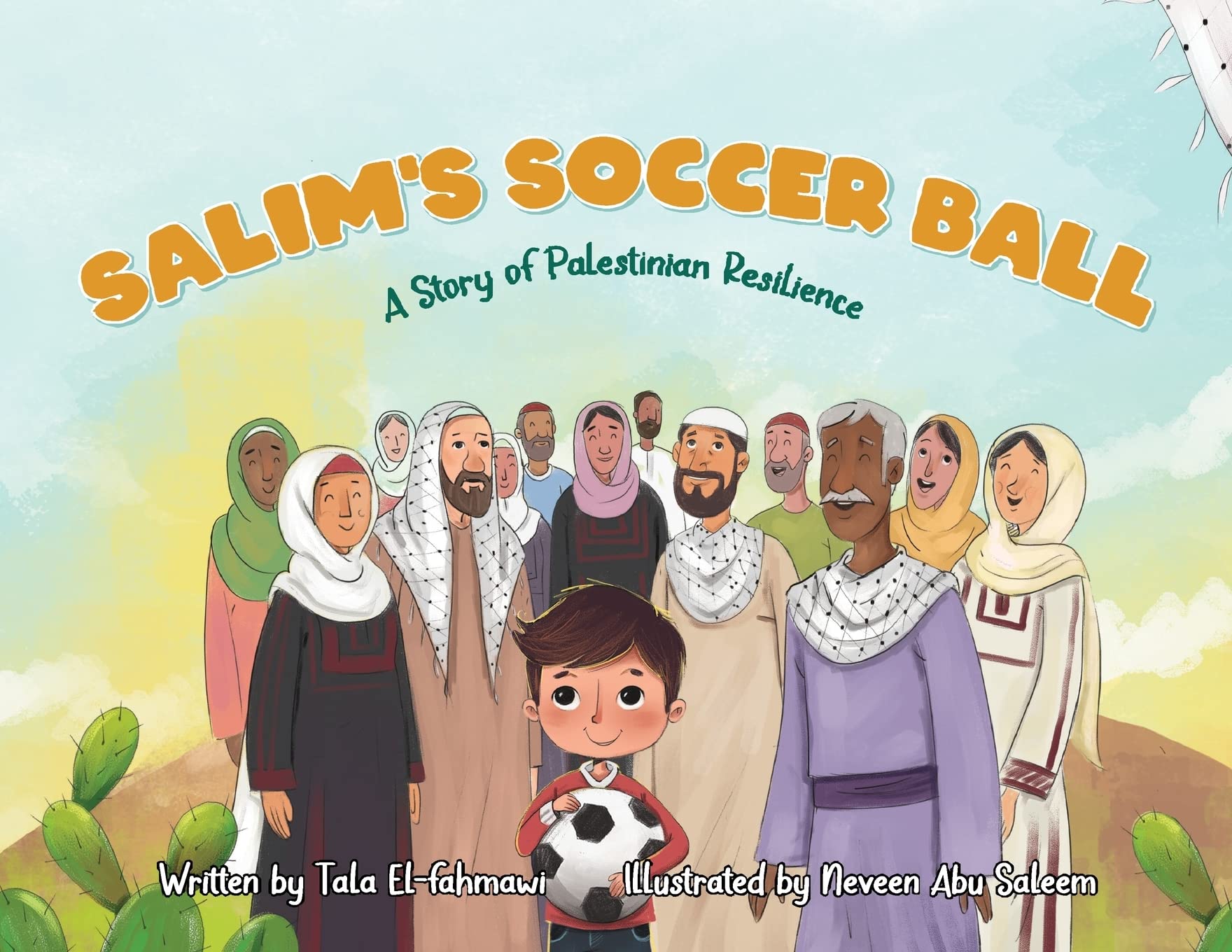
Salim’s Soccer Ball: A Story of Palestinian Resilience by Tala El-fahmawi illustrated by Naveen Abu Saleem

Standard
Salim’s Soccer Ball: A Story of Palestinian Resilience by Tala El-fahmawi illustrated by Naveen Abu Saleem

salim

This 58 page rhyming picture book weaves together a tale of a little boy and his lost soccer ball, with larger issues of community, oppression, and perspective for the youngest of readers to older children too.  I am noted to be skeptical of rhyming books, but the large font, the sweeping pictures, and the dropping of occupation, struggle, and resilience really make this book a treat. Add in discussion questions and an author’s note and you have a solid book that deserves space on home, library, and classroom shelves.  My only wish, was that the book was hardback.  The horizontal layout with a soft cover make the book difficult to read during story times as the pages flop back.  The book is long, but the text on most spreads is minimal and while I could not identify the author’s religious identity, their are numerous hijab wearing #muslimsintheillustrations as Salim journey’s around his neighborhood and into his grand father’s memories.

Salim wakes up, brushes his teeth, and is out the door to play soccer with his best friend Qusai, but the ball goes flying and Salim can’t find it. He starts walking down the hill and it seems to have disappeared.

img_5055

He asks the fisherman, Abu Zaid, if he has seen it, and he hasn’t, but he offers to help.  They then go and ask the seamstress, she hasn’t either, but she puts down her tatreez, offers reassurance, and offers to help.  As they head out they bump in to Dr. Bassam.  “‘I will help you look,’ the kindly man said. “I can fix broken bones with very few supplies.  A lack of resources has made me clever and wise. Resilience and courage are plentiful here. We will find your ball. Salim, no need to fear.'”

img_5054

The searching continues, with a small break for khanfeh, and then Qusai is found, and so is the ball.  Like so many joyful items, the barbed wire of the apartheid wall has destroyed the soccer ball. Upset, Abu Omar, calls out to Salim, and his grandpa embraces and consoles the young boy recalling a donkey with wonky ears and life on the farm.  With resilience and joy Salim heads home to a community surprise and a hopeful future inshaAllah.

img_5053

The book concludes with five discussion questions that connect Salim’s experience to universal experiences of people everywhere.  It is followed by factual and personal author’s note about Palestine and the book.  

img_5056

There is nothing religious aside from the hijabs worn, Dome of the Rock, Masjid al Aqsa, and Church of The Holy Sepulcher in the backgrounds of a few images.  I purchased my copy from Amazon HERE and can also be purchased through Shop Palestine HERE.

img_5057