Tag Archives: mystery

Zeyna Lost and Found by Shafaq Khan

Standard
Zeyna Lost and Found by Shafaq Khan

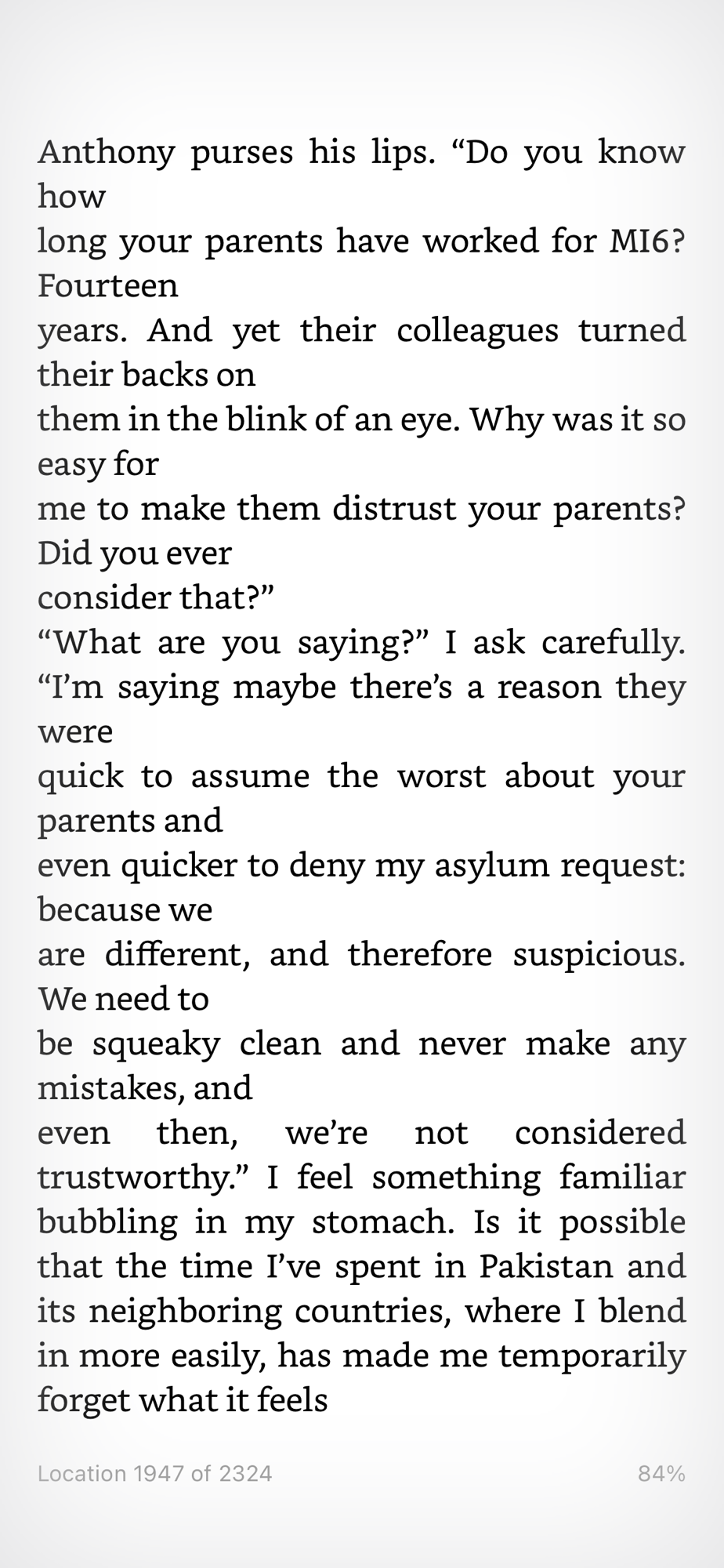
I think I needed this 336 page middle grade book that gets parents out of the way and lets a trio of kids  hop from country to country to solve a mystery, track down the bad guys and save the day. Set in the 1970s in the UK and on the Hippie Trail between Lahore, Pakistan and Istanbul, Turkey, the book is a fast paced read with humor, heart, and adventure.  I absolutely love Zeyna’s snark and voice, and her relationship with her brother and cousin, ground the story and make you cheer for them even when their antics are incredibly dangerous and improbable.  As an Islamic school librarian, my one critique with the book is that I wish there was more/any Islam. I, at one point considered that they are not Muslim, and I’m not sure what the author identifies as, but she does thank “Al-Barr, for all that is good” in the acknowledgements, and Zeyna does mention an Eid party in passing, so while I’m still on the fence, I’m going to assume they are all Muslim.  Major beats in the plot are meeting at both the Badshahi and Blue Mosque, but none of the characters ever pray, or mention the names of prayers when the athan is heard.  When they see women in burkas and chadors, Zeyna stares, not connecting the clothing to hijab, that one would hope she would know. There is only one salaam in the whole book, and the story is predominately set in Pakistan, Afghanistan, Iran, and Turkey. Granted I am sensitive, but it almost feels like a deliberate exclusion to the point of going out of the way to not let those details be present.  There are plenty of Urdu and Punjabi words and titles and cultural commentary, so it doesn’t seem that the author was concerned about watering down authenticity, a theme of the book infact is finding your place and accepting yourself.  All that aside I really enjoyed pickpocketing, imaginative, determined, sarcastic, loyal detective Zeyna, and I think kids will join me in hoping this is the first in a series.
SYNOPSIS:
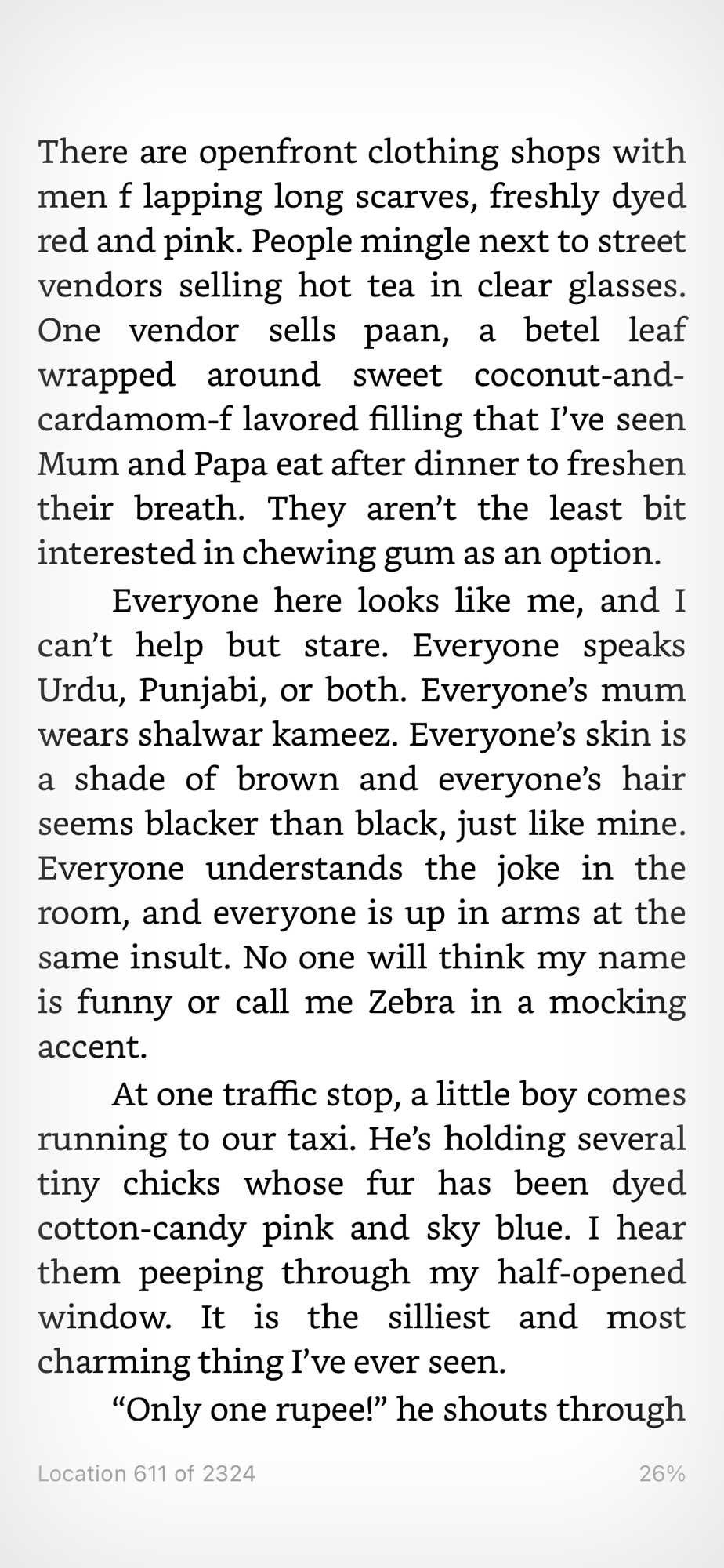
Zeyna is 12, and likes to imagine she is a detective on a case, sneaking and snooping, and roping her inventing younger brother Mahir to be her Watson. The city is on edge with the theft of the Shirin Jewel, a large Persian ruby, a case involving the 15, that Zeyna would love to solve.  When she sees a man with knife in London, who later seems to be following her and her mum, and then drops a paper with their street name on it, Zeyna is convinced this her chance to prove her self. A sudden trip to Pakistan though dampens her mood as the clues to the case will be left in the UK. She doesn’t stay down long though, as her parents start acting peculiar in Lahore, meeting with strange people, lying about why they suddenly made the trip at all, and when the police show up at the familial home to arrest her parents, they all discover that her parents have vanished.  Zeyna realizes her parents and the events in London are tied to the missing ruby, and with the help of Mahir and their cousin Amina they set off to solve the case and find her parents.
WHY I LIKE IT:
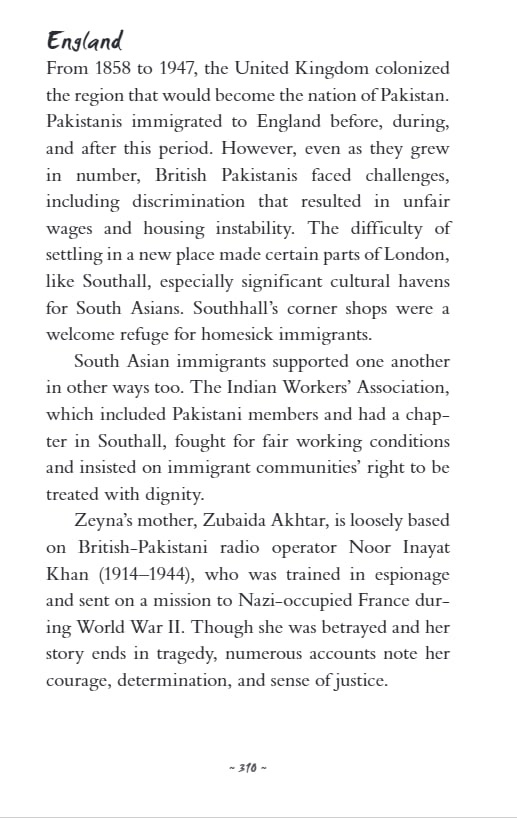
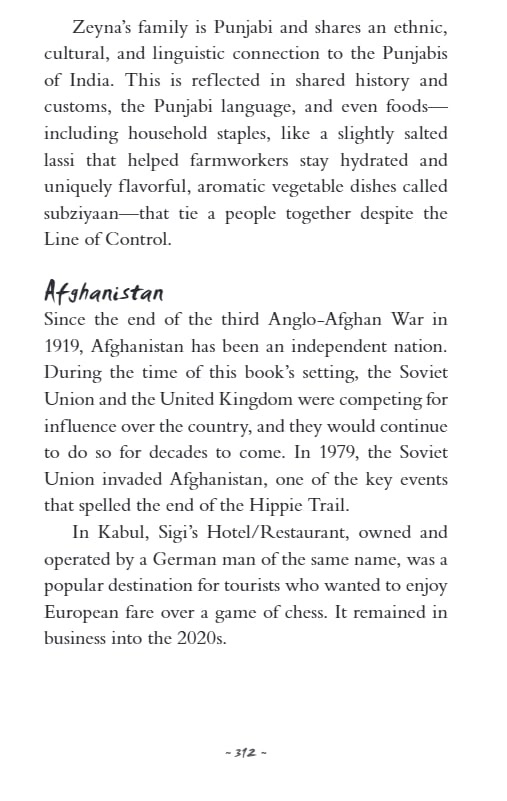
It’s hard to review a book like this without giving the twists and climax and resolution away, but more than once I gasped in delight when something happened on the page, and it crystalized where the book was going in my head.  Sure there were some particularly outlandish connections and a few plot holes, I even Googled when fax machines were invented, but I had a blast reading the book.  I loved the historical backmatter discussing the events in post partition Pakistan, a year before Bangladesh was independent, Soviet Union and UK competing over influence in Afghanistan, the discontent voices in Iran toward the shah, and the role of the Pudding House for messages in Turkey.  There are also discussion questions, a glossary, acknowledgements, and about the author at the end.

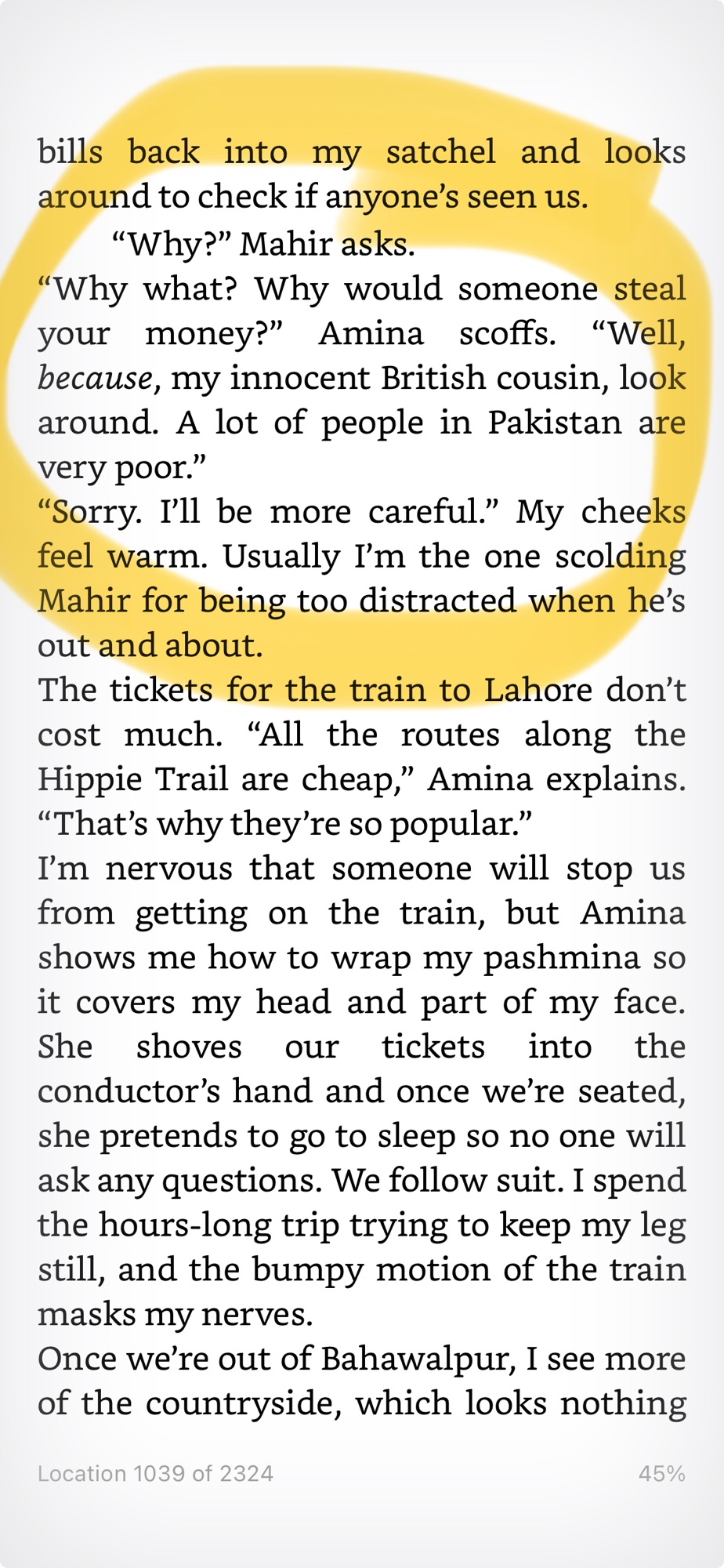
One tiny concern was the assumption that money could be stolen because the people around them are poor, it is just one paragraph, it isn’t a constant in the book, but it struck me as odd and stereotypical, and really not needed.

FLAGS:

Lying, stealing,  deception, pretending to be someone you are not, breaking and entering, eavesdropping, snooping, its a heist book!
TOOLS FOR LEADING THE DISCUSSION:
This would be an awesome book club book or novel study read, I can’t wait for it to be released in a few weeks so that I can have my kids read it.

Always Be My Bibi by Priyanka Taslim

Standard
Always Be My Bibi by Priyanka Taslim

I had pretty low expectations going into this 368 page YA romcom- as often YA is really “adult” and if the characters/author are Muslim in a “romance” it tends to become a heavy handed rebellion against Islamic principles. So imagine my surprise when the book really is meant for teenage readers. The protagonist loves her culture, and it is established really early on that they are Muslim, but aren’t religious.  Sure as an “Islamic School Librarian,” I wish the characters practiced Islam, and that the the kissing and hugging was labeled as haram, but for the fictional story on the page, that is cultural based, it is a delightfully chaotic and fun read.  Note, the kissing and haramness occurs when they are “sneaking out,” and reads as if they are sneaking out from parental rules, not Islamic ones, as they do not view the world through an Islamic lens.  The protagonist’s sister is presented as religious in that she wears hijab, and left a prestigious private school to attend a local Islamic one, but it is not a major plot point, and if anything shows that Islam is not a monolith or something forced, really though it just shows how different the siblings are.  Does that mean the writing is some literary genius? No, not really, but it is a quick light summer read that I enjoyed. The main character, Habiba, aka Bibi, reads as a Bangladeshi Cher from Clueless through and through, and while at the start it was a bit annoying, I ultimately found her endearing by the end.  There are plot holes, but I didn’t care too much given the quick pace and the nature of the book. The ending though, was drawn out and too long, and the book could have been easily 50 pages shorter. All in all it was fun to be transported to a tea estate in Bangladeshi for a wedding, and I wouldn’t have a problem with 15 – 16 year olds or so reading the book.

SYNOPSIS:

Bibi is in hot water with her father for sneaking off to prom with a boy, the deal has always been no dating until her older, perfect, law school bound, sister Halima gets married.  And her punishment for the summer is working at the family restaurant, one of the many Royal Fried Chicken locations in the chain they started that makes her family, chicken royalty. When hijab wearing, no haram dating Halima springs on her family that she is getting married, the family all heads to Bangladesh for the summer to get to know the groom’s family on the massive tea estate, and celebrate the wedding. Oh and Bibi’s punishment will be transferred from working fast food, to working in the fields under her new brother-in-law to be’s grumpy, serious, younger brother, Sohel.  Bibi also holds her father to his end of the deal and when the big book of biodatas arrives, she is ready to have her chaperoned dates as promised.

As the prickly family of inlaws look down on Bibi and her family, Bibi and surprisingly, Sohel join forces to break the pair up. As the book unfolds their mission changes, the bio data book causes drama, old flames are sought after, and the wedding takes some surprising turns.

WHY I LIKE IT:

As I write this, I’m rolling my eyes at the fact that I really did read it in two sittings and was amused. Bibi is spoiled and clueless and yet does have a good heart.  As with most romantically inclined books, a whole lot of suspension of reality takes place and side characters are not fully fleshed out.  Halima and Sunny met in college, and there families are from the same part of Sylhet, infact Baba worked on the Rahman’s tea estate before coming to America.  The grandma is woefully underdeveloped, I get that she is a side character but the girls spend so little time with this woman they love so dearly is a blaring hole. I really didn’t get some of the scenes after the midpoint, they felt like filler and they felt forced: friends coming from America, the bachelorette party turned amusement park trip, Sohel not sticking up for Bibi, the half hearted love triangle, and the Bibi Baba multiple rehashings.

I did like that the title of the book though comes from something Baba says to Bibi, and not from a love interest, that made me smile. And I liked that the “dates” were supervised, it is vague if the dates in America would have been, or if once Halima was married she would have been allowed to “date” with a western definition, but I kind of liked that it wasn’t defined.

FLAGS:

Disrespect, sneaking out, kissing, hugging, close boy girl friendships, sneaking out, language.

TOOLS FOR LEADING THE DISCUSSION:
Definitely not a book to spotlight as a book club selection, but one that I would have on the shelf and not mind older high schoolers reading.

Detective Aunty by Uzma Jalaluddin

Standard
Detective Aunty by Uzma Jalaluddin

The author may have returned to her fictional Golden Crescent neighborhood, but with her best writing yet, the focus is not romance like in her earlier books, it is a murder mystery.  If you think of it, who better to solve a mystery than an unassuming Desi Aunty with a knack for observations, getting people to talk, and prying into other people’s business? I say it with love, this book was such a fun read, I’m sure I should have paid more attention to craft and arcs and writing style, but honestly I devoured the 336 pages in two settings, and genuinely hope that Kausar is just getting started. The adult read isn’t salacious, it does feature a murder, some marital dramas, crime, fraud and the like, I think mature teens that aren’t bothered by a grandmother protagonist will enjoy the read. The first chapter is a bit dry and feels like an info dump, luckily it isn’t a long chapter and I ultimately, appreciated it getting the stage set and then slipping out of the way so the story could get good. The telling and not showing takes a while to flesh out, the author does a good job of threading it through, and by the mid point you really get a feel for the characters and appreciate the early statements that set the tone, and the book’s ability to tie up nearly every thread it presents.  There isn’t a ton of Islam, many of the characters are Muslim; the traditions and cultural expectations are plot beats in the story, even if the action and expectations are not overtly seen through an Islamic lens or with Islamic boundaries.  

SYNOPSIS:

Kausar Khan has always noticed things around her, and when needed, used those observations to position certain outcomes.  When she gets a call from her daughter in Toronto that she needs her mom to come help with the kids as he is wanted for murder, Kausar Khan leaves North Bay and returns to a city filled with memories of tragedy to try and help.  Sana asks her mom not to get involved and to just help with the cooking, cleaning, and childcare, but old friends, new secrets, and the high stakes of a murder are not going to keep this Aunty from unraveling the truth.

WHY I LIKE IT:

I love the concept, the execution, and that it didn’t unravel at the end.  I read the last few pages with the same intensity as the climax, trying to figure out whodunit.  The play on traditions and stereotypes to lure suspects in, and the wit and charm of using the religion and culture to advance the plot were flawless.  Sure, I wish the characters threw in some commentary on men and women being alone together not being ok, or some Islamic insight into marriages and rights.  It seemed intentionally lacking, and that is unfortunate. I also felt the thread with the son coming from the UK was painfully underdeveloped, the heart of the book though was strong.  And I loved the side commentary on marriage and women’s roles.  It was insightful and added depth, it didn’t come across as angry or like the author had an axe to grind, which was refreshing.  

FLAGS: 
Murder, affairs, fraud, pyramid schemes, theft, racism, gentrification.

TOOLS FOR LEADING THE DISCUSSION:
The book won’t work for a school book club, but is a perfect summer read to giggle about and chat about with friends.

The Matchmaker by Aisha Saeed

Standard
The Matchmaker by Aisha Saeed

There is no Islam, save being told a wedding took place in a mosque, in this 320 page adult book by a Muslim author.  The thriller, mystery, romance, is fairly clean, save some drugs, killings, kissing, and normalized dating, yet I would probably be fine with mature teens reading it, if so inclined.  By the end, I enjoyed the book, but it took me three attempts to get past the 30% mark as the opening was painful with its numerous characters being name dropped, the setting being established, and getting the characters into position.  But then slowly the exposition gave way to story telling and intrigue, and the second half was a decent read.  Honestly, my biggest problem with the book is that I just didn’t like the main character, or any of the characters really, and I don’t know why.  They didn’t have some clear flaw or annoying habits, they just felt distant and bland, which resulted in the plot carrying the book, and me not really caring if the protagonist was killed or harmed, I know- harsh.  I cannot deny though, that what kept me reading was to see who was behind it all and I did figure it out, but continued on just the same to be sure, and that is a testament to the author’s writing skill, even if it took a minute for the pacing, plot, twists and climax to pull me in.

SYNOPSIS:
Nura Khan runs an elite matchmaking service in Atlanta, from hands on to a dating app, her and her team match people of all backgrounds and faiths.  She herself has a long time friend who acts as a fiancé for image purposes, and a recently retired aunt who’s bad days have meant family dynamics have changed.  As a third generation matchmaker, Nura is in charge and knows what she is doing, until suddenly her image, her reputation, and her matches start faltering.  Not confined to just heartbreak, there is also stalking, threatening notes, kidnappings, and attempted murder, which suddenly thrust Nura into a world she is ill prepared for, and one that seems to put her in the crosshairs of someone determined to see her demise.

WHY I LIKE IT:

It wasn’t a heavy thriller or heavy romance, it was an easy read that didn’t “other” desi culture and I found that refreshing. That being said, I always wish her books had Islam in them.  I also liked that the climax and second half honestly didn’t feel overly forced, I’m not a writer so take it with a grain of salt that I complain that the beginning was dry and too much telling, but then the second half flew by and loose ends were more or less tied up in a satisfactory way. I’m aware that the second half was a result of what was a established in the first part, but none-the-less I hope future books will make the two halves less cumbersome and inconsistent. I also really hope future books will have more character appeal.  There was a lot of potential to care deeply about the main characters, from the aunt, to the best friend, to Nura herself, but they lacked spark, and sadly just felt like vehicles for a plot that wasn’t dependent on them, their experiences, their flaws, and their personalities.

FLAGS:

Dating and relationships of all faiths, persuasions and labels, kissing, attempted murder, killing, plotting, lying, scheming, kidnapping, drugging, physical abuse, assault, deception.

TOOLS FOR LEADING THE DISCUSSION:

With no Islam I wouldn’t do this as a high school book club, but amongst friends it would be a fun group read.

The Hysterical Girls of St. Bernadette’s by Hanna Alkaf

Standard
The Hysterical Girls of St. Bernadette’s by Hanna Alkaf

This 352 page young adult mystery, thriller could possibly be classified as magical realism, or speculative fiction, I’m not really sure, but I do know, that my expectations were really low, and I was so pleasantly surprised by how the story pulled me in and kept me engaged.  Told primarily by dual points of view, Khadijah and Rachel, the book offers commentary on sexual assault and believing victims.  The book starts with a trigger warning of “ghosts and monsters, some of whom hide beneath human faces. It includes discussions and descriptions of sexual assault, trauma, and PTSD,” before diving in to a prestigious Malaysian girls school full of secrets, hysteria, and a past that seems to be repeating itself.  There are no religious identity crisis or issues, the student body is diverse and it is a non-issue, Khadijah recites Ayat ul Kursi, makes time to pray, and wears hijab as she tries to figure out what is making the students at St. Bernadette’s scream, what happened to those that have gone missing, and how to overcome the trauma that has made her stop speaking.  The symbolism is solid, the book starts out with the screams, but builds on it by adding backstory to the main characters, mystery with the disappearance, and numerous red herrings to keep the reader guessing.  I told myself to get to the midpoint before calling it quits, but once I was there, I read the second half of the book in one sitting. I appreciated that the book was unique, there was no relationship side stories, the cultural authenticity heightened the reading experience, and that I understood the haunting magical elements.

SYNOPSIS:

St. Bernadette’s is an old prestigious all-girls school, but one day a chain reaction of girls screaming starts and the hysteria doesn’t seem to be stopping any time soon.  When Khadijah, who is dealing with her own trauma of being sexually assaulted by her step-father, starts to look into the causes, more questions than answers arise.  In efforts to protect her younger sister, Khadijah discovers not only has this happened as their school before, but it doesn’t stop with the screaming, and the shadows, last time a girl went missing.

Rachel’s life is controlled by her single mother, who is determined that Rachel is successful and a reflection of how perfect and successful they are, despite, Rachel’s father abandoning them.  When in an act of rebellion Rachel signs up for monologue competition, she plans to get into character, not to become the character.  As Rachel starts to lose her self to the girl with pink lipstick and white ribbons in her hair, she starts to notice sights and sounds around the school, but when she falls victim to the screaming hysteria herself, will anyone care enough to save her?

WHY I LIKE IT:

So often with magical realism, I honestly don’t get it, so I’m not sure if my excitement of having it all be clear means the book was a bit simplistic, if I’m getting better the more of the genre I read, or if the writing was just good.  If I’m being honest, it is probably a little bit of all of it.  Often with the author’s book, the story is really good, until it is not, and I honestly feel like this is her best book yet, with the threads coming through, the ending feeling satisfying, the pacing being consistent, and the plot not getting lost on tangents and over explanation.

I loved the symbolism of screaming and it being largely brushed aside as society’s collective apathy to victims of sexual assault.  No one at the school has answers, no one likes questions being asked, everyone just wants to carry on as if nothing is happening, and the juxtaposition of the silence and the hysteria for me was powerful. A few plot holes were the result of telling over showing such as the case of the Khadijah and her sisters relationship, but that Khadijah stayed largely silent throughout the book, did not mean she was unable to communicate or not present, and I thought it was shown in a meaningful way.

I liked that the overbearing mom, with high expectations, and lacking emotional maturity was not from the Muslim parent, at least in Western literature, that is a common trope.  But it is worth noting that presumably the rapists mentioned in the story are Muslim.  Their faith is not a factor, but I noticed, and so I do feel that should be shared.

FLAGS:

Sexual assault, ptsd, rape, kidnapping, trauma, hysteria, lying, ghosts, monsters, magic, fear

TOOLS FOR LEADING THE DISCUSSION:
I think this would be a great high school book club read.  The conversation about sexual assault, both in the story and in real life would be important to have in a safe space.  The triggers would require some evaluation if the book is a good fit, but I think the elements that unfold and the commentary on expectation, honesty, trauma, monsters, etc. would create incredible discussion.

The Djinn’s Apple by Djamila Morani translated by Sawad Hussain

Standard
The Djinn’s Apple by Djamila Morani translated by Sawad Hussain

img_4352-1

This short, 160 page YA book is really quite gripping. Admittedly, during the first third of the book, which is primarily world building, I had no idea what was really going on, but I was intrigued and by the half way mark, I was so invested, I truly could not put the book down. I received an early digital copy so I am not sure if the grammar errors, typos, and lacking punctuation is because it had not been through line edits yet, or a result of translation oversights, none-the-less I thoroughly enjoyed this book and read it in a single sitting. I wish this book was 500 pages long, with details about the time and environment, and build up to the conclusion, and angst to the romance, but it is not there, it is short, and rushed, and I don’t really know how to review it, because to point out all that is wrong, doesn’t convey all that was right. I am a self appointed reviewer, so I’m going to break my own standards and just copy and paste the teasing blurb, I can’t say it better, you are welcome: “Historical fiction meets crime fiction in The Djinn’s Apple , an award-winning YA murder mystery set in the Abbasid period—the golden age of Baghdad. A ruthless murder. A magical herb. A mysterious manuscript. When Nardeen’s home is stormed by angry men frantically in search of something—or someone—she is the only one who manages to escape. And after the rest of her family is left behind and murdered, Nardeen sets out on an unyielding mission to bring her family’s killers to justice, regardless of the cost…”

SYNOPSIS:

See above, I know my standards are slacking, but that blurb is what helped guide me when I got lost a little lost with the words on the pages.

WHY I LIKE IT:

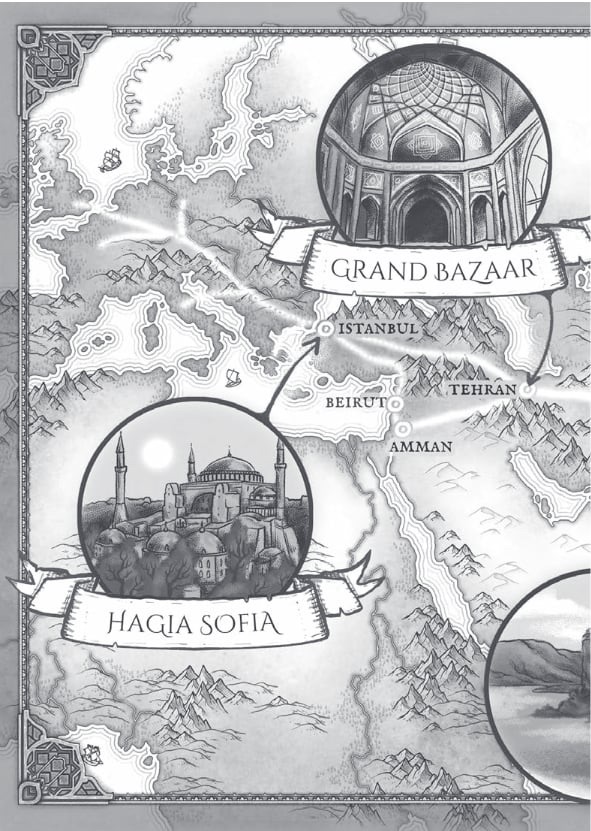
I love the map and in this case the glossary and backmatter really helped me to understand the setting because the text assumes the reader knows about Harun Al-Rashid, the Golden Age of Baghdad, and the Abassids. I appreciated the Reader’s Guide and further information about the Bimaristan, as well.

I like that it showed the family as being practicing Muslims, them being accused of being infidel Zoroastrian, and the adopted father and teacher being Jewish, it added a layer that entices the reader to reconsider stereotypes and look further into the society. The book doesn’t offer much commentary about it, but does highlight the different religious groups and show them interacting.

The book really pulls you in and considering that I was lost and there were grammar errors and typos, really speaks to the story and heart of the writing. I am glad I read it, it will stay with me, and I may not be able to pass an AR test on it, but I do plan to get a physical copy for the library and for myself, so that I can read it again.

FLAGS:

Murder, plotting, revenge, poison, romantic feelings.

TOOLS FOR LEADING THE DISCUSSION:
I need to read the book again, but yes, it would be awesome as a book club selection for Middle School or even High School to discuss, pick apart, analyze, research, and enjoy.

The Grimoire of Grave Fates by Hanna Alkaf and Margaret Owen

Standard
The Grimoire of Grave Fates by Hanna Alkaf and Margaret Owen

I keep saying I won’t read anymore anthologies or collections, but this 464 page YA fantasy mystery intrigued me because each chapter is written by a different author, presenting a different character to unravel a whodunit.  In total there are 18 character perspectives, 18 authors, and one murder that needs to be solved.  With two Muslim authors included and it created by a Muslim writer, I hoped there would be some Islamic representation.  The list of authors is quite diverse, and I think every character presents some minority label to normalize a specific culture or identity.  The Muslim characters both wear hijab, but nothing more about their religion is mentioned and no other faith is included.  There are Black, Asian, Hispanic characters, and every letter of LGBTQ+ is highlighted and seemingly the focus of the book.  At times it is just attempted normalizing that a character is queer or gay, but other times it is central to the plot such as when two girls spending the night together provides an alibi, and a few times it really takes away from the story, for example at one point two boys (one magical, one neutral) kissing and falling in love.  There are gender fluid, non binary, pronoun preferences, trans male-to-female, female-to-male characters as well. I kept reading to get to Hafsah Faizal and Karuna Riazi’s chapters, which were 10 and 12 and by then I was so close to the conclusion, I just finished.  Some chapters are stronger than others, but the resolution was really anticlimactic and didn’t do the buildup justice.  I share this review not just to comment on the story, but to also give a heads-up to the content so that you can decide if the book is suitable for you and your children.  I would not shelve this book in our Islamic school library, which is unfortunate, because I think even with the weak ending, I like the theoretical storytelling concept.

SYNOPSIS:
In moving school for magical students, a murder has been committed, and the students who all feel like they are the “chosen one” are determined to solve the case.  The characters share what they know and add to the “solving” of the case for the reader with their different magical abilities.  Some of the students are werewolves, some necromancers, there are those whose dancing is magical, others whose embroidery is, a few are the same, many are unique.  They don’t compete with one another so much as they are in their own world trying to prove their worth and right to belong.  When a homophobic, racist teacher “dies” secrets are uncovered and dirty administrators are called to account.

WHY I LIKE IT:

I like seeing a glimpse of the action from a character and then not really seeing that character again, it made it seem more puzzle-like in the coming together of the clues.  I also liked it because if I didn’t particularly like a character or writing style, it didn’t last the duration of the book.  I wish it didn’t feel so token representation though.  If the goal was to be inclusive, the mirroring uniqueness was lost when each character seemed to have to tick a box.  It made it read formulaic.

The conclusion just unraveled, and I know mysteries and horror stories tend to fall in to this trap, but I was hoping it would go out with a bang.  The buildup was strong, but then it became a lot more just telling, then sleuthing, and I don’t know if it was a reflection of the individual authors, or the overall arc of the book.  Either way, I felt like it could have concluded with a bigger punch and wrapping up of some of the loose ends.  Hanna Alkaf didn’t have a chapter, presumably she wove it all together and made it flow cohesively with the internal memos and emails and notes.

I wish the two “Muslim chapters” would have had some more representations about Islam or the girls’ cultures influencing their magical style or goals, but with token rep it is often just a label, an identifier, and then nothing more.  The two connect over fear of Islamophobes blaming them for the death of their teacher.

FLAGS:

The focus of the book is largely on relationships, mostly LGBTQ+ but some hetero crushes as well.  Trans, non binary, gender fluid, bullying, racism, prejudice, murder, magic, lying, sneaking. The Muslim characters do not have crushes or romantic relationships mentioned, but one has a close male identifying gay friend that she does have physical contact with, a reassuring hug- so the book does have Muslim girls with close male friends. Fear of Islamophobia, stereotypes.

TOOLS FOR LEADING THE DISCUSSION:

I would not be able to teach this book or shelve it in an Islamic school.

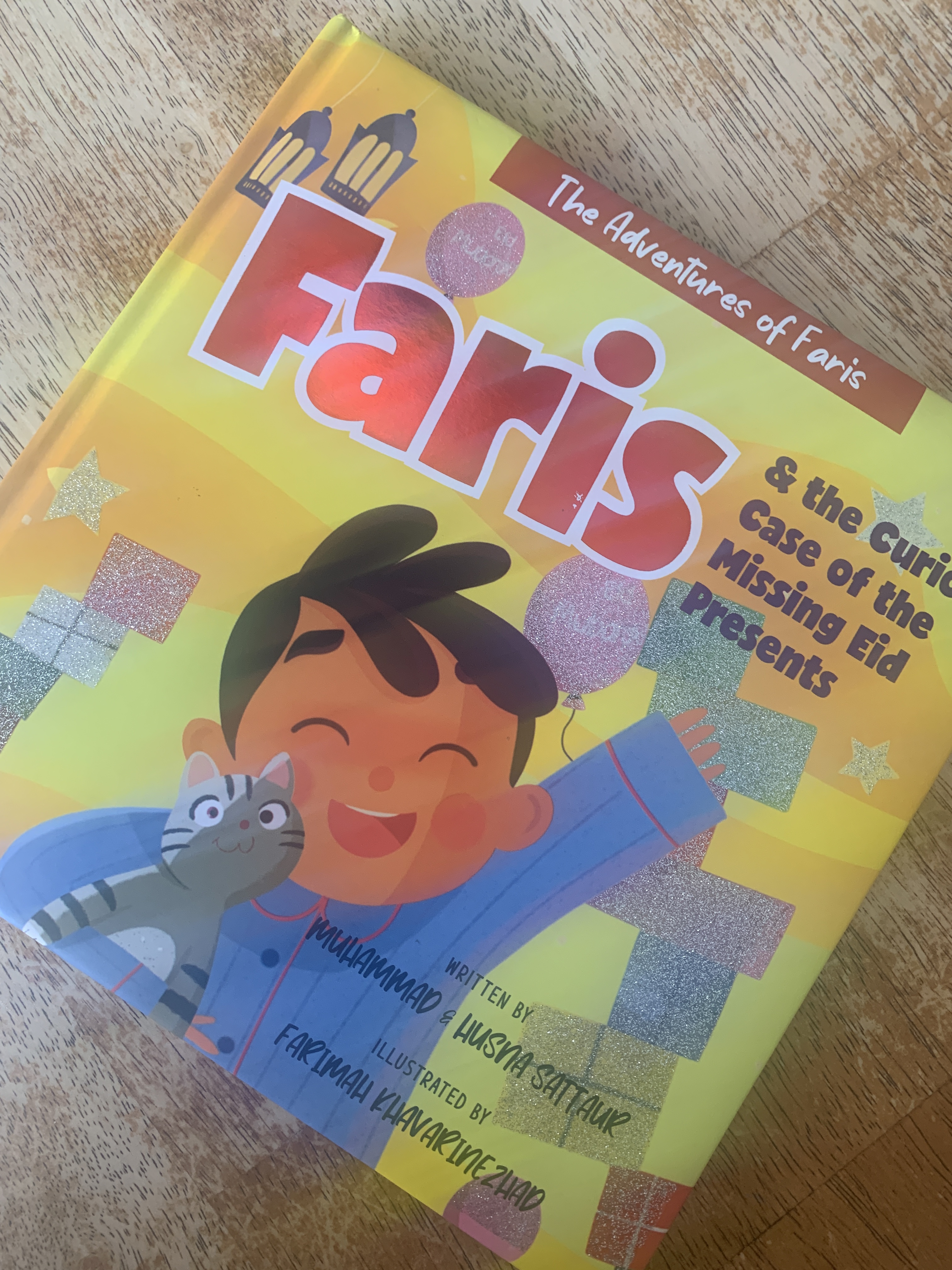
The Adventure of Faris: Faris & the Curious Case of the Missing Eid Presents by Muhammad and Husna Sattaur illustrated by Farimah Khavarine Zhad

Standard
The Adventure of Faris: Faris & the Curious Case of the Missing Eid Presents by Muhammad and Husna Sattaur illustrated by Farimah Khavarine Zhad

img_6999

This 22 page padded cover toddler book, is not quite a board book, but the thick cardstock glossy pages are definitely meant for toddler hands.  The book works for both Eid al Fitr and Eid al Adha and my 3 year old finds it silly. My older kids that have walked in and paused to listen to me reading it, as well as myself, feel like a page is missing.  The rhyming story sets the stage of Eid morning and missing presents, but the resolution is abrupt, really abrupt, with no hinting at and the forced rhyme has you wondering who Uncle Sam is in the story.  The 22 pages are bright with Islamic decorations in the house and references to Eid and praying in the text. The excitement and joy are sweet, and the focus is presents, there is nothing about Eid or anything deeper than the story at hand as it stays on level for toddler aged children.

img_7002

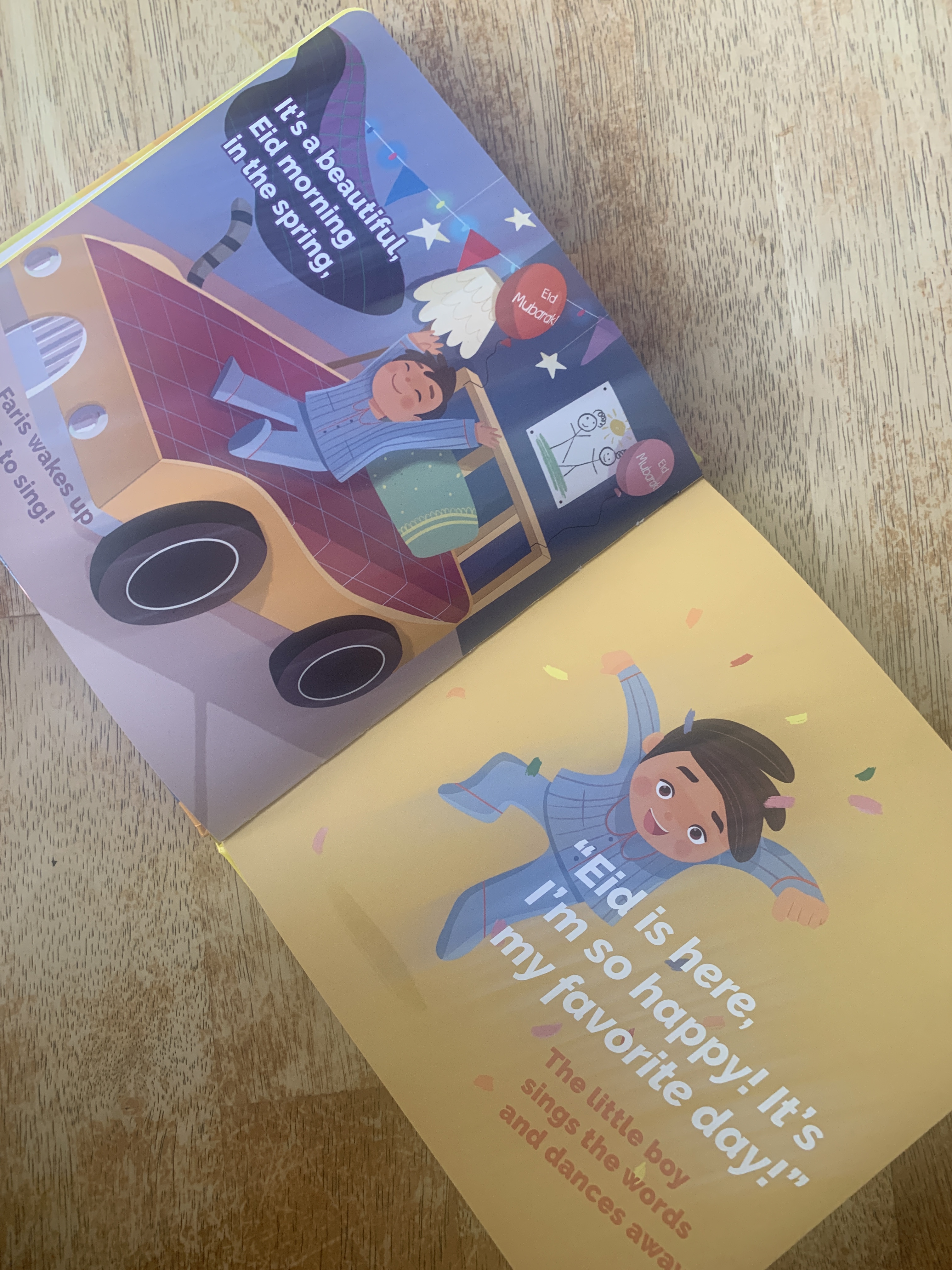
The book starts with Faris waking up on a beautiful spring morning, it is Eid and he starts to sing, before tip toing down the stairs in his Eid pjs.  He sees the time and knows they won’t be up til fajr.  So, while kids won’t care, as someone who has read the book now a dozen times, I’m curious how old Faris is that he knows how to tell time, what it means and what time fajr is.  I’m also wondering how it is ok to sing and dance, but then you need to sneak down quietly, and how it is a beautiful morning, if it isn’t fajr yet, it is dark outside.

img_7003

He daydreams in the kitchen before heading off to open presents.  Except the presents are missing. He looks everywhere and imagines a dragon eating them.  I don’t want to spoil where the presents are, but they are found, and he opens them and then his parents wake up.

img_7004

It is a little sad that he opens one at least before his parents come, and I really wish there was a little hinting at what had happened to the presents, it really feels like a page is missing.  The book was published in 2021 so hopefully they will edit the text for a next printing.

img_7001

I got mine from Crescent Moon and you can purchase a copy by clicking this link here, if you use my initials ISL (Islamic School Librarian) at checkout you will save 10%.  


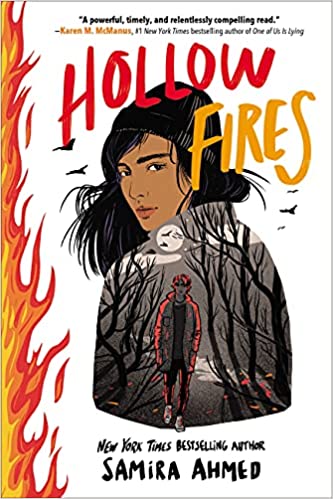
Hollow Fires by Samira Ahmed

Standard
Hollow Fires by Samira Ahmed

hollow fires

Every YA Samira Ahmed review I have written I remark at how amazing the premise is, how flat the characters are, and how forced the romance feels.  I am so happy that I did not dismiss this book, and when I return this copy to the library, I will be eagerly awaiting the purchased one to arrive so as to be placed on my book shelf.  There is connection to the protagonist, she is even likeable, the brief flirty romance is natural and not heavy handed, and the only thing better than the premise is the contemporary commentary.  The multiple writing styles, lyrical voices, and thriller/mystery elements make this 404 page teen book hard to put down.  Islam is present in different forms in different characters. There are very gentle elements of faith that really contrast the chaos of the plot and radiate peace: fajr salat, wanting a janazah, identifying as Muslim.  And while the book says 7th grade and up, I think it is more suited for high school readers.  There are strong themes of islamophobia, media, and privilege, there is killing, murder, a gay Muslim, a ghost, assault, language, planning to go to a school dance, racism, vandalism, misogyny, Halloween, relationships, hate crimes, and abuse of power, to name a few reasons that I think older readers (and adults) will appreciate and understand more deeply than most middle schoolers, how remarkable this book truly is.

SYNOPSIS:

Safiya is in her senior year at her elite private school, she’s a scholarship kid, and her passion is journalism.  As the editor of the paper she is unafraid to challenge the principal and spur others to action.  When a fellow Muslim kid, Jawad, at a nearby local school gets arrested for bringing a makerspace jetpack to school, it bothers her.  When Jawad goes missing, and events at school and in the community start putting Muslims and other minorities on edge, Safiya finds herself collecting bread crumbs and getting closer to the truth.  Throw in vandalism to her parents Desi store, smoke bombs in the bathrooms, swastikas graffitied at school, and a dead boy whispering to her and you have yourself an action packed thriller that hits close to home.  When the circumstances of how Jawad’s body are found and the clues start to fall in place, Safiya and readers will find themselves rushing against the clock.  Her to safety, and readers to see if their suspensions are correct.

WHY I LIKE IT:

I love, love, love how each chapter starts with a fact, or a lie, or an alternate fact, or truth, I keep rereading them. They are so clever, and thought provoking as the short lines stare at you in black and white and get under your skin.

I don’t think the book explains if a ghost in Islamic doctrine would be possible, but I do like that the book on more than one occasions tries to explore it.  I think for me acknowledging that it doesn’t fit, but that jinn exist and that maybe it just is what it is allowed me to overlook it and read the story for what it is.  I appreciate that the author gave the characters presence of mind to try and view it through an Islamic perspective and see answers that way, even if it did come up short.

I love the parents in the book, all of them. There is no oppression or force or lack of understanding, from the parents which was a nice break from the normal YA Muslim family dynamic presentation.  As a result perhaps, Safiya has never gone to a school dance, but when asked to Winter Formal she doesn’t have any religious or cultural hesitation in agreeing to go.  Part of me wishes it would have crossed her mind, but I think the other part wins out- that for her it is a non issue and that her view and practice of Islam is just different than mine and that is ok.  I think part of the reason I am ok with it is because there is no overly forced make-out sessions or drawn out angsty scenes.  There is a kiss on the cheek and one on the forehead, a tiny bit of snuggling, and maybe a handhold.  Suffice it to say it isn’t overboard and extreme, it never says that Safiya prays, she notes her parents do, but it seems she goes to the mosque, she identifies as Muslim and she is unapologetic, so by moving the choice to her to go or not go to a dance allows Islam to stay Islam and her actions to stay her actions.  A subtle difference I’m sure for most, but for me a very powerful one in a book that is about more than Islam’s view of premarital relationships.  I think it is also promising in that it shows how far literature has come that these nuances can exist without being overly explained or made into black and white issues.

In a similar vein is how the three Muslim characters are presented.  At one point it says they all go to different mosques because of geography or ethnicity, but to them they are just Muslim.  This includes Usman a kufi wearing Shia Hazara from Afghanistan who is always crushing on his tennis partner, or some other guy.  There is nothing more said about it, and the book carries on.

The style of the writing between the alternating voices of Safiya and Jawad are nice, but I particularly liked the inclusion of the interviews, articles, excerpts, and court transcripts.  The change of pace made it feel like it was more than a fictionalized story about the characters at hand, and a societal trend that is impactful to us all.  Which of course is a theme of the book, and was a nice way to show and convey that sentiment without having to say it over and over again to be heard.

FLAGS:

Copy and pasted from above:  There are strong themes of islamophobia, media, and privilege, there is killing, murder, attempted murder, a gay Muslim, a ghost, assault, language, planning to go to a school dance, racism, vandalism, misogyny, Halloween, relationships, hate crimes, and abuse of power. The hand of Fatima symbol is apparent in the marketing of the book, it isn’t a huge part of the story itself.  It is a key chain that was given to a character and then passed on with a message that it will keep you safe.  Clearly it doesn’t keep you safe and the irony and the passing of it from one character to another (I’m really trying not to spoil anything, can you tell) is the only significance it has on the story.

TOOLS FOR LEADING THE DISCUSSION:

I have already told my daughter she needs to read the book this summer after finals (she is 15), and while I would love to do this as a high school book club book, I don’t know that the ease of going to a dance, the normative presentation of a gay Muslim, and the ghost as a main character would be widely accepted at an Islamic school.  I think I will suggest it to high schoolers that I know, and would do so confidently as the writing, overall messaging, and critique on the media and privilege are so well executed in a compelling story, but I think the flags might keep me from “teaching” the book or shelving it in the school library.

Hungry Hearts: 13 Tales of Food and Love edited by Elsie Chapman and Caroline Tung Richmond

Standard
Hungry Hearts: 13 Tales of Food and Love edited by Elsie Chapman and Caroline Tung Richmond

hungry hearts

Occasionally I get asked about short story and/or essay from a collection that a college or high school student is hoping to share with a class that doesn’t take long to read, but shows Islamic representation.  And I never have a suggestion.  The middle grade collection Once Upon an Eid is amazing, but for younger readers.  When I learned about this collection that features two known Muslim authors, Karuna Riazi (The Gauntlet series) and S.K. Ali (Saints and Misfits, Love from A to Z), and involves food, I thought to take a look and see if I might finally have a suggestion.  Sadly, no.  None of the 13 stories wowed me, or really impressed.  A few I started then skipped, and none were really memorable.  The premise is unique: all the stories take place in the same neighborhood, feature food, and crossover characters, but some are love stories, others redemption, some have super heroes, others murder and gang violence, some really keep the food central, and others just mention it as being present.  There is familial love, romantic straight, lesbian, and trans love, there is friendship and food from many cultures served up to varying effects.  I admittedly read few short story collections, but even with that taken in to consideration, I think skipping this 353 page YA/Teen book is probably the best option.

SYNOPSIS:

I’ll only summarize the two Muslim authored stories.  A few of the others are culturally Indian, but they eat pork, so I’m assuming they are not Muslim, and the Persian one by Sara Farizan features alcohol and a lesbian romance, so since in a past book of hers I noted that I didn’t know if she or her characters identify as Muslim, I will skip reviewing hers as well.

Hearts a’ la Carte by Karuna Riazi:   Munira works at her families food cart, King of Kuisine and serves up Egyptian food to the people on Hungry Heart Row.  When a guy falls from the sky, she finds her self also falling hard for Hasan, as he regularly starts coming to eat and visit, but when it is revealed that he is a super hero (the Comet) and the reason her families cart is destroyed, Munira is not willing to pursue things further.

A Bountiful Film by S.K. Ali: Hania and her family have recently moved to Hungry Heart Row, where her father grew up and grandma Valimma lives.  Irritated that she had to leave her school, her job at Daily Harvest and friends behind, Hania is hoping to lose herself in putting together her film for the upcoming competition and beating her long time rival Gabrielle Rose.  With no clear idea of what her film should be about she starts with interviewing Valimma and her friends, which turns up a bit of an unsolved mystery involving a missing boy that keeps showing up on the security footage from local businesses.  Hania decides to pursue it, but finds herself being watched, and filmed in the process.

WHY I LIKE IT:

I like that the stories are interconnected, I don’t know that it works, but I like the idea of it.  As for the two Muslim authored stories, I like that Islam and culture are included slightly, but that the story is much more than that, and the characters have more pressing issues to figure out.  I wish in both of these two stories, food was more fleshed out.  They seemed to be lacking the magical food premise that many other stories in the collection had.

img_7244

FLAGS:

See above paragraph for some collection flags.  Riazi’s story has crushes and a budding romance, but nothing overtly “haram.” Ali’s story is clean.

TOOLS FOR LEADING THE DISCUSSION:
I wouldn’t probably even shelve the book in our Islamic school library, it doesn’t offer much in my opinion.