Tag Archives: Muslim Author

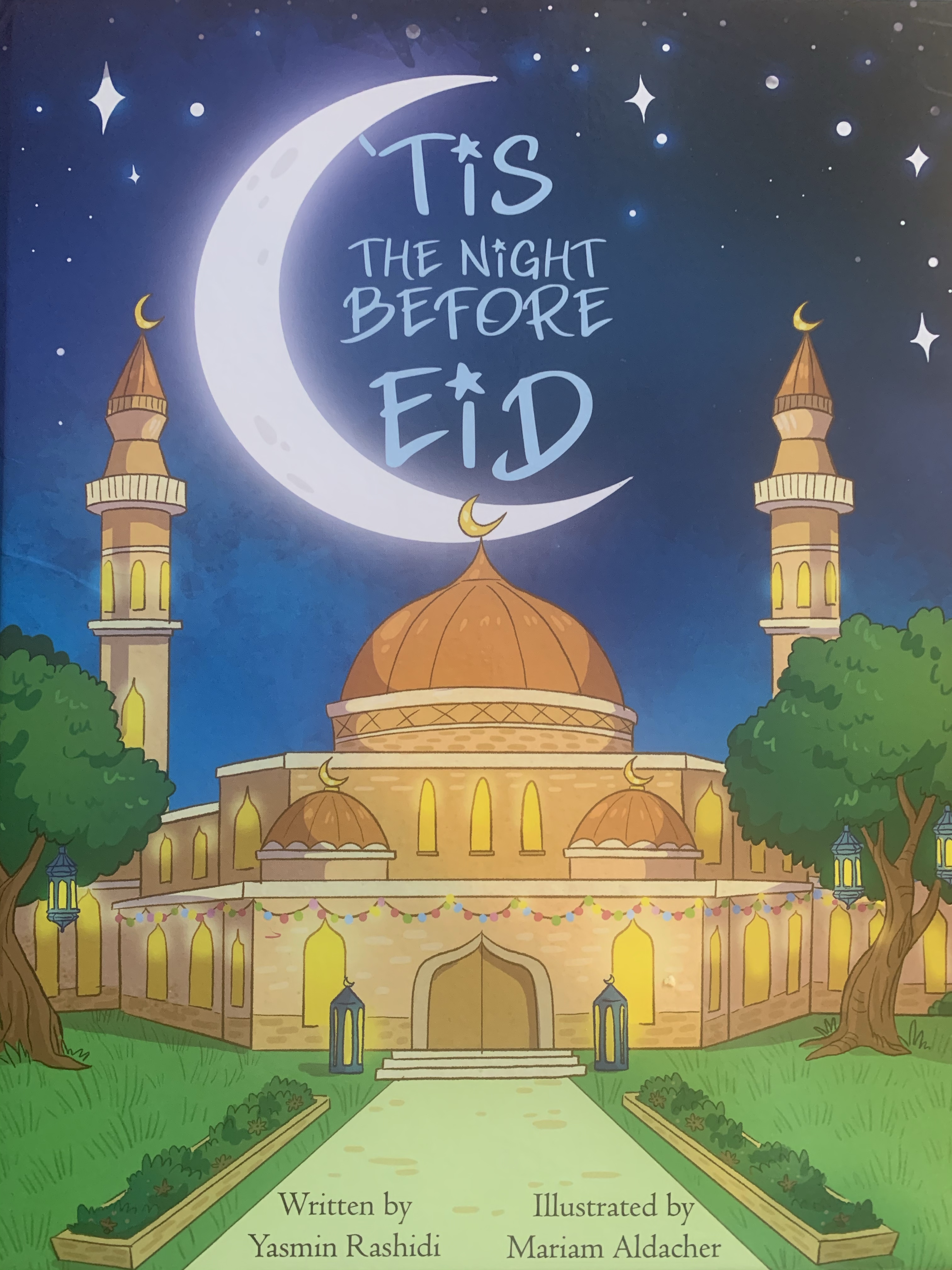
‘Tis The Night Before Eid by Yasmin Rashidi illustrated by Mariam Aldacher

Standard
‘Tis The Night Before Eid by Yasmin Rashidi illustrated by Mariam Aldacher

img_8995

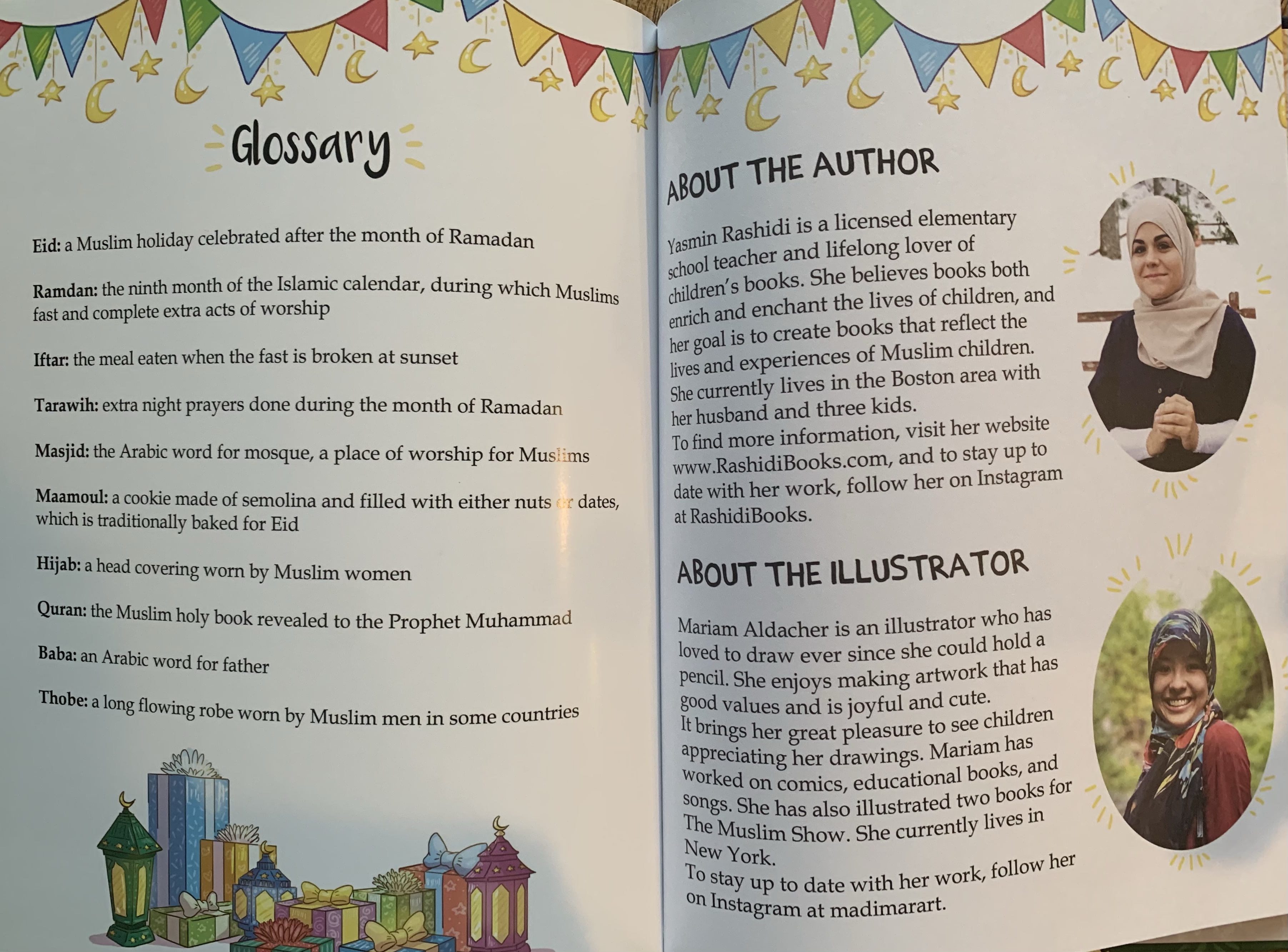
On the surface this 32 page inspired re-imagining of the classic Christmas poem might not seem that impressive, but it is really quite effective in highlighting general key points of Ramadan, the mix of sadness that Ramadan has gone too quickly with the excitement of Eid, and showing the diversity of Muslim families and communities.  The large 8 x 10 hard bound pages showcase fun and relatable illustrations that would help inform those unfamiliar with the holiday, while also mirroring and encouraging Ramadan and Eid excitement.  It is already a favorite at our house and with simple rhyming lines, the book can lend itself easily to more in-depth discussions (there is a glossary at the back) or be kept as a sweet flowing story that you don’t mind reading repeatedly at the prodding of toddlers and preschoolers alike.

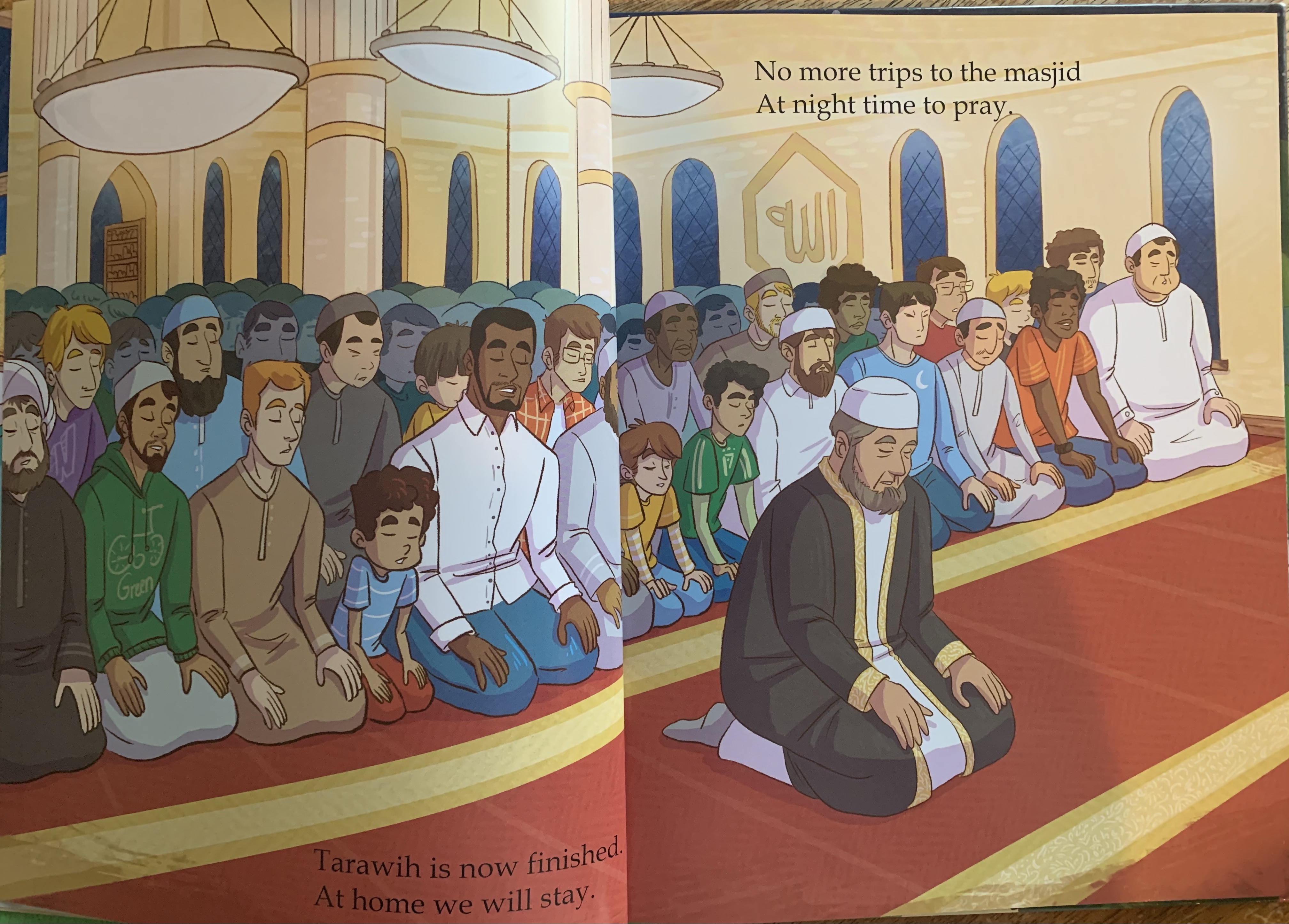
img_8997The story starts with it being the night before Eid.   Ramadan has flown by, iftar eaten, dishes are put away, trips to the masjid for Taraweh have concluded and now it is time to prepare for Eid.  The house is cleaned, clothes ironed, sweets prepared and dreams of gifts filling the kids minds.
img_8998

The narrative bounces back to Ramadan to explain that fasting is not eating til sundown for 30 days, that Quran was revealed during the blessed month and that we hold on to the lessons of Ramadan all year long.

I pre-ordered mine from the author’s website https://rashidibooks.com/home , but it is also available at Crescent Moon Store https://crescentmoonstore.com/products/twas-the-night-before-eid.  There are also printables on the author’s website.

img_9002

Zara’s New Eid Dress by Nafisah Abdul-Rahim

Standard
Zara’s New Eid Dress by Nafisah Abdul-Rahim

img_8802

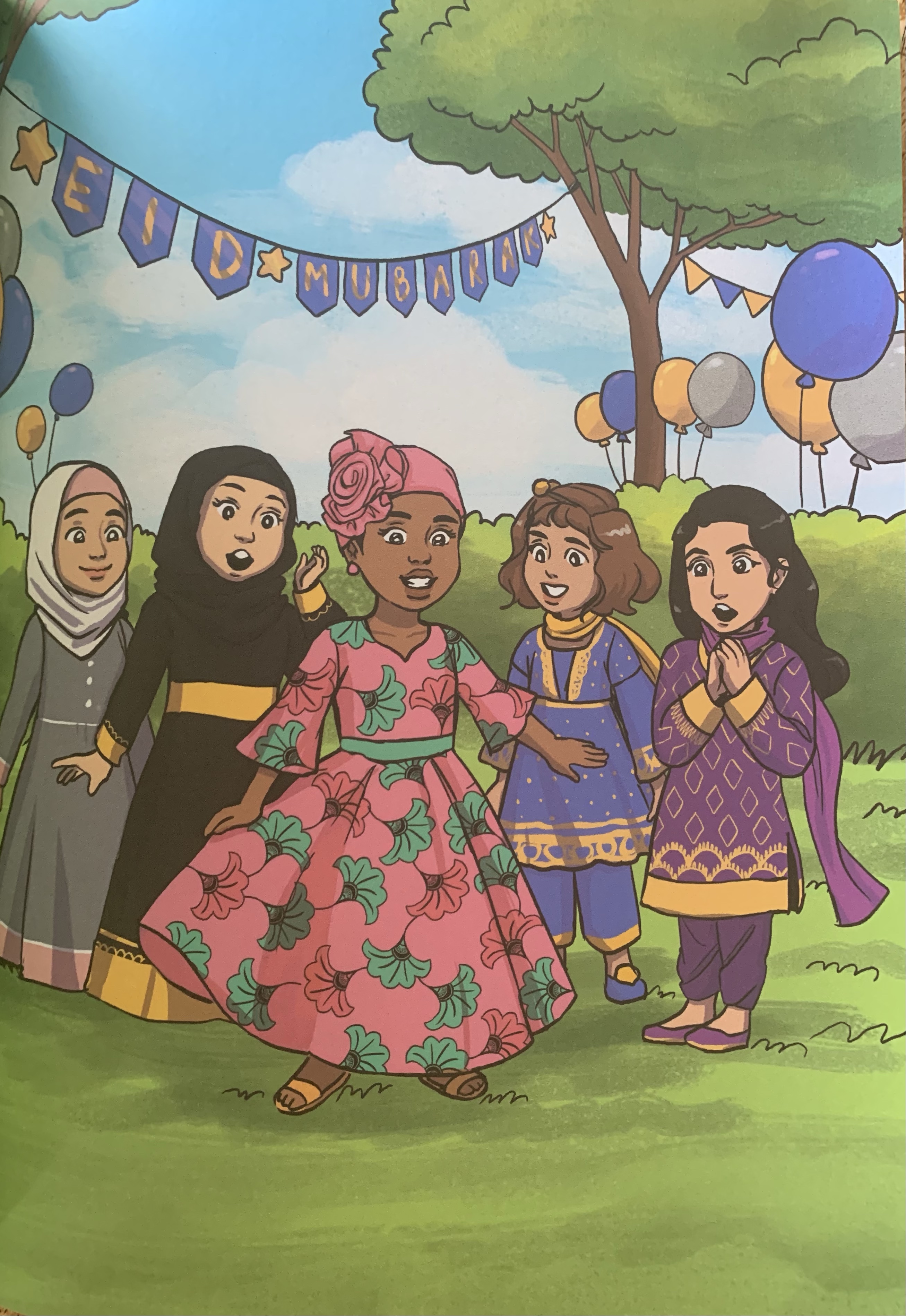
The search is on for an eid dress that reflects Zara’s African American Muslim culture.  This much needed representation highlights more of looking for a dress and the process of having one made, than providing information about Eid or the African American Muslim experience over its 30 pages.  Iftar is mentioned on one page in parentheses, so if you omit that word it could reflect either Eid preparation.  The book is cute if you are looking for a slice of life and coming together of a child, mother, and grandmother over the creation of a dress that has what Zara is wanting: pink, fluffy and containing flowers.  It falls short if you are looking for a book to learn about Eid, Ramadan, what a cultural African American Muslim dress would look like, or a peek into an under represented culture.  The illustrations are sufficient.  I felt the girl looked younger in some of the depictions, and I was surprised that the girl’s rain boots and clothes were worn over multiple days in her search for a dress, picking out fabric and inside her house when the dress is completed.  Similarly, on Eid day while her dress is stunning and fabulous, her friends are wearing the same eid clothes they wore at the start of the book from years past.

img_8804

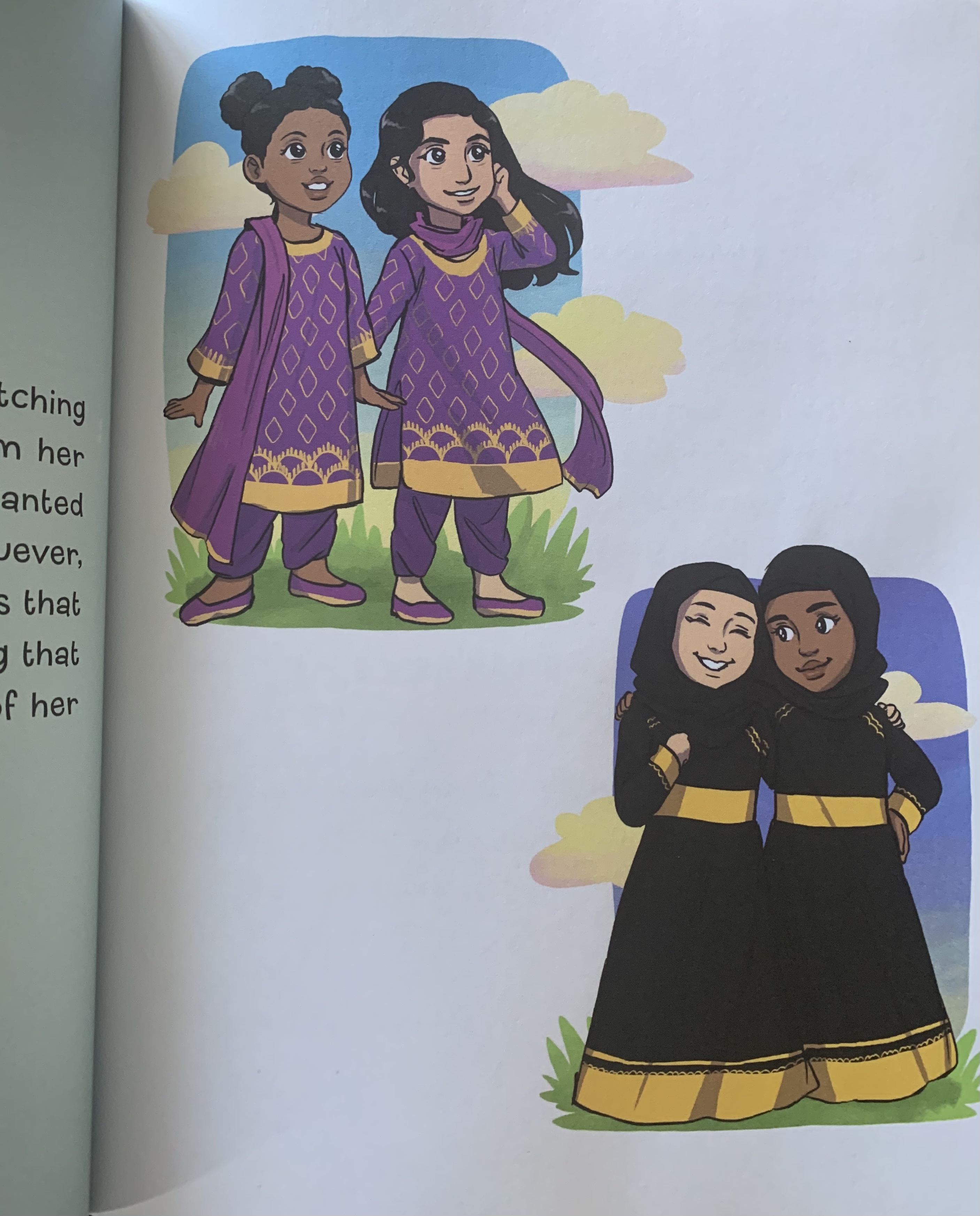
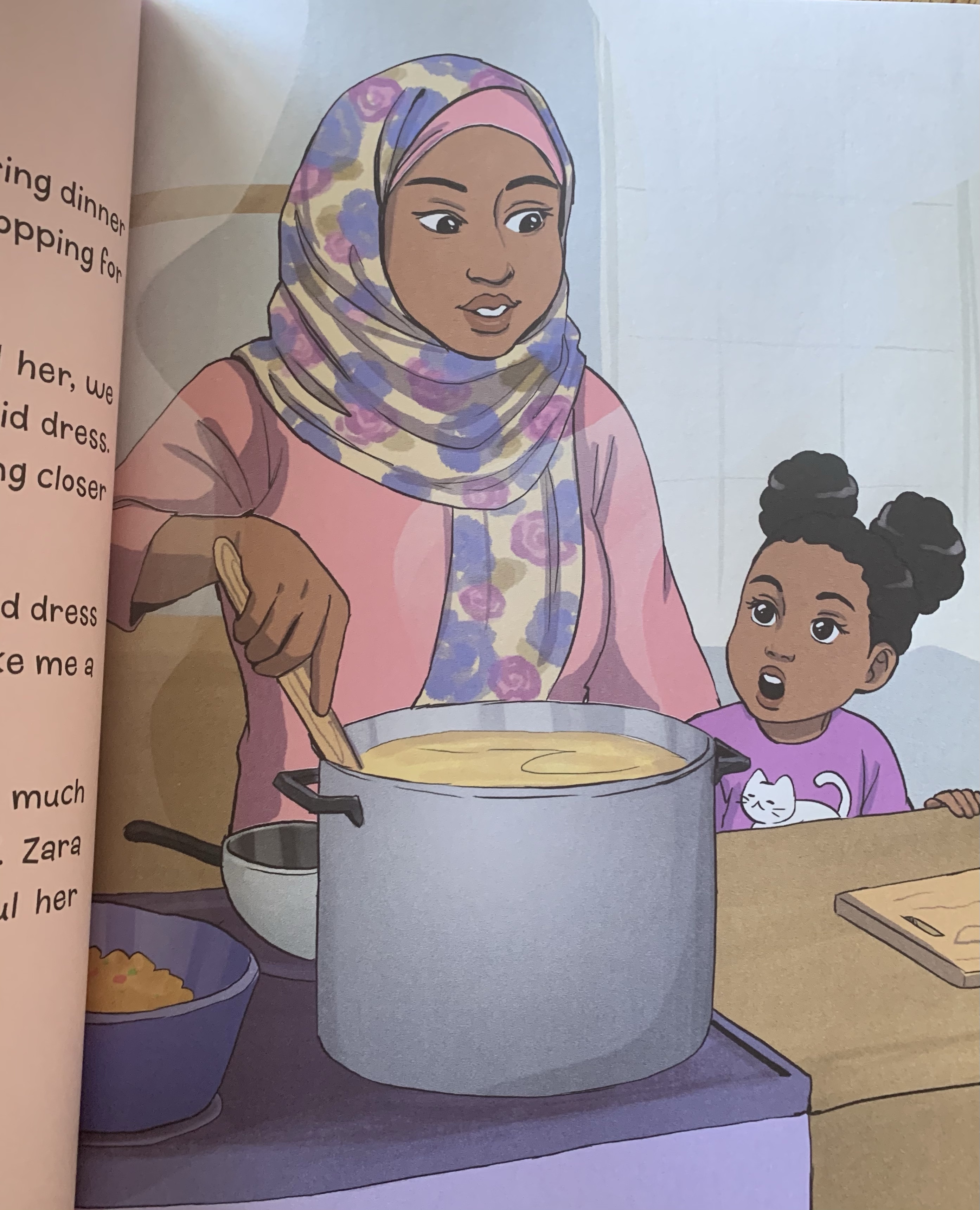
Zara has worn a salwar kameez from Pakistan with her friend Sana, an abaya like her friend Noura one year too, but this Eid, she wants a dress that shows “her own style, her heritage, a reflection of her culture as an African American Muslim.  As her mom is preparing iftar she asks when they can start shopping for her Eid dress.  She knows it won’t be easy to find and convinces her mother to start looking this weekend.

img_8805

She pulls on her rainboots as they head out the door to find “something bright, pink, fluffy, and has flowers on it.” They go to several stores and kind find anything just right.  Her mom suggests asking Nana to make it.  Zara’s mom recalls the fabulous dresses her mom used to make her to wear on Eid.

img_8806

Nana and Zara head out to the fabric store the next morning. First they find the pattern, then they find the fabric.  After a few days of hard work for Nana, the dress is complete.

img_8808

On Eid day, Zara meets up with her friends in her dress that is uniquely her own.

img_8812

Ramadan’s Coming by Rabia Bashir illustrated by Laila Ramadhani

Standard
Ramadan’s Coming by Rabia Bashir illustrated by Laila Ramadhani

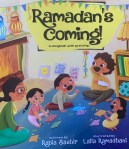
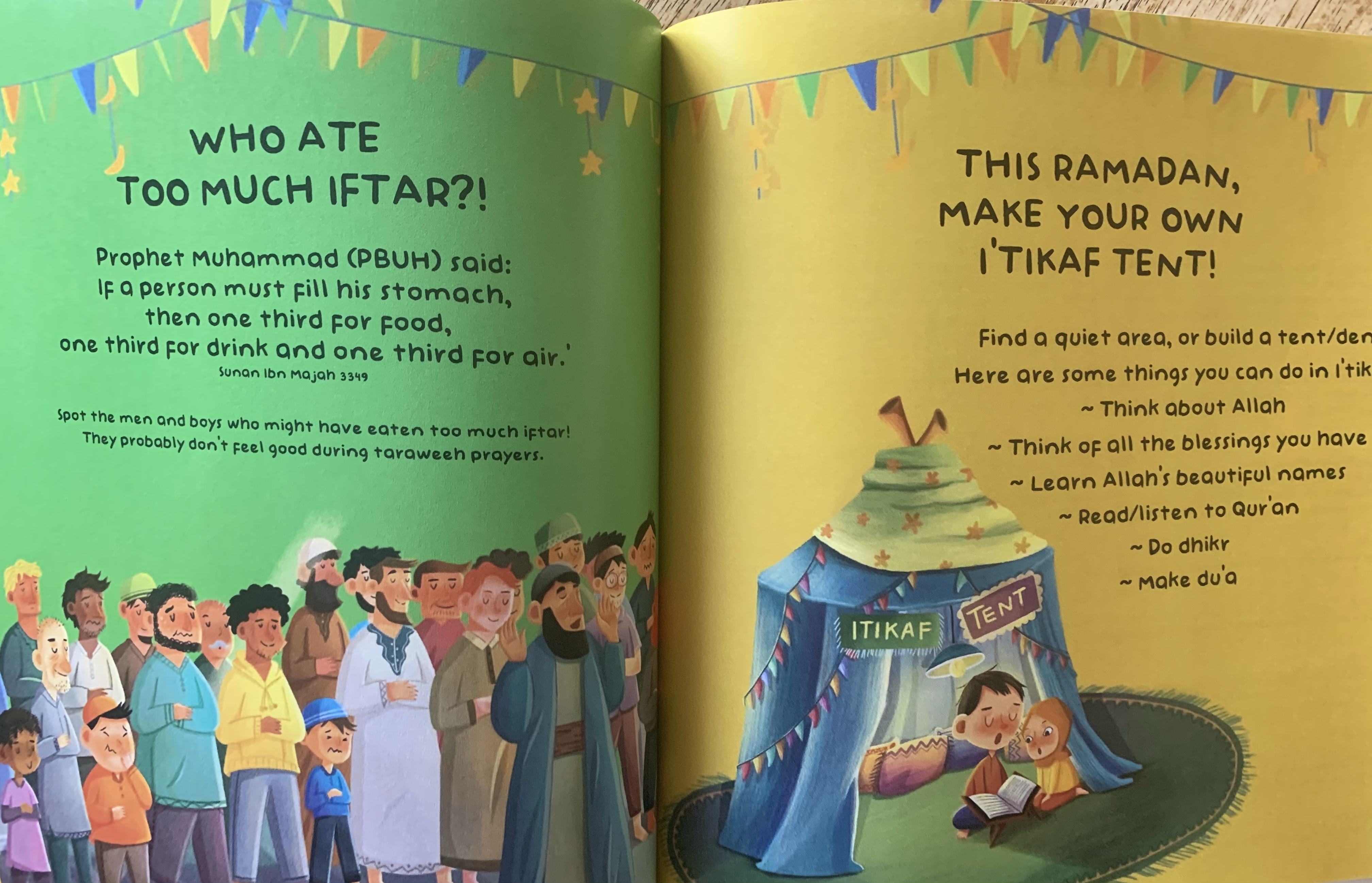
img_8785I think the illustrations in this 40 page picture song book are my favorite of the new 2021 books.  They are adorable and expressive and a big part of the story that the text alludes to, but doesn’t detail.  They also are a big part of the activities at the end of the book that encourage children to go back and find different Ramadan and Eid concepts to discuss and further understand.  I absolutely love that there is a glossary and a reference page that details and attributes the hadith implied in the simple sing song-y words.  The chorus is to the tune of jingle bells, and while I struggled to maintain the rhythm, the chorus reappears and if you are able to sing the book, your children will love it even more, haha, my voice and lack of rhythm forced me to read it, but either way it is absolutely delightful and informative for toddlers and up.
img_8787

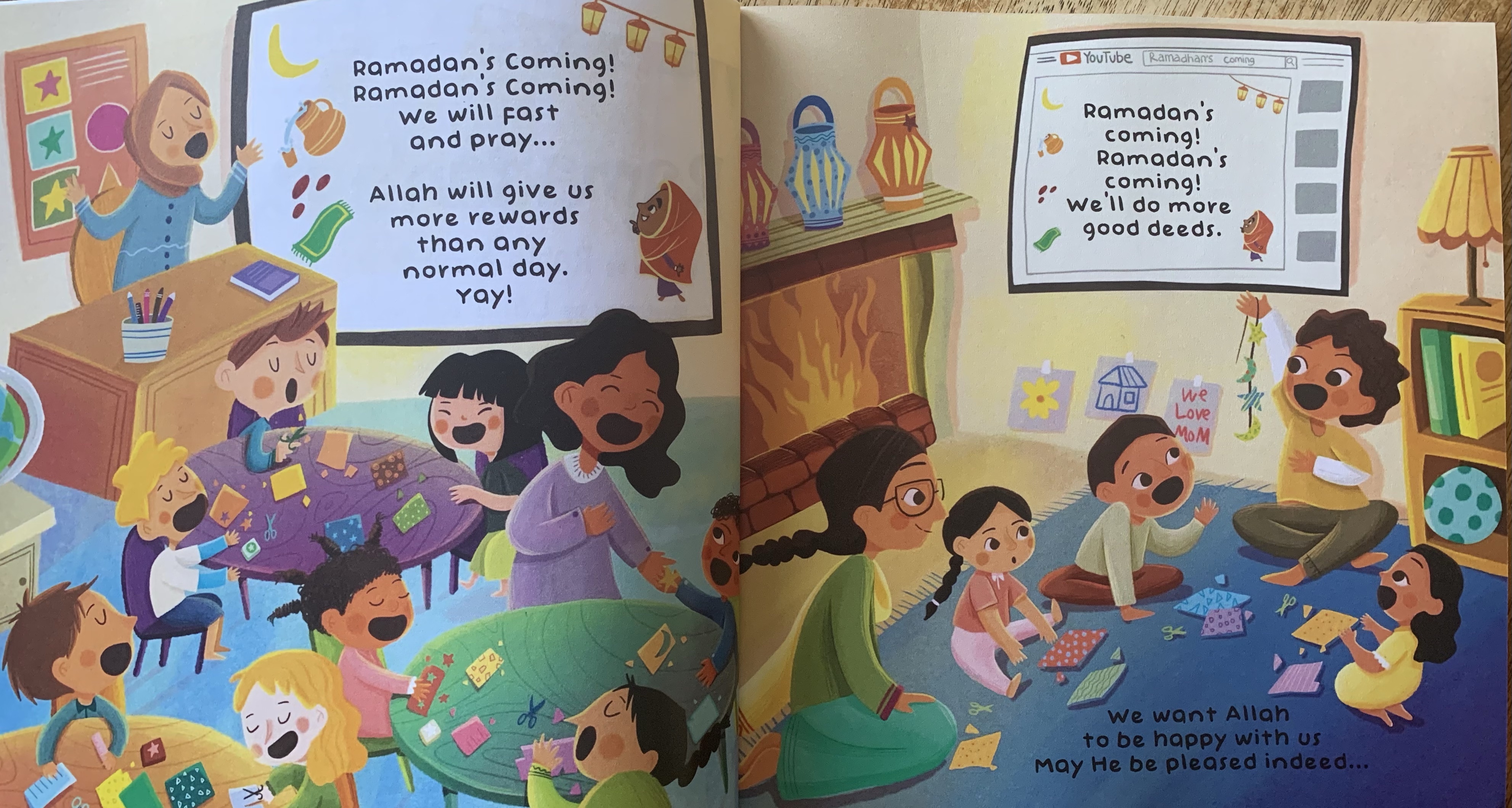
It starts out with the refrain that Ramadan is here and we will fast and pray and that Allah (swt) will give us more rewards and we will do more good deeds, than on normal days.  It then shares that Ramadan is the month after Shaban when the Qur’an first came down and that we look for the crescent moon to know when Ramadan is here.  It is important to note that the words flow and are so concise you don’t even realize that much information has been conveyed.

img_8788

The chorus repeats and shows a family praying, kids helping vacuum, and giving socks to homeless.  The family then wakes up early for a healthy suhoor, no food or drink, thinking about how the poor must feel and then having iftar with a sticky sweet date and water.  Sometimes you eat so much your belly protrudes (a great vocabulary word for little ones). The next page has salat starting and those that ate too much wishing they would have left space for air and water.

img_8792

The chorus repeats again showing zakat being given, iftars being eaten in segregated large groups, before looking for Laylat ul Qadr takes place and some children read Qur’an in an itikaf tent. Then it is time for Eid hugs, salams, prayer, food and fun.

img_8791

On one page, the grammar of one line seems off, perhaps an extra word was added.  I contacted the author to see if it is an error as it is part of the chorus, but only appears wrong in one place and one time.  Even with the error, I would happily encourage this book for families with toddlers, preschoolers, and kindergarteners.  It will be read multiple times, and the pictures will hopefully offer something new with each reading as understanding increases.

img_8793

The copy I purchased from Amazon is 8.5 by 8.5 paperback, I’m not sure if they will be available from the publisher as a board book or without faces like so many of their books are.

Zayan Unlocks the Quran by Najia Syed illustrated by Rizky Dewi

Standard
Zayan Unlocks the Quran by Najia Syed illustrated by Rizky Dewi

img_8703

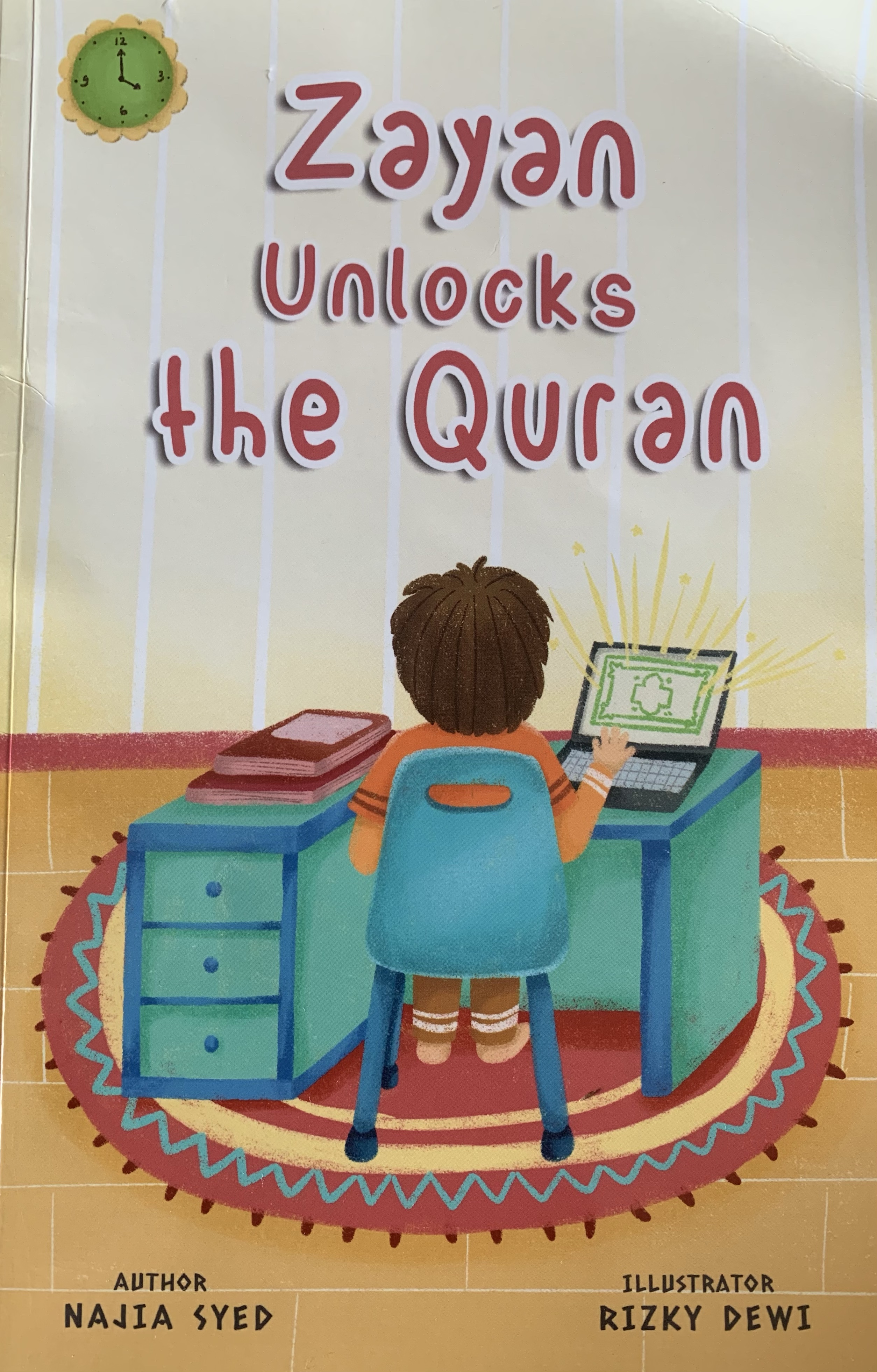
There is a lot of good information and relatable lessons in this 45 page didactic book encouraging children to get to know the Quran, and to not just recite and memorize it, but the presentation just doesn’t do it any favors.   I can’t imagine that seven and eight year olds are going to identify with the five year old protagonist learning how to add and getting in fights over crayons at school, nor that five year olds are going to have the patience for the explanations and understand the story.  The word story in and of itself is a stretch, it is a bunch of ayats from the Quran that are explained to teach young Zayan lessons that reflect his daily life and how he can succeed and inshaAllah earn jannah in the akhira.  The intention is really good, I just wish there was a bit more plot and that the book’s appearance made more sense.  Having the book look and feel like a leveled reader on the outside, but be completely tiny text filled, save a few entire page generic full-color pictures and green bannered meaning of the Quran’s translation, the book and its seven chapters are intimidating.  Space it out, make it an early chapter book in look and feel, revise the premise that a child has no idea what the Quran is, and is completely shook by learning from the kind and patient Qari Sahib that the Quran has lessons and rules to make us better.  It is a stretch to get the book going, it has some wonderful points along the way, and leaves a warm feeling when completed, but I can’t figure out the intended readers age, nor can I imagine many kids will willingly picking it up.  Like the character in the book dreading Quran class, I’m afraid getting kids to read this would similarly be met with dread, which is a shame, because the lessons are strong, the story and presentation just need a bit of polishing.

img_8704

SYNOPSIS:

Zayan does not want to leave his toys for Quran class which he attends one-on-one on the computer with his teacher, Qari Sahib.  Reading the Arabic is hard and confusing, he doesn’t understand what he is reading and he would rather be playing.  He has just built a fort and is afraid if he leaves it for class, his sister will destroy it, (over the first few pages I was convinced his sister was younger than him, and a little confused to learn that both are older).  When he begrudgingly logs on, Qari Sahib can tell he is upset and tells him that being kind to his siblings is a good deed and that many good deeds are in the Quran.  Zayan is shocked.  Qari Sahib offers to read some ayats to him and he can just listen before they resume reading Surah Fatiha.  Zayan is blown away at how pretty the Quran sounds when recited and his eyes sparkle when he learns that the Quran contains directions to get to jannah.

Chapter two explores how the ayats in the Quran about kindness can relate to Zayan’s life.  Being kind to your parents, speaking in a low voice, and not making fun of each other.  Ayats are pulled and connections made so that Zayan can inshaAllah implement his new knowledge in his life.  Zayan returns to playing after class and tests out what he has learned.

This pattern continues with chapter three discussing respect, then anger and forgiveness, cleanliness, and honesty.  The parables come when he doesn’t listen to his mother about finishing his grapes, a fight at school involving crayons, playing in the mud and lying about feeding his pet cat. At one point he remarks that much of what his teacher explains to him from the Quran are things that his mother also tells him, almost like she has read the Quran.

img_8705

WHY I LIKE IT:

The first few lines are so relatable.  The dread of the child putting the entire family on edge, it is real.  I love that Qari Sahib is kind and gentle and patient.  When the mom mentions things to him about Zayan he finds ways to talk to him about it, without lecturing or reprimanding.  I think the Qari Sahim is the real hero in the book.  I particularly like when he went in to detail about our responsibility to care for animals.  I’m glad Zayan has him to guide him because clearly his parents have failed.  Yes, I’m being judgey.  The kid doesn’t know what the Quran sounds like, doesn’t know why he is being forced to read it in Arabic, doesn’t know what it even is about? I’m not so much judging the fictitious parents, more the inconsistent writing.  If Zayan doesn’t know that his mom has read the Quran how does he know what jannah is and who shaytaan is?

FLAGS:

none

TOOLS FOR LEADING THE DISCUSSION:

Obviously not for a book club selection, but I’ve been trying to figure out if maybe my five year old and I could discuss some of the chapters together.  I wouldn’t want to read the whole book because my child loves the Quran and doesn’t dread reciting, I have five children, I know tomorrow it can change, I’m not naive, I’m just saying for him particularly right now, it isn’t a chore and I think if I presented it as a boring thing, he will start to mimic that frame of mind (my older kids know not to ever bash certain teachers, concepts, spiciness of food etc. in front of their younger siblings for this very reason).  But, while some of the lessons are really well thought out, they are just too much for a five year old.  The pictures don’t engage and the text overbearing.  I asked my 10 year old to read it and he found it really childish and didn’t finish.  If the book works for you, alhumudillah, I’m glad, it is a benefit, I wish it worked for me too.

One Perfect Eid Day and No More Cake! by Suzanne Muir illustrated by Azra Momin

Standard
One Perfect Eid Day and No More Cake! by Suzanne Muir illustrated by Azra Momin

img_8587

This lovely counting book celebrates the end of Ramadan and the festivities of Eid Al-Fitr by counting up to 10 and counting back down.  Over 24 pages of rhyming lines, adorable illustrations will bring the holiday to life as a group of children and a little white cat celebrate.  Aside from the title that for some reason I don’t love, the rest of the book is happy and festive and perfect for toddlers to preschoolers.

It starts with one month coming to an end, then henna cones and designs take over, before five pots and six trays of cake are prepared, decorations are hung, clothes are made ready and ten eager eyes watch the new moon rise.

Then ten sleepy cousins have to get up early for morning prayers with presents waiting, rotis are prepared before seven family members squeeze in the van. Friends are met at the masjid and coins are jingling as lunch parties are attended and fun-fair rides are riden. Two tired friends can’t stay away on this one perfect day, and no more cake.

I love the flow of the book, I’m not sure what the four henna designs are or what cousin doesn’t get a present and who doesn’t get to go for prayers, but little kids probably won’t over think it.  The little cat is delightful on each page and the book sets a marvelous tone of what one can look forward to and enjoy on this splendid holiday with friends, family, festivities, and food.

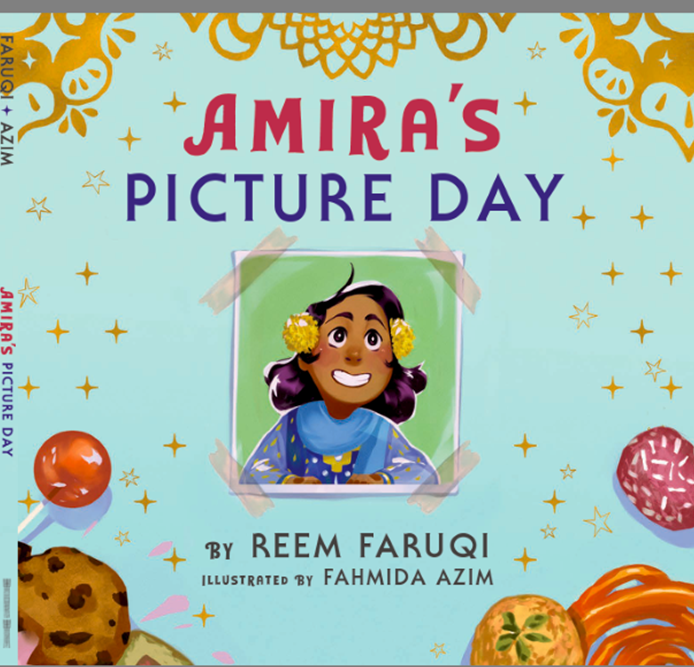
Amira’s Picture Day by Reem Faruqi illustrated by Fahmida Azim

Standard
Amira’s Picture Day by Reem Faruqi illustrated by Fahmida Azim

amira's picture day

This book is the mirror so many kids are desperate to find in literature. A young Muslim girl is excited to celebrate Eid, while at the same time is sad knowing she is missing school picture day with her class. Not knowing what day Eid will be, not having it a scheduled day off in most school districts, and always feeling like you have your foot in two different doors starts early for children in non Muslim majority countries. This early picture book touches on those emotions, and even if you can’t always get a test rescheduled or a project due date moved, at least readers that face these dilemmas at any age and stage in life, will feel seen in this 32 page book perfect for ages 5 and up.

amira4

Amira and her brother Ziyad start the book looking out the window for the moon. They see it, which means Eid is tomorrow and Amira is going to have her mom put decorative Mehndi on her hands. She has her mom include a dolphin in the green swirls and hopes that by morning the color will be dark and beautiful. Ziyad is excited that they get to skip school.

amira1

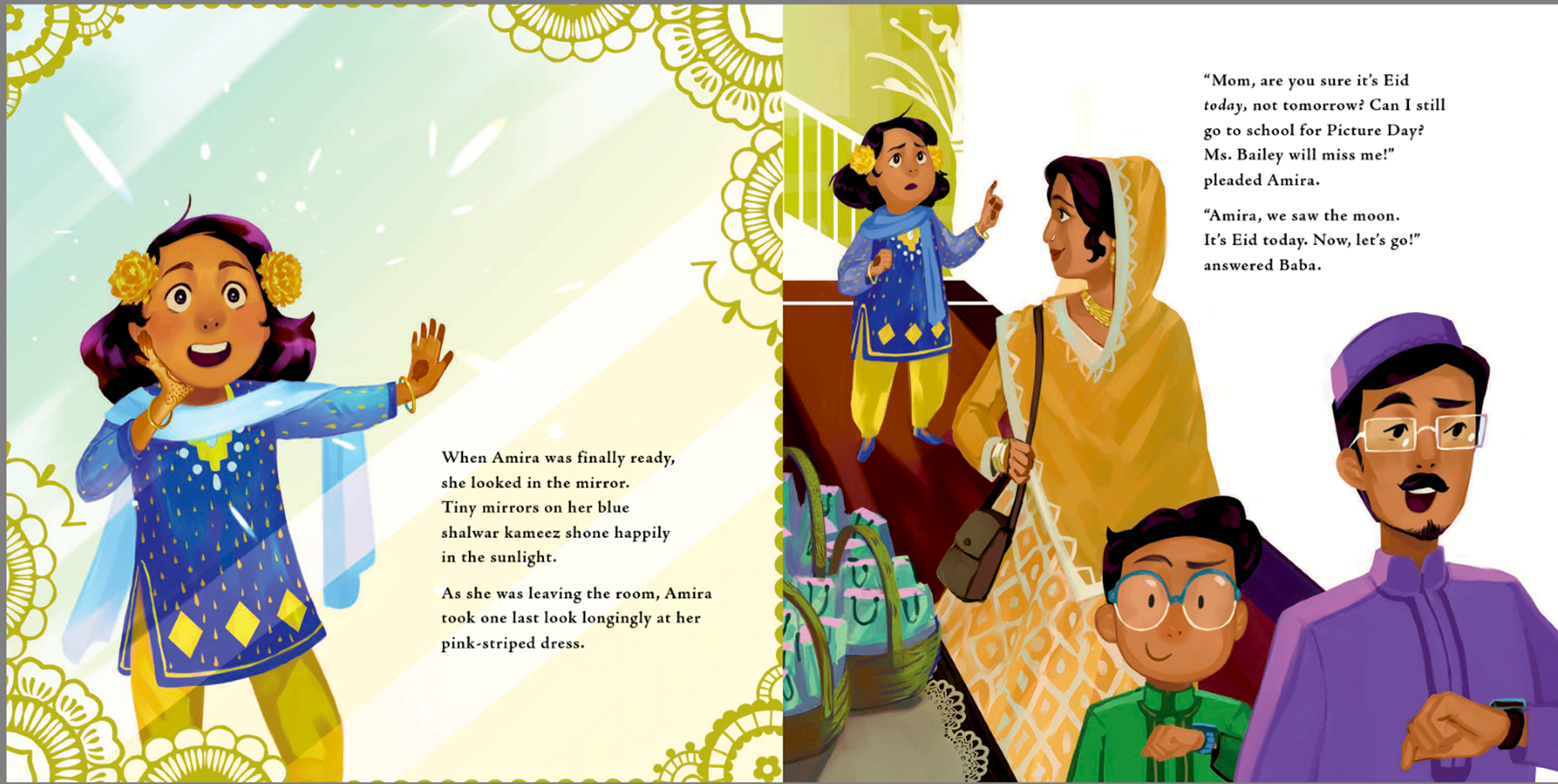
Mom recruits the two kids to make goody bags and count out lollipops for the kids at the masjid, when the flyer for picture day catches Amira’s attention. Devastated that she will miss the class picture having already picked out a pink-striped dress for the occasion, mom reassures her that she will get to wear her new shalwar kameez, and they will take lots of pictures at the masjid.

amira5

Amira loves going for prayers and the party after, but she is kept awake at night worrying how her classmates will remember her if she isn’t in the picture. The next morning she is excited, it is Eid, but seeing her pink dress hanging next to her blue Eid outfit makes getting dressed a heavy process.

amira6

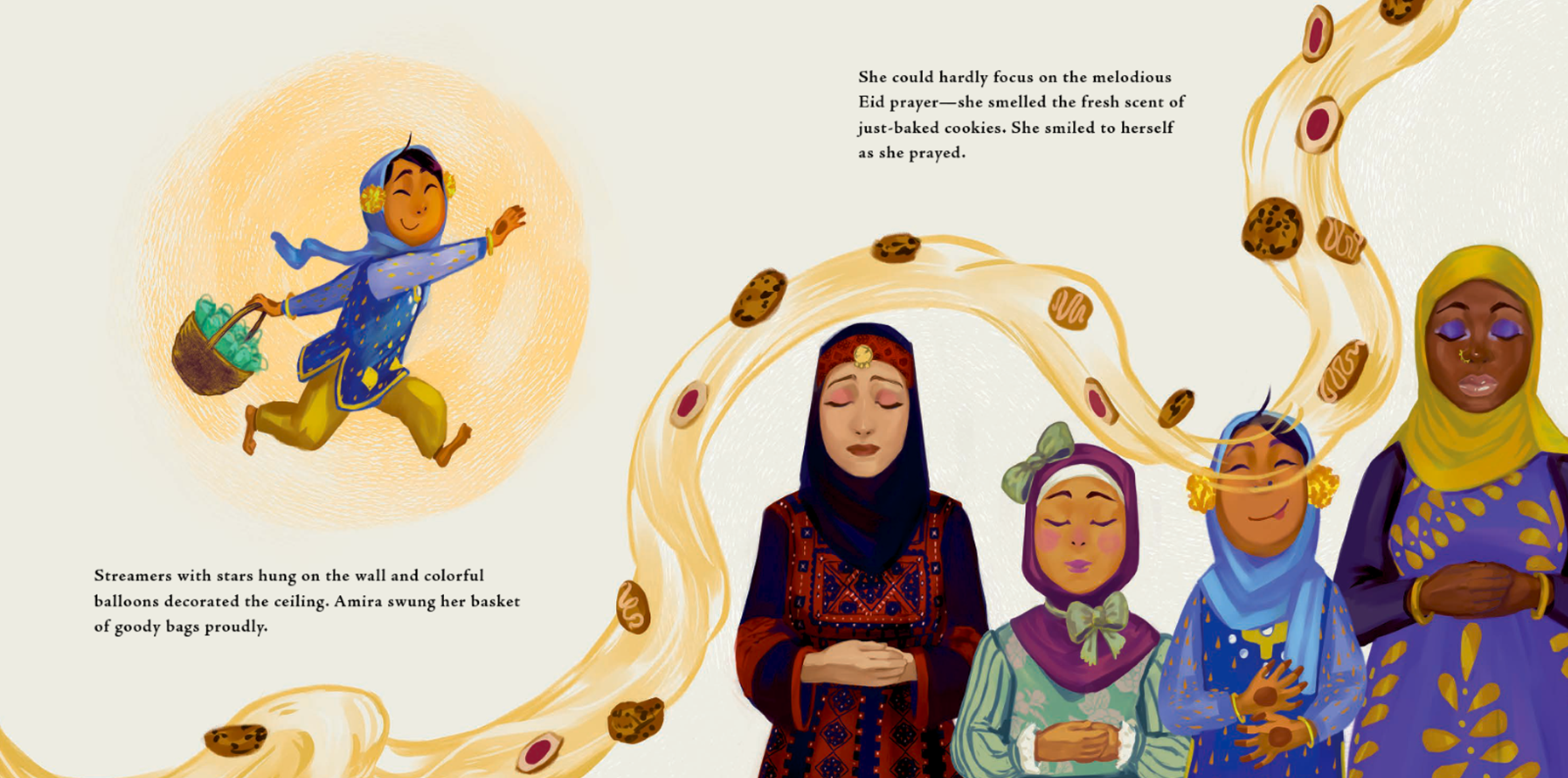
When they get to the masjid, Amira hardly recognizes it, it is all decorated and everyone looks beautiful. The smell of baked goods makes focusing on her prayers difficult, and after when everyone is taking pictures she remembers what she is missing and feels deflated.

amira3

On the way home Amira works to hold back the tears, when she suddenly has an idea to take the remaining goody bags to her classmates, and maybe catch her class pictures. Her parents agree and they stop at the school.

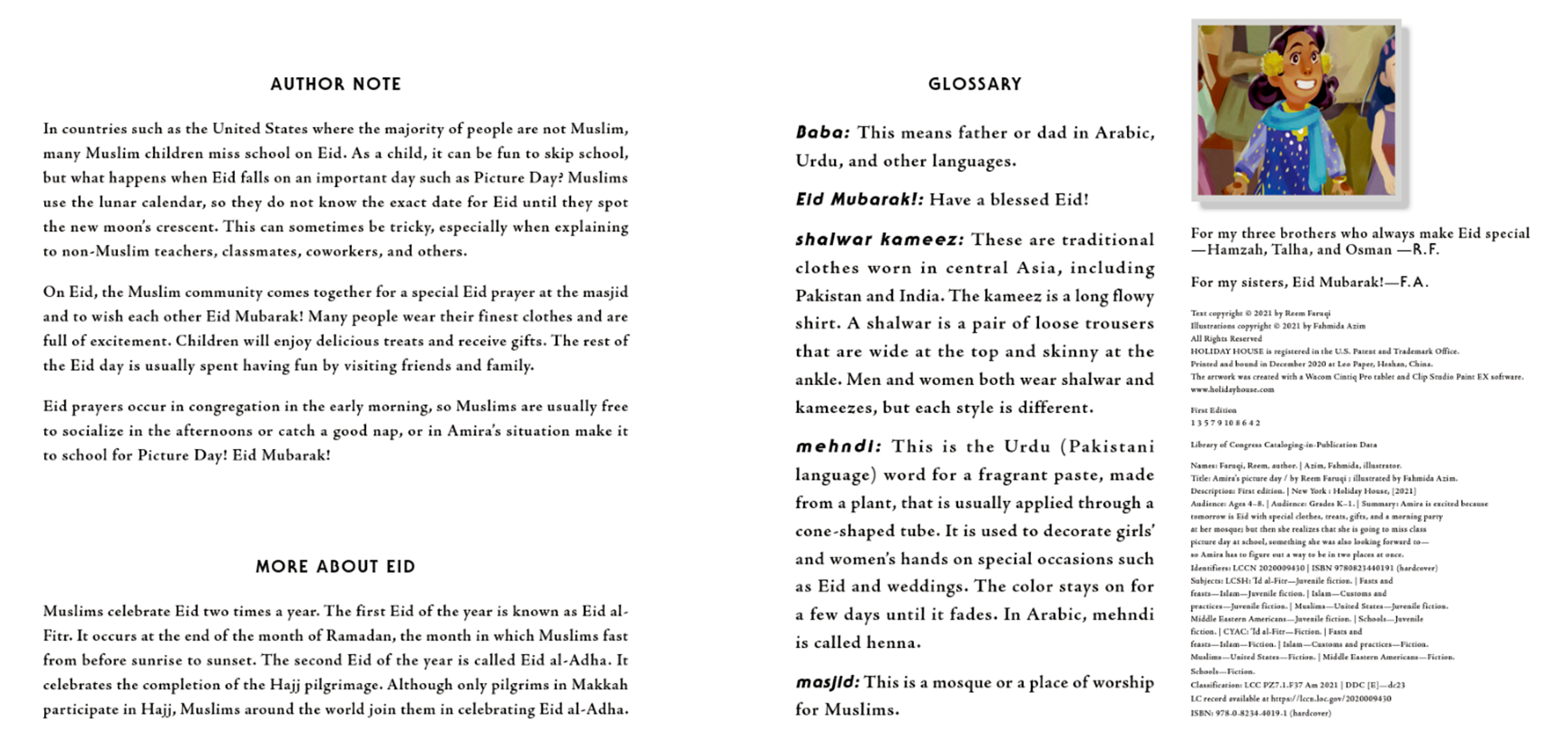
I won’t spoil if she made it in time, but the kids in her class love her clothes, and her mehndi designs. The book concludes with an Author’s Note, More about Eid and a Glossary.

amira2

I absolutely love the illustrations, little Amira is infectious and endearing. I wish the mom would have been a little more in tune with Amira’s feelings though, she definitely is upset and while I’m glad the family stopped after the Eid party, I feel like more could have been done beforehand to acknowledge Amira’s feelings, and see what could be done to accommodate both activities.

amira7

I love the diversity and brightness of the book to convey the absolute joy and happiness of Eid outside of presents. I think the book works for all children of all backgrounds and is a much needed addition to the repetitive Eid books available.

Sadiq and the Ramadan Gift by Siman Nuurali illustrated by Anjan Sarkar

Standard
Sadiq and the Ramadan Gift by Siman Nuurali illustrated by Anjan Sarkar

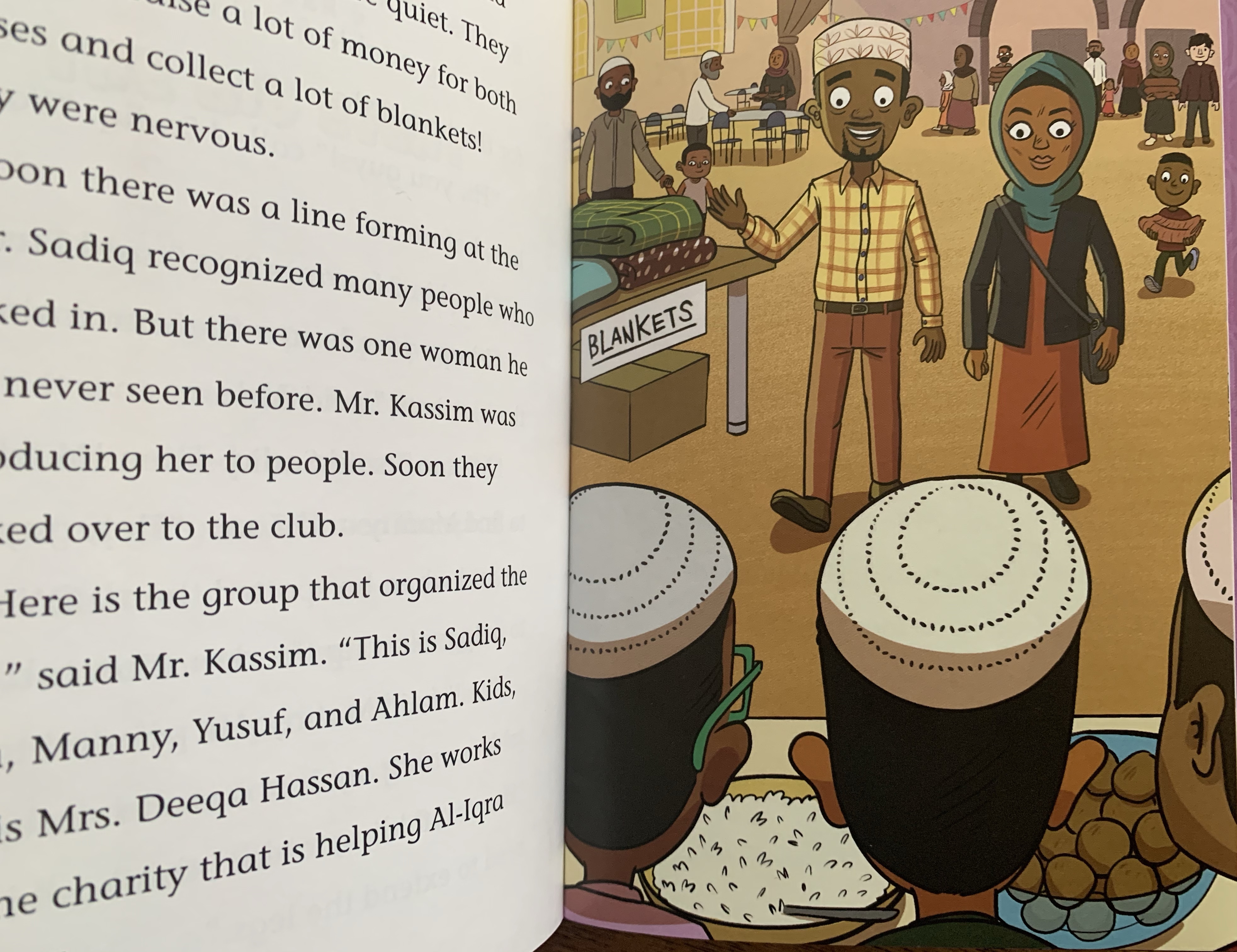
img_8554This 65 page early chapter book in the Sadiq Series does a great job of introducing Ramadan, giving a glimpse of Somali culture, and conveying a relatable and engaging story about friends with a lesson/reminder about the values of communication.  A group of boys hosting a fundraising iftar to help a school in Somalia have to figure out the logistics, the marketing, the cooking, and the execution, as they become socially aware and active in helping meet the needs of their community, both locally and afar.  This OWN voice tale doesn’t shy away from authentically drawing on religion and culture to make characters and a plot that all readers can enjoy.  The book is not preachy, but the characters know who they are in their manners, dress, speech, and environment.  A great book any time of year for first grade and up.

img_8555

SYNOPSIS:

With Ramadan starting in a few days, Sadiq and his friends at the Dugsi are reviewing the importance and values of Ramadan.  This year the masjid is raising money for a school in Somali and the students are encouraged to help, as sadaqah, or charity, is especially important during Ramadan.  The boys decide to host a fundraising iftar at the masjid and with parental help to coordinate with the Imam, the kids have to figure out how to get enough food, get the word out, get set up to take donations and more.  They make flyers, set up a website and shoot a small video.  The once excited Zaza, however, is no longer very enthusiastic in the Money Makers Club and Sadiq can’t figure out why, but with so much to do and little time to get it done, more friends and family are brought in to help, and things continue on.  When Zaza tries to tell Sadiq he wants to do his own fundraiser, Sadiq doesn’t want to listen.  I’m not going to spoil if the two friends work it out and how they handle the two ideas, but it is a good lesson in friendship, communication, and charity, Alhumdulillah.

img_8556

WHY I LIKE IT:

I love that the story starts with information about Somalia and words in Somali as well as a picture of the family.  There are activities and questions at the end as well as a glossary of religious, cultural, and English vocabulary words. The book doesn’t assume that the reader knows anything about Islam or Somalia, nor does it assumer that the readers don’t.  It strikes a balance of not talking down to the reader or getting too wordy.  It simply provides the information needed if you are curious, but allows the story and the boys dilemma to take center stage.  The whole series is remarkable in showing diversity and relatability with good quality story telling.  I think this is the only book in the series that has a religious theme, I could be mistaken.  The illustrations show the boys in kufis and the women in hijab.

img_8557

FLAGS:

None

img_8558

TOOLS FOR LEADING THE DISCUSSION:

Every elementary school library and every first through third grade classroom library should have this series.  I know my public library has it, and the copies I get from there seem to be worn and loved.  The age is too young for a book club, but would be great in small groups or for outside reading with the short chapters and engaging illustrations.

The Adventures of Adam and Anisah: My Brother’s Shield by Zahra Patel illustrated by Reyhana Ismail

Standard
The Adventures of Adam and Anisah: My Brother’s Shield by Zahra Patel illustrated by Reyhana Ismail

img_8580

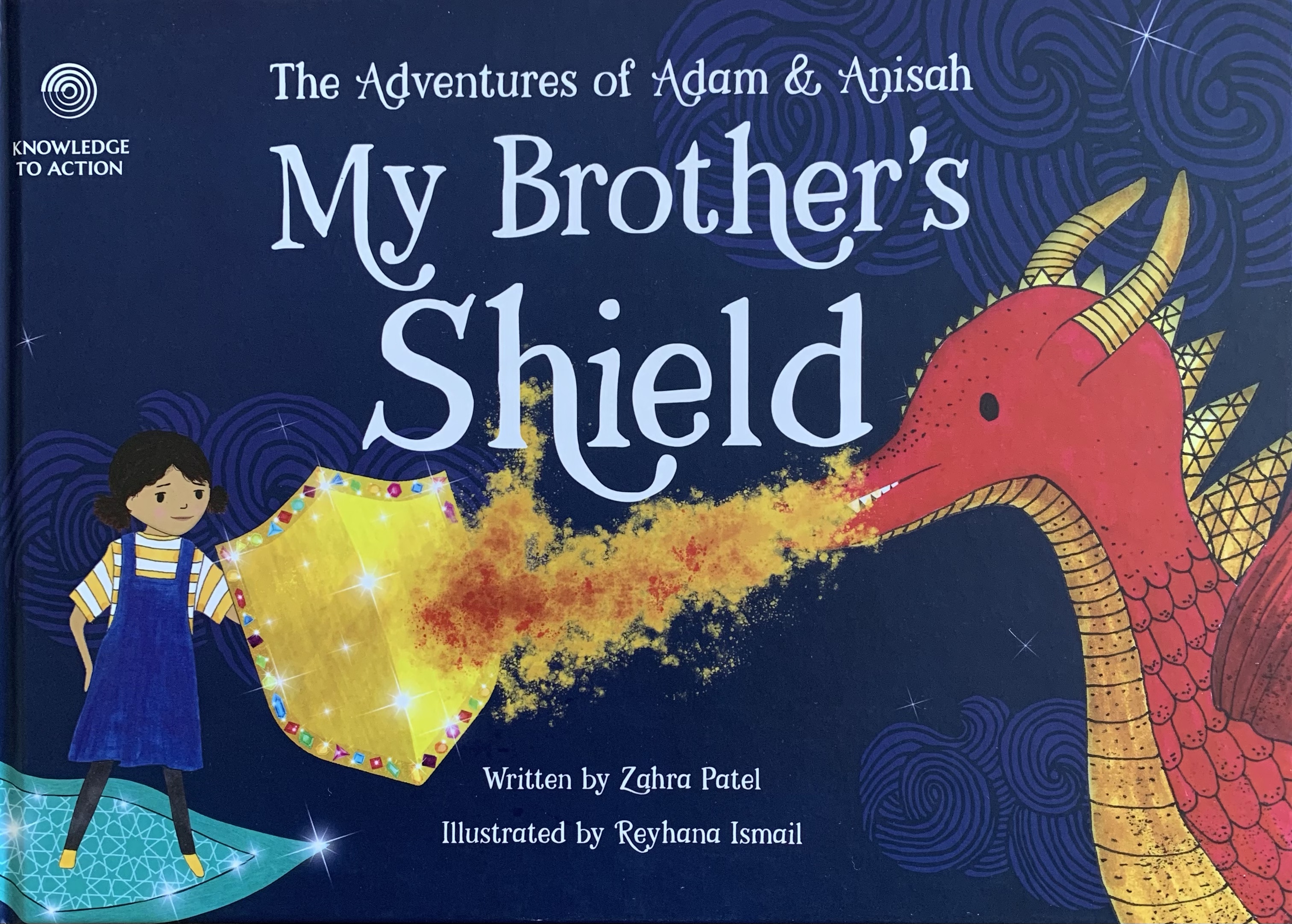
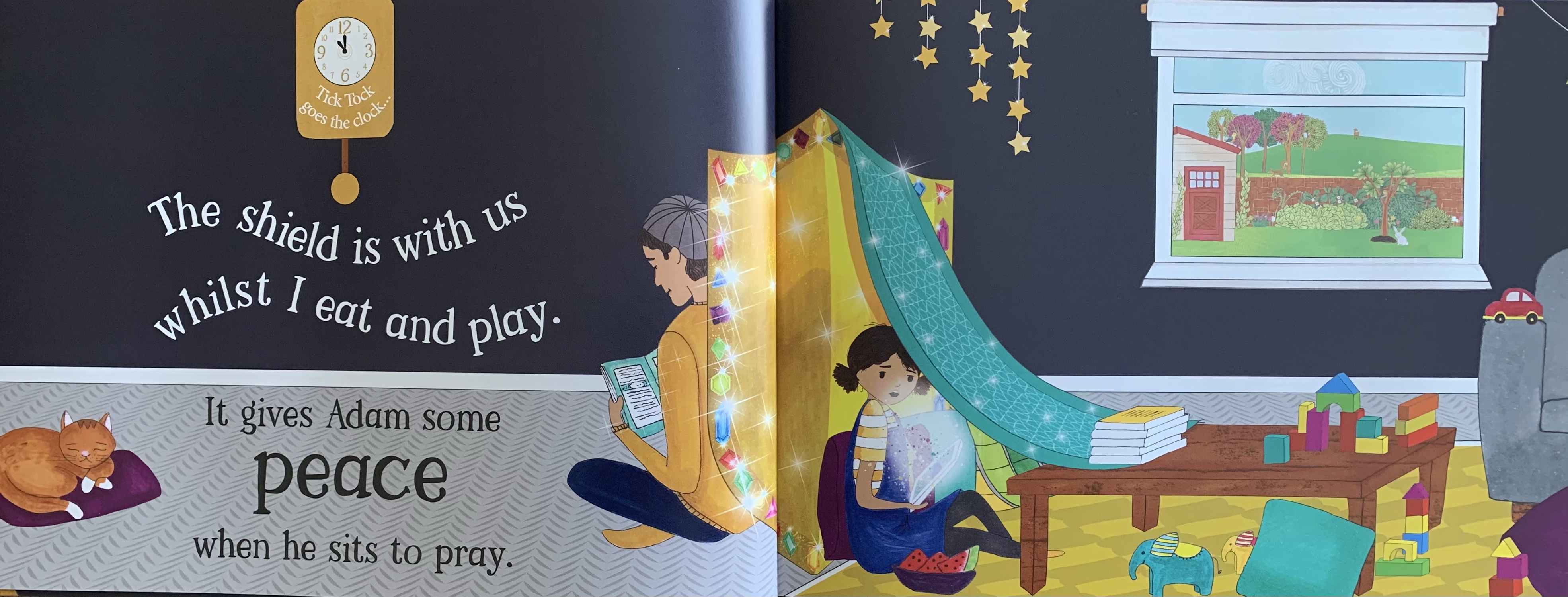
Based on the idea that “Fasting is a Shield (ibn Majah),” this adorable book brings Ramadan not just to life, but makes those that fast into absolute superheroes!  Over 32 pages of simple large rhyming words, little Anisah shares her wonder and amazement toward her brother, and his shield that he wields during Ramadan.  The beauty of her admiration for her older sibling combined with the message, illustrations, and presentation, make this book (there is also an accompanying workbook) perfect for ages three and up.

img_8581

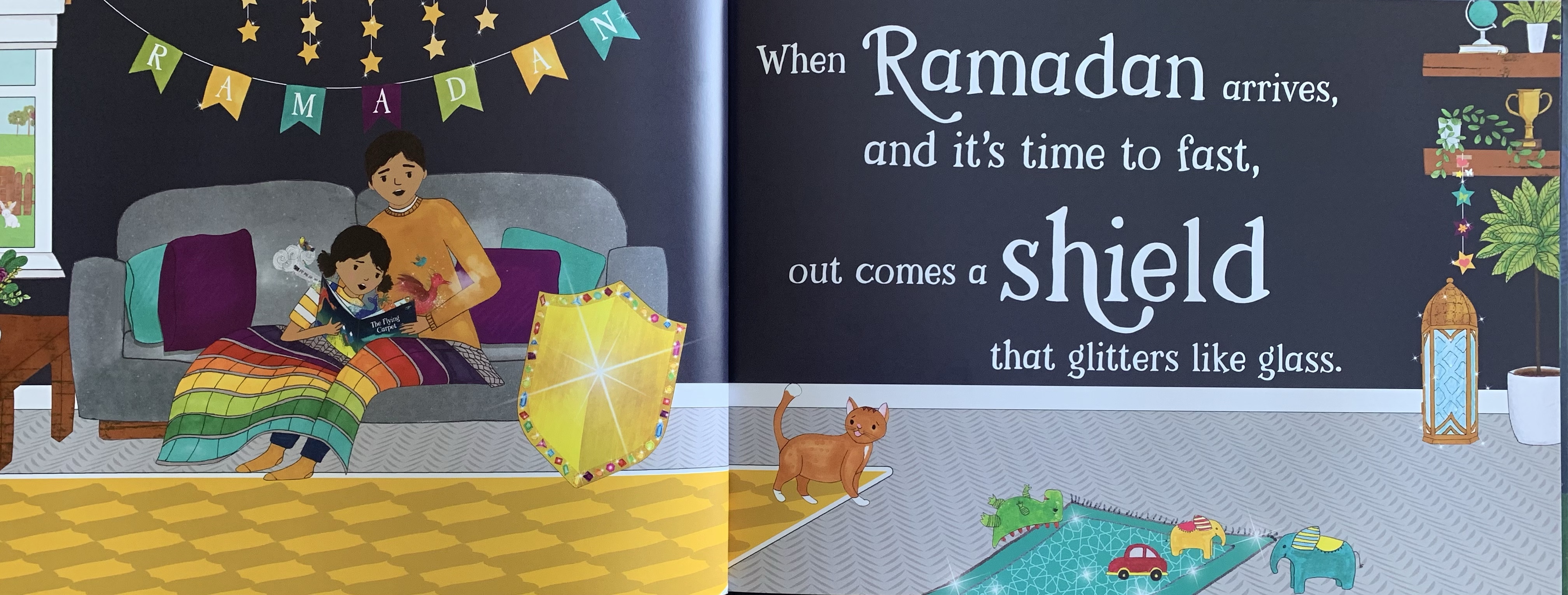
It starts with a secret.  Adam is a superhero.  When Ramadan arrives, the shield comes out and Adam carries it all day.  He doesn’t eat or drink when he has it.  It makes him brave and saves him from tempting biscuits.  It gives him peace when he reads Quran. It keeps him calm when there is a foul during a soccer game. It even keeps him away from gossip at the mosque.

img_8582

When they break their fast, they pull out their magic carpet to fly.  And when Ramadan is over the shield goes away until it is needed again. Anisah patiently marks off the days on the calendar until Ramadan will arrive, because she has another secret.  She is training to be a superhero too.

img_8583

The book concludes with how the story came about, discussion questions and some activities to help learn through practice. The illustrations show diversity and whimsy and toddlers and preschoolers, I’m certain will be begging for this story all year around.

img_8584


Accused: My Story of Injustice (I, Witness Series Book 1) by Adama Bah

Standard
Accused: My Story of Injustice (I, Witness Series Book 1) by Adama Bah

adama

This is the first book in a new middle grades nonfiction series and is Adama Bah telling her own story about being detained as a 16 year old and falsely accused of being a suicide bomber.  A story that sounds like a movie plot is painfully real and terrifying and hearing it in her own words is powerful and impactful.  The writing is very basic in its linear format and straightforward presentation of the experience through her eyes.  It is not sensationalized or overly explanatory about how this situation came to be, how she got out of it, or what the family had to go to to find lawyers and pay for them, for example.  It is how she felt, what she understood at the time, and how the experience shaped her.  While the writing style is sufficient for middle grades, her story is intense.  A big part of her experience is being strip searched, exposed, and seeking asylum to avoid female circumcision.  The 128 page book is a great way to show the realities of our world.  It took place in the 2000, the recent past, to a New York teenager that enjoyed different colored sneakers, chatting with her friends, and spending time with her family, no different than the readers picking up her story to read.

SYNOPSIS:

Adama was born in Conakry, Guinea in 1988 and moved to America as a child.  She attended public school until high school when she was then sent to an Islamic boarding School in Buffalo, New York.  Her family was not particularly religious, but Adama become more visibly Muslim returning home after the attacks on September 11, wearing niqab and wondering why she was being treated with such hostility at the airport.  As she resumes her education in public school, she slowly makes the choice to take off her niqab, while maintaining her hijab and modest clothing.  In 2005 she and her father are taken in to custody early in the morning from their home and detained.  During the questioning at 16 years old, Adama learns that she is not a legal US citizen.  Her father is separated from her, to be deported, and she is moved to Pennsylvania as the youngest person swept up in a terrorist roundup.  She is being accused of being a potential suicide bomber and is detained for six weeks before a plea deal is brokered.  She will wear an ankle monitor for three years and have a nightly curfew.  During this time she is responsible to care for her family as her father has been returned to Guinea, her mother speaks very little english and she has four younger siblings.  Even after the bracelet is removed she finds herself still on no-fly lists and finally after one more time being denied and detained at the airport, she sues the Attorney General, FBI Director, and the Director of the Terrorist Screening Center. When they learn of this they offer to remove her from the no-fly list if she withdraws her case. She is granted asylum and while she had to drop out of school, she dreams of going back.  She has since married, her dad has been able to return to America, and she continues to study Islam and believe that things could have been worse.

WHY I LIKE IT:

I love that it is her story, from her eyes and perspective, but I worry that some of the details are misplaced.  She details enjoying talking bad about the government with a friend after she is released knowing that they are listening in, but maintains that she is constantly in fear of being returned to jail and that she considers America her home.  I’m not saying all of those things can’t be true and co exist, but some additional context would help the choppiness in this example and others.  I appreciated that the genital mutilation was clearly attributed to culture and not religion, I think when others tell stories about cultural and religious practices they often conflate the two.  I wish there was more information about where this mysterious list came from, what happened to the Bengali girl that was taken, how the Islamic community reacted.  The story is powerful and moving, and readers will be drawn in as they see themselves in her.  There are also questions at the end that help connect readers to her situation, and the reality that this is the unjust world we live in and can easily be consumed by as she nearly was.

FLAGS:

Detailing a strip search, detailing taking off her clothes, having orifices checked, and using the bathroom in the open.  There is talk of female circumcision although it doesn’t define it explicitly.

TOOLS FOR LEADING THE DISCUSSION:

I think in a high school Social Studies class or current events discussion this book would be a great topic to explore and voice to highlight.  The book is short and can be read very quickly.  It is an important story to know, to learn from, to sympathize with, and be acutely aware of for people of all ages.

The Shape of Thunder by Jasmine Warga

Standard
The Shape of Thunder by Jasmine Warga

shape of thunder

Usually when a book leaves me with a lot of questions, it is because the author’s writing was incomplete or flawed, this book however, left me with a lot of questions and I’m certain the author did this deliberately. Hence, I don’t know to be irritated or impressed that I care enough about the characters to want to know more. Considering I’m still emotionally attached to the two alternating voices in the book, I’m going to claim the latter, and just be grateful that I was privy to follow the two girls for 288 pages and let the impression the book left me with overpower the curiosity I have to know everything about their past and their futures. This middle grades read is absolutely wonderful and emotionally gripping. I think all kids will have a hard time forgetting the story and characters, and more importantly I think over time they will recall and re evaluate their own thoughts regarding the personal weight of school shootings, gun ownership, sibling loss, responsibility, and maybe even the possibility of time travel. I know this book will stay with me for a long time. This amazing, half-Middle-Eastern half-American author in her OWN voice book somehow manages to discuss a school shooting without being political or preachy and the result is memorable, heartbreaking, and powerful.

SYNOPSIS:

Told in alternating 12 year old voices: Quinn and Cora are neighbor girls that used to be best friends until Quinn’s brother stole his father’s guns and shot and killed students at his school before committing suicide. One of the classmates he killed was Cora’s older sister Mabel. It has been nearly a year since the incident, and since the girls last spoke, but on Cora’s 12 birthday, Quinn leaves a box on her door.

Cora is whip smart and grieving. She lives with her dad, a professor and immigrant from Lebanon who speaks little about his culture or religion to his kids, even though the kids want to know about their heritage and do identify as Arab American Muslims. She also lives with her grandma, her mom’s mom, despite the fact that her mom has left them. It never tells where she went or what happened, which I desperately wanted to know, but Cora doesn’t miss her, because Cora doesn’t remember her, and the family dynamic seemed to be working until Mabel is gunned down. The loss of Mabel is palpable as Cora recalls that she will one day be older than her older sister, and refuses to pack up or touch anything on her side of the room. Cora is in counseling and seems to have a supportive network of friends in her Junior Quiz bowl team, but she misses Quinn even though she can’t forgive her.

Quinn’s chapters begin with a small letter to her brother Parker: what she wants to say, what she feels, questions, memories, anger, disappointment, despair. They are short, but haunting and heartbreaking. Quinn’s home life is fraught with guilt and blame. Her mother has quit work and her father is always working. Her parents fight, a lot. Her mom blames her dad for owning the guns, her dad wants to move to give them all a fresh start, it isn’t pretty. Quinn often has a hard time getting her words out at the speed she wants, she calls it freezing. As a kid, Cora would help, but without Cora and with no one in the house willing or ready to listen to Quinn, Quinn is often left alone. At school Quinn is largely ignored as no one wants to be around the sister of the mass shooter, so she doesn’t try out for soccer, she has no friends, and no one to talk to get the help she so desperately needs.

Quinn has an idea about how to fix everything, and that is what is in the box. She is convinced that if she can go back in time, she can make everything right. The only problem is, she doesn’t understand all the science and needs Cora’s help. Together the two girls work to figure out a way to find a wormhole and fix the damage that occurred. Along the way the girls realize how much they need each other to heal, and the role forgiving yourself has in the process as well.

WHY I LIKE IT:

I am shocked at how deftly the book talks about a school shooting without talking about a school shooting. It is how the families feel in the day to day acts that follow a year later and how the girls are trying to carry on with the limited tools that exist for individuals dealing with the aftermath of such an act of terror. It doesn’t go in to the 2nd Amendment rights or detail the lack of legislation to curb such acts, it really stays on the two girls. The hope of finding a wormhole is really farfetched and perhaps unrealistic, but they are so desperate to believe, to find a way to make things right, that you hope for their sake that they are successful.

It is amazing to see from the sister of a shooter the isolation and pain she endures. I don’t know that I’ve really ever considered the larger families of the shooter when your heart is so devastated for the families of the victims. Occasionally you hear about the parents, but what about the siblings, cousins, distant relatives?

I desperately wanted to know where Cora and Mabel’s mom went. I was tempted to contact the author since it really was gnawing at me. I also wanted some answers as to why Parker did what he did, what hate he was spewing online, what were the signs, did he single out Mabel for being Muslim, while also appreciating that there is no satisfactory answers for any violence of this magnitude in fiction or real life.

Cora knows nothing of Islam and kind of wants to, I felt like this could have been explored a tiny bit more. Not in that she has to be religious, but I feel like after such a life altering event such as death, religion and what happens when one dies usually comes up and a person decides they are satisfied with an answer or not. The story isn’t in the immediate aftermath of dealing with the shock, but rather is a little after the event to presumably not have to deal with the raw emotion, and can focus on the pain and strength that comes with finding a new normal. I’d like to imagine at some point perhaps Cora and her dad talked about what happens after death, but the text doesn’t suggest that it was an issue of concern. She does wonder if Mabel was killed for being Muslim and asks Quinn about it. Quinn never defends or justifies what her brother does, nor does she pretend to know, she is grieving too. She is irritated that people try and define her religiosity to make themselves feel better and she does say the family occasionally fasts, makes duas, and they always celebrate Eid.

She talks a bit more about wanting to know more Arabic, saying that if you are 50% Arab you should at least know 50 words, and she only knows five. She wants to hear about her father’s life growing up, and know that side of her. It mentions that he wanted her to feel like she belonged in America, but I’d love to know more. Maybe what happened to his family, what brought him to America, why they opted not to give them more cultural names, etc..

I also enjoyed the slight science thread. It seems the author used to teach science and I love that the scientific method and various random facts find their way into the story.

POSSIBLE FLAGS:

The book talks about death, killing, suicide, and gun violence, but doesn’t relive the chain of events or detail what happened exactly. Quinn and another friend have crushes on boys in their class. There is a Fall Festival that the kids dress up for, but it isn’t called Halloween, and there is no mention of it. The book opens with Quinn’s birthday.

TOOLS FOR LEADING THE DISCUSSION:

I would definitely read this as a middle school book club selection. It is engaging and gripping and a great book to have as an introduction to hard conversations with children. The author has a note at the beginning about her own children doing active shooter drills and having to face this real fear, and I think kids talking about it through fiction is a powerful tool to get them thinking and talking.