Tag Archives: Masjid

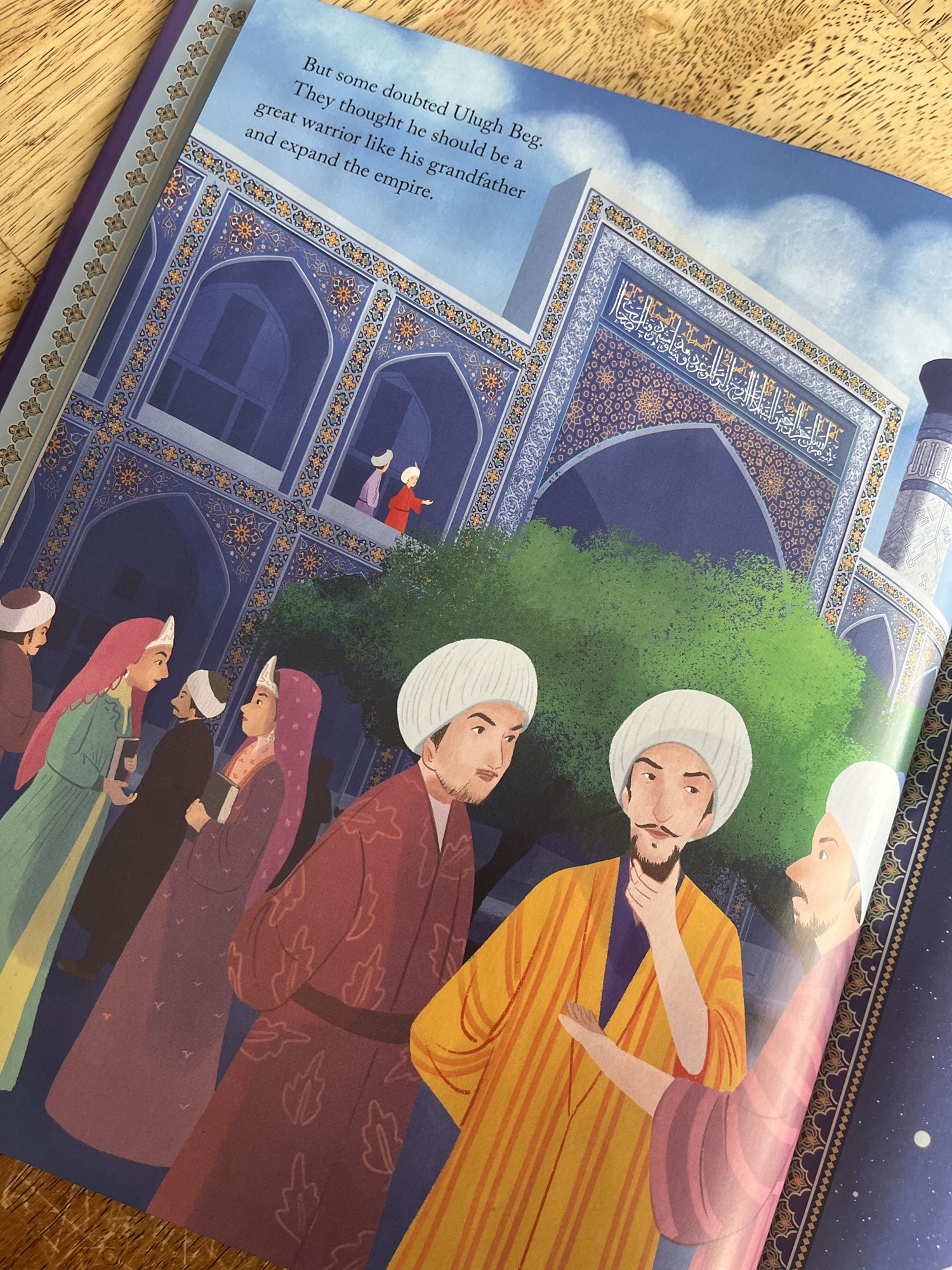
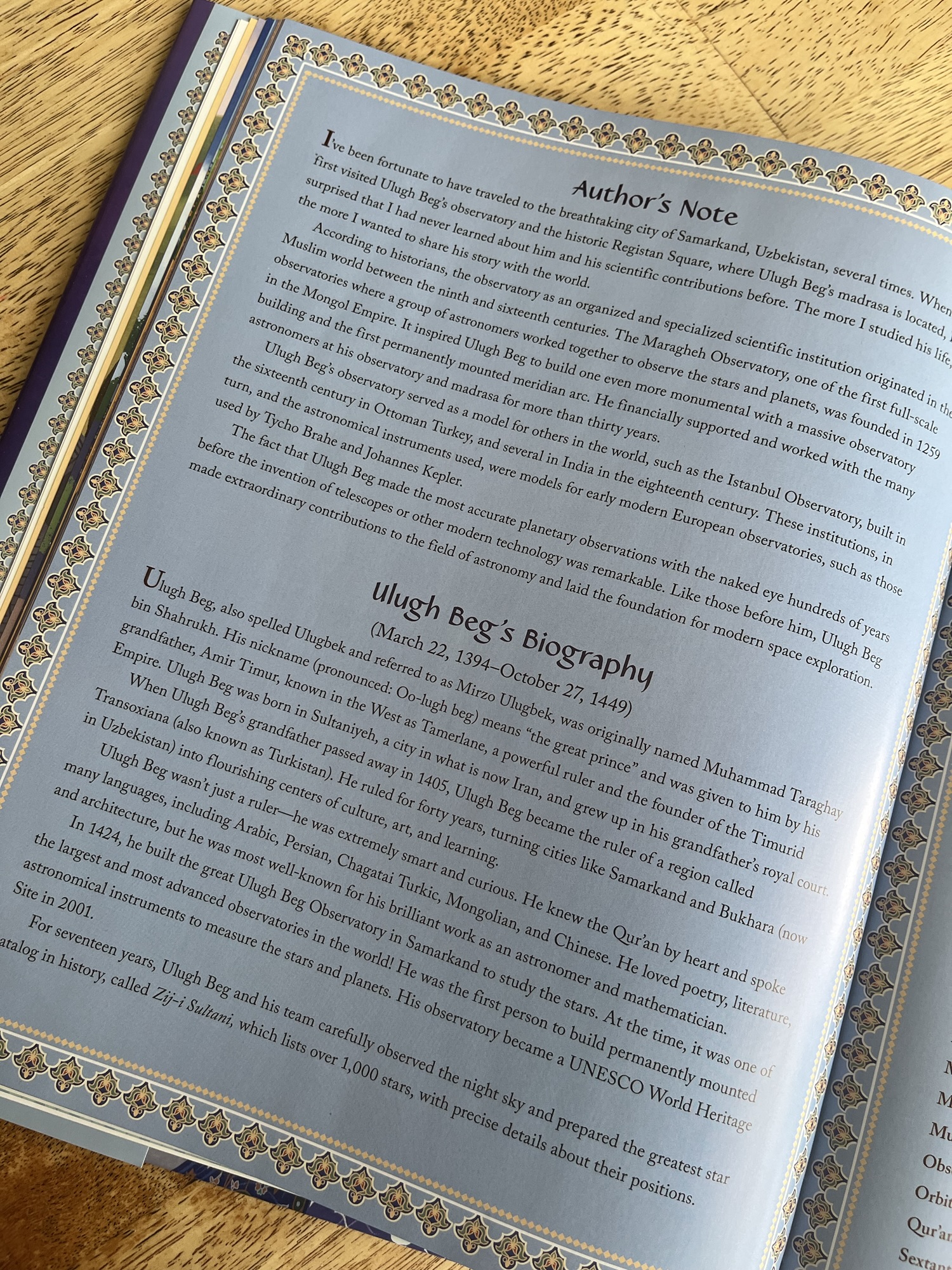
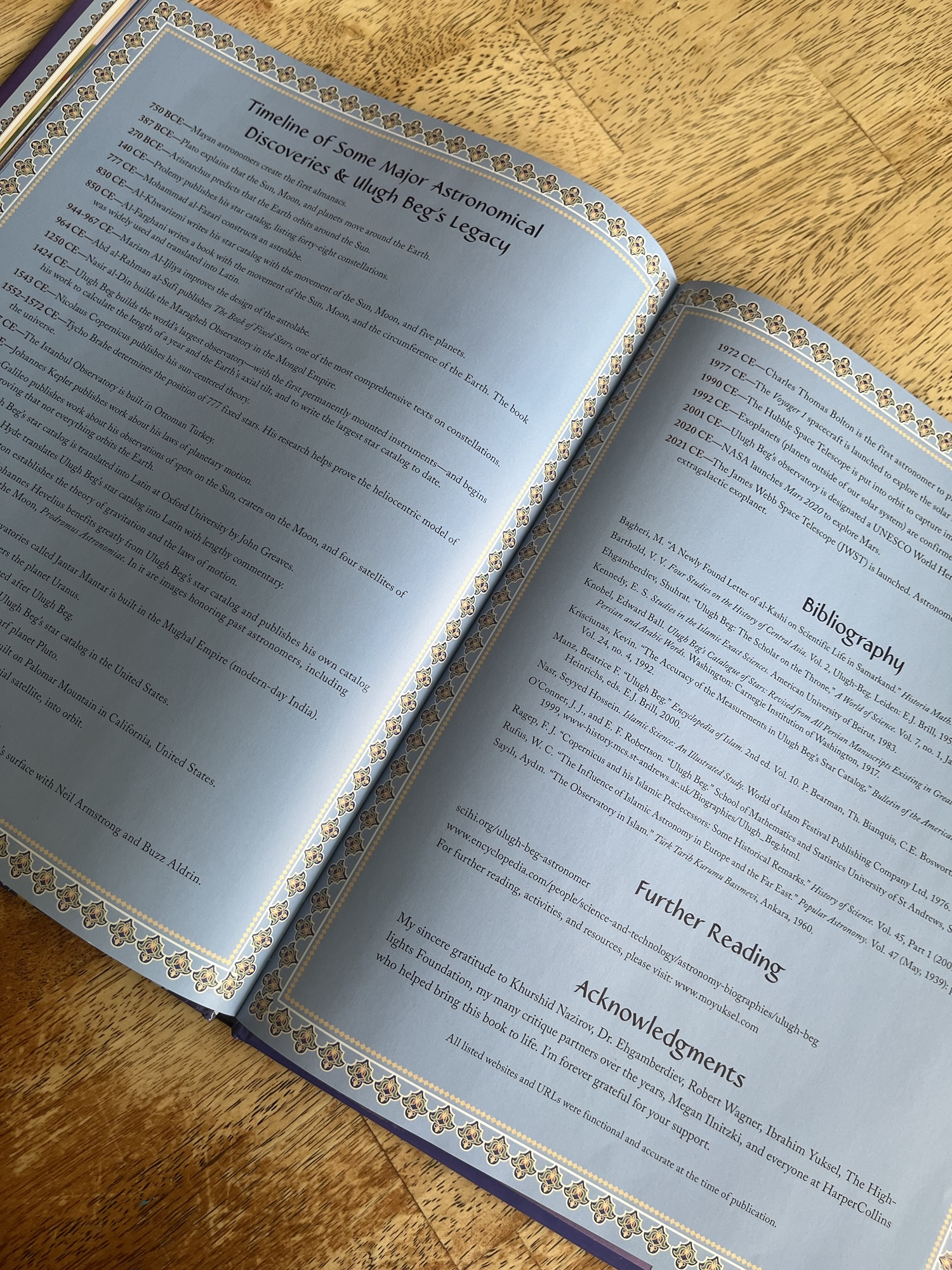
The Prince of Stars: Ulugh Beg’s Quest to Map the Stars and Seasons by M.O. Yuksel illustrated by Zelma Firdauzia

Standard
The Prince of Stars: Ulugh Beg’s Quest to Map the Stars and Seasons by M.O. Yuksel illustrated by Zelma Firdauzia

This gorgeous 40 page picture book biography is both flowing in its storytelling and informative in its sourced details of a fairly unknown, underappreciated figure.  I was humbled reading this book and learning about the accomplishments of someone I had never heard of before.  Truly this book, bringing to the attention of our young and old ones alike, such a remarkable figure, is a much needed gift.  The publisher suggests the book for 4-8 year olds, but I think it also will appeal to older readers familiar with Copernicus, Galileo, and Ptolemy and who will appreciate the efforts driven by curiosity from someone so long ago. The diction in a few lines did give me pause, but nothing that overshadows how well the author has once again proven to master the storytelling of non fiction Muslim accomplishments in an engaging, accessible, exciting way for today’s audiences.

The book opens with a map of the Timurid Empire in 1405, before showing the reader a young prince, Ulugh Beg, gazing out and the stars and wondering how many there are.  The next spread makes no sense to me, but I acknowledge others might not be bothered, how can the young boy be watching days fade into weeks, into months, into years, and then wonder how many days are in a year? Seems that either those terms weren’t yet around, or some details about the generalized meaning made him curious about the specifics.  Either way, him wanting to know how many days in a year and the changing of seasons, along with counting the stars are the questions he wonders about as a child and works to answer throughout his life.

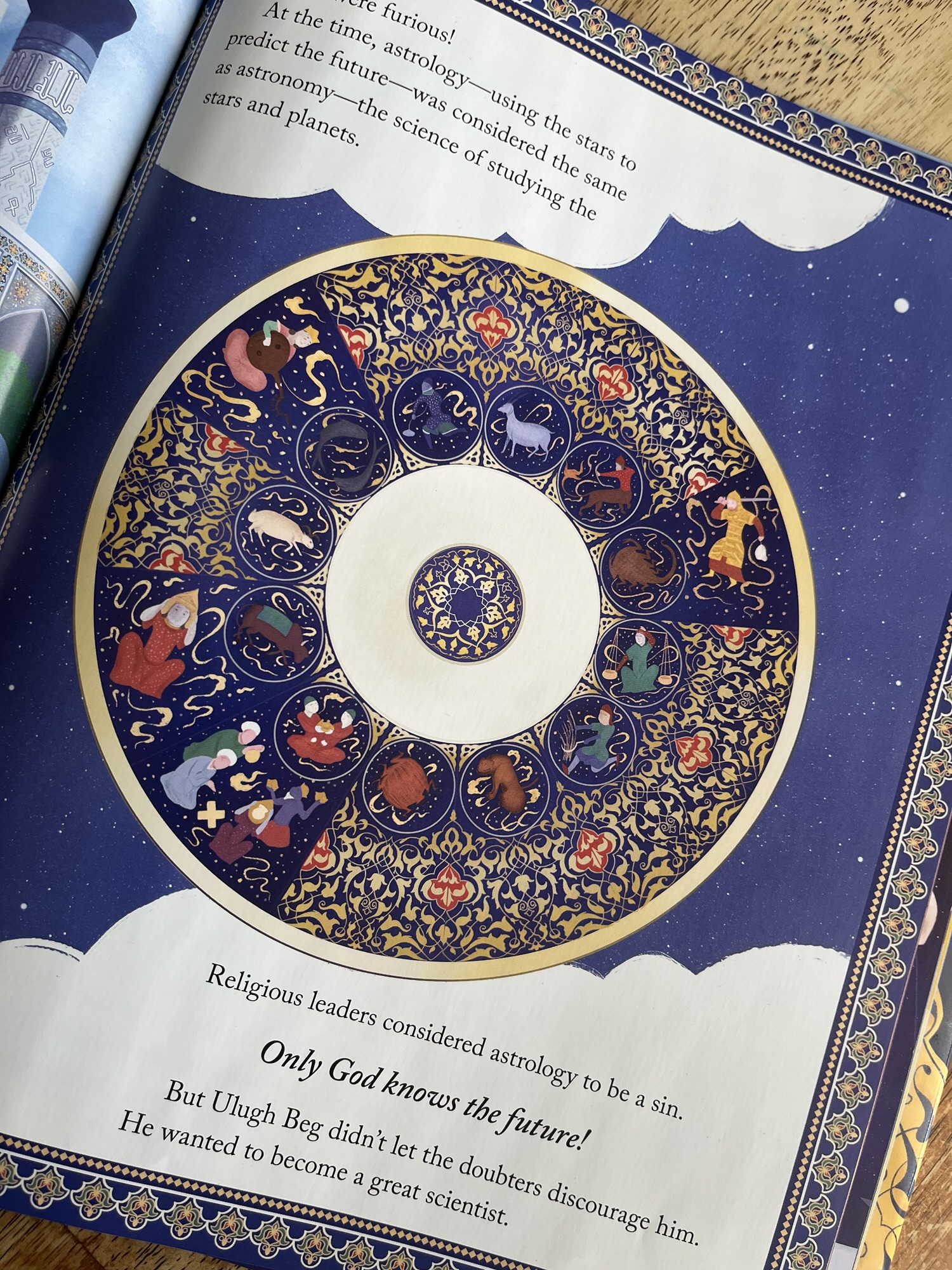
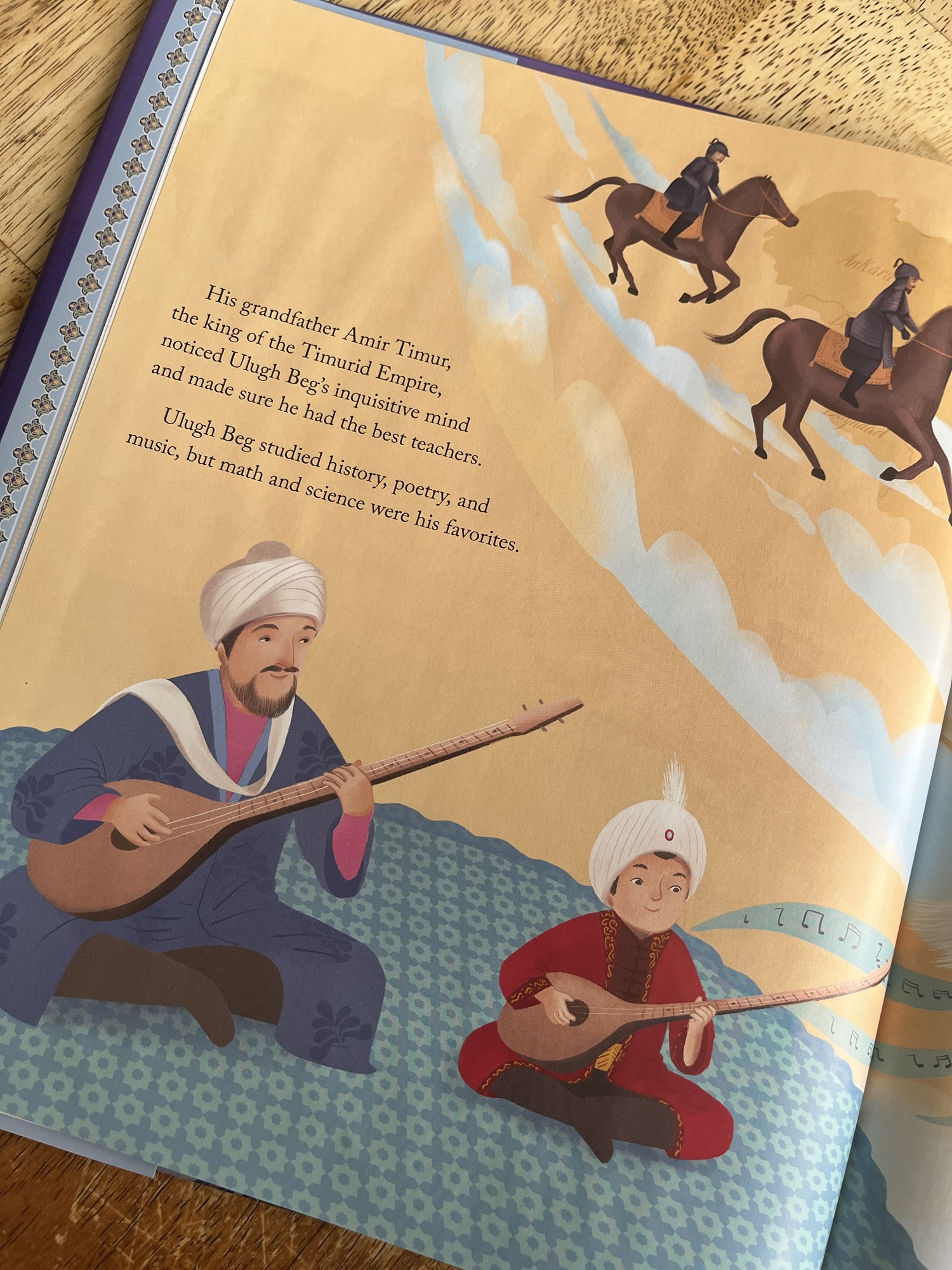
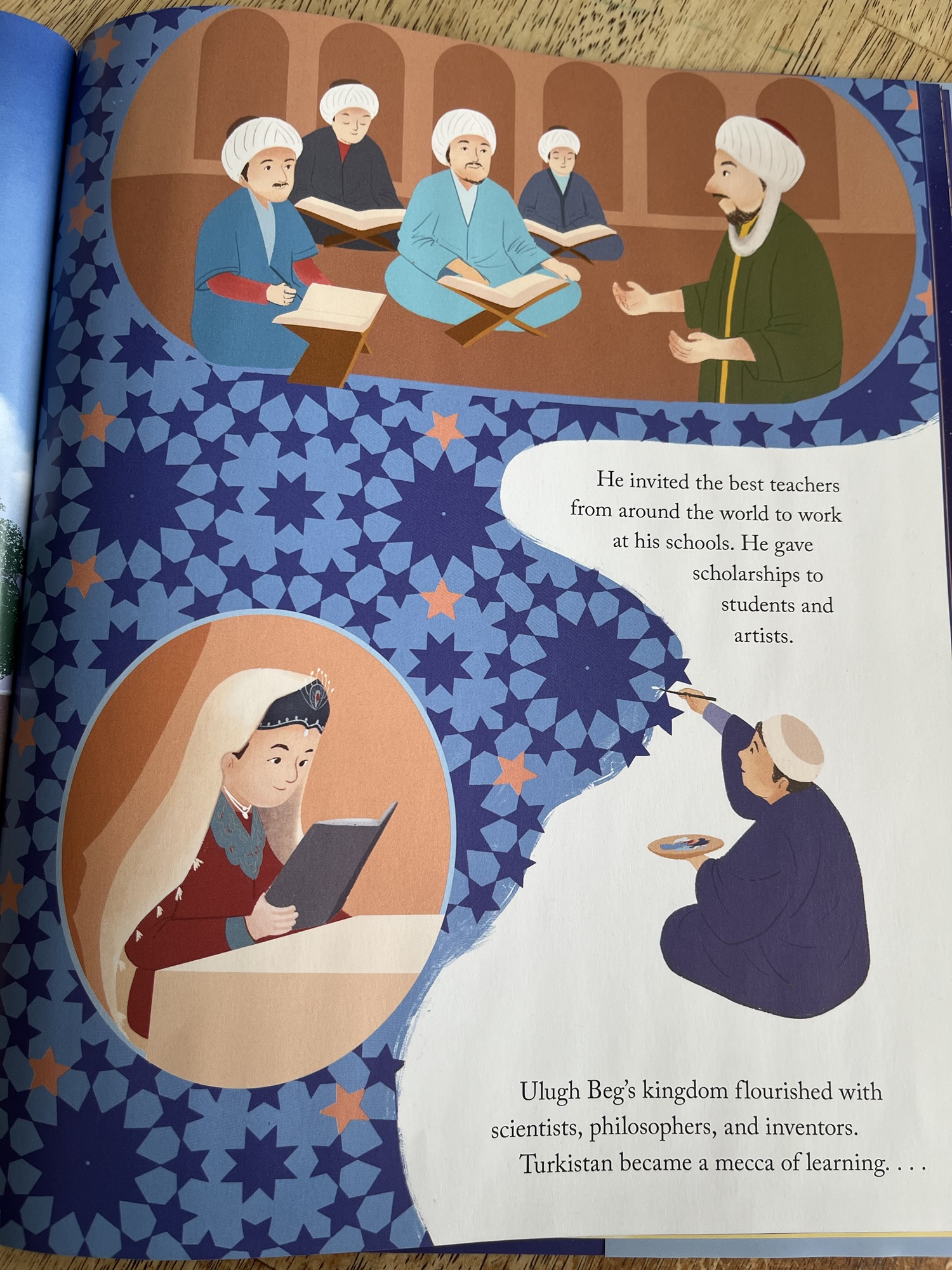
The king of the Timurid Empire, Ulugh Beg’s grandfather, insured his intelligent grandson had the best teachers and was allowed to travel, learn, and follow him curiosity.  At 15, when Ulugh Beg became the ruler of Turkistan, he built a madrasa and invited scholars, artists, students, philosophers, and inventors to attend making Turkistan “a mecca of learning.”  Yes, the usage of mecca here made me laugh.  I know it is appropriate, but it seemed a little on the noise in a book where Mecca, the direction we pray is also mentioned.  The book then details the controversy of studying the stars, as astrology and astronomy at the time, were seen as one and the same.  And with only God knowing the future, he had to assert that he was curious about the science of the stars and planets.

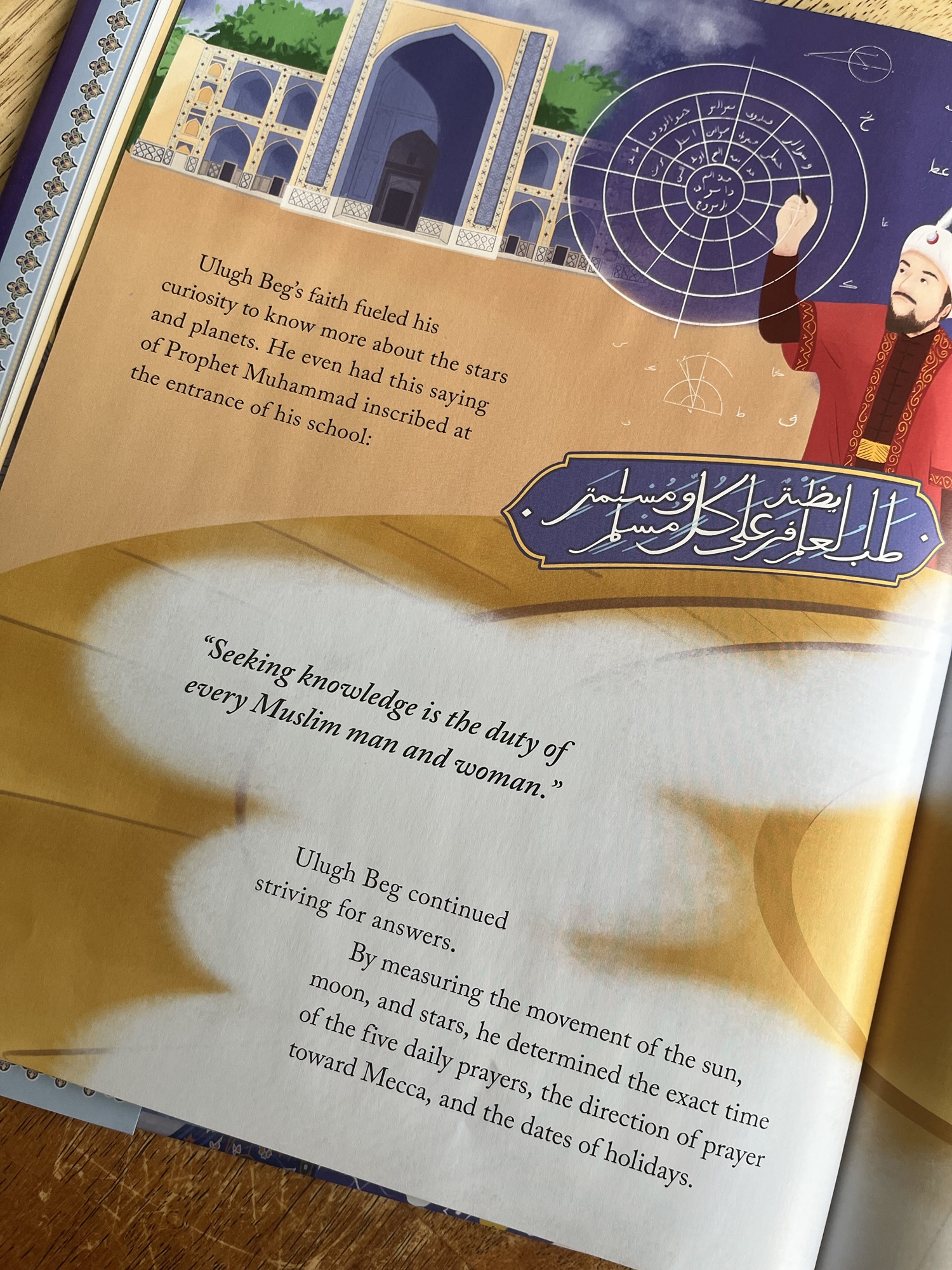
I love that faith and Islam is centered and that the inscription on his school is “Seeking knowledge is the duty of every Muslim man and woman.” But it alludes that this is a hadith, and while I agree it is inspired by a saying of Prophet Muhammad (saw), I think adding the man and woman part, where to the best of my knowledge the hadith is just “every Muslim,” is something that should be clarified. None-the-less, that it was Ulugh Beg’s motto, so to speak, and that he made a point to articulate “woman” is remarkable.  He determined the exact time of the five daily prayers, the direction to Mecca, and the dates of holidays.

He also built the world’s largest observatory, and numerous tools, including the Fakhri sextant to measure the location of the stars and movement of planets.  He encouraged being challenged and challenging others’ findings, and over 17 years wrote a star catalog of more than 1,000 stars. He answered how many days in a year, down to the seconds, why the seasons change, and inspired future astronomers and scientists.

As incredible as the story is, the backmatter is equally impressive with an Author’s Note, Ulugh Beg’s Biography, a Glossary, Astronomical Timeline, Bibliography, Further Reading, and Acknowledgements.

The illustrations are the cherry on top, somehow I don’t love the cover, but the inside spreads are nice and match the tone of the words and the detail of what he was accomplishing.  The book is on preorder and I hope, teachers, librarian, and families will prioritize learning about him, and giving him credit for what he helped us to understand, about our world.

Amar’s Fajr Reward by Amire Hoxha illustrated by Hilmy An Nabhany

Standard
Amar’s Fajr Reward by Amire Hoxha illustrated by Hilmy An Nabhany

As Muslim authored stories are increasingly more available, certain cultural Muslim stories continue to be limited or none existent. Since 2021, when four of us reviewers created the Muslim Book Reviewers and Muslim Book Awards space, we have constantly been encouraging Amire to work on her dream of being an author, and write a joyful Muslim Kosavar book. Through Ruqaya’s Bookshelf, her dream has become a reality, Alhumdulillah, in the form of this 32 page, 8.5 by 11, full color books for early elementary readers. In all my years of reviewing I have not ready many Kosavar books, and of those few, none have been OWN voice, and all have focused on the war.  Enter Amar’s Fajr Reward, a simple story of a boy and his Gjyshi, going for fajr at the masjid, finding the door locked, and the obstacles, determination, and results that transpire, not just for Amar but his grandfather as well.

The book starts with Gyjishi splashing water on Amar to wake him up for Fajr, while reminding him that “Prayer is better than sleep.”  Grandpa’s quick steps and a sleepy little boy, keep Amar hustling after his Gyjishi only to arrive at the masjid and find the door locked.  

Gyshi cannot be deterred by his grandson wanting to go home and pray, or a locked door and decides to jump the fence, something he has done in the past.  Calamity strikes, when he falls and hurts his foot and it is up to Amar to help.  But he can neither scale the wall or find anyone to help.  When the muadhin finally runs up the street Fajr can be made, Gjyshi can be assisted, and changes can be made so that hopefully getting locked out doesn’t happen again.

I love that there are pronunciation tips on the cover page of Gjyshi, grandfather, and Axhi, uncle, but I do wish there was some backmatter showcasing Muslims in Kosovo.  Are Muslim communities spread out in large diverse areas, or do they tend to have neighborhoods that are tied together by faith? As a place not often seen or heard about, a little layering of details would have deepened the story.  Especially, if the reasons are cultural or societal explaining why people don’t wake up until the athan is called, but were annoyed that Amar was knocking on the doors at that time, or maybe why the didn’t just pray outside the masjid, calling the athan and waking up the regulars that attend. Also about why the key to the masjid is “special.” Are places of worship regulated or only allowed to be open at certain times?  I also wish it would have given a little build up about Amar and this particular day. At the start he wants to pray at home as it seems like that is his norm, and Gjyshi going to the masjid seems to be the grandfather’s norm, so was this something special, a right of passage, are kids not typically seen in masjids is he visiting his grandfather? 

The book is sweet and warm, with a lot of heart and I love that it takes place in a masjid and threads in that salah is better than sleep, and that praying in congregation is 27 times the reward.  I also love that the author fulfilled her dream inspired by her own grandfather, and inshaAllah she will continue to write and bring Kosovar stories to our bookshelves, ameen.

Ibraheem’s Perfect Eid by Farhana Islam illustrated by Nabila Adani

Standard
Ibraheem’s Perfect Eid by Farhana Islam illustrated by Nabila Adani

Gorgeous illustrations, joyful Islam, and a sweet story about a little boy realizing there is more to Eid than presents. The protagonists voice is really on point and a great way to counter so many of the books, and real life antics of kids equating Eid to being about gifts. This 23 page picture book for 3-6 year olds, works for both Eid al Fitr or Eid al Adha, and follows little Ibraheem as he searches for his gifts throughout his sunnah and love filled Eid day at home and at the mosque.  I love that it shows him getting drawn into the khutba, doing takbir, ruku and sajood, eating dates before going, and taking a different path on the way home.  It doesn’t have any backmatter, but if reading it to a child, I would hope the little details in the text and illustrations would be discussed. It took me a few readings to be ok with how Ibraheem discusses his gift order with Allah swt, but I think for little kids and with the consistent tone of the book, it makes it relatable.  I also don’t know why his mom and rest of the family do not go for Eid prayers. Other females are shown at the mosque in the background, and people of various ages and mobility, but alas it is just Ibraheem and his Baba at salah, and a house full of love and family the rest of the day.

The book starts with an illustration of Ibraheem hanging up his “Eid Sunnahs” chart next to his “Dear Allah” swt list of gifts that he wants. The text then starts with it being Eid day and Ibraheem looking in all the usual places for his presents, but comes up empty. He wonders if his parents forgot, if Allah forgot, but he knows that would never happen. Luckily Baba and he are off to the mosque for prayers, maybe, he thinks, the presents are there.

As the father and son walk to the mosque they greet others, and then settle in for the “Eid day stories.” I don’t love that the khutbah is referred to as such, but that is probably just me. When the iqamah is called, it is time to pray and Ibraheem copies his Baba before they make their way into “the sea of smiling faces.”

Back at home it is time to enjoy food, games, fun, and cuddles with a bustling house.  Presents still haven’t been found, but the day has been perfect, and presents can always be opened tomorrow.

I love that this is a traditionally published book, that centers Islam on Eid and radiates with joy.  The large size makes it easy to share in all settings, and the illustrations beg to be explored and appreciated.

Join Us for Ramadan by Sana A. Faqir illustrated by Amna Asif

Standard
Join Us for Ramadan by Sana A. Faqir illustrated by Amna Asif

This 18 page chunky board book is about 7.5 x 7.5 inches and a little over an inch thick.  Each spread features interactive touch, feel, lift, slide, and rotate features that keep little toddler hands engaged, while the text shares Ramadan basics. Interestingly enough though, the back says it is not for 0-3 year olds, presumably because parts could tear and be choking hazards, but making it unusable for the demographic(?).

It starts with a slider that reveals the Ramadan moon and encourages readers to find the moon in the sky. The next spread has you lifting a cover to see what Mummy has made for suhoor.  The prayer mat is then pulled out, The Qur’an opened, Sadaqah collected, dates and chocolate rotated, masjid doors opened, and once again the moon slides into view to know it is time for Eid.  

The illustrations are cute, the manipulatives are clever and not repetitive, but the flaps on any of the lift the flap reveals are incredibly thin, and the outer strip that holds the entire book is similarly skimpy and I don’t know how long it will hold up with regular use considering the thickness of the actual pages.  

Saif’s Special Patches by Humera Malik illustrated by Ravan Sader

Standard
Saif’s Special Patches by Humera Malik illustrated by Ravan Sader

I really had no idea what this book was going to be about, and the first page or so seemed a little off with the child not knowing about the quilt he was wrapped up in, but. oh. my. heart! Every subsequent turn of the page was a hug from Saif’s patch made quilt straight to my cynical soul.  The infusion of Islam as such a part of his daily activities, his loving family and environment, and the reminder that labels can both hurt and inspire is beautifully done. The illustrations, the tone, and the messaging, is great for kids that have been called “just shy” and everyone who has ever doubted themselves (i.e. everyone) with it’s relatable emotions, and reminder that like a quilt, we are still growing.  I cannot wait for this book to be released and I can enjoy a physical copy to share in classrooms, libraries, and bedrooms. One of the best picture books I’ve read in a while, thank you.

The book starts with Ami asking Saif why he isn’t outside playing basketball with his friends.  He replies, that he “is shy.”  His mother shows him that the quilt is made of patches of Saif: experiences he has had. She shows him a patch and helps him recall the memory attached to it,  starting with last Eid when he was brave and went down the big slide. As he joins in the recollection, he then owns the label that he is brave.  It isn’t that easy though, he tries to be smart like his brother and read a lot, but reading is hard, his brother reminds him he is smart and points out the patch from when he won the scavenger hunt.  Swimming, helping at the masjid, reading Quran, calling the athan, all help Saif to realize he is more than just shy, more than one label, and that he is still growing.

I love the relatability of what Saif is going through, and even though so many of the settings and examples are Muslim centered, the book will resonate with all readers, of all ages.  A tear or more two may have stumbled out as I saw little me in the illustrations and the scenarios, and I have never been called shy. The book releases in March and is traditionally published, meaning plenty of time to pre-order a copy and request your library to shelve it, as it will be available wherever books are sold.

Almost Sunset by Wahab Algarmi

Standard
Almost Sunset by Wahab Algarmi

At 224 pages, this middle grade graphic novel has a whole lot of heart. Seventh grade is not easy for anyone, and Hassan is balancing school, grades, soccer, fasting, and taraweeh every night, while dealing with friends, video games, cousins, and falling asleep in class. I love that this OWN voice book really centers Islam. It doesn’t shy away from showing the stresses that the character and presumably the readers of immigrant kids in public schools might encounter, right alongside stresses with Muslim cousins and friends at the masjid trying to pressure you to do something you don’t want to do.  And as in any coming of age story, young Hassan does not want any special treatment or parents to get involved. SPOILER: Hassan does hide his faith and that he is fasting for Ramadan at school, he also does make mistakes, notably among them is when he breaks his fast in what he is told is a loophole of sorts, but by the end he grows and trusts and realizes he doesn’t have to do it all, all the time, and that he isn’t alone. The book is not heavy, but it has layers that serve as relatable mirrors and windows for kids who are going to thoroughly enjoy this richly illustrated book.

SYNOPSIS:

The story starts with seventh grader, Hassan dreaming about food, drooling on his arm, and then being woken up by his teacher, again.  It is Ramadan and Hassan is fasting, going to taraweeh at night, trying to keep up with school and soccer, and on top of it all, he doesn’t want anyone to know.  He also doesn’t have the latest version of the popular video game that all his friends have, and he has to explain to his childhood friend Rosie why it is no longer appropriate for them to hang out together.  Nights and weekends with family and at the masjid should be a reprieve, but somehow even there he is the odd one out, opting to pray instead of play, and being unsure if closing your eyes while sneaking food really prevents Allah swt from seeing you eating like his cousins claim.  Threaded through it all are soccer practices, games, and falling grades that are going to get him tossed off the team, making this a Ramadan to remember.

WHY I LOVE IT:

Wahoo, some Yemeni representation, I loved the flashback/dream longing for Yemen.  I like that Hassan isn’t expecting adults or others to speak for him, and his heart is really in the right place.  I did feel a bit of a disconnect though when his friends knew he fasted the previous year, why he wouldn’t just explain it was time again for him to do so. Increasingly even the most isolated western cities are aware of Ramadan, so I didn’t feel that hesitation for Hassan to own it, even when a friend explicitly asks.  SPOILER, On a similar thread, his soccer coach is Muslim and their isn’t a huge sigh of relief and immediate kinship when the information is revealed.  If Hassan really feels he is shouldering it alone, why wouldn’t this empower him to step into himself so to speak.  I also didn’t understand why the end of the season pizza party wouldn’t have just been at iftar time. The book really had a chance to model how others can support their Muslim friends, and moving a food based celebration a few hours is an easy accommodation, but the Muslim coach didn’t even do it, so why would non Muslims.  

When Hassan does sneak food during his fast, he gets away with it, but it doesn’t sit right with him and I think it is powerfully done, him coming clean also is not punished as it really is something between Hassan and Allah swt and I love how it is left to that.  Regardless of if you feel it is required of a 7th grade boy or not, the ownership of faith I feel is more important than the getting in trouble by your parents in this case.

FLAGS:

Lying, failing grades, sneaks food during fasting, boy girl friendship, hints at internalized Islamophobia.

TOOLS FOR LEADING THE DISCUSSION:

I wouldn’t do this as a book club, but would absolutely have it on shelves for kids to easily access, and I would absolutely discuss with them, what their takeaways were.

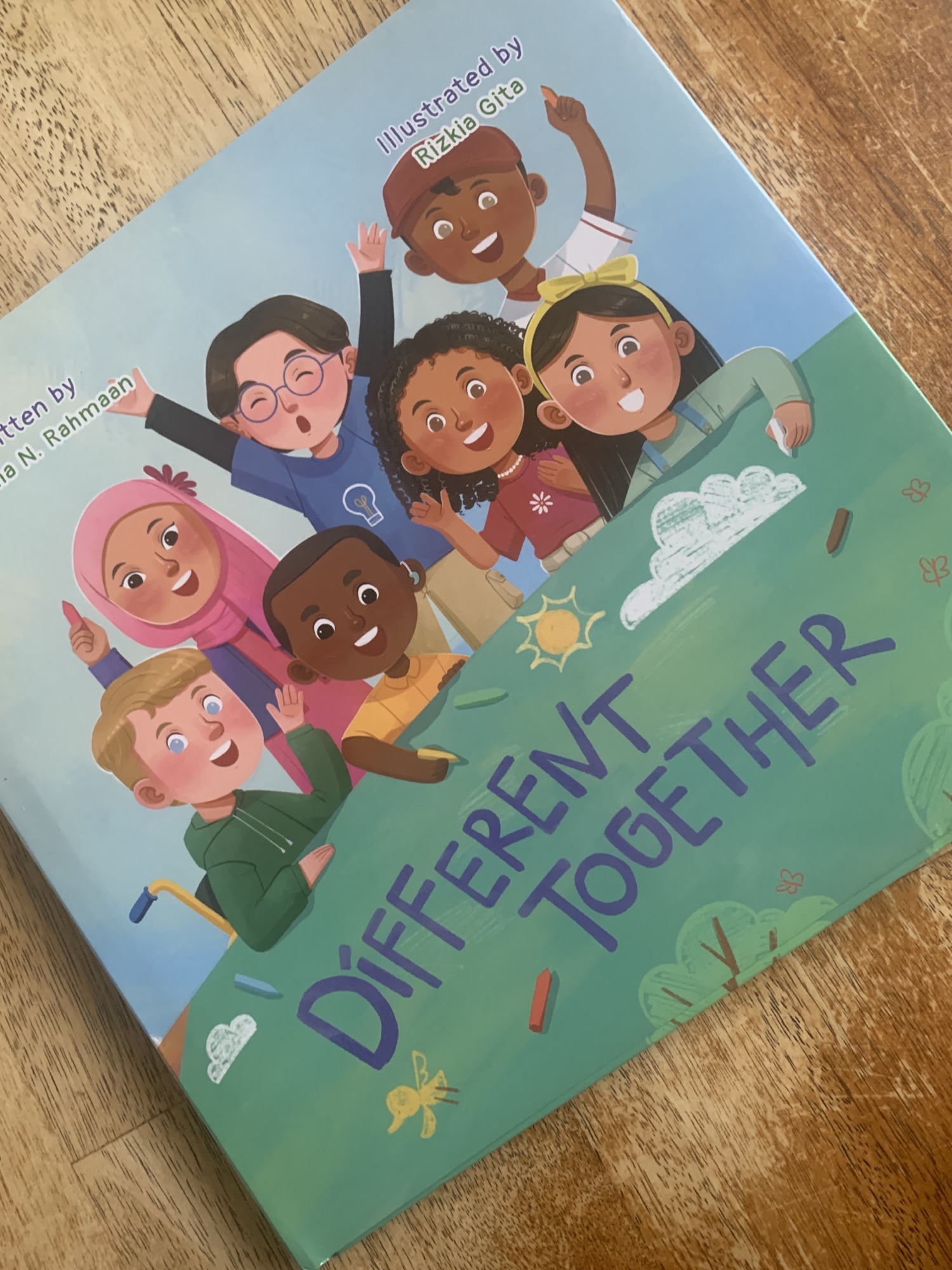
Different Together by Ayesha N. Rahmaan illustrated by Rizkia Gita

Standard
Different Together by Ayesha N. Rahmaan illustrated by Rizkia Gita

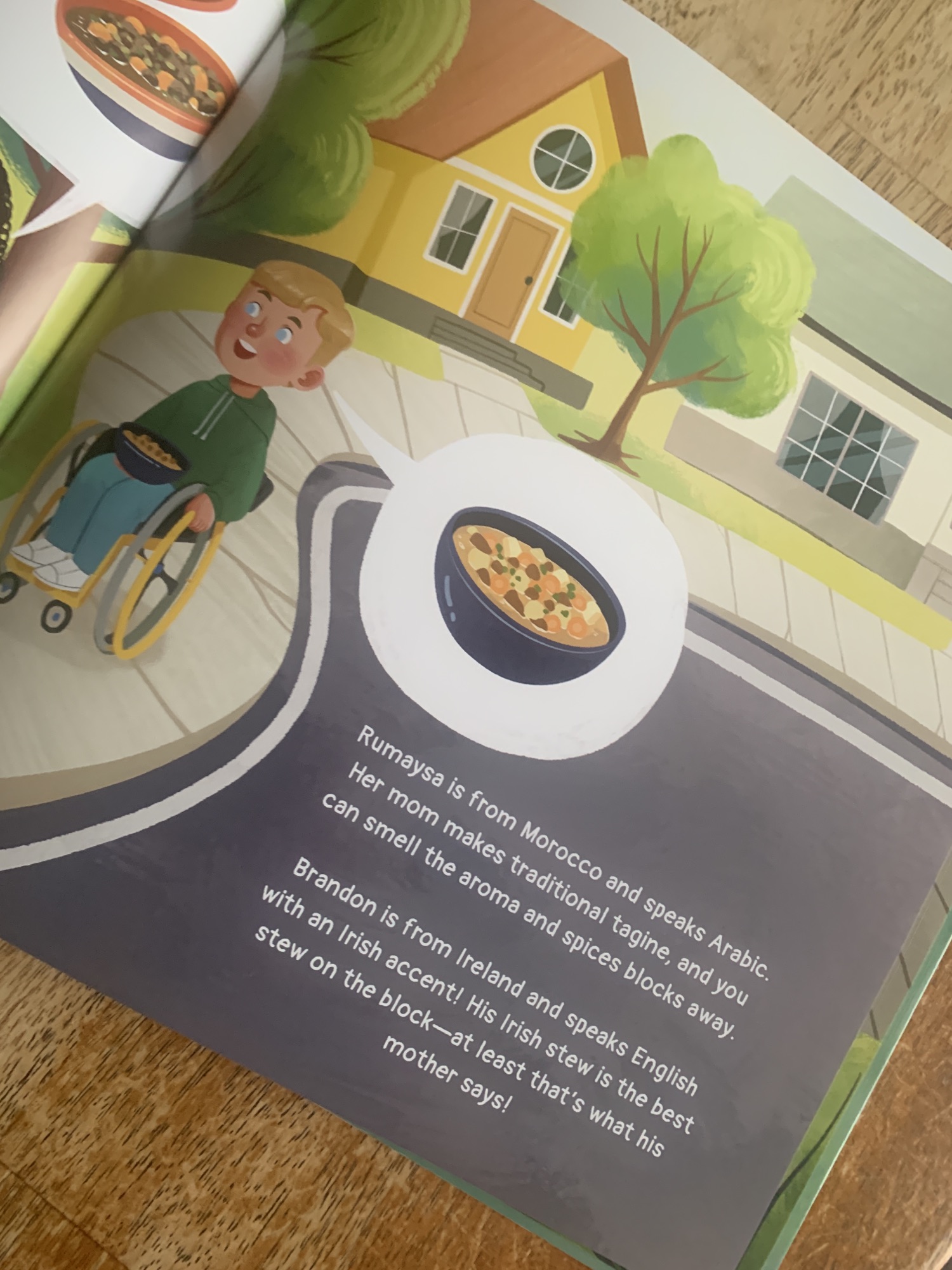
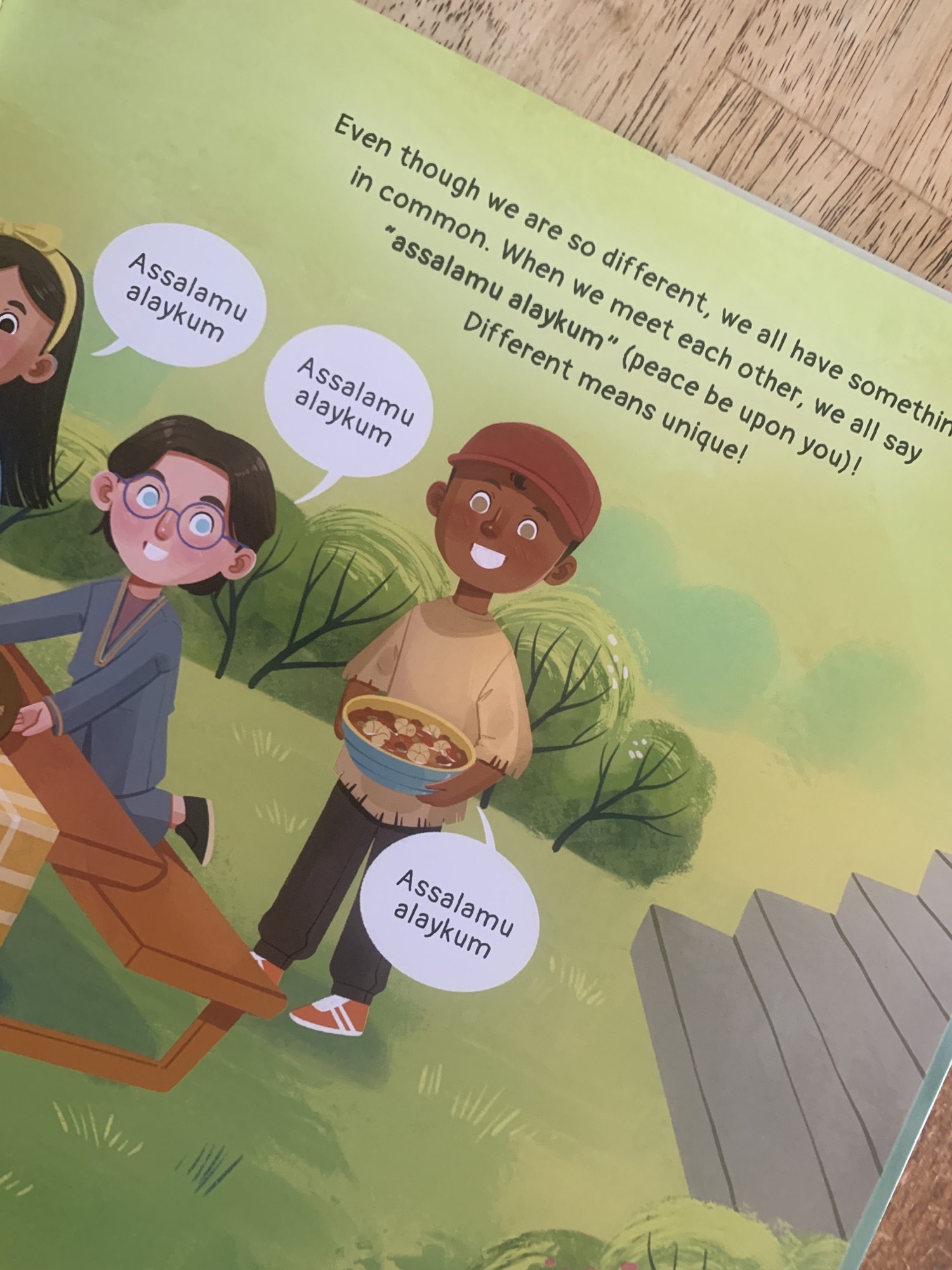
This 32 page large 10 x 10 hardback book explores how we are all different and unique, while also being the same too.  The illustrations and text present a nice way for children to learn that Allah swt created us all to be different in our appearances, what foods we like, how we dress, how we speak, but come together to all say Assalamu alaykum and stand foot-to-foot to pray.  Some of the refrains are a bit abrupt, and it really focuses a lot on physical descriptions and food, the target audience though of preschool to early elementary, will see themselves in the book, probably even a character that looks like them, and expand their understanding of al-Khaliq creating them all.


The book starts with an ayat from Surah al-Hujurat and then starts by asking the audience to imagine a world were everyone is the same.  It highlights that Allah created each of us starting with prophet Adam (as) to be just as we are, with different traits. From there, neighbors are introduced: their names, country of origin and favorite foods that all come together to make a table of sharing.

In school the students look different and play different, in the city the different building types are shown to come together, and in the masjid our hearts are in sync when we pray. The text concludes asking the reader to highlight five ways they are unique and a hadith in Arabic along with its English translation.

The Gift of Eid by Shifa Saltagi Safadi illustrayed by Aaliya Jaleel

Standard
The Gift of Eid by Shifa Saltagi Safadi illustrayed by Aaliya Jaleel

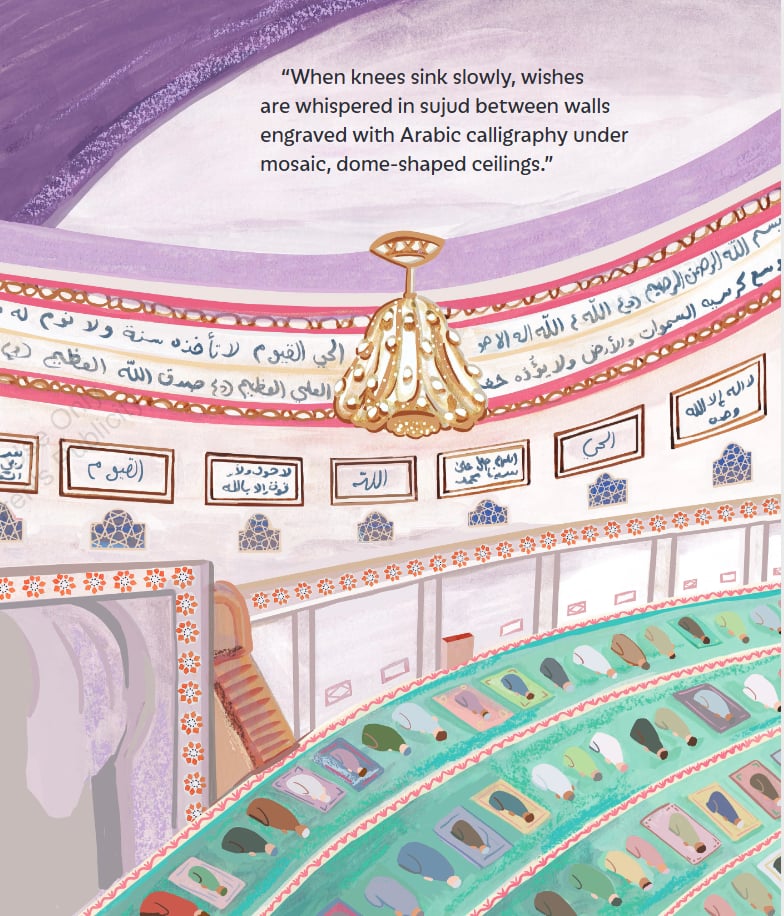
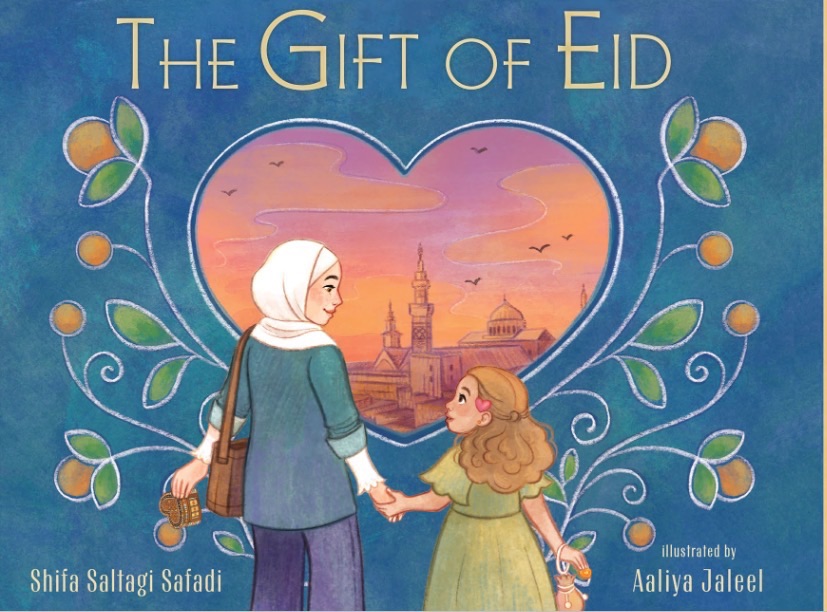
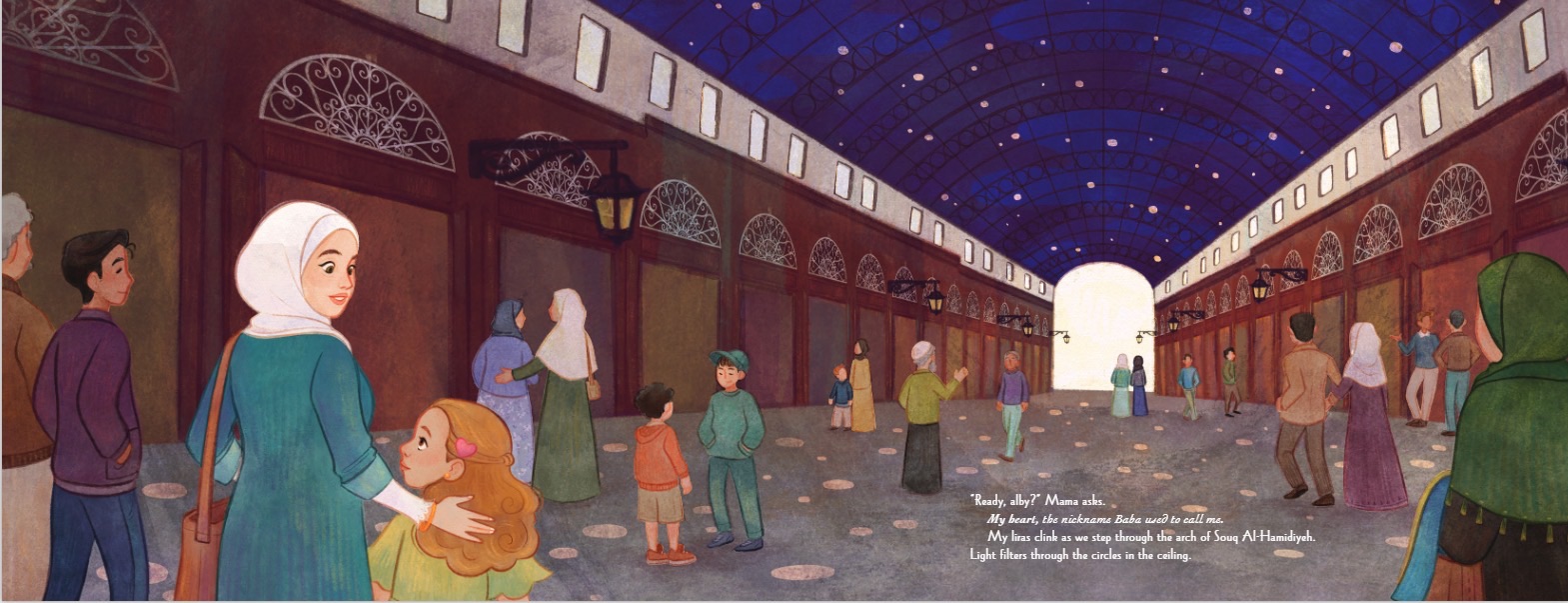
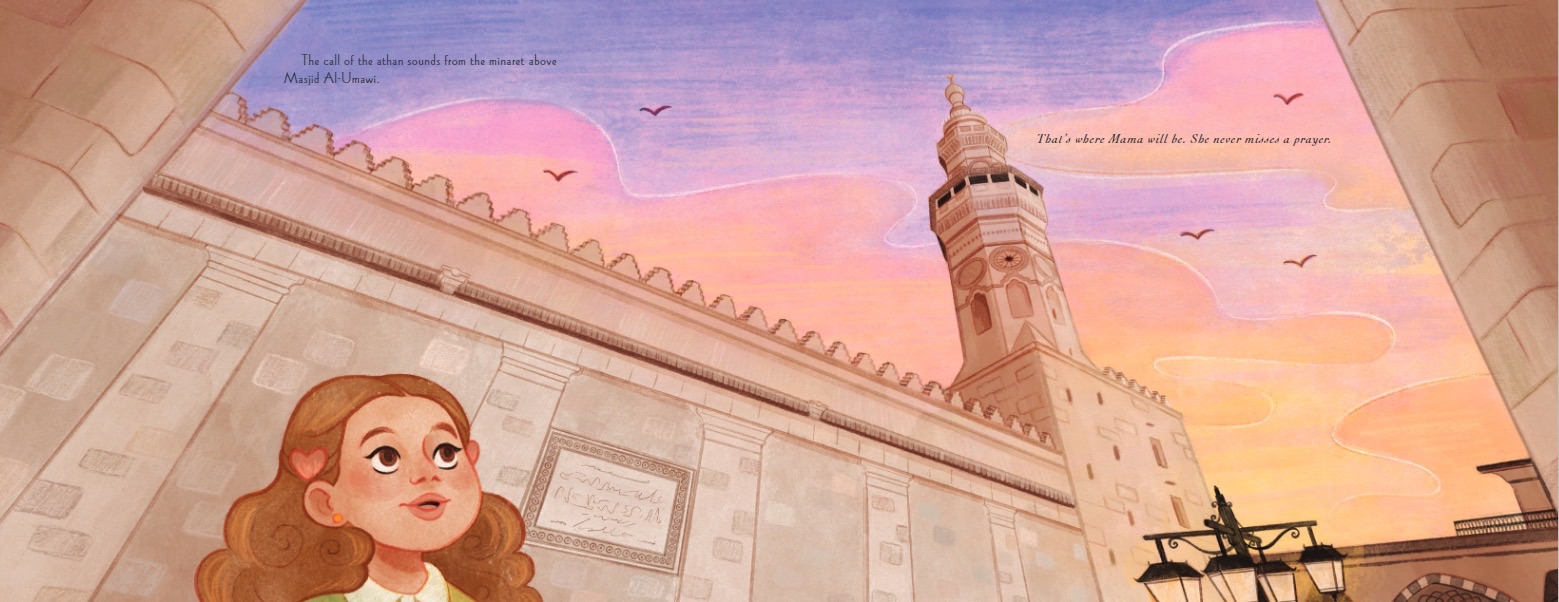
With heartfelt words and large two-page spread illustrations, this beautiful book shares a mother and daughter finding the perfect Eid gift for one another while bringing the reader into the Souq Al-Hamidiyeh, before sending them off to Masjid Al-Umawi for a warm hug.  A retelling of the classic, A Gift of the Magi, the story poignantly presents threads of love, gifts, loss, and Eid to fill the reader with joy, peace, and gratitude.  I’m admittedly very bias, as a close friend of the author, but this beautiful book doesn’t need lip service or marketing, it will appeal to all readers in all settings, and be cherished and asked for, over and over again, all throughout the year. Alhumdulillah.

The book starts with Yasmine and her mama entering the souq through the archway, and Yasmine remembering her father and her imagining the circles in the ceiling to be twinkling stars.  He is no longer with them, the magic is gone and money is tight now, but with liras jingling in her pocket, Yasmine is determined to find an Eid gift for her mother that will make her smile.

Yasmine looks around the shops as her mother counts out liras to buy za’atar, and tries to find something cheaper than sfeeha at the bakery.  She finally knows what to get her mother, but it is more lira than she has.  With determination and selflessness she makes a decision to get her mama the perfect gift.

The process separates the two, and when they reunite at the masjid for maghrib salat, it isn’t the gifts themselves, but rather what they mean, that make the laughter, tears, and love overflow.

I love the emotional depth the book conveys so deftly, never explaining or pulling the reader out of the story, thus allowing the connection to linger long after the book is closed, a rare treat in a picture book.

The Boldest White: A Story of Hijab and Community by Ibtikhaj Muhammad and S.K. Ali illustrated by Hatem Aly

Standard
The Boldest White: A Story of Hijab and Community by Ibtikhaj Muhammad and S.K. Ali illustrated by Hatem Aly

The third and final book in the standalone series is finally out and I absolutely love that Islam, salat, and the masjid are front and center. Faizah is once again brought to life through the incredible illustrations that provide all the emotional beats and make the book memorable.  The story though is only just ok, to be honest, it is clunky and disjointed.  I have read the book a half a dozen times to myself and twice aloud and I do not understand the Eid story line.  I doesn’t fit the themes of fitting in, being a leader, being bold, it just seemed to be there to motivate a white hijab being purchased, and it was very distracting to the cadence and continuity of the story. Every time Faizah is self reflecting on her fear, suddenly a conversation about Eid with a friend named Sophie disrupts the story. Even the refrain that “Bravery grows in your mind.  But its roots are in your heart,” sounds lovely, but is never explained or developed, so what are you to water it with? What are the right reasons?  I’m sure most will be fine with the concepts and presentation and not be bothered, but this book is an auto buy for Muslims and non Muslims alike, and while I appreciate the packaging, I wish the story itself was more, well “Bold.”

The book starts with Faizah going to Jummah with her mom and sister, and loving being part of the crowd, she then goes to fencing and loves being part of the crowd, “it feels right.  I feel right,” she says.  But then the coach calls her name and she starts to worry.  She doesn’t like when people stare at her, she worries she did something wrong. The coach has already reminded her to “saber first, then move forward,” so I’m not sure why she worries after if she did something wrong, it is a class, reminders and corrections are what happen in a class.

Then on Sunday, the trio is back at the masjid for salat before Asiya’s fencing lesson.  The coach asks Faizah if she wants to come in for extra practice before the tournament.  Faizah isn’t planning on participating in the tournament though and would rather think about Eid.  Thinking about getting together in the future with Sophie to pick out Eid clothes, is more fun than fencing.  The reader doesn’t know when Eid is, or why Faizah seemed to break into a day dream when asked about fencing.  Furthermore the reader doesn’t feel the worry of being in a competition because Faizah is not shown to be worried.

Later that night Asiya teaches Faizah the moves she learned and Faizah practices alone.  There is then a two page spread that I do not understand, on one page she is saying, “When no one is watching, I ‘m the best fencer in the world,” three lines later it says Even when others are watching, I can do it.  I can be the best.”  What happened in between? I get the following line, “but it’s hard to be my best when I have to stand out to do it,” but the the line in the middle makes no sense.  What is the point of the book if she can do it and knows it at the mid point?  And no, I’m not reading an arc, I checked out this copy from the library.

The family is back at the masjid on Friday and reassuring Faizah as they head to fencing, that she can do it even when people are watching, that bravery will come.  She hasn’t been nervous at class before, and hasn’t signed up for the tournament, so why is she suddenly uncomfortable, when at the start she loved fencing class as she felt she fit in.

Then it is Saturday, and Sophie finally comes, but not to prepare for Eid, just to discuss, how they will prepare for Eid.  At least now we know it will be next week. The next Friday, I know I feel like a calendar should have been included, it is fencing class again and Faizah is called up to demonstrate.  She finds her strength and she is shy, but realizes they are not just looking at her, but looking at what she can do.  She is leading, she is helping, she is being brave.

Finally it is Sunday, and Sophie and Faizah are at the hijab shop, and Faizah picks a white hijab because it matches the fencing clothes, and she is going to the tournament.

Yeah, sorry I spoiled it, I just really am sad that the book wasn’t as great as it could have been.  It connected the dots eventually, but not in a memorable way, and for the team responsible for this book, it really could and should have been amazing.

Sister Friend by Jamilah Thompkins-Bigelow illustrated by Shahrzad Maydani

Standard
Sister Friend by Jamilah Thompkins-Bigelow illustrated by Shahrzad Maydani

img_3521-1

After years of teaching, librarian-ing, and mothering, my reviewers are for adults, but with kids in mind. I read in different environments and try and balance what children will think with my more critical literary impressions. But honestly, my first reaction when I see Jamilah Thompkins-Bigelow has a new book out, is not about the children, or their parents, it is incredibly selfish, and I want to read the picture book for me.  It has been about a year since I first read my all time favorite, Salat in Secret, and I still feel all the feels, every time I read the book. I even enjoy handing the book to people and watching them read it for the first time.  So, I was both excited, and nervous to read this new book, not knowing if it would measure up to my expectations or rather hopes, so to speak.  I needn’t have worried, subhanAllah, this book in it’s own right is moving, heartfelt, layered, powerful, hopeful, relatable, tender, and while staying on a kindergarten to second grade level is also unapologetic with its centering of Islam, race, and feeling invisible, being new, and making a friend.  The illustrations and words blend beautifully, and by the second page of the 40 page book, I was already emotionally attached to the little protagonist Ameena.  Good writing is good writing, and as a result this beautiful book works for all ages and will be appreciated on multiple layers even after dozens of readings, alhumdulillah.

img_3522-1

The book begins with Ameena playing a game by herself.  She always plays by herself at school, where she tends to be invisible.  Maybe it is her hair in twists or her brownness, she doesn’t know.  One day a new girl comes, her name is Sundus, she wears hijab like Ameena wears to the masjid.

All day Ameena tries to talk to Sundus, but something always seems to keep them apart.  When they finally meet,  Ameena’s excited words get all tangled, and a misunderstanding occurs.  Ameena decides the next day to transform into a rockstar: red-orange hijab and matching boots. The other kids say she is copying the new girl.  Sundus doesn’t say anything.

img_3523-1

Ameena disappears again at school, but family night at the masjid is her happy place.  Where she doesn’t play alone, and there are lots of browns, and she is seen.  When Mama meets a new sister, and greets her with Assalamu Alaikum, Ameena sees how a greeting and a hug can be the start of sisterhood and friendship. And the next time Sundus and Ameena meet, they know just what to say.

img_3525-1

The joy at the end forces you to smile, just as Ameena playing alone at the beginning tugs at your heart.  It is a great book to see yourself and see others in a beautiful, authentic way.  The universal themes of not being seen, making a friend, and being the new kid, are woven in just as hijab, masjid and Assalamu Alaikum are, making the book powerful for Muslim and non Muslims alike.

img_3524-1

I particularly love that their is no glossary, and that the text uses the word masjid not mosque, hijab not scarf and Assalamu Alaikum not salam.  That the masjid is her safe place to laugh and play, and that this book is mainstream published and will find its way to public spaces and be widely accessible.

You can preorder your copy here on Amazon.