Tag Archives: life

Rami the Ramadan Cat by Robyn Thomas illustrated by Abira Das

Standard
Rami the Ramadan Cat by Robyn Thomas illustrated by Abira Das

rami

This delightful little story about a boy, a lost cat, Ramadan and making friends, has a great lesson in empathy and understanding even when things are hard.  The 28 page beautifully illustrated glossy book (8.5 x 11)  is set in Ramadan, but is enjoyable for children 5 to 9 all year long.

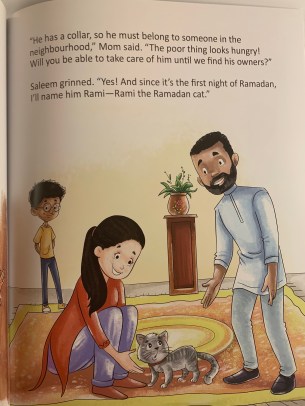
Saleem has just moved to a new city with his parents and doesn’t know anyone.  Feeling lonely on the first day of Ramadan he is outside sulking when he sees a lost little cat.  He brings it in and his parents help him take care of him until they can find the cat’s owners.

B342E851-726B-4B8A-9B63-F381F5C1009D

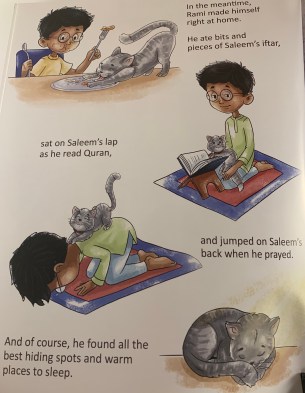
Saleem decides to call the cat, Rami the Ramadan cat for his timely appearance.  The next day the family makes flyers to post around to try and find Rami’s owner.  But no luck even after a few weeks, and secretly Saleem starts hoping they never find the owners.  Rami is his best friend, he jumps on Saleem when he is praying, keeps him company when he reads Quran, even shares his iftar with him.

22F7C85A-8891-4121-A608-421511688C49

One night at the mosque, Saleem makes Dua that Rami will stay with him forever.  After Taraweeh, Saleem can’t find his father, he waits by the door as everyone leaves, but can’t see him, he checks the shoe rack and his shoes are gone.  Feeling scared and alone he wonders if his father left him.  When his father returns from the washroom, Saleem is relieved, but wonders if that is how Rami felt that first day of Ramadan.

6E10660E-7FE3-4341-AF7E-B75EDF45DC8E

The next morning Saleem and his mom knock on every door in the neighboorhood until they find Rami’s owner.  When they find her, she is a nice lady, and tell Saleem, the cat’s name is Sammy.  Rami gives her his address and asks her to contact him if she ever needs someone to cat-sit Rami.

3634A3A5-B74D-4505-8C44-AED216D38872

Saleem’s Eid isn’t very fun without his only friend.  After prayers, there is a knock at the door, Sammy’s owner has come to offer to let Saleem keep Rami if he promises to bring him around to visit with her and her grandkids sometime.  She has other cats and sensed that he was missing Saleem.

16157CCA-24F9-4BDD-A661-B3353B6775C4

Saleem’s parents invite the lady, Mrs. Tompkins and her grand kids in to celebrate eid with them and Saleem and the children play with Rami, the best eid present ever.

The book shows Saleem praying and reading Quran and going to the masjid, but it isn’t preachy.  I think even non Muslims would enjoy the book and not be confused by anything Saleem and his family are doing.

I love that the mom so clearly wears hijab out of the house, but not in the house.  That there is some skin color diversity in the book, that Mrs. Tompkins is in a wheel chair.  I also love that the new friends, and only friends are presumably non Muslim, and that a little gray cat brought them all together, Alhumdulillah.

Planet Omar: Unexpected Super Spy by Zanib Mian illustrated by Nasaya Mafaridik

Standard
Planet Omar: Unexpected Super Spy by Zanib Mian illustrated by Nasaya Mafaridik

planet omar

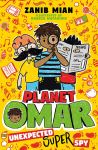
Omar is back, and the nine year old kid with a huge imagination, proves that his heart is even bigger.  Middle graders that loved the first version, The Muslims, and the reboot, Planet Omar: Accidental Trouble Magnet, will undoubtedly love this book’s adventures and the real, relate-abl, presentation of Islam in a Muslim family.  While it references the first book, it can work as a stand alone book too, and can and will be enjoyed by kids and adults, girls and boys, Muslims and non Muslims.  At 217 pages, the large spaces, doodles, playful fonts, and illustrations, make the book fly by and beg to be read again and again.

C95DB8C6-9652-4EB8-8008-112361FAE8DF

SYNOPSIS:

Omar’s family still has their Science Sundays, but they don’t visit a new mosque every Saturday, as they have found a mosque near their home that gives his parents, “secret smiles” and them all a sense of community.  Omar and his sister still bicker, and his little brother Esa is still lovable, and the former bully, Daniel, is now a great friend to Omar and Charlie.  Life is good, Alhumdulillah, but in the midst of the boys planning how to get laser guided Nerf guns and have an all out battle, Omar learns the mosque’s roof is in need of repair and that the congregation will need to come up with 30,000 pounds to cover the costs, and fast.  In an act of selflessness, Omar abandons his dream of a foam gun and donates to the masjid.  Seeing that is not going to be anywhere close to enough he plots and schemes with his friends, his non Muslim friends, on how to raise the funds.  They bake cookies, make origami birds, and get their school to host a talent show to raise the money.  Their teacher and the head teacher coordinate the hall and judges and winning prizes all to help out Omar and the mosque, in the end though, they raise just under 1,500 pounds.  Not enough by themselves, but a great contribution to what other people hopefully are scrounging up.  The worst part however isn’t that they didn’t make enough, but that what they did make, goes missing.  Omar, Charlie, and Daniel, along with the parents and police and school personnel, try and find the money and who might have taken it before time runs out.

0030B40D-17F8-415C-A54A-7874768A5B5D

WHY I LIKE IT:

I love how effortlessly the author adopts a nine-year-old’s voice and persona.  So many of the details, for example, about how the school administration signed off on a fundraiser for a religious building, and how tickets were sold, and the planning took place are left out, as a nine year old, probably wouldn’t know, or be concerned with the logistics of such endeavors.  It seemed like some details should be given, but I doubt readers would feel that way, so I pushed it aside and went along for the ride.

Omar has amazing friends, from the unpredictable old neighbor lady, to his non Muslim friends being so enthusiastic and supportive of saving a mosque.  I love it, and that they are that way because Omar is so unapologetically Muslim first.  They even discuss a hadith about how building a mosque, builds you a house in Jannah, and a mainstream book published this, and it is AMAZING! It isn’t just a kid and his family, who happen to be Muslim, the whole plot of the book is to save a mosque, and the fact that this book exists, seriously is so beautiful, and powerful, and hopeful, Alhumdulillah.

This book has a lot of layers, most kids won’t pick up on the interfaith aspects being so ground breaking, or the beauty of teachers and parents believing and supporting young kids, but will just read it as a funny story with anecdotes and inside jokes that they get as kids, as Muslims, and maybe even as Desis.  It truly is the culmination of an author who can write well, characters that our kids can see themselves in, and an opportunity to tell our OWN stories that make this book work for kids, adults and everyone in between.

3C3DA84E-29F6-4A6D-90FE-0BC134E7E615

FLAGS:

Omar and his sister are mean at times, but alas love each other and look out for each other too.

TOOLS FOR LEADING THE DISCUSSION:

I don’t do an elementary book club, but if I did, I would do this book in a heartbeat.  For middle school it would be too quick of a read, but I think all classrooms and all libraries should have the book, up through middle school.

https://www.alaraby.co.uk/english/society/2020/2/7/planet-omar-pushing-for-muslim-characters-in-childrens-literature

I got my copy here in the US at www.crescentmoonstore.com and as always you cannot beat their customer service and prices.  If you don’t have the first book, you can get it there, too.  Thank you Noura and Crescent Moon Store.

Zainab is Different by Irfana Khan illustrated by Josh Wise

Standard

zainab is different book

This 24 page picture book for kindergarten children and up, is sweet in its handling of being labled “different,” without getting overly negative or caught up in the manifestation of discrimination.  Unfortunately, with so much emphasis on different religions: the places of worship, the holidays celebrated, the manner of dress, etc., faith becomes inadvertantly highlighted as the root cause for the division and discrimination.  Perhaps I am reading too much in to it, and the book just needs a few more examples to make the author’s point that we are all different and unique, but as it is, I didn’t love it, my kids all thought it was cute though, especially my daughter named Zainab.

IMG_0555

Zainab walks to school every morning with her mom.  She says hi to the neighbor and can’t wait to get to school to her best friend Melissa and her amazing teacher Mrs. Sperber.

IMG_0556

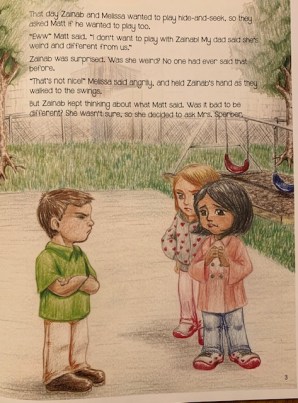
One day Melissa and Zainab want to play hide-and-seek and ask Matt if he wants to play too.  He responds, “Eww, I don’t want to play with Zainab! My dad said she’s weird and different from us.”

IMG_0557

Having never been called that, Zainab is bothered by the words and tells her teacher.  The teacher points out that they have different colored hair, but can see that Zainab is still hurt and tells her not to worry, she has an idea.

IMG_0558

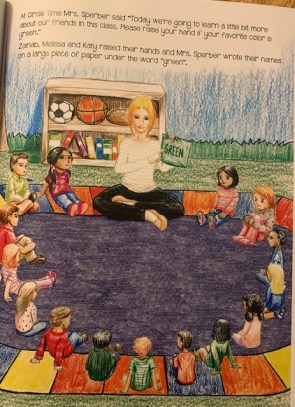
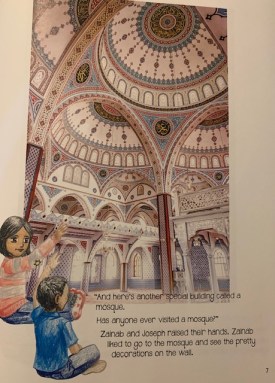
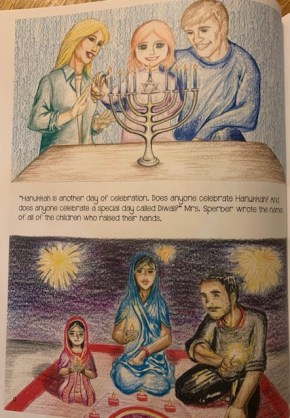
At circle time the teacher starts of by highlighting differences with the kids identifying their favorite color, and her writting their names on the ones they like best.  She then asks about places of worship they visit: churches, mosques, synagogues, temples, and again writes their names on the ones they have been to or frequent.

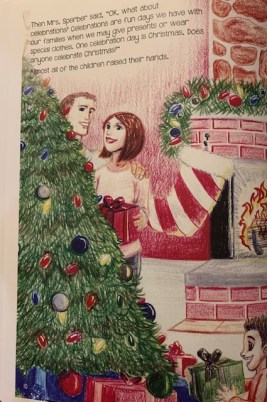
IMG_0559 Next she moves on to holidays celebrated, and then special clothing, only hijab is mentioned though.  The teacher then discusses feelings and how things about us might be different but our feelings are the same.  We like it when we are all nice to each other, and are sad when someone is mean.
IMG_0560

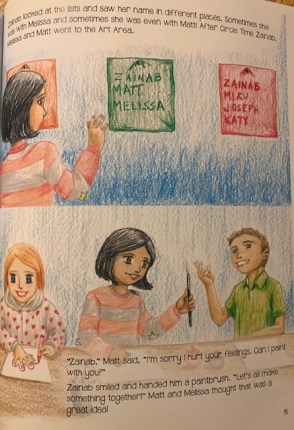
Zainab sees her name with different people’s names on the pictures now hanging up and Matt comes and apologizes for being mean earlier. The teacher also mentions that maybe some haven’t visited any of the buildings discussed.

IMG_0561

The pictures appear to be done in colored pencil and are colorful and detailed with the pictures of the places of worship bein actual images.  The 8.5 by 11 pages are large and would work well at story time or bedtime.

IMG_0562

The fact that Matt’s words are assumed to be about religion seems presumptious to me.  Maybe they are, maybe they aren’t, I feel like there needed to be more there.  A few pages about things other than faith, in my opinion, would make the message of us all being different in some things and the same in other things a bit more powerful.   The pacing too is a bit off. It is a big jump from what is your favorite color to do you go to a church?  The resolution is really quick too, as it is tied into feelings, a little bit more of showing the reader, rather than just telling them, would amplify the process and the message.


Mr. Wolf’s Class by Aron Nels Steinke

Standard
Mr. Wolf’s Class by Aron Nels Steinke

wolf

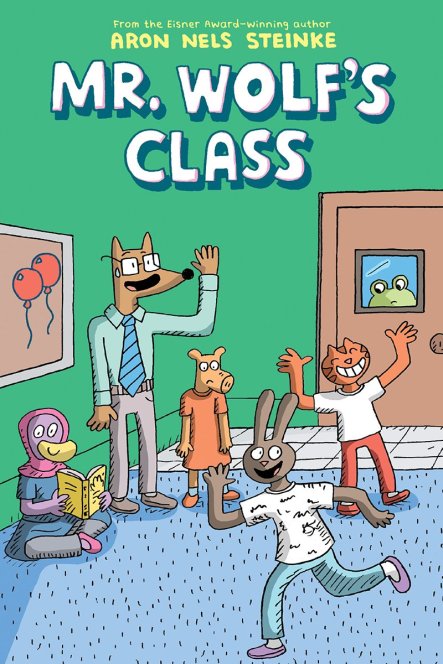
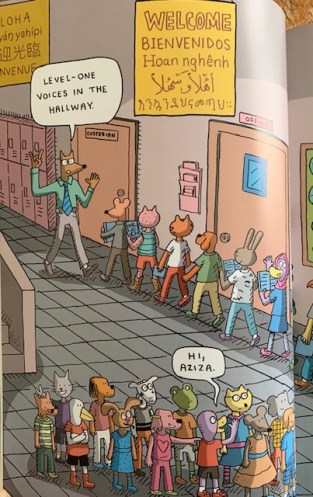
I know this AR 2.1, 156 page graphic novel probably doesn’t deserve a review, but for as important as OWN voice books are, books with Muslim characters thrown in the mix are important for representation too.  Yes sometimes we are the star and we definitely need to tell our own stories, but we are also friends, and side-kicks and supporters too.  In this case we are a purple duck with a headscarf named Aziza, that thinks she is smarter than the other 4th graders in Mr. Wolf’s class, but fits right in with the quirkiness of the anthrmorphized cast too.  There is nothing mentioned about the scarf or about Aziza’s faith, there is also a boy named Abdi in the class that is a cat and could also be Muslim, but really, in this silly book which is the start of a series, I was just so giddy to see a Muslim included and grateful for the representation.

IMG_0487

SYNOPSIS:

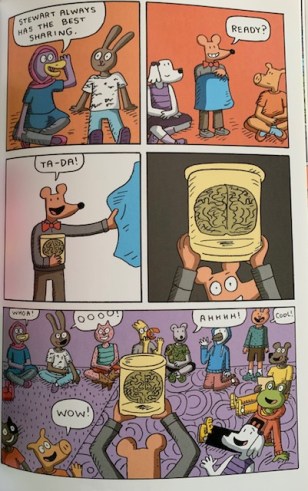
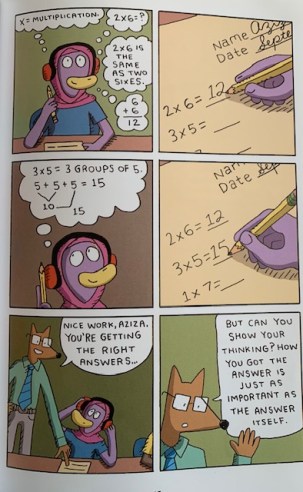
It is the first day of 4th grade and Mr. Wolf is nervous.  Margot is new too, but the other kids seem to know each other already.  Aziza, Abdi, Randy, Sampson, Henry, Penny, Bobby, Lola, Oliver, Stewart, Miguel, Noah, Molly, Lizzy, Oscar, and Johnny are all different animals and all unique.  The book is really just a handful of the characters trying to survive the first day of school.  Whether it be confronting another teacher about stealing your stapler, making a friend on the bus, having rats steal your lunch, falling asleep in a box because your new baby brother kept you up on all night, or trying to figure out why you have to show your work when on a math assessment.  The book will resonate with kids 2-4th grade and make them giggle at the silliness of it all.

IMG_0488

WHY I LIKE IT:

I love that the teacher is more nervous than the kids about the first day of school and that they all seem to be doing the best they can.  Aziza is earily irritated by her classmates who don’t seem to want to do their work, but she is no more annoying than the other students and all seem to have diverse backgrounds and issues at hand.  The author was an educator and the book reads true to any one who has littles or has been in a school environment, making it all the more charming.  There are four books thus far in the series and my kids say Aziza features prominantly in the second book too.  I have had this book in my house for a while now, and for some reason just now paid attention to the cover today when begrudgingly scolding my kids about leaving books out everywhere.  I asked if the duck had on a hijab and two of my boys without budging to put away said book, replied, “yeah it is Aziza.” As if seeing a muhajaba duck is the norm, who knows maybe it is.  So, I sat down to read the book with enthusiasm and 20 minutes later, thought how great it is to be included. Representation does shape perception, and non Muslim kids may not think anything of it, or my own kids who are flooded with Islamic fiction books, but I can only imagine how ecstatic I would have been as a kid to be included as the norm without fanfare or explanation given.

IMG_0489

FLAGS:

They talk about if farts are better or ice cream in the creation of a venn diagram.

IMG_0490

TOOLS FOR LEADING THE DISCUSSION:

Wouldn’t do it for a book club, but would definitely have it in a class library and school library.  Fun book, seemingly fun series, and easy reading for all levels.

https://www.mrwolfsclass.com/interviews-and-press

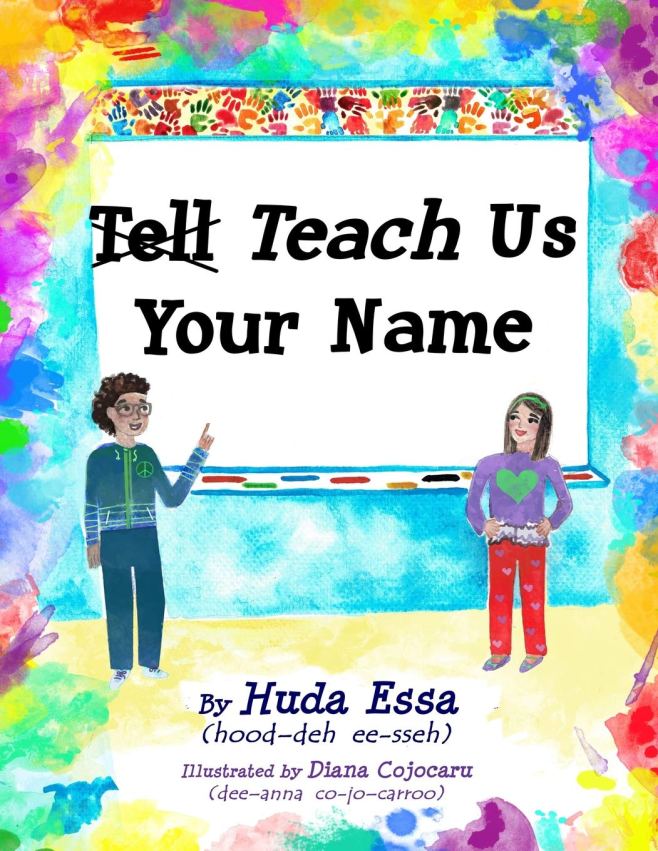
Teach Us Your Name by Huda Essa illustrated by Diana Cojocaru

Standard
Teach Us Your Name by Huda Essa illustrated by Diana Cojocaru

name cover

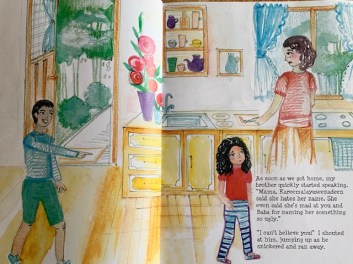
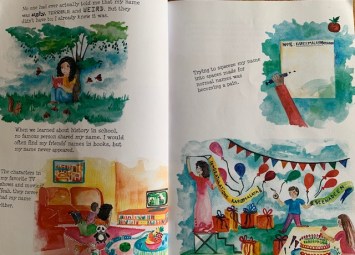
This book will resonate and empower anyone who has a “different” name, and hopefully provide insight and awareness for us all.  This 32 page picture book for grades 1st and up has a self empowering message, a confidence building approach, and problem solving tips to achieve a desired goal in a respectful way.  Written by a Muslim author, the book’s text is well done, unfortunately the pictures are inconsistent to me, some are beautiful and detailed, others seem rushed and unfinished.

IMG_0476

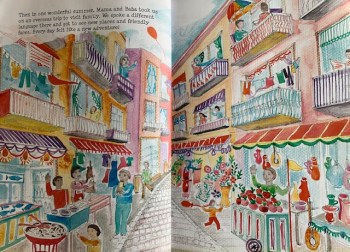
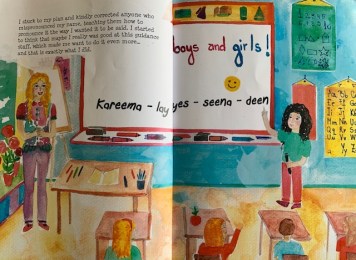
There are 20 letters in Kareemalayaseenadeen’s name, and the first day of school is such a stress for her.  She fears the teacher stumbling over her name, the other children laughing, and her unable to tell them how to pronounce her name correctly.  Her mom tries to explain that for some people the kids at school have hard names, and that for some people her name is easy.

IMG_0477

She reflects that in fact no one has ever made fun of her for her name, but that in history class she never sees her name, or on TV or in movies or on key chains.  She can hardly fit her name on her worksheets, and fitting it on banners is impossible too.  Eventually the kids kust call her Karma-Deen and even though she dislikes it, she is too shy to speak up.

IMG_0478

Over the summer, Kareemalayaseenadeen goes on vacation to visit family.  She doesn’t even think much about her name where everyone can pronounce it and say it with ease. Her Sittee though, has heard about her anxiety and sits with her to help her work through it.

IMG_0479

Sittee asks Kareemalayaseenadeen if she knows that her name means “excellent guidance” and that her name is a big part of her.  If she doesn’t like her name she isn’t liking an important part of herself.  She then urges her grandaughter to guide others on the proper way to pronounce her name.

IMG_0480

On the flight home, she ponders her grandma’s words and how to guide others to proper pronouncation, without being rude or settling on them shortening her name.  When she gets home she puts her plan in to action. And it works!

IMG_0481

When Kareemalayaseenadeen grows up, she becomes a teacher and each year she reads this book she has written (the one I’m reviewing) and asks her students to teach her how to say their names.

IMG_0482

The importance of how valuing someones name values the person and their family and culture is really one that as a society we have to keep working on.  We can say  names from Lord of the Rings, and Star Wars and Game of Thrones with no problem, so why can’t we try and pronounce someone’s name who is real and next to us and important to us? We have become lazy, and we need to do better, this book is sweet and kind and should really be read regularly as a reminder to us all, that names are beautiful.

IMG_0483

There is nothing religious about the book or even culture specific. There is a hijabi in the illustration of the market place in the unspecified “overseas country” and the name Kareemalayaseenadeen has Arabic bits, but a lot of names do as well, grandma is refereed to as Sitti, but isn’t defined, so the book is definitely meant for eveyone, especially those who will never find their name on a mug at a gift shop!


Amira Can Catch! by Kevin Christofora illustrated by Dale Tangerman

Standard
Amira Can Catch! by Kevin Christofora illustrated by Dale Tangerman

amira_can_catch

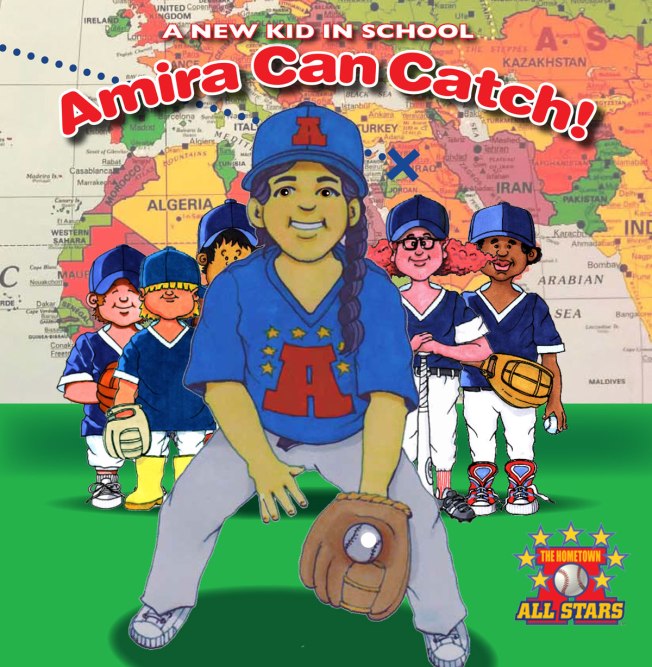
This is book four in the Hometown All Stars series aimed at 4-7 year olds.  The purpose of the series is to teach real coaching skills to help children learn about baseball, get out of the house to play, and have fun.  The 34 page book is baseball technique heavy with a fictional storyline to move it along.  Most sports books focus on team work and being a good sport, but this one takes it a step further by emphasizing the basic skills needed to play the game, as well as sneaking in lessons about inclusion and acceptance.  If your child is American and likes sports, the book will be a hit, pun intended, but there is a lot of text on each page and as America’s pastime, there is a lot of space dedicated to what it means to be American.

IMG_0410

A refugee Muslim girl from Syria, Amira, is invited to play on the after school baseball team, but first needs some help at school with spelling and adding.  Luckily the kids in class are super nice and accepting and help her learn about life in America, while similarly listening to her tell about life in Syria and at the refugee camp.  Not only do they all become friends, she also gets everyone to appreciate how much food they have, and the variety, as well as gets everyone to try pickles. Yum! They like them.

IMG_0411

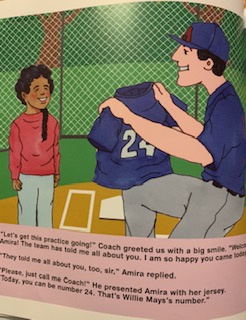
The kids at baseball practice are also incredibly welcoming as they get Amira a jersey, and teach her all about #24 Willie Mays.  From here, it is like a virtual baseball practice, the kids warm up with stretches, running the bases, and practicing their stances.  There are little info headers explaining things such as what hand to wear your mitt on and explaining how to squat, why the coach is using foam balls, and reminding the reader not to throw balls in the house.

IMG_0412

The kids learn three different types of catches.  How to stand, how to position their hands and how to be ready.  They run drills and practice, practice, practice. They find out Amira is really good, and she tells them that they had a lot of time to practice catching and throwing in the refugee camp.

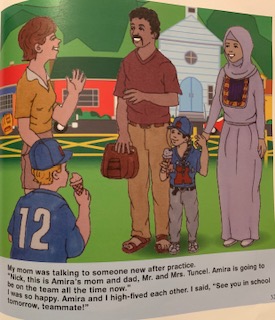
The coach then asks the kids and readers questions before Amira’s parents arrive to pick her up.  With big smiles on their faces, the mom is wearing a hijab and chatting with the narrators mom.

IMG_0415

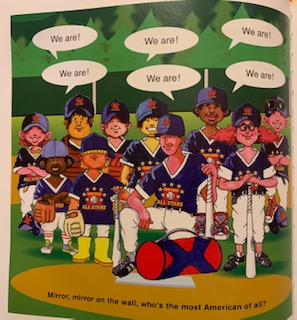
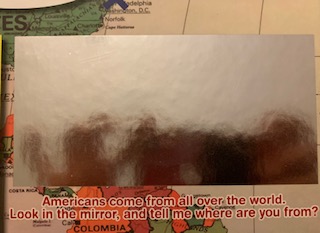
The book ends with a whole page on “What Does It Mean to be American,” a review of new words learned in the book, and all the kids answering who’s the most American of all, with “We are!”  The back cover has a reflective patch with the statement “Americans come from all over the world.  Look in the mirror, and tell me where are you from?”

IMG_0416

The book and series are a great way to learn about a game, that really a lot of kids today may not know much about.  Some of the terms, the skills, and just familiarity is clearly conveyed, with the illustrations providing the visuals and diagrams for what the coach is talking about in the text.  The fact that the author chose to add a refugee to such an “American” book and have the supporting  characters so welcoming, really does show the best of what Americans can be.

IMG_0417

Luv Ya Bunches by Lauren Miracle

Standard
Luv Ya Bunches by Lauren Miracle

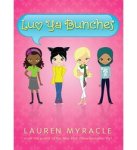
bunchesA book about 5th grade friendships told from the perspective of four different girls in a variety of styles: instant messages, chatroom conversations, video scripts, and traditional text.  The author seems to have a checklist of diverse characters and afflictions that all must make an appearance in the 335 page story.  It is written on an AR 4.4, but with one of the main characters having two moms, details of a suicide mentioned, talk of pole dancing, male anatomy joked about, thongs, crushes, and mental illness, four girls coming together to form friendships and take down a bully, might raise more questions for young readers than they are ready to handle.  Yasaman the Muslim girl in the group, also borders on perpetuating more stereotypes than she breaks, and while I definitely don’t think this book is a good fit for 4th and 5th graders, I don’t really recommend it for readers of any age, there are just better books out there.
SYNOPSIS:

Asian American Katie-Rose doesn’t have friends, unless you count her neighbor Max, but she doesn’t.  She dreams of having blond haired Camilla as a best friend, but the Camilla she went to Pioneer camp with is not the Milla at school who hangs out with Modessa (aka Medussa) and Quin, and is popular.  Katie-Rose also dreams about being a cinematographer or director, she isn’t sure yet, but she loves to imagine scenes and scripts and how things ideally should play out, even when in reality they never quite seem to do so.

Milla, isn’t sure if she wants to stay friends with Modessa and Quin, they aren’t nice and she has a lot more fun with Katie-Rose, but somehow she always ends up going back to the popular crowd.  She also has a lot of anxiety and needs various totems with her at all time to feel secure.  When her little plastic turtle goes missing, she struggles to stay composed, and her and her turtle will end up changing a lot at Rivendell Elementary.

Violet, is the new girl at school and she is not liking her life at home or at school.  Her mom is in a mental hospital and she misses her desperately, her dad brings home fast food every night for dinner and life just isn’t the same since she moved to California.  Immediately able to tell who the popular kids are at school, she hasn’t decided which group of friends is the best fit for her, but when she stumbles on Tally the turtle, and doesn’t immediately return it to Milla, she has to understand what that says about her, and figure out if she is strong enough to make things right.

Yasaman is the quiet computer wiz, she is also Turkish-American, Muslim, and a hijabi.  She designs a platform where kids who are too young to join Facebook can chat, stream videos and send cupcakes.  The only problem is, she has no friends to get to join.  When Katie-Rose and her strike up a friendship, the first seeds of the four flower named girls are planted, but it will take all four of them to put Modessa in her place, rescue Tally, and deal with stereotypes, emotions, and family along the way.

WHY I LIKE IT:

I love that a Muslim, muhajaba is included in the quartet, and that her religion, her scarf, her culture, and her belief in Allah, actually are sprinkled in.  I don’t love how in the book’s efforts to include such diversity, that it also seems to fall for a lot of the stereotypes that it on the surface seems to be dispelling.  Katie-Rose asks her if she even knows what YouTube is before being made aware of how computer savvy she is.  All this is to subtly show the assumption that Muslims are not aware of technology and whatnot, and set the record straight, but also regularly thrown in are side comments from Yasaman that her father would never let her wear something, or she wouldn’t be allowed to do that because of her dad, definitely reinforcing a male dominated, authoritarian, out-of-touch patriarchal view.  Even her mother, an artist, is shown to demand a lot of Yasaman and be incredibly strict.  A lot of things aren’t spelled out, they are just dropped in and assumed that the reader get’s it.  But only Yasaman’s parents are portrayed this way.  Milla’s two mom’s are caring, Violet and her dad seem close, and Katie-Rose’s parents are rarely highlighted.  So, I felt like it was noticeable, and not in a positive way.

I’m still completely confused as why pole dancing and male anatomy made appearances in the book.  And the pole dancing reference appeared not once, but twice when Yasaman is talking to an older cousin who is talking about a friend who’s aunt is a pole dancer, and then later when Katie-Rose’s babysitter also mentions the same friend.  They also discuss people as being slutty and boy crazy and skanky.  The male anatomy isn’t spelled out it is hidden with a girl with major orthodontia reading a Wikapedia page on the greek satyrs, discussing their physical pleasures and talents.

There is also a lot of mental health issues that I’m glad are present, but I’m not sure if they are handled seriously enough.  I’m glad they are addressed, because awareness is a good thing, but discussing how someone swallowed pills to commit suicide and even though she changed her mind still died, and not giving any context seems to make the concept come across as a bit trivial to me in its presentation.  Same goes for Camilla’s anxiety and Violet’s mom being in a mental hospital.  These girls have some major stuff going on that their preoccupation with a snotty group of girls, and the obsession of mud being consumed in an ice cream shake, seems a bit off.

Overall, the girls seem incredible perceptive and articulate in their self reflection and understanding of social personas, that I found their banter completely disjointed.  I don’t think the author’s voice is consistent, and the heavy stuff is too much coming from 5th graders in my opinion.

FLAGS:

Stereotypes, and discrimination against Yasaman and her younger sister Nigar.  Possible triggers with talk of suicide.  Milla has two moms, it is never labeled or made an issue, she just refers to them as Mom Abigail and Mom Joyce. Talk of boy private parts and erections, crushes, pole dancing, words such as skanky, and slutty and dingleberry (poop hanging on) used.  There is lying and bullying and retaliation and poetic justice.

TOOLS FOR LEADING THE DISCUSSION:

I wouldn’t use this book for a book club or even have it in the classroom.  I think it gets a bit crass unnecessarily and the cute flowery cover and inside flap, makes it all the more surprising.  You might expect some potty humor in other books, but knowing it is there allows the reader to make a decision to read it or not, I would imagine most Muslim parents would see four diverse girls on the cover, one wearing hijab, get excited and hand the book to their 3rd or 4th or 5th grade daughter and have no idea what the book also includes in passing, with no relevance to the story lines highlighted on the inside flaps and back of the book.

Lissa: A Story about Medical Promise, Friendship, and Revolution by Sherine Hamdy & Coleman Nye illustrated by Sara Bao & Caroline Brewer

Standard
Lissa: A Story about Medical Promise, Friendship, and Revolution by Sherine Hamdy & Coleman Nye illustrated by Sara Bao & Caroline Brewer

lissa-1440x2122

When I first started teaching I wasn’t a big fan of graphic novels, slowly I saw their benefit for struggling readers, and eventually I came to appreciate them as an enhanced tweak in story telling for everyone.  This book however takes the concept to the next level, for me anyway.   As the inside flap claims, it is a book “that brings anthropological research to life in comic form, combining scholarly insights and accessible, visually-rich storytelling to foster greater understanding of global politics, inequalities, and solidarity.” As a coming of age story of two friends at its core, yet taking on breast cancer, kidney failure, parental loss, different cultures, different religions and with a back drop of the Egyptian revolution, I’d say the book is meant for high school and up.  Not so much for content as for understanding and appreciation of all that went it to creating this ethnographic book.

SYNOPSIS:

Unlikely friends Anna and Layla cross economic, religious, and cultural differences to build a life long friendship.  The book is divided into three parts: Cairo, Five Years Later, and Revolution.  In the first part we see Layla’s family serving as the caretakers of a building and the two young girls bonding over pranks, arrogant tenants, and just being silly.  Anna’s family is American and the father works for the oil companies, thus they are financially very well off, however, the father is rather distant and the mother is dying of cancer.  The section concludes with the passing of Anna’s mom and the family going to Boston for the funeral.

Five years later finds the girls in college.  Layla in medical school and Anna at a university in Boston.  Layla’s father is suffering from renal failure and is unwilling to consider a transplant.  While Anna is trying to see if she carries the same genes as her mother and if insurance will cover it.  She also has to decide if she would want to have a complete double mastectomy, if she would want her breasts reconstructed, if she should do it now or later.  She gets a lot of opinions, but ultimately decides to find a way to pay for it and have it done.  Her father doesn’t understand, and Layla dismisses it forcing Anna to have to handle it alone.  But when news come that Layla’s father isn’t going to make it, she rushes back to Egypt to offer her support.

In the final section, the revolution has spread and Dr. Layla is helping those injured in Tahrir Square during the protests, and Anna is helping to identify bodies despite being attacked for being a foreigner and part of the problem.  Anna has kept the secret of her mastectomy from Layla and Layla assumes she has cancer.  At odds with their roles in the revolution, and with keeping secrets from each other and their differences in financial opportunities coming to a head, Anna returns to Boston.  When Layla’s brother is shot and loses an eye, however, Anna returns to Egypt and the two friends work to keep their relationship.

IMG_8951

WHY I LIKE IT:

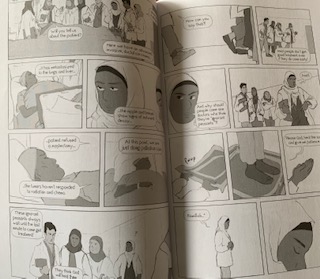
The book is grounded in so much conflict and turmoil, but fights hard to keep a character based narrative.  With two illustrators and two authors trying to convey medical approaches, two cultures, two religion, two friends, and a revolution, the last 70 pages of the 302 page book are details about how the book came about, interviews with the various contributors, a timeline of the revolution, discussion questions, key references and a teaching guide.  The book at times was confusing to me, and I’m not sure why, it quickly resolved itself or a flip back a few pages would clarify it, but I think some of the illustrations were just off enough that it complicated things.  Anna by and large is depicted oddly on a few pages along with her family as well.

IMG_8950

Layla’s family is definitely religious and at times has to challenge their thoughts to understand Anna and their own circumstances too.  I think it is handled really well and allows the reader to consider things without answers being clear cut, is it Allah’s will to not have a transplant and accept death as being written for you or to have the transplant and ask Allah to make it successful?  By and large the book poses questions through the juxtaposition of the two characters and the experiences they endure, and while it shows the choices they made, it draws the reader in to wonder what they would do in their shoes without judgement.  The book provides a lot of facts and leaves them there making it more thought provoking than a simple story.

The characters are often composites of real characters the academic author’s learned about, yet some are directly based on activists and leaders of the revolution.  The graffiti artwork is attributed and powerful.  There is a lot of information in the notes after the comics end.

FLAGS:

There is death and revolution, Layla’s brother is taking Tramadol, and their are sketches of breasts as Anna learns about her disease and prognosis.

TOOLS FOR LEADING THE DISCUSSION:

I wouldn’t do this as a book club as I don’t know how much middle schoolers would get out of it and the book is pretty pricey.  I would recommend people read it though as it gives a different perspective on numerous things many of us take for granted.

Home


Satoko and Nada 1 by Yupechika

Standard
Satoko and Nada 1 by Yupechika

satoko.jpg

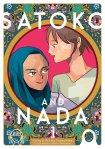
A manga series about two college roommates who have come to America to study, Nada from Saudi Arabia and Satoko from Japan.  Written by a Japanese author and translated into English, there is a lot about Muslims, particularly Muslims from Saudi, as the two characters get to know each other and become friends.  Their interactions work to dispel a lot of stereotypes and promote how rewarding getting to know people different from your self can be.  Volume one (there are three) is 127 pages, read right to left in four panel pages, and is fairly clean for all ages (they do buy underwear and bras at one point), but would most likely appeal to female readers in 4th or 5th grade and up.
8CE09DE5-2BEB-48C0-9157-96B13CC78CD9

SYNOPSIS:

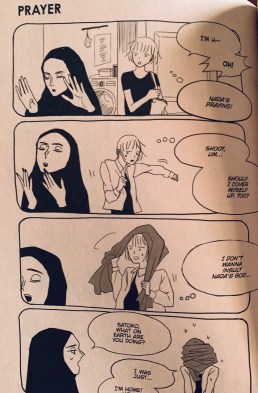
The book is about two girls getting to know each other, learning about each other’s culture, and navigating life in America.  There isn’t really a plot or a story line outside of this basic framework, and with a heading every page or two it reads like a quick scene about the topic expressed in the heading.  So, for example there are headings of Veils, Ramadan, Birthday, MashAllah Choice, etc, and then a few panels showing the girls having an interaction about it, resulting in understanding, humor, or a lesson.

In a bit of a stereotype twist, Nada is more street savvy then Satoko when approached by a stranger for a ride, and thus Nada hasto educate her a bit.  The book brings in a Christian American character and a third generation Japanese character learning Japanese, to further show how assumptions plague as all and how simple conversation and an open mind, can lead to some amazing friendships.

WHY I LIKE IT:

The book is really choppy, but you get used to it and soon you forget that it isn’t a typical story.  I admittedly haven’t read a lot of manga so, I have no idea if this is the norm, or something unique.  I love that its upfront about stereotypes, if it was an American writing it, or a even a Muslim it would probably come across as preachy or arrogant, but somehow it doesn’t seem like the two characters have much baggage, nor feel a need to defend their culture by putting another’s down.  They deal with issues such as women driving in Saudi, differences between hijab, burka, abaya, niqab, being around alcohol,  the joy of a fatwa allowing soy sauce and its alcohol content to be permissible, etc.  Some things are cited for clarity and something are very Saudi, but it really contains a lot of information, about Islam that I am pretty impressed by.  There isn’t a ton about Japanese culture since I would assume it was written for Japanese readers, so it would be redundant, but I did learn, according to Satoko, how religion is viewed by Japanese, how putting age and gender and race on forms seems incredibly personal, and some information about food.

FLAGS:

There is a possible failed abduction, not sure what the guys intention was, but the girls treated it as such.  The girls do go buy undergarments, so they are visually depicted.  There is mention of alcohol.

2DF66805-A246-4150-89BA-E7E1EAF90E90
TOOLS FOR LEADING THE DISCUSSION:

I wouldn’t do this as a traditional book club, but I think I am going to get a copy of the series to pass around my daughters middle school group of friends, to

one- give them a taste of manga

two- see what they think of the Islamic rep from a Japanese paradigm and

three- give us all something to chat about

The book is fun, I got it at the public library and think it might open up a new book type for kids to try and a new point of view for many of us to consider.

Can Mustafa Control His Anger? By Hadeek Aziz and Katherine Bullock illustrated by Eman Salem

Standard
Can Mustafa Control His Anger? By Hadeek Aziz and Katherine Bullock illustrated by Eman Salem

mustafa.jpg

When I finished the 27 page Islamic fiction early chapter book, I thought, “It reads like a child wrote it.”  And sure enough as I flipped to the bio page I learned that indeed it is written by a secondary school senior.  I don’t want to be overly critical as a result of learning this, but as a published book that I paid for, I really wish some would have “corrected the book” and smoothed it out.  It has a lot of potential, and a good message, it just slightly misses the mark in details, some awkward tense changes, and crossing the line of what Mustafa does and says when he lashes out.  He doesn’t apologize and physically assaults people without consequences other than kids not liking him, and considering its for independent readers seven and up, that is a bit concerning.

SYNOPSIS:

Mustafa is a nice boy, except for when he isn’t.  Unfortunately he loses his temper a lot and as a result has no friends.  Whether it is losing a game, having someone not believe him, or even someone taking a treat he wanted, Mustafa resorts to physical violence and hateful words.  No parents or adults seem to ever correct him, so other kids just steer clear of him.

When a teammate won’t pass him the ball in soccer he punches poor Humza and when he goes to throw another punch he gets pushed off and bumps his head.  He storms off into the forest feeling alone, but not remorseful when a little red creature pops up and tells him he will be weak until he can control him.  Determined to show the creature he is strong he chases after it only to be scooped up by a giant named brother Haneef.

Brother Haneef and his giant friends live in a mud house in Makkah.  Shocked at how he got to the desert, he learns from his giant friend to ignore taunting, when another giant says you cannot learn Surah Al-Falaq in an hour.  Later when the giants race and Haneef loses, he says Audhu bilallahi min ash-shaitan ar-rajm and to sit down if standing and lay down if sitting as per the Prophet (saw) advice.  A giant girl gives Mustafa a strawberry tart and when he reaches to get a chocolate cupcake and someone else takes it, both he and Haneef scream, but Haneef goes and makes wudu reminding Mustafa of another hadith.  When Mustafa asks Haneef why he shouldn’t be mean to people that make fun of him or leave him out, Haneef tells him the hadith about how the strong man is the one who controls himself when he is angry.  As the giants go off to pray at the Kabaa, Mustafa finds himself at home in his bed with his sister waking him up and asking him where he has been.

41582EA9-516C-41FA-A337-C668F29C9F3A

WHY I LIKE IT:

I love the topic and that hadith are used and referenced in the book, as well as other resources. I also do like that it was written by a teen.  The pictures in the book are well done for the style and audience of the book, and the six short chapters are appropriate and inviting as well.

Oddly, the tense of the story changes at an awkward place on page 6 and I think it was intentional to go from telling about Mustafa to experiencing his “adventure” with him in the present tense, it just needs to be smoothed out.  Similarly, Mustafa is the protagonist, and we know his thoughts, but randomly at one point we know Haneef’s.  It isn’t technically wrong, but again, it is awkward as it is a short book, and everything else focuses on Mustafa asking Haneef to know things, not suddenly being in Haneef’s head.  I also felt like some resolution with shaytan, the red being, leaving or saying I’ll be back or something to continue his arc and role in the book is needed.  The details are hit or miss, vague descriptions about the giants lumps them all together, why they were at the Kabaa seems a bit random as well.

The biggest concern I have is a common one with these type of books, think Ahmed and Layla Deen books.  To make the point that he has a problem with his anger, the story goes way overboard.  Mustafa is genuinely hurting people, with kicking, punching, pushing, and throwing.  He lashes out and tells his little sister to shut up and calls her an idiot, and never once does he apologize even after his time with the giants.  Haneef makes the point that we all lose our temper, and need to simmer down, but Haneef also never apologizes for yelling or getting upset.  This is not ok, if you are teaching with the Prophetic method then that is a fairly large hole to have in the story.

There are no parents or adults which could make the point that kids won’t play with him stronger, but I feel like it really just means he gets away with a lot, and as a bully, that is not reassuring at all to the other characters in the book.  Some immediate consequences would be nice, or delayed guilt, something to make Mustafa not just seem like an awful person.  The moral is that he has learned his lesson, but I wasn’t convinced, nor where my 9, 10, and 12 year olds.

FLAGS:

Language and violence. Mustafa says, “shut up” and  “idiot,” he kicks a girl, throws a kid off a chair, throws a plate at his sister, punches a teammate,  and yells at everyone.

TOOLS FOR LEADING A DISCUSSION:

I wouldn’t recommend this book as a book club book, or even one to spend library or classroom library shelf space on.  It isn’t awful, there are just much better books out there and this one if not discussed might leave kids with the wrong impression.

3F32BB71-B114-48E9-978F-8B6031A2F88F