Tag Archives: immigrant

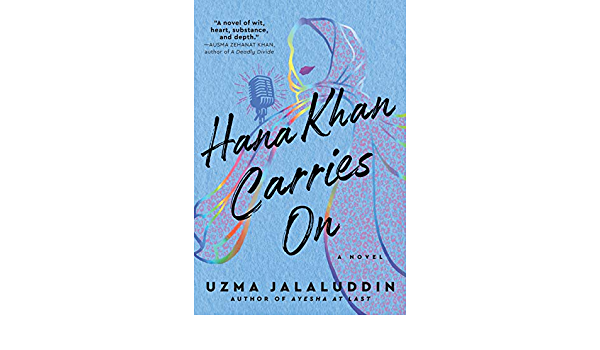
Hana Khan Carries On by Uzma Jalaluddin

Standard
Hana Khan Carries On by Uzma Jalaluddin

hana khanTechnically this book is adult fiction because the protagonist is 24 years old, but the halal rom-com is so sweet and considering the YA options that exist in the same genre, I think high school juniors and senior would do better to dive in to this light, enjoyable, albeit predictable, read over so many of the other options out there.  I read the 368 page book in two days, I was hooked and impressed with the strength of all the female characters, the step away from all the stereotypical tropes and the smooth writing style.  The book is for everyone and while packaged as a light read, there are some themes of immigration, family, choice, and OWN voice realizations that are presented and explored in a thoughtful and impactful manner.

SYNOPSIS:

Hana Khan’s mother owns and operates Three Sisters Biriyani Poutine in Toronto, there are not three sisters, biriyani poutine is not on the menu and business is bad, really bad.  The 15 year old restaurant that Hana named when she was nine is struggling even though it is the only halal option in the close-knit, diverse, golden crescent community.  When news hits that a new upscale halal restaurant is opening a few doors down, Hana chooses to ignore that the business was struggling and instead blames the new proprietors.  They are wealthy, corporate and insufferable.  Well, the dad is anyway, the son Aydin, he isn’t so easily defined.

Hana balances shifts at the restaurant, her internship at Radio Toronto and her own anonymous brown girl podcast.  Hana, real name Hanaan, comes from a supportive and close family.  Her dad was injured in a serious car accident, her older sister is pregnant, and her cousin from India along with a cousin-aunt have just arrived under suspicious circumstances.

As the new restaurant gets closer to opening, Hana finds herself stooping to all new lows to sabotage their success.  Encouraged by an anonymous podcast listener who she has been chatting with for quite a while, and inspired by her rebel cousin-aunt, Hana is determined to secure a permanent job in radio, save her family restaurant, and destroy the competition.  But, an attack downtown draws attention to growing Islamophobia and forces Aydin and Hana to work together.

In a fictional story where everyone knows everyone both in India and Toronto, crazy family members are endearing and loyal, it is no surprise that the main characters are more connected than they think.  As Hana finds her strength to carry on amidst change, she also figures out what direction to focus her energy, her talents, and voice.

WHY I LIKE IT:

I absolutely love the writing.  I was invested in many of the characters, not just the protagonist, and absolutely cheered as she gave a nod to so many assumptions so that she could move past them: forced marriage, hijab, acceptable professions, inclusion, etc.. The family is all about choice and not getting hung up on stereotypes show the power that OWN voices have in telling stories that resonate with everyone.  The book is full of religion, from waking up for fajr, to listening to the khutbah at jumah, going to the masjid to find peace, and believing in destiny.  It is not a preachy book by any means, but the characters are Muslim inside and out.  The traditional family does not pressure Hana to get married, her sister’s marriage was a love one.  She is often alone with her male cousin or brother in law, or best friend Yusuf.  She knows who she is and her family trusts her.

I love the food, the insight of immigrants and family.  I was particularly moved by her articulation of being told by outsiders what it means to be Muslim in Canada, or an immigrant and then not being listened to when pushed back upon. Her challenging a teacher on what the fourth pillar of Islam is and not being heard, resonated profoundly.

Within the first 100 pages or so the reader figures out who everyone is and how they are connected, save one surprise, but it is like watching a favorite movie, you keep going because it is fun, and enjoyable and the point isn’t to figure it out, but to enjoy the ride.

FLAGS:

There are relationship threads, but nothing more detailed than a hand touch after a funeral.  Her best friend Yusuf marries their best friend Lily an Agnostic, knowing that both families are against it.  There is music and racist talk and vandalism.

TOOLS FOR LEADING THE DISCUSSION:

The high school book club usually tries to include a halal romance novel for the loyal participants that clamor for it in the group and I plan to suggest this one to them.  For as light and straightforward as the book is, there is a lot to discuss when the surface is peeled back.  There would be lot to explore from her podcast, internship experience, and her hate crime experience, that the romance part will be seen as simply a vessel to more profound issues to explore.

Ahmed Aziz’s Epic Year by Nina Hamza

Standard
Ahmed Aziz’s Epic Year by Nina Hamza

img_7992

There is such a shortage of male Muslim protagonist middle grades books that I have been waiting quite impatiently to get my hands on this one, and alhumdulillah, it didn’t disappoint.  I’m not sure if it qualifies as OWN voice, being it has a female author, but the authenticity in the little religious and cultural details would suggest that it should.  The 320 page book is meant for ages 8-12, but the weight of Aziz’s father’s illness, the plot pivoting around three classic books (Holes, Bridge to Terabithia, and From the Mixed-Up Files of Mrs. Basil E. Frankweiler), and the clever reflections of Ahmed along with his quick wit and thoughtful choices, might make the book’s sweet spot be 5th to 7th grade readers (as well as us moms who are suckers for elementary literary references, teachers who are heroes, and kids realizing their potential).  The book has a bully, but is clean and wonderful, and I thoroughly enjoyed it.

SYNOPSIS:

Twelve-year-old Ahmed is leaving the only home he has known in Hawaii to move to Minnesota.  His dad has Cirrhosis, a result from a rare genotype of hepatitis C, and Minnesota is one of the top options for treatment.  The family is nervous to move in general, but more so to move to Minnesota.  It is where Ahmed’s dad Bilal grew up, and where his dad’s younger brother passed away at age 12. Ahmed’s younger sister, Sara, is perhaps the only one excited for the new adventure.

The family arrives and is greeted by Bilal’s old friends, and when school starts he realizes one of his dad’s best friends, is his English teacher, and somewhat of a legend at the school in getting kids to try and beat her at an end of the year quiz show like competition.  The school is also where Bilal and his brother Muhammed went to school and a picture of Muhammed hangs right above Ahmed’s locker.  The biggest stress at school is Jack. Jack who lives a few houses over, Jack who rides the same bus, Jack who is in Ahmed’s English group, and Jack who has a lot of followers at school.  Jack is a bully.  One who makes Ahmed’s life miserable at every turn, not just socially, but even the police.

Ahmed is a laid back kid that doesn’t like to read, but loves words, who wants to blend in yet is the only brown kid in a sea of white, who enjoys attending  Jummah salat, but ultimately hates going because of the shoe chaos afterwards.  Ahmed has no intention to read the books assigned in class, but some how the three classic books assigned do get read, and  Holes, Bridge to Terabithia, and From the Mixed-Up Files of Mrs. Basil E. Frankweiler tie together and weave in and out of Ahmed’s epic year.

I don’t want to spoil much, but Ahmed’s dad is in the hospital a lot, there is a lot of plotting to survive being bullied, as well as getting revenge on the bully in Ahmed’s own way without involving parents.  Ahmed slowly grows to love Minnesota, his small circle of friends, and his school while learning about his uncle and the kind of person he wants to be as he grows up.

WHY I LIKE IT:

Ahmed is Muslim and while his mom prays five times a day and his dad is an occasional prayer it doesn’t specify how often Ahmed prays or how he feels about religion, other than going for Jummah.  At first Ahmed thinks he is being bullied by Jack because he is brown, his mom is an immigrant from India, his father the son of immigrants from India, but learns that Jack picks on anyone new.  I like that for as much as Ahmed hates stereotypes and assumptions, he acknowledges that he makes them too.  I like that Ahmed doesn’t like to read, but is smart, and eventually comes around to reading.  He is tech smart and very mature in how he views the world and himself in it, cares for his sister and parents, handles things on his own, and builds others up.  Ahmed is a good kid, not in that he doesn’t make errors or is a teacher’s pet, but in that he has a really good heart and a good head, and I think would make anyone better for knowing him.  I love that the book is smart too.  If you have read the three books mentioned you will love the discussions and questions about the books, if you haven’t read them, you will be tempted to after you finish this book.  I wish there was a tad more religion, there is a sprinkling of culture, primarily the mom’s tragic cooking, but a bit more religion in a book that has illness and death would seem natural to me.  The storytelling is superb, I was so curious where the father’s parents were, but alas it did answer that, I would have liked it sooner, but I was glad it made it in none-the-less.  I would have liked a bit more from the parents about why they wanted Ahmed at his dad’s old school, or how they were comfortable constantly leaving the two kids home alone at night, but Ahmed like I said is pretty mature.  I particularly love the brother sister relationship.  Ahmed is a good older brother and it reminded me in some ways of my older brother, which made my heart warm, good siblings are a blessing.

There are multiple climaxes, but while I expected the dad’s health to be a big one and Jack getting what was due to be a close second along with the outcome of the literary contest, I was not prepared for the level of Jack’s torture to climb to, and was pleasantly surprised by the unresolved thread of Jack and Ahmed’s future relationship.  Things in life don’t magically resolve and I love when middle grade novels keep that in mind.

FLAGS:

None

TOOLS FOR LEADING THE DISCUSSION:

I would absolutely do this in a heartbeat for a middle school book club selection.  Even if the book is more middle grades, I think the students will enjoy it and be surprised by the emotional investment the dad character extracts.  I think they will also benefit from the literary references, relatable characters, and the overall great storytelling.

Spell it Like S-A-M-A-R by Shifa Saltagi Safadi illustrated by Saliha Caliskan

Standard
Spell it Like S-A-M-A-R by Shifa Saltagi Safadi illustrated by Saliha Caliskan

img_7225

This 36 page book for kindergarten and up shows the role perseverance, confidence, and believing in yourself can play in conquering bullies, carving out a space for yourself and finding success.  While the book is a little predictable on the surface, older kids will understand that by winning the spelling bee, Samar didn’t just benefit by standing up to the bully, but in proving to herself what she is capable of and ultimately being more confident of her place in a new country.  The book is presented on large 8.5 by 11 full color glossy pages and features discussion questions at the end.

img_7227

Samar is in 3rd grade after recently moving to America from Syria, where she was the best student in her class.  ESL wasn’t difficult, but mainstream class is proving to be a challenge, mostly because of Jenna, the class bully.

img_7228

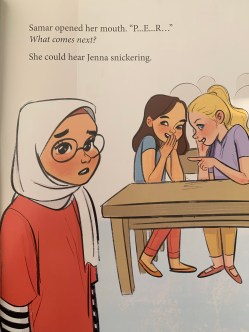
Jenna, snickers when it is Samar’s turn to spell words in front of the class, she teased her about her jump rope songs not being in English, and she makes fun of her for her accent.  With the help of a kind friend, Angela, the two girls decide the school spelling bee will be the best chance to prove how smart Samar is, by winning.

img_7229

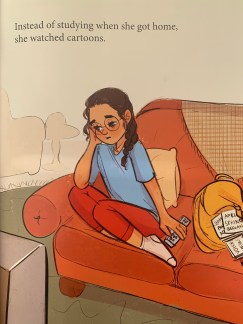
The first step Samar must do is convince her teacher, Ms. Bryan to help her study.  To  show her commitment she offers to give up her recess to study.  The teacher agrees, but on the way home Jenna teases her saying she’ll never win when she can’t even speak English properly.  Deflated, when Samar gets home, she doesn’t study the flashcards and opts to watch cartoons instead.

img_7230

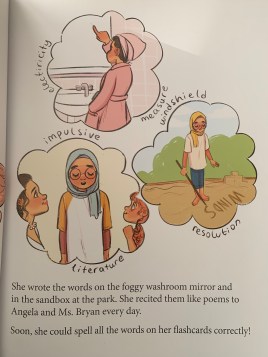
When later in the week her teacher quizzes her, Samar admits she didn’t study.  Ms. Bryan encourages her by sharing her own story of coming to America and having to learn English.  When Samar gets home she sees her mother, a former dentist in Syria, studying for the exams to be a dentist in America. This is the spark she needs and she studies hard, everywhere, and with anyone who will help.

On the day of the bee, Samar spells word after words correctly and after saying bismillah before spelling the final word, wins the competition and beats Jenna. The audience cheers and the next day Samar and Angela are jumping rope and Samar is singing in Arabic.

img_7231

I love that Samar and her mom wear hijab while out, but not at home, that they speaks Arabic, and Samar says bismillah.   Samar’s mom is clearly highly educated and determined and mom and dad are supportive.  I love that Samar’s drive, however, comes from her own determination, no one forces her or guilts her, it is her leading the way and understanding what her mother is going through and her teacher has gone through, and using that as inspiration.  I love that at the end she doesn’t rub it in Jenna’s face that she won, and the symbolism of Jenna just disappearing from the story makes this clear as Samar steps in to her own.  I truly love that for every Jenna in the wold there is also an Angela.  Be kind, be supportive, be a good friend!

I got this book from http://www.Ruqayasbookshelf.com and it can also be found at my favorite book store http://www.crescentmoonstore.com as well.  Happy Reading!

The Beauty of Your Face by Sahar Mustafah

Standard
The Beauty of Your Face by Sahar Mustafah

img_7145

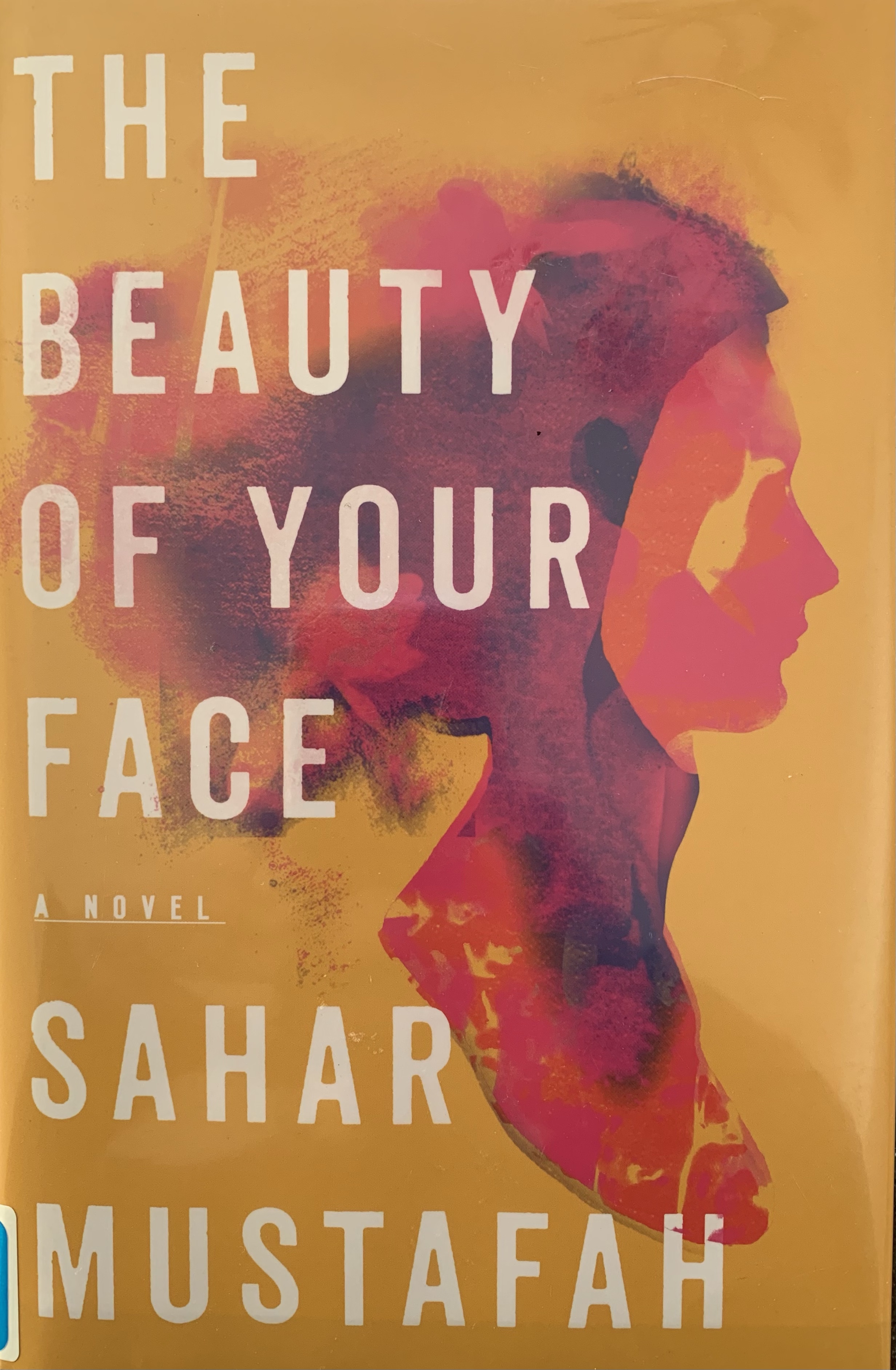
I had debated picking up this book knowing that it isn’t labeled YA and I’m painfully behind on a stack of books I want to review, but after reading @muslimmommyblog’s review I opened the first page: that was 24 hours ago, I couldn’t put it down.  I’ve seen a lot of comments about this book being more YA than adult fiction because it tidies everything up so precisely at the end.  I’ve also seen critiques from non Muslims that it is overly preachy at times.  Many Muslims are so swept away by the rawness and presence in Islam in the book that they are making their teens read it.  So I wanted to read it and review it to determine if it is appropriate from my perspective for teens, and offer my take on it.  Ultimately I think while much of the Palestinian-American protagonist’s life story in the book occurs as a child and young adult coming of age, that the “flags” are so critical to the story and so numerous, that no matter how deftly and non specific she handles these issues and moments, that the book really is meant for more mature readers. I’ll detail it more below in the FLAGS section but to highlight a few mature spots mentioned in the book to varying degrees:  extra marital affair, alcohol, making out, groping, nudity, sex, voyeurism, killing, shooting, physical abuse, profanity, suicide attempt, bigotry, etc.  The writing is absolutely superb, and it isn’t sensationalized, but it is there and provides understanding as to why the characters often are as they are to a point that you need to understand them with a certain clarity.  I would think this 298 page book would most appeal to early college age readers where one is hopefully open minded enough to understand the characters relationship with religion whether they are Muslim or not, old enough to have some of their own life to reflect upon, and on the cusp of a new chapter that they realize the role their choices can make as they move forward.

SYNOPSIS:

Afaf’s life story unfolds out of order and with occasional interruptions from an outside point of view.  It opens with her at work, as a principal of an Islamic girls high school in Chicago as we see her dealing with parents upset with things taught at the school and the balance she tries to achieve in guiding her girls to be strong, confident, well-informed Muslims in a diverse America.  It then flips back to 1976 and begins the tale of Afaf’s life with her parents, immigrants from Palestine, her older sister and younger brother.  Not ever feeling like she fits in at school, she loses any sense of normalcy at home when her 17 year old sister Nada goes missing.   There were problems at home before: her mother never being happy, Afaf never feeling her mother’s affection, her father having having an ongoing relationship with another woman, but as days and months go by, and no clues can find Nada, it will be the event that seemingly tore the family apart.  Afaf’s mother has a mental breakdown, Afaf’s father takes to drinking, and thus Afaf and her younger brother Majeed have to navigate much of their life on their own.  In high school Majeed finds baseball and becomes the ideal student and son.  Afaf lets white boys feel her up and has a reputation for being easy.  She doesn’t cross the line, but her reputation and name on the back of bathroom stalls is fairly accurate.  When their father is involved in a car accident, he finds Islam.  The family is very cultural, but not religious at all.  Eventually Afaf and her brother accompany their father, much to their mother’s protests to the Islamic Center and while Majeed has no interest in religion let alone Islam and never returns, Afaf feels an instant peace and the opportunity to redefine herself and continues to go and study Islam.

The book jumps regularly in sections, not every other chapter, and at some point it shows Afaf as an elementary school teacher making the commitment to wear hijab and preparing to wed a Bosnian man with a broken war filled past.  It jumps and has her brother home from law school visiting and her mother attempting suicide by drinking drano and being found laying naked in a bath tub.  After recovering, her mother returns to Palestine and never returns.  In yet another vignette, it has Afaf and her husband and father preparing to go for Hajj, where her father passes away, and has her returning to find she is expecting her third child a little girl.  There are other surprises that I’ll not reveal, but some of these jumps are interrupted by a voice of a radical alt right mant who walks into the girls school and starts shooting, finding himself face to face with the principal, Afaf.

WHY I LIKE IT:

I am seriously blown away at the quality of writing, and the interweaving of religion and culture.  It is a main stream book and it has a lot of religion in it.  It isn’t so much long passages of preaching, the father would like it to be that way, but the other characters keep him in check.  But the quiet transformation of Afaf and having Islam save her from a life she was not content with.  I love that it has joy and happiness despite all the tests and obstacles.  The book could have been really heavy and drag, but it wasnt, it was compelling and hard to put down.  The characters will be with me a while and I can see myself rereading the book just to visit them again.  

I was a little confused with Afaf’s limited Arabic and her mom’s limited English.  How did they communicate? I get that perhaps it was symbolic of their broken relationship, but seriously when Afaf is seven and not understanding Arabic and her mom is not understanding the police and neighbor in basic English, something is a bit off.  I like that insight is given as to why Afaf is fooling around with any boy that wants her and that it shows it isn’t about the acts themselves.  I also like how it showed her conflicts in reporting an Arab child in her class being abused at home by her father and how the response was so sad by the community.  While Islam saves her and holds her to a higher standard, it doesn’t appeal to her brother, it doesn’t remove the hypocrisy of people who are Muslim: abuse, owning liquor stores, and it doesn’t make everything better for her.  She has to suffer consequences of her choices, she just feels that Islam gives her the tools to persevere and understand and have hope.  

I love the food, oh man, hearing all the dishes being cooked and served and cleaned up after, really made me very hungry.  The cultural elements of the music and songs and oud really ground the book and make the OWN voice value ring so true and strong.  The racism and bigotry feels very real as well.  The author is the daughter of Palestinian immigrants and the way that she articulates such pointed examples of not being given the chance to move up in the elementary reading group, side comments the high school coach makes to her, and the general stereotypes thrust upon her, are very powerful.

FLAGS:

So there is a lot, as stated in the intro, but I want to articulate a bit of why I maintain older teens for the book even though it isn’t overtly sensationalized. I’ll walk through some of the major flag themes.:

Take the drinking. The father is an alcoholic, but the mother and children hate it, Majeed drinks beer with his friends, but isn’t Muslim, yet the Khalti is somewhat religious and they pour amber drinks at Thanksgiving. So there is some moral lesson, which I think you could argue is fine in YA or even middle grades.

Relationships/sex/body: The father is having an affair with a much younger woman, they refer to her as sharmoota and everyone knows about it, no other details are given. Afaf lets boys touch her naked body, but draws the line at intercourse, she says she on some level doesn’t want to do that to her parents or something of that nature. Right before proposing marraige, her and Bilal do kiss. Once they are married it mentions them making love in the mornings. It mentions masterbating and blow jobs. The shooter and his girl friend have sex, the shooter watches an Indian neighbor nurse her baby through the door and sees her exposed breast with some detail and then goes home and masterbates. When the mother is pulled out from the tub after attempting suicide it doesn’t just mention she was naked, it comments on her pubic hair.

Violence: An Arab Muslim male classmate, drives Afaf away from her bike and the slaps her telling her basically that she should not be such a slut. Afaf punches another girl in a fight at school. A child in Afaf’s class is being hit by her father. Mother lashes out at Afaf, she ends up burned. The climax is a mass shooting where 14 students and a teacher are gunned down and killed. Self harm: car crash while drunk, suicide attempt with drano.

Minor: Yeah there is music, and Halloween,

TOOLS FOR LEADING THE DISCUSSION:

This would make a great book club selection for those in their early 20s and up. It is well done, just not for younger readers. The book is very popular and numerous author interviews can be found with a quick Google search.

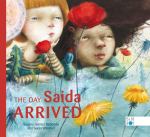
The Day Saida Arrived by Susana Gómez Redondo illustrated by Sonja Wimmer translated by Lawrence Schimel

Standard
The Day Saida Arrived by Susana Gómez Redondo illustrated by Sonja Wimmer translated by Lawrence Schimel

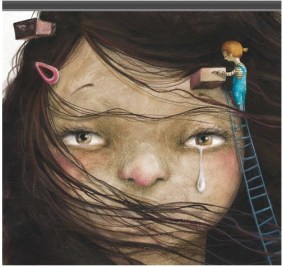
saidaThis absolutely gorgeous lyrical book will sweep you up and hold you tight as you imagine a world where more people take the time to get to know one another through the power and beauty of language.  Over 32 pages that are exquisitely and whimsically illustrated the words dance and come to life in English and Arabic as a friendship is formed.  Perfect for preschool through 3rd graders, older children and adults alike will be softened by the kindness and example shown between two little girls.
saida1

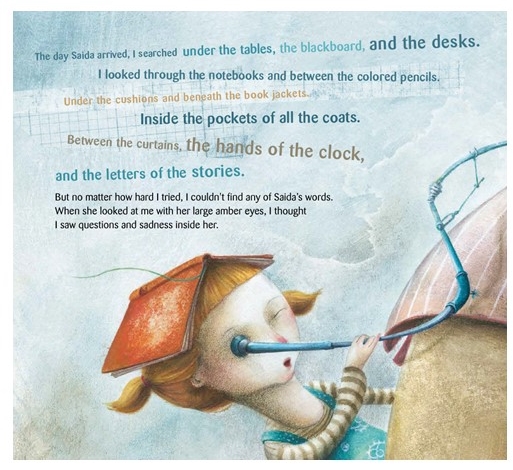
Told from the perspective of a little girl that meets a new girl in school named Saida and decides right away that they are going to be friends.  Unfortunately Saida speaks only Arabic, and the little girl only English.

saida2

But it is no problem, because the little girl is going to help Saida find her words.  She is going to look everywhere to let her get rid of her tears and throw away her silence.  So that she doesn’t see questions and sadness locked up in her.

saida4

That night at home, the little girl’s parents tell her about Morocco and find it on the globe.  They explain that Saida’s words don’t work here and that her words wouldn’t work in Morocco.

saida5

Undeterred the two girls start teaching each other words in their languages.  Some stick, some float away, but the two learn and communicate and connect. They find friendship in learning each other’s words.

They recite a poem by Jacqueline Woodson and tells stories about Marrakesh. The two girls plan to travel the world together. The book concludes with both alphabets shared and the reader wishing to join the little girls on their adventures.

saida 3

I was blown away by the presentation of the book and the feeling of compassion and cultural appreciation depicted.  Such a beautiful approach to welcoming someone different in to your life.

There is nothing Islamic or religious in the book, or really even cultural, aside from language.

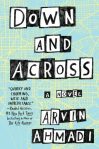
Down and Across: A Novel by Arvin Ahmadi

Standard
Down and Across: A Novel by Arvin Ahmadi

down and across

This 320 page book featuring an Iranian American lead written by an Iranian American is a coming of age story written on an AR 5.2 level, that I don’t think most reading this blog would want their child to identify with.  It is an OWN voice book from what I can gather in the author’s interviews online, and sure many Muslims definitely receive the label of “Muslim” more from others than from their own self identity, but I don’t know that many would want their children seeing themselves in the main character who runs away from home, hangs out in bars getting drunk, picks up girls as a challenge, and basically tells one lie after another, especially while being completely endearing and quirky and someone you really find charming.

SYNOPSIS:

Sakeet Ferdowsi aka Scott, is an only child of Iranian immigrants who really love him and want him to do well in life.  The story opens with 16 year old Scott chatting with his dad at McDonalds about his lack of direction, his lack of interest in his summer internship, and his parents leaving him alone for the summer as they journey to Iran.  Sakeet’s dad tells him of a professor at Georgetown University who writes about “grit” and how grit, not wealth or IQ is the greatest predictor of success.  With a track record of not seeing things through, Scott is told he needs to find some grit and some direction in life.  Drawn to this idea, Sakeet lasts a few days at his mouse poop research internship before become obsessed with grit, jumping on a greyhound bus and heading from Philadelphia to Washington, D.C. to get help face-to-face with Professor Cecily Mallard.

On the bus, he tries to position his backpack to prevent having a seatmate, but a college girl, calls his bluff and forces him to chat with her.  Fiona is not like most people with her free spirited ways and her love of crossword puzzles, and with her now in his life, Scott’s four week DC adventure is set to be memorable.

While in DC Scott learns a lot about himself from the people he meets, the situations he finds himself in, and in general the freedom from his parents.  He is mistaken as a college student and keeps the ruse running to everyone he meets outside of Fiona, Professor Mallard, and Trent.  Trent saves Scott after he crashes a stolen bike (he didn’t know it was stolen) and is being chased by its owner.  They quickly discover they both know Fiona and the big hearted southern helps Scott get a fake ID to get in to bars, and a job working behind the bar to pay for his time in DC.   Trent dreams about working with his favorite senator, which is a big part of the climax, as is the fact that he has been cut off by his well-to-do family because he is gay.  Throw in an ultra conservative “girlfriend” who Sakeet picks up on a dare at the National Zoo and Sakeet to discover if in fact he has grit.

WHY I LIKE IT:

The book reads really easy and smooth, hence the middle grade AR level, but I don’t think any elementary kids should read it, or even middle school for that matter.  As a coming of age book, early high school would probably be the best fit, but with such a focus on drinking and bars, and sex I kind of feel like the rave reviews are coming from adults who find the antics quaint and idyllic as a way for Scott to grow, not as something they would want their own child to identify with.  Online reviews praise the person of color protagonist and the Muslim representation, but really I don’t find either of them overtly influential in the story.  Yes, Scott is straddling two worlds as a child of immigrants and must balance parental expectation with his own mysterious wants (he doesn’t know what he wants), but I don’t know that culture or religion shape him other than his parents not letting him go to overnight camps growing up.

When he is called a terrorist by a drunk guy, or dumped by a girl for being Muslim, he takes it, he doesn’t deny it, but he doesn’t let it really rile him either.  At one point Scott amends Fiona’s statement of calling him a Muslim.  “‘ish,’ I said.  ‘A long time ago I asked my parents what religion I was, and accepted what they told me.  Haven’t gotten around to reevaluating it or whatever.'”  Other’s call him a Muslim, but I don’t know that he every really says it himself, which ironically I kind of appreciate.  In a few phone conversations with his parents he says “Salam” or “inshaAllah,” but there is no Islamic practice or conscious or even expectation in the book.  I think for readers they will respond to Sakeet and his faith based on where they are in life.  For Muslims, they may find such a careless label frustrating and belittling, or possibly relatable.  Non Muslims may understand Sakeet’s practice means Islamic rules are not followed, and those that do follow them more “extreme.”   Islam is fluid and we are all flawed, so I don’t expect a fictional or real character to be perfect, I’m just pointing out what my concerns would be to have this book in an Islamic school library.  As a reader, I appreciated that the author had the character articulate that he is Muslim-ish only, and have other people call him Muslim and have him not constantly use his faith and culture to set himself apart.  He is fallible and growing and he has a lot of parts to his persona not just these markers.  Incidentally the parts he is exploring and questioning and learning about himself as he looks to his future don’t involve Persian culture or Islam.

FLAGS:

Alcohol, getting drunk and hungover, cursing, some violence, theft, nudity, kissing, talk of sex, sexting, talk of making out, a gay character, lying, drug addiction, getting high.

TOOLS FOR LEADING THE DISCUSSION:

I wouldn’t use this book as a book club selection because of the themes and inconsistency of values, also because of the inconsistency of topics and writing style.

Author’s website: https://www.arvinahmadi.com/

Interviews with author:

https://mashable.com/article/mashreads-podcast-down-and-across-arvin-Ahmadi/

https://ew.com/books/2017/08/03/the-hate-u-give-author-angie-thomas-interviews-arvin-ahmadi/

https://www.npr.org/2018/01/27/580837850/a-puzzled-teen-seeks-answers-and-finds-crosswords-in-down-and-across


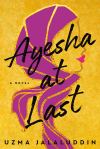
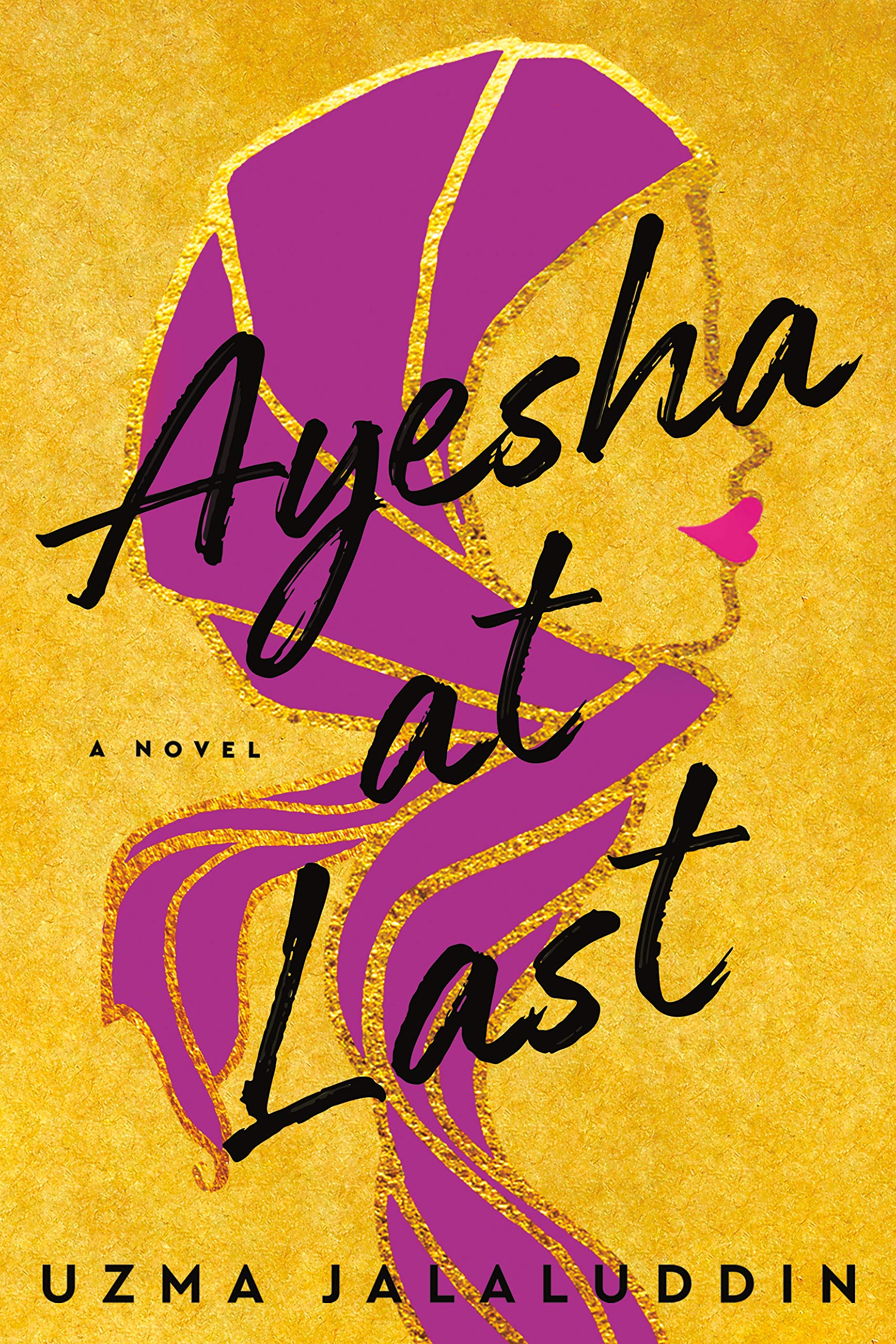
Ayesha at Last by Uzma Jalaluddin

Standard
Ayesha at Last by Uzma Jalaluddin

ayesha at last.jpg

This is not a YA book.  The back of the book and about 75% of the story could really make it seem ok for mature middle school and early high school readers, but I’m reviewing it as a “public service announcement,” that it really isn’t appropriate for a young adult demographic.  No where does the book claim to be YA, I’ve just seen a lot of people online ask if their 13-16 year old (ish) daughters would like it.  That being said, the 351 pages of halal romantic comedy a’ la Pride and Prejudice inspiration, really is a fun light summer read that I enjoyed and feel young college age girls and up will too.

SYNOPSIS:

Set in Canada, Ayesha is 27 and still sorting out what she wants in life while considering expectation, obligation, and passion.  Born in India, she came to Canada after her father died in secretive circumstances, and with a workaholic mom against marriage, a Nani who once studied to be a police officer, a Nana who quotes Shakespeare at all times, Clara, a best friend, and a flighty beautiful younger richer cousin, this cast of characters cheer her on, gently nudge her, and support her, giving a diverse and nuanced view of what a Muslim family looks like and how they interact.  Then throw in Khalid.  A very black and white character in his views on Islam, and culture and pretty much everything, and you have a storyline with a lot of potential, twists, and interconnections.  

Khalid works with Clara, lives across the street from Ayesha, and has an incredibly controlling mom who has just sent a marriage proposal to Ayesha’s flighty cousin Hafsa.  When a conference at the masjid forces Ayesha and Khalid to work together after meeting earlier, tension and sparks fly, and to top it all off Ayesha is pretending to be Hafsa. 

Khalid has his own team of supporting characters, Amir an alcoholic- womanizing-homeless colleague who for some reason is considered a friend, a sister who was banished to India and forced into an arranged marriage 12 years earlier, an Islamaphobe boss, and his own baggage regarding his father’s sudden death. 

Bring in the Wickham character of Tarek and the cast of characters is complete for all the action to go down at the mosque and give the Aunty Brigade a whole lot of gossip to process and spread.

WHY I LIKE IT:

The book is fairly predictable in the major story arcs, but there are a lot of twists that keep you hooked, and the author’s writing is smooth and fluid.  Being it is a loose retelling of a classic, I wasn’t expecting much and was pleasantly surprised how well the story would stand alone as an OWN voice piece about growing, maturing, changing and willing to challenge oneself. 

I love that every Muslim and desi character in the book is different and unique and not a cookie cutter of stereotypes and tropes.  Most of the females cover, but they are nuanced in how they do it, what it means, how they carry themselves etc., some shake hands with males some don’t, some are comfortable in bars, some are more reserved, some have never had a boyfriend, some have, and they really show the reader that Islam is a deeply personal conviction and the rules are interpreted and challenged differently for each person.  It also shows different male approaches and the internal struggles of doing what you want to do and what you know you should or shouldn’t do in a very realistic non preachy way.

My favorite relationship by far is that of Ayesha and Clara, I love that Ayesha’s non Muslim friend knows that Khadijah (RA) proposed to Prophet Muhammad (SAW) and jokes about rishtas and frequently asks “What would Nana do.”  Seriously, as someone of  Paki background, who started covering in high school, who is half American and proud to be Muslim, this is friendship goals!

The book is perfect for the beach, or a day at the pool, it is light and silly and really you just go with the outrageousness of some of the details.  There are a few thought provoking themes, but really it is just fun and sweet.

FLAGS:

I was really impressed how halal the main story romance remained, however a few of the side stories are a little intense for younger readers and don’t really appear until about 2/3rds of the way into the book.  Yes, Clara has a live in boyfriend and there are a few jokes and situations involving  hooking up, virginity and porn, along with some characters smoking and drinking and being around alcohol, but then the climax really puts more mature situations on center stage. 

Khalid’s sister had an abortion resulting from a pre-marriage relationship and thus was sent to India.  Amir shows Khalid a porn website where hijabi and niqabis strip and pose, a website that is discovered Tarek runs and Hafsa is featured on. The website and the pregnancy/abortion really are the crux of the book and it becomes a big portion of the last third of the book.  It isn’t that the content is overly detailed, it just what the concept presents.  It isn’t salacious or pornographic or titillating in presenting the information to the reader, but the mere presence of it in the story would make it inappropriate for a YA book or younger readers.

TOOLS FOR LEADING THE DISCUSSION:

No way the book could be taught in an Islamic school book club setting, however, if the teachers wanted to start a book club, this one would be a great candidate.


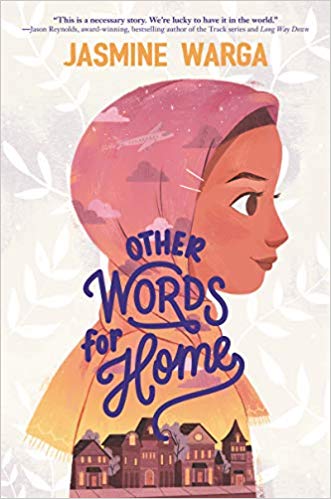
Other Words for Home by Jasmine Warga

Standard
Other Words for Home by Jasmine Warga

other words for home.jpg

Three hundred and forty pages written in verse that beautifully consume you and leave you emotionally changed and vulnerable and humbled all at once.  The book claims it is for middle grades, but I think middle school will appreciate it more, and I sincerely hope everyone of all ages will take a couple of hours to fall under the spell that is woven to tell a story of a refugee leaving home and starting anew in America.

SYNOPSIS:

Jude is a 12 year old girl living on the beach in Syria, watching American movies with her friends and hanging out at her dad’s store.  With an older brother and a little sister on the way, life as told from her own perspective is pretty good.  Until it is not.  Until the crimes they only hear about happening in Aleppo and Damascus start to hit closer to home.  Until her brother starts sneaking out to meetings with other youth hoping to change the politics of their country.  Until a raid almost catches Jude and her brother and her parent’s decide it is time for Jude and her mother to journey to America, for a little while, to visit her mom’s brother and deliver the baby.

America is not like it is in the 90’s movies that Jude loves: Pretty Woman, Legally Blond, Miss Congeniality.  Her American aunt and her Uncle that seems to have forgotten his Syrian upbringing, are gracious and welcoming and their daughter, Sarah, who is less than a year older than Jude waxes and wanes in her approach to her cousin.  Adjusting to school, life without baba and her brother, and all the other adaptations that moving to a new country entail are brought to life through Jude’s eyes and understanding of the world around her.  As she comes of age and decides to wear hijab, as Islamaphobia shakes her sense of justice, and her little sister is born, the reader sees her grow and change and mature and find themselves hoping that she will soar.

WHY I LIKE IT:

I love that the style of the story telling somehow gives life to so much.  With verse some things are highlighted in detail and other things skimmed over and yet at the end, not only do you feel like you understand Jude, but a lot of the side characters as well, which caught me off guard.  Truly the writing is strong and deliberate.  A lot of the politics and war crimes occurring in Syria are not detailed, and I have to assume that is because the point of view is a 12 year old girl that is blissfully in her own world.  I imagine this is also why the target audience is listed as 8-12 year olds, because it simplifies a truly horrific situation.  Also because despite moments of raw vulnerability, the book stays pretty optimistic and hopeful.  

I like that the characters are Muslim, and that the mom scolds her brother for not going to the mosque.  The book does talk about Jude’s period starting and thus Jude starting to wear hijab, which is one of the reasons I feel like early middle school might be a bit more appropriate age group.  There isn’t too much talk about faith and Islamic beliefs, but a few tidbits are sprinkled in, prayer, not eating pork, modesty.  The book is not gender exclusive, but I think girls will gravitate much more to Jude’s perspective, experiences and voice.

The only thing I found a bit off is that the book takes place in modern time, present day, yet none of them have cell phones or social media.  Jude Skypes her dad, yet writes letters to her friend back in Syria and is distraught when they don’t have a forwarding address to send them to after her friend also leaves home.  It seems that social media, email, a cell phone number, something would be available for them to all keep in touch.

FLAGS:

There is mention of Jude and her friends having to sneak in to see Pretty Woman because Julia Roberts is a prostitute, and mention of blood between one’s legs and periods starting.  The book otherwise is pretty clean.  It hints at her kind of crushing on a boy that is in the play with her, but nothing more than friendship is explored.  Violence mentioned is minimal and language is clean even when dealing with hate crimes in America.

TOOLS FOR LEADING THE DISCUSSION:

There is a good chance that next year the students joining the middle school book club will be all girls, so if that is the case and the school counselor feels all the girls can handle the puberty aspects mentioned I would totally do this book.  The book reads very quick and might be a good way to get new kid to give a book club a try as well.

Author’s website: http://jasminewarga.com/about

Q & A with the Author: https://www.publishersweekly.com/pw/by-topic/childrens/childrens-authors/article/80127-q-a-with-jasmine-warga.html

Interview with the Author: https://www.hbook.com/2019/04/authors-illustrators/publishers-previews/spring-2019-publishers-preview-five-questions-for-jasmine-warga/


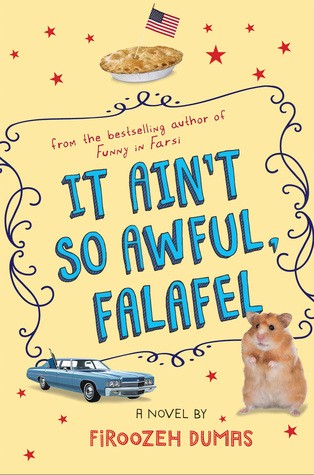
It Ain’t So Awful, Falafel by Firoozeh Dumas

Standard
It Ain’t So Awful, Falafel by Firoozeh Dumas

it aint so awful

Islamaphobia is rampant in today’s America, but it isn’t the first time that a minority group has had to face extreme persecution.  Often us Muslims need to look around and be reminded: Blacks are still targeted, Japanese once were interned, Italians, Irish, Hispanics, really every minority group has, and continues to struggle to be accepted as part of American culture, unfortunately.  Today’s middle school students didn’t live through 9//11 and often they think they are the first to be ostracized for their faith or their parent’s countries of origin.  So I picked up this book to see how well the book would serve as a way to discuss prejudice and persecution with Muslim kids, in a way that they could relate to, but be removed enough from that hopefully they could offer their own insights and experiences.   This book takes place in the 1970s and the climax is the Iran hostage situation as the book is told from an 11-year-old Iranian girl’s perspective. 

Similarly, most Persian penned books that I’ve read fight against Islam and the way it was forced upon them by their government, so I also wanted to see how the author would paint the faith in her semi auto-biographical-middle-school tale.  Alhumdulillah, I was happily surprised how Islam was handled in this 378 page, AR 4.7, book, and I think, like the inscription reads, “To all the kids who don’t belong, for whatever reason.  This one’s for you.”

SYNOPSIS:

Zomorod has lived in America before.  She was born in Iran, moved to California, moved back to Iran, back to California, and now from Compton, California she is moving to the much wealthier Newport Beach and hoping to start middle school fitting in more with her new Brady Bunch inspired name, Cindy.  Establishing early that she is the translator for her mother, who doesn’t speak English and doesn’t want to learn, and that she is somewhat embarrassed by her parent’s thick accents, lack of American snacks, Iranian food, and conversation topics, the book will appeal to most middle schooler’s who can relate.  Her parents, however, are pretty chill about letting her go out with friends, and doing whatever she wants, so really its more about the age and being angsty and awkward, then it is about her parents and their lifestyle and culture.  The basic point of the book is a growing-up tale of making friends, finding real ones that care about you, finding the balance between family and the outside world, cultures that conflict, the past and the future, and ultimately finding acceptance and pride in who, and what you are.

The political climate in Iran and in America amplify what it is like when people hate your country, but can’t find it on the map, and manifest in the story with bullying at school, Zomorod’s father losing his job and not finding a new one, and some hateful acts occurring at the Yousefzadeh’s home. 

WHY I LIKE IT:

The book could be heavy and dark, but it’s not.  The voice of Zomorod really stays in the persona of an 11-year-old girl and is poignant, clever and light-hearted, I even laughed out loud a few times.   The 1970’s backdrop isn’t too alienating for today’s readers, as there aren’t a lot of cultural references that would turn them off.  The historical significance, is very likely one they will not have heard of before and the book, through Zomorod’s eyes, will shed light on Iran in the late 70s and early 80s without boring the target audience.  They might even learn something and remember it.  

The stereotypes about Iran are addressed, the concept of a single person having to represent every one of that minority group is felt first had through the main character, and many misconceptions about Iran are clarified.  Yet, the book doesn’t get preachy, it maintains its lightness, and while I read it in a few days, it was just as easy to put down as it was to pick up.  The characters felt real and developed for the most part, so even though it was a tale about life, it was compelling enough to stick around, and you are invested enough to care how the characters are doing. There are a lot of really great supporting characters in the book as well: neighbors, friends, teachers, friend’s families, and a few not so nice characters that surprisingly aren’t painted with a singular condemning evil stroke.  The author is very careful to reserve judgement of all her characters and the sub groups they represent.

Which brings me to how Islam is handled in this book.  Her family doesn’t practice, but her reference for Islam is shia, as evident by her mentioning 12 imams.  I took pictures of most of the pages where Islam is mentioned, less than 10 in all, but where it is mentioned it is handled very politically correct and powerfully.   She talks about how they don’t celebrate Christmas or most holidays as they aren’t Christian or really American, but when the pool key is lost she does pray to a Christian Saint after a suggestion that such an act will help it be found.  It isn’t really presented as a religious act, more of one done in desperation. Here are the most applicable and relevant passages regarding Islam.

  • Dr. Klein shakes his head in sympathy.  “Do your wife and Cindy have to wear those cover-ups if you go back?”  “Yes, and I cannot believe this.  When we lived in Iran, my wife, my sisters, all the women I knew wore western clothes.  No tennis clothes like you see here, but regular clothes.  Only religious women chose to wear hijab, it meant something.  Imagine if everybody in America had to wear a cross around their neck or a Star of David-what would those symbols mean? Nothing. If you have to wear it, it means nothing.  If you choose to wear it, it means something” (168).
  • “The Ayatollah is Muslim, right? So is, like Allah, his God?”  “Allah is the Arabic word for God,” I say.  “It’s the same God. (154).”
  • We don’t have Saints in Islam, just a Prophet with twelve imams, and they don’t preach to animals or help find lost items,  My family, like most Iranians, is Muslim, but we never do anything religious.  I’ve never even been in a mosque, which is like a church (40).
  • “Being Muslim means different things to different people,” I say.  “My family doesn’t do anything officially religious.  My dad says religion is kindness and that’s what everyone should practice” ((184-5).
  • “…even though we belong to three different religions. We are alike in so many more ways than we are different.” 

FLAGS:

The book is fine for middle school readers, there is mention of Cindy’s dad trying alcohol at one point in the past and not liking it.  Cindy’s friends tease her once or maybe twice about liking a boy and Halloween is celebrated.  There is a lot of lying in the book, but it is made clear why, even if she doesn’t always feel bad about it: she is embarrassed by her mom’s food and lies that she shared it, she withholds information a lot, she pranks the neighbor lady who left a dead rodent on their porch, etc.  Hopefully the demographic won’t be inspired by Zomorod’s antics and just find them as her way of dealing with life.

TOOLS FOR LEADING THE DISCUSSION:

This would be a fun book club book to discuss being new to a country, minorities, how to handle conflicting cultures, and how to be and have good friends.

Educators guide: http://firoozehdumas.com/wp-content/uploads/2016/03/ItAintSoAwfulFalafelguide.pdf

https://www.floridamediaed.org/uploads/6/1/4/2/61420659/ms_-_it_ain%E2%80%99t_so_awful_falafel.pdf

https://www.bookmovement.com/bookDetailView/49051/It-Ain’t-So-Awful,-Falafel-By-Firoozeh-Dumas

Author’s page: http://firoozehdumas.com/books/it-aint-so-awful-falafel/

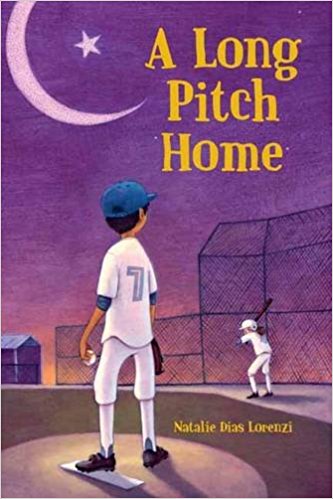
A Long Pitch Home by Natalie Dias Lorenzi

Standard
A Long Pitch Home by Natalie Dias Lorenzi

a long pitch

The correlation between baseball and cricket provides the foundation for detailing the relationship of  Bilal’s first year in America after having to leave Pakistan in a hurry: the same, but different.  This 248 page book written on an AR 4.6 pivots around sports, but has a lot of heart as themes of family, friendship, and longing, take center stage.  Throw in a whole new culture, the English language, Ramadan and prom and you have a whole lot to cover in this well crafted story.

SYNOPSIS:

Bilal has a good life in Karachi, Pakistan.  He is the oldest of three kids and at 10 years old, his world pretty much involves Cricket, friends, and his dad.  When his father disappears things get frantic, and when his father returns, the family decides to move to America.  Unfortunately Bilal’s dad can’t come.  As Bilal, his mom, his younger sister Hira and younger brother Humza, board a plan to Virginia, everything Bilal knows is left behind.

Virginia is home to Bilal’s maternal Uncle, his wife, and their teenage son, Jalaal.  Jalaal plays baseball and arranges to have Bilal join him at baseball camp for the summer.  Learning the new sport, and a new language, and the nuances of life in a new land are frustrating and often comical as Bilal points out how confusing navigating American life can be.  He also keeps an ongoing list of new things in America to share with his dad over Skype, as they swap memories of an old life in preparation for a new one.  The supporting characters on the field are generally kind and accepting of Bilal, because they have a bigger problem then a foreign boy, there is a girl on the team, Jordan.  Jordan is new too, and the coaches niece at that, naturally they become friends, but its not easy, Bilal has to learn what being a friend really means.

The majority of the book stems from the tension of waiting to hear from Bilal’s father, and to see if he can come to America.  The passing of time with baseball games and school are anecdotal to the larger arc that sets the pace of the book.  Will Baba be able to come, and if so, when?

WHY I LIKE IT:

Interestingly religion has a pretty big role in Bilal’s life and the author does explain some tenants in Islam.  He wakes up for fajr (although he does miss it occasionally), he only eats halal zabiha, the family fasts in Ramadan, and they celebrate Eid.  Bilal wants to fast, but him mom tells him he is too young when they are coming to America, and the following year he doesn’t because of baseball, which is unfortunate, because a lot of kids fast and play sports all over the world.  They go to the mosque on Eid only, and it mentions that the women in his family do not wear hijab like some of the women at the mosque.  His older cousin Jalaal wants to take the neighbor girl, Olivia, to prom, which the family explains awkwardly as something that Muslims don’t really do until they are older, or at least that is how Bilal understands it.  In the end, they let Jalaal go with Olivia and a group of friends, and the whole family Skype’s the family in Pakistan and sees them off.  Even more funny is that they don’t join their friends for dinner before the dance, because Jalaal is fasting and can’t eat until later.  I don’t know if this will confuse 4th and 5th grade readers, but as an adult I found it hysterical, because these cultural contradictions are more common than not.  I did like that nothing was done behind the parent’s backs.  Things were discussed and worked out instead of lied about.

Another thing that I found interesting, but since finishing the book, I have come to appreciate, is that there is no Islamaphobia in the story, or even xenophobia.  The kids are accepting of Bilal’s faith and culture.  He is far more self conscious about being different or not understanding than those around him are.  Its idealistic perhaps, but at the same time, I think it would distract from the core of the story.

While the book focuses on sports, I think even non sports fans will be able to enjoy the story.  The author doesn’t get too technical and it moves steadily with mini climaxes and triumphs through out.  Girls and boys will enjoy the book, Muslims and non Muslims too, the readers might even learn something about baseball or cricket or Pakistan, or even about themselves along the way.

FLAGS:

The book is remarkably clean and what you would expect for a good quality, solid 4th grade and up story.  There is the “prom” issue, but there is no hugging, kissing, longing etc.  They “like” each other, but it isn’t more explicit than that.

TOOLS FOR LEADING THE DISCUSSION:

I don’t know if I would use this for a Book Club.  One could, but I think it would require a lot of coaxing to get kids to give a book about baseball/cricket a try.  I have no doubt if they started it, they would finish it, but it might be a tough sell.  The confusion in American life would make for an awesome discussion after being read, because everyone can relate to some of the oddities of the English language, and challenges of learning a new language and culture.  I think how Islam is handled would also make for some good discussion in addressing how each family handles things differently as they arise.  Although written on a 4.6 level if I were to do it in a school setting, I would probably do it for middle school kids who could articulate their own life parallels to the story.

An interview with the author:

http://wordspelunking.blogspot.com/2016/09/a-long-pitch-home-blog-tour-interview.html

Overall a solid decent book about an immigrant Muslim boy making his way in America, while not losing or giving up on who he is, alhumdulillah.