Tag Archives: friendship

Compass, Vol. 1: The Cauldron of Eternal Life by Robert MacKenzie & Dave Walker illustrated by Justin Greenwood 

Standard
Compass, Vol. 1: The Cauldron of Eternal Life by Robert MacKenzie & Dave Walker illustrated by Justin Greenwood 

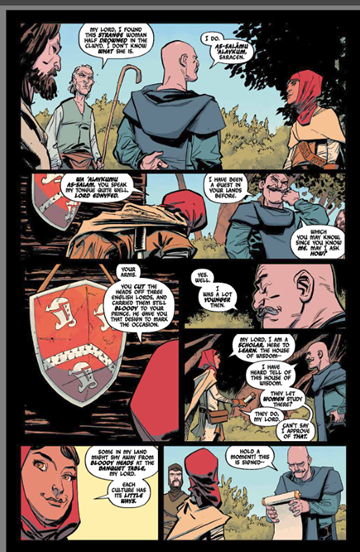
compasscoverDo you ever find yourself in the middle of an amazing historical fiction fantasy adventure graphic novel, reading as fast as you can to find out what happens next, while simultaneously having absolutely no clue what is going on? Yeah, I am was confused often in this upper YA/Teen (16+) 136 page book set in Europe during the Islamic Golden Age and starring a female from the renown House of Wisdom.  I’m fairly positive it is my own limitations that made the book confusing, but for those wiser and more versed in graphic novels, I would recommend this book.  It has action, adventure, science, history, philosophy, a strong Muslim character, friendship, wisdom, ingenuity, a bibliography, Mongols, Druids, and a dragon.

compass1

SYNOPSIS:
Shahidah El-Amin is a Compass from the House of Wisdom, she is not a thief, she seeks knowledge which means that she is incredibly educated, fierce, and scrappy: part Indiana Jones, part Tomb Raider perhaps.  She is a hijab wearing, dua invoking, Qur’an quoting, don’t give me alcohol even as you are about to kill me, strong confident Muslim. 

The book opens with her finding an artifact and being betrayed by a fellow scholar and friend, Ling Hua, a Chinese scholar.  The two race to Wales to get to the possibly rumored Calderon of Eternal Life for different reasons and using different methods.  Along the way Shahidah shows her skills in surviving, understanding what her priorities are, and learning about friendship.  She will battle Master Hua, the Khan, a dragon, a bear, the Druids, a leper just to name a few as the fantasy world is developed and built up with historical accuracies thrown in.

compas

WHY I LIKED IT:

I love that the lead is a fierce female Abbasid Muslim from Baghdad and that there are a variety of religions and cultures mentioned and depicted.  It refers to Shahidah as an Arab witch by the enemy and calls Muslims “Mohammedans” which takes a bit of getting used to and I never got comfortable with.  I love the inclusion of ayats in transliterated text of the Arabic, and the concept is wonderful.  I got lost though in some of the world building and plot.  I think the action and illustrations are clear, but the text needed a little clarity in my opinion.  Again, I acknowledge my lack of familiarity with the concepts and format of the book.

I loved the bibliography and the notes included at the beginning and end.  I actually would have liked more information on the House of Wisdom and as always, a map.

FLAGS:

The concept and references make it for more mature readers.  There is also violence, a mention to love making, and depicted death, gore, killing, etc..

compass2

TOOLS FOR LEADING THE DISCUSSION:

Even though it is for older readers, I think it would be great on a library shelf for middle grades and up.  It probably isn’t for everyone, and many wouldn’t be tempted by it even, but the few kids that like this kind of content, will absolutely love the book.

Samir and Yonatan by Daniella Carmi

Standard
Samir and Yonatan by Daniella Carmi

samirandyon

I saw this book at the library and was shocked: a Palestinian pov story written by an Israeli.  I checked it out, braced myself, and got ready to rage.  Except it isn’t blatant, and I can’t just chop it up to obvious hate, but that isn’t to say that the 183 page middle school book should be shared and deemed harmless: it subtly minimizes the occupation of an entire people, it in many ways glosses over the apartheid taking place.  It gives the inequity lip service, and I’m sure many western non Muslim, non Palestinian readers will find the book balanced, but I never could quite shake the looming shadow throughout, of trivializing the oppressive regime that is Israel.  I don’t know if the undermining is intentional, and I couldn’t find anything with a Google search to see how the book was received by Israelis in 1994 when it was published (it was translated in 2000), but either way it provides a great example as to why OWN voice books are so much more powerful.  This is not the oppressors’ story to tell.  I’m not saying the author isn’t sympathetic to the Palestinian struggles or that she actively supports encroachment of Palestinian homes, I honestly don’t know her stance.  I do know that the lived experiences of Palestinians though, is best left to be told by people that live it, have lived it, and those that feel loss because of it.  It is not a narrative to be told by the force that is causing the pain.  My biggest worry is that readers will take away from the story that the situation isn’t that bad, that Israelis are taking care of this poor injured Palestinian boy out of the goodness of their hearts so they must be nice, and at the end of the day the two sides are just two opposing forces, but the people once they get to know each other, bond over the fact that they pee the same and can be friends.  It waters down that it is, and was, major international powers backing the Israelis and that it is not, nor has it ever been, a simple disagreement between two equal sides. No I don’t expect every book about the region to detail the specifics, but don’t tell me that killing of children, a life of checkpoints, curfews, and fear can all disappear over a few months when the “enemy” provides medical care, regular meals, and arts and craft times. I’m not Palestinian and I can see the short-sided reality of that real quick.  It leaves young impressionable readers with a very skewed view, no matter how diplomatic the author attempts to be on the surface.  And I cannot support it.

SYNOPSIS:

Palestinian boy Samir injures his leg in a bicycle accident, quite seriously, and his mother who cleans for an Israeli lawyer is able to get him a special permit to be taken to the Jew’s hospital to be cared for by a visiting American surgeon.  He speaks broken Hebrew, but understands quite a bit as he has worked in a Jewish grocery store in the past.  When he gets to the hospital, he is placed in a room with other children to wait.  He stays there for weeks until the doctor can arrive and then even after the procedure he stays for physical therapy for weeks before he can return home.

While he is there, he gets to observe and know, in some ways, the other patients.  Yonatan is always buried in a book, but at night, when the other kids go to sleep he talks to Samir and plots with him a trip to Mars.  Yonatan’s mom lives in American, he lives with his dad who is an astronomy professor.  He also ethically is a vegetarian and saves his kabobs and chicken from his meals to give to Samir.  There is a girl that was hit by her father and refuses to see him, and one that is like a princess that doesn’t like to eat.  Tzahi wears a colostomy bag and is always jumping around and causing trouble.  His brother is a paratrooper in the Israeli army and he hates Palestinians.  It is hard for Samir when the brother comes to visit, the fear is real.

Samir’s younger brother Fadi was recently killed by Israeli soldiers and the memory, horror, and anguish is still very fresh for Samir and his entire family.

WHY I LIKE IT:

At first I really couldn’t articulate the saccharin taste the book was causing to form in my mouth as I read.  The curfews, and check points and loss of Fadi was being discussed and contrasted to the luxury of the Israeli hospital, and then it began to occur to me that, it was almost worse than just being blatantly hateful.  The placating and sugar coating slowly diminishes the horrors of reality.  At the beginning Samir doesn’t want to go to the hospital, he would rather have a limp, but the narrative slowly becomes about the kids in the hospital also have stressing and hard lives, and that seems sweet, except, their issues while specific, are universal.  Samir’s leg is as well, but the oppression of his people is systemic and helping him doesn’t erase that the same people running the hospital killed his brother, dictate his reality, and his future opportunities.  It is not enough for the “anti Palestinian child” to have a surgery that corrects his ability to urinate and at the very end, they pee in to the planters.  It might work on the surface, but it trivializes too much. If Samir would have gotten to tell them about his life and his pains, and his experiences, and they would have accepted them as valid, maybe I could see bridges being built, but bonding over basic human functions, and celebrating that an Israeli boy finally talks to a Palestinian, isn’t compassion, it is arrogance.

The only real positive takeaway I had of the book was that even in the tiniest human kindnesses Yonatan showed Samir it was something for Samir to contrast with his life long friendship with Adnan.  That growth of realizing what makes a good friend was more humanizing and affectionate than any other storyline in the book.

FLAGS:

Murder, fear, harassment, oppression, bullying, teasing, violence, gun violence, abuse, talk of urinating, showering in front of others.

TOOLS FOR LEADING THE DISCUSSION:

No way, I will never have Palestinian children read about their life experiences from an Israeli person speaking through a Palestinian character.

What if Dinosaurs Were Muslims? by Rabia Bashir illustrated by Laila Ramadhani

Standard
What if Dinosaurs Were Muslims? by Rabia Bashir illustrated by Laila Ramadhani

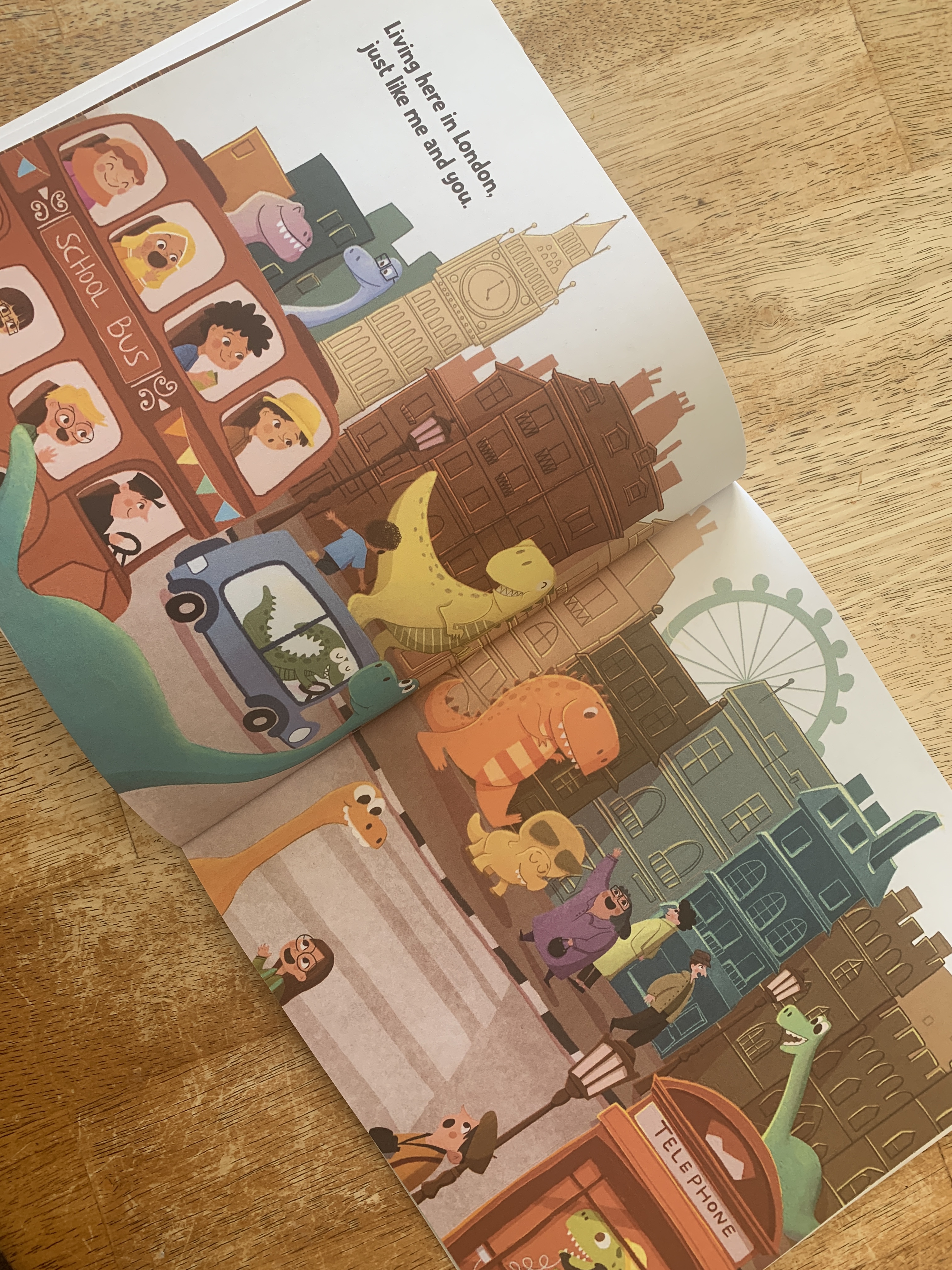
This rhyming Islamic tale wonders what dinosaurs would do if they were Muslim and alive today.  For littlest Muslim readers this repetitive tale ponders how they would eat, pray, love their mothers, respect their neighbors, dream, and feel, by tying all those things back to how Muslims behave.  The adorable illustrations kept my 6 year old glued to the story and the simple text held my 2 year old’s attention.  A fun book with wonderful supplements at the end to engage children in activities that everyone does compared to those that just Muslims do, a Fun Fact about (Muslim) dinosaurs and mums in Islam.  As well as extra activities, valuable information, and details about donations made with the purchase of this book.

The book takes place in London and imagines if dinosaurs were alive and if they were Muslim what day-to-day life would be like.  The refrain starts out “If dinosaurs were alive today and if they were Muslims too,” before stating what they would do and having it conclude with “just like me and you.”

In a similar vein as the ever popular How do Dinosaurs series by Jane Yolen, the book teaches kids how to behave by teaching the dinosaurs.  The book is short, and the humor comes from the illustrations, primarily the facial expressions of the parents, more than from the text, but I think the wildness of Dinosaurs living today will get most little kids smiling.

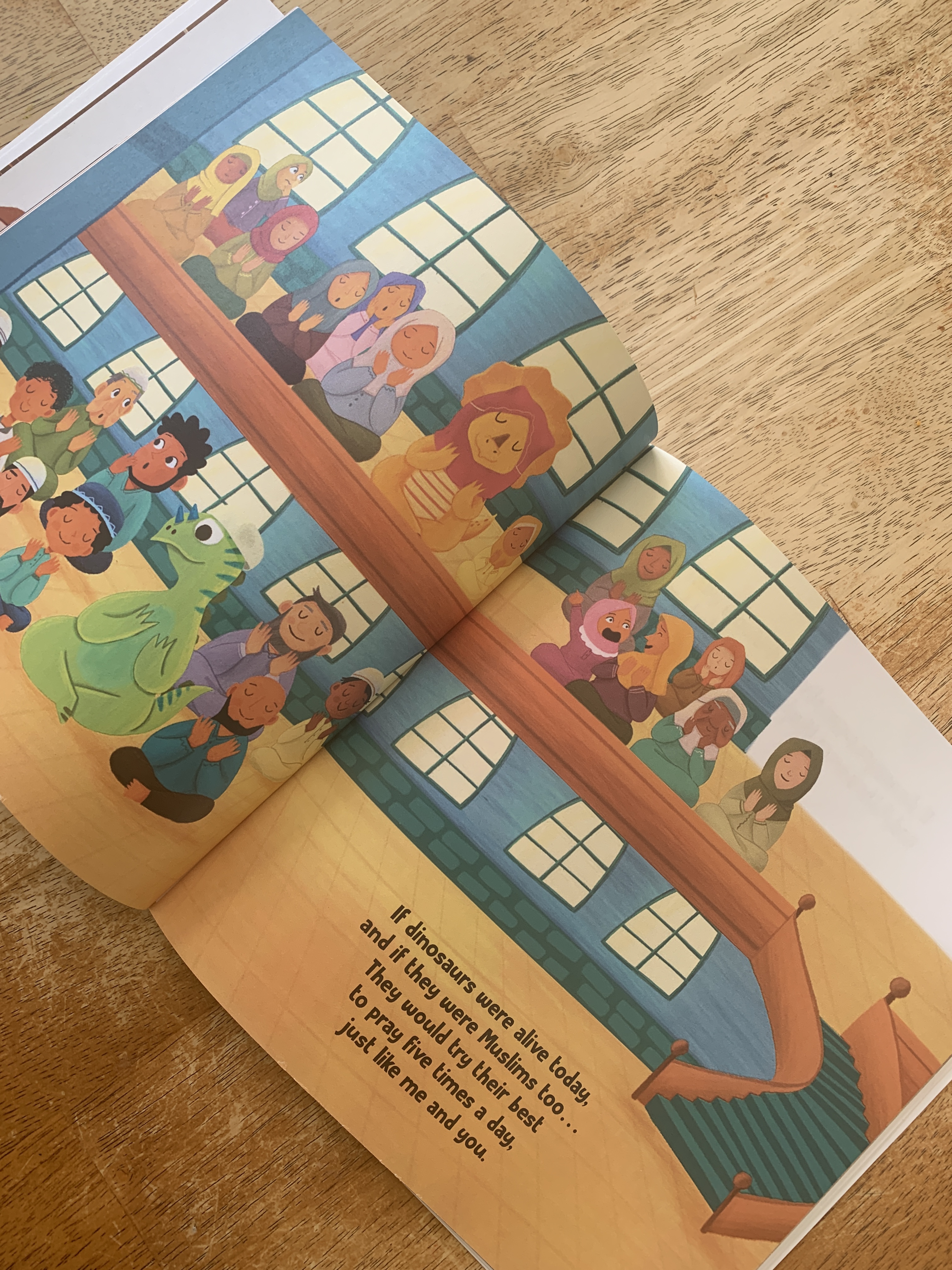
The only real concern I have with the book is the text when they are in the masjid praying and it reads, “they would try their best to pray five times a day.”  I know we don’t demand our littlest ones to pray all five salat, but I don’t know if it would imply that trying to pray is sufficient even when you are older.

From start to finish I found myself smiling while reading this book aloud to my kids, even after the fourth time in a row, alhumdulillah.

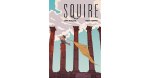
Squire by Sara Alfageeh and Nadia Shammas

Standard
Squire by Sara Alfageeh and Nadia Shammas

squire

This 336 page YA graphic novel set in a fictitious world draws on the authors’ Arab culture and creates relatability for universal readers everywhere.  Themes of coming of age, war, family honor, discrimination, classism, deceit, and friendship, all interweaves with rich illustrations and warmth.  With a few unnamed #muslimsintheillustrations the story shows a lot of heart and with some language, violence, death, and oppression would be best suited for 9th grade and up.

SYNOPSIS:

Aiza and her family belong to the Ornu tribe and are treated as second class citizens in the Bayt-Sajji Empire.  With their traditional arm tattoos and seemingly more plentiful food, they are greatly disliked by the larger community and oppressed at every opportunity.  Aiza dreams of joining the army, rising in ranks, earning citizenship for her family and changing their future.  She also dreams of being a hero.  When she finally convinces her family to allow her to enlist, they also encourage her to hide her identity, and just like that, she is off.

Once in training she is pushed to excel or risk being sent to the front lines.  As she navigates new friendships, harsh instructors, and the shadowy General Hende, Aiza learns there is so much more to war and politicking than meets the eye.  Her life, her loyalties, her understanding of the world will all be tested, as Aiza must decide which path is for her.

WHY I LIKE IT:

The text and illustrations are seamless in conveying a united story, I was a little nervous with two authors, and I like that the story has twists and multitudes.  I loved seeing strong women in the military, as the authors’ say tough girls with swords.  While reading it I was completely submerged in the story and the characters, but writing this review a few days later, I’ve largely forgotten the characters names and quirks.  I’m not sure if it is because I read a digital version, or because the character building is a little lacking.  I don’t know that I was emotionally invested in some of the major plot points because I was not seeing the struggles it was requiring of the character to endure.  Admittedly I have not read a lot of fantasy graphic novels, so I don’t know that I have a lot to compare it to, but I do plan to read a physical copy when I can, and read follow up books in the series, to see if my impression changes.

FLAGS:

Some language, bullying, oppression, violence, death, killing.

TOOLS FOR LEADING THE DISCUSSION:

There is nothing religious in the text, so I wouldn’t use it as a book club selection, but I would definitely shelve it in a school library, classroom, and keep it in mind for readers that love these kind of books.

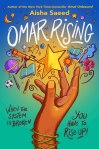
Omar Rising by Aisha Saeed

Standard
Omar Rising by Aisha Saeed

omar rising

This middle grades 224 page read is quick and memorable.  The story is set in Pakistan and the characters are probably Muslim, but there is no religion mentioned until nearly the end, and even then only in passing.  The only culture specific references are the characters’ names, social etiquettes, and the foods mentioned.  By and large, the story is universal and could take place anywhere, and probably does take place everywhere.  While I wish it would have had more cultural and religious references, it is an OWN voice story after all, the book is enjoyable, the characters endearing, and I think young readers will benefit from spending the school year with Omar, seeing classism up close, and cheering for an unjust school system to be challenged.

SYNOPSIS:

Omar is the son of a servant and when he earns a scholarship to a prestiges boy’s school for seventh grade, the entire village is bursting with pride.  When he gets there though, it is hard, really hard.  The scholarship kids aren’t allowed to participate in any extra curriculars, they have to do service hours, and they have to maintain the ridiculously high A plus grade average or be expelled.  It seems that that headmaster is out to get the scholarship kids, and Omar in particular.  As the scholarship students struggle to stay afloat, Omar has to determine if it is all worth it. He spends all his time studying, even when he goes home to visit his mother, and while he doesn’t want to let the village down, he is struggling to find the optimism to keep fighting for his place.  When Omar learns that the system is designed to make the scholarship kids fail, and that those that are kicked out are called “ghost boys,” he has to decide to how hard to push himself and ultimately how hard to push to break down the system that treats him and those like him like second class citizens.  Luckily, Omar has some supportive teachers, some loyal friends, and a whole lot of determination.

WHY I LIKE IT:

I love that the story is universal, it is at times a much tamer version of the YA book Ace of Spades which also explores second class citizens in posh private schools as a theme, and at times I even felt some Dead Poet’s Society vibes.  The cultural setting and names however, to me is a mixed bag.  I’m glad that it didn’t become another story about problems in another country with judgmental overtones, but at the same time, to be so void of cultural references seemed too far of an extreme in the other direction to make the story feel real richness and authenticity.  I love that the story isn’t about bullying and that a number of characters have depth.  I was genuinely confused for a large portion of the book about what the orientation in the summer entailed.  It was clarified much too late that it was a weekend, but I was at a loss trying to figure out how he knew some of the campus, some of the other scholarship kids, had a roommate, yet knew so little of the school and what it would be like.  I am not sure why that information was delayed, but seeing as I read an arc, I hope it is clarified in the final copy.

FLAGS:

Omar and a girl are friends, they hug at the end, but it seems rather innocent, and more sibling like as they were raised together.  

TOOLS FOR LEADING THE DISCUSSION:

This would be a good book on a shelf, and would possibly work as a read aloud to grades four or five.


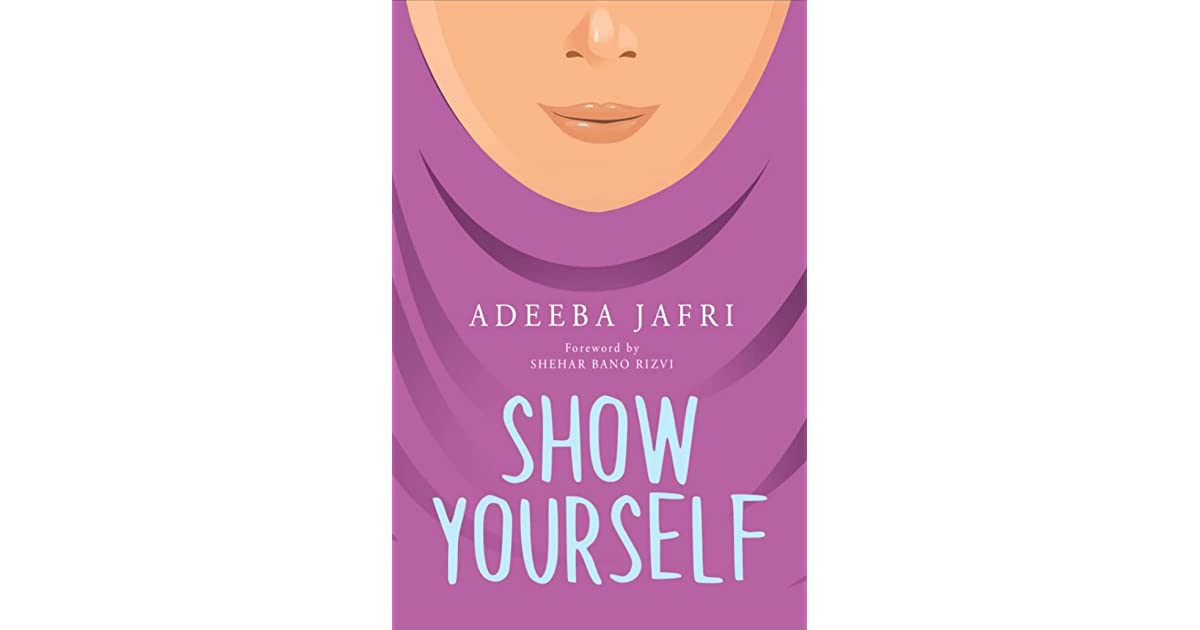
Show Yourself by Adeeba Jafri

Standard
Show Yourself by Adeeba Jafri

show yourself

At 98 pages the book claims to be two YA mental health novellas that bring attention to mental health in a relatable and contemporary audience through Muslim characters.  As someone with some experience in loving individuals going through some of the issues addressed in the book, I was thrilled that voices were making it on to the page and in a capacity to increase discussion about self-harm.  Unfortunately, the presentation of the two short stories baffled me and I don’t think the book will find its way in to many YA reader’s hands.  I don’t know why it is two novellas when the characters are the same and it very easily could, and should, have been fleshed out into a single longer novel.  I think it would have shown a better well-rounded understanding on the importance of knowing and recognizing signs of someone struggling with their mental health, how coping skills aren’t often enough and outside help is needed, how assumptions and stereotypes further alienate those suffering, and just overall made the characters deeper and more relatable.  Instead we get two isolated snapshots that subtly try to discuss mental health, but use a very immature cover story that misses the target audience.  The book as is, is better suited for middle school readers, but I think even they would get a limited view of how to help those close to them, or reach out themselves if they are hurting.  It needs to be five short stories with different characters and a unifying theme, or one complete novel.  Unfortunately, as much as I wanted to share this book with my teen daughter so we could discuss, I couldn’t convince her to read it, which is unfortunate, because the author can write, it just isn’t tempting presented as it is.

SYNOPSIS:

The book is two novellas, the first focuses on three female Muslim friends and one’s little sister.  The girls all go to school together, but are of different economic statuses, have different interests but support one an other, and have different family dynamics, that all come in to play.  The close knit community means the parents are social with each other as well, and one parent or another is always picking or dropping them off at each other’s homes.  When Hana gets a new phone, Aliya is clearly jealous, Lena tries to brush it off and keep the peace, but, when Hana’s phone goes missing, even she has to admit that “rebel” Aliya is looking guilty. As the girls search for the phone, Lena spends time with her family, goes to her brother’s robotics tournament and finally confronts Aliya.  Aliya’s mom has disappeared earlier, and with her purple dipped hair, sudden influx of funds for Ubers and new accessories, the girls fight and Aliya pulls away.  When Aliya and her dad don’t attend Hana’s younger sister, Sara’s ice skating performance, it seems the friendships are irreconcilable.  Aliya, however, shows up to the after party things are revealed and amends are made.

The second novella is the story of what happened with Aliya’s parents, particularly her mother.  Similar to Sara, Aliya’s mother was harming herself and eventually abandoned her family.

WHY I LIKE IT:

I like that it shows Muslims suffering, coping, and dealing with mental health issues.  The topic is way too taboo and it effects all swaths of the human population, we need to normalize discussions about it.  I wish the novellas would have stressed getting professional help more, sure it is great that Hana is going to try and put her phone down and pay attention to her younger sister, but that is not always enough.  Aliya mentions that after her mom left her and her dad went to therapy, but the mom claimed to leave to get help and then never came back.  I think there needs to be A LOT more emphasis on what “good” help looks like and what it can do to change lives.

The book is self published it seems through a publisher, so hopefully the author could ramp up the story telling, character building, and messaging, to really make the book shine.  I don’t understand the title, I don’t know why it is under a hundred pages.  I don’t know who the forward is written by.  If you want to write a book about mental health you really need to have done a lot of research, not just necessarily your own experience, and you probably should have a bunch of letters after your name.  Otherwise just write a work of fiction and touch on some of the issues that you want to support discussions about.  The book seems to straddle committing to one or the other, and ultimately it falters because of it.

I do like that the characters are Muslim, the book is not preachy, some seem to be more religious then others, but it isn’t really part of the story.  The characters’ culture and nationalities seem to be left intentionally vague.  It mentions gossip from the ladies at the masjid, which I think should have been drawn out more.  Really if you ask me, this is a great rough draft, it needs fleshing out is all, build it up to 250 pages and set out to reach middle school readers instead, and it will resonate and have the effect I think the author is hoping for.

FLAGS:

Self harm, abandonment, assumptions about a man Aliya seems to be sharing a meal with in a photograph, gossip, lying.

TOOLS FOR LEADING THE DISCUSSION:

Because it doesn’t seem to stress how to help and what help is out there, I don’t know that the book would be a great read for all.  I think if you are looking to open a discussion with a small group of readers or individually, you may be able to assign the book and discuss in a safe environment.

Barakah Beats by Maleeha Siddiqui

Standard
Barakah Beats by Maleeha Siddiqui

barakah

I have been waiting for this book for a really long time: a girl leaves an Islamic school for a public middle school and is not just unapologetic, but proud of who she is and of her religion, all while navigating such a huge life change and the day-to-day stresses of school, family, friends, and life. This is it right, the middle grade 288 page book that holds up the mirror to our own experience as a typical Muslim family in the west, that so many of us have been waiting for? Except, sigh, for me it was just ok. Don’t get me wrong, if you are new to seeing mainstream (Scholastic) Muslim protagonists shining and making their salat on time, this book is revolutionary and amazing. But, I’ve been doing this a long time, and I guess I wanted more than a tweak on Aminah’s Voice. I wanted to relate. I’m not a hafiza, nor do I know many 12 year olds that are. I enjoy boy bands, but have never been asked to join one. Sure the details and her decision to follow Islam the way she understands it is a great message, but it doesn’t clearly appear til nearly the end of the book, and until I got there my brain was constantly finding holes in the narrative, to the point I got out a notebook and started taking notes. There is absolutely no reason you shouldn’t read the book, and I know I am clearly in the minority here, so brace yourself this is a long review. If you see this at your child’s book fair and you think it looks cute, grab it, it is. I am cynical and jaded and I’m owning it, so perhaps we can agree to disagree, I’m just sad that I didn’t absolutely love it, so hold on, because I’m going to get it all out so that I can move on, inshaAllah.

SYNOPSIS:

The book opens with Nimra at her Ameen, a celebration to acknowledge her completion of not just reading the entire Quran, but of memorizing it. Her best friend Jenna, her non Muslim neighbor, is there and as everything is explained to her, the readers learn about Surah Yaseen, becoming a hafiza, and the schooling differences that Nimra and Jenna have had. That night when Jenna is sleeping over and the girls are watching Marvel’s Infiniti War, Nimra’s parents inform Nimra that she will be starting public school and that the two girls will finally be together. The news is big, but Jenna shrugs it off, and Nimra senses that something is off between them. When school starts, Jenna is surprised that Nimra is planning to wear her hijab to school, and this is before they have even left in the morning. The rest of the day: comments by Jenna’s friends, purposefully being excluded at lunch by Jenna, and being overwhelmed with a big school and so many teachers, makes Nimra miss her small three person Islamic school. Additionally she loves art, and is always tucked away in a corner with a sketch pad, her parents, however, have made her take Spanish instead of art class, and the frustration is painful. When she asks the principal for a quiet place to pray, another girl Khadijah pipes up that she can pray in the band room where she does. Khadija and her immediately hit it off, but she has already prayed, so Nimra sets off on her own to find the room. As she is about to start, some music starts, so to tune it out and focus on her salat, she recites aloud. When she exits, three boys are in awe at her vocal abilities: Bilal, Waleed, and Matthew, three Muslim boys. Better known as the middle school celebrity boy band, Barakah Beats, the boys beg her to join them. Nimra says she’ll think about it, but as the days show her and Jenna drifting further apart, being in the band might just be the way to get Jenna to pay attention. Unfortunately, Nimra’s family doesn’t believe Islam allows for musical instruments. She acknowledges that it is controversial, but that her family doesn’t play any instruments, attend concerts, or get up and dance. She figures she can join the band, just long enough to get Jenna’s friendship back on track and then dump the band without having to tell her parents. There is just one giant hiccup, they are planning to perform at a refugee fundraiser, oh and she really likes hanging out with the boys and Bilal’s sister Khadijah.

WHY I LOVE IT:

Had I read this book five maybe seven years ago, I’d be gushing, swooning, but when the author says in the forward that she is showing a girl proudly owning her religion, and essentially daring to be her authentic self, I expect something almost radical, revolutionary even. We are all settling in to seeing our Muslim selves in fiction and acknowledging that we are not a monolith, that we are diverse and flawed and valuable, but this premise felt different somehow, and I really wanted to connect with Nimra and her family, so when I didn’t, it hurt. It isn’t just a main character Muslim POV, or an OWN voice book, it is portrayed as being authentic to those of us that love our faith and don’t feel like we need to tone it down to be American. We are second or third generation American Muslim, we know our deen and this is our country, there is no going back to a homeland or assimilating. The book is about her being true to her self, but I don’t know that I know what she wants or what she believes, aside from her parents. The book addresses intergenerational conflict of power and expectation between her parents and grandparents, but other than for Spanish vs Art class, it seems to skim by the music issue, the main issue of the book. The book expects readers to acknowledge the maturity and voice of a 12 year old girl, but that same expectation isn’t given to the readers of nearly the same age. It glosses over any articulate arguments for why musical instruments are or are not allowed. It mentions that some people feel it is ok if the lyrics are not bad, some say it isn’t ok, that there are disagreements, that there are controversies, but it never explicitly answers, why? And readers are going to notice. I found it incredibly odd, that the music controversy is at the heart of this book, but the safe alternative is art and drawing. Drawing faces is a HUGE point of differing opinions among Muslims, perhaps as big, if not bigger than music. Nimra is always sketching and it mentions that she often is drawing super heroes: people, with faces, and possibly (magic) powers! The whole book she is in the band, and she regrets that she is using it to get back at her friend, but there isn’t a whole lot of internal debate if she thinks music is haram like her parents or it is ok, she just stays in the band, and plots how she will leave it so her parents don’t find out. SPOILER: I like that she ultimately makes the decision that is best for her and leaves the band after fulfilling her commitment, but we never see that, that is what her heart is telling her. There is no self exploration or critical thinking, it is just justifying why she is doing it, and then not doing it.

In terms of character development, only Nimra is really explored, the side characters are all pretty flat. Jenna gets some depth, but not much. I mean, how does Nimra’s best friend and neighbor who comes over every day after school not know that she has been working on memorizing the Quran? Not know how to dress at a religious themed celebration, a halter dress, really? Jenna is never shown to be a good friend, or even a nice person, the tone around her is negative from the start. We are told she is a good friend, but we never see it. The conversation about Nimra wearing hijab to school is like two lines, but is made to be a much bigger issue in Nimra’s head as she feels things haven’t been right since then. But, I’m not buying it. The girls go to movies, they go shopping, and she wears hijab, so why would school be so different? All of Jenna’s friends know about Nimra, so she can’t really be that embarrassed by Nimra’s scarf if they go out when she is wearing it and none of the other classmates seem surprised. I also felt off with the portrayal of the character because we so fervently believe that often the best dawah or even method to break down stereotypes and bigotry is to get to know some one personally. Jenna knows all of Nimra’s family and has for nearly her whole life, and she is so hateful and clueless to everything Islam? It is a stretch, the family prays, fasts, dresses Islamically, cares for her, feeds her cultural food, yet she is oblivious to it all. I get that her hate or lack of interest is probably reflective of how a lot of our neighbors are, but there aren’t many non Muslims in this book, and that portrayal is going to linger heavily for young readers.

Nimra is likeable enough on the surface, but the more you think about her, she isn’t really any different than those she is hurt by. She is mad when Julie assumes she doesn’t speak English, but she assumes Matthew isn’t Muslim because he is white. She checks her self in other ways, but this one seems to slip by. Other inconsistencies I noticed are when the first day of school teachers are really mean to her, but then it is never mentioned again. I wanted to know did they keep at it, did she prove them wrong? It was built up and then just abandoned. At her old school there were two other girls doing hifz, but when she meets up with one at Saturday school it seems they both are no longer at the school either. Did they graduate? Did they abandon it? Her Quran teacher comes to see her perform a song, perhaps a little understanding about her point of view in addition to the other Muslim’s in the band would have helped explain the why music is controversial in Islam. Also, does and would ADAMS allow music at an event? I’m genuinely curious. I even tried to Google it. Most masjids probably wouldn’t, but maybe a community center would. Readers are going to be so confused why Nimra is so stressed when the religious teacher and the place of worship are fine with it.

The friends as boys thing is sweet, but a little surprising, having three boys come over to hang out and watch a movie, high fiving them, sure it isn’t shocking, but its a bit inconsistent given the narrative. Plus, Nimra trying to help hook Waleed and Julie up? For as much as the book doesn’t want to sell itself out, little acts like this without a little hesitation or comment or introspection, kind of make it seem like its trying to normalize non Islamic acts as being ok.

I love the pop culture Marvel references, The Greatest Showman songs and the shoutout to Amal Unbound. I even loved the Deen Squad remixes getting acknowledged, but it made me wonder if all the songs of Barakah Beats are Islamic themed. Perhaps it doesn’t matter, but it would be interesting to know since the entire school adores the band, even asking for autographs at one point.

FLAGS:

Nothing a third grader and up couldn’t handle: music, art, lying, bullying, talking about crushes.

TOOLS FOR LEADING THE DISCUSSION:

I think I’d pass on the book as a middle school book club option, as it really is a middle grades read, and the thematic issues brought up for discussion are better found elsewhere. If I had an in person classroom, however, I would have the book on my shelf, it is a quick short read, that I think might encourage a discussion on music to take place, or at least allow readers to see a proud Muslim doing well in different environments.

A Pocketful of Stars by Aisha Bushby

Standard
A Pocketful of Stars by Aisha Bushby

This middle grades magic realism novel draws you in and pulls on your heartstrings pausing only to offer pointed commentary on friendship, self-awareness, and self acceptance.  Oh sure there were parts that seemed a bit repetitive and parts I had to read again because the continuity was just off enough to have me confused, but the book has power, and especially for a debut novel I was blown away.  Well, actually I was in tears, and thats a pretty strong emotion to be felt in 246 pages, so be impressed.  I don’t know if the author identifies as Muslim, she was born in Bahrain and has lived in Kuwait amongst other places.  The main character, Safiya,  experiences her mother’s memories in Kuwait where Eid and the Athan are briefly mentioned and a few characters wear scarves.  There are culture rich Arabic names, but no religion is mentioned outright.  Saff has Christmas money, eats pepperoni, a side character has a boyfriend and they kiss, and there is just a touch of magic to tie it all together.

SYNOPSIS:
Safiya’s parents have been divorced for a few years, and when she chose to live with her dad, her Saturdays became one-on-one time with her mom.  Her mom, Aminah, is a lawyer from Kuwait who can chat with anyone and everyone about anything and everything.  The complete opposite of video game loving Saff who struggles to find her voice, and has nothing in common with her articulate, headstrong, independent, theater loving mother.  The two rarely get along and after a particularly intense fight, Safiya decides to not spend Saturday with her mom, but rather head out with her best friend Elle and new year eight friends at the mall.  When her dad tells her to come home asap, she knows something is up, but could never have imagined how life altering the days events are about to become.

Aminah is in a coma, and Safiya is full of regret and fear.  As she sits next to her mother’s hospital bed and drinks in her perfume, she is drifted to a far away land filled with a crumbling house and a magic like quality.  Approaching this oddity like her favorite video game, she explores her mother’s memories, and finds a girl not so different from herself.  As reality and magic merge in young Saff, she begins to sort through her feelings toward her mother and come to peace with what she has to do and endure and overcome.

In the process of handling her life-changing home situation, Saff, also finds the strength to call out cruel acts from classmates, find her voice, and cut out toxic friendships while cultivating supportive ones.  The journey on both fronts will have readers cheering for Saff while wiping away tears.

WHY I LIKE IT:

I love the quick pace and rawness of the characters.  Grandma, mom, and Safiya all say and do things they regret while hot and angry and have to learn the consequences and humbling that needs to occur to fix what their words have broken.  No character is completely good, nor completely bad, and in a middle grade book that is powerful. Each one has relatable qualities that really make the book memorable.  

Safiya has to really work out what is going on with her best friend, Elle, and what she is willing to accept and what lines she is not willing to cross.  The character’s maturity is inspiring, and I love it.  She doesn’t fancy boys (yet), and doesn’t see liking boys a sign of maturity.  She doesn’t want it forced on her, and she doesn’t want to give up things that she enjoys just to “fit in.” The fact that she can articulate how Elle is a chameleon blending in to her surroundings where she is just a plain old lizard is wonderful.

I enjoy the magical trips to Kuwait.  They don’t show much of the culture, but what is revealed is lovingly conveyed.  I like that it did acknowledge that Aisha knows Arabic, but struggles a bit to read it.  I would have loved more Arabic words sprinkled in, but at least it accounted for the linguistic abilities as it jumped between countries.  The book is set in England, so some of the concepts or phrases might need a bit of explanation for younger American readers.

I wanted more information about the backstories just beneath the main story line.  How did Safiya’s parents meet? Was the divorce amicable? Did her dad have any family around? How did Aminah leave for England at such a young age alone? How come Saff never visited Kuwait? How come Saff didn’t know about Aminah’s friends? How did the friends take Aminah leaving? Why didn’t they just email her the invitation? Why did they still have it? How did the girls meet in the middle of the night? I know that the book is middle grades, but just a bit more would have helped some of the holes feel shallower, and the overall story details more polished.

FLAGS:

Teasing, death, boyfriend, kissing, illness, verbal fighting. Nothing middle graders can’t handle, although the mom is kind of terrible to Aminah at the beginning.

TOOLS FOR LEADING THE DISCUSSION:

I think this would be an awesome fourth or fifth grade book to read and discuss. I don’t do a book club for that age, nor do I have children in that age group at the moment, but I am planning to suggest it to teacher friends I know.  The book would appeal to boys and girls, but I think girls especially those going through friend dramas and girls butting heads with their moms will really benefit from this quick memorable read.

Zara Hossain is Here by Sabina Khan

Standard
Zara Hossain is Here by Sabina Khan

zara

After reading a few chapters of this book, I really had no intention of finishing it, knowing that my review highlighting the main character’s bisexual identity and romance would draw critiques from both people that don’t want to see Muslim character’s identifying as any of the LGBTQ+ labels and those angered by my mentioning of them as potential flags.  Alas, I did finish the book, and I am reviewing it because as a (former) Islamic School Librarian, I would want to know how much romance is in any book that I would shelve or recommend, and this book particularly gives no insight about any romance in the blurb on the inside flap.  The author’s first book was very clearly about being a queer Muslim, but this YA short 244 page book focuses a lot on Zara’s relationships, her parents support and acceptance of her being bisexual, and her new romance with a girl.  The book is not graphic or even overly steamy, but the blurb suggests the book is only about immigration, hate crimes, and bullying.   So, I write this review to give a heads up to parents, like me, that might see this book on the library shelf or if like the author’s first book, which was picked up by Scholastic, in a school book fair, and not realize that there is a fair amount of discussion about her sexuality and how it is perceived in the Pakistani and Islamic culture, as well as how she doesn’t see the need to fast in Ramadan or pray five times a day, but still identifies as Muslim.  All that aside, I also didn’t love how the book was written, it is a lot of telling and not showing, I feel like the mom is painfully underdeveloped and flat, and the story threads don’t weave together consistently;  it reads scattered.  The book is pretty short for YA and with so many heavy themes, it ultimately can’t spend much time exploring any of them particularly well, a shame since the author in real life seems to have endured much of what she writes for her characters in regards to immigration status and citizenship.

img_2132

SYNOPSIS:

Zara Hossain is a senior at a Private Catholic school, in Texas, she has friends that have over the years become family as the parents too regularly get together.  Zara came to American when she was three.  Her family left Pakistan for more educational opportunities and after her father’s pediatric residency, he stayed on with a work permit and green card waiting for citizenship.  The process continues to drag on, and it isn’t finalized.

A boy at school, Tyler, is harassing Zara for being Muslim, an immigrant, and brown.  Her father wants to discuss it with the principal, her best friend Nick wants to beat him up, and her mother just worries.  When finally a meeting with the principal is set, Tyler’s father doesn’t show, and things escalate.  Zara’s locker is defaced with profanity, Tyler is suspended, and the Hossain’s house is vandalized.  When Zara’s dad, Iqbal, goes to talk to Tyler’s father, he is shot, by Tyler’s dad.  He ends up in a coma in the hospital.  During all this Zara is crushing and pursuing a relationship with Chloe, who has just come out to her parents.  Zara’s family is very accepting of Zara being bisexual, and take Chloe in when she needs a break from her conservative Christian family.

Tyler’s dad is well connected in Corpus Christi, and while Iqbal recovers, he is faced with trespassing charges.  Although trespassing is a misdemeanor, by pleading guilty and paying a $200 fine, a criminal record will further complicate their citizenship status, and where they call home.

WHY I LIKE IT:

I like that it shows how messed up legal immigration often is. Dr. Hossain is the victim, he is shot,  he is a vibrant member of his community, but is being forced to leave and uproot his family.  The issue however about trespassing isn’t ever completely clear, the reader is never given a play-by-play account of what happened that night.  I wish we were.  It would be nice to not leave that area gray.  Also a lot of what lead up to Tyler causing Zara so much trouble is rather glossed over.  I wanted to hate him and be angry with him, and then be forced to examine how much was his doing and how much was his father’s, but I never really felt that emotion until the book told me to be mad.

I vaguely recall from the book that she is in a religious high school, the inside flap when I took the picture (see above) seems to stress it more than the story does.  She does mention that they couldn’t start a Pride Club, but I wish she would have talked a bit about being Muslim in a Catholic school, or better yet, shown the reader.  She doesn’t come right out and say that all Muslims are different and this is her.  I wish she would have, instead she talks a lot about being annoyed at having to explain why she doesn’t pray and fast.  Yet she never tells the readers why she doesn’t.  She goes to mosques to counter Islamophobic protests, and talks of going to Sunday school to learn Arabic as a child, but she is very clear that she was encouraged to question religion and God, but not what she found or why she still identifies as Muslim if she doesn’t believe it.  I was curious if she doesn’t believe it actually, why fast at all? If she is still questioning, why not say that.  I really felt that Islam and being Muslim was just a box to be checked to justify the hate crime, but really, she could have just focused on the culture.  There are Urdu phrases, and lots of foods mentioned, she clearly loves Pakistan and talks highly of it and often points out the good and bad in both Pakistan and America.  Food is in the book a lot, and not just Desi food, frozen yogurt is a crutch for the story, and it gets a bit annoying.  I wish there was as much character development as there was food detail and banter.

I liked that her parents defend and stick up for their daughter.  Whether you accept the lifestyle of Zara and her family or not, it is wonderful to see families stick together.  The nosey aunty got put in her place and if you have ever had to deal with the stereotypical aunties or the threat of what everyone will say, you had to cheer for Zara’s parents.  I don’t care what your thoughts are about LGBTQ+, that scene was awesome.  Great job Iqbal and Nilufer.  It was one time that Nilufer got to shine, I really don’t get why Zara’s mom is relegated to the cooking, feeding, worrying stereotype for much of the book.  I lost track of the number of times the book says, “no need to worry your mother,” or something to that effect.  The lady clearly is loving and strong, but doesn’t get developed, and it is frustrating.

The ending is a bit abrupt, yes time is ticking, and whether to move to Pakistan or stay and fight the system is definitely not an easy decision, but how is Canada suddenly the magical answer? I assume for most it is enough, and being the OWN voice tale seems to be very close to reality in this regard, I have no room to roll my eyes, but Canada has civil rights issues with Muslims too, and this 2021 published book kind of made it seem like it is just the perfect answer to all their problems.

FLAGS:

Violence, bullying, Islamophobia, profanity, vandalism, crime, shooting, stereotypes, hate, lying, straight and lesbian romance, crushes, kissing.

TOOLS FOR LEADING THE DISCUSSION:

This book would not work for an Islamic School middle school book club selection.

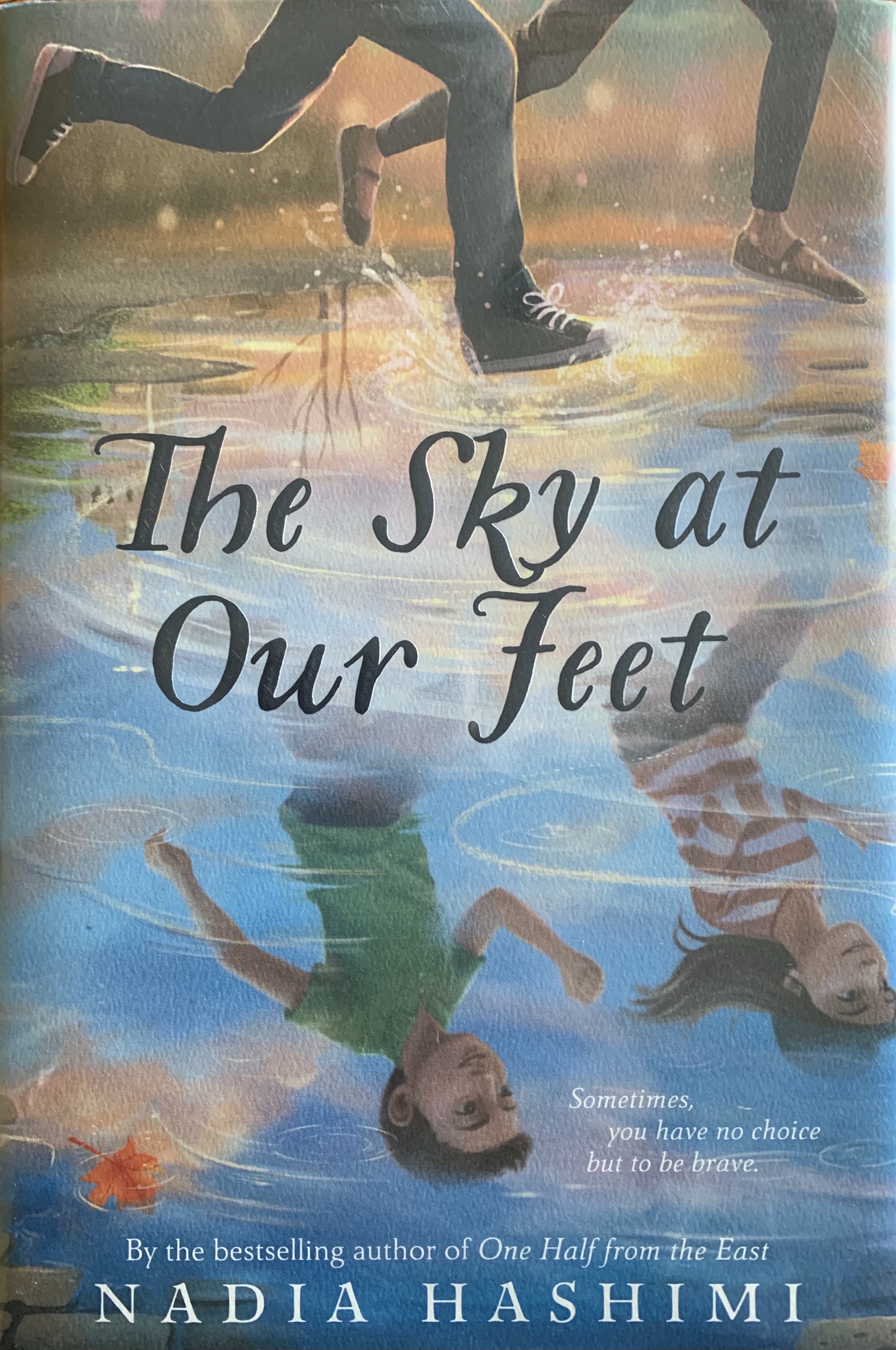
The Sky at Our Feet by Nadia Hashimi

Standard

This 295 page middle grades AR 4.8 book is a fast passed romp through New York City as two 12-year-old kids explore freedom and fear in a new city while grappling with their own sense of identity and what it means.  The OWN Voice story features immigration, chronic disease, family, bravery, and friendship.  There is lying and avoiding police, sneaking and “borrowing” a horse, but it is all for a good cause, and third grade and up will enjoy this read.  There is very little religion in it, but the main character does say salam, notice the similarities between amen and ameen, and reference eid as his holiday. 

SYNOPSIS:

Jason D, known only to his mom and aunt as Shah, was named by a nurse when his mom wanted to make sure he had an American sounding name, and his middle initial D is for December, which comes from her staring at a calendar when asked if she wanted her son to have a middle name.  Life is fairly simple, he enjoys sneaking on to the roof of his apartment building to imagine training pigeons, his mom works at a dry cleaners, they walk where they need to go, money is tight, but they do ok, and his dad passed away before he was born.  His mom is from Afghanistan, but he doesn’t speak much Dari and his mom speaks English, but not confidently.  On her birthday as they are about to enjoy a cupcake he saved up for, the news in the background is covering protestors chanting for illegal immigrants to go home, and Jason’s mom starts to tell him about how she ended up overstaying her visa and  is living in the US illegally.  

Jason’s dad worked with the US military in Afghanistan and with his work came the promise of visas to America for him and for his wife to study.  Many of the locals though didn’t like that he was cooperating and vowed to take their revenge.  With the family in the US and Jason’s mom starting to study medicine, Jason’s dad had one more job in Afghanistan and sadly was killed by anti American Afghans.  Fearful to return, she chose to stay, but with a new baby, few resources, no family and friend support, eventually she was forced to drop out of school and remain undocumented knowing that to return would be at great peril to her and her son.  At some point she befriends an Indian lady, Seema and to Jason, she is Aunt Seema, the only family other than his mother that he knows.  

When a few weeks later Jason sees his mother being taken away by two officers, he knows that this is what she warned him about when she told him the truth about her legal standing.  Terrified and alone, Jason only knows that somehow he has to get to New York to Aunt Seema so that they can figure out how to save his mom.  He grabs a few pictures of his father, whatever money he can find a broken address and heads to the big apple from New Jersey.

Having never been to NYC or really out of his hometown, he loses his backpack to a dog, and struggles to figure out how to get a ticket to get in to the city.  When he arrives at Penn Station he is overwhelmed and exhausted and passes out, hitting his head, and landing himself in the hospital.  

When he awakens he is met by doctors making sure he is ok, and police trying to locate his parents, he opts to pretend he has amnesia and can’t remember anything.  This buys him time, and also acquaints him with Max, a girl with wires coming out of her head and who claims they are running tests on her to understand her level of genius.

The two hit it off and hitch a plan to escape the locked hospital floor, have a day of adventure in the city, and get Jason D to his aunts house.  Naturally this plan is going to have all sorts of obstacles, but thats the story and that is where the fun and discovery unfolds.

WHY I LIKE IT:

I was impressed at how emotionally cathartic the conclusion was.  I hadn’t realized how invested I had become in these two kids and their run through the city.  It was touching, and heartfelt, and a big sigh of relief when it all wrapped up.  I like that both kids are so very different, yet dealing with similar thematic issues from different perspectives.  Max is an epileptic and is kept on a short chain to ensure her safety. She is trying to find and define who she is outside of the medical diagnosis.  Jason is trying to understand if he can be American and Afghan and what that means about where he belongs, and where home is.  There is a lot that they ponder over as they run through central park and the zoo, duck into subways, and get all sorts of turned around on the streets.  Through it all though the kids show just how clever and smart they both are with the quick thinking, riddle solving abilities, and perpetual optimism.  It is at times far fetched, stealing a horse and bumping in to your doctor in the New York City Marathon, and at other times completely plausible, sneaking in to a zoo with a field trip group and ducking through turnstiles to get on the subway.

FLAGS:

Lying, stealing.

TOOLS FOR LEADING THE DISCUSSION:
This is a bit young for even early middle school readers, but would make a great addition to a summer reading list.  I think kids will marvel at the riddles and determination of the two protagonists and imagine a world where kids could maybe get away with such a bold adventure.