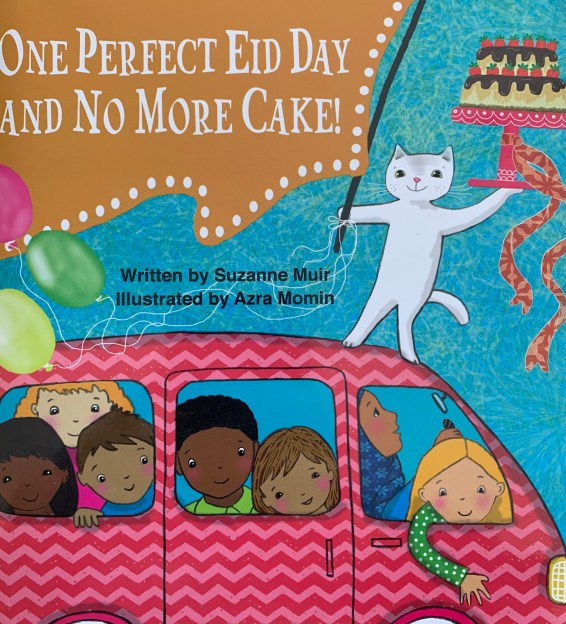
This lovely counting book celebrates the end of Ramadan and the festivities of Eid Al-Fitr by counting up to 10 and counting back down. Over 24 pages of rhyming lines, adorable illustrations will bring the holiday to life as a group of children and a little white cat celebrate. Aside from the title that for some reason I don’t love, the rest of the book is happy and festive and perfect for toddlers to preschoolers.
It starts with one month coming to an end, then henna cones and designs take over, before five pots and six trays of cake are prepared, decorations are hung, clothes are made ready and ten eager eyes watch the new moon rise.
Then ten sleepy cousins have to get up early for morning prayers with presents waiting, rotis are prepared before seven family members squeeze in the van. Friends are met at the masjid and coins are jingling as lunch parties are attended and fun-fair rides are riden. Two tired friends can’t stay away on this one perfect day, and no more cake.
I love the flow of the book, I’m not sure what the four henna designs are or what cousin doesn’t get a present and who doesn’t get to go for prayers, but little kids probably won’t over think it. The little cat is delightful on each page and the book sets a marvelous tone of what one can look forward to and enjoy on this splendid holiday with friends, family, festivities, and food.
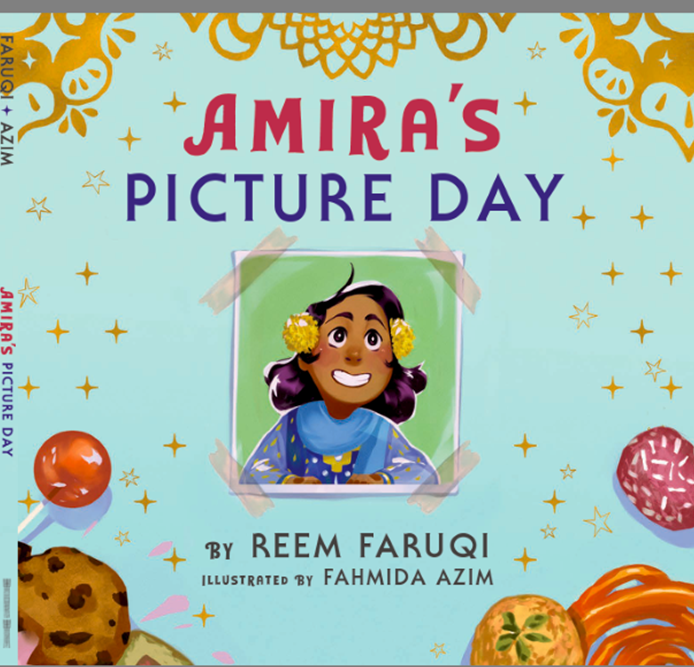
This book is the mirror so many kids are desperate to find in literature. A young Muslim girl is excited to celebrate Eid, while at the same time is sad knowing she is missing school picture day with her class. Not knowing what day Eid will be, not having it a scheduled day off in most school districts, and always feeling like you have your foot in two different doors starts early for children in non Muslim majority countries. This early picture book touches on those emotions, and even if you can’t always get a test rescheduled or a project due date moved, at least readers that face these dilemmas at any age and stage in life, will feel seen in this 32 page book perfect for ages 5 and up.
Amira and her brother Ziyad start the book looking out the window for the moon. They see it, which means Eid is tomorrow and Amira is going to have her mom put decorative Mehndi on her hands. She has her mom include a dolphin in the green swirls and hopes that by morning the color will be dark and beautiful. Ziyad is excited that they get to skip school.
Mom recruits the two kids to make goody bags and count out lollipops for the kids at the masjid, when the flyer for picture day catches Amira’s attention. Devastated that she will miss the class picture having already picked out a pink-striped dress for the occasion, mom reassures her that she will get to wear her new shalwar kameez, and they will take lots of pictures at the masjid.
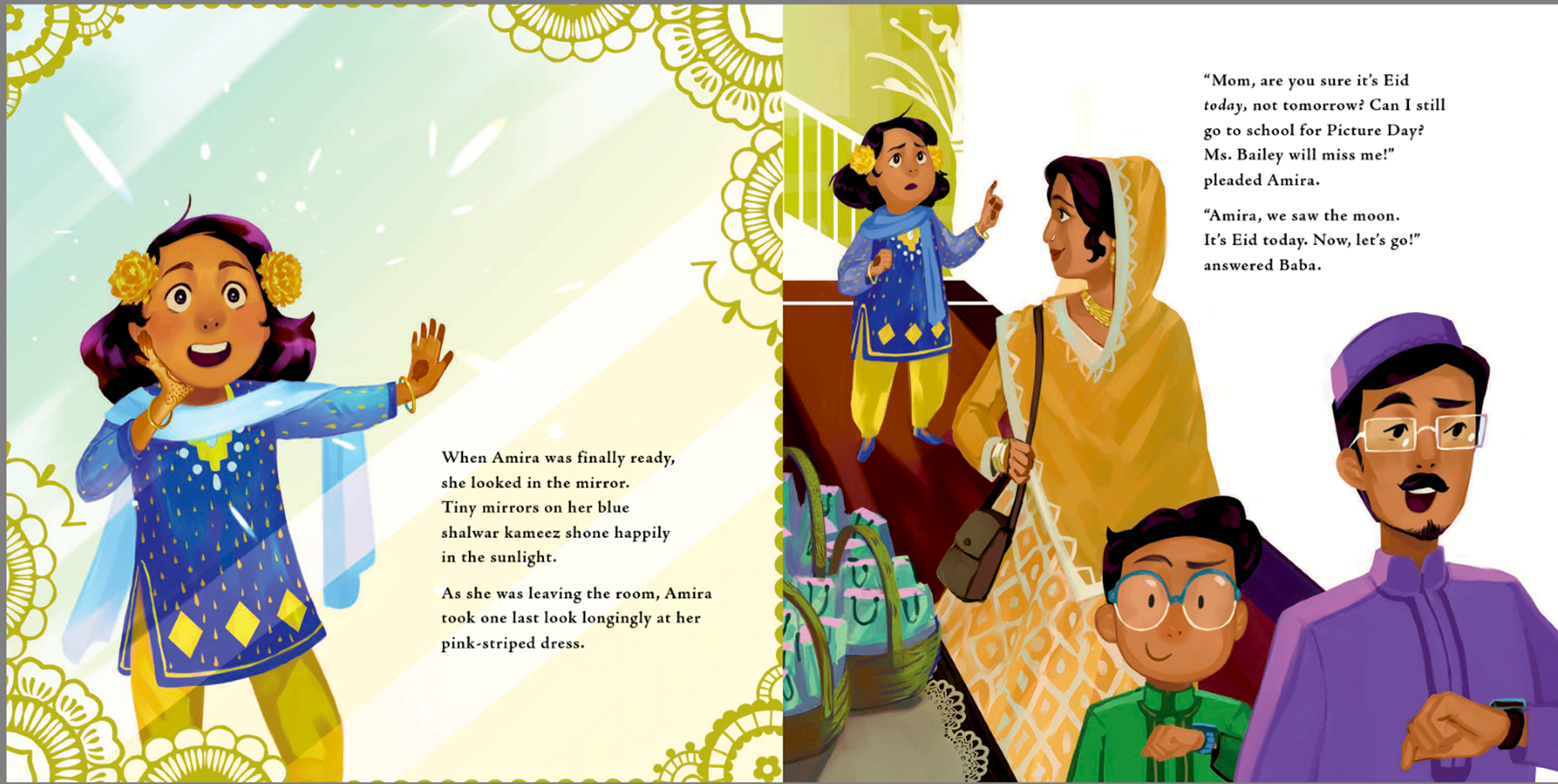
Amira loves going for prayers and the party after, but she is kept awake at night worrying how her classmates will remember her if she isn’t in the picture. The next morning she is excited, it is Eid, but seeing her pink dress hanging next to her blue Eid outfit makes getting dressed a heavy process.
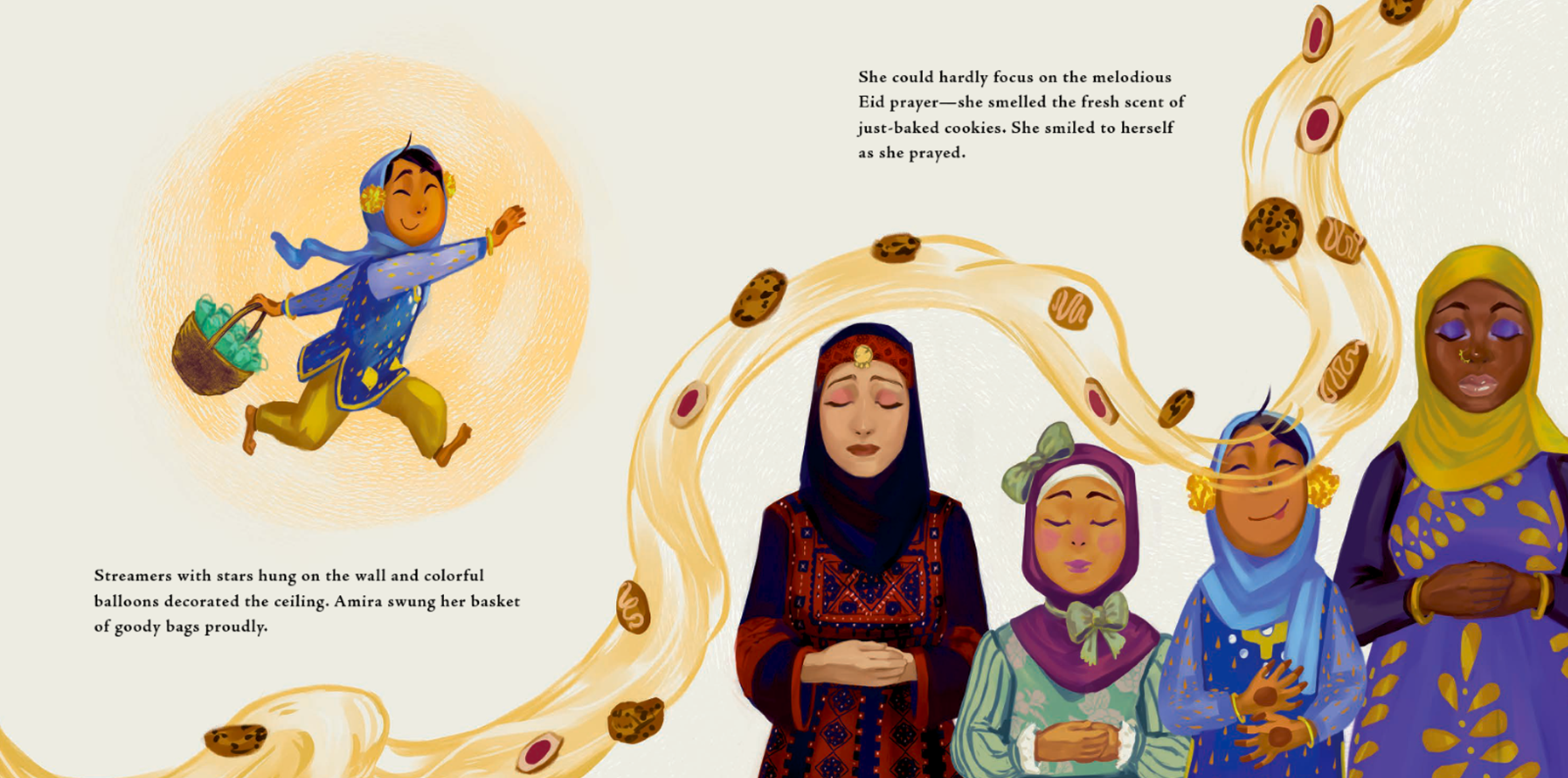
When they get to the masjid, Amira hardly recognizes it, it is all decorated and everyone looks beautiful. The smell of baked goods makes focusing on her prayers difficult, and after when everyone is taking pictures she remembers what she is missing and feels deflated.
On the way home Amira works to hold back the tears, when she suddenly has an idea to take the remaining goody bags to her classmates, and maybe catch her class pictures. Her parents agree and they stop at the school.
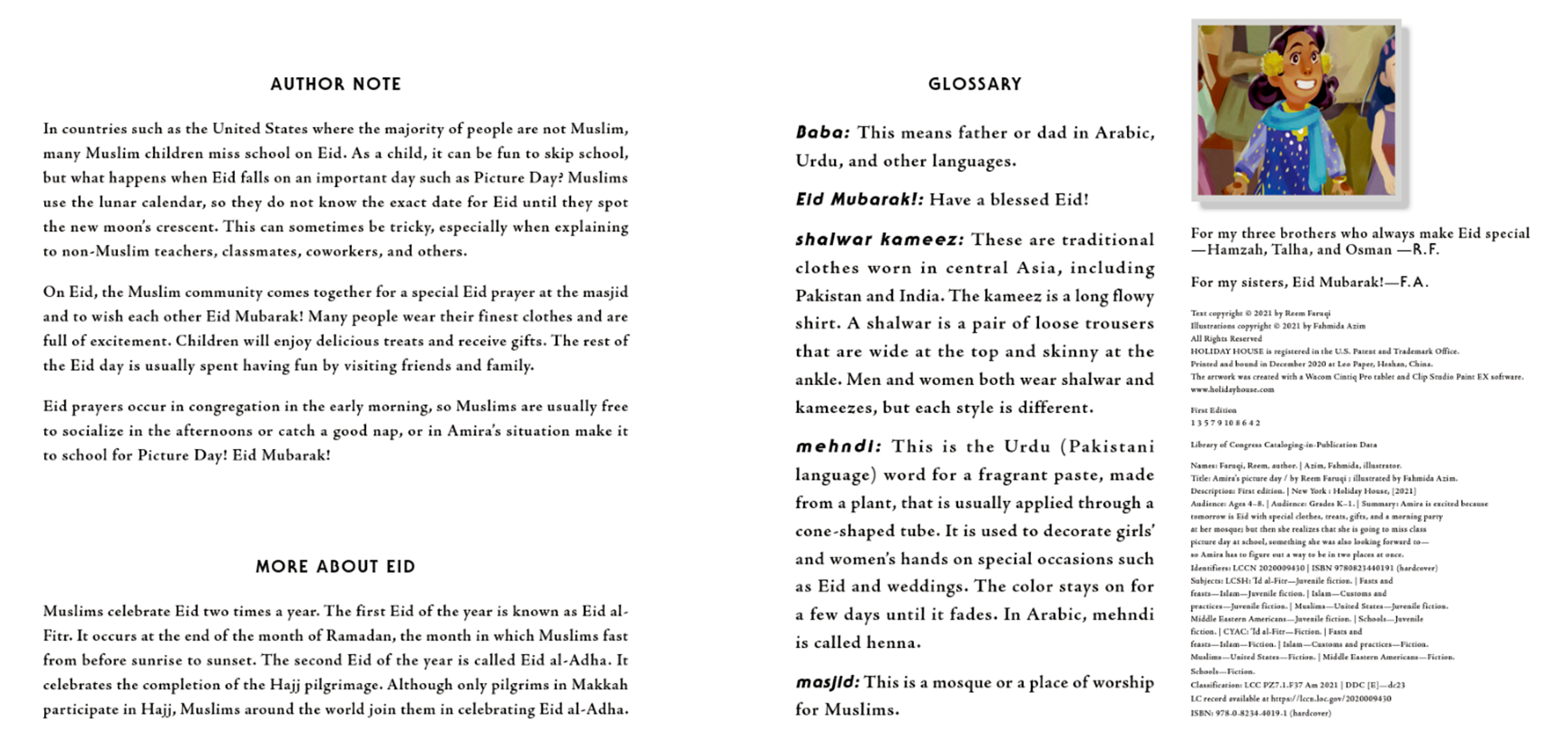
I won’t spoil if she made it in time, but the kids in her class love her clothes, and her mehndi designs. The book concludes with an Author’s Note, More about Eid and a Glossary.
I absolutely love the illustrations, little Amira is infectious and endearing. I wish the mom would have been a little more in tune with Amira’s feelings though, she definitely is upset and while I’m glad the family stopped after the Eid party, I feel like more could have been done beforehand to acknowledge Amira’s feelings, and see what could be done to accommodate both activities.
I love the diversity and brightness of the book to convey the absolute joy and happiness of Eid outside of presents. I think the book works for all children of all backgrounds and is a much needed addition to the repetitive Eid books available.
I was excited to see publishing company DK add this Ramadan book to their board book selection, but overall it didn’t wow me, or even really impress me. It has realistic pictures of diverse Muslims celebrating Ramadan, simple text, and bright images, but it read awkward as it switched between first and third person, realistic and stock looking images, and not terribly enticing with slightly faded mehndi and unexplained foods. There are better board books out there for babies and toddlers than this 12 page mainstream published one. If you can find it at the library, sure check it out, but I’d save my money on purchasing it.
The book starts out saying Muslims follow Islam and Ramadan is a special month in Islam. It features a a man holding a little girl and both are people of color. The opposite page is a cartoonish crescent moon saying it is the start of Ramadan.
The next page has a plate of realistic deviled eggs on a bright background stating that many Muslims fast, don’t eat from sunrise to sunset. It also states that the meal before dawn is called suhoor or sehri. I’m not sure why Urdu is included with the traditional Arabic and no other languages are mentioned.
The next page then shows a little girl praying and switches to present tense first person and says “Let’s pray…” followed by a little boy reading Quran and stating that reading Quran helps us learn about Islam. It then switches back to declarative 3rd person saying that people break their fasts before sunset prayers and shows a bowl of dates.
A family is then shown breaking their fast with a meal known as iftar and the reader is urged to pick their favorite sweet to eat from a plate of different shaped baklava. There is no description about the baklava and I don’t know how enticing they would be if you have never tasted it before.
The book concludes with the same cartoonish night sky and silhouetted masjids saying the crescent has been seen, Ramadan is over and tomorrow is Eid. The last page is a girls hand saying , “Let’s celebrate Eid by making henna patterns on our hands.”
I think the idea is good, but I feel like it doesn’t answer many questions about Ramadan and Muslims and probably makes the religion and celebrations seem foreign and odd, presumably the opposite effect. I admittedly haven’t read the other holiday books in the series and am not a baby expert, so perhaps I’m really critical and missing the developmental reasoning behind the presentation. But I don’t know that this book is fun or really informative for any age, it just seems random.
My tween boys read the first two books in the Streetball Crew Series and recommended I read book one because there is a Muslim character and I’m a fan of the basketball all-star author who draws on his own life and experiences growing up in the story. It is 265 pages, an AR 4.5, and while the story is decent, and I enjoyed the majority of it, I didn’t love it. I was not thrilled at the choppiness of the story telling and ultimately the way Islam was presented. Obviously there are plenty of Muslims that will occasionally eat pork and who get violent as they get more religious, but I don’t think it is the norm and definitely isn’t a message most middle grade Muslim readers would identify with, nor want non Muslims assuming about Muslims as a whole. The book randomly has a sudden Muslim chapter toward the end and attributes some threats on the main character as being from Muslims becoming more devout. The main character is not Muslim, this is a side character and her family, and you don’t find out til the book is nearly over that she is Muslim. I worry how younger readers will be affected by the negativity toward Islam, as it really isn’t explored or even part of the story. There is enough going on in 8th grade Theo’s life with out the insertion of religion. I was glad I read it so that I could discuss it with my boys, but I would encourage the book for more middle school aged kids, if at all. The book involves basketball as a subplot, but has larger life lessons and developments away from the game. Do be aware one of the young characters smokes cigarettes, there is female objectification talk among the male characters, racism is discussed, there is some physical assault, and beer, R-rated movies, tattoos, branding, and dating are mentioned in this coming of age book.
SYNOPSIS:
Theo is 13, in 8th grade, and over the summer has grown six inches. He identifies as a science nerd and a geek and is on the Academic Olympic team at his school. He now, however, finds himself on the school basketball team, and has no idea what he is doing. Towering over everyone, he is assumed to be good, but his lanky body and new found size brings him ridicule and teasing. His life long best friend, a fellow geek, can’t figure out why he won’t just quit the basketball team, but Theo is oddly enough, enjoying the concept of team, and suddenly being recognized in the halls. When he joins a pickup game to improve his skills however, he gets in a fight with another kid, get’s threatened by some guys on motorcycles, and teased by a weird girl named Rain.
Outside of school it is just Theo and his police officer dad. Theo’s mom has recently passed away and the two are creating a new normal, that is until Theo finds out his father is giving online dating a try. After the first abysmal basketball game, Theo is forced to go visit his cousin in LA who is a tiny bit older than him, but much rougher. He constantly teases Theo and puts him down. He claims to be a great musician, but no one has ever heard his music, and suddenly on this visit, he seems a bit more insightful, which has Theo confused.
With Theo being pulled in multiple directions, he risks being kicked off the basketball team, moved down to alternate on the Brain Game Team, killed on Friday by the motorcycle gang and to top it all off, a CD of his cousins music has been stolen from Theo’s backpack and band has gone viral with one of the songs.
WHY I LIKE IT:
I like that it is a coming of age book for boys. I feel like there are a lot of girl books out there, but this one really does get into a young males head. It isn’t always pretty, and while women/girls are at times objectified in his thoughts and while chatting with his friends, I think he realizes it and doesn’t treat or talk to women in a negative way. I like that race is discussed as he is one of 14 black kids in his school of 600. There are times when he or his family are treated different for their skin color, but his mom never allowed him to accept it to be a reason for not being the best ‘you’ and she would make them put money in a jar any time they blamed race for something bad happening, a tradition they continue even though she has passed. I like the pop cultural references, a lot of books overdo it, this book makes it pretty smooth and relatable.
*Spoiler Warning* So Rain, turns out to be Matar, Arabic for Rain, she has convinced her aunt and uncle to let her change schools while her parents are in Iraq (her mom is Iraqi, her father a Quaker from Pennsylvania) and call her by her American name and let her wear American clothes (no hijab). The motorcycle villains, are her cousins, who were trying to find her and were threatening Theo to try and find out where she was. Their frustration with her behavior and dress is what prompted them to hit Rain which made her run. Rain and Theo discuss why after September 11, she was tired of being accused of being a terrorist and so she wanted a fresh start. Her uncle and aunt are noted as being nice, but clearly the devout Muslim cousins are what will be remembered. She also discusses sometimes eating pork, that hijab is modesty in the Quran, not a requirement to cover your hair, and that she is Muslim, but doesn’t know if she will be when she is older.
The book didn’t find its flow for me until nearly half way through, maybe about page 100 or so. It seemed to struggle to get all the characters introduced, flesh them out, and then decide what the book should be about. Once it got through all that it flowed better, but still left me confused as to why there was a spontaneous breakfast party, why a lawyer would so quickly get involved in the music case, why Theo was withdrawing from his friends, why Rain wouldn’t just talk to Theo, how Rain had friends she could stay with after just starting at the school, how Rain could switch schools without her parents there. Really the Rain character in general seemed really forced.
FLAGS:
I listed most of the potential concerns in the opening paragraph so that anyone, like me that would think, ‘oh fabulous a middle grade sports book by a Muslim author’ would be aware that there are a few potentially concerning elements.
TOOLS FOR LEADING THE DISCUSSION:
I wouldn’t do this as a book club selection, it is a little all over the place, my 11 year old disagrees and thinks it would be a great book club read, so I’ll leave it to you to decide.
Video interviews with Kareem Abdul-Jabbar about the book:
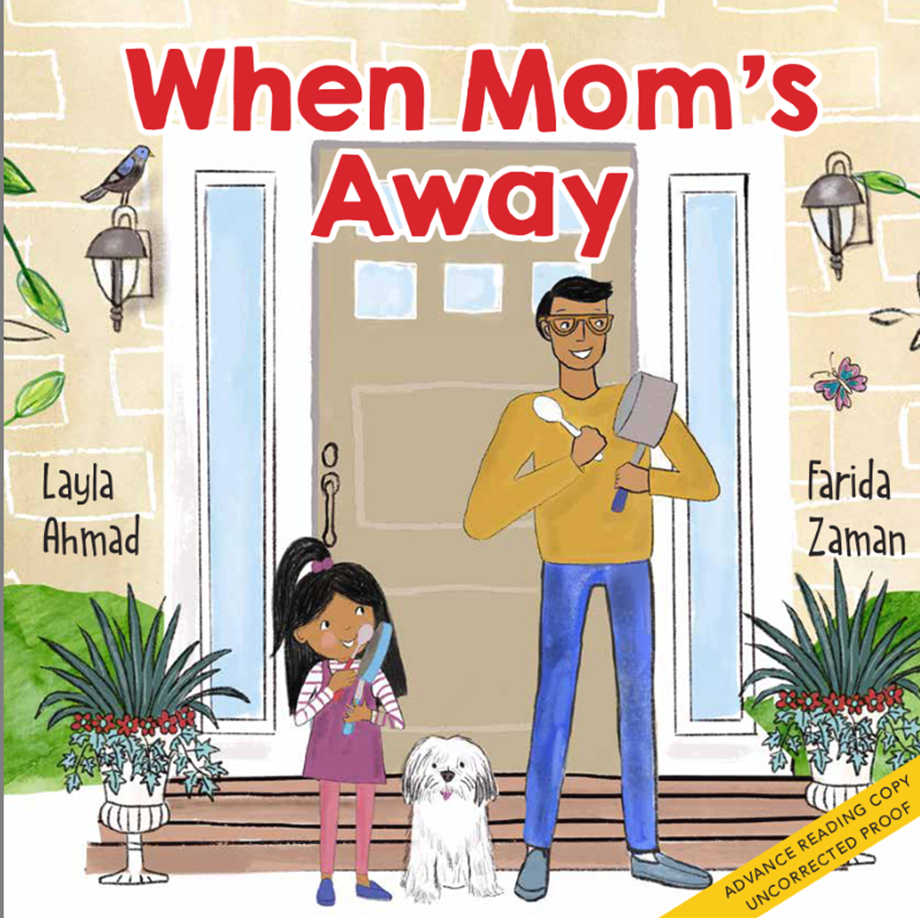
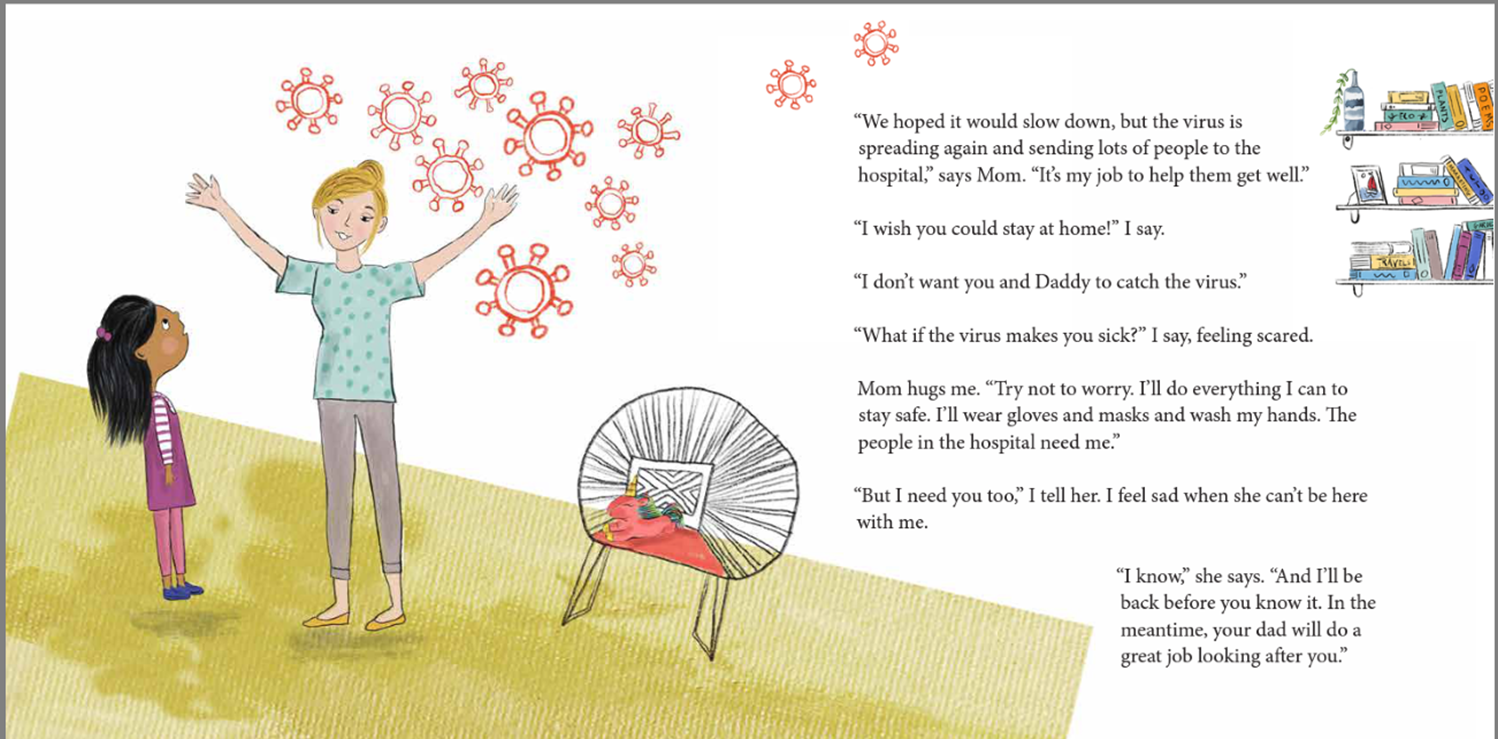
This 24 page, timely children’s book focuses on life with Covid-19 from the point of view of a little girl whose mom is a doctor and must quarantine in the garage to keep her family safe. The reassurance of such a book to remind our children that they are not the only ones going through such disruptions with virtual learning, staying away from grandparents, wearing a mask and not seeing a parent for a few days, is a powerful one. I couldn’t find anything stating if the author or illustrator identify as Muslim (I know, I know, assumptions based on names is rather pathetic), and there is nothing religious in the story, but the book shows a diverse family and as this pandemic rages on, kids and parents will benefit from feeling less alone and sharing this resource I hope is a benefit.
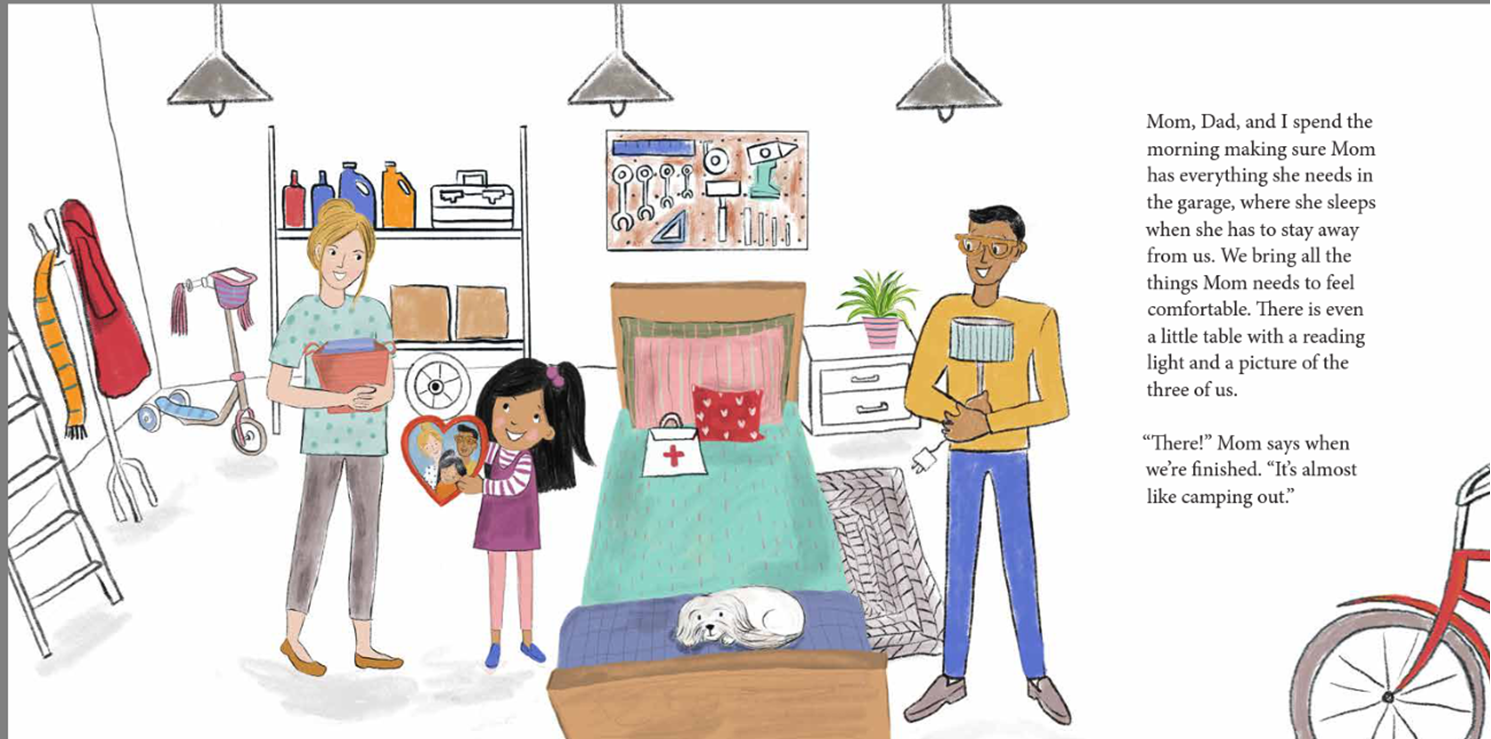
The book starts out with the little girl learning that her mom is going away, well not really away, but will not be in the house with her and her dad. That the virus isn’t slowing down and her mom has to go help people. The family of three then sets up the garage to make sure mom has everything she will need when she comes home from work. A bed, a little table, even a picture of the three of them.
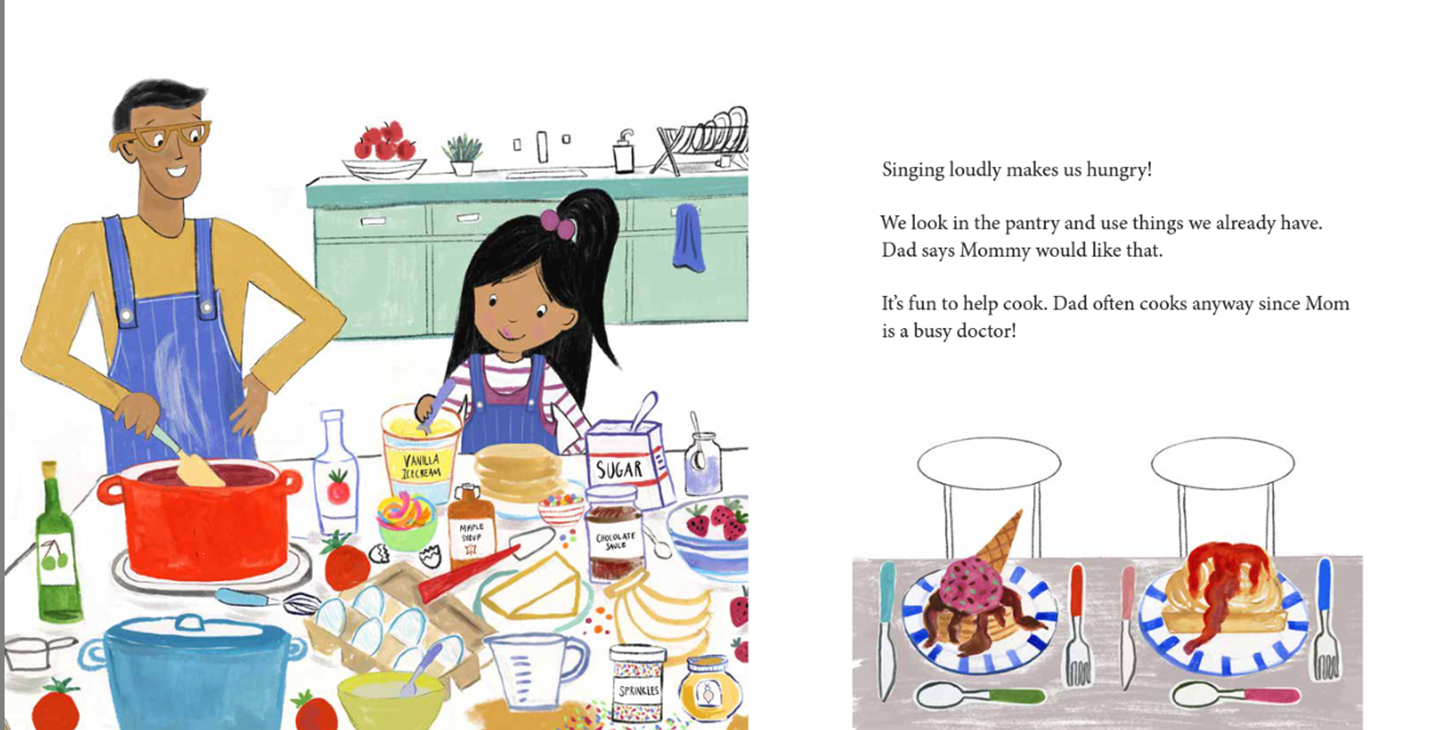
The dad calls the mom a superhero and gets the little girl on board with helping mom as she helps others. They wash their hands to a special song, they wear masks when they go out, they shop for a neighbor, and try to use things to make dinner that they already have.
The book then articulates that mom is a busy doctor and dad cooks often. The little girl plays games with her dad and video chats with her mom feeling proud that she is making her mom’s job easier. Every morning the dad does the little girls hair before virtual learning begins, and every evening she waits by the window to wave to her mom. The little girl misses her teacher, friends, and mom.
The little girl and her dad go grocery shopping for Grandma and Grandpa and deliver the groceries to them outside with masks on as they wave from afar. Sometimes before dinner the neighbors all stand outside banging pots and pans cheering for all the heroes coming home.
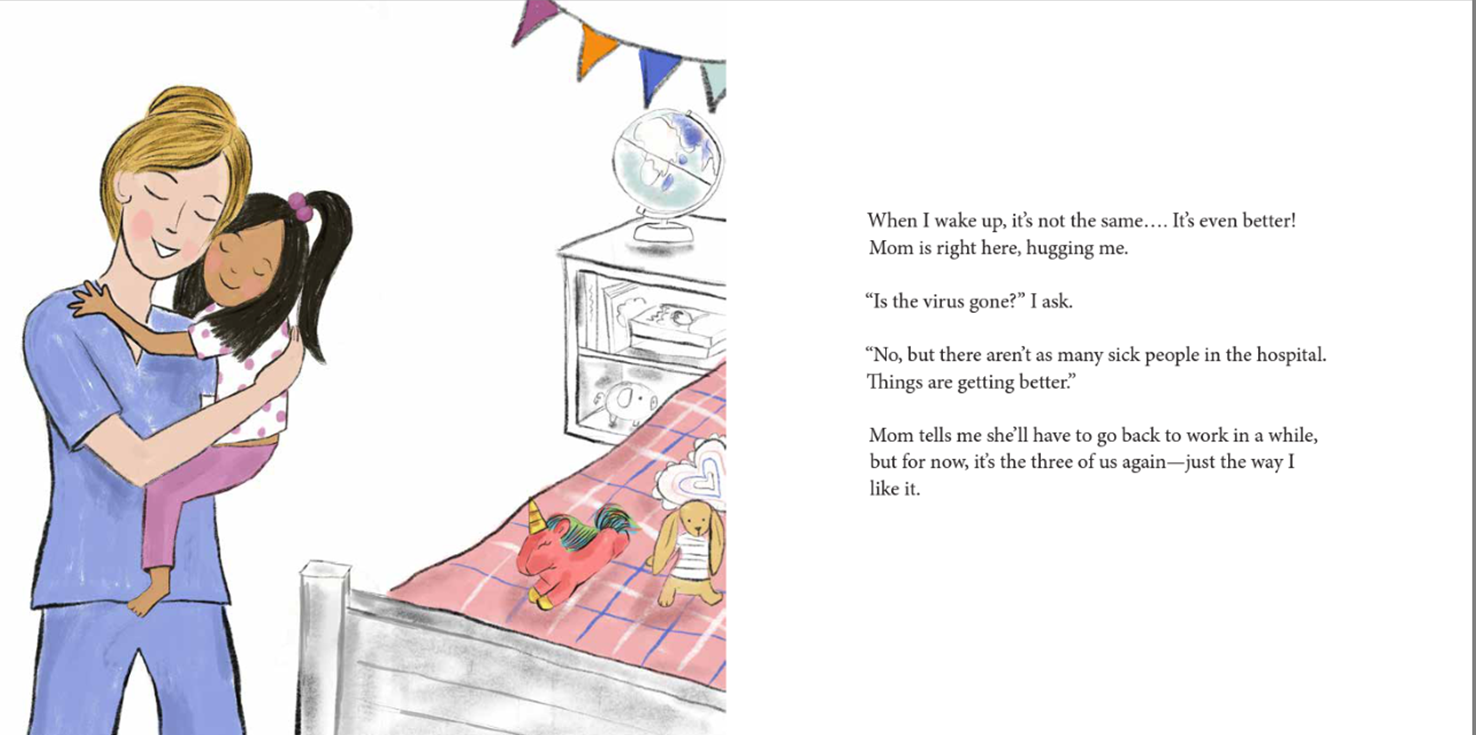
When her mom returns from quarantine, the little girl asks if the virus is gone, and the mother says no, but that things are getting better. When her mom thanks her for doing such a good job while she was away, the little girl says, “No problem, Mom. That’s what superheroes do!”
I love that the concept of super heroes is presented as real people on the front line doing their jobs even when it requires tremendous sacrifice. I also like that all of us working together to curb the pandemic is also heroic work.
I love that it shows a mom capable and professional and loving, as well as a father loving and capable and supportive. Yes, she likes how mom does her hair better, but it shows competency from both parents, which sometimes in books is lost when it makes one parent the brunt of misguided humor.
I don’t know if years from now the book will be as relevant, but certainly children today are living this story and will relate to the characters. I think children in preschool and up will enjoy the illustrations and storyline.
This graphic novel jammed pack with sleuthing, friendship, and diversity is perfect for ages 8 and up. The inclusive cast shows motive and growth keeping anyone from being entirely good or completely villainous and strikes a wonderful balance of insight, community building, and relatable fun. From the main character’s mom wearing hijab, and random hijabis in the background panels, to characters of color, and characters with social obstacles, there are also bullies, cancer survivors, a character with two moms, working parents, and a missing gecko all coming together over 221 pages to leave the reader waiting for the next book in the series.
SYNOPSIS:
Jamila has just moved to the neighborhood and with older brothers as role models, she just wants to spend her summer shooting hoops and taking it easy. Her mom, on the other hand, wants to send her off to science camp. Shirley, is incredibly perceptive and wants to spend her summer solving neighborhood crimes, the ones adults won’t or can’t help with, but her mother has signed her up for dance camp. When the girls cross paths at a yard sale, Shirley uses her wits to convince her mom and Jamila’s mom to let them spend the summer together at the basketball courts, thus both girls get what they want. The two girls aren’t exactly friends, but the arrangement benefits them both, and the days go smoothly, until a gecko goes missing and Shirley and Jamila have to decide to break their parents’ rules to leave the courts and venture to the swimming pool to investigate. Jamila and Shirley hit a snag in their understanding of one another and realize they want to be friends, something neither of them currently have. As they work Oliver and Vee’s case to find Enoch the gecko, the reader meets lots of neighborhood characters, from life guards to daycare informants. And as the clues come together so do a group of kids, all needing friendship, kindness, and a little understanding.
WHY I LIKE IT:
I love the Nancy Drew, Great Brain, Encyclopedia Brown, vibe of the story. It is funny and plausible and about so much more than just the case. It is quick and well drawn, and really just a joy overall. I love the diversity and teamwork and innocence of a summer and some good old fashion kids using their brains to save the day.
Other than the mom wearing a scarf when out of the home and a few hijabis in the background there is no textual mention of religion. The mom at one point says something in Urdu and the family has Muslim names.
FLAGS:
One of the side characters mentions that she has two moms. It is mentioned once, it isn’t dwelled on, and in many ways I think a great way to explain to your kids, if they mention it, that they might have friends and classmates with different family structures. I love that fiction allows for this conversations to occur in the abstract so to speak, you can guide your children how to handle these differences while talking about fictional characters, and imparting your families view of such matters in an open and hopefully non judgmental or hateful way.
TOOLS FOR LEADING THE DISCUSSION:
As always with graphic novels, they just aren’t the best format for book clubs as they are usually quick reads. The target audience for this is middle grades as well and while middle schoolers might enjoy it, they would read it in less than a half an hour and there really wouldn’t be much to discuss once the case is solved. I would highly recommend checking your local public library for the book, that is where I found my copy, and happy reading!
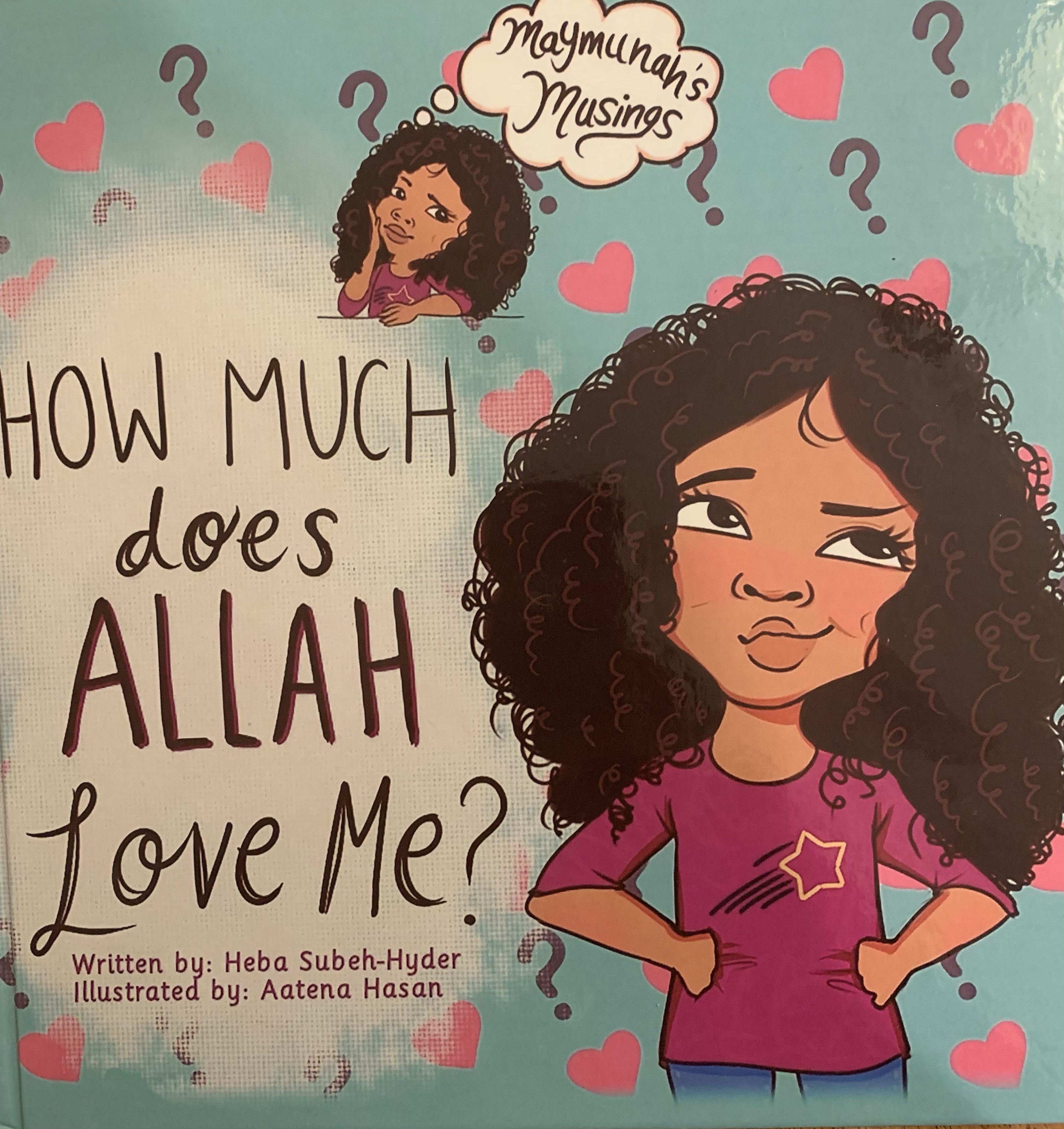
I waited to review this book to see if my initial response would change, and before I got around to writing up the review, the second book in the Maymunah’s Musings has come out. So I am admittedly a bit late and quite a bit behind, and based on other people’s review I’m in the minority on my opinions. This 40 page book is wonderfully presented with a multicultural girl asking her mother about Allah’s love for her. I wanted to absolutely love the text as much as the playful illustrations, but I felt like it was a bit wordy in places, a bit out of order in the mom’s explanation to the little girl making it somewhat repetitive, and ultimately I wanted a bit more. More ayats or references or even specific examples. There is truly nothing wrong with the book, but at its price point I was a bit disappointed.
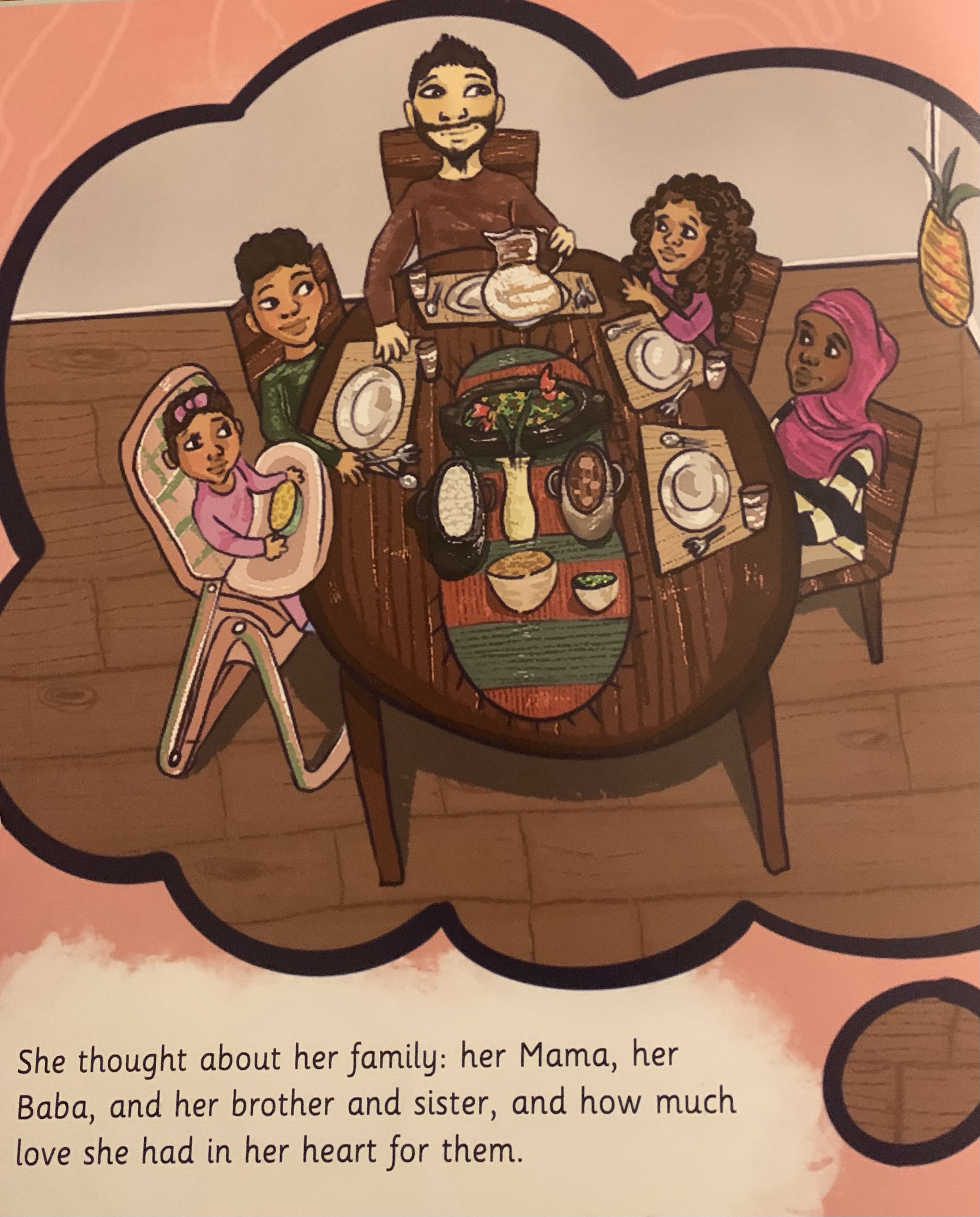
Maymunah is looking out the window and thinking about Allah swt: what she has learned in Sunday school and about His remarkable creations. She recalls the amazing animals, the vast number of stars in the sky, the different type of trees, and her family.
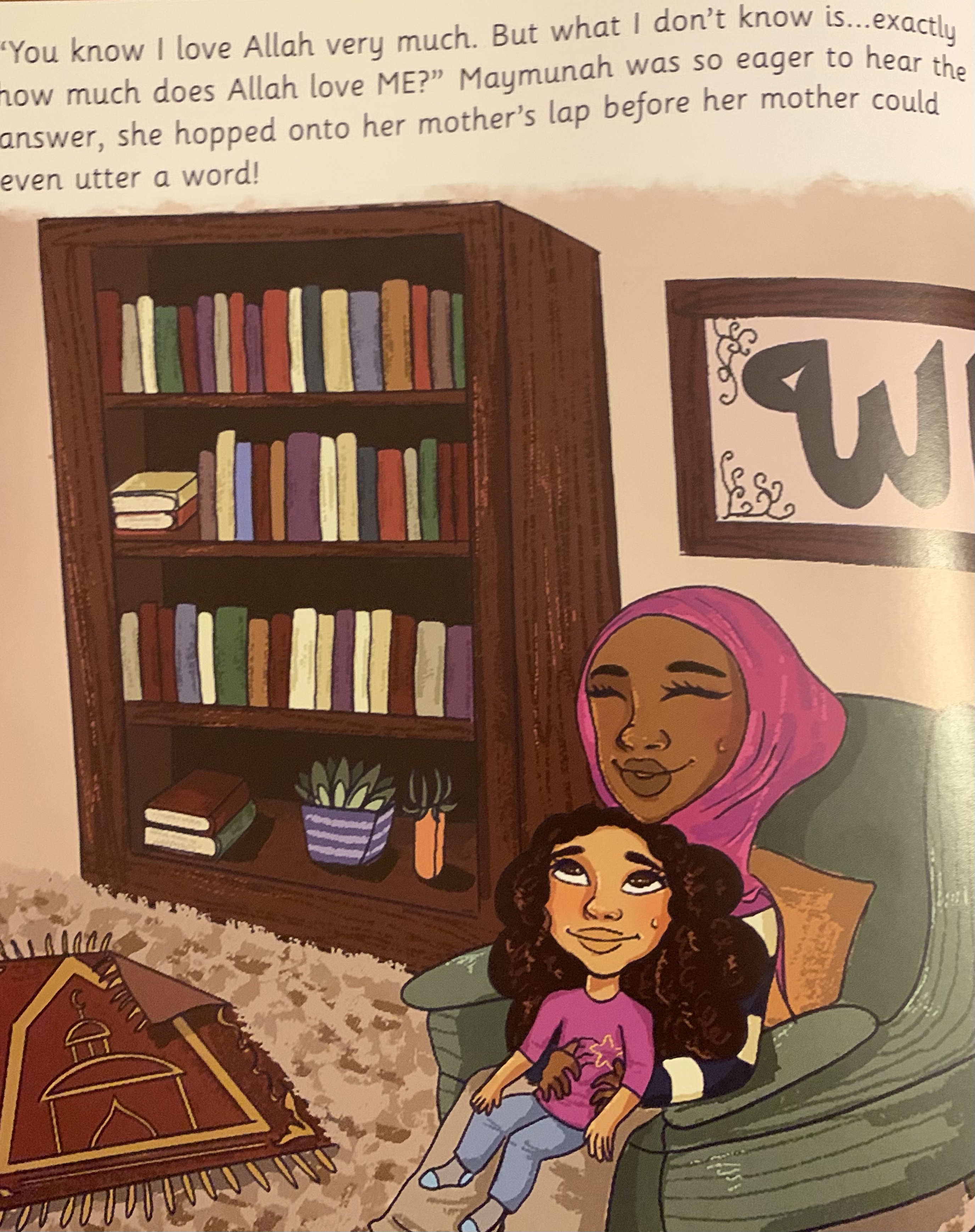
She loves Allah, and wants to know how much He loves her. So she rushes to find her mother, the only person that can answer that question (I’m not sure why no one else can). Her mother lovingly and patiently situates herself with Maymunah in her lap to answer the important question.
Maymunah’s mom explains that Allah loves her more than the billions of stars in the sky, more than all the fish in the ocean, more than all the raindrops that fall, more than the billions of people in the entire world, more than all grains of sand on the beach, and blades of grass in the meadow.
Then Maymunah’s mom asks her if she knows how much Mama loves her. Maymunah repeats back all the examples her mother has just given for how much Allah loves Maymunah. The mom then says and Allah loves you more than that.
Maymunah is satisfied and reflects on how much Allah loves her and then remarks that her love for her mother and her mother’s love for her is bigger than the whole wide world. The last page of the book mentions that her love for Allah is more than that and that Allah’s love for her was even bigger, but it seemed muddled to me as it started stressing how big a mother and child’s love is.
I felt like the natural order would be to explain to a child how much a mother loves them, then say Allah loves you even more. Not tell all the ways Allah loves you, then talk about how much Mama loves you with the exact same examples and then say Allah loves you more. It doesn’t even say Allah loves you ‘the most.’
If you don’t read it over and over and take it on the surface it is probably fine, and I realize I might be overly harsh, but with only a single ayat at the end, I really wanted to feel that a child’s curiosity would be satisfied with this book, and I think it ultimately fell short for me and my children.
Ultimately, despite all this, I don’t regret buying the book from the wonderful Crescent Moon Book Store, and I will be buying the new one too inshaAllah. I hope this review helps you to determine if this book is right for your toddlers and preschoolers.
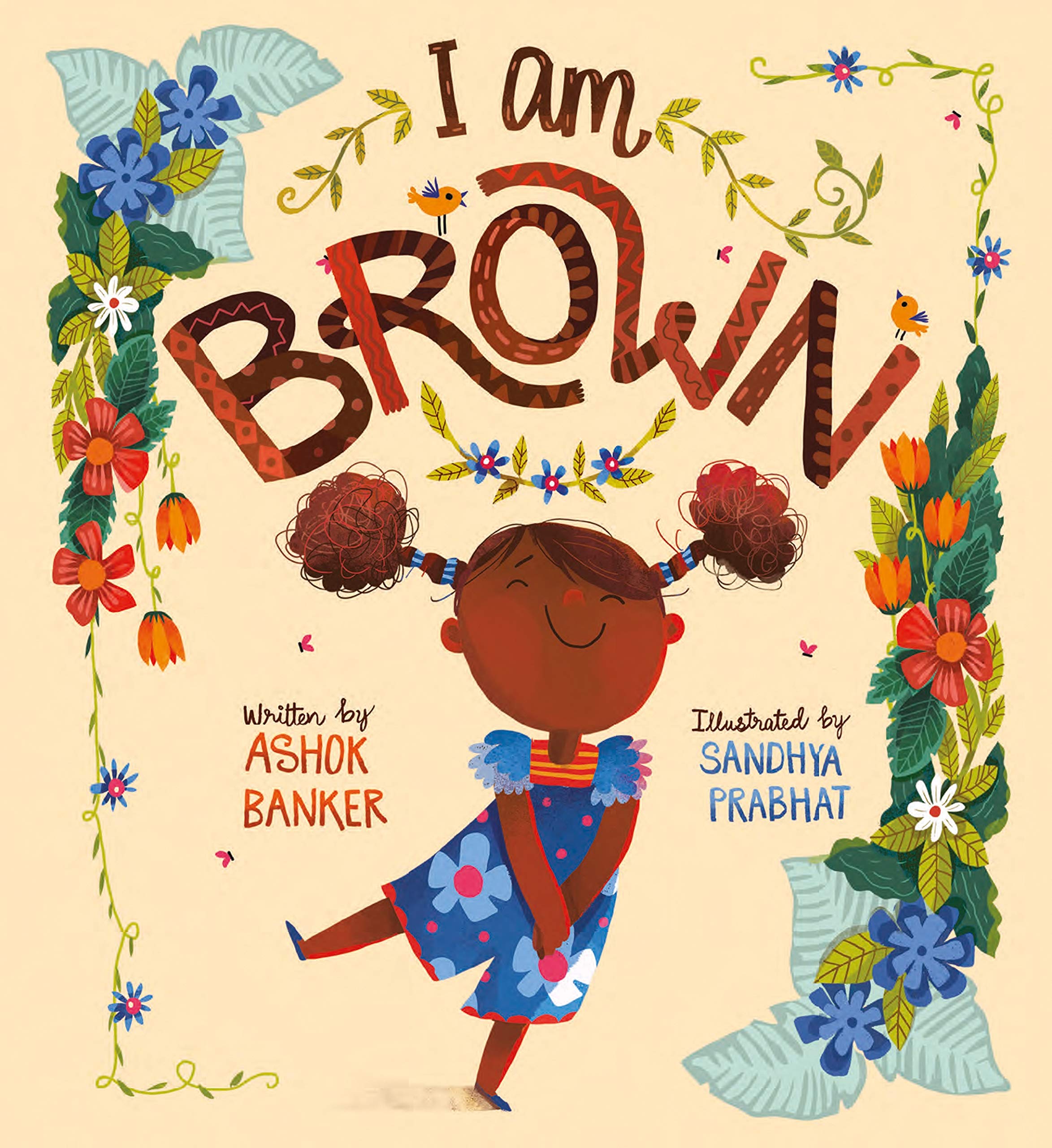
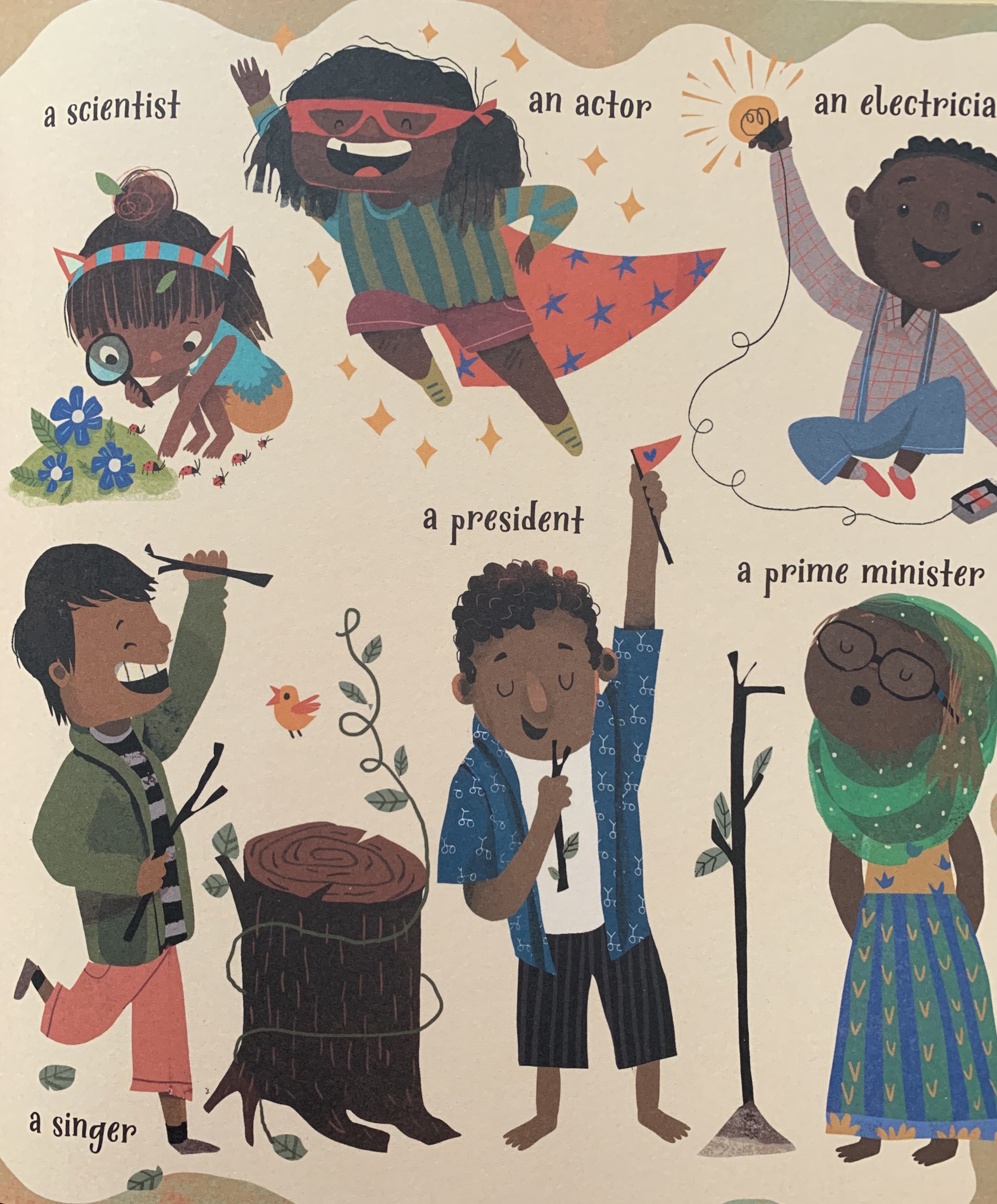
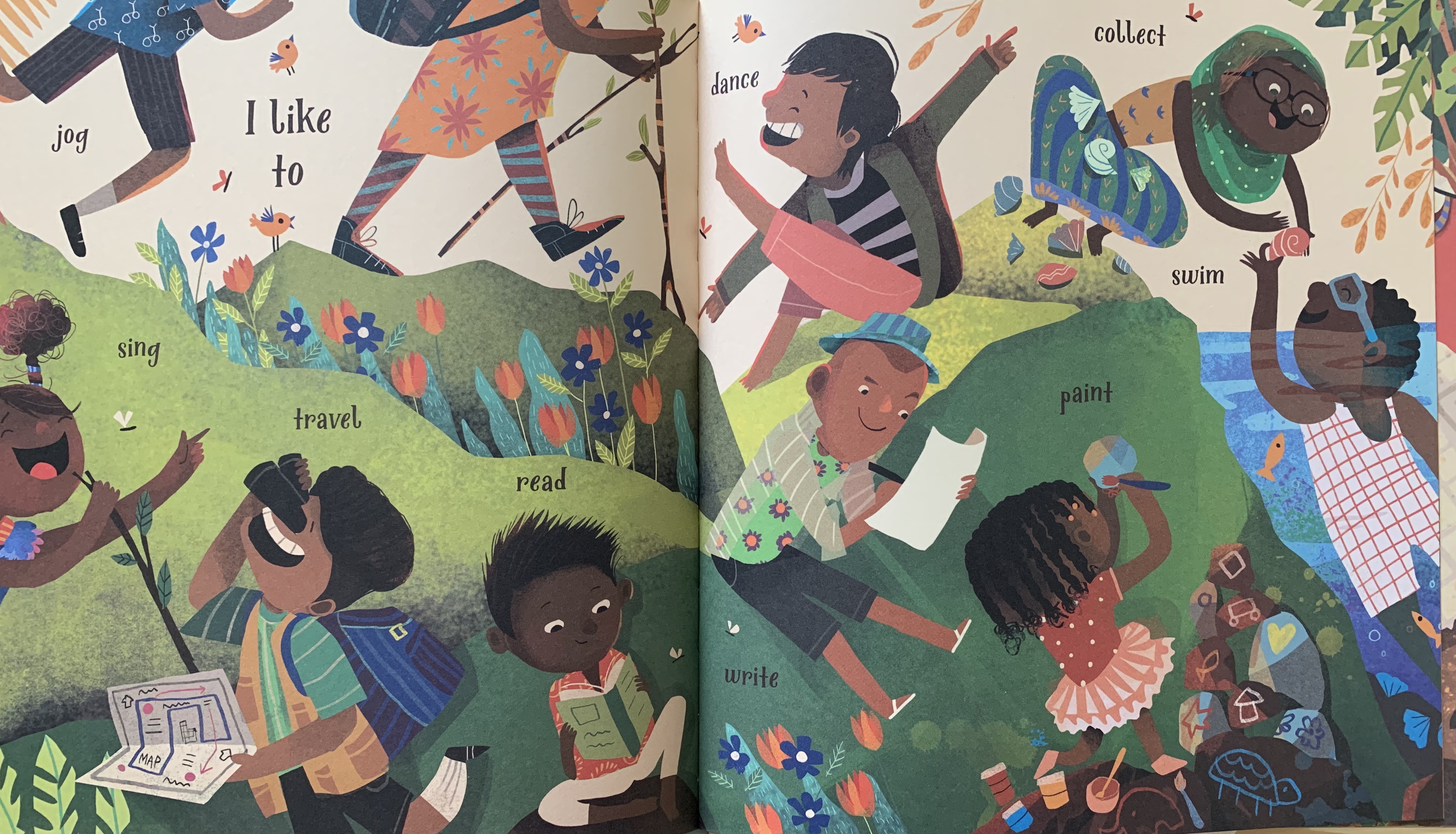
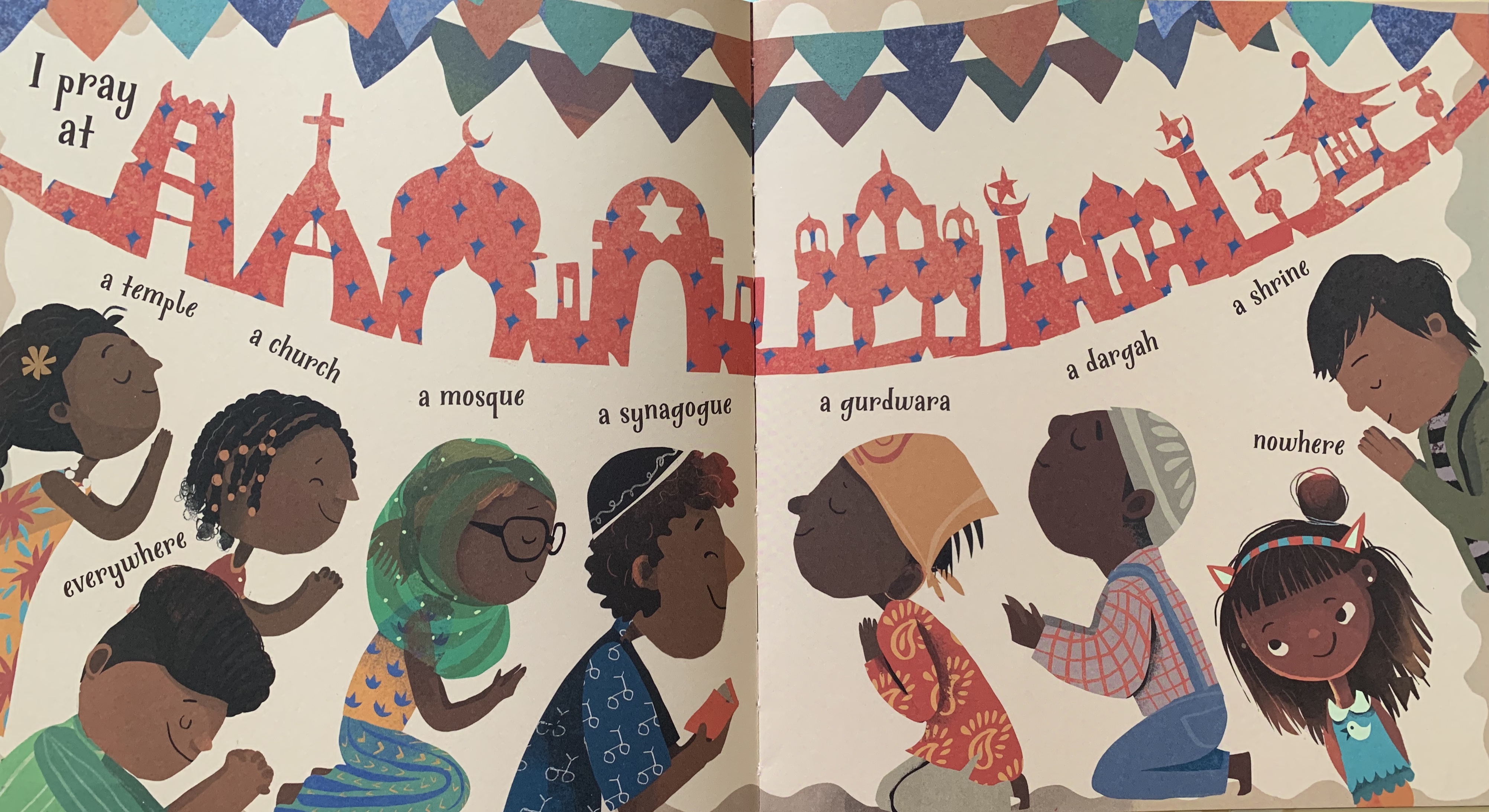
This 40 page celebration of diversity within the label “brown” is a sweet and powerful book that shows how the color of our skin is beautiful and perfect while at the same time making it clear that who we are and what we can be is not defined by our appearance. The book shows adorably illustrated brown children finding strength in different cultures, clothing, religions, languages and dreams, which will hopefully empower children everywhere (and of all colors) to take labels that may have negative connotations and turn them in to positive affirmations of identity and strength. There isn’t a story with a plot, but with the regular inclusion of a girl with a scarf on, and the mention of a mosque, I thought to highlight it. The book is perfect for preschool and up.
The book starts with a little girl identifying herself as brown, beautiful and being perfect. It then stretches to her being love, friendship and happiness.
From there it branches out to a whole cast of kids identifying the variety of things they can be, from a writer to an electrician to a prime minister. the same kids then do and make and work on things before identifying where they come from and what languages they speak.
The kids all have different hair on their heads and faces and even no hair at all. They live in different dwellings, they like to do different things.
Brown people are not a monolith, the kids show that they eat different foods in different ways, that they wear different clothes.
People with brown skin are roommates and teachers and friends and classmates. Some go to temple or church, others a mosque or shrine, some not at all.
The book ends with a close up of three smiling faces proclaiming, “I am brown. I am amazing. I am You.”
I’m sure people will argue that if you switch out white for brown the book would be deemed racist, and you are correct it would be. But as a group that is marginalized as “other” and often the darker brown you are with in the brown subset moves you “value” and “worth” down, makes a book celebrating the strength and beauty of “brown” so necessary and heart warming. I personally am the lightest “brown” imaginable being only half Pakistani. So, believe me I have privilege in the desi community, but I don’t find this book offensive at all. I’ve read this book at least a dozen times and my impressions alternate between beaming with pride and tears that so many beautiful people feel less than because of skin color and yes, anger too, that people are MADE to feel less than. May we all be more inclusive, more loving, and more open to the diversity of the human being. Ameen.
This book did not work for me. Despite the fact that the main character is Muslim and it is Ramadan, no matter how much I wanted to connect with this multicultural lead and her friends, and see myself in her as she navigates high school, I just could not. The writing was choppy 3rd person which distanced the main character for me, the crude language on every page, the drugs and alcohol in every scene, the detailed sexual encounters throughout, the lacking growth of the characters and the muddled point of the book in general made the book difficult to read. The book is an AR 4.9 but content wise is more suited for mature 18 year olds. Even this review might be a little too much, I’ll do my best to keep it clean. Ultimately this book missed the mark for me in showing females defining themselves, celebrating friendships and diversity, or even just creating characters to cheer for as they navigate life.
SYNOPSIS:
Leila is half Iraqi Muslim from her dad’s side and half American Catholic from her mother. She doesn’t know how to pray as her father isn’t religious, but celebrates Ramadan and Christmas and defines the world on her own terms. She is fearless and owns herself, hence she hates her name and goes by Lulu instead. The book opens with her making out with a boy in a closet which she kind of regrets and then goes to join up with her friends at the party to drink and get high and attack one another for their poor choices resulting in drama. In this instance Lulu’s anger pushes a boy in the pool, and then the four friends devise a way to get home and work out the lies they will need to tell to the parents involved. This scenario with only slight variations repeats five or six times in the book.
Lulu is the fearless one, Lo, short for Delores, is the leader, Audrey is an alcoholic math whiz and Emma, not to be underestimated and often is forgotten (literally) is coming out in her first lesbian relationship. Yes these labels are limiting and stereotypical, especially in a book calling for girl power or what not, but sadly that is really the only space they flesh out, not a whole lot more is known about them. The girls defend each other fiercely to outsiders, but are truly awful and angry to one another all the time. They break apart and Lulu doesn’t really know why, so the path back to one another isn’t really cathartic. They pull a prank to get back at a boy that crossed the line with Lulu, but it fizzles when the threat of what the prank could do is enough to keep him away and they don’t have to complete it completely.
Between the parties there are some sub plots that weave in and out. Lulu has to spend time with Iraqi family friends who don’t accept her and are critical, in Arabic, of her mother. This gives some cultural layer to the story, but the characters are pretty flat and petty and hypocritical. The bombings in Paris a few years earlier, and the resulting bullying by classmates hardened Lulu, but there isn’t much info on how awful they treated her or how it defined her, so not much sympathy is garnered by the event nor does it help the reader get inside Lulu’s head. There is also a sweeter love story brewing than the one night stands that define Lulu, but then she goes with her mother to get birth control so she can sleep with him all while making it clear that he isn’t her boyfriend, she just wants to have sex with him- which she does on her seventeenth birthday.
Eventually the girls are back together and gushing with tales of sorrow and personal growth and vows that they will always be like sisters.
WHY I LIKE IT:
I don’t mind the premise so much as the execution of it. I get that people practice Islam differently, but I really don’t get the need to even bring her religion in to such a story. Culture maybe, but even that is a stretch. I don’t know if the story would be better if it was first person, I would like to think so, as not connecting with the main character was such an obstacle for me. I wanted to see her grow and change or at least have clarity in her decisions even if I didn’t agree with them or couldn’t relate to them. I wanted to feel her remorse or the weight of her decisions, but was often just told in passing that something scared her or was hard for her, not shown it. The theme of not belonging anywhere is a legit one, but I don’t know that this book explored it, it just sort of brushed by it almost as a trial to see if the emotions would stick. Which for a character built up to be unapologetic and unafraid to suddenly want a victim label without any real emotional ties, didn’t work for me. There are such holes in the story, that at times things didn’t seem believable or details were so specific with no context that I didn’t get their purpose. I would have loved to know more about her brothers and the tests they went through, or why her family was so loyal to the Arabs around them. I desperately wanted something that showed a different side of Lulu not just the anger and “F everyone who wants to change me” mantra. People are scared of her and she enjoys that power, but I don’t get why they are scared and why she enjoys it. It seems like a big part of her story and of the book in general to miss. Yes she is independent, and I get that can be misread, but she almost seems one dimensional and flat which defies the concept of defining yourself on your own terms and carving out where you want to belong among groups that see you as other, right?
The character is pretty open that she knows little about Islam, she also claims she isn’t interested. She fasts not so much because it is a commandment but more to appreciate poor people. She says this, but actions don’t seem to back it up. She tries not to drink during Ramadan but she still smokes, gets high, makes out, and lies once the sun goes down. At one point she calls a bride and her mother whores, and refuses to apologize, so her dad gets a fatwa issued. Lulu’s mom mentions that something went all Shiite on the situation, so I’m not sure if the fatwa issuing for such a specific thing is a shiite thing or something I’m just not aware of or familiar with as a tool for handling family dramas.
FLAGS:
The whole book really. Sex, drugs, alcohol, sexual assault, lying, cheating, blackout drunk, vaping, talk of orgasms and going down, lesbian relationship, hetero relationships, sexual encounters, language etc etc etc.
TOOLS FOR LEADING THE DISCUSSION:
Would never cross my mind to share or suggest this book. Even religion representation issues aside, I don’t know that there is really a single “healthy” relationship highlighted among the main characters, some of the side characters maybe, but not enough information is given to really make that case. The characters just all seem so angry, not saying teenage years aren’t angry and messy, but this one doesn’t seem to add much perspective to that singular thought unfortunately.
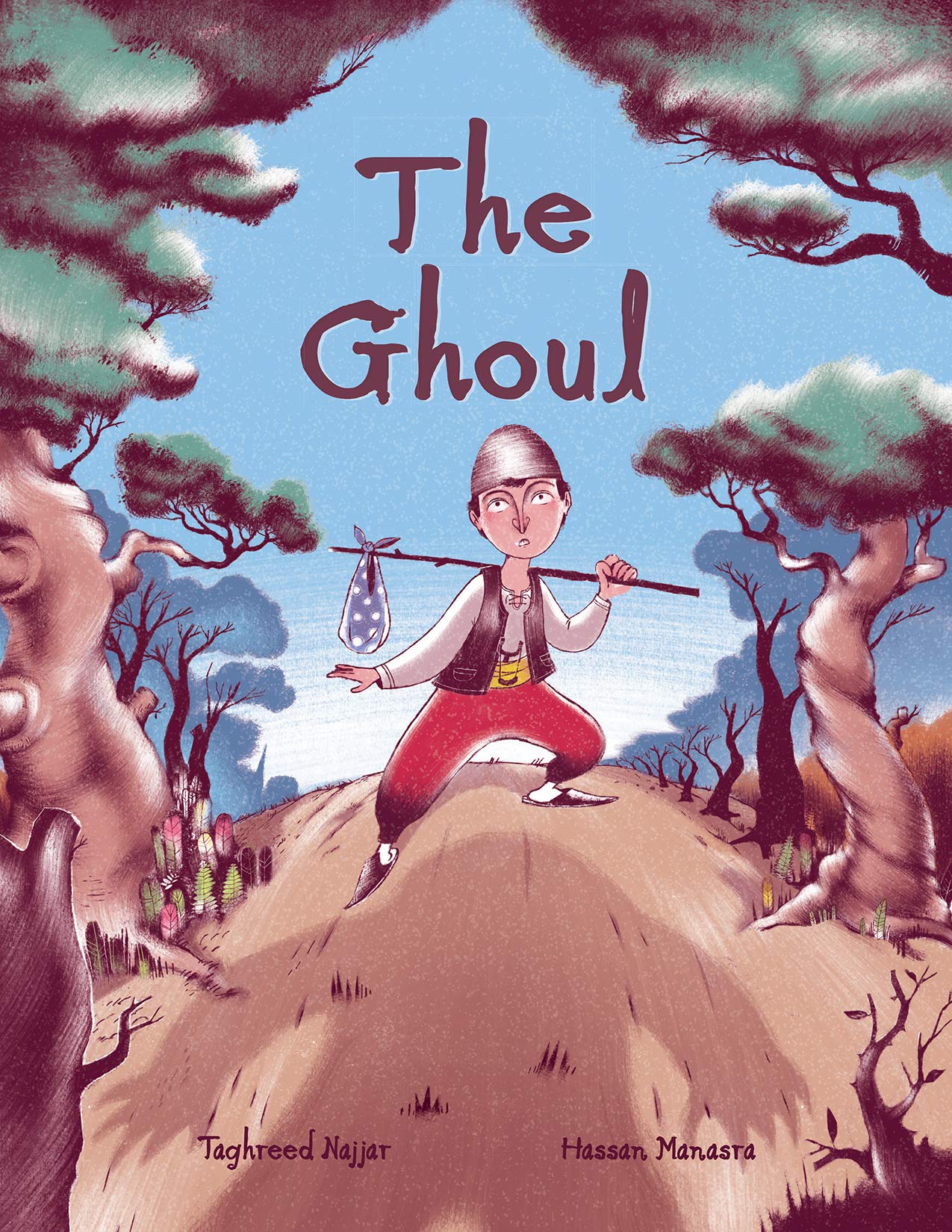
This 36 page book for ages five through eight is a cute story about being brave, facing your fears, challenging your perceptions, celebrating differences and giving friendship a chance. Recently translated and published in English, this Arabic inspired folktale is timeless and important for readers of all ages to learn from.
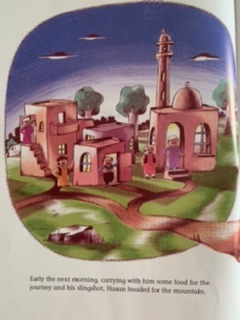
Hasan the Brave is a young boy that lives in a mountain village. The children are told not to laugh out loud, the adults tiptoe to their fields, and the fear of being eaten by the ghoul that lives in a cave on top of the mountain consumes them all.
But Hasan isn’t buying it and starts asking questions. Why is everyone afraid of the ghoul, he asks his aunt one day in the olive grove? She tells him because he is covered in hair, has one eye, long claws, sharp teeth and his favorite food is little boys and girls. Unconvinced Hasan asks his dad if anyone in the village has been hurt by the ghoul. His dad can’t think of anyone. He asks his mom if the Ghoul ever ate anyone in the village? She can’t think of anyone, but has heard plenty of rumors and wants him to not disturb the ghoul none-the-less.
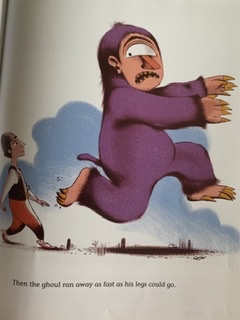
Hasan is tired of being scared and decides he will climb the mountain. Everyone in the village tries to warn him against it, but he is Hasan the Brave after all and is determined to go. When he gets to the top of the mountain and relishes at the beautiful view he proclaims that he is fearless and that he won’t be afraid of the ghoul. Then he sees the ghoul, and after the ghoul sizes him up, the ghoul runs away.
Hasan goes to investigate why such a monster is scared of him and learns that the ghoul is scared of people because they have two eyes instead of one, they do not have thick hair like him, they have strange hair, small teeth, and they eat ghouls. Ghouls, Hasan finds out are vegetarians.
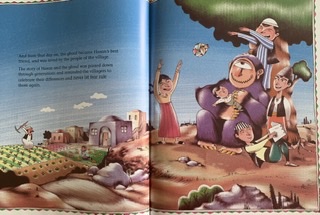
The two laugh at their assumptions, and run off to play together. From that day on the two are best friends and the people in the village pass on stories to remind future generations to celebrate differences and not let fear rule them again.
There are a few women in hijab, the villagers say inshaAllah, but there is nothing religious in the book. The illustrations are detailed and colorful in a muted manner. Overall a fun book with a great lesson.





















 This 36 page book for ages five through eight is a cute story about being brave, facing your fears, challenging your perceptions, celebrating differences and giving friendship a chance. Recently translated and published in English, this Arabic inspired folktale is timeless and important for readers of all ages to learn from.

 Islamic School Librarian