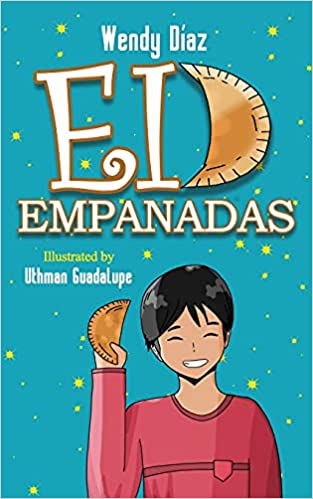
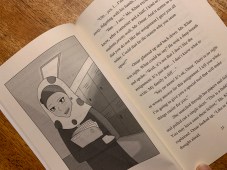
I love books that show, not tell how diverse Muslims are and celebrate the unique ways that Islam and culture come together. This early elementary chapter book beautifully blends, Islam with Spanish words and phrases that all come together to celebrate Ramadan and Eid in America. At 79 pages, with illustrations sprinkled in, this is a great book to share all year long.
SYNOPSIS:
Omar is in 5th grade and when his teacher assigns the entire class to write an essay about their Ramadan and Eid traditions he is nervous that his family’s way of celebrating is very different than everyone else’s. Omar’s mom is from Puerto Rico and his dad’s parents immigrated from Ecuador, even after a year and a half at the Islamic school, though, he still feels like the new kid, and doesn’t want to draw attention to himself.
Sensing that Omar is nervous, his teacher Ms. Khan offers ways to brainstorm and organize his thoughts. Once home, in his casa, his little sister and parents join in to give him enough ideas, if only he can be brave enough to share them.
WHY I LIKE IT:
I love that there is so much joy and love in this little book. The twist of having a kid not feel like he is fitting in at an Islamic school, is also so fabulous to read. The OWN voice narrative and recipe at the back will help kids like Omar everywhere feel confident to share their culture, and those that know kids like Omar (even if only fictiously) anxious to learn more about Latino Muslims.
The only thought that did cross my mind, when Jummah was being explained as the congregational prayer on Friday, was why not use the word Jummah, just like all the Spanish words were used, and then defined. I would love to ask the author who the intended audience is, and how that shaped her word choice, what was defined and what wasn’t.
FLAGS:
None
TOOLS FOR LEADING THE DISCUSSION:
I’m hoping to get copies to the first grade and second grade teacher to read in Ramadan to their classes. This book has the potential to really excite kids, expand their understanding, and show them how beautiful and diverse Islam really is.
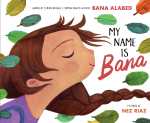
OWN voice books are always important, and while we see a rise in minority voices claiming their own stories, to read a child’s story about war and hope by a child, is particularly impressive. Bana Alabed was born in 2009, she is an activist, a Syrian refugee, and now an author. Her clear voice doesn’t stumble and her perspective is unapologetic, yet hopeful. Over 40 pages she tells her story in her own words with beautifully warm and complementary illustrations filling the pages. For kindergarten and up, this book stands out in a crowded field of refugee inspired stories for its authenticity, strong author, and overall emotional connection.
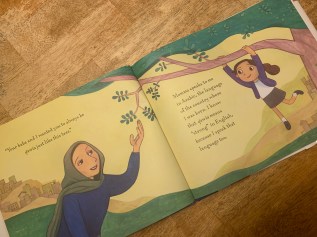
Bana begins her picture book memoir by asking her mother why she was named Bana. Her mother explains that she was named after a tall bushy tree that grows in Syria. Her favorite tree. A tree that is qawai, Arabic for strong.
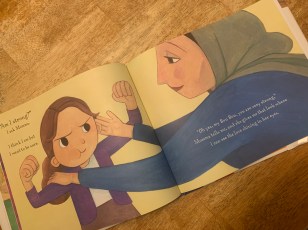
Bana then asks what it means to be strong. And once again her mother lovingly explains, that strong is to be brave even when you are scared, and to be sturdy so others can lean on you. It also means you use your mighty voice to speak up when something is wrong, you read, study, and exercise your body.
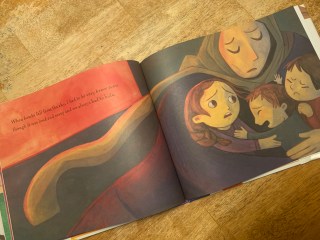
Bana appreciates her name, and being strong, because war came to her country. When bombs fell they had to hide, when her brothers were scared, she had to keep them distracted, when they moved to a new place where they didn’t know the language or any people, she had to be strong still.
As a young girl, Bana tweeted about the war, the book doesn’t touch on that, but it does show her being strong as she shares her story all over the world. It then returns to her and her mother discussing amal, Arabic for hope, and Bana imagines herself strong, reaching into the sky.
The book ends on a simpler note of acknowledging her little brothers’ names: Laith and Noor, lion and light. The Author’s Note at the end is just as powerful as the text of the book and provides more information about Bana’s experience and outlook. The way that war is handled is not overpowering for young readers, and will provide a great starting point of discussion. The relationship between Bana and her mother is warm and supportive and equally deserving of mention with the little people you share the book with, alhumdulillah.
“Kids shouldn’t have to always be strong. Every child deserves to live in peace.” Bana Alabed
This 40 page month-by-month celebration of Arab culture, both old an new, will be a source of pride and smiles for readers of all ages. The author is an Arab American of Lebanese decent and the illustrator was born in Lebanon. The book shows Muslim’s teaching others about Ramadan, looking up hijabi fashions, as well as making cookies at Easter and dressing in sleeveless shirts. To be Arab is not a monolith and this book seems to convey that culture and tradition and love are all it takes to be included in the broad diverse identity of being Arab.
January starts with finding stars with Arabic names, and February recalls how a comic about Martin Luther King, Jr. helped inspire the Arab Spring. The kids in turn make a comic to teach others about Ramadan. March is a chuckle about Arab time, and April is making maamoul with Sitti for Easter. May is learning to write Arabic and June for gathering grape leaves to make warak enab. July is picnics that remind mama of Morocco and making perfume with familiar smells and memories.
August is playing the doumbek with Dad who is in an Arab band. September is researching hijab costumes to wear to comic con. Dressing up like Umm Kulthum wins first prize. October is pomegranate time, which means the kids jump in the tub to eat and enjoy the messy fruit. Chilly November air requires the Palestinian keffiyeh to keep memories warm, and December when friends are busy over winter break it is time for sleep-overs and henna parties.
I like that dressing up is not for Halloween and that while some examples are country specific, many are general. The book specifically mentions a few Arab countries, but the electronic arc did not include all the supplemental information that the published hardback book will contain. I can’t wait to check it out and gift to my Arab friends and their children.
I’m not sure how to really review this 167 page book. It is the translated YA work of an Arabic Epic that took place somewhere between the seventh and 10th centuries and began possibly being compiled in the 1100s. It was told orally, but when written, comprised some 6000 pages. The translator notes that the choices of what to include and how to translate, all potentially alter and reshape the narrative, so as a reviewer I’m simply going to review the text in my hands. I have no outside knowledge of this epic woman, and approached the book as I would have in high school when reading The Odyssey or Beowulf: some of the history is accurate, the characters fictitious, the culture possibly representative. As a result, I find the comparisons to Wonder Woman and Katniss Everdeen on the back cover, very odd choices. At times the contemporary diction, in my opinion cheapens the narrative. Sure I appreciate the modernization of the text to make it an easy read, but throwing in modern slang seems too much. I found the book’s framing unfortunately counterproductive of what it hoped to achieve. I have no idea what the other 5,900 pages include and what the translator had to choose from, but the majority of the book focuses on marriage, being raped by her husband, and working to prove who the father of her Black son is when her and her rapist husband are white. I was prepared for battles, and conquering, and fighting misogyny, and saving the down trodden, not every one just wanting to marry her. Many of the characters are Muslim, some convert to Christianity to escape Dhat al-Himma, the Quran is quoted, prayers are made, the Kaaba visited. I do however, take issue with the explanation of the child’s skin coloring being attributed to intercourse (rape) occurring while Fatima is menstruating and a case of Prophet Muhammad (saw) being used as proof of this occurring. So much of the text is footnoted, this instance is not, and I find it disturbing. The book also contains a lesbian character who ends up marrying a man, violence, death, and many other potential flags (see below) that might make it better suited for older college age readers.
SYNOPSIS:
The story doesn’t begin with the birth of Fatima, but rather with her great great grandfather. It sets the stage a bit to show culture, how women and honor are treated, and the line of her ancestry. When we get to know Fatima a few chapters later she is being born and her gender is a disappointment, so she is hidden away. As she grows away from her tribe she becomes an accomplished warrior and captures her father in a raid. When she returns to her people, her cousin, Walid, born the same time as her, is struck by her beauty and wants to marry her. She refuses. Repeatedly. Finally she agrees to battle him and if he wins, she will marry him. She wins, and he still doesn’t back down, finally she is forced/tricked in to marrying him by the Caliph’s agent. The two are pronounced wed, but little changes for Fatima, she is a warrior and does not seek intimacy or companionship. Eventually, her husband Walid enlists the help of Fatima’s milk brother and friend, Marzuq, to have him drug Fatima, so that he can rape her. He acknowledges the rape, the whole community does, but allows it, because he is her husband. When the child is born he is Black and Walid and his family refuse to accept that the child is his. Amira Fatima is socially put on trial for being a whore and that the child is illegitimate. As Walid works to have them killed, Fatima works to prove her innocence and carry on with her life trusting in Allah swt completely, all while the Arab-Byzantine battles are raging in the borderlands. As Abdelwahhab, Fatima’s son, grows he too becomes a formidable warrior and the two have continued adventures.
WHY I LIKE IT:
I love the richness of the culture coming through a compelling story. Fatima is incredibly devout in her worship of Allah, swt. She does not falter, ever. When she is being tested she needs only her faith, at one point a man converts to Islam upon having a dream as a result of her conviction in praying. That being said, I genuinely don’t understand a few critical points. How can a woman who single handedly destroys tribes not be listened to, to make her own decisions to lead her own life. I get that that is perhaps the poignant point of the story in today’s context, but there are a lot of strong women in this book, so why does her marriage and being defined by her not wanting to marry get so much of the spotlight? Her father didn’t want her, but they don’t resolve anything, they just reunite and all is well. I need more. I want to know what happened to Walid once he became Christian, was it a permanent thing, a temporary fix? What ended up happening between her and Marzuq? He was her trusted advisor and immediately regretted drugging her, what happened to him. I want more about her mother, maybe even her Aunt or other women to see how their lives compared and contrasted to the powerful women highlighted. How did they view her, was she inspiration, an anomaly, beloved, loathed?
I appreciate the footnotes, the introduction, the Note on the Translation, the further reading list, help with pronunciation and the character list. A map would have been nice.
FLAGS:
There is violence, killing, rape, talk of sexual intercourse and menstruation. There is misogyny, racism, flirting, sexual temptation, a lesbian character, magic, jinn.
TOOLS FOR LEADING THE DISCUSSION:
I would not be able to lead a proper discussion on this book, I am just not knowledgeable enough on the larger story. I think I would like to be a student or be able to join a discussion led by someone well versed in The Tale of Princess Fatima and all the subtext that brought her story to life and maintained it over time. It would be fascinating.
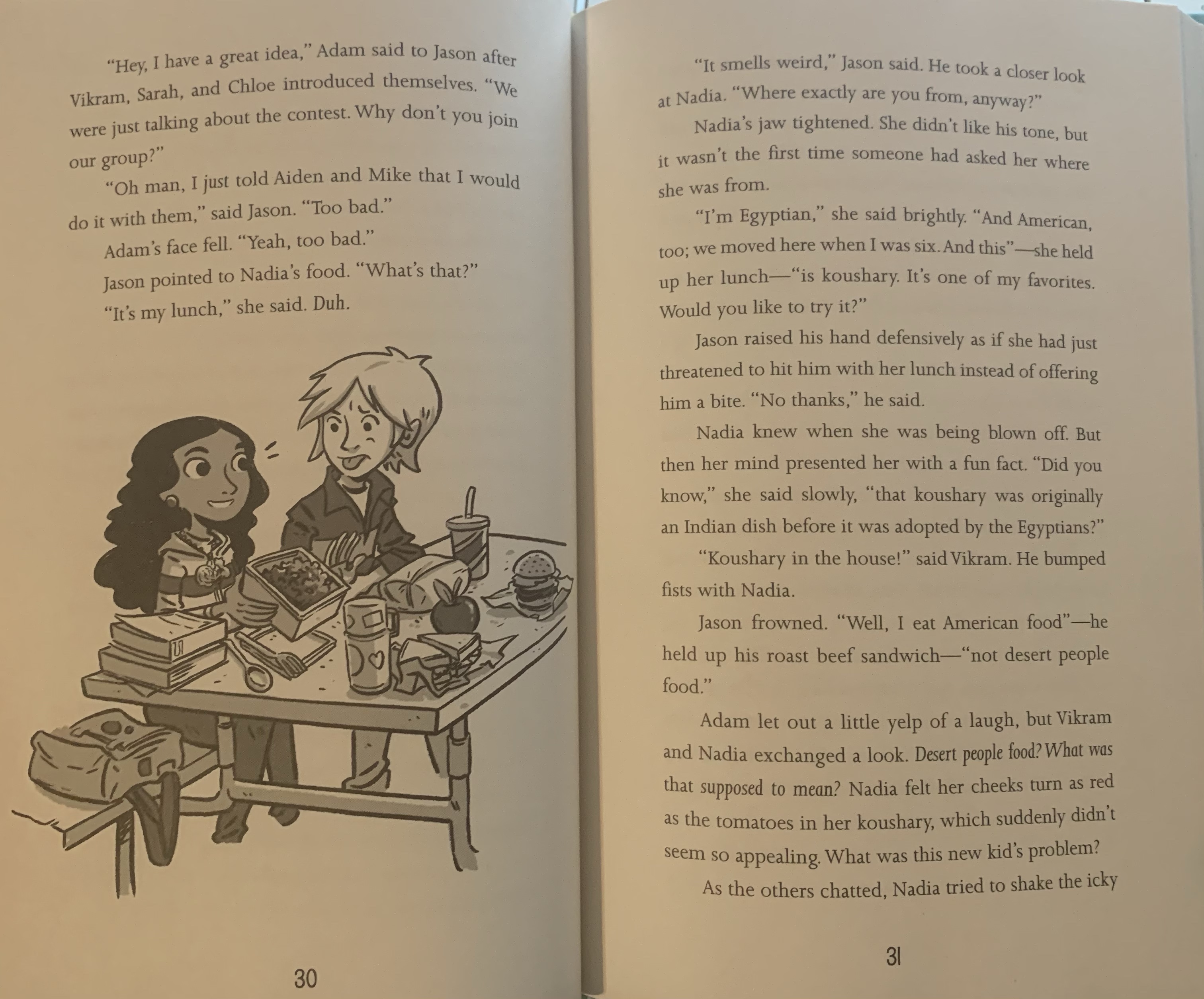
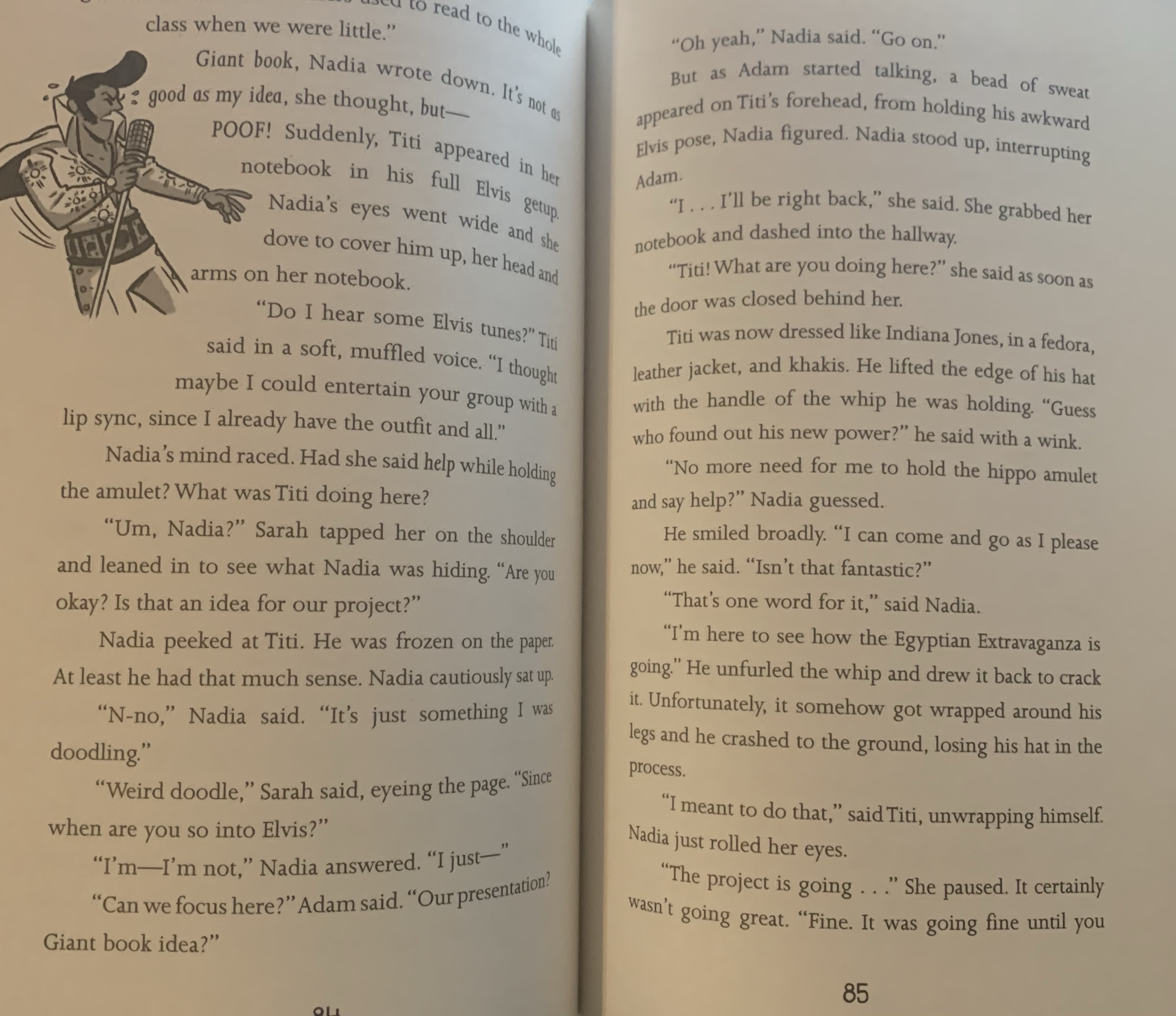
This middle grades AR 4.5 OWN voice book by Muslim author/comedian/surgeon/activists Bassem Youssef mixes text, comic strips, and illustrations over 166 pages to tell a story about ancient Egypt, friendship, leadership, xenophobia, and life sprinkled with magic. It has a lot of potential, and I liked the lessons that Egyptian-American Nadia learns, but it just seemed lacking to me. It seems to be book one in a series, and in many ways it reads like an introduction. The magical element is underdeveloped to me and often just annoying. The micro aggressions, racism, and character’s ages would suggest upper middle grader readers would gravitate toward the book, but the overall writing style and length would more appeal to younger readers. This disconnect makes the book hard to pin down and hard to connect with. I’ll definitely check out future books in the series even though no religion is mentioned, because this brown girl has a lot of potential to break down Arab-American stereotypes and empower readers to be proud of where they and their families are from as universal obstacles are worked through.
SYNOPSIS:
Nadia has just come back from a summer vacation visiting family and friends in Egypt and can’t wait to get ice cream with her best friend Adam. She picked up an Egyptian comic book for him and is anxious to see if he likes it. Except the comic book seems to have disappeared and when she asks her many bobble heads to help her find it, her necklace with a hippo amulet starts to glow and an ancient Egyptian teacher, Titi, starts talking to her from the now found comic book pages. As Nadia figures out how to control this ancient man who lives around her neck and in papers around her, she also has to deal with a new kid that acts like a bully and has the admiration of her best friend Adam. Nadia loves facts and her and her friends call themselves the Nerd Patrol. Nadia can be a bit bossy though, and while usually her friends let it go, she seems to be stepping on toes lately, especially with Adam. When a competition at school is announced that will result in an exhibit at the Museum of American History, Nadia will have to use her “genie” to get help coming up with ideas for her display, coping with a bully, restoring friendships, and learning how to be a leader before her friendships fall apart.
WHY I LIKE IT:
I love that Nadia is so proud of her culture and doesn’t feel like she has to pick one of her hyphens over another. She brings Egyptian food for lunch, wears Egyptian inspired clothing, and is still very “American” as well. Ancient Egyptian tidbits as well as modern day Egyptian information seeps through and weaves into the story smoothly. The diverse side characters are also a plus. I think her trying to handle the bully in multiple ways makes the story resonate with other kids and gives readers something to ponder over. I worry that most readers, however, won’t know who Elvis Presley is, or get if Titi is really helping or not and how it all comes together for him. I am curious to see if he is a major character in future books, because I still have a lot of questions about his knowledge and understanding of the world after being trapped in an amulet for so long. Really, she could have learned so much from him, she just scratched the surface.
FLAGS:
There is teasing and bullying and racism, subtle and overt.
TOOLS FOR LEADING THE DISCUSSION:
This book is too short and superficial for a middle school book club selection, but it could be a fun read aloud in a 3rd or 4th grade class.
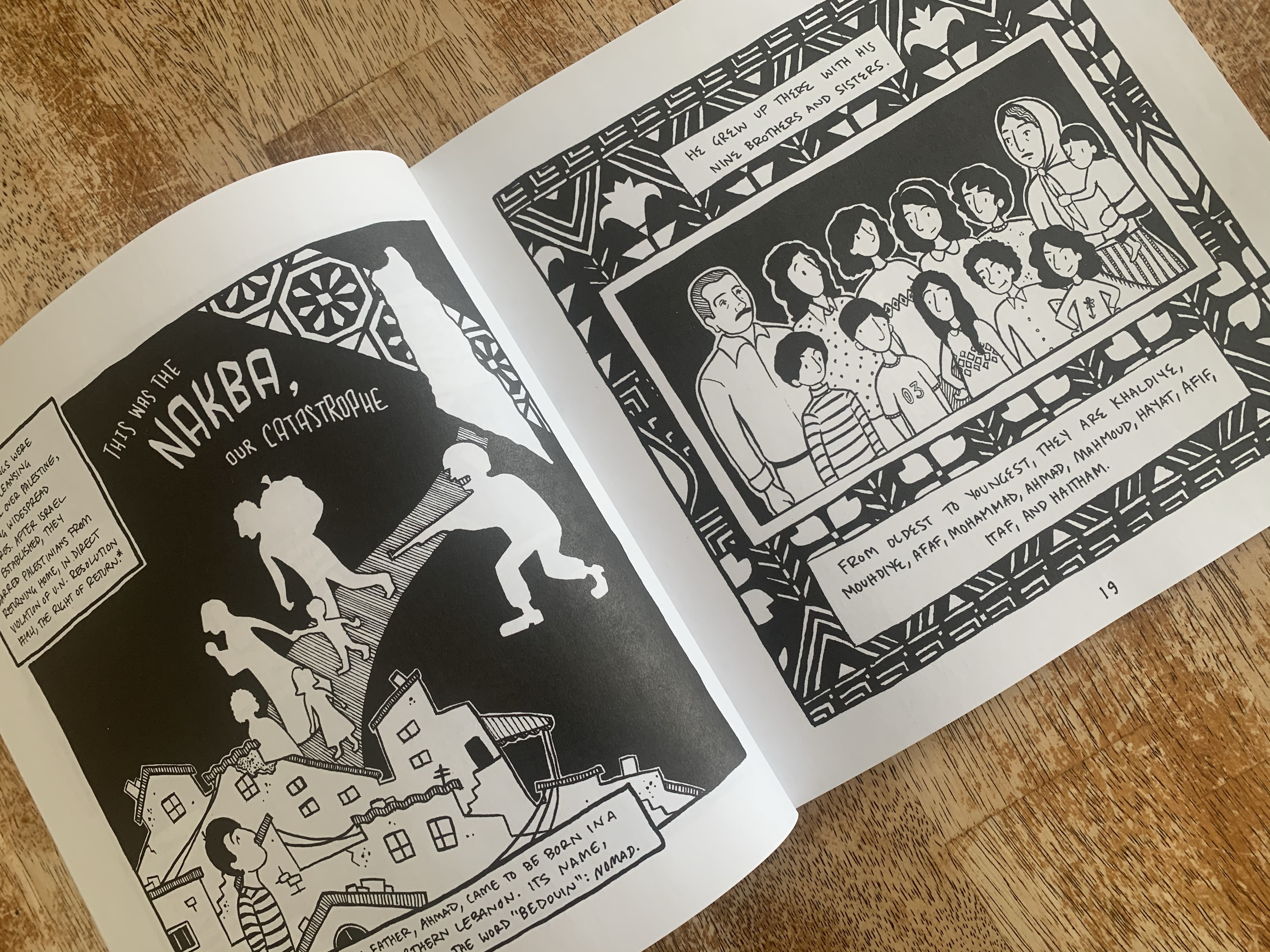
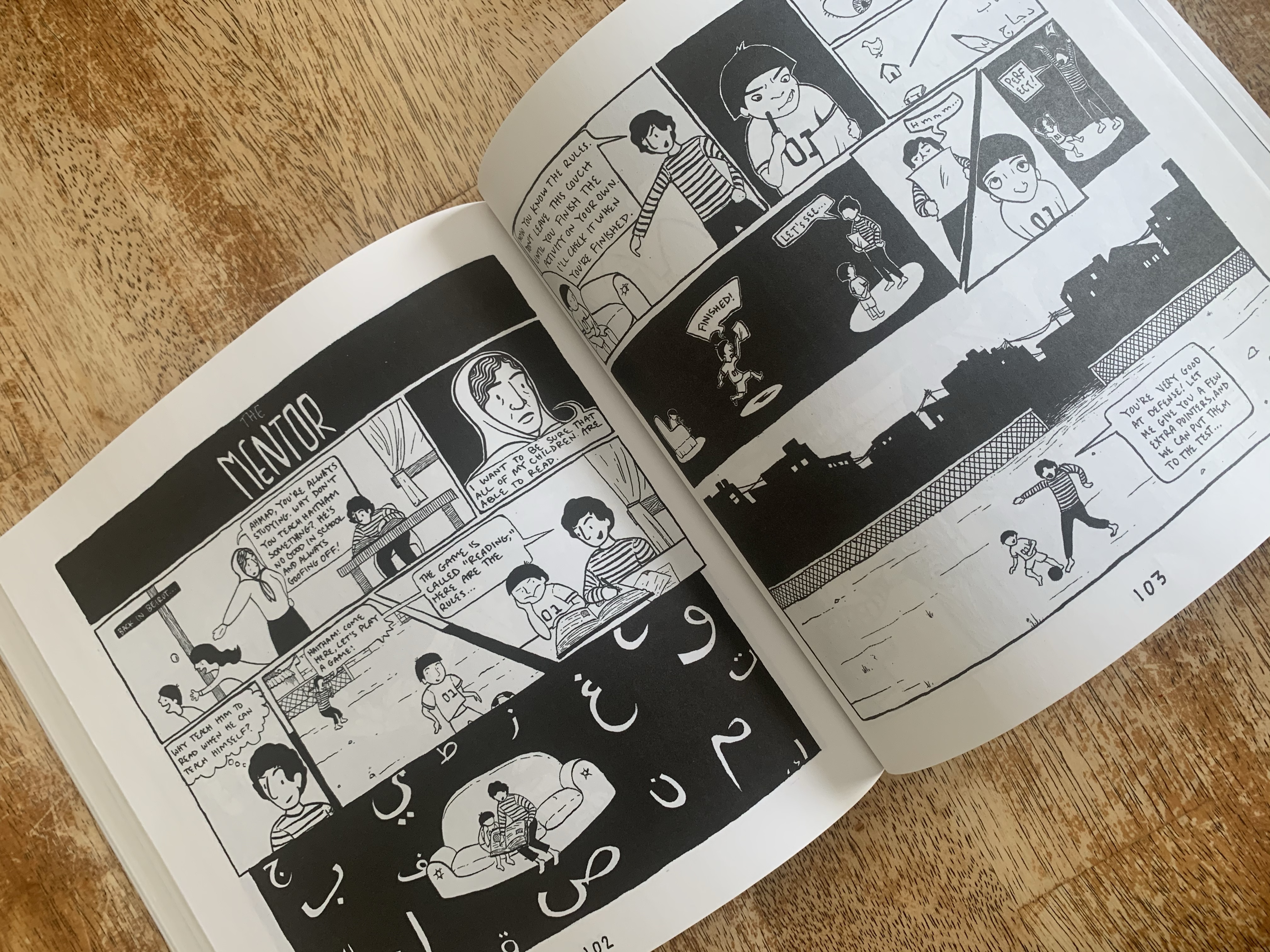
This 8.5 x 8.5 middle school graphic novel biography tells a powerful story of a young boy coming of age and striving to find his place in the chaos of the Nakba and its aftermath. Over 128 pages the reader will learn and be outraged about the displacement and genocide of so many Palestinians as they see the events through Ahmad’s eyes and relate to his dreams and experiences despite the terror around him. The book has violence, destruction, death and mentions rape, yet the humanity shines through as it is also heartfelt and memorable. I had my 14, 12, and 10 year olds read it and we have discussed it at length in context to what they already know about Palestine and the ethnic cleansing occurring. It is a seamless mix of history and character driven narratives brought to life by the black and white illustrations of the author/illustrator’s family history.
SYNOPSIS:
There are 10 children in the author’s father’s family, and her father, Ahmad, was born in a refugee camp in northern Lebanon, called Baddawi. The story starts on October 29, 1948 when Safsaf was ethnically cleansed. Ahmad’s father, the author’s grandfather had been in Akka at the time of the massacre, and her grandmother hid from the Israeli soldiers, the family, once reunited, would escape for a refugee camp, hoping that they would one day return.
We first get to know Ahmad as he starts first grade in Baddawi. Things do not start well for the little guy as right away he gets teased by other students, his class is too large so he is selected to be joined with a girls class, and he doesn’t have soccer cleats so he isn’t allowed to play soccer, luckily he gets two good crayons, unlike his friend who gets a white one. Ahmad is identifiable by his striped shirt that he wears throughout as a nod to Handala, the boy depicted with a striped shirt with his hands clasped behind his back and his face not shown. The artist said his face would be revealed when Palestine was free, sadly the artist, Naji al-Ali passed away, and Palestine is still occupied.
Ahmad desperate to purchase soccer cleats devises a business plan that his mother takes as gambling and quickly puts an end to, in exchange she offers to pay him if he helps her collect and prepare za’atar. It isn’t as fun, or as lucrative, but they family is busy packing up to return to Palestine. Unfortunately the Naksa, the setback, the six day war occurs, and more Palestinians are ethnically cleansed and the families cannot return. Ahmad and all those in Baddawi carry on, playing, celebrating Eid, trying to claim normalcy. The camp however, is not safe and soldiers raid the camp killing PLO leaders and innocent people in their way. With no option but to keep on keeping on, these acts of violence are often taken in stride. It is so hard to believe, but what else can they do, the children still play, deal with bullies, and cope with universal struggles in addition to being shot by rubber bullets, and fearing cluster bombs and shellings. At one point Ahmad and his siblings are left in Baddawi to finish school while his parents are in Beirut.
When the family is reunited in Beirut, Ahmad is in a better school, but violence follows as Mossad agents start raiding PLO homes in Lebanon. Ahmad goes back and forth between Beirut and Baddawi, wherever he can go to school. His favorite library is the one at the American University in Beirut and he hopes to attend school there, but without connections, he is at a loss to come up with funding. His intellect finally lands him an opportunity to leave the Middle East to pursue higher education, he ends up in the United States, and when the story ends, readers are left hoping that everything works out even knowing it will be 10 years before he can return home to see his family.
WHY I LIKE IT:
I love that the harsh horrific life is not shied away from in a war, but the little things are just as important in shaping and showing Palestinians to be resilient and culture rich. I love how the concept of Handala is included and amplified. The book is at times funny, and at other times devastating. The connection to the characters is pretty remarkable, in such a relatively short book, and I am fairly confident it will be pulled off the shelf and thumbed through often. I really wanted to know if the girl in the book that Ahmad left behind ended up being the author’s mother, or if he married someone else, but I couldn’t find it by Googling. This book is truly powerful, and I highly recommend it. There isn’t a lot of religion, the family is shown praying on Eid and celebrating. It mentions the diversity in Beirut, but nothing too detailed. Similarly, there isn’t a lot of political detail. There is a glossary at the end, some actual photographs of Ahmad and his family. At the beginning of the book there is a preface about Handala and how Ahmad represents more than just her father’s experience as well as information about the tatreez patterns on the pages and a map.
FLAGS:
There is violence, torture, killing, death, bullying, and possibly gambling. The book mentions that women were raped, but it isn’t detailed. The war is ever present and depicted, but it isn’t sensationalized. Ahmad and a girl study together and the family wants them to get married, but Ahmad opts instead to leave for school, nothing inappropriate.
TOOLS FOR LEADING THE DISCUSSION:
This book might not work as a book club selection, but I hope middle school children and their teachers or parents will encourage them to read this book and think about it. Imagine if it was their homes that were taken, imagine what they would do, and how they would manage, and to be aware that it is still going on and that we cannot be silent.
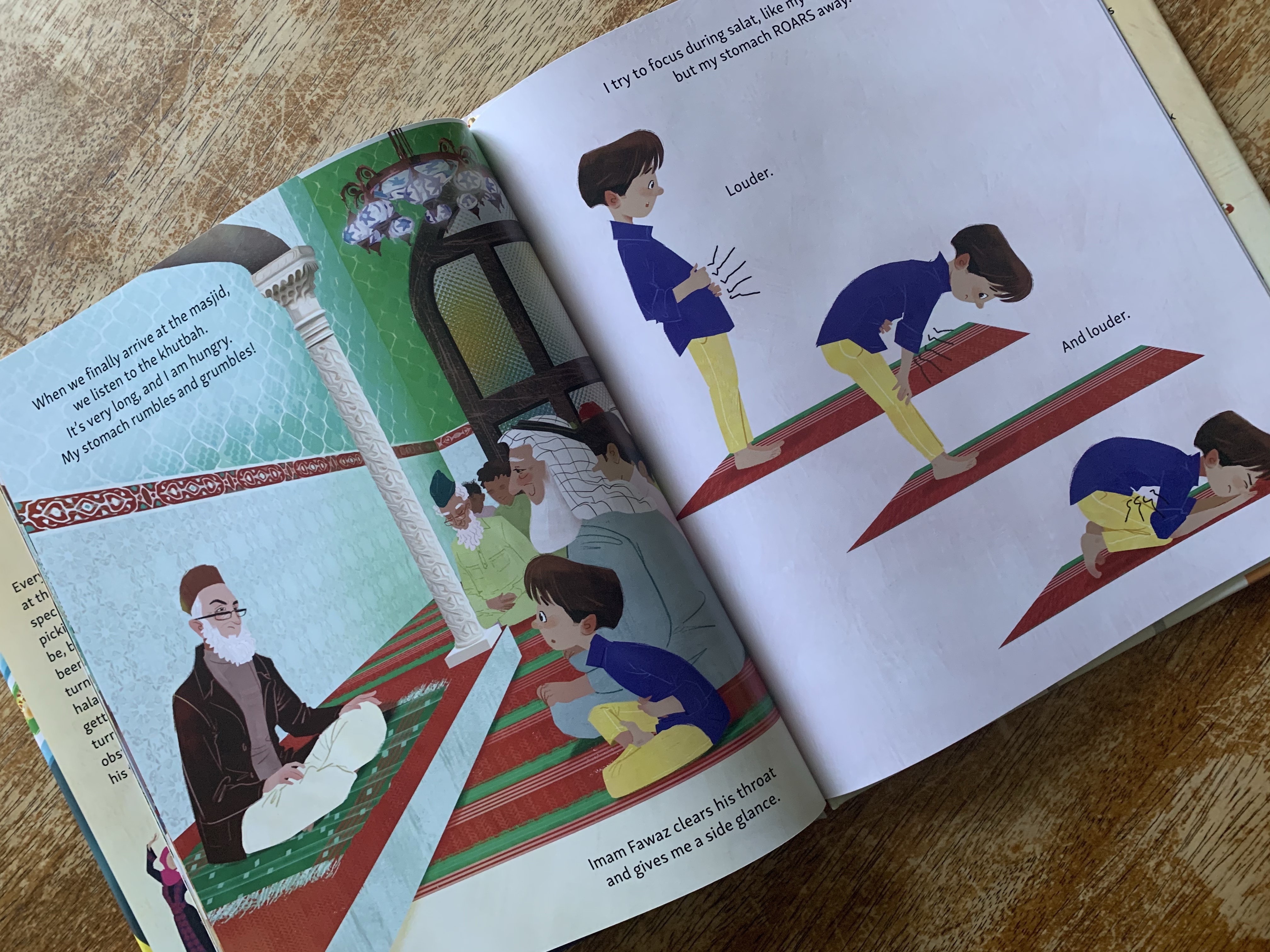
I’m not sure what I expected this book to be, I just knew I wanted to get my hands on it, but I’m fairly certain, that even if I would have had some expectations, they would have been no where near how well done this 40 page book for four to eight year olds is overall. It is unapologetically American-Palestinian Muslim in an inclusive funny delightful way, that only an OWN voice book can be. There have been some great picture books lately that are authentic, yet mainstream, and this book pushes that standard just a little bit higher as it normalizes jummah, halal food, dabke, hijab, with familiar threads of street food, spunky little sisters, untied shoelaces, tradition, and excitement. The story has a twist and some intentionally misleading foreshadowing, that give the book depth and added fun. Readers of all backgrounds will relate to this book and find something that they can relate to, as they laugh and marvel at Musa’s infectious enthusiasm for hot dogs.
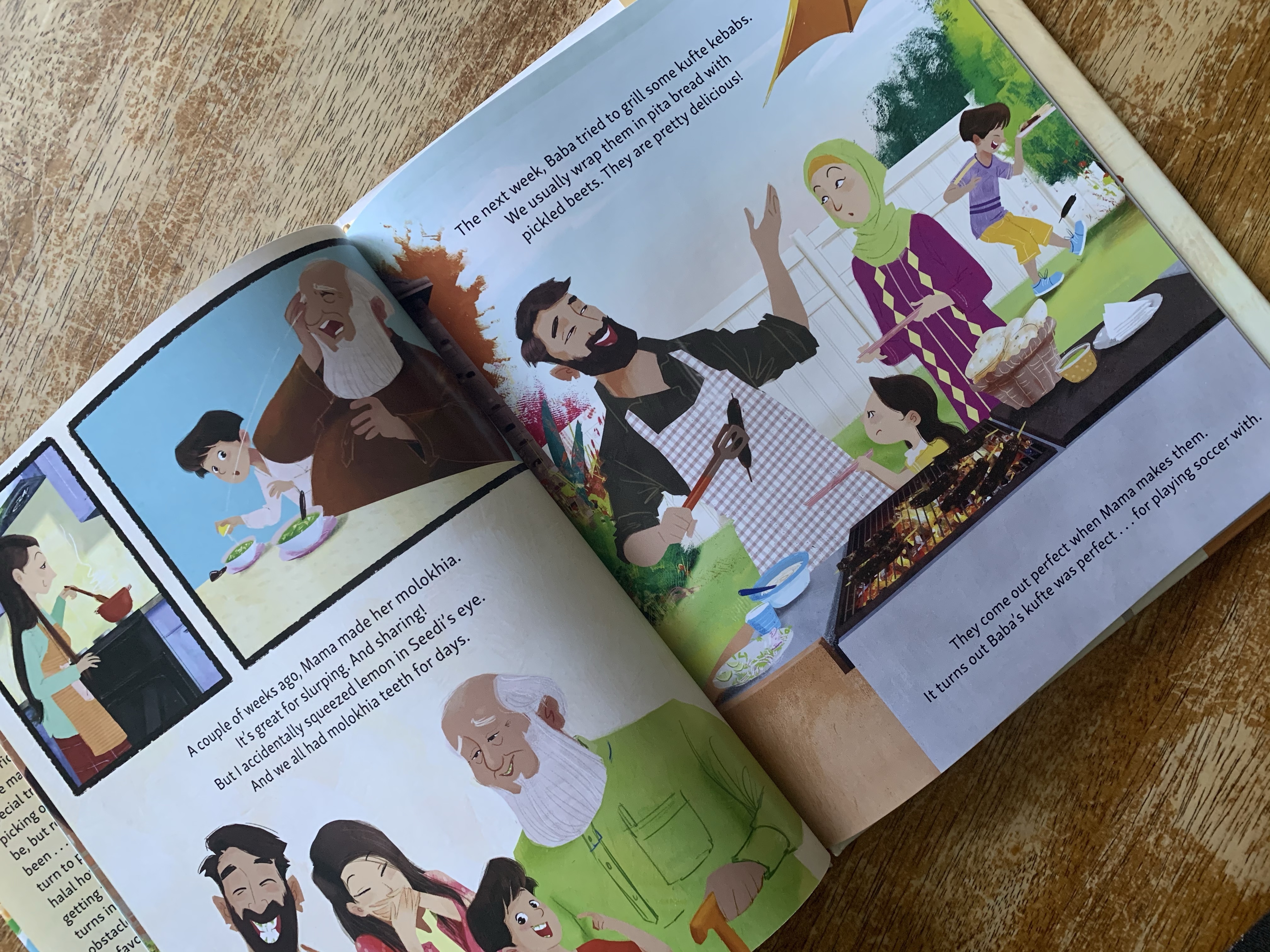
Musa Ahmed Abdul Aziz Moustafa Abdel Salam, aka Musa, loves Fridays. His family heads to the masjid for Jummah prayer and then home for a special Jummah treat. Lately, they’ve had molokhia, that stayed in their teeth for a week, kufte kabobs that were better for soccer playing than eating, riz bi haleeb with lost dentures, and prelicked jelly beans. Alhumdulillah, this week is Musa’s turn to pick, and he is picking his favorite: halal hot dogs with Salam sauce.
They head to the mosque dancing dabke as they leave their house with smiling faces. The khutbah is long though, and during salat his stomach is roaring! Afterward he is off, but Seedi has to help Maryam find her red shoes in a sea of red shoes and mama is chatting with friends.
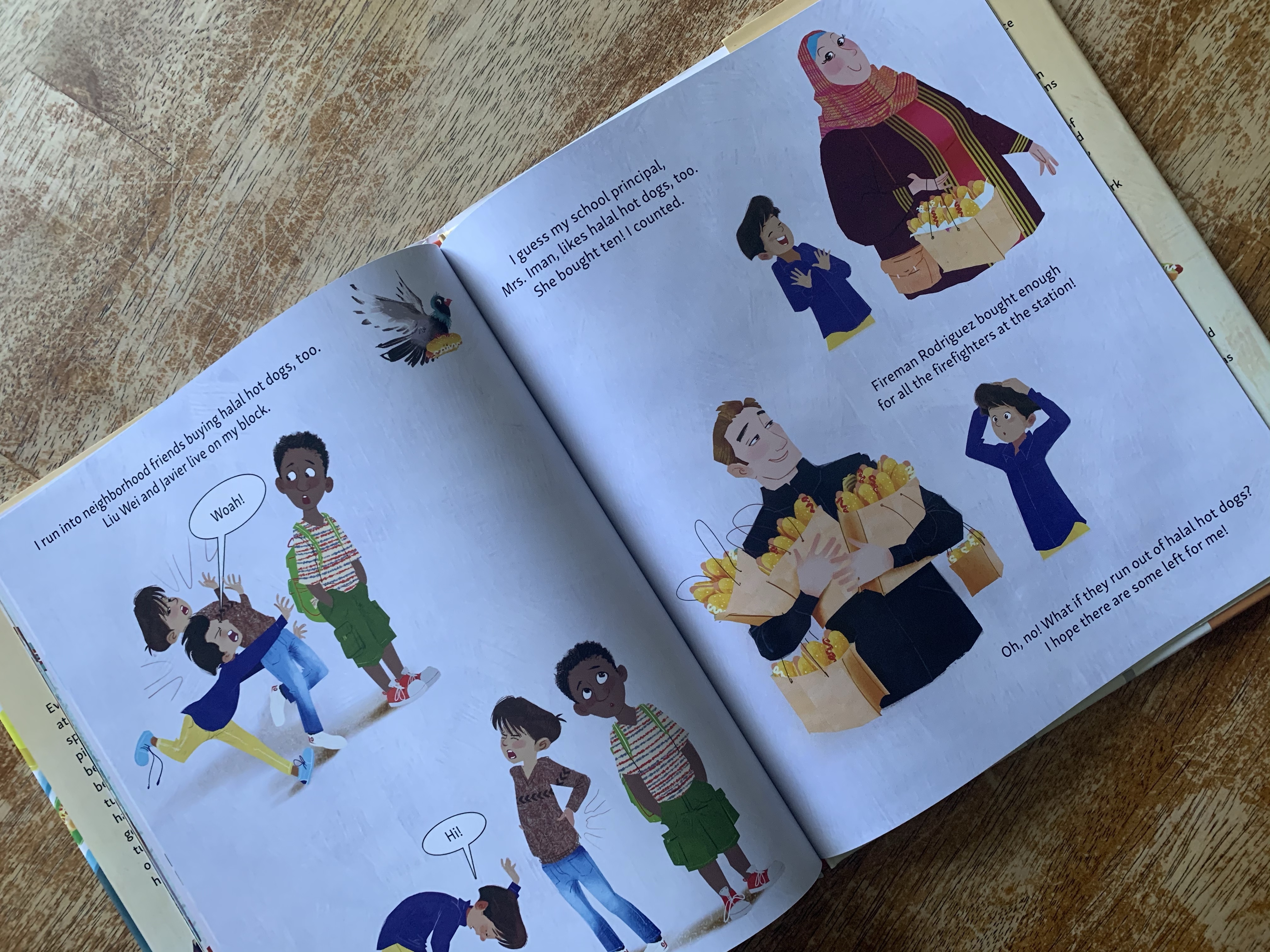
Dad gives in and lets Musa go get the hot dogs alone. As he heads to the stall with the best hotdogs: the perfect amount of hot, chewy, juicy hot dog goodness, he passes all sorts of foods being eaten. There is falafel and bao and tacos and samosas and churros, but he is determined to get hot dogs, even though the line is really long.
He sees friends in line, and firefighters, and even his school principal. Everyone loves hot dogs, even birds and squirrels. Finally he buys a whole bag full with special Salam sauce and races home to share with everyone. But uh oh, it doesn’t go as planned, and I’m not about to spoil it, so get yourself a copy like I did from http://www.crescentmoonstore.com or your library, and maybe don’t read it while you are fasting, because you will be craving hot dogs, mmmmmm nom nom nom.
There is an Author’s Note at the end that details her kids’ influence on the story and explains that a portion of the proceeds go to UNRWA USA, a non profit that helps Palestinian refugees. There is a glossary of Arabic Words and Terms, and a section explaining Halal Laws.
The book shows the mom in hijab outside the home, and uncovered within the home. There are diverse skin colors among the Muslim and non Muslim characters in the book, as well as a variety of ages depicted. Seedi wears a keffiyah on Jummah, but different clothes on different days. The illustrations are wonderful and descriptive and do a lot to compliment the story by setting a relatable and diverse-positive visual.
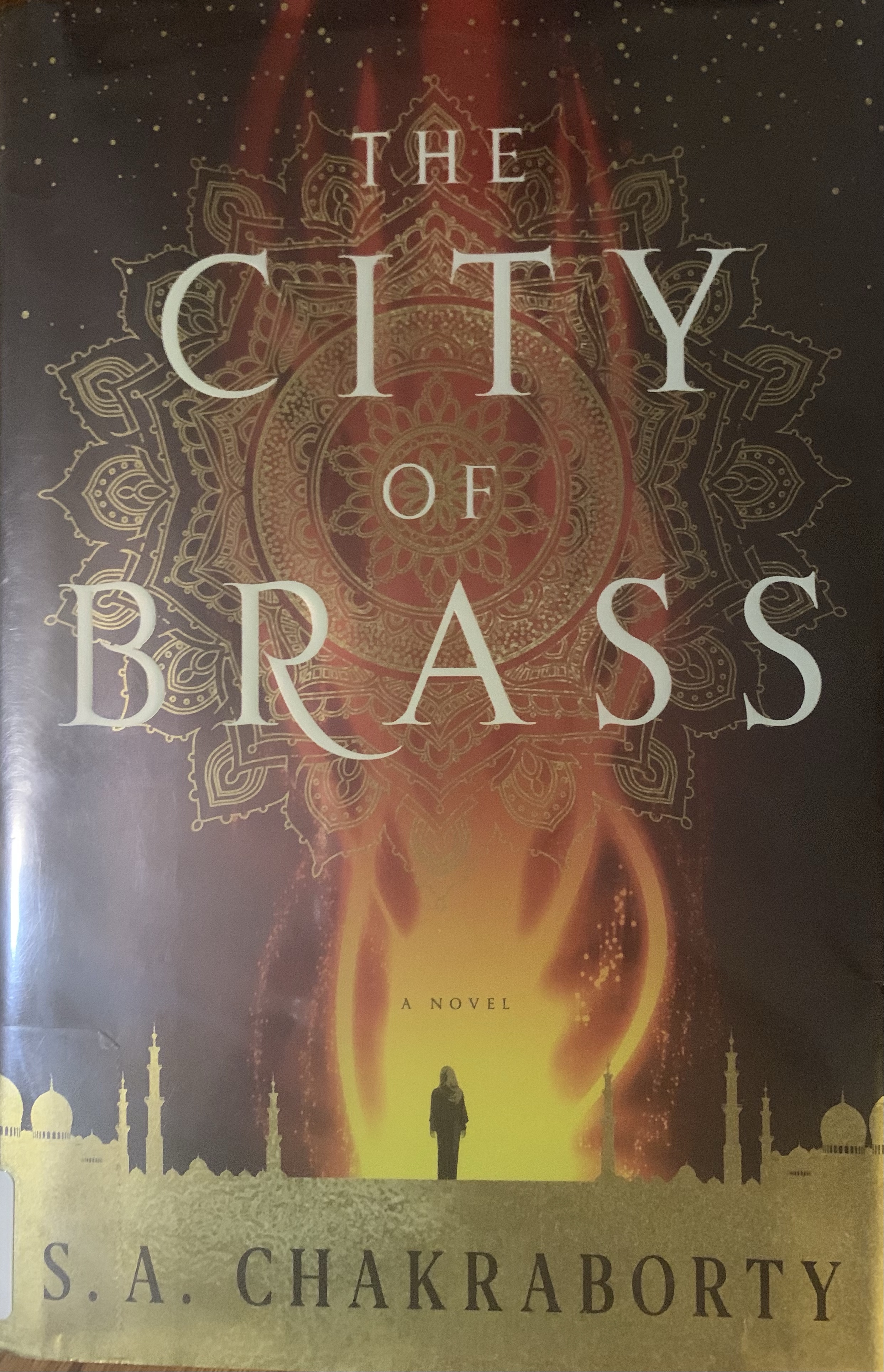
This series is adult fantasy written by a Muslim author for her ummah and contains Muslim characters. I think the series as a whole is definitely not YA, as the main characters would age out of the target demographic, but I think that book one could qualify. I’ve contacted the author to get her perspective on the matter, and will update this if I hear back. So why am I reviewing it? Because it is so good, and I’ve heard of a lot of people letting/encouraging their teens to read it, and honestly, I did as well. There is complex world building, implied physical interactions, one hinted at gay romance, alcohol, concubines, violence, djinn, ifrits, killing and one kiss/slight make out session. There is also Middle Eastern culture, Islam, and a fiery protagonist that make the 530 pages in the first book fly by. I’m only reviewing the first book, and I think 14 years and up can handle it, I know my 14 year old and I haven’t stopped talking about it, and it has been quite fun to fan girl with her over it.
SYNOPSIS:
Nahri is living in 18th Century Cairo. She is completely alone and always has been. To survive she relies on her healing abilities and her ability to steal, cheat, and con her way to food and shelter. She knows nothing of her past, but is able to pick up any language after hearing a few words. At a performance to con a family needing help healing their daughter, she accidentally summons a djinn, Dara, which in turn awakens a graveyard full of ifrit, and sends Nahri on the run. Not trusting Dara they are travel companions none-the-less as they make their way to Daaevabad, a protected home of the fire beings, and the only place Dara thinks she will be safe. Along the way on the month long journey, Nahri tries to learn about the djinn, called Daeva, and the creatures they are running from. She also learns that she is the last surviving Nahid, healer, and while she may be a shafit, a half blood, she has powers and lineage the kingdom desires. Dara isn’t forthcoming with information, as a result his dark past and incredible powers keep Nahri on edge. She is constantly plotting her escape from the magic carpet carrying them and the future that she doesn’t understand let alone know if she wants.
The book is told from Nahri’s perspective and from Ali’s as well. Ali is the second born son to the king of Daevabad and has been raised away from the palace at the citadel. With a soft spot for the shafit, second class citizens of Daevabad, he gets tangled up in a plot to free child slaves and gets called back to the palace to be watched and tested as his brother’s future Qaid, the top military official that he has been preparing for his entire life. Ali is already an outcast to his family, as a devout Muslim in practice, belief, and actions, unlike his family who identify as Muslim for political unity.
Once Nahri and Dara cross in to Daevabad and the two narratives come together, the politicking, deception, deceit, and historical complexities get intense. The king demands that Ali get to know Nahri so that she can be persuaded to marry the emir, Muntadhir, but Nahri is in love with Dara and struggling to learn how to be a healer in the mythical world. To say that the story gets messy with the djinn tribes, and the manipulation of power and historical atrocities would be a simplification. But the writing is superb, and the world building encompassing. The book doesn’t drag and even after reading all three volumes, you’ll find yourself thrilled to know that the author has some additional points of view online.
WHY I LIKE IT:
The author takes a lot of liberties with Prophet Suleiman’s story, but it is fiction and I don’t think that anyone would be mislead by the information given about him and his control over the djinn. The “Islamic” elements in the book are really just that, elements, they aren’t plot lines, or more than just a layer to the setting and the characters. The history and the cultural richness is made more complete by the foods, clothes, and salat times mentioned, but there is nothing Islamic fiction about the text.
I love the writing. Period. It is engaging and doesn’t lag or feel repetitive. The characters are very fleshed out: no one is good or bad, the entire cast is shades of gray, and their motives and intentions are often debatable. My daughter and I have argued and I don’t think we have tried this hard to convince each other about characters since Harry Potter, and it is so great!
FLAGS:
SPOILERS: Dara and Nahri have chemistry and they kiss and long for each other, but it isn’t the bulk of the story line. Ali starts to fall for Nahri, but he has poor judgement so it is by and large dismissed. Muntadhir is always drinking wine and courting courtesans and is never in his own bed, nothing is detailed, it is said in passing, or implied. It is also hinted that Muntadhir is in love with his best friend, a male, and pretty much everyone knows, and they just look the other way. It does not state anything explicitly about them, but it is hinted at, implied, and mentioned by the other man’s father that the prince has broken his son’s heart numerous times.
Wine is always present, as is stealing, and lying. There is a lot of violence, not overt gore, but occasionally graphic as Nahri is a healer and there is a war simmering in the current time line, and a historical one that wiped about a whole tribe that is discussed throughout.
TOOLS FOR LEADING THE DISCUSSION:
I wouldn’t be able to do this for middle school, but perhaps closer to the end of the school year, I would suggest that the high school book club consider it. There is a ton online for this award winning debut novel, so I’ll just include the author’s website: http://sachakraborty.com
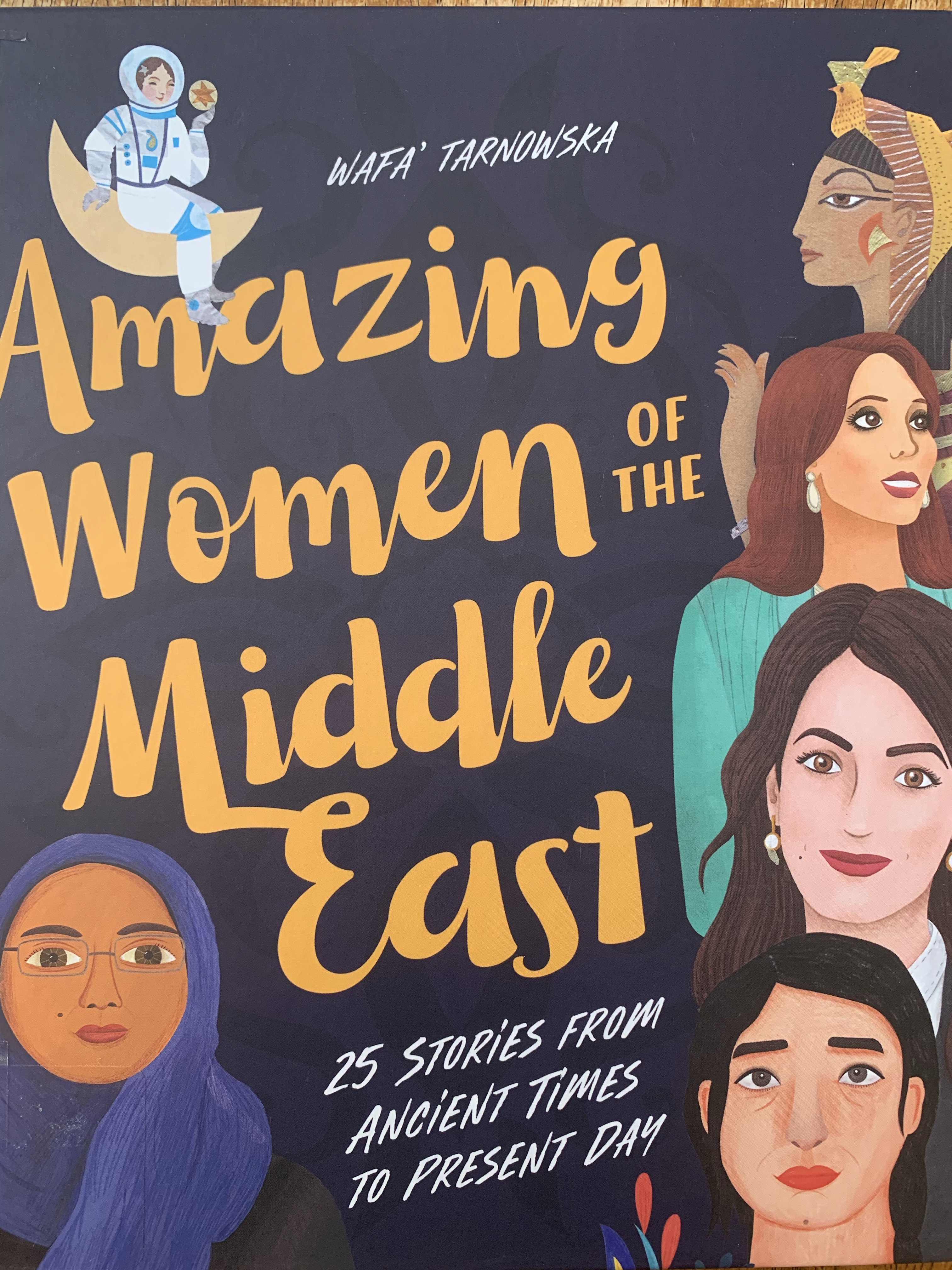
A nonfiction picture book for teens that features amazing women from ancient times to the present day. Many of the women featured are Muslim and each entry receives a teasing summation page with a full page portrait from one of five international artists before a two page, more in-depth biography is presented. The 112 pages feature an introduction, and a map to start the book off, and acknowledgements and a glossary at the end. There are large time gaps that I wish would have been commented on, the geographical pool includes India which surprised me, and in one of the entries the way hijab is discussed seemed judgmental to me, but other than that the stories are absolutely remarkable. There are amazing women in every culture and throughout all time periods, but to see one that highlights a region that is stereotypically oppressive to women is a sight for sore eyes. I learned so much and marveled at the intellect, bravery and determination shown from being rulers of empires to intellectuals to scientists and artists everything in between.
The book starts with Nefertiti born in 1370 BCE and concludes with Zahra Lari, a hijab wearing ice skater from the United Arab Emirates born in 1995. There are “celebrities” such as Amal Clooney, Fairuz, Cleopatra, Sheherazade and many that might not be as well known.
I particularly enjoyed learning about Zenobia the 3rd century warrior queen who conquered a third of the Roman empire in just five years. Sufi mystic and poet Rabi’a al Adawiyya and her devotion to Allah swt. Eqyptian Shajarat al-Durr who was nicknamed Queen of the Muslims in the 13th century. And Hurrem Sultan from the Ottoman Empire.
Not every one featured was a ruler or married to one, and not are so far in the past, which in many ways gives the collection it’s charm. Somayya Jabarti was the first female editor-in-chief in Saudi Arabia in 2014 and Maha al Balushi is the first Omani woman to fly professionally for her country’s airline in 2010, examples of two women presented that cracked the glass ceiling by following their own dreams.
It is great to learn about the strength of the women from the past and see how to add to the legacy. The book is a great reference, as well as a source of inspiration for people of all backgrounds to enjoy and appreciate. I found the book at my local public library in the YA/Teen nonfiction women section.
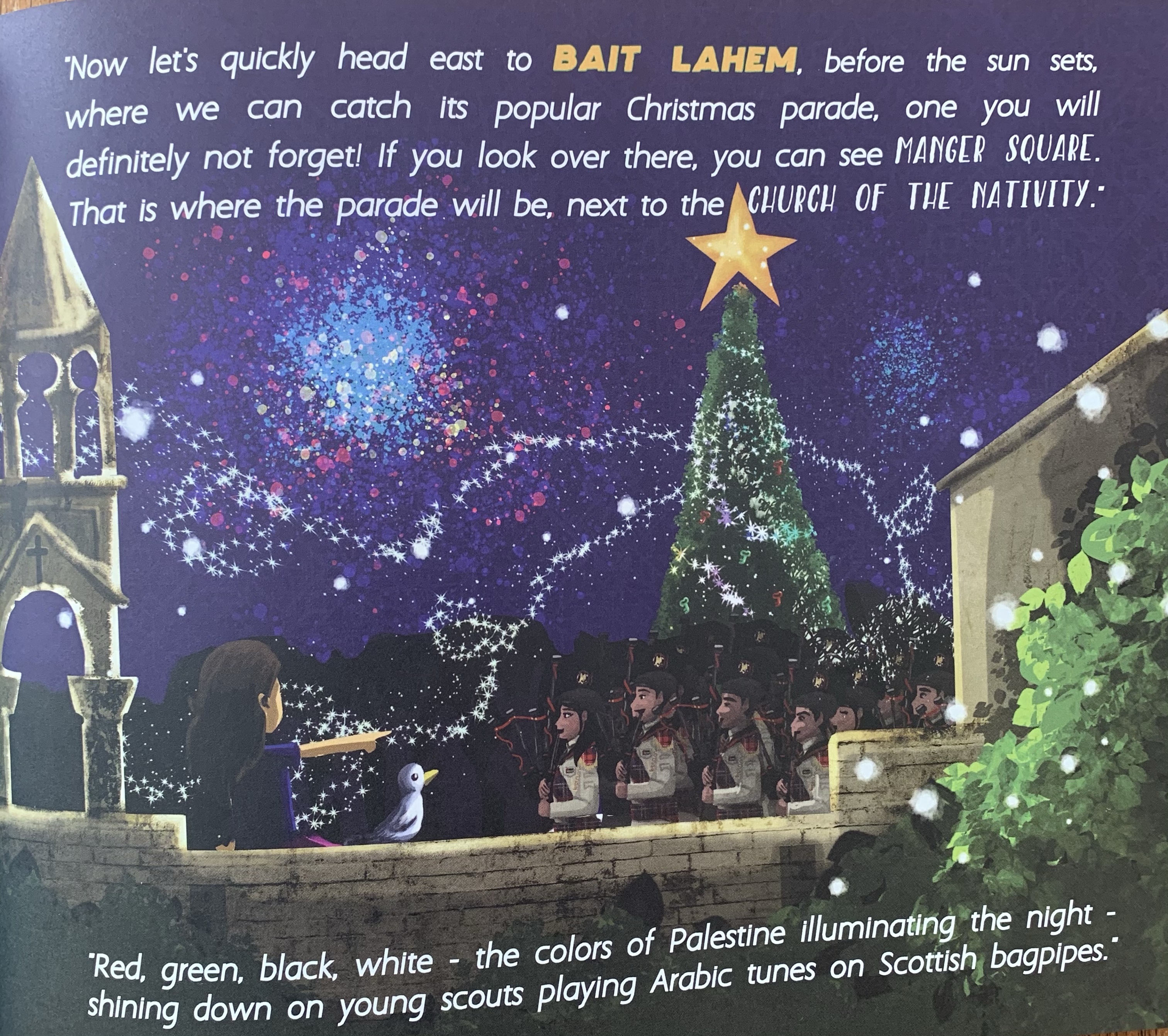
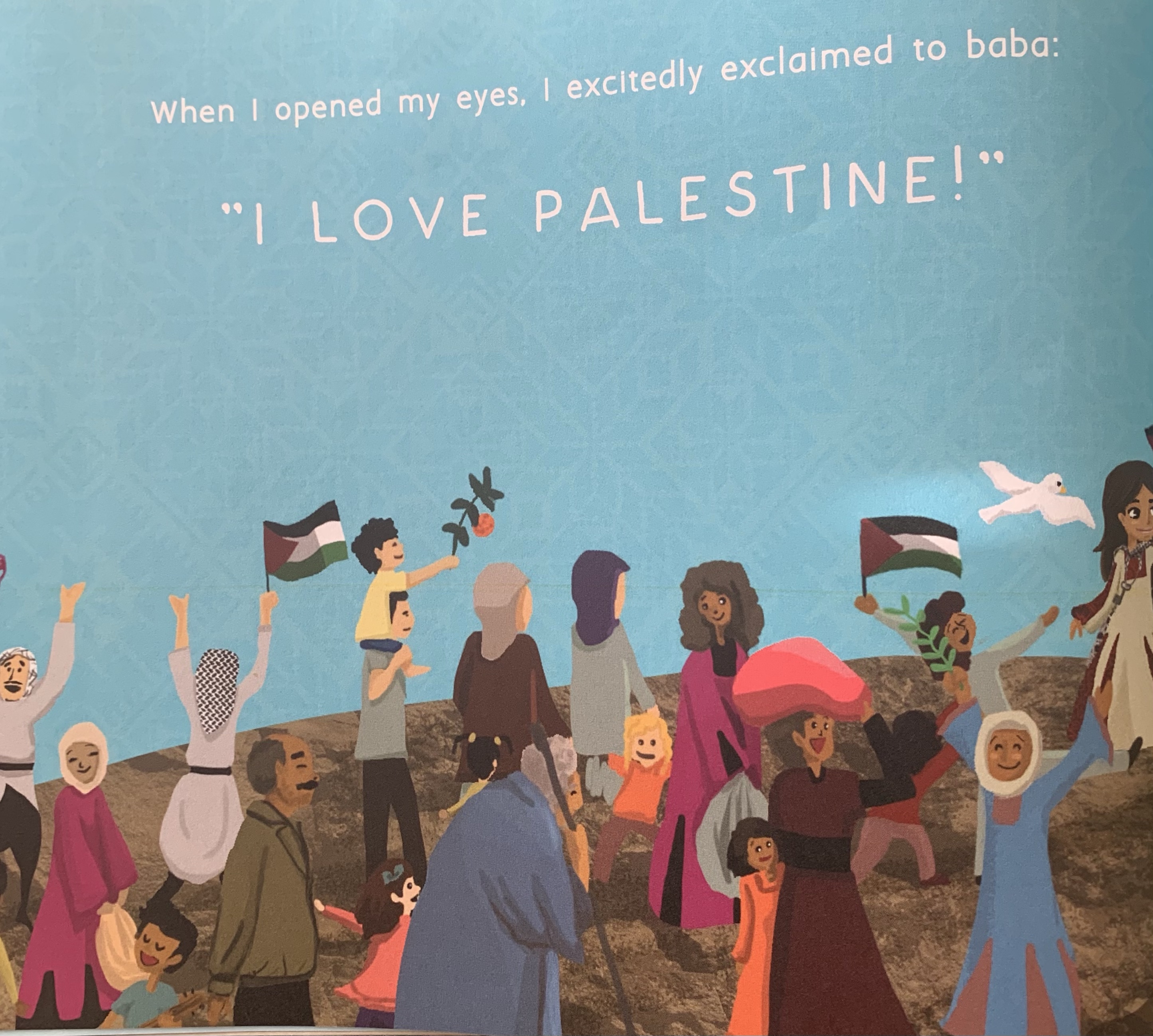
This lyrical journey through Palestine’s major cities, shares historical facts, geographical information, cultural richness, and love for a homeland that will inspire and educate all readers. There is a lot of information pressed in to 32 pages and at times the rhyming text, illustrations, and maps are powerful, and at other times overwhelming. The 8.5 x 11 horizontal paperback bound book needs to be bigger to hold all that the pages contain, and hard back to hold up to the details that need to be poured over to be appreciated. The content about the names and places in Palestine is priceless and well done, but I really wanted to love the book a bit more than I ended up feeling for it. I think trying to make it all rhyme was just a bit too much for my liking, but I would buy this book again in a heartbeat to share with my children. Even though we are not Palestinian, I think all Muslims have a piece of Palestine in our hearts and feel a deep need to celebrate the culture, fight for their freedom, and demand a quality of life that they are brutally being denied by their oppressors.
The book starts out at bedtime with a little girl, Saamideh asking her baba what her name means. He explains to her that it means “one who is patient, persistent and one who perseveres.” She is named this because she is Palestinian, he explains and then he shows her the key to their ancestral home in Palestine. He asks her to close her eyes and imagine a white dove, named Salam, taking her on tonight’s journey.
Salam and Samamidah prepare to journey across Palestine’s mountains, hills, deserts, and plains. They start in Areeha, one of the oldest cities in the world, and one one of the lowest points on Earth.
They journey next to Al-Quds, the capital. They see the old city, Al-Aqsa, and more, before heading off to Nablus, Yafa, Haifa and the Akka. Learning about the cities, the food, and the history of each.
They learn about the dabkah, and the weaving in Gaza and head to Bait Lahem too. They learn about glass blowing in Al-Khalil at the Ibrabhimi Mosque, and finally they conclude their journey with the little girl dreaming of flying around the world to use her key and open people’s hearts and minds.
She proudly exclaims her love of Palestine and her and her baba pray that one day they will be able to return. Saamidah then asks her baba why they are refugees, and he promises to save that conversation for tomorrow’s beditme story.
The book concludes with a list of the city names in Arabic, trasliterated in English, and then the English names. It then has discussion questions at the end.
The book is not outwardly political, nor critical. It is a celebration of a people, a culture, and land. Happy Reading!















 A nonfiction picture book for teens that features amazing women from ancient times to the present day. Many of the women featured are Muslim and each entry receives a teasing summation page with a full page portrait from one of five international artists before a two page, more in-depth biography is presented. The 112 pages feature an introduction, and a map to start the book off, and acknowledgements and a glossary at the end. There are large time gaps that I wish would have been commented on, the geographical pool includes India which surprised me, and in one of the entries the way hijab is discussed seemed judgmental to me, but other than that the stories are absolutely remarkable. There are amazing women in every culture and throughout all time periods, but to see one that highlights a region that is stereotypically oppressive to women is a sight for sore eyes. I learned so much and marveled at the intellect, bravery and determination shown from being rulers of empires to intellectuals to scientists and artists everything in between.






 Islamic School Librarian