Tag Archives: Anger

Kicked Out by A.M. Dassu

Standard
Kicked Out by A.M. Dassu

81h06Amch6L._AC_UF1000,1000_QL80_

The first few chapters of this 336 page middle grade book were rough. It is a stand-alone companion novel, and I have read the previous works, so I don’t know if my expectation of myself to know the characters being introduced, was additionally muddled because the memories were faint, or as I actually suspect, the writing at the beginning is just weak. Like really weak, but I’m stubborn, and I kept reading, and I was rewarded, alhumdulillah. The book found its voice, its pacing, its heart, its relatability, its layers and I am so glad that I didn’t dnf it. The characters, their community, their tenacity, the exploration of family really stays on level with providing the reader insight and messaging to make them reflect on their own lives, without feeling preached to. The focus of football (soccer) keeps the book light and hopeful, while the difficult themes of deportation, Islamophobia, refugees, theft, absent parents, self doubt, forgiveness and second chances with adults, thread in and out. Many of the characters are Muslim, halal food is normalized as is saying salam, it isn’t focused on Islam but the kids make duas before they start a sting operation and when life changes are presented, also they consider Qadr of Allah when things occur. It feels authentic, and Muslim kids will enjoy that the focus isn’t a religious or cultural identity crisis, but just part of who they are as they take on this next chapter of their lives, non Muslims will feel the same.

SYNOPSIS:
Ali, Mark, and Sami are living it up since Mark’s mom won the lottery and they move in to a mansion with a pool. Sami’s brother Aadam starts doing the lawns to help pay for his lawyer fees to appeal his deportation, and things are looking up, expect for Mark’s mom’s new boyfriend though, he seems to be a bit of a racist. It all comes pouring down when Aadam is accused of stealing money, the boys are no longer allowed at the house, and Mark is prevented from hang out with his friends. Ali and Sami are not about to take this treatment without a fight, they have an idea to raise some money for Aadam with a charity football match, and Mark knows his mom is being influenced by her boyfriend and doesn’t abandon his friends. Ali though, is preoccupied, his absent father shows back up, and his step-brother has just been enrolled in their school. It is a lot but together Ali, Sami, and Mark support each other, stand up for what they believe in, and find ways to make sure they and Aadam are not “kicked out.”

WHY I LIKE IT:
I love the commentary on refugees, that it isn’t a political issue, but a human one. The exploration of found family and born family, and giving family second chances impressed me in a middle grade book. I also liked the kids hyping up the community and getting creative to solve a problem, rather than wait for the adults to step in. Whether it was to raise money for legal fees, or solve a mystery and clear someone’s name, these kids really have each other’s backs while dealing with a lot of heavy stresses. They mess up and make mistakes, but the book spending time to show them come back from them is a level of emotional intelligence and maturity that I think readers will benefit from.

I was thrown at a passage that mentioned that Ali can’t go to the mosque because he doesn’t have his dad around. Which made no sense to me as the kid goes to restaurants, parks, stores, on buses, on his bike alone throughout the book. Alhumdulillah, I have wiser folks I can ask concerns to, and my Lit Sister Zainab explained that in fact in the UK some masjids don’t allow women all the time and kids are not encouraged to come unsupervised, so if that stands out to you as well for being completely off, recognize it doesn’t mean it is wrong, like I did.

Truly the book is terrible at the beginning. The barrage of character names, the unlikability of Ali because of how he treats his brother, and the stress of how winning the lottery has made Mark’s life better, is all over the place. I must have read the first three chapters at least four times, before I just decided to plow through and see if the pieces fell in to place, which alhumdulillah, they did.

FLAGS:
Lying, stereotypes, racism, Islamophobia, accusations, theft, lottery, Mark has a crush on Grace, but it is subtle, anger, jealousy.

SPOILER: Ali’s dad was in love with a lady before he married Ali’s mom. His parent’s had him marry Ali’s mom to tame their “wild son” and at some point in the marriage, the dad had a nikkah with the first lady and eventually left Ali, his mom, and two siblings for his other family. The focus is how Ali feels about having his dad leave their family, being jealous of his step brother, and dealing with his return. It doesn’t make it a religious issue or judge if this was permissible, it really stays focused on the parent children relationship and the emotions involved in the leaving, not staying in touch, and the returning. I think middle grade can handle it.


Saving Sunshine by Saadia Faruqi illustrated by Shazleen Khan

Standard
Saving Sunshine by Saadia Faruqi illustrated by Shazleen Khan

img_9623

The themes, messaging and Islamic and cultural representation in this upper MG/lower middle school graphic novel are wonderfully unapologetically present.  Yet somehow, I never connected with the characters, and the plotting seemed stiff.  I don’t regret reading the book, and I’m sure most readers will be delighted with the main story of sibling annoyance, a sick turtle, and independent kids with reflective flashbacks and OWN voice threads of Islamophobia, immigration, starting to wear hijab, identity and othering.  I just felt the tropes were predictable, stereotypical even, and when the dad takes a stethoscope to a medical conference and the TSA agent doesn’t know what it is, I cringed.  Seriously, who takes a stethoscope on vacation? Who doesn’t know what one is? I normally love the author’s characters and wish for more Islam, this book gave me the Islam, but I really disliked the siblings, they were mean, angry, and annoying.  I own that reading a book about bickering kids a few days before my own five children returned to school may have jaded me, and I do think I found the religious touchstones predictable because I do read a lot of kid lit and I’m older, so while I’m not gushing in my praise for this book, I will be preordering a copy for myself and the school library. How is that for having an opinion and then completely walking it back? Yeah, it happens.

SYNOPSIS:

Twins Zara and Zeeshan bicker, a lot.  Zara loves animals and nature, Zeeshan space exploration, and both love their phones.  When the family heads to a medical conference in Key West where their mom is getting an award, the kids get their phones taken away by their parents when the two won’t stop fighting. The parents stick to their policy and the two are forced to stick together and entertain themselves while their parents attend lectures.  At one point they find a turtle and Zara takes the lead to try and help Sunshine, but will need her brother along the way.

WHY I LIKE IT:
I love that the characters identifying as Muslim was central and unapologetic.  I liked the flashbacks that provided a little bit of depth to the parents coming to America and their life in Pakistan, along with the personal reflections about starting to wearing hijab and when the kids started to go their own way.  But the airport scene, the identity issues, and the Islamophobia seemed a little superficial and over done.  The heart to hearts with the dad and his son and mom and Zara were sweet and insightful about belonging and where you come from, and not being so angry, but they also seemed very natural and in-character for the parents which is a disconnect from the anger the kids seem to carry.  If the parents are talking to them and modeling all this, it is a bit of a stretch that they are reacting as they are in the book.

I have a brother, it is just the two of us, we aren’t twins, but growing up in the 80s as the only Muslims in the area with a convert mom and immigrant dad, we came together a lot because only each other could understand the stresses we faced in and outside our home.  I thought this book would draw on that universal theme, and I was surprised that the point of the book felt a little underdeveloped.  I know MG can handle more than we give them credit for, but I felt like this book built up to have more of a warm hug, than I felt.  I wanted more of them plotting together, I didn’t feel like Zara really needed her brother to stick up for her, she wanted it sure, but that was a foot in the door that I think was missed.  She is strong, yet was being vulnerable with her brother, and he was able to step up for her, but it needed a few more beats to be appreciated.  I also wanted more connection to the turtle, his name is in the title, I thought he’d have a bigger role.

FLAGS:

Disrespect, lying, anger, yelling, bullying, teasing, Islamophobia, stereotypes, prejudice

TOOLS FOR LEADING THE DISCUSSION:

The book would allow for discussion for middle grade readers who might see themselves in the family dynamic or be able to relate to some of the Islamophobia.  It could also cause some worry for some children that being visibly Muslim or having cultural names, and wearing cultural clothes will bring negative differential treatment to them.

Available for order here

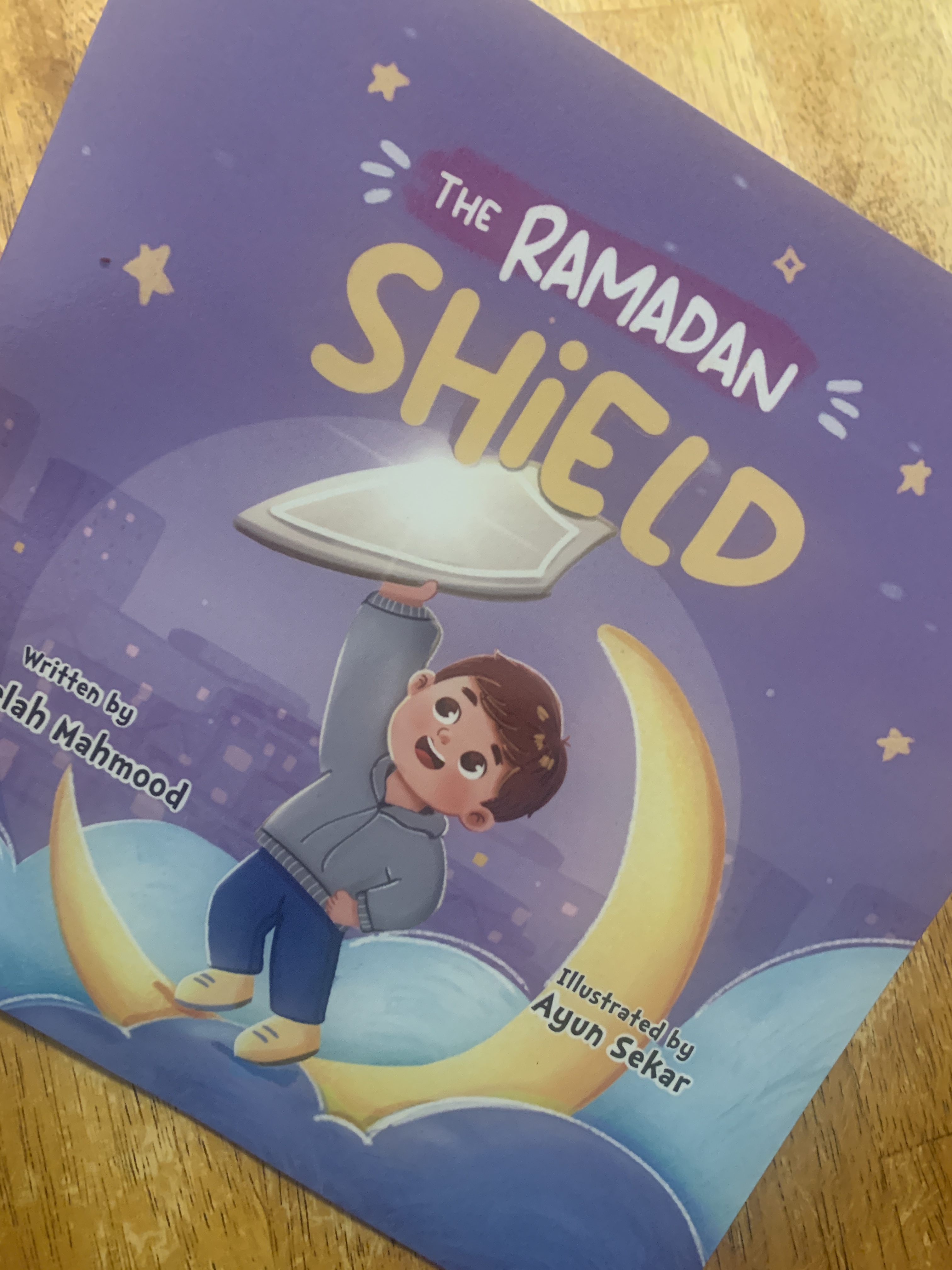
The Ramadan Shield by Fadelah Mahmood illustrated by Ayun Sekar

Standard
The Ramadan Shield by Fadelah Mahmood illustrated by Ayun Sekar

img_7028

This new 32 page rhyming book focuses on a boy who gets frustrated and often loses his temper and how the onset of Ramadan has his father imparting the lesson that fasting isn’t just staying away from food and drink, but also about behavior and controlling your anger.  He shares the hadith of saying “…I’m fasting, I’m fasting,” which is shared in its entirety and sourced at the end.  The book has a lot of text and scenarios in its moral framed telling that creates a bit of a disconnect between the presentation and the target audience.  The characters are fasting, there is no discussion about why they are fasting or that it is a first time fasting (thank you). the child’s art assignment is pretty advanced, and friends are seen independently out and about, but the rhyming lines and illustrations at the end of the kids on the rug seems aimed at a much younger reader/listener.  For my purpose of story times to children 4-9 it is a great choice, because it can appeal to the large range of relatability and attention spans, but for repeated readings in a home, it might need some shortening or additional explaining to connect as intended.

img_7029

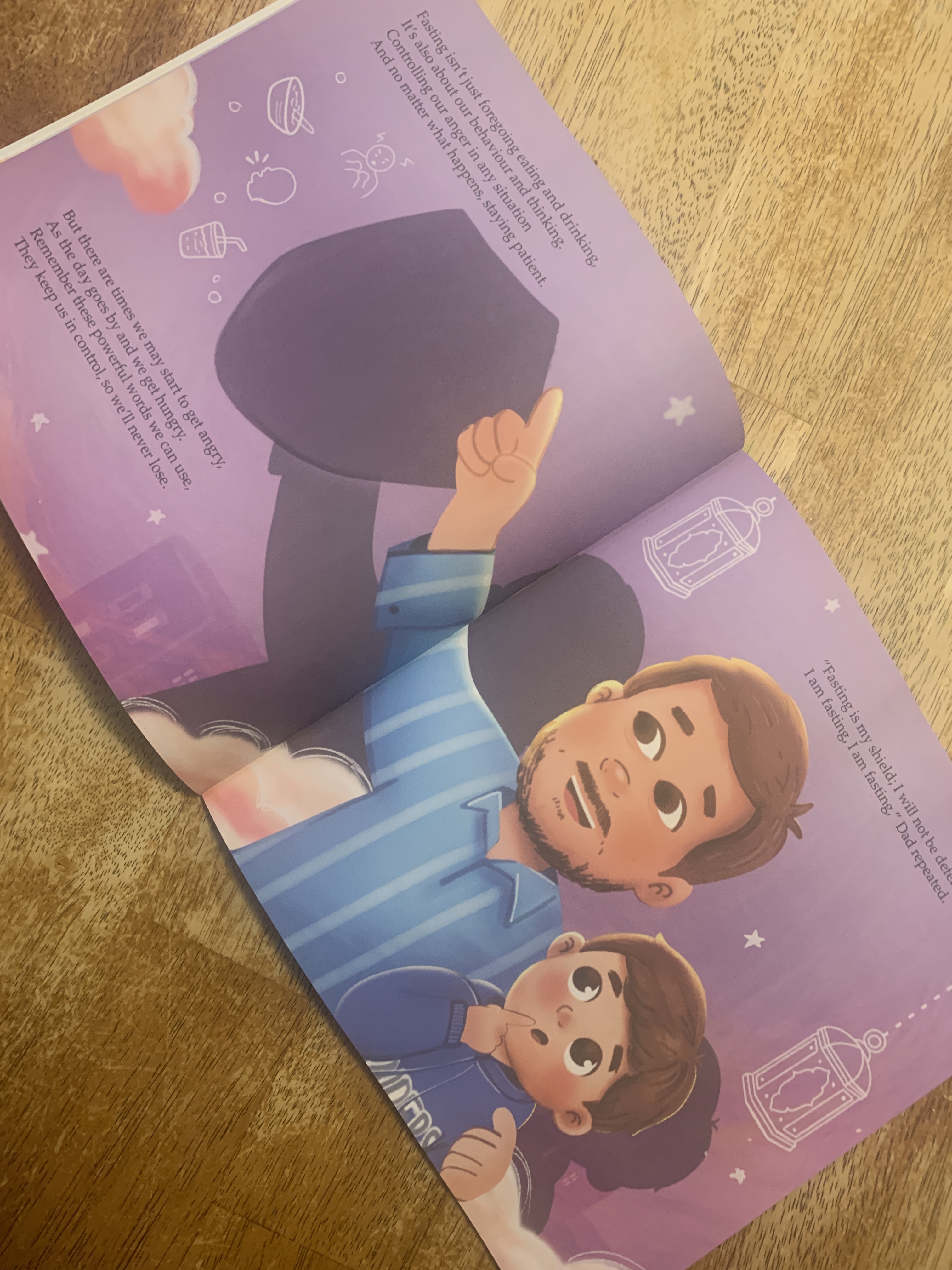
The story starts with Nuh working on an assignment to draw and paint a picture of the Kaba, but it keeps coming out tilted and he crumples and throws page after page.  His dad snuggles him close and explains that Shabaan is over and Ramadan is about to start which means that he needs to go without food and water, but also work on his behavior.  He explains, how to use the advice of saying, “Fasting is my shield; I will not be defeated! I am fasting, I am fasting.”

img_7030

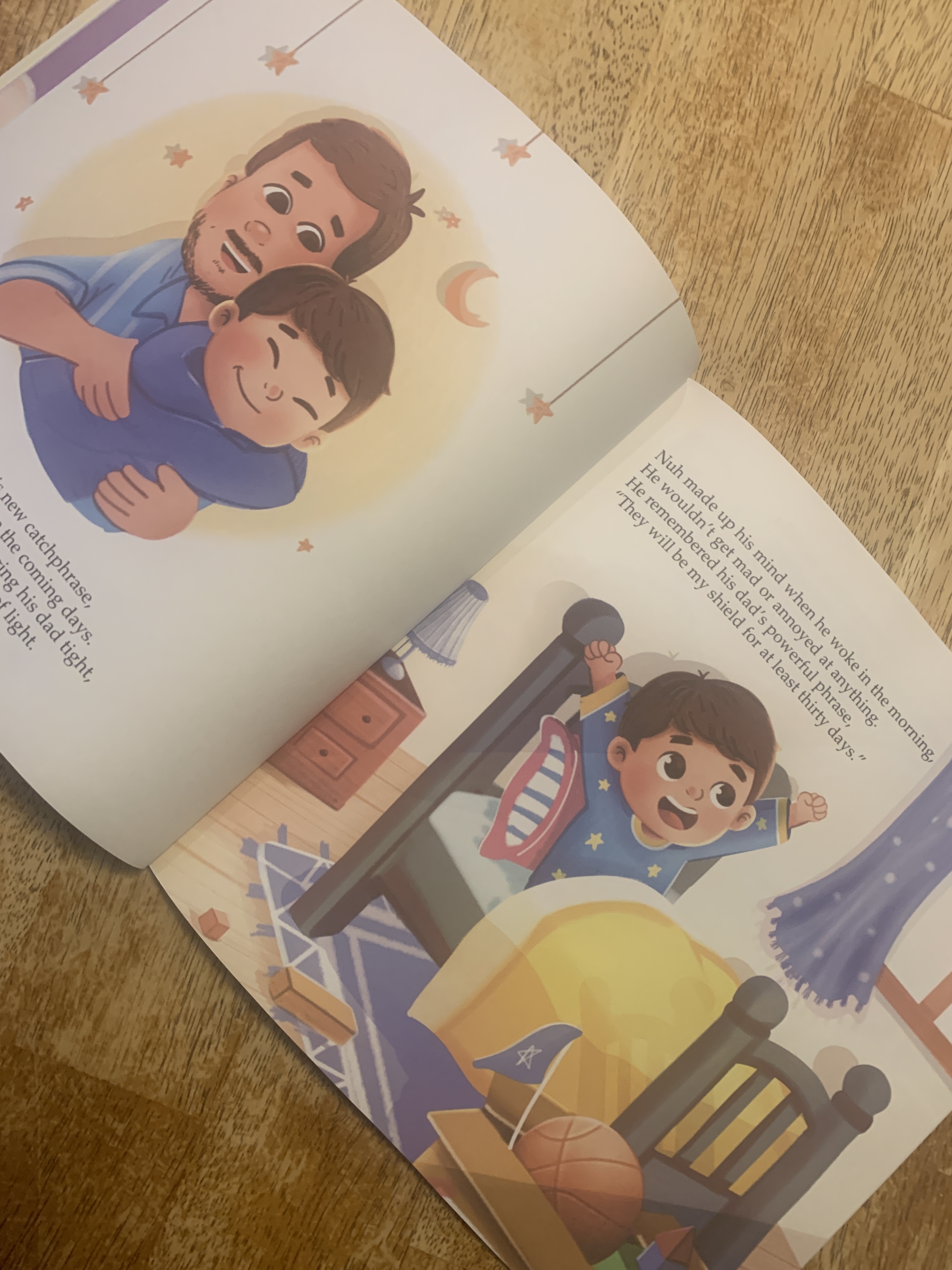
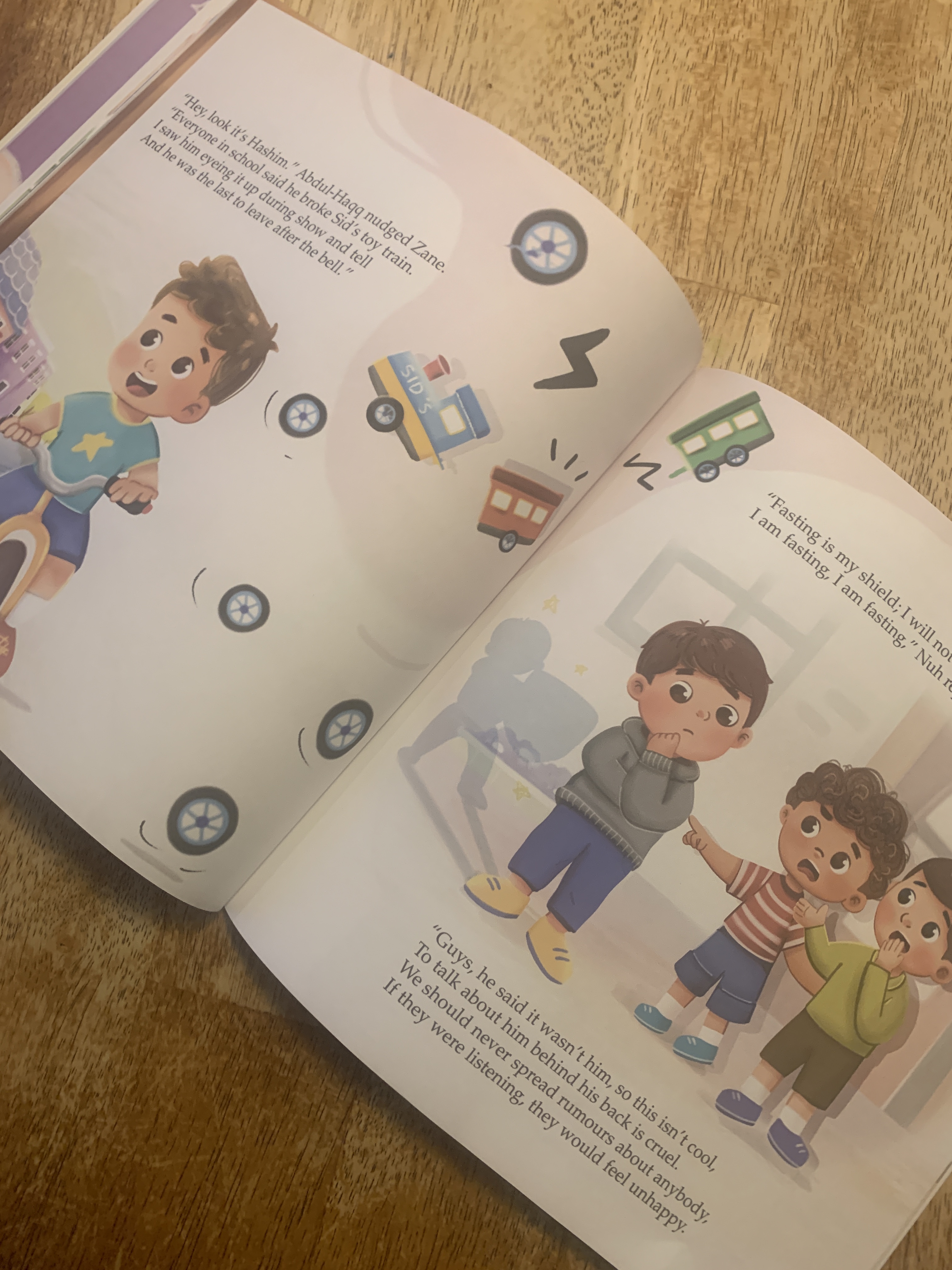
Empowered by the words, Nuh starts his next morning remembering his father’s advice.  When he spills water on his painting he remembers the advice. When a grocery cart collision at the store with his nemesis gets his fist clenching, he remembers his father’s advice.  He even gets a chance to share his knowledge with his friends.

img_7031

When the day is over he is eating iftar with his family and determined to keep his temper at bay throughout he whole month and beyond, inshaAllah, starting with him trying his drawing of the Kaba again.

img_7032

I like that the focus is on behavior, I think that is a good reminder for older kids, and something younger kids that may or may not be fasting need to implement in Ramadan.  I also like that the parents are encouraging and invested, but not controlling the individual situations.  The book is preachy, and when the kid takes the lesson and starts preaching it to him, it is a little heavy handed, but I think it fits with the nature of the book.  I appreciate that the kid knows what Ramadan and fasting is, so that the lesson can go a bit deeper in this Islamic fiction story.

I got my copy from Crescent Moon store, and you can get yours there as well by clicking this link here.  If you use code ISL (Islamic School Librain initials) at checkout you will save 10%,

Let it Go: Learning the Lesson of Forgiveness by Na’ima B. Robert and Mufti Menk illustrated by Samantha Chaffey

Standard
Let it Go: Learning the Lesson of Forgiveness by Na’ima B. Robert and Mufti Menk illustrated by Samantha Chaffey

let it go

1AA90D6C-5528-4766-B486-219F31FF7AEC

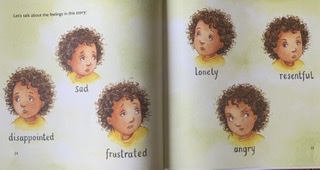
This 32 page rhyming book follows a little boy around as he is weighed down by a lot of things not going his way.  He doesn’t want to forgive until he is the one that hurts someone else and realizes we all make mistakes, forgiveness is not a weakness, and we all feel angry at times.  The book breaks from the story to ask the reader to think about their emotions in various situations, and encourages the reader to talk about their feelings.  The framework is Islamic and the repenting to Allah swt is part of the message. I found it awkward to read independently, but I read it to a small group of my own kids and their cousins, seven in all, ages four to thirteen, and it worked very well to discuss what the boy was feeling and how they would react.  I think this book would be great in a classroom or as a book an adult reads to a child at bedtime to encourage conversation.  I had to point out to the little ones, that the knapsack was getting bigger with the little boys anger, and explain what it was, but as a tool to foster dialogue it was incredibly powerful.

AF3C685C-9745-42B2-96C3-53F2B28B50B7


The book starts out with a poem/du’a by Mufti Menk that sets the tone for the book.  It makes clear that we are all human and feel things and that this book is a tool to understand and emotionally grow from.  No one is going to get in trouble or be reprimanded.

997B392B-E053-4EB3-AAAE-B40023247F90

The story stats with the little boy waking up happy and ready to have a wonderful day.  But then when he comes down for breakfast, his sister has eaten the last piece of toast.  The book asks the reader, “how do you feel when things don’t go your way?” and asks the little boy to let sorry make it better so that he can let it go.  But the little boy doesn’t want to let it go, he wants to hold on, and as a result it makes his heart feel heavy.

71B6DCC3-5B85-423E-A3F7-6F1F3DC80136

This pattern is followed throughout the book giving examples when the boy doesn’t get included in a game at school with his friends, when his friend kicks his football (soccer ball) in to the road and it gets popped by a passing car, and at dinner when his older brother laughs at him.

5BAA4271-891B-4D25-8451-B1A787D4C1F9

He then picks on his sister at bedtime, and doesn’t even know why he is doing it, and realizes that he too has made a mistake.  He learns that “it takes a strong person to let it go,” and that “forgiving is like taking off a heavy bag that I’ve been carrying all day long.”

4D498CEE-6886-40ED-925B-6D230205CB6C

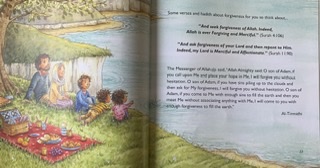
The book ends with some verses and hadith about forgiveness.  Has some facial expressions with emotions to discuss, and space to write down things that make you feel angry, hurt, or sad as well as a place to share what makes you happy, grateful, and safe.  There is also a glossary of Islamic Arabic terms on the inside back cover.

D5E111E7-2791-466B-9343-B362E7D4EB23


Can Mustafa Control His Anger? By Hadeek Aziz and Katherine Bullock illustrated by Eman Salem

Standard
Can Mustafa Control His Anger? By Hadeek Aziz and Katherine Bullock illustrated by Eman Salem

mustafa.jpg

When I finished the 27 page Islamic fiction early chapter book, I thought, “It reads like a child wrote it.”  And sure enough as I flipped to the bio page I learned that indeed it is written by a secondary school senior.  I don’t want to be overly critical as a result of learning this, but as a published book that I paid for, I really wish some would have “corrected the book” and smoothed it out.  It has a lot of potential, and a good message, it just slightly misses the mark in details, some awkward tense changes, and crossing the line of what Mustafa does and says when he lashes out.  He doesn’t apologize and physically assaults people without consequences other than kids not liking him, and considering its for independent readers seven and up, that is a bit concerning.

SYNOPSIS:

Mustafa is a nice boy, except for when he isn’t.  Unfortunately he loses his temper a lot and as a result has no friends.  Whether it is losing a game, having someone not believe him, or even someone taking a treat he wanted, Mustafa resorts to physical violence and hateful words.  No parents or adults seem to ever correct him, so other kids just steer clear of him.

When a teammate won’t pass him the ball in soccer he punches poor Humza and when he goes to throw another punch he gets pushed off and bumps his head.  He storms off into the forest feeling alone, but not remorseful when a little red creature pops up and tells him he will be weak until he can control him.  Determined to show the creature he is strong he chases after it only to be scooped up by a giant named brother Haneef.

Brother Haneef and his giant friends live in a mud house in Makkah.  Shocked at how he got to the desert, he learns from his giant friend to ignore taunting, when another giant says you cannot learn Surah Al-Falaq in an hour.  Later when the giants race and Haneef loses, he says Audhu bilallahi min ash-shaitan ar-rajm and to sit down if standing and lay down if sitting as per the Prophet (saw) advice.  A giant girl gives Mustafa a strawberry tart and when he reaches to get a chocolate cupcake and someone else takes it, both he and Haneef scream, but Haneef goes and makes wudu reminding Mustafa of another hadith.  When Mustafa asks Haneef why he shouldn’t be mean to people that make fun of him or leave him out, Haneef tells him the hadith about how the strong man is the one who controls himself when he is angry.  As the giants go off to pray at the Kabaa, Mustafa finds himself at home in his bed with his sister waking him up and asking him where he has been.

41582EA9-516C-41FA-A337-C668F29C9F3A

WHY I LIKE IT:

I love the topic and that hadith are used and referenced in the book, as well as other resources. I also do like that it was written by a teen.  The pictures in the book are well done for the style and audience of the book, and the six short chapters are appropriate and inviting as well.

Oddly, the tense of the story changes at an awkward place on page 6 and I think it was intentional to go from telling about Mustafa to experiencing his “adventure” with him in the present tense, it just needs to be smoothed out.  Similarly, Mustafa is the protagonist, and we know his thoughts, but randomly at one point we know Haneef’s.  It isn’t technically wrong, but again, it is awkward as it is a short book, and everything else focuses on Mustafa asking Haneef to know things, not suddenly being in Haneef’s head.  I also felt like some resolution with shaytan, the red being, leaving or saying I’ll be back or something to continue his arc and role in the book is needed.  The details are hit or miss, vague descriptions about the giants lumps them all together, why they were at the Kabaa seems a bit random as well.

The biggest concern I have is a common one with these type of books, think Ahmed and Layla Deen books.  To make the point that he has a problem with his anger, the story goes way overboard.  Mustafa is genuinely hurting people, with kicking, punching, pushing, and throwing.  He lashes out and tells his little sister to shut up and calls her an idiot, and never once does he apologize even after his time with the giants.  Haneef makes the point that we all lose our temper, and need to simmer down, but Haneef also never apologizes for yelling or getting upset.  This is not ok, if you are teaching with the Prophetic method then that is a fairly large hole to have in the story.

There are no parents or adults which could make the point that kids won’t play with him stronger, but I feel like it really just means he gets away with a lot, and as a bully, that is not reassuring at all to the other characters in the book.  Some immediate consequences would be nice, or delayed guilt, something to make Mustafa not just seem like an awful person.  The moral is that he has learned his lesson, but I wasn’t convinced, nor where my 9, 10, and 12 year olds.

FLAGS:

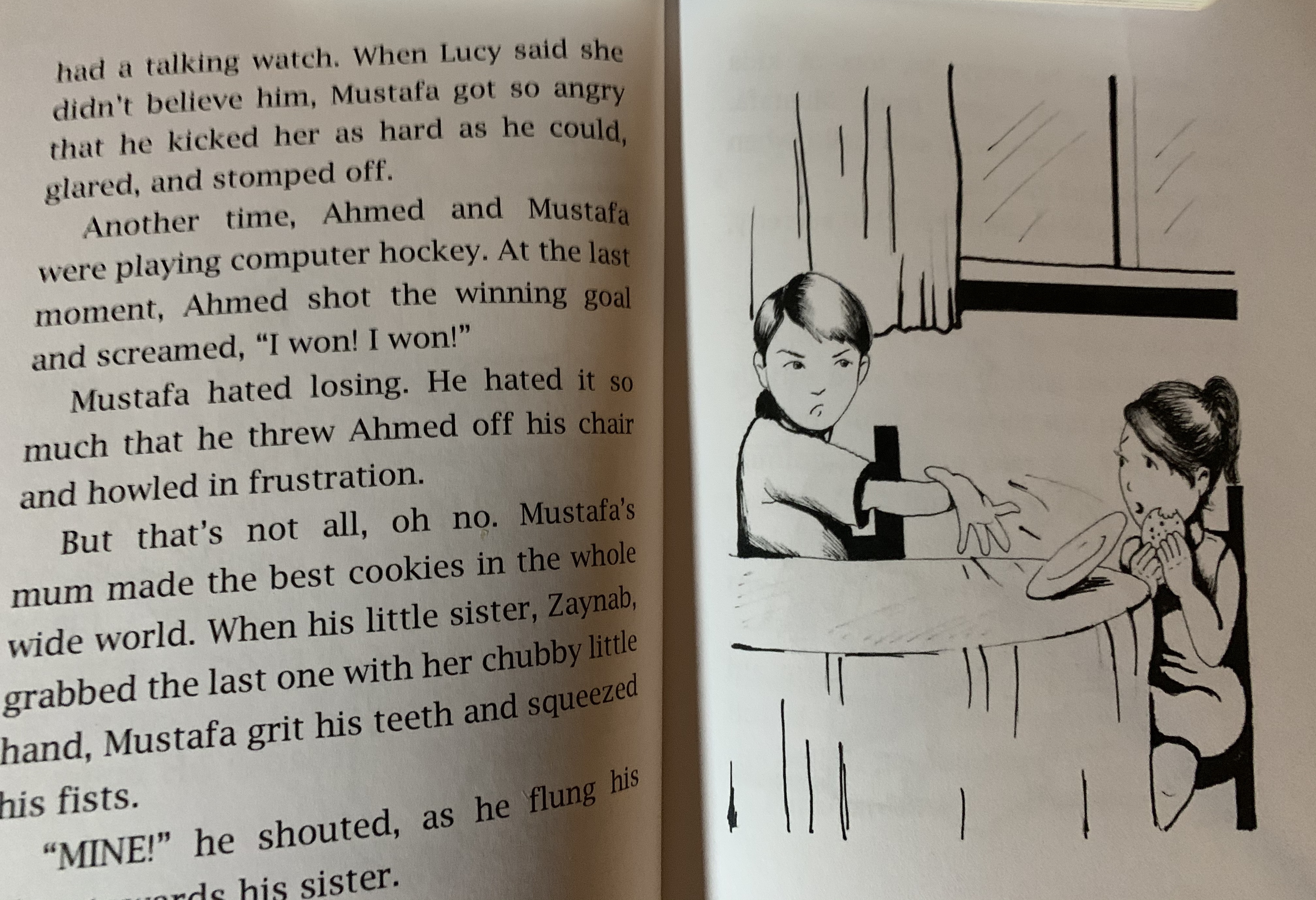
Language and violence. Mustafa says, “shut up” and  “idiot,” he kicks a girl, throws a kid off a chair, throws a plate at his sister, punches a teammate,  and yells at everyone.

TOOLS FOR LEADING A DISCUSSION:

I wouldn’t recommend this book as a book club book, or even one to spend library or classroom library shelf space on.  It isn’t awful, there are just much better books out there and this one if not discussed might leave kids with the wrong impression.

3F32BB71-B114-48E9-978F-8B6031A2F88F


Controlling Your Anger by Saaliha & Ali

Standard
Controlling Your Anger by Saaliha & Ali

anger cover

I love little picture books for toddlers and early elementary kids that introduce children to Akhlaaq, good manners and characters.  The book’s tone, however, seemed a bit off to me, so I put it away a month ago and pulled it out again today to read it, knowing I would have forgotten most of my initial thoughts, but somehow, they resurfaced with a vengeance, unfortunately.  And while the pictures and binding and theme are all absolutely wonderful in this 23 page book, I didn’t like the main character at all, and being it is based on a real person, a child, I feel awful saying that.

anger

Saaliha starts the book keeping her anger just under the surface as her friend Hannah has borrowed and lost her pencil.  Hannah says she’ll look for it after lunch, and Saaliha controls her anger and basically says that it needs to be found now because it is the right thing to do.  All of that is fine, but for some reason she seems bossy and controlling and I really don’t know why.  Maybe because once they look for the pencil and then find it, Saaliha gives her peer (and thus the reader) a teaching moment by saying that she knew she didn’t lose it on purpose.  Hannah’s response is more believable when she feels embarrassed and admits she should be more careful, but I found Saaliha’s reaction smug because she was so close to getting mad, and then to be self-righteous about it, seemed a little passive aggressive to me.  

anger3

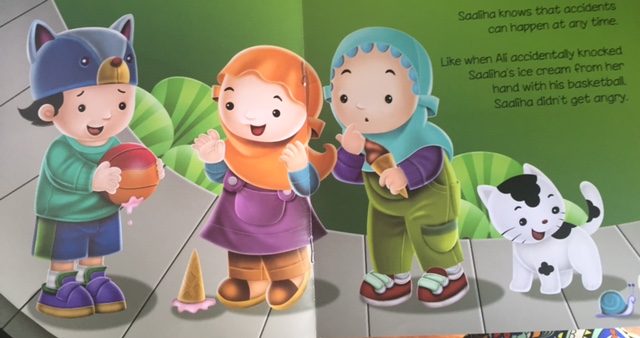
As the book continues, Saaliha recounts that accidents can happen at any time and to not get mad, which is great, it gives the example of when her younger brother Ali, accidentally knocked her ice cream out of her hand with his basketball or when he broke her pencil.   She seems to have a thing with pencils, there should have been a different example.

anger2

It then moves on to an incident with a friend, Jalal, who took a donut without asking, but it was an accident for not asking as he normally asks.  The repetition of the word accident here, I get is to carry the concept, but that doesn’t seem like an accident, it seems like he forgot, and an apology should have been in order, not Saaliha having to justify it solely.  Being it is a book about Akhlaaq I feel like the illustration of Jalal winking and eating the donut, seemed off.  

anger1

I like that Saaliha reminds her friends not to get angry as anger comes from Shaitan, but then when the book says she always says A’uthu Billahi Mina Shaitan Nir Rajeem to keep her anger in check, one wonders why in the opening scenario she didn’t say it.

I can’t pinpoint why I didn’t love this book, or maybe I just didn’t like the main character and I would probably give the series another try, but I’d like to hear your thoughts if you have read the book, and more importantly what your children thought of it.