Tag Archives: Aisha Saeed

The Matchmaker by Aisha Saeed

Standard
The Matchmaker by Aisha Saeed

There is no Islam, save being told a wedding took place in a mosque, in this 320 page adult book by a Muslim author.  The thriller, mystery, romance, is fairly clean, save some drugs, killings, kissing, and normalized dating, yet I would probably be fine with mature teens reading it, if so inclined.  By the end, I enjoyed the book, but it took me three attempts to get past the 30% mark as the opening was painful with its numerous characters being name dropped, the setting being established, and getting the characters into position.  But then slowly the exposition gave way to story telling and intrigue, and the second half was a decent read.  Honestly, my biggest problem with the book is that I just didn’t like the main character, or any of the characters really, and I don’t know why.  They didn’t have some clear flaw or annoying habits, they just felt distant and bland, which resulted in the plot carrying the book, and me not really caring if the protagonist was killed or harmed, I know- harsh.  I cannot deny though, that what kept me reading was to see who was behind it all and I did figure it out, but continued on just the same to be sure, and that is a testament to the author’s writing skill, even if it took a minute for the pacing, plot, twists and climax to pull me in.

SYNOPSIS:
Nura Khan runs an elite matchmaking service in Atlanta, from hands on to a dating app, her and her team match people of all backgrounds and faiths.  She herself has a long time friend who acts as a fiancé for image purposes, and a recently retired aunt who’s bad days have meant family dynamics have changed.  As a third generation matchmaker, Nura is in charge and knows what she is doing, until suddenly her image, her reputation, and her matches start faltering.  Not confined to just heartbreak, there is also stalking, threatening notes, kidnappings, and attempted murder, which suddenly thrust Nura into a world she is ill prepared for, and one that seems to put her in the crosshairs of someone determined to see her demise.

WHY I LIKE IT:

It wasn’t a heavy thriller or heavy romance, it was an easy read that didn’t “other” desi culture and I found that refreshing. That being said, I always wish her books had Islam in them.  I also liked that the climax and second half honestly didn’t feel overly forced, I’m not a writer so take it with a grain of salt that I complain that the beginning was dry and too much telling, but then the second half flew by and loose ends were more or less tied up in a satisfactory way. I’m aware that the second half was a result of what was a established in the first part, but none-the-less I hope future books will make the two halves less cumbersome and inconsistent. I also really hope future books will have more character appeal.  There was a lot of potential to care deeply about the main characters, from the aunt, to the best friend, to Nura herself, but they lacked spark, and sadly just felt like vehicles for a plot that wasn’t dependent on them, their experiences, their flaws, and their personalities.

FLAGS:

Dating and relationships of all faiths, persuasions and labels, kissing, attempted murder, killing, plotting, lying, scheming, kidnapping, drugging, physical abuse, assault, deception.

TOOLS FOR LEADING THE DISCUSSION:

With no Islam I wouldn’t do this as a high school book club, but amongst friends it would be a fun group read.

The Door Is Open: Stories of Celebration and Community by 11 Desi Voices: Hena Khan (Editor), Sayantani DasGupta, Reem Faruqi, Veera Hiranandani, Simran Jeet Singh, Supriya Kelkar, Rajani LaRocca, Maulik Pancholy, Mitali Perkins, Aisha Saeed, N.H. Senzai

Standard
The Door Is Open: Stories of Celebration and Community by 11 Desi Voices: Hena Khan (Editor), Sayantani DasGupta, Reem Faruqi, Veera Hiranandani, Simran Jeet Singh, Supriya Kelkar, Rajani LaRocca, Maulik Pancholy, Mitali Perkins, Aisha Saeed, N.H. Senzai

img_5078-1

I cannot in good conscience at the current time support this book as a whole, as many of the contributing authors have not used their platform to speak up, spread awareness, and draw attention to the genocide occurring in Palestine. As recent South Asian history involves colonization, I find this silence deplorable, disappointing and shameful, we need to do better. That being said, I am reviewing the book none-the-less because a few of the authors have spoken out, some quite a lot, and I hope those that have remained silent, will speak out. Our voices have power, and while it feels like it might be too late to take a stand, it is not. Lives might yet be saved.

img_5079-1

The 328 page middle grade book is a collection of 11 Desi voices, four of which are Muslim (Hena Khan, Reem Faruqi, Aisha Saeed, and N.H. Senzai). All 11 are threaded together by a fictional community center that houses badminton games, ameens, cooking classes, dancing for Navratri, chess tournaments, spelling bees, celebrating an aqiqah, and everything in between. The majority of the stories are joyful with threads of overcoming stereotypes being a frequent mention in a book filled with different cultures, religions, and perspectives. Potential flags and triggers: there is mention in one story of domestic violence, there are a few hetero crushes and one same sex identifying boy who isn’t ready to discuss his attractions, there is ostracizing of a single woman choosing to adopt, and a few mentions of divorce. As with all anthologies some are better written than others, but as a whole the book is pretty consistent in spotlighting something specific to religion or Desi culture, and having a hobby or family conflict push the character to problem solve, find their voice, and then be supported in a happy ending.

My favorite story is N.H. Senzai’s piece, I might be bias seeing as I check her Instagram numerous times a day for Palestine updates, but her story, with the domestic violence mom and daughter surviving and flourishing, is powerful, on level, and memorable. Framed around a mom’s prayers, duaas, she named her daughter Duaa. Duaa is a gamer that tries to make her mom happy by helping with her catering business. When she helps set up for a domestic abuse banquet at the community center she faces what her and her mom overcame by leaving in the middle of the night, and starting over.

I’m not going to review each story, but I will highlight the remaining Muslim authored ones. Aisha Saeed’s story doesn’t have any Islam specific mentions, her story is set during a mehndi at the community center. Her khala is getting married to Brian and moving to Kenya, and she is not happy, throw in cousins who are still mad at her for ruining their furniture with chocolate last year, and Maha just wants to hide in the back and pout.

Reem Faruqi brings her characters together through old fashioned letter writing. Orchestrated by Rahma’s nani, second cousins who will be meeting for the first time at an aqiqah at the community center, start corresponding to get to know one another, and gripe about siblings. When they finally do meet, in matching outfits no less, the girls decide their siblings, like their favorite candy, can be both sweet and sour.

Hena Khan’s story brings everyone together for an ameen six years in the making. Halima has finally finished the Quran and the family is throwing a party. Halima wanted a carnival type party, mom wants a formal affair, but when the community center is on the brink of being closed down, the family decides to invite everyone to show what the center offers the community.

Forty Words for Love by Aisha Saeed

Standard
Forty Words for Love by Aisha Saeed

fourty

This YA magical realism book by a Muslim author contains no Islam, and while it is a love story of sorts, and there is a kiss, it remains clean for the demographic.  It is a snapshot of daily life for a few characters in a small magical town.  There is no real understanding of the premise, or the magic, nor resolution to what happens or why any of it matters, there aren’t even forty words for love provided, yet the author is good at writing, so I kept reading, even when the plot holes and rationale for the “point” of the book clearly were not coming.  The ethereal lilting tone was lovely and lyrical at times, but honestly, I was left with more confusion about the leaves, the tree, the pastel waters and the cause of blame and bigotry at the end, than when I started.  It is an easy read, I don’t regret it, but it is hard to suggest others invest in a 304 page book that doesn’t really leave you feeling satisfied.  I wouldn’t object to it on a shelf, and others might absolutely love the infusion of other worlds into a grounded reality to tell a story of industry leaving a town, and two kids moving from friendship to romance, but I just wanted more: more world building, more tension, more resolution, more backstory, more detail, more magic, more understanding, more character development and connection.

SYNOPSIS:

In the vey first chapter, a small child drowns.  The child had wandered off from his nanny and died in the ocean.  That is the day that the pink and purple waters of Moonlight Bay turned angry and black.  Eighteen year old Raf, a Golub, blames himself because he was about to tell his childhood friend Yasmine that he was in love with her.  A rule that he has been told for the last decade will mean that his leaf on his arm will fade and he will have to leave his community.  When he is about to approach Yas he sees that she is cozying up with Moses, and he stops.  When the body is then found, a scream breaks loose and  everyone runs to the little boy. Later that night the Golub tree opens and two kids, a brother and sister emerge, and the tourist rich city is no longer beautiful.  The candy factory that relies on the healing waters closes up shop and most of the townsfolk move away.  Many of those that remain blame the Golub for the town’s misfortune.  The Golub arrived by tree a decade before when their own homeland froze over.  They live in the forest and eagerly await the tree to thaw signaling that it is safe for them to return home.

Yas and Raf carry on, Raf working in the diner, and Yas gathering shells for her mother to shape into stars that heal.  Both dream of leaving the confining town, pursuing their passions: Yas art and Raf architecture, but rules, family, and obligation keep them from leaving and keep them from being more than just friends.

WHY I LIKE IT: (SPOILERS):

I like the tone of the book.  It is like a dreamy lullaby that floats around, but I really needed answers.  If certain threads were unresolved, I could take it as being left up to interpretation, but this was more than a literary devices, this reads underdeveloped.  So much happens in the first chapter, and the rest of the book really doesn’t keep up.  The reader never learns why the leaves fade or pulse or why Uncle came to the conclusions he did even if safety was his motivation, we don’t know how Kot and Nara got through the tree or survived for 10 more years in Golub.  It is hard to believe that in a decade so few Golub tested out their leaves? And what purpose do they even have? They allow them to return, that is it? That is their rumored, untested magical ability? Were the waters healing before the Golub came, the confusion of what Yas and her mom do and the arrival of the tree seem a bit inconsistent. Yas feels electricity when Raf is around it is mentioned a few times, but never explored.  We are told that Jake hates Golub, but does anyone else really?  How can a city that reads like 10 people have its own high school? It doesn’t feel fleshed out, it reads like there are a few families is all, and doesn’t contrast it to when the town was thriving, it is rather stagnant.  I get that bigotry and hate are illogical and the story is perhaps a bit of an allegory for that, but the town has pink and purple waters with healing properties that changed overnight and a group of people arrived through a tree with leaves tattooed on their arms, I don’t see how the magic or the leaf on their inner arm is what is being blamed for Sammy’s death or the water changing.  It is a weak premise.  Even when we learn that Uncle lied, no one seems to get any truth out of him or be determined to figure stuff out. It is a bit hard to believe no one ever looked at the beach at night, and what exactly are the Weepers doing?  Some history or back story about Moonlight would be great to explore. Are Golub and humans different in any way? What was the cause of death of Raf’s dad? Absolutely nothing set out by the book is resolved, nothing is learned, no characters grow, the only closure is that Raf and Yas have told each other how they feel, and the Golub have learned that they can travel further than 40 miles from their tree, that is it.

I do like the mix of names of the characters coming from different cultures all existing without othering or explanation. I like that the slow burn angst is clean, it is nothing a 14 and up couldn’t handle, even if it is a bit obvious.

FLAGS:

Magic, a gay couple own the movie theater, there is some angst, a couple of kisses between Yas and Raf, bullying, premonitions, family fighting, lying, sneaking, romantic hetero affection.

TOOLS FOR LEADING THE DISCUSSION:

There is no Islam and the plot is centered around two teens’ feelings for one another so I would not host this as a book club, nor would I really want to do so.  But, if I knew there was a a group of people gathering to discuss this book, I would totally join in to see if any insight to all the unanswered threads could be resolved.

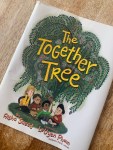
The Together Tree by Aisha Saeed illustrated by LeUyen Pham

Standard
The Together Tree by Aisha Saeed illustrated by LeUyen Pham

img_7924

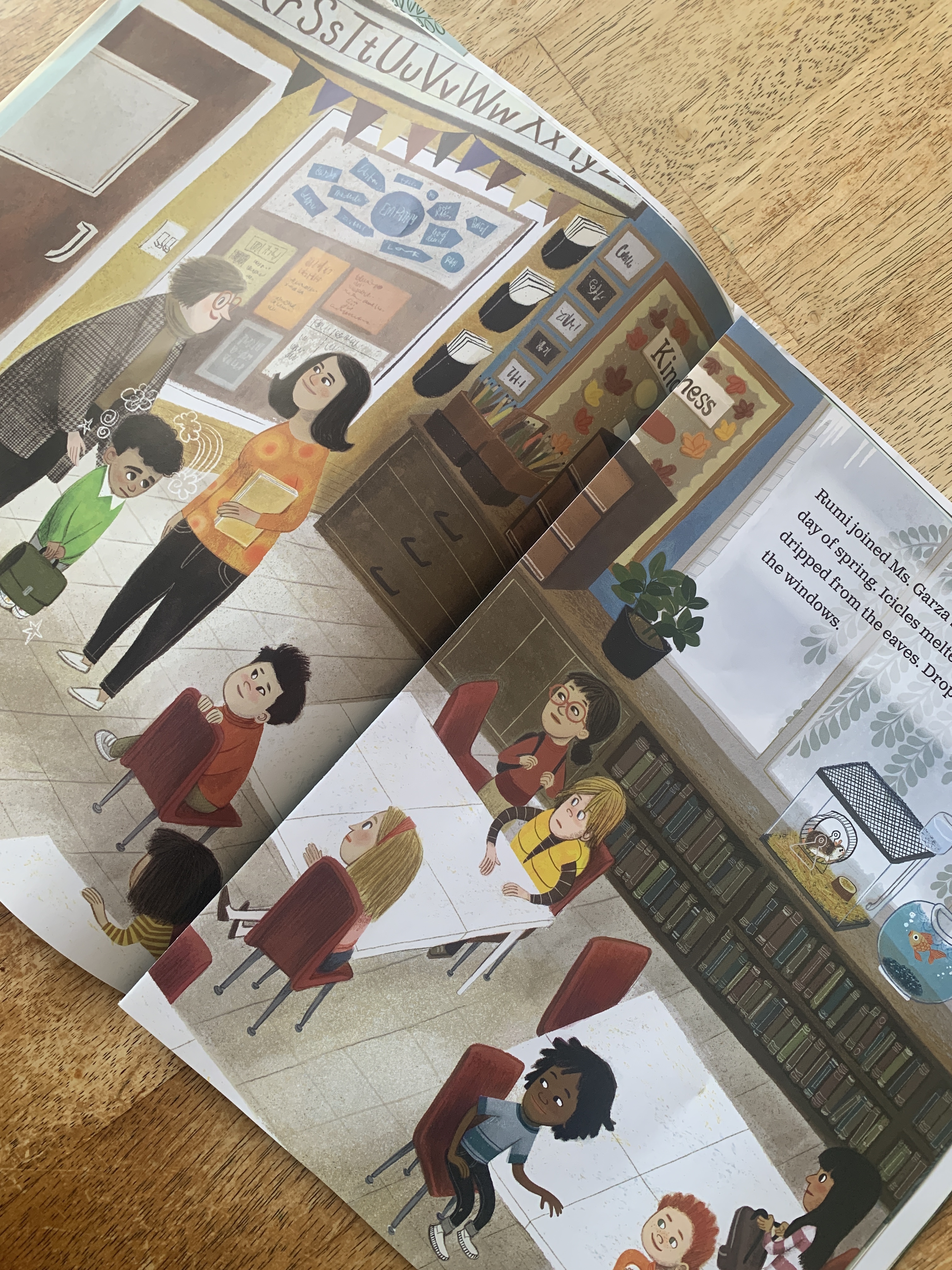
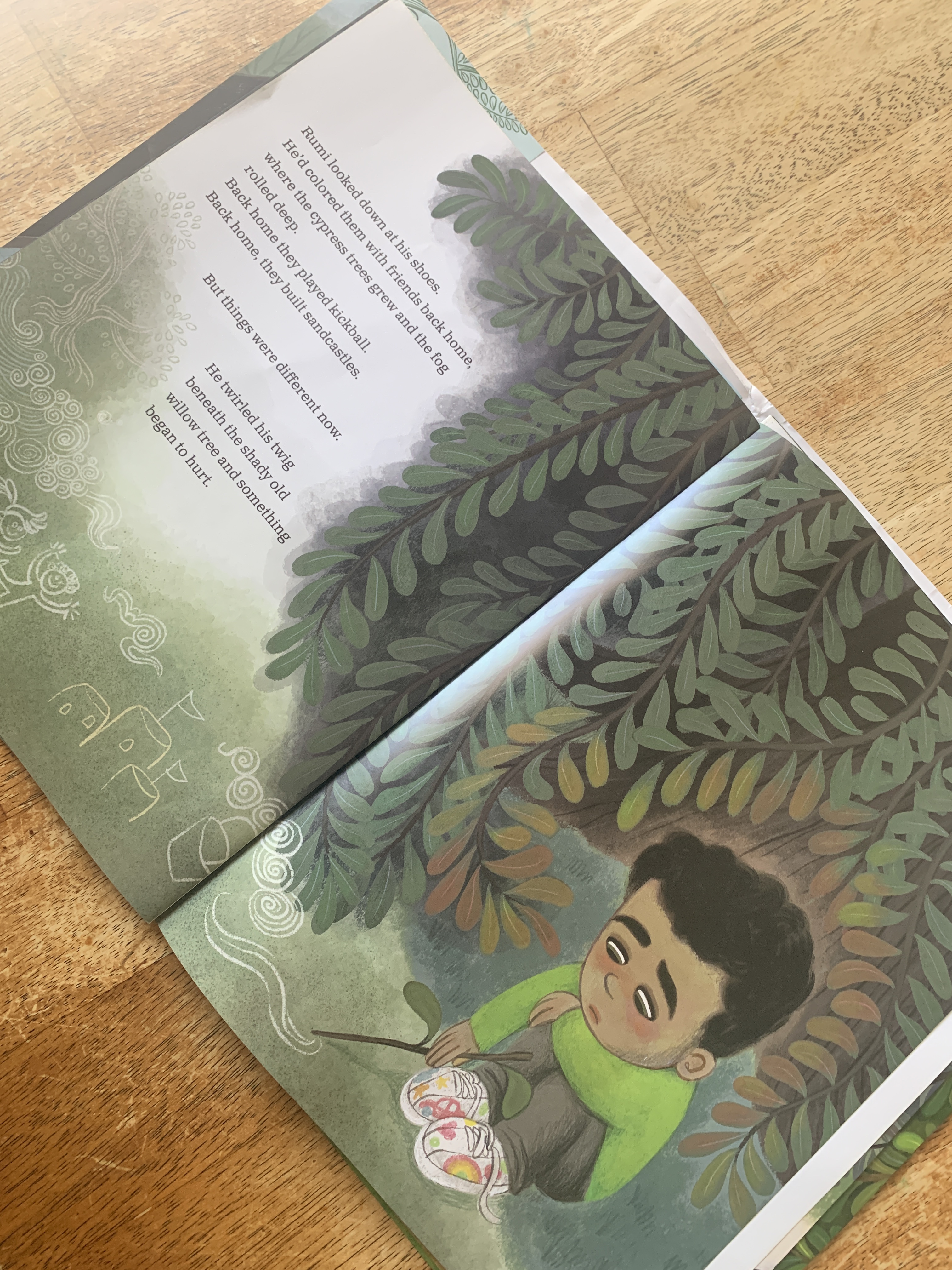
Being the new kid, not having friends, and being teased are not new themes in literature (or life), so if you are going to write a book about them, take a lesson from Muslim author Aisha Saeed and make sure the story is heartfelt, emotional, and well-told.  There is no Islam in the book, no foreign culture, or teasing because of skin color, it is a boy named Rumi who has moved from San Francisco to the other side of America and his shoes, with their drawings and colorings, that cause the kids to stare and start bullying.  Rumi seeks solace under a willow tree and fellow classmate Han has to be brave to put a stop to the mistreatment by finding his voice and not simply staying silent.  The text and illustrations provide a lot of opportunities for children to see themselves in the story, in the various characters, and ruminate over the actions and feelings from different points of view.  The book is lyrical, it is not heavy handed or preachy, and the Author’s Note at the end is equally touching and hopeful.

img_7925

Rumi is quiet, and on his first day in Ms. Garza’s class the kids stare at him as he stares out the window.  At recess he wanders off to sit beneath the willow tree when Asher, Ella and Han leave the swings to see what he is up to.  Asher and Ella start to make fun of Rumi, Han is uncomfortable, but stays quiet.

Rumi recalls coloring his shoes with his friends, and how different it was to where he is now, he picks up a twig to twirl as the hurt grows. In music class when the giggling starts, he tries not to cry.  At recess he retreats to his refuge under the tree.

When the bullying escalates, and tears fall, Han speaks up and breaks the cycle. Others follow and see the world Rumi has created with his twig and are drawn to it and to Rumi.  Forgiveness is asked for, and granted and the tree becomes a place of friendship and togetherness.

img_7928

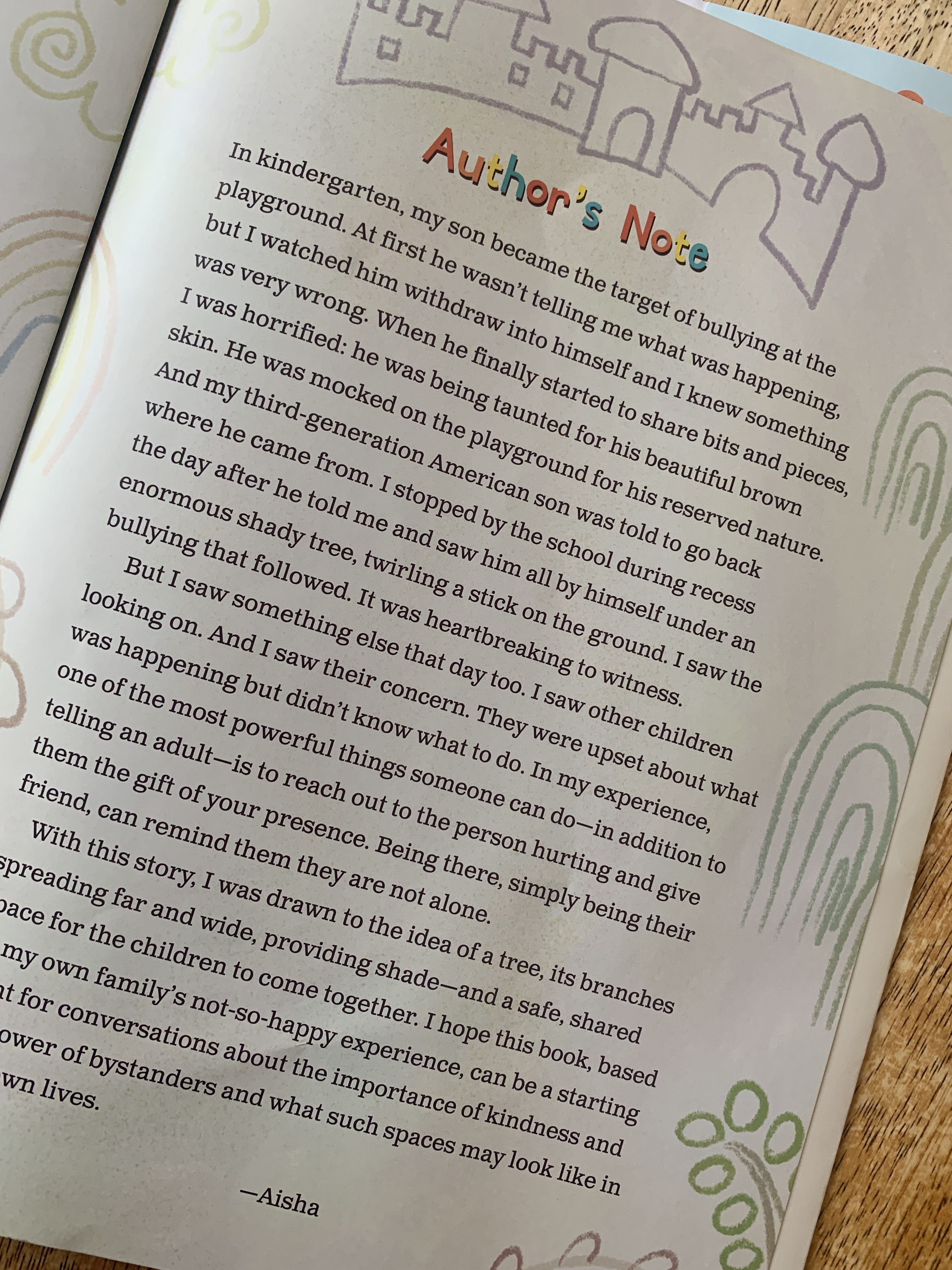
The Author’s Note shares the real life observations of the author about her son in kindergarten and how while heartbreaking, there was also hope in the concern shown by other kids that simply weren’t sure what to do.  I love that even though Rumi is being teased for his shoes and being different, he doesn’t stop wearing his shoes or try and clean the drawings off.

img_7926

I think this book is a must read in classrooms and homes were kids can slowly peel back the pieces and see where they can relate, how they can plan to act, and what parts they identify with.  The book is deliberate and slow, and while a child could read it on their own and enjoy the story and illustrations at hand, the real power it has, is being a catalyst for discussion and empathy and speaking up.

Pre order/order here on Amazon

img_7927


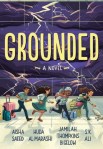
Grounded: A Novel by Aisha Saeed, Huda Al-Marashi, Jamilah Thompkins Bigelow and S.K. Ali

Standard
Grounded: A Novel by Aisha Saeed, Huda Al-Marashi, Jamilah Thompkins Bigelow and S.K. Ali

Over the years I’ve read to a lot of kids, with a lot of kids, discussed books in classrooms, and in book clubs, so when reviewing I often share what kids think or what I imagine kids will think, and I usually acknowledge when I’m being overly critical as a reviewer, but this book I will tell you, I did not read through the intended middle grade lens, I read it as a 42 year old seasoned reader.  I know this because I cried during the entire second half, and the book is not sad.  It is fast paced, joyful and adventure filled.  I cried at the ownership of identity, the pureness of friendship, the acceptance of the flaws and strengths of those closest to us, the love of family and that this book is written by four incredible Muslim women authors for Muslim kids to be seen and for non Muslims to see Muslim kids in action in a fantastic, non preachy, authentic, powerful engaging story.  In short I loved it.  I love that the voices are different, but polished and seamless in conveying a fictional story with universal themes through a variety of Muslim characters without talking down or over explaining anything. From the maps to the crossover character Hanna from S.K. Ali books, the poetry from they young lyricist to the representation and discussions of Muslims not being a monolith, and the sprinkling of a Hadith or Quranic ayat here and there (I wish there was more), the book tugged at my heart strings.  For kids third grade and up, some of those themes might resonate, or it might just be a book about a lost cat in an airport and a hodgepodge group of strangers, turning friends, stranded in an airport searching for her while dodging security and exasperated parents.

SYNOPSIS:

The end of the MONA  (Muslims of North America) Conference has lots of families at the fictional Zora Neale Hurston heading home.  Tired parents and restless kids lead Feek’s little sister Ruqi to go missing and Feek to blame.  As he searches for his little sister he meets Hanna, a girl looking for a lost cat, not her lost cat, just one she has heard about from her animal activist group that is missing at the airport.  As they search for Ruqi, Sami gets dragged along even though he’d rather be mentally keeping his anxiety in check as he prepares for the Karate competition he is heading to.  Luckily Nora, Congresswoman Najjar’s daughter, finds Ruqi and the five strangers are brought together.  When all flights are grounded because of weather, the group goes in search of the missing cat, Snickerdoodle, finding leads, security, secret corridors, self confidence, friendship, and skills along the way.

WHY I LIKE IT:

I knew the book would be good with the authors’ names on the cover and their ability to tell a good story, but I was still blown away by how real the characters were fleshed out and their “problems” articulated.  The emotional connection to each character facing their insecurities and supporting one another’s’ vulnerabilities was reflective and insightful. I love the diverse inclusion of showing Muslims that don’t speak Arabic or don’t know if they are Muslim enough, of Black Muslims and Black culture, of being an only children and struggling with siblings, understanding parental expectation and finding your voice to speak up to those you love.  The surface story is paced well and entertaining and sufficient, but the details and the story beneath the surface, really is powerful.

Again with the reviewer lens- I did wish in the middle there was a tiny bit more inclusion of a Bismillah when following a lead or an AstugfirAllah when breaking a rule or a quick prayer when running from authorities, the beginning and end was Islamically rooted, but as an Islamic School Librarian, I must admit I’d like a few more mentions during the “adventure” parts.

FLAGS:

The kids are dishonest, they break rules (possibly laws), they lie, and do some damage, they sneak and kind of talk back to their parents, nothing is normalized or accepted though and they are called to account.  There is a birthday that is celebrated with everyone singing, and possible triggers of talking about a deceased parent. The kids are 12/13 and younger, and brought together by circumstance, but by the end the girls and boys have developed close friendships.

TOOLS FOR LEADING THE DISCUSSION:

Even though the book is meant for middle grades, I think younger middle school readers would enjoy the book and find plenty to discuss as they see themselves and others in the characters, imagine what they would do in such a situation, and get swept up in the ride.

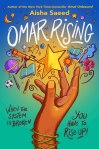
Omar Rising by Aisha Saeed

Standard
Omar Rising by Aisha Saeed

omar rising

This middle grades 224 page read is quick and memorable.  The story is set in Pakistan and the characters are probably Muslim, but there is no religion mentioned until nearly the end, and even then only in passing.  The only culture specific references are the characters’ names, social etiquettes, and the foods mentioned.  By and large, the story is universal and could take place anywhere, and probably does take place everywhere.  While I wish it would have had more cultural and religious references, it is an OWN voice story after all, the book is enjoyable, the characters endearing, and I think young readers will benefit from spending the school year with Omar, seeing classism up close, and cheering for an unjust school system to be challenged.

SYNOPSIS:

Omar is the son of a servant and when he earns a scholarship to a prestiges boy’s school for seventh grade, the entire village is bursting with pride.  When he gets there though, it is hard, really hard.  The scholarship kids aren’t allowed to participate in any extra curriculars, they have to do service hours, and they have to maintain the ridiculously high A plus grade average or be expelled.  It seems that that headmaster is out to get the scholarship kids, and Omar in particular.  As the scholarship students struggle to stay afloat, Omar has to determine if it is all worth it. He spends all his time studying, even when he goes home to visit his mother, and while he doesn’t want to let the village down, he is struggling to find the optimism to keep fighting for his place.  When Omar learns that the system is designed to make the scholarship kids fail, and that those that are kicked out are called “ghost boys,” he has to decide to how hard to push himself and ultimately how hard to push to break down the system that treats him and those like him like second class citizens.  Luckily, Omar has some supportive teachers, some loyal friends, and a whole lot of determination.

WHY I LIKE IT:

I love that the story is universal, it is at times a much tamer version of the YA book Ace of Spades which also explores second class citizens in posh private schools as a theme, and at times I even felt some Dead Poet’s Society vibes.  The cultural setting and names however, to me is a mixed bag.  I’m glad that it didn’t become another story about problems in another country with judgmental overtones, but at the same time, to be so void of cultural references seemed too far of an extreme in the other direction to make the story feel real richness and authenticity.  I love that the story isn’t about bullying and that a number of characters have depth.  I was genuinely confused for a large portion of the book about what the orientation in the summer entailed.  It was clarified much too late that it was a weekend, but I was at a loss trying to figure out how he knew some of the campus, some of the other scholarship kids, had a roommate, yet knew so little of the school and what it would be like.  I am not sure why that information was delayed, but seeing as I read an arc, I hope it is clarified in the final copy.

FLAGS:

Omar and a girl are friends, they hug at the end, but it seems rather innocent, and more sibling like as they were raised together.  

TOOLS FOR LEADING THE DISCUSSION:

This would be a good book on a shelf, and would possibly work as a read aloud to grades four or five.


Diana and the Island of No Return by Aisha Saeed

Standard
Diana and the Island of No Return by Aisha Saeed

dianaThis Wonder Woman story of Princess Diana as a young girl is not noteworthy because of its groundbreaking storytelling, but more for the fact that the series and story is by a Pakistani-American Muslim author.  I am not sure how authors are assigned or chosen to  write these reimagined character series, but I think it is a great compliment to her writing and a great mainstream representation of diversity that we should celebrate.  Even more exciting is the subtle addition of Diana’s best friend, Princess Sakina, daughter of Queen Khadijah to the story, and that while they are citizens of fictitious world of Greek gods, they seem to spout Islamic wisdom on occasion, and be equally strong and important to the adventure at hand.  The book is meant for middle grades and at 288 pages is a fun light read for girls and boys of all ages.
SYNOPSIS:

Young Diana is anxiously waiting for the start of the yearly Chara Festival, when strong women from all over the world come to her island home of Themyscira to celebrate their different cultures and strengths.  Most of all Diana is waiting to spend the week with her best friend Sakina.  Frustrated that her mother is not allowing her to train with the other Amazonian women, Sakina listens to her and they hope to persuade Queen Hippolyta that this is the year.

As the women are arriving and gathering in the palace, Diana discovers a boy near the ships, Augustus.  Boys are not allowed on Themyscira.  There is no exception, but when all the women in the palace are drugged to sleep, her and Sakina are forced to trust him to try and save their loved ones.

Augustus confesses that a demon has hypnotized everyone on his island home, and that he was told to break the spell he needed to bring Princess Diana to the demon.  With no options and determined to prove her self, Diana and Sakina and her trusty bird fly off on a chariot to another world.

With tests around every corner, literally, the trio has to work together, to stay alive, gather the ingredients to make a potion to save the people on both islands, and push themselves to be brave.

WHY I LIKE IT:

So the story is ok, it is fun, I’m sure most kids that like superheroes and even many that don’t will enjoy the quick paced plot of the story.  There are definitely little nuggets of inspiration and motivation that make the book a positive influence on the reader.  The trio discuss bravery and how being scared doesn’t make you less brave, they encourage one another to push themselves and they forgive each other when they make mistakes.

Sakina and her people are scholars and on occasion says deep thoughts.  She says at one point, “My mother always says we are supposed to enjoin the right and forbid the wrong.” Which is a general principal, but the word choice sounds a lot like Surah 3 verse 110 “enjoining what is right, forbidding what is wrong,”

FLAGS:

There is talk of Zeus and the other gods.  There is lying.

TOOLS FOR LEADING THE DISCUSSION:

I probably wouldn’t do this as a book club book, but I would definitely encourage kids to read it.  I think muslim kids will get a kick out of seeing the names Sakina and Khadijah in the book and feel like its a bit of a shoutout, which I think is awesome.  It seems like it is book one in a three part series, so I hope to have my kids read them all and make sure the 3rd-5th grade teachers at their school have them as well.


Yes No Maybe So by Becky Ablertalli and Aisha Saeed

Standard
Yes No Maybe So by Becky Ablertalli and Aisha Saeed

yes no

This new rom com in book form with a Muslim female character written by a Muslim author, sets itself apart by being co-written by a Jewish author and the other half of the love story being told by a Jewish boy’s point of view.  This YA book is very relevant as a special election in Georgia served as the catalyst of the two authors coming together and fictionalizing the effects of white supremacy, Islamaphobia, and antisemitism for the book, while real headlines were urging the two to canvas, get involved, and make a change against the increased showing of hate with the election of Trump.  The presentation of Islam is probably realistic, but definitely not ideal, and with the kissing, multiple LGBTQ+ supporting characters, the profanities, and 436 page length, the book is probably best for 15 year old readers and up.

SYNOPSIS:

Jamie Goldberg is 17 and is spending his summer helping his cousin work on a special election campaign for a Democratic candidate in an incredibly red district in Georgia.  A very nervous kid, who hates public speaking and talking to girls in general, he would rather be behind the scenes or hanging out at Target.  His little sister, Sophie’s bat mitzvah is coming and things at home are crazy with pre party planning.  His grandma, an Instagram sensation uses him for tech support and video filming, and his easy going demeanor means he spends a lot of time, being bossed around.

Maya is the 17 year old only child of a lawyer mom and physician dad and has just found out that they are separating.  With her one friend too busy with work and starting at the University of Georgia, US born, Pakistani-American Muslim Maya, is not having a very good Ramadan.  When an interfaith event reunites her with a childhood play-date friend, Jamie, her mom convinces her to help him canvas to keep busy and sweetens the deal by bribing her with a car.

Naturally the two spend a lot of time together vounteering for Jordan Rossum, stuffing envelopes, canvassing, and putting up signs.  Along their way they become good friends, and invested in the election as a House Bill banning head coverings, and antisemitic bumper stickers start getting plastered around town.  The end of Ramadan, the election, the hate the two encounter, and families changing, bring Jamie and Maya together.

Maya’s parents are pretty chill about boys, and only caution her about unnecessary complications by dating in high school, when Maya throws it back on them, that their relationship is pretty complicated, she seems to not find an Islamic reason not to make-out with Jamie.  The whole book is angsty and the two feign cluelessness, but based on the cover of the book alone you know where it is going.  The true climax is how much the relationship can be used for political gain, and if they can get their candidate elected.

WHY I LIKE IT:

I like the political setting, it is a different and very relevant slant.  It might be a little alienating to readers outside the United States, because the political process isn’t really detailed, but the characters involvement in their small slice is a major aspect of the book.  The book is definitely pro Democrat, but addresses the gas lighting, hate speech, and views of those on both sides.

I also like that two minority authors came together to share an OWN voice perspective of life today.  For the most part the story telling is smooth with the two characters getting alternating chapters to tell their story from their point of view.  A few times, I felt details were missing, for example what Maya wore for Eid, when space was given to detail that she didn’t wear ethnic clothes to an iftar, and her picking a dress for Sophie’s bat mitzvah.  Similarly, Maya’s parents seemed flat for their trial separation being a major part of Maya’s stress.  Jamie’s grandma was probably my favorite side character, and one of the most fleshed out.

I am fully aware that some Muslims pick and chose what to follow and that not everyone is strict about boy/girl relations, but I felt like for a book that is set in Ramadan, uses religion as a catalyst for civic action, Maya’s mom wearing hijab, and an opening scene being set at the masjid, there is really nothing Islam in the defining aspects of the characters or story.  It is so watered down and almost catering to non Muslims to feel comfortable, that it left me annoyed.  And I think non Muslims too will wonder why Maya’s mom covers and Maya doesn’t and how that works, or why Maya switches to having one reason for not dating and then a religious one.

The book sets out to do a lot in terms of humanizing the effects of laws and policy on average people, but I don’t know that most Muslims hoping to see a mirror to their experience will find that in Maya.  I can’t speak about Jamie, and the Jewish experience, but Maya is rather forgettable in my opinion.

FLAGS:

There is a lot of cursing, and the F word at that.  In the dialogue set in Ramadan, it becomes a joke to substitute it for something else, but once the month is over, the language resumes.  There is kissing, and making-out with the main characters.  There is talk of hooking up, but nothing explicit.  There are is a side character friend that is gay and he and his boyfriend are affectionate.  After the bat mitzvah Sophie comes out to Jamie.

TOOLS FOR LEADING THE DISCUSSION:

I don’t think that I could do this as a middle school selection, the rationale for Jamie and Maya dating, isn’t ok for an Islamic School message.  I really wish just once, a book like this would have the main character, being like, “nope, sorry.”  It is getting predictable and while I know it is countering the oppressed woman view, it is becoming equally one dimensional in its presentation of Muslim women.


Bilal Cooks Daal by Aisha Saeed illustrated Anoosha Syed

Standard
Bilal Cooks Daal by Aisha Saeed illustrated Anoosha Syed

bilal cooks daal

Aside from me desperately wanting to get Bilal’s family a pressure cooker this 40 page book does a good job, and follows a reliable tradition of using food to introduce a “foreign” culture while simultaneously showing universal themes that show how similar we all are when it comes to family, meals, friends and feeling loved.  

Bilal’s favorite food is daal, lentils, and when he is out riding his bike with his friends, his father calls him in to help him make it.  Confused as to why Bilal’s dad would need to start dinner so early in the day, Bilal’s friends join in, in helping make the slow cooking traditional asian subcontinent dish.

IMG_5306

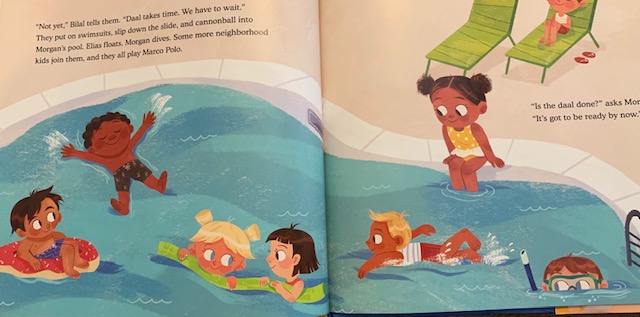
They line up the spices, they put it in the pot, and then they wait.  They put their shoes back on and play hopscotch, they go swimming, they go for a hike and it still isn’t done. 

IMG_5308

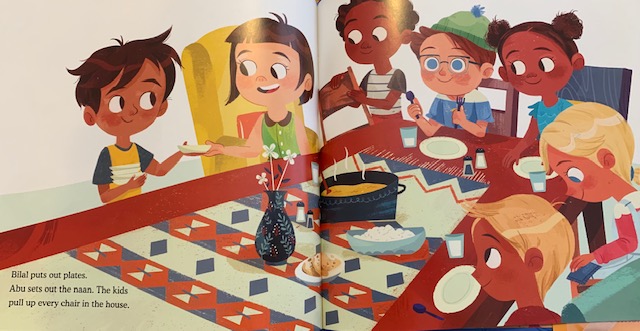
At one point Bilal is worried his friends won’t like it, but after waiting all day and gathering more friends at each activity, when the time finally comes they all dive in and love it.

IMG_5309

I love the diversity of the friends and that the dad is cooking and involving his son.  I also like that everyone is willing to try something new and give it a chance.

IMG_5307

The book would work for all kids ages 4 and up with the expressive colorful illustrations, diction, and amount of text on the page.  The book is 9×8 so it works well in small groups and at bedtime.  

IMG_5310

If you eat daal your kids will love seeing themselves in the pages, if you have never had daal there is a recipe at the end following an Author’s Note. 

IMG_5311

There is nothing religious in the book, and anyone from India, Pakistan, and Bangladesh could easily take ownership of the dish and story.  The Author’s note mentions that Bilal’s grandparents are from Pakistan and with a name of Bilal chances are he is a Muslim character.


Amal Unbound by Aisha Saeed

Standard
Amal Unbound by Aisha Saeed

amal unbound.jpg

This book was suggested to me and I was thrilled to find it at the public library so quickly after its May 8, 2018 release date.  I love that it is an AR 4.2 and 226 pages about a girl standing up for her self, determined to be educated, and facing whatever society, and culture, and circumstance throw at her.  The protagonist is 12, but I think most middle school readers will find the story a bit too idyllic, perhaps even too simplistic and neat.  I really think the AR level of 4.2 is spot on in terms of writing level, interest, and story telling: 3rd through 5th graders will benefit the most from this inspiring, memorable and informative tale.

SYNOPSIS:

Amal lives in a small Pakistani village.   The book opens with her begrudgingly having to take time off from school, as the oldest, to help her mother who is about to deliver her fifth daughter.  The stage is quickly set to show a supportive father, but the cultural stress involved in educating a girl is incredibly strong.  The priority is to care for the home when push comes to shove and this fight is simplified in the book, but not completely belittled.  Right away we also see some class divisions with servants and landowners and the various positions in between.  It is easy to judge those with money as being evil, but the author does show some nuances in character aside from wealth and position.  As Amal’s mom struggles with recovering after the baby, it is decided that Amal will miss more school.  This devastates Amal who dreams of being a teacher.  Burdened by keeping up the house and carrying for everyone’s meals, laundry, and watching her younger sisters constantly, frustration mounts and she snaps when an arrogant man tries to take her pomegranate in the market.  Her simply saying no, is the catalyst that changes her life as the man she stands up to, Jawad Sahib, is the wealthy land owner everyone in town is indebted to.  Saved by his mother, Nasreen Baji, who is in need of a personal servant, Amal is now forced to pay off an impossible debt to a cruel powerful family. 

In  many ways the story doesn’t really get good, until Amal enters the Khan family’s world, about 50 pages in to it, but obviously the character building and detail is necessary, so if you find your kid is getting a bit bored, encourage them to keep going.  

Once, she arrives at the Khan compound, she begins to make friends, and enemies, and similarly see just how ruthless Jawad Sahib is, and can be.  As she finds her own voice and realizes her own role in determining how others treat her, what her future holds, and what power she does have, she is forced to wrestles with the choices in front of her. Ultimately, the reader will cheer for her to take a stand and be bold in doing what is right, no matter the cost.  And while one can guess, because of the target demographic, that it has a happy ending, I won’t spoil the climax, the resolution, or outcome of the young heroine.

WHY I LIKE IT:

I love that despite the themes, the story isn’t depressing, in many ways it is informative and inspiring. I think the fact that things are not left to ponder but clearly articulated, has its merits in a book for elementary children who might be overwhelmed by the cultural aspects to think critically on their own.  At the beginning, with the birth of yet another daughter, the biggest concern is that the mom is depressed because she hasn’t had a boy.  The mom even apologizes to the dad about this.  The neighbors, friends, everyone seems so upset about it, but Amal doesn’t understand why the women particularly seem disappointed, when they themselves were little girls once, and this simplistic point of view on such a complex and real issue, is so spot on and obvious, I loved it.  The mom and dad point out that it is God’s doing and they clarify that they are not sad the baby is a girl, and to me it seems obvious the mom is suffering from postpartum depression, but the book only describes it, it doesn’t identify it.  I also love that there is perspective on how while Amal is in forced servitude and thus not free, either is her female boss, who is unable to go visit her family, or to garden.  This helps amplify that even the wealthiest woman, is still limited to be truly free in the context of the character’s world.  

I like that the book is culturally authentic and not judgemental.  There are strong females, supportive male friends, and plenty of details to show that the author is writing about what she knows, and that she loves her culture.  Islam is mentioned only a few times with regards to prayer time, but nothing more.  There is nothing about praying for anything specific, or covering, or religious beliefs, practices, or traditions.   The book like the author’s first book Written in the Stars, almost oddly leaves religion out, and stresses culture.  Because this book is for a younger audience, it isn’t as obvious, and if I didn’t write reviews about books I probably wouldn’t notice.  

The presentation of culture, the idea of indentured servitude, and females being educated is balanced and explained pretty well.  At most many of the readers will know little of Pakistan, but may have heard of Malala, and the author talks about her in the Author Note.  I like that this book shows a fictional strong female in a similar vein as Malala, but also shows that it isn’t an outside force, the Taliban, preventing her from an education, but in some ways a whole societal view.  I think this expansion of paradigm is really the most powerful thing about this book.  It is important to understand that people may want their daughters educated, and opportunities may be available, but sometimes more is needed.   A lot more to change tradition, on a lot of different fronts.

The book also does a good job of showing some of the paradoxes that exist in developing countries as well: Amal rides in a car for the first time, but also is handed a cell phone from her mom, she knows all about email but has never used a computer.  For readers to see that somethings are very similar to their own lives, and some things are foreign, will make Amal and what she stands for have staying power and relevance, long after the end of the book.

FLAGS:

There is talk of physical violence when people are murdered, crops burned, and Amal is slapped.  There is some lying, but the truth comes out. Overall: clean.


TOOLS FOR LEADING THE DISCUSSION:

I would absolutely present this book as an Elementary Book Club selection and I would encourage teachers to use it as a novel study.  There is a lot of perspective to be had from this book, and its clean simple style will keep the keep points in focus.

Author’s website: http://aishasaeed.com/amalunbound/

Q & A with the Author: https://www.publishersweekly.com/pw/by-topic/childrens/childrens-authors/article/76814-q-a-with-aisha-saeed.html

Discussion Guide: http://www.penguin.com/wp-content/uploads/2018/05/AmalUnbound_Brochure.pdf