Category Archives: Story Time

A Bear for Bimi by Jane Breskin Zalben illustrated by Yevgenia Nayberg

Standard
A Bear for Bimi by Jane Breskin Zalben illustrated by Yevgenia Nayberg

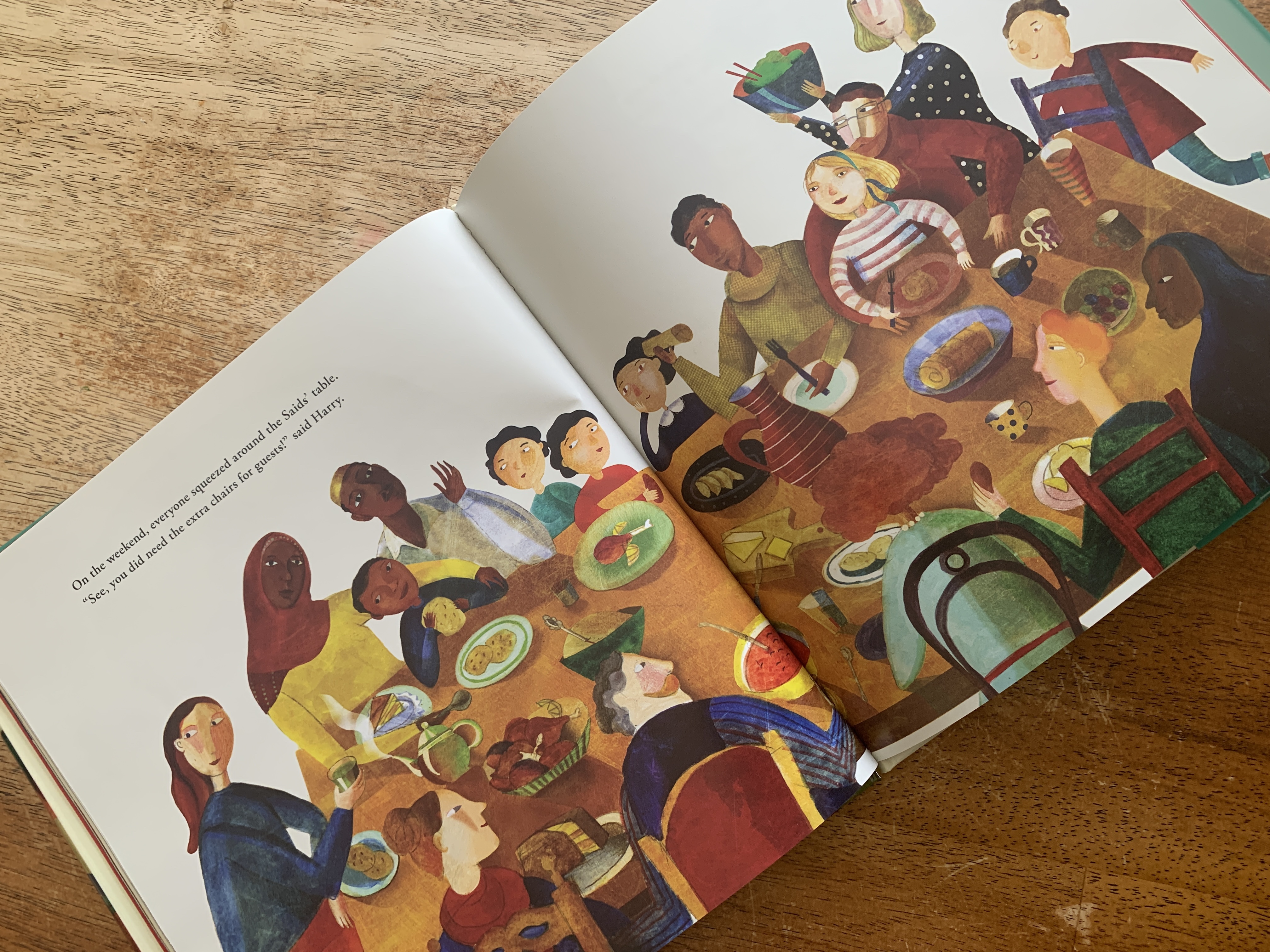
This 40 page picture book for preschool and up does a decent job of highlighting how many of us have immigrants in our family history who have relocated much like the immigrants today. The story focuses on Evie and her family welcoming a Muslim family to the neighborhood.  Some are excited to help, including a Muslim neighbor, others are not so welcoming.  The book shows some of the obstacles an immigrant might face, ways someone already established can help, and just how to be a good neighbor- all on a simple pre-schoolr to first grade level.  For little kids it is a good story to start a discussion, and for slightly older kids it is nice to see Islamic names in the text, smiling hijabis in the illustrations, and different characters to identify with.

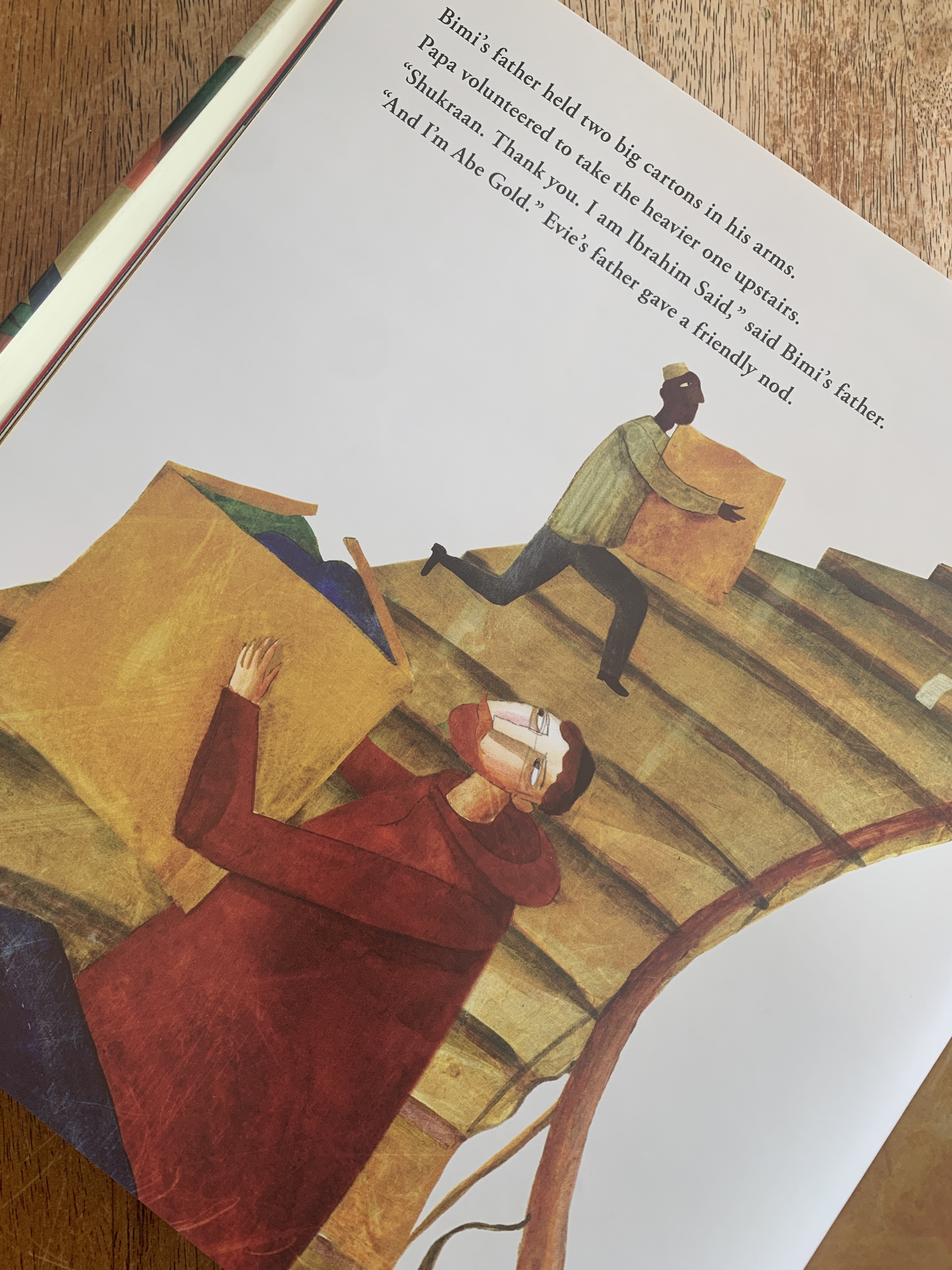
Evie’s parents tell her that a family from far away is moving in next door, she asks if they are coming like her grandparents did, and indeed they are.  When they arrive Evie runs out to introduce herself to Bimi. Evie’s parents help the Said family move in.  But one neighbor, Mrs. Monroe just glares out the window.

Bimi asks his parents about Mrs. Monroe and Evie asks hers.  Bimi’s parents tell him that some people are scared of people that seem different, and Evie’s parents wish Mrs. Monroe would remember what it was like when she first came to America.

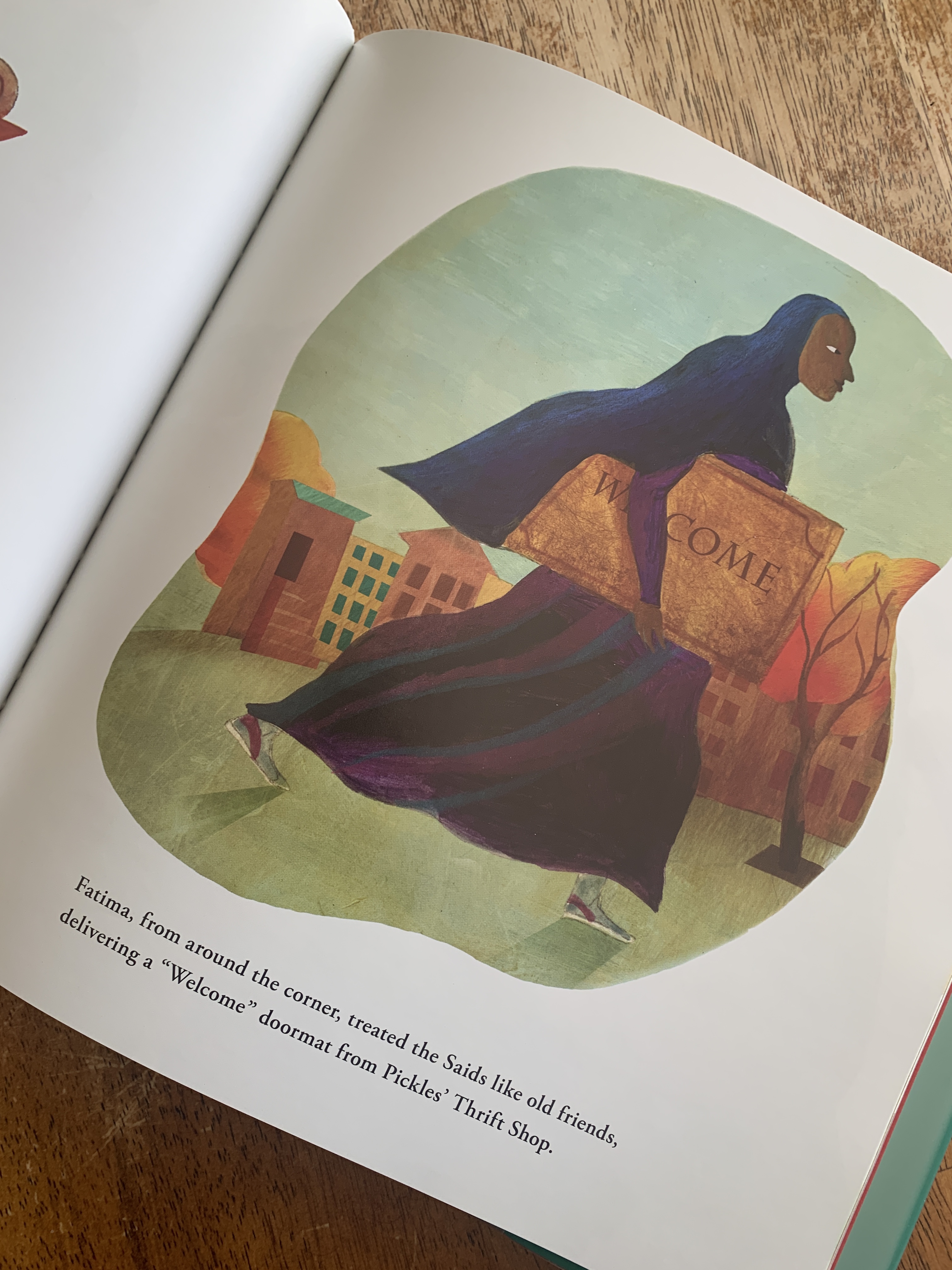
That night Evie has an idea to help furnish Bimi’s house.  The whole neighborhood helps out, including Fatima who lives around the corner.   After getting the apartment set up, they all share a meal, everyone that is, except Mrs. Monroe.

When the kids go out to play, Mrs. Monroe’s shopping bag spills, and Bimi helps her and Mrs. Said invites her in.  Later Evie gifts Bimi her teddy bear and Bimi gives Evie a stone from his grandma’s garden.  Evie asks him what he will name the bear, and when he says Evie, the reader knows the two are friends, and Bimi is “home.”

The book isn’t exciting, emotional, or particularly memorable, but there is value in it and I appreciate the Islamic representation.

The Most Exciting Eid by Zeba Talkhani illustrated by Abeeha Tariq

Standard
The Most Exciting Eid by Zeba Talkhani illustrated by Abeeha Tariq

the most exciting eid

I was really excited for this book, I even contacted Scholastic USA and the author to see how we could get it here in America, but once I received my copy from the UK, I was disappointed.  It offers nothing new to the available Eid titles aside from the pretty illustrations. It is a rather forgettable story, with nothing more than surface level growth, predictable emotion, and a formulaic retelling of a basic Eid day.  Meant for preschoolers (3-4 year olds) the story will suffice as an introduction to Eid and reinforce the importance of sharing with others, but anyone older will find the story lacking unfortunately, and question why they didn’t go for Eid salat, if the cousin was even upset about not getting to ride Safa’s new bike, if the neighbors are poor and needy, and if they have gifts for neighbors or are just giving out random leftovers. Five years ago when reasonably priced brother sister duo books celebrating Eid were popping up everywhere, this book would have warranted excitement of representation and Eid joy, but the quality has elevated and while there might not be anything “wrong” with the book, it still feels like it sadly falls short.

img_8977

Safa and her parents see the new moon and that means it is Eid.  She is so excited as her mom puts henna on her like every year, and her dad brings out the box of decorations.  At night she is anticipating presents, gifts, new clothes and food that she can hardly sleep.

The next morning she comes down in new clothes, prays, asks Allah for a new doll, a colouring pencil set and a bicycle.  Guests come over, even Alissa her cousin. She opens her presents revealing she got everything she asked for.  Alissa calls after Safa, but Safa doesn’t want to share, she’s been waiting for this bike forever. Since sharing is the point of the story, it is worth noting that Alissa in the text shouts after her and in the illustration is shown to be calling out, there is no reinforcement that Alissa even wants to ride the bike.  I suppose I’m glad that Safa feels it, and regrets it later, but it is subtle and I don’t know that a 4 year old will even register that, that is implied.

img_8978

Mom then calls to Safa while carrying two huge purple bags to come with her to share joy and food with those in need.  Safa adds some of the treats she has received in to the big purple bags and they hand the items out to their neighbors. I love that they are visiting their neighbors and it brings the giver and receiver joy, but the set-up is that neighbors and those in need are one in the same, and I think that is conflating two different things.

Some neighbors get small gifts, one a potted plant, another homemade looking food, and then there is one bag left, somehow the purple huge garbage bag sized bags have shrunk to being a shopping bag size and the next recipient is a surprise: grandparents.

img_8979

The mom and daughter join the grandparents for desi cultural foods of samosas, kebabs, biryani.  Dad does not join them, and I’m not sure why the grandparents didn’t come to the party at Safa’s house? I also wondered if the party at the house was still happening, because once Safa realizes she enjoyed sharing, her parents and Alissa are seen outdoors, with the little girls on bikes and Alissa asking her cousin where she went.

There is a two page spread glossary at the end which defines words that are not in the text, but is informative.  It mixes “cultural” words such as Allah Hafiz being defined as being a common way among Muslims to say goodbye, which technically isn’t wrong, but it is an Urdu word and only used by Desis.  It isn’t in the story, so it seems off to me as well.

img_8980

The illustrations are the highlight in the book.  They are vibrant, expressive and engaging.  The mom seems to have a dupatta on her head, it might pass for hijab, but she has wavy tendrils showing on the side, even the grandma shows much of the top of her hair.  Neither the father in the story or grandfather have beards.

Abdul’s Story by Jamilah Thompkins-Bigelow illustrated by Tiffany Rose

Standard
Abdul’s Story by Jamilah Thompkins-Bigelow illustrated by Tiffany Rose

abduls story

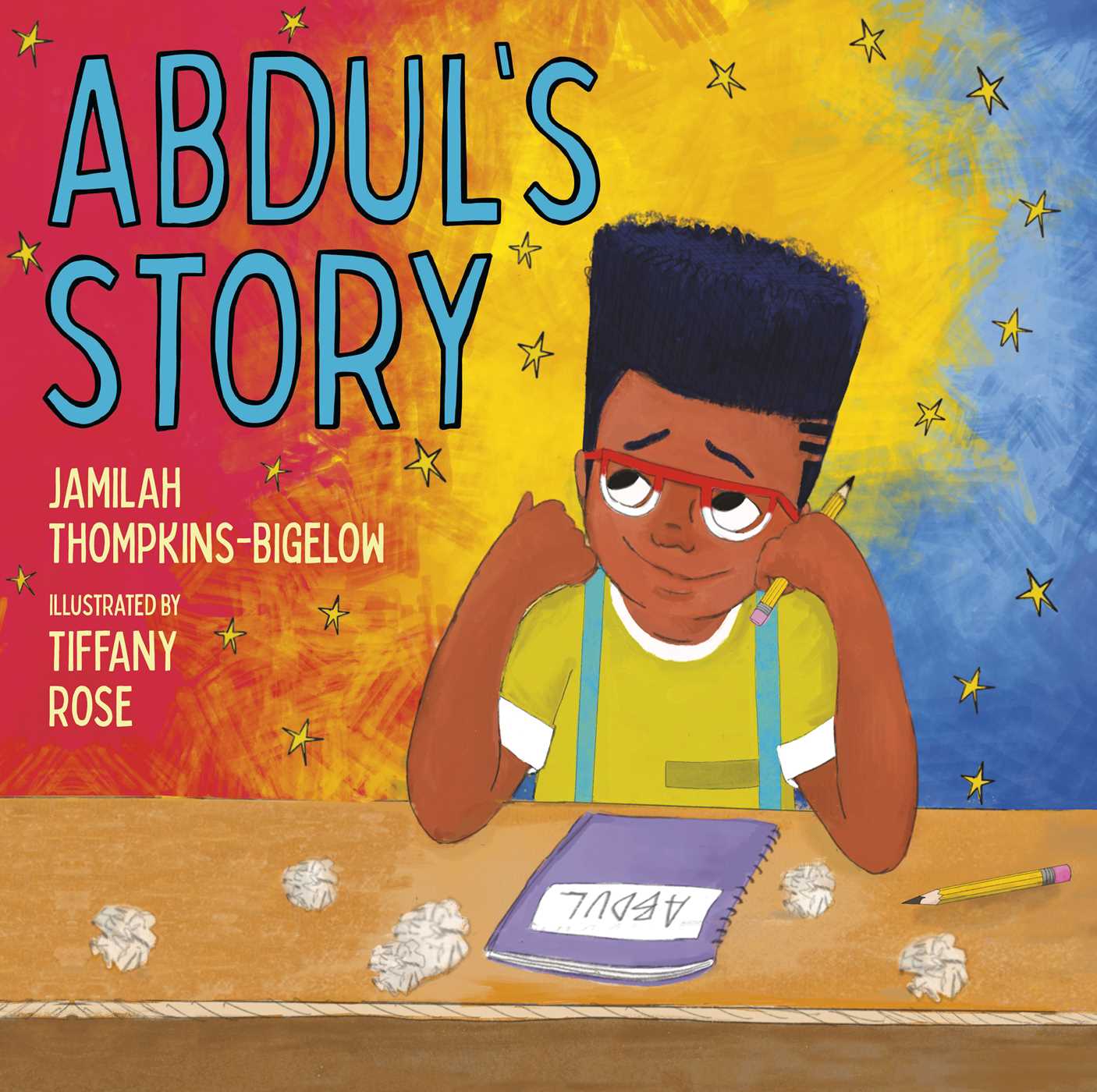
I really don’t know what more you could want from a 40 page brightly illustrated picture book for ages 5 and up.  I felt seen, I got a little emotional, I was inspired, I smiled, I felt compassion and empathy, hope and nervousness.  I was reminded of the power of role models, of getting down on a child’s level, literally.  I was reassured that we all make mistakes, learn differently, and can still thrive. Suffice it to say the book is moving.  The OWN voice lyricism will resonate with children of all colors, but that the messaging is from a Black Muslim boy and is so unapologetic and proud and beautiful, makes the emotions Abdul feels palpable.  Every classroom bookshelf needs this book, every child needs to hear it, read it, and explore the layers contained within.  Alhumdulillah.

img_8766

The book starts out with absolute joy.  Abdul loves to tell stories.  Writing stories, however, is something else.  The letters are tricky, they get turned around, they aren’t straight and crisp like the one’s the barber cuts.   His pages don’t look like the neat lines of his classmates.

He decides that maybe his stories aren’t for books.  It isn’t like he even sees stories like his in books:  stories about the people and places that he knows.

img_8767

Then one day a visitor comes to class, Mr. Muhammad, and he is a writer.  He encourages the children to, “write new stories with new superheroes.”  Abdul tries, but he keeps making mistakes, and then he has to erase, and before long his paper is covered in smudges and holes.

img_8768

Mr. Muhammad encourages Abdul to keep trying and fix the messes later, Abdul has an idea, and with a “bismillah,” he gives it another go.  There is no perfection, there is just determination.  The struggles, success, and support of his peers and Mr. Muhammad, just might change Abdul’s mind about his stories.

img_8769

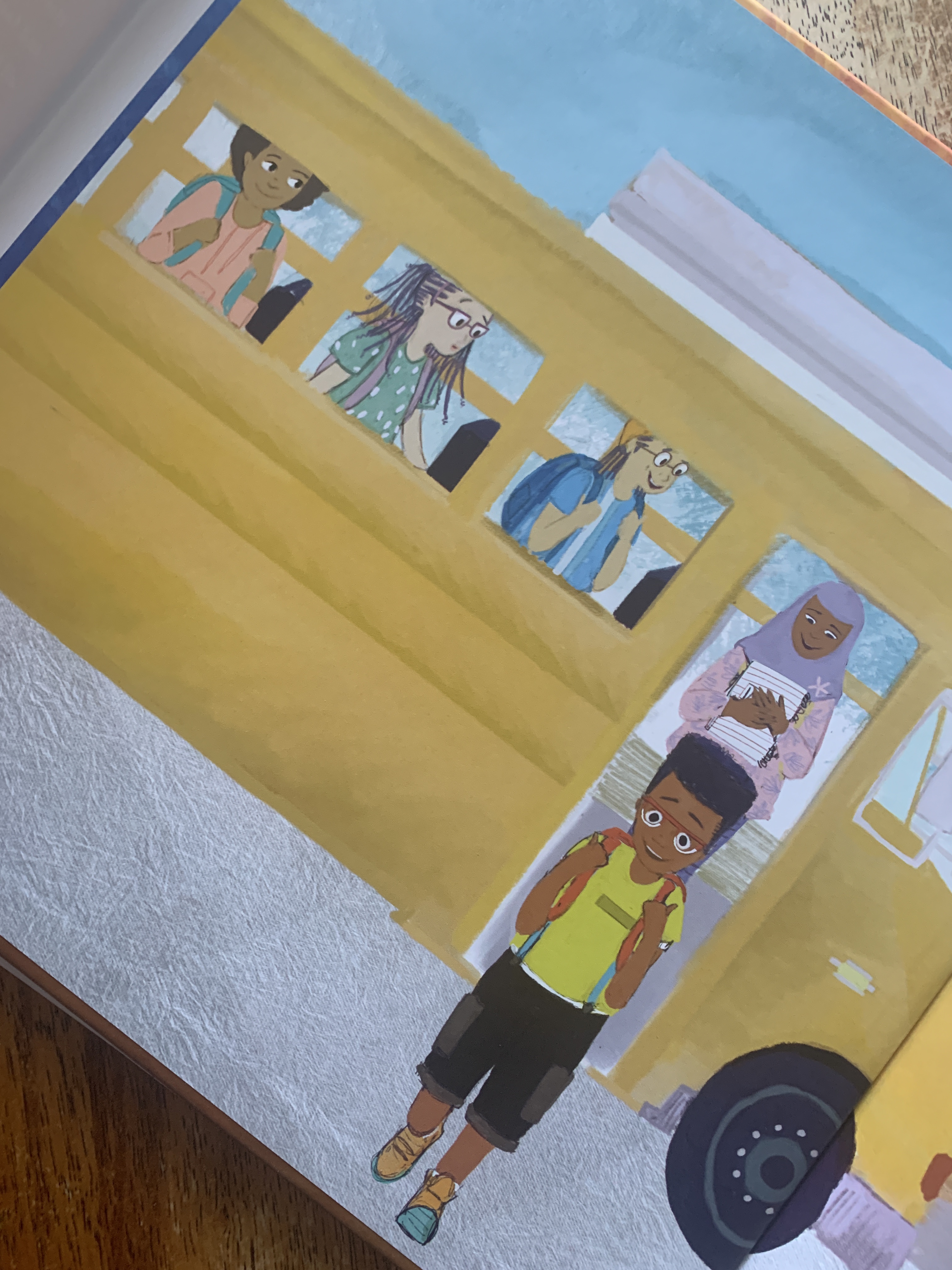
I love that the book is Black centered and Muslim centered.  There is praying salat, mention of bean pies, a classmate in hijab, and saying of Bismillah.  I’ve read the book seven or so times and it has yet to get old.  The characters burst with personality, even the side ones, that I’m positive it will be a favorite at story time and bedtime alike.

img_8770

Can be purchased at Crescent Moon Store or Amazon

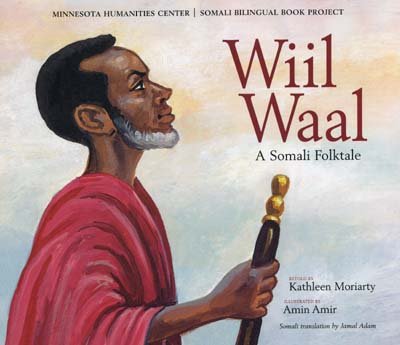
Wiil Waal: A Somali Folktale retold by Kathleen Moriarty illustrated by Amin Amir and Somali translation by Jamal Adam

Standard
Wiil Waal: A Somali Folktale retold by Kathleen Moriarty illustrated by Amin Amir and Somali translation by Jamal Adam

wiil

This bilingual (English and Somali) book tells the folktale of a wise leader challenging the men in his province with a riddle, and it being solved by a poor farmer’s eldest daughter.  Based on a real Sultan from the mid 19th century, the book does not claim the story to be true, and leaves it up to the reader to form their own impression.  The lesson however, is rich with culture, insight, charm, and perhaps surprise.  There is no Islam present or hinted at, but the illustrator’s and translator’s names suggest that they are Muslim as the majority of Somali’s are, and the picture at the back of the book of members of the Somali Book Project show multiple females in hijab- so I’m sharing it on my platform to inshaAllah encourage often rarely seen, in western literature, cultures and traditions to be brought to more peoples’ attention.

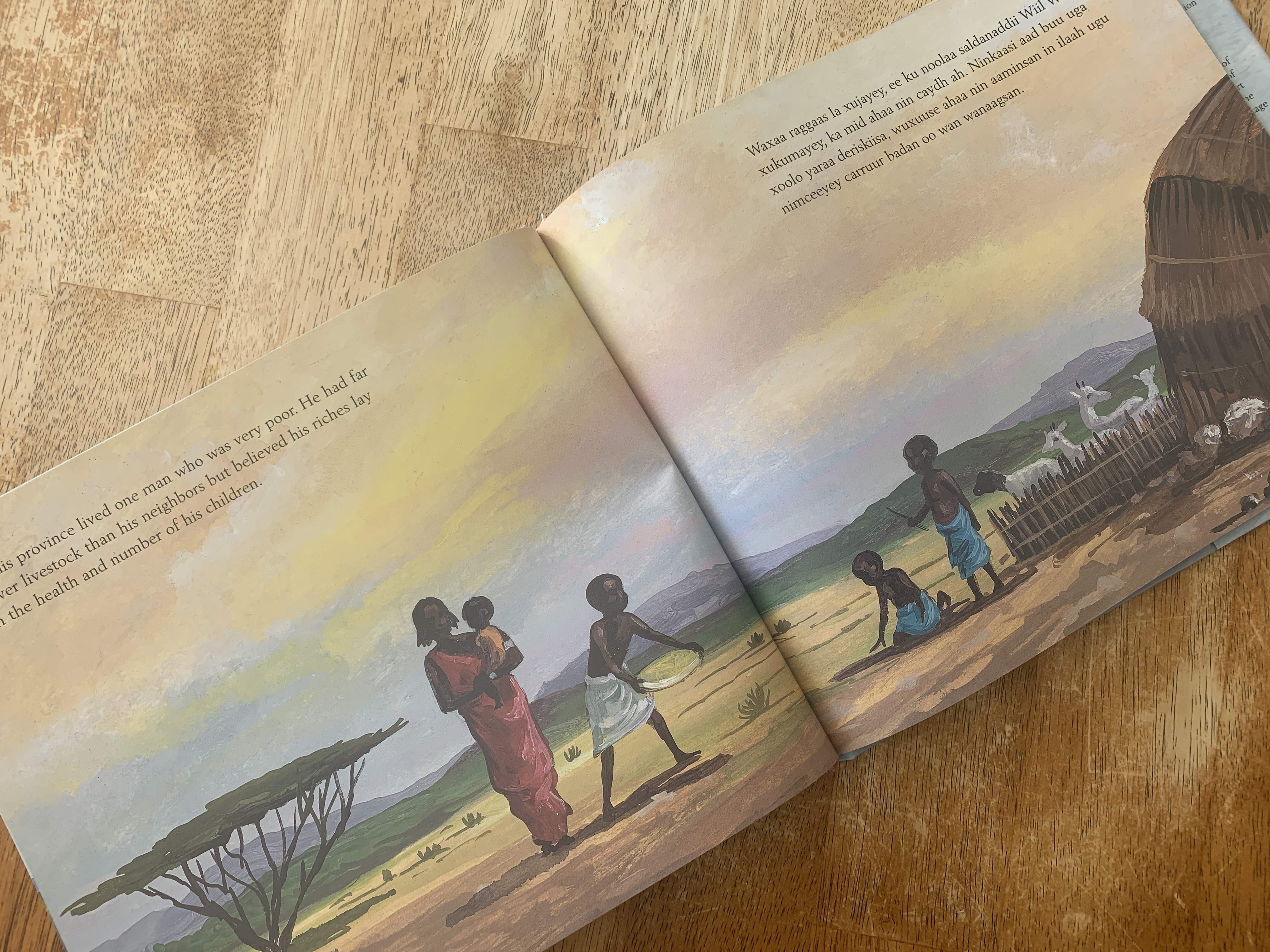
The book starts with an author’s note explaining the tradition in East Africa of having a nickname and that Wiil Waal was the naanay of Garad Farah Garad Hirsi, a man who was a sultan for a brief time.  He was known to be a great leader who was brave, and clever, and used riddles to unite people.  Like all folktales though, this doesn’t claim to be a true story, but one filled with wisdom.

img_6966

Long ago Wiil Waal set forth a riddle, “bring me part of one of your sheep.  The sheep’s part should symbolize what can divide people or unite them as one.”  The one who can do so will be honored as a wise man.

img_6968

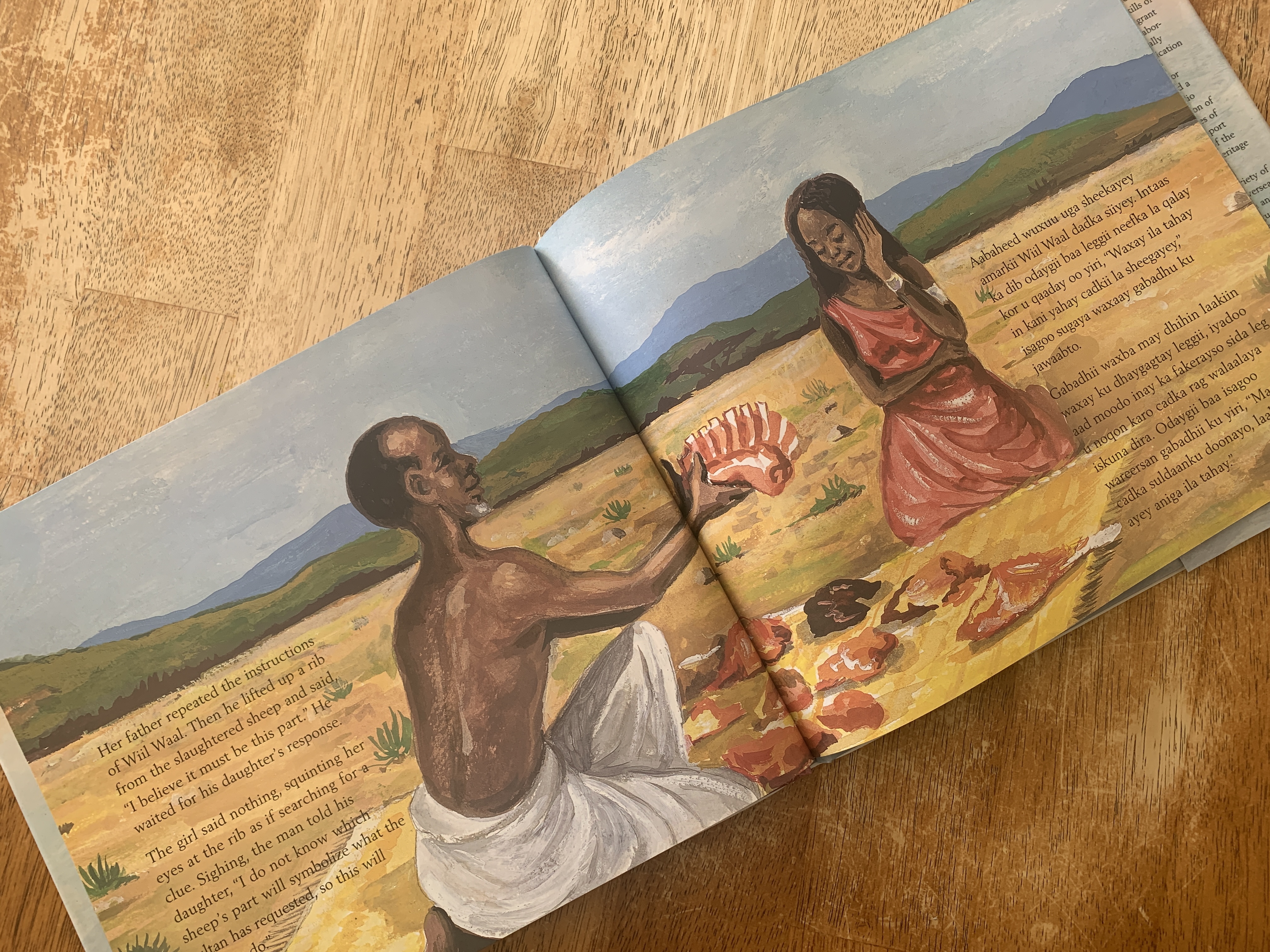
The men pick different parts to bring to the sultan with little success:  a rib, a liver, a shoulder of meat.  In a distant province a poor farmer who had few sheep and many children half heartedly prepared to slaughter his finest animal to present to Wiil Waal.  His oldest daughter comes to help him, and he tells her the riddle.  They work through it, and she thinks she is certain she knows the answer.

img_6969

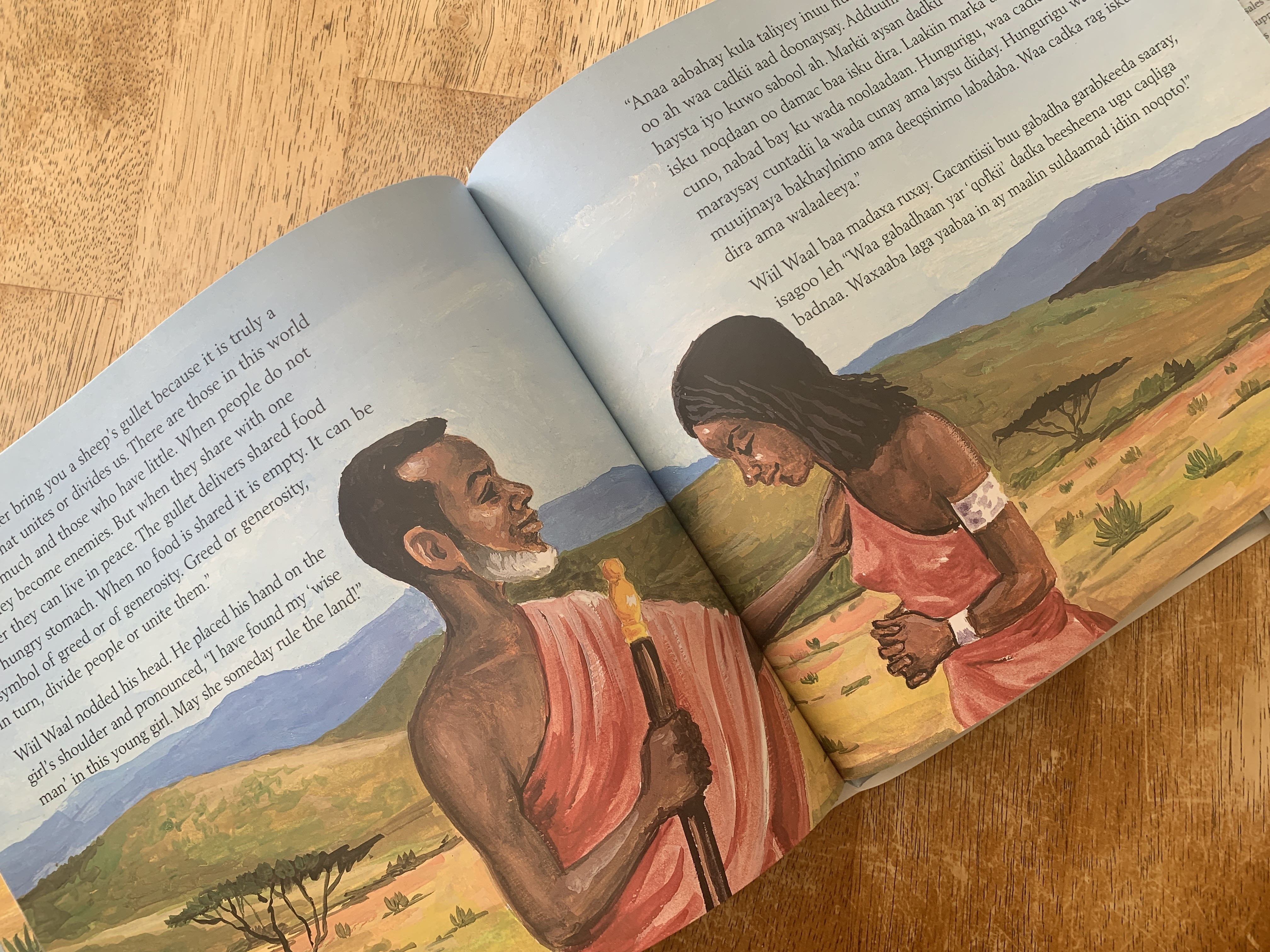
Trusting his daughter the farmer presents the sultan with what his daughter recommended.  Quick to see that the farmer is not confident, he asks who solved the riddle and the story of the daughter’s intelligence is conveyed.

The book ends hinting that she is a future leader of Somalia.  And no, I’m not going to tell you the answer.  Go read the book!

img_6972

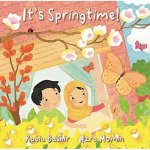
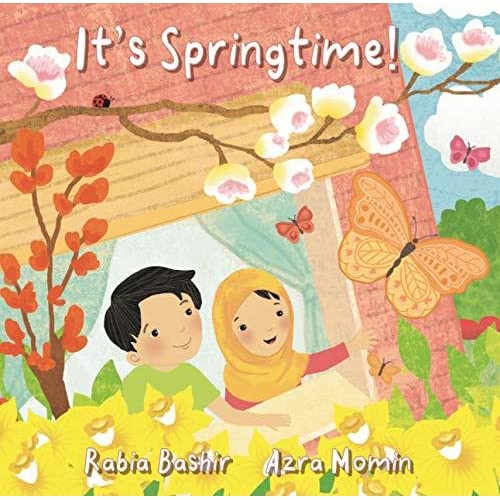
It’s Springtime! by Rabia Bashir illustrated by Azra Momin

Standard
It’s Springtime! by Rabia Bashir illustrated by Azra Momin

spring time

This sweet 18 page board book introduces seasons to our littlest Muslims through rhyming lines, Islamic gratitude and activities enjoyed during certain times of the year.  It even has a “spot and talk” activity at the back and a way to explain “Alhumdulillah” to children.  The text is simple and the illustrations engaging for ages infant to pre-k.

img_8386

The book starts with spring and dedicates four pages to praising Allah swt by appreciating the flowers and baby animals before looking forward to summer, that is on its way.

img_8387

Summer is also four pages of saying Alhumdulillah for the sunshine, ice cream, the beach, and sandcastles, before heading off to autumn.

img_8388

The book covers all four seasons and mentions that after winter is spring again.  The book’s size and the thickness of the pages makes it great for toting around for little ones, and the flowing lines make it a quick read that you don’t mind reading over and over again, Alhumdulillah.

img_8389

Songs and activities available at www.preciousbees.com

ABC’s of Pakistan by Marzieh Abbas illustrated by Michile Khan

Standard
ABC’s of Pakistan by Marzieh Abbas illustrated by Michile Khan

abcs of Pakistan

I absolutely love this ABC book, it truly does Pakistan proud and I’m thrilled that I could obtain it, it wasn’t easy, sorry not sure where you can get it in the USA, and it isn’t available even at Liberty Books in Karachi, but if you can find it, grab a copy, or two because it really is a well done tour of the country.  My only suggestions would be thicker pages, the hardback 8.5 x 11 binding is nice, but the pages seem to have curled in the transporting from overseas.  Also, some pages have a large A or E, but others such as the words for B, C, D, are just all flowing story style over a two page spread.  I don’t mind one way or another, but I do side with consistency, either have the letter on all pages singled out, or on none.  The effort to string the pages together makes it read very much like a story, and I appreciate that it features little snippets of fact and history in talking bubbles throughout.

img_7514

Little Hassan and his cat Makhan introduce themselves and then take you on a tourney of Pakistan.  Included are landmarks, handicrafts, foods, famous people, festivals, sports, and more.  It concludes with a reminder to carry facemasks and hand sanitizers, which might date the book a little in the future, it was published in 2020.

img_7517

The book works for non Pakistani’s to learn, especially those of us with children that have not been to the “homeland,” as well as for Pakistanis in Pakistan to feel proud of their culture, history, tradition, and landmarks.  There are beautiful masjids and the azaan mentioned and hijab wearing and non wearing women, as well as famous men and women included.  It is inclusive on the F for festivals page where it mentions Eid, Basant, Christmas, Diwali, and Children’s Literature Festival.

img_7516

Enjoyable text and illustrations alike. InshaAllah, will be more readily available if we can convince the author and illustrator and publisher that there is demand, I hope, hint hint.  Happy Reading!

The Clever Wife: A Kyrgyz Folktale by Rukhsana Khan illustrated by Ayesha Gamiet

Standard
The Clever Wife: A Kyrgyz Folktale by Rukhsana Khan illustrated by Ayesha Gamiet

the clever wife

It has been nearly 10 years since a new Rukhsana Khan book has been published, and alhumdulillah, she is back with a delightful folktale.  This story starts off like many popular fairy tales, but it doesn’t simply end with a wedding and living happily ever after.  The story is just getting started, once the clever Danyshman and Khan Bolotbek start their lives together.  Over 40 richly illustrated pages brimming with character, culture, and hints of what might happen, the ending will sweep readers aged 5 and up into smiles and giggles and leave them begging to hear the story again and again.

img_7220

When the old Khan is on his deathbed, he leaves the future rule to be decided upon by his beloved white falcon.  The bird lands on the shoulder of a young shepherd and the subjects begrudgingly accept him as their leader.  As his kindness and compassion over the years wins the people over, their only concern is that he hasn’t yet taken a wife.

So, many high born maidens gather and try and solve the questions Khan Bolotbek sets before them.  When one poor maiden learns what is happening and accompanies them, they are surprised with her clever answers, and the khan asks her to marry him.

img_7223

The khan discusses and consults with Danyshman and they essentially rule together.  There is just one promise the khan asked of his bride, and that is to “not share her wisdom with anyone, but him.”  The story continues, but with a clever wife being held to that promise, it is only a matter of time before her wisdom is shared, and it will take true cleverness for her not to lose everything as a result.

I love the strength of Danyshman, the levelheadedness of both her and the khan in ruling, and in remembering their humble roots.  The story is timeless, and this retelling ensures that more families with be familiar with this tale from Kyrgyzstan.

img_7222

The Katha Chest by Radhiah Chowdhury illustrated by Lavanya Naidu

Standard
The Katha Chest by Radhiah Chowdhury illustrated by Lavanya Naidu

katha

This 40 page picture book for preschoolers and up shows connection to family, memories, and Bangladeshi culture as a little girl explores the quilts made from her Maa and aunts’ worn out saris.  This book has been on my radar for a while and while there is nothing wrong with the slow and thoughtful story, it didn’t sweep me up in a hug and wow me, as I had hoped it would.  The illustrations are as critical as the words in conveying the message, and the illustrations are indeed beautiful, I guess I just needed more.  More connection to the emotion the little girl was feeling recalling the strong women in her life, more impact to the fact that her Nanu is no longer with them, and more understanding about the history of Bangladesh that seems to shape the memories.  I worry that most readers simply won’t get anything other than the surface level of the book, which is ok, the memories woven through generations manifesting in quilts, is tangible and perhaps enough.  I feel like, however, the framing of the story and the textless illustration pages attempted to add more layers to the story, and I think to anyone not Bangladeshi, those layers might not be understood.  I wish their was an afterward with notes about the pictured references, inclusion of such backmatter would really open the book up to a wider audience, and give the book discussion and staying power in my opinion.  If you are Bangladeshi this book will be a treasure I’m sure, and I’d love to hear your thoughts on it.

img_7721

Asiya loves going to her Nanu’s house, there are treasures there.  Her favorite treasure is the katha chest.  An old trunk full of the quilts made from the old worn out saris of her Nanu, Maa, and khalas. She snuggles in their warmth and listens to the stories they tell. Stories of hardship, joy, skills learned, moves made, loss, death, love and family.

img_7720

Boro Khala’s looks like Khalu’s medal, from a sad time when he was away.  Mejo Khala bright oranges and yellow like her fingers.  Shejo Khala’s is stiff and neat, she is never messy.  Choto Khala’s has a white streak like the white saris she wears since Khalu died.  Maa’s katha is patchworked and different than the others, and Nanu’s is paper thin and smells of tea, old books, porcelain and wood.

img_7718

There is an author’s note and illustrator’s note detailing the construction and value of kathas, but nothing about Bangladeshi wars, wearing white after a husband’s death, or the textile skills and artistry shown.  The book would read well with context or activities about family heirlooms, connections, and traditions.

img_7719


After Iftar Tales arranged by Bismillah Buddies

Standard
After Iftar Tales arranged by Bismillah Buddies

after iftar tales

This book’s beautiful dark blue cover with sparkly stars feels good in your hands and looks lovely on the shelf.  It is a collection of 10 short stories presumably to be read by an adult to a child or children during Ramadan and has its highs and lows.  As often is the case in anthologies, some are written better than others and while I particularly liked two of the stories contained, I couldn’t help wishing that the entire collection would have been better edited.  I don’t know any of the authors, or their ages, and there is not an intro or conclusion detailing how the stories were selected or compiled, but as a whole, the grammar errors (spaces before and after commas and periods), failure to spell out numbers less than ten, and the overall plot holes in so many of the stories, makes it hard to love this book.  Something about judging a book by it’s cover would seemingly apply here, the illustrations are decent, the topics and themes covered are important, but the finishing is lacking, and the book really had a lot of potential.

SYNOPSIS:
The ten stories cover Ramadan in different ways, and do not get repetitive.  With different authors and illustrators and pictures on every other page at a minimum, the books presents well.  Many of the stories are adequate, but largely forgettable as the plot holes just made me and my kids dismiss them.  A few are too lengthy and wandering, but there are two that even despite writing obstacles, thematically were memorable:  “A Ramadan Surprise” by Malika Kahn and “Iftar in Space” by Tayyaba Anwar.

“A Ramadan Surprise” is written in rhyming verse and discusses the need for wheelchair accessibility at masjids.  Focusing on a young girl it also hints on the importance of accessibility for the elderly.  This is such a needed and important reminder and I love that it is present in a book that is positioned to be read and thus hopefully discussed.

“Iftar in Space” similarly opens itself up to be discussed and marveled at between a child(ren) and an adult: how would you fast and pray if you were on the International Space Station. This connection could then be made for people that live near the poles, and how science is valued in Islam and so much more.  I love that Islamic information is seemingly sourced, but I would have loved a line or two at the end clearly articulating that in fact this is what this scholar or these scholars have declared.

WHY I LIKE IT:

At first it didn’t bother me that the text was so small, but mid way through, it started to because the pictures are so inviting and regular.  If a child is snuggled up with a reader looking at the pictures it is impossible for them to follow along. I get that that is kind of the point, but with huge margins, the text size can easily be increased.

I don’t know why the book doesn’t seem to have been edited.  The cover and illustrations and binding are all decent to high quality, the cost of the book for consumers is high, so I don’t know why an editor was not (seemingly) involved in the process.  Sure I am picky, but it isn’t one or two grammar errors, it is a lot, and when it is a regular concern, it ruins the flow and feeling of the book.

Overall, honestly there is also very little Islam present in most stories except for the timing of Ramadan, and many of the stories seem to have gaps.  In the first story, a boy is found by a stranger and gifted a lamp, and the family never even tries to find the person who saved their son to thank him? They live in a small village?  In one of the stories where a little girls is fasting for the first time she is also making a salad independently and pulling a cooked tray of lasagna out of a hot oven. A child in one story eats moldy candy, and in a contemporary story kids donate their money to an orphanage.  Are there still orphanages? In one story it opens with a banner being made that is crooked, but the accompanying illustration does not match.  One error or two is easy to overlook, but again, when it is every single story, it is incredibly disappointing.

FLAGS:

Clean

TOOLS FOR LEADING THE DISCUSSION:

I think while reading it you would find plenty to discuss with your children.  On stories where your children seem bored you could skip them, if sentences don’t make sense you can alter them.  I doubt children will read the book independently, so there is some wiggle room to add or subtract from the text to make the points you want to make and keep the stories engaging.  There are a few stories that discuss Covid and the frustration that it has caused to daily activities, which might help add another layer of connection to the text.

Ramadan Rocket by Emma Halim illustrated by Stephen Tucker

Standard
Ramadan Rocket by Emma Halim illustrated by Stephen Tucker

ramadan rocket

The banter in this 36 page Ramadan moon book is fun and engaging, and as the mom of five kids who was once a kid herself, the struggle is real to try and spot the Ramadan moon.   Most years, frustration abounds and nothing is seen. Haarith has the same problem, but last year he did something about it.  In this 36 page book for preschoolers and up, the faceless pictures will have kids giggling and their imagination’s soaring as they try and determine if Ramadan is about to begin.

img_7572

Haarith loves listening to stories about Ramadan, but always has trouble seeing the Ramadan moon. Last year, he decided to get a closer look.  He set out to build a rocket, but his best friend Hakeem had one he could borrow, so Haarith recruits two other friends, Jawaad and Khaleel, and plans are underway.  Jawaad will pilot since he flew out of a swing last week, and Khaleel will be in charge of food because his mom makes awesome cakes.  The boys head to space, passing, satellites, drones, and NASA rockets, before they see the moon and head back home.  After maghrib the community heads to search the sky and when they see nothing, it is Haarith that can locate exactly what they are looking for.

img_7571

I wish the moon was shown as super thin and hard to see in the illustrations, instead of as a thick crescent so that kids that might not have personal experience could at least understand why Haarith is struggling.  Also, I’m not sure why the line spacing on one page is double what it is on the others.  Many of the pages are text heavy and could have used some editing to tighten it up, but overall the story is fun.

img_7573

The premise though sent my head spinning, and yes I’m going to show my ignorance here, you can judge me. If you go to space, the moon is spherical, the earth and shadows are no longer at play right? So wouldn’t a new moon, a full moon, or a waxing gibbous all look the same? Clearly my confidence in this matter is non existant, and while I have no problem with the characters borrowing a friend’s rocket, it has been sitting unused for a year after all, I’ve been struggling to get this point clarified in my head.  And I believe it would all depend on where the rocket is and thus the boys’ point of view.  According to the University of Maryland, “The reason that we do not always see a Moon which is half lit is because of our position relative to the Moon and the Sun. As the Moon moves in its orbit, different portions of it appear (to us!) to be lit up as we look at it from Earth. This is why we see lunar phases.” So I suppose that depending on the rocket’s position in space would determine if the moon looked like a “Ramadan moon” or say a third quarter moon.  I’ve linked a NASA video that explains that the International Space Station sees the same phases as earth, so umm yeah, maybe I should take a break from fiction and go read some nonfiction basic science books.