Category Archives: STEM

Girls Who Code by Stacia Deutsch and Michelle Schusterman

Standard
Girls Who Code by Stacia Deutsch and Michelle Schusterman

I sadly think that it is safe to say that whenever you see a book that features a cast of characters meant to include multiple minority groups, certain representation is going to read more generic and formulaic than others.  Translation: just because you see a hijabi on the cover, do not rush out to obtain, purchase, and read the entire series.  Chances are if a scarf wearing Muslim is being featured, the details will be simplistic, the rep mediocre, and the OWN voice emotion lacking.  Also know, that other minority groups will have similarly been included for their surface level representation and not necessarily for any real depth.  This includes the boxes to be checked for Black, Hispanic, Asian, and LGBTQ+ storylines, characters, and/or side references.  This is a sweeping generalization, and inshaAllah when I am proven wrong, I will happily point those books out too.  This series hopes to appeal to middle grade female readers (AR 4.0-4.6) with an emphasis on coding, but not so much on how it is done or how they learn it, but how it helps them in their other passions and dramas.  I read books two and four, since the Muslim character is not introduced until book two and I wanted to see how she is developed as the series advances.  Each book is told from a different girl’s perspective so it is assumed that book five, could be Leila’s, but honestly with the focus on crushes, dances, and relationships, I won’t be sticking around to find out.

SYNOPSIS:

BOOK 2: TEAM BFF: RACE TO THE FINISH! is told from Sophia’s perspective.  She is hispanic, has lots of little sisters, loves sports and has a lot of responsibility.  The original four girls reach out to Leila, a new girl from Pakistan to join their coding team and even end up naming their robot Zahira.  When Soph is forced to take care of her siblings instead of go to the hackathon, she will have to learn to ask for help and lean on others when she can’t do everything herself.  It also means she will have to take charge with the upcoming dance and ask Sammy out herself.

BOOK 4: SPOTLIGHT ON CODING CLUB:  The school is doing a new virtual format for the talent show and that means that the coding club has to design a website, an app, and collect all the data.  They don’t have much time, and with everyone’s time stretched thin with other obligations, Erin keeps volunteering to do more.  Her hope is that if she is so busy she can’t think, her anxiety won’t flare up  and she won’t stress too much about her dad who is deployed on a secret mission.  When their teacher announces that she is leaving, the group seems to be falling apart as well, and something will have to give.

WHY I LIKE IT:

The first two books are written by one author, and then three is written by someone else, as is book four.  The writing quality of book four is much better, and the insight in to mental illness, divorced parents, a parent actively deployed, and being stretched too thin, will resonate a lot stronger with readers, than the more whiney presentation of the second book.  Each book seems to also present with a new crush storyline: in the second book it is Sophia recognizing changing feelings for a friend, and in book four it is a lesbian crush that has the side characters angsty.  I wish more about the girls as individuals was stressed rather than having them all be defined by their hundreds of hobbies and extracurriculars.  I was exhausted just imagining all the places they have to be in a week and the frantic pace they must keep to ensure they get there. I get that the demographic is probably giggly over crushes, but honestly they seem so forced and unnecessary in books that already have a lot of moving parts.

FLAGS:

Lying, crushes (gay and straight), anxiety triggers, stress.

TOOLS FOR LEADING THE DISCUSSION:
I don’t know that I would even shelve these in an Islamic School, the idea is good, the execution not so much.

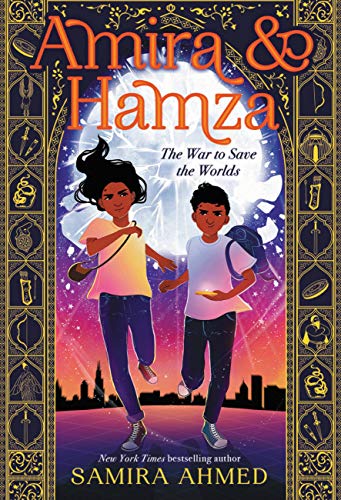
Amira & Hamza: The War to Save the Worlds by Samira Ahmed

Standard
Amira & Hamza: The War to Save the Worlds by Samira Ahmed

amira and hamza

Make sure you are sitting in a comfy spot when you crack open this middle grades fantasy adventure, because it hits the ground running from the very beginning and doesn’t let up over 368 pages.  The like-able and relatable brother sister duo snarkily banter and bicker about everything from cultural Indian (Desi) folklore, religious stories, Marvel, Lord of the Rings, He-Man, Arabic Sesame Street, Star Wars, hygiene, fears, potential science fair projects, and food, all while battling jinn, devs, peris, and reality as they work to save the worlds.  The book is chalked full of STEM concepts, cultural touchstone, Islamic footholds, pop culture, and fun, as one character remarks, it is the ultimate fan fiction. I regularly Googled people, references, and concepts, and ended up learning quite a bit.  And don’t fret if you ever get lost or confused, or something doesn’t make sense, you don’t have to worry that you missed something or that the author left a gap in the narrative, the book moves quick and Amira’s constant dialogue and commentary points out all the ridiculousness of what they are experiencing and the questions that she wishes she had time to ask, explore, and discover.  The author never loses control of the narrative, and keeps the world building on level without skimping on details and understanding.  I have not loved any of the author’s previous books in their entirety, I think this one, however, is her best one yet, and the switch to middle grades is a good fit.  

SYNOPSIS:

Twelve-year-old Amira and her 10-year-old brother Hamza are heading to the Shriner’s Madinah Temple in their hometown of Chicago to explore the exhibit of Ancient Astronomy artifacts, or as Hamza calls it “tools that belonged to dead Muslim Astrologers.”  Hosted by the Islamic Society of Ancient Astronomy corresponds with the eclipse viewing party of the incredibly rare super blood blue moon.  In typical Hamza fashion however, a Nerf gun is brought and things are touched.  When Amira is tasked with bringing her brother up to the roof to learn how to use the telescopes, the two scuffle over a small box with a tiny moon inside, a series of snatching and tussling between the siblings cause the Box of the Moon to break, or rather start working.  As day turns to night, the moon seems to be breaking a part, and everyone in the world is suspended in sleep except for Amira and Hamza, and an entire jinn army is heading their way.

When jinn leaders Abdul Rahman and Maqbool reach the children they must convince them that they are not there to harm them, but rather to recruit them as the chosen ones to save the worlds: Qaf and Earth and the barrier, the moon, that keeps the realms separate from destruction at the hands of Ifrit.  The confusion over there being two of them creeps up, but is squashed as Suleiman the Wise left tests to prove that the chosen one is properly equipped to battle Iftrit as it has been prophesized.  The children must work together to prove themselves they must then actually seek out and defeat Ifrit.  As tests and challenges arise, it becomes clear (pun intended) that the two are not the chosen ones, but with no option of turning back they must forge ahead none-the-less.

“What? We’re Indian, dude, we were basically born half doctor.”

WHY I LIKE IT:

I love Amira and Hamza’s banter.  The references are at times laugh out loud funny.  Similarly, I was impressed by all the historical and STEM concepts intertwined in the story, there is even a tiny bit about mental health.  I learned about parts of the moon, historical figures, folklore, and more.  The characters are Muslim, Amira wears Ayatul Kursi around her neck and they talk of Sunday school.  The book isn’t religious though, in they aren’t saying Bismillah before they embark on things, or supplicating when in danger, but they greet different beings with peace, and the framing is clearly from an Islamic paradigm.  I think the high speed pacing works for most of the book, and somehow you still get to know and connect with the characters, but at times a slight pause to clarify a point would have been nice.  I would have liked to have the kids proving they were the chosen ones a bit more articulate and dramatic before hand rather than in retrospect.  I feel like the jinn transportation of cauldrons could have used a bit of backstory as well.  And a little fleshing out of the scroll, the government structure and communication methods of Qaf, would have helped some of the transitions between the action.  I read a digital ARC and it had a page reserved for a map, and I think when the physical book comes out that will be really helpful, as I didn’t quite fully understand the 18 realms and their locations  in comparison to the locations the children encounter.  

FLAGS:

UPDATE:  I TOOK THIS BOOK AS COMPLETE FICTION. THAT THE ISLAMIC PREMISE WAS A STARTING OFF POINT, AND DIDN’T DWELL TOO MUCH ON THE ACCURACY.  I READ AN ADVANCED READER COPY OF THE BOOK THAT DID NOT HAVE ALL THE SUPPLEMENTAL AUTHOR’S NOTES AND RESOURCES AT THE END.  I WAS UNAWARE THAT THE AUTHOR FELT SHE WAS INCOPERATING FACT AND ACCURACY IN THIS INCREDIBLY FICTIONALIZED BOOK. AND AS A RESULT I AM NERVOUS TO SUGGEST THIS BOOK TO THE MIDDLE GRADE INTENDED AUDIENCE.  IF YOU HAVE A MUSLIM CHILD THAT IS WELL VERSED ON PROPHET SULAIMAN, THE CONCEPT OF FICTION, AND IS OLDER THAN THE IMPRESSIONABLE EIGHT OR NINE YEAR OLD INTENDED AUDIENCE, ONLY THEN PERHAPS WOULD THIS BOOK WORK FOR YOU.  IT WOULD BE VERY MISLEADING IF YOUR CHILD TAKES THE TWISTED STORY AS FACTUAL AND BASED ON THE NOTES AND RESOURCES AT THE END, THIS VERY WELL COULD HAPPEN. To read more about the concerns you can click here and head over to Muslim Mommy Blogs take on the book.

There is magic and magical beings. A transgendered jinn.  It mentions Amira and Hamza celebrating Halloween. Death and fighting.

TOOLS FOR LEADING THE DISCUSSION:

I think this would be a great audio book to listen to with the family or a read aloud in a middle grades classroom.  It is too young for middle school readers to not find it slightly predictable, but if you had it on a classroom or home shelf I am sure it would be picked up, read, enjoyed by middle grades and middle schoolers alike.  It reads much like the Rick Riordan Presents series and I hope that there are more books featuring Amira and Hamza in the future.


The Tale of a Tiny Droplet by Ally Daanish illustrated by Oana Cocheci

Standard
The Tale of a Tiny Droplet by Ally Daanish illustrated by Oana Cocheci

droplet

I would imagine if you were to pitch the idea of this book it would go very favorably.  A raindrop goes on an adventure to a desert kingdom after facing adversity for being small, an ocean wave wants to consume her, a chance encounter with a grain of sand and confidence in Allah swt to keep them safe leads to refuge being offered in an oyster who journeys them through the ocean to salam its inhabitants only to wash up near the palace and at the feet of a prince who has been searching for a treasure for his mother’s crown.  The problem comes in its delivery.  It is told in rhyme that is incredibly forced and trying to do too much.  It is a 32 page children’s picture book trying to blend religion, science, adventure, and two points of view.  It needs to be clear, not concerned with a rhyme scheme that muddles the themes.  The book has potential and with the QR code and online teaching resources I could see an Islamic school teacher using this to explain how a pearl is formed and the incredibleness of one of Allah’s creations, but it will take a lot of outside explanation.  I am confident that no four to six year old is going to independently understand clearly what is going on.  I myself had to read it multiple times to figure out what was going on, and even then I found more holes, inconsistencies, and head shaking then there should have been in a large, glossy, well illustrated, effort filled book.

img_3589

A tiny droplet wants to be free, but this personified little water being’s friends tell her only great things live in the kingdom and she is too small.  Not sure how greatness and physical size become synonymous, but they do apparently.  So, on a windy day, the raindrop jumps out of the sky to join the ocean as a means to reach the kingdom.  A hurricane, or wind gale, catches her and she collides with a grain of sand.  But the pov switches, and the sand collides with her and it hurts the sand.  Grain apologizes and Droplet says not to worry she she is heading to the ocean too.  Grain warns her that the ocean isn’t safe, that there is a big wave who will consume them.  Droplet says she isn’t afraid and trusts Allah swt will keep them safe.  The wave threatens to chase them with all its pride (?) if they dare to run and hide.  The pair find an oyster to hide in and they swim with the tide. The oyster is bothered by their tiny feet so he throws them a blanket.  The wave continues to give chase, but they trust Allah swt and after months and days they wash up on the kingdoms shore.

img_3590

The book then pivots and focuses on a young prince who is searching for a gem for his mother the Queen.  Her crown has lost its shine.  He has travelled for months and day through mountains and valleys to no avail. One day while walking, back home on the beach, he hears voices hoping for safety from the wave.  Droplet and Grain think the wave has perhaps finally got them, but it is the prince opening the oyster and finding just the gem he needs. The book concludes with the pearl saying “Alhumdulillah” to the distant stormy sky, “All things can live in the kingdom and its palace rising high.”

img_3591

So my questions, first I’m not sure how a droplet isn’t free, is there only one wave in the ocean? Who is talking at the end, obviously the anthropomorphism as a science lesson kind of hits a dead end, it went from two talking objects to one new talking object, so thats creepy.  Wouldn’t it have been better to end when the gem was found and then have an info or fact page highlighting how pearls are made, having two distinct characters morph into one is a bit jarring story wise. The concept of the kingdom not allowing in little things, and then concluding that all things are welcome, is also so painfully underdeveloped.  Even little readers are going to find that assumption so off the mark.  I like that they trust Allah, but Droplet keeps saying she isn’t scared, but continues to run? swim? The duo don’t want to be consumed, but essentially aren’t they consumed by the oyster? The Pearl feels like it beat the wave despite its size, but it was the other drops that were telling Droplet she was too small, not the wave.

img_3592

All confusion aside, my kids and I might just not be the ideal readers.  My six year old didn’t know what a pearl was, so he was incredibly confused.  I thought the book was going to be about the water cycle, so it took me a minute to realize that wasn’t where the story was going. There is a QR code on the front and if you go to the website a number of resources are available https://www.lotehouse.com/product-page/the-tale-of-a-tiny-droplet. I wish there was info within the binding though to explain the process of sand and water in an oyster making a pearl and I wish a heavy handed editor would have cleaned up the text.  Sadly, a potential great book mixing adventure, science and deen just really missed the mark.

Little Rocket’s Imaan Boosting Journey by Ilm Bubbles

Standard
Little Rocket’s Imaan Boosting Journey by Ilm Bubbles

img_2180

This 32 page toddler to first grade picture book at first appears to be just another book praising Allah’s creation from the ground level up to the heavens as the main character is a personified rocket ship.  However, I was delighted to see that after a few pages the book goes deeper in both Islamic messaging and in literary action.  Told in rhyme, Little Rocket will face dangerous comets, make desperate humbled duas for help, be rescued by Officer Cosmo, show gratitude, and grow in his imaan and understanding of Allah’s creation and mercy.  With a guide at the end to further involve children in the lessons of the book, and a glossary; the bright glossy illustrations will give little Muslims important well woven in lessons in a fun story packaging.

img_2184

Little Rocket is about to take off from his little town, it is his first flight, so he is a little nervous.  A little dhikr calms his heart and bismillah he is off. He prayers for courage as he looks down and sees so many of Allah’s creations.

img_2181

As he enters space the colors of Earth become the dark sky full of stars and planets that do not fall.  Careful not to get too close to the burning sun.  Little Rocket wants to keep heading toward Neptune, but needs to take a rest on a rocky moon.  As he drifts off to sleep in the quiet of space he is abruptly awoken by comets hitting the surface.

img_2183

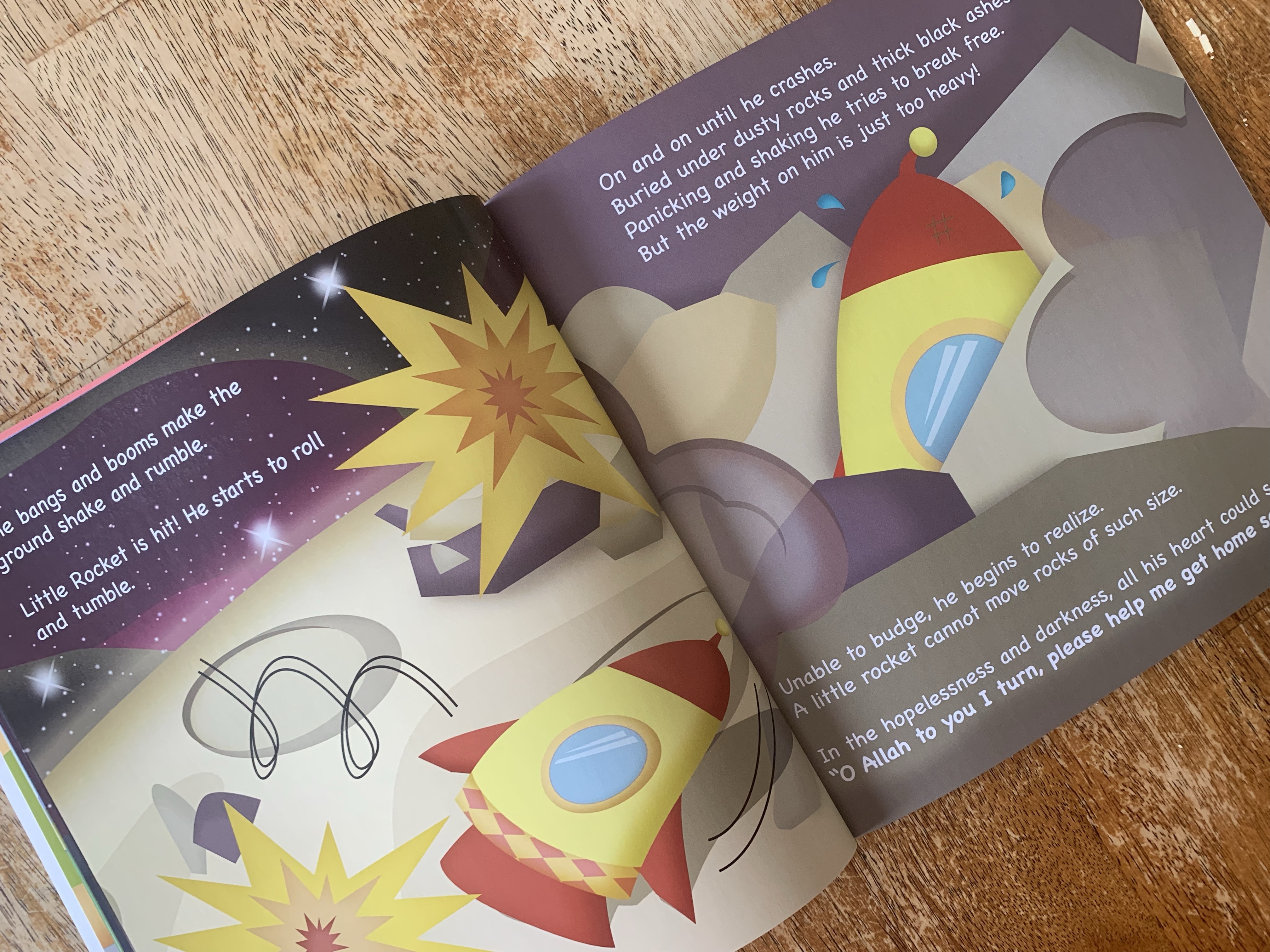
Little Rocket is hit and the ash is thick from the destruction.  He gets stuck from falling debris and prays to Allah swt for help.  A brave blue rocket, Officer Cosmo, hears something, and comes to Little Rocket’s aid.  SubhanAllah Officer Cosmo is able to save a very grateful Little Rocket.

img_2182

Little Rocket heads home feeling closer to Allah swt then he did when he left that morning and knows that “There is none worthy of Worship, but Allah.”

img_2185

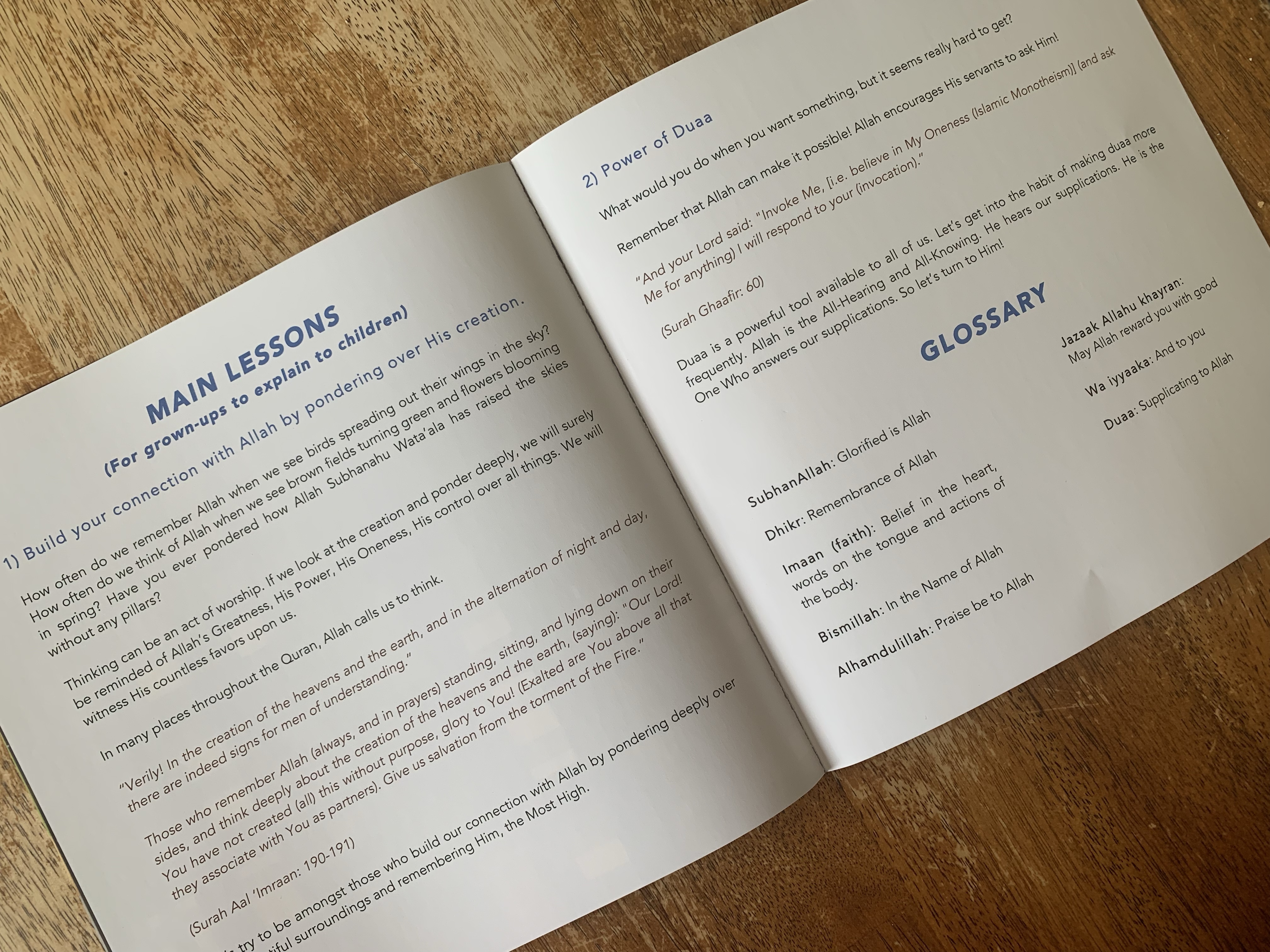
The power of Dua saved the day and with concepts and vocabulary of space all combined in a story with a sweet plot, this book will be requested over and over, and inshaAllah help little ones to appreciate and trust Allah always.

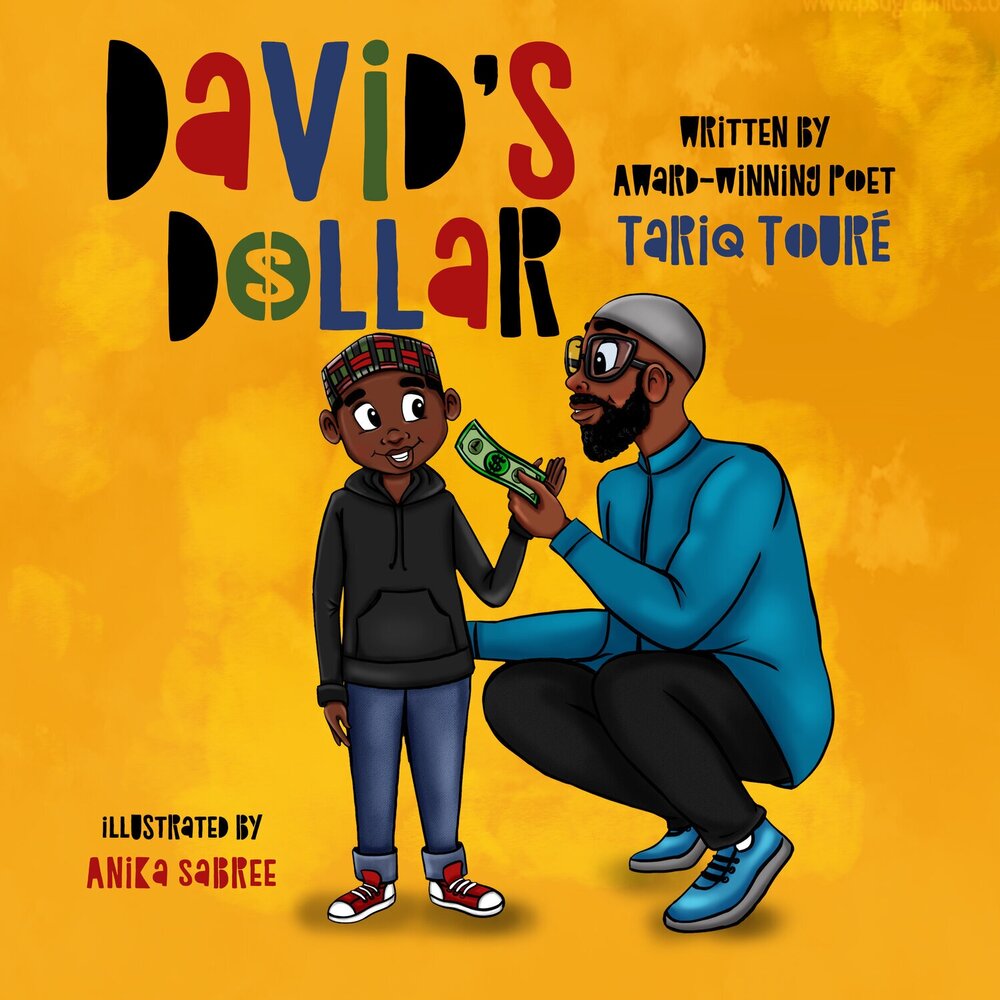
David’s Dollar by Tariq Toure’ illustrated by Anika Sabree

Standard
David’s Dollar by Tariq Toure’ illustrated by Anika Sabree

This early elementary 20 page story is an entertaining, yet informative look at community and economics on a kid’s level.  It features black Muslim characters, business owning women of color, commerce, charity, and relevance.  I loved the cadence of the book, the illustrations, and the simple text. Sure, maybe a dollar isn’t much and it is a transparent simplistic view, but it makes the point of how when you shop local everyone benefits, and how the path money takes impacts everyone it touches.

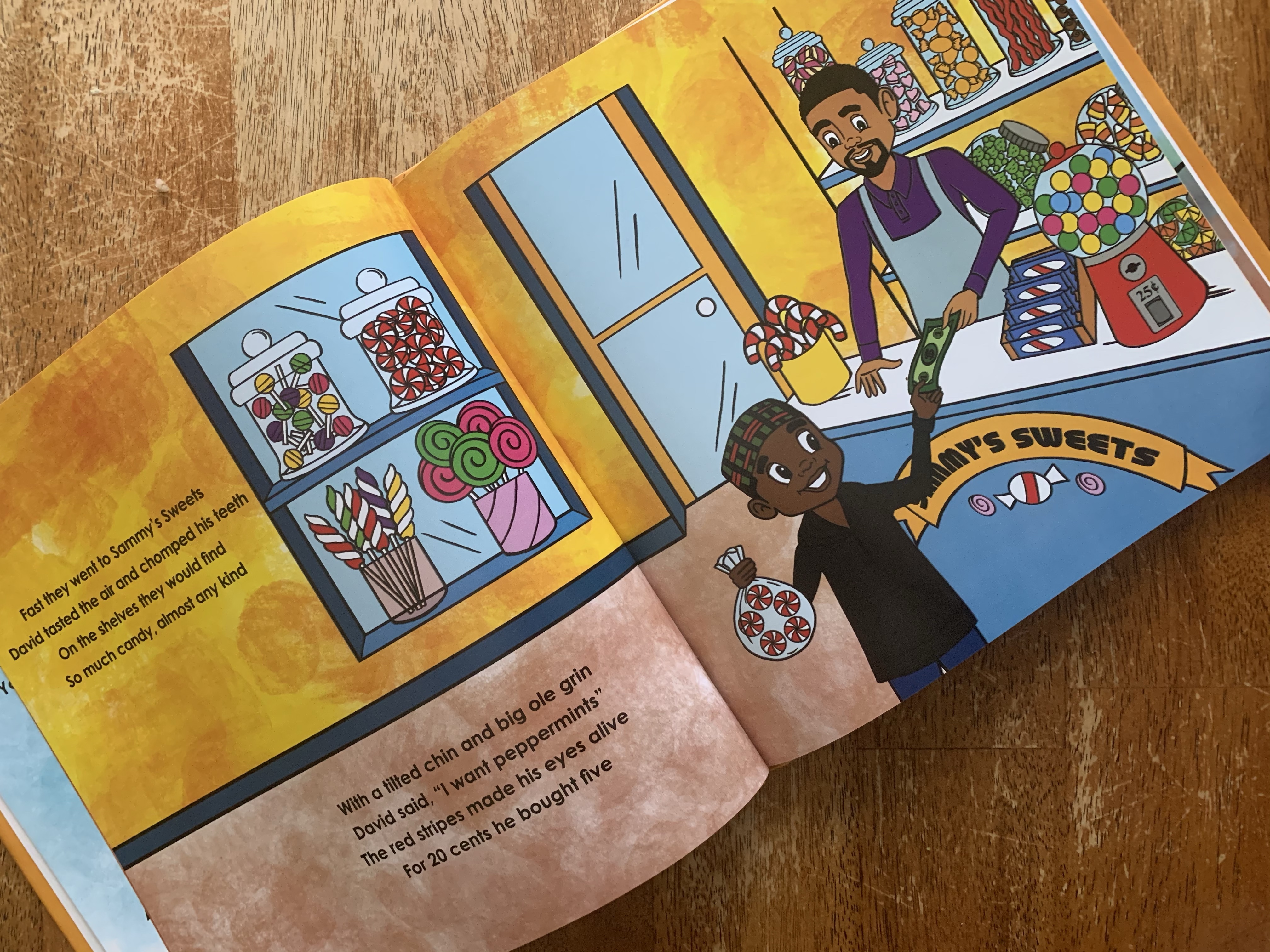
David is getting his dollar after doing his chores, and he is ready to head to the candy shop to see what to spend it on.  At Sammy’s sweets, he decides to get five peppermints, and just like that his hard earned money is gone.  He asks his dad where the money went and off they head to Mansa’s juice shop. When Sammy comes in and buys a drink, out comes David’s dollar and now it is in Mansa’s hands.

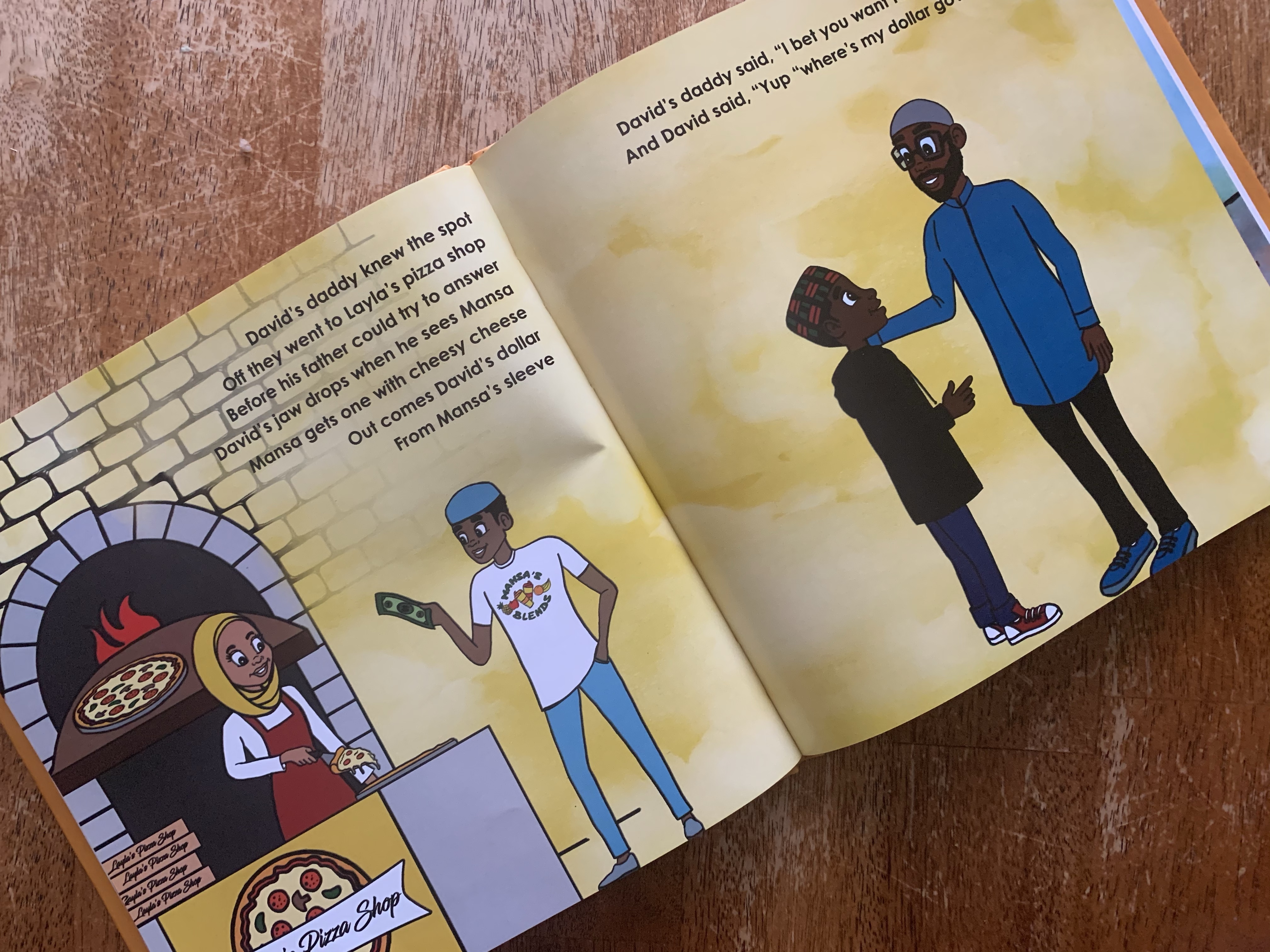
David and his Daddy follow the money and see it change hands at Layla’s Pizza Shop, and then Madame C’s Braids, before heading to Uncle Kareem’s hardware store where the dollar too has ended up.  It is time to pray so Uncle Kareem, Daddy, and David head to the mosque.

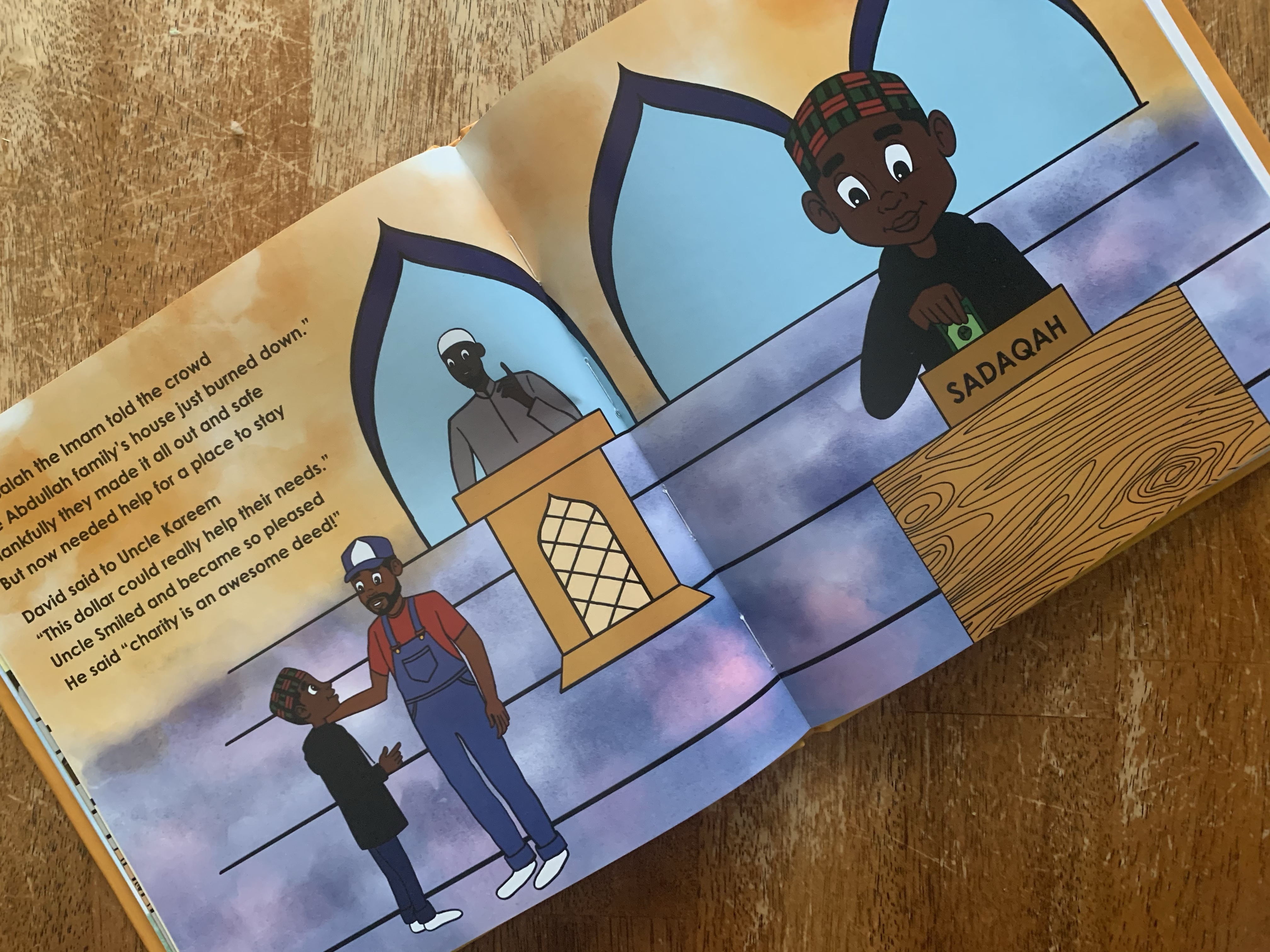
After Salah the Imam tells the crowd that a family’s house has burned down and they are collecting sadaqah.  David tells Uncle Kareem that that dollar should go to the family.  At night, David recalls all the places his dollar traveled and resolves to learn more math.

The book starts with a beautiful heartfelt gratitude message to Allah swt and the community of supporters.  The end of the book features a detailed bio of the book’s poet author and his successes and praises.

The story is rooted in an Islamic community, but is for all readers of all faiths.  There is no preaching or details about belief. many women have hijab on, there are Islamic names, they go to the mosque, they pray, and they give sadaqah.

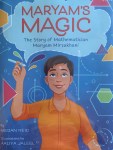
Maryam’s Magic: The Story of Mathematician Maryam Mirzakhani by Megan Reid illustrated by Aaliya Jaleel

Standard
Maryam’s Magic: The Story of Mathematician Maryam Mirzakhani by Megan Reid illustrated by Aaliya Jaleel

img_8776

This 40 page nonfiction biography is beautifully illustrated and informative.  I had never heard of Maryam Mirzakhani the Iranian born, first female winner of the Fields Medal.  Her life from loving stories and not liking math, to becoming a student and later a professor in the United States is remarkable and inspiring.  Second through fourth grade readers that both love and struggle with math will be drawn in to her unique way of looking at the world, and the math she found to serve as her magic wand in explaining it.  I don’t know if she identified as Muslim, while in Iran she was forced to cover, but when she left, she no longer did.  The illustrator is Muslim and religion aside, I am thrilled that a book like this exists, and that such a brilliant woman and her accomplishments can be presented to young readers.

img_8778

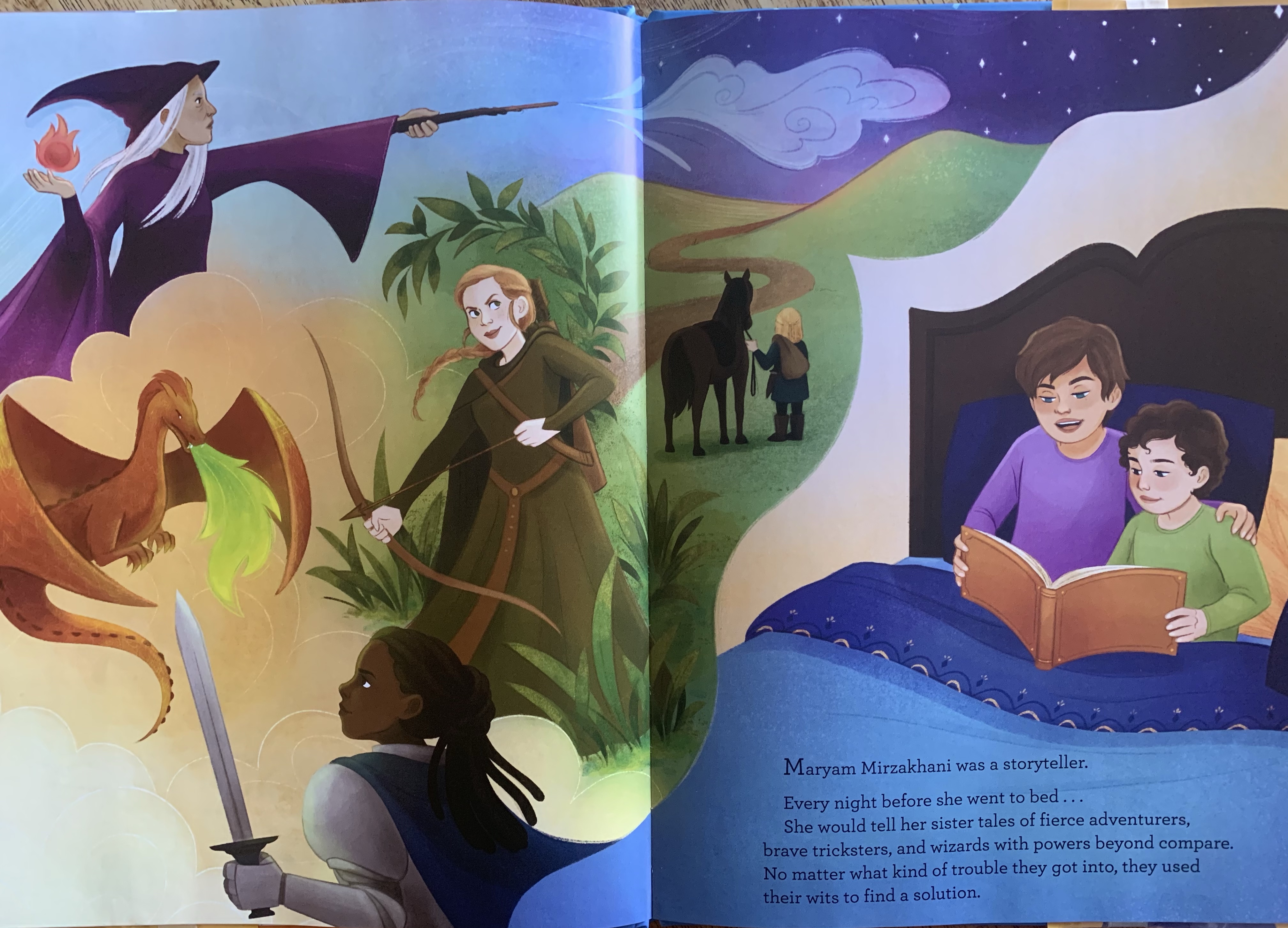
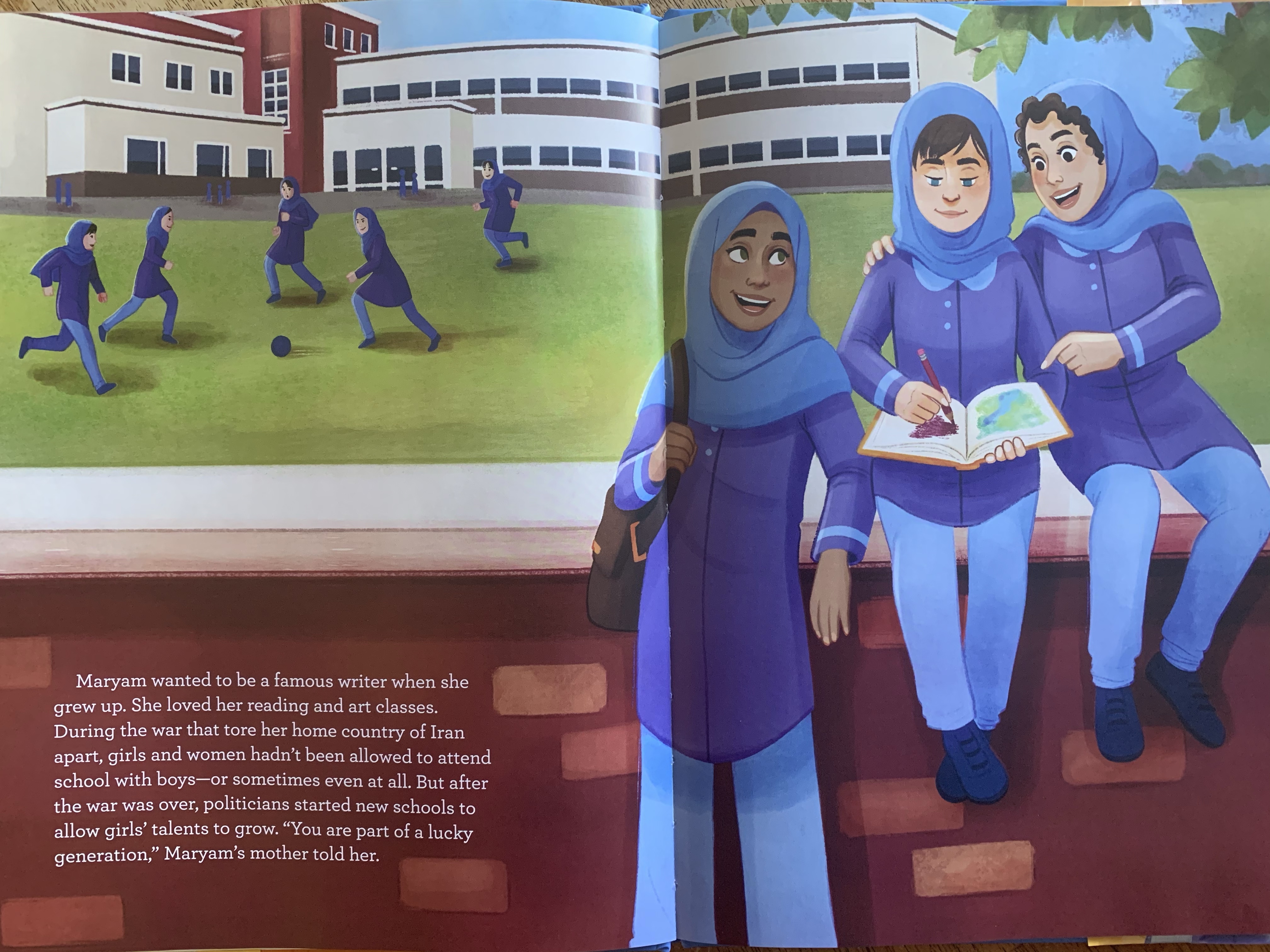
Maryam loves stories.  She reads them to her sister, her best friend Roya and her browse bookstores and dream themselves into plots of their favorite stories.  On the weekends she spreads long rolls of paper on the floor to draw and color her imaginary worlds.  She wanted to be an author when she grew up and knew how lucky her generation was to attend school after the war that tore her country apart.

img_8779

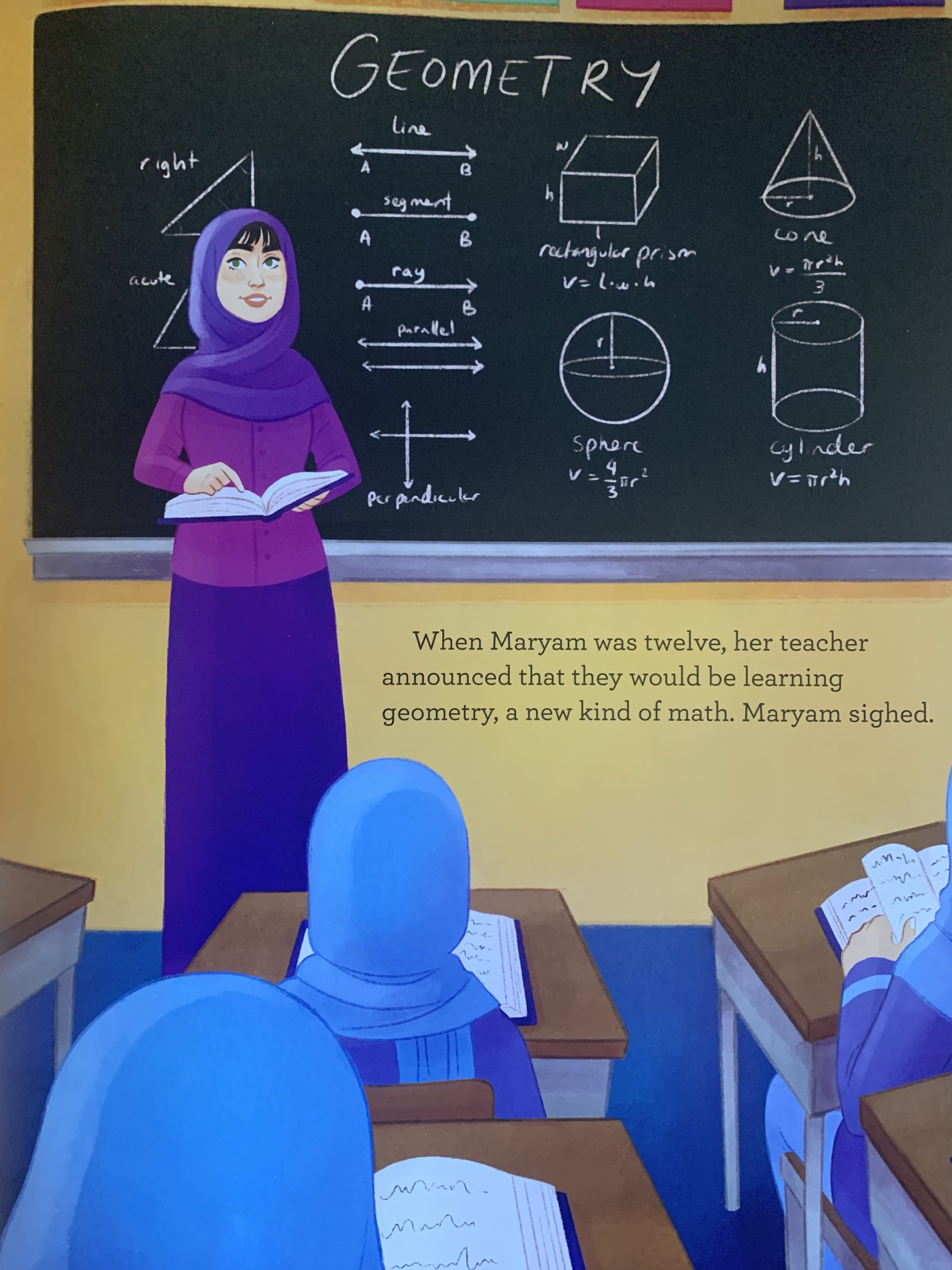
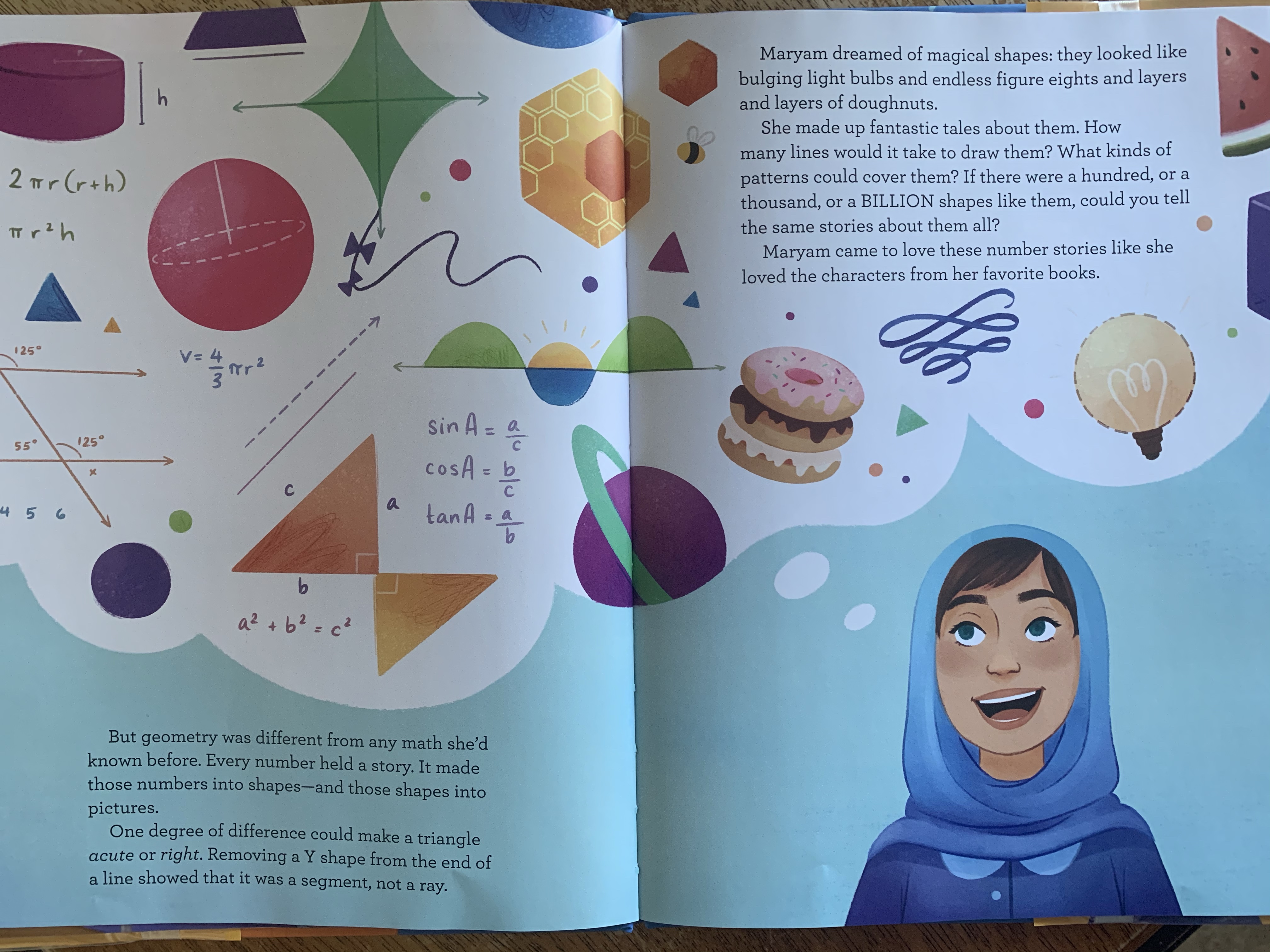
Math made her head spin, she would rather be doodling, but when she was 12 her teacher introduced her class to geometry.  It was different, the numbers held stories and the shapes were pictures. She made stories about the problems and wondered about them as if they were characters.

img_8781

In high school, Maryam and Roya entered the International Mathematical Olympiad.  The first year they received participation medals, but the next year, Maryam won the grand prize with a perfect score. She finished her schooling in Iran devoting her life to the stories that numbers told and left Iran to start graduate school at Harvard in the United States.

img_8782

When she had a hard time solving problems she would spread large rolls of paper on the floor and solve them.  Her daughter would tell people she was a painter.  She wanted to stretch the mind and how people went about solving equations.  She became a professor and a lecturer and one of her discoveries became known as “the magic wand theorem.”

In 2017 she passed away from breast cancer and the world lost a remarkable storyteller, mathematician and human.  The book concludes with an author’s note, important dates, and books to reference to learn more about Maryam Mirzakhani.

img_8780

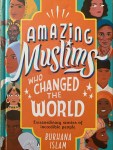
Amazing Muslims Who Changed the World: Extraordinary Stories of Incredible People by Burhana Islam illustrated by Reya Ahmed, Deema Alawa, Nabi H. Ali, Saffa Khan, Aaliya Jaleel and Aghnia Mardiyah

Standard
Amazing Muslims Who Changed the World: Extraordinary Stories of Incredible People by Burhana Islam illustrated by Reya Ahmed, Deema Alawa, Nabi H. Ali, Saffa Khan, Aaliya Jaleel and Aghnia Mardiyah

img_8359

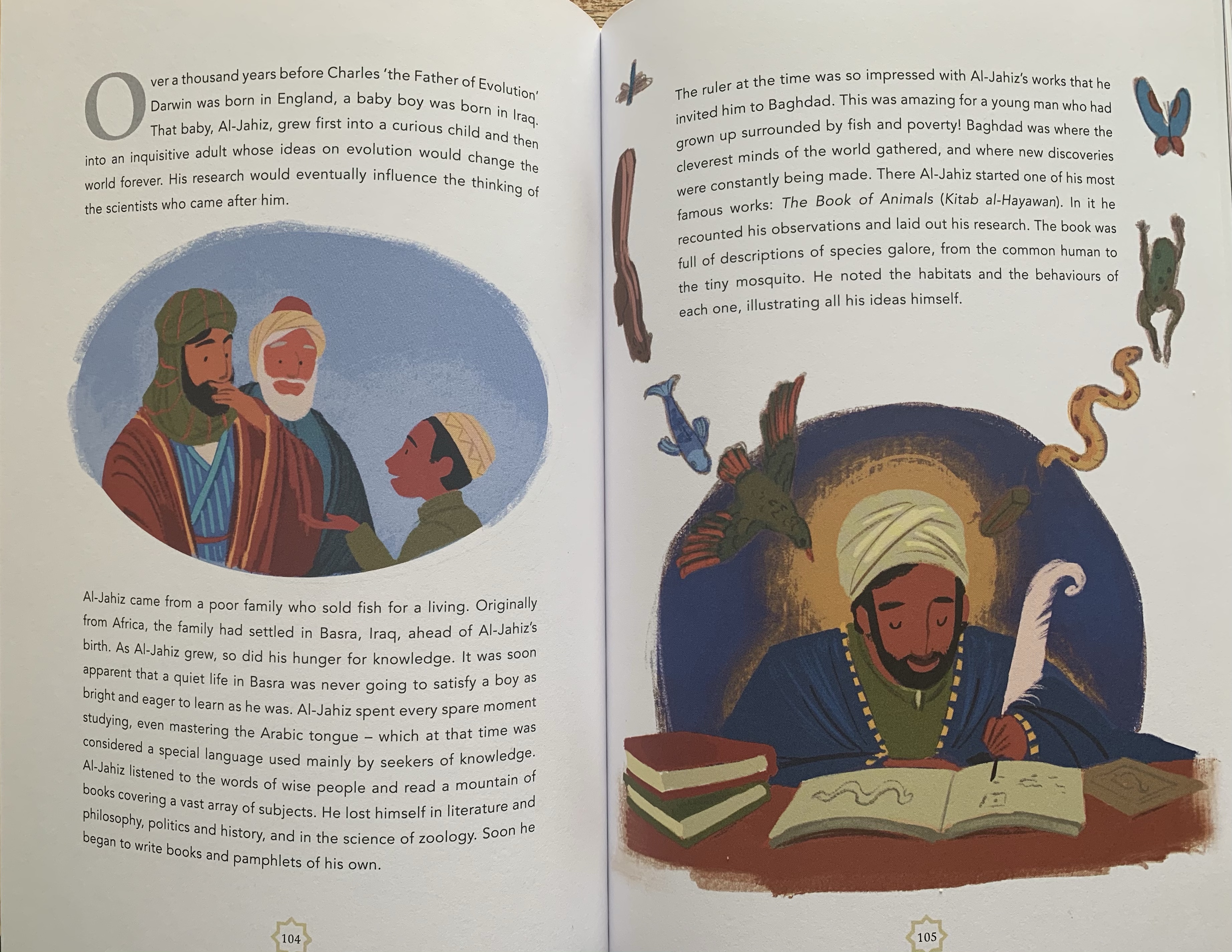
The 30 stories presented over 197 pages are inspiring, and this compilation so desperately overdue. The book is not chronological it is completely random, and at first I was confused, but as I made my way through the book, I actually grew to love not knowing who I would be reading about next.  Yes, there is a table of contents, but the point being that you don’t have to be born into royalty, or be a warrior, or have lived a long time ago to be amazing, you just have to follow your passion.  I learned so much about people I thought I knew about, and was tickled to learn about people I have never heard of: bakers, athletes, actors, educated slaves, architects, spies, singers, scientists and politicians.

img_8360

At the end of each six page illustrated blurb is an “Interesting Fact” and at the end of the entire book are some activities in the “Amazing Extras” section.  Readers can crack a code like Noor Inayat Khan who helped the Allies decode and send secret messages from France to Britain or write a poem like Rumi, a song like Yusuf Islam (Cat Stevens), draw a superhero like G. Willow Wilson, make a camera following the science of Hasan Ibn Al-Haytham, or color a picture of Muhammad Al-Idrisi.

img_8361

My favorite biographies were those that I knew little or nothing about before hand.  If I had to pick two favorite among all of those sections, I’d pick Khawlah bint Al-Azwar and Ayuba Suleiman Diallo.

img_8362

In 600 CE Arabia, Khawah, the masked knight, learned how to fight along side her brother and eventually served with Khalid ibn Waleed in battle.  It is said that she killed the Byzantine leader that captured her and then asked for her hand in marriage.

img_8365

Ayuba Suleiman Diallo in the 1700s in modern day Senegal was a highly educated man who was captured and forced in to slavery in Maryland, USA, interacted with James Oglethorpe, found himself being sent to England and with the help of a Thomas Bluett was able to be freed and eventually return home a free man. SubhanAllah!

img_8363

This book has it all: famous Muslim men, famous Muslim women, Black Muslims, Arab Muslims, European Muslims, American Muslims, Asian Muslims, African Muslims, Muslims who lived a long time ago, Muslims who are still alive all jumbled up and beautifully presented by a Muslim author and a handful of Muslim illustrators. This book is wonderful for 3rd graders to adults and would be a benefit on any book shelf.  It is worth noting there are no sources given, and doesn’t explain how the people were chosen to be included in the book.

Solar Story: How One Community Lives Alongside the World’s Biggest Solar Plant by Allan Drummond

Standard
Solar Story: How One Community Lives Alongside the World’s Biggest Solar Plant by Allan Drummond

Set in Morrocco, the fictionalized framing of a children’s story about solar energy and sustainability at the the world’s largest solar plant in Ghassate will appeal to curious children in kindergarten and up. Told through the every day life of Jasmine, a little girl living near the plant, the concepts are not technical, but give a broad overview allowing readers to understand how impressive solar energy is, as well as the disparity that exists in the world. Over 40 pages with factual sidebars and an author’s note at the end, children who enjoy the story and are curious about the reality of it all will find an easy opportunity to learn more.

Jasmine and her friend Nadia live in Morocco between the High Atlas mountains and the huge Sahara desert. It is always sunny where they live.

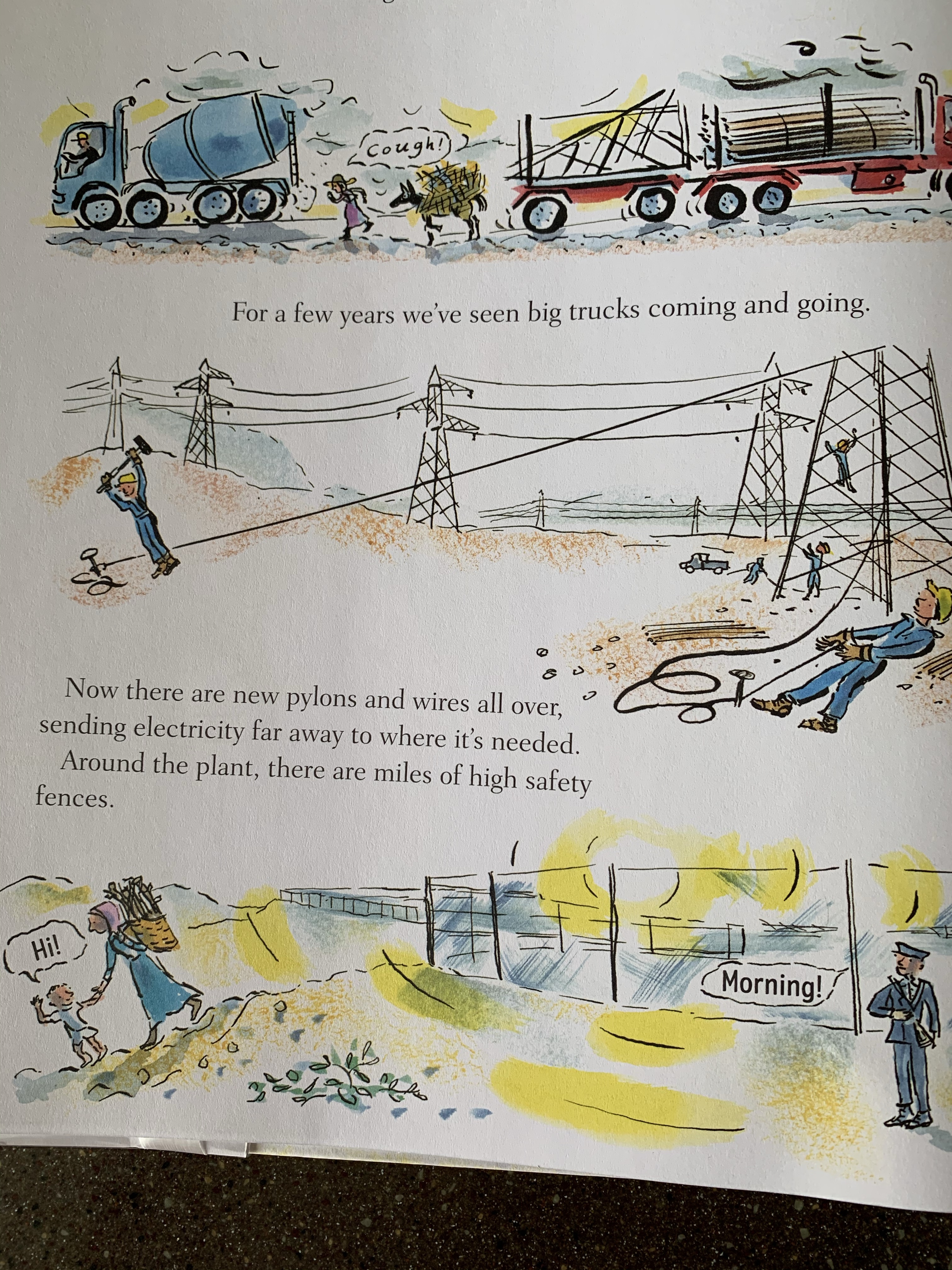
They talk a lot about making energy from sunshine as they watch trucks going and coming from the world’s largest solar plant. Their teacher likes to ask them about the big changes happening in their world.

As the villagers tend to their sheep and cows, they cook on open fires and bake bread in clay ovens all while keeping an eye on the workers making the largest solar tower in the world. Jasmine’s dad rides a mule to work and many classmates parents work at the state of the art plant. The contrast is obvious.

The next day at school Miss Abdellam the teacher asks the students about sustainability. And the book doesn’t define the concept right away. First the class goes on a field trip to the solar plant.

At the plant the size of 3,500 soccer fields they see the 660,000 mirrors that follow the sun like sunflowers and bounce the rays to the 800 ft tower. The tower gets to a thousand degrees on top and heats water whose steam powers turbines and is turned into electricity.

The kids go home to work on their sustainability homework. With no internet or computers even, they have to think for themselves. The remaining pages define and provide examples of how solar power is changing life for the villagers and improving life for people not just in Morrocco or Northern Africa but potentially the entire world.

I love that the concept of sustainability isn’t just a definition it shows how it is in every day things, and those every day things lead to big things that are both tangible and ideological. The author/illustrator acknowledges his own surprise and bias when he learned that the largest solar power plant was in Nothern Africa. I love that some of the females wear hijab, and some do not, and that the teacher and some of the parents at the solar plant are female. There is nothing religious even mentioned in the book, but the visibly Muslim characters are empowering and honest for a story about science and Morocco.

The World is Not a Rectangle: A Portrait of Architect Zaha Hadid by Jeanette Winter

Standard
The World is Not a Rectangle: A Portrait of Architect Zaha Hadid by Jeanette Winter

rectangle

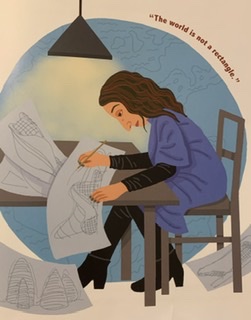
This non fiction book spread over 56 pages on an AR 4.0 level is the biography of the famed Iraqi architect’s inspiration, triumph over obstacles and accomplishments.  It doesn’t go in to great detail of her life, but gives enough information for children to become familiar with her and be inspired by all that she accomplished not only as an Arab, Muslim woman, but as an architect and trail blazer of design and structure.  The pages are beautifully illustrated and the simple text flows and dances around the pages like her buildings in real life.

0BE54CFC-BBDB-4507-9DDA-FDA54576B014

Born in Iraq where rivers flow, wind swoops across sand dunes, and cities existed thousands of years ago, Zaha finds designs and shapes throughout her home and the city of Baghdad.  She has ideas about arrangements of furniture and designs of clothing, she loves that dunes and rivers and marshes don’t have corners.

CEE97AF8-91A3-46AC-A63E-E3484F1790B1

She is a Muslim that attends Catholic school and loves math.  She goes to London for college to study to be an architect. She is relentless in her passion and fills notebooks with plans, paintings with what she sees in her mind and graduates with honors.

94EC3F0A-2584-4786-9FF8-9FE173CB04A5

She opens her own office and with a few friends, she designs buildings that swoosh and zoom and flow and fly.  The world is not a rectangle, but unfortunately no one wants to build her designs.  She keeps entering competitions, and winning, but they refuse to build her buildings.

FE2B9584-E1C6-4B19-94B8-9684A9F6BC0C

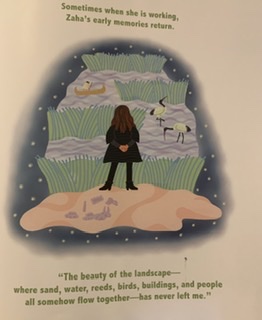
She designs buildings that come from her memory of grasses swaying, and wind blowing over dunes, and shells being cradled.  She designs an opera house like a pebble in the water, with the singer the pearl.  A ski jump that reaches the sky like a mountain.

91BAFF18-340B-4334-B856-5984A4CF1060

One by one, Zaha’s designs become buildings all over the world.  She has over 400 employees and designs buildings, shoes, doll houses, furniture, she does what she likes and urges others to do so as well.  Zaha passed away in 2016, but her visions are still carried out.


Mae Among the Stars by Roda Ahmed illustrated by Stasia Burrington

Standard
Mae Among the Stars by Roda Ahmed illustrated by Stasia Burrington

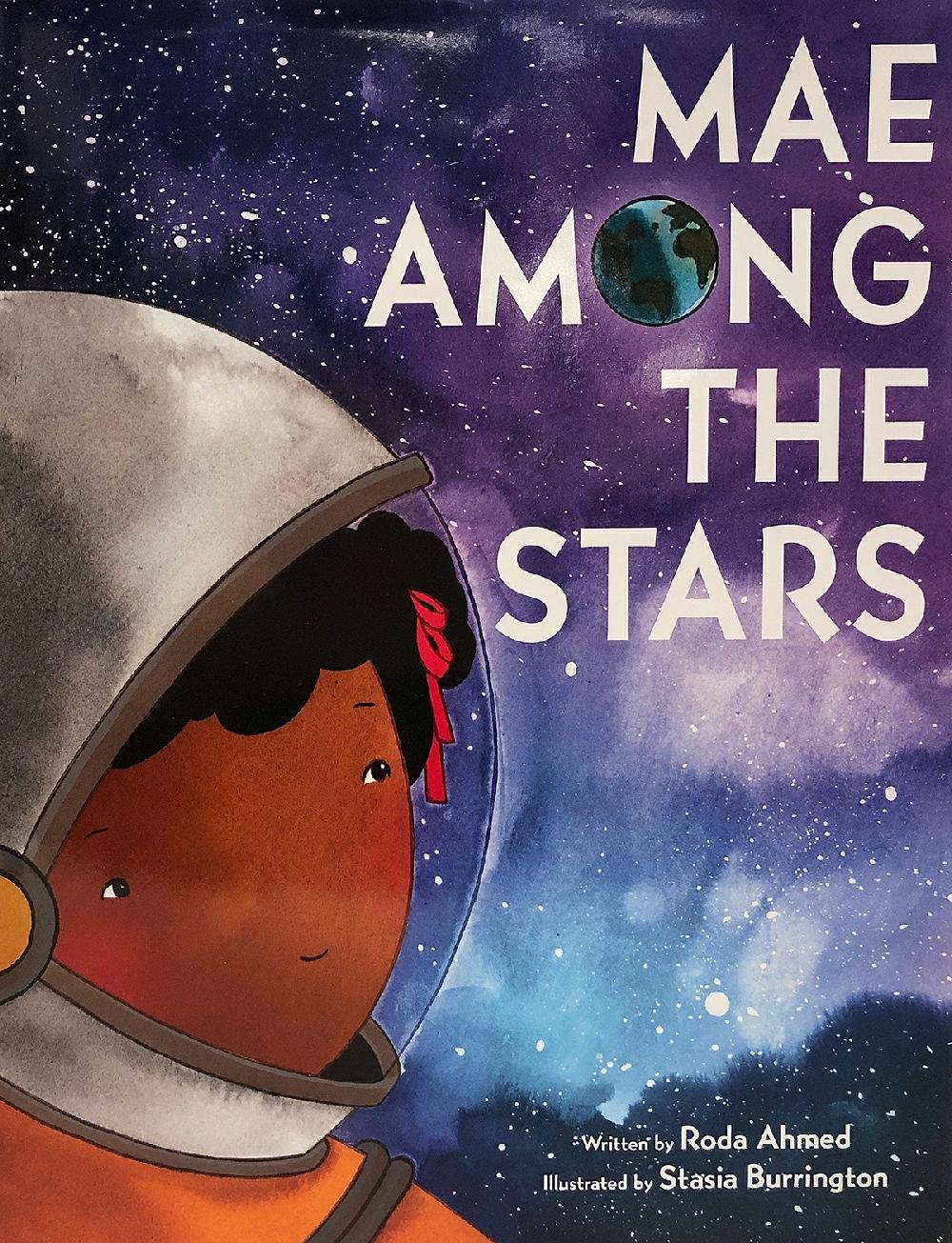
mae

Inspired by the early life story of astronaut Mae Jemison this 36 page AR 3.0 children’s picture book is inspiring and encouraging.  It is not a biography of the first African American woman in space for children, infact with the exception of the note at the end, there really are very few specifics about how she went from being discouraged by a teacher to flying in outer space.  That isn’t to say the book isn’t beautiful and impressive, because it is, and it shows how no one should limit your dreams or your success.  The book radiates warmth and determination and for children, preschool to third grade, if desired, offers a way to start a discussion about racism and sexism all while celebrating the amazing accomplishments of Mae Jemison.

9291EB01-47EA-42C7-AE9A-2E2601245176

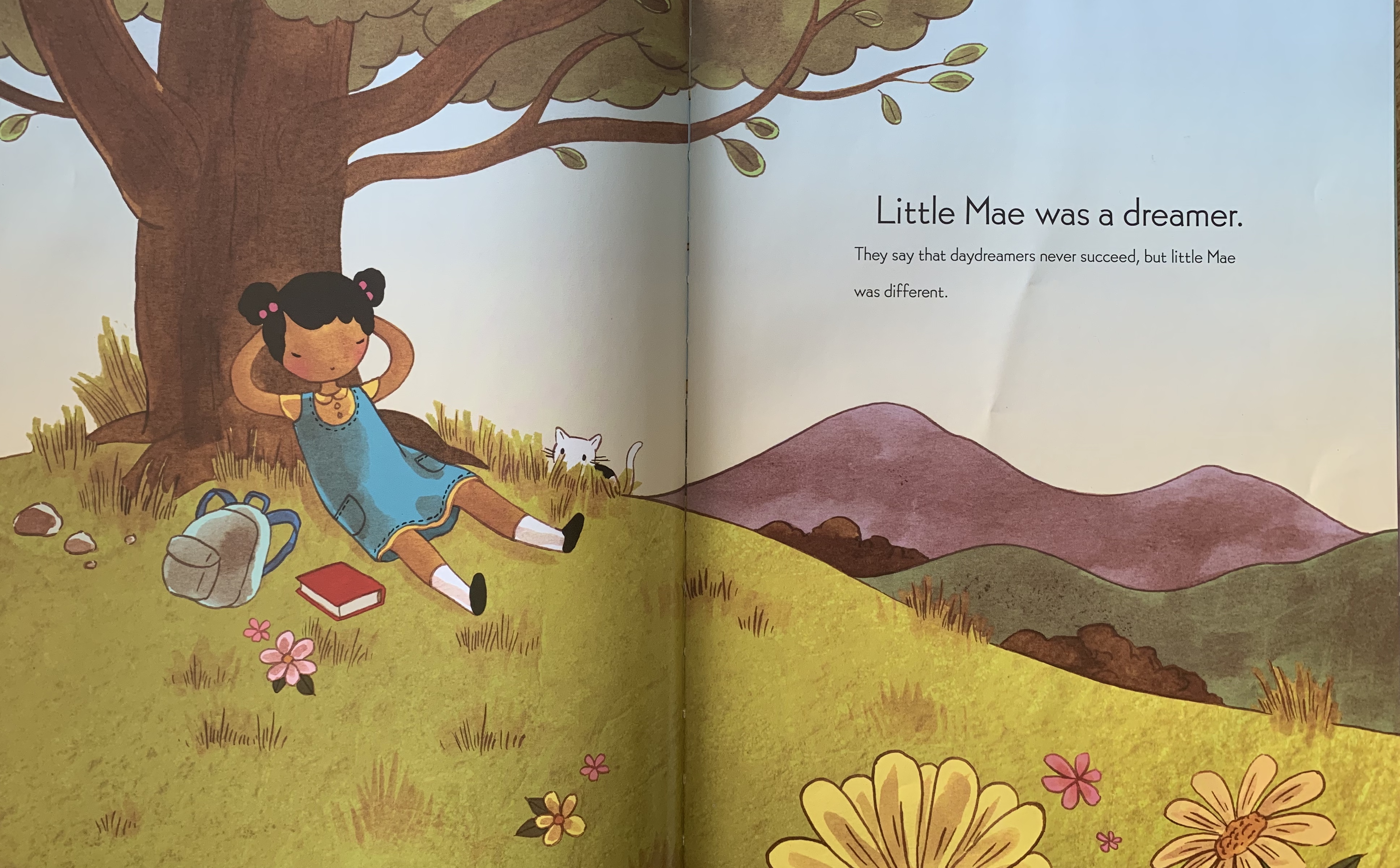
Mae is a dreamer and her homework one day asks her what she wants to be when she grows up, she tells her family she wants to see the Earth from up there, pointing to the sky.  Her mom tells her that she will have to be an astronaut to do that.  Nervous that it might be too lofty of a goal, her family reassures her that if she can dream it and believe it and work hard for it, that anything is possible.

ACD1927E-46F4-4525-84D9-4D1D4479B261

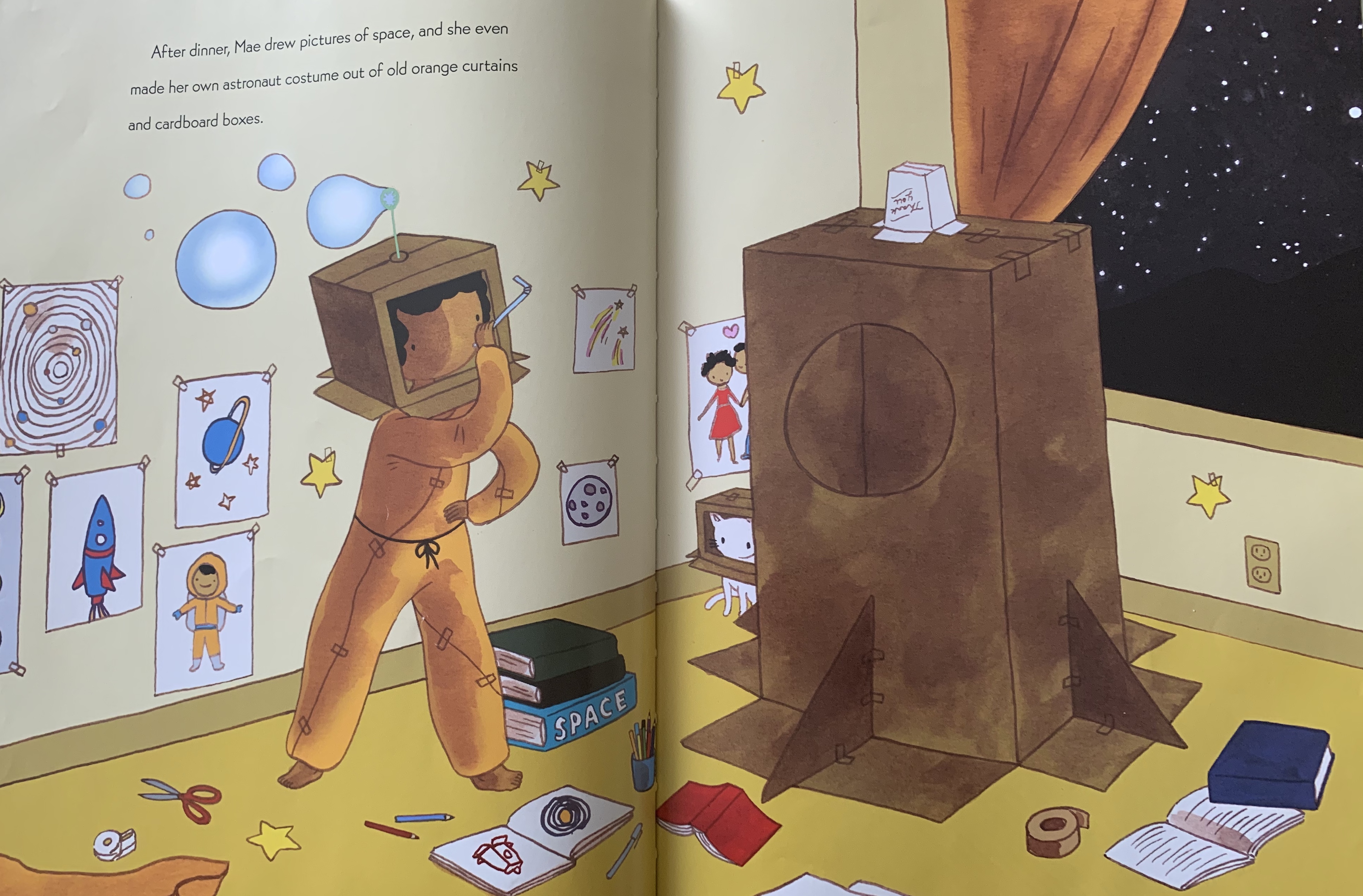
From then on, Mae reads books about space from the library, plays pretend, and makes herself a space suit from old curtains and a cardboard box.  She dreams about being in space and looking back at Earth, and she tells everyone she can about her dream to be an astronaut.

869AD060-D37E-4B8A-AB1A-C77F1E92A68C

At school when the teacher asks what everyone wants to do and be in the future, Mae’s answer gets her laughed at.  Ms. Bell tries to encourage her to be a nurse instead.  Once home, Mae breaks in to tears that her teacher didn’t believe in her.  Mae’s mom tells her that her teacher was wrong and that she hoped Mae didn’t believe her.  She told Mae that no one could stop her from pursuing her dreams.

EC432DA0-0032-45F8-B22D-9017DD033DAE

With her family’s unwavering support and a lot of hard work, Mae goes to space. The book ends with her keeping her promise of waving to her parents and looking down on Earth.

958EA75A-98CD-4FD0-9AA0-5091A9E06B65

The book touches on a lot of powerful issues that I really hope adults will point out and discuss with their children.  Why her teacher didn’t think she could be an astronaut, not as a belittling of the nursing profession, but as a woman of color what would make her teacher think that was her best option.  When and how should we handle when teachers, or people in authority,  do or say something that we disagree with. I also hope that the note at the end that tells more about Dr. Jemison’s accomplishments is poured over again and again and again and appreciated.  Truly she is a hero!

4532F757-FC28-41E8-AB6B-D548B60DB1BB

There is nothing Islamic in the book, I’m assuming the author is Muslim, but honestly I didn’t find anything in my Google searches that would indicate that she is or isn’t.  It is really just my assumption about the name and my wanting to share this inspiring story with beautiful illustrations with the people who frequent my blog.  Enjoy!