Category Archives: Picture book

Dear Moon: Inspiration from the Beautiful Wisdom of the Qur’an by Zayneb Haleem

Standard
Dear Moon: Inspiration from the Beautiful Wisdom of the Qur’an by Zayneb Haleem

img_8075-1

At 128 pages, this hard back 7.5 x 8.5 inch book is a beautiful book from start to finish.  If you follow the artist online (@idotdoodle), you know her style and her incorporation of an ayat from the Qur’an or an Islamic sentiment with her signature young girl and nature embellished scenes.  But holding the book in your hands, and pausing on the two page spreads to reflect, and ponder, and be reminded to connect with the love of your creator, is truly a treat. Whether you read it from start to finish, or dip in and spend time with just a few pages at a time, the book will capture the attention of all ages and be enjoyed over and over again, alhumdulillah.

The book starts with a welcome to the reader from the artist, introducing herself, her connection to Islam, her love of art, her expression of emotions through her illustrations, how she picked the verses, where her own thoughts and reflections emerged from, and what she hopes the book will accomplish. 

The book releases in February 2025 and is available wherever you purchase your books.  I hope you will consider preordering to show your support.

Doctor Bear and Helpful Bunny: The Travelling Dentist by Emma L. Halim & Her Mum Mary Tucker illustrated by Alissa Mutiara

Standard
Doctor Bear and Helpful Bunny: The Travelling Dentist by Emma L. Halim & Her Mum Mary Tucker illustrated by Alissa Mutiara

Sometimes you just need a sweet little story about a traveling (sorry one l I’m not British) dentist going under the sea to help a hammer head shark with a toothache.  This rhyming story for toddlers is perfect for the demographic as duas are said to get through the pain and fear and the reliance on Allah swt that all will be well.  The Muslim animals and the fun illustrations make the story appealing whether your child is afraid of the dentist or not, and the focus on the duas in the backmatter, makes the book a good tool for repetitive use.  It is worth noting that their are 32 pages in the book, but the story is only 20 pages.  There is a glossary, multiple dedications, scanable codes for activities, ads for other books, duas, sources for duas and author bios in the back.

The book starts with Doctor Bear and Helpful Bunny introducing themselves as traveling dentists for all animals, even those under the sea.  When they get a call from Sonny, they set an appointment time, gather their gear on a boat and then head underwater to the shark village.

Sammy is glad they are there, as he is in pain. They clean his teeth, but need to remove the wiggly one, and that scares him.  He says a dua and before he knows it the huge tooth is out, alhumdulillah.

The book then has a two page spread about duas that help when you are “feeling funny inside” in Arabic, English transliteration, and their meanings in English.  A fun book with a great mix of story, silliness, education, and heart.

Different Together by Ayesha N. Rahmaan illustrated by Rizkia Gita

Standard
Different Together by Ayesha N. Rahmaan illustrated by Rizkia Gita

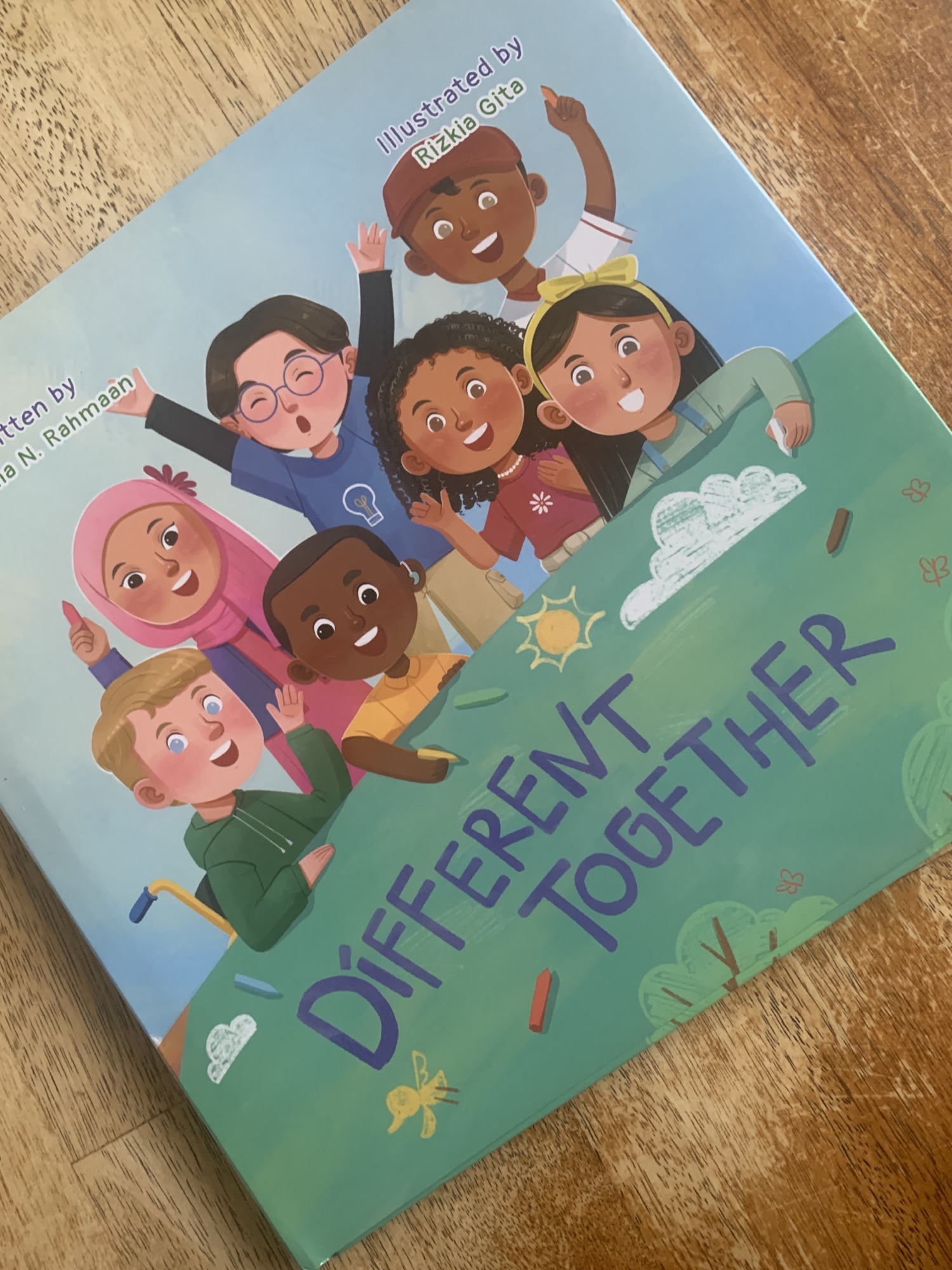
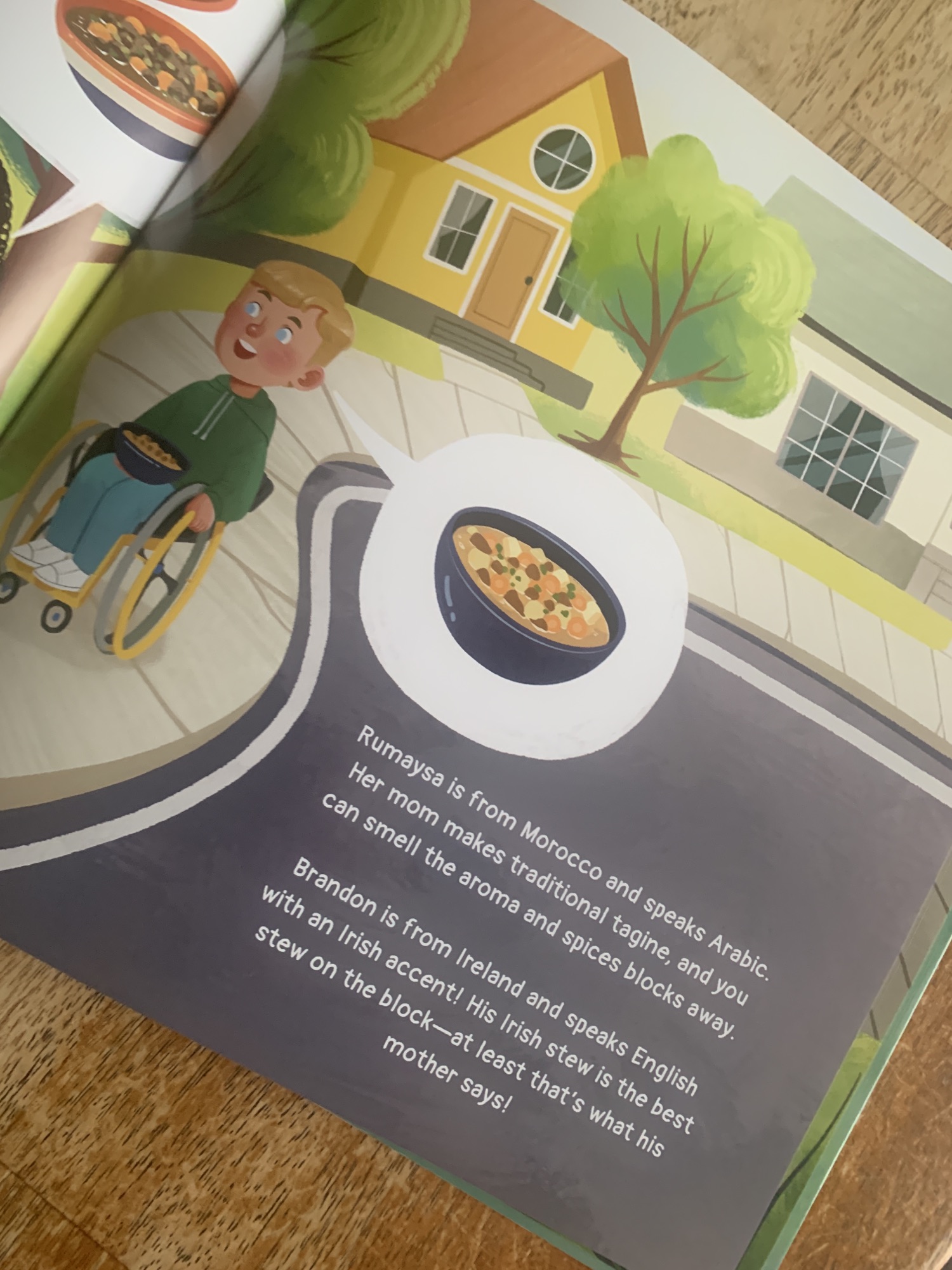
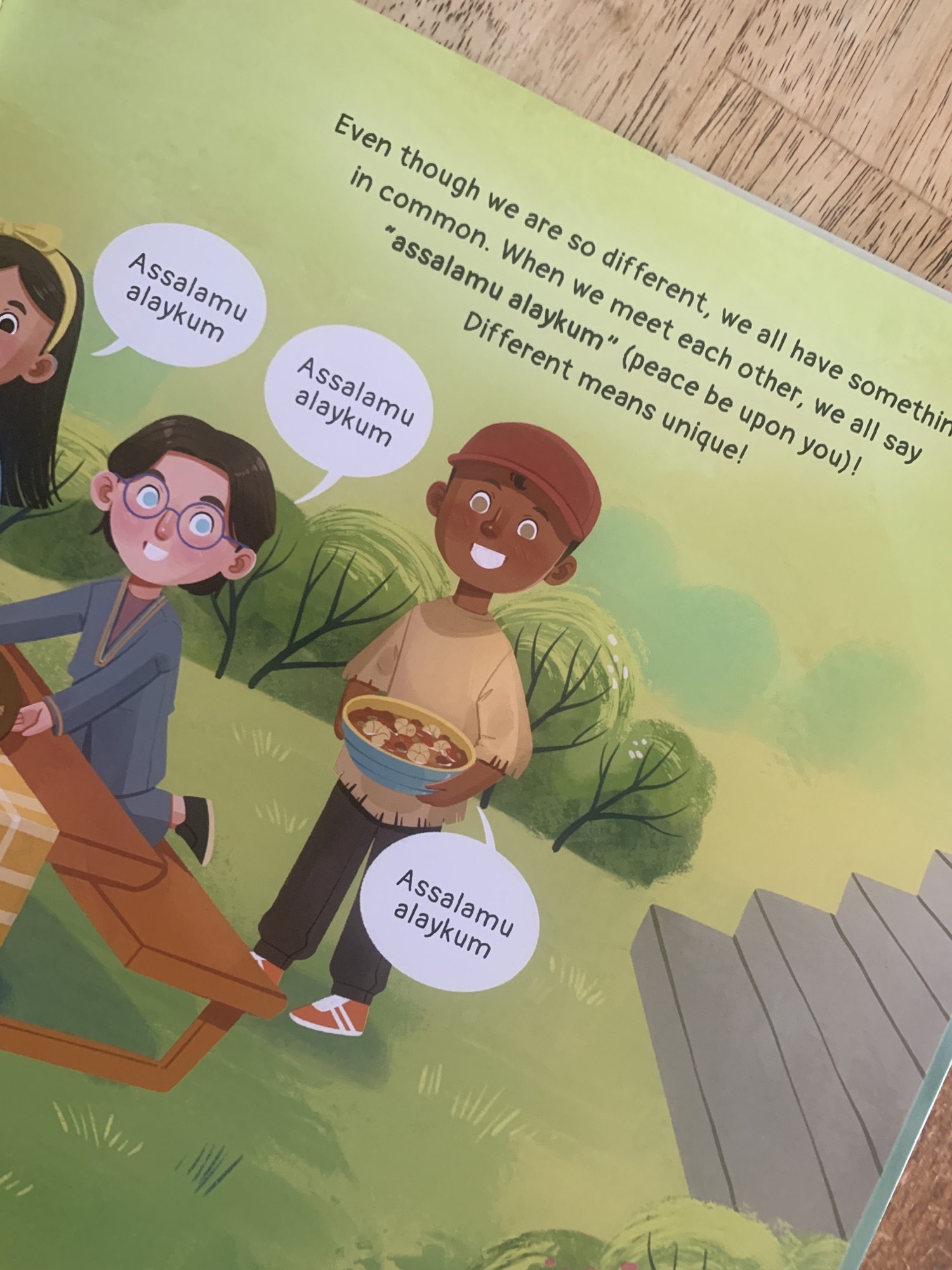
This 32 page large 10 x 10 hardback book explores how we are all different and unique, while also being the same too.  The illustrations and text present a nice way for children to learn that Allah swt created us all to be different in our appearances, what foods we like, how we dress, how we speak, but come together to all say Assalamu alaykum and stand foot-to-foot to pray.  Some of the refrains are a bit abrupt, and it really focuses a lot on physical descriptions and food, the target audience though of preschool to early elementary, will see themselves in the book, probably even a character that looks like them, and expand their understanding of al-Khaliq creating them all.


The book starts with an ayat from Surah al-Hujurat and then starts by asking the audience to imagine a world were everyone is the same.  It highlights that Allah created each of us starting with prophet Adam (as) to be just as we are, with different traits. From there, neighbors are introduced: their names, country of origin and favorite foods that all come together to make a table of sharing.

In school the students look different and play different, in the city the different building types are shown to come together, and in the masjid our hearts are in sync when we pray. The text concludes asking the reader to highlight five ways they are unique and a hadith in Arabic along with its English translation.

The Gift of Eid by Shifa Saltagi Safadi illustrayed by Aaliya Jaleel

Standard
The Gift of Eid by Shifa Saltagi Safadi illustrayed by Aaliya Jaleel

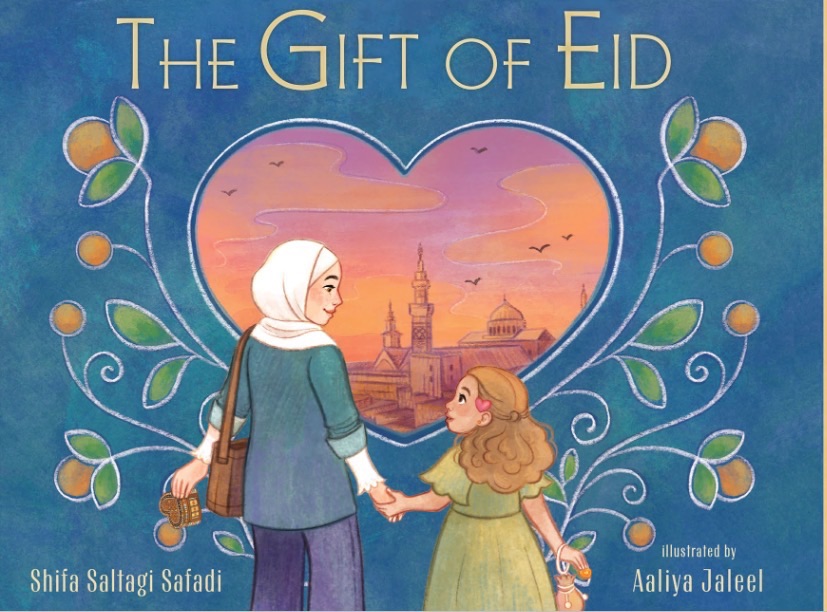
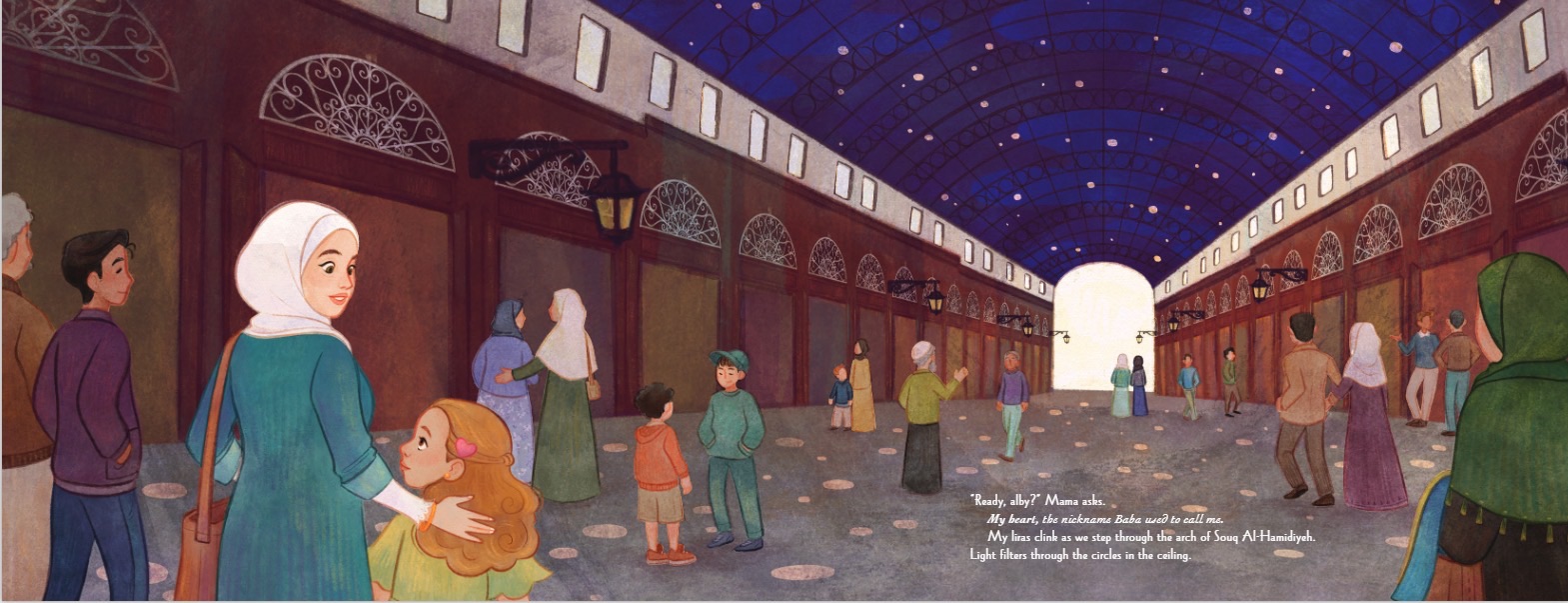
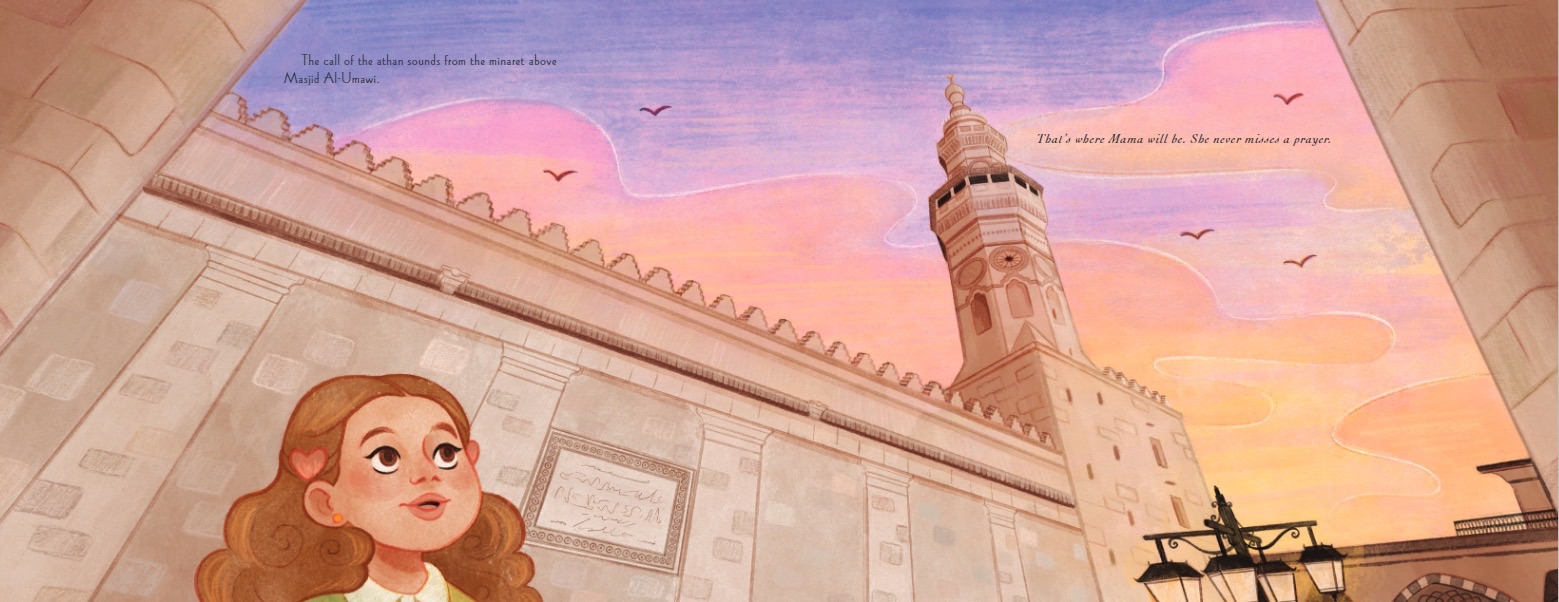
With heartfelt words and large two-page spread illustrations, this beautiful book shares a mother and daughter finding the perfect Eid gift for one another while bringing the reader into the Souq Al-Hamidiyeh, before sending them off to Masjid Al-Umawi for a warm hug.  A retelling of the classic, A Gift of the Magi, the story poignantly presents threads of love, gifts, loss, and Eid to fill the reader with joy, peace, and gratitude.  I’m admittedly very bias, as a close friend of the author, but this beautiful book doesn’t need lip service or marketing, it will appeal to all readers in all settings, and be cherished and asked for, over and over again, all throughout the year. Alhumdulillah.

The book starts with Yasmine and her mama entering the souq through the archway, and Yasmine remembering her father and her imagining the circles in the ceiling to be twinkling stars.  He is no longer with them, the magic is gone and money is tight now, but with liras jingling in her pocket, Yasmine is determined to find an Eid gift for her mother that will make her smile.

Yasmine looks around the shops as her mother counts out liras to buy za’atar, and tries to find something cheaper than sfeeha at the bakery.  She finally knows what to get her mother, but it is more lira than she has.  With determination and selflessness she makes a decision to get her mama the perfect gift.

The process separates the two, and when they reunite at the masjid for maghrib salat, it isn’t the gifts themselves, but rather what they mean, that make the laughter, tears, and love overflow.

I love the emotional depth the book conveys so deftly, never explaining or pulling the reader out of the story, thus allowing the connection to linger long after the book is closed, a rare treat in a picture book.

First Words from the Qur’an by Jenny Molendyk Divleli illustrated by Sena Aydogan

Standard
First Words from the Qur’an by Jenny Molendyk Divleli illustrated by Sena Aydogan

img_7527-1

This large, LARGE (10 x 13.5), 16 page board book is joyful and informative for our little Muslims to look through.  Each two page spread starts with a topic that is followed by an ayat from the Quran and then adorable illustrations are splattered around with comments, questions, facts, or definitions.  In some ways it reminds me of the Richard Scarry books that don’t have a story, and don’t have to be read front to back. You can, or you can just pore over the pages and point things out to your little ones.  The book also helps caregivers that might not do voices and Broadway style productions at story time, by offering little prompts with each picture that allow the child to engage, have their attention directed, or offer up their connections in an intuitive manner.  The size and quality definitely make the book stand out on the shelf, and I think for babies to early elementary the Islam centered focus will appeal to more than just toddlers.

The book features Animals in the Qu’ran, Plants in the Qur’an, People in the Qur’an, Nature in the Qur’an, Places in the Qur’an, Objects in the Qur’an, Blessings int he Qur’an, and  Color’s and Shapes in the Qur’an. The last page features a baby safe reflective “mirror.”

The Boldest White: A Story of Hijab and Community by Ibtikhaj Muhammad and S.K. Ali illustrated by Hatem Aly

Standard
The Boldest White: A Story of Hijab and Community by Ibtikhaj Muhammad and S.K. Ali illustrated by Hatem Aly

The third and final book in the standalone series is finally out and I absolutely love that Islam, salat, and the masjid are front and center. Faizah is once again brought to life through the incredible illustrations that provide all the emotional beats and make the book memorable.  The story though is only just ok, to be honest, it is clunky and disjointed.  I have read the book a half a dozen times to myself and twice aloud and I do not understand the Eid story line.  I doesn’t fit the themes of fitting in, being a leader, being bold, it just seemed to be there to motivate a white hijab being purchased, and it was very distracting to the cadence and continuity of the story. Every time Faizah is self reflecting on her fear, suddenly a conversation about Eid with a friend named Sophie disrupts the story. Even the refrain that “Bravery grows in your mind.  But its roots are in your heart,” sounds lovely, but is never explained or developed, so what are you to water it with? What are the right reasons?  I’m sure most will be fine with the concepts and presentation and not be bothered, but this book is an auto buy for Muslims and non Muslims alike, and while I appreciate the packaging, I wish the story itself was more, well “Bold.”

The book starts with Faizah going to Jummah with her mom and sister, and loving being part of the crowd, she then goes to fencing and loves being part of the crowd, “it feels right.  I feel right,” she says.  But then the coach calls her name and she starts to worry.  She doesn’t like when people stare at her, she worries she did something wrong. The coach has already reminded her to “saber first, then move forward,” so I’m not sure why she worries after if she did something wrong, it is a class, reminders and corrections are what happen in a class.

Then on Sunday, the trio is back at the masjid for salat before Asiya’s fencing lesson.  The coach asks Faizah if she wants to come in for extra practice before the tournament.  Faizah isn’t planning on participating in the tournament though and would rather think about Eid.  Thinking about getting together in the future with Sophie to pick out Eid clothes, is more fun than fencing.  The reader doesn’t know when Eid is, or why Faizah seemed to break into a day dream when asked about fencing.  Furthermore the reader doesn’t feel the worry of being in a competition because Faizah is not shown to be worried.

Later that night Asiya teaches Faizah the moves she learned and Faizah practices alone.  There is then a two page spread that I do not understand, on one page she is saying, “When no one is watching, I ‘m the best fencer in the world,” three lines later it says Even when others are watching, I can do it.  I can be the best.”  What happened in between? I get the following line, “but it’s hard to be my best when I have to stand out to do it,” but the the line in the middle makes no sense.  What is the point of the book if she can do it and knows it at the mid point?  And no, I’m not reading an arc, I checked out this copy from the library.

The family is back at the masjid on Friday and reassuring Faizah as they head to fencing, that she can do it even when people are watching, that bravery will come.  She hasn’t been nervous at class before, and hasn’t signed up for the tournament, so why is she suddenly uncomfortable, when at the start she loved fencing class as she felt she fit in.

Then it is Saturday, and Sophie finally comes, but not to prepare for Eid, just to discuss, how they will prepare for Eid.  At least now we know it will be next week. The next Friday, I know I feel like a calendar should have been included, it is fencing class again and Faizah is called up to demonstrate.  She finds her strength and she is shy, but realizes they are not just looking at her, but looking at what she can do.  She is leading, she is helping, she is being brave.

Finally it is Sunday, and Sophie and Faizah are at the hijab shop, and Faizah picks a white hijab because it matches the fencing clothes, and she is going to the tournament.

Yeah, sorry I spoiled it, I just really am sad that the book wasn’t as great as it could have been.  It connected the dots eventually, but not in a memorable way, and for the team responsible for this book, it really could and should have been amazing.

My Olive Tree by Hazar Elbayya

Standard
My Olive Tree by Hazar Elbayya

img_7154-1

I love that this author illustrator traditionally published book shows the ways that olive trees and their fruit connect people.  The little girl, Salam, can’t wait to grow her very own tree, but it takes a while, and when it finally sprouts, it is trampled by soldiers.  Heartbroken to lose her plant, her community shows her how they are like their beloved olive trees: their roots are deep, and they are a part of the land.  The tender illustrations, the poignant symbolism, and the love and unity that radiates through, makes this book an important read for children and adults of all ages and backgrounds.  There are no countries mentioned in the text (Palestine appears only in the author’s note), nor any religion, there are visible Muslims in the illustrations, even the soldiers are unnamed, but the setting is clear.  Picture books take years to be published and that it released at this point in history, shows how long the struggle for freedom has been taking place, and how strong and resilient Palestinians are.  This book that will be read over and over, shows even in the sadness, the feeling of hope abounds.

The book starts with Salam noting how old her grandpa is, and that only the olive trees are older than Sido.  Sido then explains to his granddaughter how the olive trees connect them all: farmed, picked, pressed, oil used to cook, olives sold to eat, added to dishes, and made into soap.  Salam goes to plant her seed and be part of the connection. She waters it and waits, but it doesn’t seem to be growing.
Finally a spout, and then a little plant, and then the soldiers march into their lands and destroy everything in their path, even Salam’s olive tree.  Sido reassures her that she will plant more olive trees in her lifetime, but Sido also wants to show her that she is not alone.  Friends, family, and neighbors, come together to show her, “just like the olive trees, when they try to break us, we grow back stronger.”

A truly beautiful hopeful book, subhanAllah.

img_7144-1


Esma Farouk, Lost in the Souk by Lisa Boersenand Hasna Elbaamrani illustrated by Annelies Vandenbosch

Standard
Esma Farouk, Lost in the Souk by Lisa Boersenand Hasna Elbaamrani illustrated by Annelies Vandenbosch

img_7161-1

This fun and silly picture book takes place in a Moroccan shopping center, where a visiting Esma Farouk, suddenly can’t find her mother.  Lost and tearful, the community comes together to help her out: from water carriers, to a man with a monkey, the acrobats, the fortune teller, the musicians, and even the snake charmer. Esma is encouraged to be brave and together they all put on a show, and reunite Esma, Mama, and Auntie Fatima.  There is no Islam, or any religion, in the text, but their are plenty of visible Muslims in the illustrations, in this OWN voice book inspired by the author’s memories of packing peanut butter and cheese on summer trips to visit family.

The book starts with Esma and her family heading to Morocco with their bags bursting with gifts, when they get there they are emptied and quickly refilled with the gifts their family is giving to them.  Esma wants to go to her favorite place, the souk, and Mama and Auntie Fatima are happy to take her.  Mama is in her new purple djellaba’ bargaining, and Esma is watching a snake charmed by music, when suddenly she realizes, Mama is not there.  Panic sets in, but Esma is quickly surrounded by kind strangers willing to help her find her family.

I enjoyed the illustrations and the love and joy and excitement that they brought to the text.  I have no way to know if the details are accurate, but I hope they are as my kids enjoyed going back and getting lost in them, even after the last page was read.  The sense of community and kindness is wonderfully portrayed and the action at the souk, makes it seem like a fantastic place that everyone should go and visit.

Growing Giddo’s Hair by Sumayyah Hussein illustrated by Milton Bazerque

Standard
Growing Giddo’s Hair by Sumayyah Hussein illustrated by Milton Bazerque

The latest batch of Ruqaya’s Bookshelf books have arrived at my house, and this was the first book my youngest picked to have read to him.  The book is silly, over the top and an easy read. The little boy shows initiative and creativity in trying to surprise his grandfather by sneakily applying hair regrowing serum on his Gido’s bald head.  It, as expected, causes a bit of mayhem, but I think 4-8 year olds will recognize the comedic intent of it all, as the love Nuh has for his Gido comes through the silliness.  I was a little surprised that it centered a birthday, it isn’t just the setting, it is the  main foundation of the book, and I was also a little surprised that the Muslim authored, Muslim published book, contained no Islam in the text.  The only featured Islam was the mom in hijab in the illustrations.

The book starts with Nuh trying to figure out what to get for his grandfather who is turning 70 in a week.  He contemplates a 70 layer cake with candles, 70 pairs of shoes, even a 70 flower bouquet, but nothing seems right until he stumbles on a picture of his grandfather years ago, when he had hair!  Later that night he sees a TV commercial for hair growth gel, and Nuh knows just what to get and can’t wait for the surprise.  Once it arrives, the biggest obstacle is getting it on Gido’s head without him noticing.  But Gido doesn’t stay still and the hair product has unintended results as it doesn’t just grow on one’s head.
The book in all its silliness, does offer a few “teachable moments” if desired: false advertising, lying, sneaking your parent’s credit card, etc..  My kindergartner thought it was silly, and enjoyed the illustrations.  For the most part so did I, although, the page of the razor shaving the hair on the tongue definitely makes me squirm and my tongue itch…yeah, my son found that pretty funny as well.

Momo & Bronty’s first book about Prophet Muhammad (saw) by Zanib Mian illustrated by Laila Ramadhani

Standard
Momo & Bronty’s first book about Prophet Muhammad (saw) by Zanib Mian illustrated by Laila Ramadhani

I’ve mentioned it numerous times over the years how few children’s books there are about Prophet Muhammad (saw), and I love that this new book by Zanib Mian is a wonderfully illustrated 14 page board book for toddlers introducing them to some of the basics about our beloved Rasulallah. Momo and his toy dinosaur Bronty are featured in the illustrations, but do not dominate the text, which keeps the focus on Prophet Muhammad (saw) being the last of Allah’s messengers sent to tell us Allah is One, that the salutation is said after his name, and that he is always smiling, truthful, and making duas for us all, his ummah. I read the book a few times to myself and stumbled over some of the short sentences, but oddly enough when I read it aloud to my kindergartner it flowed fine. I always read picture books aloud before writing my reviews, as I was taught to read my essays aloud in school before submitting them, to effectively find errors. So, I’m not sure why for this book, I stumbled when reading to myself, but not aloud, a first for everything I suppose. The last spread though I did benefit from reading beforehand, as the order of what text comes next is not clear on first look. The pictures contain a lot of accessible details and discussion points and even early elementary aged children will find themselves drawn to the book, the reminders, the messaging and the simple text.

The board book is not just a list of facts, but doesn’t have a plot either, it is somewhere in between as it stays on level and flows between ideas, keeping the readers engaged. It starts by explaining that Allah swt sent Prophet Muhammad to us, the Qur’an through him, the message he carried, and why we love him. It shows that he exemplifies what a Muslim is and gives some examples, it then highlights that “His face was more beautiful than the full shining moon” and that “he played with little ones and made them laugh.” It concludes with connecting us, his ummah, as being important to him as he knew “the message he brought from Allah,” would spread.