Category Archives: Muslim Illustrator

The Story of Hajj and Eid Al-Adha by Humera Malik illstrated by Basmah Syadza

Standard
The Story of Hajj and Eid Al-Adha by Humera Malik illstrated by Basmah Syadza

img_5367-1

This early chapter book discusses some of the key parts of Hajj and Eid al-Adha in a fictionalized manner.  A young girl, Sumayyah, spending the weekend with her grandparents finds an old photo album of their trip to Hajj, and bed time, walks to the park, and baking muffins, all provide great opportunities for grandma and grandpa to share their experience, the Islamic concepts, and the historical roots of this pillar of Islam.  The book is presented in a gentle way with concepts explained in broad terms, some related to experiences Sumayyah can relate to, and kept light and age appropriate.  The book is not particularly detailed, or even as informative as many picture books, but allows early independent readers to emerge themselves in the story, pick up on familiar and new facts, and hopefully gain a bit of an overview about Hajj and Eid al Adha.  Their isn’t a plot, it is characters and their dialogue providing a framing for the concepts to be shared.  The illustrations are sweet and make it accessible to the target audience, and while the author’s note acknowledges that further information can and should be sought from people of knowledge.  I really wish this book would have sources or a scholars approval, or where to go for more information.  Overall, a good book for our kids, and an easy read that they will benefit from, alhumdulillah.

The book starts with establishing the characters, the photo album, and the curiosity surrounding it all.  There are nine chapters in the book: The Photo Album, Prophet Ibrahim, Ihram, Tawaf, Sayy, Mina, Arafah, Muzdalifah, and The Ka’bah.  The titles really outline the book and what it covers.  The rituals are explained and the historical concept given and often linked to something Sumayyah and her grandparents are doing.  For example, Sumayyah is inspired by Hajarah’s bravery running between As-Safah and Al-Marwah and uses that to fuel her determination to tackle the zip line at the park.

I enjoyed the approach to the content, it doesn’t just list everything as steps or facts.  The history, the acts of hajj, blend together to make it read like a story, even with the predictable framing of teaching the character to teach the reader.  My 8 year old knows a lot of the facts and details, but could chat about them a bit more after reading this book, alhumdulillah.

A Letter to the Beloved: Dear Prophet Muhammad (saw) by Jenny Molendyk Divleli illustrated by Rumeysa Abis

Standard
A Letter to the Beloved: Dear Prophet Muhammad (saw) by Jenny Molendyk Divleli illustrated by Rumeysa Abis

img_5332-1

I was a little skeptical about a 32 page rhyming letter to our beloved Rasullah, illustrated in book format, but it is cute and it won me over.  The rhythm keeps the rhyme from feeling too forced and allows for some forgiveness when it misses the mark, it also makes the book appeal to a wider audience. Even my preschooler could sit through it pretty well.  The book being the letter without any stilted framing, has a lovely authentic voice of a young boy, also named Muhammad, asking the Prophet (saw) questions and chatting in a very stream of conscience sort of way. It blends facts that the young boy knows with his stresses and asking the Prophet for advice.  The font is meant to look like a child wrote it, but it is a little cumbersome for children to read, and even adults (me) during read alouds.  I do wish the book was sourced, nothing really seemed wrong, but having it sourced or approved by a scholar is just a reassurance to the reader, and in my view a responsibility of the author.  The only line I didn’t like was near the end, when the boy hopes “that you will remember me, from this letter I am writing you.”  I feel like it will confuse kids, is the letter being sent? How would he know you when you’ve never met? What will be done with the letter once written? The illustrations are hit or miss, some are absolutely lovely, others a bit off, for example a music book on top of a picture of Masjid an Nabawi and the Kaaba, some also easier for small groups to see than others.  For kids there really aren’t a lot of books about Prophet Muhammad saw that are not textbook like in their portrayal, so I like the approach this takes, I just wish a few things were tweaked.

The book dives right in, with Muhamad introducing himself to our Prophet, he writes that he was named after him, and all about his family.  He then starts to tell what he knows about Prophet Muhammad, and questions he would like to ask.  Its a one sided discussion about siblings, smiles, appearances, kindness, and generosity.

The little boy then wants to know about Buraq, splitting the moon, talking to angels, standing out numbered at Badr.  It then turns to food and the little boy wondering about if RasulAllah would like mustard and relish, and burgers.  

img_5336-1

He imagines the Prophet visiting and leading his family in prayer and the scent that would then linger.  The boy hopes to meet him in Jannah, and promises to do his best to follow Allah’s decree. He signs off and sends salawat upon the Prophet. There is then a place for readers to write their own letters to the Prophet.  

The Home We Make by by Maham Khwaja illustrated by Daby Zainab Faidhi

Standard
The Home We Make by by Maham Khwaja illustrated by Daby Zainab Faidhi

img_5134-1

This 48 page picture book follows a family as they leave their home under siege and journey to America.  Through the eyes of the young girl the thread of what is home, where is home, and is it a place or a feeling weave through the emotional unknown that the family faces throughout.  Even once settled the feeling of security at home is threatened, and the family must persevere.  The little girl’s joy and hope that whatever comes will be faced together with her parents, keeps the book hopeful and at times even joyful.  The lyrical writing is occasionally makes the book feel text heavy, but because the reflection of memories and inclusion of emotions is used in conjunction with the story moving forward, I think elementary aged children with guidance will benefit from reading and discussing the book. As a former journalist, I truly believe one can research a topic and write an accurate story or an article presenting what they learned for others to benefit from.  At the same time as a lover of fiction, I enjoy OWN voice and the authenticity that it brings to the experience.  So, when I read the Author’s Note at the end, and found the author is not a refugee, and that there is no named sources of the author’s friends who are refugees, in fact there are no references whatsoever, I felt deflated.  It in some ways makes me uncomfortable that what looks much like a Syrian refugee story on the pages, is perhaps so mainstream, that a fictionalized account can be shared and accepted without authenticating it.  No country is named in the book, the author is an immigrant so there undoubtedly is a level of OWN voice, and she disclosed she is not a refugee- truly nothing “wrong” has been done, but nonetheless I feel like I should share that here for you to decide how you feel about it before reading the book.

The book starts with rockets falling outside a family’s home while they pack essentials in the red glow.  They then leave their home, and the house key behind as they start their journey. They begin walking past destroyed buildings, the girl’s school, branches that seem to not want to let them leave.  They arrive at the docks, spread the same blanket they once took to the beach during happier times, and wait for the boats.

There are not enough lifejackets, but her parents make sure she gets one.  As the boat bobs along, the young girl imagines astronauts in space and wonders if they too miss home.  The angels in blue vests get them from the boats to the camp, where they stay and wait, while they complete paperwork and dream of finding a new home. When that day comes, the goodbye is hard, but they board a plane to America with hopes and dreams.

img_5139-1

In America there is an apartment, help to learn the language, and reminders that they are lucky they have made it this far.  But, there are also people who do not want them here, that make them feel unsafe in their new home, and the family will have to work hard to find their place and make the puzzle pieces fit.

img_5140-1

The full illustrations bring the book to life, and compliment the text, establishing a tone that is seamless in conveying both fear and happiness on a kid appropriate level. 


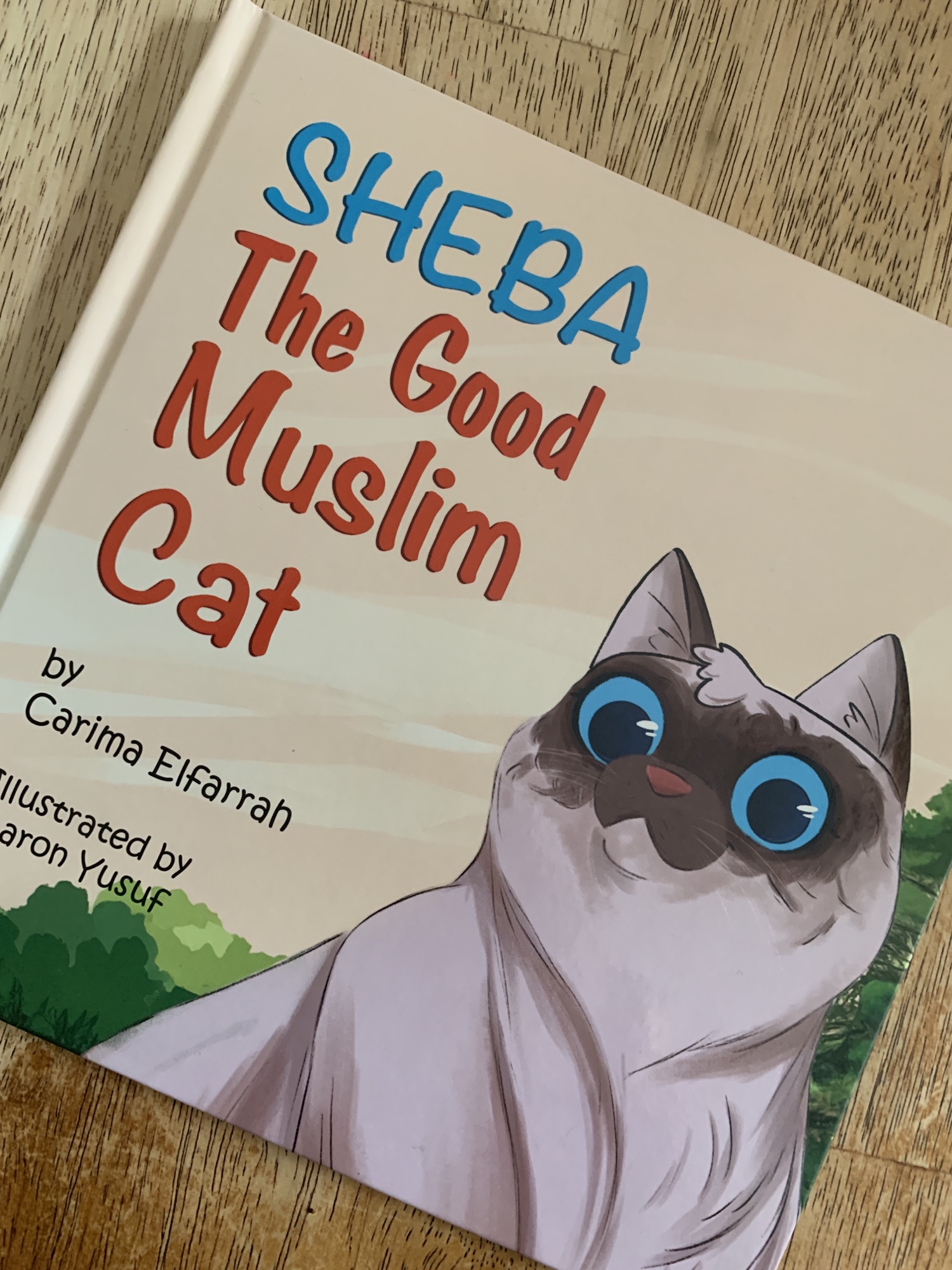
Sheba: The Good Muslim Cat by Carima Elfarrah illustrated by Aaron Yusuf

Standard
Sheba: The Good Muslim Cat by Carima Elfarrah illustrated by Aaron Yusuf

img_4999-1

I was really looking forward to this book about Muslims and cats.  Every masjid seems to have cats all over the world, and while feline friends often sneak into Islamic fiction books about other things, I liked the idea of giving a cat the spotlight.  Alas, the rhyming text, the examples given, the inspiration shared in the backmatter, the angel imagery, and the ambitious glossary made this small 8×8 inch 32 page picture book rather off putting and ultimately forgettable unfortunately. The cat remains at the family home, and basically just hangs out with the family when they read Quran, pray, get up for fajr, and the cat is patient when waiting for food or water.  Sure it makes it a nice cat, but with a title implying this cat is a “Good Muslim,” I really expected more.  I appreciate the hadith at the end, but it is not sourced, and the cat with a halo and wings signals Christian imagery, that doesn’t align with the tone of the book.  Additionally, the idea of the book comes from a story of a Syrian scholar who had a conversation with a cat. I’m not saying it did or did not happen, but it seems a little bit of a stretch for my cynical brain.  The book reads for toddler and preschool Muslims, but the glossary reads copy and pasted from Wikipedia for non Muslim adults.  The small size makes the book impossible for group story times, and it can be hard to read at times because the text often runs over the pictures making it hard to see.  Ultimately though, while my toddler enjoyed it well enough the first time, he has not asked for the book again despite it sitting on my side table for weeks, which is probably more insightful than my review.

The book starts with a young boy introducing his family cat, Sheba, who has sapphire eyes. The family is Muslim and the boy is confident his cat is too because she hangs around his dad when he reads Quran, she comes running when salah time comes, she plays with the imam (the dad) after the last salaam, and she waits patiently for food and water when her bowls are empty.  She cries at fajr to wake the boy up and he hopes that on the day of judgement she will attest to the good the family did for her.

The backmatter includes the story of Shiekh Shukari, a scholar in Damascus that spoke to a cat, then a two page spread glossary, and author and illustrator bios. The illustrations aren’t particularly spectacular, the boy at the beginning seems much older on some of the pages compared to others, although his clothes stay the same.  I didn’t like the angel imagery, perhaps I’m erroneous, but none-the-less it felt off to me.

Busy Eid illustrated by Campbell Books illustrated by Debby Rahmalia

Standard
Busy Eid illustrated by Campbell Books illustrated by Debby Rahmalia

img_5008-1

I put this book on hold at the library during Ramadan, but there was a waiting list and I just got it.  No worries though, the 8 page board book with moveable parts can be fun for babies and toddlers all year long, and if you skip over the welcoming of the new moon on the first page, the rest of the book will work for Eid al Adha just the same.  The book doesn’t have an author, it seems to be written by committee by Campbell Books or Macmillan which is fine, since their are only eight rhyming lines. The speaking bubbles that ask the reader to do something however, are about off.  For example asking what color the domes on the mosque are, to which my overthinking brain can’t discern, are they gold…en? tan…ish? on the first page it wants you to move the moon, then asks you to point to the stars and moon, but then on a later spread wants you to guess what’s in the present before you slide the scene to reveal it, with only four spreads, at the very least there should be consistency.  As for the illustrations though, they are lovely and inclusive.  There are smiling warm faces of all colors, shapes, sizes, cats a plenty, a blind gentleman, old young, different styles of hijabis, some non hijabis too.

img_5009-1

The book starts as they all seem to, with the sighting of the new moon, there is cheering, wearing one’s best clothes, and going to pray, gift giving, and food, and pullouts, pushups, and slides on each spread to engage little hands.

img_5011-1

The book is sweet, I’m glad we have representation in toddler board books for Eid joy.  There is nothing religious, or educational.  A Muslim family will perhaps see some of their Eid activities mirrored in the pages, but there is no real grounding or insight for those unfamiliar with Eid to understand why Eid is special, what it is celebrating, or who celebrates the holiday.

img_5010-1

I got my book at the library, but it is available here on Amazon or here at Crescent Moon where my initials ISL at checkout will save you 10%.

Birthday Kunafa by Rifk Ebeid illustrated by Noor Alshalabi

Standard
Birthday Kunafa by Rifk Ebeid illustrated by Noor Alshalabi

img_4902-1

This 50 page wordless picture book allows readers to make up their own words to describe the progression of what is shown in the illustrations. With no right or wrong, the backmatter helps give context and points out key images that allow the story to resonate on multiple levels.  On the surface it is a birthday girl who is upset she cannot have kunafa, but when you truly look at the pictures, and see what is preventing her from moving from Jerusalem to Nablus, the reader is shown, she is not just a child wanting something she can’t have, but that she is being denied basic rights by an occupying force.  I love that the little girl represents so much more than just herself, and that her determination to cross checkpoints, is not just about acquiring dessert.  The book starts with a little girl on her birthday that could represent a little girl with her friends and family anywhere, but as the pages are turned you witness how beautiful Palestinian joy is, how much we take for granted the freedom to move, and how desperately we need to stand up for a free Palestine.  With no words, Islamic representation is limited to two hijabis in the illustrations.  The author and illustrator are Muslim. The book centers a birthday, there is dancing dabkah and an oud shown leaning up against a wall.

So often when thinking about Palestine, not just since October, we all find ourselves speechless.  There are no words, only tears when watching the news, reading headlines, or scrolling, and I find it incredibly timely for a wordless picture book about Palestine to be published.  There are a few labels so to speak throughout the book that I didn’t particularly find necessary, but they do not distract from the story, so they didn’t bother me.  I like that the book showed restraint in terms of the oppression that could have been shown.  It allows for the story of the little girl and her family to maintain the narrative.

The story that I understood the images to be telling is that it is a little girl’s birthday, the family is having a party, they have a birthday cake, but she wants kunafa, she tries to get some and along the way sees joy everywhere, until the checkpoints turn the images gray, and prevent her from moving forward.  So mama and her problem solve, they try and make their own, but it is not the same, so they devise a plan, and they try again.  They do not give up. There is no giving up.

The backmatter provides a recipe for kunafa, a two page spread about “Why Wordless Picture Books,” another spread about “Context Matters” giving information about Zionism and Palestinian resistance.  It is then followed by four pages entitled “Did You See?” where symbols are shown that appear in the pages and described.  Warning there are numerous sweet and savory foods shown, and it will make you very hungry.

The book is available here from Crescent Moon or here from Amazon.

Allah Made Me Beautiful by Layla Izruna illustrated by Laila Radhani

Standard
Allah Made Me Beautiful by Layla Izruna illustrated by Laila Radhani

img_4555-1

This 6×6 board book is 18 pages of affirming and celebrating that no matter what we look like, “the Best of Shapers, shaped us all.” The little size, the rhyming lines, the repetition of the phrase “Allah made me beautiful” on the right page of each spread, is what you would expect from a board book meant for newborns and up.  The rhyme and cadence levels out after the first page, and makes for a sweet easy read.  The mirror on the last page with a hadith in English and Arabic is particularly nice.  The illustrations and text are intentionally diverse and inclusive and with the Islamic centering the book is good for starting discussions as well.

The book is no literary masterpiece, but sometimes it doesn’t need to be, to be a staple read on repeat to our little believers.  This book dives right in on the first page, there are no copyright or dedications that have to be flipped through.  It is numerous pages of examples of how Allah swt made us all different: straight hair, curly hair, twins, larger body size, skin color, mobility, freckles, glasses etc. The end spread, before the mirror, is the conclusion that our “looks have been perfected by Him, tying it all together.

The illustrations are engaging, and simple, but detailed enough to foster dialogue if desired and while the small size would make using it at story time impossible, I think little hands and little hearts will benefit from knowing that we are different, but just as Allah swt intended us to look.

The book is available from the publisher Prolance directly, or here on Amazon 

img_4560-1


Our World: Pakistan by Rumaisa Bilal illustrated by Nez Riaz

Standard
Our World: Pakistan by Rumaisa Bilal illustrated by Nez Riaz

img_4412-1

This 20 page board book doesn’t come out for a few months, but it really is adorable, and I love that it centers Islam, so I’m putting it on your radar hoping you might preorder to show your support.  This ever growing series highlights different countries by OWN voice authors, focuses on simple text, cultural insight, linguistic samples, and bright illustrations.  The book follows a little girl from morning to bedtime and then highlights parts of the unique cultural aspects shared in the back-ish matter.

img_4413-1

The book starts with Subah Bakhair, good morning, written in Urdu and English, before AllahuAkbar and prayers are made. Then it is time to get dressed and deciding what to wear.  Little brother is in a swinging cradle, and paratha and lassi are shared with family.  The little protagonist then heads on the driverless orange trains with her Dada, grandfather, to do some shopping, concluding with bedtime du’aas.

img_4415-1

Board books are a little tricky for me as if they are more than just a few words on a very basic topic, they seem to be really jumpy or really wordy.  If they manage to not have long blocks of text, and stay on the intended audience’s level, they seem to be random in what is included.  This book is no exception. I am not sure how the words were chosen to include in Urdu script, why some words are given for specific things like shalwar kameez, but not for the joolah.  Not sure why the bathroom, getting ready for bed scene is included, and why lota is highlighted in the end, either.  I’m sure to someone else it seems logical, there is nothing “wrong” with it, it just seemed a little disjointed from the rest of the inclusions.

img_4416-1

I love the illustrations, they are engaging and joyful.  Desis have a decent amount of rep in children’s books, but a board book dedicated just to Pakistan widely available here in the west, that is OWN voice, features Islam, and well done, really is delightful to see, alhumdulillah.

img_4418-1

You can preorder your copy here

img_4417-1

The Magical Moroccan Rug by Naveed Mir illustrated by Anisa Mohammad

Standard
The Magical Moroccan Rug by Naveed Mir illustrated by Anisa Mohammad

img_4186-1

I really like the premise of the book, a Muslim Magic Tree House so to speak, two kids that magically go back in time, in this case to Andalucía. At times the book did make me smile, but really it feels like a missed opportunity.  The writing needs tightening, it feels early reader at 94 pages long with a few full page illustrations, but the vocabulary and text filled pages support the suggested reading level of middle grade.  It takes way too long to build up to the “action,” and when it gets to the plot it doesn’t seem to know what to do with itself.  It is a lot of walking this way only to turn around and walk back for no development, character growth, or enriching reason.  As an adult I had to force myself to keep reading, my eight year old who loves Magic Tree House books had basic foundational questions and couldn’t’ get past page 24.  Honestly it just needed some proof reading and some trimming, which is why I found it so frustrating; it really had so much potential.  Example, if the little boy is so excited to see his grandfather after 8 years, why didn’t he go with his dad to the airport, why did his elderly tired grandfather immediately go to a community event after arriving in the UK from Morocco, why wouldn’t Yusuf go with his beloved grandfather to the masjid.  And this is all within the first few pages.  If the logic isn’t there for the mundane set-up, it is hard to get on board for the fantasy aspect of a flying carpet going back in time.  The historical figures are introduced in passing and don’t leave much of an impression, so yes it is good to give readers a bit of information on people they may not have heard of before, but it doesn’t give them enough connection to make them memorable.  The backmatter sadly is not more information about the three historical figures presented: Abdur Rahman (The Falcon of Andalus), Lubna of Cordoba, and Abbas Ibn Firnas, it is a glossary and a Quick Quiz.  The answers to the quiz are not provided, there are additional facts shared but no sources given, and there is urging to find out more about Muslim Spain, but no directions, links, or book suggestions are provided.  The publisher should have proofed the book, it reads like a pitch, maybe a first draft, and our children and their purchasing adults deserve better.  We have growing options of stories with historical Islamic OWN voice framing, and unfortunately this book had a lot of potential, a few pages of interest, but not ultimately enough intrigue to win me, or my kids over.

img_4187-1

SYNOPSIS:

Yusuf and his friend Jack live in the same neighborhood, but don’t go to the same school.  They spend a lot of time together though, and have known each other since they were babies.  When Yusuf’s grandfather comes to visit from Morocco, he brings an old carpet and gifts it to his 10 year old grandson.  Unsure what to do with it, Yusuf puts it in his room, and feigns gratitude.  With a history project looming, and a dislike for historical study, Yusuf and Jack find themselves heading on a magic carpet ride into the past.

They arrive in Cordoba in 856 CE, disoriented and dizzy, Omar, their guide, greets them, walks them through the mosque answers one question then walks them back to the carpet to take them to a different time, 786 CE and they see diverse people living together peacefully.  They first observe “one of the greatest rulers that Andalus ever had,” The Falcon of Andalus, aka Abdur Rahman.  He is a humble leader that freely interacts with his subjects.  They then head to the 10th century to see Lubna with a crowd of scholars in Cordoba  learning from her in the library.

When Yusuf remembers his history project about flight, Umar guides them to 875 CE with a pit stop in CE 852 to see Abbas Ibn Firnas take flight, well fail and then eventually take flight in 875.  The boys then say their goodbyes and are whisked away home. Where they can’t believe what transpired, and are determined to figure out how to make it happen again.

img_4188-1

WHY I LIKE IT:

I like the concept, and that Jack is not Muslim, and Yusuf is unapologetically Muslim.  Seeing the two interact is enjoyable and both good modeling, and mirroring.  The heart of the book is truly not bad, it is the tangents that get long winded for no advancement of the story that take away from the flow.  As stated above the relationship between Yusuf and his grandfather doesn’t align with what is said and what is shown.  The end suffers the same lack of editing.  How can grandpa and Yusuf live in the same home, but they can never find a moment to talk.  Nothing is gained by delaying their conversation, so why delay it, and go on and on about delaying it?

If the point is to share not just with Yusuf and Jack about key historical figures, but with also the reader.  Then there needs to be more interaction with the characters, not just watching them from afar.  Interact with other observers or students or colleagues, convey information from a “personal level” not just drop a snippet here or there from what feels like a vague Wikipedia page.  If the book is not sourced, why not take some fictional liberties and flesh out Abbas, Lubna and Abdur Rahman, so that they are remembered. Include more information about the three real characters in the backmatter, reinforce the idea that a magic carpet is not real, but these remarkable people were, and they changed the world.

I don’t know that kids will have issues with how the carpet worked, but because the set up was so weak, I had a hard time going along with any of it.  I wanted to know why it had to be a grandson, not a son or daughter, how grandpa or his grandpa figured that out when it wasn’t a relative that gave the first Yusuf the carpet, but a storyteller.  How Umar knew to look for them at that moment.  Why did they go to 856 CE and then go to 786 CE why couldn’t they just meet Umar on the first stop? Seems unnecessarily dragged out, for no reason.  When was grandpa’s last trip? Could you get stuck out of your time? If no one can see or feel the rug, why do they keep hiding it? Can people see and hear them, or only their guide?

I like that Yusuf prays and Jack knows that Yusuf prays, and what a mosque is.   I didn’t like that they hear the athan, and went with everyone to pray, but then just left without praying.  The book seemed to do that a few times.  Have the kids walk through a crowd presumably toward something or for some purpose only to turn around and return to the place of origin having gained nothing, learned nothing, or seen anything, again just drags the book out and frustrates readers.

There really is not conflict in the book, no climax either, there is no really stress about getting back, stress about figuring out how to go on the next adventure, it is there, but not heightened, and it is unfortunate, because the book really could be adventure filled, and it just isn’t.

img_4189-1

FLAGS:
None

img_4190-1

TOOLS FOR LEADING THE DISCUSSION:
If you are learning about Abbas Ibn Firnas, or Lubna, or The Falcon of Andalus or Spain, and have access to supplemental material, the book has value.  I don’t know that if a kid picked it up off the shelf even with interest in history, that they would finish reading the book.  It doesn’t provide a solid feeling of learning or understanding about the time and place and people seen in the time travels, nor is it action packed on its own.  So if you can motivate a child to read it and then look further into it, the book would help connect the past as being interesting and engaging, but on its own, the book does not achieve that.

Shiny Misfits by Maysoon Zayid and Shadia Amin

Standard
Shiny Misfits by Maysoon Zayid and Shadia Amin

img_4083-1

I admittedly wanted to read this book because the author is of Palestinian descent. I have seen clips of her standup and I’m not a huge fan, although I do appreciate that she doesn’t deny her culture and Islam, doesn’t let her cerebral palsy keep her from working toward her dreams, and that she is successful.  All good messages for a 256 page middle grade graphic novel that is not autobiographical, but draws on her life none-the-less.  I was surprised, though, that there are no Palestinian references in the book, very few Arab cultural touchstones either, and yet swearing on the Quran and not eating pork are presented fairly often, almost as “bits” to be laughed at.  I truly understand that the character is presented as culturally Muslim more than centering Islam in her identity, but perhaps because the protagonist, Bay Ann, is rather unlikeable, it just rubbed me the wrong way.  I love that the people in Bay Ann’s life do not caudle her, and that she is fierce and dramatic and driven, but she is an awful friend, her obsession with Alyee Maq (yes full names are used throughout) gets annoying, and I worry that some of the humor will be missed for the younger target audience and be taken as Muslim or Arab norms.  The presentation of a disability in a well illustrated graphic novel is empowering, an amazing Arab dad is nice to see, a divorced family co-parenting is important, but the foundation for much of the story is Bay Ann’s crush on Alyee Maq, he does kiss her on the cheek for social media likes, the book starts with Halloween Idol, features dancing throughout, and concludes with a Nondenominational Holiday Spectacular.  Bay Ann’s mom is not very kind or involved, and Alyee Maq’s mom, the only hijabi in the book, also is rather rough.  This is a book where I acknowledge my own overthinking, as both an adult reader and reviewer.  If you are ok with the (random) Islamic rep, kids will benefit from seeing Bay Ann as a fully capable person who happens to have a disability.  I’d suggest seeing if your local library has the book and looking through it first to see if you are comfortable passing it on to your kids.

SYNOPSIS:

Bay Ann is a tap dancer and with Halloween Idol coming up, she plans to win.  Her best friend Michelle is going to do her make-up as a zombie bride, and be her zombie bridesmaid with Davey Matt, the third in their trio, being the dead ring-bearer dog.  They can’t be her backup dancers because she is a one woman show, but she needs them to cheer her on.  When she wins, she has the spotlight stolen from her by Alyee Maq kissing her claiming he is making “a sick girls dream come true.” The clip goes viral, as Alyee Maq is a bit of a celebrity and the competition is on.  Whether it is science fair, social media posts, or the class debate, Bay Ann is determined to knock Alyee Maq down, claim the online spotlight, and  prove her talent is more than her disability.  With each attempt failing, her resolve grows stronger and her tunnel vision pushes those closest to her away, as she joins Alyee Maq with the hopes that if she can’t beat him, she will join him and achieve the fame she seeks.

WHY I LIKE IT:

I know the book is rather intentionally ridiculous, but I wanted to cheer for Bay Ann, and I never really liked her.  I don’t like how she treats Davey Matt, or even Michelle.  If she was better to them at the beginning, I think it would have shown how disconnected her mom Malak is as well as the school administrators, and made it more funny, but it truly just makes her seem like she is awful to everyone, and thus you don’t really find yourself invested in her stardom, her friendships, or her defining her own narrative.

I wish their was some Arab rep, not just a few Arabic words tossed in here and there.  I also wish there was more Islamic centering, or honestly even less. The swearing on the Quran really bothered me, Friday prayer is mentioned in passing, but there is no impact on the characters or the story, so it seemed misplaced.

The pacing of the story is rushed, and at times a bit chaotic.  I think it is intentional, but it makes it hard to connect to the characters or to grasp their motivations.  I don’t know that I truly ever understood why Bay Ann wants the spotlight, or why Alyee Maq is famous, or why Davey Matt hangs around Michelle and Bay Ann when they belittle him. It doesn’t need to be thoroughly explained, but when you finish the book, and feel exhausted, but can’t even articulate what the book was really about other than a girl that wants to be famous for her talent not her shaking, and won’t let anything or anyone get in her way, it seems like some opportunities were missed.

FLAGS:

Close male and female friendships with touching, an unwanted kiss, lying, manipulation.  Swearing on a Quran, disrespect. Using people.

TOOLS FOR LEADING THE DISCUSSION:

I don’t know that I would seek this book out to own, but in an Islamic school library if it found its way in, I would probably not object to it being shelved.