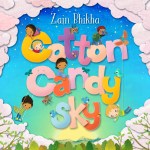
So glad to see another Zain Bhika song hit the mark and bring the beloved lyrics to life in book form. Ages 2 and up will enjoy the 28 page book even if they haven’t heard the song, and parents will enjoy watching the kids sing-read the pages independently if they have.
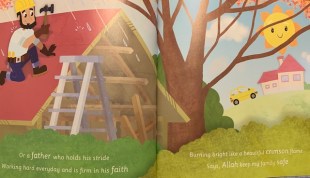
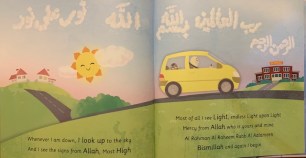
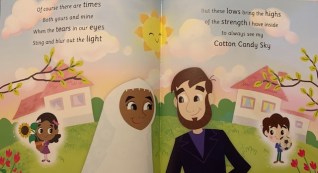
The illustrations are sweet and diverse with the characters and their families changing with each verse. But all celebrating in their appreciation for the light of Allah’s blessings and the patience of waiting for the rain to pass.
I particularly enjoy the Arabic in the clouds on the pages explaining what the character does whenever he/she feels down and looks up to the sky to see Allah’s signs.
The hardback book is sturdy with a playful large font on the pages, and is meant for Muslim kids with the concept coming from Surah An-Noor (24:35).
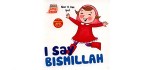
Another adorable board book teaching the concept of saying Bismillah to the littlest Muslims. The illustrations are really sweet, and the text large and playful on their 5.5 square pages. The story is simple, but because there is a story, and the word repeated, it does just what it intends to do and shows Bismillah being said before you start something. It is worth noting though, that it never articulates why you say it.
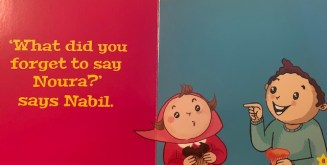
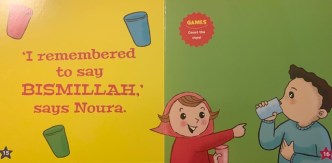
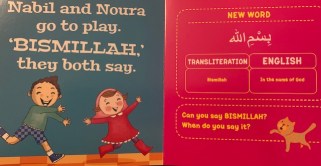
In this 20 page story brother and sister, Nabil and Noura are about to eat some yummy cupcakes. Noura forgets to say Bismillah and her brother Nabil reminds her. They both say Bismillah and then Noura says it before she drinks her milk. Proud of herself for remembering, Nabil praises her as well, and they both head off to play after saying Bismillah again.
I like that the siblings encourage each other and no one gets in “trouble” for not saying it, but rather they are gentle in their approach and it comes not from a parent or authority figure but from one another.
There are a few “games” sprinkled in on two of the pages: say the colors of the cupcakes, count the cups. There is also the word Bismillah written in Arabic at the end along with the English transliteration, English meaning and two questions: can you say Bismillah, and when do you say it, to verify comprehension.
Thanks once again to Crescent Moon Store (www.crescentmoonstore.com) for their fast and friendly service and great prices. There are four books in the series and they carry them all.
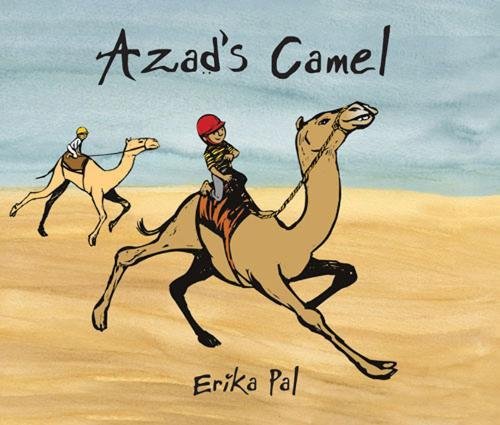
This beautifully illustrated picture book takes the reader in to the world of camel racing, children jockeys, mistreatment by adults, children being sold by their families and running away, all in a span of 40 pages and on an AR 3.5 level. Yeah, its a lot for a kid’s book, but it has a happy ending and it does draw attention to an atrocity not often discussed or thought about.
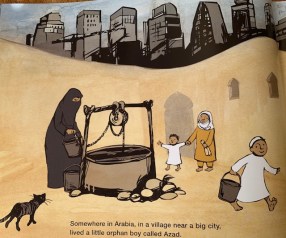
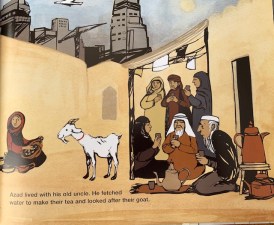
Young Azad lives with his old uncle in a village outside the city. He helps take care of the goat and fetches water for tea in the mornings, in the afternoons he plays with his friends. One day he is doing handstands on a soccer goal post when a rich Sheikh drives by and sees him.
The Sheikh comes back and convinces the uncle to let him take the boy to be trained as a camel rider to one day be famous. The uncle agrees saying he can’t afford to keep him.
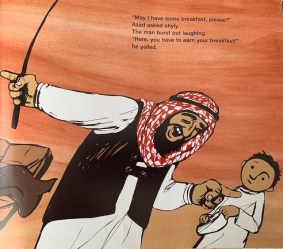
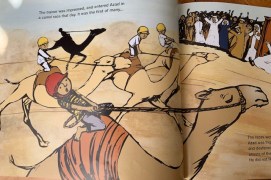
The Sheik takes Azad to the desert with other boys to live and be trained. Azad learns that food is earned and chores are a must. The races are dangerous and Azad doesn’t like them, but he is good and is forced to keep racing.
One night the camel, Asfur, talks to Azad and the two plan to keep running past the finish line at their next race. The pair are so fast that, they do just that, and no one can catch them. They run through the city, and back to the desert.
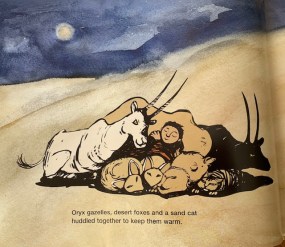
The other animals of the desert keep them warm when it gets cold and until a Beduin tribe discovers them and takes them in. At last Azad and Asfur find a home.
There is information about camel racing at the end including how robots are replacing child jockeys in some countries and how many young children are being returned to their families, school and a normal life.
I like that the book takes on a real and sad occurrence, bringing camel racing and forced child labor in to light. The story is truly written for younger elementary kids with short paragraphs on each page, large engaging illustrations, quick jumps in events and glossing over any truly graphic details.
I do worry that stereotypes are reinforced with the use of calling the rich man who bought Azad a “Sheikh” and the Bedouins dancing at the end. Culturally the book is a generic Middle Eastern country and doesn’t mention or emphasize religion at all with the exception of the women in the pictures being veiled.
I found the book at the library and think it has good information to discuss with your children, but I don’t know that I can see it being anyone’s favorite book, or a regular night time request. While, yes, it does have a happy ending, you don’t really “feel” what Azad is going through, you are just glad he finds people that want him.
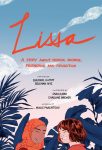
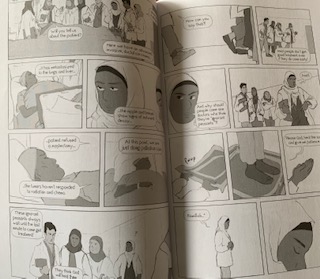
When I first started teaching I wasn’t a big fan of graphic novels, slowly I saw their benefit for struggling readers, and eventually I came to appreciate them as an enhanced tweak in story telling for everyone. This book however takes the concept to the next level, for me anyway. As the inside flap claims, it is a book “that brings anthropological research to life in comic form, combining scholarly insights and accessible, visually-rich storytelling to foster greater understanding of global politics, inequalities, and solidarity.” As a coming of age story of two friends at its core, yet taking on breast cancer, kidney failure, parental loss, different cultures, different religions and with a back drop of the Egyptian revolution, I’d say the book is meant for high school and up. Not so much for content as for understanding and appreciation of all that went it to creating this ethnographic book.
SYNOPSIS:
Unlikely friends Anna and Layla cross economic, religious, and cultural differences to build a life long friendship. The book is divided into three parts: Cairo, Five Years Later, and Revolution. In the first part we see Layla’s family serving as the caretakers of a building and the two young girls bonding over pranks, arrogant tenants, and just being silly. Anna’s family is American and the father works for the oil companies, thus they are financially very well off, however, the father is rather distant and the mother is dying of cancer. The section concludes with the passing of Anna’s mom and the family going to Boston for the funeral.
Five years later finds the girls in college. Layla in medical school and Anna at a university in Boston. Layla’s father is suffering from renal failure and is unwilling to consider a transplant. While Anna is trying to see if she carries the same genes as her mother and if insurance will cover it. She also has to decide if she would want to have a complete double mastectomy, if she would want her breasts reconstructed, if she should do it now or later. She gets a lot of opinions, but ultimately decides to find a way to pay for it and have it done. Her father doesn’t understand, and Layla dismisses it forcing Anna to have to handle it alone. But when news come that Layla’s father isn’t going to make it, she rushes back to Egypt to offer her support.
In the final section, the revolution has spread and Dr. Layla is helping those injured in Tahrir Square during the protests, and Anna is helping to identify bodies despite being attacked for being a foreigner and part of the problem. Anna has kept the secret of her mastectomy from Layla and Layla assumes she has cancer. At odds with their roles in the revolution, and with keeping secrets from each other and their differences in financial opportunities coming to a head, Anna returns to Boston. When Layla’s brother is shot and loses an eye, however, Anna returns to Egypt and the two friends work to keep their relationship.
WHY I LIKE IT:
The book is grounded in so much conflict and turmoil, but fights hard to keep a character based narrative. With two illustrators and two authors trying to convey medical approaches, two cultures, two religion, two friends, and a revolution, the last 70 pages of the 302 page book are details about how the book came about, interviews with the various contributors, a timeline of the revolution, discussion questions, key references and a teaching guide. The book at times was confusing to me, and I’m not sure why, it quickly resolved itself or a flip back a few pages would clarify it, but I think some of the illustrations were just off enough that it complicated things. Anna by and large is depicted oddly on a few pages along with her family as well.
Layla’s family is definitely religious and at times has to challenge their thoughts to understand Anna and their own circumstances too. I think it is handled really well and allows the reader to consider things without answers being clear cut, is it Allah’s will to not have a transplant and accept death as being written for you or to have the transplant and ask Allah to make it successful? By and large the book poses questions through the juxtaposition of the two characters and the experiences they endure, and while it shows the choices they made, it draws the reader in to wonder what they would do in their shoes without judgement. The book provides a lot of facts and leaves them there making it more thought provoking than a simple story.
The characters are often composites of real characters the academic author’s learned about, yet some are directly based on activists and leaders of the revolution. The graffiti artwork is attributed and powerful. There is a lot of information in the notes after the comics end.
FLAGS:
There is death and revolution, Layla’s brother is taking Tramadol, and their are sketches of breasts as Anna learns about her disease and prognosis.
TOOLS FOR LEADING THE DISCUSSION:
I wouldn’t do this as a book club as I don’t know how much middle schoolers would get out of it and the book is pretty pricey. I would recommend people read it though as it gives a different perspective on numerous things many of us take for granted.
This is the second Alan Gratz multi-perspective historical fiction novel I’m reviewing for its inclusion of a Muslim character. While in Refugee it seemed a natural choice to include a Muslim family, I was completely shocked that he would feature one in a WWII D-Day novel. With numerous storylines spread over 322 pages the book is quick, fast paced, intense and emotional. An enjoyable read for history lovers and curious kids fifth grade and up, it is an AR 5.6 and older kids will benefit from it too.
SYNOPSIS:
The characters and timeline are fictionalized to all take place on D-Day, June 6, 1944, as the Allied forces and French resistance come together to storm German occupied France on the beaches of Normandy. Many of the details do come from history though as detailed in the Author Notes at the end of the book.
The book starts out following Dee, a German national who left for America to escape the Nazi’s and is now returning in a Higgins boat to fight them. Knowing no one will understand, including his friend Sid, a Jew from New York, he keeps this knowledge to himself and focuses on the task ahead.
Samira and her mother are the focus of the next mission and highlight the role of the French Resistance, the Maquis. What makes their story more meaningful is that they are spies with the French Resistance, but they are French Algerians, not really a part of France at all, and they are Muslim. In Samira’s back story we learn how she must remove her hijab and how she is treated different at school because Algeria and France are at odds. When her mother is taken by the Nazis before she can deliver the message to the Resistance, Samira vows to do it and get her mother back as well.
19-year-old James from Winnipeg Canada is a paratrooper who volunteered for combat to feel empowered after years of bullying. His buddy in the story Sam is a Cree Indian from Quebec, who has few rights at home, and hopes to have more success in the military.
Medic Henry is scrambling along on the beach helping anyone and everyone he can. Having left behind a segregated US, even the military has reservations about African Americans saving and serving. As he performs one heroic act after another being questioned and doubted and insulted all along the way, readers see how ridiculous and infuriating racism is on every level.
We meet Private Bill Richards who drives a Sherman tank and is following in his fathers WWI footsteps. But who is unfortunately killed before reaching Bayeux. And finally we meet Monique Marchand, a French 13 year old girl, who gets caught up in the invasion because she left her swim suit in the beach hut the day before and has returned to retrieve it. Determined to do something other than cower in fear, she starts helping fallen soldiers and meets up with American journalist Dorothy, a strong woman determined to not be stopped on the basis of gender.
All the story lines criss and cross as the invasion is a chaotic mess and everyone is dropped, disembarked, or arriving in the wrong place at the wrong time. Surviving the day is an immediate challenge and not one that everyone will succeed at. The larger success of the mission will depend on some lucky breaks and a whole lot of teamwork.
WHY I LIKE IT:
I love that the story somehow isn’t political at all in the traditional war story, war strategy sense. But the strength at least for me, wasn’t the horrific battle at hand, which is truly violent and abhorrent, but the relationships between the people. The realizing what is driving them, what matters and more importantly how hard our prejudices are. The larger story of the Allies shows British, Americans, and Canadians coming together to defeat he Nazis, but yet, a girl, an African American, and a Cree are treated as “other” irregardless of how beneficial they are even in matters of life and death.
As for the story of Samira, she is a tough girl, both clever and brave. To have a Muslim in an American/westerm story of D-Day and a young girl at that, to me was pretty remarkable. There isn’t mention of faith or anything other than that she is told to take off her scarf and continues to wear a small kerchief on her head anyway, but for Muslim kids all over, this character and how she behaves will spark a sense of extra pride in the Allies success over Hitler, just as the other minority characters will for their representation in such a dramatic event.
FLAGS:
There is a bit of mild profanity. There is violence and death, and blood, not too bad, but the point is clear, the beach isn’t pretty.
TOOLS FOR LEADING THE DISCUSSION:
I think this book would be a great supplement to any WWII history lesson. There are great resources at the end, and maps at the beginning and a high energy, short chaptered book that doesn’t skimp on character building or war intensity.
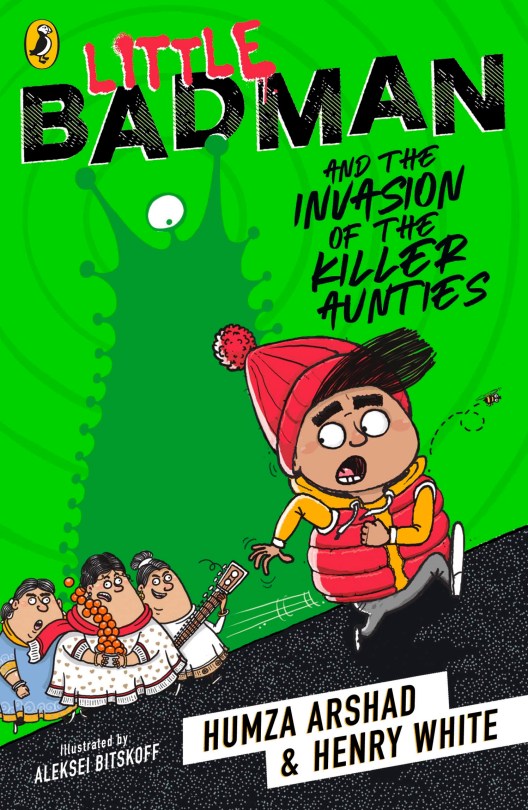
It’s been a while since I’ve read such an over the top silly book that has a lot of heart. It is 352 pages that remind me of the the My Teacher is an Alien book series of my youth smashed up with the Weirder School/Diary of a Wimpy Kid series of today. Meant for upper elementary with some bad words (hell and damn), the story is Pakistani-British representation with many Muslim named characters, a Muslim author, and a shout out to a KFC in another town that is halal. Don’t read it if if you want to learn anything, but definitely pick it up if you want to roll your eyes, giggle, and ponder a world where Desi aunties are the perfect disguise for force feeding an entire community delicious food as part of their evil plan to take over the world.
SYNOPSIS:
Humza Mohammed Khan is an 11 year old Pakistani kid in Britain who thinks of himself as the next big rapper, Little Badman. He dreams big and talks even bigger as he struts around primary school getting in trouble and trying to film his music video on his friend Umer’s extremely old Nokia flip phone. With a normal enough mom, a hyper exaggerating father, and a handful of their friends known as Aunties and Uncles, Humza gets in trouble regularly enough, but overall seems to have a good heart.
Things at school slowly start to change after their teacher gets stung by a bee named Mustafa, that Umer brought to school to be his pet. Weird as that might be, it is even more odd, when their teacher is replaced by a volunteer auntie. Every day it seems like a teacher goes missing, and is replaced by some asian kids’ aunt. When the supper ladies are replaced and the food improves, no one is complaining. When every volunteer starts bringing snacks to school, no problem. Who doesn’t love gulab jams, and samosas, and butter chicken all day long every day? Well, as the school puts on the pounds and all the teachers and staff are officially missing, Humza, Umer and their former nemesis Wendy, start to get worried. Humza’s Uncle who he calls Grandpa, claims his wife Auntie Uzma is not really his wife, and helps Humza investigate.
Secret meetings in supermarkets, teachers and grandpa vanishing, and Humza seeing a giant slug coming out of the substitute librarian, means that Little Badman is going to have to run away from cricket practice, not get sent in a crate to Pakistan, face his stage fright, and save the day from the aliens taking over the aunties.
WHY I LIKE IT:
I like that it is cultural rep and own voice in its telling. Humza is Pakistani and his cultural baggage is hilarious and part of him, and no explanations are needed. In his world people are from lots of places and they all live and play and learn together and they eat caramel apples and toffee and jilabies. The diversity is great and not articulated, it just is what it is, and they all have to work together to save the day. I think my favorite character is Grandpa, who Humza has to learn to appreciate and not just see as an old almost dead guy and Humza’s dad who exaggerates everything and takes his cricket very seriously. At the end Humza has to have a heart to heart with his dad and his uncle, Grandpa and it makes this over the top nutty story really kind of sweet too.
There is no “Islam” in it aside from Muslim names and mention in a rap of a halal KFC. I kind of like that they are Muslim kids and it appeals to a larger audience, sure something praying or something at some point might have been nice, but it isn’t a book that you’d be expecting spiritual nuggets from, so it is ok.
FLAGS:
The words damn and hell are used. There is disrespect of authority, parents, and teachers as well as lying.
TOOLS FOR LEADING THE DISCUSSION:
I had my ten year old read it and he thought it was ok, but was uncomfortable with the language, which I was glad, but I told him I thought he could handle it, and know what is appropriate to use. That being said, school libraries should have the book, maybe not classroom libraries though, and I probably wouldn’t do it as a book club. I will have my other kids read it though, cause like I said, it is silly and fun.
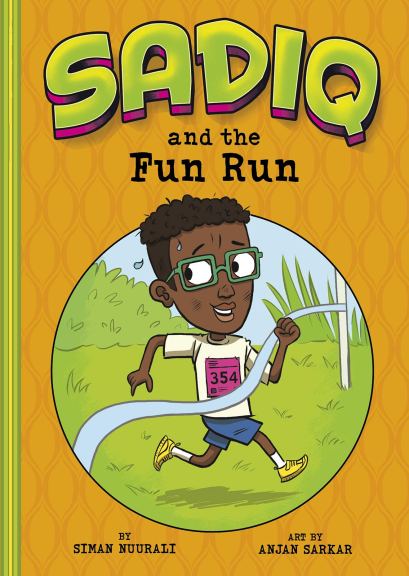
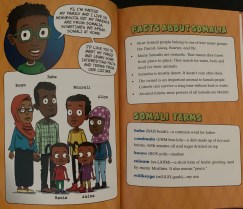
This new series featuring Sadiq, a Somali American living in Minnesota, is great for early chapter book readers looking for representation and diversity. There are four books about Sadiq, his family, and his friends and classmates in third grade, and all are either an AR 3.6 or AR 3.5. At 57 pages long, divided into five chapters and filled with bright and colorful illustrations students in grades 1st through fourth, depending on reading level and interest, will enjoy these simple plotted, yet relatable stories.
SYNOPSIS:
Sadiq’s friends are all getting ready to try out for football, but his parent’s say that he is too young for such a rough sport and has to wait until he is 12 like his older brother, Nuurali, did. Sadiq’s parents and family encourage him to try another sport, and with a new running club starting in a few days coached by a member of the national team, that’s what he opts to do. Begrudgingly he joins the team, but is hurt when his friends talk about how much fun football is and how much more tough and difficult it is compared to running. While this is going on, he is getting support from his brother to keep running, and from his teammates, but it is hard and he doesn’t enjoy it. Slowly, he starts to improve, however, and with the Fun Run the climax of the book he sails across the finish line in first place when he sees his friends have come to cheer him on!
WHY I LIKE IT:
I love that the book/series proudly features a Somali-American-Muslim family. There is information about Somali at the beginning as well as some Somali terms and a portrait with names for the members of Sadiq’s family. The mom and older sister wear hijab, “Salaam” is one of the defined words and the characters use it when they meet. I also love the diversity of skin tones in the illustrations and one of the girls on the track team wears a scarf as well. There are Muslim named kids and non Muslim named kids in the story, and while Islam isn’t mentioned outright, it is definitely represented through the characters words, names, and appearances.
The story is straightforward and perfect for the age group, the books in the series do not need to be read in any order, and you will get to see the different supporting casts featured more prominently in different books, thus getting to know Sadiq and his world. I like that he doesn’t get his way, and doesn’t get to do what all his friends are doing, but he makes it work. He is grumpy and upset, but he doesn’t get obnoxious or overly whiney. I think this subtly gives readers some tools and insights to model in their own disappointments. I also like that while he has to put in the work and fix his attitude, he doesn’t have to do it all alone. His family and coach are supportive, and eventually his friends apologize and support him too. For the simplicity of the book, you actually do get invested in his little trial and want to see the outcome.
FLAGS:
None, it is clean.
TOOLS FOR LEADING THE DISCUSSION:
This book is like a boy protagonist version of the Meet Yasmin books, they show a kid of culture in everyday experiences. The target audience wouldn’t make it work for a school wide book club, but I think early elementary teachers would benefit from having the series in their classrooms and letting kids in small groups discuss if they want. These books would be great for first graders that are way above reading level and parents are struggling to find appropriate books.
The end of the book has some resources as well: a glossary, discussion questions to talk about and some to write down, as well as a home workout guide and information about the author and illustrator.
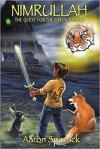
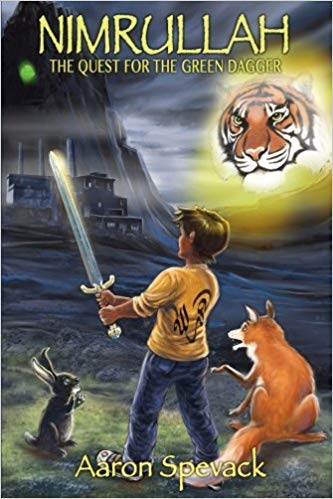
Oh this one was hard for me to finish. It was the only thing I took to keep me entertained on a 7 hour plane ride in February as I was determined to read this, and even between the going and return flight, I couldn’t force myself to get through it. Four months later out of sheer stubbornness I finished this 204 page book and I’m not better for it. If it was your thing, I’m glad for you, but I didn’t get it, I don’t know what age group I’d even suggest it for, and for all the potential it could have had in being a fantasy series with religious overtones like Chronicles of Narnia by C.S. Lewis or some grand adventure with moral highlights, for me it was just a simple story made complex by huge religiously vague passages and too many dozens of characters.
SYNOPSIS:
The bare bones of the book is pretty straightforward. Much like even Lord of the Rings or any basic video game, the main character has to do this, then do this, then do that to succeed and win and reach the end. In this book it is a ten year old boy named Ahmad who crawls under the mimbar of his Massachusetts mosque and finds himself in a land of talking animals who need him to go on a quest to save their way of life. His sister Amina also finds her way to this enchanted land and Nimrullah’s garden, but they have little interaction with each other or with Nimrullah, a tiger and head of the Dar al-Ashjar folk. Along the way Ahmed meets beavers, and snakes and rabbits, and dragons, all with names and random tidbits of information flung in, but no real purpose or back story or attachment. Ahmad is given a book by a turtle that will guide his internal journey, that quite often Ahmad doesn’t understand and the author doesn’t even share the text so the reader doesn’t understand, and when the author does share the text it is paragraphs and pages long, that what it means is baffling to me as an adult, let alone any elementary aged child. The point of the journey is to get to a green dagger that is on an island in a crystal sea, but he isn’t going to an island to get it, he is going to a mountain and then a cave. The villains are the Kadhibun that mine crystal and enslave the animals from Dar al-Ashjar in factories destroying the crystal sea, and thus the environment and animals’ way of life.
WHY I LIKE IT:
I love what the author tried to do. Even comparing it to C.S. Lewis’ work gave some hope that Muslim children would find a surface level adventure story to fall in love with, and be compelled to understand the symbolic undertones of religion, morality and faith. However, it not just fell short, it never really gave itself a chance. There is too much telling and not enough showing. All the characters and animals and references to things are not explained and lose the reader, and even when I would go back I wouldn’t find concrete points to fall back on. There are too many characters that are just name dropped and become more words to skim over. Major battle scenes are never detailed, and the narrator resorts to saying, “it would be hard to explain.” Characters are trusted, but no reason to trust or mistrust them is provided. Litany’s are to be recited, but aren’t shared. “Ahmed opened his book again, and started reading the commentary, which contained the litanies. Their details cannot be mentioned here, as such a sword cannot be handed to anyone.” There is a litany of the mountain, litany of the cave and a litany of the crystal sea. But, apparently the litany of the sea is the same as the cave one, huh? It really is a mess, I’m sad to say. It builds up to something and then just lets it drop. On top of that, and now I’m just ranting, there are no page numbers!
The overall moral of Ahmad learning self contron and slaying his ego and trusting Allah and being patient is all there, but it is so hidden and muddled that I don’t think the average reader will find it inspiring or triumphant. It is almost like the author tried to put a ton of Sufi knowledge into a children’s book, but forgot to simplify it for children. Just having the framework of a ten year old boy surrounded by talking animals isn’t enough to deliver the message, the message itself has to be palatable for kids too. And basic writing and story telling are critical as well.
FLAGS:
The book is clean
TOOLS FOR LEADING THE DISCUSSION:
I wouldn’t use this book for a basic book club, I couldn’t even get my 9 year old son who reads over 300 pages a day to get past the first third. If I am missing major Sufi tenants, which I definitely could be as I know very little about Sufism, and this book is a foil for much bigger and more critical concepts then perhaps someone with Sufi knowledge teaching children in a clever way, will find this book useful, unfortunately I’m not that person, so I think I’ll have to pass on suggesting the book to others.
I don’t know what is more frustrating: quality books that are poorly packaged (binding, illustrations, font, spacing, etc.) or beautiful books that miss the mark in storytelling and basic writing skills. Both are equally annoying, and while yes, a good story should be the basis, this book is really well written that the presentation of it just makes me sad. At 116 pages, the book is perfect for 3rd graders. My daughter and son read it a few years ago when I first picked it up. I made them read it. And last week when I pulled it out to read myself, both remarked that it was a good story. The fact that they remembered it and remembered liking it are huge pluses, and made the fact that I had to make them read it all the more disheartening. I’m certain if you can get your kids to read eight maybe 10 pages they will zoom through the rest of the book. It is the getting them to pick it up and start, that is the tricky part. The book is paperback, thick and glossy, but the cover looks homemade almost. If you thumb through it the font is too small, spaced too tight and the illustrations mean well, but don’t deliver. Unfortunate, because like my children, I too think the story is fun and I’m disappointed that the book was published in 2013 as #1 in the Lulubug’s Week in the Life Series, and no further books have come out.
SYNOPSIS:
Laila (Lulu), and her family are American Muslims living in Southern Virginia. Lulu’s mom is a lawyer and a convert, her dad is from Egypt and owns an Italian restaurant, and her older twin brothers are 12 and keep an eye on her. Being incredibly bright Lulu has skipped third grade and is having trouble with some bullies in her new fourth grade class: Veronica B. and Veronica C. aka the Veries. Using help from her brothers, her neighbor and friend Toni, and some friends in class, a trap is set to get the bullies to confess to their evil mischief, but that unfortunately isn’t the only thing Lulu is going through this week. Throw in her parent’s sudden decision to move closer to the masjid in another city, a litter of kittens abandoned on the side of the road, and some weird noises coming from the woods behind their house, and Lulu has a lot to deal with.
WHY I LIKE IT:
I love that it shows the day-to-day of a typical Muslim family in a normal presentation. They pray together, they watch what they eat, they know their neighbors and worry about each other. It doesn’t idolize the family, making them better than anyone or preachy, but makes them very relatable and likable in a realistic way. When bees are discovered or the kittens need carrying for, sunnahs and ayats are identified, but very seamlessly, that non Muslim kids will learn a bit about Islam and Muslim kids will be excited to see themselves. My favorite scene regarding this is when the mom finds out there will be a middle-school dance, and even though the boys are not planning to go, know that it isn’t for them, and don’t even seem tempted by it, they still have a family meeting about it, to discuss. I also like that at one point Lulu meets another Muslim girl and they don’t hit it off right away, the girls work through it, but it is nice to see some diversity in even the way Muslims are presented and possibly misunderstood even amongst one another.
There is a lot going on in the book in terms of action items, but there still is a lot of character development and dimensions to Lulu. Lulu has to navigate relationships with her family and friends that ring true and aren’t over simplified. Her friend and neighbor, Toni, expects Lulu to act different at school now that they are in the same class, but returns to her silly self once they are home. Lulu clashes a lot with her mom, but can smile and get her way super easy with her dad and manipulates that a lot. She has to balance her sassiness with her teacher and principal, pick her battles with the Veries, and abide by other adults’ rules and expectations. The book reads in a similar vein as Junie B. Jones, or Clementine, just maybe a more mature and less obnoxious reincarnation.
I wish the adventure involving the backyard noises, was a bit more dramatic, and maybe even the unveiling of the trap involving the dye was more resolved. At times the book seemed rushed to wrap up all the stories introduced and I think they deserved a little more time to be explored and enjoyed. If the font and spacing and pictures could be tweaked I think the book would really speak to kids in a fun way. Third and fourth graders can easily handle a 150-160 page book that has good pacing and is packaged in a tempting, non intimidating way. I’m holding out hope that maybe the author will write some more, tweak this one, and give it the chance at reaching an audience that would benefit from the smart, fun, grounded life of Lulu.
FLAGS:
Clean, it does mention that Toni likes a boy, but Lulu thinks that boys are trouble.
TOOLS FOR LEADING THE DISCUSSION:
If I still did an elementary book club, I think this book would work. I think kids need a nudge to give it a try, but once the book gets going, girls and boys alike will enjoy it. I may read it for a Lunch Bunch choice (I read once a week to 4th and 5th graders while they eat their lunch). Kids will love seeing themselves, their stresses, their families, and their faith presented well.
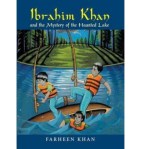
It has been over four years since I reviewed the first Ibrahim Khan book, and while I didn’t love The Mystery of the Roaring Lion, it was just ok, this book was more fun and adventurous and stayed relevant even for a book published in 2010. At 68 pages the book works ideally for 2nd to 4th graders looking for a quick read, or advanced younger kids that will enjoy the short chapters, detailed illustrations and easy to hold book.
SYNOPSIS:
Third grade cousins, Ibrahim and Zayn, are off on a camping trip with their class. Thinking how nice it will be to take a vacation from solving crime, the boys enjoy hearing the story of the haunted lake around the camp fire and not thinking its more than just a story. But the next morning when they wake up for fajr and hear some weird groaning from the woods, they realize they have a case after all.
The mysterious noise presents itself at different times and at different locations, as the boys and their friends work to unravel the clues. The climax gets tense as the whole class is on a moonlight hike when the noise sends them all running and screaming “ghost.” Ibrahim and Zayn, the smart sleuths that they are, find themselves at the culprits tent with the culprits near by. Saved by a classmate, the boys now must now figure out how to prove that the “ghosts” are not just having fun scaring the campers, but are up to some serious crimes that will require police action and being patient.
WHY I LIKE IT:
I love that the boys are Muslim and they wake up and pray and eat vegetarian to ensure they keep halal, and I love that they are also just friends and classmates and kids. There are Muslim and non Muslim kids in the class, at least one girl wears hijab, but it is a diverse group. I like that the characters have their own personalities and they do annoy each other and have to apologize. There does seem to be a lot of characters, and a few times in the short book I had a hard time keeping them all straight, but knowing the real story is the mystery I just keep reading, and figured all the details aside from the clues wouldn’t hold up the story too much.
I don’t know why the author has only written two books in the Ibrahim Khan series, but I hope eventually more will pop up. The books are fun little mysteries that show Muslim characters in action. They learn good manners, cooperation, compromises, prioritizing, and problem solving without the book being in your face about learning all those things. The kids embody them, by being good Muslims and having to rely on one another to save the day.
The book is written in British English and is set in Canada. I bring this up because I didn’t know artifact is spelled artefact and I thought it was an error.
FLAGS:
The book is clean alhumdulillah.
TOOLS FOR LEADING THE DISCUSSION:
The length is too short for a book club book, but I think it would be nice to have in a school or classroom library as the bright well-done cover will entice children to pick it up off the shelf and the short quick paced story will motivate kids that start the book to finish it.



















 Islamic School Librarian