Category Archives: islamic fiction

Sameer and Snazzy: Kindness Counts by Emma L. Halim illustrated by Herry Prihamdni

Standard
Sameer and Snazzy: Kindness Counts by Emma L. Halim illustrated by Herry Prihamdni

The 32 page faceless picture book for toddlers and up, is set in Australia and follows Sameer and his cat Snazzy on a bushwalk.  At first I felt like it might be a little bit like the classic, “And to Think that I Saw it on Mulberry Street,” but the structured story with a repetitive refrain adds in Islamic phrases, silly encounters, and examples of kindness that make it unique.  Add in a fun surprise at the end, and like many other books by the author, be prepared to have it memorized as your little ones ask for it over and over again.

The book starts with Sameer look forward to his grandpa coming to visit, but wishing he had something exciting to share with him.  Snazzy suggests he shares that he can talk to animals, but Sameer knows no one would ever believe that, so the two set off on a bushwalk to find something exciting.

When they hear an “A-choooooo!” in the trees, the fun is just getting started with Miss Koala sneezing and making eucalyptus leaves fall. The duo finds a way to help, but the fallen leaves mean ants are stuck in their home and can’t get out.  Once again, Sameer and Snazzy, find a way to help.  After each episode the refrain of, “‘Imagine if I told Grandpa this!”‘ I say to Snazzy.  ‘He’d never believe you! he smiles.  ‘NO-ONE WOULD!’ We laugh together and continue along the path, when suddenly…”

The book ends with a surprise, that I won’t spoil. The backmatter has a reference to Surah An-Naml and explains that Prophet Sulayman peace be upon him, really could speak to animals.  There is also a glossary of the Islamic phrases and a QR code to continue to the fun after the story ends.

The book is a bit more text heavy than some of her others, but the illustrations are fun, and will keep kid’s attention.  It does not rhyme, but has a cadence that makes reading it aloud easy. The small size makes the book better suited to bed time, but could work in a story time, and would be wonderful tuned into a story board/felt board read aloud.  The book is a universal story, but at some point in Islamic fiction self published and small published books, I think we will need to have open dialogue and discussions if having characters that are not the same race as the author or illustrator is appropriate and beneficial, or is misleading and better to avoid.

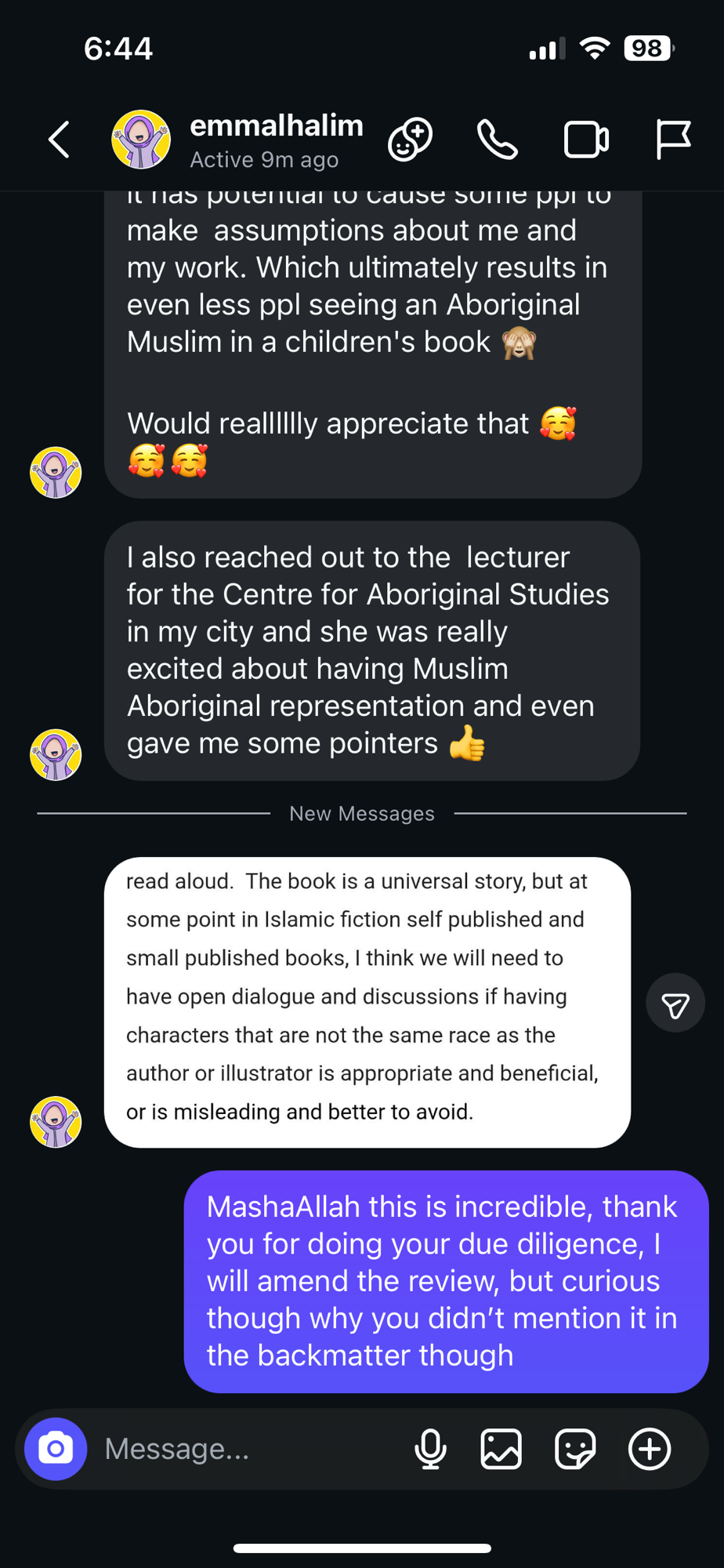
***EDIT: The author reached out to me asking me to remove this generalized opinion of me calling upon the need to have discussion, I opted to amend, as I think we need to have conversation and believe intention and purpose in whatever one decides is a benefit.  So, to avoid errors in interpreting her ask, I will simply post the screen shots, and my response.  Please note I did not tag the author in my Instagram post, she reached out to me.  I purchased the book, it was not gifted.

All the Ways to be Pretty by Shamaila Khan illustrated by Reyhana Ismail

Standard
All the Ways to be Pretty by Shamaila Khan illustrated by Reyhana Ismail

The premise of this book is fabulous, an Islamic approach to internal beauty to counter the societal emphasis on external appearance, by drawing on the examples of Ai’shah (RA), Khadija (RA), Sumayyah (RA), Maryam (RA), Hajar (RA), and Rufaidah (RA), may Allah swt be pleased with them all.  The illustrations are decent, focusing on the girl understanding what her mother is saying and her imaging herself with those qualities.  The part that I struggled with, is I flipped through it before I started reading it, and the pages are often walls of text.  Additionally, I didn’t realize it is rhyming text over 34 pages.  SubhanAllah though, somehow, it works.  I can see this book being shared at preteen gatherings in masajids, homes, and schools everywhere.  The rhyme at times is forced and lacking, but the flow makes the walls of text zoom by and the information shared is not overwhelming and Alhumdulillah, it doesn’t stray too far from the central messaging. You could share it with younger readers, but I think it works best if the audience knows some of the women and facts highlighted, and the information shared is a mix of reminder and new tidbits urging further exploration. The publisher lists the reading age at 7-10 which is probably a good fit based on the amount of text, but the rhyme, mirrors at the end, and starting point of battling beauty standards on the screen and “Princess” messaging is a bit of a target audience disconnect, which is why I point it out so consumers are aware.

The book starts with a lengthy author’s note before the rhyming scene of a mother and daughter walking to school and discussing what the daughter would like to be.  The girl doesn’t answer a profession, but rather responds that she wants to be pretty, and gives some justifications.  The mother gently then encourages her not to just want to be pretty, but rather pretty smart, pretty wise, pretty brave, pretty pious, pretty resilient, and pretty kind, before concluding with the girl throughout the day thinking of how to be like them, and her mother, to earn Allah’s pleasure.  Each attribute is a two page spread with one of the historical women featured.  The book ends with a hadith and six mirrors with the characteristics beneath them.

I like that the book does not try to give an entire biography about the women featured.  I also like that Islamic references are also brought in, some explained some not. It is “Islamic fictionalized non fiction” it is meant for Muslims with Islamic framing, not just Muslim characters, and it has substance.  Lately so many self published or even Islamic published books seem to not feature Islamic foundational themes, and I realize how much I have missed reading books that do.  Yes, I normally would have a solution to offer as to how to make the pages less text filled and I know I should say that maybe it shouldn’t rhyme, because it makes for some awkward phrasing, over explaining, and useless lines, but alas, I have no suggestions.  We need books that present our Sahabas and Prophets in a manner that allow our kids to know them and think of them and emulate them. Alhumdulillah, I can see this book being read and shared and discussed, and that to me is a “pretty “good thing.

Dark Nights and Light Hearts: A Muslim Book of Opposites by Hena Khan illustrated by Mehrdokht Amini

Standard
Dark Nights and Light Hearts:  A Muslim Book of Opposites by Hena Khan illustrated by Mehrdokht Amini

Every few years, for the last 13 or so, we get a new title in this series, and each one warms my cynical heart with its unapologetic Islamic representation and vibrancy.  The heartfelt rhyming lines, the Islam centering, and the enveloping illustration make these books timeless, sought after, and beloved.  This installment covers opposites, previous books in the series focused on colors, shapes, and numbers. From the BIG ummah to a SMALL baby’s aqiqah, HOT oud to COLD rain bringing barakah, SLOW honey full of shifa to FAST cars heading to Jummah, the book uses two page spreads per each term in the opposite pair with rhyming couplets in large clear font to introduce/remind, describe, and highlight an Islamic tradition.  As both opposites and Islam are conveyed, the cadence and illustrations pull Muslim and non Muslim children in and make the book delightful at storytime, in small groups, at bedtime, and for kids to look through on their own, over and over again.  Alhumdulillah.

The book is 36 pages with a Glossary of Islamic words at the end with an Author’s Note.  It is available wherever books are sold and a great reminder that well done Islamic books can make it from traditional publishers.


Eliyas Explains: What was Prophet Muhammad (saw) Like? by Zanib Mian illustrated by Daniel Hills

Standard
Eliyas Explains: What was Prophet Muhammad (saw) Like? by Zanib Mian illustrated by Daniel Hills

Zanib Mian once again fills a void in the literary world for our children using her easy to read and relate to protagonist’s voice.  Over 149 pages, filled with illustrated doodles, details about our beloved Prophet Muhammad (saw) flow through the fictional framing of Eliyas and his family heading to the airport to pick up their Mamoo.  It starts with the standard introduction of characters that all Eliyas books have, so while it is part of the series it can be read as a standalone as well. But really if you have children 5-14, you should invest in the entire collection.  Also, as with the rest of the series, the book is checked by a Shaykh who is named at the beginning so that the reader can enjoy the Islamic details that are to follow. I know there is some debate about the cave and the spider, a story shared briefly within the pages, but I will leave it to those more knowledgeable to decide upon.  The book works well read aloud and independently, either way I’m confident children will enjoy the story, learn something new, and grow in their love of our Rasul Allah, alhumdulillah.

SYNOPSIS:

Eliyas’s dad’s uncle, Haroon Mamoo is coming for a visit, and while Mum wants to make sure they leave at a specific time to get to the airport, Dad isn’t stressed, he had a dream about Prophet Muhammad saw the night before and the kids want to hear all about it.  The story progresses weaving in things around them with Mum and Dad tying them to the sunnah.  From a fight at the airport, to a pigeon getting stuck, to Haroon Mamoo seeming to have gotten lost. The book is preachy, in the best way possible, as Eliyas and Aasiya banter, crack jokes, and learn along with the reader.

WHY I LIKE IT:

I love Eliyas’s voice and the weaving of a fictional story to convey the non fictional sunnahs that are truly the heart of the book.  The information presents in an easy way for children to hopefully remember it, and to also see how they should be behaving and acting in their own lives. The fun fonts, illustrations, and layout make it inviting to pick up and keep reading.

FLAGS;

None

TOOLS FOR LEADING THE DISCUSSION:
This book is not a journal, like some in the series are, but provides ample opportunity to discuss points on each page.  

Your Friend From Palestine by Nabila Adani

Standard
Your Friend From Palestine by Nabila Adani

This book is absolutely gorgeous, from the raised text on the cover, the sweeping illustrations with tangible details, the Islamic threads, and the heart, but…yeah you knew something critical was coming, the rhyme is not consistent, and the biggest hurdle for me, is that there is no backmatter.  I can’t say that I’m “bringing this up again,” because I don’t know that the debate ever dies down: can you write a book about something personal that you have not lived through? In this case can a non Palestinian write a book from a Palestinian perspective? As a former journalist and long time reader, I still maintain that you can, but backmatter detailing your own limitations, what efforts were made to have the book verified by those with OWN voice experience, and background information on why this is pertinent and relevant are mandatory. And this book does not offer them.  Nothing feels off about the contents, and anyone with a heart, has seen and felt everything on the pages about our brothers and sisters living under occupation and through genocide. So is it a good book, yes. Do I think it has value, yes. But, is it authentic? Is it accurate? Is it enough? Does the focus on hardship and destruction open eyes or diminish Palestinian joy? Why wasn’t a Palestinian brought in to cowrite the book with the author illustrator? Was it sensitivity read? I am not able to answer these questions, I simply bring up my concerns for you to decide for you and your children. While the book ends on hope for a free Palestine, and a safe Gaza, the oppressor is unnamed.

The book starts with children on a beach playing when they find a message in a bottle.  The message is from Khalid, a child in Gaza telling the finder about his life and asking about theirs. He likes to play football, but sometimes it isn’t safe, he likes to read stories but often can’t because there are no lights, and he dreams of swimming in a swimming pool, because they often don’t even have water to drink.

Khalid then tells the finders of the bottle, and thus the readers, to not lose hope, “to hold on to your imaan.” And it highlights what we can all do to help.  “You can pray for us! Send charity! Spread the news!” and tell people about Palestine. So that one day we can meet at the Dome of the Rock, pray at Masjid Al-Aqsa, and be together in a free Palestine, inshaAllah.

The illustrations are beautiful and the framing effective in connecting with readers, and highlighting the similarities before revealing the obstacles. Again why I wish there was backmatter, so that it didn’t feel simplistic, but rather bringing it down to a younger audience level.  With dialogue, explanation, and context, the book can be powerful, but on its own, I feel the lacking authenticity, transparency, and details about Palestine, make the book in need of an update before future reprintings.

Amar’s Fajr Reward by Amire Hoxha illustrated by Hilmy An Nabhany

Standard
Amar’s Fajr Reward by Amire Hoxha illustrated by Hilmy An Nabhany

As Muslim authored stories are increasingly more available, certain cultural Muslim stories continue to be limited or none existent. Since 2021, when four of us reviewers created the Muslim Book Reviewers and Muslim Book Awards space, we have constantly been encouraging Amire to work on her dream of being an author, and write a joyful Muslim Kosavar book. Through Ruqaya’s Bookshelf, her dream has become a reality, Alhumdulillah, in the form of this 32 page, 8.5 by 11, full color books for early elementary readers. In all my years of reviewing I have not ready many Kosavar books, and of those few, none have been OWN voice, and all have focused on the war.  Enter Amar’s Fajr Reward, a simple story of a boy and his Gjyshi, going for fajr at the masjid, finding the door locked, and the obstacles, determination, and results that transpire, not just for Amar but his grandfather as well.

The book starts with Gyjishi splashing water on Amar to wake him up for Fajr, while reminding him that “Prayer is better than sleep.”  Grandpa’s quick steps and a sleepy little boy, keep Amar hustling after his Gyjishi only to arrive at the masjid and find the door locked.  

Gyshi cannot be deterred by his grandson wanting to go home and pray, or a locked door and decides to jump the fence, something he has done in the past.  Calamity strikes, when he falls and hurts his foot and it is up to Amar to help.  But he can neither scale the wall or find anyone to help.  When the muadhin finally runs up the street Fajr can be made, Gjyshi can be assisted, and changes can be made so that hopefully getting locked out doesn’t happen again.

I love that there are pronunciation tips on the cover page of Gjyshi, grandfather, and Axhi, uncle, but I do wish there was some backmatter showcasing Muslims in Kosovo.  Are Muslim communities spread out in large diverse areas, or do they tend to have neighborhoods that are tied together by faith? As a place not often seen or heard about, a little layering of details would have deepened the story.  Especially, if the reasons are cultural or societal explaining why people don’t wake up until the athan is called, but were annoyed that Amar was knocking on the doors at that time, or maybe why the didn’t just pray outside the masjid, calling the athan and waking up the regulars that attend. Also about why the key to the masjid is “special.” Are places of worship regulated or only allowed to be open at certain times?  I also wish it would have given a little build up about Amar and this particular day. At the start he wants to pray at home as it seems like that is his norm, and Gjyshi going to the masjid seems to be the grandfather’s norm, so was this something special, a right of passage, are kids not typically seen in masjids is he visiting his grandfather? 

The book is sweet and warm, with a lot of heart and I love that it takes place in a masjid and threads in that salah is better than sleep, and that praying in congregation is 27 times the reward.  I also love that the author fulfilled her dream inspired by her own grandfather, and inshaAllah she will continue to write and bring Kosovar stories to our bookshelves, ameen.

My First Salah Book: Why and How we Pray by Learning Roots

Standard
My First Salah Book: Why and How we Pray by Learning Roots

Over 91 pages this informative book tells “The Story of Salah” through the miraculous night journey, how to do wudu and its benefits, step by step how to make salah, and then a story style portion of “Life with Salah.” I do not have the digital “kitab” pen that allows readers to have the book read to them and activities made interactive without parental involvement, but even with out it, the book is a pretty solid resource.  The hardback binding, and full color pages are not crowded, they introduce nine characters at the beginning and feature them throughout the pages learning the steps, imagining witnessing the events, and putting the lessons into practice.  Some of the recent Learning Roots books have the characters watching or imagining themselves in story’s of the Sahabas and Prophets, that make me uncomfortable.  The first chapter of this book, is more limited as it illustrates a light in the sky as the Buraq being seen by some children, not the characters in the book, and a silhouetted tree as Sidrat al-Muntaha.  As I am not knowledgeable enough to know if it is “right” or “wrong” to have a child seeing the silhouetted tree and pointing to it, or who it is meant to be, I’ve included pictures for you to decide what is best for your family.  I particularly like that on the pages where Arabic is spoken it is found written in easy to read Arabic with English translation and transliteration.  Within the text there are attributions of hadith and after each chapter there is an activity and questions.  The book concludes with a glossary.

Whether as a tool to learn for the first time, or a book to revise with children already praying, the approach is gentle and easy, inviting children to engage with the pages.  The four chapters are packed full of information, but the illustrations, diagrams, and steps, also allow the book to be referenced, or read cover to cover.

The last chapter, “Life with Salah” shows the character group engaging with salah in a very idyllic way, but given the tone of the book, it works, and will allow readers to see salah as more than just an obligation, which is important.

I got my copy from crescent moon store, if you use my initials (ISL) at checkout you can save 10%.

What Shape is Your Mosque? By Jenny Molendyk Divleli illustrated by Zeynep Begüm Şen, Ayşenur Kazan, Hümeyra Yograncı, Hatice Leyla Arslanbenzer, Gökhan Özdemir, Özlem Güneş, Rumeysa T. Karaca, Şüheda Başer Yılgör, Aybüke B. Aslanoğlu, M. Ahmet Demir, Fatma Betul Akbal

Standard
What Shape is Your Mosque? By Jenny Molendyk Divleli illustrated by Zeynep Begüm Şen, Ayşenur Kazan, Hümeyra Yograncı, Hatice Leyla Arslanbenzer, Gökhan Özdemir, Özlem Güneş, Rumeysa T. Karaca, Şüheda Başer Yılgör, Aybüke B. Aslanoğlu, M. Ahmet Demir, Fatma Betul Akbal

Framed the same as the author’s book entitled What Color is Your Mosque? The readers are taken all over the world to see masjids in a variety of shapes: conical, spiral, oblong, flower, boat shaped and more.  Each two page spread has a child introducing themselves, where they are from, the name of the mosque and some bits of information to engage the reader.  It isn’t a literary masterpiece, but I don’t think it attempts to be.  It is a fun informative book to show children the diversity of architecture, the universal practice of Islam, and be motivated by the prompt at the end to ponder how they might design their own masjid. I particularly like that the author points out that the first mosque she ever prayed in was a converted house.  This book is great in small groups and story times, where the pictures can be looked at, and lends itself to further research of looking up pictures of the mosque’s included, building mosques with blocks or legos, or paired with a similarly inspired craft.

The book starts with a note to parents, some hadith, a dedication, and then the author, Jenny introducing herself to the reader, and starting the journey.  The book shares mosques in Kuwait, Qatar, Indonesia, Germany, Pakistan, Saudi Arabia, Croatia, Kazakhstan, China. Each spread is illustrated by a different artist, but all are beautifully done.

I found the pages smile inducing, as I Googled to see real photographs of the mosques mentioned.  One of my favorites was the Rijeka Mosque in Croatia that was designed by a sculpture and changes shapes depending on the vantage point.  And I was shocked I had never seen or heard, or somehow noticed, the Kashti Wali Masjid in Karachi, Pakistan.  I masjid that is boat shaped and very near to my familys’ homes.  

I purchased my copy from Crescent Moon and if you use code ISL (my initials) at checkout you can save 10% on your entire order.

Huda F Wants to Know? by Huda Fahmy

Standard
Huda F Wants to Know? by Huda Fahmy

Huda Fahmy books always make me laugh, but this is the first one that made me cry. Centering mental health and her parents divorce, we see Huda grappling with change, loss, anger, and resolve in a raw vulnerable way. While ever hopeful, and at times comical, the book is also incredibly moving and insightful.  Whether as part of the Huda F series or her two graphic novels prior, her autobiographic books always tackle heavy topics in a joyful, hilarious, honest way that appeal to girls and boys from middle school and up.  I know at 263 pages, this book is a YA read, but in my house my kids (daughter and sons) have loved reading her perspective about hijab, arranged marriages, identity, and sibling relationships. The unapologetic Muslim authenticity is unparalleled, and that non Muslims champion her books as well, truly shows the value of good story telling, and gives me hope in an often bleak world. Huda’s books are staples: new books are anxiously awaited, previous books are regularly reread, and Huda F Wants to Know? continues in that tradition.  This book isn’t just fun, it is important- it normalizes mental health, empowers families shaken up by change, and makes us all feel seen and less alone. SubhanAllah.

The book starts with Huda’s plan for her junior year in high school, her friend Nabz and her are determined to buckle down and get scholarships.  When Huda’s parents call a family meeting, she thinks she just might be getting a car, but instead she and her sisters learn, their parents are getting a divorce. The book then rewinds to show a little lead up before Huda’s world shatters, and junior year’s blue print is tossed aside.  We see her going to the masjid for weekly halaqas where Sr Amal discusses topics like societal pressures, family expectations, gender bias in education, and other relevant topics.  At one such gathering, Dr Haifa came to talk about mental health.  We also see her crushing on a boy at school, fighting with her mom and sisters, and the girls going on a road trip to a Muslim convention.

Every storyline, every twist, every page really, has Islam woven in.  It is the way the characters see themselves, see their world, handle stresses, find peace.  Mental health is not separate from the hadith and sunnah, it is blended and approached in a holistic manner.  Divorce is understood Islamically, and the clarity in which it is articulated will, I imagine, be so reassuring for Muslims who have gone through it, and seen others go through it.  Just as my boys years ago read That Can Be Arranged, and became incredibly curious about marriage in Islam, I have no doubt that this book, will also be a powerful conversation starter for so many.  I don’t know if that is part of why Huda write, but it definitely is a result of her books.  I wish I could ask her, I’d also want to know how she decides what to share of her own life, where the line of reality and fiction for her is and how she sets and maintains those boundaries? I also desperately would like to ask her if she plans to write forever, because the world benefits from her books, needs her books, I know I do.  No pressure or anything.

 There are resources for mental health at the back of the book, some even specifically for Muslims. Please preorder this book and/or request it at your local public library as a show of support, it releases in April.

Join Us for Ramadan by Sana A. Faqir illustrated by Amna Asif

Standard
Join Us for Ramadan by Sana A. Faqir illustrated by Amna Asif

This 18 page chunky board book is about 7.5 x 7.5 inches and a little over an inch thick.  Each spread features interactive touch, feel, lift, slide, and rotate features that keep little toddler hands engaged, while the text shares Ramadan basics. Interestingly enough though, the back says it is not for 0-3 year olds, presumably because parts could tear and be choking hazards, but making it unusable for the demographic(?).

It starts with a slider that reveals the Ramadan moon and encourages readers to find the moon in the sky. The next spread has you lifting a cover to see what Mummy has made for suhoor.  The prayer mat is then pulled out, The Qur’an opened, Sadaqah collected, dates and chocolate rotated, masjid doors opened, and once again the moon slides into view to know it is time for Eid.  

The illustrations are cute, the manipulatives are clever and not repetitive, but the flaps on any of the lift the flap reveals are incredibly thin, and the outer strip that holds the entire book is similarly skimpy and I don’t know how long it will hold up with regular use considering the thickness of the actual pages.