Category Archives: Eid ul Adha

Music of the Mountains: A Story in Pakistan by Sabrina Shah illustrated by Manal Mirza

Standard
Music of the Mountains: A Story in Pakistan by Sabrina Shah illustrated by Manal Mirza

Set around an Eid concert in the North-West Frontier in Pakistan, a young girl must find her courage to play the rabab in front of an audience, even though she is still learning her first song. The beautiful illustrations of Manal Mirza and focusing on an under represented population, made me hopeful that this book would transcend the musical focus and weave in Islam and culture. Sadly, though, the book falls victim to cliche lines that mean nothing, and a story that doesn’t make a lot of sense once you move past the superficial attraction. The backmatter infographics about the rabab, where it can be heard, details about the Pathan/Pashtun people, What Eid is, the traditional clothing, and a Pashto Glossary, add to the vibe of the book, but still fail to offer any specific “hospitality, courage, and rich traditions,” that are only ever referenced in generalized terms and statements.

The book starts with Roohi’s favorite time of day, the sun is settling behind the snow capped mountains and her family is gathering around to listen to her grandfather, Neeka Baba, play the rabab. No they aren’t praying maghrib, or breaking their fast, so presumably it is not Ramadan.  When Neeka Baba plays, “songs full of rhythm echo through the cherry blossom hills.  Songs from long ago tell stories of folklore, heroes, and love. . . songs of Roohi’s ancestors.” A beautiful sentiment, but it is not a thesis statement or main idea of the book as we, the reader, never learn about her ancestors, or folklore, or about the culture.” We are just told they all had courage, and she needs to channel that strength.

She will need strength to play the rabab at her school concert, except remember “she hasn’t even learned a whole song yet.” She also worries she won’t be as good as her grandfather, but presumably he has been playing longer and she is just starting, so I never connected why she felt she should be as good as him.  No one in the story compares them, or says she should be as good as him, or even strive to be as good as him.  There is nothing that hints that this is even a part of the characters development other than the repetitive refrain that she must “play with the courage of those who came before her.” So the cathartic release of being told “to play like yourself” also seems forcefully contrived and not a natural arc of growth and understanding.

As Eid creeps closer, Roohi has lessons with her grandfather on the rabab, and then Neeka Baba coughs and is in the hospital. The reader has no idea how this man falls ill, or recovers, if it was sudden or a known affliction, but he is no longer the focus, the rabab is, and so the story continues.

At the school concert, Roohi is introduced as playing music from the North-West Frontier Province.  Hold up, yes I thought I skipped a page.  They live in the North-West Frontier, don’t they, this is a school concert? What an odd introduction, did they travel? At the end there is a “smile as wide as the lush valleys back home.”  When did they leave home? And why a silent prayer, why not a “bismillah.” Isn’t the point of OWN voice to have the little details and the voice that can’t be imitated by researched work?

I am going to spoil the ending, she freezes, Mama and Neeka Baba help her find her beat in the audience and she steals the show so to speak. The ending is sweet, but not anywhere near as heartfelt as it should have been if the audience would have been shown the strength and courage of the Pashtun culture, not just repeatedly told it, felt the warmth of their hospitality, the rich ancestral values that would be threads that manifest in the music that she is hoping to share with others. Sadly we are just expected to know that they all exist and cheer for Roohi to succeed.

Disappointing, considering how fantastic the illustrations are, sigh.

Abdullah’s Bear Needs a Name by Yasmin Hanif illustrated by Sophie Benmouyal

Standard
Abdullah’s Bear Needs a Name by Yasmin Hanif illustrated by Sophie Benmouyal

I love the idea behind this 28 page book, and the illustrations are pretty great too, but I felt like the story needed a little more depth to convey meaningful emotion, appreciation, and connection.  It starts with an Eid gift, but there is nothing tying it to the holiday after the first spread.  And while it shows both Islam and Desi culture in action, I wanted to hear the stories of his family, and the connection to his culture that helps him name his bear.  I also feel like the premise was a little rocky, did everyone get family heirlooms for gifts? Did they get other gifts? Why was he gifted this special stuffed toy and not his older or younger siblings? Would a kid really be that excited to get a hand me down stuffed bear? Once you read the author’s intent, and the inspiration for the story, an adult could connect the dots and help a reader recognize the internalized othering being overcome, and discuss it, but I don’t know if all kids would not pick a cultural name for a toy, or see that Abdullah didn’t consider reflective names either.

The book starts with the reader dropped into an Eid day celebration.  Abdullah is handed a gift by his parents and when he unwraps it he finds himself the new owner of an old well-loved teddy bear.  His father was the previous owner, but refuses to tell Abdullah the bear’s name, urging him to discover it on his own.

Abdullah loves the bear, and takes it with him to the store, to school, to cricket, to madrasa Everywhere he goes he tries out names: old names at the museum, classmates names, but nothing seems to fit.  When his Abba tells him a story about his grandfather, he finally finds the perfect name for his bear.

I really like the details in the illustrations, they bring the story to life and feel authentic: the store names, the Eid spread, the activities.  I feel like this book is so close to being a standout, but I don’t know that kids who don’t find themselves exactly in Abdullah’s mindset, would be able to relate and connect to what transpires.  Unfortunately, it is unclear if he grows and learns from the experience, or if it was contained to this one incident. 


Can You Find My Eid Presents? By A.M. Dassu illustrated by Junissa Bianda

Standard
Can You Find My Eid Presents? By A.M. Dassu illustrated by Junissa Bianda

This brightly illustrated Eid book has cute illustrations, but is very basic.  There is very little about Eid, in fact I have no idea if it is supposed to be Eid al Fitr or Eid al Adha. The girl is outside when it gets dark and no mention of iftar is made, but there is no crescent moon for Eid al Adha as there is one prominently seen in the illustration, so any insight into the matter would be great.  The book is just a little girl running around looking for the missing Eid presents.  It doesn’t talk about traditions or faith, Hana is literally just moving from location to location to look under the bed, in the wardrobe, the broom cupboard, the bathroom, the garbage, outside, in the shed. So yes, yet another Eid book with no Islam, no heart, no explaining why finding presents makes this the “best Eid ever!” Sigh. Truly it could be, Can you find my birthday presents or Christmas presents, and nothing in the story would have to change.

The book starts the evening before Eid, and Mummy and Hana are laying the table, and admiring the Eid decorations.  Mummy has a lot still to do and asks Hana to help by getting the Eid presents to Nani’s house for the party.  Only problem is that Hana can’t find them.

She looks everywhere, inside and out, and when Daddy comes home he is too busy to help.  He shoos her off to Nani’s next door, where the mystery is solved and the next morning when the presents are opened everyone is happy.

I wish there was some emotion, maybe whatever was in the little blue box for her Nani had her excited, and when it goes missing she is anxious.  Even to mention that they go open presents after Eid prayers seems like a natural inclusion, but alas, there is no emotion, no Islam, and no real point of the book.

Ibraheem’s Perfect Eid by Farhana Islam illustrated by Nabila Adani

Standard
Ibraheem’s Perfect Eid by Farhana Islam illustrated by Nabila Adani

Gorgeous illustrations, joyful Islam, and a sweet story about a little boy realizing there is more to Eid than presents. The protagonists voice is really on point and a great way to counter so many of the books, and real life antics of kids equating Eid to being about gifts. This 23 page picture book for 3-6 year olds, works for both Eid al Fitr or Eid al Adha, and follows little Ibraheem as he searches for his gifts throughout his sunnah and love filled Eid day at home and at the mosque.  I love that it shows him getting drawn into the khutba, doing takbir, ruku and sajood, eating dates before going, and taking a different path on the way home.  It doesn’t have any backmatter, but if reading it to a child, I would hope the little details in the text and illustrations would be discussed. It took me a few readings to be ok with how Ibraheem discusses his gift order with Allah swt, but I think for little kids and with the consistent tone of the book, it makes it relatable.  I also don’t know why his mom and rest of the family do not go for Eid prayers. Other females are shown at the mosque in the background, and people of various ages and mobility, but alas it is just Ibraheem and his Baba at salah, and a house full of love and family the rest of the day.

The book starts with an illustration of Ibraheem hanging up his “Eid Sunnahs” chart next to his “Dear Allah” swt list of gifts that he wants. The text then starts with it being Eid day and Ibraheem looking in all the usual places for his presents, but comes up empty. He wonders if his parents forgot, if Allah forgot, but he knows that would never happen. Luckily Baba and he are off to the mosque for prayers, maybe, he thinks, the presents are there.

As the father and son walk to the mosque they greet others, and then settle in for the “Eid day stories.” I don’t love that the khutbah is referred to as such, but that is probably just me. When the iqamah is called, it is time to pray and Ibraheem copies his Baba before they make their way into “the sea of smiling faces.”

Back at home it is time to enjoy food, games, fun, and cuddles with a bustling house.  Presents still haven’t been found, but the day has been perfect, and presents can always be opened tomorrow.

I love that this is a traditionally published book, that centers Islam on Eid and radiates with joy.  The large size makes it easy to share in all settings, and the illustrations beg to be explored and appreciated.

Eid for Nylah by Nizrana Farook illustrated by Zelma Firdauzia

Standard
Eid for Nylah by Nizrana Farook illustrated by Zelma Firdauzia

I have read this book dozens of times and I honestly don’t know how I feel about it. If you remove the title and second to last page and just READ the words, the book could be about any holiday that you might clean and decorate for, that would involve giving gifts, putting on henna, wearing new clothes, praying, and sharing food at. The illustrations imply that it is a Muslim holiday with about half the women in the pictures wearing hijab, and a few decor items that say Eid Mubarak in English and Arabic, but readers that are unaware or unfamiliar might not grasp that it is faith based at all, and the Author’s Note mentions, but doesn’t detail much about the religious significance either. During one reading, I felt it also could almost seem like a mystery, that the title just happens to ruin. The cat Nylah goes to different houses on the street seeing and hearing the tidying and banner hanging and gift wrapping occurring, but doesn’t know why no one has time for her, until the big reveal that it is Eid. I think for little non reading kids that actually might be my approach, to share the book without the title and back blurb and see if they can figure out why everyone is too busy to play with Nylah.  I don’t know that it is tokenism, or that Islam is left out to make the book palatable for the Western gaze, I could be wrong though, I really just think this is the author’s style.  Having read her chapter books that always center animals, feature community, and include Muslim names, I think this is just an extension of her lyrical writing in her debut picture book. The book would work for either Eid, but the backmatter is the author’s reflection on Ramadan and Eid al Fitr.  I know I’m the minority that struggles with Islamic holiday books that leave out the Islam, so for those of you that do not find it disappointing, the book is sweet.  Nylah is a cat that is welcome and known to the entire neighborhood, to come and go as she pleases, the age engaging illustrations complimented by the cadence and rhythm of the structure, lines, and diction are easy to read aloud to groups of all sizes, and hold the attention of 3 year old children and up.

The book starts with a family “wiping and scrubbing, tidying and sorting, everything in sight.”  When no one has time to play with Nylah, she heads outside under the crescent moon, and goes next door to Bilal’s house, where he and his family are decorating.  When she tries to play with the ribbon, she is once again told they are too busy to play, so she slips into Reem’s house where they are doing henna.  This continues from one house to another until the next morning when her family all dressed wakes her up to go to the park with them for prayers and Nylah realizes it is Eid.  Now the children are not too busy and everyone plays with Nylah.

Yeah, I know, taking a cat to Eid prayers sounds wild to me too, kids love imagining though what chaos might ensue.  There is enough hinted at that Muslim families can find the clues and make the book more religious or holiday centered, but I wish it showed the cat seeing praying or reading Quran, hearing the athan or thikr, or something that would ground the book in Islam, but alas, it does not.

The book concludes with an Author’s Note and scanable QR Code for a free audio reading.

The Eidi Bag by Shazia Afzal illustrated by Shiva Delsooz

Standard
The Eidi Bag by Shazia Afzal illustrated by Shiva Delsooz

This adorable 32 page picture book, is not just a story about celebrating Eid al fitr, it weaves in themes of culture, faith, anticipation, disappointment, change, and appreciation.  It is Sarah’s first Eid in a new country and she has made herself a new Eidi bag just for the occasion, to collect the money she will receive from friends and family to celebrate the holiday, and then use to buy treats to share.  Except other than her parents and grandfather, no one gives her Eidi.  She longs for Pakistan and the traditions that she is used to, when slowly she sees that new and different traditions can also be fun and filled with love and joy.  The slow realization and protagonist point of view are skillfully done in keeping the story engaging, the arc smooth, and the lessons nuanced.  The beautiful illustrations, tug at your heart and bring the story to life making me confident that it will be a highly sought after addition to any book shelf for story time, bedtime or independent readers, Muslim and non Muslim alike.

The book starts with Sarah running into the kitchen on Eid morning to show her Mama her Eidi bag and ask for her Eidi. Her Mama lovingly gives in and reminds her that it isn’t polite to ask for Eidi.  Sarah repeats the requests when Baba and Dada ji enter, and Mama rolls her eyes.  The family is then off to the masjid to pray, listen to the khutba and give donations.  At each turn of greeting friends, Sarah shows off her bag, and yet no one offers her Eidi, much to her confusion.  On the way home Sarah is missing Pakistan and recalling how full her bag would be if she were there.

Once home, Mama is busy in the kitchen getting ready for guests to come by. Sarah notices that they will be coming at a certain time, not in and out all day long like before.  When the guests, Muslim and non Muslim, start to arrive they each bring a gift, baklava, flowers, candies, a little plant, and even a set of 40 markers just for Sarah, that she can store in her Eidi bag.

I love that even though it could very easily come across as whiney, or with money being discussed, greedy, it doesn’t.  The book is very tender, and you feel the emotions of Sarah in a new place adjusting to what her expectations are to the reality, and adapting. Being kind of dismissed at Eid also was very reflective as children everywhere get a bit jostle with all the hugging and greetings flying around above their heads. I also love that the neighbors come, including a friend named Jessica, modeling for non Muslims what they too can expect if invited to an Eid party. Someone brings baklava, not a traditional Pakistani dish, also showing the diversity within Islam, subtly adding an additional beautiful layer to the story.

The book concludes with an Author’s note and a glossary.  A great book that will work for both Eid al Fitr and Eid al Adha.

Our Neighborhood: Excited for Eid by Marzieh Abbas illustrated by Anoosha Syed

Standard
Our Neighborhood: Excited for Eid by Marzieh Abbas illustrated by Anoosha Syed

img_8357-1

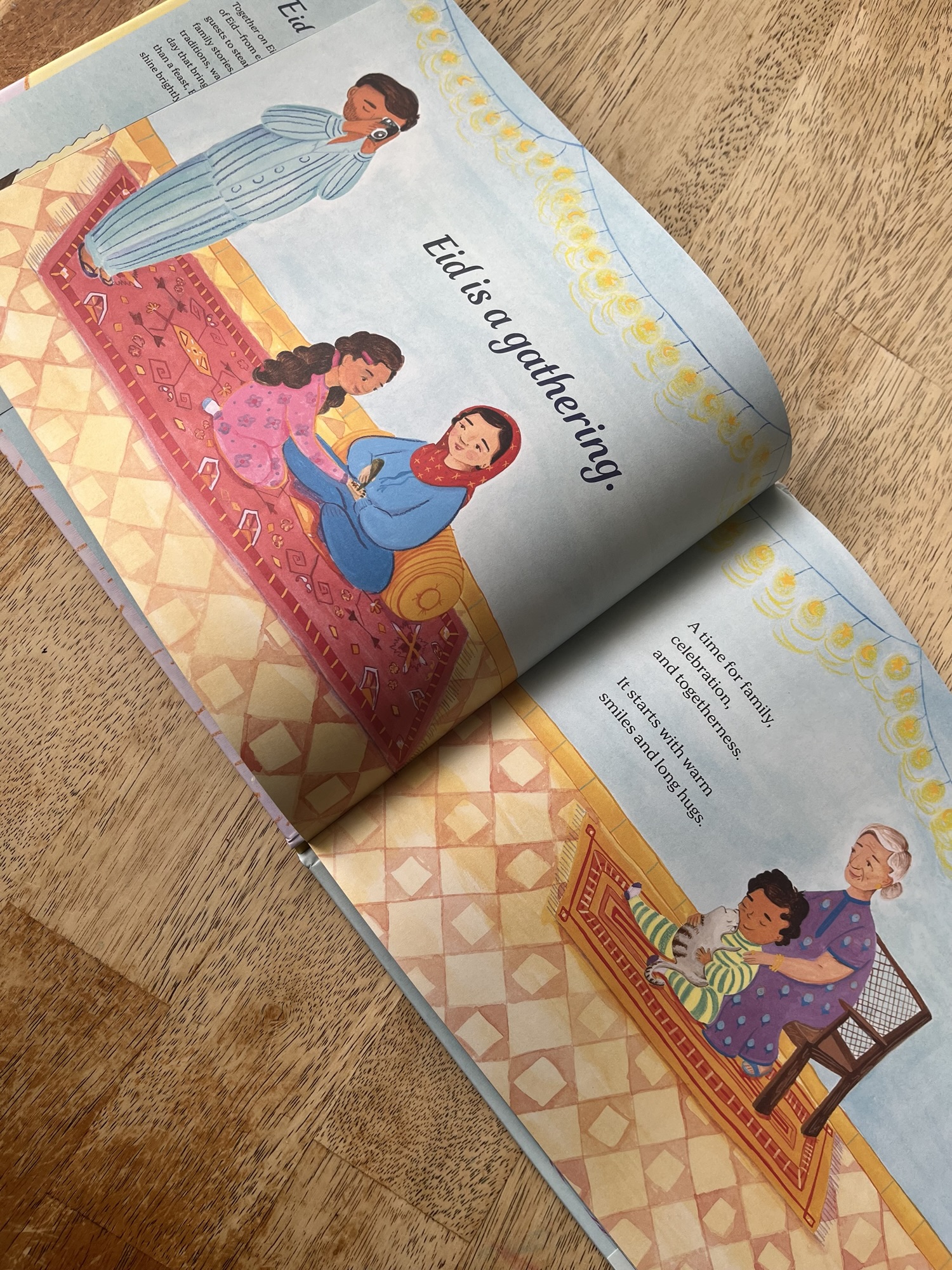
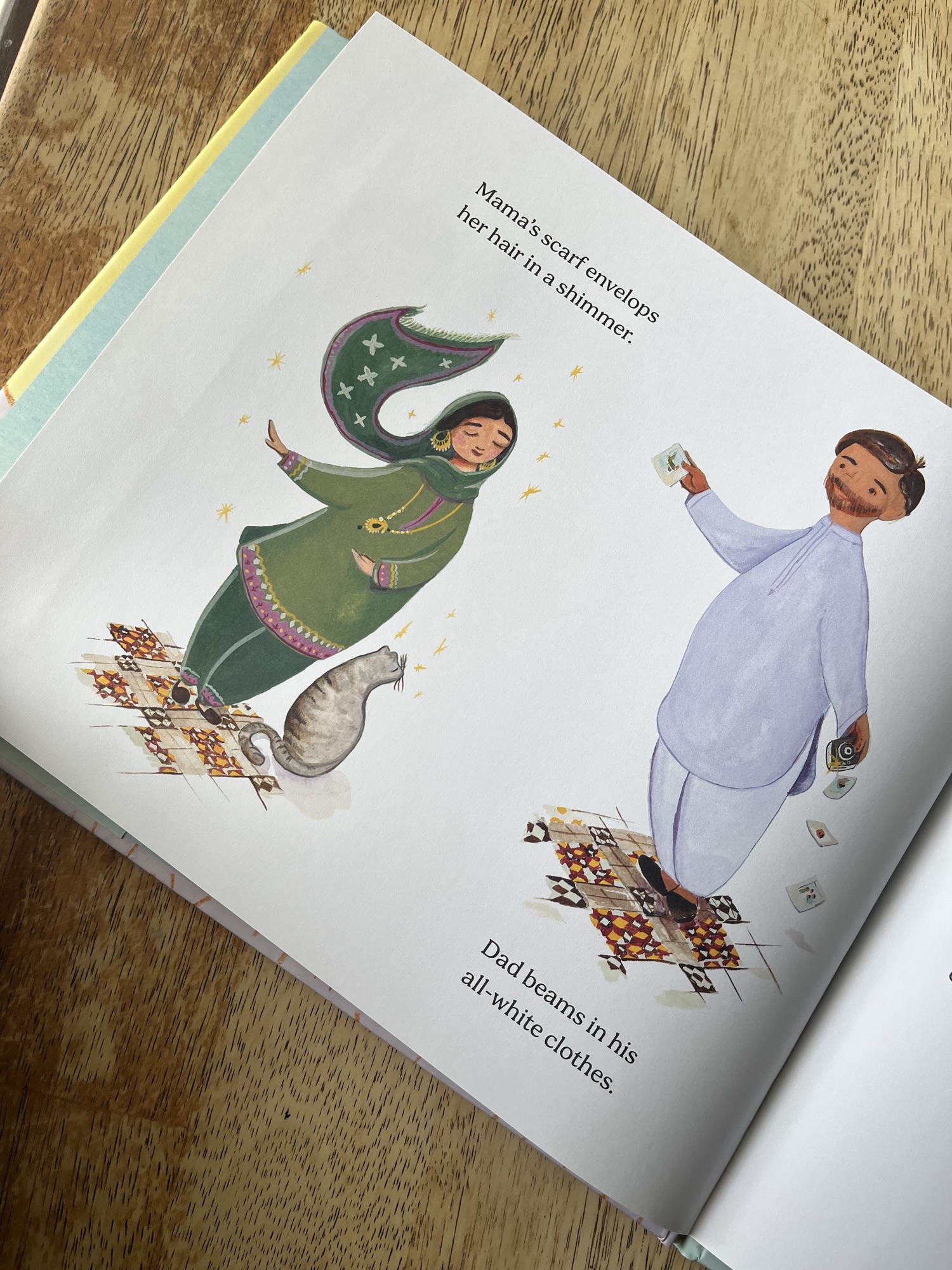
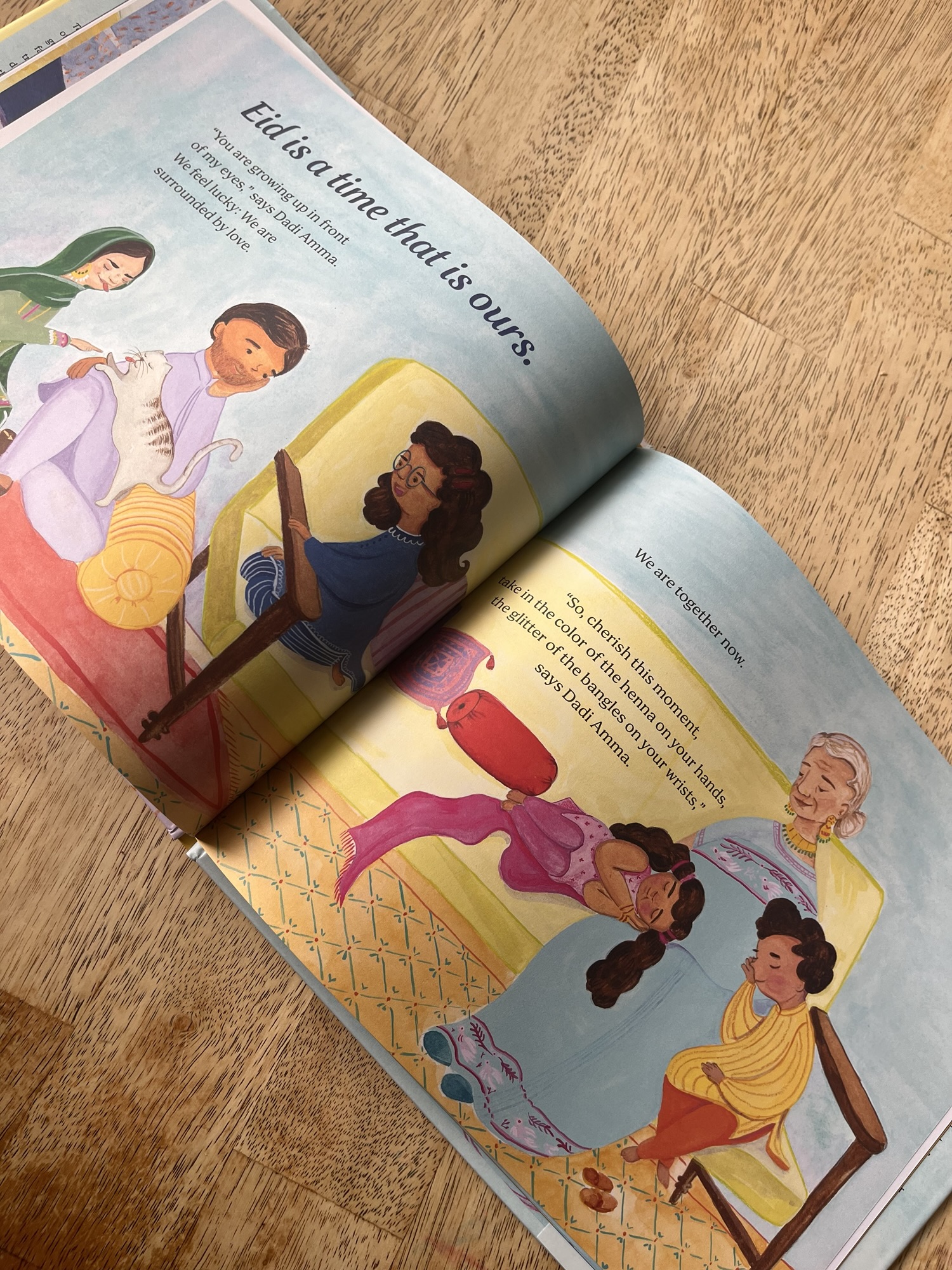
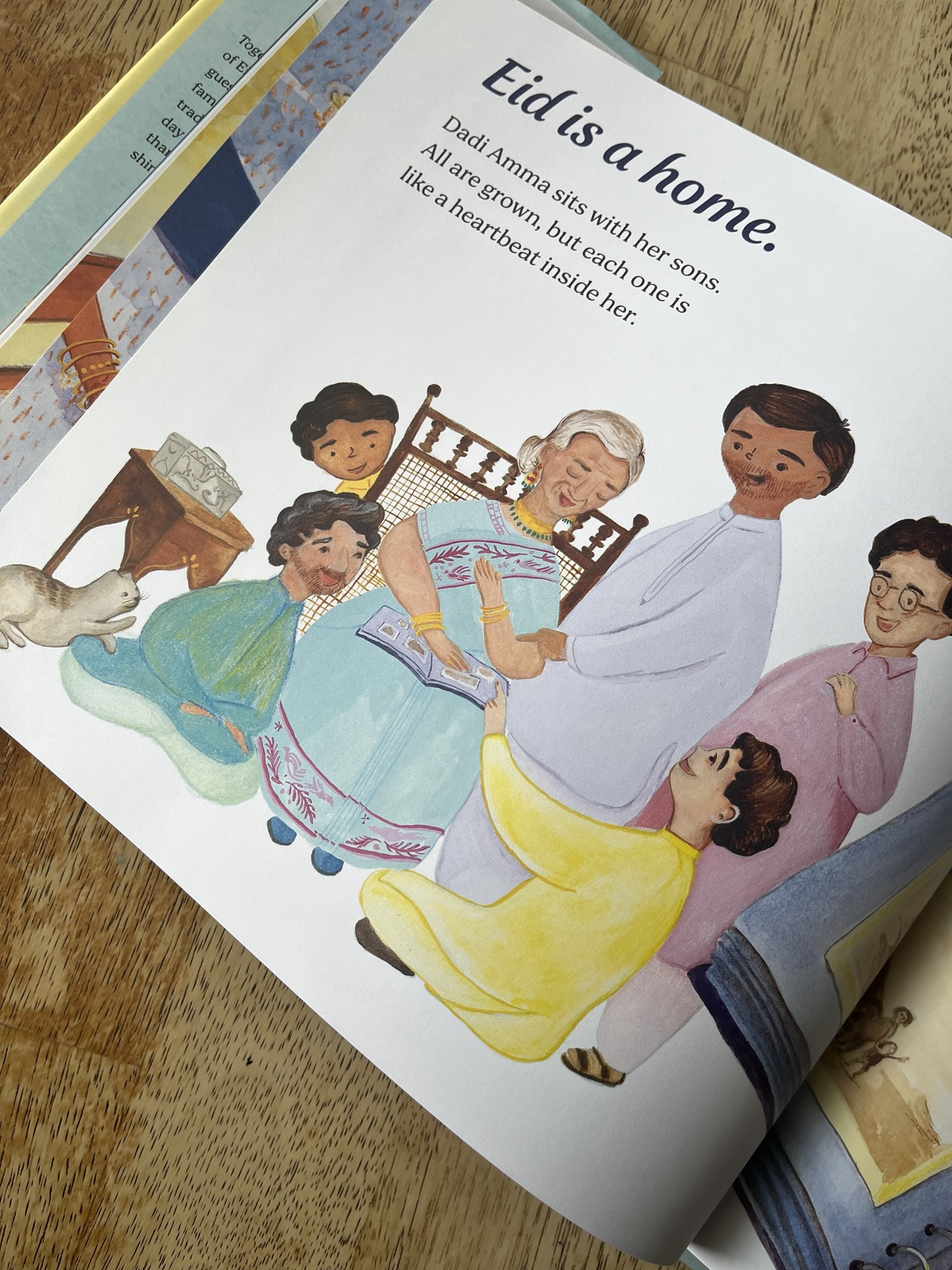
Like the first book in the Celebrating Islam from the Our Neighborhood series, Friday Fun, this 26 page 7 x 7 board book is delightfully done in capturing the joy, sentiments, and traditions of the day. The mix of specifics and generalized parts of an Eid day experience offer both a window and mirror for toddler to early preschool kids. My concerns is that while maybe families will sense that henna/mendhi is cultural fun, and balloons and ice cream are not a religious requirement of the holiday, the two page spread dedicated to gathering at graves is a lot of space given to a cultural practice, not an Islamic one. I’m not a scholar and the book with its minimal words does not indicate if these families are visiting all graves, if they visit on days other than Eid, if they are grieving recent deaths and acknowledging that holidays can be hard. It shows multiple families at multiple graves some with flowers, some bare, some placing flowers, under the words, “gather together” and “love forever.” It is uncomfortable to me because of the space it takes up and the implication that it is a major part, or perhaps that it is a requirement of the religious holiday, when it is not.

img_8360-1

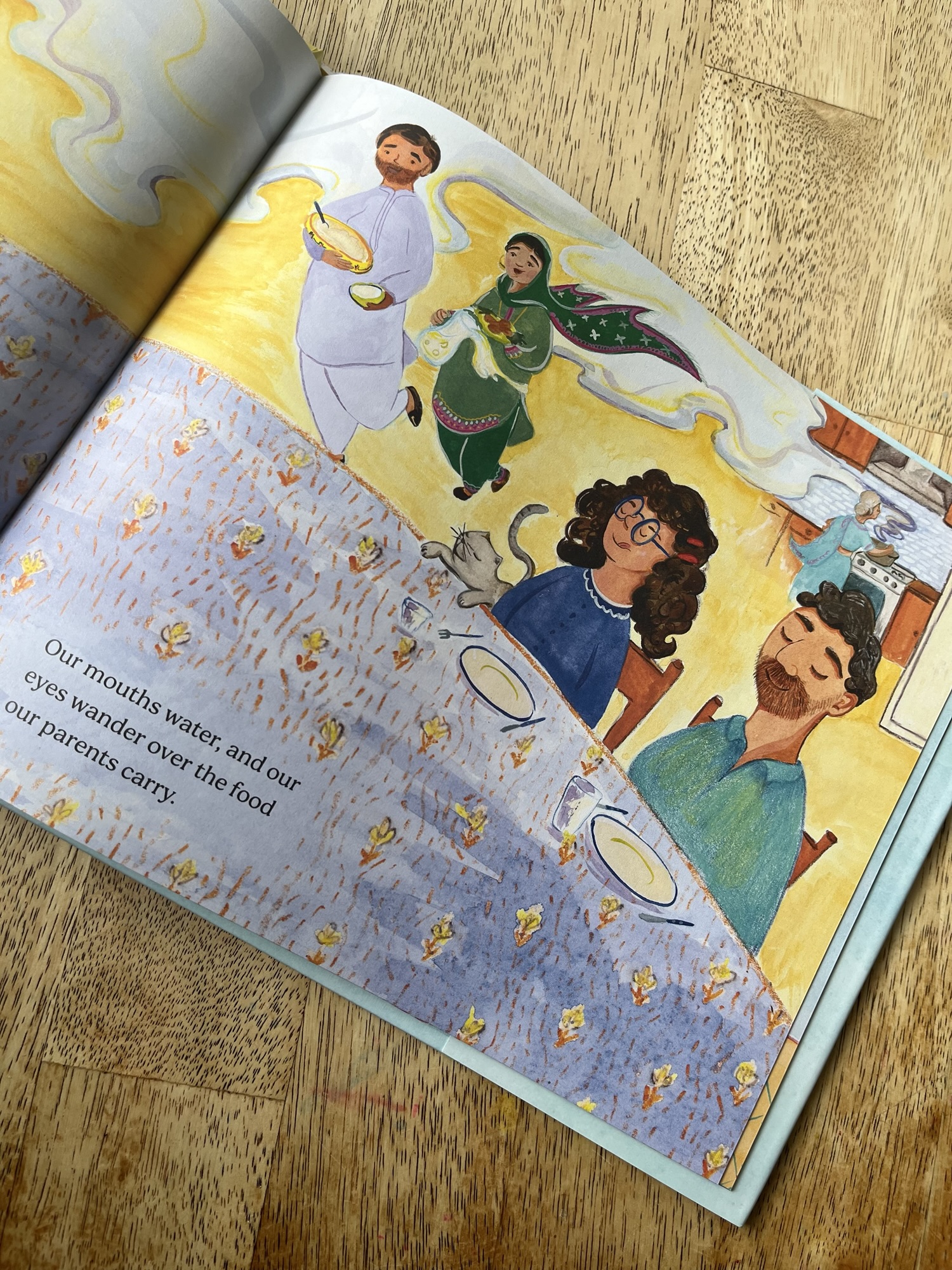
Similarly, the absence of going to the masjid or even praying is also glaringly missing. The family goes past the “lit up mosque” to get to the “fun kiosk” later at night for fun and games, but again no Eid prayers, five daily prayers, or really any worship is shown to take place on Eid other than in the illustrations reading Quran and making dua at graves. Hijab is shown on numerous women and mentioned in the text. For a book about a religious holiday, positioned to celebrate Islam, I would have hoped for some clear religious acts to be shown and articulated as being joyous parts shared by a global faith.

I enjoyed the little baby’s desire for ice cream that stretches through the story. It will add a layer of joy to even the youngest audience members. The gathering to eat and share and have fun is beautifully illustrated under the simple rhyming text, but Eid is a religious holiday, and that point seemed unfortunately absent.

The Gift of Eid by Shifa Saltagi Safadi illustrayed by Aaliya Jaleel

Standard
The Gift of Eid by Shifa Saltagi Safadi illustrayed by Aaliya Jaleel

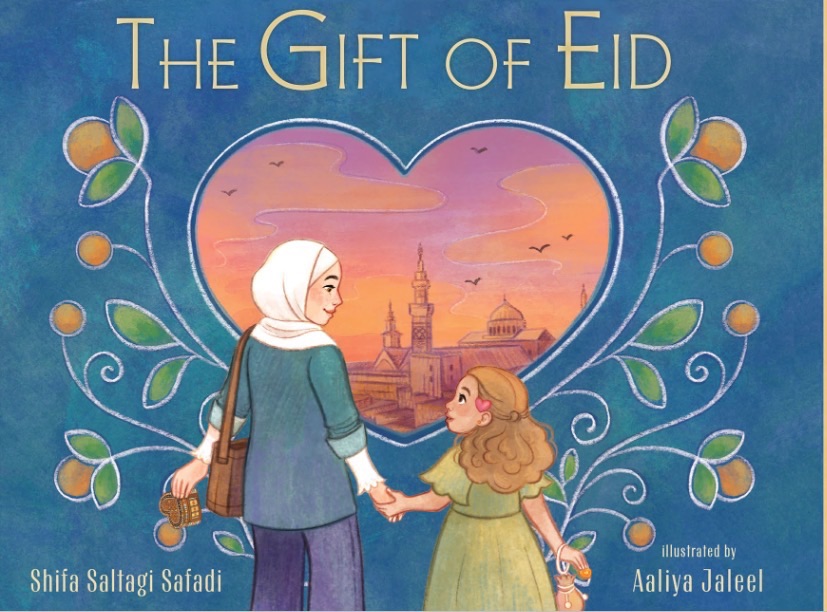
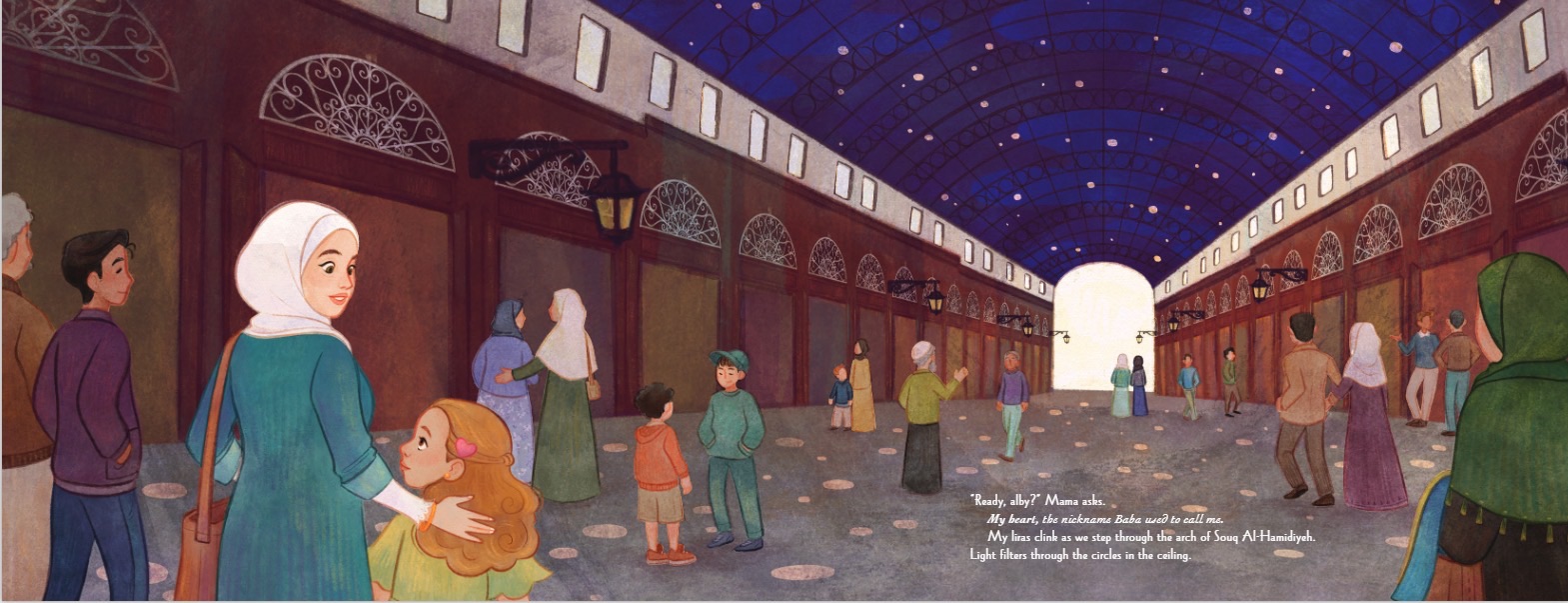
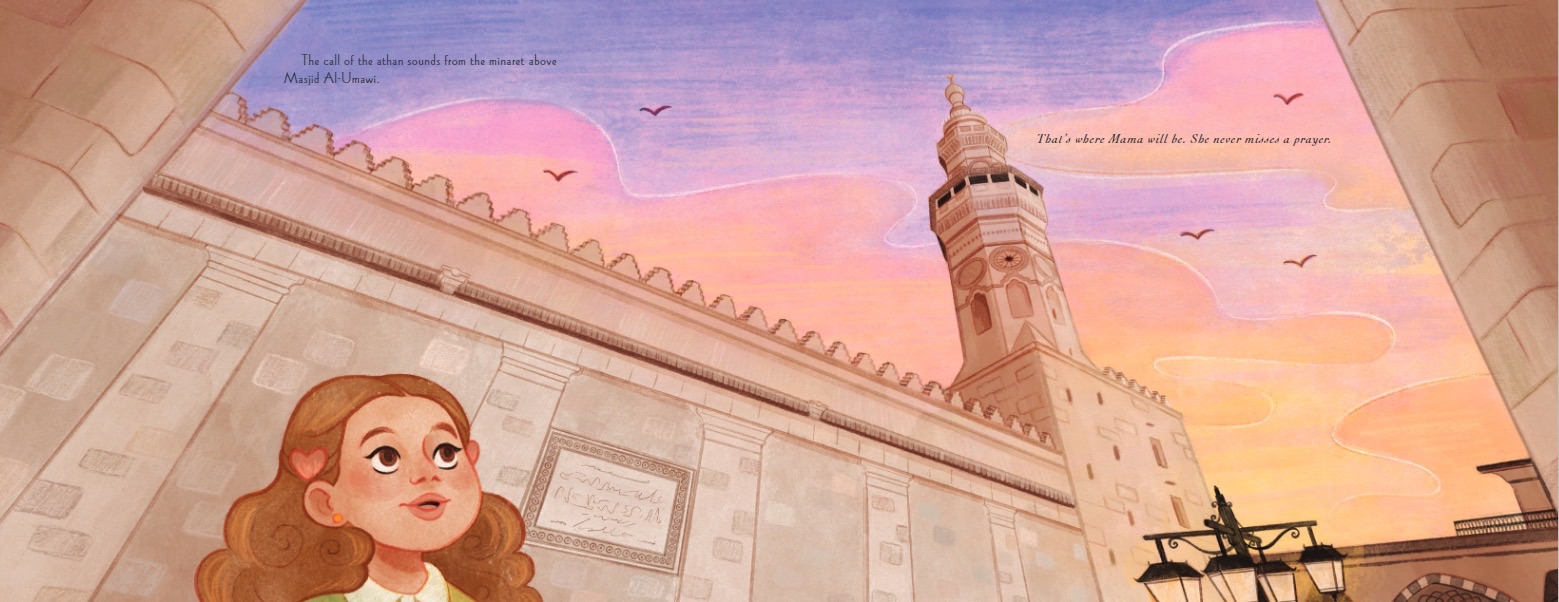
With heartfelt words and large two-page spread illustrations, this beautiful book shares a mother and daughter finding the perfect Eid gift for one another while bringing the reader into the Souq Al-Hamidiyeh, before sending them off to Masjid Al-Umawi for a warm hug.  A retelling of the classic, A Gift of the Magi, the story poignantly presents threads of love, gifts, loss, and Eid to fill the reader with joy, peace, and gratitude.  I’m admittedly very bias, as a close friend of the author, but this beautiful book doesn’t need lip service or marketing, it will appeal to all readers in all settings, and be cherished and asked for, over and over again, all throughout the year. Alhumdulillah.

The book starts with Yasmine and her mama entering the souq through the archway, and Yasmine remembering her father and her imagining the circles in the ceiling to be twinkling stars.  He is no longer with them, the magic is gone and money is tight now, but with liras jingling in her pocket, Yasmine is determined to find an Eid gift for her mother that will make her smile.

Yasmine looks around the shops as her mother counts out liras to buy za’atar, and tries to find something cheaper than sfeeha at the bakery.  She finally knows what to get her mother, but it is more lira than she has.  With determination and selflessness she makes a decision to get her mama the perfect gift.

The process separates the two, and when they reunite at the masjid for maghrib salat, it isn’t the gifts themselves, but rather what they mean, that make the laughter, tears, and love overflow.

I love the emotional depth the book conveys so deftly, never explaining or pulling the reader out of the story, thus allowing the connection to linger long after the book is closed, a rare treat in a picture book.

The Boldest White: A Story of Hijab and Community by Ibtikhaj Muhammad and S.K. Ali illustrated by Hatem Aly

Standard
The Boldest White: A Story of Hijab and Community by Ibtikhaj Muhammad and S.K. Ali illustrated by Hatem Aly

The third and final book in the standalone series is finally out and I absolutely love that Islam, salat, and the masjid are front and center. Faizah is once again brought to life through the incredible illustrations that provide all the emotional beats and make the book memorable.  The story though is only just ok, to be honest, it is clunky and disjointed.  I have read the book a half a dozen times to myself and twice aloud and I do not understand the Eid story line.  I doesn’t fit the themes of fitting in, being a leader, being bold, it just seemed to be there to motivate a white hijab being purchased, and it was very distracting to the cadence and continuity of the story. Every time Faizah is self reflecting on her fear, suddenly a conversation about Eid with a friend named Sophie disrupts the story. Even the refrain that “Bravery grows in your mind.  But its roots are in your heart,” sounds lovely, but is never explained or developed, so what are you to water it with? What are the right reasons?  I’m sure most will be fine with the concepts and presentation and not be bothered, but this book is an auto buy for Muslims and non Muslims alike, and while I appreciate the packaging, I wish the story itself was more, well “Bold.”

The book starts with Faizah going to Jummah with her mom and sister, and loving being part of the crowd, she then goes to fencing and loves being part of the crowd, “it feels right.  I feel right,” she says.  But then the coach calls her name and she starts to worry.  She doesn’t like when people stare at her, she worries she did something wrong. The coach has already reminded her to “saber first, then move forward,” so I’m not sure why she worries after if she did something wrong, it is a class, reminders and corrections are what happen in a class.

Then on Sunday, the trio is back at the masjid for salat before Asiya’s fencing lesson.  The coach asks Faizah if she wants to come in for extra practice before the tournament.  Faizah isn’t planning on participating in the tournament though and would rather think about Eid.  Thinking about getting together in the future with Sophie to pick out Eid clothes, is more fun than fencing.  The reader doesn’t know when Eid is, or why Faizah seemed to break into a day dream when asked about fencing.  Furthermore the reader doesn’t feel the worry of being in a competition because Faizah is not shown to be worried.

Later that night Asiya teaches Faizah the moves she learned and Faizah practices alone.  There is then a two page spread that I do not understand, on one page she is saying, “When no one is watching, I ‘m the best fencer in the world,” three lines later it says Even when others are watching, I can do it.  I can be the best.”  What happened in between? I get the following line, “but it’s hard to be my best when I have to stand out to do it,” but the the line in the middle makes no sense.  What is the point of the book if she can do it and knows it at the mid point?  And no, I’m not reading an arc, I checked out this copy from the library.

The family is back at the masjid on Friday and reassuring Faizah as they head to fencing, that she can do it even when people are watching, that bravery will come.  She hasn’t been nervous at class before, and hasn’t signed up for the tournament, so why is she suddenly uncomfortable, when at the start she loved fencing class as she felt she fit in.

Then it is Saturday, and Sophie finally comes, but not to prepare for Eid, just to discuss, how they will prepare for Eid.  At least now we know it will be next week. The next Friday, I know I feel like a calendar should have been included, it is fencing class again and Faizah is called up to demonstrate.  She finds her strength and she is shy, but realizes they are not just looking at her, but looking at what she can do.  She is leading, she is helping, she is being brave.

Finally it is Sunday, and Sophie and Faizah are at the hijab shop, and Faizah picks a white hijab because it matches the fencing clothes, and she is going to the tournament.

Yeah, sorry I spoiled it, I just really am sad that the book wasn’t as great as it could have been.  It connected the dots eventually, but not in a memorable way, and for the team responsible for this book, it really could and should have been amazing.

The Story of Hajj and Eid Al-Adha by Humera Malik illstrated by Basmah Syadza

Standard
The Story of Hajj and Eid Al-Adha by Humera Malik illstrated by Basmah Syadza

img_5367-1

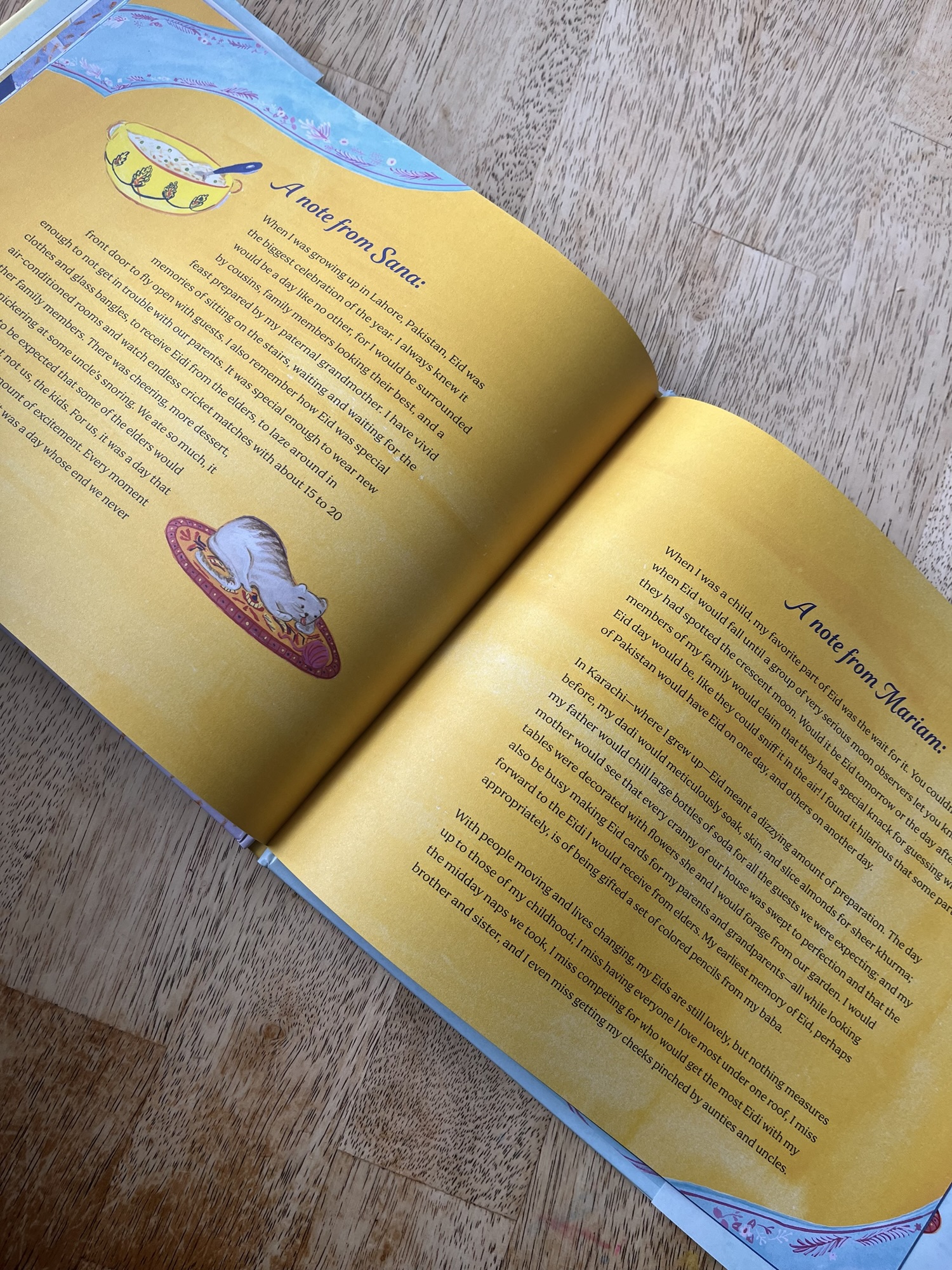
This early chapter book discusses some of the key parts of Hajj and Eid al-Adha in a fictionalized manner.  A young girl, Sumayyah, spending the weekend with her grandparents finds an old photo album of their trip to Hajj, and bed time, walks to the park, and baking muffins, all provide great opportunities for grandma and grandpa to share their experience, the Islamic concepts, and the historical roots of this pillar of Islam.  The book is presented in a gentle way with concepts explained in broad terms, some related to experiences Sumayyah can relate to, and kept light and age appropriate.  The book is not particularly detailed, or even as informative as many picture books, but allows early independent readers to emerge themselves in the story, pick up on familiar and new facts, and hopefully gain a bit of an overview about Hajj and Eid al Adha.  Their isn’t a plot, it is characters and their dialogue providing a framing for the concepts to be shared.  The illustrations are sweet and make it accessible to the target audience, and while the author’s note acknowledges that further information can and should be sought from people of knowledge.  I really wish this book would have sources or a scholars approval, or where to go for more information.  Overall, a good book for our kids, and an easy read that they will benefit from, alhumdulillah.

The book starts with establishing the characters, the photo album, and the curiosity surrounding it all.  There are nine chapters in the book: The Photo Album, Prophet Ibrahim, Ihram, Tawaf, Sayy, Mina, Arafah, Muzdalifah, and The Ka’bah.  The titles really outline the book and what it covers.  The rituals are explained and the historical concept given and often linked to something Sumayyah and her grandparents are doing.  For example, Sumayyah is inspired by Hajarah’s bravery running between As-Safah and Al-Marwah and uses that to fuel her determination to tackle the zip line at the park.

I enjoyed the approach to the content, it doesn’t just list everything as steps or facts.  The history, the acts of hajj, blend together to make it read like a story, even with the predictable framing of teaching the character to teach the reader.  My 8 year old knows a lot of the facts and details, but could chat about them a bit more after reading this book, alhumdulillah.